Collective Intelligence Meets the Political Agenda: 
Enhancing Election Debates to Foster Viewers' Engagement 
edv-project.net 
Brian Plüss 
Anna De Liddo 
Simon Buckingham Shum
Simon Buckingham Shum 
Professor 
Learning Informatics 
Anna De Liddo 
Research Associate 
Collective Intelligence 
Paul Wilson 
Lecturer 
Design 
Brian Plüss 
Research Associate 
Debate Analytics 
Giles Moss 
Lecturer 
Media Policy 
Stephen Coleman 
Professor 
Political Communication
Leeds & OU research 
on the 2010 Election Debates
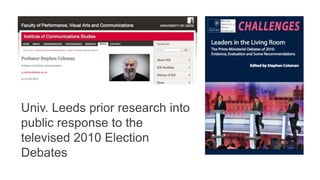
Univ. Leeds prior research into 
public response to the 
televised 2010 Election 
Debates
Impact of the 3 debates on 
voter intentions
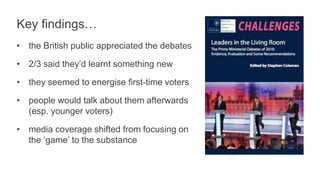
Key findings… 
• the British public appreciated the debates 
• 2/3 said they’d learnt something new 
• they seemed to energise first-time voters 
• people would talk about them afterwards 
(esp. younger voters) 
• media coverage shifted from focusing on 
the ‘game’ to the substance
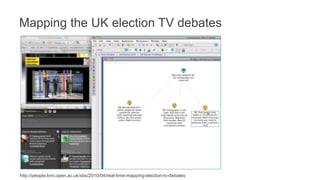
Mapping the UK election TV debates 
http://people.kmi.open.ac.uk/sbs/2010/04/real-time-mapping-election-tv-debates
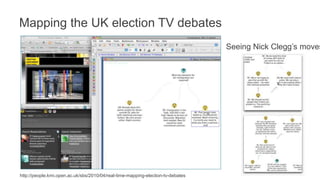
Mapping the UK election TV debates 
http://people.kmi.open.ac.uk/sbs/2010/04/real-time-mapping-election-tv-debates 
Seeing Nick Clegg’s moves
The EDV Project 
2013-2016
Focus groups motivate a set of 
‘democratic entitlements’ 
• Ability to scrutinise the communicational strategies 
adopted by the speakers, e.g. to detect intentional 
confusion & manipulation 
• Understand the meaning, background and 
historical record of political claims 
• Connect disparate arguments and claims with a 
view to understanding their ramifications, esp. 
negative 
• Have a sense of involvement, presence and 
voice, including telling their stories
The debate-viewing 
experience today
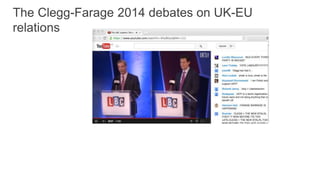
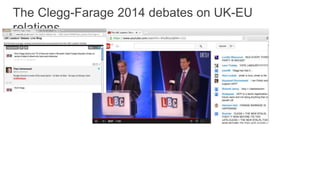
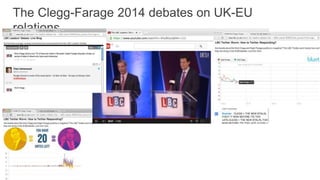
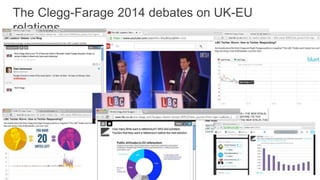
The Clegg-Farage 2014 debates on UK-EU relations 
LBC Radio, 26 March BBC, 2 April
The Clegg-Farage 2014 debates on UK-EU 
relations
The Clegg-Farage 2014 debates on UK-EU 
relations
The Clegg-Farage 2014 debates on UK-EU 
relations
The Clegg-Farage 2014 debates on UK-EU 
relations
The Clegg-Farage 2014 debates on UK-EU 
relations
The Clegg-Farage 2014 debates on UK-EU 
relations
Fact-checking 
Full Fact (@FullFact) 
Independent fact checking organisation 
• https://fullfact.org/ 
• Knowledge base 
• Live fact-checking 
• …
BBC Live site
The Future of 
Election Debate Replays
Replay 
Platform
Debate Analytics and 
Visualisations 
• Argument Maps 
• Rhetoric and Rules of the Game 
Collaborations might make possible: 
• Social Media Analytics 
• Fact-Checking 
• Topic Analysis
Argument Mapping and 
Visualisation 
http://compendiuminstitute.net
Collaborative 
Knowledge 
Production 
Collaborative Web 
Annotation and 
Knowledge 
mapping 
Structured Online 
Discussion and 
Argumentation 
Social Network 
Analysis and 
Visualization 
Advanced Analytics for: 
Attention mediation & 
Deliberation diagnostic 
http://catalyst-fp7.eu 
Collective Argument Mapping and 
Visualisation 
Collective intelligence 
for social innovation
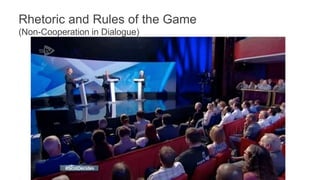
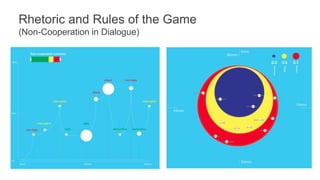
Rhetoric and Rules of the Game 
(Non-Cooperation in Dialogue)
Rhetoric and Rules of the Game 
(Non-Cooperation in Dialogue)
Rhetoric and Rules of the Game 
(Non-Cooperation in Dialogue) 
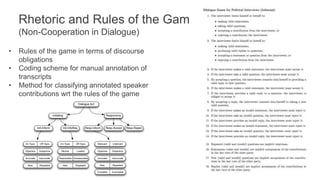
• Rules of the game in terms of discourse 
obligations 
• Coding scheme for manual annotation of 
transcripts 
• Method for classifying annotated speaker 
contributions wrt the rules of the game
Rhetoric and Rules of the Game 
(Non-Cooperation in Dialogue) 
• Rules of the game in terms of discourse 
Dialogue Act 
Initiating Responsive 
Init-Inform Init-InfoReq Resp-Inform Resp-Accept Resp-Reject 
On-Topic Off-Topic 
Objective Subjective 
Accurate Inaccurate 
New Repeated 
On-Topic Off-Topic 
Neutral Loaded 
Reasonable Unreasonable 
New Repeated 
Relevant Irrelevant 
Objective Subjective 
Accurate Inaccurate 
New Repeated 
Complete Incomplete 
obligations 
• Coding scheme for manual annotation of 
transcripts 
• Method for classifying annotated speaker 
contributions wrt the rules of the game
Rhetoric and Rules of the Game 
(Non-Cooperation in Dialogue) 
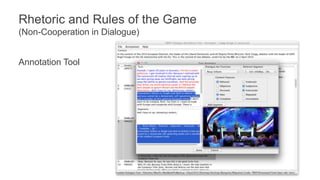
Annotation Tool
Rhetoric and Rules of the Game 
(Non-Cooperation in Dialogue) 
• Rules of the game in terms of discourse 
Dialogue Act 
Initiating Responsive 
Init-Inform Init-InfoReq Resp-Inform Resp-Accept Resp-Reject 
On-Topic Off-Topic 
Objective Subjective 
Accurate Inaccurate 
New Repeated 
On-Topic Off-Topic 
Neutral Loaded 
Reasonable Unreasonable 
New Repeated 
Relevant Irrelevant 
Objective Subjective 
Accurate Inaccurate 
New Repeated 
Complete Incomplete 
obligations 
• Coding scheme for manual annotation of 
transcripts 
• Method for classifying annotated speaker 
contributions wrt the rules of the game
Rhetoric and Rules of the Game 
(Non-Cooperation in Dialogue)
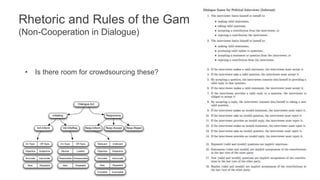
Rhetoric and Rules of the Game 
(Non-Cooperation in Dialogue) 
• Is there room for crowdsourcing these? 
Dialogue Act 
Initiating Responsive 
Init-Inform Init-InfoReq Resp-Inform Resp-Accept Resp-Reject 
On-Topic Off-Topic 
Objective Subjective 
Accurate Inaccurate 
New Repeated 
On-Topic Off-Topic 
Neutral Loaded 
Reasonable Unreasonable 
New Repeated 
Relevant Irrelevant 
Objective Subjective 
Accurate Inaccurate 
New Repeated 
Complete Incomplete
Citizen Voice Channels 
• Viewer Feedback 
And later perhaps… 
• Crowdsourced Fact-Checking 
• Life stories
Citizen Voice Channels 
• Viewer Feedback 
And later perhaps… 
• Crowdsourced Fact-Checking 
• Life stories 
• Everything?
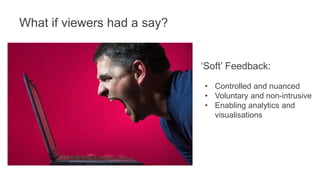
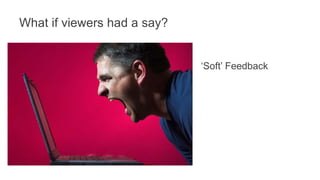
What if viewers had a say?
What if viewers had a say? 
‘Soft’ Feedback
What if viewers had a say? 
‘Soft’ Feedback: 
• Controlled and nuanced 
• Voluntary and non-intrusive 
• Enabling analytics and 
visualisations
What if viewers had a say? 
‘Soft’ Feedback: 
• Controlled and nuanced 
• Voluntary and non-intrusive 
• Enabling analytics and 
visualisations
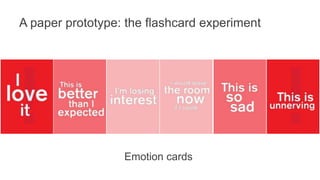
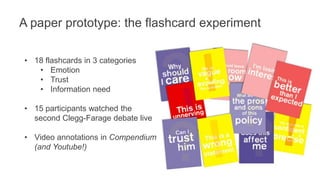
A paper prototype: the flashcard experiment 
• 18 flashcards in 3 categories 
• Emotion 
• Trust 
• Information need 
• 15 participants watched the 
second Clegg-Farage debate live 
• Video annotations in Compendium 
(and Youtube!)
A paper prototype: the flashcard experiment 
Emotion cards
A paper prototype: the flashcard experiment 
Trust cards
A paper prototype: the flashcard experiment 
Information need cards
A paper prototype: the flashcard experiment 
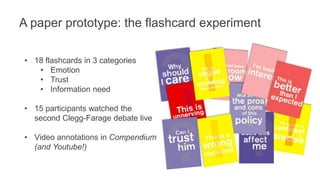
• 18 flashcards in 3 categories 
• Emotion 
• Trust 
• Information need 
• 15 participants watched the 
second Clegg-Farage debate live 
• Video annotations in Compendium 
(and Youtube!)
A paper prototype: the flashcard experiment
A paper prototype: the flashcard experiment 
• 18 flashcards in 3 categories 
• Emotion 
• Trust 
• Information need 
• 15 participants watched the 
second Clegg-Farage debate live 
• Video annotations in Compendium 
(and Youtube!)
A paper prototype: the flashcard experiment 
Compendium Annotations 
• Video mapping with modifications 
• Annotations exported as XML, 
CSV, etc. for analysis 
• Youtube export for dissemination 
• Replay of annotated videos
A paper prototype: the flashcard experiment 
Qualtitative analysis: 
• Engagement with the cards 
• Ease of use 
• Peer pressure 
Quantitative analysis: 
• Most/least frequently used cards 
• Most/least frequently used categories 
• Comparison with other feedback 
elicitation methods
A paper prototype: the flashcard experiment 
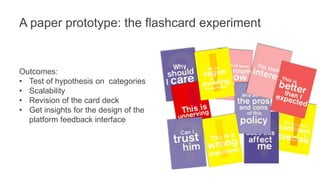
Outcomes: 
• Test of hypothesis on categories 
• Scalability 
• Revision of the card deck 
• Get insights for the design of the 
platform feedback interface
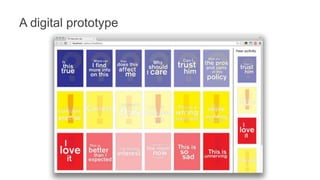
A digital prototype
Debate Replay Platform 
• Uniformly organise diverse sources 
of information 
• Support user preferences in terms 
of: 
• Visualisation channels 
• Media navigation and indexing 
• Allow for different kinds of audience 
response
EDV 
Replay 
Platform
Arguments Fact checking 
Generation of: 
- Web content 
- Analytics 
- Open data 
- ... 
Repository 
Replay Website 
GO! 
Argument Mapping 
Open 
Data 
Video Transcripts 
Twitter 
Feeds 
Soft 
Feedback 
System 
Rhetoric and 
Rules Checking 
Debate 
Rules 
Non-Cooperation Topics 
Open Data 
Sentiment 
Analysis 
Party 
Manifestos 
Topic Analysis 
Soft Feedback 
Analysis 
Fact-Checking 
Soft Feedback 
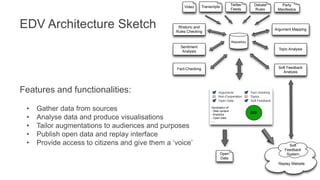
EDV Architecture Sketch 
Features and functionalities: 
• Gather data from sources 
• Analyse data and produce visualisations 
• Tailor augmentations to audiences and purposes 
• Publish open data and replay interface 
• Provide access to citizens and give them a ‘voice’
Thanks for your time! 
Brian Plüss 
Anna De Liddo 
Simon Buckingham Shum 
Knowledge Media Institute 
The Open University, UK 
http://edv-project.net/

Collective Intelligence Meets the Political Agenda

  • 1.
    Collective Intelligence Meetsthe Political Agenda: Enhancing Election Debates to Foster Viewers' Engagement edv-project.net Brian Plüss Anna De Liddo Simon Buckingham Shum
  • 2.
    Simon Buckingham Shum Professor Learning Informatics Anna De Liddo Research Associate Collective Intelligence Paul Wilson Lecturer Design Brian Plüss Research Associate Debate Analytics Giles Moss Lecturer Media Policy Stephen Coleman Professor Political Communication
  • 3.
    Leeds & OUresearch on the 2010 Election Debates
  • 4.
    Univ. Leeds priorresearch into public response to the televised 2010 Election Debates
  • 5.
    Impact of the3 debates on voter intentions
  • 6.
    Key findings… •the British public appreciated the debates • 2/3 said they’d learnt something new • they seemed to energise first-time voters • people would talk about them afterwards (esp. younger voters) • media coverage shifted from focusing on the ‘game’ to the substance
  • 7.
    Mapping the UKelection TV debates http://people.kmi.open.ac.uk/sbs/2010/04/real-time-mapping-election-tv-debates
  • 8.
    Mapping the UKelection TV debates http://people.kmi.open.ac.uk/sbs/2010/04/real-time-mapping-election-tv-debates Seeing Nick Clegg’s moves
  • 9.
    The EDV Project 2013-2016
  • 10.
    Focus groups motivatea set of ‘democratic entitlements’ • Ability to scrutinise the communicational strategies adopted by the speakers, e.g. to detect intentional confusion & manipulation • Understand the meaning, background and historical record of political claims • Connect disparate arguments and claims with a view to understanding their ramifications, esp. negative • Have a sense of involvement, presence and voice, including telling their stories
  • 11.
  • 12.
    The Clegg-Farage 2014debates on UK-EU relations LBC Radio, 26 March BBC, 2 April
  • 13.
    The Clegg-Farage 2014debates on UK-EU relations
  • 14.
    The Clegg-Farage 2014debates on UK-EU relations
  • 15.
    The Clegg-Farage 2014debates on UK-EU relations
  • 16.
    The Clegg-Farage 2014debates on UK-EU relations
  • 17.
    The Clegg-Farage 2014debates on UK-EU relations
  • 18.
    The Clegg-Farage 2014debates on UK-EU relations
  • 19.
    Fact-checking Full Fact(@FullFact) Independent fact checking organisation • https://fullfact.org/ • Knowledge base • Live fact-checking • …
  • 20.
  • 21.
    The Future of Election Debate Replays
  • 23.
  • 24.
    Debate Analytics and Visualisations • Argument Maps • Rhetoric and Rules of the Game Collaborations might make possible: • Social Media Analytics • Fact-Checking • Topic Analysis
  • 25.
    Argument Mapping and Visualisation http://compendiuminstitute.net
  • 27.
    Collaborative Knowledge Production Collaborative Web Annotation and Knowledge mapping Structured Online Discussion and Argumentation Social Network Analysis and Visualization Advanced Analytics for: Attention mediation & Deliberation diagnostic http://catalyst-fp7.eu Collective Argument Mapping and Visualisation Collective intelligence for social innovation
  • 28.
    Rhetoric and Rulesof the Game (Non-Cooperation in Dialogue)
  • 29.
    Rhetoric and Rulesof the Game (Non-Cooperation in Dialogue)
  • 30.
    Rhetoric and Rulesof the Game (Non-Cooperation in Dialogue) • Rules of the game in terms of discourse obligations • Coding scheme for manual annotation of transcripts • Method for classifying annotated speaker contributions wrt the rules of the game
  • 31.
    Rhetoric and Rulesof the Game (Non-Cooperation in Dialogue) • Rules of the game in terms of discourse Dialogue Act Initiating Responsive Init-Inform Init-InfoReq Resp-Inform Resp-Accept Resp-Reject On-Topic Off-Topic Objective Subjective Accurate Inaccurate New Repeated On-Topic Off-Topic Neutral Loaded Reasonable Unreasonable New Repeated Relevant Irrelevant Objective Subjective Accurate Inaccurate New Repeated Complete Incomplete obligations • Coding scheme for manual annotation of transcripts • Method for classifying annotated speaker contributions wrt the rules of the game
  • 32.
    Rhetoric and Rulesof the Game (Non-Cooperation in Dialogue) Annotation Tool
  • 33.
    Rhetoric and Rulesof the Game (Non-Cooperation in Dialogue) • Rules of the game in terms of discourse Dialogue Act Initiating Responsive Init-Inform Init-InfoReq Resp-Inform Resp-Accept Resp-Reject On-Topic Off-Topic Objective Subjective Accurate Inaccurate New Repeated On-Topic Off-Topic Neutral Loaded Reasonable Unreasonable New Repeated Relevant Irrelevant Objective Subjective Accurate Inaccurate New Repeated Complete Incomplete obligations • Coding scheme for manual annotation of transcripts • Method for classifying annotated speaker contributions wrt the rules of the game
  • 34.
    Rhetoric and Rulesof the Game (Non-Cooperation in Dialogue)
  • 35.
    Rhetoric and Rulesof the Game (Non-Cooperation in Dialogue) • Is there room for crowdsourcing these? Dialogue Act Initiating Responsive Init-Inform Init-InfoReq Resp-Inform Resp-Accept Resp-Reject On-Topic Off-Topic Objective Subjective Accurate Inaccurate New Repeated On-Topic Off-Topic Neutral Loaded Reasonable Unreasonable New Repeated Relevant Irrelevant Objective Subjective Accurate Inaccurate New Repeated Complete Incomplete
  • 36.
    Citizen Voice Channels • Viewer Feedback And later perhaps… • Crowdsourced Fact-Checking • Life stories
  • 37.
    Citizen Voice Channels • Viewer Feedback And later perhaps… • Crowdsourced Fact-Checking • Life stories • Everything?
  • 38.
    What if viewershad a say?
  • 39.
    What if viewershad a say? ‘Soft’ Feedback
  • 40.
    What if viewershad a say? ‘Soft’ Feedback: • Controlled and nuanced • Voluntary and non-intrusive • Enabling analytics and visualisations
  • 41.
    What if viewershad a say? ‘Soft’ Feedback: • Controlled and nuanced • Voluntary and non-intrusive • Enabling analytics and visualisations
  • 42.
    A paper prototype:the flashcard experiment • 18 flashcards in 3 categories • Emotion • Trust • Information need • 15 participants watched the second Clegg-Farage debate live • Video annotations in Compendium (and Youtube!)
  • 43.
    A paper prototype:the flashcard experiment Emotion cards
  • 44.
    A paper prototype:the flashcard experiment Trust cards
  • 45.
    A paper prototype:the flashcard experiment Information need cards
  • 46.
    A paper prototype:the flashcard experiment • 18 flashcards in 3 categories • Emotion • Trust • Information need • 15 participants watched the second Clegg-Farage debate live • Video annotations in Compendium (and Youtube!)
  • 47.
    A paper prototype:the flashcard experiment
  • 48.
    A paper prototype:the flashcard experiment • 18 flashcards in 3 categories • Emotion • Trust • Information need • 15 participants watched the second Clegg-Farage debate live • Video annotations in Compendium (and Youtube!)
  • 49.
    A paper prototype:the flashcard experiment Compendium Annotations • Video mapping with modifications • Annotations exported as XML, CSV, etc. for analysis • Youtube export for dissemination • Replay of annotated videos
  • 50.
    A paper prototype:the flashcard experiment Qualtitative analysis: • Engagement with the cards • Ease of use • Peer pressure Quantitative analysis: • Most/least frequently used cards • Most/least frequently used categories • Comparison with other feedback elicitation methods
  • 51.
    A paper prototype:the flashcard experiment Outcomes: • Test of hypothesis on categories • Scalability • Revision of the card deck • Get insights for the design of the platform feedback interface
  • 52.
  • 53.
    Debate Replay Platform • Uniformly organise diverse sources of information • Support user preferences in terms of: • Visualisation channels • Media navigation and indexing • Allow for different kinds of audience response
  • 54.
  • 55.
    Arguments Fact checking Generation of: - Web content - Analytics - Open data - ... Repository Replay Website GO! Argument Mapping Open Data Video Transcripts Twitter Feeds Soft Feedback System Rhetoric and Rules Checking Debate Rules Non-Cooperation Topics Open Data Sentiment Analysis Party Manifestos Topic Analysis Soft Feedback Analysis Fact-Checking Soft Feedback EDV Architecture Sketch Features and functionalities: • Gather data from sources • Analyse data and produce visualisations • Tailor augmentations to audiences and purposes • Publish open data and replay interface • Provide access to citizens and give them a ‘voice’
  • 56.
    Thanks for yourtime! Brian Plüss Anna De Liddo Simon Buckingham Shum Knowledge Media Institute The Open University, UK http://edv-project.net/