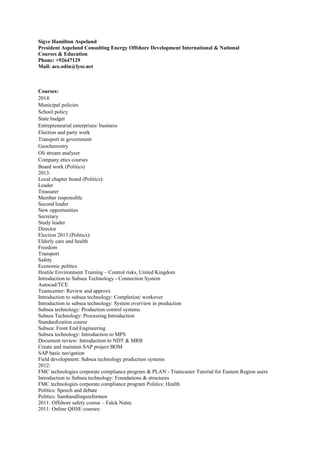
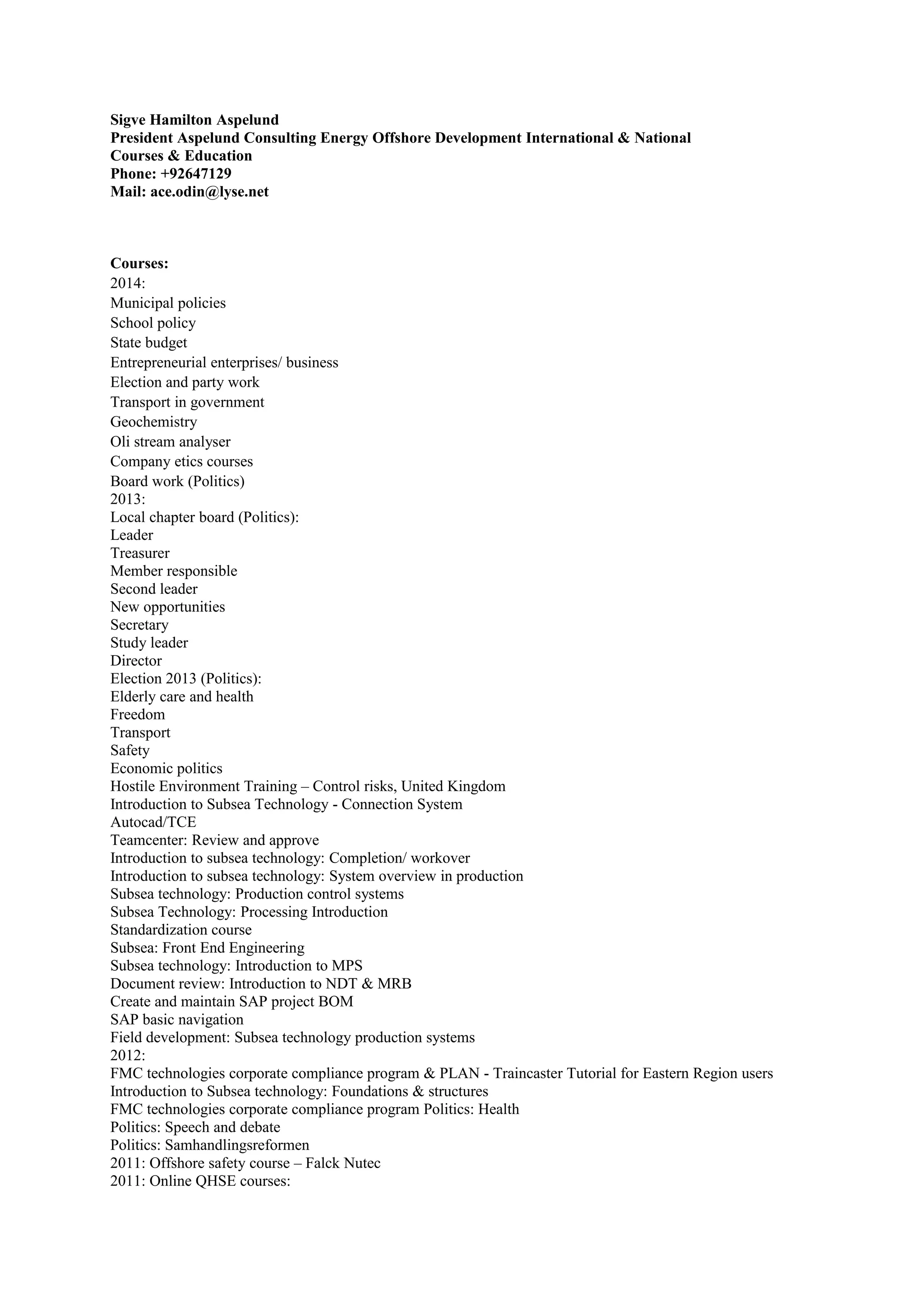
Sigve Hamilton Aspelund 
President Aspelund Consulting Energy Offshore Development International & National 
Courses & Education 
Phone: +92647129 
Mail: ace.odin@lyse.net 
Courses: 
2014: 
Municipal policies 
School policy 
State budget 
Entrepreneurial enterprises/ business 
Election and party work 
Transport in government 
Geochemistry 
Oli stream analyser 
Company etics courses 
Board work (Politics) 
2013: 
Local chapter board (Politics): 
Leader 
Treasurer 
Member responsible 
Second leader 
New opportunities 
Secretary 
Study leader 
Director 
Election 2013 (Politics): 
Elderly care and health 
Freedom 
Transport 
Safety 
Economic politics 
Hostile Environment Training – Control risks, United Kingdom 
Introduction to Subsea Technology - Connection System 
Autocad/TCE 
Teamcenter: Review and approve 
Introduction to subsea technology: Completion/ workover 
Introduction to subsea technology: System overview in production 
Subsea technology: Production control systems 
Subsea Technology: Processing Introduction 
Standardization course 
Subsea: Front End Engineering 
Subsea technology: Introduction to MPS 
Document review: Introduction to NDT & MRB 
Create and maintain SAP project BOM 
SAP basic navigation 
Field development: Subsea technology production systems 
2012: 
FMC technologies corporate compliance program & PLAN - Traincaster Tutorial for Eastern Region users 
Introduction to Subsea technology: Foundations & structures 
FMC technologies corporate compliance program Politics: Health 
Politics: Speech and debate 
Politics: Samhandlingsreformen 
2011: Offshore safety course – Falck Nutec 
2011: Online QHSE courses:
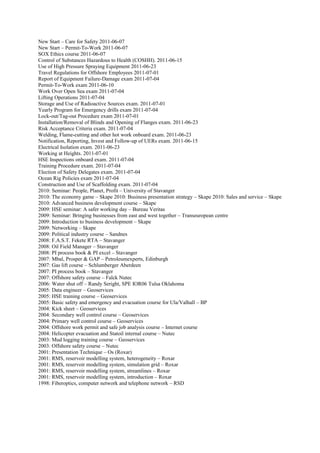
New Start – Care for Safety 2011-06-07 
New Start – Permit-To-Work 2011-06-07 
SOX Ethics course 2011-06-07 
Control of Substances Hazardous to Health (COSHH). 2011-06-15 
Use of High Pressure Spraying Equipment 2011-06-23 
Travel Regulations for Offshore Employees 2011-07-01 
Report of Equipment Failure-Damage exam 2011-07-04 
Permit-To-Work exam 2011-06-10 
Work Over Open Sea exam 2011-07-04 
Lifting Operations 2011-07-04 
Storage and Use of Radioactive Sources exam. 2011-07-01 
Yearly Program for Emergency drills exam 2011-07-04 
Lock-out/Tag-out Procedure exam 2011-07-01 
Installation/Removal of Blinds and Opening of Flanges exam. 2011-06-23 
Risk Acceptance Criteria exam. 2011-07-04 
Welding, Flame-cutting and other hot work onboard exam. 2011-06-23 
Notification, Reporting, Invest and Follow-up of UERs exam. 2011-06-15 
Electrical Isolation exam. 2011-06-23 
Working at Heights. 2011-07-01 
HSE Inspections onboard exam. 2011-07-04 
Training Procedure exam. 2011-07-04 
Election of Safety Delegates exam. 2011-07-04 
Ocean Rig Policies exam 2011-07-04 
Construction and Use of Scaffolding exam. 2011-07-04 
2010: Seminar: People, Planet, Profit – University of Stavanger 
2010: The economy game – Skape 2010: Business presentation strategy – Skape 2010: Sales and service – Skape 
2010: Advanced business development course – Skape 
2009: HSE seminar: A safer working day – Bureau Veritas 
2009: Seminar: Bringing businesses from east and west together – Transeuropean centre 
2009: Introduction to business development – Skape 
2009: Networking – Skape 
2009: Political industry course – Sandnes 
2008: F.A.S.T. Fekete RTA – Stavanger 
2008: Oil Field Manager – Stavanger 
2008: PI process book & PI excel – Stavanger 
2007: Mbal, Prosper & GAP – Petroleumexperts, Edinburgh 
2007: Gas lift course – Schlumberger Aberdeen 
2007: PI process book – Stavanger 
2007: Offshore safety course – Falck Nutec 
2006: Water shut off – Randy Seright, SPE IOR06 Tulsa Oklahoma 
2005: Data engineer – Geoservices 
2005: HSE training course – Geoservices 
2005: Basic safety and emergency and evacuation course for Ula/Valhall – BP 
2004: Kick sheet – Geoservices 
2004: Secondary well control course – Geoservices 
2004: Primary well control course – Geoservices 
2004: Offshore work permit and safe job analysis course – Internet course 
2004: Helicopter evacuation and Statoil internal course – Nutec 
2003: Mud logging training course – Geoservices 
2003: Offshore safety course – Nutec 
2001: Presentation Technique – Os (Roxar) 
2001: RMS, reservoir modelling system, heterogeneity – Roxar 
2001: RMS, reservoir modelling system, simulation grid – Roxar 
2001: RMS, reservoir modelling system, streamlines – Roxar 
2001: RMS, reservoir modelling system, introduction – Roxar 
1998: Fiberoptics, computer network and telephone network – RSD
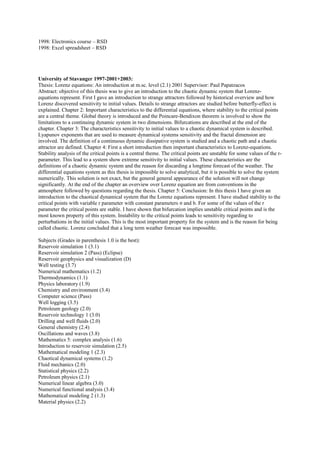
1998: Electronics course – RSD 
1998: Excel spreadsheet – RSD 
University of Stavanger 1997-2001+2003: 
Thesis: Lorenz equations: An introduction at m.sc. level (2.1) 2001 Supervisor: Paul Papatzacos 
Abstract: objective of this thesis was to give an introduction to the chaotic dynamic system that Lorenz-equations 
represent. First I gave an introduction to strange attractors followed by historical overview and how 
Lorenz discovered sensitivity to initial values. Details to strange attractors are studied before butterfly-effect is 
explained. Chapter 2: Important characteristics to the differential equations, where stability to the critical points 
are a central theme. Global theory is introduced and the Poincare-Bendixon theorem is involved to show the 
limitations to a continuing dynamic system in two dimensions. Bifurcations are described at the end of the 
chapter. Chapter 3: The characteristics sensitivity to initial values to a chaotic dynamical system is described. 
Lyapunov exponents that are used to measure dynamical systems sensitivity and the fractal dimension are 
involved. The definition of a continuous dynamic dissipative system is studied and a chaotic path and a chaotic 
attractor are defined. Chapter 4: First a short introduction then important characteristics to Lorenz-equations. 
Stability analysis of the critical points is a central theme. The critical points are unstable for some values of the r-parameter. 
This lead to a system show extreme sensitivity to initial values. These characteristics are the 
definitions of a chaotic dynamic system and the reason for discarding a longtime forecast of the weather. The 
differential equations system as this thesis is impossible to solve analytical, but it is possible to solve the system 
numerically. This solution is not exact, but the general general appearance of the solution will not change 
significantly. At the end of the chapter an overview over Lorenz equation are from conventions in the 
atmosphere followed by questions regarding the thesis. Chapter 5: Conclusion: In this thesis I have given an 
introduction to the chaotical dynamical system that the Lorenz equations represent. I have studied stability to the 
critical points with variable r parameter with constant parameters σ and b. For some of the values of the r 
parameter the critical points are stable. I have shown that bifurcation implies unstable critical points and is the 
most known property of this system. Instability to the critical points leads to sensitivity regarding to 
perturbations in the initial values. This is the most important property for the system and is the reason for being 
called chaotic. Lorenz concluded that a long term weather forecast was impossible. 
Subjects (Grades in parenthesis 1.0 is the best): 
Reservoir simulation 1 (3.1) 
Reservoir simulation 2 (Pass) (Eclipse) 
Reservoir geophysics and visualization (D) 
Well testing (3.7) 
Numerical mathematics (1.2) 
Thermodynamics (1.1) 
Physics laboratory (1.9) 
Chemistry and environment (3.4) 
Computer science (Pass) 
Well logging (3.5) 
Petroleum geology (2.0) 
Reservoir technology 1 (3.0) 
Drilling and well fluids (2.0) 
General chemistry (2.4) 
Oscillations and waves (3.8) 
Mathematics 5: complex analysis (1.6) 
Introduction to reservoir simulation (2.5) 
Mathematical modeling 1 (2.3) 
Chaotical dynamical systems (1.2) 
Fluid mechanics (2.0) 
Statistical physics (2.2) 
Petroleum physics (2.1) 
Numerical linear algebra (3.0) 
Numerical functional analysis (3.4) 
Mathematical modeling 2 (1.3) 
Material physics (2.2)
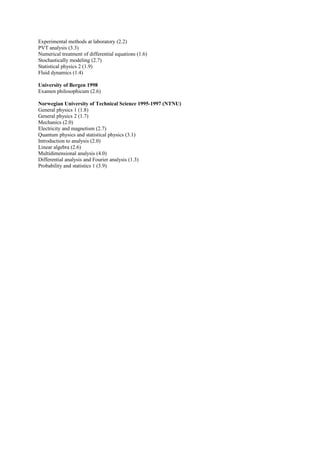
Experimental methods at laboratory (2.2) 
PVT analysis (3.3) 
Numerical treatment of differential equations (1.6) 
Stochastically modeling (2.7) 
Statistical physics 2 (1.9) 
Fluid dynamics (1.4) 
University of Bergen 1998 
Examen philosophicum (2.6) 
Norwegian University of Technical Science 1995-1997 (NTNU) 
General physics 1 (1.8) 
General physics 2 (1.7) 
Mechanics (2.0) 
Electricity and magnetism (2.7) 
Quantum physics and statistical physics (3.1) 
Introduction to analysis (2.0) 
Linear algebra (2.6) 
Multidimensional analysis (4.0) 
Differential analysis and Fourier analysis (1.3) 
Probability and statistics 1 (3.9)

Eduction and courses 2014 Sigve Hamilton Aspelund

  • 1.
    Sigve Hamilton Aspelund President Aspelund Consulting Energy Offshore Development International & National Courses & Education Phone: +92647129 Mail: ace.odin@lyse.net Courses: 2014: Municipal policies School policy State budget Entrepreneurial enterprises/ business Election and party work Transport in government Geochemistry Oli stream analyser Company etics courses Board work (Politics) 2013: Local chapter board (Politics): Leader Treasurer Member responsible Second leader New opportunities Secretary Study leader Director Election 2013 (Politics): Elderly care and health Freedom Transport Safety Economic politics Hostile Environment Training – Control risks, United Kingdom Introduction to Subsea Technology - Connection System Autocad/TCE Teamcenter: Review and approve Introduction to subsea technology: Completion/ workover Introduction to subsea technology: System overview in production Subsea technology: Production control systems Subsea Technology: Processing Introduction Standardization course Subsea: Front End Engineering Subsea technology: Introduction to MPS Document review: Introduction to NDT & MRB Create and maintain SAP project BOM SAP basic navigation Field development: Subsea technology production systems 2012: FMC technologies corporate compliance program & PLAN - Traincaster Tutorial for Eastern Region users Introduction to Subsea technology: Foundations & structures FMC technologies corporate compliance program Politics: Health Politics: Speech and debate Politics: Samhandlingsreformen 2011: Offshore safety course – Falck Nutec 2011: Online QHSE courses:
  • 2.
    New Start –Care for Safety 2011-06-07 New Start – Permit-To-Work 2011-06-07 SOX Ethics course 2011-06-07 Control of Substances Hazardous to Health (COSHH). 2011-06-15 Use of High Pressure Spraying Equipment 2011-06-23 Travel Regulations for Offshore Employees 2011-07-01 Report of Equipment Failure-Damage exam 2011-07-04 Permit-To-Work exam 2011-06-10 Work Over Open Sea exam 2011-07-04 Lifting Operations 2011-07-04 Storage and Use of Radioactive Sources exam. 2011-07-01 Yearly Program for Emergency drills exam 2011-07-04 Lock-out/Tag-out Procedure exam 2011-07-01 Installation/Removal of Blinds and Opening of Flanges exam. 2011-06-23 Risk Acceptance Criteria exam. 2011-07-04 Welding, Flame-cutting and other hot work onboard exam. 2011-06-23 Notification, Reporting, Invest and Follow-up of UERs exam. 2011-06-15 Electrical Isolation exam. 2011-06-23 Working at Heights. 2011-07-01 HSE Inspections onboard exam. 2011-07-04 Training Procedure exam. 2011-07-04 Election of Safety Delegates exam. 2011-07-04 Ocean Rig Policies exam 2011-07-04 Construction and Use of Scaffolding exam. 2011-07-04 2010: Seminar: People, Planet, Profit – University of Stavanger 2010: The economy game – Skape 2010: Business presentation strategy – Skape 2010: Sales and service – Skape 2010: Advanced business development course – Skape 2009: HSE seminar: A safer working day – Bureau Veritas 2009: Seminar: Bringing businesses from east and west together – Transeuropean centre 2009: Introduction to business development – Skape 2009: Networking – Skape 2009: Political industry course – Sandnes 2008: F.A.S.T. Fekete RTA – Stavanger 2008: Oil Field Manager – Stavanger 2008: PI process book & PI excel – Stavanger 2007: Mbal, Prosper & GAP – Petroleumexperts, Edinburgh 2007: Gas lift course – Schlumberger Aberdeen 2007: PI process book – Stavanger 2007: Offshore safety course – Falck Nutec 2006: Water shut off – Randy Seright, SPE IOR06 Tulsa Oklahoma 2005: Data engineer – Geoservices 2005: HSE training course – Geoservices 2005: Basic safety and emergency and evacuation course for Ula/Valhall – BP 2004: Kick sheet – Geoservices 2004: Secondary well control course – Geoservices 2004: Primary well control course – Geoservices 2004: Offshore work permit and safe job analysis course – Internet course 2004: Helicopter evacuation and Statoil internal course – Nutec 2003: Mud logging training course – Geoservices 2003: Offshore safety course – Nutec 2001: Presentation Technique – Os (Roxar) 2001: RMS, reservoir modelling system, heterogeneity – Roxar 2001: RMS, reservoir modelling system, simulation grid – Roxar 2001: RMS, reservoir modelling system, streamlines – Roxar 2001: RMS, reservoir modelling system, introduction – Roxar 1998: Fiberoptics, computer network and telephone network – RSD
  • 3.
    1998: Electronics course– RSD 1998: Excel spreadsheet – RSD University of Stavanger 1997-2001+2003: Thesis: Lorenz equations: An introduction at m.sc. level (2.1) 2001 Supervisor: Paul Papatzacos Abstract: objective of this thesis was to give an introduction to the chaotic dynamic system that Lorenz-equations represent. First I gave an introduction to strange attractors followed by historical overview and how Lorenz discovered sensitivity to initial values. Details to strange attractors are studied before butterfly-effect is explained. Chapter 2: Important characteristics to the differential equations, where stability to the critical points are a central theme. Global theory is introduced and the Poincare-Bendixon theorem is involved to show the limitations to a continuing dynamic system in two dimensions. Bifurcations are described at the end of the chapter. Chapter 3: The characteristics sensitivity to initial values to a chaotic dynamical system is described. Lyapunov exponents that are used to measure dynamical systems sensitivity and the fractal dimension are involved. The definition of a continuous dynamic dissipative system is studied and a chaotic path and a chaotic attractor are defined. Chapter 4: First a short introduction then important characteristics to Lorenz-equations. Stability analysis of the critical points is a central theme. The critical points are unstable for some values of the r-parameter. This lead to a system show extreme sensitivity to initial values. These characteristics are the definitions of a chaotic dynamic system and the reason for discarding a longtime forecast of the weather. The differential equations system as this thesis is impossible to solve analytical, but it is possible to solve the system numerically. This solution is not exact, but the general general appearance of the solution will not change significantly. At the end of the chapter an overview over Lorenz equation are from conventions in the atmosphere followed by questions regarding the thesis. Chapter 5: Conclusion: In this thesis I have given an introduction to the chaotical dynamical system that the Lorenz equations represent. I have studied stability to the critical points with variable r parameter with constant parameters σ and b. For some of the values of the r parameter the critical points are stable. I have shown that bifurcation implies unstable critical points and is the most known property of this system. Instability to the critical points leads to sensitivity regarding to perturbations in the initial values. This is the most important property for the system and is the reason for being called chaotic. Lorenz concluded that a long term weather forecast was impossible. Subjects (Grades in parenthesis 1.0 is the best): Reservoir simulation 1 (3.1) Reservoir simulation 2 (Pass) (Eclipse) Reservoir geophysics and visualization (D) Well testing (3.7) Numerical mathematics (1.2) Thermodynamics (1.1) Physics laboratory (1.9) Chemistry and environment (3.4) Computer science (Pass) Well logging (3.5) Petroleum geology (2.0) Reservoir technology 1 (3.0) Drilling and well fluids (2.0) General chemistry (2.4) Oscillations and waves (3.8) Mathematics 5: complex analysis (1.6) Introduction to reservoir simulation (2.5) Mathematical modeling 1 (2.3) Chaotical dynamical systems (1.2) Fluid mechanics (2.0) Statistical physics (2.2) Petroleum physics (2.1) Numerical linear algebra (3.0) Numerical functional analysis (3.4) Mathematical modeling 2 (1.3) Material physics (2.2)
  • 4.
    Experimental methods atlaboratory (2.2) PVT analysis (3.3) Numerical treatment of differential equations (1.6) Stochastically modeling (2.7) Statistical physics 2 (1.9) Fluid dynamics (1.4) University of Bergen 1998 Examen philosophicum (2.6) Norwegian University of Technical Science 1995-1997 (NTNU) General physics 1 (1.8) General physics 2 (1.7) Mechanics (2.0) Electricity and magnetism (2.7) Quantum physics and statistical physics (3.1) Introduction to analysis (2.0) Linear algebra (2.6) Multidimensional analysis (4.0) Differential analysis and Fourier analysis (1.3) Probability and statistics 1 (3.9)