EDUCATIONAL INSTITUTIONS
HISTORYOF EDUCATIONAL
INSTITUTIONS
IMPORTANCE OF EDUCATION
TYPES OF EDUCATION
FUNCTIONS OF EDUCATION IN
SOCIETY
MASLOW’S HIERARCHY OF NEEDS
PRIMARY EDUCATION AS A HUMAN
RIGHT
2.
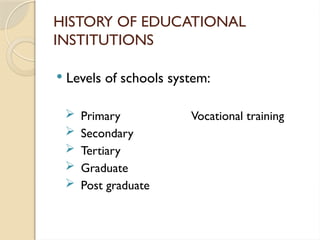
HISTORY OF EDUCATIONAL
INSTITUTIONS
Ancient Greeks – coined the word
SCHOOL to mean “leisure” in the
cultivation of the mind and propagation of
wisdom
Pre-modern societies – equate education
with its holistic and non fragmentary
nature-learning as life long and
continuous process
3.
HISTORY OF EDUCATIONAL
INSTITUTIONS
Rise of industrialism – contributes to the
compartmentalization of education
Late 19th
century – elementary education
became widespread in Europe
1930s – secondary education is common
and compulsory
4.
HISTORY OF EDUCATIONAL
INSTITUTIONS
WorldWar II – from elementary to post-
graduate schools
It is educational institutions that handle
the responsibility of teaching individuals
what it is to be a member of society, how
to live in it, and how to help it survive
IMPORTANCE OF EDUCATION
It equips people with knowledge and skills
that will position each member for a
specific place in a society
“Niche making”
7.
IMPORTANCE OF EDUCATION
It functions as a systematic, formalized
transmission of knowledge, skills, and
values.
Provide children opportunities to interact
in groups, enabling them to discover
individual differences like sexual and
gender roles, personality and preferences,
attitudes and values
8.
IMPORTANCE OF EDUCATION
Formal schooling allows people and
experiences enter into the socialization
process. In school, children learn to
interact with people beyond their family
domains.
9.
IMPORTANCE OF EDUCATION
Schooling lets children discover a new
setting of social activity in the so-called peer
group, people with common interests and
social position, who are usually the same age
Education as a social institution – the
prevalence of formal education in many
developed and even developing societies
warrants the proliferation of mass education
10.
TYPES OF EDUCATION
Formal Education
Refers to the hierarchically structured,
chronologically graded educational
system from primary school to the
university
This includes programs and institutions
for full time technical and vocational
training
11.
TYPES OF EDUCATION
Formal Education
At the end of each level, learners must
obtain certification to enter or advance
to the next level
12.
TYPES OF EDUCATION
Formal Education
Elementary education – involves
compulsory, formal education primarily
concerned with providing basic
education, and usually corresponds to a
traditional 6 grades or 7 grades, in
addition, to preschool programs
13.
TYPES OF EDUCATION
Formal Education
Elementary education – such preschool
education normally consists of
kindergarten schooling but may cover
other preparatory courses as well
14.
TYPES OF EDUCATION
Formal Education
Elementary education – at the basic
educational level, the DepEd sets
overall educational standards and
mandates standardized tests for the K
to 12 basic education system, though
private schools are generally free to
determine their own curriculum
15.
TYPES OF EDUCATION
Formal Education
Secondary education – primarily
concerns with continuing basic
education of the elementary level and
expanding it to include the learning of
employable, gainful skills, usually
corresponding to four years of JHS and
two years of SHS
16.
TYPES OF EDUCATION
Formal Education
Tertiary education – most institutions
of higher learning are regulated by the
Commission on Higher Education
(CHED)
17.
TYPES OF EDUCATION
Non-Formal Education
Refers to any organized educational
activity outside the established formal
system to provide selected types of
learning to a segment of the population
18.
TYPES OF EDUCATION
Non-Formal Education
This emerged in response to the world
crisis in education identified by Philip
H. Coombs in 1967, who argued that
formal education system has failed to
address the changing dynamics of the
environment and societies.
19.
TYPES OF EDUCATION
Non-Formal Education
The skills that are needed to foster
economic development are lacking due
to untrained labor force that is not
able to access formal education.
Non-formal education enables a
student to learn skills and knowledge
through structured learning
experiences.
20.
TYPES OF EDUCATION
Non-Formal Education
An example of non-formal education is
vocational education
Accredited private institutions offer
technical and vocational education.
Programs offered vary in duration from
a few weeks to two years
TESDA
21.
TYPES OF EDUCATION
Informal Education
It is a life-long process whereby every
individual acquires from daily
experiences, attitudes, values, facts,
skills, and knowledge or motor skill
from resources in his or her
environment
22.
TYPES OF EDUCATION
Informal Education
It offers alternative learning
opportunities for the out-of-school
youth and adults specifically those who
are 15 years old and above and unable
to avail themselves of the educational
services and programs of formal
education.
23.
TYPES OF EDUCATION
Special Education
It refers to the education of persons
who are physically, mentally,
emotionally, socially or culturally
different from so-called “normal”
individuals
They require modification of school
practices to develop their potential.
24.
TYPES OF EDUCATION
Special Education
It provides distinct services, curricula,
and instructional materials geared to
pupils or students who are significantly
higher or lower than the average or
norm.
25.
FUNCTIONS OF EDUCATIONIN
SOCIETY
Productive Citizenry
Education systems enable citizens to be
productive members of a society, as
they are equipped with knowledge and
skills that could contribute to the
development of their society’s systems
and institutions
26.
FUNCTIONS OF EDUCATIONIN
SOCIETY
Productive Citizenry
This highlights the importance of
formal and non-formal education in the
development of oneself and the society.
Consequentially, it is crucial for
educational systems to adapt to the
changing demands of the environment
to efficiently capacitate individuals.
27.
FUNCTIONS OF EDUCATIONIN
SOCIETY
Productive Citizenry
Being a productive citizen requires
critical thinking. One must have the
ability to understand his or her duties
and be able to respond to them by
making decisions.
Through education, individuals are
introduced to concepts concerning
democracy, power, inequality, and the like.
28.
FUNCTIONS OF EDUCATIONIN
SOCIETY
Productive Citizenry
This promotes greater awareness in his
or her society. It encourages vigilance
and participation.
Educational attainment does not only
contribute to the individual’s success
but also to the betterment of his or
her environment.
29.
FUNCTIONS OF EDUCATIONIN
SOCIETY
Self-Actualization
Education develops one’s sense of self.
As a huge part of the discovery
process of oneself, education
encourages having the vision to
become self-actualized.
30.
FUNCTIONS OF EDUCATIONIN
SOCIETY
Self-Actualization
(Maslow) Self-actualization is the
highest form of human need.This is to
become more and more what one
is, to become everything that one
is capable of becoming.
31.
FUNCTIONS OF EDUCATIONIN
SOCIETY
Self-Actualization
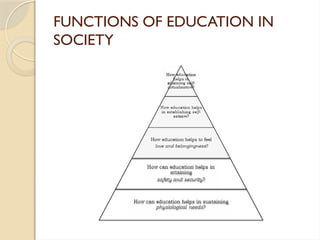
The concept of Maslow’s hierarchy of
needs is once that level is fulfilled, the
next level up is what motivates us, and
so on.
MASLOW’S HIERARCHY OFNEEDS
Physiological needs – these are biological
requirements for human survival, e.g. air,
food, drink, shelter, clothing, warmth, sex,
sleep. If these needs are not satisfied, the
human body cannot function optimally.
Safety needs – protection from elements,
security, order, law, stability, freedom from
fear
34.
MASLOW’S HIERARCHY OFNEEDS
Love and belongingness needs – the need
for interpersonal relationships motivates
behavior. Examples include friendship,
intimacy, trust and acceptance, receiving and
giving affection and love
Esteem needs – two categories: (a) esteem
for oneself (dignity, achievement, mastery
and independence) and (b) the desire for
reputation or respect from others (status,
prestige)
35.
MASLOW’S HIERARCHY OFNEEDS
Esteem needs – Maslow indicated that
the need for respect or reputation is
most important for children and
adolescents and precedes real self-esteem
or dignity
Self-actualization – realizing personal
potential, self-fulfillment, seeking personal
growth and peak experiences
36.
PRIMARY FUNCTION OF
EDUCATION
Teaching basic skills such as reading,
writing and arithmetic
Helping children develop skills in
abstracting, thinking and problem solving
Transmitting the cultural heritage, from
which individual may develop an
appreciation of their society
Communicating to children the basic
value of society
37.
PRIMARY FUNCTION OF
EDUCATION
Teaching the special aspects of the culture,
such as art, music, literature, drama, science,
technology and sports
Teaching vocational skills that help individuals
enter the job market
Training citizens for life within the political
system of their society
Preparing children to live long and form
meaningful relationship with other human
beings
38.
PRIMARY EDUCATION ASA HUMAN
RIGHT
Humans need education to enable them
to adapt to the dictates of their society.
The United Nations Educational Scientific
and Cultural Organization (UNESCO)
declares that education is a fundamental
human right and essential for the exercise
of all other human rights.
39.
PRIMARY EDUCATION ASA HUMAN
RIGHT
Education promotes individual freedom
and empowerment and yields important
development benefits
Education is a powerful tool by which
economically and socially marginalized
adults and children can lift themselves out
of poverty and participate fully as citizens