EDUC-6706R-2, The Beginning
      Reader, PreK-3
              By
        Stephanie Greer
Getting to Know Literacy Learners
• Teachers should get to know their students on a
  personal level to know what kind of books they
  might like to read.
• I learned new and different activities to do with
  the students at the beginning of the year to get to
  know them.
• I am thankful that I walked into a room full of
  library books.
• I separated the books into different genres and
  reading levels for the students.
Getting to Know Literacy Learners
                   cont.
•   Observed Mrs. Burgess’s classroom
•   Worked with different level students
•   Non-cognitive-motivation to read profile
•   Cognitive-DIBELS assessment
    – Five Pillars of Reading
    These assessments helped me realize I need to do
    more one on one work with my students.
Getting to Know Literacy Learners
                  Research
       Five pillars of reading instruction. (2013). Retrieved from

http://www.readinghorizons.com/research/five-pillars.aspx

       Gambrell, L. B., Palmer, B. M., Codling, R. M., & Mazzoni, S. A. (1996). Assessing

motivation to read. The reading teacher, 49(7), 518-533.

       Laureate Education, Inc. (Executive Producer). [Video Podcast]. (2008). Literacy

Autobiographies. Baltimore. Retrieved from: www.waldenu.edu

       Laureate Education, Inc. (Executive Producer). [Video Podcast]. (2008). Getting to Know

Your Students. BaltimoreRetrieved from: www.waldenu.edu
Selecting Texts
• Such a variety of genres and types of texts
• Lower grades have a major impact on how
   students perform in the upper grades.
• “Fourth Grade Slump”
• Literacy Matrix
The Literacy Matrix has really helped me look at
all the aspects of a book.
Selecting Text
                              Resource

Laureate Education, Inc. (Executive Producer). [Video Podcast]. (2010). Analyzing and

       Selecting Text. Baltimore. [Dr. Douglas Hartman]. Retrieved from: www.waldenu.edu

Laureate Education, Inc. (Executive Producer). (2010). Informational text in the early years.

       Baltimore: Author.
Literacy Lesson: Interactive Perspective
• Lesson plan
• Mrs. Burgess’s class
• Three different leveled children.
• I need to ask more higher level thinking
  questions.
• I also need to work with students more in
  small groups and one on one.
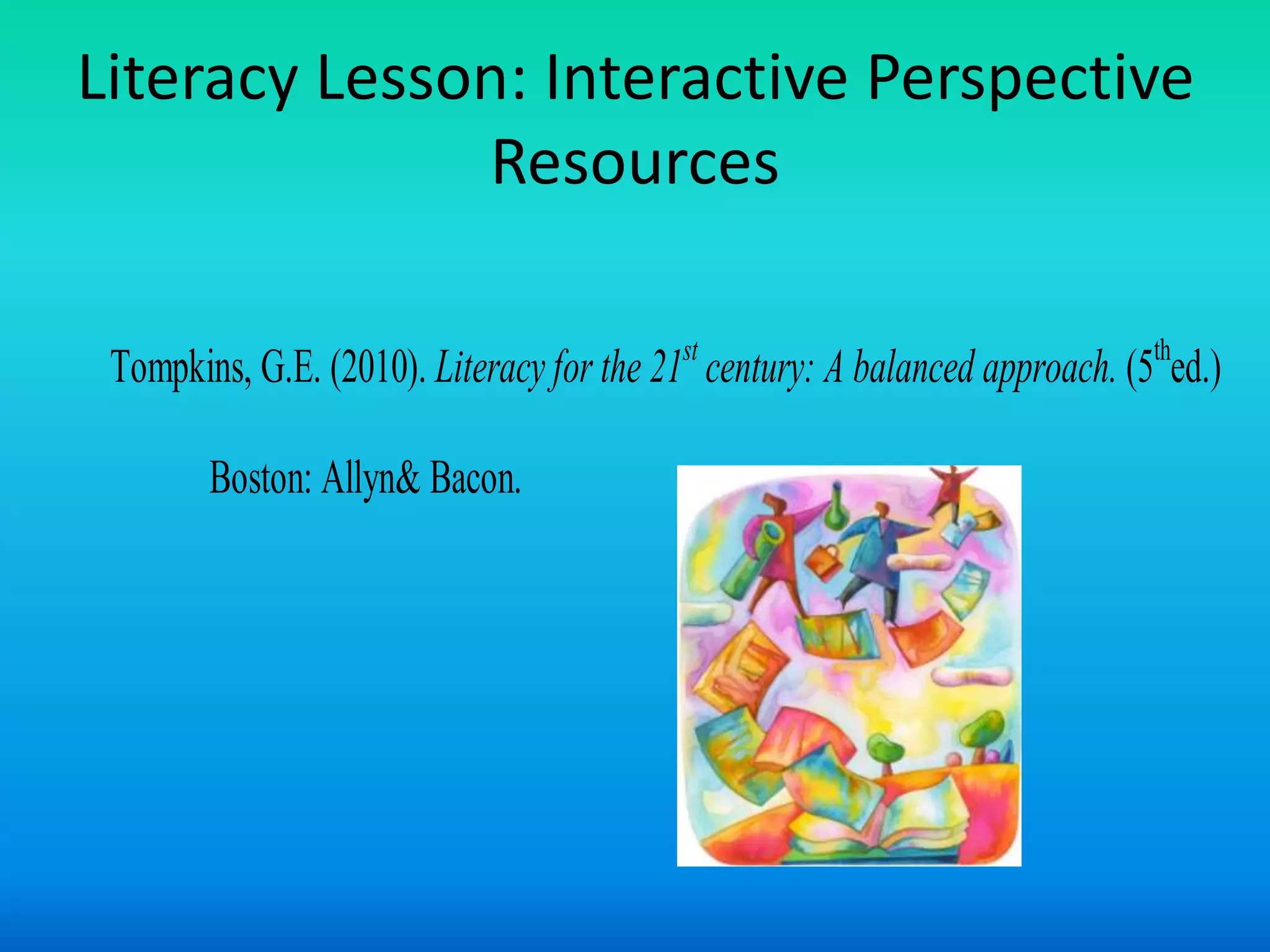
Literacy Lesson: Interactive Perspective
              Resources

 Tompkins, G.E. (2010). Literacy for the 21st century: A balanced approach. (5thed.)

        Boston: Allyn& Bacon.
Literacy Lesson: Critical & Response
              Perspectives
• Earth Day Lesson plan
• Students need to be more engaged in the
  learning process.
• Students need to be pushed higher and have
  higher standards to meet.
• The students were able to compare and
  contrast text to a movie.
Literacy Lesson: Critical & Response
               Perspectives Resource
Laureate Education, Inc. (Executive Producer). [Video Podcast]. (2010a). Critical Perspective.

       Baltimore. [Dr. Janice Almasi]. Retrieved from: www.waldenu.edu

Laureate Education, Inc. (Executive Producer). [Video Podcast]. (2010b). Response Perspective.

       Baltimore. [Dr. Janice Almasi]. Retrieved from: www.waldenu.edu
Feedback from Colleagues and Family
       Members of Students
• Everyone seemed to enjoy the presentation.
• They all loved my new attitude toward
  reading.
• I feel that this class has really opened my eyes
  to new, fresh ideas for the classroom.
• They had questions about my time constraints
  in the classroom.
• They were also interested in my ideas to
  incorporate more group work.

Educ 6706 r-2, the beginning reader, prek-3 powerpoint

  • 1.
    EDUC-6706R-2, The Beginning Reader, PreK-3 By Stephanie Greer
  • 2.
    Getting to KnowLiteracy Learners • Teachers should get to know their students on a personal level to know what kind of books they might like to read. • I learned new and different activities to do with the students at the beginning of the year to get to know them. • I am thankful that I walked into a room full of library books. • I separated the books into different genres and reading levels for the students.
  • 3.
    Getting to KnowLiteracy Learners cont. • Observed Mrs. Burgess’s classroom • Worked with different level students • Non-cognitive-motivation to read profile • Cognitive-DIBELS assessment – Five Pillars of Reading These assessments helped me realize I need to do more one on one work with my students.
  • 4.
    Getting to KnowLiteracy Learners Research Five pillars of reading instruction. (2013). Retrieved from http://www.readinghorizons.com/research/five-pillars.aspx Gambrell, L. B., Palmer, B. M., Codling, R. M., & Mazzoni, S. A. (1996). Assessing motivation to read. The reading teacher, 49(7), 518-533. Laureate Education, Inc. (Executive Producer). [Video Podcast]. (2008). Literacy Autobiographies. Baltimore. Retrieved from: www.waldenu.edu Laureate Education, Inc. (Executive Producer). [Video Podcast]. (2008). Getting to Know Your Students. BaltimoreRetrieved from: www.waldenu.edu
  • 5.
    Selecting Texts • Sucha variety of genres and types of texts • Lower grades have a major impact on how students perform in the upper grades. • “Fourth Grade Slump” • Literacy Matrix The Literacy Matrix has really helped me look at all the aspects of a book.
  • 6.
    Selecting Text Resource Laureate Education, Inc. (Executive Producer). [Video Podcast]. (2010). Analyzing and Selecting Text. Baltimore. [Dr. Douglas Hartman]. Retrieved from: www.waldenu.edu Laureate Education, Inc. (Executive Producer). (2010). Informational text in the early years. Baltimore: Author.
  • 7.
    Literacy Lesson: InteractivePerspective • Lesson plan • Mrs. Burgess’s class • Three different leveled children. • I need to ask more higher level thinking questions. • I also need to work with students more in small groups and one on one.
  • 8.
    Literacy Lesson: InteractivePerspective Resources Tompkins, G.E. (2010). Literacy for the 21st century: A balanced approach. (5thed.) Boston: Allyn& Bacon.
  • 9.
    Literacy Lesson: Critical& Response Perspectives • Earth Day Lesson plan • Students need to be more engaged in the learning process. • Students need to be pushed higher and have higher standards to meet. • The students were able to compare and contrast text to a movie.
  • 10.
    Literacy Lesson: Critical& Response Perspectives Resource Laureate Education, Inc. (Executive Producer). [Video Podcast]. (2010a). Critical Perspective. Baltimore. [Dr. Janice Almasi]. Retrieved from: www.waldenu.edu Laureate Education, Inc. (Executive Producer). [Video Podcast]. (2010b). Response Perspective. Baltimore. [Dr. Janice Almasi]. Retrieved from: www.waldenu.edu
  • 11.
    Feedback from Colleaguesand Family Members of Students • Everyone seemed to enjoy the presentation. • They all loved my new attitude toward reading. • I feel that this class has really opened my eyes to new, fresh ideas for the classroom. • They had questions about my time constraints in the classroom. • They were also interested in my ideas to incorporate more group work.