Submitted by
AMINA SHIRIN N S
Roll no: 15
1st B.Ed Mathematics
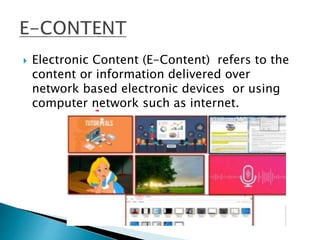
 Electronic Content (E-Content) refers to the
content or information delivered over
network based electronic devices or using
computer network such as internet.
 E-content includes e-texts, digital learning
resources etc. These could be digital
textbooks, workbooks, articles, videos or
multimedia resources
Eg: E-Journals, E-books, Power point
presentations, etc
 Switching from Traditional textbooks to
digital course materials is a growing trend in
school education as well as higher education.
E-Content is the need of the hour. It
promotes fast constitution of content matters
in users.
DEFINITIONS
 According to Oxford Dictionary, 'e-content is
the digital text and images designed to
display on web pages'.
 According to Saxena Anurag, 'E-content is
basically a package that satisfies the
conditions like minimization of distance, cost
effectiveness, user friendliness and
adaptability to local conditions.
FEATURES OF E-CONTENT
1. Learning by Principle of Chunking
2. Provide Multi-sensory Learning Experience
3. It can impress learners
4. Prepared in appropriate format
5. Sticks to the topic
6. Explains the topic with images, animations, simulations
etc.
7. Easily accessible
8. Reusable
9. Accurate information
10. Technically Friendly (Download and use on anytime)
11. Learner Friendly
12. Learner Centric(useful for self learning)
13. Teacher Friendly
SCOPE
 E-content is becoming popular because of its flexibility of time,
place and pace of learning.
 E-content is available in many subjects and almost all levels of
education. It can be used by wide variety of leraners with diverse
needs , different backgrounds , skill levels and experience.
 It can be shared and transmitted easily among unlimited
number of users around the world.
 Teachers, students and others get benefited by the use of well
designed and developed E-content.
 It is advantageous to educational organizations to make their
program accessible to thier and students in schools, campus,
home and other community learning or resource centers.
 It has a significant implications for open and distant
learning intuitions. Online learning Platforms have become
widely acceptable with the help of E-Contents such as
PowerPoint Presentations, Word documents, Pdfs,
Evaluating Sheets etc.
 The purpose of E-Content development is to create an
information rich society-Quality Education.
 E-content promotes the learner to access or interact with
so as to achieve related learning outcomes.
 Various E-contents provides a resource rich environment
which is necessary for teaching and learning to be
effective.
 E-content can be saved in appropriate file format.
TYPES OF E-CONTENT
1. Assembled E-content
It is the e-content assembled from several
resources and books with due care taken for
copyright issues.
Eg: E-books, E-Journals
2. Created E-content
It is the e-content developed based on
various sources and his own work.
Eg: Slide Presentations, Word documents etc.
FORMS OF E-CONTENT
E-content is often made of separate units or a combination of
text, video, images, sounds etc. These are the building blocks which are
often used to make composite learning objects that can be exhibited in
various presentation formats.
Different forms of E-Content includes:
1. Texts: create text files with Wordpad, M S Word.
.text , .doc , .pdf are the main formats
2. Visual : It includes both images and graphics. Various
formats include . jpg,. png,. gif etc
3. Sound: Various formats include. wav , . au , . mp3, . mid.
. wav is common format and. au is compressed format.
4. Video : Format include . avi,. mpg,. flv
. mpg is compressed format.
5. Animation : 2D and 3D animations
6. Simulation : real time interactive e content
like virtual lab.
7. Presentation: Powerpoint Presentations.
Other forms include Games, Rich internet
applications, database, e-journals, interactives,
e-books, immensive content etc.
CONCLUSION
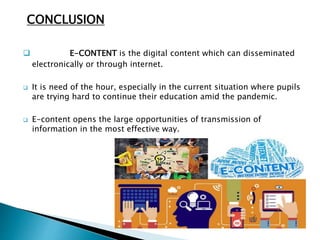
 E-CONTENT is the digital content which can disseminated
electronically or through internet.
 It is need of the hour, especially in the current situation where pupils
are trying hard to continue their education amid the pandemic.
 E-content opens the large opportunities of transmission of
information in the most effective way.
THANK YOU

E-content Features : Concept, Scope ppt presentation

  • 1.
    Submitted by AMINA SHIRINN S Roll no: 15 1st B.Ed Mathematics
  • 2.
     Electronic Content(E-Content) refers to the content or information delivered over network based electronic devices or using computer network such as internet.
  • 3.
     E-content includese-texts, digital learning resources etc. These could be digital textbooks, workbooks, articles, videos or multimedia resources Eg: E-Journals, E-books, Power point presentations, etc  Switching from Traditional textbooks to digital course materials is a growing trend in school education as well as higher education. E-Content is the need of the hour. It promotes fast constitution of content matters in users.
  • 4.
    DEFINITIONS  According toOxford Dictionary, 'e-content is the digital text and images designed to display on web pages'.  According to Saxena Anurag, 'E-content is basically a package that satisfies the conditions like minimization of distance, cost effectiveness, user friendliness and adaptability to local conditions.
  • 5.
    FEATURES OF E-CONTENT 1.Learning by Principle of Chunking 2. Provide Multi-sensory Learning Experience 3. It can impress learners 4. Prepared in appropriate format 5. Sticks to the topic 6. Explains the topic with images, animations, simulations etc. 7. Easily accessible 8. Reusable 9. Accurate information 10. Technically Friendly (Download and use on anytime) 11. Learner Friendly 12. Learner Centric(useful for self learning) 13. Teacher Friendly
  • 6.
    SCOPE  E-content isbecoming popular because of its flexibility of time, place and pace of learning.  E-content is available in many subjects and almost all levels of education. It can be used by wide variety of leraners with diverse needs , different backgrounds , skill levels and experience.  It can be shared and transmitted easily among unlimited number of users around the world.  Teachers, students and others get benefited by the use of well designed and developed E-content.  It is advantageous to educational organizations to make their program accessible to thier and students in schools, campus, home and other community learning or resource centers.
  • 7.
     It hasa significant implications for open and distant learning intuitions. Online learning Platforms have become widely acceptable with the help of E-Contents such as PowerPoint Presentations, Word documents, Pdfs, Evaluating Sheets etc.  The purpose of E-Content development is to create an information rich society-Quality Education.  E-content promotes the learner to access or interact with so as to achieve related learning outcomes.  Various E-contents provides a resource rich environment which is necessary for teaching and learning to be effective.  E-content can be saved in appropriate file format.
  • 8.
    TYPES OF E-CONTENT 1.Assembled E-content It is the e-content assembled from several resources and books with due care taken for copyright issues. Eg: E-books, E-Journals 2. Created E-content It is the e-content developed based on various sources and his own work. Eg: Slide Presentations, Word documents etc.
  • 9.
    FORMS OF E-CONTENT E-contentis often made of separate units or a combination of text, video, images, sounds etc. These are the building blocks which are often used to make composite learning objects that can be exhibited in various presentation formats. Different forms of E-Content includes: 1. Texts: create text files with Wordpad, M S Word. .text , .doc , .pdf are the main formats 2. Visual : It includes both images and graphics. Various formats include . jpg,. png,. gif etc 3. Sound: Various formats include. wav , . au , . mp3, . mid. . wav is common format and. au is compressed format.
  • 10.
    4. Video :Format include . avi,. mpg,. flv . mpg is compressed format. 5. Animation : 2D and 3D animations 6. Simulation : real time interactive e content like virtual lab. 7. Presentation: Powerpoint Presentations. Other forms include Games, Rich internet applications, database, e-journals, interactives, e-books, immensive content etc.
  • 11.
    CONCLUSION  E-CONTENT isthe digital content which can disseminated electronically or through internet.  It is need of the hour, especially in the current situation where pupils are trying hard to continue their education amid the pandemic.  E-content opens the large opportunities of transmission of information in the most effective way.
  • 12.