TECHNOLOGY
SEMINAR
Prepared by
Reshma Ravikumar, Rita Tomy,
Roshna Raju, Sruthy S Nair
E-CONTENT
2
E-CONTENT
Electronic content (e-content ) or digital content are the contents that can be
transmitted over a computer network such as internet.
e-content is termed as electronic content that include text, image, graphics,
animation, audio and video.
Oxford dictionary defines e-content as “digital text and images designed for
display on web pages”.
3
FEATURES OF E-CONTENT
e-content is technologically friendly to pupil for
downloaded text materials and used on any
computers independently for the purpose of
learning process.
e-content is having learner friendly for easy
navigation.
e-content is learner centric, it is useful in self
instructional model.
e-content is also teacher friendly, it is used in
various teaching methods such as classroom,
lecturing to a group, lab sessions.
e-content is all forms of digital information that is
used for multiple purpose in different fields and
areas.
e-content is the living expression of life in country
with all its images, sounds and recorded heritage.
e-content is innovative application of computer in
the teaching and learning process.
e-content may be internet based which includes
text ,images, audio, video, animation and visual.
4
SCOPE OF E-CONTENT
5
1 3
5
6
4
2
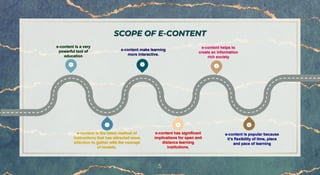
e-content is a very
powerful tool of
education
e-content make learning
more interactive.
e-content helps to
create an information
rich society
e-content is the latest method of
instructions that has attracted more
attention to gather with the concept
of models.
e-content has significant
implications for open and
distance learning
institutions.
e-content is popular because
it’s flexibility of time, place
and pace of learning
SCOPE OF E-CONTENT
6
7 9
10
11
8
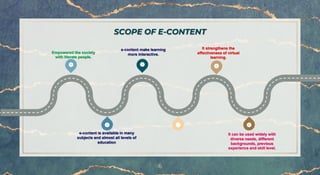
Empowered the society
with literate people.
e-content make learning
more interactive.
It strengthens the
effectiveness of virtual
learning.
e-content is available in many
subjects and almost all levels of
education
It can be used widely with
diverse needs, different
backgrounds, previous
experience and skill level.
DESIGNING AND DEVELOPMENT OF E-CONTENT
E-content design development and approach will depend upon the nature of
content and the learners.
It will also depend upon the quality and complexity the learning you wish to
create.
Various instructional design model are available according to our requirement.
Before understanding the 5 design and development of e-content, it is essential
to understand the meaning of instructional design. They are Analyze, Design,
Develop, Implement and Evaluate.
ADDIE
▫ The most common model used for creating instructional material is
ADDIE Model.
▫ This acronym stands for 5 phases contained in the model (Analyze,
Design, Develop, Implement and Evaluate).
▫ The ADDIE model was initially developed by Florida State University to
explain the processes involved in the formulation of an instructional
systems development (ISD) program for military inter-service training.
▫ The model originally contained several steps under its original 5
phases.
8
5 PHASES
1. Analysis : It is related to analyzing the learning needs, context,
learner, task and content.
Contextual Analysis
Learner Analysis
Task Analysis
Content Analysis
9
5 PHASES
2. Design : It is concerned with defining the learning objectives,
structuring the content logically and specifying instructional
and evaluation strategies and preparing for the visual and
technical design.
10
5 PHASES
3. Development : Development, involves the creation of activities that
will be implemented. It is in this phase that the
blueprint of the design phase are assembled.
11
5 PHASES
4. Implementation : After the content is developed, it is then
implemented. The materials are distributed to the
learners.A comprehensive implementation strategy
document is developed.
12
5 PHASES
5. Evaluation : The final phase, evaluation ensures the material achieved
the desired goal. It consists of two parts : formative and
summative assessment.
13
THANKS!
14

e-content

  • 1.
    TECHNOLOGY SEMINAR Prepared by Reshma Ravikumar,Rita Tomy, Roshna Raju, Sruthy S Nair
  • 2.
  • 3.
    E-CONTENT Electronic content (e-content) or digital content are the contents that can be transmitted over a computer network such as internet. e-content is termed as electronic content that include text, image, graphics, animation, audio and video. Oxford dictionary defines e-content as “digital text and images designed for display on web pages”. 3
  • 4.
    FEATURES OF E-CONTENT e-contentis technologically friendly to pupil for downloaded text materials and used on any computers independently for the purpose of learning process. e-content is having learner friendly for easy navigation. e-content is learner centric, it is useful in self instructional model. e-content is also teacher friendly, it is used in various teaching methods such as classroom, lecturing to a group, lab sessions. e-content is all forms of digital information that is used for multiple purpose in different fields and areas. e-content is the living expression of life in country with all its images, sounds and recorded heritage. e-content is innovative application of computer in the teaching and learning process. e-content may be internet based which includes text ,images, audio, video, animation and visual. 4
  • 5.
    SCOPE OF E-CONTENT 5 13 5 6 4 2 e-content is a very powerful tool of education e-content make learning more interactive. e-content helps to create an information rich society e-content is the latest method of instructions that has attracted more attention to gather with the concept of models. e-content has significant implications for open and distance learning institutions. e-content is popular because it’s flexibility of time, place and pace of learning
  • 6.
    SCOPE OF E-CONTENT 6 79 10 11 8 Empowered the society with literate people. e-content make learning more interactive. It strengthens the effectiveness of virtual learning. e-content is available in many subjects and almost all levels of education It can be used widely with diverse needs, different backgrounds, previous experience and skill level.
  • 7.
    DESIGNING AND DEVELOPMENTOF E-CONTENT E-content design development and approach will depend upon the nature of content and the learners. It will also depend upon the quality and complexity the learning you wish to create. Various instructional design model are available according to our requirement. Before understanding the 5 design and development of e-content, it is essential to understand the meaning of instructional design. They are Analyze, Design, Develop, Implement and Evaluate.
  • 8.
    ADDIE ▫ The mostcommon model used for creating instructional material is ADDIE Model. ▫ This acronym stands for 5 phases contained in the model (Analyze, Design, Develop, Implement and Evaluate). ▫ The ADDIE model was initially developed by Florida State University to explain the processes involved in the formulation of an instructional systems development (ISD) program for military inter-service training. ▫ The model originally contained several steps under its original 5 phases. 8
  • 9.
    5 PHASES 1. Analysis: It is related to analyzing the learning needs, context, learner, task and content. Contextual Analysis Learner Analysis Task Analysis Content Analysis 9
  • 10.
    5 PHASES 2. Design: It is concerned with defining the learning objectives, structuring the content logically and specifying instructional and evaluation strategies and preparing for the visual and technical design. 10
  • 11.
    5 PHASES 3. Development: Development, involves the creation of activities that will be implemented. It is in this phase that the blueprint of the design phase are assembled. 11
  • 12.
    5 PHASES 4. Implementation: After the content is developed, it is then implemented. The materials are distributed to the learners.A comprehensive implementation strategy document is developed. 12
  • 13.
    5 PHASES 5. Evaluation: The final phase, evaluation ensures the material achieved the desired goal. It consists of two parts : formative and summative assessment. 13
  • 14.