Price and Arc Elasticity
Overview
• Elasticity
• Types of Elasticity
• Price Elasticity
* Price Elasticity of Demand
* Classification of Price Elasticity Demand
* Determinants of Price Elasticity Demand
Elasticity
• In Economics, the concept of elasticity measures the
responsiveness of one variable to a certain change of
another variable.
• Two significant words: “Measure”, reported as
numbers or coefficients, and “ responsiveness”,
meaning reaction to change (Sensitive).
• Thus, any change causes people to react, and elasticity
measures this extent to which the people react.
• Proportional measures or percentage change in the
variables measures the responsiveness of consumers
and producers.
Price Elasticity of Demand
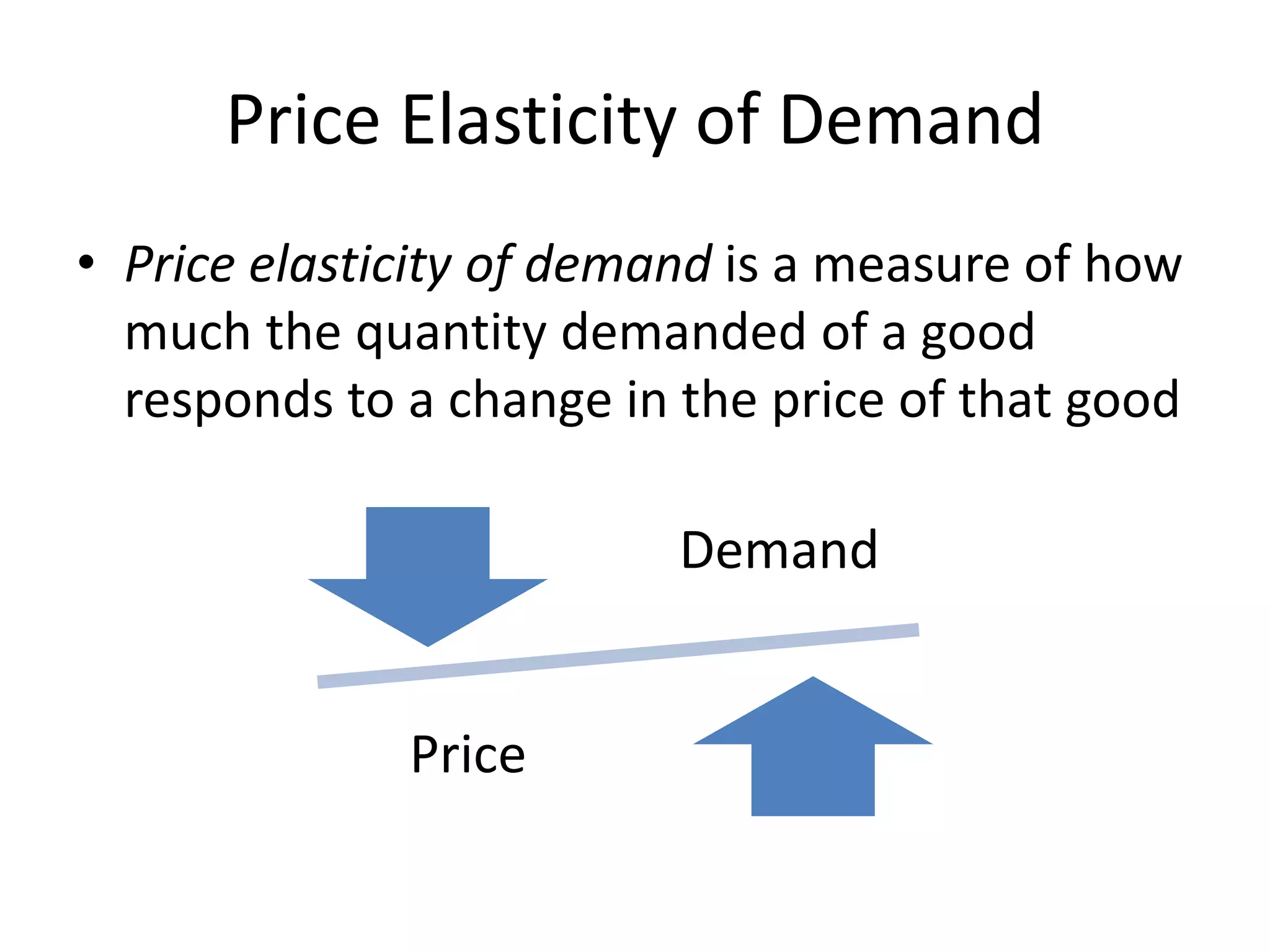
• Price elasticity of demand is a measure of how
much the quantity demanded of a good
responds to a change in the price of that good
Demand
Price
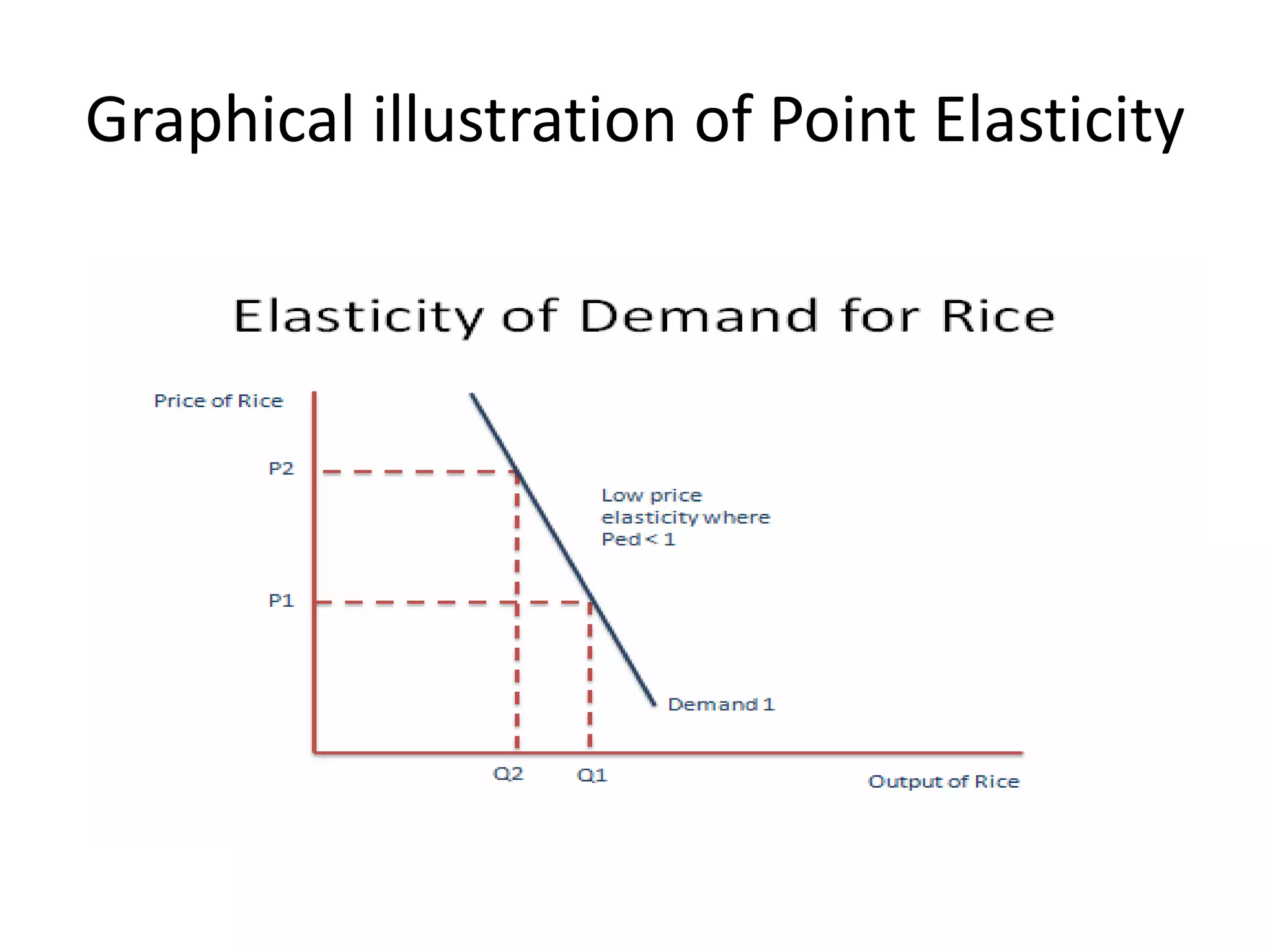
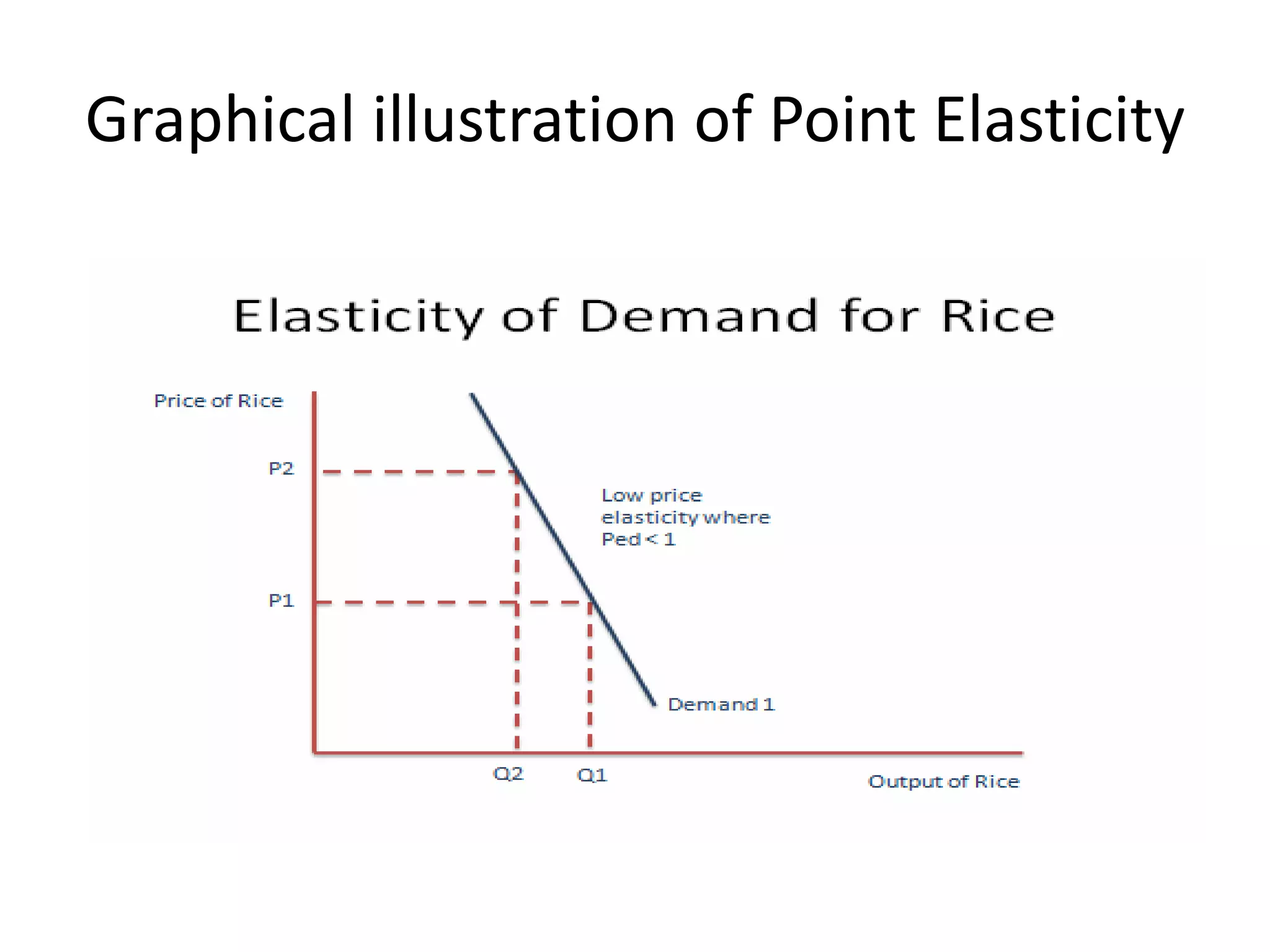
Graphical illustration of Point Elasticity
Computing the Price Elasticity of
Demand
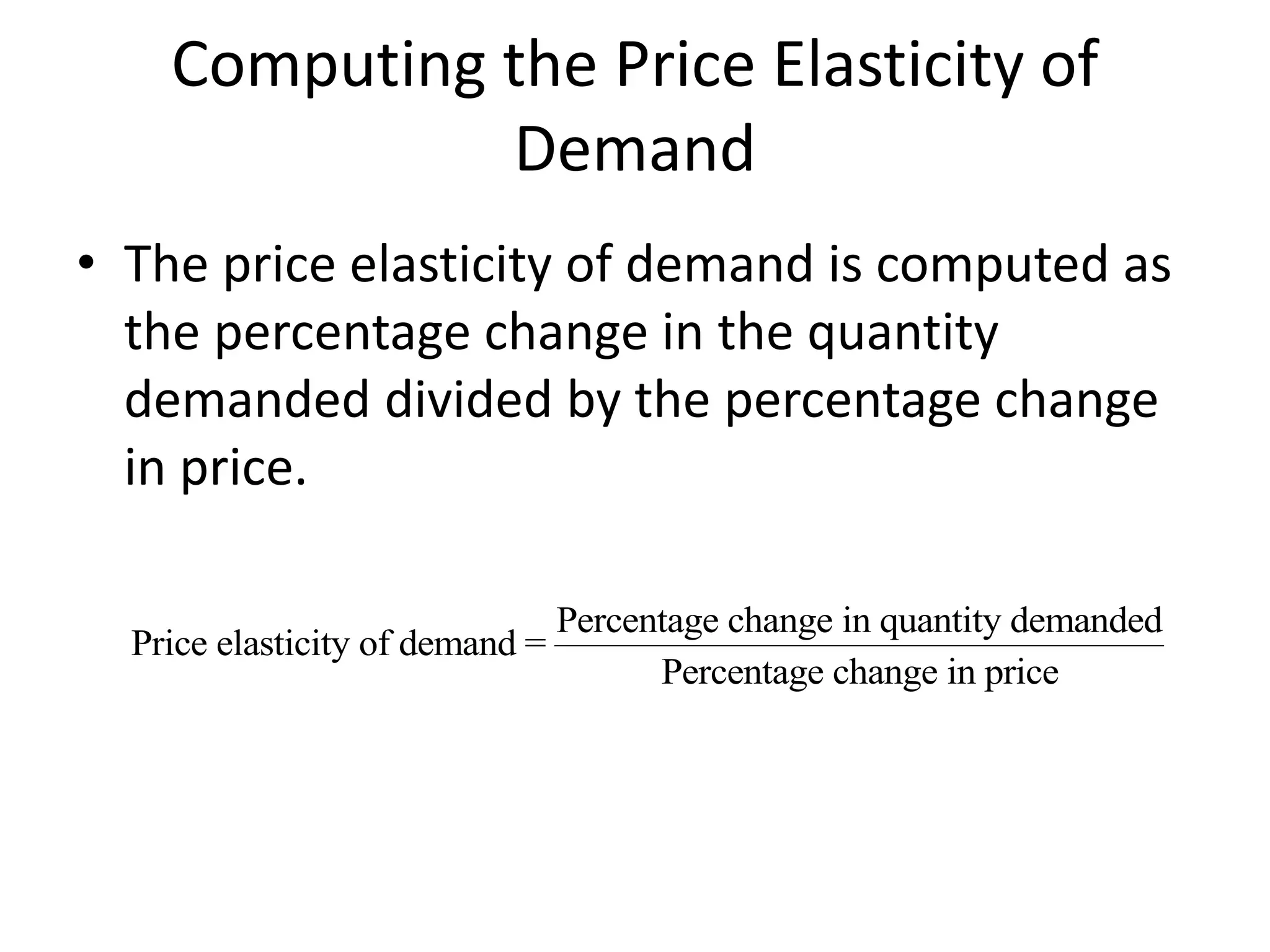
• The price elasticity of demand is computed as
the percentage change in the quantity
demanded divided by the percentage change
in price.
Price elasticity of demand =
Percentage change in quantity demanded
Percentage change in price
Types of Elasticity
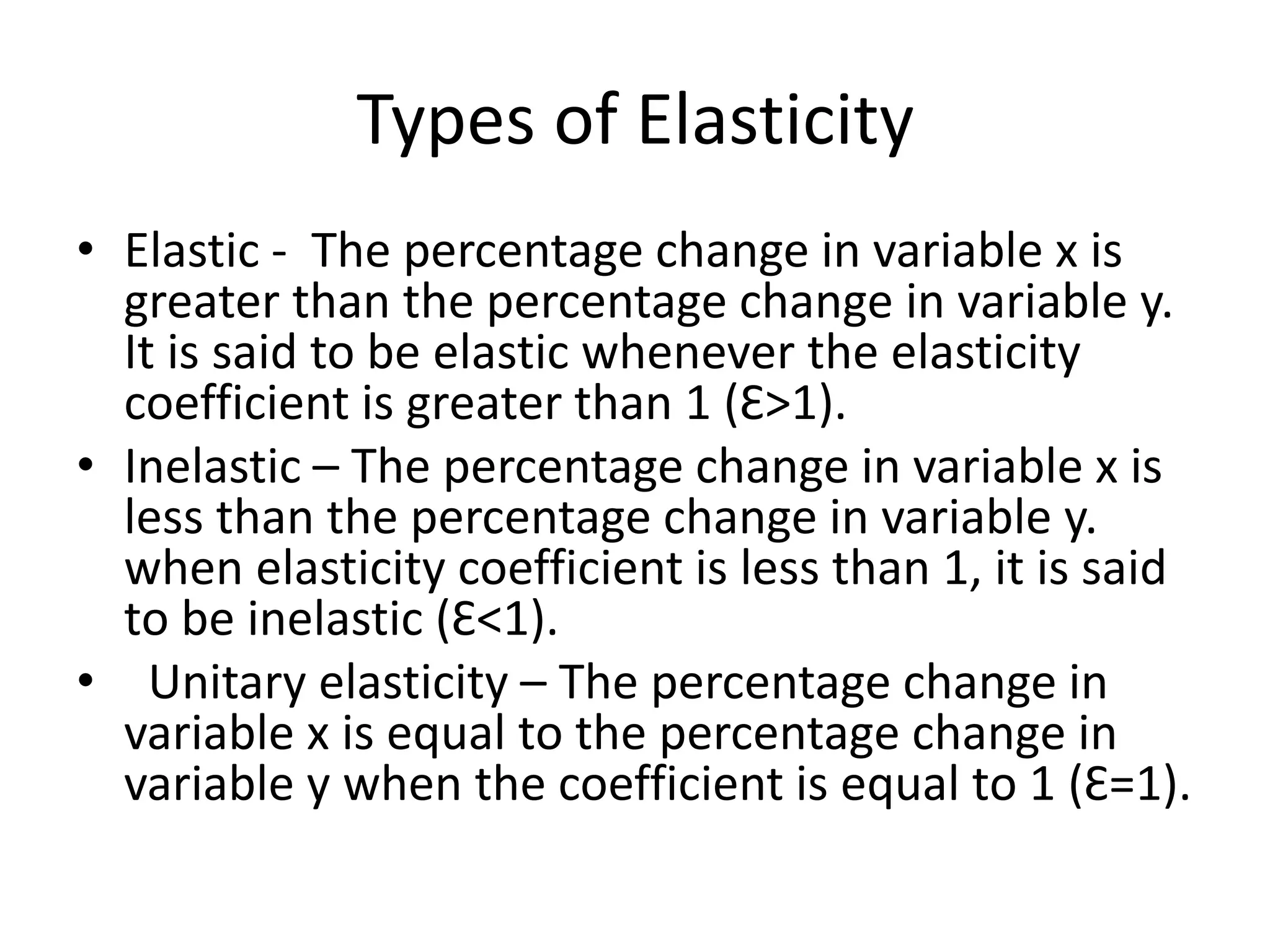
• Elastic - The percentage change in variable x is
greater than the percentage change in variable y.
It is said to be elastic whenever the elasticity
coefficient is greater than 1 (Ɛ>1).
• Inelastic – The percentage change in variable x is
less than the percentage change in variable y.
when elasticity coefficient is less than 1, it is said
to be inelastic (Ɛ<1).
• Unitary elasticity – The percentage change in
variable x is equal to the percentage change in
variable y when the coefficient is equal to 1 (Ɛ=1).
Elastic, Inelastic and Unit
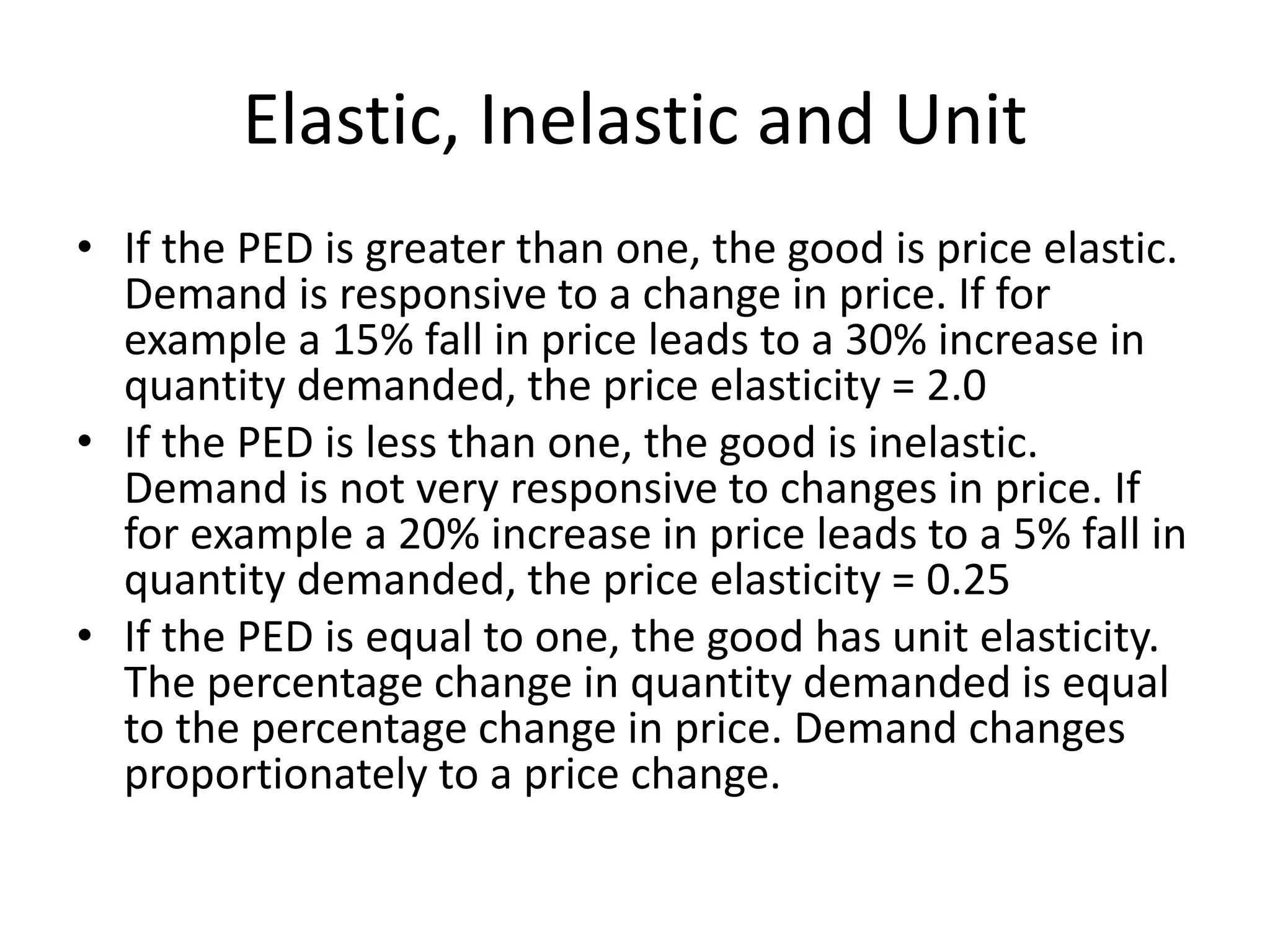
• If the PED is greater than one, the good is price elastic.
Demand is responsive to a change in price. If for
example a 15% fall in price leads to a 30% increase in
quantity demanded, the price elasticity = 2.0
• If the PED is less than one, the good is inelastic.
Demand is not very responsive to changes in price. If
for example a 20% increase in price leads to a 5% fall in
quantity demanded, the price elasticity = 0.25
• If the PED is equal to one, the good has unit elasticity.
The percentage change in quantity demanded is equal
to the percentage change in price. Demand changes
proportionately to a price change.
Computing the Price Elasticity of
Demand
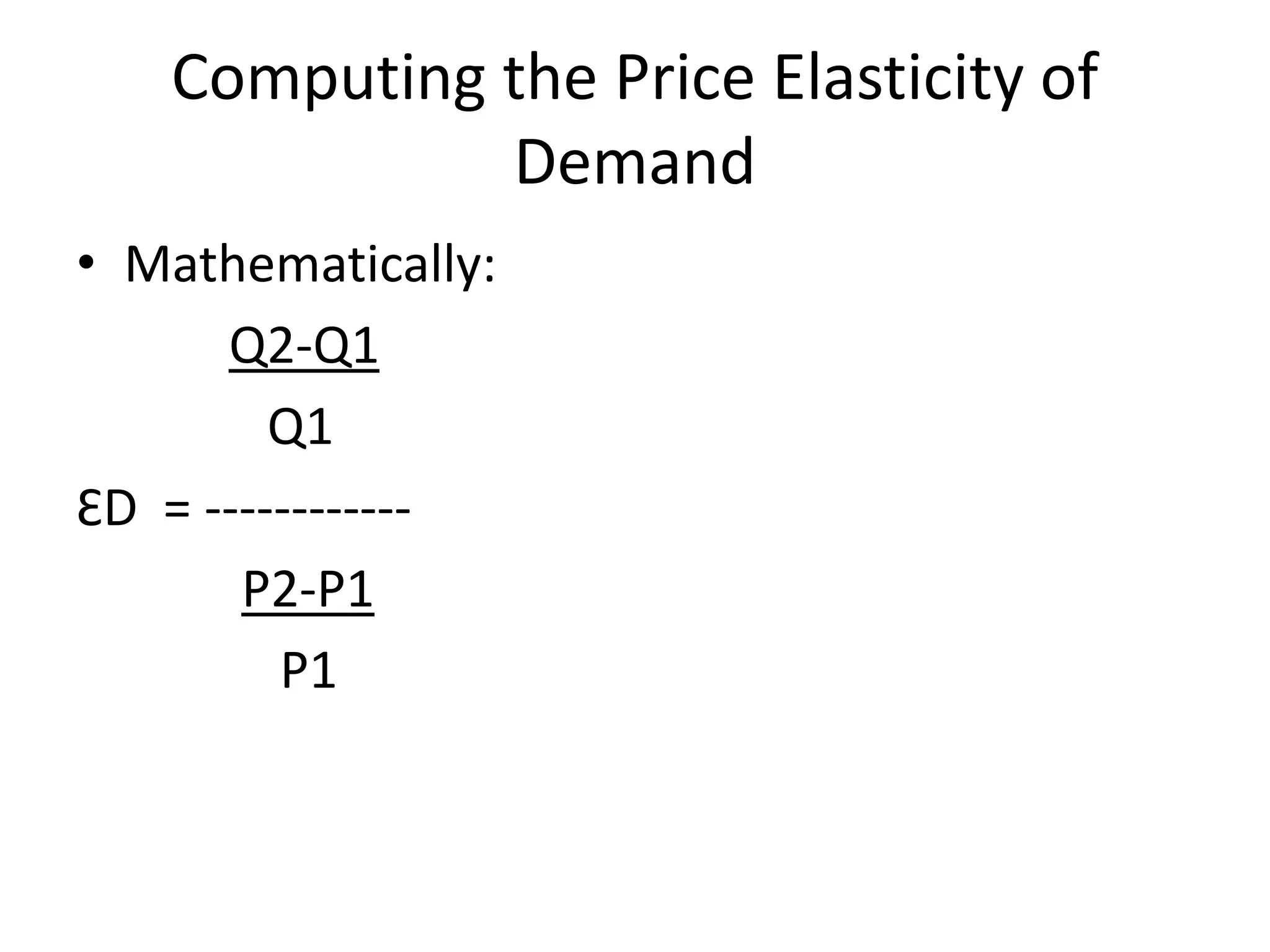
• Mathematically:
Q2-Q1
Q1
ƐD = ------------
P2-P1
P1
Sample Problem
• Compute PED from Point A to E.
• Compute PED from Point E to A.
• Identify the types of Elasticity Demand.
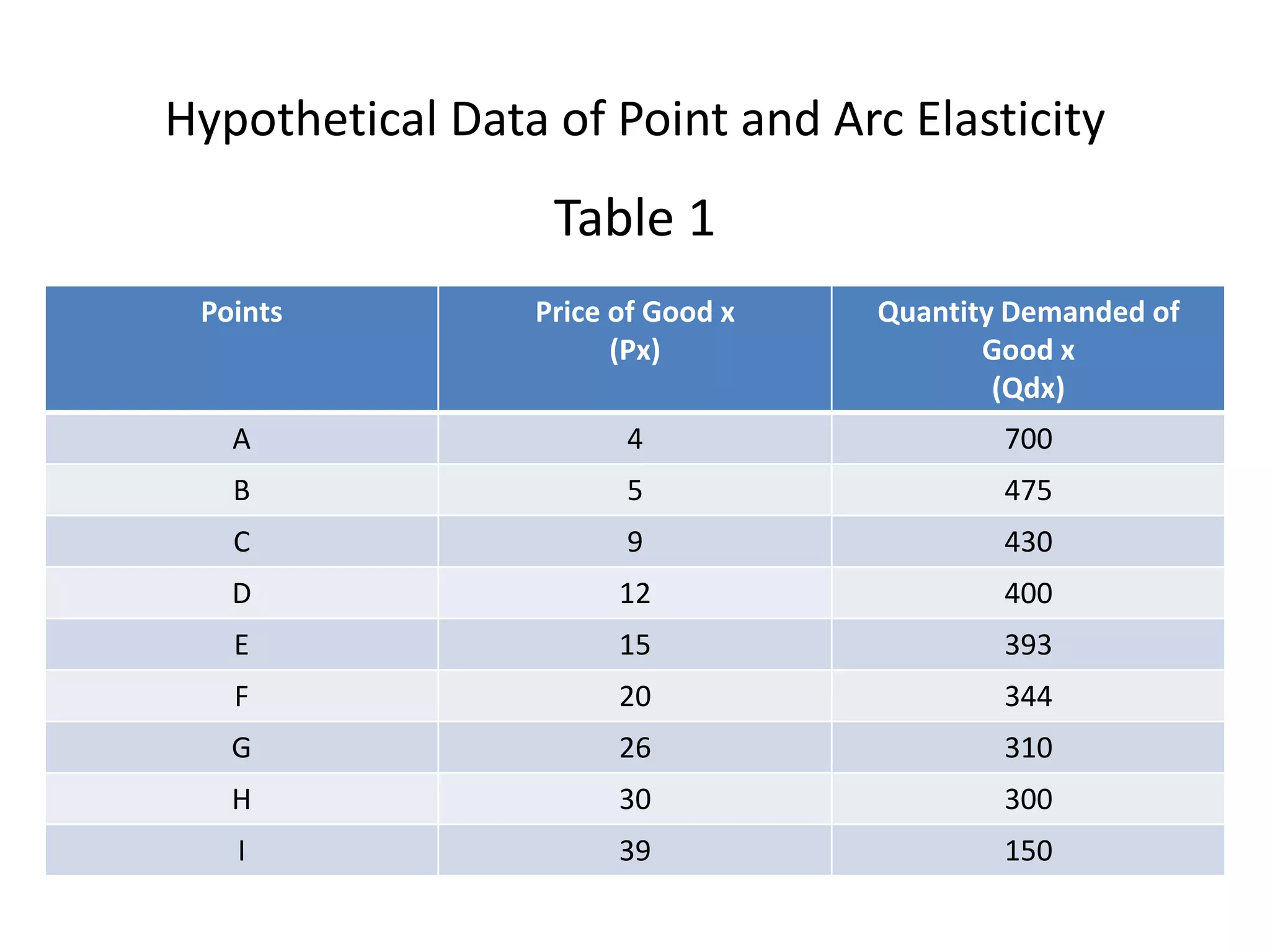
Hypothetical Data of Point and Arc Elasticity
Table 1
Points Price of Good x
(Px)
Quantity Demanded of
Good x
(Qdx)
A 4 700
B 5 475
C 9 430
D 12 400
E 15 393
F 20 344
G 26 310
H 30 300
I 39 150
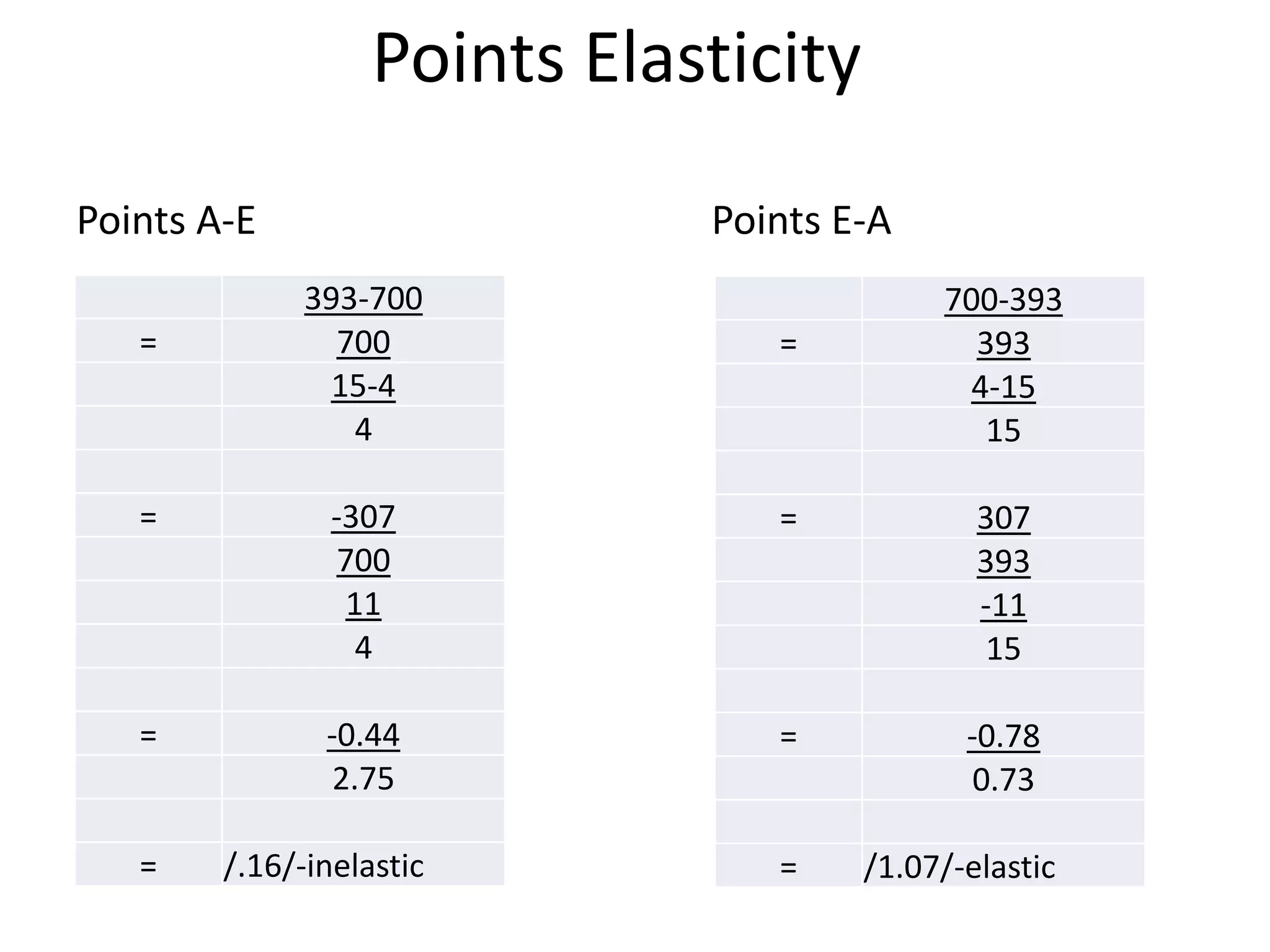
Points Elasticity
Points A-E Points E-A
393-700
= 700
15-4
4
= -307
700
11
4
= -0.44
2.75
= /.16/-inelastic
700-393
= 393
4-15
15
= 307
393
-11
15
= -0.78
0.73
= /1.07/-elastic
Sample Problem
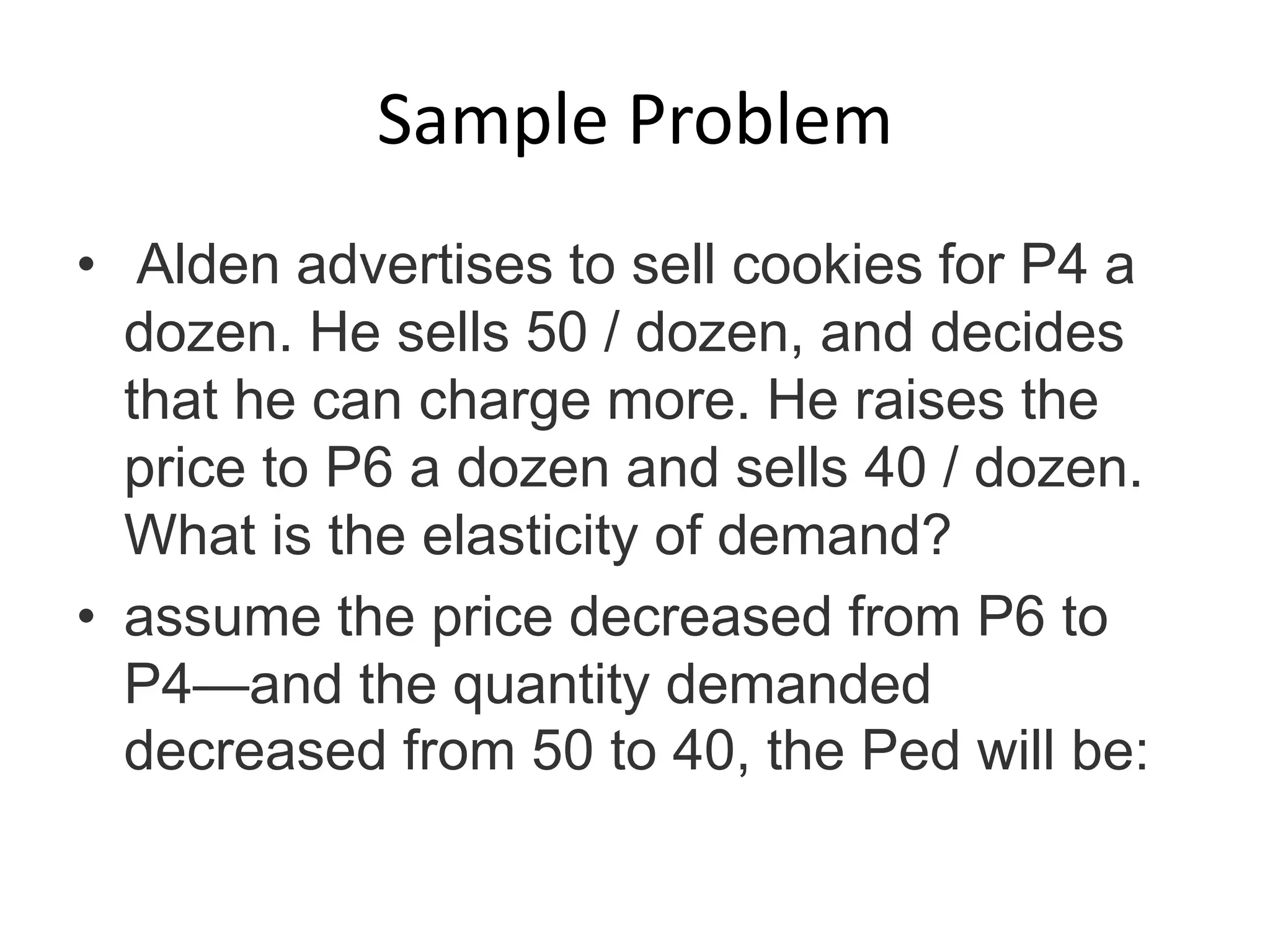
• Alden advertises to sell cookies for P4 a
dozen. He sells 50 / dozen, and decides
that he can charge more. He raises the
price to P6 a dozen and sells 40 / dozen.
What is the elasticity of demand?
• assume the price decreased from P6 to
P4—and the quantity demanded
decreased from 50 to 40, the Ped will be:
QUESTION?
DEMAND/SUPPLY
DETERMINANTS
Demand
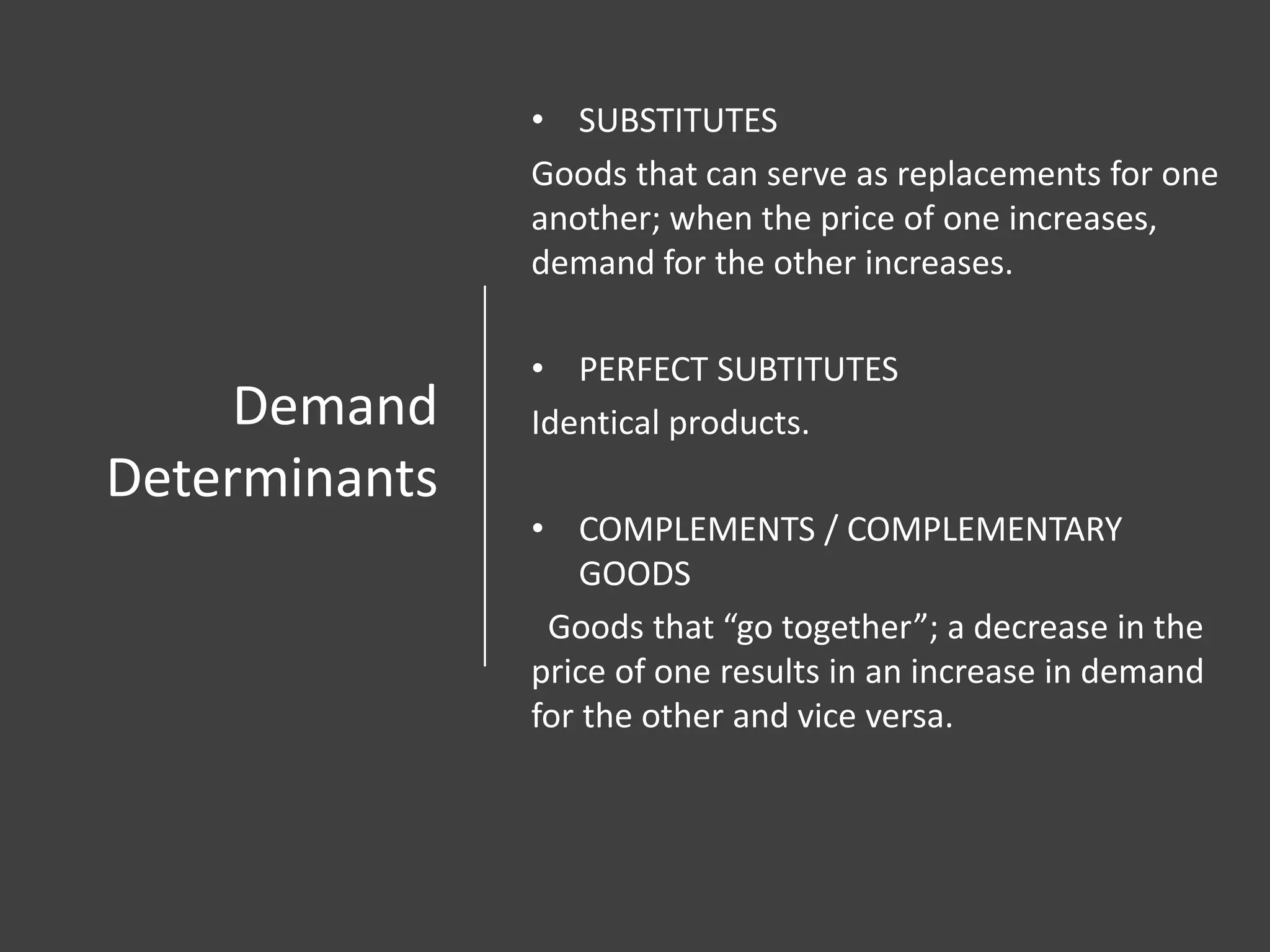
Determinants
• SUBSTITUTES
Goods that can serve as replacements for one
another; when the price of one increases,
demand for the other increases.
• PERFECT SUBTITUTES
Identical products.
• COMPLEMENTS / COMPLEMENTARY
GOODS
Goods that “go together”; a decrease in the
price of one results in an increase in demand
for the other and vice versa.
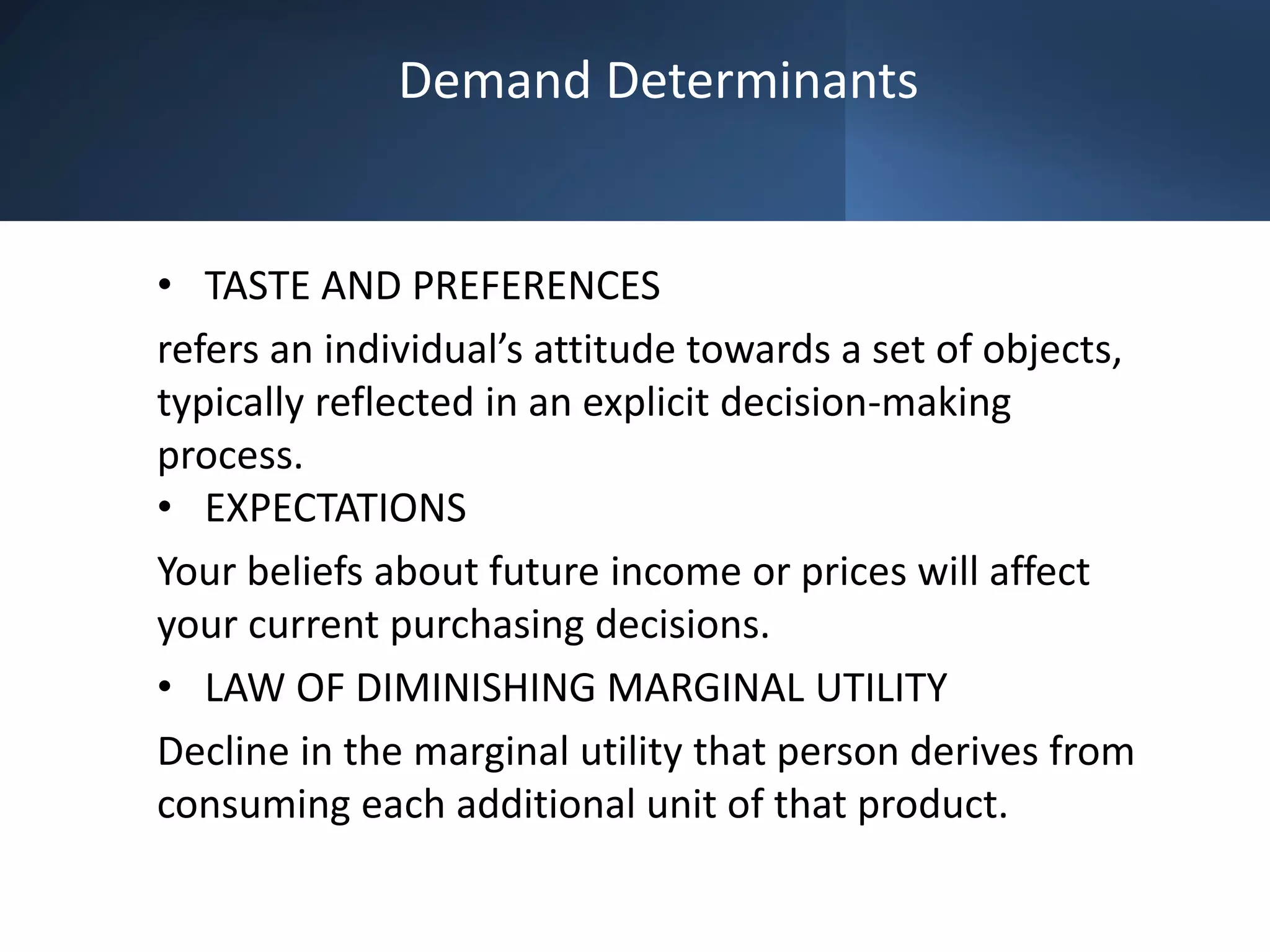
Demand Determinants
• TASTE AND PREFERENCES
refers an individual’s attitude towards a set of objects,
typically reflected in an explicit decision-making
process.
• EXPECTATIONS
Your beliefs about future income or prices will affect
your current purchasing decisions.
• LAW OF DIMINISHING MARGINAL UTILITY
Decline in the marginal utility that person derives from
consuming each additional unit of that product.
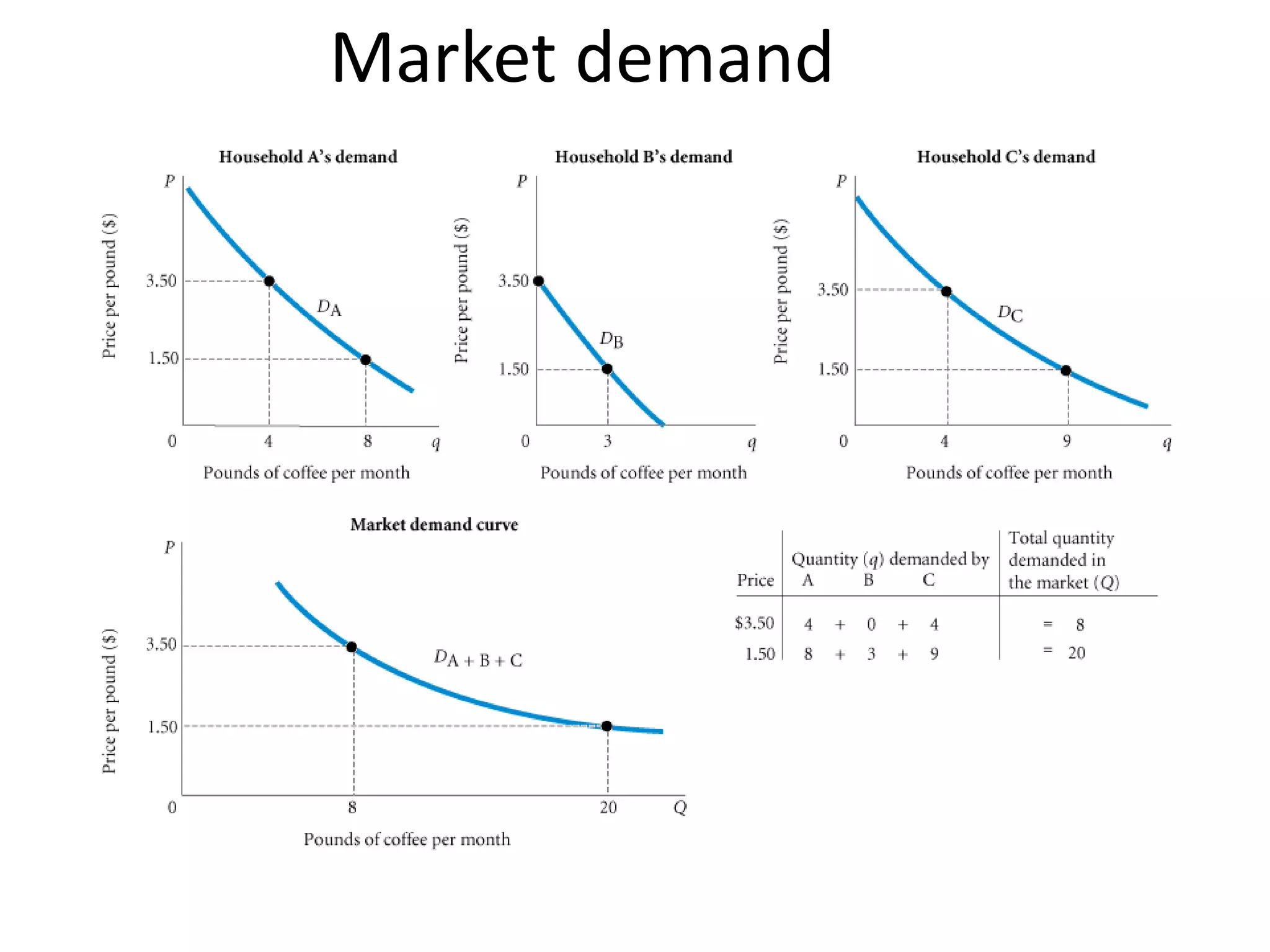
Market demand
The sum of all the quantities of a
good or service demanded per period
by all the households buying in the
market for that good or service.
Supply Determinants
• COST OF PRODUCTION
 Depends on a number of factors, including the
available technologies and the prices and
quantities of the inputs needed by the firm (labor,
land, capital, energy, and so on).
• PRICES OF RELATED PRODUCTS
 The cost of producing the product, which in turn
depends on:
 The price of required inputs (labor, capital, and
land).
 The technologies that can be used to produce the
product.
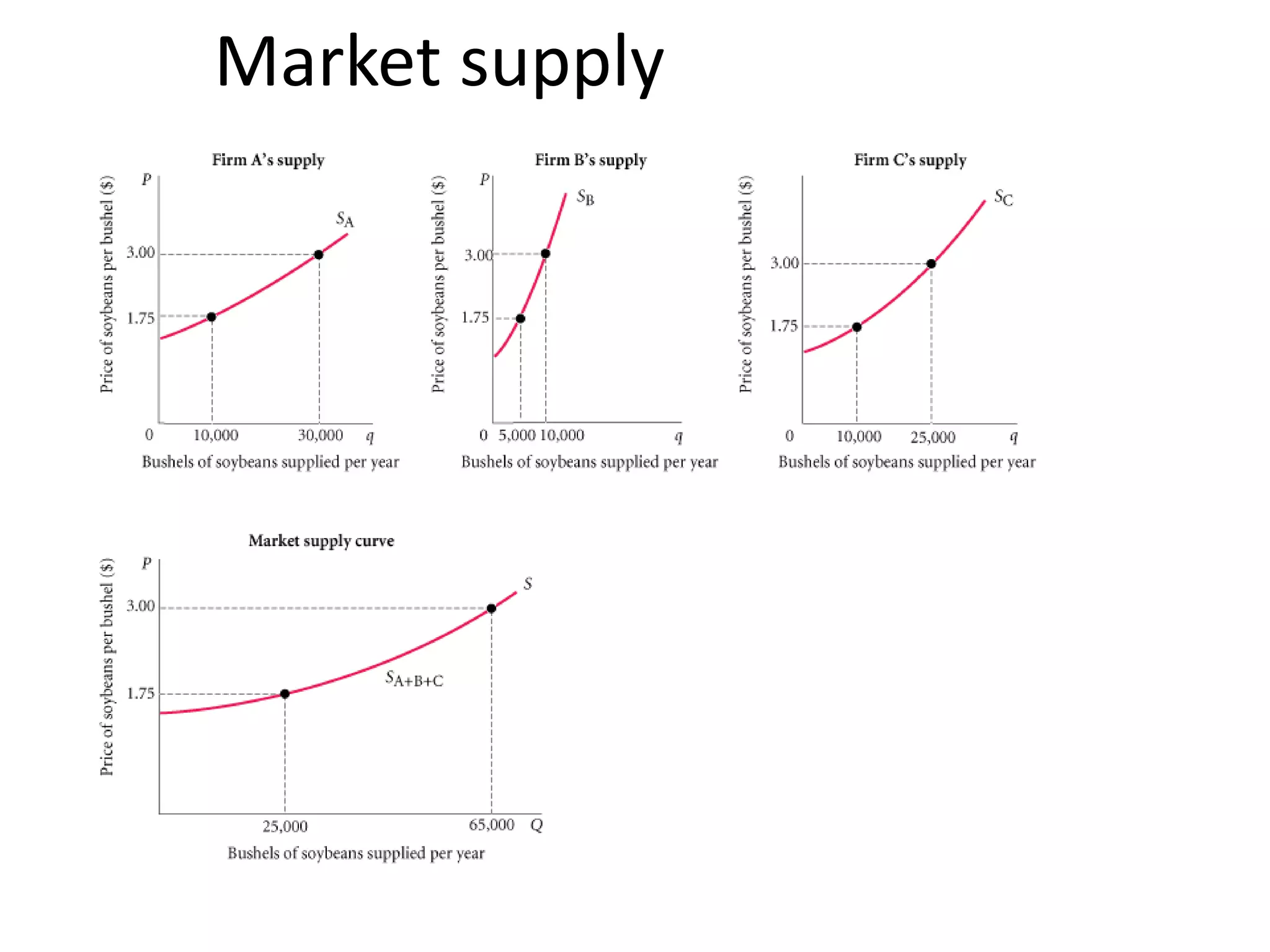
Market supply
MARKET SUPPLY is the sum of all
that is supplied each period by all
producers of a single product.
ARC ELASTICITY
OF DEMAND
What is Arc Elasticity?
What
is
Arc
Elasticity In mathematics and
economics, the arc
elasticity is the elasticity
of one variable with
respect to another
between two given
points.
It is the ratio of the percentage
change of one of the variables
between the two points to the
percentage change of the other
variable.
It contrasts with the point elasticity, which is
the limit of the arc elasticity as the distance
between the two points approaches zero and
which hence is defined at a single point rather
than for a pair of points.
Graphical illustration of Point Elasticity
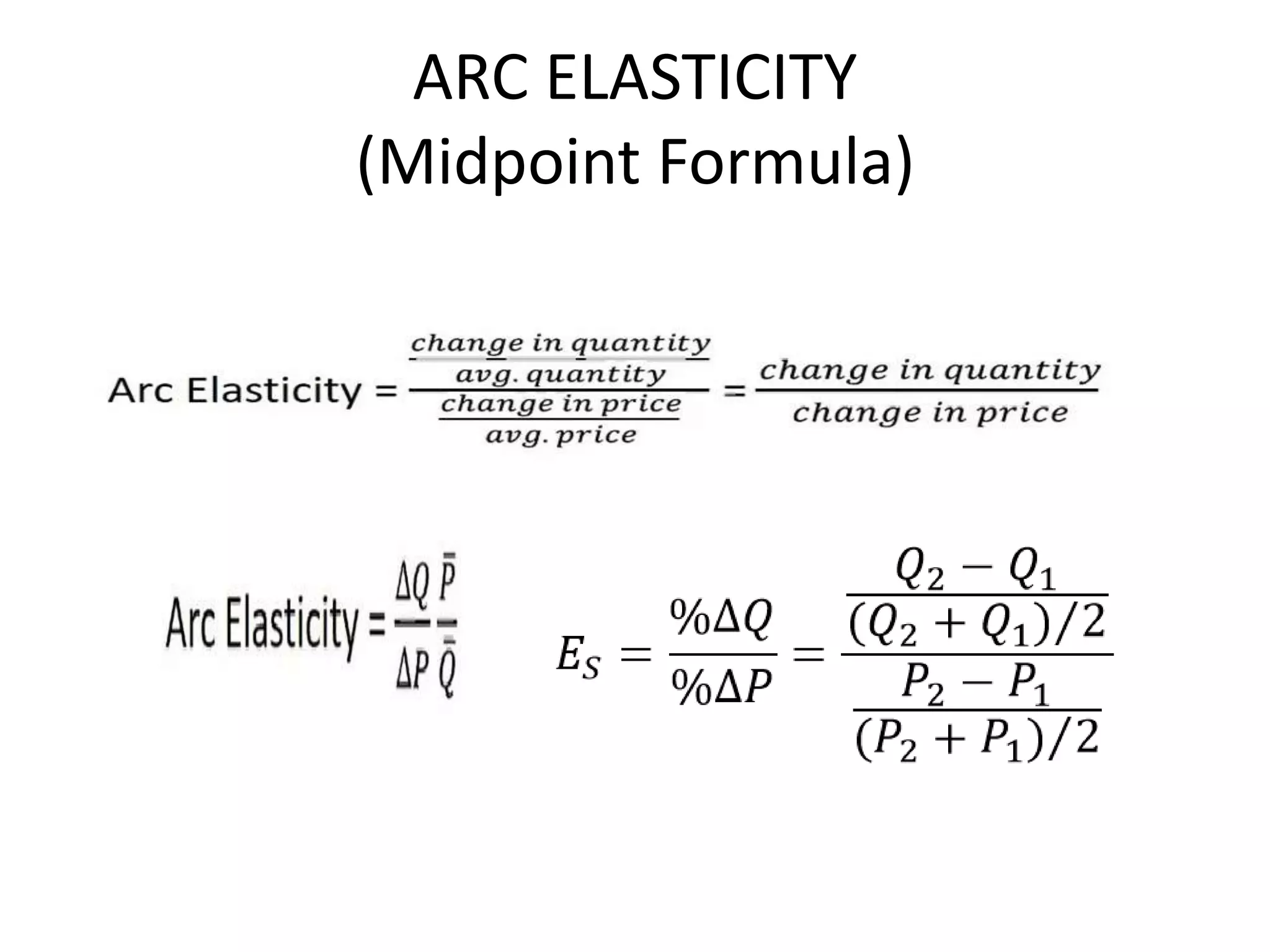
ARC ELASTICITY
(Midpoint Formula)
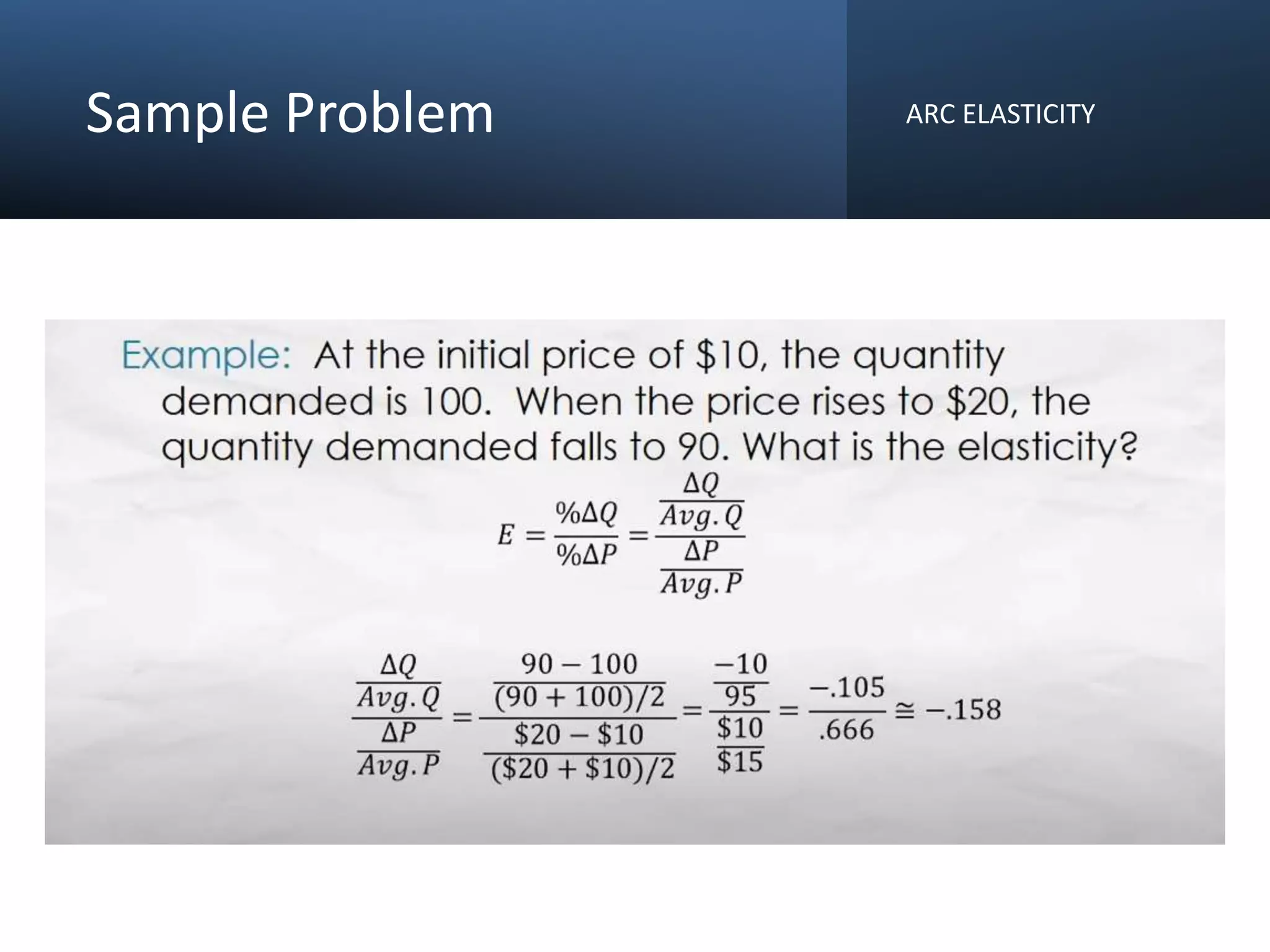
Sample Problem ARC ELASTICITY
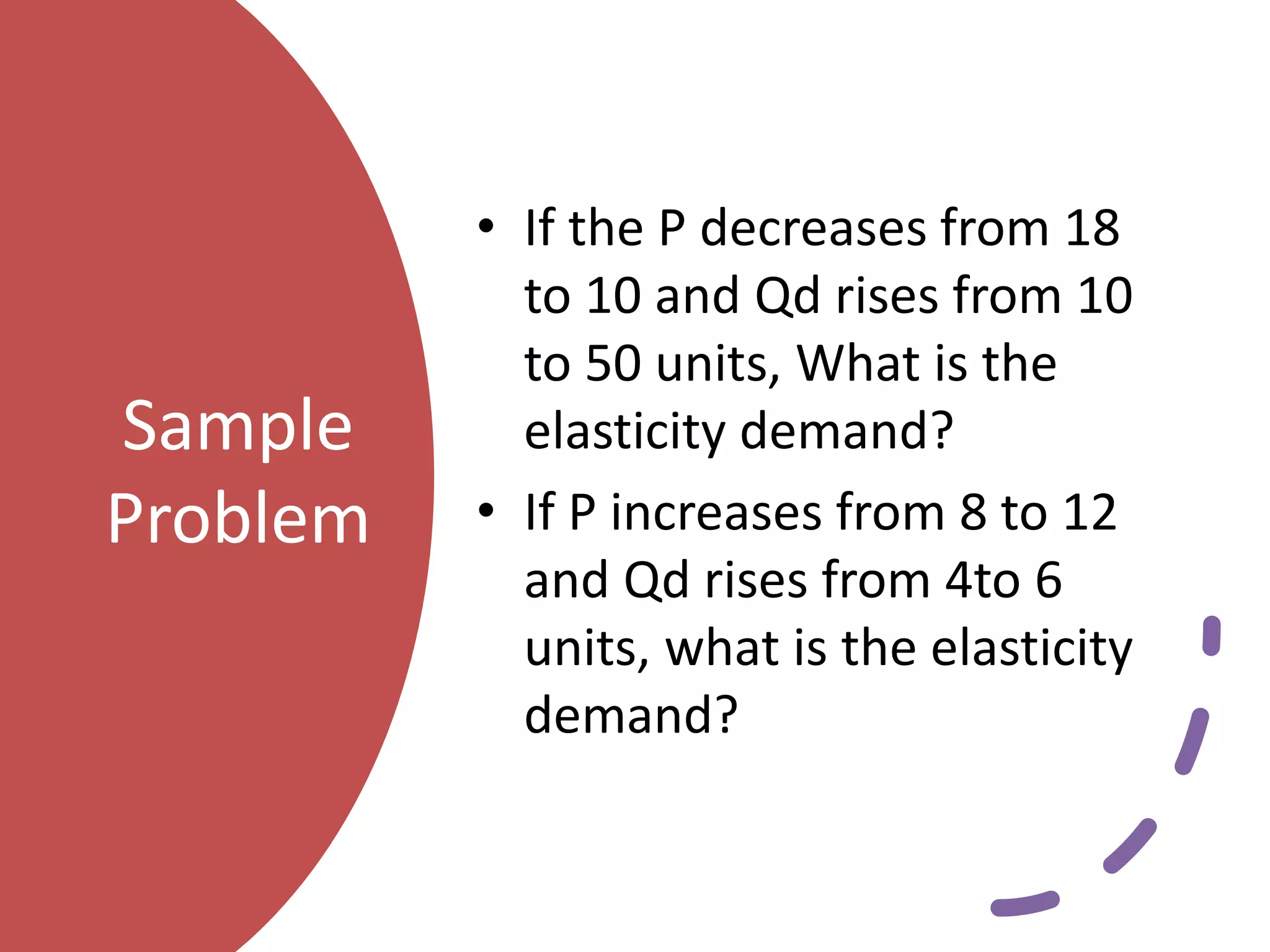
Sample
Problem
• If the P decreases from 18
to 10 and Qd rises from 10
to 50 units, What is the
elasticity demand?
• If P increases from 8 to 12
and Qd rises from 4to 6
units, what is the elasticity
demand?
Question?

Economics-Elasticity.pptx

  • 1.
    Price and ArcElasticity
  • 3.
    Overview • Elasticity • Typesof Elasticity • Price Elasticity * Price Elasticity of Demand * Classification of Price Elasticity Demand * Determinants of Price Elasticity Demand
  • 4.
    Elasticity • In Economics,the concept of elasticity measures the responsiveness of one variable to a certain change of another variable. • Two significant words: “Measure”, reported as numbers or coefficients, and “ responsiveness”, meaning reaction to change (Sensitive). • Thus, any change causes people to react, and elasticity measures this extent to which the people react. • Proportional measures or percentage change in the variables measures the responsiveness of consumers and producers.
  • 5.
    Price Elasticity ofDemand • Price elasticity of demand is a measure of how much the quantity demanded of a good responds to a change in the price of that good Demand Price
  • 6.
    Graphical illustration ofPoint Elasticity
  • 7.
    Computing the PriceElasticity of Demand • The price elasticity of demand is computed as the percentage change in the quantity demanded divided by the percentage change in price. Price elasticity of demand = Percentage change in quantity demanded Percentage change in price
  • 8.
    Types of Elasticity •Elastic - The percentage change in variable x is greater than the percentage change in variable y. It is said to be elastic whenever the elasticity coefficient is greater than 1 (Ɛ>1). • Inelastic – The percentage change in variable x is less than the percentage change in variable y. when elasticity coefficient is less than 1, it is said to be inelastic (Ɛ<1). • Unitary elasticity – The percentage change in variable x is equal to the percentage change in variable y when the coefficient is equal to 1 (Ɛ=1).
  • 9.
    Elastic, Inelastic andUnit • If the PED is greater than one, the good is price elastic. Demand is responsive to a change in price. If for example a 15% fall in price leads to a 30% increase in quantity demanded, the price elasticity = 2.0 • If the PED is less than one, the good is inelastic. Demand is not very responsive to changes in price. If for example a 20% increase in price leads to a 5% fall in quantity demanded, the price elasticity = 0.25 • If the PED is equal to one, the good has unit elasticity. The percentage change in quantity demanded is equal to the percentage change in price. Demand changes proportionately to a price change.
  • 10.
    Computing the PriceElasticity of Demand • Mathematically: Q2-Q1 Q1 ƐD = ------------ P2-P1 P1
  • 11.
    Sample Problem • ComputePED from Point A to E. • Compute PED from Point E to A. • Identify the types of Elasticity Demand.
  • 12.
    Hypothetical Data ofPoint and Arc Elasticity Table 1 Points Price of Good x (Px) Quantity Demanded of Good x (Qdx) A 4 700 B 5 475 C 9 430 D 12 400 E 15 393 F 20 344 G 26 310 H 30 300 I 39 150
  • 13.
    Points Elasticity Points A-EPoints E-A 393-700 = 700 15-4 4 = -307 700 11 4 = -0.44 2.75 = /.16/-inelastic 700-393 = 393 4-15 15 = 307 393 -11 15 = -0.78 0.73 = /1.07/-elastic
  • 14.
    Sample Problem • Aldenadvertises to sell cookies for P4 a dozen. He sells 50 / dozen, and decides that he can charge more. He raises the price to P6 a dozen and sells 40 / dozen. What is the elasticity of demand? • assume the price decreased from P6 to P4—and the quantity demanded decreased from 50 to 40, the Ped will be:
  • 15.
  • 16.
  • 17.
    Demand Determinants • SUBSTITUTES Goods thatcan serve as replacements for one another; when the price of one increases, demand for the other increases. • PERFECT SUBTITUTES Identical products. • COMPLEMENTS / COMPLEMENTARY GOODS Goods that “go together”; a decrease in the price of one results in an increase in demand for the other and vice versa.
  • 18.
    Demand Determinants • TASTEAND PREFERENCES refers an individual’s attitude towards a set of objects, typically reflected in an explicit decision-making process. • EXPECTATIONS Your beliefs about future income or prices will affect your current purchasing decisions. • LAW OF DIMINISHING MARGINAL UTILITY Decline in the marginal utility that person derives from consuming each additional unit of that product.
  • 19.
    Market demand The sumof all the quantities of a good or service demanded per period by all the households buying in the market for that good or service.
  • 20.
    Supply Determinants • COSTOF PRODUCTION  Depends on a number of factors, including the available technologies and the prices and quantities of the inputs needed by the firm (labor, land, capital, energy, and so on). • PRICES OF RELATED PRODUCTS  The cost of producing the product, which in turn depends on:  The price of required inputs (labor, capital, and land).  The technologies that can be used to produce the product.
  • 21.
    Market supply MARKET SUPPLYis the sum of all that is supplied each period by all producers of a single product.
  • 22.
  • 23.
    What is ArcElasticity?
  • 24.
    What is Arc Elasticity In mathematicsand economics, the arc elasticity is the elasticity of one variable with respect to another between two given points. It is the ratio of the percentage change of one of the variables between the two points to the percentage change of the other variable. It contrasts with the point elasticity, which is the limit of the arc elasticity as the distance between the two points approaches zero and which hence is defined at a single point rather than for a pair of points.
  • 25.
    Graphical illustration ofPoint Elasticity
  • 26.
  • 27.
  • 28.
    Sample Problem • If theP decreases from 18 to 10 and Qd rises from 10 to 50 units, What is the elasticity demand? • If P increases from 8 to 12 and Qd rises from 4to 6 units, what is the elasticity demand?
  • 29.