Money Market
• MoneyMarket is a segment of the financial market in India where
borrowing and lending of short-term funds take place.
• The maturity of money market instruments is from one day to one
year.
• In India, this market is regulated by both RBI (the Reserve bank of
India) and SEBI (the Security and Exchange Board of India).
• The nature of transactions in this market is such that they are large in
amount and high in volume. Thus, we can say that the entire market is
dominated by a small number of large players.
3.
Objectives of themoney market in India
Objectives of the money
market in India
Facilitate a parking place to
employ short-term surplus
funds.
Aid room for overcoming
short-term deficits.
To enable the Central Bank
to influence and regulate
liquidity in the economy
through its intervention in
this market.
Help reasonable access to
users of short-term funds to
meet their requirements
quickly, adequately and at
reasonable costs.
4.
Segments of theIndian money market
• The unorganized money market is an old and ancient market, mainly it made of
indigenous bankers and money lenders, etc.
Unorganized
market
• The organized money market is that part which comes under the regulatory ambit of RBI
& SEBI.
• Governments (Central and State), Discount and Finance House of India (DFHI), Mutual
Funds, Corporate, Commercial or Cooperative Banks, Public Sector Undertakings,
Insurance Companies, and Financial Institutions and Non-Banking Financial Companies
(NBFCs) are the key players of the organized Indian money market.
Organized
money-
markets
5.
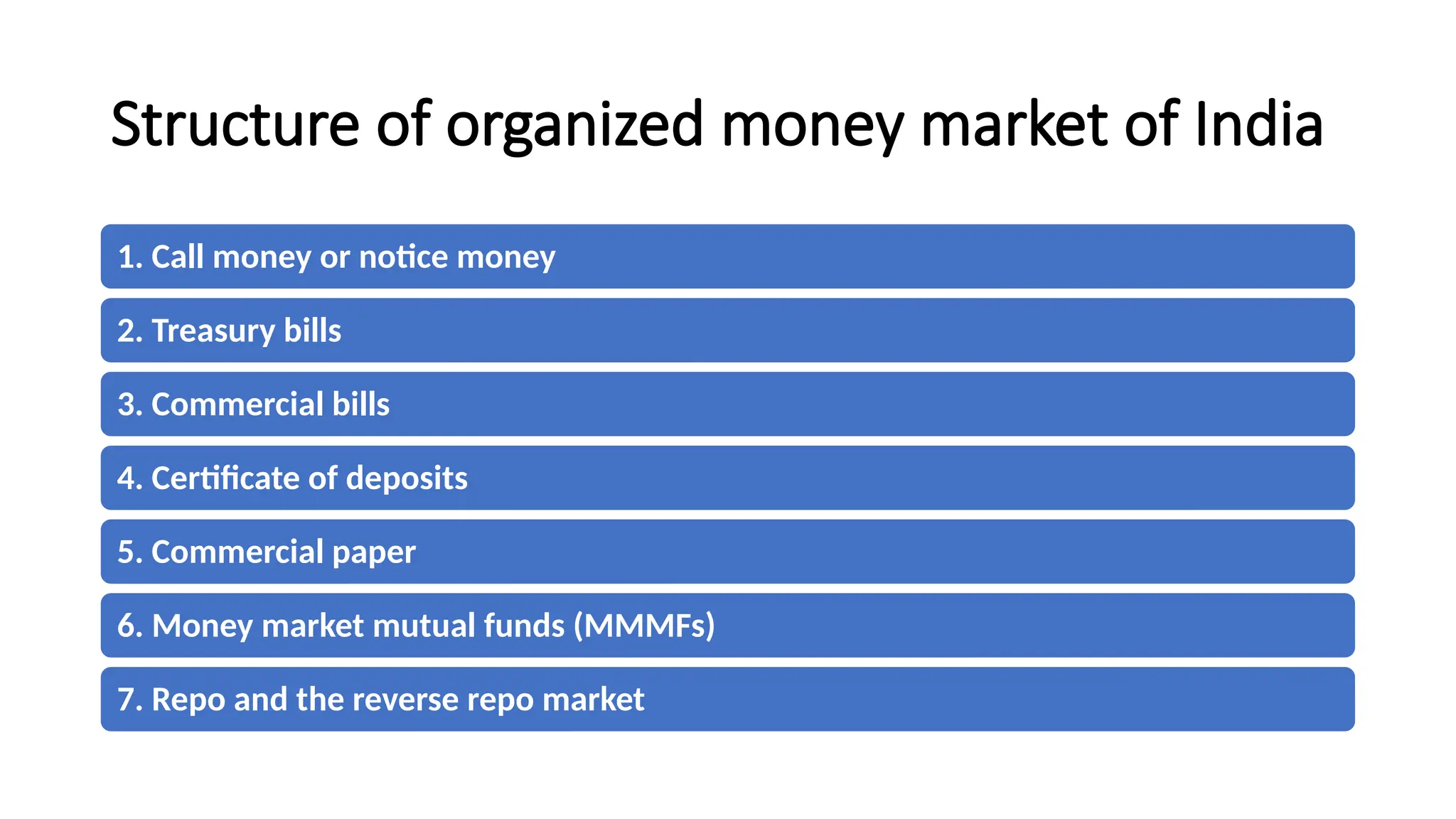
Structure of organizedmoney market of India
1. Call money or notice money
2. Treasury bills
3. Commercial bills
4. Certificate of deposits
5. Commercial paper
6. Money market mutual funds (MMMFs)
7. Repo and the reverse repo market
6.
Call money ornotice money
• Call money, notice money, and term money markets are sub-markets
of the Indian money market. These markets provide funds for very
short-term. Lending and borrowing from the call money market for 1
day.
• Whereas lending and borrowing of funds from notice money market
are for 2 to 14 days. And when there are borrowing and lending of
funds for the tenor of more than 14 days, it refers to “Term Money”.
7.
Treasury bills
• TheBill market is a sub-market of this market in India. There are two
types of the bill in the money market. They are treasury bills and
commercial bill. The treasury bills are also known as T-Bills, T-bills are
issued by the Central bank on behalf of Government, whereas
Commercial Bills are issued by Financial Institutions.
• Treasury bills do not yield any interest, but it is issued at discount and
repaid at par at the time of maturity. In T-bills there is no risk of
default; it is a safe investment instrument.
8.
Commercial bills
• Commercialbill is a money market instrument which is similar to the
bill of exchange; it is issued by a Commercial organization to raise
money for short-term needs.
• In India, the participants of the commercial bill market are banks and
financial institutions.
9.
Certificate of deposits
•Certificate of Deposits also known as CDs. It is a negotiable money
market instrument. It is like a promissory note. Rates, terms, and
amounts vary from institution to institution. CDs are not supposed to
trade publically neither it is traded on any exchange.
• In general institutions issue certificate of deposit at discount on its
face value. The banks and financial institutions can issue CDs on a
floating rate basis.
10.
Commercial paper
• Thecommercial paper is another money market instrument in India.
We also call commercial paper as CP.
• CP refers to a short-term unsecured money market instrument.
• Big corporations with good credit rating issue commercial paper as a
promissory note.
• There is no collateral support for CPs. Hence, only large firms with
considerable financial strength can issue the instrument.
11.
Money market mutualfunds (MMMFs)
• The money-market mutual funds were introduced by RBI in 1992 and
since 2000 they are brought under the regulation of SEBI.
• It is an open-ended mutual fund which invests in short-term debt
securities.
• This kind of mutual fund solely invests in instruments of the money
market.
12.
Repo and thereverse repo market
• Repo means “Repurchase Agreement”. It exists in India since
December 1992.
• REPO means selling a security under an agreement to repurchase it at
a predetermined date and rate.
• Those who deal in government securities they use the repo as an
overnight borrowings.
13.
Features of theIndian money market
The money market is purely for short-term funds or assets called near money.
All the instruments of the money market deal only with financial assets that are financial in nature. Also, such instruments have
maturity period up to one year.
It deals assets that can convert into cash readily without much loss and with minimum transaction cost.
Generally, transactions take place through oral communication (for eg. phone or mobile). The exchange of relevant documents and
written communications take place subsequently. There is no formal place for the trading ( like a stock exchange).
Brokers free transactions are there.
The components of a money market are the Central Bank, Commercial Banks, Non-banking financial companies, discount houses,
and acceptance house. Commercial banks are dominant player of this market.