E-commerce Payment Systems
Chapter 5
What is Online Electronic Payment
 An electronic payment system (EPS) also known
as electronic currency, broadly speaking, refer to
a transaction in the online exchange of funds;
 is a system of financial exchange between
buyers and sellers in the online environment
that is facilitated by a digital financial
instrument (such as encrypted credit card
numbers, electronic checks, or digital cash) backed
by a bank, an intermediary, or by legal tender.
What is Online Electronic Payment
(contd.)
 Electronic Payment System is the basis for
online payments, and online payments system
development is a higher form of electronic
payment.
 It means electronic payment may, at any time,
through the Internet directly to the transfer,
settlement and form e-business environment.
Electronic Payments Benefits
Electronic payments can benefit our business by:
 extending our customer base;
 boosting (increasing) cash flow;
 reducing costs;
 enhancing customer service
 improving your competitive advantage.
Five reasons why Electronic payments
improve customer service
 Choice – like our competitors, we can offer a wide range of
payment options
 Convenience – they remove the need for invoices(bill)
cheques, cash
 Credit – they may allow purchases that would otherwise be
delayed
 Concessions – small discounts to encourage online
purchases improve the perception of value
 Competitive Edge - if we don’t offer the full range of
payment options but your competitors do, what does this
say about your business?
Five reasons why Electronic payments
increase profitability
 Convenience – removing administrative resources
required by invoices, cheques and cash
 Immediacy – credit cards enable instant
purchasing (without delay)
 Improved cash flow – payment at the time of
purchase reduces the pressures caused by 30-day
invoicing
 Growth – open additional payment channels via the
phone, mail order and Internet and increase your
customer base. More customers mean more
revenue(income).
 Competitive advantage – match and beat the
services of your competitors and gain the edge
Electronic Payment Methods
 Innovations affecting consumers, include credit
and debit cards, automated teller machines (ATMs),
stored value cards, and e-banking.
 Innovations enabling online commerce are e-
cash, e-checks, smart cards, and encrypted credit
cards. These payment methods are not too popular
in developing countries. They are employed by a few
large companies in specific secured channels on a
transaction basis.
 Innovations affecting companies pertain to
payment mechanisms that banks provide their
clients, including inter-bank transfers through
automated clearing houses allowing payment by
direct deposit.
Available payment methods
 Credit Card
 Debit Card
 Smart Card
 E-Money
 Electronic Fund Transfer (EFT)
Credit Card
 Payment using credit card is one of most common
mode of electronic payment.
 Credit card is small plastic card with a unique number
attached with an account.
 It has also a magnetic strip embedded in it which is
used to read credit card via card readers.
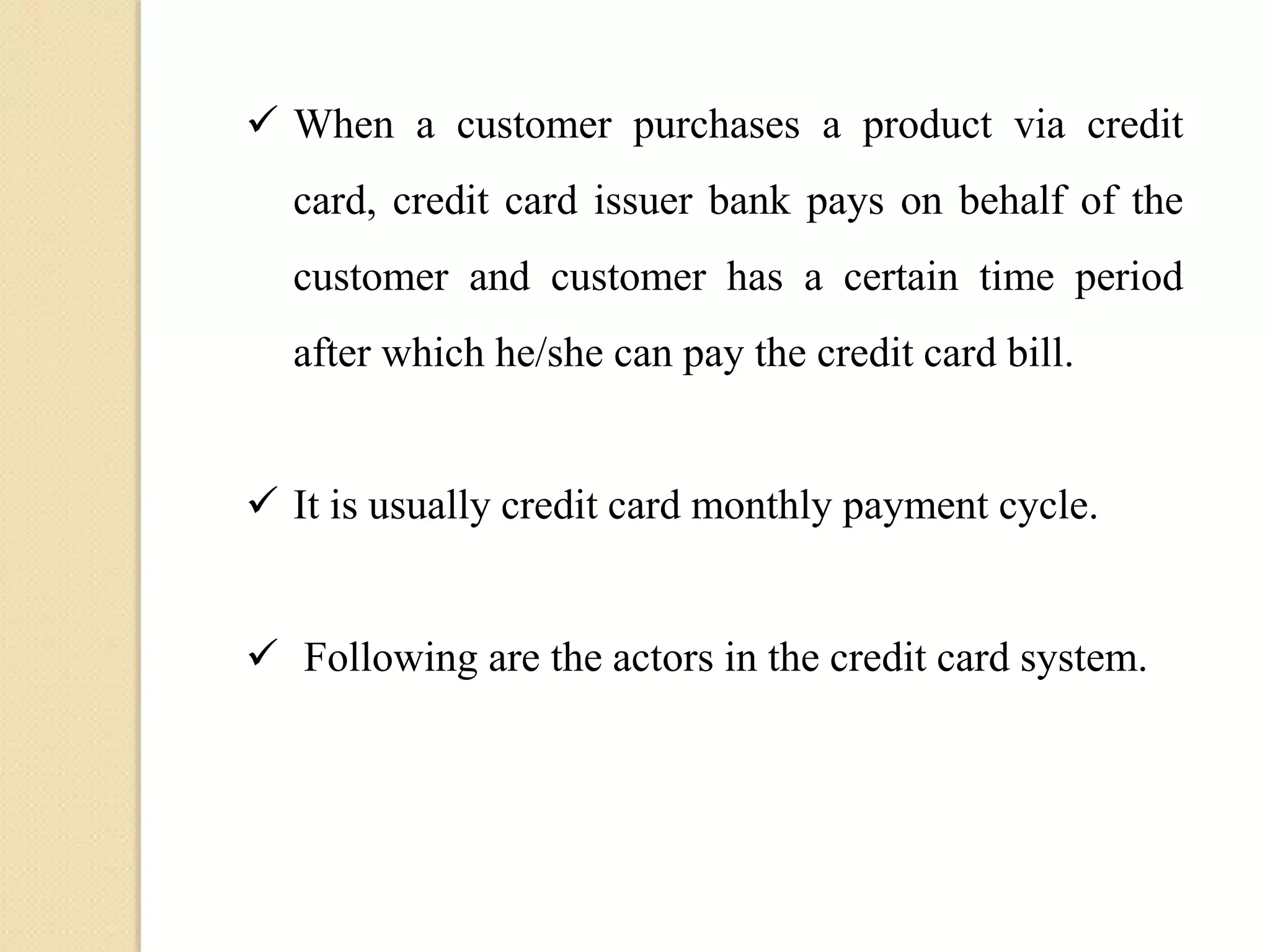
 When a customer purchases a product via credit
card, credit card issuer bank pays on behalf of the
customer and customer has a certain time period
after which he/she can pay the credit card bill.
 It is usually credit card monthly payment cycle.
 Following are the actors in the credit card system.
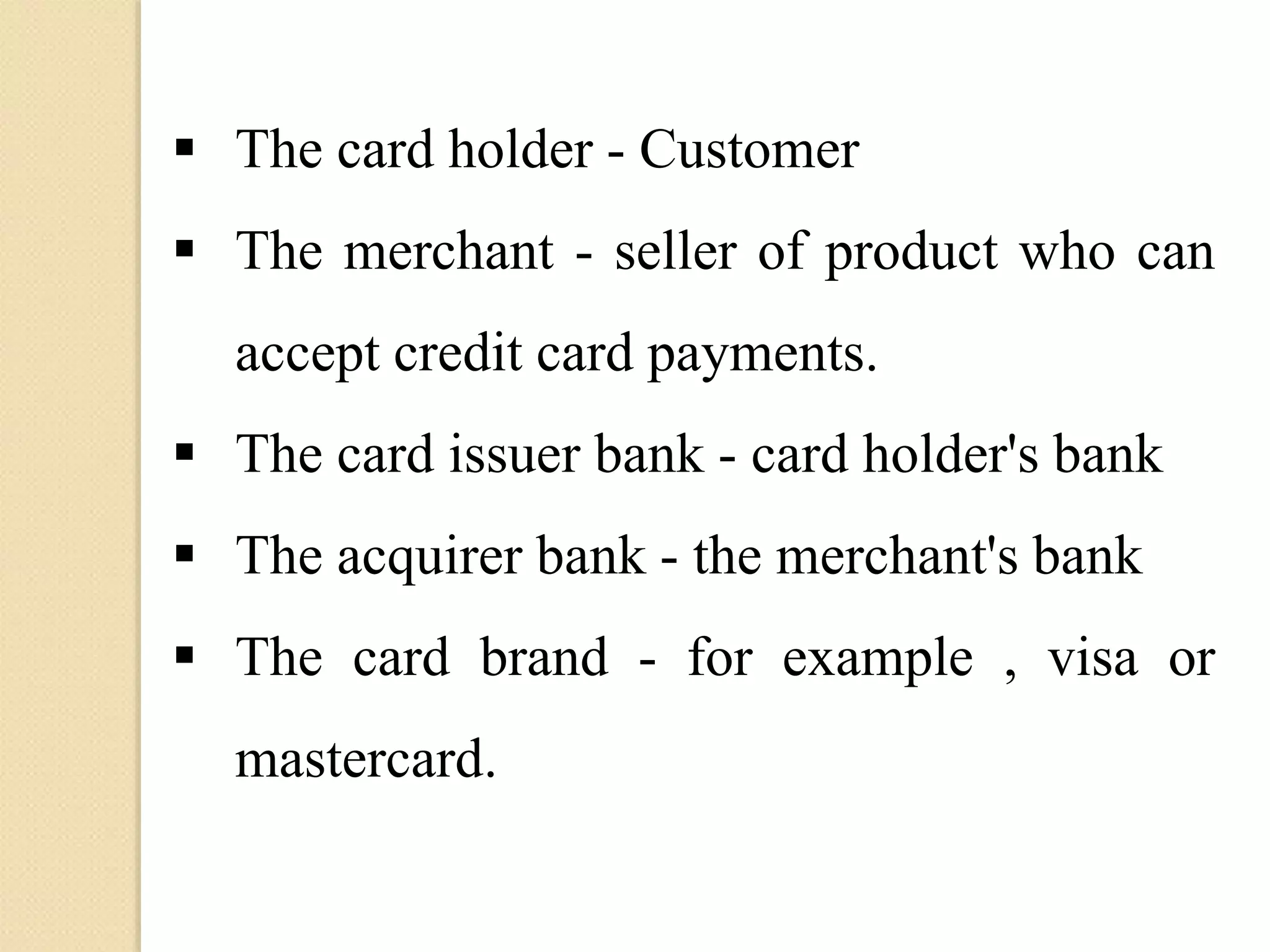
 The card holder - Customer
 The merchant - seller of product who can
accept credit card payments.
 The card issuer bank - card holder's bank
 The acquirer bank - the merchant's bank
 The card brand - for example , visa or
mastercard.
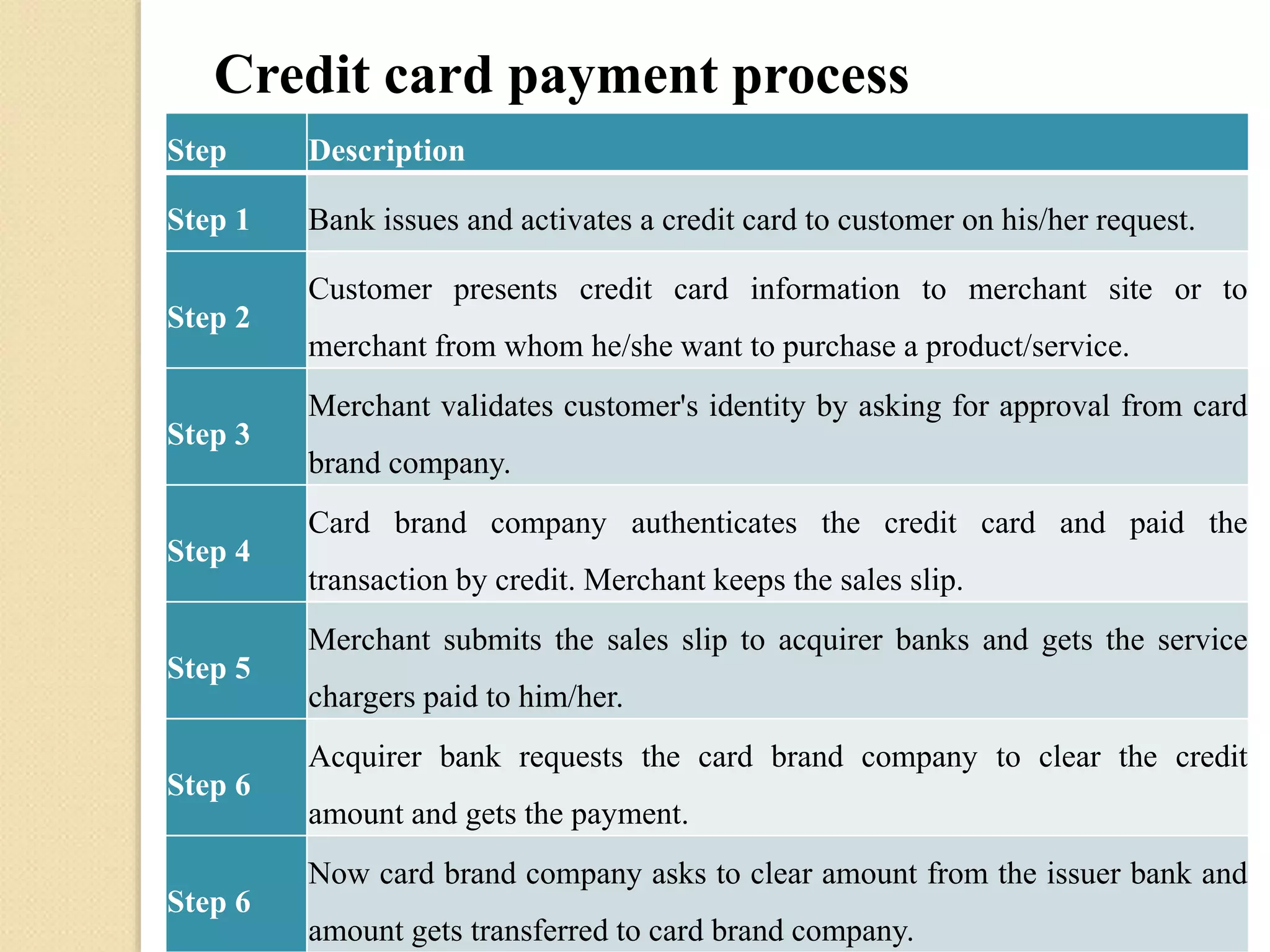
Credit card payment process
Step Description
Step 1 Bank issues and activates a credit card to customer on his/her request.
Step 2
Customer presents credit card information to merchant site or to
merchant from whom he/she want to purchase a product/service.
Step 3
Merchant validates customer's identity by asking for approval from card
brand company.
Step 4
Card brand company authenticates the credit card and paid the
transaction by credit. Merchant keeps the sales slip.
Step 5
Merchant submits the sales slip to acquirer banks and gets the service
chargers paid to him/her.
Step 6
Acquirer bank requests the card brand company to clear the credit
amount and gets the payment.
Step 6
Now card brand company asks to clear amount from the issuer bank and
amount gets transferred to card brand company.
Debit Card
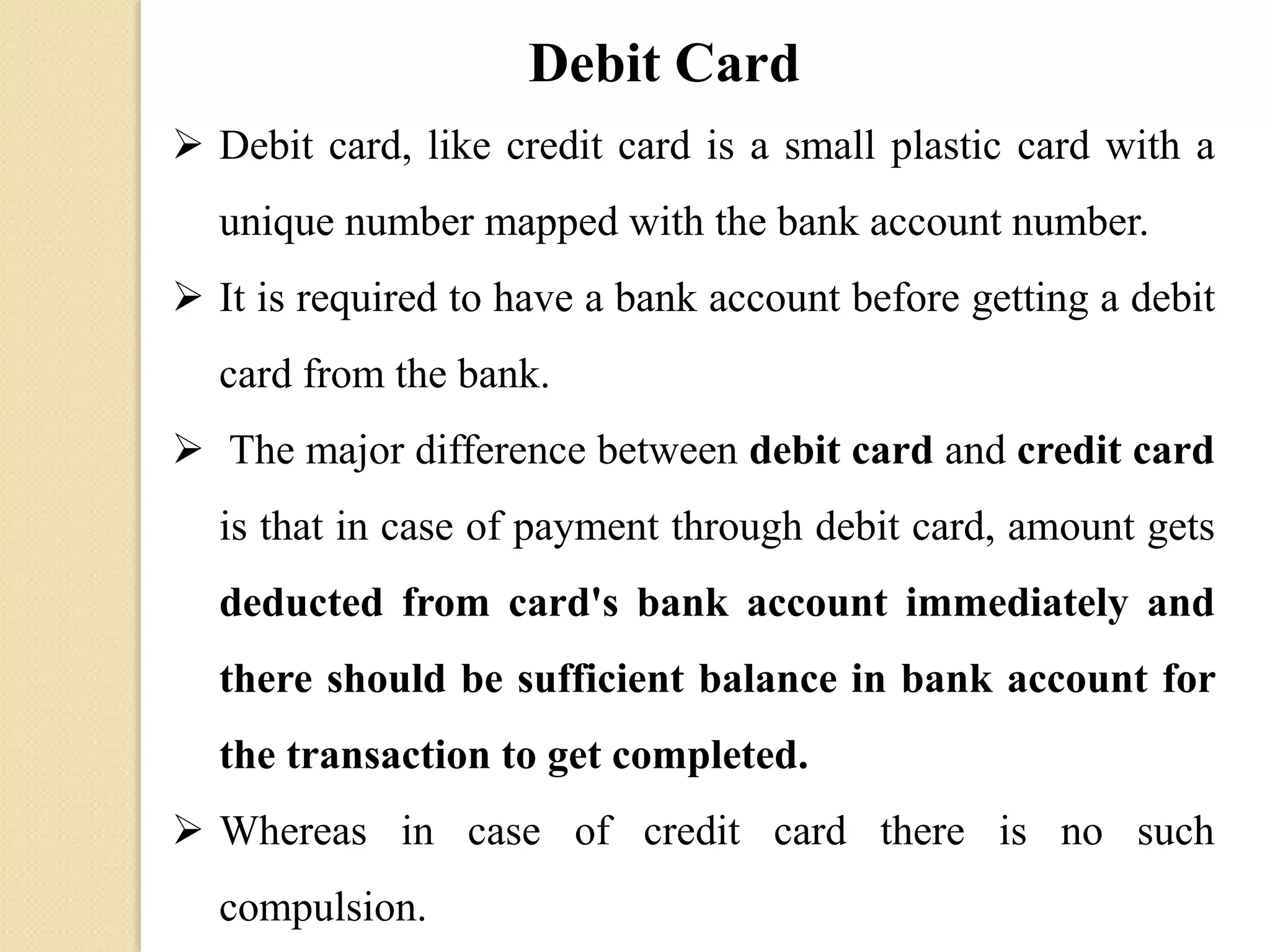
 Debit card, like credit card is a small plastic card with a
unique number mapped with the bank account number.
 It is required to have a bank account before getting a debit
card from the bank.
 The major difference between debit card and credit card
is that in case of payment through debit card, amount gets
deducted from card's bank account immediately and
there should be sufficient balance in bank account for
the transaction to get completed.
 Whereas in case of credit card there is no such
compulsion.
Debit cards free customer to carry cash, cheques and even
merchants accepts debit card more readily.
Having restriction on amount being in bank account also
helps customer to keep a check on his/her spending.
Smart Card
Smart card is again similar to credit card and debit card in
apperance but it has a small microprocessor chip embedded
in it.
It has the capacity to store customer work related/personal
information.
Smart card is also used to store money which is reduced as
per usage.
 Smart card can be accessed only using a PIN of
customer.
 Smart cards are secure as they stores information in
encrypted format and are less expensive/provides faster
processing.
 Mondex and Visa Cash cards are examples of smart
cards.
E-Money
E-Money transactions refers to situation where payment is
done over the network and amount gets transferred from one
financial body to another financial body without any
involvement of a middleman.
E-money transactions are faster, convenient and saves a lot
of time.
Online payments done via credit card, debit card or smart
card are examples of e-money transactions.
Another popular example is e-cash. In case of e-cash, both
customer and merchant both have to sign up with the bank
or company issuing e-cash.
E-Cash (Electronic-cash) Internet Payment
Online payments via debit cards, credit cards or smart
card are the examples of e-money transactions.
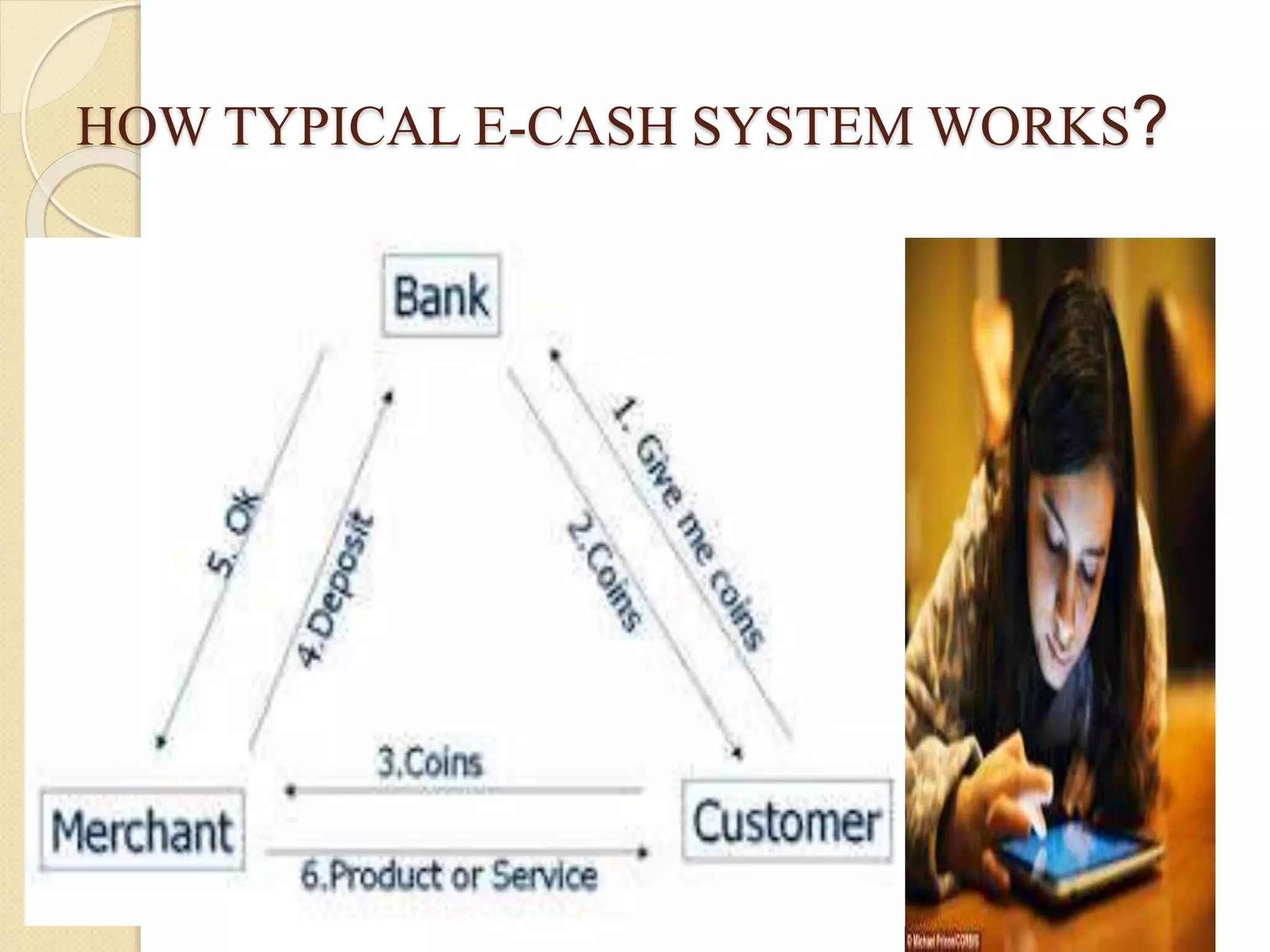
E Cash is transferred directly from customer’s desktop
to the merchant’s site.
HOW TYPICAL E-CASH SYSTEM WORKS?
E-cash and e-payment systems
E-cash and e-payment systems also have the
advantage of cash, mainly as follows:
 Anonymity (facelessness);
 Not shadowing (investigation);
 Savings on transaction costs;
 Savings on transmission costs;
 Less risk;
 Pay flexibility;
 Prevent forgery and repeatability
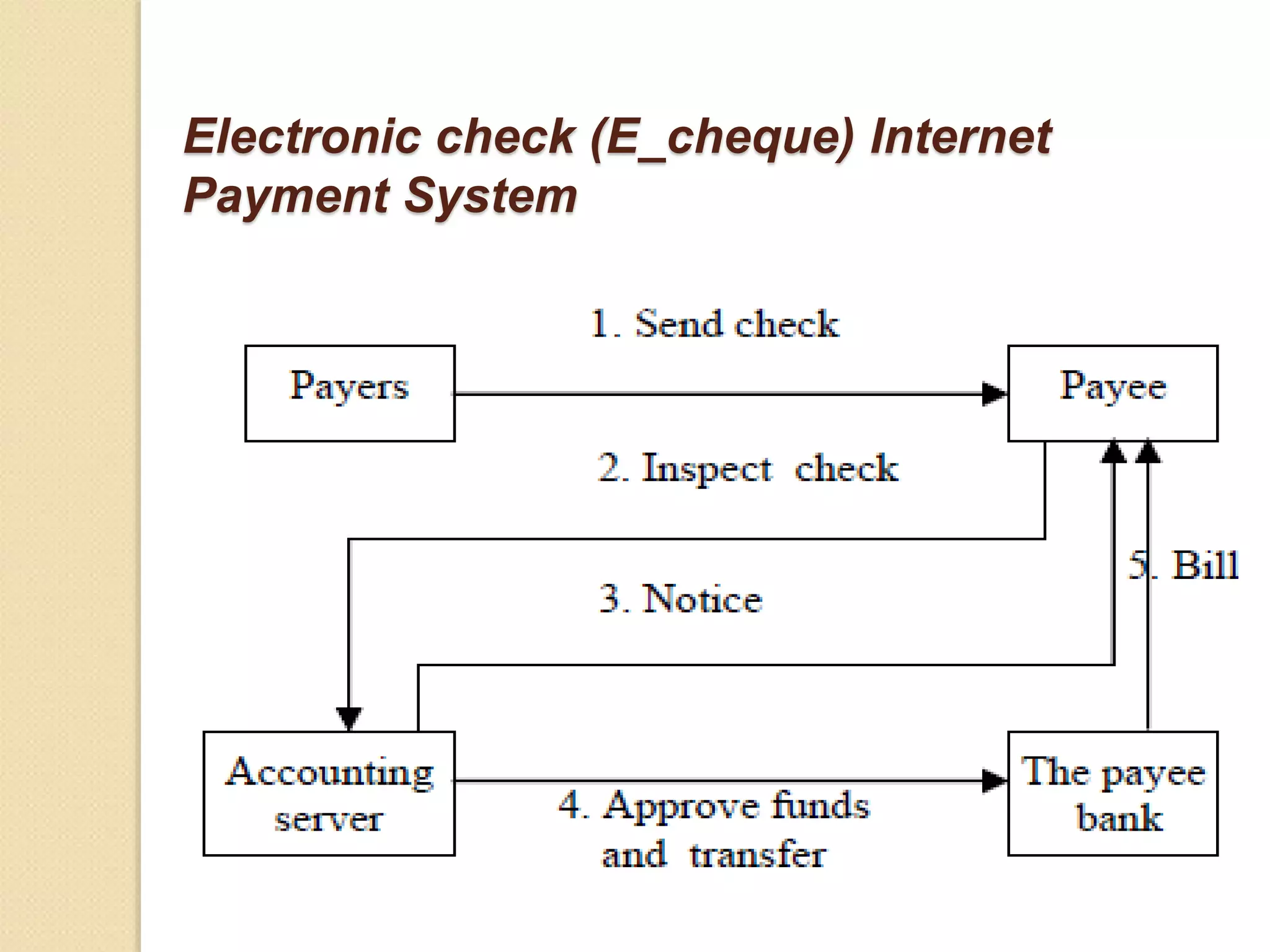
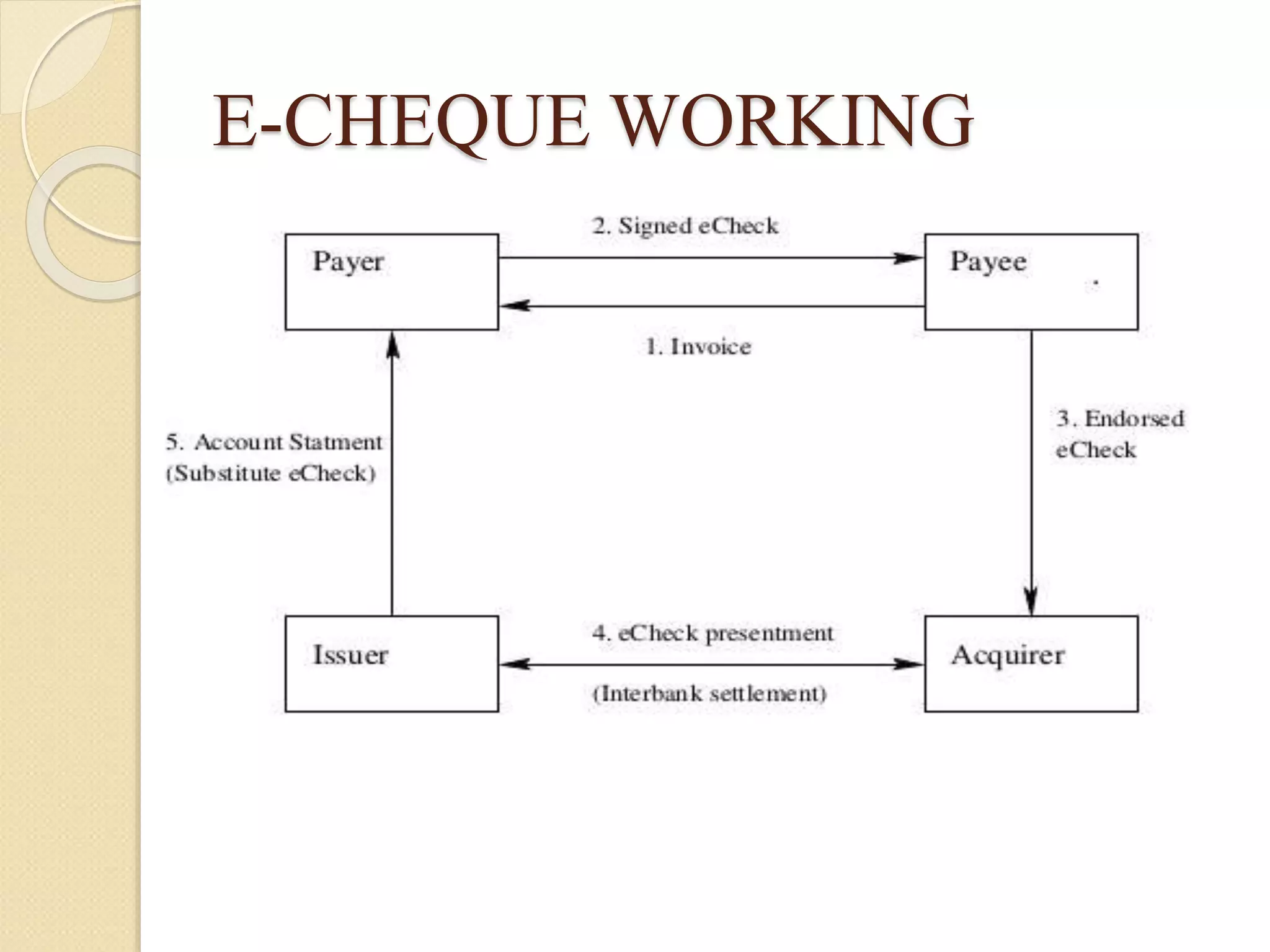
Electronic check (E_cheque) Internet
Payment System
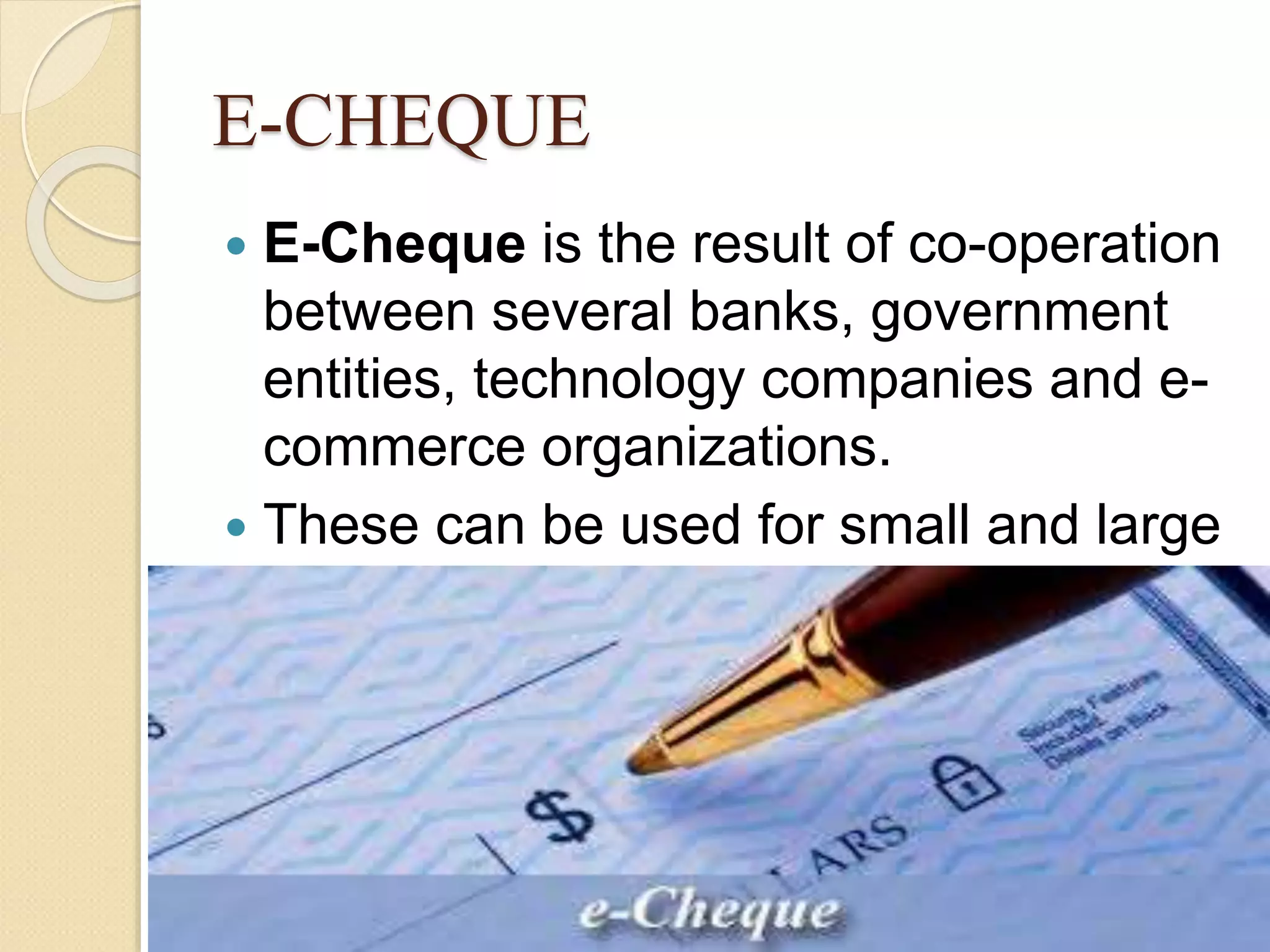
E-CHEQUE
 E-Cheque is the result of co-operation
between several banks, government
entities, technology companies and e-
commerce organizations.
 These can be used for small and large
organizations
E-CHEQUE WORKING
BENEFITS OF ELECTRONIC
PAYMENT SYSTEM
BENEFIT TO
BUYERS
BENEFITS TO
SELLERS
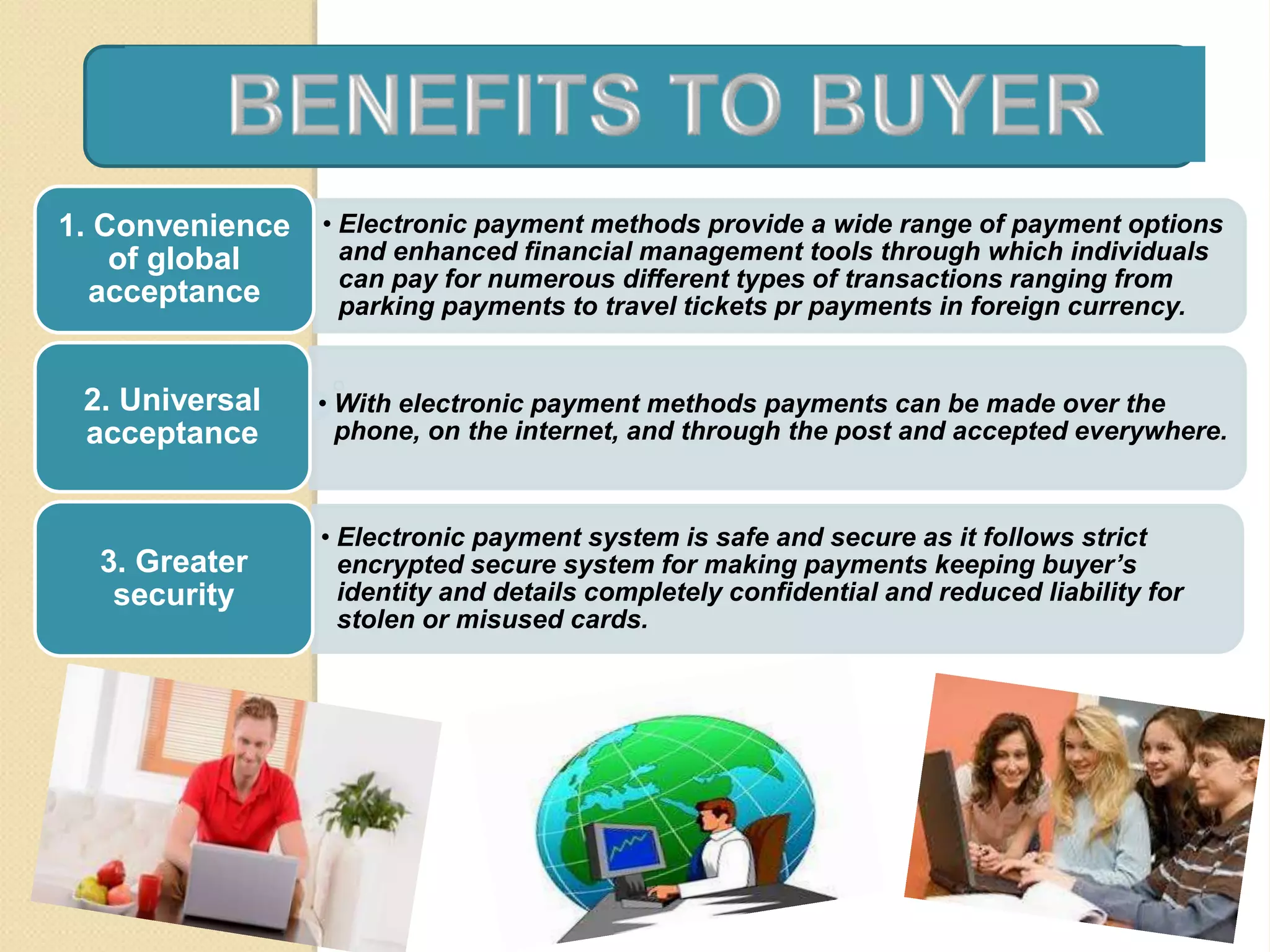
• Electronic payment methods provide a wide range of payment options
and enhanced financial management tools through which individuals
can pay for numerous different types of transactions ranging from
parking payments to travel tickets pr payments in foreign currency.
1. Convenience
of global
acceptance
• With electronic payment methods payments can be made over the
phone, on the internet, and through the post and accepted everywhere.
2. Universal
acceptance
• Electronic payment system is safe and secure as it follows strict
encrypted secure system for making payments keeping buyer’s
identity and details completely confidential and reduced liability for
stolen or misused cards.
3. Greater
security
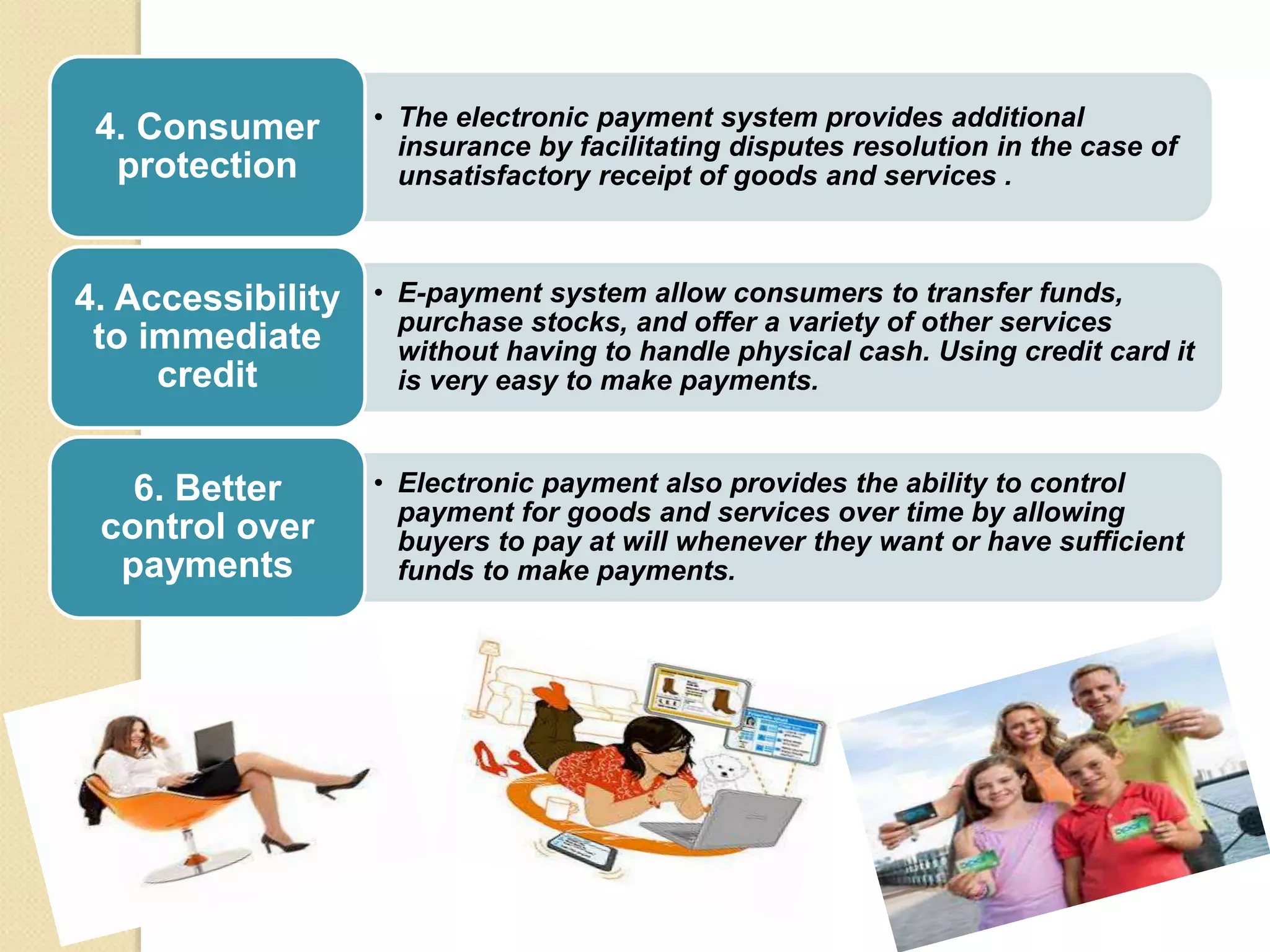
• The electronic payment system provides additional
insurance by facilitating disputes resolution in the case of
unsatisfactory receipt of goods and services .
4. Consumer
protection
• E-payment system allow consumers to transfer funds,
purchase stocks, and offer a variety of other services
without having to handle physical cash. Using credit card it
is very easy to make payments.
4. Accessibility
to immediate
credit
• Electronic payment also provides the ability to control
payment for goods and services over time by allowing
buyers to pay at will whenever they want or have sufficient
funds to make payments.
6. Better
control over
payments
BENEFITS TO SELLERS
• EPS ensure faster processing of transaction from
verification and authorization to clearing and
settlement . It reduces the visibility of information.
1. Speed and
security
• EPS provides companies freedom from more costly
labour, materials and accounting services hat are
require in paper based processing.
2. Reduces cost
• It leads to better management of cash flow, inventory
and financial planning due to swift bank payment.
3. Efficiency
• When used properly the electronic aspects of purchasing
and prepaid cards can increase internal controls over
high volumes .
4. Better control
Online payment risk assessment
 Charge-backs – the risk of refunds on our merchant
account;
 Forecast turnover figures – higher turnover can
generate higher exposure;
 Average transaction size – if we sell very high
value items (diamonds, cars) this will influence the
risk analysis of our business;
 Time from payment to order fulfillment – The
longer it takes to dispatch goods to a customer, the
greater the risk of an order cancellation;
 Length of trading record – a start-up company
presents more risk than a well established business;
Risks in Electronic Payment systems:
Customer's risks
 Stolen credentials or password – Dishonest
merchant – Disputes over transaction –
Inappropriate use of transaction details
Merchant‘s risk
 Forged or copied instruments
 Doubtful charges
 Insufficient funds in customer‘s account
 Unauthorized redistribution of purchased items
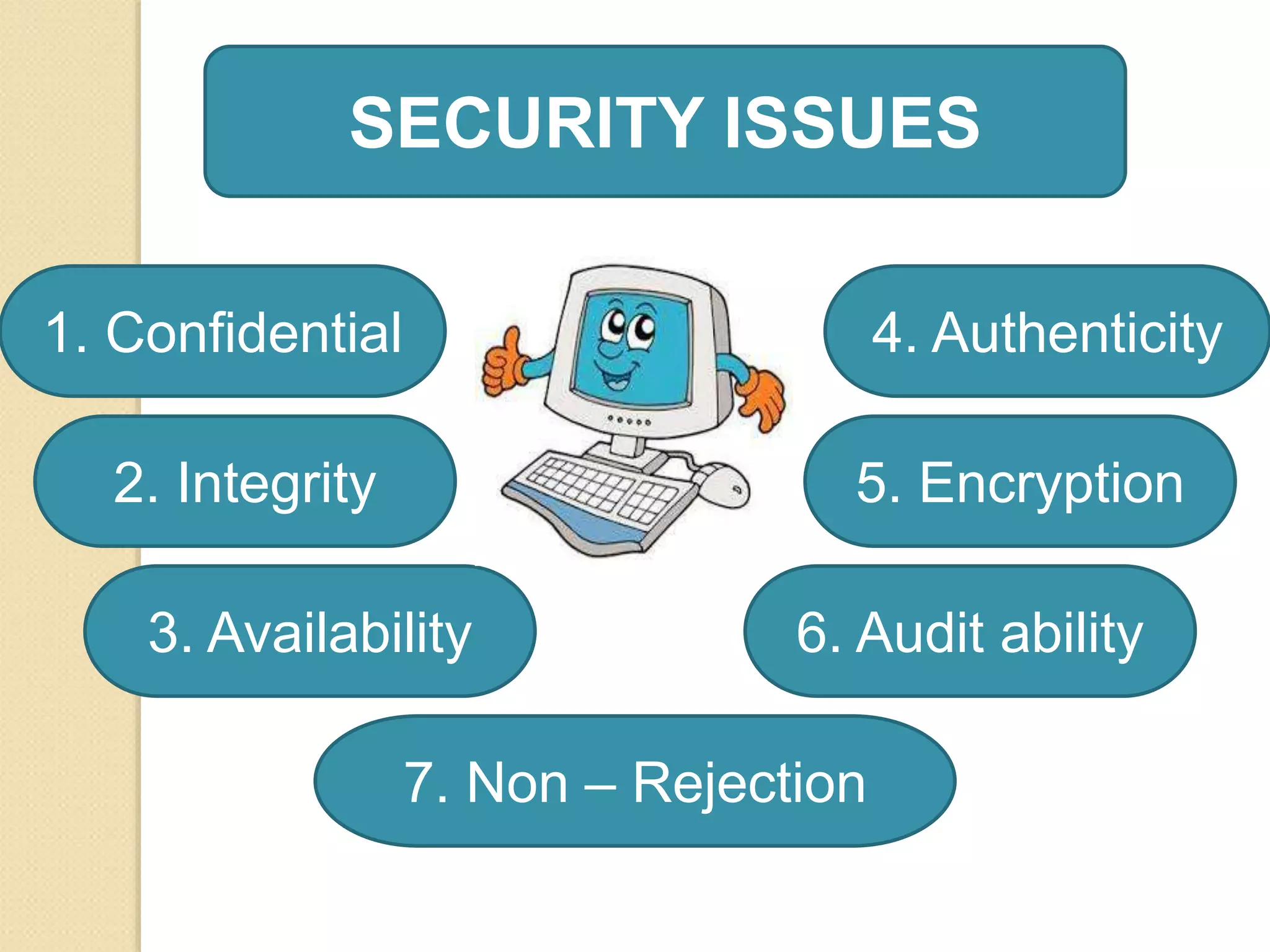
SECURITY ISSUES
1. Confidential
2. Integrity
3. Availability
5. Encryption
4. Authenticity
6. Audit ability
7. Non – Rejection

Ecommerce_Ch5.ppt

  • 1.
  • 2.
    What is OnlineElectronic Payment  An electronic payment system (EPS) also known as electronic currency, broadly speaking, refer to a transaction in the online exchange of funds;  is a system of financial exchange between buyers and sellers in the online environment that is facilitated by a digital financial instrument (such as encrypted credit card numbers, electronic checks, or digital cash) backed by a bank, an intermediary, or by legal tender.
  • 3.
    What is OnlineElectronic Payment (contd.)  Electronic Payment System is the basis for online payments, and online payments system development is a higher form of electronic payment.  It means electronic payment may, at any time, through the Internet directly to the transfer, settlement and form e-business environment.
  • 4.
    Electronic Payments Benefits Electronicpayments can benefit our business by:  extending our customer base;  boosting (increasing) cash flow;  reducing costs;  enhancing customer service  improving your competitive advantage.
  • 5.
    Five reasons whyElectronic payments improve customer service  Choice – like our competitors, we can offer a wide range of payment options  Convenience – they remove the need for invoices(bill) cheques, cash  Credit – they may allow purchases that would otherwise be delayed  Concessions – small discounts to encourage online purchases improve the perception of value  Competitive Edge - if we don’t offer the full range of payment options but your competitors do, what does this say about your business?
  • 6.
    Five reasons whyElectronic payments increase profitability  Convenience – removing administrative resources required by invoices, cheques and cash  Immediacy – credit cards enable instant purchasing (without delay)  Improved cash flow – payment at the time of purchase reduces the pressures caused by 30-day invoicing  Growth – open additional payment channels via the phone, mail order and Internet and increase your customer base. More customers mean more revenue(income).  Competitive advantage – match and beat the services of your competitors and gain the edge
  • 7.
    Electronic Payment Methods Innovations affecting consumers, include credit and debit cards, automated teller machines (ATMs), stored value cards, and e-banking.  Innovations enabling online commerce are e- cash, e-checks, smart cards, and encrypted credit cards. These payment methods are not too popular in developing countries. They are employed by a few large companies in specific secured channels on a transaction basis.  Innovations affecting companies pertain to payment mechanisms that banks provide their clients, including inter-bank transfers through automated clearing houses allowing payment by direct deposit.
  • 8.
    Available payment methods Credit Card  Debit Card  Smart Card  E-Money  Electronic Fund Transfer (EFT)
  • 9.
    Credit Card  Paymentusing credit card is one of most common mode of electronic payment.  Credit card is small plastic card with a unique number attached with an account.  It has also a magnetic strip embedded in it which is used to read credit card via card readers.
  • 10.
     When acustomer purchases a product via credit card, credit card issuer bank pays on behalf of the customer and customer has a certain time period after which he/she can pay the credit card bill.  It is usually credit card monthly payment cycle.  Following are the actors in the credit card system.
  • 11.
     The cardholder - Customer  The merchant - seller of product who can accept credit card payments.  The card issuer bank - card holder's bank  The acquirer bank - the merchant's bank  The card brand - for example , visa or mastercard.
  • 12.
    Credit card paymentprocess Step Description Step 1 Bank issues and activates a credit card to customer on his/her request. Step 2 Customer presents credit card information to merchant site or to merchant from whom he/she want to purchase a product/service. Step 3 Merchant validates customer's identity by asking for approval from card brand company. Step 4 Card brand company authenticates the credit card and paid the transaction by credit. Merchant keeps the sales slip. Step 5 Merchant submits the sales slip to acquirer banks and gets the service chargers paid to him/her. Step 6 Acquirer bank requests the card brand company to clear the credit amount and gets the payment. Step 6 Now card brand company asks to clear amount from the issuer bank and amount gets transferred to card brand company.
  • 13.
    Debit Card  Debitcard, like credit card is a small plastic card with a unique number mapped with the bank account number.  It is required to have a bank account before getting a debit card from the bank.  The major difference between debit card and credit card is that in case of payment through debit card, amount gets deducted from card's bank account immediately and there should be sufficient balance in bank account for the transaction to get completed.  Whereas in case of credit card there is no such compulsion.
  • 14.
    Debit cards freecustomer to carry cash, cheques and even merchants accepts debit card more readily. Having restriction on amount being in bank account also helps customer to keep a check on his/her spending.
  • 15.
    Smart Card Smart cardis again similar to credit card and debit card in apperance but it has a small microprocessor chip embedded in it. It has the capacity to store customer work related/personal information. Smart card is also used to store money which is reduced as per usage.
  • 16.
     Smart cardcan be accessed only using a PIN of customer.  Smart cards are secure as they stores information in encrypted format and are less expensive/provides faster processing.  Mondex and Visa Cash cards are examples of smart cards.
  • 17.
    E-Money E-Money transactions refersto situation where payment is done over the network and amount gets transferred from one financial body to another financial body without any involvement of a middleman. E-money transactions are faster, convenient and saves a lot of time.
  • 18.
    Online payments donevia credit card, debit card or smart card are examples of e-money transactions. Another popular example is e-cash. In case of e-cash, both customer and merchant both have to sign up with the bank or company issuing e-cash.
  • 19.
    E-Cash (Electronic-cash) InternetPayment Online payments via debit cards, credit cards or smart card are the examples of e-money transactions. E Cash is transferred directly from customer’s desktop to the merchant’s site.
  • 20.
    HOW TYPICAL E-CASHSYSTEM WORKS?
  • 21.
    E-cash and e-paymentsystems E-cash and e-payment systems also have the advantage of cash, mainly as follows:  Anonymity (facelessness);  Not shadowing (investigation);  Savings on transaction costs;  Savings on transmission costs;  Less risk;  Pay flexibility;  Prevent forgery and repeatability
  • 22.
    Electronic check (E_cheque)Internet Payment System
  • 23.
    E-CHEQUE  E-Cheque isthe result of co-operation between several banks, government entities, technology companies and e- commerce organizations.  These can be used for small and large organizations
  • 24.
  • 25.
    BENEFITS OF ELECTRONIC PAYMENTSYSTEM BENEFIT TO BUYERS BENEFITS TO SELLERS
  • 26.
    • Electronic paymentmethods provide a wide range of payment options and enhanced financial management tools through which individuals can pay for numerous different types of transactions ranging from parking payments to travel tickets pr payments in foreign currency. 1. Convenience of global acceptance • With electronic payment methods payments can be made over the phone, on the internet, and through the post and accepted everywhere. 2. Universal acceptance • Electronic payment system is safe and secure as it follows strict encrypted secure system for making payments keeping buyer’s identity and details completely confidential and reduced liability for stolen or misused cards. 3. Greater security
  • 27.
    • The electronicpayment system provides additional insurance by facilitating disputes resolution in the case of unsatisfactory receipt of goods and services . 4. Consumer protection • E-payment system allow consumers to transfer funds, purchase stocks, and offer a variety of other services without having to handle physical cash. Using credit card it is very easy to make payments. 4. Accessibility to immediate credit • Electronic payment also provides the ability to control payment for goods and services over time by allowing buyers to pay at will whenever they want or have sufficient funds to make payments. 6. Better control over payments
  • 28.
    BENEFITS TO SELLERS •EPS ensure faster processing of transaction from verification and authorization to clearing and settlement . It reduces the visibility of information. 1. Speed and security • EPS provides companies freedom from more costly labour, materials and accounting services hat are require in paper based processing. 2. Reduces cost • It leads to better management of cash flow, inventory and financial planning due to swift bank payment. 3. Efficiency • When used properly the electronic aspects of purchasing and prepaid cards can increase internal controls over high volumes . 4. Better control
  • 29.
    Online payment riskassessment  Charge-backs – the risk of refunds on our merchant account;  Forecast turnover figures – higher turnover can generate higher exposure;  Average transaction size – if we sell very high value items (diamonds, cars) this will influence the risk analysis of our business;  Time from payment to order fulfillment – The longer it takes to dispatch goods to a customer, the greater the risk of an order cancellation;  Length of trading record – a start-up company presents more risk than a well established business;
  • 30.
    Risks in ElectronicPayment systems: Customer's risks  Stolen credentials or password – Dishonest merchant – Disputes over transaction – Inappropriate use of transaction details Merchant‘s risk  Forged or copied instruments  Doubtful charges  Insufficient funds in customer‘s account  Unauthorized redistribution of purchased items
  • 31.
    SECURITY ISSUES 1. Confidential 2.Integrity 3. Availability 5. Encryption 4. Authenticity 6. Audit ability 7. Non – Rejection