CHAPTER 3
DIVERSITY INORGANIZATIONS
2-1
Yohannes W. (Ph. D.), Assistant Profess or of Business, Organization, and
Strategy
2.
After studying thischapter, you should be able to:
1. Describe the two major forms of workforce diversity.
2. Recognize stereotypes and understand how they
function in organizational settings (discrimination).
3. Identify the key biographical characteristics and
describe how they are relevant to OB.
4. Define intellectual ability and demonstrate its
relevance to OB.
5. Contrast intellectual and physical ability.
6. Describe how organizations manage diversity
effectively.
2-2
Yohannes W. (Ph. D.), Assistant Profess or of Business, Organization, and
Strategy
3.
Overview
Effective diversitymanagement increases an
organization’s access to the widest possible pool of skills,
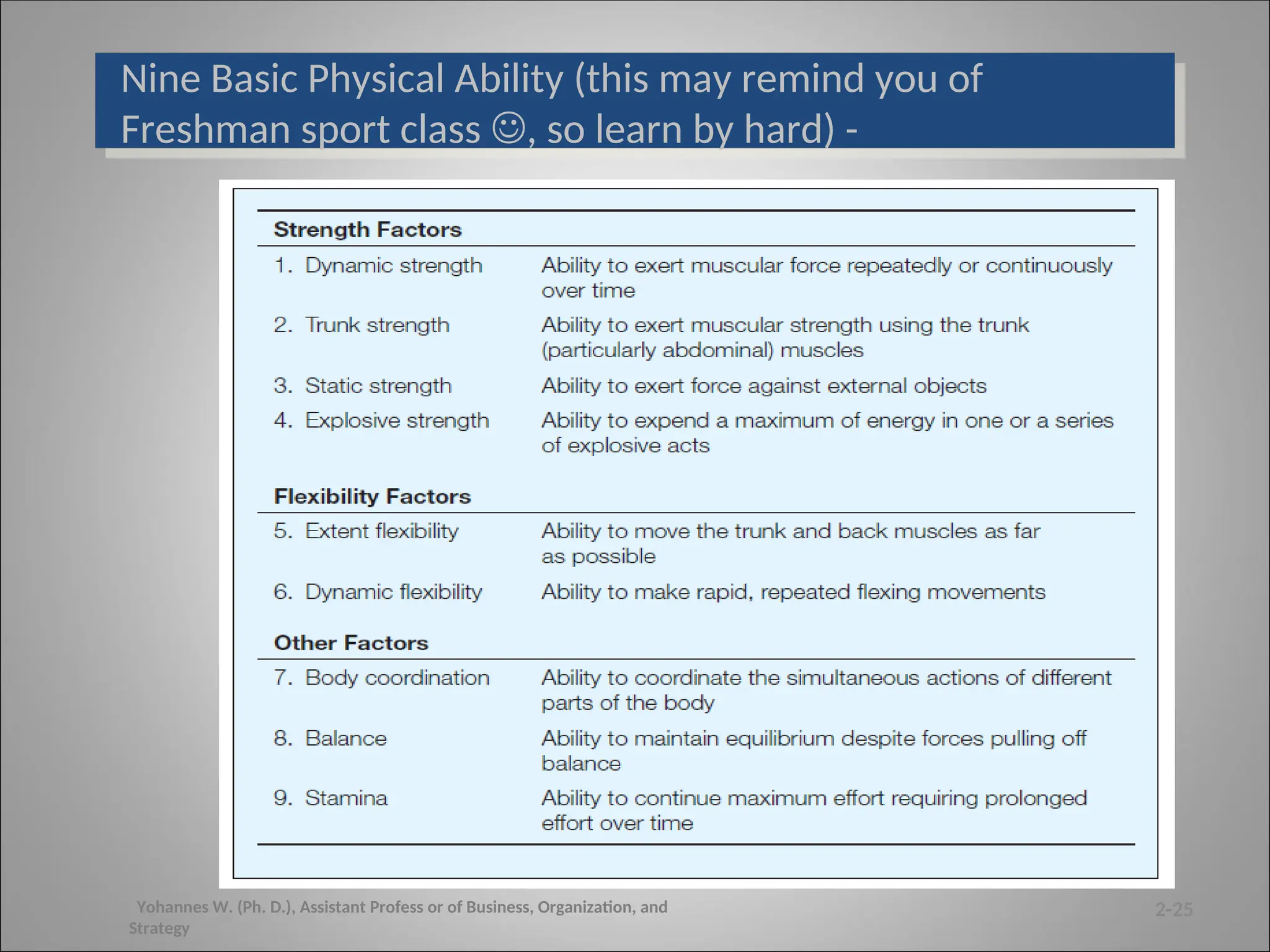
abilities, and ideas.
Managers also need to recognize that differences among
people can lead to miscommunication, misunderstanding,
and conflict.
2-3
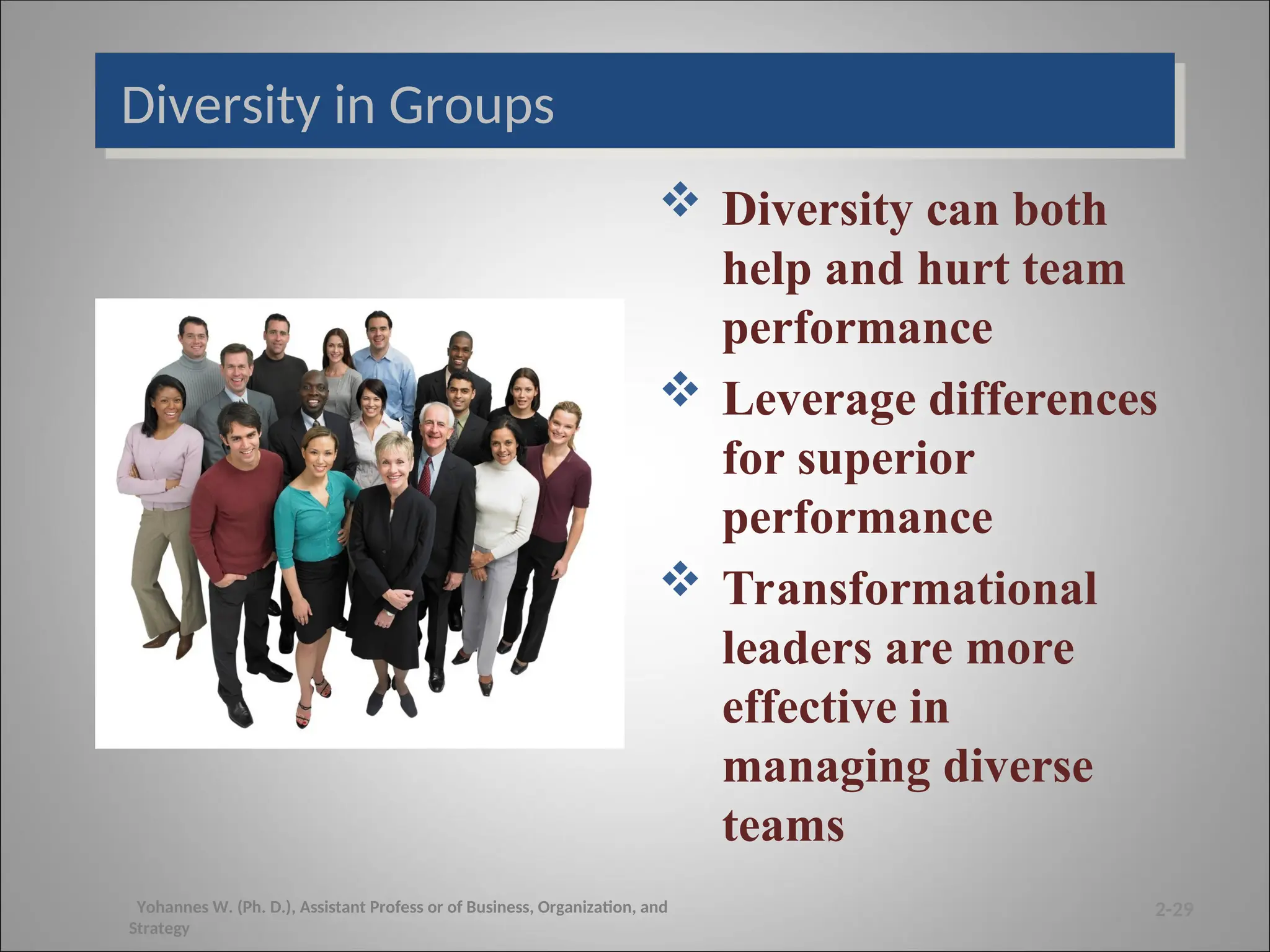
Yohannes W. (Ph. D.), Assistant Profess or of Business, Organization, and
Strategy
4.
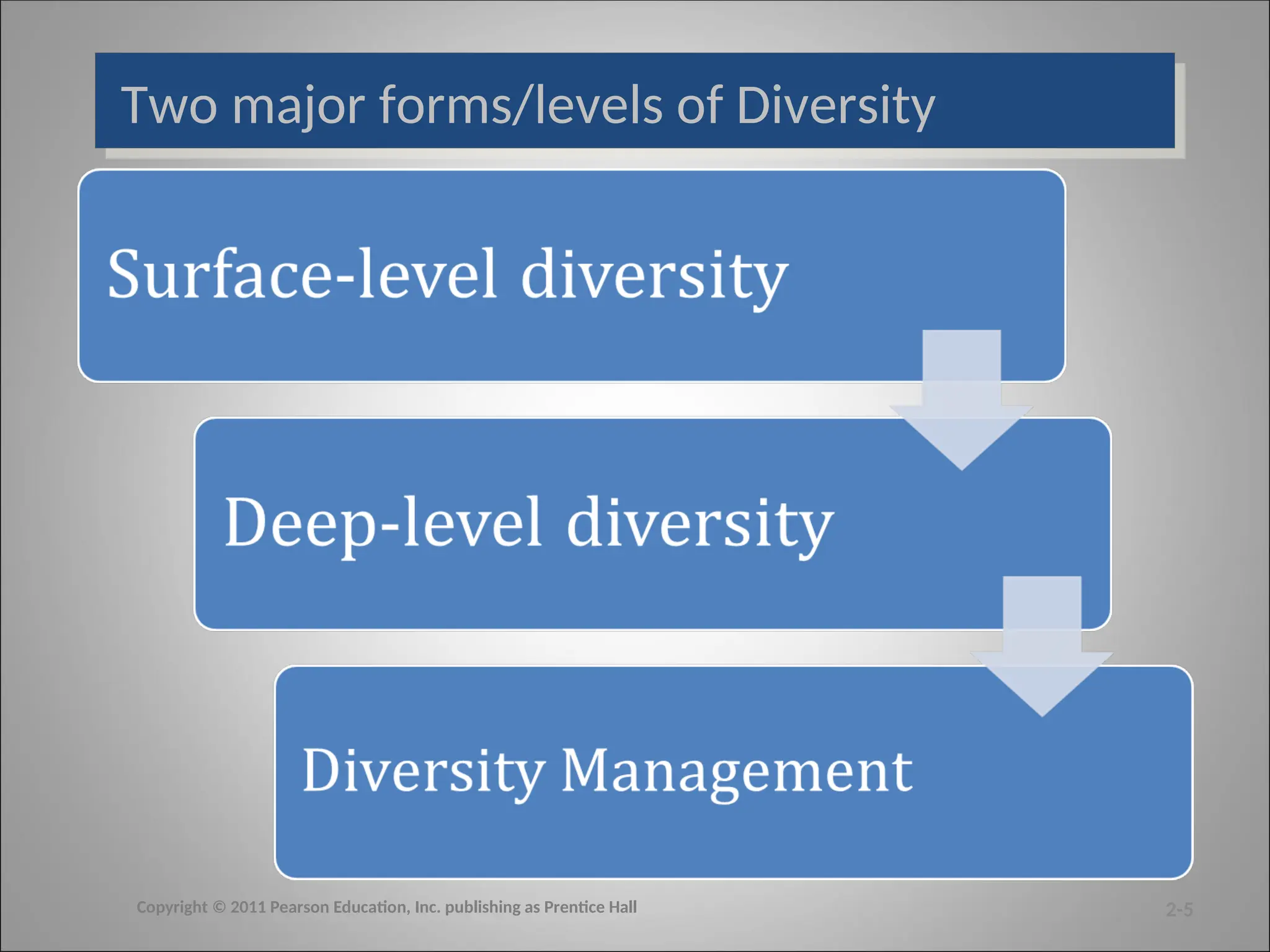
Levels of Diversity-surface level and deep level
Although much has been said about diversity in age, race,
gender, ethnicity, religion, and disability status, experts
now recognize that these demographic characteristics are
just the tip of the iceberg.
Demographics mostly reflect surface level diversity , not
thoughts and feelings, and can lead employees to perceive
one another through stereotypes and assumptions.
However, evidence has shown that as people get to know
one another, they become less concerned about
demographic differences if they see themselves as sharing
more important characteristics, such as personality and
values, that represent deep-level diversity.
.
2-4
Yohannes W. (Ph. D.), Assistant Profess or of Business, Organization, and
Strategy
Diversity Examples
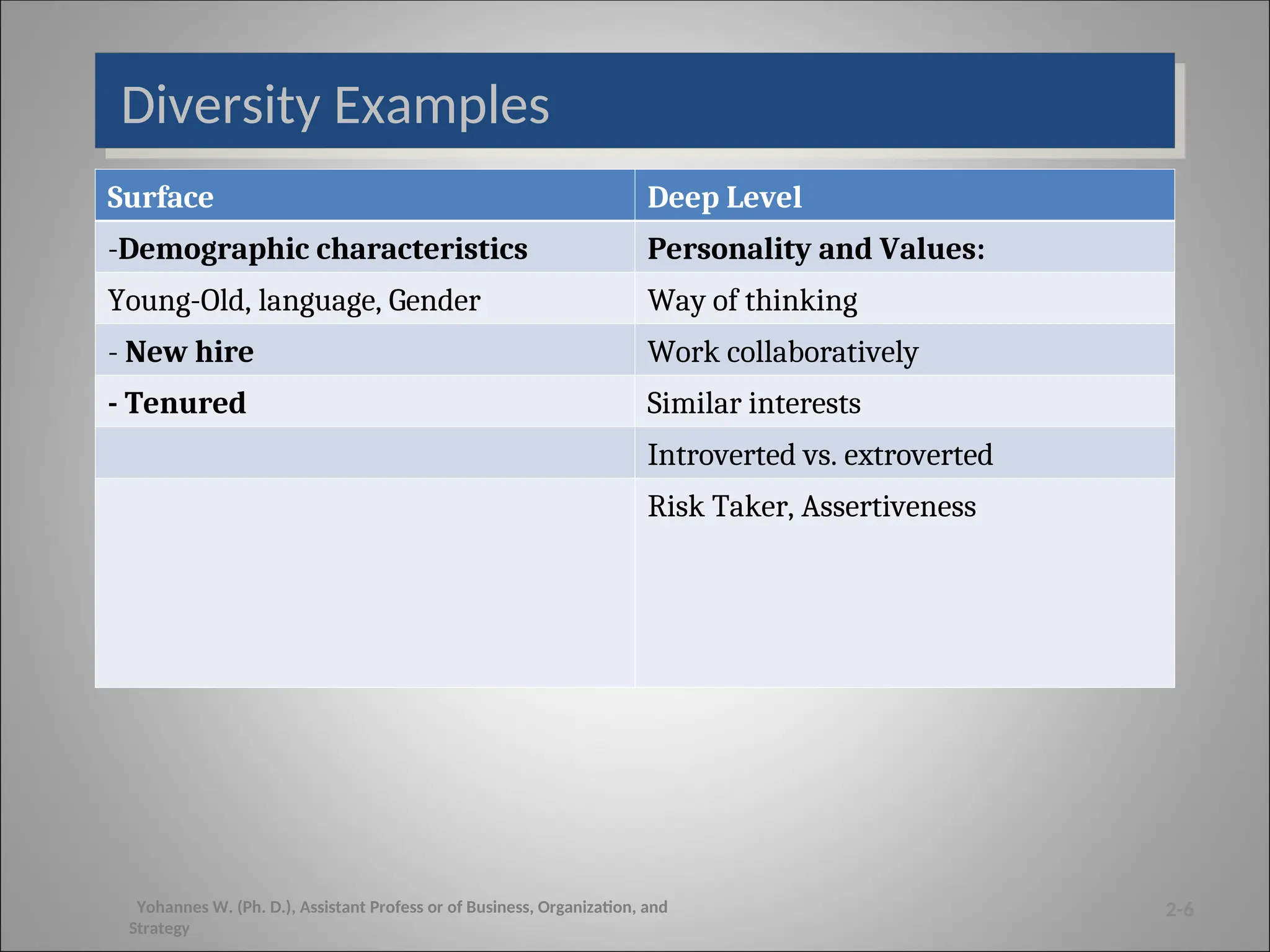
Surface DeepLevel
-Demographic characteristics Personality and Values:
Young-Old, language, Gender Way of thinking
- New hire Work collaboratively
- Tenured Similar interests
Introverted vs. extroverted
Risk Taker, Assertiveness
2-6
Yohannes W. (Ph. D.), Assistant Profess or of Business, Organization, and
Strategy
7.
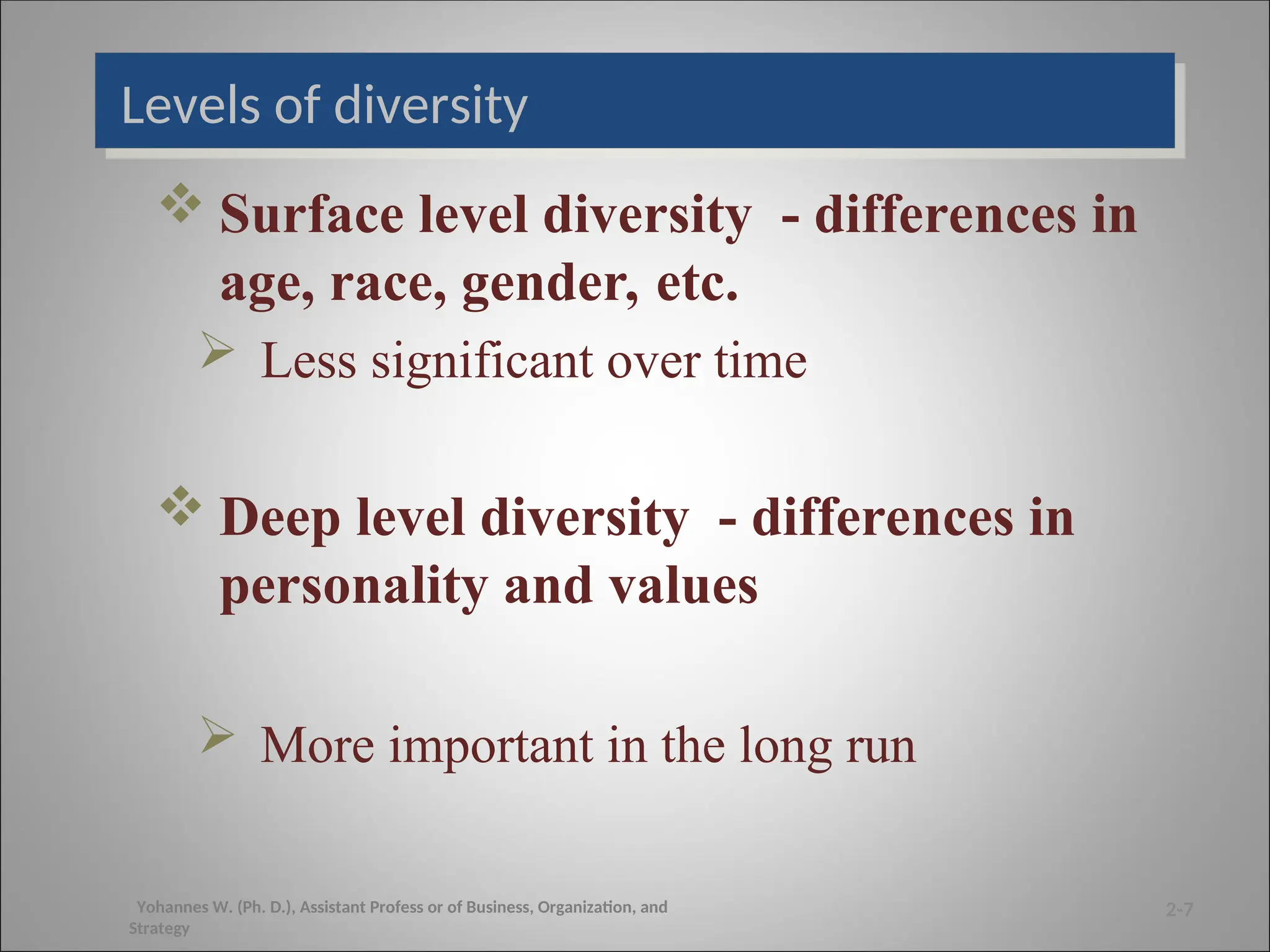
Levels of diversity
Surface level diversity - differences in
age, race, gender, etc.
Less significant over time
Deep level diversity - differences in
personality and values
More important in the long run
2-7
Yohannes W. (Ph. D.), Assistant Profess or of Business, Organization, and
Strategy
8.
Discrimination
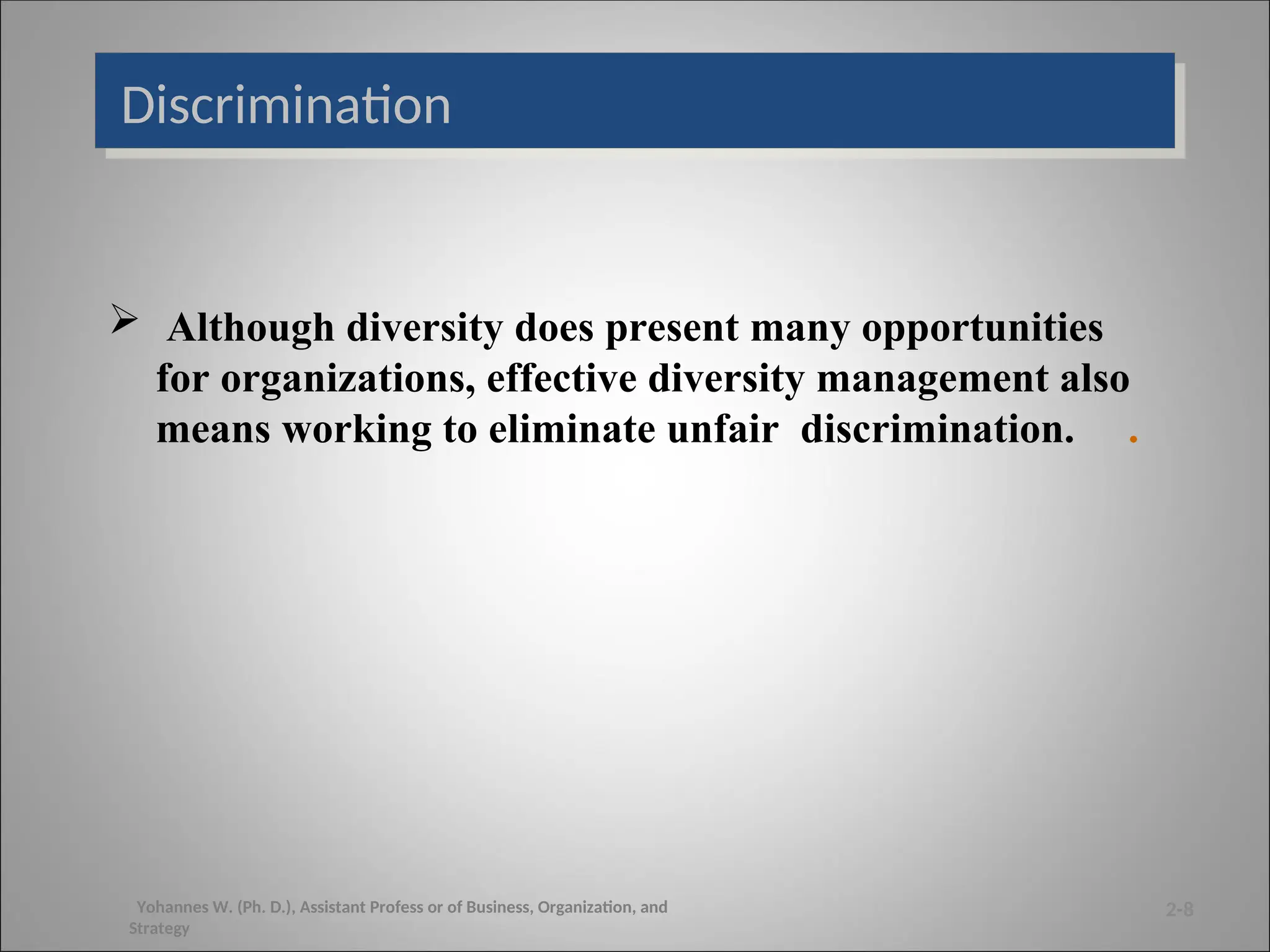
Although diversitydoes present many opportunities
for organizations, effective diversity management also
means working to eliminate unfair discrimination. .
2-8
Yohannes W. (Ph. D.), Assistant Profess or of Business, Organization, and
Strategy
9.
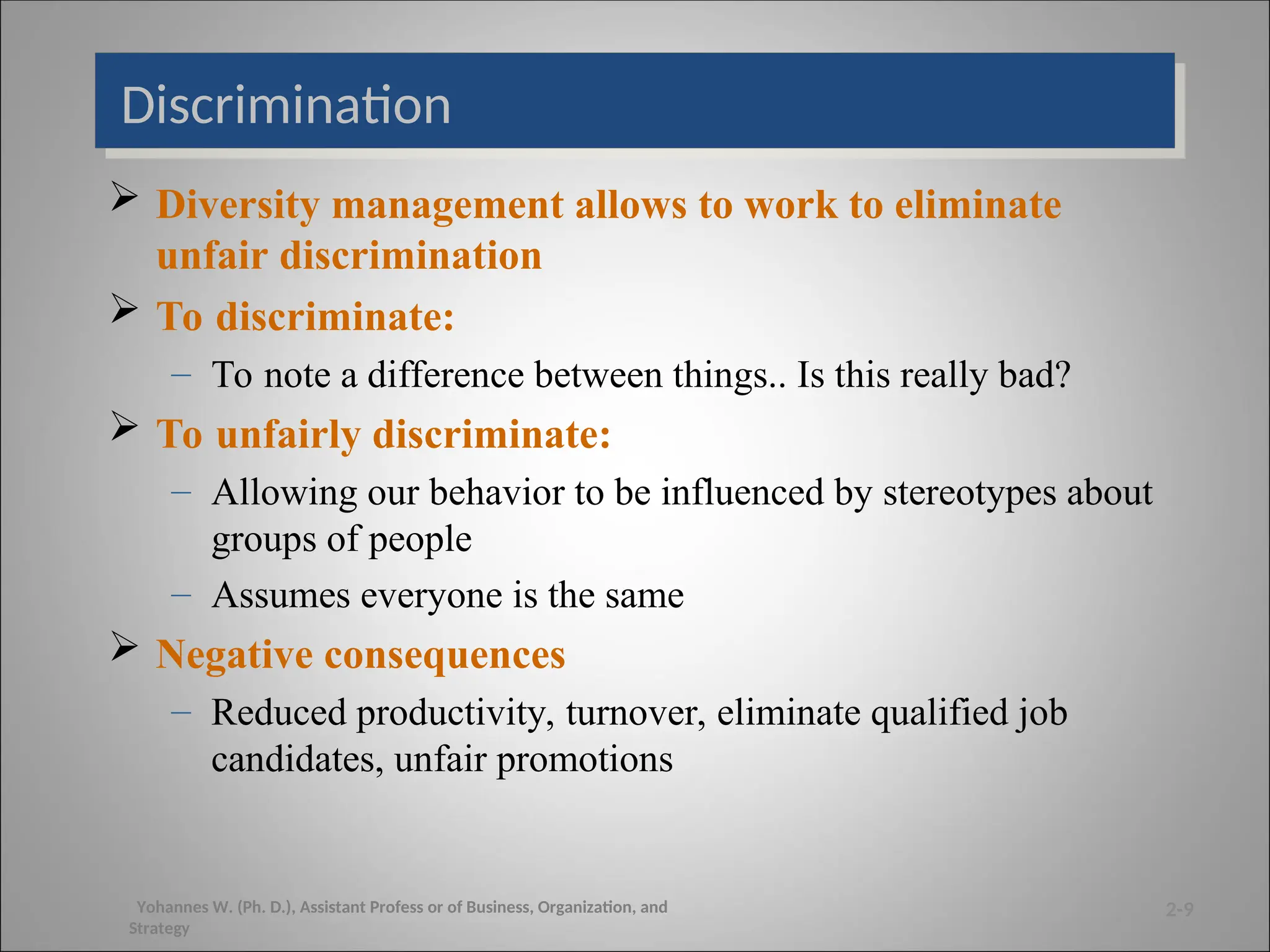
Discrimination
Diversity managementallows to work to eliminate
unfair discrimination
To discriminate:
– To note a difference between things.. Is this really bad?
To unfairly discriminate:
– Allowing our behavior to be influenced by stereotypes about
groups of people
– Assumes everyone is the same
Negative consequences
– Reduced productivity, turnover, eliminate qualified job
candidates, unfair promotions
2-9
Yohannes W. (Ph. D.), Assistant Profess or of Business, Organization, and
Strategy
10.
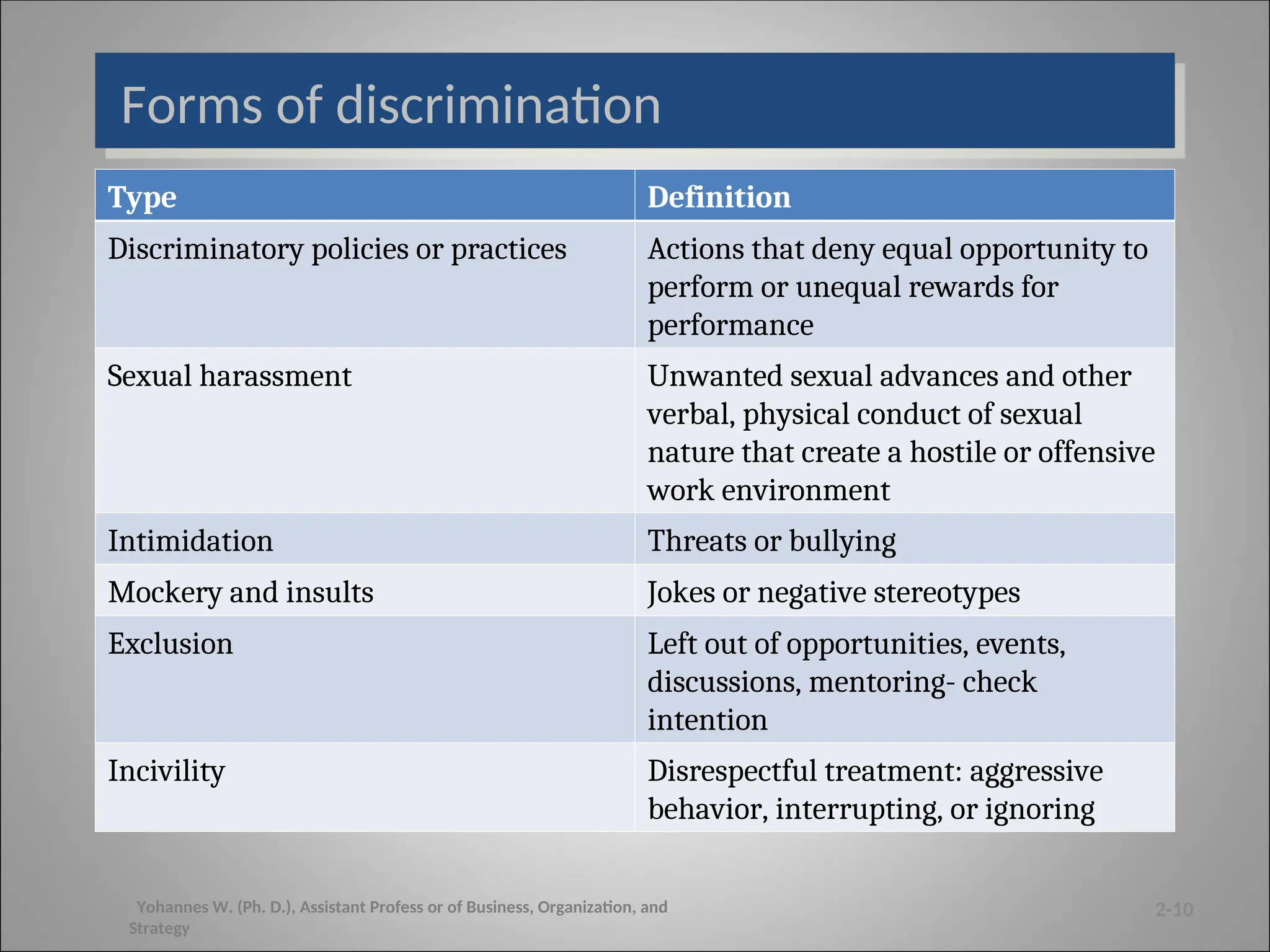
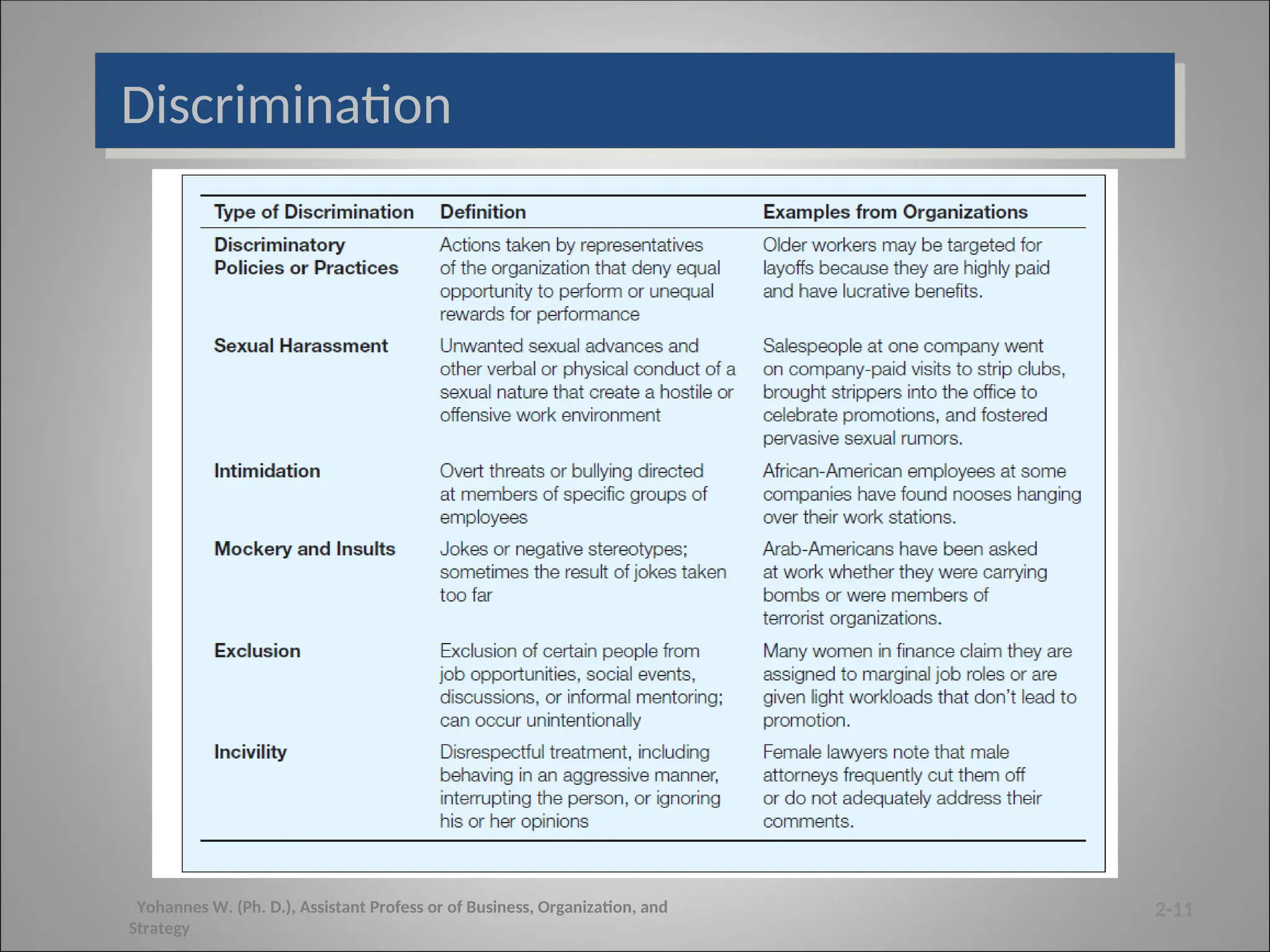
Forms of discrimination
TypeDefinition
Discriminatory policies or practices Actions that deny equal opportunity to
perform or unequal rewards for
performance
Sexual harassment Unwanted sexual advances and other
verbal, physical conduct of sexual
nature that create a hostile or offensive
work environment
Intimidation Threats or bullying
Mockery and insults Jokes or negative stereotypes
Exclusion Left out of opportunities, events,
discussions, mentoring- check
intention
Incivility Disrespectful treatment: aggressive
behavior, interrupting, or ignoring
2-10
Yohannes W. (Ph. D.), Assistant Profess or of Business, Organization, and
Strategy
Biographical characteristics
2-12
Yohannes W.(Ph. D.), Assistant Profess or of Business, Organization, and
Strategy
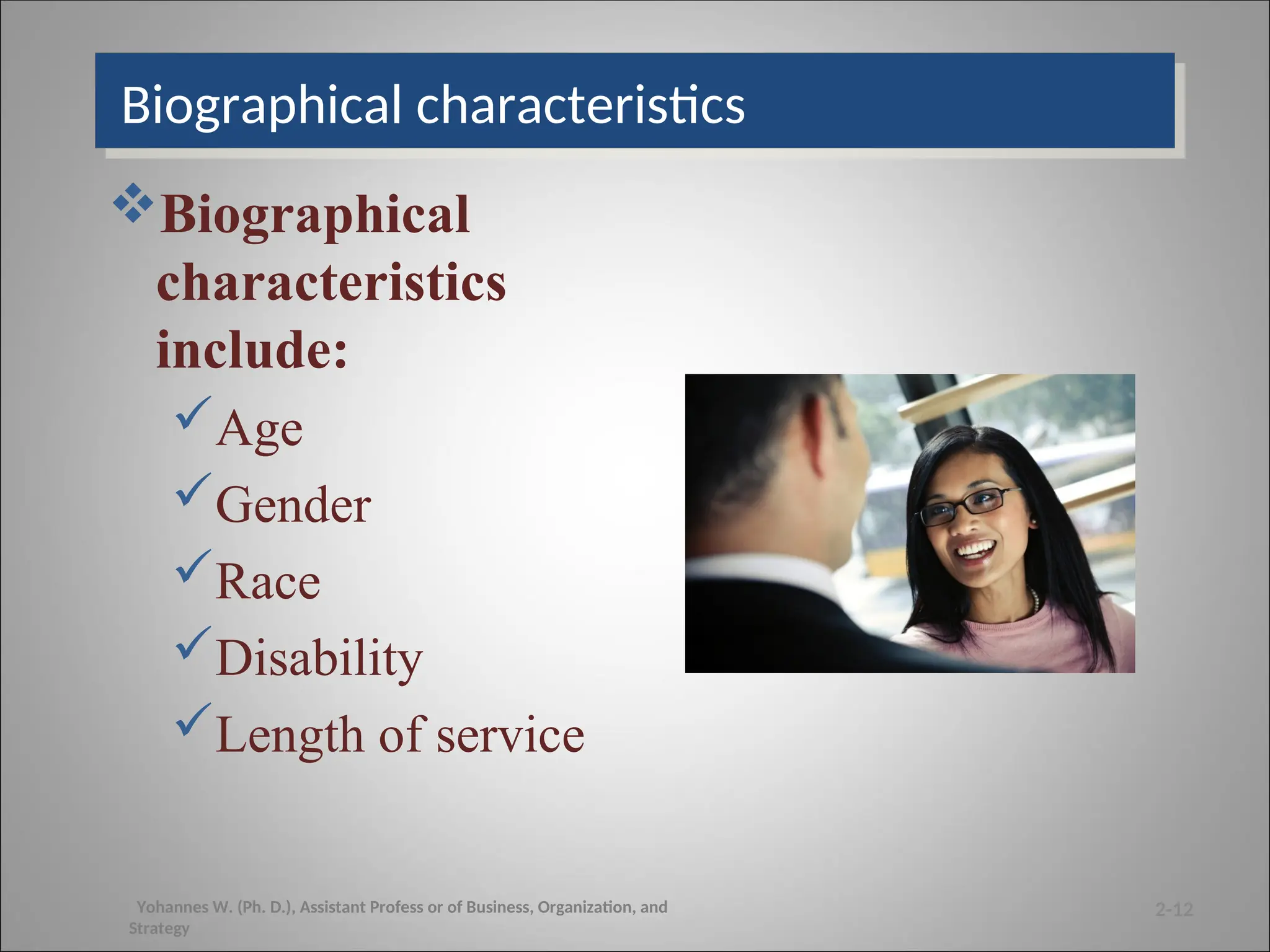
Biographical
characteristics
include:
Age
Gender
Race
Disability
Length of service
13.
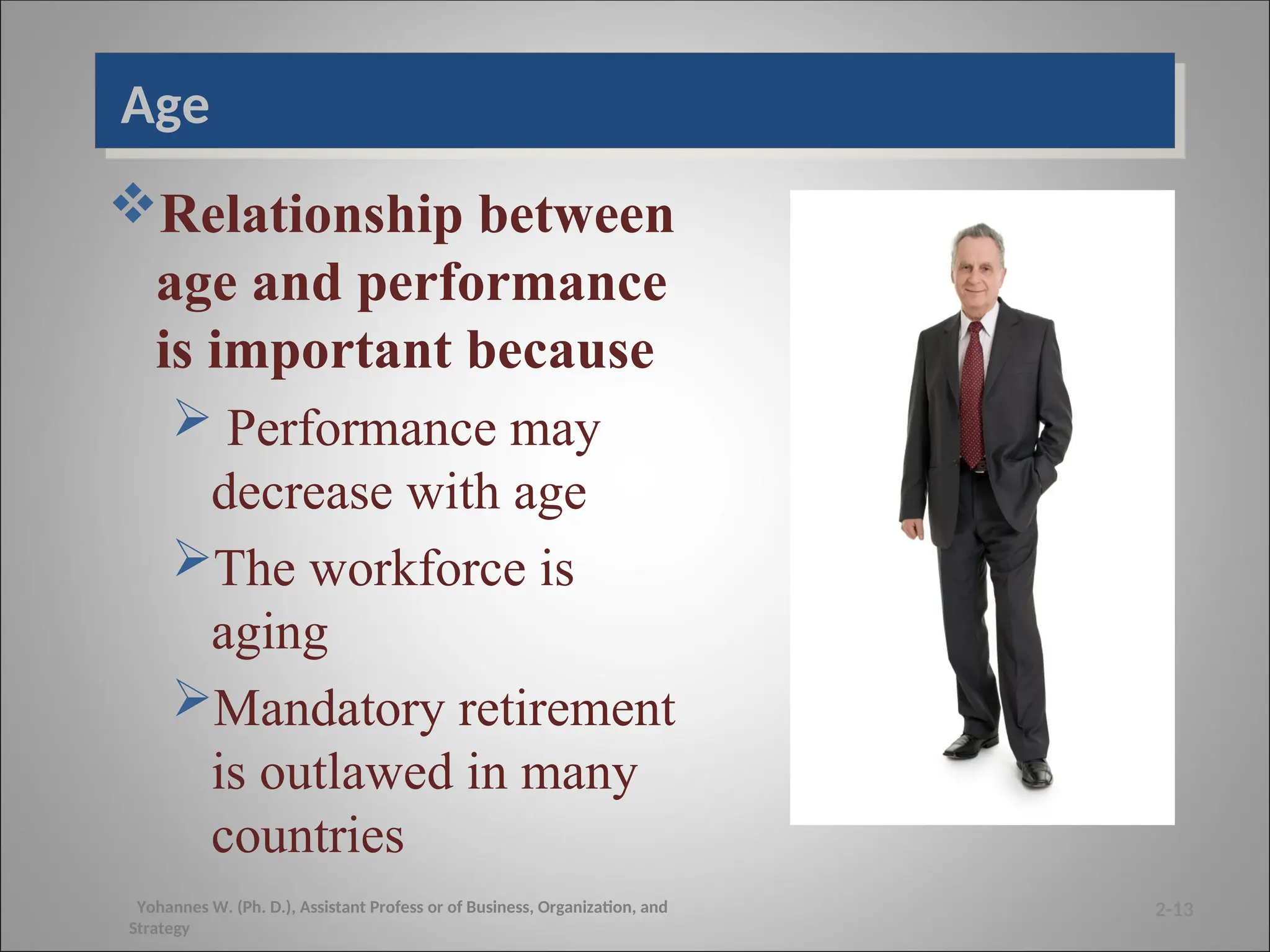
Age
Relationship between
age andperformance
is important because
Performance may
decrease with age
The workforce is
aging
Mandatory retirement
is outlawed in many
countries
2-13
Yohannes W. (Ph. D.), Assistant Profess or of Business, Organization, and
Strategy
14.
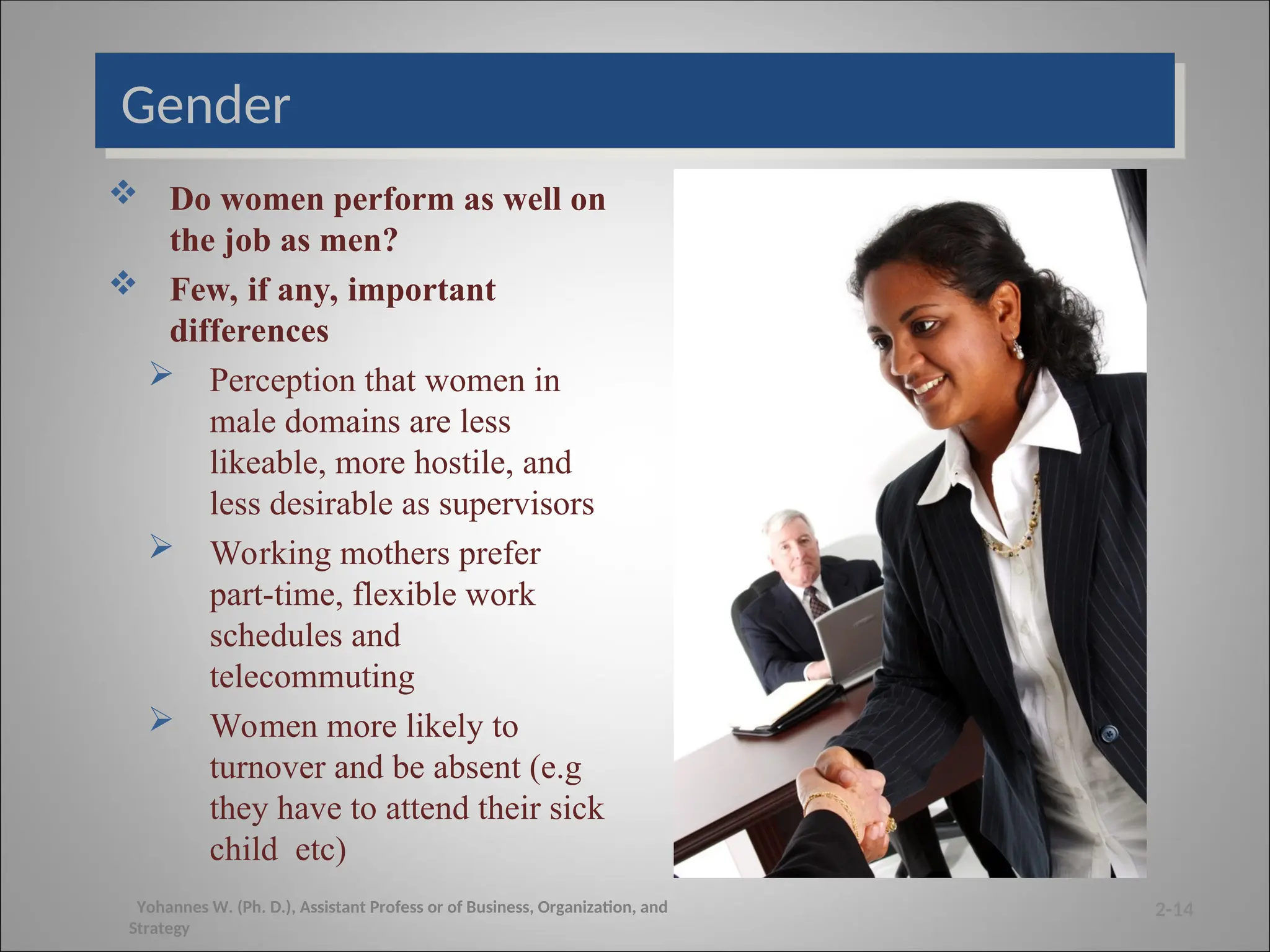
Gender
Do womenperform as well on
the job as men?
Few, if any, important
differences
Perception that women in
male domains are less
likeable, more hostile, and
less desirable as supervisors
Working mothers prefer
part-time, flexible work
schedules and
telecommuting
Women more likely to
turnover and be absent (e.g
they have to attend their sick
child etc)
2-14
Yohannes W. (Ph. D.), Assistant Profess or of Business, Organization, and
Strategy
15.
Race and Ethnicity
Racial and ethnic differences exists almost everywhere
Race/ethnicity is a controversial issue. In many cases, even
bringing up the topic of race and ethnicity is enough to create an
uncomfortable silence
For example - U.S. Census Bureau
Recognizes 7 racial groups : American Indian and Alaska Native;
Asian; Black or African American; Native Hawaiian and Other
Pacific Islander; Some Other Race; White; and Two or More
Races.
In terms of ethnicity in USA there are two ethnic groups: native
English speakers and Hispanics
That is an ethnicity distinction is also made between native
English speakers and Hispanics: Hispanics can be of any race.
2-15
Yohannes W. (Ph. D.), Assistant Profess or of Business, Organization, and
Strategy
16.
Race and Ethnicity
Someresearch findings (USA) –
Individuals slightly favor colleagues of their own race in
performance evaluations, promotion decisions, and pay raises
Substantial racial differences exist in attitudes towards affirmative
action (African Americans and Hispanics approve Affirmative
action programs to a greater degree than whites)
African Americans tend to fare worse than Whites in employment
decisions (African Americans receive lower ratings in
employment interviews, receive lower job performance ratings,
are paid less, and are promoted less frequently )
2-16
Yohannes W. (Ph. D.), Assistant Profess or of Business, Organization, and
Strategy
17.
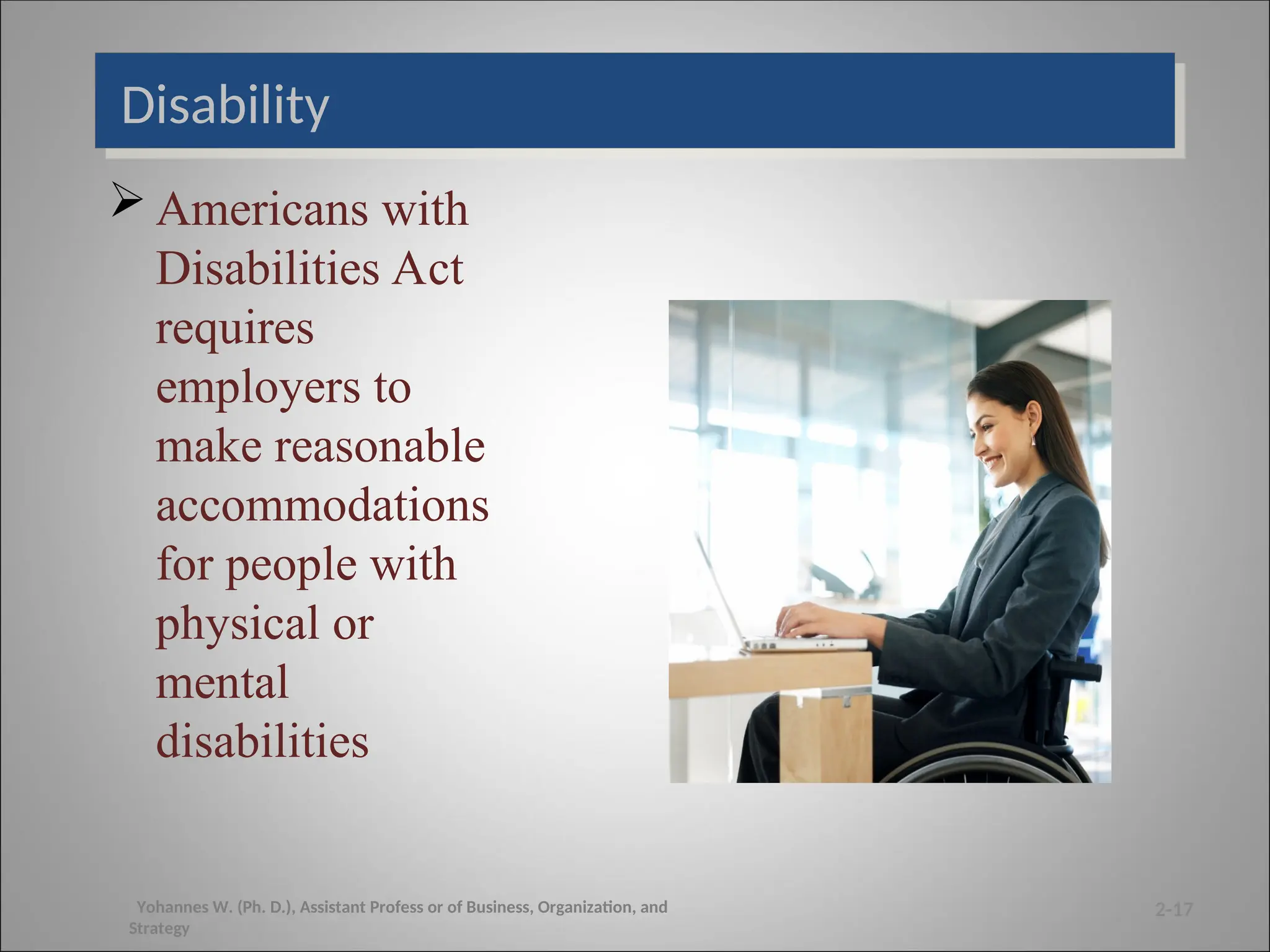
Disability
Americans with
DisabilitiesAct
requires
employers to
make reasonable
accommodations
for people with
physical or
mental
disabilities
2-17
Yohannes W. (Ph. D.), Assistant Profess or of Business, Organization, and
Strategy
18.
Other Biographical Characteristics
Tenure (seniority) - If we define seniority as time on a
particular job, the most recent evidence demonstrates a
positive relationship between seniority and job productivity.
Religion - Not only do religious and nonreligious people
question each other’s belief systems; often people of
different religious faiths conflict.
E.g. U.S. federal law prohibits employers from discriminating
against employees based on their religion, with very few
exceptions. However, that doesn’t mean religion is a
nonissue in OB.
2-18
Yohannes W. (Ph. D.), Assistant Profess or of Business, Organization, and
Strategy
19.
Ability – Intellectualand physical Ability
An individual’s capacity to perform the various tasks in a
job.
Intellectual and Physical Abilities
2-19
Yohannes W. (Ph. D.), Assistant Profess or of Business, Organization, and
Strategy
20.
Ability
Made up oftwo sets of factors:
– Intellectual Abilities
• The abilities needed to perform mental activities – thinking,
reasoning, and problem solving
• No correlation between intelligence and job satisfaction.
– Physical Abilities
• The capacity to do tasks demanding stamina, dexterity,
strength, and similar characteristics.
2-20
Yohannes W. (Ph. D.), Assistant Profess or of Business, Organization, and
Strategy
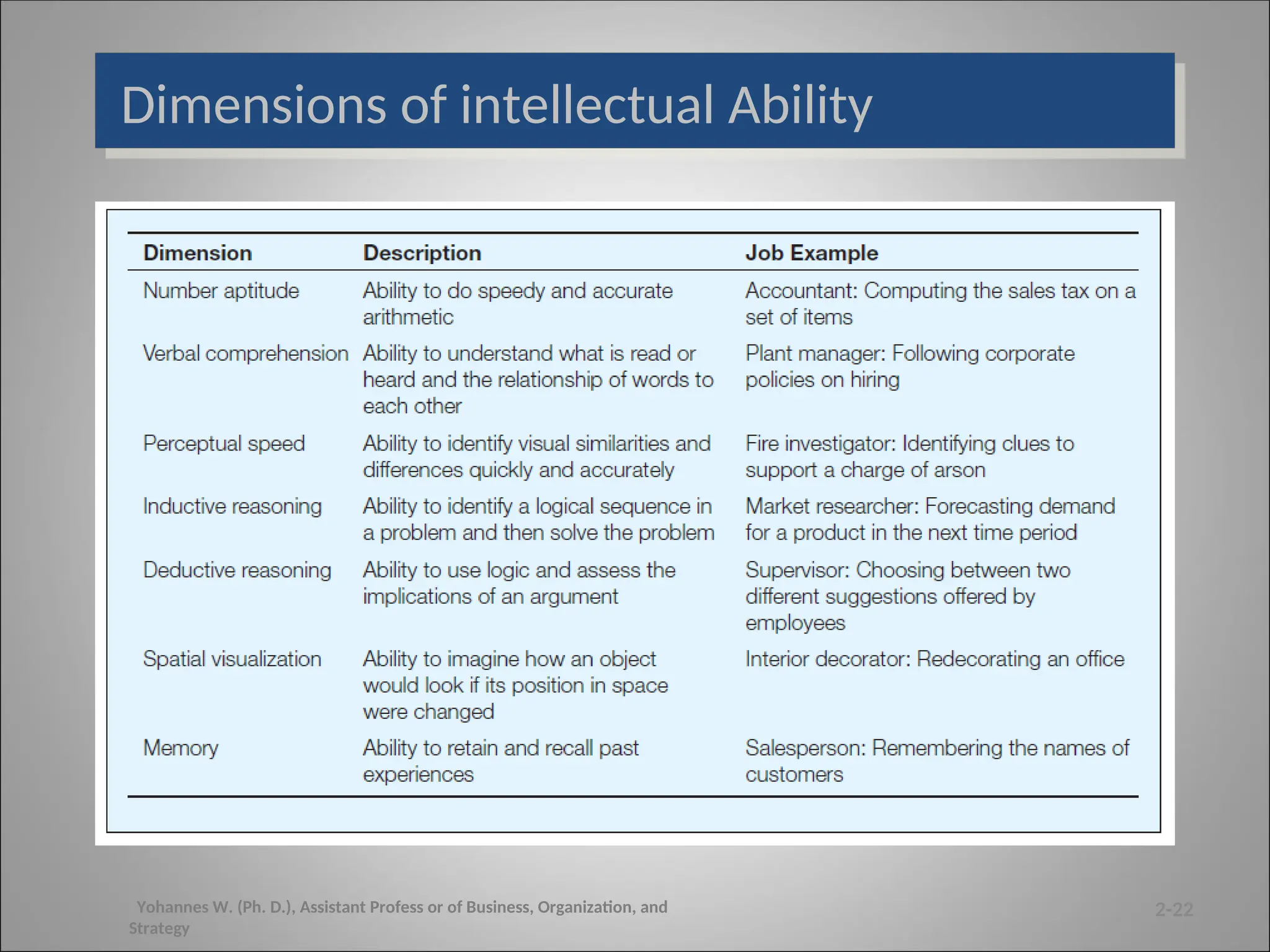
Dimensions of intellectualAbility
2-22
Yohannes W. (Ph. D.), Assistant Profess or of Business, Organization, and
Strategy
23.
Physical Ability
Thoughthe changing nature of work suggests intellectual
abilities are increasingly important for many jobs,
physical abilities have been and will remain valuable.
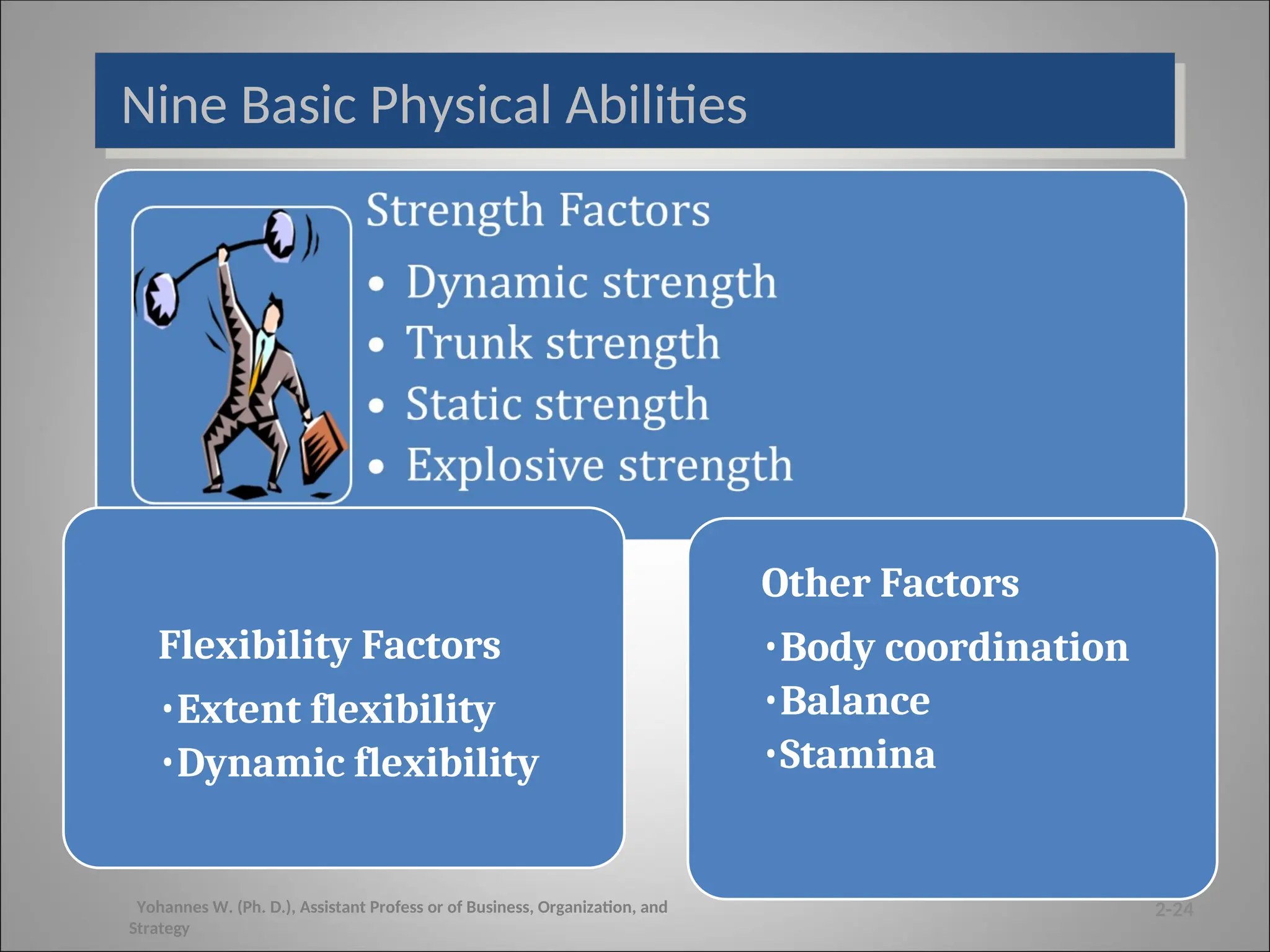
Research on hundreds of jobs has identified nine basic
abilities needed in the performance of physical tasks.
2-23
Yohannes W. (Ph. D.), Assistant Profess or of Business, Organization, and
Strategy
24.
Nine Basic PhysicalAbilities
2-24
Yohannes W. (Ph. D.), Assistant Profess or of Business, Organization, and
Strategy
Flexibility Factors
•Extent flexibility
•Dynamic flexibility
Other Factors
•Body coordination
•Balance
•Stamina
25.
Nine Basic PhysicalAbility (this may remind you of
Freshman sport class , so learn by hard) -
2-25
Yohannes W. (Ph. D.), Assistant Profess or of Business, Organization, and
Strategy
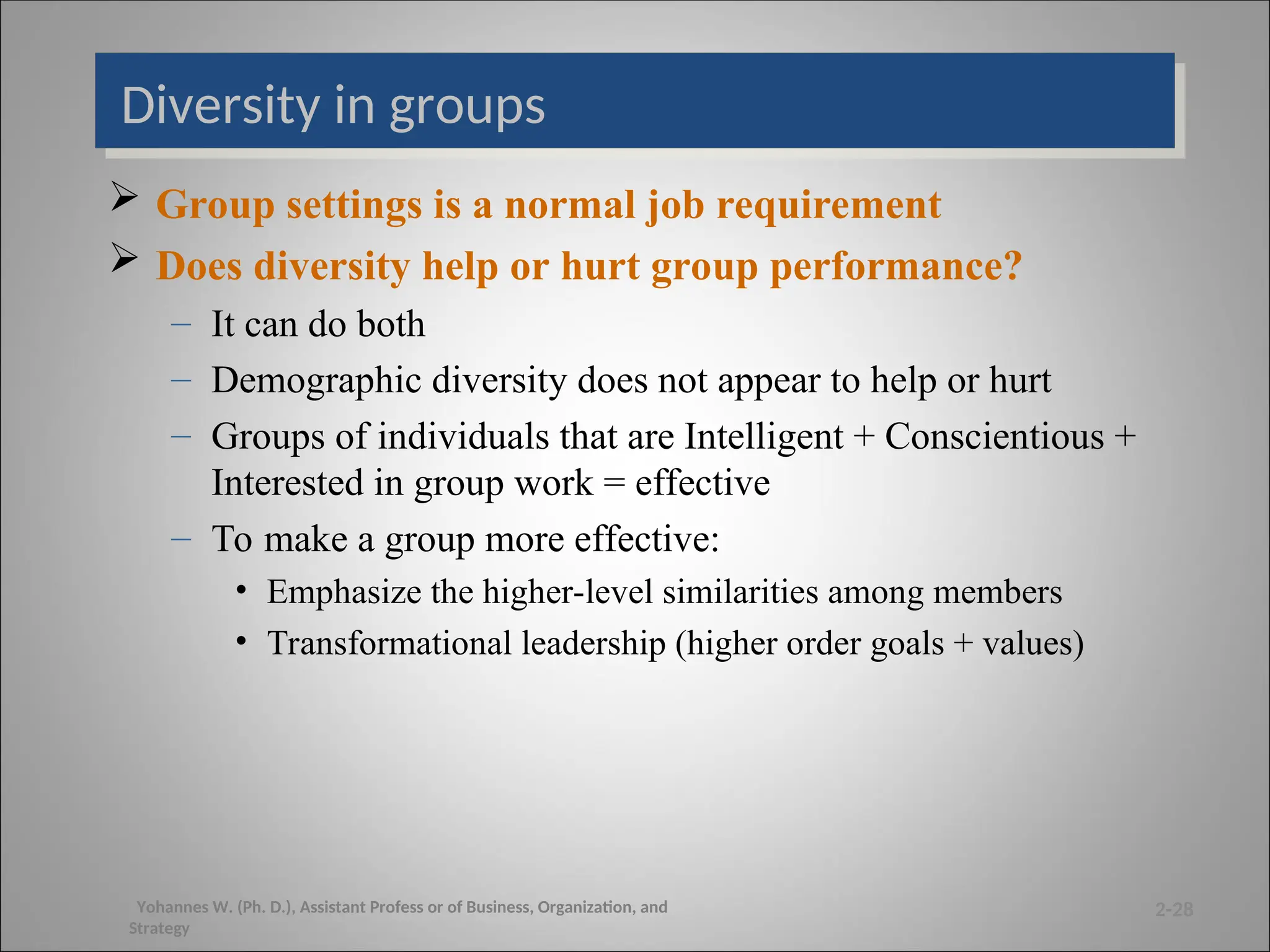
Diversity in groups
Group settings is a normal job requirement
Does diversity help or hurt group performance?
– It can do both
– Demographic diversity does not appear to help or hurt
– Groups of individuals that are Intelligent + Conscientious +
Interested in group work = effective
– To make a group more effective:
• Emphasize the higher-level similarities among members
• Transformational leadership (higher order goals + values)
2-28
Yohannes W. (Ph. D.), Assistant Profess or of Business, Organization, and
Strategy
29.
Diversity in Groups
Diversity can both
help and hurt team
performance
Leverage differences
for superior
performance
Transformational
leaders are more
effective in
managing diverse
teams
2-29
Yohannes W. (Ph. D.), Assistant Profess or of Business, Organization, and
Strategy
30.
Effective diversity programs
Teach managers about the legal
framework for equal employment
opportunity and encourage fair
treatment of all people regardless of
their demographic characteristics
Teach managers how a diverse
workforce will be better able to serve a
diverse market of customers/clients
Foster personal development practices
– That bring out the skills and abilities
of all workers
– Differences can improve
performance
2-30
Yohannes W. (Ph. D.), Assistant Profess or of Business, Organization, and
Strategy
31.
Summary and Implicationsfor Managers
This chapter looked at diversity from many perspectives. We paid
particular attention to three variables—biographical characteristics,
ability, and diversity programs. The following are important ideas:
Biographical differences have minimal effects on performance
An effective job selection process will improve the fit between
employees and job requirements
Promotion and transfer decisions affecting incumbents should
reflect the individuals’ abilities
Managers can accommodate employees with disabilities by
improving the fit between the job and the individual’s abilities
Diversity management must be an ongoing, organization-wide
commitment
Policies to improve the climate for diversity can be effective, so
long as they are designed to acknowledge all employees’ perspectives.
2-31
Editor's Notes
#5 Everybody brings differences to an organization where they work. These differences can create energy and excitement in the workplace, but they can also cause conflict. So it is important that we have an understanding of how diversity works in organizations.
When we look at the workplace we can recognize two levels of diversity. Surface-level diversity represents the characteristics that are easily observed such as race, gender, age etc. Deep-level diversity represents the aspects that are more difficult to see at first glance such as values, personality, and work preferences.
Organizations need to engage in Diversity Management to eliminate unfair discrimination. By understanding what diversity is and helping employees with training and development opportunities, the negative impact of discrimination can be minimized.
#19 Ability is defined as an individual’s capacity to perform the various tasks associated with the job. When ability is dissected, two key factors are found. The first factor set apart is intellectual ability. This is the ability to perform mental activities.
#20 There are a number of measures of intellectual ability available for use by organizations. Two representative measures are the GMA (General Mental Ability) measure and the Wonderlic Personnel Test. The GMA takes a look at overall intelligence and is generally recognized by researchers. The Wonderlic is generally used as a quick measure of intelligence in the hiring process. Often, it takes less than ten minutes to complete. Depending on the requirements of the job, intelligence tests can be used to predict success on certain job tasks. However, there has been no correlation found between intelligence and job satisfaction.
Physical Ability is the second factor of ability and represents the capacity to do tasks that demand stamina, dexterity, strength, and other characteristics related to performance of physical tasks.
#21 Intellectual ability is made up of many dimensions. They include number aptitude, verbal comprehension, perceptual speed, inductive reasoning, deductive reasoning, spatial visualization, and memory.
Number aptitude is the ability to do speedy and accurate arithmetic and will be effective in jobs requiring mathematical ability, such as an accountant.
Verbal comprehension is the ability to understand what is read or heard and the relationship of words to each other. This ability will be helpful in jobs where the manager needs to understand policies in order to carry out their job tasks.
Perceptual speed is the ability to identify visual similarities and differences quickly and accurately. This particular ability is helpful when an employee needs to take in a lot of information and make decisions about the patterns, such as a detective or inspector.
Inductive reasoning is present when an individual can identify a logical sequence in a problem in order to help find a solution. An employee who needs to make decisions about the future based on historical information will need the ability of inductive reasoning.
Deductive reasoning is the ability to use logic and assess the implications of the argument. When making choices between two different possible solutions to a problem, a manager would need to call upon their deductive reasoning skills.
Spatial Visualization is when someone can imagine how an object would look if its position in space was changed. An employee who needs to make decisions about office setup or interior design would need to have a high level of spatial visualization ability.
Memory is the ability to retain and recall past experiences. Individuals who need to act quickly in a situation, such as a paramedic or nurse, would need a significant degree of memory ability.
#24 Physical abilities are needed when performance requires physical activity to complete a task. There are three main categories of physical ability – strength, flexibility and other.
Strength factors include dynamic strength, trunk strength, static strength, and explosive strength.
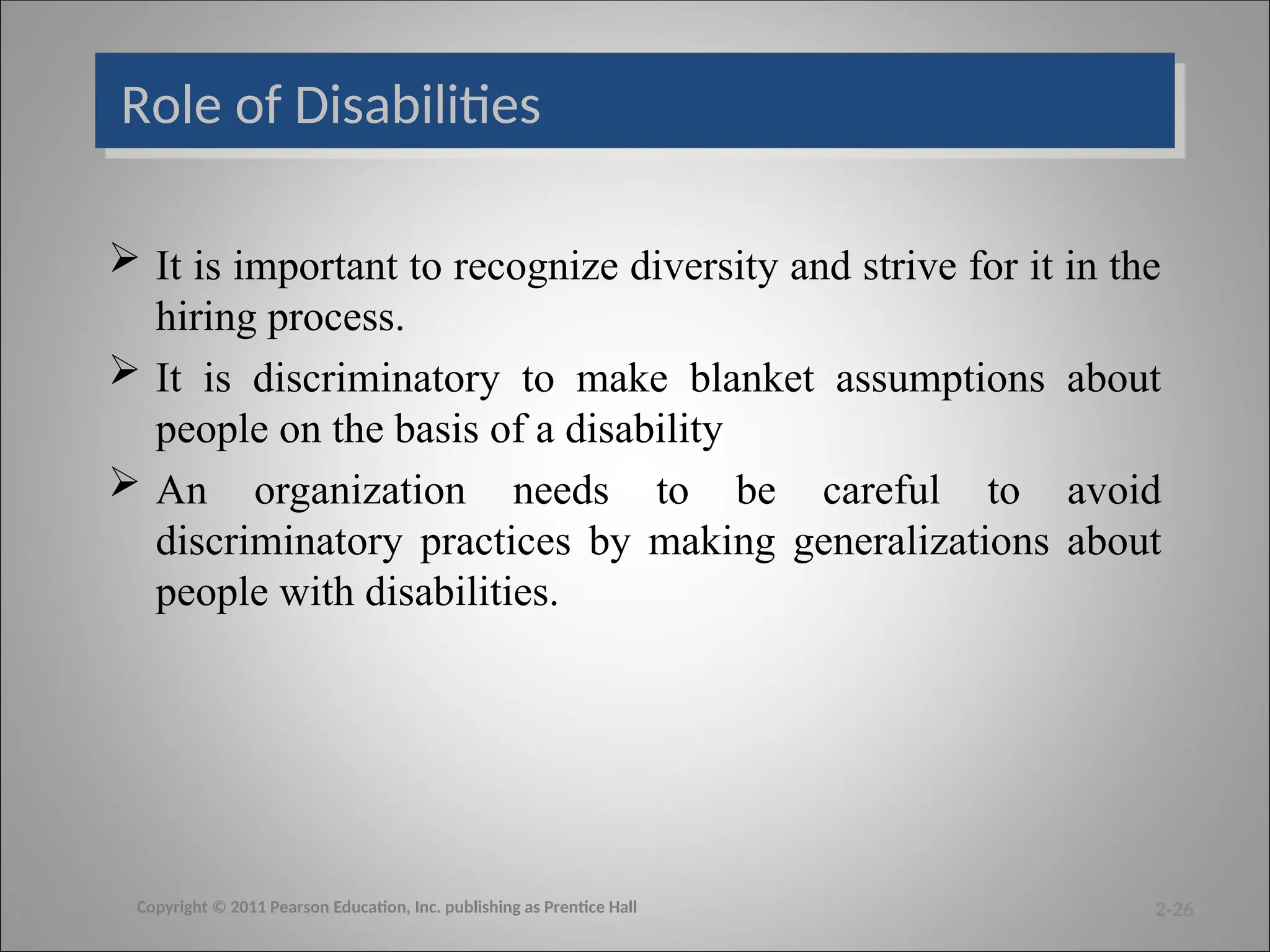
#26 When an organization discusses abilities, it can cause difficulty when developing policies that recognize diversity in terms of disabilities. While it is important for the organization to strive for diversity in the hiring process, it is important to be careful to avoid discriminatory practices during hiring by making generalizations about people with disabilities.
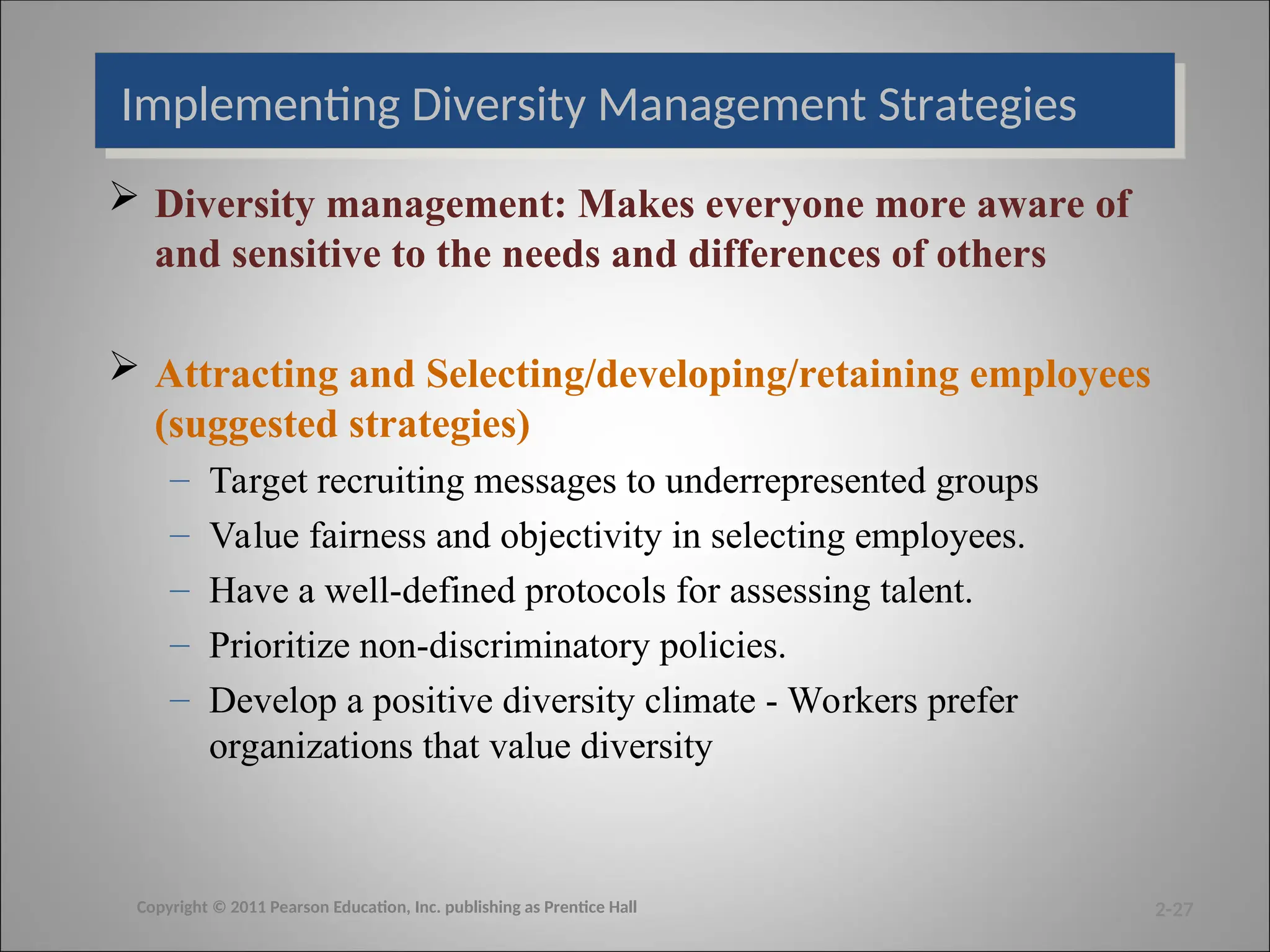
#27 Knowing that people are different is not enough for organizations to operate effectively with differences. Managers must work to develop strategies to develop ways to utilize differences to achieve work outcomes. Managers start by attracting, selecting, developing, and retaining employees who can operate and excel in a workplace with diverse individuals, viewpoints, and ideas. Gaining a diverse workforce through the selection process and developing that workforce through organizational training and development programs will help to provide for an environment that fosters creativity and effectiveness by tapping into the potential of all employees.
More and more organizations are requiring employees to work in groups. Diversity can aid in group effectiveness and it can diminish it. Organizations must provide the tools to leverage the differences to obtain superior performance.
Effective workforce programs that encourage diversity contain three components. First, they teach managers about the laws they need to follow and equal employment opportunity requirements. Second, they help managers and employees to see that a diverse workforce is better able to serve diverse markets. Third, they take into account personal differences and approach the differences as strengths that can be utilized to enhance performance.