E-commerce Payment Systems
L. Chitanana
What is Online Electronic
Payment
 An electronic payment system (EPS) also known
as electronic currency, broadly speaking, refer to
a transaction in the online exchange of funds;
 is a system of financial exchange between buyers
and sellers in the online environment that is
facilitated by a digital financial instrument (such
as encrypted credit card numbers, electronic
checks, or digital cash) backed by a bank, an
intermediary, or by legal tender.
What is Online Electronic
Payment (contd.)
 Electronic Payment System is the
basis for online payments, and online
payments system development is a
higher form of electronic payment.
 It means electronic payment may, at
any time, through the Internet
directly to the transfer, settlement
and form e-business environment.
Electronic Payments Benefits
Electronic payments can benefit our business
by:
 extending our customer base;
 boosting cash flow;
 reducing costs;
 enhancing customer service
 improving your competitive advantage.
Five reasons why Electronic
payments improve customer service
 Choice – like our competitors, we can offer a wide range of
payment options
 Convenience – they remove the need for invoices, cheques, cash
and BACs
 Credit – they may allow purchases that would otherwise be delayed
 Concessions – small discounts to encourage online purchases
improve the perception of value
 Competitive Edge - if we don’t offer the full range of payment
options but your competitors do, what does this say about your
business?
Five reasons why Electronic
payments increase profitability
 Convenience – removing administrative resources required by
invoices, cheques and cash
 Immediacy – credit cards enable instant purchasing (without
delay)
 Improved cash flow – payment at the time of purchase reduces
the pressures caused by 30-day invoicing
 Growth – open additional payment channels via the phone, mail
order and Internet and increase your customer base. More
customers mean more revenue.
 Competitive advantage – match and beat the services of your
competitors and gain the edge
Electronic Payment Methods
 Innovations affecting consumers, include credit and debit
cards, automated teller machines (ATMs), stored value
cards, and e-banking.
 Innovations enabling online commerce are e-cash, e-
checks, smart cards, and encrypted credit cards. These
payment methods are not too popular in developing
countries. They are employed by a few large companies in
specific secured channels on a transaction basis.
 Innovations affecting companies pertain to payment
mechanisms that banks provide their clients, including inter-
bank transfers through automated clearing houses allowing
payment by direct deposit.
Available payment methods
 Credit Cards
 PayPal
 E-Check
 Wire Transfer
 C.O.D.
 Bank Transfer
 Gold Money
 Money Order or Cashiers Check by Mail
 Moneybookers
 WebMoney Transfer
 Western Union QuickPay
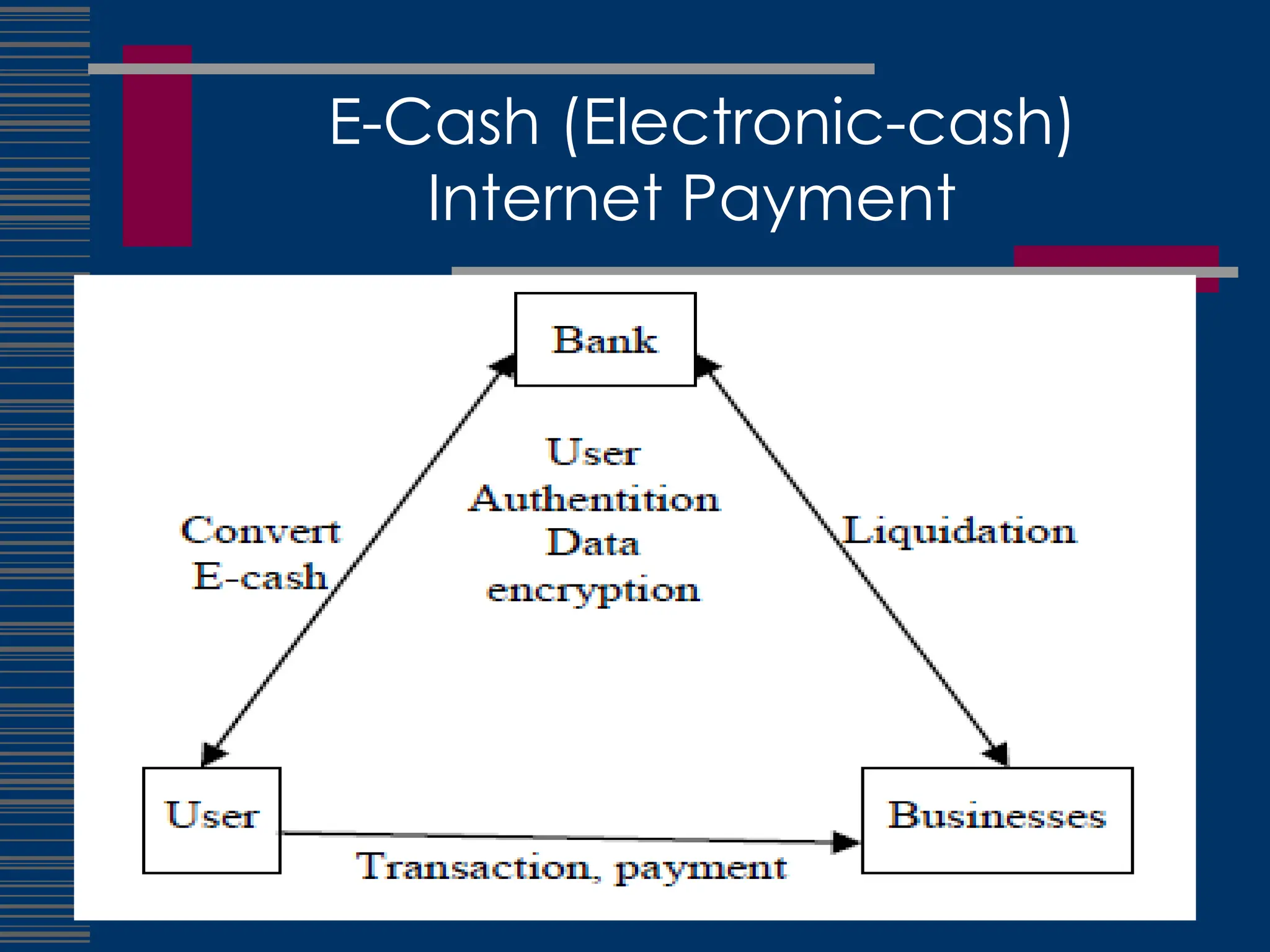
E-Cash (Electronic-cash)
Internet Payment
E-cash and e-payment systems
E-cash and e-payment systems also have the
advantage of cash, mainly as follows:
 Anonymity;
 Not shadowing;
 Savings on transaction costs;
 Savings on transmission costs;
 Less risk;
 Pay flexibility;
 Prevent forgery and repeatability
E-purse Internet Payment
System
 E-purse is sporadic small payment
transactions that is always used in
conjunction with bank cards to help
users complete the entire shopping
process
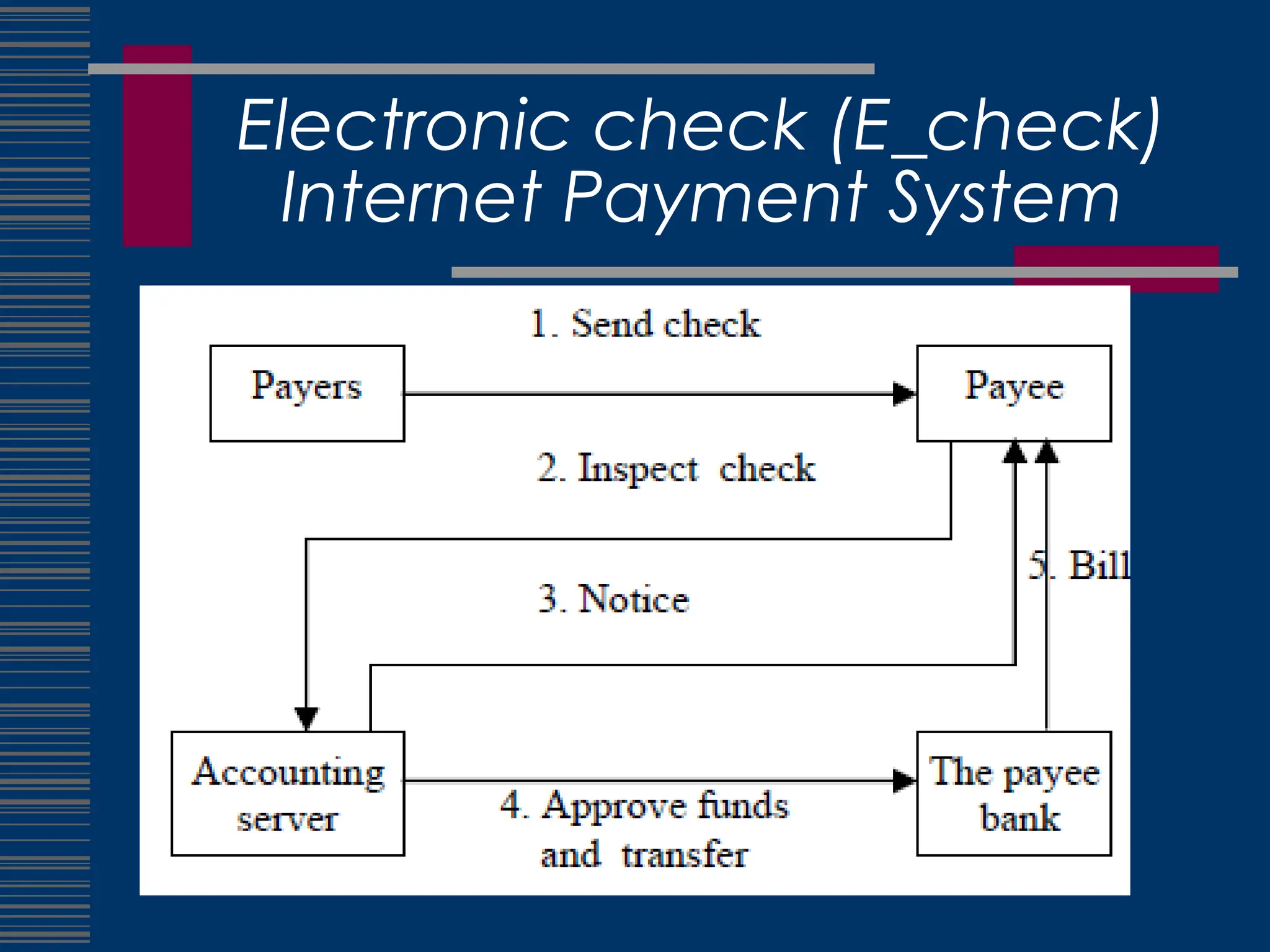
Electronic check (E_check)
Internet Payment System
Security Standards
The security demands in EC activity
specified as below:
 Safe transmitting of payment information and order
information on internet, securing the data transmitted on
network not be stolen by hacker;
 Separation of order information and personal account
information, when the order containing the card holder’s
account information is sent to the supplier, only the order
information can be seen by the supplier, while other account
information of card holder can not be read;
 Mutual identification between the cardholder and the
supplier, to make clear the identities of the two sides of
communication; under most circumstances the trust
guarantee on network is provided by the third party.
Online payment security
 Secure Socket Layer (SSL)
 Secure Electronic Transaction (SET)
 Public Key Software Infrastructure
(PKI)
Secure Electronic Transaction
(SET)
 SET aims to solve the safety problem in electronic payment of
credit card:
 Ensure the confidentiality of information and avoid being
wiretapped when information is transmitted on line. Only the
authorized legal person can get and decode the information;
 Ensure the entity of payment information, secure the data
transmitted can be received fully without any alteration in the
middle way;
 Attest the supplier and the customer, verify the validity of supplier,
card holder and business activity which do business on the public
network;
 Secure wide mutual operationality, ensure the communication
protocol, message formatting and standard being adopted have
the common adaptability. Thus various products of different
supplier can be integrated on public interlinking networks.
Online payment risk assessment
 Charge-backs – the risk of refunds on our merchant account;
 Forecast turnover figures – higher turnover can generate higher
exposure;
 Average transaction size – if we sell very high value items (diamonds,
cars) this will influence the risk analysis of our business;
 Time from payment to order fulfillment – The longer it takes to dispatch
goods to a customer, the greater the risk of an order cancellation;
 Length of trading record – a start-up company presents more risk than a
well established business;
 Business sector classification – different sectors have more or less risk
associated with them (CDs can be resold but a flight needs the
purchaser to turn up in person). Some banks have over 700 different
business sector classifications.
 Safeguards you have in place – security checks like verifying address
details or phoning customers who place large or repeated orders will
reduce the perceived risk.

1256450638Lesson 3_E-commerce Payment Systems.ppt

  • 1.
  • 2.
    What is OnlineElectronic Payment  An electronic payment system (EPS) also known as electronic currency, broadly speaking, refer to a transaction in the online exchange of funds;  is a system of financial exchange between buyers and sellers in the online environment that is facilitated by a digital financial instrument (such as encrypted credit card numbers, electronic checks, or digital cash) backed by a bank, an intermediary, or by legal tender.
  • 3.
    What is OnlineElectronic Payment (contd.)  Electronic Payment System is the basis for online payments, and online payments system development is a higher form of electronic payment.  It means electronic payment may, at any time, through the Internet directly to the transfer, settlement and form e-business environment.
  • 4.
    Electronic Payments Benefits Electronicpayments can benefit our business by:  extending our customer base;  boosting cash flow;  reducing costs;  enhancing customer service  improving your competitive advantage.
  • 5.
    Five reasons whyElectronic payments improve customer service  Choice – like our competitors, we can offer a wide range of payment options  Convenience – they remove the need for invoices, cheques, cash and BACs  Credit – they may allow purchases that would otherwise be delayed  Concessions – small discounts to encourage online purchases improve the perception of value  Competitive Edge - if we don’t offer the full range of payment options but your competitors do, what does this say about your business?
  • 6.
    Five reasons whyElectronic payments increase profitability  Convenience – removing administrative resources required by invoices, cheques and cash  Immediacy – credit cards enable instant purchasing (without delay)  Improved cash flow – payment at the time of purchase reduces the pressures caused by 30-day invoicing  Growth – open additional payment channels via the phone, mail order and Internet and increase your customer base. More customers mean more revenue.  Competitive advantage – match and beat the services of your competitors and gain the edge
  • 7.
    Electronic Payment Methods Innovations affecting consumers, include credit and debit cards, automated teller machines (ATMs), stored value cards, and e-banking.  Innovations enabling online commerce are e-cash, e- checks, smart cards, and encrypted credit cards. These payment methods are not too popular in developing countries. They are employed by a few large companies in specific secured channels on a transaction basis.  Innovations affecting companies pertain to payment mechanisms that banks provide their clients, including inter- bank transfers through automated clearing houses allowing payment by direct deposit.
  • 8.
    Available payment methods Credit Cards  PayPal  E-Check  Wire Transfer  C.O.D.  Bank Transfer  Gold Money  Money Order or Cashiers Check by Mail  Moneybookers  WebMoney Transfer  Western Union QuickPay
  • 9.
  • 10.
    E-cash and e-paymentsystems E-cash and e-payment systems also have the advantage of cash, mainly as follows:  Anonymity;  Not shadowing;  Savings on transaction costs;  Savings on transmission costs;  Less risk;  Pay flexibility;  Prevent forgery and repeatability
  • 11.
    E-purse Internet Payment System E-purse is sporadic small payment transactions that is always used in conjunction with bank cards to help users complete the entire shopping process
  • 12.
  • 13.
    Security Standards The securitydemands in EC activity specified as below:  Safe transmitting of payment information and order information on internet, securing the data transmitted on network not be stolen by hacker;  Separation of order information and personal account information, when the order containing the card holder’s account information is sent to the supplier, only the order information can be seen by the supplier, while other account information of card holder can not be read;  Mutual identification between the cardholder and the supplier, to make clear the identities of the two sides of communication; under most circumstances the trust guarantee on network is provided by the third party.
  • 14.
    Online payment security Secure Socket Layer (SSL)  Secure Electronic Transaction (SET)  Public Key Software Infrastructure (PKI)
  • 15.
    Secure Electronic Transaction (SET) SET aims to solve the safety problem in electronic payment of credit card:  Ensure the confidentiality of information and avoid being wiretapped when information is transmitted on line. Only the authorized legal person can get and decode the information;  Ensure the entity of payment information, secure the data transmitted can be received fully without any alteration in the middle way;  Attest the supplier and the customer, verify the validity of supplier, card holder and business activity which do business on the public network;  Secure wide mutual operationality, ensure the communication protocol, message formatting and standard being adopted have the common adaptability. Thus various products of different supplier can be integrated on public interlinking networks.
  • 16.
    Online payment riskassessment  Charge-backs – the risk of refunds on our merchant account;  Forecast turnover figures – higher turnover can generate higher exposure;  Average transaction size – if we sell very high value items (diamonds, cars) this will influence the risk analysis of our business;  Time from payment to order fulfillment – The longer it takes to dispatch goods to a customer, the greater the risk of an order cancellation;  Length of trading record – a start-up company presents more risk than a well established business;  Business sector classification – different sectors have more or less risk associated with them (CDs can be resold but a flight needs the purchaser to turn up in person). Some banks have over 700 different business sector classifications.  Safeguards you have in place – security checks like verifying address details or phoning customers who place large or repeated orders will reduce the perceived risk.