Eclipse Hara
Updating Embedded Devices with hawkBit Made Easy
Matteo Di Pirro & Nicola La Gloria
Kynetics LLC - Santa Clara, CA
Agenda
● Who we are
● A glance at Eclipse hawkBit
● Eclipse Hara
● Native Services
● Virtual Devices
● Hara 2022 Enhancements
● Conclusion
About us
● We provide OSes and Applications for embedded systems
○ Android
○ Open Embedded
● UpdateFactory
○ Software as a Service to update remote devices at scale
○ Based on Eclipse hawkBit
● Members of the Eclipse Foundation
○ Maintainers of Project Hara
○ IoT Working group
○ Edge Native Working Group & Edge Native Steering Committee
1/12
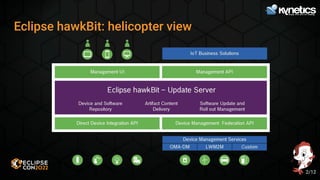
Eclipse hawkBit: helicopter view
2/12
Why project Hara
● hawkBit provides solid backend/API but no client implementation
○ Need for hawkBit client supporting update workflows
● Linux devices already taken care of
○ SWUpdate
○ RAUC + hawkBit Updater
● Internal design of an Android hawkBit client
○ Upon DDI API
○ Customer deployments
● Need for a JVM-based OS-agnostic reusable library
3/12
Eclipse Hara: helicopter view
● Kotlin library to speed up the development of hawkBit DDI native clients
● OS independent
● Architecture dependent
○ Based on JVM (available for many architectures)
● Agnostic with respect to the update artifacts (apps, OS OTA, …)
● Designed to facilitate the integration of native update Services
4/12
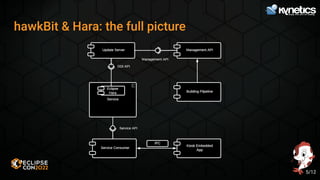
hawkBit & Hara: the full picture
5/12
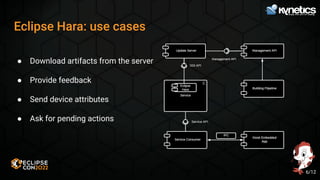
Eclipse Hara: use cases
● Download artifacts from the server
● Provide feedback
● Send device attributes
● Ask for pending actions
6/12
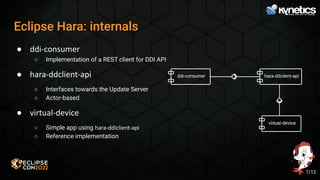
Eclipse Hara: internals
● ddi-consumer
○ Implementation of a REST client for DDI API
● hara-ddclient-api
○ Interfaces towards the Update Server
○ Actor-based
● virtual-device
○ Simple app using hara-ddiclient-api
○ Reference implementation
7/12
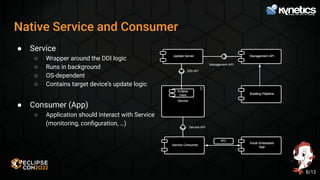
Native Service and Consumer
● Service
○ Wrapper around the DDI logic
○ Runs in background
○ OS-dependent
○ Contains target device’s update logic
● Consumer (App)
○ Application should interact with Service
(monitoring, configuration, …)
8/12
Service and Application drive the update logic!
● User experience
● Outages/timeouts handling
● Single/double copy updates
● Updates of the native service itself
● Error handling
9/12
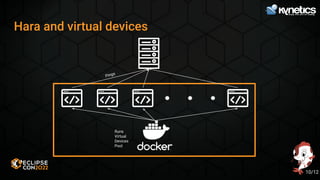
Hara and virtual devices
Pings
Runs
Virtual
Devices
Pool
10/12
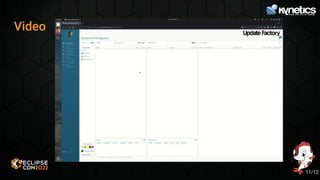
Video
11/12
Hara latest enhancements (Oct 2022)
● Schedule the download and application of an update for both soft and forced
● Configure the number of download attempts and the time between such
attempts
○ Android Client implements this feature with exponential back-off
● Verbose messages from the client to the Update Server
○ Reason of failure
○ Time to the next attempt
● Target Attributes sent at every polling if
○ They are actually updated
○ Server requests, explicitly, to receive the target attributes
Conclusion
Updating embedded devices made easy
1. DDI logic separated from device-specific Service
○ Easy to create custom Native Services
2. Testing with multiple (virtual) devices
○ No need for physical boards
12/12
Let’s increase clients availability
to spread the use of hawkBit!
Thank you
Matteo Di Pirro
matteo.dipirro@kynetics.com
Nicola La Gloria
nicola.lagloria@kynetics.com
Useful Links
● https://projects.eclipse.org/projects/iot.hawkbit.hara
● https://github.com/eclipse/hara-ddiclient
● https://www.eclipse.org/hawkbit/
● https://www.kynetics.com
● https://github.com/kynetics

Eclipse Hara, Updating Embedded Devices with hawkBit Made Easy

  • 1.
    Eclipse Hara Updating EmbeddedDevices with hawkBit Made Easy Matteo Di Pirro & Nicola La Gloria Kynetics LLC - Santa Clara, CA
  • 2.
    Agenda ● Who weare ● A glance at Eclipse hawkBit ● Eclipse Hara ● Native Services ● Virtual Devices ● Hara 2022 Enhancements ● Conclusion
  • 3.
    About us ● Weprovide OSes and Applications for embedded systems ○ Android ○ Open Embedded ● UpdateFactory ○ Software as a Service to update remote devices at scale ○ Based on Eclipse hawkBit ● Members of the Eclipse Foundation ○ Maintainers of Project Hara ○ IoT Working group ○ Edge Native Working Group & Edge Native Steering Committee 1/12
  • 4.
  • 5.
    Why project Hara ●hawkBit provides solid backend/API but no client implementation ○ Need for hawkBit client supporting update workflows ● Linux devices already taken care of ○ SWUpdate ○ RAUC + hawkBit Updater ● Internal design of an Android hawkBit client ○ Upon DDI API ○ Customer deployments ● Need for a JVM-based OS-agnostic reusable library 3/12
  • 6.
    Eclipse Hara: helicopterview ● Kotlin library to speed up the development of hawkBit DDI native clients ● OS independent ● Architecture dependent ○ Based on JVM (available for many architectures) ● Agnostic with respect to the update artifacts (apps, OS OTA, …) ● Designed to facilitate the integration of native update Services 4/12
  • 7.
    hawkBit & Hara:the full picture 5/12
  • 8.
    Eclipse Hara: usecases ● Download artifacts from the server ● Provide feedback ● Send device attributes ● Ask for pending actions 6/12
  • 9.
    Eclipse Hara: internals ●ddi-consumer ○ Implementation of a REST client for DDI API ● hara-ddclient-api ○ Interfaces towards the Update Server ○ Actor-based ● virtual-device ○ Simple app using hara-ddiclient-api ○ Reference implementation 7/12
  • 10.
    Native Service andConsumer ● Service ○ Wrapper around the DDI logic ○ Runs in background ○ OS-dependent ○ Contains target device’s update logic ● Consumer (App) ○ Application should interact with Service (monitoring, configuration, …) 8/12
  • 11.
    Service and Applicationdrive the update logic! ● User experience ● Outages/timeouts handling ● Single/double copy updates ● Updates of the native service itself ● Error handling 9/12
  • 12.
    Hara and virtualdevices Pings Runs Virtual Devices Pool 10/12
  • 13.
  • 14.
    Hara latest enhancements(Oct 2022) ● Schedule the download and application of an update for both soft and forced ● Configure the number of download attempts and the time between such attempts ○ Android Client implements this feature with exponential back-off ● Verbose messages from the client to the Update Server ○ Reason of failure ○ Time to the next attempt ● Target Attributes sent at every polling if ○ They are actually updated ○ Server requests, explicitly, to receive the target attributes
  • 15.
    Conclusion Updating embedded devicesmade easy 1. DDI logic separated from device-specific Service ○ Easy to create custom Native Services 2. Testing with multiple (virtual) devices ○ No need for physical boards 12/12
  • 16.
    Let’s increase clientsavailability to spread the use of hawkBit! Thank you Matteo Di Pirro matteo.dipirro@kynetics.com Nicola La Gloria nicola.lagloria@kynetics.com
  • 17.
    Useful Links ● https://projects.eclipse.org/projects/iot.hawkbit.hara ●https://github.com/eclipse/hara-ddiclient ● https://www.eclipse.org/hawkbit/ ● https://www.kynetics.com ● https://github.com/kynetics