The Proponents of
Early Childhood
Philosophy
Prepared By: AnnielynMogar &AbigailTim
tim
PRAYER
ENERGIZER
PROPONENTS
A personwhoadvocatesa theory, proposal, or project.
Proponent comes from the same Latin word as propose, so a
proponent is someone who proposes something, or at least
supportsit by speaking and writing infavor of it.
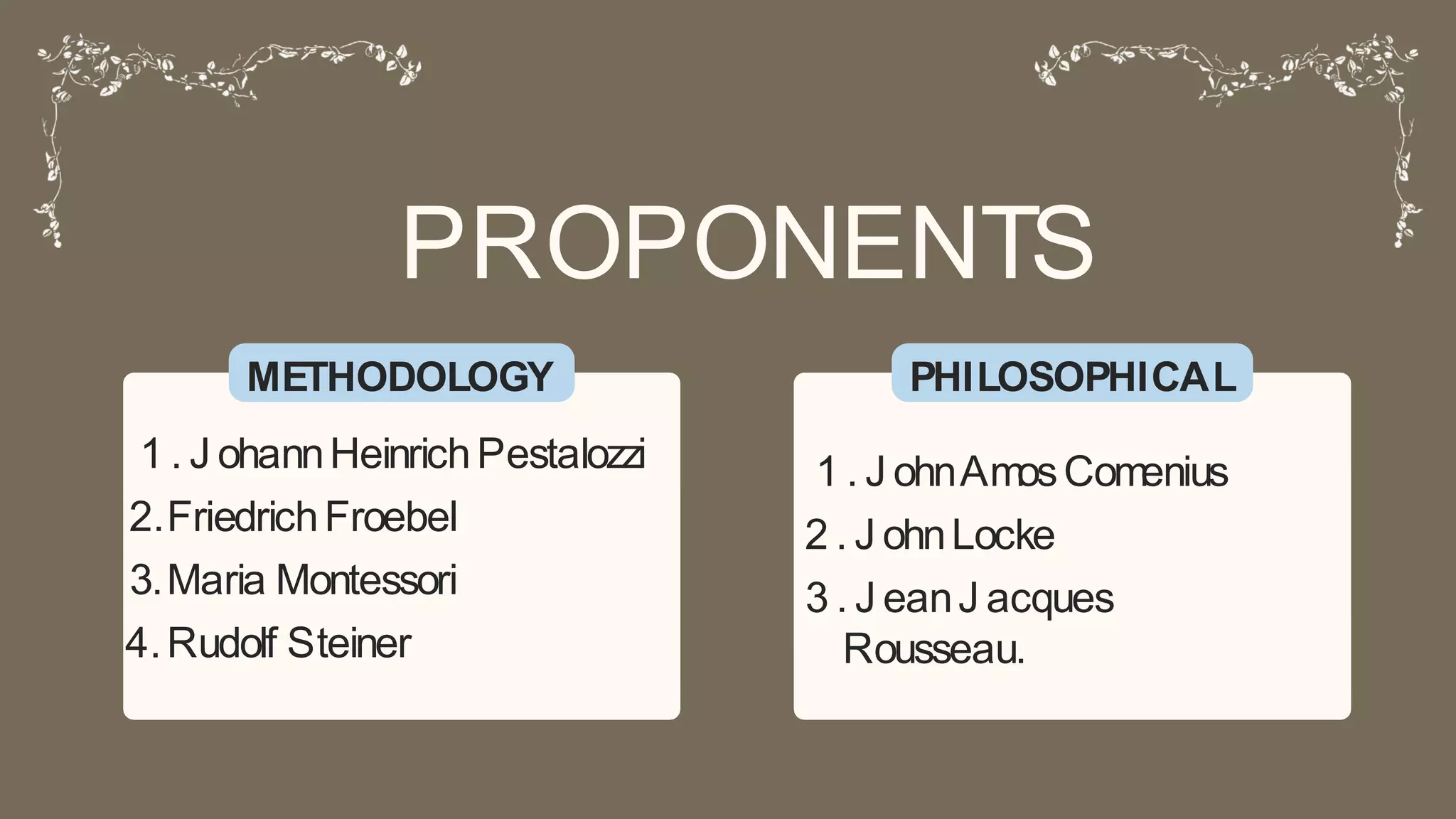
PROPONENTS
METHODOLOGY
1 . J ohannHeinrichPestalozzi
2.FriedrichFroebel
3.Maria Montessori
4.Rudolf Steiner
PHILOSOPHICAL
1 . J ohnAmosComenius
2 . J ohnLocke
3 . J eanJ acques
Rousseau.
A system of methods used in
a particular area of study of
activity.
METHODOLOGY
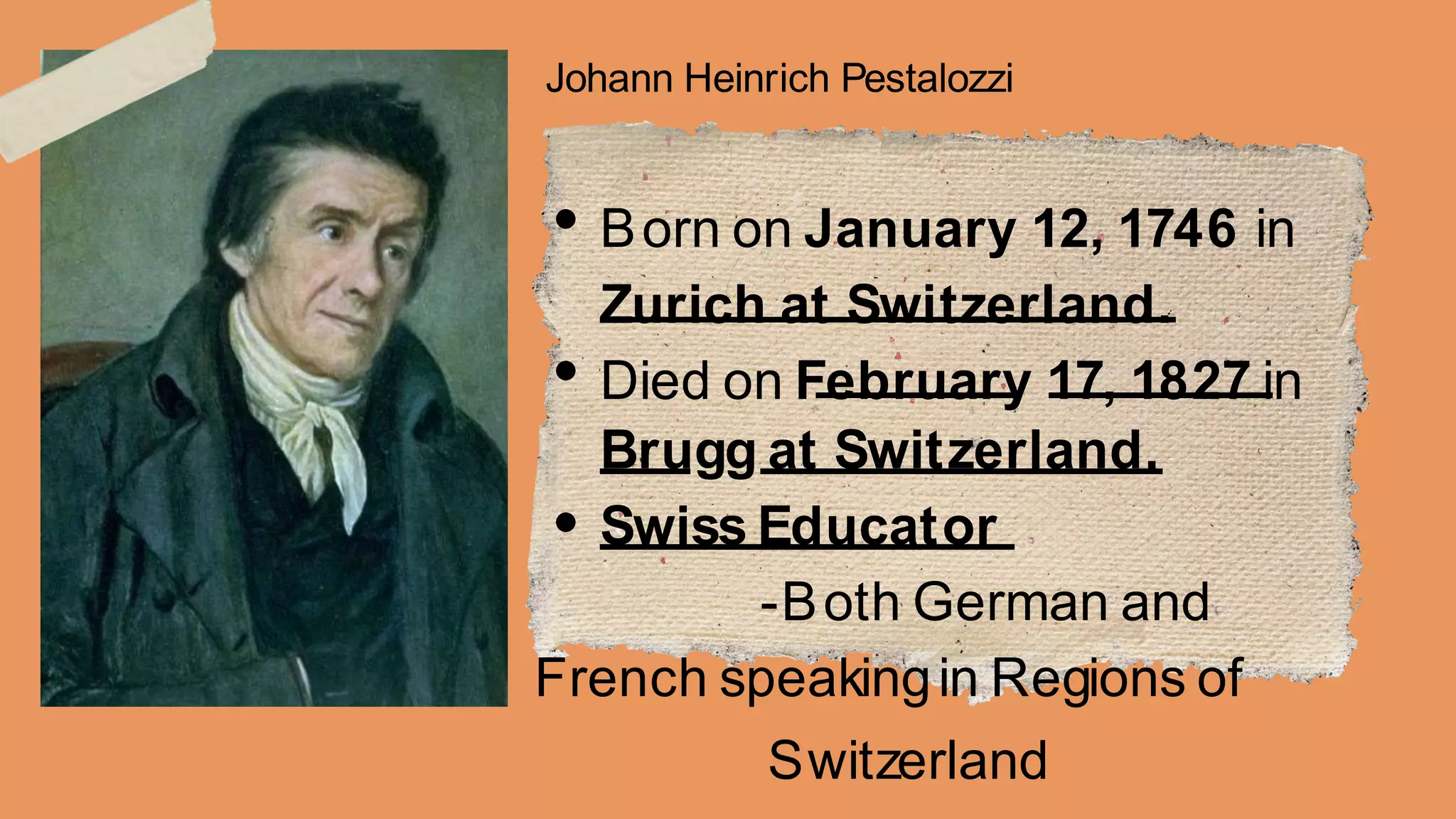
Johann Heinrich Pestalozzi
Born on January 12, 1746 in
Zurich at Switzerland.
Died on February 17, 1827 in
Brugg at Switzerland.
Swiss Educator
-Both German and
French speakingin Regions of
Switzerland
Motto
Learning by Head, Hand and Heart.
Famous Books:
Gertrude Teaches Her Children of 1801.
Rejecting corporal punishment, rote
memorization and bookishness.
Learning through experience.
- Touch, Feel, See and Smell
Pestalozzi method rested on Two premises:
1.Children need an emotionally secure
environment as the setting for successful
learning.
Pestalozzi method rested on Two premises:
2. Emphasis on Sensory Learning.
Theories of Learning
Theory of Value
1.What knowledge and skills are
worthwhile learning?
2.What are the goals of
Education?
Arithmetic, Geography, Science, Music,
Drawing Language and Physical Education
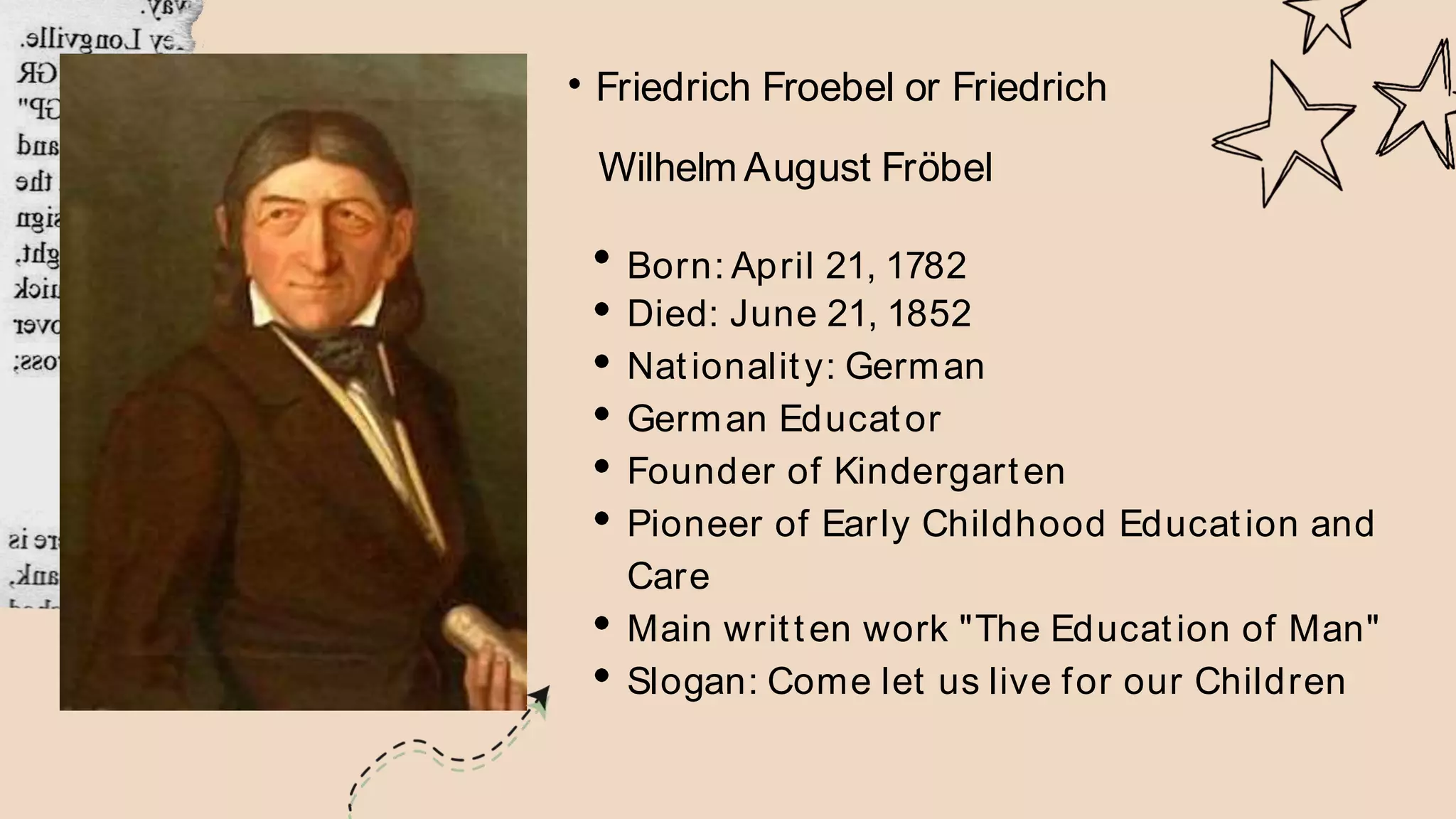
Friedrich Froebel or Friedrich
Wilhelm August Fröbel
Born: April 21, 1782
Died: June 21, 1852
Nationality: German
German Educator
Founder of Kindergarten
Pioneer of Early Childhood Education and
Care
Main written work "The Education of Man"
Slogan: Come let us live for our Children
Contribution of Education
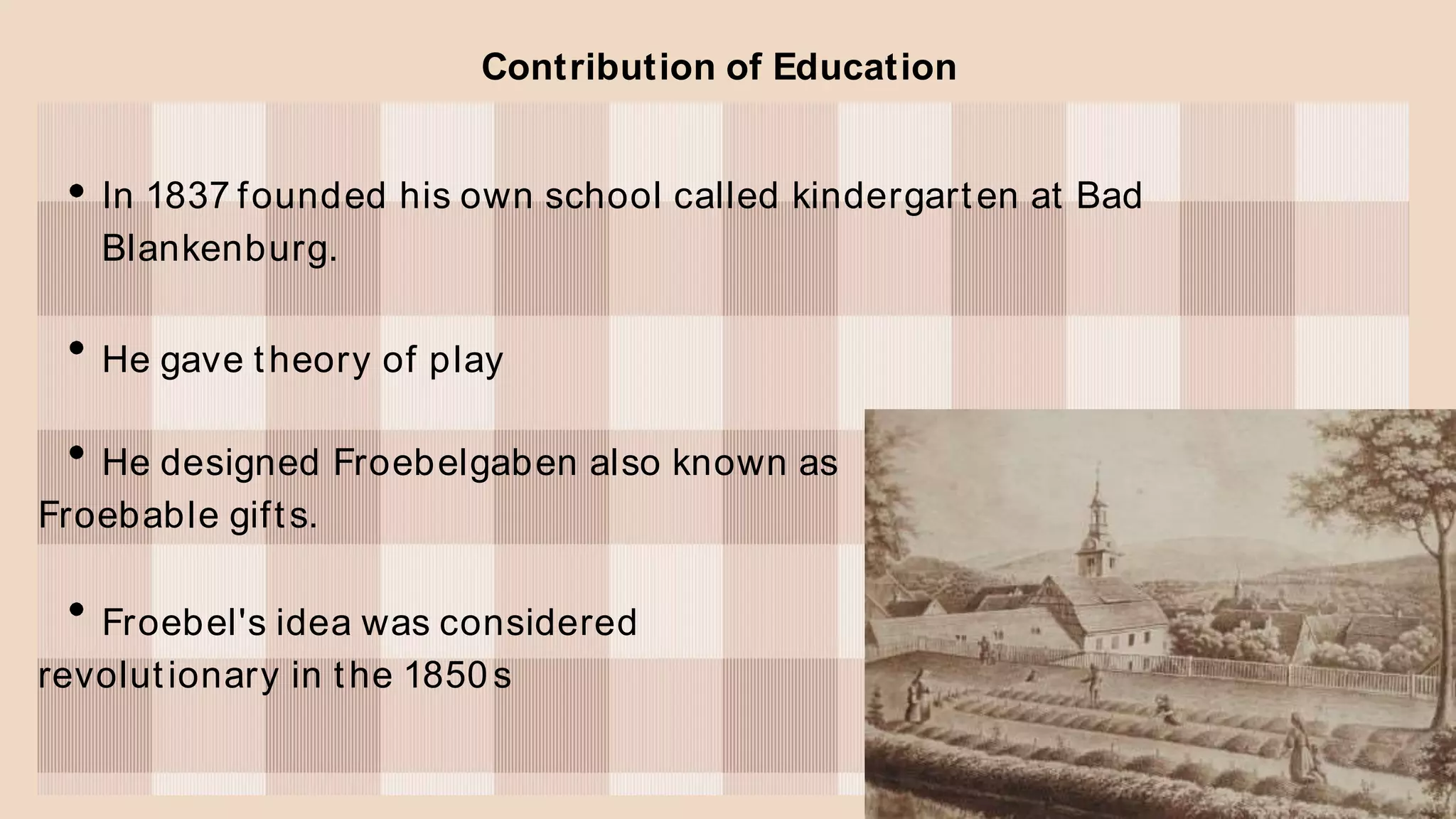
In 1837 founded his own school called kindergarten at Bad
Blankenburg.
He gave theory of play
He designed Froebelgaben also known as
Froebable gifts.
Froebel's idea was considered
revolutionary in the 1850s
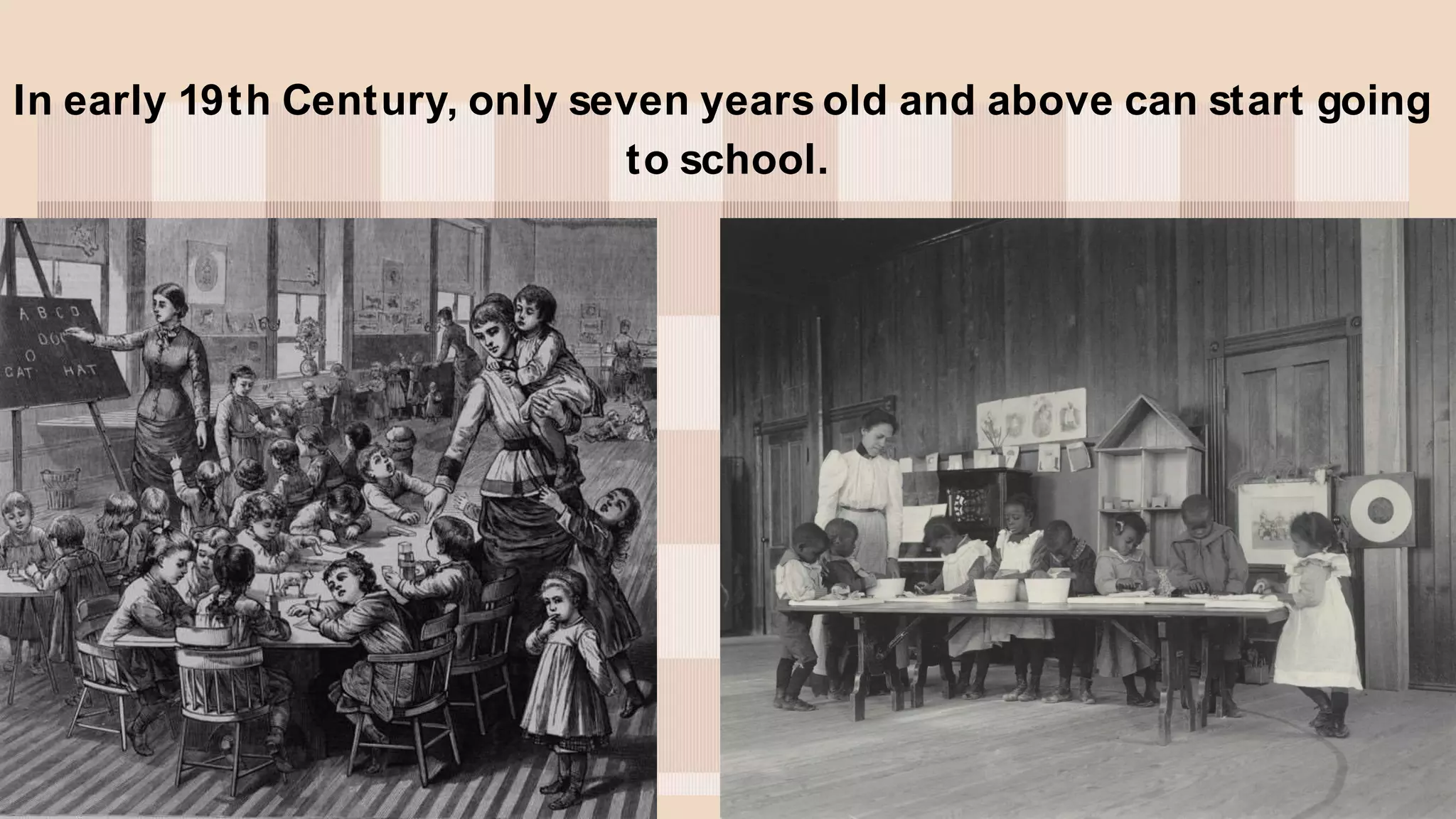
In early 19th Century, only seven years old and above can start going
to school.
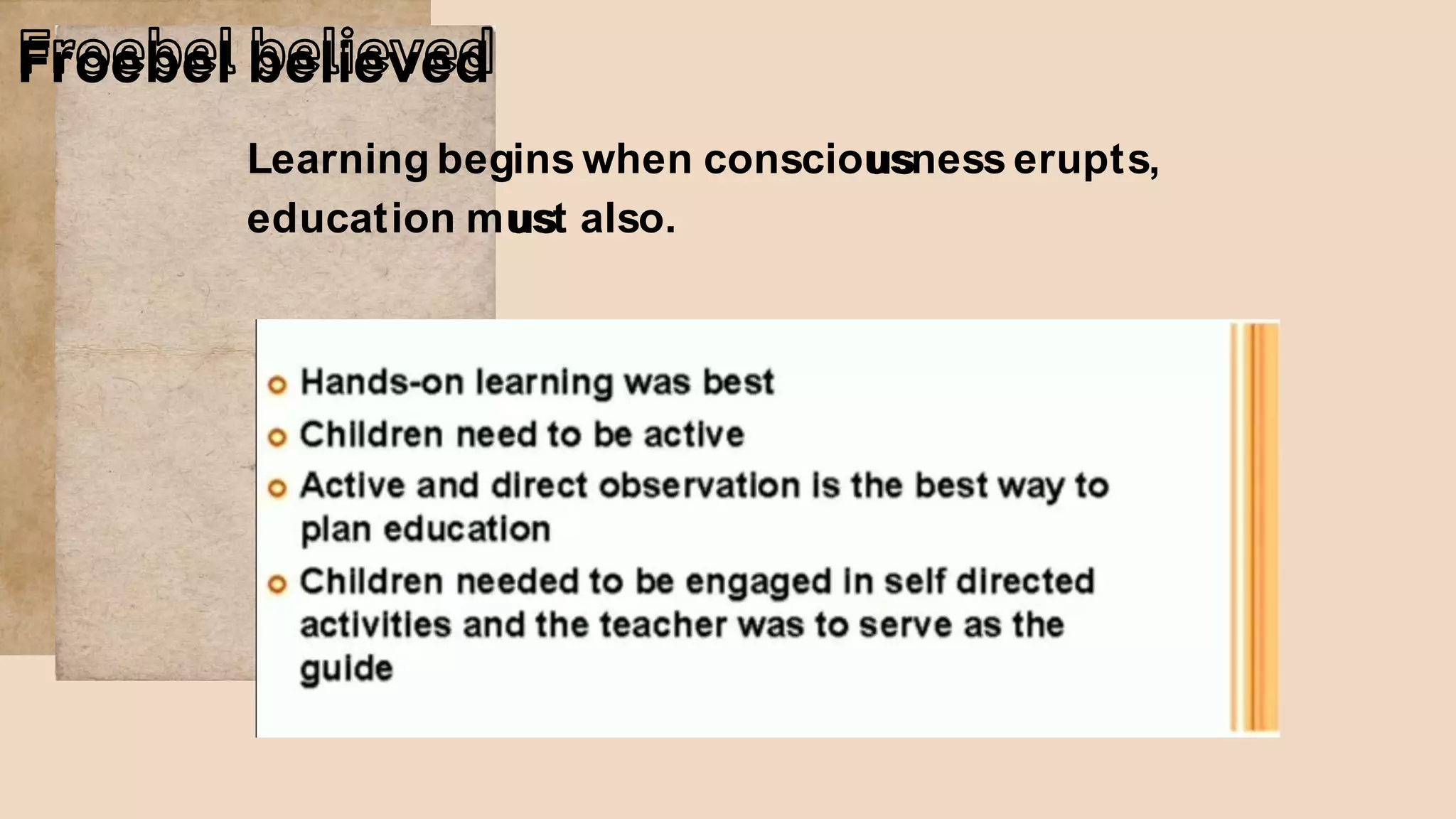
Froebel believed
Learning begins when consciou
us
sness erupts,
education mu
us
st also.
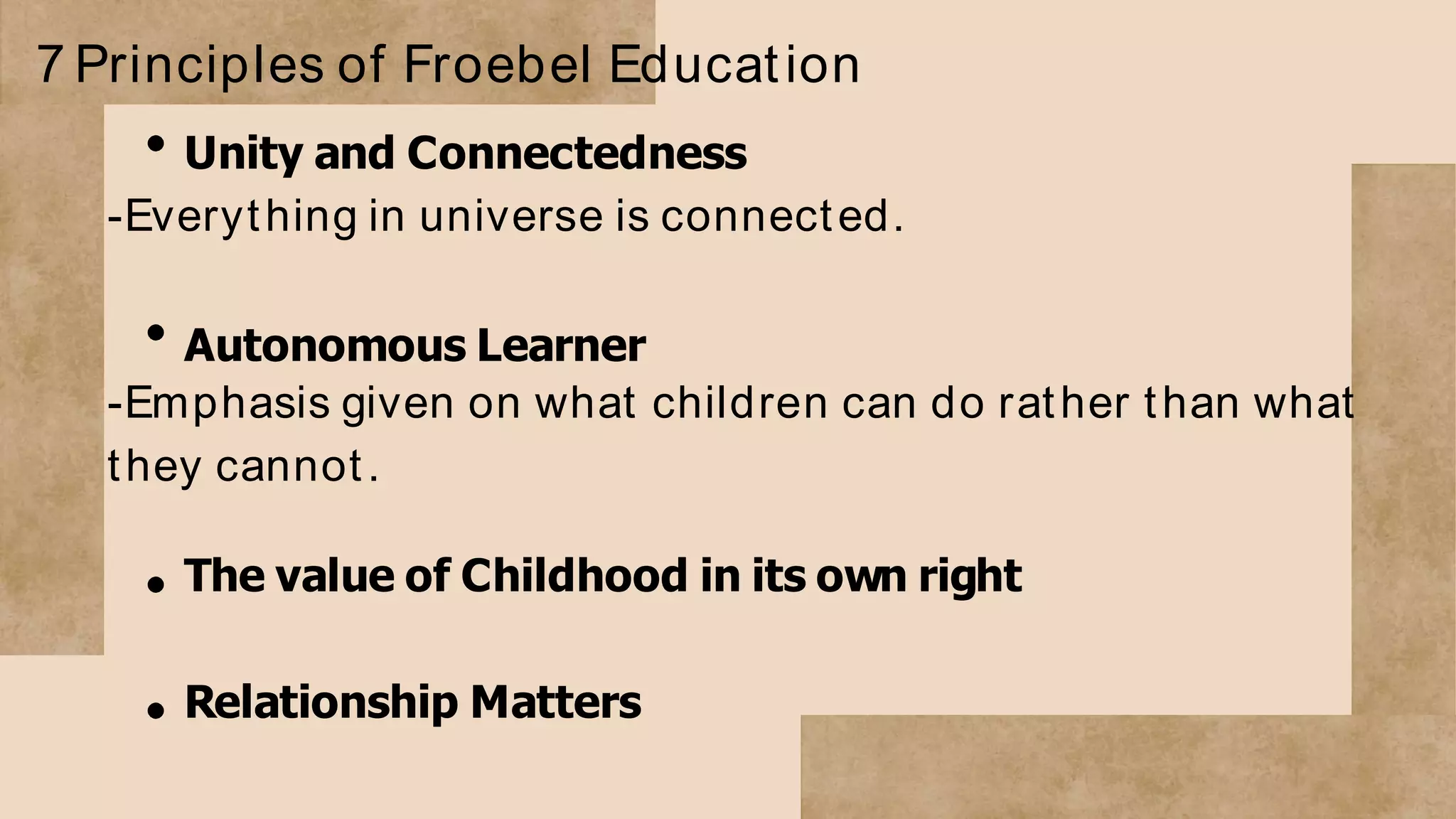
7 Principles of Froebel Education
Unity and Connectedness
-Everything in universe is connected.
Autonomous Learner
-Emphasis given on what children can do rather than what
they cannot.
The value of Childhood in its own right
Relationship Matters
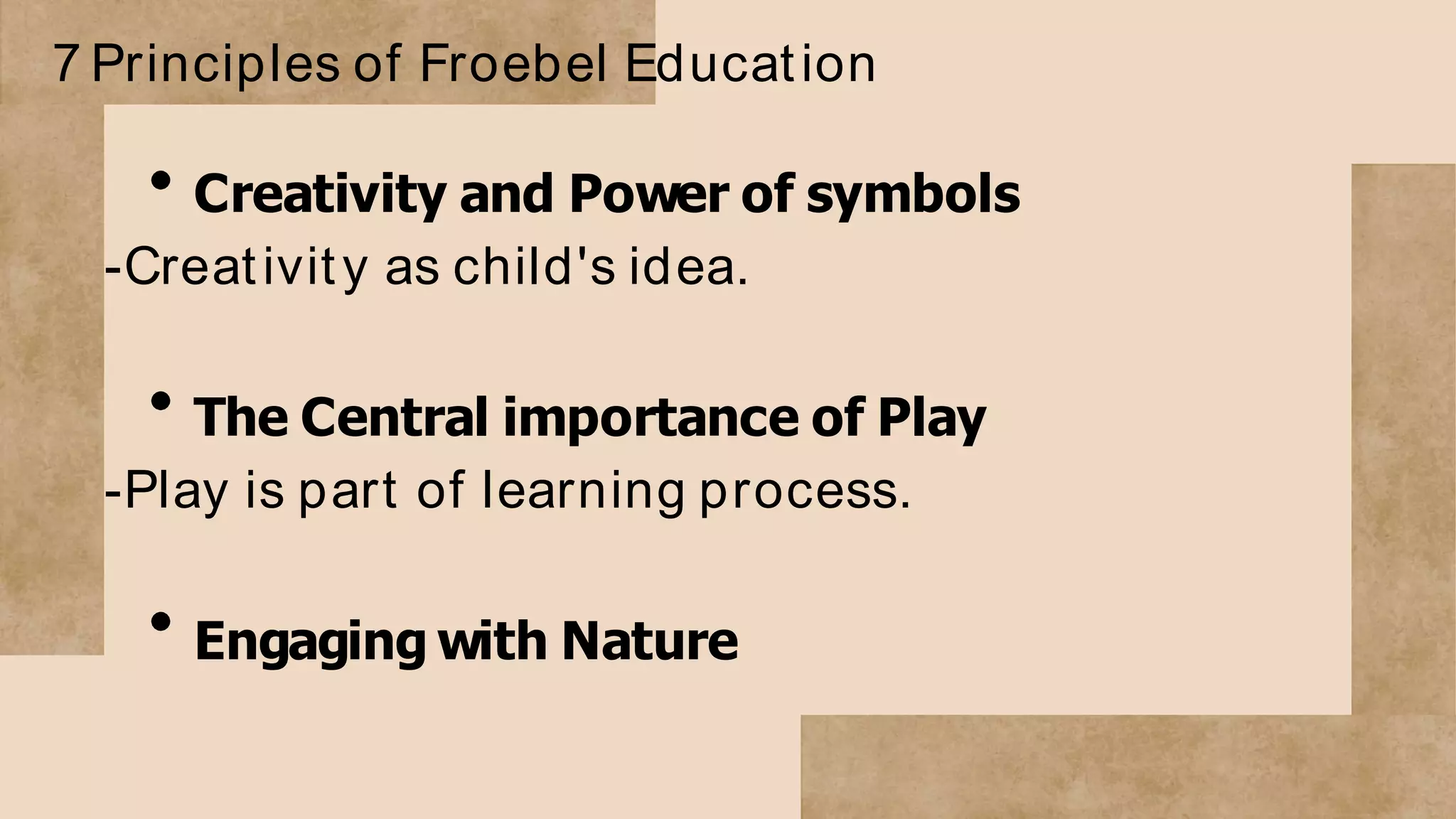
7 Principles of Froebel Education
Creativity and Power of symbols
-Creativity as child's idea.
The Central importance of Play
-Play is part of learning process.
Engaging with Nature
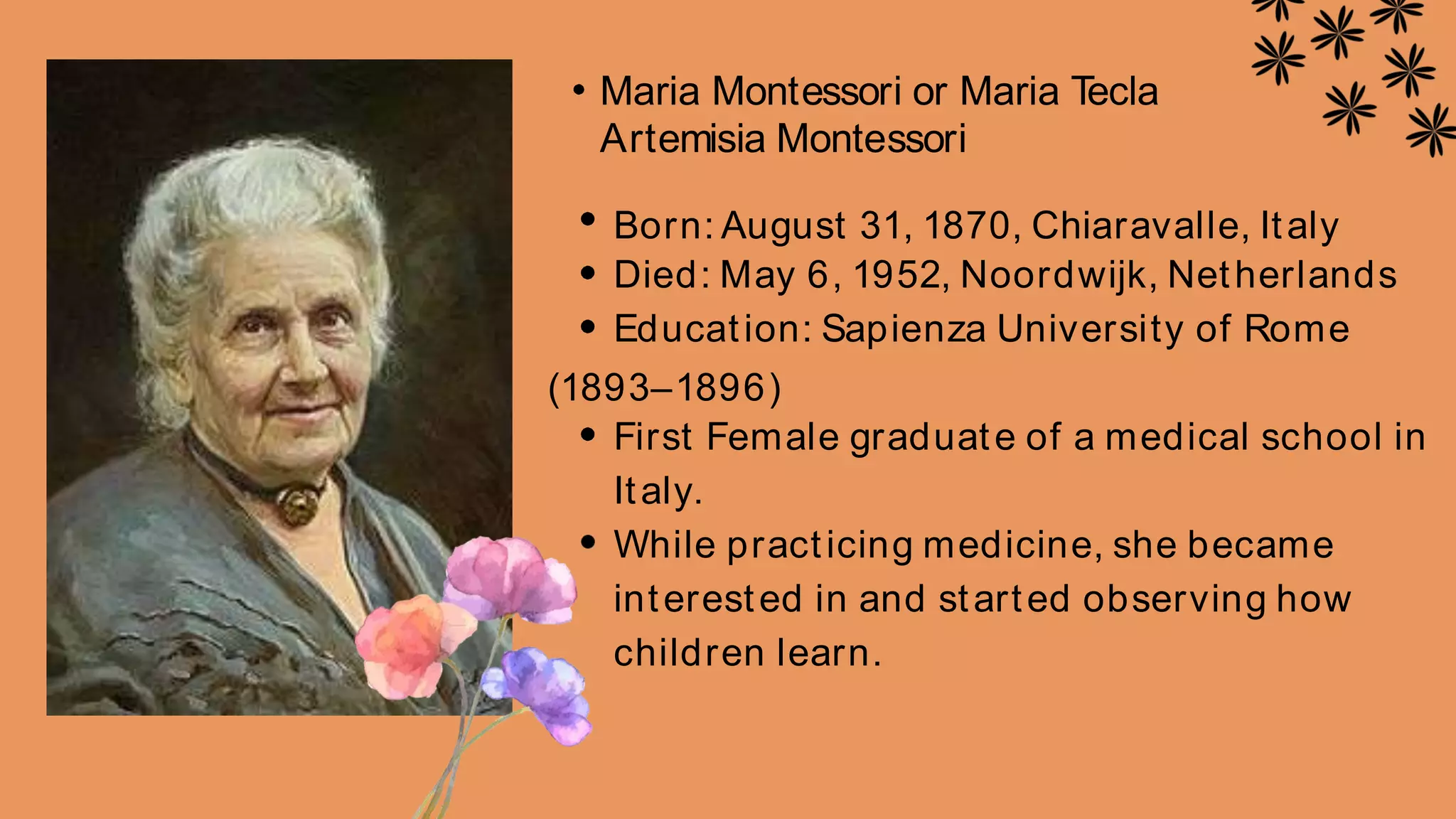
Maria Montessori or Maria T
ecla
Artemisia Montessori
Born: August 31, 1870, Chiaravalle, Italy
Died: May 6, 1952, Noordwijk, Netherlands
Education: Sapienza University of Rome
(1893–1896)
First Female graduate of a medical school in
Italy.
While practicing medicine, she became
interested in and started observing how
children learn.
8 Principle of Montessori
1.Movement and Cognition
2.Choice
3.Interest
4. Extrinsic Rewards are Avoided
5.Learning with and from Peers
6. Learning in Context
7.Teacher Ways and Child Ways
8.Order in Environment and Mind
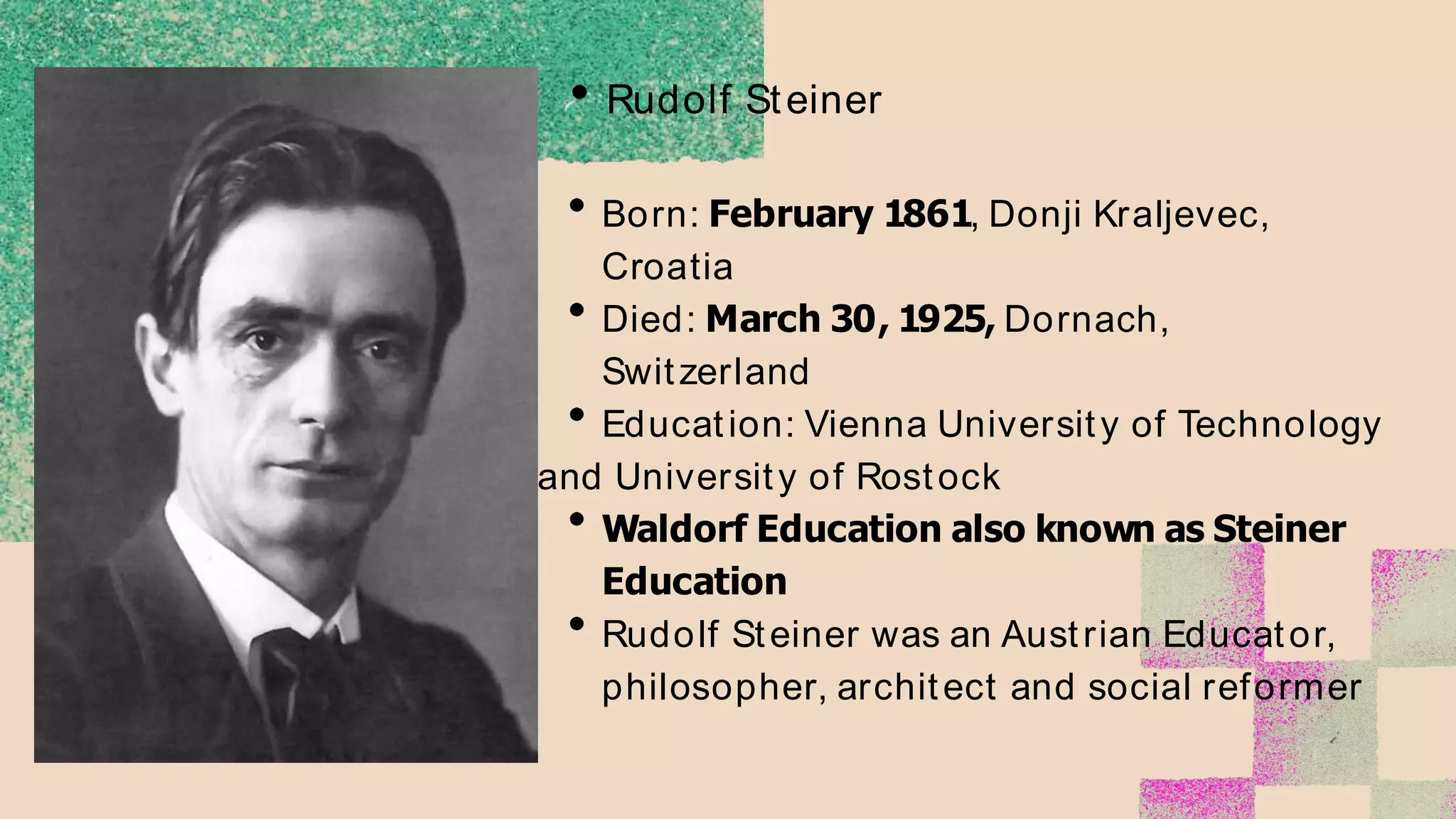
Rudolf Steiner
Born: February 1861, Donji Kraljevec,
Croatia
Died: March 30, 1925, Dornach,
Switzerland
Education: Vienna University of Technology
and University of Rostock
Waldorf Education also known as Steiner
Education
Rudolf Steiner was an Austrian Educator,
philosopher, architect and social reformer
Waldorf Education
Rudolf Steiner set 4 condition for opening
School
1.School should be open for all Children.
2.Coeducational
3.Unified twelve year School
4. Self governed/administered.
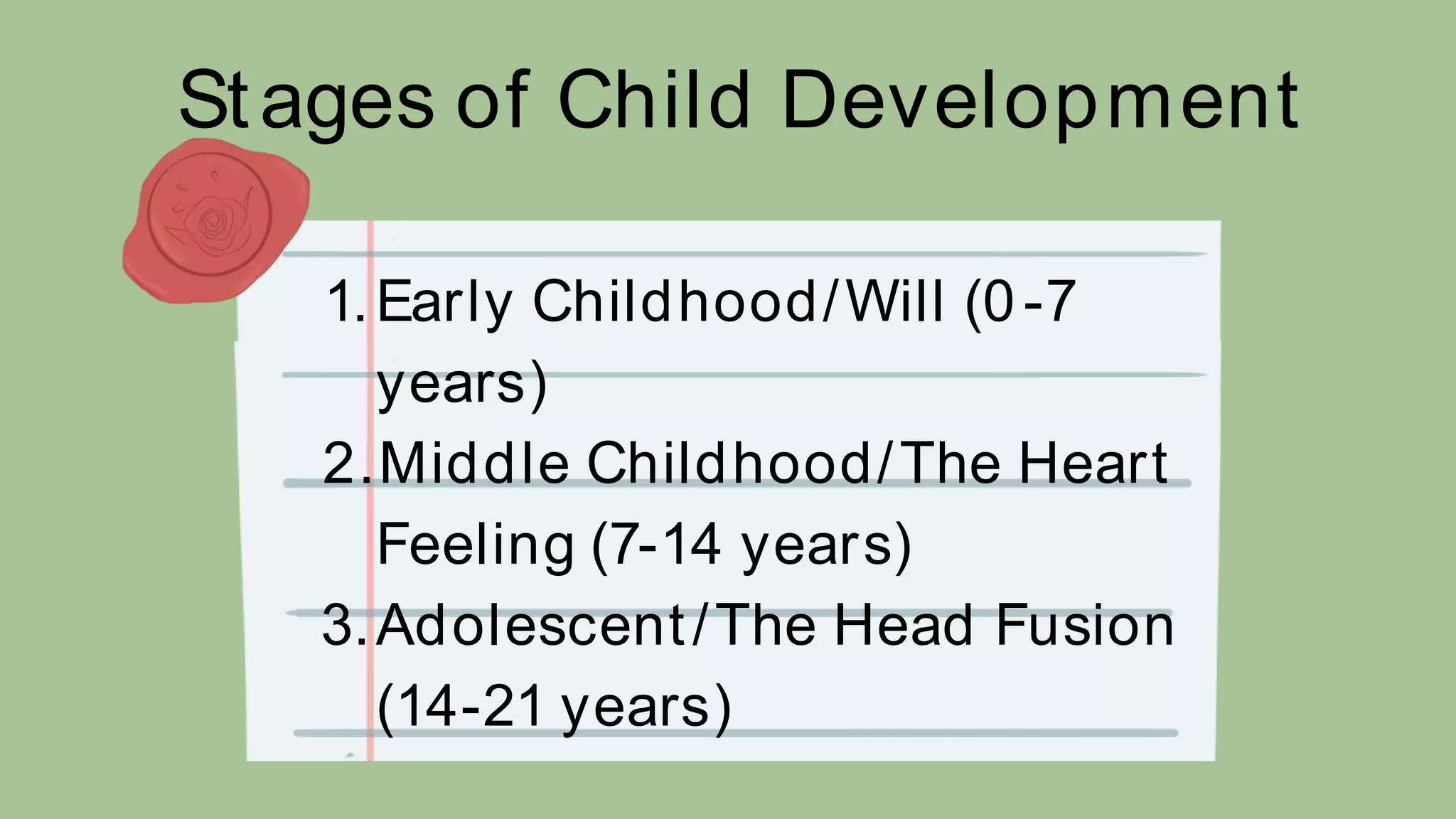
Stages of Child Development
1.Early Childhood/Will (0-7
years)
2.Middle Childhood/The Heart
Feeling (7-14 years)
3.Adolescent/The Head Fusion
(14-21 years)
THANK YOU FOR
LISTENING!

ECE-3-report.pptx

  • 1.
    The Proponents of EarlyChildhood Philosophy Prepared By: AnnielynMogar &AbigailTim tim
  • 2.
  • 3.
  • 4.
    PROPONENTS A personwhoadvocatesa theory,proposal, or project. Proponent comes from the same Latin word as propose, so a proponent is someone who proposes something, or at least supportsit by speaking and writing infavor of it.
  • 5.
    PROPONENTS METHODOLOGY 1 . JohannHeinrichPestalozzi 2.FriedrichFroebel 3.Maria Montessori 4.Rudolf Steiner PHILOSOPHICAL 1 . J ohnAmosComenius 2 . J ohnLocke 3 . J eanJ acques Rousseau.
  • 6.
    A system ofmethods used in a particular area of study of activity. METHODOLOGY
  • 7.
    Johann Heinrich Pestalozzi Bornon January 12, 1746 in Zurich at Switzerland. Died on February 17, 1827 in Brugg at Switzerland. Swiss Educator -Both German and French speakingin Regions of Switzerland
  • 8.
    Motto Learning by Head,Hand and Heart. Famous Books: Gertrude Teaches Her Children of 1801. Rejecting corporal punishment, rote memorization and bookishness.
  • 9.
    Learning through experience. -Touch, Feel, See and Smell Pestalozzi method rested on Two premises: 1.Children need an emotionally secure environment as the setting for successful learning.
  • 10.
    Pestalozzi method restedon Two premises: 2. Emphasis on Sensory Learning.
  • 11.
    Theories of Learning Theoryof Value 1.What knowledge and skills are worthwhile learning? 2.What are the goals of Education? Arithmetic, Geography, Science, Music, Drawing Language and Physical Education
  • 12.
    Friedrich Froebel orFriedrich Wilhelm August Fröbel Born: April 21, 1782 Died: June 21, 1852 Nationality: German German Educator Founder of Kindergarten Pioneer of Early Childhood Education and Care Main written work "The Education of Man" Slogan: Come let us live for our Children
  • 13.
    Contribution of Education In1837 founded his own school called kindergarten at Bad Blankenburg. He gave theory of play He designed Froebelgaben also known as Froebable gifts. Froebel's idea was considered revolutionary in the 1850s
  • 14.
    In early 19thCentury, only seven years old and above can start going to school.
  • 15.
    Froebel believed Learning beginswhen consciou us sness erupts, education mu us st also.
  • 16.
    7 Principles ofFroebel Education Unity and Connectedness -Everything in universe is connected. Autonomous Learner -Emphasis given on what children can do rather than what they cannot. The value of Childhood in its own right Relationship Matters
  • 17.
    7 Principles ofFroebel Education Creativity and Power of symbols -Creativity as child's idea. The Central importance of Play -Play is part of learning process. Engaging with Nature
  • 18.
    Maria Montessori orMaria T ecla Artemisia Montessori Born: August 31, 1870, Chiaravalle, Italy Died: May 6, 1952, Noordwijk, Netherlands Education: Sapienza University of Rome (1893–1896) First Female graduate of a medical school in Italy. While practicing medicine, she became interested in and started observing how children learn.
  • 19.
    8 Principle ofMontessori 1.Movement and Cognition 2.Choice 3.Interest 4. Extrinsic Rewards are Avoided 5.Learning with and from Peers 6. Learning in Context 7.Teacher Ways and Child Ways 8.Order in Environment and Mind
  • 20.
    Rudolf Steiner Born: February1861, Donji Kraljevec, Croatia Died: March 30, 1925, Dornach, Switzerland Education: Vienna University of Technology and University of Rostock Waldorf Education also known as Steiner Education Rudolf Steiner was an Austrian Educator, philosopher, architect and social reformer
  • 21.
    Waldorf Education Rudolf Steinerset 4 condition for opening School 1.School should be open for all Children. 2.Coeducational 3.Unified twelve year School 4. Self governed/administered.
  • 22.
    Stages of ChildDevelopment 1.Early Childhood/Will (0-7 years) 2.Middle Childhood/The Heart Feeling (7-14 years) 3.Adolescent/The Head Fusion (14-21 years)
  • 23.