Easements
in Texas
Judon Fambrough
Senior Lecturer and Attorney at Law
Technical Report 422
Judon Fambrough
Senior Lecturer and Attorney at Law
Easements in Texas
Revised September 2013
© 2013, Real Estate Center. All rights reserved.
Contents
	 1	Summary
	 1	 Private Easements in Texas
	 2	 Creation of Private Easements
	 5	 Termination of Private Easements
	 6	 Public Easements in Texas	
	 6	 Easements by Dedication
	 11	 Termination of Public Easements
	12	 Conclusion
	 13	 Appendix A. Synopsis of Private Easements
	 14	 Appendix B. Synopsis of Public Easements
	15	 Glossary
1
Easements in Texas
Judon Fambrough
Senior Lecturer and Attorney at Law
Summary
Easements play a vital role in everyone’s life. People daily traverse easements either granted, dedicated
or condemned for public rights-of-way. Also, people constantly use energy transported along pipeline and
utility easements. In rural areas, many tracts of land not served by public roadways would be rendered
practically valueless if it were not for private easements crossing neighboring properties.
An easement is defined as a right, privilege or advantage in real property, existing distinct from the own-
ership of the land. In other words, easements consist of an interest (or estate) in real property that does not
constitute full ownership. Most commonly, an easement entails the right of a person (or the public) to use
the land of another in a certain manner.
Easements should not be confused with licenses. A license is merely permission given to an individual
to do some act or acts on the land of another. It does not give rise to an interest in land as do easements.
Licenses need not be in writing to be effective and generally are revocable at any time. Tickets to entertain-
ment or sporting events serve as a good example of licenses.
This publication explains two broad categories of easements — private and public. Private easements
are those in which the enjoyment and use are restricted to one or a few individuals. Public easements are
those in which the rights of enjoyment and use are vested in the public generally or in an entire community.
The publication describes the various types of private and public easements, how they are created and
how they are terminated.
Private Easements in Texas
Mark and John had been farming and ranching in a
particular community for more than 50 years. Several
years ago Mark purchased some grazing land in a re-
mote section of the county. There was no public access.
However, John orally had permitted Mark to cross part
of his property in order to reach the land. The agreement
was never written nor recorded.
Recently, John died and his heirs sold the land to
some people new to the area. The buyers were not told
of the oral agreement and threatened to bring legal ac-
tion to terminate Mark’s passage over their land. Without
the easement, Mark must curtail his cattle operations.
This is just one example of the importance of private
easements. As will be demonstrated, unless the creation
of a private easement is carefully documented and re-
corded, its legality is questionable.
In Gross
Private easements may be divided into two groups
depending on the possessing entity. If an individual or
business owns the easement, it is said to be an easement
in gross. Pipeline easements are in gross. As a general
rule, an easement in gross is a personal right that cannot
be assigned or otherwise transmitted. The easement thus
terminates upon death of the individual owner or the
demise of the business. There is authority to the contrary
where the easement in gross is (1) placed in writing and (2)
explicitly made assignable by the instrument creating it.
The language making an easement in gross transfer-
able generally reads: "The terms, conditions and provi-
sions of this contract shall extend to and be binding
upon the grantee, his heirs, successors and assigns."
Appurtenant
The other type of private easement, known as an
appurtenant easement, attaches to or is incident to a
particular tract of land, not to a particular individual or
business. Appurtenant easements require two different
estates (or tenements) for their existence—a dominant
estate and a servient estate. The owner of the dominant
tenement has the right or privilege to use an easement
across the land of the servient tenement. The servient
tenement is burdened by the easement.
Appurtenant easements may be classified further as
either affirmative or negative. An affirmative easement
gives the dominant tenement the right to actively use the
easement on the servient tenement’s land. A negative
easement restricts the use of the servient tenement’s land
in favor of the dominant tenement.
2
An example will clarify these two types of easements.
Suppose landowner "A" wants to build a dam that will
back water across landowner "B’s" property. To keep "B"
from suing, "A" seeks an affirmative easement from "B"
allowing "A" to flood a portion of "B’s" land. If "A" is suc-
cessful, "A’s" land will be the dominant tenement, and
"B’s" land will be the servient tenement. "B’s" land will
be burdened by the standing water.
Suppose further that "B" becomes dependent upon
the supply of water provided by "A’s" dam. "B" wants to
invest in some livestock but needs the assurance of a
permanent source of water. Here "B" will seek a nega-
tive easement from A. The negative easement would
restrict A from destroying the dam or draining the water.
These are rights "A" would have except for the negative
easement.
The only duty an easement imposes on the owner of
the servient estate is that of a negative nature. The servi-
ent owner may not interfere with the use and enjoyment
of the dominant estate’s easement across the land. Any
repairs or works necessary to effectuate the use and en-
joyment of the easement must be made by the dominant
owner.
Appurtenant easements are easily transferable. A
conveyance of the dominant tenement automatically
includes the easement across the servient tenement’s
land. A transfer of the servient estate will include the
easement burdening it if the purchaser has actual or
constructive notice of the easement’s existence. If the
dominant tenement purchases the servient tenement’s
land, the easement terminates. One cannot own an
easement across his or her property.
Creation of Private Easements
An easement may be created by various means. Each
has its own distinct requirements. Because easements
represent interests in land, they generally require some
written, tangible evidence prescribed by Section 5.021
of the Texas Property Code for their creation. The written
requirements may be waived where the person claiming
the easement has (1) paid consideration for the ease-
ment in money or services, (2) began using the ease-
ment and (3) made valuable and permanent improve-
ments to the easement.
The written document creating an easement need not
be recorded to be effective. However, to give construc-
tive notice to subsequent purchasers as described in
Section 13.002 of the Texas Property Code, easements
normally are recorded.
Without a written document, an easement may be
created three ways. They are (1) by implication, (2) by
estoppel and (3) by prescription. The party claiming
such an easement may have to resort to a judicial pro-
cess known as a declaratory judgment to claim it.
Easements by Implication
Easements by implication, better known as implied
easements, may be created three ways: (1) by reserva-
tion, (2) by grant or (3) by way of necessity. Each has
distinct requirements. One thing they hold in common,
though, is the property must be landlocked without the
implied easement.
The first two implied easements mentioned earlier are
sometimes called Quasi Easements. These are based on
the prior usage of a roadway that was overlooked in the
transaction. The roadway (right of entry) was either not
reserved or conveyed in the deed thereby leaving the
property landlocked. The other implied easement (by
way of necessity) does not require the prior usage of a
roadway, only that the property is landlocked after the
transaction.
Another distinction worth noting is how difficult must
the entry be before the land is considered landlocked.
The courts put forth two standards: reasonably necessary
(also known as reasonable necessity) versus strictly nec-
essary (or strict necessity). Reasonable necessity means
another way of access may exist, but it is inconvenient
to use. Strictly necessity means no other way of access
exists, whether convenient or not.
Reasonable necessity is sufficient to acquire an
implied easement by grant. However, strict necessity is
required for either an implied easement by reservation
or easement by way of necessity.
Easements by implied reservation or grant. The cre-
ation of an implied easement by either reservation or
grant requires the prior existence and use of the ease-
ment. Furthermore, the prior use must have been appar-
ent, permanent, continuous and necessary for the enjoy-
ment of the property granted. In each implied easement
case, the court views the implied easement as merely
an oversight on the part of the grantor and grantee at the
time of the conveyance.
For instance, suppose "A" owns a 40-acre tract of land
with a public road running along its southern boundary.
"A’s" house sits along the northern part of the 40-acre
tract. It is served by a private road running north and
south. A decides to sell the southern 20 acres to "B."
However, A forgets to reserve a right-of-way easement
across the 20 acres to access the home.
This is a classical example of when the court most
likely would approve an implied reservation for "A."
The easement must have been apparent, permanent
and continuously used at the time of the grant. The only
other requisite is that there are no other available access
routes this route is necessary.
An implied grant of an easement can be illustrated by
the same set of facts. Suppose "A" decided to sell the
northern 20 acres. "A" retains title and possession to the
southern 20 acres along the public roadway. If A does
not grant an easement to "B" across the southern 20
acres when title is conveyed, the courts may approve an
easement by implied grant.
The implied grant would require the same elements
as the implied reservation. In other words, the easement
must be apparent, permanent, continuous and necessary
for "B’s" use and enjoyment of the property.
Some Texas courts recognize implied easements by
grant more readily than implied easements by reserva-
tion. This is based on the rule that the courts favor the
3
grantee more readily than the grantor. In this case, the
grantor should have protected his or her interest by
reserving an access easement in the deed. Hence strict
necessity is required for an implied easement by reser-
vation (where the grantor failed to reserve one) versus
reasonable necessity being required for an implied ease-
ment by grant.
Easements by way of necessity. Finally, an implied
easement may arise by way of necessity. This easement
differs primarily from the other two implied easements
in that no prior existence or use of the easement is re-
quired. As the name implies, an easement of this nature
arises only where no other routes of ingress and egress
appear. It is strictly necessary.
For an implied easement by way of necessity to arise,
the following three conditions must be fulfilled. First,
there must have been unity of ownership of the domi-
nant and servient estates at the time of conveyance
or at some prior time. Second, the easement is strictly
necessary for the grantee to enter and leave the property.
Third, the necessity for the easement existed at the time
of the severance of the dominant and servient estates.
As to the issue of unity of ownership, case law re-
quires that sometime in the chain of title after the land
was patented, the tract needing the easement and the
tract preventing the easement must have been under
common ownership. (A patent occurs when the sover-
eign conveys ownership to a private individual.) Com-
mon ownership of the two tracts by the sovereign does
not meet the test.
Strict necessity requires that no other passageway to
and from the conveyed property can exist. If the grantee
can use another way either at the time of conveyance
or thereafter, the right-of-way by necessity cannot be
claimed. The mere showing that it would be more
expensive or less convenient to obtain another access
route is not sufficient to give rise to an implied easement
by necessity.
The issue of what constitutes strict or absolute neces-
sity has raised some interesting modern-day issues. For
instance, any piece of property is accessible by air via
a helicopter or parachute. Thus, no tract of land is ever
absolutely inaccessible. Yet no case has ever been found
in which an easement was denied because of its acces-
sibility solely by air.
Similarly, if a tract of land is accessible only by navi-
gable water, is it absolutely landlocked? Only ten cases
have denied an easement because of such accessibility.
Of these, only two were decided after 1925; five were
decided prior to 1900. Eight cases recognize an ease-
ment despite access by water. All but one of these cases
were decided after 1927. Although none were Texas
cases, the trend seems to be toward a more relaxed
standard of necessity by water.
Just as the grantee can acquire an implied easement
by way of necessity, so can the grantor. Should the
grantor retain a tract with no access, the law allows the
grantor to claim an implied easement by way of neces-
sity. The servient estate in the hands of the grantee under
the conveyance is charged with the burden.
Because an easement by necessity requires no prior
use, the location of the easement may present problems.
The case law holds that it should be placed in a "con-
venient way" across the surrounding land. If a particular
route is used by common consent, that fixes the loca-
tion. Thereafter, the location can not change, except
with the consent of both parties.
If the location can not be derived by common con-
sent, the selection belongs to the servient tenement
(the one crossed), giving due regards to the dominant
owner's rights. If the servient tenement does not select
the route, the right rests with the dominant tenement.
Again, once selected, the route can not change except
with common consent.
Statutory Easement for Landlocked Property
The law has not always been consistent regarding
landlocked property in Texas. Prior to 1963, any per-
son having land without an easement could statutorily
condemn a private right-of-way to and from the property
according to the Texas Revised Statutes Article 1377b(2).
However, in 1963, the Texas Supreme Court held this
statute contrary to Article 1, Section 17 of the Texas
Constitution because it lacked public purpose. (See
Estate of Waggoner v. Gleghorn, 378 S.W. 2d 47.)
The second statutory attempt also failed (Texas Re-
vised Statutes, Article 6711). It authorized the commis-
sioners court to declare and open a public highway, at
public expense, across lands of nonconsenting owners.
The action could be taken upon the sworn application
of one or more landlocked landowners.
This statute also lacked the necessary public purpose
requirement. It was declared unconstitutional in 1962
by the Texas Supreme Court (Maher v. Lasater, 354 S.W.
2d 923.) The high court, in reversing a prior decision,
wrote, "In deciding that question (case) we assumed,
but did not hold, that it is of public importance that
every person residing on land be provided access to
and from his land so that he may enjoy the privileges
and discharge the duties of a citizen." The court further
stated, "The legislature may not authorize that which the
consitution prohibits."
Effective Sept. 1, 1995, the Texas Legislature passed
a new statute that mirrors the former Article 6711. The
new law is found in Subchapter B, Chapter 251 of the
Texas Transportation Code.
Again, on a sworn application, a landlocked property
owner may request that a road be condemned by the
commissioners court. The procedure is outlined in the
statute.
In 2009, Section 251.054 was repealed, removing all
funding for any land taken under Chapter 251 of the
Texas Transportation Code. This section contained the
sole means for determining damages for affected land-
owners. The repeal apparently terminated any future use
of this statute for accessing landlocked property.
For more information, see "Don't Fence Me In," publi-
cation 1130.
4
Easements by Estoppel
Another way an easement may be created without
written expression is by estoppel. Here the easement
arises from the acts and/or oral expressions of the grant-
or that indicates the existence, creation or conveyance
of an easement. Should the grantee rely on such demon-
strations and accept the grantor’s offer and be damaged
thereby, the grantor will be estopped (or legally prevent-
ed) from denying the existence of the easement.
For example, suppose "A" wants to induce a buyer
into purchasing a lot in an undeveloped subdivision.
The prospect is shown a platted map with a roadway
indicating a convenient access route to and from the lot.
If the prospect should purchase the lot, "A" would be
legally precluded from asserting the nonexistence of the
easement.
However, an easement by estoppel based on silence
can be established only when the landowner has a duty
to speak. If a person (or family) has a revocable right
(or permission) to cross another's land, the landowner
has no duty to advise subsequent generations that the
easement is revocable at will. Therefore, the user cannot
complain when the easement is unilaterally revoked.
A claim of an easement by estoppel by silence will not
apply.
Easements by Prescription
The last way an unexpressed easement may be cre-
ated is by way of prescription—sometimes referred to
as by way of limitations. Prescriptive easements arise in
much the same manner as title accrues by adverse pos-
session. The requirements basically are the same. The
only difference is that adverse possession ripens into
title to the land, whereas a prescriptive right matures
into an easement.
There are five basic requirements for a prescriptive
easement. The absence of any one is fatal to the cre-
ation of the easement. First, the use of the land must be
adverse to the owner of the land. In other words, the use
must begin and continue without the actual or implied
permission of the landowner.
Second, the use must be open and notorious. This
means the use must be asserted in such a manner as to
serve notice of the claim not only to the landowner but
all persons in the immediate area. Secretive use is insuf-
ficient. A clear and positive use must be evident. An ex-
ception does exist for the latter requirement. The courts
have substituted actual knowledge and acquiescence of
the owner of the servient tenement in the place of open
and notorious use. Acquiescence may be implied from
the circumstances.
Third, the use must be exclusive. The use of an ease-
ment common with others or even with the owner is
insufficient to create a prescriptive right. This rule, how-
ever, is a rule of evidence raising a rebuttable presump-
tion that permission was given the claimant when both
the owner and claimant use the easement concurrently.
The rule does not apply where concurrent use by the
owner and claimant occur after the prescriptive period
has matured (i.e., the claimant has used the easement
for ten years).
Fourth, the use must be in the same place and within
definite lines. The practice of passing over land in differ-
ent places does not establish a prescriptive right except
where the divergences are only slight. Also, the travel
over unenclosed and unimproved land will not entitle
the traveler to a prescriptive right unless the way is defi-
nitely marked.
Fifth, the use must be continuous and uninterrupted.
Thus, the assertion of the enjoyment of the land cannot
mature into a prescriptive right based on occasional
passage. Likewise, any time the adverse usage is inter-
rupted, the running of the prescriptive period is an-
nihilated and must begin anew. It has been held that
placing a fence across a road for a week is a sufficient
interruption.
In Texas, the three-, five-, ten- and 25-year statutes
dealing with adverse possession have been held inap-
plicable to the creation of prescriptive easements. The
courts, however, judicially have placed the required
period of continuous, uninterrupted adverse use for
prescriptive easements at ten years.
The courts have placed certain limitations and stipula-
tions as to when the prescriptive period begins. For
example, the period will not run if the owner of the
servient estate is suffering under a legal disability such
as infancy or insanity or is the ward of an estate when
the adverse use begins. The period will run once the
disability is removed. An intervening disability occurring
after the period has started will not suspend (or toll) the
running of the prescriptive period.
The following example illustrates the rules. Assume
"A" inherits land. "A" is 16 years of age. The same year
"B" begins crossing the land without "A’s" permission.
Because "A" is a minor, the prescriptive period will not
commence. However, once "A" reaches the legal age of
18, the prescriptive period will start to run.
In another example, suppose "A" inherits the land
when "A" is 21 years of age, the same year "B" begins
crossing the land without "A’s" permission. Five years
later "A" is adjudicated insane. Here the prescriptive
period will continue to run. Intervening disabilities will
not suspend the running of the ten-year period.
The courts have, in limited instances, applied the
doctrine of tacking in cases involving appurtenant pre-
scriptive easements. Tacking entails adding the periods
of consecutive adverse users together in determining the
necessary ten-year period. However, certain qualifica-
tions are necessary. (1) There must be no interruptions in
the use between users. (2) The users must be successive
owners of the dominant tenement. (3) The document
conveying the dominant estate must contain the follow-
ing language: "together with all and singular the rights
and appurtenances thereto in anywise belonging to the
said grantees."
5
Termination of Private Easements
Private easements may be extinguished in as many, or
more, ways than they can be created. In fact, the man-
ner in which some easements arise determines directly
the means by which they can be terminated. Without
going into any great detail, the following is a brief syn-
opsis of the various ways easements may be dissolved.
Transfer of Servient Estate
to Bona Fide Purchaser
Regardless of the method of creating the easement,
the most universal means of terminating private ease-
ments involves the conveyance of the servient estate to
a bona fide purchaser (BFP).
A BFP is someone who pays “valuable consideration”
for the property and takes title “without having actual
or constructive notice” of a third party’s claim. (Bona
fide purchasers are sometimes referred to as Innocent
Purchasers.)
Texas case law to some degree clarifies and defines
these requirements.
“Valuable consideration” means the buyer paid a sig-
nificant amount for the property. Although the amount
may be less than fair market value, it cannot be nominal
or grossly inadequate.
For example, the recipient of a gift deed, where no
consideration changes hands, cannot claim BFP status.
However, even if consideration is paid, the recipient
of title to land via a quitclaim deed cannot achieve the
status of a BFP either.
“Actual knowledge” refers to any oral or written repre-
sentations the buyer receives prior to closing concerning
the title to or use of the property.
“Constructive notice” refers to the information affect-
ing title to the property contained in the deed records as
well as any facts a physical inspection or visible exami-
nation would reveal.
To ascertain the information in the deed records
(sometimes called the real property records), the buyer
may:
• examine the recorded documents personally or hire
someone to do the same using the county clerk’s indices
to trace title;
• require the seller to prepare an abstract of title and
have it examined by an attorney chosen by the buyer; or
• purchase title insurance.
Thus, constructive notice may be given by having the
easement recorded in the county deed records in com-
pliance with the Texas Property Code, Section 13.002.
By doing so, any subsequent purchaser of the property
is charged (imputed) with knowledge of the easement
even though the buyer does examine or have the deed
records examined.
For more information regarding BFPs and protec-
tion afforded by the recording statutes, see the Center’s
publication entitle “Deeds and the Texas Recording
Statutes” http://recenter.tamu.edu/pdf/1267.pdf
Finally, prospective purchasers should personally
inspect the property for evidence of an easement not
disclosed in the deed records.
If no open and apparent use of an unrecorded ease-
ment exists across the property, then the BFP takes free
of them.
Effective Oct. 1, 1991, Procedural Rule P-37 was
adopted by the Texas State Board of Insurance regard-
ing guaranteeing the right of access in a title insurance
policy. All title policies issued after Oct. 1, 1991, ensure
the right of access unless a specific exception is added.
Neither the width of the access nor access to a public
thoroughfare is insured.
Easements arising without written expression have
inherent problems whenever the servient estate is trans-
ferred. Because there is no written document to record,
the only way knowledge can be given to the prospective
buyer is by actual notice. Consequently, all easements
should be placed in writing and recorded to preserve
their existence.
For instance, consider the previous example involving
Mark and John. Mark probably will lose the easement
because it was never recorded. The new purchasers
probably took title to the servient estate without actual
or constructive knowledge of the easement. Even if the
purchasers had actual knowledge, the easement could
not survive Mark's death. Oral easements in gross are
nontransferable as mentioned earlier.
Operation of Law
Easements may be extinguished by operation of law.
The foreclosure on delinquent promissory notes secured
by a mortgage or deed of trust on real property will
terminate all easements created subsequent to the mort-
gage being placed on the land. The first in time prevails
in such an instance.
Likewise, condemnation will terminate all existing
easements across the condemned land. The rights of
the public in condemned property are paramount to an
individual’s right.
Abandonment
Easements may be extinguished by abandonment.
Abandonment takes place whenever cessation of use
occurs accompanied by a clear intent never to use the
easement again. Mere nonuse does not constitute aban-
donment. However, the intent may be inferred from the
circumstances if such evidence is clear and definite.
Failure of Condition
Noncompliance by the grantee with a condition of
the grant is another way an easement may terminate.
However, the condition must be explicitly coupled with
a right of forfeiture. For example, an easement will ter-
minate when it is conditioned on the use by the grantee
within a stipulated period. Also, the failure of the
grantee to pay half of the easement's upkeep is another
example of a conditional easement.
6
Merger
As mentioned earlier, the merger of the dominant and
servient tenements under a common owner terminates
all appurtenant easements between the two estates.
Expiration of Designated Term
The expiration of the designated number of years in a
grant will extinguish a term easement. For example, an
easement granted for a term of 15 years expires auto-
matically at the end of the designated 15-year period.
Adverse Possession
Adverse possession of an easement by the servient
tenement for ten continuous years will terminate an
easement. For instance, suppose "A" grants "B" a right-
of-way easement in 1950. The easement leads to some
property recently acquired by "B." "B" intends to live on
the property following retirement. In 1970, "B" retires.
However, in the meantime, "A" erected a fence across
the easement and also a barn and catch pens. Other
portions of the easement were plowed and placed in
cultivation.
In such an instance, the easement granted in 1950
may have terminated if it has been "actually and visibly
appropriated, commenced and continued under a claim
of right inconsistent with and hostile to the claim of 'B',"
as described in the Texas Civil Practice and Remedies
Code, Section 16.026. The character of the claim must
indicate unmistakably an assertion of exclusive owner-
ship by "A" for ten consecutive years.
Expiration of Purposes
The removal of the purpose or reason for creating an
easement will terminate it. For example, an easement
granted explicitly for the construction of a reservoir will
terminate when the reservoir is completed. An easement
granted to serve a particular oil well will expire when
the well ceases production.
Misuse
The misuse of an easement generally will not cause
the easement’s termination. Also, the use of an easement
for an unauthorized purpose or in an excessive man-
ner is not sufficient to cause a forfeiture. However, such
abuses do give rise to damages on the part of the servi-
ent tenement. Misuse can result in termination when the
misuse creates an impossibility to use the easement for
the purpose originally granted.
Change of Condition
A change in condition also may extinguish certain
easements. For example, an implied easement by way
of necessity is only a temporary right. It continues only
so long as the necessity exists. Should the necessity dis-
sipate, so will the easement.
Grant of Release
Lastly, an easement can terminate by a release being
granted by the owner. However, the release should
be placed in writing and recorded in the county land
records. If not, serious title problems could result in the
future.
In fact, the latter point cannot be overemphasized.
Regardless of how an easement is extinguished, a care-
fully written release should be prepared, signed by the
party granting the release and placed in the county land
records. Otherwise, subsequent conflicts may arise dis-
puting the easement's continued existence.
Public Easements in Texas
The Philmores owned a residence approximately one
block from an elementary school in a heavily populated
district of a city. There were no sidewalks in the neigh-
borhood. A heavy concentration of children traversed
the area twice daily going to and coming from school.
To help relieve some of the danger of having the
children travel on the side of the street, the Philmores
constructed a sidewalk on their property. The children
began using the sidewalk, but the Philmores failed to
anticipate the adverse effects. The children caused the
family dog to bark, the paper was generally missing
each morning and minor acts of vandalism occurred on
their property.
The Philmores finally decided to dismantle the side-
walk. However, they were served with a restraining
order by the city attorney’s office. The city contended
that the Philmores had granted the public an irrevocable
easement across the land.
Public easements, as mentioned earlier, are those
easements to which the right of enjoyment and use are
vested in the public generally or in an entire commu-
nity. Aside from purchasing, there are three ways public
easements may be created. Each method is unique and
has different requirements. The three ways public ease-
ments may arise without purchasing are: (1) by dedica-
tion, (2) by prescription and (3) by condemnation.
Once created, the uses for which public right-of-way
easements can be used have been construed broadly.
An easement for city streets includes the right for the
municipality to lay sewer, gas and water lines. West
Texas Utilities Co. v. City of Baird, 286 S.W. 2d 185.
An easement for a state highway includes the right for
a municipality to lay a gas pipeline within it. Grimes v.
Corpus Christi Transmission Co., 829 S.W. 2d 335.
Easements by Dedication
Dedication is perhaps the most common means by
which public easements arise. Dedication is defined as
a method of creating or transferring an interest in land,
consisting of an easement only and not title. It is the act
of devoting or giving property, or an interest therein, for
some proper object. It is a voluntary transfer that does
not require consideration.
There are two distinct types of dedication—statutory
and common law. Both types require an intent on the
part of the owner to dedicate (or set apart) the easement
and a reciprocal acceptance of the easement by the
7
public generally, by the governing body of a municipal-
ity or by the county.
Statutory Dedication
Statutory dedication is the simpler of the two types
of dedication to explain. As the name implies, statu-
tory dedication must be carried out in compliance with
all relevant statutes. Different procedures are required
depending on the location of the land. If the land is
located in a municipality or a municipality’s extraterrito-
rial jurisdiction, Chapter 212 of the Texas Local Govern-
ment Code governs. If the land is located in a rural area,
yet outside the extraterritorial jurisdiction of a munici-
pality, Chapter 232 of the Texas Local Government code
controls. Finally, if the dedication occurs in counties
having a population of 50,000 or less, Section 281.001
et seq. of the Texas Transportation Code governs (and
limits) the procedure.
Note:BothChapters212and232dealwithsubdivision
plats.Thededicationofstreetsandalleyswithinthesubdivi-
sionsisthecontextinwhichthestatutesareaddressedhere.
Chapter 212. Section 212.001 et seq. of the Texas
Government Code requires the following:
•	The platted land must be situated within the limits
or in the extraterritorial jurisdiction of a municipality.
•	The owner of the land must intend to lay out a sub-
division, an addition to the municipality, suburban
lots, building lots or any lot, street, alley, park or
some other portion for public use.
•	Theownermustaccuratelydescribetheproposed
subdivisionoradditionbymetesandboundsinaplat.
Theplatmustcontainprecisedimensionsofallthe
proposedstreets,alleys,squares,parksorotherpor-
tionsintendedtobededicatedtopublicuse.
•	The plat must be acknowledged by the owner and
filed for approval with the municipal planning
commission (if there is one) or with the govern-
ing body of the municipality. Section 212.007 of
the Government Code describes the procedure for
approving a plat of land lying in the extraterritorial
jurisdiction of more than one municipality.
•	The municipal authority responsible for approving
plats must act within 30 days after filing, otherwise
the plat shall be deemed approved by inaction. If
the plat must be approved by the governing body of
the municipality in addition to the planning com-
mission, the governing body shall act on the plat
within 30 days of its approval (by whatever means)
by the planning commission.
•	Once approved, the plat must be filed of record in
the county in which the land lies.
The plat manifests the owner’s intent to give appropri-
ate easement to the public in the proposed streets, alleys
and public areas. The approval of the plat, however,
does not indicate the municipality’s acceptance of the
easements. According to the Texas Local Government
Code, Section 212.011, "The approval of a plat is not
considered an acceptance of any proposed dedica-
tion and does not impose on the municipality any duty
regarding the maintenance or improvement of any dedi-
cated parts until the appropriate municipal authorities
make an actual appropriation of the dedicated parts by
entry, use, or improvement."
Chapter 232. Section 232.001 et seq. of the Texas
Local Government Code applies to platted land located
outside the limits of a municipality or a municipality’s
extraterritorial jurisdiction. Whenever the owner of such
land divides the tract into two or more parts for a subdi-
vision, a plat must be prepared and recorded. Before the
plat can be recorded, it must:
•	describe the subdivision by metes and bounds;
•	locate the subdivision with respect to an original
corner of the original survey of which it is a part;
•	state the dimensions of the subdivision and of each
lot, street, alley, square, park, or other part of the
tract intended to be dedicated to public use or for
the use of purchasers or owners of lots fronting
on or adjacent to the street, alley, square, park, or
other party;
•	be acknowledged by the owner or the proprietor, or
by the owner’s or proprietor’s agent; and
•	be filed with the commissioners court of the county
for approval by an order entered in the minutes.
Once approved, the plat must be filed with the county
clerk for recording according to the Texas Property
Code, Section 12.002.
Note: Before approving the plat, the commissioners
court may:
•	require a right-of-way on a street or road that func-
tions as a main artery in a subdivision, of a width
of not less than 50 feet or more than 100 feet;
•	require a right-of-way on any other street or road in
a subdivision of not less than 40 feet or more than
70 feet;
•	require that the shoulder-to-shoulder width on col-
lectors or main arteries within the right-of-way be
not less than 32 feet or more than 56 feet, and that
the shoulder-to-shoulder width on any other street
or road be not less than 25 feet or more than 35
feet;
•	adopt, based on the amount and kind of travel over
each street or road in a subdivision, reasonable
specifications relating to the construction of each
street or road;
•	adopt reasonable specifications to provide ad-
equate drainage for each street or road in a sub-
division in accordance with standard engineering
practices;
•	require that each purchase made between a sub-
divider and a purchaser of land in the subdivision
contain a statement describing the extent to which
8
water will be made available to the subdivision
and, if it will be made available, how and when;
and
•	require that the owner of the tract to be subdivided
execute a good and sufficient bond in the manner
provided by law.
There is no provision regarding how soon the com-
missioners court must act on the plat after submission.
Neither is there a provision providing acceptance of the
plat by inaction.
Section 281.001 et seq. of Transportation Code.
Unlike Chapters 212 and 232, Chapter 281 of the
Transportation Code requires no formal platting for the
dedication of private roads. The chapter applies only to
dedications occurring after 1980 in counties having a
population of 50,000 or less.
Basically, the chapter restricts the ways these counties
may acquire a public interest in private roads to:
•	purchase,
•	condemn,
•	dedicate and
•	a judgment of adverse possession (sometimes
referred to as a prescriptive easement, discussed
later.)
The chapter specifies how the dedication may and
may not occur. The dedication must be an explicit vol-
untary grant of the private roadway for public purposes
communicated to the commissioners court in writing in
the county where the property is located. A dedication
conveyed orally or by overt acts is invalid.
In turn, the commissioners court may accept the dedi-
cation and assert a public interest in the road by:
•	entering a resolution in the commissioners court re-
cords recognizing the interest acquired in the road-
way, the circumstances by which it was acquired,
and the effective date of the acquisition; and
•	giving written notice of the acceptance to the own-
er of the land from which the road was acquired in
person or by registered mail.
Section 281.004 prohibits counties from acquiring
a public interest in a private road in certain circum-
stances. It states that counties may never claim adverse
possession of a private road when the county commis-
sioners maintain a private road with:
•	the owner’s permission or
•	public funds when the public has no recorded
interest in the roadway.
Common Law Dedication
All common law dedications require the following
four elements: (1) a person competent to dedicate, (2)
a public purpose served by the dedication, (3) an offer
or tender of the dedication and (4) an acceptance of the
offer or tender.
As to the element of capacity, any person having the
capacity to make a grant of land has the capacity to
make a valid dedication. However, in addition to having
the capacity to dedicate, the person also must own an
unqualified and undivided fee title to the land. A co-ten-
ant cannot make a valid dedication without the joinder
of the other co-tenants.
As to the element of public purpose, the dedica-
tion must be for a use beneficial to the public and not
prohibited by statute. If the easement is reserved for a
specific group, then there is no public purpose involved
and no dedication of a public easement can occur.
As to the element of the offer or tender, it must be
based on a manifest desire of the landowner to devote
the land to a public use. If there is no intent, there can
be no offer.
The intent to dedicate must be based on a clear, un-
equivocal act or declaration of the landowner. A secret
intent is insufficient. The courts will presume an intent
in very limited situations.
The intent also must be unqualified. The intent must
be such that the public has an irrevocable right to enjoy
the property, independent of any whim of the land-
owner and beyond recall. The intent must be to divest
the owner of the interest immediately and not at some
future time. However, it is not necessary that the owner
intend immediate use by the public.
The way the offer is communicated to the public de-
termines whether or not it constitutes an express or im-
plied common law dedication. Whichever way is used,
both the manifestation and communication must be so
clear and convincing that a reasonable person would be
induced to act in reliance thereon.
Express Dedication
If the dedication is expressed, it may be declared ei-
ther orally or placed in writing. Perhaps the oral decla-
ration is the weaker of the two. It has been held that oral
declarations may be, in and of themselves, sufficient to
constitute an offer of dedication. However, as a general
rule, oral declarations serve only to explain the conduct
of the owner.
For instance, in one case, a developer made casual
comments about his intent to place streets and alleys
at a certain place within a proposed subdivision. Later,
when the developer began selling the lots, he did so by
making references to a map where the suggested streets
and alleys were omitted. Here the courts
maintained the references to the map negated the prior
casual comments.
Written expressions of intent to dedicate are more
common than oral representations. Generally, the writ-
ten expression of intent will appear either in a dedica-
tory deed or incorporated in a proposed plat. If the
intent is embodied in a dedicatory deed, the deed may
name either a city or the public generally as the grantee.
The mere fact the deed does not meet the requirements
of conveyance set forth in Sections 5.021 and 5.022 of
the Texas Property Code is irrelevant because a written
dedication may be shown by a simple contract.
9
Plat designation is the most common form of a written
dedication. It can occur when the owner lays out a town
site or an addition to a town or city on a plat and delin-
eates the proposed streets, parks or other public places.
It also can occur when any part of a town site or addi-
tion is sold by reference to a plat containing designated
public (not private) areas.
If the dedication takes the form of a map or plat,
it generally is necessary to record or file the plat to
establish effective communication of the offer to the
public. If recorded, it constitutes an unequivocal offer
of dedication.
Note: As long as the plat or map has not been record-
ed, a common law dedication is possible. If, however,
the plat or map is recorded, it must be done in com-
pliance with Chapters 212 or 232 of the Texas Local
Government Code as mentioned earlier. Such recording
constitutes a statutory dedication, not a common law
one. Most dedications in Texas via a map or plat are
statutory.
Effective communication can be established without
recording by placing the plat in the possession of public
authorities so that it is readily accessible to the general
public. The exhibition of the plat to a few individuals
may create a private easement by estoppel as mentioned
earlier but not a public easement.
Implied Dedication
Implied common law dedications may be communi-
cated to the public in two ways. One is by the affirma-
tive acts of the owner, the other by inactions or acquies-
cence on the owner’s part.
If affirmative acts are the means of communication,
the acts must amount to an invitation or encourage-
ment to the public to use the land. For instance, open-
ing property to public use or even fencing off part of
the land and making repairs thereon convenient for the
public’s use have been held sufficient affirmative acts to
give rise to an implied dedication.
Inactions or acquiescence sufficient to give rise to an
implied dedication is more difficult to ascertain. Howev-
er, by disregarding certain private interests for a consid-
erable length of time, a landowner may have dedicated
land for public use by implication. Allowing the public
to use a strip of land without objections serves as a good
example. The landowner may not deny the implications.
The duration of the owner’s inactions or acquiescence
is important only when the attitude or intent cannot be
clearly ascertained. For example, where a landowner
silently permits the public authorities to grade, repair or
otherwise improve a private road, such inactions have
been held sufficient evidence to establish an implied
intent to dedicate but not in counties where Article
6812(h) applies.
When the attitude or intent cannot be established, the
period of the use then becomes more important. The
courts will presume an intent if the period of inactions
extends for several years. Generally a ten-year period is
used, but 50-, 40-, 35-, 20-, eight- and six-year periods
also have been adhered to by the courts.
Before indulging in any presumptions, the courts must
examine the existing evidence as to the owner’s attitude
and the general character of the land used by the public.
For instance, if permission was given to cross the land,
the owner must have intended it to be permanent, not
temporary, and it must have extended to the public gen-
erally and not to select individuals.
Likewise, mere use by the public is not in and of itself
sufficient to disclose an intent to dedicate. This fact is
particularly true when the public use does not interfere
with the owner’s use of the property. Thus, the owner
has no occasion to declare overtly his or her intentions
in the matter. No intention to dedicate can be ascer-
tained when the use is promiscuous, occasional or un-
defined. No public easement can arise when the use is
confined to a particular class of persons as distinguished
from the public generally.
Finally, to complete the dedication, the offer or tender
of the use must be accepted by or on behalf of the
public. Acceptance must take place within a reasonable
time after the tender but before it is revoked.
Also, the offer may lapse by the expiration of a
designated period imposed by the owner. Revocation
also can occur by the owner’s devoting the property to
some inconsistent use or by vacating a filed plat in ac-
cordance with Chapters 212 or 232 of the Texas Local
Government Code as will be discussed later.
Any public action that shows an unequivocal intent to
appropriate the property to the purpose for which it was
set aside is sufficient to constitute a binding acceptance.
Once accepted, the dedication becomes immediately
operative. The owner becomes divested of all rights in
the property consistent with the purpose to which the
easement was dedicated.
The acceptance may be either formal or informal.
In most instances, an informal acceptance transpires.
The following are examples of cases in which informal
acceptance occurred: (1) establishing roads, streets and
alleys by a city in conformity to the plat filed by the
owner, (2) purchasing land by individuals relying on the
existence of a valid dedication, (3) taking possession of,
or assuming control over, the dedicated land and im-
proving or repairing it, (4) failing to assess property taxes
against the dedicated land and (5) using the dedicated
land by the public.
The purchasing of land by individuals relying on
the existence of a valid dedication (example number
2 above) needs further amplification as a result of its
unique interpretation in Texas. Under Texas case law, it
is possible for a private easement and a public easement
to exist simultaneously on the same roadway or thor-
oughfare. Here is how it can happen.
As mentioned earlier under private easements, an
easement by estoppel may arise when a purchaser
relies on a map or plat for the placement of easements.
If the same map or plat is filed in the county land
records, and if the city or county accepts the dedica-
tion, a public easement arises simultaneously along the
10
same route. Each easement is independent of the other.
Each easement has separately vested rights; each must
terminate independently.
Easements by Prescription
The second way public easements may be created is
by prescription. There appears to be only one major dif-
ference between the requirements for creating a public
prescriptive easement and a private prescriptive ease-
ment. The difference is that a private easement requires
one or a few individuals to use the land continuously for
ten years, while a public easement requires a similar use
by the public generally.
All the other requirements remain the same. The use
of the land must be hostile and adverse to the owner of
the land. The use must be open and notorious. The use
must be exclusive. Finally, the use must be continuous
and uninterrupted for ten years.
There is a unique statutory twist dealing with public
prescriptive easements. According to Sections 16.030
and 16.061 of the Texas Civil Practice and Remedies
Code, ". . . no person may acquire by adverse posses-
sion any right or title to any part or portion of any road,
street, alley, sidewalk or grounds which belong to any
town, city or county or which have been donated or
dedicated for public use. . . ." In other words, the public
can gain a public prescriptive easement across private
land, but a private individual or individuals cannot gain
a private prescriptive easement across public land.
Two important rules regarding public prescriptive
easements have been established by case law. First, a
public prescriptive easement cannot arise where the use
by the public is merely for pleasure and recreation. Such
uses are not for general travel and do not impart suffi-
cient notice to the landowner that the property is being
used or claimed by the public.
The other proposition is that the use must be exclusive
and not shared by the owner. If the enjoyment is con-
sistent with the right of the owner, it confers no rights in
opposition to such ownership.
There is a significant difference between acquiescence
as used in association with implied dedications and pre-
scriptive easements. The two major differences are: (1)
acquiescence assumes the owner intended to dedicate
the land by his or her inactions; prescriptive easements
assume the owner at all times objected to the public use
of the land and (2) acquiescence requires some public
use during the period; prescriptive easements require
continuous use for the entire ten years.
Note. As discussed earlier, acquiescence cannot con-
stitute a dedication of a private road for public use in
counties having populations of 50,000 or less.
Easements by Condemnation
The third and last way for a public easement to arise is
by way of condemnation. Condemnation is the proce-
dure by which private land is taken for a public purpose.
The power is generally lodged in the federal and state
governments. In Texas, the legislature has delegated the
power to various agencies and subdivisions of the state
such as counties, cities, towns and villages.
Certain legal restraints are placed on the condemna-
tion process. For instance, (1) the taking must be to
achieve some public purpose, (2) the condemnor cannot
condemn more land than is necessary for the undertak-
ing, (3) the landowner must be paid just or adequate
compensation for the taking and finally (4) the process
must be carried out in compliance with due process of
the law. The precise procedure is contained in Sections
21.011 through 21.016 of the Texas Property Code.
Without going into any detail, the following chart
contains a brief synopsis of the entities and accompany-
ing empowering statutes permitting the condemnation
of public easements in Texas. The list is not necessarily
inclusive of all relevant entities and statutes.
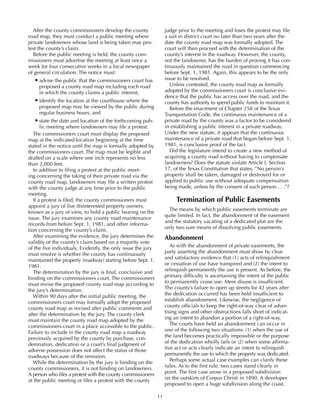
Entity 	 Empowering Statute
Texas Highway 	 Texas Transportation Code,
Department 	 Section 224.001 et seq.
Incorporated	 TexasLocalGovernmentCode,
citiesandtowns	 Section251.001etseq.
CountyCommissioners	 TexasLocalGovernmentCode,
Court		 Section 261.001etseq.
Home-Ruleand 	 TexasTransporationCode,
General-Law		 Section311.001etseq.
Municipalities
The chart does not contain the statutes granting
railroads, pipeline and utility companies the right to
condemn easements. The purpose of the omission is
twofold. First, the easements permitted under the per-
tinent statutes are not for public thoroughfares. Sec-
ond, the subject is covered in depth in the Real Estate
Center’s technical report 394, entitled Understanding
the Condemnation Process in Texas.
Easements Created by County Road Map
Effective Sept. 1, 2003, through Sept. 1, 2009, Texas
legislators approved a new means by which county
commissioners may acquire a public interest in private
roadways. The method, known as the County Road Map,
is outlined in Sections 258.001 through 259.006 of the
Texas Transportation Code. No payment is required for
the acquisition.
Basically, the county commissioners may (not shall)
propose a county road map indicating each road in
which the county claims a public interest under Chap-
ter 281 of the Texas Transportation Code (this Chapter
was discussed earlier as it applies to counties having a
population of 50,000 or less), under any other law of the
State of Texas, or as a result of continuously maintaining
a private road with public funds commencing before
Sept. 1, 1981.
The term continuous maintenance is defined in the
statute as grading or other routine road maintenance be-
ginning before Sept. 1, 1981, and continuing to the date
the landowner files a protest (discussed later.)
11
After the county commissioners develop the county
road map, they must conduct a public meeting where
private landowners whose land is being taken may pro-
test the county’s claim.
Before the public meeting is held, the county com-
missioners must advertise the meeting at least once a
week for four consecutive weeks in a local newspaper
of general circulation. The notice must:
•	advise the public that the commissioners court has
proposed a county road map including each road
in which the county claims a public interest,
•	identify the location at the courthouse where the
proposed map may be viewed by the public during
regular business hours, and
•	state the date and location of the forthcoming pub-
lic meeting where landowners may file a protest.
The commissioners court must display the proposed
map at the indicated location beginning at the time
stated in the notice until the map is formally adopted by
the commissioners court. The map must be legible and
drafted on a scale where one inch represents no less
than 2,000 feet.
In addition to filing a protest at the public meet-
ing concerning the taking of their private road via the
county road map, landowners may file a written protest
with the county judge at any time prior to the public
meeting.
If a protest is filed, the county commissioners must
appoint a jury of five disinterested property owners,
known as a jury of view, to hold a public hearing on the
issue. The jury examines any county road maintenance
records from before Sept. 1, 1981, and other informa-
tion concerning the county’s claim.
After examining the evidence, the jury determines the
validity of the county’s claim based on a majority vote
of the five individuals. Evidently, the only issue the jury
must resolve is whether the county has continuously
maintained the property (roadway) starting before Sept. 1,
1981.
The determination by the jury is final, conclusive and
binding on the commissioners court. The commissioners
must revise the proposed county road map according to
the jury’s determination.
Within 90 days after the initial public meeting, the
commissioners court may formally adopt the proposed
county road map as revised after public comments and
after the determination by the jury. The county clerk
must maintain the county road map adopted by the
commissioners court in a place accessible to the public.
Failure to include in the county road map a roadway
previously acquired by the county by purchase, con-
demnation, dedication or a court’s final judgment of
adverse possession does not affect the status of those
roadways because of the omission.
While the determination by the jury is binding on the
county commissioners, it is not binding on landowners.
A person who files a protest with the county commissioners
at the public meeting or files a protest with the county
judge prior to the meeting and loses the protest may file
a suit in district court no later than two years after the
date the county road map was formally adopted. The
court will then proceed with the determination of the
county’s interest in the roadway. However, the county,
not the landowner, has the burden of proving it has con-
tinuously maintained the road in question commencing
before Sept. 1, 1981. Again, this appears to be the only
issue to be resolved.
Unless contested, the county road map as formally
adopted by the commissioners court is conclusive evi-
dence that the public has access over the road, and the
county has authority to spend public funds to maintain it.
Before the enactment of Chapter 258 of the Texas
Transportation Code, the continuous maintenance of a
private road by the county was a factor to be considered
in establishing a public interest in a private roadway.
Under the new statute, it appears that the continuous
maintenance of a private road that began before Sept. 1,
1981, is conclusive proof of the fact.
Did the legislature intend to create a new method of
acquiring a county road without having to compensate
landowners? Does the statute violate Article I, Section
17, of the Texas Constitution that states, “No person’s
property shall be taken, damaged or destroyed for or
applied to public use without adequate compensation
being made, unless by the consent of such person . . .”?
Termination of Public Easements
The means by which public easements terminate are
quite limited. In fact, the abandonment of the easement
and the statutory vacating of a dedicated plat are the
only two sure means of dissolving public easements.
Abandonment
As with the abandonment of private easements, the
party asserting the abandonment must show by clear
and satisfactory evidence that (1) acts of relinquishment
or cessation of use have transpired and (2) the intent to
relinquish permanently the use is present. As before, the
primary difficulty is ascertaining the intent of the public
to permanently cease use. Mere disuse is insufficient.
The county’s failure to open up streets for 42 years after
the dedication occurred has been held insufficient to
establish abandonment. Likewise, the negligence of
county officials to keep the right-of-way clear of adver-
tising signs and other obstructions falls short of indicat-
ing an intent to abandon a portion of a right-of-way.
The courts have held an abandonment can occur in
one of the following two situations: (1) when the use of
the land becomes practically impossible or the purpose
of the dedication wholly fails or (2) when some affirma-
tive act or acts clearly indicate an intent to relinquish
permanently the use to which the property was dedicated.
Perhaps some actual case examples can clarify these
rules. As to the first rule, two cases stand clearly in
point. The first case arose in a proposed subdivision
on the outskirts of Corpus Christi in 1890. A developer
proposed to open a huge subdivision along the coast.
12
The plans, maps and plats were drafted and filed of
record. Streets and public areas were indicated on the
plats. However, the project collapsed entirely after its
inception. The land was turned back into agricultural
uses. Later, certain persons in the subsequent chain
of title wanted the proposed streets and public areas
established.
Here the court held that the evidence, taken as a whole,
discloses a complete abandonment of the proposed
enterprise in all its essential features that amounted to a
destruction of the general scheme and purpose. Given
this, a condition exists in which "the object of the use for
which the property was dedicated wholly fails."
The other case involved a dead-end road less than
one mile long. The courts held an abandonment had
occurred when the county undertook the following two
projects at the road’s intersection with the main high-
way. First, a culvert was placed under the main highway
so that one end of the culvert opened directly in the
center of the intersecting road. Next, bar ditches were
dredged along the main highway, making it impossible
to enter or leave the road in question. Here the courts
held the use of the land had been rendered practically
impossible for its intended use.
As to the second rule involving intent, again two
cases serve as prime examples. The first case occurred
in Travis County, Texas. It involved a public use project.
The state dedicated certain land to the county as a site
for a courthouse and jail. The courthouse and jail were
erected and maintained on the site for several years. The
buildings were then abandoned when a new court-
house and jail were built at another location. Such acts
were held to show clearly an intent to abandon the site
permanently.
The other case is more complicated. A developer
filed in the county records a plat showing a main thor-
oughfare running through a proposed subdivision. As
the subdivision developed, the primary thoroughfare
emerged on a parallel street about a half mile away. The
proposed thoroughfare was never opened. It was kept
fenced without objections for 20 years and never used
by the public. Here, evidence was sufficient to show an
abandonment of the street by the county. Possibly, the
courts could have ruled that the streets had never been
accepted by the public generally or by the county.
In situations where it is possible for a private and pub-
lic easement to co-exist along the same route, the courts
noted that each easement must be terminated on its
own merits. The courts stated in the above case that the
controversy did not involve the rights of the purchasers
who had bought property in the addition in reference to
the recorded plat. The private rights were separate and
distinct from the rights of the county and the general
public. Thus, the private rights to an easement cannot be
prejudiced by any abandonment or refusal to accept the
dedication on the part of the county.
Again, referring to the example involving the Philm-
ores’ sidewalk, in all probability the restraining order
would be upheld. The sidewalk could not be removed
by the Philmores if the court found that a valid dedica-
tion and acceptance had occurred.
Vacating Plat
Vacating a dedicated plat also can terminate public
easements. The procedure required for the cancellation
depends on whether or not the original plat was filed
pursuant to Chapter 212 or Chapter 232 of the Texas Lo-
cal Government Code.
If Chapter 212 was the enabling statute, the require-
ments vary depending on whether or not any lots have
been sold. If no sales have transpired, the developer
must obtain approval from the municipal planning com-
mission or the governing body of the municipality for
the proposed cancellation. If so, a written instrument
declaring the cancellation of the plat or any part there
of shall be executed, acknowledged and recorded in the
same office as the original plat.
Ifsaleshavealreadyoccurred,theprocedureremains
basicallythesame.Theonlydifferenceisthattheoriginal
petitiontocancelallorapartoftheplatmustbefiledbyall
theownersofthelotsinthesubdivision,notthedeveloper.
Otherwise,theprocedureisthesame.
If the original plat was filed pursuant to Chapter 232,
then the entity owning the land must file an applica-
tion to cancel all or any part of the subdivision with the
commissioners court of the county where the land is
located. The commissioners court must publish notice
of the proposed cancellation in a county newspaper
for three weeks preceding any action. The notice shall
command any interested party desiring to protest the
cancellation to appear at a specified time.
At the hearing, if no one protests, and if it can be
shown that the cancellation will not interfere with the
established rights of any purchaser in the subdivision,
then the commissioners shall give the owner permission
to file the proposed cancellation in the land records. If
the cancellation interferes with the established rights of
purchasers, the cancellation may still be approved if the
persons so adversely affected agree to the action.
Evenifprotestisraised,cancellationoftheplatmaybe
granted.However,thoseadverselyaffectedmaysuethe
developerfordamagesnottoexceedthepurchasepriceof
thelot.Thesuitmustbebroughtwithinoneyearafterthe
commissionersgrantthecancellation.
All delinquent property taxes on the subdivision must
be paid before the cancellation.
Conclusion
The importance of private and public easements can-
not be overemphasized in today’s society. Easements
play a vital role in everyone’s life.
Most controversies associated with easements focus
on when the easements arise and when they termi-
nate. Both the statutory and case law in Texas contain
extensive information on the subject. This publication
explains these laws. However, it is not a substitute for
competent legal counsel.
13
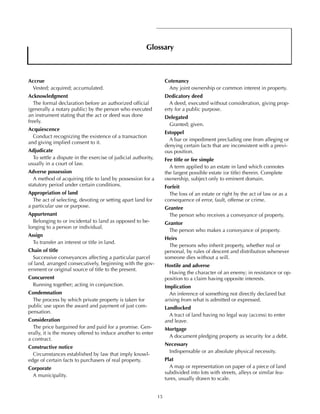
Appendix A
Synopsis of Private Easements
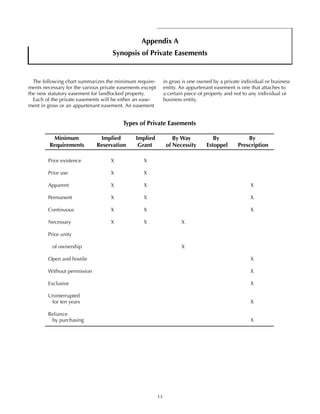
The following chart summarizes the minimum require-
ments necessary for the various private easements except
the new statutory easement for landlocked property.
Each of the private easements will be either an ease-
ment in gross or an appurtenant easement. An easement
in gross is one owned by a private individual or business
entity. An appurtenant easement is one that attaches to
a certain piece of property and not to any individual or
business entity.
Types of Private Easements
Minimum	 Implied	 Implied	 By Way	 By	 By
Requirements	 Reservation	 Grant	 of Necessity	 Estoppel	 Prescription
Prior existence	 X	 X
Prior use	 X	 X
Apparent	 X	X			 X
Permanent	 X	X			 X
Continuous	 X	X			 X
Necessary	 X	X	 X
Prior unity
of ownership			 X
Open and hostile					 X
Without permission					X
Exclusive					X
Uninterrupted
for ten years					 X
Reliance
by purchasing					 X
14
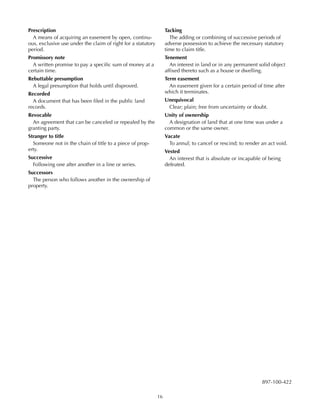
Appendix B
Synopsis of Public Easements
Types of Public Easements
Express
Minimum	 Statutory	 Common Law	 Common Law	 Prescriptive Easement
Requirements	 Dedication	 Dedication	 Dedication 	 Easement Condemnation
OFFERS:			 X
Oral			 X
Written			 X
Plat	 X		 X
Affirmative acts		 X
ACCEPTANCES:	
Some public use	 X	 X	 X
Reliance by purchasing		 X	 X
Establish roads,	 X	 X	 X
streets, etc.
Improve roads,	 X	 X	 X
streets, etc.
Failure to assess	 X	 X	 X
property taxes
Compliance	 X				X
with relevant statutes
Continuous public use				 X
(ten years)
Open and hostile				 X
public use
Adverse public use				 X
Exclusive public use				 X
Public purpose	 X	 X	 X		 X
Public necessity					 X
Just compensation					 X
The following chart summarizes the requirements nec-
essary for public easements.
Most of the chart depicts the requirements for ease-
ments arising by dedication. Under any form of dedica-
tion, the owner must intend to dedicate the easement
followed by a reciprocal acceptance of the easement by
the public generally, by the governing body of a munici-
pality or by a county. Thus, the first part of the chart is
devoted to the ways offers are tendered followed by the
ways they maybe accepted.
15
Glossary
Accrue
Vested; acquired; accumulated.
Acknowledgment
The formal declaration before an authorized official
(generally a notary public) by the person who executed
an instrument stating that the act or deed was done
freely.
Acquiescence
Conduct recognizing the existence of a transaction
and giving implied consent to it.
Adjudicate
To settle a dispute in the exercise of judicial authority,
usually in a court of law.
Adverse possession
A method of acquiring title to land by possession for a
statutory period under certain conditions.
Appropriation of land
The act of selecting, devoting or setting apart land for
a particular use or purpose.
Appurtenant
Belonging to or incidental to land as opposed to be-
longing to a person or individual.
Assign
To transfer an interest or title in land.
Chain of title
Successive conveyances affecting a particular parcel
of land, arranged consecutively, beginning with the gov-
ernment or original source of title to the present.
Concurrent
Running together; acting in conjunction.
Condemnation
The process by which private property is taken for
public use upon the award and payment of just com-
pensation.
Consideration
The price bargained for and paid for a promise. Gen-
erally, it is the money offered to induce another to enter
a contract.
Constructive notice
Circumstances established by law that imply knowl-
edge of certain facts to purchasers of real property.
Corporate
A municipality.
Cotenancy
Any joint ownership or common interest in property.
Dedicatory deed
A deed, executed without consideration, giving prop-
erty for a public purpose.
Delegated
Granted; given.
Estoppel
A bar or impediment precluding one from alleging or
denying certain facts that are inconsistent with a previ-
ous position.
Fee title or fee simple
A term applied to an estate in land which connotes
the largest possible estate (or title) therein. Complete
ownership, subject only to eminent domain.
Forfeit
The loss of an estate or right by the act of law or as a
consequence of error, fault, offense or crime.
Grantee
The person who receives a conveyance of property.
Grantor
The person who makes a conveyance of property.
Heirs
The persons who inherit property, whether real or
personal, by rules of descent and distribution whenever
someone dies without a will.
Hostile and adverse
Having the character of an enemy; in resistance or op-
position to a claim having opposite interests.
Implication
An inference of something not directly declared but
arising from what is admitted or expressed.
Landlocked
A tract of land having no legal way (access) to enter
and leave.
Mortgage
A document pledging property as security for a debt.
Necessary
Indispensable or an absolute physical necessity.
Plat
A map or representation on paper of a piece of land
subdivided into lots with streets, alleys or similar fea-
tures, usually drawn to scale.
16
Prescription
A means of acquiring an easement by open, continu-
ous, exclusive use under the claim of right for a statutory
period.
Promissory note
A written promise to pay a specific sum of money at a
certain time.
Rebuttable presumption
A legal presumption that holds until disproved.
Recorded
A document that has been filed in the public land
records.
Revocable
An agreement that can be canceled or repealed by the
granting party.
Stranger to title
Someone not in the chain of title to a piece of prop-
erty.
Successive
Following one after another in a line or series.
Successors
The person who follows another in the ownership of
property.
897-100-422
Tacking
The adding or combining of successive periods of
adverse possession to achieve the necessary statutory
time to claim title.
Tenement
An interest in land or in any permanent solid object
affixed thereto such as a house or dwelling.
Term easement
An easement given for a certain period of time after
which it terminates.
Unequivocal
Clear; plain; free from uncertainty or doubt.
Unity of ownership
A designation of land that at one time was under a
common or the same owner.
Vacate
To annul; to cancel or rescind; to render an act void.
Vested
An interest that is absolute or incapable of being
defeated.
17
ADVISORY COMMITTEE
DOUGLAS A. SCHWARTZ, CHAIRMAN
El Paso
JAMES MICHAEL BOYD
Houston
CATARINA GONZALES CRON
Houston
TOM H. GANN
Lufkin
CELIA GOODE-HADDOCK
College Station
DAVID E. DALZELL, VICE CHAIRMAN
Abilene
D. MARC McDOUGAL
Lubbock
BARBARA A. RUSSELL
Denton
RONALD CHARLES WAKEFIELD
San Antonio
LARRY JOKL, EX-OFFICIO
Brownsville
MAYS BUSINESS SCHOOL
Texas A&M University
2115 TAMU
College Station, TX 77843-2115
http://recenter.tamu.edu
979-845-2031
800-244-2144 orders only
DIRECTOR
GARY W. MALER

Easement in Texas.

  • 1.
    Easements in Texas Judon Fambrough SeniorLecturer and Attorney at Law Technical Report 422
  • 2.
    Judon Fambrough Senior Lecturerand Attorney at Law Easements in Texas Revised September 2013 © 2013, Real Estate Center. All rights reserved.
  • 3.
    Contents 1 Summary 1 Private Easements in Texas 2 Creation of Private Easements 5 Termination of Private Easements 6 Public Easements in Texas 6 Easements by Dedication 11 Termination of Public Easements 12 Conclusion 13 Appendix A. Synopsis of Private Easements 14 Appendix B. Synopsis of Public Easements 15 Glossary
  • 4.
    1 Easements in Texas JudonFambrough Senior Lecturer and Attorney at Law Summary Easements play a vital role in everyone’s life. People daily traverse easements either granted, dedicated or condemned for public rights-of-way. Also, people constantly use energy transported along pipeline and utility easements. In rural areas, many tracts of land not served by public roadways would be rendered practically valueless if it were not for private easements crossing neighboring properties. An easement is defined as a right, privilege or advantage in real property, existing distinct from the own- ership of the land. In other words, easements consist of an interest (or estate) in real property that does not constitute full ownership. Most commonly, an easement entails the right of a person (or the public) to use the land of another in a certain manner. Easements should not be confused with licenses. A license is merely permission given to an individual to do some act or acts on the land of another. It does not give rise to an interest in land as do easements. Licenses need not be in writing to be effective and generally are revocable at any time. Tickets to entertain- ment or sporting events serve as a good example of licenses. This publication explains two broad categories of easements — private and public. Private easements are those in which the enjoyment and use are restricted to one or a few individuals. Public easements are those in which the rights of enjoyment and use are vested in the public generally or in an entire community. The publication describes the various types of private and public easements, how they are created and how they are terminated. Private Easements in Texas Mark and John had been farming and ranching in a particular community for more than 50 years. Several years ago Mark purchased some grazing land in a re- mote section of the county. There was no public access. However, John orally had permitted Mark to cross part of his property in order to reach the land. The agreement was never written nor recorded. Recently, John died and his heirs sold the land to some people new to the area. The buyers were not told of the oral agreement and threatened to bring legal ac- tion to terminate Mark’s passage over their land. Without the easement, Mark must curtail his cattle operations. This is just one example of the importance of private easements. As will be demonstrated, unless the creation of a private easement is carefully documented and re- corded, its legality is questionable. In Gross Private easements may be divided into two groups depending on the possessing entity. If an individual or business owns the easement, it is said to be an easement in gross. Pipeline easements are in gross. As a general rule, an easement in gross is a personal right that cannot be assigned or otherwise transmitted. The easement thus terminates upon death of the individual owner or the demise of the business. There is authority to the contrary where the easement in gross is (1) placed in writing and (2) explicitly made assignable by the instrument creating it. The language making an easement in gross transfer- able generally reads: "The terms, conditions and provi- sions of this contract shall extend to and be binding upon the grantee, his heirs, successors and assigns." Appurtenant The other type of private easement, known as an appurtenant easement, attaches to or is incident to a particular tract of land, not to a particular individual or business. Appurtenant easements require two different estates (or tenements) for their existence—a dominant estate and a servient estate. The owner of the dominant tenement has the right or privilege to use an easement across the land of the servient tenement. The servient tenement is burdened by the easement. Appurtenant easements may be classified further as either affirmative or negative. An affirmative easement gives the dominant tenement the right to actively use the easement on the servient tenement’s land. A negative easement restricts the use of the servient tenement’s land in favor of the dominant tenement.
  • 5.
    2 An example willclarify these two types of easements. Suppose landowner "A" wants to build a dam that will back water across landowner "B’s" property. To keep "B" from suing, "A" seeks an affirmative easement from "B" allowing "A" to flood a portion of "B’s" land. If "A" is suc- cessful, "A’s" land will be the dominant tenement, and "B’s" land will be the servient tenement. "B’s" land will be burdened by the standing water. Suppose further that "B" becomes dependent upon the supply of water provided by "A’s" dam. "B" wants to invest in some livestock but needs the assurance of a permanent source of water. Here "B" will seek a nega- tive easement from A. The negative easement would restrict A from destroying the dam or draining the water. These are rights "A" would have except for the negative easement. The only duty an easement imposes on the owner of the servient estate is that of a negative nature. The servi- ent owner may not interfere with the use and enjoyment of the dominant estate’s easement across the land. Any repairs or works necessary to effectuate the use and en- joyment of the easement must be made by the dominant owner. Appurtenant easements are easily transferable. A conveyance of the dominant tenement automatically includes the easement across the servient tenement’s land. A transfer of the servient estate will include the easement burdening it if the purchaser has actual or constructive notice of the easement’s existence. If the dominant tenement purchases the servient tenement’s land, the easement terminates. One cannot own an easement across his or her property. Creation of Private Easements An easement may be created by various means. Each has its own distinct requirements. Because easements represent interests in land, they generally require some written, tangible evidence prescribed by Section 5.021 of the Texas Property Code for their creation. The written requirements may be waived where the person claiming the easement has (1) paid consideration for the ease- ment in money or services, (2) began using the ease- ment and (3) made valuable and permanent improve- ments to the easement. The written document creating an easement need not be recorded to be effective. However, to give construc- tive notice to subsequent purchasers as described in Section 13.002 of the Texas Property Code, easements normally are recorded. Without a written document, an easement may be created three ways. They are (1) by implication, (2) by estoppel and (3) by prescription. The party claiming such an easement may have to resort to a judicial pro- cess known as a declaratory judgment to claim it. Easements by Implication Easements by implication, better known as implied easements, may be created three ways: (1) by reserva- tion, (2) by grant or (3) by way of necessity. Each has distinct requirements. One thing they hold in common, though, is the property must be landlocked without the implied easement. The first two implied easements mentioned earlier are sometimes called Quasi Easements. These are based on the prior usage of a roadway that was overlooked in the transaction. The roadway (right of entry) was either not reserved or conveyed in the deed thereby leaving the property landlocked. The other implied easement (by way of necessity) does not require the prior usage of a roadway, only that the property is landlocked after the transaction. Another distinction worth noting is how difficult must the entry be before the land is considered landlocked. The courts put forth two standards: reasonably necessary (also known as reasonable necessity) versus strictly nec- essary (or strict necessity). Reasonable necessity means another way of access may exist, but it is inconvenient to use. Strictly necessity means no other way of access exists, whether convenient or not. Reasonable necessity is sufficient to acquire an implied easement by grant. However, strict necessity is required for either an implied easement by reservation or easement by way of necessity. Easements by implied reservation or grant. The cre- ation of an implied easement by either reservation or grant requires the prior existence and use of the ease- ment. Furthermore, the prior use must have been appar- ent, permanent, continuous and necessary for the enjoy- ment of the property granted. In each implied easement case, the court views the implied easement as merely an oversight on the part of the grantor and grantee at the time of the conveyance. For instance, suppose "A" owns a 40-acre tract of land with a public road running along its southern boundary. "A’s" house sits along the northern part of the 40-acre tract. It is served by a private road running north and south. A decides to sell the southern 20 acres to "B." However, A forgets to reserve a right-of-way easement across the 20 acres to access the home. This is a classical example of when the court most likely would approve an implied reservation for "A." The easement must have been apparent, permanent and continuously used at the time of the grant. The only other requisite is that there are no other available access routes this route is necessary. An implied grant of an easement can be illustrated by the same set of facts. Suppose "A" decided to sell the northern 20 acres. "A" retains title and possession to the southern 20 acres along the public roadway. If A does not grant an easement to "B" across the southern 20 acres when title is conveyed, the courts may approve an easement by implied grant. The implied grant would require the same elements as the implied reservation. In other words, the easement must be apparent, permanent, continuous and necessary for "B’s" use and enjoyment of the property. Some Texas courts recognize implied easements by grant more readily than implied easements by reserva- tion. This is based on the rule that the courts favor the
  • 6.
    3 grantee more readilythan the grantor. In this case, the grantor should have protected his or her interest by reserving an access easement in the deed. Hence strict necessity is required for an implied easement by reser- vation (where the grantor failed to reserve one) versus reasonable necessity being required for an implied ease- ment by grant. Easements by way of necessity. Finally, an implied easement may arise by way of necessity. This easement differs primarily from the other two implied easements in that no prior existence or use of the easement is re- quired. As the name implies, an easement of this nature arises only where no other routes of ingress and egress appear. It is strictly necessary. For an implied easement by way of necessity to arise, the following three conditions must be fulfilled. First, there must have been unity of ownership of the domi- nant and servient estates at the time of conveyance or at some prior time. Second, the easement is strictly necessary for the grantee to enter and leave the property. Third, the necessity for the easement existed at the time of the severance of the dominant and servient estates. As to the issue of unity of ownership, case law re- quires that sometime in the chain of title after the land was patented, the tract needing the easement and the tract preventing the easement must have been under common ownership. (A patent occurs when the sover- eign conveys ownership to a private individual.) Com- mon ownership of the two tracts by the sovereign does not meet the test. Strict necessity requires that no other passageway to and from the conveyed property can exist. If the grantee can use another way either at the time of conveyance or thereafter, the right-of-way by necessity cannot be claimed. The mere showing that it would be more expensive or less convenient to obtain another access route is not sufficient to give rise to an implied easement by necessity. The issue of what constitutes strict or absolute neces- sity has raised some interesting modern-day issues. For instance, any piece of property is accessible by air via a helicopter or parachute. Thus, no tract of land is ever absolutely inaccessible. Yet no case has ever been found in which an easement was denied because of its acces- sibility solely by air. Similarly, if a tract of land is accessible only by navi- gable water, is it absolutely landlocked? Only ten cases have denied an easement because of such accessibility. Of these, only two were decided after 1925; five were decided prior to 1900. Eight cases recognize an ease- ment despite access by water. All but one of these cases were decided after 1927. Although none were Texas cases, the trend seems to be toward a more relaxed standard of necessity by water. Just as the grantee can acquire an implied easement by way of necessity, so can the grantor. Should the grantor retain a tract with no access, the law allows the grantor to claim an implied easement by way of neces- sity. The servient estate in the hands of the grantee under the conveyance is charged with the burden. Because an easement by necessity requires no prior use, the location of the easement may present problems. The case law holds that it should be placed in a "con- venient way" across the surrounding land. If a particular route is used by common consent, that fixes the loca- tion. Thereafter, the location can not change, except with the consent of both parties. If the location can not be derived by common con- sent, the selection belongs to the servient tenement (the one crossed), giving due regards to the dominant owner's rights. If the servient tenement does not select the route, the right rests with the dominant tenement. Again, once selected, the route can not change except with common consent. Statutory Easement for Landlocked Property The law has not always been consistent regarding landlocked property in Texas. Prior to 1963, any per- son having land without an easement could statutorily condemn a private right-of-way to and from the property according to the Texas Revised Statutes Article 1377b(2). However, in 1963, the Texas Supreme Court held this statute contrary to Article 1, Section 17 of the Texas Constitution because it lacked public purpose. (See Estate of Waggoner v. Gleghorn, 378 S.W. 2d 47.) The second statutory attempt also failed (Texas Re- vised Statutes, Article 6711). It authorized the commis- sioners court to declare and open a public highway, at public expense, across lands of nonconsenting owners. The action could be taken upon the sworn application of one or more landlocked landowners. This statute also lacked the necessary public purpose requirement. It was declared unconstitutional in 1962 by the Texas Supreme Court (Maher v. Lasater, 354 S.W. 2d 923.) The high court, in reversing a prior decision, wrote, "In deciding that question (case) we assumed, but did not hold, that it is of public importance that every person residing on land be provided access to and from his land so that he may enjoy the privileges and discharge the duties of a citizen." The court further stated, "The legislature may not authorize that which the consitution prohibits." Effective Sept. 1, 1995, the Texas Legislature passed a new statute that mirrors the former Article 6711. The new law is found in Subchapter B, Chapter 251 of the Texas Transportation Code. Again, on a sworn application, a landlocked property owner may request that a road be condemned by the commissioners court. The procedure is outlined in the statute. In 2009, Section 251.054 was repealed, removing all funding for any land taken under Chapter 251 of the Texas Transportation Code. This section contained the sole means for determining damages for affected land- owners. The repeal apparently terminated any future use of this statute for accessing landlocked property. For more information, see "Don't Fence Me In," publi- cation 1130.
  • 7.
    4 Easements by Estoppel Anotherway an easement may be created without written expression is by estoppel. Here the easement arises from the acts and/or oral expressions of the grant- or that indicates the existence, creation or conveyance of an easement. Should the grantee rely on such demon- strations and accept the grantor’s offer and be damaged thereby, the grantor will be estopped (or legally prevent- ed) from denying the existence of the easement. For example, suppose "A" wants to induce a buyer into purchasing a lot in an undeveloped subdivision. The prospect is shown a platted map with a roadway indicating a convenient access route to and from the lot. If the prospect should purchase the lot, "A" would be legally precluded from asserting the nonexistence of the easement. However, an easement by estoppel based on silence can be established only when the landowner has a duty to speak. If a person (or family) has a revocable right (or permission) to cross another's land, the landowner has no duty to advise subsequent generations that the easement is revocable at will. Therefore, the user cannot complain when the easement is unilaterally revoked. A claim of an easement by estoppel by silence will not apply. Easements by Prescription The last way an unexpressed easement may be cre- ated is by way of prescription—sometimes referred to as by way of limitations. Prescriptive easements arise in much the same manner as title accrues by adverse pos- session. The requirements basically are the same. The only difference is that adverse possession ripens into title to the land, whereas a prescriptive right matures into an easement. There are five basic requirements for a prescriptive easement. The absence of any one is fatal to the cre- ation of the easement. First, the use of the land must be adverse to the owner of the land. In other words, the use must begin and continue without the actual or implied permission of the landowner. Second, the use must be open and notorious. This means the use must be asserted in such a manner as to serve notice of the claim not only to the landowner but all persons in the immediate area. Secretive use is insuf- ficient. A clear and positive use must be evident. An ex- ception does exist for the latter requirement. The courts have substituted actual knowledge and acquiescence of the owner of the servient tenement in the place of open and notorious use. Acquiescence may be implied from the circumstances. Third, the use must be exclusive. The use of an ease- ment common with others or even with the owner is insufficient to create a prescriptive right. This rule, how- ever, is a rule of evidence raising a rebuttable presump- tion that permission was given the claimant when both the owner and claimant use the easement concurrently. The rule does not apply where concurrent use by the owner and claimant occur after the prescriptive period has matured (i.e., the claimant has used the easement for ten years). Fourth, the use must be in the same place and within definite lines. The practice of passing over land in differ- ent places does not establish a prescriptive right except where the divergences are only slight. Also, the travel over unenclosed and unimproved land will not entitle the traveler to a prescriptive right unless the way is defi- nitely marked. Fifth, the use must be continuous and uninterrupted. Thus, the assertion of the enjoyment of the land cannot mature into a prescriptive right based on occasional passage. Likewise, any time the adverse usage is inter- rupted, the running of the prescriptive period is an- nihilated and must begin anew. It has been held that placing a fence across a road for a week is a sufficient interruption. In Texas, the three-, five-, ten- and 25-year statutes dealing with adverse possession have been held inap- plicable to the creation of prescriptive easements. The courts, however, judicially have placed the required period of continuous, uninterrupted adverse use for prescriptive easements at ten years. The courts have placed certain limitations and stipula- tions as to when the prescriptive period begins. For example, the period will not run if the owner of the servient estate is suffering under a legal disability such as infancy or insanity or is the ward of an estate when the adverse use begins. The period will run once the disability is removed. An intervening disability occurring after the period has started will not suspend (or toll) the running of the prescriptive period. The following example illustrates the rules. Assume "A" inherits land. "A" is 16 years of age. The same year "B" begins crossing the land without "A’s" permission. Because "A" is a minor, the prescriptive period will not commence. However, once "A" reaches the legal age of 18, the prescriptive period will start to run. In another example, suppose "A" inherits the land when "A" is 21 years of age, the same year "B" begins crossing the land without "A’s" permission. Five years later "A" is adjudicated insane. Here the prescriptive period will continue to run. Intervening disabilities will not suspend the running of the ten-year period. The courts have, in limited instances, applied the doctrine of tacking in cases involving appurtenant pre- scriptive easements. Tacking entails adding the periods of consecutive adverse users together in determining the necessary ten-year period. However, certain qualifica- tions are necessary. (1) There must be no interruptions in the use between users. (2) The users must be successive owners of the dominant tenement. (3) The document conveying the dominant estate must contain the follow- ing language: "together with all and singular the rights and appurtenances thereto in anywise belonging to the said grantees."
  • 8.
    5 Termination of PrivateEasements Private easements may be extinguished in as many, or more, ways than they can be created. In fact, the man- ner in which some easements arise determines directly the means by which they can be terminated. Without going into any great detail, the following is a brief syn- opsis of the various ways easements may be dissolved. Transfer of Servient Estate to Bona Fide Purchaser Regardless of the method of creating the easement, the most universal means of terminating private ease- ments involves the conveyance of the servient estate to a bona fide purchaser (BFP). A BFP is someone who pays “valuable consideration” for the property and takes title “without having actual or constructive notice” of a third party’s claim. (Bona fide purchasers are sometimes referred to as Innocent Purchasers.) Texas case law to some degree clarifies and defines these requirements. “Valuable consideration” means the buyer paid a sig- nificant amount for the property. Although the amount may be less than fair market value, it cannot be nominal or grossly inadequate. For example, the recipient of a gift deed, where no consideration changes hands, cannot claim BFP status. However, even if consideration is paid, the recipient of title to land via a quitclaim deed cannot achieve the status of a BFP either. “Actual knowledge” refers to any oral or written repre- sentations the buyer receives prior to closing concerning the title to or use of the property. “Constructive notice” refers to the information affect- ing title to the property contained in the deed records as well as any facts a physical inspection or visible exami- nation would reveal. To ascertain the information in the deed records (sometimes called the real property records), the buyer may: • examine the recorded documents personally or hire someone to do the same using the county clerk’s indices to trace title; • require the seller to prepare an abstract of title and have it examined by an attorney chosen by the buyer; or • purchase title insurance. Thus, constructive notice may be given by having the easement recorded in the county deed records in com- pliance with the Texas Property Code, Section 13.002. By doing so, any subsequent purchaser of the property is charged (imputed) with knowledge of the easement even though the buyer does examine or have the deed records examined. For more information regarding BFPs and protec- tion afforded by the recording statutes, see the Center’s publication entitle “Deeds and the Texas Recording Statutes” http://recenter.tamu.edu/pdf/1267.pdf Finally, prospective purchasers should personally inspect the property for evidence of an easement not disclosed in the deed records. If no open and apparent use of an unrecorded ease- ment exists across the property, then the BFP takes free of them. Effective Oct. 1, 1991, Procedural Rule P-37 was adopted by the Texas State Board of Insurance regard- ing guaranteeing the right of access in a title insurance policy. All title policies issued after Oct. 1, 1991, ensure the right of access unless a specific exception is added. Neither the width of the access nor access to a public thoroughfare is insured. Easements arising without written expression have inherent problems whenever the servient estate is trans- ferred. Because there is no written document to record, the only way knowledge can be given to the prospective buyer is by actual notice. Consequently, all easements should be placed in writing and recorded to preserve their existence. For instance, consider the previous example involving Mark and John. Mark probably will lose the easement because it was never recorded. The new purchasers probably took title to the servient estate without actual or constructive knowledge of the easement. Even if the purchasers had actual knowledge, the easement could not survive Mark's death. Oral easements in gross are nontransferable as mentioned earlier. Operation of Law Easements may be extinguished by operation of law. The foreclosure on delinquent promissory notes secured by a mortgage or deed of trust on real property will terminate all easements created subsequent to the mort- gage being placed on the land. The first in time prevails in such an instance. Likewise, condemnation will terminate all existing easements across the condemned land. The rights of the public in condemned property are paramount to an individual’s right. Abandonment Easements may be extinguished by abandonment. Abandonment takes place whenever cessation of use occurs accompanied by a clear intent never to use the easement again. Mere nonuse does not constitute aban- donment. However, the intent may be inferred from the circumstances if such evidence is clear and definite. Failure of Condition Noncompliance by the grantee with a condition of the grant is another way an easement may terminate. However, the condition must be explicitly coupled with a right of forfeiture. For example, an easement will ter- minate when it is conditioned on the use by the grantee within a stipulated period. Also, the failure of the grantee to pay half of the easement's upkeep is another example of a conditional easement.
  • 9.
    6 Merger As mentioned earlier,the merger of the dominant and servient tenements under a common owner terminates all appurtenant easements between the two estates. Expiration of Designated Term The expiration of the designated number of years in a grant will extinguish a term easement. For example, an easement granted for a term of 15 years expires auto- matically at the end of the designated 15-year period. Adverse Possession Adverse possession of an easement by the servient tenement for ten continuous years will terminate an easement. For instance, suppose "A" grants "B" a right- of-way easement in 1950. The easement leads to some property recently acquired by "B." "B" intends to live on the property following retirement. In 1970, "B" retires. However, in the meantime, "A" erected a fence across the easement and also a barn and catch pens. Other portions of the easement were plowed and placed in cultivation. In such an instance, the easement granted in 1950 may have terminated if it has been "actually and visibly appropriated, commenced and continued under a claim of right inconsistent with and hostile to the claim of 'B'," as described in the Texas Civil Practice and Remedies Code, Section 16.026. The character of the claim must indicate unmistakably an assertion of exclusive owner- ship by "A" for ten consecutive years. Expiration of Purposes The removal of the purpose or reason for creating an easement will terminate it. For example, an easement granted explicitly for the construction of a reservoir will terminate when the reservoir is completed. An easement granted to serve a particular oil well will expire when the well ceases production. Misuse The misuse of an easement generally will not cause the easement’s termination. Also, the use of an easement for an unauthorized purpose or in an excessive man- ner is not sufficient to cause a forfeiture. However, such abuses do give rise to damages on the part of the servi- ent tenement. Misuse can result in termination when the misuse creates an impossibility to use the easement for the purpose originally granted. Change of Condition A change in condition also may extinguish certain easements. For example, an implied easement by way of necessity is only a temporary right. It continues only so long as the necessity exists. Should the necessity dis- sipate, so will the easement. Grant of Release Lastly, an easement can terminate by a release being granted by the owner. However, the release should be placed in writing and recorded in the county land records. If not, serious title problems could result in the future. In fact, the latter point cannot be overemphasized. Regardless of how an easement is extinguished, a care- fully written release should be prepared, signed by the party granting the release and placed in the county land records. Otherwise, subsequent conflicts may arise dis- puting the easement's continued existence. Public Easements in Texas The Philmores owned a residence approximately one block from an elementary school in a heavily populated district of a city. There were no sidewalks in the neigh- borhood. A heavy concentration of children traversed the area twice daily going to and coming from school. To help relieve some of the danger of having the children travel on the side of the street, the Philmores constructed a sidewalk on their property. The children began using the sidewalk, but the Philmores failed to anticipate the adverse effects. The children caused the family dog to bark, the paper was generally missing each morning and minor acts of vandalism occurred on their property. The Philmores finally decided to dismantle the side- walk. However, they were served with a restraining order by the city attorney’s office. The city contended that the Philmores had granted the public an irrevocable easement across the land. Public easements, as mentioned earlier, are those easements to which the right of enjoyment and use are vested in the public generally or in an entire commu- nity. Aside from purchasing, there are three ways public easements may be created. Each method is unique and has different requirements. The three ways public ease- ments may arise without purchasing are: (1) by dedica- tion, (2) by prescription and (3) by condemnation. Once created, the uses for which public right-of-way easements can be used have been construed broadly. An easement for city streets includes the right for the municipality to lay sewer, gas and water lines. West Texas Utilities Co. v. City of Baird, 286 S.W. 2d 185. An easement for a state highway includes the right for a municipality to lay a gas pipeline within it. Grimes v. Corpus Christi Transmission Co., 829 S.W. 2d 335. Easements by Dedication Dedication is perhaps the most common means by which public easements arise. Dedication is defined as a method of creating or transferring an interest in land, consisting of an easement only and not title. It is the act of devoting or giving property, or an interest therein, for some proper object. It is a voluntary transfer that does not require consideration. There are two distinct types of dedication—statutory and common law. Both types require an intent on the part of the owner to dedicate (or set apart) the easement and a reciprocal acceptance of the easement by the
  • 10.
    7 public generally, bythe governing body of a municipal- ity or by the county. Statutory Dedication Statutory dedication is the simpler of the two types of dedication to explain. As the name implies, statu- tory dedication must be carried out in compliance with all relevant statutes. Different procedures are required depending on the location of the land. If the land is located in a municipality or a municipality’s extraterrito- rial jurisdiction, Chapter 212 of the Texas Local Govern- ment Code governs. If the land is located in a rural area, yet outside the extraterritorial jurisdiction of a munici- pality, Chapter 232 of the Texas Local Government code controls. Finally, if the dedication occurs in counties having a population of 50,000 or less, Section 281.001 et seq. of the Texas Transportation Code governs (and limits) the procedure. Note:BothChapters212and232dealwithsubdivision plats.Thededicationofstreetsandalleyswithinthesubdivi- sionsisthecontextinwhichthestatutesareaddressedhere. Chapter 212. Section 212.001 et seq. of the Texas Government Code requires the following: • The platted land must be situated within the limits or in the extraterritorial jurisdiction of a municipality. • The owner of the land must intend to lay out a sub- division, an addition to the municipality, suburban lots, building lots or any lot, street, alley, park or some other portion for public use. • Theownermustaccuratelydescribetheproposed subdivisionoradditionbymetesandboundsinaplat. Theplatmustcontainprecisedimensionsofallthe proposedstreets,alleys,squares,parksorotherpor- tionsintendedtobededicatedtopublicuse. • The plat must be acknowledged by the owner and filed for approval with the municipal planning commission (if there is one) or with the govern- ing body of the municipality. Section 212.007 of the Government Code describes the procedure for approving a plat of land lying in the extraterritorial jurisdiction of more than one municipality. • The municipal authority responsible for approving plats must act within 30 days after filing, otherwise the plat shall be deemed approved by inaction. If the plat must be approved by the governing body of the municipality in addition to the planning com- mission, the governing body shall act on the plat within 30 days of its approval (by whatever means) by the planning commission. • Once approved, the plat must be filed of record in the county in which the land lies. The plat manifests the owner’s intent to give appropri- ate easement to the public in the proposed streets, alleys and public areas. The approval of the plat, however, does not indicate the municipality’s acceptance of the easements. According to the Texas Local Government Code, Section 212.011, "The approval of a plat is not considered an acceptance of any proposed dedica- tion and does not impose on the municipality any duty regarding the maintenance or improvement of any dedi- cated parts until the appropriate municipal authorities make an actual appropriation of the dedicated parts by entry, use, or improvement." Chapter 232. Section 232.001 et seq. of the Texas Local Government Code applies to platted land located outside the limits of a municipality or a municipality’s extraterritorial jurisdiction. Whenever the owner of such land divides the tract into two or more parts for a subdi- vision, a plat must be prepared and recorded. Before the plat can be recorded, it must: • describe the subdivision by metes and bounds; • locate the subdivision with respect to an original corner of the original survey of which it is a part; • state the dimensions of the subdivision and of each lot, street, alley, square, park, or other part of the tract intended to be dedicated to public use or for the use of purchasers or owners of lots fronting on or adjacent to the street, alley, square, park, or other party; • be acknowledged by the owner or the proprietor, or by the owner’s or proprietor’s agent; and • be filed with the commissioners court of the county for approval by an order entered in the minutes. Once approved, the plat must be filed with the county clerk for recording according to the Texas Property Code, Section 12.002. Note: Before approving the plat, the commissioners court may: • require a right-of-way on a street or road that func- tions as a main artery in a subdivision, of a width of not less than 50 feet or more than 100 feet; • require a right-of-way on any other street or road in a subdivision of not less than 40 feet or more than 70 feet; • require that the shoulder-to-shoulder width on col- lectors or main arteries within the right-of-way be not less than 32 feet or more than 56 feet, and that the shoulder-to-shoulder width on any other street or road be not less than 25 feet or more than 35 feet; • adopt, based on the amount and kind of travel over each street or road in a subdivision, reasonable specifications relating to the construction of each street or road; • adopt reasonable specifications to provide ad- equate drainage for each street or road in a sub- division in accordance with standard engineering practices; • require that each purchase made between a sub- divider and a purchaser of land in the subdivision contain a statement describing the extent to which
  • 11.
    8 water will bemade available to the subdivision and, if it will be made available, how and when; and • require that the owner of the tract to be subdivided execute a good and sufficient bond in the manner provided by law. There is no provision regarding how soon the com- missioners court must act on the plat after submission. Neither is there a provision providing acceptance of the plat by inaction. Section 281.001 et seq. of Transportation Code. Unlike Chapters 212 and 232, Chapter 281 of the Transportation Code requires no formal platting for the dedication of private roads. The chapter applies only to dedications occurring after 1980 in counties having a population of 50,000 or less. Basically, the chapter restricts the ways these counties may acquire a public interest in private roads to: • purchase, • condemn, • dedicate and • a judgment of adverse possession (sometimes referred to as a prescriptive easement, discussed later.) The chapter specifies how the dedication may and may not occur. The dedication must be an explicit vol- untary grant of the private roadway for public purposes communicated to the commissioners court in writing in the county where the property is located. A dedication conveyed orally or by overt acts is invalid. In turn, the commissioners court may accept the dedi- cation and assert a public interest in the road by: • entering a resolution in the commissioners court re- cords recognizing the interest acquired in the road- way, the circumstances by which it was acquired, and the effective date of the acquisition; and • giving written notice of the acceptance to the own- er of the land from which the road was acquired in person or by registered mail. Section 281.004 prohibits counties from acquiring a public interest in a private road in certain circum- stances. It states that counties may never claim adverse possession of a private road when the county commis- sioners maintain a private road with: • the owner’s permission or • public funds when the public has no recorded interest in the roadway. Common Law Dedication All common law dedications require the following four elements: (1) a person competent to dedicate, (2) a public purpose served by the dedication, (3) an offer or tender of the dedication and (4) an acceptance of the offer or tender. As to the element of capacity, any person having the capacity to make a grant of land has the capacity to make a valid dedication. However, in addition to having the capacity to dedicate, the person also must own an unqualified and undivided fee title to the land. A co-ten- ant cannot make a valid dedication without the joinder of the other co-tenants. As to the element of public purpose, the dedica- tion must be for a use beneficial to the public and not prohibited by statute. If the easement is reserved for a specific group, then there is no public purpose involved and no dedication of a public easement can occur. As to the element of the offer or tender, it must be based on a manifest desire of the landowner to devote the land to a public use. If there is no intent, there can be no offer. The intent to dedicate must be based on a clear, un- equivocal act or declaration of the landowner. A secret intent is insufficient. The courts will presume an intent in very limited situations. The intent also must be unqualified. The intent must be such that the public has an irrevocable right to enjoy the property, independent of any whim of the land- owner and beyond recall. The intent must be to divest the owner of the interest immediately and not at some future time. However, it is not necessary that the owner intend immediate use by the public. The way the offer is communicated to the public de- termines whether or not it constitutes an express or im- plied common law dedication. Whichever way is used, both the manifestation and communication must be so clear and convincing that a reasonable person would be induced to act in reliance thereon. Express Dedication If the dedication is expressed, it may be declared ei- ther orally or placed in writing. Perhaps the oral decla- ration is the weaker of the two. It has been held that oral declarations may be, in and of themselves, sufficient to constitute an offer of dedication. However, as a general rule, oral declarations serve only to explain the conduct of the owner. For instance, in one case, a developer made casual comments about his intent to place streets and alleys at a certain place within a proposed subdivision. Later, when the developer began selling the lots, he did so by making references to a map where the suggested streets and alleys were omitted. Here the courts maintained the references to the map negated the prior casual comments. Written expressions of intent to dedicate are more common than oral representations. Generally, the writ- ten expression of intent will appear either in a dedica- tory deed or incorporated in a proposed plat. If the intent is embodied in a dedicatory deed, the deed may name either a city or the public generally as the grantee. The mere fact the deed does not meet the requirements of conveyance set forth in Sections 5.021 and 5.022 of the Texas Property Code is irrelevant because a written dedication may be shown by a simple contract.
  • 12.
    9 Plat designation isthe most common form of a written dedication. It can occur when the owner lays out a town site or an addition to a town or city on a plat and delin- eates the proposed streets, parks or other public places. It also can occur when any part of a town site or addi- tion is sold by reference to a plat containing designated public (not private) areas. If the dedication takes the form of a map or plat, it generally is necessary to record or file the plat to establish effective communication of the offer to the public. If recorded, it constitutes an unequivocal offer of dedication. Note: As long as the plat or map has not been record- ed, a common law dedication is possible. If, however, the plat or map is recorded, it must be done in com- pliance with Chapters 212 or 232 of the Texas Local Government Code as mentioned earlier. Such recording constitutes a statutory dedication, not a common law one. Most dedications in Texas via a map or plat are statutory. Effective communication can be established without recording by placing the plat in the possession of public authorities so that it is readily accessible to the general public. The exhibition of the plat to a few individuals may create a private easement by estoppel as mentioned earlier but not a public easement. Implied Dedication Implied common law dedications may be communi- cated to the public in two ways. One is by the affirma- tive acts of the owner, the other by inactions or acquies- cence on the owner’s part. If affirmative acts are the means of communication, the acts must amount to an invitation or encourage- ment to the public to use the land. For instance, open- ing property to public use or even fencing off part of the land and making repairs thereon convenient for the public’s use have been held sufficient affirmative acts to give rise to an implied dedication. Inactions or acquiescence sufficient to give rise to an implied dedication is more difficult to ascertain. Howev- er, by disregarding certain private interests for a consid- erable length of time, a landowner may have dedicated land for public use by implication. Allowing the public to use a strip of land without objections serves as a good example. The landowner may not deny the implications. The duration of the owner’s inactions or acquiescence is important only when the attitude or intent cannot be clearly ascertained. For example, where a landowner silently permits the public authorities to grade, repair or otherwise improve a private road, such inactions have been held sufficient evidence to establish an implied intent to dedicate but not in counties where Article 6812(h) applies. When the attitude or intent cannot be established, the period of the use then becomes more important. The courts will presume an intent if the period of inactions extends for several years. Generally a ten-year period is used, but 50-, 40-, 35-, 20-, eight- and six-year periods also have been adhered to by the courts. Before indulging in any presumptions, the courts must examine the existing evidence as to the owner’s attitude and the general character of the land used by the public. For instance, if permission was given to cross the land, the owner must have intended it to be permanent, not temporary, and it must have extended to the public gen- erally and not to select individuals. Likewise, mere use by the public is not in and of itself sufficient to disclose an intent to dedicate. This fact is particularly true when the public use does not interfere with the owner’s use of the property. Thus, the owner has no occasion to declare overtly his or her intentions in the matter. No intention to dedicate can be ascer- tained when the use is promiscuous, occasional or un- defined. No public easement can arise when the use is confined to a particular class of persons as distinguished from the public generally. Finally, to complete the dedication, the offer or tender of the use must be accepted by or on behalf of the public. Acceptance must take place within a reasonable time after the tender but before it is revoked. Also, the offer may lapse by the expiration of a designated period imposed by the owner. Revocation also can occur by the owner’s devoting the property to some inconsistent use or by vacating a filed plat in ac- cordance with Chapters 212 or 232 of the Texas Local Government Code as will be discussed later. Any public action that shows an unequivocal intent to appropriate the property to the purpose for which it was set aside is sufficient to constitute a binding acceptance. Once accepted, the dedication becomes immediately operative. The owner becomes divested of all rights in the property consistent with the purpose to which the easement was dedicated. The acceptance may be either formal or informal. In most instances, an informal acceptance transpires. The following are examples of cases in which informal acceptance occurred: (1) establishing roads, streets and alleys by a city in conformity to the plat filed by the owner, (2) purchasing land by individuals relying on the existence of a valid dedication, (3) taking possession of, or assuming control over, the dedicated land and im- proving or repairing it, (4) failing to assess property taxes against the dedicated land and (5) using the dedicated land by the public. The purchasing of land by individuals relying on the existence of a valid dedication (example number 2 above) needs further amplification as a result of its unique interpretation in Texas. Under Texas case law, it is possible for a private easement and a public easement to exist simultaneously on the same roadway or thor- oughfare. Here is how it can happen. As mentioned earlier under private easements, an easement by estoppel may arise when a purchaser relies on a map or plat for the placement of easements. If the same map or plat is filed in the county land records, and if the city or county accepts the dedica- tion, a public easement arises simultaneously along the
  • 13.
    10 same route. Eacheasement is independent of the other. Each easement has separately vested rights; each must terminate independently. Easements by Prescription The second way public easements may be created is by prescription. There appears to be only one major dif- ference between the requirements for creating a public prescriptive easement and a private prescriptive ease- ment. The difference is that a private easement requires one or a few individuals to use the land continuously for ten years, while a public easement requires a similar use by the public generally. All the other requirements remain the same. The use of the land must be hostile and adverse to the owner of the land. The use must be open and notorious. The use must be exclusive. Finally, the use must be continuous and uninterrupted for ten years. There is a unique statutory twist dealing with public prescriptive easements. According to Sections 16.030 and 16.061 of the Texas Civil Practice and Remedies Code, ". . . no person may acquire by adverse posses- sion any right or title to any part or portion of any road, street, alley, sidewalk or grounds which belong to any town, city or county or which have been donated or dedicated for public use. . . ." In other words, the public can gain a public prescriptive easement across private land, but a private individual or individuals cannot gain a private prescriptive easement across public land. Two important rules regarding public prescriptive easements have been established by case law. First, a public prescriptive easement cannot arise where the use by the public is merely for pleasure and recreation. Such uses are not for general travel and do not impart suffi- cient notice to the landowner that the property is being used or claimed by the public. The other proposition is that the use must be exclusive and not shared by the owner. If the enjoyment is con- sistent with the right of the owner, it confers no rights in opposition to such ownership. There is a significant difference between acquiescence as used in association with implied dedications and pre- scriptive easements. The two major differences are: (1) acquiescence assumes the owner intended to dedicate the land by his or her inactions; prescriptive easements assume the owner at all times objected to the public use of the land and (2) acquiescence requires some public use during the period; prescriptive easements require continuous use for the entire ten years. Note. As discussed earlier, acquiescence cannot con- stitute a dedication of a private road for public use in counties having populations of 50,000 or less. Easements by Condemnation The third and last way for a public easement to arise is by way of condemnation. Condemnation is the proce- dure by which private land is taken for a public purpose. The power is generally lodged in the federal and state governments. In Texas, the legislature has delegated the power to various agencies and subdivisions of the state such as counties, cities, towns and villages. Certain legal restraints are placed on the condemna- tion process. For instance, (1) the taking must be to achieve some public purpose, (2) the condemnor cannot condemn more land than is necessary for the undertak- ing, (3) the landowner must be paid just or adequate compensation for the taking and finally (4) the process must be carried out in compliance with due process of the law. The precise procedure is contained in Sections 21.011 through 21.016 of the Texas Property Code. Without going into any detail, the following chart contains a brief synopsis of the entities and accompany- ing empowering statutes permitting the condemnation of public easements in Texas. The list is not necessarily inclusive of all relevant entities and statutes. Entity Empowering Statute Texas Highway Texas Transportation Code, Department Section 224.001 et seq. Incorporated TexasLocalGovernmentCode, citiesandtowns Section251.001etseq. CountyCommissioners TexasLocalGovernmentCode, Court Section 261.001etseq. Home-Ruleand TexasTransporationCode, General-Law Section311.001etseq. Municipalities The chart does not contain the statutes granting railroads, pipeline and utility companies the right to condemn easements. The purpose of the omission is twofold. First, the easements permitted under the per- tinent statutes are not for public thoroughfares. Sec- ond, the subject is covered in depth in the Real Estate Center’s technical report 394, entitled Understanding the Condemnation Process in Texas. Easements Created by County Road Map Effective Sept. 1, 2003, through Sept. 1, 2009, Texas legislators approved a new means by which county commissioners may acquire a public interest in private roadways. The method, known as the County Road Map, is outlined in Sections 258.001 through 259.006 of the Texas Transportation Code. No payment is required for the acquisition. Basically, the county commissioners may (not shall) propose a county road map indicating each road in which the county claims a public interest under Chap- ter 281 of the Texas Transportation Code (this Chapter was discussed earlier as it applies to counties having a population of 50,000 or less), under any other law of the State of Texas, or as a result of continuously maintaining a private road with public funds commencing before Sept. 1, 1981. The term continuous maintenance is defined in the statute as grading or other routine road maintenance be- ginning before Sept. 1, 1981, and continuing to the date the landowner files a protest (discussed later.)
  • 14.
    11 After the countycommissioners develop the county road map, they must conduct a public meeting where private landowners whose land is being taken may pro- test the county’s claim. Before the public meeting is held, the county com- missioners must advertise the meeting at least once a week for four consecutive weeks in a local newspaper of general circulation. The notice must: • advise the public that the commissioners court has proposed a county road map including each road in which the county claims a public interest, • identify the location at the courthouse where the proposed map may be viewed by the public during regular business hours, and • state the date and location of the forthcoming pub- lic meeting where landowners may file a protest. The commissioners court must display the proposed map at the indicated location beginning at the time stated in the notice until the map is formally adopted by the commissioners court. The map must be legible and drafted on a scale where one inch represents no less than 2,000 feet. In addition to filing a protest at the public meet- ing concerning the taking of their private road via the county road map, landowners may file a written protest with the county judge at any time prior to the public meeting. If a protest is filed, the county commissioners must appoint a jury of five disinterested property owners, known as a jury of view, to hold a public hearing on the issue. The jury examines any county road maintenance records from before Sept. 1, 1981, and other informa- tion concerning the county’s claim. After examining the evidence, the jury determines the validity of the county’s claim based on a majority vote of the five individuals. Evidently, the only issue the jury must resolve is whether the county has continuously maintained the property (roadway) starting before Sept. 1, 1981. The determination by the jury is final, conclusive and binding on the commissioners court. The commissioners must revise the proposed county road map according to the jury’s determination. Within 90 days after the initial public meeting, the commissioners court may formally adopt the proposed county road map as revised after public comments and after the determination by the jury. The county clerk must maintain the county road map adopted by the commissioners court in a place accessible to the public. Failure to include in the county road map a roadway previously acquired by the county by purchase, con- demnation, dedication or a court’s final judgment of adverse possession does not affect the status of those roadways because of the omission. While the determination by the jury is binding on the county commissioners, it is not binding on landowners. A person who files a protest with the county commissioners at the public meeting or files a protest with the county judge prior to the meeting and loses the protest may file a suit in district court no later than two years after the date the county road map was formally adopted. The court will then proceed with the determination of the county’s interest in the roadway. However, the county, not the landowner, has the burden of proving it has con- tinuously maintained the road in question commencing before Sept. 1, 1981. Again, this appears to be the only issue to be resolved. Unless contested, the county road map as formally adopted by the commissioners court is conclusive evi- dence that the public has access over the road, and the county has authority to spend public funds to maintain it. Before the enactment of Chapter 258 of the Texas Transportation Code, the continuous maintenance of a private road by the county was a factor to be considered in establishing a public interest in a private roadway. Under the new statute, it appears that the continuous maintenance of a private road that began before Sept. 1, 1981, is conclusive proof of the fact. Did the legislature intend to create a new method of acquiring a county road without having to compensate landowners? Does the statute violate Article I, Section 17, of the Texas Constitution that states, “No person’s property shall be taken, damaged or destroyed for or applied to public use without adequate compensation being made, unless by the consent of such person . . .”? Termination of Public Easements The means by which public easements terminate are quite limited. In fact, the abandonment of the easement and the statutory vacating of a dedicated plat are the only two sure means of dissolving public easements. Abandonment As with the abandonment of private easements, the party asserting the abandonment must show by clear and satisfactory evidence that (1) acts of relinquishment or cessation of use have transpired and (2) the intent to relinquish permanently the use is present. As before, the primary difficulty is ascertaining the intent of the public to permanently cease use. Mere disuse is insufficient. The county’s failure to open up streets for 42 years after the dedication occurred has been held insufficient to establish abandonment. Likewise, the negligence of county officials to keep the right-of-way clear of adver- tising signs and other obstructions falls short of indicat- ing an intent to abandon a portion of a right-of-way. The courts have held an abandonment can occur in one of the following two situations: (1) when the use of the land becomes practically impossible or the purpose of the dedication wholly fails or (2) when some affirma- tive act or acts clearly indicate an intent to relinquish permanently the use to which the property was dedicated. Perhaps some actual case examples can clarify these rules. As to the first rule, two cases stand clearly in point. The first case arose in a proposed subdivision on the outskirts of Corpus Christi in 1890. A developer proposed to open a huge subdivision along the coast.
  • 15.
    12 The plans, mapsand plats were drafted and filed of record. Streets and public areas were indicated on the plats. However, the project collapsed entirely after its inception. The land was turned back into agricultural uses. Later, certain persons in the subsequent chain of title wanted the proposed streets and public areas established. Here the court held that the evidence, taken as a whole, discloses a complete abandonment of the proposed enterprise in all its essential features that amounted to a destruction of the general scheme and purpose. Given this, a condition exists in which "the object of the use for which the property was dedicated wholly fails." The other case involved a dead-end road less than one mile long. The courts held an abandonment had occurred when the county undertook the following two projects at the road’s intersection with the main high- way. First, a culvert was placed under the main highway so that one end of the culvert opened directly in the center of the intersecting road. Next, bar ditches were dredged along the main highway, making it impossible to enter or leave the road in question. Here the courts held the use of the land had been rendered practically impossible for its intended use. As to the second rule involving intent, again two cases serve as prime examples. The first case occurred in Travis County, Texas. It involved a public use project. The state dedicated certain land to the county as a site for a courthouse and jail. The courthouse and jail were erected and maintained on the site for several years. The buildings were then abandoned when a new court- house and jail were built at another location. Such acts were held to show clearly an intent to abandon the site permanently. The other case is more complicated. A developer filed in the county records a plat showing a main thor- oughfare running through a proposed subdivision. As the subdivision developed, the primary thoroughfare emerged on a parallel street about a half mile away. The proposed thoroughfare was never opened. It was kept fenced without objections for 20 years and never used by the public. Here, evidence was sufficient to show an abandonment of the street by the county. Possibly, the courts could have ruled that the streets had never been accepted by the public generally or by the county. In situations where it is possible for a private and pub- lic easement to co-exist along the same route, the courts noted that each easement must be terminated on its own merits. The courts stated in the above case that the controversy did not involve the rights of the purchasers who had bought property in the addition in reference to the recorded plat. The private rights were separate and distinct from the rights of the county and the general public. Thus, the private rights to an easement cannot be prejudiced by any abandonment or refusal to accept the dedication on the part of the county. Again, referring to the example involving the Philm- ores’ sidewalk, in all probability the restraining order would be upheld. The sidewalk could not be removed by the Philmores if the court found that a valid dedica- tion and acceptance had occurred. Vacating Plat Vacating a dedicated plat also can terminate public easements. The procedure required for the cancellation depends on whether or not the original plat was filed pursuant to Chapter 212 or Chapter 232 of the Texas Lo- cal Government Code. If Chapter 212 was the enabling statute, the require- ments vary depending on whether or not any lots have been sold. If no sales have transpired, the developer must obtain approval from the municipal planning com- mission or the governing body of the municipality for the proposed cancellation. If so, a written instrument declaring the cancellation of the plat or any part there of shall be executed, acknowledged and recorded in the same office as the original plat. Ifsaleshavealreadyoccurred,theprocedureremains basicallythesame.Theonlydifferenceisthattheoriginal petitiontocancelallorapartoftheplatmustbefiledbyall theownersofthelotsinthesubdivision,notthedeveloper. Otherwise,theprocedureisthesame. If the original plat was filed pursuant to Chapter 232, then the entity owning the land must file an applica- tion to cancel all or any part of the subdivision with the commissioners court of the county where the land is located. The commissioners court must publish notice of the proposed cancellation in a county newspaper for three weeks preceding any action. The notice shall command any interested party desiring to protest the cancellation to appear at a specified time. At the hearing, if no one protests, and if it can be shown that the cancellation will not interfere with the established rights of any purchaser in the subdivision, then the commissioners shall give the owner permission to file the proposed cancellation in the land records. If the cancellation interferes with the established rights of purchasers, the cancellation may still be approved if the persons so adversely affected agree to the action. Evenifprotestisraised,cancellationoftheplatmaybe granted.However,thoseadverselyaffectedmaysuethe developerfordamagesnottoexceedthepurchasepriceof thelot.Thesuitmustbebroughtwithinoneyearafterthe commissionersgrantthecancellation. All delinquent property taxes on the subdivision must be paid before the cancellation. Conclusion The importance of private and public easements can- not be overemphasized in today’s society. Easements play a vital role in everyone’s life. Most controversies associated with easements focus on when the easements arise and when they termi- nate. Both the statutory and case law in Texas contain extensive information on the subject. This publication explains these laws. However, it is not a substitute for competent legal counsel.
  • 16.
    13 Appendix A Synopsis ofPrivate Easements The following chart summarizes the minimum require- ments necessary for the various private easements except the new statutory easement for landlocked property. Each of the private easements will be either an ease- ment in gross or an appurtenant easement. An easement in gross is one owned by a private individual or business entity. An appurtenant easement is one that attaches to a certain piece of property and not to any individual or business entity. Types of Private Easements Minimum Implied Implied By Way By By Requirements Reservation Grant of Necessity Estoppel Prescription Prior existence X X Prior use X X Apparent X X X Permanent X X X Continuous X X X Necessary X X X Prior unity of ownership X Open and hostile X Without permission X Exclusive X Uninterrupted for ten years X Reliance by purchasing X
  • 17.
    14 Appendix B Synopsis ofPublic Easements Types of Public Easements Express Minimum Statutory Common Law Common Law Prescriptive Easement Requirements Dedication Dedication Dedication Easement Condemnation OFFERS: X Oral X Written X Plat X X Affirmative acts X ACCEPTANCES: Some public use X X X Reliance by purchasing X X Establish roads, X X X streets, etc. Improve roads, X X X streets, etc. Failure to assess X X X property taxes Compliance X X with relevant statutes Continuous public use X (ten years) Open and hostile X public use Adverse public use X Exclusive public use X Public purpose X X X X Public necessity X Just compensation X The following chart summarizes the requirements nec- essary for public easements. Most of the chart depicts the requirements for ease- ments arising by dedication. Under any form of dedica- tion, the owner must intend to dedicate the easement followed by a reciprocal acceptance of the easement by the public generally, by the governing body of a munici- pality or by a county. Thus, the first part of the chart is devoted to the ways offers are tendered followed by the ways they maybe accepted.
  • 18.
    15 Glossary Accrue Vested; acquired; accumulated. Acknowledgment Theformal declaration before an authorized official (generally a notary public) by the person who executed an instrument stating that the act or deed was done freely. Acquiescence Conduct recognizing the existence of a transaction and giving implied consent to it. Adjudicate To settle a dispute in the exercise of judicial authority, usually in a court of law. Adverse possession A method of acquiring title to land by possession for a statutory period under certain conditions. Appropriation of land The act of selecting, devoting or setting apart land for a particular use or purpose. Appurtenant Belonging to or incidental to land as opposed to be- longing to a person or individual. Assign To transfer an interest or title in land. Chain of title Successive conveyances affecting a particular parcel of land, arranged consecutively, beginning with the gov- ernment or original source of title to the present. Concurrent Running together; acting in conjunction. Condemnation The process by which private property is taken for public use upon the award and payment of just com- pensation. Consideration The price bargained for and paid for a promise. Gen- erally, it is the money offered to induce another to enter a contract. Constructive notice Circumstances established by law that imply knowl- edge of certain facts to purchasers of real property. Corporate A municipality. Cotenancy Any joint ownership or common interest in property. Dedicatory deed A deed, executed without consideration, giving prop- erty for a public purpose. Delegated Granted; given. Estoppel A bar or impediment precluding one from alleging or denying certain facts that are inconsistent with a previ- ous position. Fee title or fee simple A term applied to an estate in land which connotes the largest possible estate (or title) therein. Complete ownership, subject only to eminent domain. Forfeit The loss of an estate or right by the act of law or as a consequence of error, fault, offense or crime. Grantee The person who receives a conveyance of property. Grantor The person who makes a conveyance of property. Heirs The persons who inherit property, whether real or personal, by rules of descent and distribution whenever someone dies without a will. Hostile and adverse Having the character of an enemy; in resistance or op- position to a claim having opposite interests. Implication An inference of something not directly declared but arising from what is admitted or expressed. Landlocked A tract of land having no legal way (access) to enter and leave. Mortgage A document pledging property as security for a debt. Necessary Indispensable or an absolute physical necessity. Plat A map or representation on paper of a piece of land subdivided into lots with streets, alleys or similar fea- tures, usually drawn to scale.
  • 19.
    16 Prescription A means ofacquiring an easement by open, continu- ous, exclusive use under the claim of right for a statutory period. Promissory note A written promise to pay a specific sum of money at a certain time. Rebuttable presumption A legal presumption that holds until disproved. Recorded A document that has been filed in the public land records. Revocable An agreement that can be canceled or repealed by the granting party. Stranger to title Someone not in the chain of title to a piece of prop- erty. Successive Following one after another in a line or series. Successors The person who follows another in the ownership of property. 897-100-422 Tacking The adding or combining of successive periods of adverse possession to achieve the necessary statutory time to claim title. Tenement An interest in land or in any permanent solid object affixed thereto such as a house or dwelling. Term easement An easement given for a certain period of time after which it terminates. Unequivocal Clear; plain; free from uncertainty or doubt. Unity of ownership A designation of land that at one time was under a common or the same owner. Vacate To annul; to cancel or rescind; to render an act void. Vested An interest that is absolute or incapable of being defeated.
  • 20.
    17 ADVISORY COMMITTEE DOUGLAS A.SCHWARTZ, CHAIRMAN El Paso JAMES MICHAEL BOYD Houston CATARINA GONZALES CRON Houston TOM H. GANN Lufkin CELIA GOODE-HADDOCK College Station DAVID E. DALZELL, VICE CHAIRMAN Abilene D. MARC McDOUGAL Lubbock BARBARA A. RUSSELL Denton RONALD CHARLES WAKEFIELD San Antonio LARRY JOKL, EX-OFFICIO Brownsville MAYS BUSINESS SCHOOL Texas A&M University 2115 TAMU College Station, TX 77843-2115 http://recenter.tamu.edu 979-845-2031 800-244-2144 orders only DIRECTOR GARY W. MALER