TECTONIC
PLATES
WHAT HAVE YOU NOTICED?
Continental Drift
PANGAEA
“All The Earth”
Theory
Alfred Wegener’s Evidences
1. Fit of the Continents
• Coastlines of continents like
South America and Africa appear
to fit together like puzzle pieces,
suggesting they were once
joined.
Alfred Wegener’s Evidences
2. Fossil Evidence
• Identical plant and animal
fossils found on widely
separated continents (e.g.,
Mesosaurus in South America
and Africa; Glossopteris plant
fossils in Africa, India, South
America, and Antarctica).
Alfred Wegener’s Evidences
3. Geological Evidence
• Similar rock formations and
mountain ranges appear on
continents now far apart (e.g.,
Appalachian Mountains in
North America match
mountains in Greenland.
Alfred Wegener’s Evidences
4. Paleoclimate Evidence
• Evidence of past climates that
don’t match current locations:
Glacial deposits found in present-
day tropical regions (India, Africa,
South America, Australia). Coal
deposits (formed in warm,
swampy conditions) found in now
cold regions like Antarctica.
TECTONIC
PLATES
PLATE
TECTONICS
WHAT IS
PLATE
TECTONICS ?
•Plate tectonics holds theory of the outermost
rigid layer of the earth (the lithosphere) is
broken into several segments called “PLATES” ,
and these lithospheric plates are in motion.
PLATES
PLATES
• Plate tectonics is the modern
version of CONTINENTAL
DRIFT.
• Continental drift is a theory first
proposed by ALFRED
WEGENER, a German
meteorologist in 1912. The
theory explains that the
continents today had been once
joined together in a single
landmass called ‘supercontinent’
PANGAEA 200 million years ago.
• Wegener hypothesized that
Pangaea broke apart into
smaller pieces that slowly
drifted away from each other.
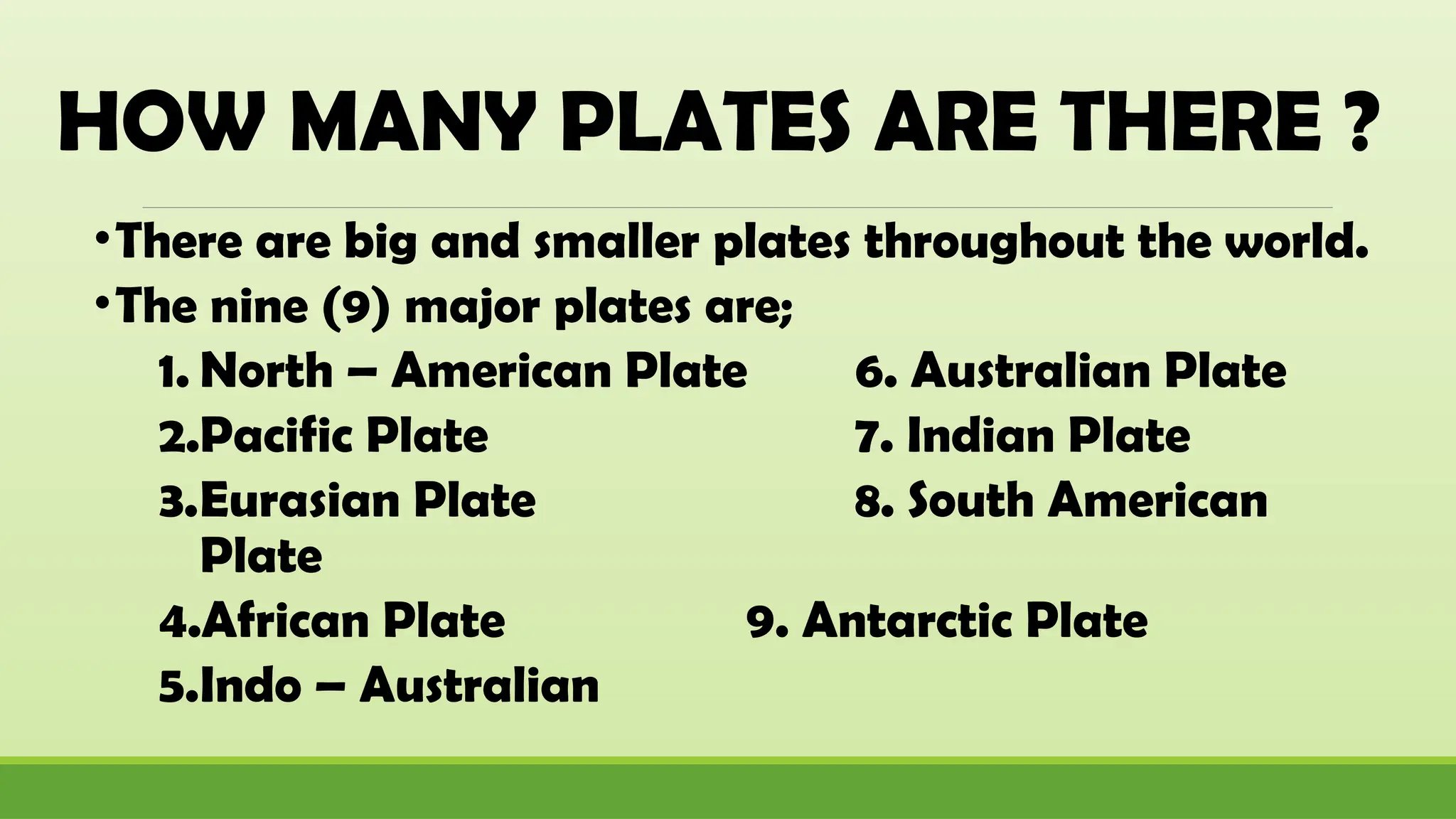
HOW MANY PLATES ARE THERE ?
•There are big and smaller plates throughout the world.
•The nine (9) major plates are;
1. North – American Plate 6. Australian Plate
2.Pacific Plate 7. Indian Plate
3.Eurasian Plate 8. South American
Plate
4.African Plate 9. Antarctic Plate
5.Indo – Australian
MAP OF THE EARTH’S PLATES
1. DIVERGENT BOUNDARY
- two plates moving away from each other
.
Continental Plate
Continental Plate
Rift Valley
Lithosphere
The divergent boundary can occur
on oceanic plates and continental
plates
When oceanic plates
move apart from each
other it creates;
 Oceanic Ridge
 Volcanic Activity in
the form of fissure
eruptions
 Shallow earthquake
activity
Example:
The Mid Atlantic Ridge
MID -
ATLANTIC
RIDGE
When continental
plates moves apart
from each other it
creates;
 Rift valley
(sometimes
occupied by long
linear lakes or a
shallow arm of
the ocean).
Example:
The Red Sea
THE RED SEA
- Formed by a divergent
boundary
2. CONVERGENT BOUNDARY
- two plates moving/colliding with each other
Continental Plate
Continental Plate
Lithosphere
Lithosphere
There are three scenarios that may
happen along the convergent
boundary;
a). Two continental plates may collide
b). Two oceanic plates may collide
c). A continental plate and an oceanic
plate may collide
Two continental
plates may collide
• When two continental
plate collides, the
rocks that are caught
between are
squeezed, crumpled
and lifted up. In the
process mountains are
built.
• Continental to
continental plate
collisions are
MOUNTAIN –
BUILDING PROCESS.
THE HIMALAYAN MOUNTAINS
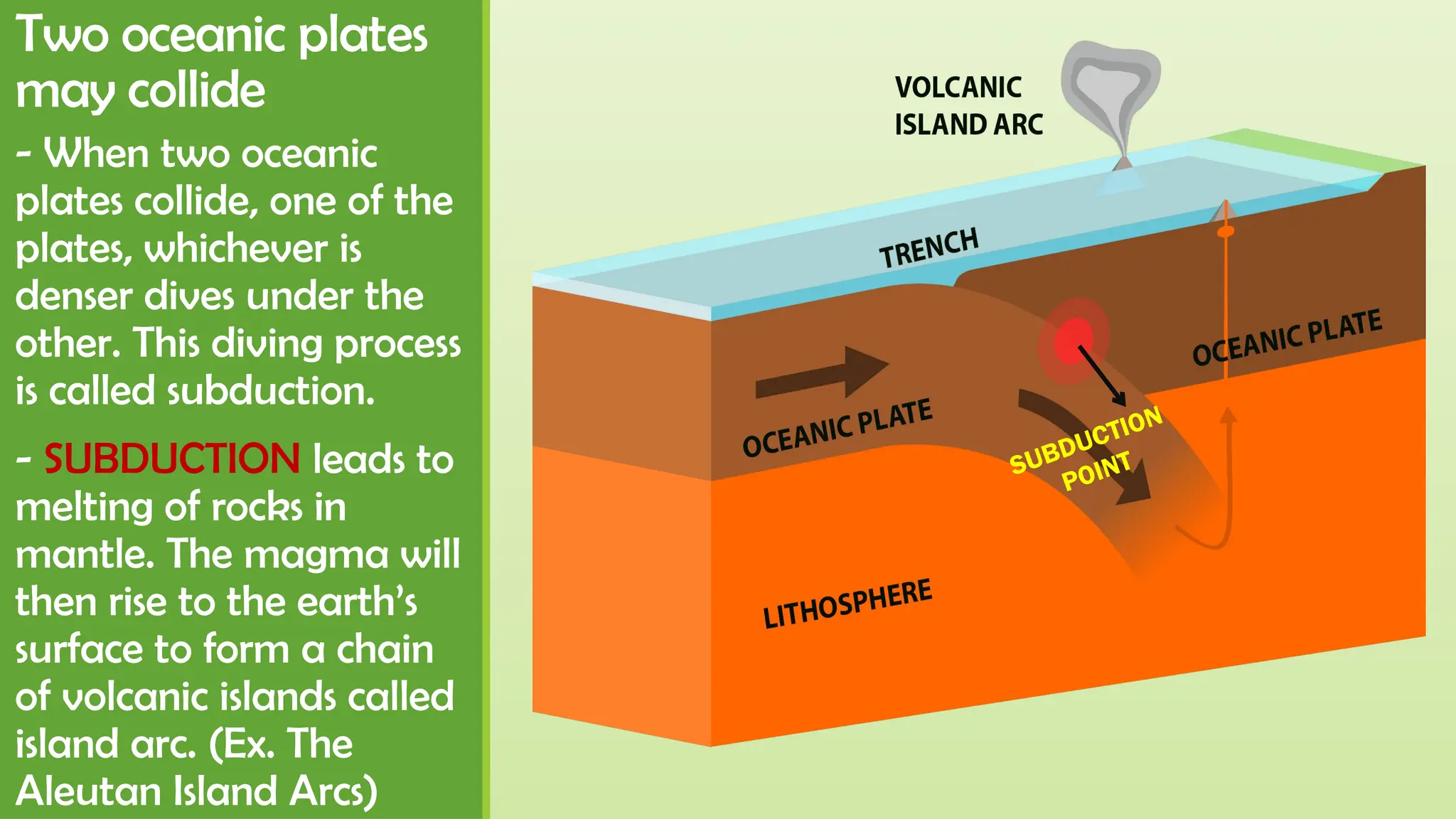
Two oceanic plates
may collide
- When two oceanic
plates collide, one of the
plates, whichever is
denser dives under the
other. This diving process
is called subduction.
- SUBDUCTION leads to
melting of rocks in
mantle. The magma will
then rise to the earth’s
surface to form a chain
of volcanic islands called
island arc. (Ex. The
Aleutan Island Arcs)
SUBDUCTION
POINT
AERIAL VIEW OF “ALEUTIAN ISLANDS”. AN EXAMPLE OF ISLAND ARC CAUSED
BY THE COLLISION OF TWO OCEANIC PLATES.
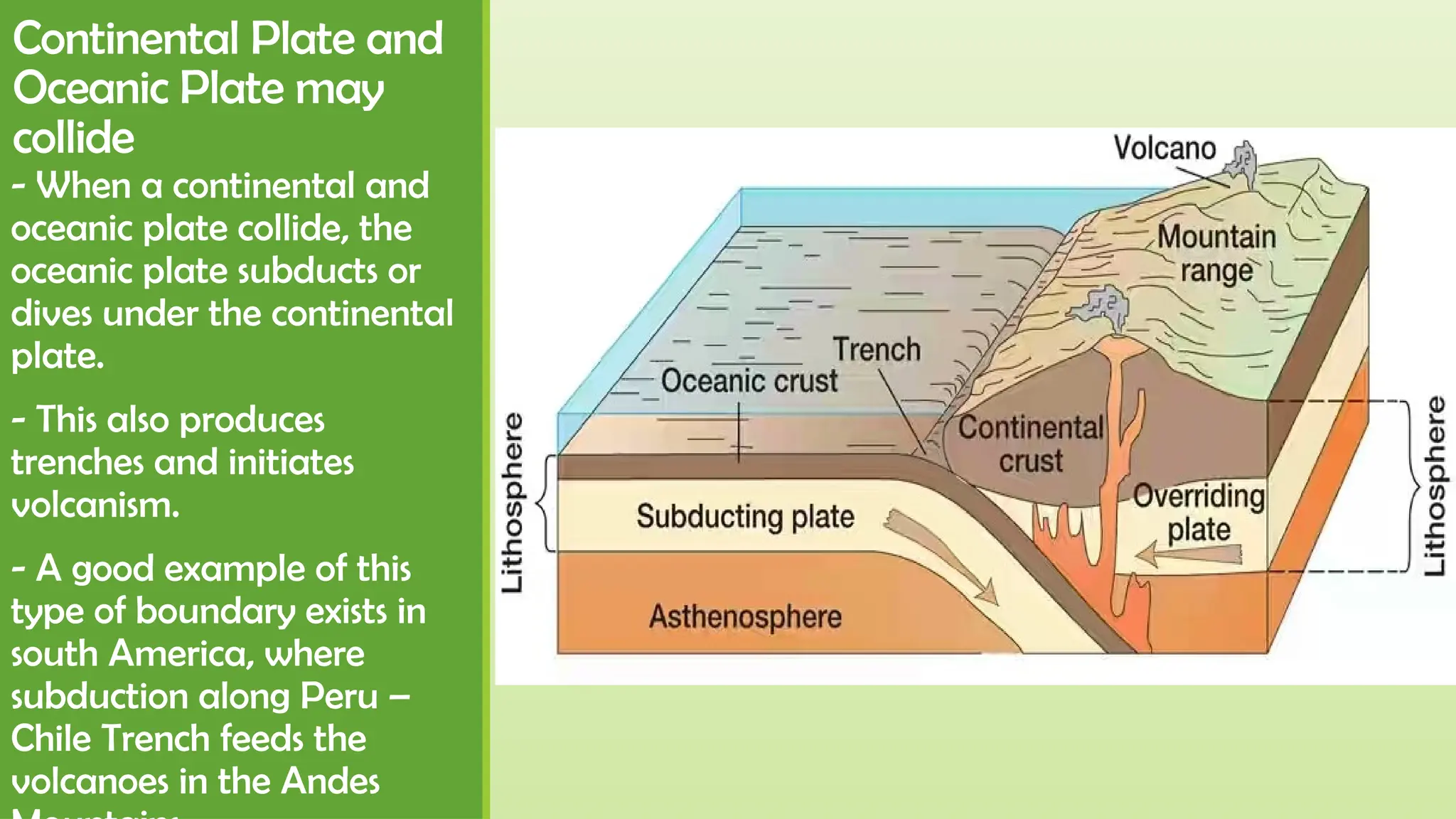
Continental Plate and
Oceanic Plate may
collide
- When a continental and
oceanic plate collide, the
oceanic plate subducts or
dives under the continental
plate.
- This also produces
trenches and initiates
volcanism.
- A good example of this
type of boundary exists in
south America, where
subduction along Peru –
Chile Trench feeds the
volcanoes in the Andes
ONE OF THE ACTIVE VOLCANOES OF THE ANDES MOUNTAIN
RANGES. “THE CALBUCO”
An example of the
subduction effect
along Peru – Chile
trench. The subduction
feds this volcano that
causes it to erupt.
3. TRANSFORM BOUNDARY
- the plates are sliding past each other.
Continental Plate
Continental Plate
Lithosphere
Lithosphere
“SAN ANDREAS FAULT”, THE FAMOUS TRANSFORM BOUNDARY LOCATED
IN CALIFORNIA
WHY
THE
LITOSPHERE
MOVES ?
CONVECTION in the mantle is probably the
fundamental driving mechanism responsible for the
plate motion.
CONVECTION – is the process of rising and sinking of
rock materials in the mantle. The hot rock materials
rise ( because of lesser density ) while cooler rock
materials sink ( because of greater density ).
CONVECTION
EARTH SCI PLATE TECTONICSpowerpoint.pptx

EARTH SCI PLATE TECTONICSpowerpoint.pptx

  • 1.
  • 2.
  • 3.
    Alfred Wegener’s Evidences 1.Fit of the Continents • Coastlines of continents like South America and Africa appear to fit together like puzzle pieces, suggesting they were once joined.
  • 4.
    Alfred Wegener’s Evidences 2.Fossil Evidence • Identical plant and animal fossils found on widely separated continents (e.g., Mesosaurus in South America and Africa; Glossopteris plant fossils in Africa, India, South America, and Antarctica).
  • 5.
    Alfred Wegener’s Evidences 3.Geological Evidence • Similar rock formations and mountain ranges appear on continents now far apart (e.g., Appalachian Mountains in North America match mountains in Greenland.
  • 6.
    Alfred Wegener’s Evidences 4.Paleoclimate Evidence • Evidence of past climates that don’t match current locations: Glacial deposits found in present- day tropical regions (India, Africa, South America, Australia). Coal deposits (formed in warm, swampy conditions) found in now cold regions like Antarctica.
  • 7.
  • 8.
  • 9.
    •Plate tectonics holdstheory of the outermost rigid layer of the earth (the lithosphere) is broken into several segments called “PLATES” , and these lithospheric plates are in motion. PLATES PLATES
  • 10.
    • Plate tectonicsis the modern version of CONTINENTAL DRIFT. • Continental drift is a theory first proposed by ALFRED WEGENER, a German meteorologist in 1912. The theory explains that the continents today had been once joined together in a single landmass called ‘supercontinent’ PANGAEA 200 million years ago. • Wegener hypothesized that Pangaea broke apart into smaller pieces that slowly drifted away from each other.
  • 11.
    HOW MANY PLATESARE THERE ? •There are big and smaller plates throughout the world. •The nine (9) major plates are; 1. North – American Plate 6. Australian Plate 2.Pacific Plate 7. Indian Plate 3.Eurasian Plate 8. South American Plate 4.African Plate 9. Antarctic Plate 5.Indo – Australian
  • 12.
    MAP OF THEEARTH’S PLATES
  • 14.
    1. DIVERGENT BOUNDARY -two plates moving away from each other . Continental Plate Continental Plate Rift Valley Lithosphere
  • 15.
    The divergent boundarycan occur on oceanic plates and continental plates
  • 16.
    When oceanic plates moveapart from each other it creates;  Oceanic Ridge  Volcanic Activity in the form of fissure eruptions  Shallow earthquake activity Example: The Mid Atlantic Ridge
  • 17.
  • 18.
    When continental plates movesapart from each other it creates;  Rift valley (sometimes occupied by long linear lakes or a shallow arm of the ocean). Example: The Red Sea
  • 19.
    THE RED SEA -Formed by a divergent boundary
  • 20.
    2. CONVERGENT BOUNDARY -two plates moving/colliding with each other Continental Plate Continental Plate Lithosphere Lithosphere
  • 21.
    There are threescenarios that may happen along the convergent boundary; a). Two continental plates may collide b). Two oceanic plates may collide c). A continental plate and an oceanic plate may collide
  • 22.
    Two continental plates maycollide • When two continental plate collides, the rocks that are caught between are squeezed, crumpled and lifted up. In the process mountains are built. • Continental to continental plate collisions are MOUNTAIN – BUILDING PROCESS.
  • 23.
  • 24.
    Two oceanic plates maycollide - When two oceanic plates collide, one of the plates, whichever is denser dives under the other. This diving process is called subduction. - SUBDUCTION leads to melting of rocks in mantle. The magma will then rise to the earth’s surface to form a chain of volcanic islands called island arc. (Ex. The Aleutan Island Arcs) SUBDUCTION POINT
  • 25.
    AERIAL VIEW OF“ALEUTIAN ISLANDS”. AN EXAMPLE OF ISLAND ARC CAUSED BY THE COLLISION OF TWO OCEANIC PLATES.
  • 26.
    Continental Plate and OceanicPlate may collide - When a continental and oceanic plate collide, the oceanic plate subducts or dives under the continental plate. - This also produces trenches and initiates volcanism. - A good example of this type of boundary exists in south America, where subduction along Peru – Chile Trench feeds the volcanoes in the Andes
  • 27.
    ONE OF THEACTIVE VOLCANOES OF THE ANDES MOUNTAIN RANGES. “THE CALBUCO” An example of the subduction effect along Peru – Chile trench. The subduction feds this volcano that causes it to erupt.
  • 28.
    3. TRANSFORM BOUNDARY -the plates are sliding past each other. Continental Plate Continental Plate Lithosphere Lithosphere
  • 29.
    “SAN ANDREAS FAULT”,THE FAMOUS TRANSFORM BOUNDARY LOCATED IN CALIFORNIA
  • 30.
  • 31.
    CONVECTION in themantle is probably the fundamental driving mechanism responsible for the plate motion. CONVECTION – is the process of rising and sinking of rock materials in the mantle. The hot rock materials rise ( because of lesser density ) while cooler rock materials sink ( because of greater density ). CONVECTION

Editor's Notes

  • #1 Pangaea was a supercontinent, a single massive landmass that once comprised most of Earth's present-day continents, existing from the late Paleozoic to the late Triassic eras, approximately 335 to 175 million years ago. Named from the Greek for "all the Earth," Pangaea was surrounded by a global ocean called Panthalassa and slowly began to break apart, forming the continents we recognize today through the process of continental drift.  
  • #3 Have you ever wondered how violent volcanic eruption occurs, how mountain ranges are formed, the movement of solid rock that causes earthquake. Why is there such phenomena happened?
  • #4 Fossils are the preserved remains, or traces of remains, of ancient organisms. Fossils provide evidence for continental drift because the discovery of identical fossil species on widely separated continents suggests these lands were once connected, allowing these organisms to migrate and live together before the continents drifted apart.
  • #5 Have you ever wondered how violent volcanic eruption occurs, how mountain ranges are formed, the movement of solid rock that causes earthquake. Why is there such phenomena happened?
  • #6 Wegener studied tillites (ancient glacial deposits) and glacial striations (scratches on bedrock made by moving glaciers). These were discovered in South America, Africa, India, and Australia, which are all in tropical or subtropical climates today. Wegener showed that if you reconstruct the continents into the supercontinent Pangaea, all the glacial evidence from these far-flung regions lines up into a single, connected ice sheet centered around the South Pole. This explained how glaciers could have spread across those areas, making the evidence consistent. The pattern of glaciation made sense only if these continents were once joined together near the South Pole, forming part of the ancient supercontinent Gondwana.
  • #8 Have you ever wondered how violent volcanic eruption occurs, how mountain ranges are formed, the movement of solid rock that causes earthquake. Why is there such phenomena happened?
  • #9 Lithosphere the rigid outer part of the earth, consisting of the crust and upper mantle.
  • #16 A fissure is a long, narrow crack opening along the surface of Earth. A fissure eruption is a type of volcanic eruption where lava flows from a long, linear crack in the Earth's crust called a fissure, rather than from a single central vent. These eruptions typically don't build up substantial volcanic cones but rather create extensive lava flows 
  • #24 The denser tectonic plate will subduct, or sink, beneath the less dense plate during a collision at a convergent plate boundary. 
  • #27 Taal Volcano is formed through the subduction of the Philippine Sea Plate (oceanic crust) beneath the Eurasian Plate (continental crust) at a convergent boundary.
  • #32 The mantle’s convection currents act like a conveyor belt. Ang lithospheric plates (crust + upper mantle) naglutaw ibabaw sa asthenosphere (part sa mantle). Kung ang hot rock materials mosaka → it pushes the plates apart (divergent boundary). Kung ang cold rock materials mosink → it pulls plates down (convergent boundary).