User empowerment 
in mental health 
– a statement by the WHO 
Regional Office for Europe 
Empowerment is not a destination, 
but a journey 
With the support of the European Commission Health and Consumers Directorate-General
Historically, people with mental health problems have lacked a voice. Neither they nor 
their families have been involved in decision-making on mental health services, and 
they continue to be at risk of social exclusion and discrimination in all facets of life. In a 
mental health context, empowerment refers to the level of choice, influence and control 
that users of mental health services can exercise over events in their lives. The key to 
empowerment is the removal of formal or informal barriers and the transformation of 
power relations between individuals, communities, services and governments. This 
statement specifies the action to be taken to strengthen user and carer empowerment in 
mental health and outlines the objectives of the Partnership Project on User 
Empowerment in Mental Health by the WHO Regional Office for Europe and the 
European Commission. 
Keywords 
MENTAL HEALTH SERVICES 
USER PARTICIPATION 
PATIENT ADVOCACY 
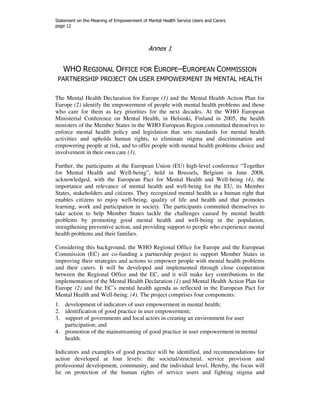
CAREGIVERS 
HEALTH PERSONNEL 
POWER 
Address requests about publications of the WHO Regional Office for Europe to: 
Publications 
WHO Regional Office for Europe 
Scherfigsvej 8 
DK-2100 Copenhagen Ø, Denmark 
Alternatively, complete an online request form for documentation, health information, or for permission to quote or translate, on the 
Regional Office web site (http://www.euro.who.int/pubrequest). 
© World Health Organization 2010 
All rights reserved. The Regional Office for Europe of the World Health Organization welcomes requests for permission to 
reproduce or translate its publications, in part or in full. 
The designations employed and the presentation of the material in this publication do not imply the expression of any opinion 
whatsoever on the part of the World Health Organization concerning the legal status of any country, territory, city or area or 
of its authorities, or concerning the delimitation of its frontiers or boundaries. Dotted lines on maps represent approximate 
border lines for which there may not yet be full agreement. 
The mention of specific companies or of certain manufacturers’ products does not imply that they are endorsed or 
recommended by the World Health Organization in preference to others of a similar nature that are not mentioned. Errors and 
omissions excepted, the names of proprietary products are distinguished by initial capital letters. 
All reasonable precautions have been taken by the World Health Organization to verify the information contained in this 
publication. However, the published material is being distributed without warranty of any kind, either express or implied. 
The responsibility for the interpretation and use of the material lies with the reader. In no event shall the World Health 
Organization be liable for damages arising from its use. The views expressed by authors, editors, or expert groups do not 
necessarily represent the decisions or the stated policy of the World Health Organization.
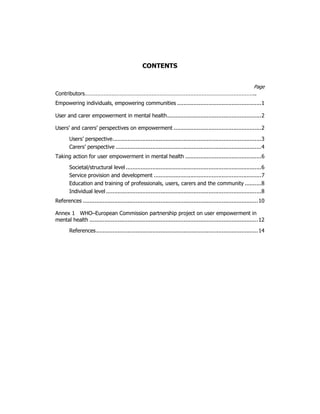
CONTENTS 
Page 
Contributors…………………………………………………………………………………………….. 
Empowering individuals, empowering communities ...................................................1 
User and carer empowerment in mental health.........................................................2 
Users’ and carers’ perspectives on empowerment .....................................................2 
Users’ perspective..........................................................................................3 
Carers’ perspective ........................................................................................4 
Taking action for user empowerment in mental health ..............................................6 
Societal/structural level ..................................................................................6 
Service provision and development .................................................................7 
Education and training of professionals, users, carers and the community ..........8 
Individual level ..............................................................................................8 
References ..........................................................................................................10 
Annex 1 WHO–European Commission partnership project on user empowerment in 
mental health ......................................................................................................12 
References..................................................................................................14
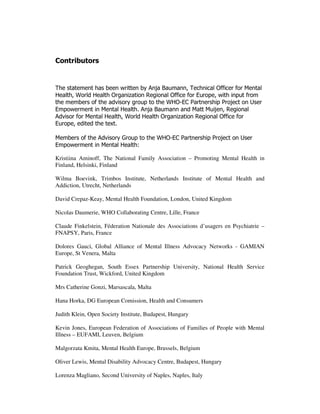
Contributors 
The statement has been written by Anja Baumann, Technical Officer for Mental 
Health, World Health Organization Regional Office for Europe, with input from 
the members of the advisory group to the WHO-EC Partnership Project on User 
Empowerment in Mental Health. Anja Baumann and Matt Muijen, Regional 
Advisor for Mental Health, World Health Organization Regional Office for 
Europe, edited the text. 
Members of the Advisory Group to the WHO-EC Partnership Project on User 
Empowerment in Mental Health: 
Kristiina Aminoff, The National Family Association – Promoting Mental Health in 
Finland, Helsinki, Finland 
Wilma Boevink, Trimbos Institute, Netherlands Institute of Mental Health and 
Addiction, Utrecht, Netherlands 
David Crepaz-Keay, Mental Health Foundation, London, United Kingdom 
Nicolas Daumerie, WHO Collaborating Centre, Lille, France 
Claude Finkelstein, Féderation Nationale des Associations d’usagers en Psychiatrie – 
FNAPSY, Paris, France 
Dolores Gauci, Global Alliance of Mental Illness Advocacy Networks - GAMIAN 
Europe, St Venera, Malta 
Patrick Geoghegan, South Essex Partnership University, National Health Service 
Foundation Trust, Wickford, United Kingdom 
Mrs Catherine Gonzi, Marsascala, Malta 
Hana Horka, DG European Comission, Health and Consumers 
Judith Klein, Open Society Institute, Budapest, Hungary 
Kevin Jones, European Federation of Associations of Families of People with Mental 
Illness – EUFAMI, Leuven, Belgium 
Malgorzata Kmita, Mental Health Europe, Brussels, Belgium 
Oliver Lewis, Mental Disability Advocacy Centre, Budapest, Hungary 
Lorenza Magliano, Second University of Naples, Naples, Italy
Andrew McCulloch, Mental Health Foundation, London, United Kingdom 
Erik Olsen, European Network of (ex-)Users and Survivors of Psychiatry - ENUSP, 
Copenhagen, Denmark 
Geoffrey Reed, World Health Organization 
Julie Repper, The University of Nottingham, United Kingdom 
Jean-Luc Roelandt, WHO Collaborating Centre, Lille, France 
Peter Ryan, Middlesex University, London, United Kingdom 
Maria Jesús San Pío Tendero, Spanish Confederation of Groupings of Families and 
People with Mental Illness - FEAFES, Madrid, Spain 
Jürgen Scheftlein, European Commission, DG Health and Consumers 
David Shiers, National Institute for Mental Health in England – NIMHE, Longsdon, 
United Kingdom
Statement on the Meaning of Empowerment of Mental Health Service Users and Carers 
page 1 
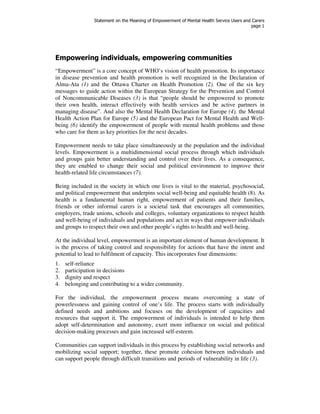
Empowering individuals, empowering communities 
“Empowerment” is a core concept of WHO’s vision of health promotion. Its importance 
in disease prevention and health promotion is well recognized in the Declaration of 
Alma-Ata (1) and the Ottawa Charter on Health Promotion (2). One of the six key 
messages to guide action within the European Strategy for the Prevention and Control 
of Noncommunicable Diseases (3) is that “people should be empowered to promote 
their own health, interact effectively with health services and be active partners in 
managing disease”. And also the Mental Health Declaration for Europe (4), the Mental 
Health Action Plan for Europe (5) and the European Pact for Mental Health and Well-being 
(6) identify the empowerment of people with mental health problems and those 
who care for them as key priorities for the next decades. 
Empowerment needs to take place simultaneously at the population and the individual 
levels. Empowerment is a multidimensional social process through which individuals 
and groups gain better understanding and control over their lives. As a consequence, 
they are enabled to change their social and political environment to improve their 
health-related life circumstances (7). 
Being included in the society in which one lives is vital to the material, psychosocial, 
and political empowerment that underpins social well-being and equitable health (8). As 
health is a fundamental human right, empowerment of patients and their families, 
friends or other informal carers is a societal task that encourages all communities, 
employers, trade unions, schools and colleges, voluntary organizations to respect health 
and well-being of individuals and populations and act in ways that empower individuals 
and groups to respect their own and other people’s rights to health and well-being. 
At the individual level, empowerment is an important element of human development. It 
is the process of taking control and responsibility for actions that have the intent and 
potential to lead to fulfilment of capacity. This incorporates four dimensions: 
1. self-reliance 
2. participation in decisions 
3. dignity and respect 
4. belonging and contributing to a wider community. 
For the individual, the empowerment process means overcoming a state of 
powerlessness and gaining control of one’s life. The process starts with individually 
defined needs and ambitions and focuses on the development of capacities and 
resources that support it. The empowerment of individuals is intended to help them 
adopt self-determination and autonomy, exert more influence on social and political 
decision-making processes and gain increased self-esteem. 
Communities can support individuals in this process by establishing social networks and 
mobilizing social support; together, these promote cohesion between individuals and 
can support people through difficult transitions and periods of vulnerability in life (3).
Statement on the Meaning of Empowerment of Mental Health Service Users and Carers 
page 2 
The empowerment of communities comprises a higher degree of individual 
empowerment among the members of the community, a stronger sense of belonging to 
the community, development of and participation in political activities, leadership of 
decision-making process and access to resources for the benefit of the community 
(9,10). 
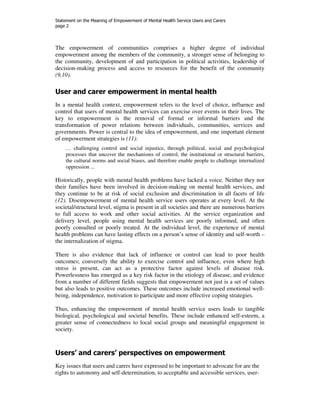
User and carer empowerment in mental health 
In a mental health context, empowerment refers to the level of choice, influence and 
control that users of mental health services can exercise over events in their lives. The 
key to empowerment is the removal of formal or informal barriers and the 
transformation of power relations between individuals, communities, services and 
governments. Power is central to the idea of empowerment, and one important element 
of empowerment strategies is (11): 
… challenging control and social injustice, through political, social and psychological 
processes that uncover the mechanisms of control, the institutional or structural barriers, 
the cultural norms and social biases, and therefore enable people to challenge internalized 
oppression ... 
Historically, people with mental health problems have lacked a voice. Neither they nor 
their families have been involved in decision-making on mental health services, and 
they continue to be at risk of social exclusion and discrimination in all facets of life 
(12). Disempowerment of mental health service users operates at every level. At the 
societal/structural level, stigma is present in all societies and there are numerous barriers 
to full access to work and other social activities. At the service organization and 
delivery level, people using mental health services are poorly informed, and often 
poorly consulted or poorly treated. At the individual level, the experience of mental 
health problems can have lasting effects on a person’s sense of identity and self-worth – 
the internalization of stigma. 
There is also evidence that lack of influence or control can lead to poor health 
outcomes; conversely the ability to exercise control and influence, even where high 
stress is present, can act as a protective factor against levels of disease risk. 
Powerlessness has emerged as a key risk factor in the etiology of disease, and evidence 
from a number of different fields suggests that empowerment not just is a set of values 
but also leads to positive outcomes. These outcomes include increased emotional well-being, 
independence, motivation to participate and more effective coping strategies. 
Thus, enhancing the empowerment of mental health service users leads to tangible 
biological, psychological and societal benefits. These include enhanced self-esteem, a 
greater sense of connectedness to local social groups and meaningful engagement in 
society. 
Users’ and carers’ perspectives on empowerment 
Key issues that users and carers have expressed to be important to advocate for are the 
rights to autonomy and self-determination, to acceptable and accessible services, user-
Statement on the Meaning of Empowerment of Mental Health Service Users and Carers 
page 3 
led evaluation of services, the right for everyone to be recognized as a person before the 
law without discrimination, the destigmatization of mental disorders, and more inclusive 
and respectful services with user and carer involvement (13). In the following these key 
issues are described from user’s and carer’s perspectives. 
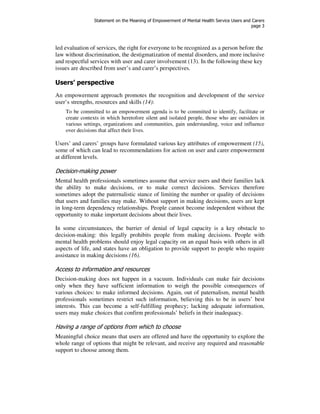
Users’ perspective 
An empowerment approach promotes the recognition and development of the service 
user’s strengths, resources and skills (14): 
To be committed to an empowerment agenda is to be committed to identify, facilitate or 
create contexts in which heretofore silent and isolated people, those who are outsiders in 
various settings, organizations and communities, gain understanding, voice and influence 
over decisions that affect their lives. 
Users’ and carers’ groups have formulated various key attributes of empowerment (15), 
some of which can lead to recommendations for action on user and carer empowerment 
at different levels. 
Decision-making power 
Mental health professionals sometimes assume that service users and their families lack 
the ability to make decisions, or to make correct decisions. Services therefore 
sometimes adopt the paternalistic stance of limiting the number or quality of decisions 
that users and families may make. Without support in making decisions, users are kept 
in long-term dependency relationships. People cannot become independent without the 
opportunity to make important decisions about their lives. 
In some circumstances, the barrier of denial of legal capacity is a key obstacle to 
decision-making: this legally prohibits people from making decisions. People with 
mental health problems should enjoy legal capacity on an equal basis with others in all 
aspects of life, and states have an obligation to provide support to people who require 
assistance in making decisions (16). 
Access to information and resources 
Decision-making does not happen in a vacuum. Individuals can make fair decisions 
only when they have sufficient information to weigh the possible consequences of 
various choices: to make informed decisions. Again, out of paternalism, mental health 
professionals sometimes restrict such information, believing this to be in users’ best 
interests. This can become a self-fulfilling prophecy; lacking adequate information, 
users may make choices that confirm professionals’ beliefs in their inadequacy. 
Having a range of options from which to choose 
Meaningful choice means that users are offered and have the opportunity to explore the 
whole range of options that might be relevant, and receive any required and reasonable 
support to choose among them.
Statement on the Meaning of Empowerment of Mental Health Service Users and Carers 
page 4 
Carers’ perspective 
Carers and their families and friends have needs of their own. While care giving can be 
a strongly positive experience, most who write about it describe the impact in terms of 
burden, both subjective (perceived) and objective (e.g. ill health, economic, displacing 
daily routine). WHO (17) estimated that the burden to family and community from 
psychosis is only exceeded by those from dementia and quadriplegia. 
A study in five European countries (Italy, England (United Kingdom), Germany, Greece 
and Portugal) reported that caregivers for adults with schizophrenia spent an average of 
6–9 hours per day providing care (18). A United Kingdom survey by Rethink (19) 
found that: 
• 95% of carers are members of service users’ families; 
• 29% provide support and care for more than 50 hours per week; 
• 90% are adversely affected by the caring role in terms of leisure activities, career 
progress, financial circumstances and family relationships; 
• 60% have a significantly or moderately reduced social life; 
• 33% find that family relationships are seriously affected; and 
• 41% have significant or moderately reduced mental and physical health. 
Nevertheless, it should be remembered that informal caregivers are not an amorphous 
group. A particular focus should be given to the fact that 82% of carers are female 
(mothers, in 90% of cases); 70% are aged over 60 years and 33% over 70 years (20). 
Moreover, the perception of burden may vary between different cultures in terms of 
being more or less accepting of disability and seeing hope for the future (21). 
Information sharing and confidentiality 
In general, health care has increasingly been seen as a partnership between providers 
and users and their families. The sensitive nature of mental health problems, however, 
means that there can be particular difficulties in relation to confidentiality and the 
sharing of information, compounded by differences of practitioners’ opinions on what 
information can be shared. The practitioner must balance the value of information 
sharing – sometimes crucial to the well-being of both users and carers – against ethical 
and legal duties of confidentiality to both users and carers independently. Unfortunately, 
many mental health practitioners never receive training on dealing with these complex 
issues or addressing the different needs of users and carers. As a result, they lack 
confidence and so avoid giving any information, often citing confidentiality as the 
reason. 
Clearly, the quality of support varies, and many carers feel marginalized by services that 
seem unaware of their huge contribution as informal caregivers. The essential message 
is that services should support families and friends responding to their own needs as 
carers and enabling them to care most effectively. 
Characteristics and qualities 
To achieve the objectives of empowerment, some external conditions and internal 
qualities are important:
Statement on the Meaning of Empowerment of Mental Health Service Users and Carers 
page 5 
• hope and respect 
• reclaiming one’s life 
• feeling connected 
• understanding that people have rights 
• learning skills that the individual defines as important 
• moving from secrecy to transparency 
• growth and change that are never ending and self initiated. 
Hope and respect 
Hope is essential to growth. A hopeful person believes in the possibility of future 
change and improvement; without hope, making an effort can seem pointless. Yet some 
professionals who label their patients incurable or chronic seem also to expect them to 
be motivated to take action and make changes in their lives, despite the overall 
hopelessness such labels convey. Carers need to show respect for the inherent dignity 
and individual autonomy of people with mental health problems, including acceptance 
of difference as part of human diversity and humanity. 
Reclaiming one’s life 
As part of the process of psychiatric diagnosis and treatment, users and their families 
have had their lives, their personal stories, transformed into case histories. Part of the 
empowerment process is therefore the reclaiming of these life stories. 
Similarly, the process of empowerment should include a reclaiming of one’s sense of 
competence, and recognition of the often hidden power relationships inherent in the 
treatment situation. In the early stages of participation in self-help groups, for example, 
members often tell one another their stories; both the act of telling and that of being 
listened to are important for group members. 
Feeling connected – not feeling alone 
Empowerment does not occur to the individual alone, but has to do with experiencing a 
sense of shared experience and connectedness with other people. 
Understanding that people have rights 
The self-help movement among psychiatric service users is part of a broader movement 
to establish basic legal rights. There are parallels between this movement and other 
movements of oppressed and disadvantaged people, including racial and ethnic 
minorities, women, gay and lesbian people, and people with disabilities. The struggle 
for equal rights has been part of all these liberation movements. Through understanding 
their rights, people increase their sense of strength and self-confidence. 
Learning skills that the individual defines as important 
Health professionals sometimes complain that users have poor skills and cannot seem to 
learn new ones. At the same time, the skills that professionals define as important are 
often not the ones that users find interesting or important. When users are given the 
opportunity to learn things that they want to learn, they often surprise professionals (and 
sometimes themselves) by being able to learn them well.
Statement on the Meaning of Empowerment of Mental Health Service Users and Carers 
page 6 
Moving from secrecy to transparency 
People with devalued social status who can hide that fact often choose to do so, but this 
decision takes its toll in the form of decreased self-esteem and fear of discovery. Those 
who reach the point where they can reveal their identities as mental health service users 
are more likely to display self-confidence. 
People can be helped to make decisions about disclosure through support in recognizing 
that they have multiple characteristics, many of which are positive. It is also important 
for both people with mental health problems and society to recognize and accept that 
mental health problems are a source of learning, growth and development, and bring 
additional skills and qualities. 
Growth and change that are never ending and self initiated 
Empowerment is not a destination, but a journey. No one reaches a final stage at which 
further growth and change are neither possible nor beneficial. 
Taking action for user empowerment in mental health 
A process of empowerment requires action at different levels: the societal/structural, 
service provision and professional development, community and the individual level. 
Based on the above reflections, action for user and carer empowerment must cover the 
following five key issues at these levels: 
1. Protection of the human rights of service users and fighting stigma and 
discrimination; 
2. Ensuring high-quality care and accountability of services; 
3. Having access to information and resources; 
4. Inclusion in decision-making; 
5. Having local organizational capacity to make demands on institutions and governing 
structures. 
The following are recommended actions for user and carer empowerment at these 
levels. 
Societal/structural level 
• Ensure that the full range of service users’ human rights is respected, protected and 
fulfilled. For example, governments can effectively implement human rights 
instruments, many of which cover people with mental health problems either 
specifically or by implication. Examples include: the United Nations Convention on 
the Rights of Persons with Disabilities (16), which includes enacting comprehensive 
anti-discrimination legislation with robust enforcement mechanisms, and the 2005 
report of the Special Rapporteur on the right of everyone to the enjoyment of the 
highest attainable standard of physical and mental health (22). The WHO resource
Statement on the Meaning of Empowerment of Mental Health Service Users and Carers 
page 7 
book on mental health, human rights and legislation (23) discusses a range of 
human rights issues. 
• Provide resources to develop of user-led services, including representative 
organizations that give input to public and political activities and are active at the 
international, national, regional and local levels. 
• Build social capital by funding and resourcing local networks of users and carers. 
• Resource independent advocacy in every area of life and society. 
• Ensure government activities to reduce stigma and discrimination and to promote 
community-based multilevel services that involve public awareness campaigns. 
• Facilitate contact between users and the media to sensitize media professionals in 
reporting on people with mental health problems in a non-stigmatizing way. 
• Ensure mental health promotion, disorder prevention and anti-stigma activities in 
the workplace. 
Service provision and development 
• Ensure access to high-quality care and the accountability of services by: 
– making available free or affordable, comprehensive and effective treatment and 
care; 
– offering genuine choice in treatment options; 
– respecting people’s right to refuse treatment; 
– providing community-based specialist mental health treatment and care; 
– offering services that are relevant to different groups’ needs and are provided 
on a basis of non-discrimination; 
– ensuring that independent review bodies are in place to review the lawfulness of 
treatment and services. 
• Offer people who use services the chance to be partners or to be involved in: 
– all stages and levels of running, planning, delivering and evaluating services; 
– choosing their key mental health caregivers; 
– drawing up their care plans and planning their treatment (encouraging fully 
informed decision-making, which includes a discussion of risks linked to 
medication and the importance of health promoting lifestyles); 
– working towards shared crisis plans, advance directives, enduring powers of 
attorney, recovery plans and risk safety plans; 
– ensuring staff are trained in mental health law and human rights standards; 
– ensuring that the recruitment of staff, volunteers and advocates is free of 
discrimination on the grounds of psychiatric history, as well as more familiar 
grounds such as ethnicity, religion, gender, sexual orientation, age and 
disability;
Statement on the Meaning of Empowerment of Mental Health Service Users and Carers 
page 8 
• Ensure that users and carers actively working for empowerment are not penalized, 
by being either labelled troublemakers or denied support. Users may need more 
support, not less, when they are involved in planning, delivering or reviewing 
policies, legislation and services. 
• Consider resourcing a self-advocacy group or user quality group, so that individual 
users and carers who speak out have a constituency and support network. 
• Have a well-publicized complaints procedure. Users and their families should be 
able to complain irrespective of their circumstances, and be able to have a lay 
advocate to assist them. 
Education and training of professionals, users, carers and the 
community 
• Those who design and deliver mental health professionals’ training should do so in 
systematic partnership with users and carers. 
• Seek trainers with a range of perspectives; for instance, include trainers on the 
issues relevant to users from ethnic or linguistic minorities, and on those relating 
specifically to girls and women with mental health problems. 
• Include the stigma of mental illness as a topic in the curricula of primary care and 
mental health professionals. 
• Offer training for relevant community actors such as police officers and employers. 
• Ensure parity between users and non-users: if a professional consultant or trainer is 
offered a fee, so must a user or carer consultant or trainer. 
• Offer training for users and carers in skills for committee work and leadership 
development. 
• Develop user routes and pathways into roles and opportunities in the caring 
professions at qualifying and post-qualifying levels. 
Individual level 
While structures, conditions and support can create the opportunities that enable 
individual empowerment, responsibility ultimately lies with individuals to reclaim 
control of their problems, the way they are treated and their lives. 
At the individual level, users and carers need to take back control by: 
• developing or strengthening ways of coping with their difficulties (e.g. through 
personal recovery planning); 
• having a real say in the treatment and care that they receive, and planning for crises 
so that they can exert an influence even at times of acute distress (e.g. through 
advance statements); and 
• working towards their own ambitions and goals, which may well include 
employment, education, enhanced family roles and relationships.
Statement on the Meaning of Empowerment of Mental Health Service Users and Carers 
page 9 
This entails demanding rights and taking on responsibilities that create and maximize 
freedoms that will give mental health service users equal status in society by fostering: 
1. respect, independence and protection in the forms of: 
– the right to privacy, receiving and exercising the full rights and responsibilities 
of citizenship, and being free from any kind of discrimination; 
– benefits guaranteeing a decent standard of life, and choice of residence and 
housing with full tenancy rights; 
– secure property rights, access to free or affordable legal representation and an 
absence of coercion; 
2. choice and opportunities for personal development and social inclusion in the form 
of equal access to information, employment and peer support; 
3. personal development through opportunities for education and leisure: schools, 
universities and libraries, and access the Internet, various leisure activities and 
travel; and 
4. social inclusion in terms of access to public activities, no restriction on club 
membership, and no limitation on health insurance or securing loans from banks. 
Conclusions 
This statement defines empowerment, describes the challenges, identifies the 
perspectives and the elements that comprise empowerment, and proposed action. It 
identifies the multi-dimensional aspects of empowerment. Unless the individual, service 
and societal levels are aligned, empowerment initiatives will not be effective and 
stigma, discrimination and marginalization will endure. The lack of empowerment and 
the need to strengthen user and carer empowerment needs to be accepted by everyone, 
and respect and growth are essential challenges to be recognized and acted on by 
everyone, everywhere. 
Initial steps will be the identification and recognition of these challenges, the next the 
actions that are specified in this statement, many evidence based, and finally evaluation. 
WHO accepts the responsibility to advocate these initiatives, and will develop indicators 
to steer this process. These actions will be taken forward in partnership with the 
European Commission's Health and Consumers Directorate General. We believe that 
initiatives embracing empowerment and inclusion will not only offer opportunities and 
equality to the most vulnerable and discriminated groups, but will benefit communities 
as a whole.
Statement on the Meaning of Empowerment of Mental Health Service Users and Carers 
page 10 
References 
1. Declaration of Alma-Ata. Copenhagen, WHO Regional Office for Europe, 1978 
(http://www.euro.who.int/AboutWHO/Policy/20010827_1, accessed 11 May 2009). 
2. Ottawa Charter for Health Promotion. Copenhagen, WHO Regional Office for 
Europe, 1986 (http://www.euro.who.int/AboutWHO/Policy/20010827_2, accessed 
11 May 2009). 
3. Gaining Health. The European Strategy for the Prevention and Control of 
Noncommunnicable Diseases. Copenhagen, WHO Regional Office for Europe, 
2006 
(http://www.euro.who.int/InformationSources/Publications/Catalogue/20061003_1, 
accessed 11 May 2009). 
4. Mental Health Declaration for Europe. Copenhagen, WHO Regional Office for 
Europe (http://www.euro.who.int/document/mnh/edoc06.pdf, accessed 11 May 
2009). 
5. Mental Health Action Plan for Europe. Copenhagen WHO Regional Office for 
Europe (http://www.euro.who.int/Document/MNH/edoc07.pdf, accessed 11 May 
2009). 
6. European Pact for Mental Health and Well-being. Brussels, European Commission, 
2008 
(http://ec.europa.eu/health/ph_determinants/life_style/mental/docs/pact_en.pdf, 
accessed 11 May 2009). 
7. Loss J, Wiese M. Evaluation von Empowerment – Perspektiven und Konzepte von 
Gesundheitsförderern. Ergebnisse einer qualitativen Studie in Australien. 
Gesundheitswesen, 2008, 70:755–763. 
8. CSDH. Closing the gap in a generation: health equity through action on the 
socialdeterminants of health. Final Report of the Commission on Social 
Determinants of Health. Geneva, World Health Organization, 2008. 
9. Achieving health equity: from root causes to fair outcomes. Commission on Social 
Determinants of Health. Interim statement. Geneva, World Health Organization, 
2007 (http://whqlibdoc.who.int/publications/2007/interim_statement_eng.pdf, 
accessed 11 May 2009). 
10. Israel BA et al. Health education and community empowerment: conceptualizing 
and measuring perceptions of individual, organizational, and community control. 
Health Education Quarterly, 1994, 21:149–170. 
11. Wallerstein N. What is the evidence on effectiveness of empowerment to improve 
health? Copenhagen, WHO Regional Office for Europe, 2006 (Health Evidence 
Network report; http://www.euro.who.int/Document/E88086.pdf, accessed 11 May 
2009). 
12. Policies and practices for mental health in Europe. Meeting the challenges. 
Copenhagen, WHO Regional Office for Europe, 2008 
(http://www.euro.who.int/InformationSources/Publications/Catalogue/20081009_1, 
accessed 11 May 2009).
Statement on the Meaning of Empowerment of Mental Health Service Users and Carers 
page 11 
13. Empowerment and mental health advocacy. Briefing paper for the WHO European 
Ministerial Conference on Mental Health: Facing the Challenges, Building 
Solutions. Copenhagen, World Health Organization, 2005 
14. Fitzimmons S, Fuller R. Empowerment and its implications for clinical practice. 
Mental Health: a Review Journal of Mental Health, 2002, 11(5):481–499. 
15. Rogers ES et al. Consumer-constructed scale to measure empowerment among 
users of mental health services. Psychiatric Services, 1997, 48(8):1042–1047. 
16. Convention on the Rights of Persons with Disabilities and its Optional Protocol. 
New York, United Nations, 2006 
(http://www.un.org/disabilities/default.asp?id=150, accessed 11 May 2009). 
17. World health report 2001. Mental health: new understanding, new hope. Geneva, 
World Health Organization, 2001 (http://www.who.int/whr/2001/en, accessed 11 
May 2009). 
18. Magliano L et al. Burden on the families of patients with schizophrenia: results of 
the BIOMED I study. Social Psychiatry and Psychiatric Epidemiology, 1998, 
33(9):405–412. 
19. Who cares? The experiences of mental health carers accessing service and 
information. Kingston Upon Thames, Rethink, 2003 
(http://www.mentalhealthshop.org/products/rethink_publications/who_cares.html, 
accessed 11 May 2009). 
20. Awad AG, Voruganti LN. The burden of schizophrenia on caregivers. 
Pharmacoeconomics, 2008, 26(2):149–162. 
21. Rosenfarb IS, Bellack AS, Aziz N. A socio-cultural stress appraisal and coping 
model of schizophrenia burden and family attitudes towards patients with 
schizophrenia. Journal of Abnormal Psychology, 2006, 115:157–165. 
22. Report of the Special Rapporteur on the right of everyone to the enjoyment of the 
highest attainable standard of physical and mental health, Paul Hunt. Geneva, 
Office of the United Nations High Commissioner on Human Rights, 
2005:paragraph 46(d) (E/CN.4/2005/51; http://daccess-ods. 
un.org/access.nsf/Get?Open&DS=E/CN.4/2005/51&Lang=E, accessed 11 May 
2009). 
23. WHO resource book on mental health, human rights and legislation. Geneva, 
World Health Organization, 2005 
(http://www.who.int/mental_health/policy/legislation/essentialpackage2v1/en, 
accessed 11 May 2009).
Statement on the Meaning of Empowerment of Mental Health Service Users and Carers 
page 12 
Annex 1 
WHO REGIONAL OFFICE FOR EUROPE–EUROPEAN COMMISSION 
PARTNERSHIP PROJECT ON USER EMPOWERMENT IN MENTAL HEALTH 
The Mental Health Declaration for Europe (1) and the Mental Health Action Plan for 
Europe (2) identify the empowerment of people with mental health problems and those 
who care for them as key priorities for the next decades. At the WHO European 
Ministerial Conference on Mental Health, in Helsinki, Finland in 2005, the health 
ministers of the Member States in the WHO European Region committed themselves to 
enforce mental health policy and legislation that sets standards for mental health 
activities and upholds human rights, to eliminate stigma and discrimination and 
empowering people at risk, and to offer people with mental health problems choice and 
involvement in their own care (3). 
Further, the participants at the European Union (EU) high-level conference “Together 
for Mental Health and Well-being”, held in Brussels, Belgium in June 2008, 
acknowledged, with the European Pact for Mental Health and Well-being (4), the 
importance and relevance of mental health and well-being for the EU, its Member 
States, stakeholders and citizens. They recognized mental health as a human right that 
enables citizens to enjoy well-being, quality of life and health and that promotes 
learning, work and participation in society. The participants committed themselves to 
take action to help Member States tackle the challenges caused by mental health 
problems by promoting good mental health and well-being in the population, 
strengthening preventive action, and providing support to people who experience mental 
health problems and their families. 
Considering this background, the WHO Regional Office for Europe and the European 
Commission (EC) are co-funding a partnership project to support Member States in 
improving their strategies and actions to empower people with mental health problems 
and their carers. It will be developed and implemented through close cooperation 
between the Regional Office and the EC, and it will make key contributions to the 
implementation of the Mental Health Declaration (1) and Mental Health Action Plan for 
Europe (2) and the EC’s mental health agenda as reflected in the European Pact for 
Mental Health and Well-being. (4). The project comprises four components: 
1. development of indicators of user empowerment in mental health; 
2. identification of good practice in user empowerment; 
3. support of governments and local actors in creating an environment for user 
participation; and 
4. promotion of the mainstreaming of good practice in user empowerment in mental 
health. 
Indicators and examples of good practice will be identified, and recommendations for 
action developed at four levels: the societal/structural, service provision and 
professional development, community, and the individual level. Hereby, the focus will 
lie on protection of the human rights of service users and fighting stigma and
Statement on the Meaning of Empowerment of Mental Health Service Users and Carers 
page 13 
discrimination; ensuring high-quality care and accountability of services; having access 
to information and resources; inclusion in decision-making; having local organizational 
capacity to make demands on institutions and governing structures.
Statement on the Meaning of Empowerment of Mental Health Service Users and Carers 
page 14 
References 
1. Mental Health Declaration for Europe. Copenhagen, WHO Regional Office for 
Europe (http://www.euro.who.int/document/mnh/edoc06.pdf, accessed 11 May 
2009). 
2. Mental Health Action Plan for Europe. Copenhagen WHO Regional Office for 
Europe (http://www.euro.who.int/Document/MNH/edoc07.pdf, accessed 11 May 
2009). 
3. Mental health: facing the challenges, building solutions. Report from the WHO 
European Ministerial Conference. Copenhagen, WHO Regional Office for Europe, 
2005 
(http://www.euro.who.int/InformationSources/Publications/Catalogue/20050912_1, 
accessed 11 May 2009). 
4. European Pact for Mental Health and Well-being. Brussels, European Commission, 
2008 
(http://ec.europa.eu/health/ph_determinants/life_style/mental/docs/pact_en.pdf, 
accessed 11 May 2009).

User Empowerment in Mental Health

  • 1.
    User empowerment inmental health – a statement by the WHO Regional Office for Europe Empowerment is not a destination, but a journey With the support of the European Commission Health and Consumers Directorate-General
  • 2.
    Historically, people withmental health problems have lacked a voice. Neither they nor their families have been involved in decision-making on mental health services, and they continue to be at risk of social exclusion and discrimination in all facets of life. In a mental health context, empowerment refers to the level of choice, influence and control that users of mental health services can exercise over events in their lives. The key to empowerment is the removal of formal or informal barriers and the transformation of power relations between individuals, communities, services and governments. This statement specifies the action to be taken to strengthen user and carer empowerment in mental health and outlines the objectives of the Partnership Project on User Empowerment in Mental Health by the WHO Regional Office for Europe and the European Commission. Keywords MENTAL HEALTH SERVICES USER PARTICIPATION PATIENT ADVOCACY CAREGIVERS HEALTH PERSONNEL POWER Address requests about publications of the WHO Regional Office for Europe to: Publications WHO Regional Office for Europe Scherfigsvej 8 DK-2100 Copenhagen Ø, Denmark Alternatively, complete an online request form for documentation, health information, or for permission to quote or translate, on the Regional Office web site (http://www.euro.who.int/pubrequest). © World Health Organization 2010 All rights reserved. The Regional Office for Europe of the World Health Organization welcomes requests for permission to reproduce or translate its publications, in part or in full. The designations employed and the presentation of the material in this publication do not imply the expression of any opinion whatsoever on the part of the World Health Organization concerning the legal status of any country, territory, city or area or of its authorities, or concerning the delimitation of its frontiers or boundaries. Dotted lines on maps represent approximate border lines for which there may not yet be full agreement. The mention of specific companies or of certain manufacturers’ products does not imply that they are endorsed or recommended by the World Health Organization in preference to others of a similar nature that are not mentioned. Errors and omissions excepted, the names of proprietary products are distinguished by initial capital letters. All reasonable precautions have been taken by the World Health Organization to verify the information contained in this publication. However, the published material is being distributed without warranty of any kind, either express or implied. The responsibility for the interpretation and use of the material lies with the reader. In no event shall the World Health Organization be liable for damages arising from its use. The views expressed by authors, editors, or expert groups do not necessarily represent the decisions or the stated policy of the World Health Organization.
  • 3.
    CONTENTS Page Contributors…………………………………………………………………………………………….. Empowering individuals, empowering communities ...................................................1 User and carer empowerment in mental health.........................................................2 Users’ and carers’ perspectives on empowerment .....................................................2 Users’ perspective..........................................................................................3 Carers’ perspective ........................................................................................4 Taking action for user empowerment in mental health ..............................................6 Societal/structural level ..................................................................................6 Service provision and development .................................................................7 Education and training of professionals, users, carers and the community ..........8 Individual level ..............................................................................................8 References ..........................................................................................................10 Annex 1 WHO–European Commission partnership project on user empowerment in mental health ......................................................................................................12 References..................................................................................................14
  • 4.
    Contributors The statementhas been written by Anja Baumann, Technical Officer for Mental Health, World Health Organization Regional Office for Europe, with input from the members of the advisory group to the WHO-EC Partnership Project on User Empowerment in Mental Health. Anja Baumann and Matt Muijen, Regional Advisor for Mental Health, World Health Organization Regional Office for Europe, edited the text. Members of the Advisory Group to the WHO-EC Partnership Project on User Empowerment in Mental Health: Kristiina Aminoff, The National Family Association – Promoting Mental Health in Finland, Helsinki, Finland Wilma Boevink, Trimbos Institute, Netherlands Institute of Mental Health and Addiction, Utrecht, Netherlands David Crepaz-Keay, Mental Health Foundation, London, United Kingdom Nicolas Daumerie, WHO Collaborating Centre, Lille, France Claude Finkelstein, Féderation Nationale des Associations d’usagers en Psychiatrie – FNAPSY, Paris, France Dolores Gauci, Global Alliance of Mental Illness Advocacy Networks - GAMIAN Europe, St Venera, Malta Patrick Geoghegan, South Essex Partnership University, National Health Service Foundation Trust, Wickford, United Kingdom Mrs Catherine Gonzi, Marsascala, Malta Hana Horka, DG European Comission, Health and Consumers Judith Klein, Open Society Institute, Budapest, Hungary Kevin Jones, European Federation of Associations of Families of People with Mental Illness – EUFAMI, Leuven, Belgium Malgorzata Kmita, Mental Health Europe, Brussels, Belgium Oliver Lewis, Mental Disability Advocacy Centre, Budapest, Hungary Lorenza Magliano, Second University of Naples, Naples, Italy
  • 5.
    Andrew McCulloch, MentalHealth Foundation, London, United Kingdom Erik Olsen, European Network of (ex-)Users and Survivors of Psychiatry - ENUSP, Copenhagen, Denmark Geoffrey Reed, World Health Organization Julie Repper, The University of Nottingham, United Kingdom Jean-Luc Roelandt, WHO Collaborating Centre, Lille, France Peter Ryan, Middlesex University, London, United Kingdom Maria Jesús San Pío Tendero, Spanish Confederation of Groupings of Families and People with Mental Illness - FEAFES, Madrid, Spain Jürgen Scheftlein, European Commission, DG Health and Consumers David Shiers, National Institute for Mental Health in England – NIMHE, Longsdon, United Kingdom
  • 7.
    Statement on theMeaning of Empowerment of Mental Health Service Users and Carers page 1 Empowering individuals, empowering communities “Empowerment” is a core concept of WHO’s vision of health promotion. Its importance in disease prevention and health promotion is well recognized in the Declaration of Alma-Ata (1) and the Ottawa Charter on Health Promotion (2). One of the six key messages to guide action within the European Strategy for the Prevention and Control of Noncommunicable Diseases (3) is that “people should be empowered to promote their own health, interact effectively with health services and be active partners in managing disease”. And also the Mental Health Declaration for Europe (4), the Mental Health Action Plan for Europe (5) and the European Pact for Mental Health and Well-being (6) identify the empowerment of people with mental health problems and those who care for them as key priorities for the next decades. Empowerment needs to take place simultaneously at the population and the individual levels. Empowerment is a multidimensional social process through which individuals and groups gain better understanding and control over their lives. As a consequence, they are enabled to change their social and political environment to improve their health-related life circumstances (7). Being included in the society in which one lives is vital to the material, psychosocial, and political empowerment that underpins social well-being and equitable health (8). As health is a fundamental human right, empowerment of patients and their families, friends or other informal carers is a societal task that encourages all communities, employers, trade unions, schools and colleges, voluntary organizations to respect health and well-being of individuals and populations and act in ways that empower individuals and groups to respect their own and other people’s rights to health and well-being. At the individual level, empowerment is an important element of human development. It is the process of taking control and responsibility for actions that have the intent and potential to lead to fulfilment of capacity. This incorporates four dimensions: 1. self-reliance 2. participation in decisions 3. dignity and respect 4. belonging and contributing to a wider community. For the individual, the empowerment process means overcoming a state of powerlessness and gaining control of one’s life. The process starts with individually defined needs and ambitions and focuses on the development of capacities and resources that support it. The empowerment of individuals is intended to help them adopt self-determination and autonomy, exert more influence on social and political decision-making processes and gain increased self-esteem. Communities can support individuals in this process by establishing social networks and mobilizing social support; together, these promote cohesion between individuals and can support people through difficult transitions and periods of vulnerability in life (3).
  • 8.
    Statement on theMeaning of Empowerment of Mental Health Service Users and Carers page 2 The empowerment of communities comprises a higher degree of individual empowerment among the members of the community, a stronger sense of belonging to the community, development of and participation in political activities, leadership of decision-making process and access to resources for the benefit of the community (9,10). User and carer empowerment in mental health In a mental health context, empowerment refers to the level of choice, influence and control that users of mental health services can exercise over events in their lives. The key to empowerment is the removal of formal or informal barriers and the transformation of power relations between individuals, communities, services and governments. Power is central to the idea of empowerment, and one important element of empowerment strategies is (11): … challenging control and social injustice, through political, social and psychological processes that uncover the mechanisms of control, the institutional or structural barriers, the cultural norms and social biases, and therefore enable people to challenge internalized oppression ... Historically, people with mental health problems have lacked a voice. Neither they nor their families have been involved in decision-making on mental health services, and they continue to be at risk of social exclusion and discrimination in all facets of life (12). Disempowerment of mental health service users operates at every level. At the societal/structural level, stigma is present in all societies and there are numerous barriers to full access to work and other social activities. At the service organization and delivery level, people using mental health services are poorly informed, and often poorly consulted or poorly treated. At the individual level, the experience of mental health problems can have lasting effects on a person’s sense of identity and self-worth – the internalization of stigma. There is also evidence that lack of influence or control can lead to poor health outcomes; conversely the ability to exercise control and influence, even where high stress is present, can act as a protective factor against levels of disease risk. Powerlessness has emerged as a key risk factor in the etiology of disease, and evidence from a number of different fields suggests that empowerment not just is a set of values but also leads to positive outcomes. These outcomes include increased emotional well-being, independence, motivation to participate and more effective coping strategies. Thus, enhancing the empowerment of mental health service users leads to tangible biological, psychological and societal benefits. These include enhanced self-esteem, a greater sense of connectedness to local social groups and meaningful engagement in society. Users’ and carers’ perspectives on empowerment Key issues that users and carers have expressed to be important to advocate for are the rights to autonomy and self-determination, to acceptable and accessible services, user-
  • 9.
    Statement on theMeaning of Empowerment of Mental Health Service Users and Carers page 3 led evaluation of services, the right for everyone to be recognized as a person before the law without discrimination, the destigmatization of mental disorders, and more inclusive and respectful services with user and carer involvement (13). In the following these key issues are described from user’s and carer’s perspectives. Users’ perspective An empowerment approach promotes the recognition and development of the service user’s strengths, resources and skills (14): To be committed to an empowerment agenda is to be committed to identify, facilitate or create contexts in which heretofore silent and isolated people, those who are outsiders in various settings, organizations and communities, gain understanding, voice and influence over decisions that affect their lives. Users’ and carers’ groups have formulated various key attributes of empowerment (15), some of which can lead to recommendations for action on user and carer empowerment at different levels. Decision-making power Mental health professionals sometimes assume that service users and their families lack the ability to make decisions, or to make correct decisions. Services therefore sometimes adopt the paternalistic stance of limiting the number or quality of decisions that users and families may make. Without support in making decisions, users are kept in long-term dependency relationships. People cannot become independent without the opportunity to make important decisions about their lives. In some circumstances, the barrier of denial of legal capacity is a key obstacle to decision-making: this legally prohibits people from making decisions. People with mental health problems should enjoy legal capacity on an equal basis with others in all aspects of life, and states have an obligation to provide support to people who require assistance in making decisions (16). Access to information and resources Decision-making does not happen in a vacuum. Individuals can make fair decisions only when they have sufficient information to weigh the possible consequences of various choices: to make informed decisions. Again, out of paternalism, mental health professionals sometimes restrict such information, believing this to be in users’ best interests. This can become a self-fulfilling prophecy; lacking adequate information, users may make choices that confirm professionals’ beliefs in their inadequacy. Having a range of options from which to choose Meaningful choice means that users are offered and have the opportunity to explore the whole range of options that might be relevant, and receive any required and reasonable support to choose among them.
  • 10.
    Statement on theMeaning of Empowerment of Mental Health Service Users and Carers page 4 Carers’ perspective Carers and their families and friends have needs of their own. While care giving can be a strongly positive experience, most who write about it describe the impact in terms of burden, both subjective (perceived) and objective (e.g. ill health, economic, displacing daily routine). WHO (17) estimated that the burden to family and community from psychosis is only exceeded by those from dementia and quadriplegia. A study in five European countries (Italy, England (United Kingdom), Germany, Greece and Portugal) reported that caregivers for adults with schizophrenia spent an average of 6–9 hours per day providing care (18). A United Kingdom survey by Rethink (19) found that: • 95% of carers are members of service users’ families; • 29% provide support and care for more than 50 hours per week; • 90% are adversely affected by the caring role in terms of leisure activities, career progress, financial circumstances and family relationships; • 60% have a significantly or moderately reduced social life; • 33% find that family relationships are seriously affected; and • 41% have significant or moderately reduced mental and physical health. Nevertheless, it should be remembered that informal caregivers are not an amorphous group. A particular focus should be given to the fact that 82% of carers are female (mothers, in 90% of cases); 70% are aged over 60 years and 33% over 70 years (20). Moreover, the perception of burden may vary between different cultures in terms of being more or less accepting of disability and seeing hope for the future (21). Information sharing and confidentiality In general, health care has increasingly been seen as a partnership between providers and users and their families. The sensitive nature of mental health problems, however, means that there can be particular difficulties in relation to confidentiality and the sharing of information, compounded by differences of practitioners’ opinions on what information can be shared. The practitioner must balance the value of information sharing – sometimes crucial to the well-being of both users and carers – against ethical and legal duties of confidentiality to both users and carers independently. Unfortunately, many mental health practitioners never receive training on dealing with these complex issues or addressing the different needs of users and carers. As a result, they lack confidence and so avoid giving any information, often citing confidentiality as the reason. Clearly, the quality of support varies, and many carers feel marginalized by services that seem unaware of their huge contribution as informal caregivers. The essential message is that services should support families and friends responding to their own needs as carers and enabling them to care most effectively. Characteristics and qualities To achieve the objectives of empowerment, some external conditions and internal qualities are important:
  • 11.
    Statement on theMeaning of Empowerment of Mental Health Service Users and Carers page 5 • hope and respect • reclaiming one’s life • feeling connected • understanding that people have rights • learning skills that the individual defines as important • moving from secrecy to transparency • growth and change that are never ending and self initiated. Hope and respect Hope is essential to growth. A hopeful person believes in the possibility of future change and improvement; without hope, making an effort can seem pointless. Yet some professionals who label their patients incurable or chronic seem also to expect them to be motivated to take action and make changes in their lives, despite the overall hopelessness such labels convey. Carers need to show respect for the inherent dignity and individual autonomy of people with mental health problems, including acceptance of difference as part of human diversity and humanity. Reclaiming one’s life As part of the process of psychiatric diagnosis and treatment, users and their families have had their lives, their personal stories, transformed into case histories. Part of the empowerment process is therefore the reclaiming of these life stories. Similarly, the process of empowerment should include a reclaiming of one’s sense of competence, and recognition of the often hidden power relationships inherent in the treatment situation. In the early stages of participation in self-help groups, for example, members often tell one another their stories; both the act of telling and that of being listened to are important for group members. Feeling connected – not feeling alone Empowerment does not occur to the individual alone, but has to do with experiencing a sense of shared experience and connectedness with other people. Understanding that people have rights The self-help movement among psychiatric service users is part of a broader movement to establish basic legal rights. There are parallels between this movement and other movements of oppressed and disadvantaged people, including racial and ethnic minorities, women, gay and lesbian people, and people with disabilities. The struggle for equal rights has been part of all these liberation movements. Through understanding their rights, people increase their sense of strength and self-confidence. Learning skills that the individual defines as important Health professionals sometimes complain that users have poor skills and cannot seem to learn new ones. At the same time, the skills that professionals define as important are often not the ones that users find interesting or important. When users are given the opportunity to learn things that they want to learn, they often surprise professionals (and sometimes themselves) by being able to learn them well.
  • 12.
    Statement on theMeaning of Empowerment of Mental Health Service Users and Carers page 6 Moving from secrecy to transparency People with devalued social status who can hide that fact often choose to do so, but this decision takes its toll in the form of decreased self-esteem and fear of discovery. Those who reach the point where they can reveal their identities as mental health service users are more likely to display self-confidence. People can be helped to make decisions about disclosure through support in recognizing that they have multiple characteristics, many of which are positive. It is also important for both people with mental health problems and society to recognize and accept that mental health problems are a source of learning, growth and development, and bring additional skills and qualities. Growth and change that are never ending and self initiated Empowerment is not a destination, but a journey. No one reaches a final stage at which further growth and change are neither possible nor beneficial. Taking action for user empowerment in mental health A process of empowerment requires action at different levels: the societal/structural, service provision and professional development, community and the individual level. Based on the above reflections, action for user and carer empowerment must cover the following five key issues at these levels: 1. Protection of the human rights of service users and fighting stigma and discrimination; 2. Ensuring high-quality care and accountability of services; 3. Having access to information and resources; 4. Inclusion in decision-making; 5. Having local organizational capacity to make demands on institutions and governing structures. The following are recommended actions for user and carer empowerment at these levels. Societal/structural level • Ensure that the full range of service users’ human rights is respected, protected and fulfilled. For example, governments can effectively implement human rights instruments, many of which cover people with mental health problems either specifically or by implication. Examples include: the United Nations Convention on the Rights of Persons with Disabilities (16), which includes enacting comprehensive anti-discrimination legislation with robust enforcement mechanisms, and the 2005 report of the Special Rapporteur on the right of everyone to the enjoyment of the highest attainable standard of physical and mental health (22). The WHO resource
  • 13.
    Statement on theMeaning of Empowerment of Mental Health Service Users and Carers page 7 book on mental health, human rights and legislation (23) discusses a range of human rights issues. • Provide resources to develop of user-led services, including representative organizations that give input to public and political activities and are active at the international, national, regional and local levels. • Build social capital by funding and resourcing local networks of users and carers. • Resource independent advocacy in every area of life and society. • Ensure government activities to reduce stigma and discrimination and to promote community-based multilevel services that involve public awareness campaigns. • Facilitate contact between users and the media to sensitize media professionals in reporting on people with mental health problems in a non-stigmatizing way. • Ensure mental health promotion, disorder prevention and anti-stigma activities in the workplace. Service provision and development • Ensure access to high-quality care and the accountability of services by: – making available free or affordable, comprehensive and effective treatment and care; – offering genuine choice in treatment options; – respecting people’s right to refuse treatment; – providing community-based specialist mental health treatment and care; – offering services that are relevant to different groups’ needs and are provided on a basis of non-discrimination; – ensuring that independent review bodies are in place to review the lawfulness of treatment and services. • Offer people who use services the chance to be partners or to be involved in: – all stages and levels of running, planning, delivering and evaluating services; – choosing their key mental health caregivers; – drawing up their care plans and planning their treatment (encouraging fully informed decision-making, which includes a discussion of risks linked to medication and the importance of health promoting lifestyles); – working towards shared crisis plans, advance directives, enduring powers of attorney, recovery plans and risk safety plans; – ensuring staff are trained in mental health law and human rights standards; – ensuring that the recruitment of staff, volunteers and advocates is free of discrimination on the grounds of psychiatric history, as well as more familiar grounds such as ethnicity, religion, gender, sexual orientation, age and disability;
  • 14.
    Statement on theMeaning of Empowerment of Mental Health Service Users and Carers page 8 • Ensure that users and carers actively working for empowerment are not penalized, by being either labelled troublemakers or denied support. Users may need more support, not less, when they are involved in planning, delivering or reviewing policies, legislation and services. • Consider resourcing a self-advocacy group or user quality group, so that individual users and carers who speak out have a constituency and support network. • Have a well-publicized complaints procedure. Users and their families should be able to complain irrespective of their circumstances, and be able to have a lay advocate to assist them. Education and training of professionals, users, carers and the community • Those who design and deliver mental health professionals’ training should do so in systematic partnership with users and carers. • Seek trainers with a range of perspectives; for instance, include trainers on the issues relevant to users from ethnic or linguistic minorities, and on those relating specifically to girls and women with mental health problems. • Include the stigma of mental illness as a topic in the curricula of primary care and mental health professionals. • Offer training for relevant community actors such as police officers and employers. • Ensure parity between users and non-users: if a professional consultant or trainer is offered a fee, so must a user or carer consultant or trainer. • Offer training for users and carers in skills for committee work and leadership development. • Develop user routes and pathways into roles and opportunities in the caring professions at qualifying and post-qualifying levels. Individual level While structures, conditions and support can create the opportunities that enable individual empowerment, responsibility ultimately lies with individuals to reclaim control of their problems, the way they are treated and their lives. At the individual level, users and carers need to take back control by: • developing or strengthening ways of coping with their difficulties (e.g. through personal recovery planning); • having a real say in the treatment and care that they receive, and planning for crises so that they can exert an influence even at times of acute distress (e.g. through advance statements); and • working towards their own ambitions and goals, which may well include employment, education, enhanced family roles and relationships.
  • 15.
    Statement on theMeaning of Empowerment of Mental Health Service Users and Carers page 9 This entails demanding rights and taking on responsibilities that create and maximize freedoms that will give mental health service users equal status in society by fostering: 1. respect, independence and protection in the forms of: – the right to privacy, receiving and exercising the full rights and responsibilities of citizenship, and being free from any kind of discrimination; – benefits guaranteeing a decent standard of life, and choice of residence and housing with full tenancy rights; – secure property rights, access to free or affordable legal representation and an absence of coercion; 2. choice and opportunities for personal development and social inclusion in the form of equal access to information, employment and peer support; 3. personal development through opportunities for education and leisure: schools, universities and libraries, and access the Internet, various leisure activities and travel; and 4. social inclusion in terms of access to public activities, no restriction on club membership, and no limitation on health insurance or securing loans from banks. Conclusions This statement defines empowerment, describes the challenges, identifies the perspectives and the elements that comprise empowerment, and proposed action. It identifies the multi-dimensional aspects of empowerment. Unless the individual, service and societal levels are aligned, empowerment initiatives will not be effective and stigma, discrimination and marginalization will endure. The lack of empowerment and the need to strengthen user and carer empowerment needs to be accepted by everyone, and respect and growth are essential challenges to be recognized and acted on by everyone, everywhere. Initial steps will be the identification and recognition of these challenges, the next the actions that are specified in this statement, many evidence based, and finally evaluation. WHO accepts the responsibility to advocate these initiatives, and will develop indicators to steer this process. These actions will be taken forward in partnership with the European Commission's Health and Consumers Directorate General. We believe that initiatives embracing empowerment and inclusion will not only offer opportunities and equality to the most vulnerable and discriminated groups, but will benefit communities as a whole.
  • 16.
    Statement on theMeaning of Empowerment of Mental Health Service Users and Carers page 10 References 1. Declaration of Alma-Ata. Copenhagen, WHO Regional Office for Europe, 1978 (http://www.euro.who.int/AboutWHO/Policy/20010827_1, accessed 11 May 2009). 2. Ottawa Charter for Health Promotion. Copenhagen, WHO Regional Office for Europe, 1986 (http://www.euro.who.int/AboutWHO/Policy/20010827_2, accessed 11 May 2009). 3. Gaining Health. The European Strategy for the Prevention and Control of Noncommunnicable Diseases. Copenhagen, WHO Regional Office for Europe, 2006 (http://www.euro.who.int/InformationSources/Publications/Catalogue/20061003_1, accessed 11 May 2009). 4. Mental Health Declaration for Europe. Copenhagen, WHO Regional Office for Europe (http://www.euro.who.int/document/mnh/edoc06.pdf, accessed 11 May 2009). 5. Mental Health Action Plan for Europe. Copenhagen WHO Regional Office for Europe (http://www.euro.who.int/Document/MNH/edoc07.pdf, accessed 11 May 2009). 6. European Pact for Mental Health and Well-being. Brussels, European Commission, 2008 (http://ec.europa.eu/health/ph_determinants/life_style/mental/docs/pact_en.pdf, accessed 11 May 2009). 7. Loss J, Wiese M. Evaluation von Empowerment – Perspektiven und Konzepte von Gesundheitsförderern. Ergebnisse einer qualitativen Studie in Australien. Gesundheitswesen, 2008, 70:755–763. 8. CSDH. Closing the gap in a generation: health equity through action on the socialdeterminants of health. Final Report of the Commission on Social Determinants of Health. Geneva, World Health Organization, 2008. 9. Achieving health equity: from root causes to fair outcomes. Commission on Social Determinants of Health. Interim statement. Geneva, World Health Organization, 2007 (http://whqlibdoc.who.int/publications/2007/interim_statement_eng.pdf, accessed 11 May 2009). 10. Israel BA et al. Health education and community empowerment: conceptualizing and measuring perceptions of individual, organizational, and community control. Health Education Quarterly, 1994, 21:149–170. 11. Wallerstein N. What is the evidence on effectiveness of empowerment to improve health? Copenhagen, WHO Regional Office for Europe, 2006 (Health Evidence Network report; http://www.euro.who.int/Document/E88086.pdf, accessed 11 May 2009). 12. Policies and practices for mental health in Europe. Meeting the challenges. Copenhagen, WHO Regional Office for Europe, 2008 (http://www.euro.who.int/InformationSources/Publications/Catalogue/20081009_1, accessed 11 May 2009).
  • 17.
    Statement on theMeaning of Empowerment of Mental Health Service Users and Carers page 11 13. Empowerment and mental health advocacy. Briefing paper for the WHO European Ministerial Conference on Mental Health: Facing the Challenges, Building Solutions. Copenhagen, World Health Organization, 2005 14. Fitzimmons S, Fuller R. Empowerment and its implications for clinical practice. Mental Health: a Review Journal of Mental Health, 2002, 11(5):481–499. 15. Rogers ES et al. Consumer-constructed scale to measure empowerment among users of mental health services. Psychiatric Services, 1997, 48(8):1042–1047. 16. Convention on the Rights of Persons with Disabilities and its Optional Protocol. New York, United Nations, 2006 (http://www.un.org/disabilities/default.asp?id=150, accessed 11 May 2009). 17. World health report 2001. Mental health: new understanding, new hope. Geneva, World Health Organization, 2001 (http://www.who.int/whr/2001/en, accessed 11 May 2009). 18. Magliano L et al. Burden on the families of patients with schizophrenia: results of the BIOMED I study. Social Psychiatry and Psychiatric Epidemiology, 1998, 33(9):405–412. 19. Who cares? The experiences of mental health carers accessing service and information. Kingston Upon Thames, Rethink, 2003 (http://www.mentalhealthshop.org/products/rethink_publications/who_cares.html, accessed 11 May 2009). 20. Awad AG, Voruganti LN. The burden of schizophrenia on caregivers. Pharmacoeconomics, 2008, 26(2):149–162. 21. Rosenfarb IS, Bellack AS, Aziz N. A socio-cultural stress appraisal and coping model of schizophrenia burden and family attitudes towards patients with schizophrenia. Journal of Abnormal Psychology, 2006, 115:157–165. 22. Report of the Special Rapporteur on the right of everyone to the enjoyment of the highest attainable standard of physical and mental health, Paul Hunt. Geneva, Office of the United Nations High Commissioner on Human Rights, 2005:paragraph 46(d) (E/CN.4/2005/51; http://daccess-ods. un.org/access.nsf/Get?Open&DS=E/CN.4/2005/51&Lang=E, accessed 11 May 2009). 23. WHO resource book on mental health, human rights and legislation. Geneva, World Health Organization, 2005 (http://www.who.int/mental_health/policy/legislation/essentialpackage2v1/en, accessed 11 May 2009).
  • 18.
    Statement on theMeaning of Empowerment of Mental Health Service Users and Carers page 12 Annex 1 WHO REGIONAL OFFICE FOR EUROPE–EUROPEAN COMMISSION PARTNERSHIP PROJECT ON USER EMPOWERMENT IN MENTAL HEALTH The Mental Health Declaration for Europe (1) and the Mental Health Action Plan for Europe (2) identify the empowerment of people with mental health problems and those who care for them as key priorities for the next decades. At the WHO European Ministerial Conference on Mental Health, in Helsinki, Finland in 2005, the health ministers of the Member States in the WHO European Region committed themselves to enforce mental health policy and legislation that sets standards for mental health activities and upholds human rights, to eliminate stigma and discrimination and empowering people at risk, and to offer people with mental health problems choice and involvement in their own care (3). Further, the participants at the European Union (EU) high-level conference “Together for Mental Health and Well-being”, held in Brussels, Belgium in June 2008, acknowledged, with the European Pact for Mental Health and Well-being (4), the importance and relevance of mental health and well-being for the EU, its Member States, stakeholders and citizens. They recognized mental health as a human right that enables citizens to enjoy well-being, quality of life and health and that promotes learning, work and participation in society. The participants committed themselves to take action to help Member States tackle the challenges caused by mental health problems by promoting good mental health and well-being in the population, strengthening preventive action, and providing support to people who experience mental health problems and their families. Considering this background, the WHO Regional Office for Europe and the European Commission (EC) are co-funding a partnership project to support Member States in improving their strategies and actions to empower people with mental health problems and their carers. It will be developed and implemented through close cooperation between the Regional Office and the EC, and it will make key contributions to the implementation of the Mental Health Declaration (1) and Mental Health Action Plan for Europe (2) and the EC’s mental health agenda as reflected in the European Pact for Mental Health and Well-being. (4). The project comprises four components: 1. development of indicators of user empowerment in mental health; 2. identification of good practice in user empowerment; 3. support of governments and local actors in creating an environment for user participation; and 4. promotion of the mainstreaming of good practice in user empowerment in mental health. Indicators and examples of good practice will be identified, and recommendations for action developed at four levels: the societal/structural, service provision and professional development, community, and the individual level. Hereby, the focus will lie on protection of the human rights of service users and fighting stigma and
  • 19.
    Statement on theMeaning of Empowerment of Mental Health Service Users and Carers page 13 discrimination; ensuring high-quality care and accountability of services; having access to information and resources; inclusion in decision-making; having local organizational capacity to make demands on institutions and governing structures.
  • 20.
    Statement on theMeaning of Empowerment of Mental Health Service Users and Carers page 14 References 1. Mental Health Declaration for Europe. Copenhagen, WHO Regional Office for Europe (http://www.euro.who.int/document/mnh/edoc06.pdf, accessed 11 May 2009). 2. Mental Health Action Plan for Europe. Copenhagen WHO Regional Office for Europe (http://www.euro.who.int/Document/MNH/edoc07.pdf, accessed 11 May 2009). 3. Mental health: facing the challenges, building solutions. Report from the WHO European Ministerial Conference. Copenhagen, WHO Regional Office for Europe, 2005 (http://www.euro.who.int/InformationSources/Publications/Catalogue/20050912_1, accessed 11 May 2009). 4. European Pact for Mental Health and Well-being. Brussels, European Commission, 2008 (http://ec.europa.eu/health/ph_determinants/life_style/mental/docs/pact_en.pdf, accessed 11 May 2009).