IOSR Journal of Computer Engineering (IOSR-JCE)
e-ISSN: 2278-0661,p-ISSN: 2278-8727, Volume 17, Issue 3, Ver. IV (May – Jun. 2015), PP 22-31
www.iosrjournals.org
DOI: 10.9790/0661-17342231 www.iosrjournals.org 22 | Page
Energy Efficiency in Key Management of Body Sensor Network
Shilpa Bansal1
, Prof. Dinesh Kumar2
1
(Mtech-CSE Student, GZS-PTU Campus, Bathinda, Punjab, India)
2
(Assistant Professor Department of CSE, GZS-PTU Campus, Bathinda, Punjab, India)
Abstract: In this research, we have developed an algorithm that maintains the shape and integrity of the Bio-
Signal over Body- Sensor Network. A new approach has been experimented successfully using set theory
operators (union, intersection, complement, Cartesian product) instead of using traditional interpolation
method for maintenance of original properties of Bio-signal and synchronization. A secure key management
scheme is used to enhance the security of wireless body area network (WBAN) and energy analysis is also done.
The operational resources of biosensor nodes in BSNs are very restricted, and traditional security technologies
are not directly applicable to BSNs. Due to characteristics of biosensors, time synchronization and low-energy
communication are two challenging problems for BSNs. Various cryptography techniques are employed in
order to provide security as the information exchanged during health monitoring are highly sensitive and
require strict protection from unauthorized access.
Keywords: Body Sensor Network, Energy Consumption.
I. Introduction
The data generated from the continuous monitoring [3] from the body sensors consist of sequence of
data items thereafter referred to as a data stream. Data stream generally enter the program of monitoring stream
from multiple body sensors, each data item is processed for limited time period before it is discarded or
analyzed. Many medical devices have added [10] communication capabilities into existing products. In typical
scenario, access point would act as a patient-side hub, which relays stored readings form medical devices to
remote center for store and forward monitoring, analysis and disease management. The main function is to
measure or determine the [15] presence of some physical quantity that may be useful for diagnostic purposes.
The choice of proper parameters which have high information content is an important issue in the patient
monitoring system. One of the wireless standards known as advanced and adaptive network technology (ANT)
[16] has received significant attention especially for sports and health application. The system consist of ECG,
signal collection node, blood oxygen signal [7] collection node, inertial sensor node, receiving node and upper
computer software. The 3 nodes collect ECG signals, blood O2 signal, motion signals. The collected signals are
transmitted wirelessly to receiving node and analyzed by software in computer in real time. The structure of
data stream need to be in steady state, in regular and predictable order [19]. The data from body sensors must
allow dynamic modification occasionally [17] (key management/exchange) etc. Sometimes, re-initialization,
rebooting, time lag occurs due to multiple reasons. High performance is expected, in real time [3] constrain that
must be satisfied by specific health application in terms of latency/throughput. In Wireless body area network
(WBAN) [8], small electronic devices are attached with human body to monitor specific health related problem
such as blood sugar level, organ movement etc. It has high cost of synchronization. The data stream generated
by body sensors is basically a Time Series Data Set. A wireless sensor node generally has limited storage and
computation capabilities, [4] also severely constrained power supplies. Limited work is reported on identifying
anomalies in such kind of time series database, which result in low commitment in synchronization. There a
reference based time series analysis is required so that, the shape of bio signals remain intact. There are three
possible ways of synchronization: Union, Intersection and Uniform. These methods offer a better alternative to
interpolation method as reference or perfect time series is used for shape and synchronization of the bio signals.
However, energy consumption need to be observed and taken into consideration for selecting one of the best out
of these three methods. Another thing that becomes extremely important is security [18], when wireless sensor
network are deployed in a hostile environment. In order to provide security, wireless communication should be
authenticated and encrypted. Key management is the main problem in wireless sensor network (WSN) when
concentrated on security. The key management scheme proposed should be scalable to increase in sensor nodes
substantially and also its dynamic nature.
II. Related Work
In this section, we have solicited some journals. From basics to advanced knowledge is analyzed in it.
1) In this paper, a data logger was designed to have 4 layers i.e. application, disc operating system, driver,
hardware. Each layer completes its functionality by using the resources of its lower layers. By only
Energy Efficiency in Key Management of Body Sensor Network
DOI: 10.9790/0661-17342231 www.iosrjournals.org 23 | Page
changing application layer firmware, data logger can be used in several applications, without modifying
lower level driver and hardware layer. The mathematical relationship between number of retry and
frequency has been shown. From graph it was depicted that value of retries was above 0.3 resulted in
highest possible value.
2) This paper investigated a mobile multimedia system through combining various technologies such as
wireless sensor network, embedded multimedia system and node mobility. It also investigated the
employment of some powerful sensor mode which was equipped with both mobility and multimedia
functionalities. Here, multimedia sensor node was exploited to enhance the sensor network capability for
event description. The trade offs of end to end delay and energy consumption for supporting multimedia
service with delay QoS requirement was discussed. The results showed efficiency of mobile multimedia
geographic routing (MGR) in satisfying QoS requirement while saving energy. The delay requirement TQoS
was set to 0.035s. GPRS paths had various delays ranging from 0.014s to 0.035s. By comparison, most
delays in MGR change from 0.025s to 0.035s.
3) A WBAN can monitor vital signs, providing real time feedback for enabling many patients’ diagnostics
procedures via continuous monitoring of chronic conditions or recovery progress from an illness or surgical
procedure. This paper developed a delay modeling framework for store-and-forward packet routing in
WBANs. Using a prototype WBAN for experimentally characterizing and capturing on body topology
traces, an analytical delay modeling technique was developed for evaluating single-copy DTN routing
protocol.
4) A wireless sensor mode generally has limited storage and computation capabilities, also restricted power
supplies. In this paper, comparing was done between both wired data collection and other application of
WSN’s. WSN has been applied to many applications since emerging and data collection was one of the
most important applications among them. Each sensing data was collected continuously at each node and
forwarded to central base station for further processing. Also, approaches were discussed for message
disseminations, which were critical component for network control and management and thus affected
performance of data collection of WSN’s.
5) In this paper obstructive sleep apnea (OSA) was discussed which is a common sleep disorder. Continuous
positive airway pressure (CPAP) has emerged as a standard therapy for OSA, a majority of patients were
not tolerant to this treatment, largely because of uncomfortable nasal air delivery during their sleep. An
approach had been developed to provide 1-3 min ahead early warning of an impending sleep apnea episode
based on using wearable wireless multisensory suite and a novel non-linear non-stationary process
prediction method. Also longest vertical length (LVL) of recurrence plot and normalized power spectral
density (NPSD) were most sensitive feature for OSA.
6) This research paper deals with the area of emotional detection using a BSN in car. It used empirical
evidence. It had proposed an architecture describing how the BSN could be integrated into vehicular ad-hoc
network (VANETs) in order to analyze driver’s emotion.
7) The purpose of this paper was to develop a health monitoring system that could measure human vital signs
and recognize human activity based on BSN. The system consisted of ECG signal collection node, blood
oxygen signal collection node, inertial sensor node, receiving node and upper computer software. The 3
collection nodes collect ECG signals, blood O2 signal, motion signal. Collected signals are transmitted
wirelessly to receiving node and analyzed by software in computer in real time. Result shows that system
can simultaneously monitor human ECG, heart rate, pulse rate, SPO2 and recognize human activity.
8) In WBAN, small electronic devices were attached with human to monitor specific health related problem
such as blood pressure, blood sugar level and organ movement. This concept was presented to facilitate
healthcare issues distantly or to monitor athletes. WBAN consisted of sensors which collected health related
data and communicate that data to medical servers so that it could be analyzed and monitor the patient
health parameters or to track their fatigue and muscle stress. Mathematical representation of data was
depicted in graph.
9) The paper presented design and development of body sensor network for posturometric studies comprising
a wireless precision balance and number of other wireless sensing such as accelometers and EMG. The data
measured by this BSN was synchronically sent to laptop by Bluetooth 4.0 transreceivers in order to measure
and study the postural alternations of human body.
10) Worlds rapidly ageing population and its burden on healthcare system, were one of intense areas of
development in mHaelth were continuous patient monitoring. It required careful integration of wearable
sensors and wireless body sensor network. A lot many medical devices had added communication
capabilities into existing products. In typical scenario, access point would have acted as a patient-side hub,
which relayed stored reading from medical devices to a remote center for store and forward monitoring,
analysis and disease management.
Energy Efficiency in Key Management of Body Sensor Network
DOI: 10.9790/0661-17342231 www.iosrjournals.org 24 | Page
11) The aim of this research was to implement and test the propagation of health monitoring system. The
system consisted of body central unit with Bluetooth module and wearable sensors. The system included
custom designed transmission protocol and remote web-based GUI for remote real time data analysis. For a
group of humans who performed various activities showed maximum 5% absolute error compared to
certified medical devices. The results were promising and indicated that developed wireless wearable
monitoring system faced challenges of multi-sensor human health monitoring during performing daily
activities and opened new opportunity in developing novel healthcare services.
12) According to survey, cardiovascular diseases were major causes of death world-wide. Due to increase in
cardiac diseases, miniaturized and energy efficient remote cardiac monitoring system was required. To
develop an activity aware energy efficient priority based multi-patient monitoring protocol for BSN, to
monitor physiological signals continuously. The protocol must be adopted to allow new connections and to
renegotiate the node services. The protocol was implemented on shimmer nodes and ECG signals of N
patients were monitored. The reconfiguration of the nodes priority and sampling rate based on health
condition of patient were demonstrated. A comparison of energy consumption, packet delivery ratio and
battery lifetime was made. Energy consumption and nodes lifetime were the parameters that needs to be
optimized.
13) According to this paper, worldwide population is increasing and area is becoming lesser, it had become a
challenge for medical associates to take care of patients by calling in the hospital and personally checking
them. With advancements in micro-electro-mechanical sensors (MEMs) technology and wireless
communication, this problem has got a solution by implementation of remote health monitoring system.
14) The main function was to measure or determine the presence of some physical quantity that may be useful
for diagnostics purposes. The choice of proper parameters which has high information content is an
important issue in the patient monitoring system. By use of respective sensors the body temperature, heart
rate, ECG and blood pressure of a person by taking the average of reading by fixing maximum and
minimum values and the data was transferred to microcontroller. The transmitted digital data after
conversation from analog data by ADC, the data stored in EPROM and then data was displaced.
15) WSN for monitoring of track cycling performance will be presented. One of the wireless standards known
as advanced and adaptive network technology (ANT) has received significant attention especially for sport
and health application. Low power micro-controller will be incorporated into the design, which would be
used to acquire the bike parameters for on-site analysis. Energy- efficiency was achieved by decreasing the
message rate and broadcast data transmission mode was selected.
16) Security becomes extremely important when wireless sensor network were deployed in a hostile
environment. In order to provide security, wireless communication should be authenticated and encrypted.
Key management was main problem in WSN when concentrated on security. The key management scheme
proposed should be scalable to increase in sensor nodes substantially and also its dynamic nature.
Asymmetric key management strategies were not suitable for WSN as it operates on limited battery life. In
proposed system, key management was provided for privacy and simultaneously validated for security
measures. System performance improved key management scheme by positioning the new mode and
forming head for multi-cluster to replace the failed relay nodes. The private key, multi-cluster key, primary
key and structure key are used to encrypt every message passed within improved key management scheme.
The improved key management scheme acquires 4-5% improved security with lesser execution time and
communication energy consumption.
17) World population growth was facing 3 major challenges: demographic peak of baby boomers, increase of
life expectancy leading to ageing population and rise in healthcare costs. Millions of people die due to some
fatal diseases; this was because many people experience the symptoms and have disease diagnosed to late.
So future healthcare system should provide proactive wellness management and concentrate on early
detection and prevention of disease. WBANs will allow for continuous monitoring of patients in medical
applications capable of early detection of abnormal condition resulting in major improvements in quality of
life.
18) An increase in world population along with a significant ageing portion was facing rapid rises in healthcare
costs. The healthcare system was going through a transformation in which continuous monitoring of
inhabitants was possible even without hospitalization. Wearable sensors detect abnormal or foreseen
situations by monitoring physiological parameters along with other symptoms.
19) This research paper was concerned with the design and implementation of WBAN based prototype system
for based prototype system for monitoring mobile user’s physical activities and health status via internet.
WBAN was becoming a major technological trend for ambulatory and prolonged body monitoring. A
durable, low cost, light weight and compact WBAN system for remote monitoring was fully possible.
Energy Efficiency in Key Management of Body Sensor Network
DOI: 10.9790/0661-17342231 www.iosrjournals.org 25 | Page
III. Methodology
Initialize Network Parameters
(Network Topology)
Initialize Energy Parameters
(EC, ET,ER)
kk
Initialize Signal Stimuli
(Heart Variability Data)
Initialize Key Parameters
(Private, Public)
Process Bio Signals
Run Synchronization Algorithm
Run Key Exchange Scheme
Recollect & Collect Data of Bio Signal
Analyze Signal Properties and
Energy Cost
Evaluate Performance
Body Sensor Network
Energy Efficiency in Key Management of Body Sensor Network
DOI: 10.9790/0661-17342231 www.iosrjournals.org 26 | Page
In this research we explain the process of conducting this research,
The first step in this is to build a body sensor network (BSN). BSN is also referred to as body area
network (BAN). BAN devices, may be embedded inside the body, implants may be surface mounted on a body
in a fixed position wearable technology or may be accompanied devices which humans can carry in different
positions, in clothes pocket, by hand or in the bag.
The second step is to initialize various network parameters like no. of sensors, minimum battery life
required, topologies used, routing protocol etc.
The third step leads to initializing various energy parameters like ER, EC, ET etc i.e. receiving energy,
consumption energy, and transmission energy respectively. It can be shown as a formula as E= ER+EC+ET .
In the fourth step physio.net based dataset of bio-signal are loaded and initialize signal stimuli.
The fifth step includes key parameters like minimum size of keys, hash keys etc are initialized.
The sixth step involves processing of bio-signals to check time- lag and magnitude of sensors.
The seventh step runs some synchronization algorithms. This is basically done to reduce time-lag.
The eighth step exchanges the various keys in order to communicate over the network.
In the ninth and tenth step respectively data is collected and graphs are plotted to analyze signal
properties and energy cost. In the last step, performance is evaluated.
IV. Results
In this section we shall explain the evaluation process done on the implementation steps conducted as
experiments. This section also covers graphical presentation of the data analyzed related to energy and
effectiveness of the proposed algorithm as compared to previous algorithm.
4.1) Energy Consumption Parameters:
4.1.1) Energy Consumption in Key Generation: Key generation is the process of generating keys for
cryptography. More the keys generated more will be the energy consumed.
Table: 1 Energy Consumption in Key Generation (Data in Sending) in n-J
Table: 2 Energy Consumption in Key Generation (Data in Receiving) in n-J
4.1.2) Energy Consumption in Key Distribution: Key distribution is the process of distributing the keys. In
this process both parties must possess secret keys which they must exchange prior to using any encryption.
Energy Efficiency in Key Management of Body Sensor Network
DOI: 10.9790/0661-17342231 www.iosrjournals.org 27 | Page
Table: 3 Energy Consumption in Key Distribution (Data in Sending) in n-J
Table: 4 Energy Consumption in Key Distribution (Data in Receiving) in n-J
4.1.3) Energy Consumption in Key Encryption: Encryption is the process which uses two keys i.e. private
and public. Private Key is owned by just one person and public key is known to everyone. This is done to
provide security to the information.
4.1.4) Energy Consumption in Key Decryption: Decryption is the process to decrypt the encrypted data.
This can be done respectively with private and public keys.
4.1.5) Energy Consumption in Key Exchange: It is a process of cryptography by which cryptographic keys
are exchanged between two parties.
Table: 5 Energy Consumption in Key Exchange (Data in Sending) in n-J
Energy Efficiency in Key Management of Body Sensor Network
DOI: 10.9790/0661-17342231 www.iosrjournals.org 28 | Page
Table: 6 Energy Consumption in Key Exchange (Data in Receiving) in n-J
4.1.6) Energy Consumption in Key Storage: It is the process of storing the values if the keys. More the no.
of keys more is the storage is required, hence more is the energy consumed.
V. Graphical Interpretation
Analysis:
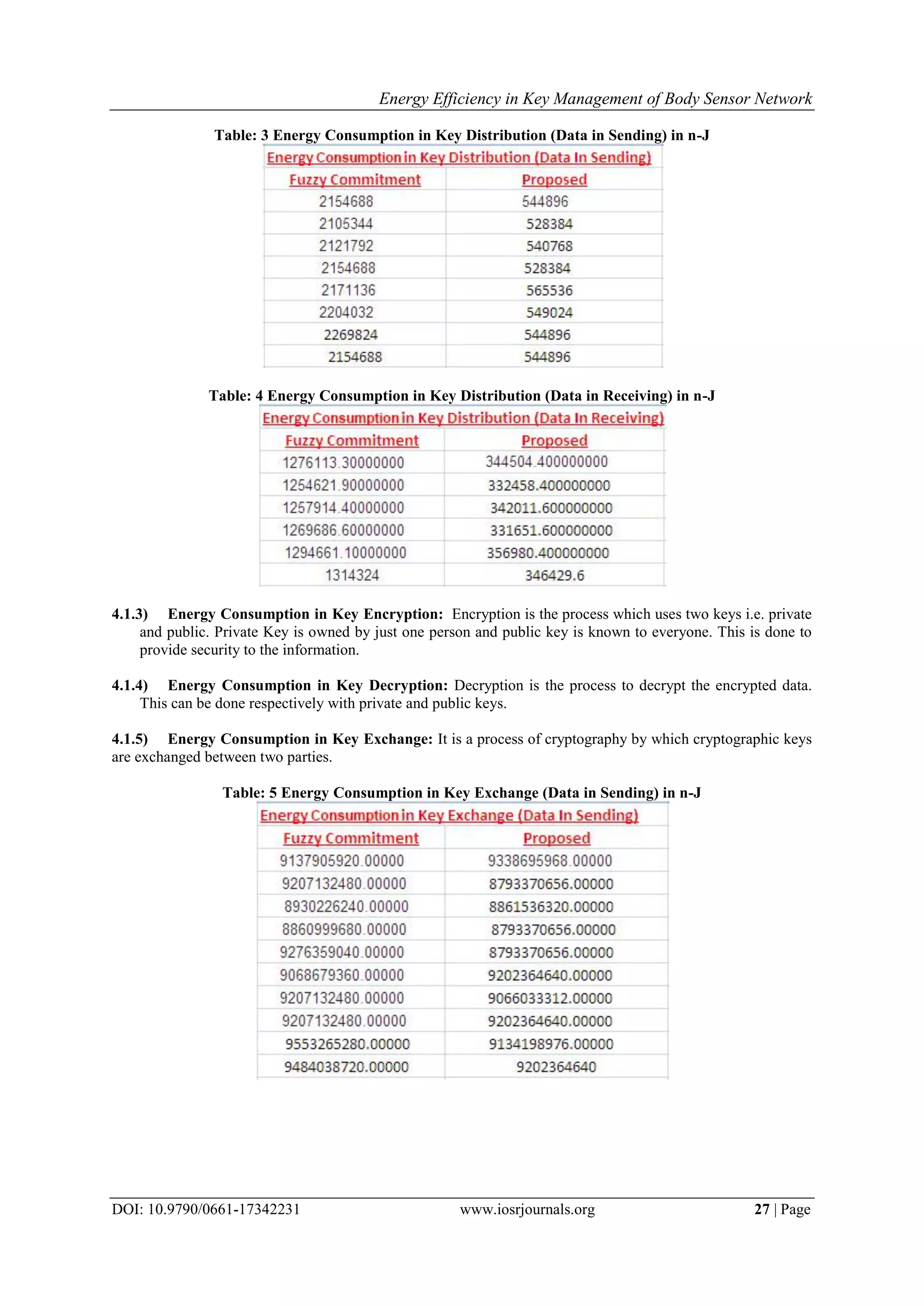
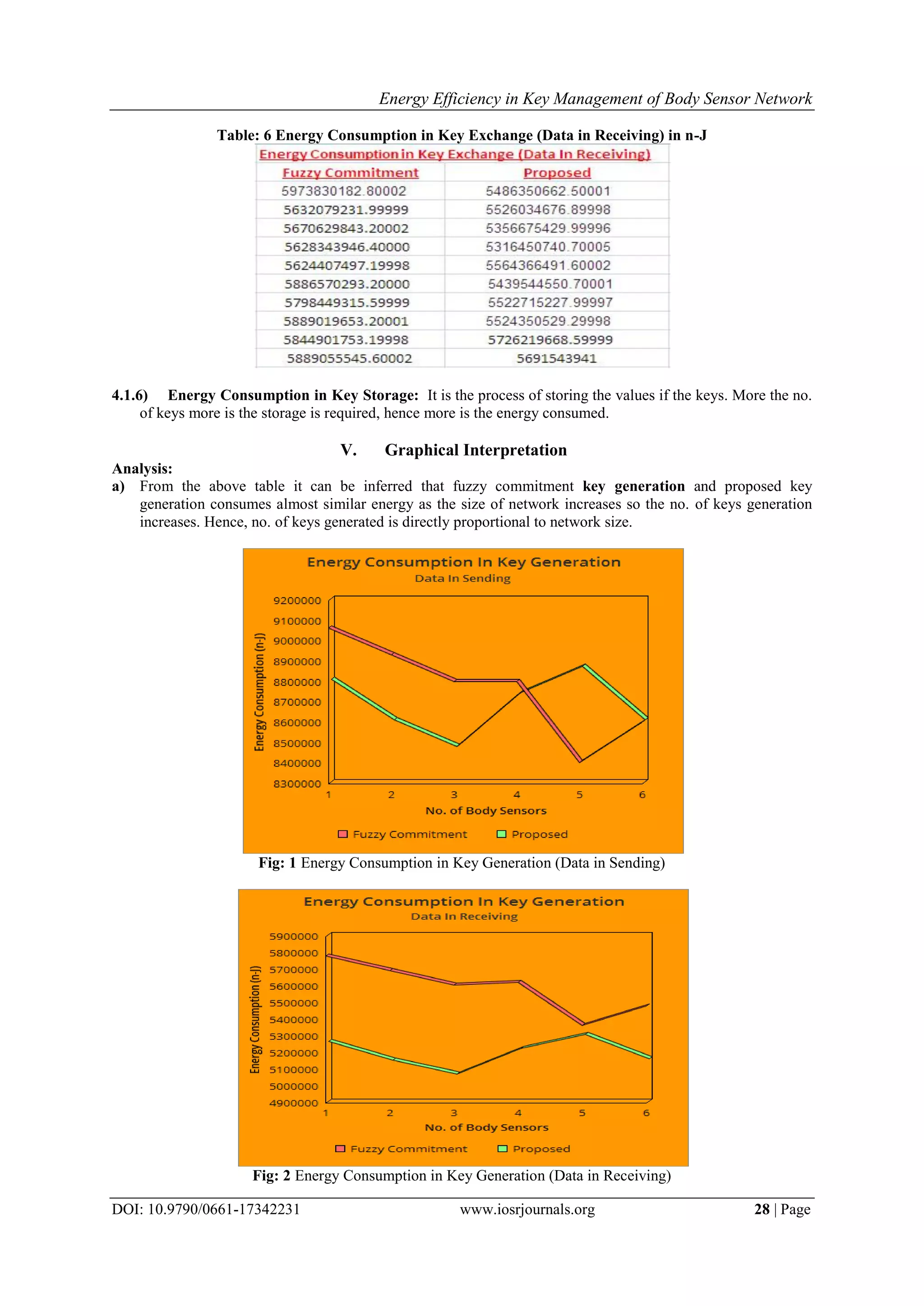
a) From the above table it can be inferred that fuzzy commitment key generation and proposed key
generation consumes almost similar energy as the size of network increases so the no. of keys generation
increases. Hence, no. of keys generated is directly proportional to network size.
Fig: 1 Energy Consumption in Key Generation (Data in Sending)
Fig: 2 Energy Consumption in Key Generation (Data in Receiving)
Energy Efficiency in Key Management of Body Sensor Network
DOI: 10.9790/0661-17342231 www.iosrjournals.org 29 | Page
b) In this comparison, it is observed that fuzzy commitment key distribution scheme consumes less energy as
compared to proposed scheme. This may be because as bandwidth and size of network involved.
Fig: 3 Energy Consumption in Key Distribution (Data in Sending)
Fig: 4 Energy Consumption in Key Distribution (Data in Receiving)
c) Form the comparison table and graphs it can be said that fuzzy commitment key encryption consumes less
energy as compared to proposed system as from graphs it can be depicted that more energy is consumed as
more key refreshes are required.
d) Form the comparison table and graphs it can be said that fuzzy commitment key decryption consumes less
energy as compared to proposed system as from graphs it can be depicted that more energy is consumed as
more key refreshes are required.
e) It is clear from the above table and graph that fuzzy commitment key exchange is consuming less energy as
compared to proposed energy. This may be attributed to multiple factors.
Energy Efficiency in Key Management of Body Sensor Network
DOI: 10.9790/0661-17342231 www.iosrjournals.org 30 | Page
Fig: 5 Energy Consumption in Key Exchange (Data in Sending)
Fig: 6 Energy Consumption in Key Exchange (Data in Receiving)
f) If there is the less time lag and signals reach with their integrity intact, the keys are exchanged less, this
leads to wastage of energy.
VI. Discussions
According to the observations we can say that energy consumption can be reduced by reducing no. of
key exchanges and better synchronization process. Similarly we can also say for the storage as we know that
storage is directly proportional to no. of keys generated. The main issue in BSN is to maintain security as data
incurred in BSN is highly sensitive and could be tampered easily. High the security required, high is the key
generation and more is key exchange and more is energy consumption. Hence it becomes necessary to have
energy efficient algorithms so that system becomes cost effective.
VII. Conclusions
It can be concluded that energy consumption can be reduced by reducing no. of key exchange, as it is
observed that no. of key generated is directly proportional to network size hence energy consumption increases
as no. of key increases. The main challenge arises to design such networks that have low cost and low energy
Energy Efficiency in Key Management of Body Sensor Network
DOI: 10.9790/0661-17342231 www.iosrjournals.org 31 | Page
consumption. The key goal is to reduce the data transmission cost which is achieved by proposed scheme which
can be easily depicted from the graphs and in the results shown.
Future Scope
The Body Sensor Networks runs without human intervention, they need machine-to-machine
authentication protocol to maintain security. Therefore, future work may be preceded in the direction of building
protocols that incorporate ‘zero proof’ algorithms. Also, the above proposed scheme is limited to a bounding
environment within a particular environment. Therefore, the future direction of this research is to devise an
algorithm for the unbounded environment in which patient moves freely and may get in range of other BSN in
the outside environment and then couple it with the synchronization and energy efficient algorithm to form a
complete energy efficient key management scheme.
References
[1]. Khan, Tareq Hasan, and Khan A. Wahid. "An advanced physiological data logger for medical imaging applications." EURASIP
Journal on Embedded Systems 2012, no. 1 (2012): 1-14.
[2]. Chen, Min, Chin-Feng Lai, and Honggang Wang. "Mobile multimedia sensor networks: architecture and routing." EURASIP
Journal on Wireless Communications and Networking 2011, no. 1 (2011): 1-9.
[3]. Quwaider, Muhannad, Mahmoud Taghizadeh, and Subir Biswas. "Modeling on-body dtn packet routing delay in the presence of
postural disconnections." EURASIP journal on wireless communications and networking 2011 (2011): 3.
[4]. Begonya, Otal, Alonso Luis, and Verikoukis Christos. "Design and analysis of an energy-saving distributed mac mechanism for
wireless body sensor networks." EURASIP Journal on Wireless Communications and Networking 2010 (2010).
[5]. Le, T.Q.; Changqing Cheng; Sangasoongsong, A.; Wongdhamma, W.; Bukkapatnam, S.T.S., "Wireless Wearable Multisensory
Suite and Real-Time Prediction of Obstructive Sleep Apnea Episodes," Translational Engineering in Health and Medicine, IEEE
Journal of , vol.1, no., pp.2700109,2700109, 2013
[6]. Rebolledo-Mendez, Genaro, Angelica Reyes, Sebastian Paszkowicz, Mari Carmen Domingo, and Lee Skrypchuk. "Developing a
body sensor network to detect emotions during driving." Intelligent Transportation Systems, IEEE Transactions on 15, no. 4 (2014):
1850-1854.
[7]. Zhao, Cong, and Sen Qiu. "A system of human vital signs monitoring and activity recognition based on body sensor network."
(2014).
[8]. Alrajeh, Nabil Ali, Jaime Lloret, and Alejandro Canovas. "A Framework for Obesity Control Using a Wireless Body Sensor
Network." International Journal of Distributed Sensor Networks 2014 (2014).
[9]. Sala, Marco, Paolo Cunzolo, and Diego Barrettino. "Body sensor network for posturometric studies." In Instrumentation and
Measurement Technology Conference (I2MTC) Proceedings, 2014 IEEE International, pp. 536-541. IEEE, 2014.
[10]. Hung, Kevin, C. C. Lee, and Sheung-On Choy. "Ubiquitous Health Monitoring: Integration of Wearable Sensors, Novel Sensing
Techniques, and Body Sensor Networks." In Mobile Health, pp. 319-342. Springer International Publishing, 2015.
[11]. Kantoch, E., P. Augustyniak, M. Markiewicz, and D. Prusak. "Monitoring activities of daily living based on wearable wireless body
sensor network." In Engineering in Medicine and Biology Society (EMBC), 2014 36th Annual International Conference of the
IEEE, pp. 586-589. IEEE, 2014.
[12]. Sudha, G. Florence, S. Karthik, and N. Selva Kumar. "Activity aware energy efficient priority based multi patient monitoring
adaptive system for body sensor networks." Technology and Health Care 22, no. 2 (2014): 167-177.
[13]. Dangi, Kusum Grewal, and Supriya P. Panda. "Challenges in Wireless Body Area Network-A survey." In Optimization, Reliabilty,
and Information Technology (ICROIT), 2014 International Conference on, pp. 204-207. IEEE, 2014.
[14]. Subudhi, Ch Sandeep Kumar, and S. Sivanandam. "Intelligent Wireless Patient Monitoring and Tracking System (Using Sensor
Network and Wireless Communication)." International Journal 1, no. 3 (2014): 97-104.
[15]. Gharghan, Sadik Kamel, Rosdiadee Nordin, and Mahamod Ismail. "Design Consideration of an Energy Efficient Wireless Sensor
Network for High Performance Track Cycling." In Information Science and Applications (ICISA), 2014 International Conference
on, pp. 1-5. IEEE, 2014.
[16]. Nagarajan, N., and Ahmad Taher Azar. "An Improved Key Management Scheme with High Security in Wireless Sensor Networks."
In Bio-inspiring Cyber Security and Cloud Services: Trends and Innovations, pp. 249-264. Springer Berlin Heidelberg, 2014.
[17]. Movassaghi, Samaneh, Mehran Abolhasan, Justin Lipman, David Smith, and Abbas Jamalipour. "Wireless body area networks: a
survey." (2014): 1-29.
[18]. Mukhopadhyay, S. "Wearable Sensors for Human Activity Monitoring: A Review." (2015).
[19]. Meena, R., S. Ravishankar, and J. Gayathri. "Monitoring Physical Activities Using WBAN." International Journal of Computer
Science & Information Technologies 5, no. 4 (2014).

E017342231

  • 1.
    IOSR Journal ofComputer Engineering (IOSR-JCE) e-ISSN: 2278-0661,p-ISSN: 2278-8727, Volume 17, Issue 3, Ver. IV (May – Jun. 2015), PP 22-31 www.iosrjournals.org DOI: 10.9790/0661-17342231 www.iosrjournals.org 22 | Page Energy Efficiency in Key Management of Body Sensor Network Shilpa Bansal1 , Prof. Dinesh Kumar2 1 (Mtech-CSE Student, GZS-PTU Campus, Bathinda, Punjab, India) 2 (Assistant Professor Department of CSE, GZS-PTU Campus, Bathinda, Punjab, India) Abstract: In this research, we have developed an algorithm that maintains the shape and integrity of the Bio- Signal over Body- Sensor Network. A new approach has been experimented successfully using set theory operators (union, intersection, complement, Cartesian product) instead of using traditional interpolation method for maintenance of original properties of Bio-signal and synchronization. A secure key management scheme is used to enhance the security of wireless body area network (WBAN) and energy analysis is also done. The operational resources of biosensor nodes in BSNs are very restricted, and traditional security technologies are not directly applicable to BSNs. Due to characteristics of biosensors, time synchronization and low-energy communication are two challenging problems for BSNs. Various cryptography techniques are employed in order to provide security as the information exchanged during health monitoring are highly sensitive and require strict protection from unauthorized access. Keywords: Body Sensor Network, Energy Consumption. I. Introduction The data generated from the continuous monitoring [3] from the body sensors consist of sequence of data items thereafter referred to as a data stream. Data stream generally enter the program of monitoring stream from multiple body sensors, each data item is processed for limited time period before it is discarded or analyzed. Many medical devices have added [10] communication capabilities into existing products. In typical scenario, access point would act as a patient-side hub, which relays stored readings form medical devices to remote center for store and forward monitoring, analysis and disease management. The main function is to measure or determine the [15] presence of some physical quantity that may be useful for diagnostic purposes. The choice of proper parameters which have high information content is an important issue in the patient monitoring system. One of the wireless standards known as advanced and adaptive network technology (ANT) [16] has received significant attention especially for sports and health application. The system consist of ECG, signal collection node, blood oxygen signal [7] collection node, inertial sensor node, receiving node and upper computer software. The 3 nodes collect ECG signals, blood O2 signal, motion signals. The collected signals are transmitted wirelessly to receiving node and analyzed by software in computer in real time. The structure of data stream need to be in steady state, in regular and predictable order [19]. The data from body sensors must allow dynamic modification occasionally [17] (key management/exchange) etc. Sometimes, re-initialization, rebooting, time lag occurs due to multiple reasons. High performance is expected, in real time [3] constrain that must be satisfied by specific health application in terms of latency/throughput. In Wireless body area network (WBAN) [8], small electronic devices are attached with human body to monitor specific health related problem such as blood sugar level, organ movement etc. It has high cost of synchronization. The data stream generated by body sensors is basically a Time Series Data Set. A wireless sensor node generally has limited storage and computation capabilities, [4] also severely constrained power supplies. Limited work is reported on identifying anomalies in such kind of time series database, which result in low commitment in synchronization. There a reference based time series analysis is required so that, the shape of bio signals remain intact. There are three possible ways of synchronization: Union, Intersection and Uniform. These methods offer a better alternative to interpolation method as reference or perfect time series is used for shape and synchronization of the bio signals. However, energy consumption need to be observed and taken into consideration for selecting one of the best out of these three methods. Another thing that becomes extremely important is security [18], when wireless sensor network are deployed in a hostile environment. In order to provide security, wireless communication should be authenticated and encrypted. Key management is the main problem in wireless sensor network (WSN) when concentrated on security. The key management scheme proposed should be scalable to increase in sensor nodes substantially and also its dynamic nature. II. Related Work In this section, we have solicited some journals. From basics to advanced knowledge is analyzed in it. 1) In this paper, a data logger was designed to have 4 layers i.e. application, disc operating system, driver, hardware. Each layer completes its functionality by using the resources of its lower layers. By only
  • 2.
    Energy Efficiency inKey Management of Body Sensor Network DOI: 10.9790/0661-17342231 www.iosrjournals.org 23 | Page changing application layer firmware, data logger can be used in several applications, without modifying lower level driver and hardware layer. The mathematical relationship between number of retry and frequency has been shown. From graph it was depicted that value of retries was above 0.3 resulted in highest possible value. 2) This paper investigated a mobile multimedia system through combining various technologies such as wireless sensor network, embedded multimedia system and node mobility. It also investigated the employment of some powerful sensor mode which was equipped with both mobility and multimedia functionalities. Here, multimedia sensor node was exploited to enhance the sensor network capability for event description. The trade offs of end to end delay and energy consumption for supporting multimedia service with delay QoS requirement was discussed. The results showed efficiency of mobile multimedia geographic routing (MGR) in satisfying QoS requirement while saving energy. The delay requirement TQoS was set to 0.035s. GPRS paths had various delays ranging from 0.014s to 0.035s. By comparison, most delays in MGR change from 0.025s to 0.035s. 3) A WBAN can monitor vital signs, providing real time feedback for enabling many patients’ diagnostics procedures via continuous monitoring of chronic conditions or recovery progress from an illness or surgical procedure. This paper developed a delay modeling framework for store-and-forward packet routing in WBANs. Using a prototype WBAN for experimentally characterizing and capturing on body topology traces, an analytical delay modeling technique was developed for evaluating single-copy DTN routing protocol. 4) A wireless sensor mode generally has limited storage and computation capabilities, also restricted power supplies. In this paper, comparing was done between both wired data collection and other application of WSN’s. WSN has been applied to many applications since emerging and data collection was one of the most important applications among them. Each sensing data was collected continuously at each node and forwarded to central base station for further processing. Also, approaches were discussed for message disseminations, which were critical component for network control and management and thus affected performance of data collection of WSN’s. 5) In this paper obstructive sleep apnea (OSA) was discussed which is a common sleep disorder. Continuous positive airway pressure (CPAP) has emerged as a standard therapy for OSA, a majority of patients were not tolerant to this treatment, largely because of uncomfortable nasal air delivery during their sleep. An approach had been developed to provide 1-3 min ahead early warning of an impending sleep apnea episode based on using wearable wireless multisensory suite and a novel non-linear non-stationary process prediction method. Also longest vertical length (LVL) of recurrence plot and normalized power spectral density (NPSD) were most sensitive feature for OSA. 6) This research paper deals with the area of emotional detection using a BSN in car. It used empirical evidence. It had proposed an architecture describing how the BSN could be integrated into vehicular ad-hoc network (VANETs) in order to analyze driver’s emotion. 7) The purpose of this paper was to develop a health monitoring system that could measure human vital signs and recognize human activity based on BSN. The system consisted of ECG signal collection node, blood oxygen signal collection node, inertial sensor node, receiving node and upper computer software. The 3 collection nodes collect ECG signals, blood O2 signal, motion signal. Collected signals are transmitted wirelessly to receiving node and analyzed by software in computer in real time. Result shows that system can simultaneously monitor human ECG, heart rate, pulse rate, SPO2 and recognize human activity. 8) In WBAN, small electronic devices were attached with human to monitor specific health related problem such as blood pressure, blood sugar level and organ movement. This concept was presented to facilitate healthcare issues distantly or to monitor athletes. WBAN consisted of sensors which collected health related data and communicate that data to medical servers so that it could be analyzed and monitor the patient health parameters or to track their fatigue and muscle stress. Mathematical representation of data was depicted in graph. 9) The paper presented design and development of body sensor network for posturometric studies comprising a wireless precision balance and number of other wireless sensing such as accelometers and EMG. The data measured by this BSN was synchronically sent to laptop by Bluetooth 4.0 transreceivers in order to measure and study the postural alternations of human body. 10) Worlds rapidly ageing population and its burden on healthcare system, were one of intense areas of development in mHaelth were continuous patient monitoring. It required careful integration of wearable sensors and wireless body sensor network. A lot many medical devices had added communication capabilities into existing products. In typical scenario, access point would have acted as a patient-side hub, which relayed stored reading from medical devices to a remote center for store and forward monitoring, analysis and disease management.
  • 3.
    Energy Efficiency inKey Management of Body Sensor Network DOI: 10.9790/0661-17342231 www.iosrjournals.org 24 | Page 11) The aim of this research was to implement and test the propagation of health monitoring system. The system consisted of body central unit with Bluetooth module and wearable sensors. The system included custom designed transmission protocol and remote web-based GUI for remote real time data analysis. For a group of humans who performed various activities showed maximum 5% absolute error compared to certified medical devices. The results were promising and indicated that developed wireless wearable monitoring system faced challenges of multi-sensor human health monitoring during performing daily activities and opened new opportunity in developing novel healthcare services. 12) According to survey, cardiovascular diseases were major causes of death world-wide. Due to increase in cardiac diseases, miniaturized and energy efficient remote cardiac monitoring system was required. To develop an activity aware energy efficient priority based multi-patient monitoring protocol for BSN, to monitor physiological signals continuously. The protocol must be adopted to allow new connections and to renegotiate the node services. The protocol was implemented on shimmer nodes and ECG signals of N patients were monitored. The reconfiguration of the nodes priority and sampling rate based on health condition of patient were demonstrated. A comparison of energy consumption, packet delivery ratio and battery lifetime was made. Energy consumption and nodes lifetime were the parameters that needs to be optimized. 13) According to this paper, worldwide population is increasing and area is becoming lesser, it had become a challenge for medical associates to take care of patients by calling in the hospital and personally checking them. With advancements in micro-electro-mechanical sensors (MEMs) technology and wireless communication, this problem has got a solution by implementation of remote health monitoring system. 14) The main function was to measure or determine the presence of some physical quantity that may be useful for diagnostics purposes. The choice of proper parameters which has high information content is an important issue in the patient monitoring system. By use of respective sensors the body temperature, heart rate, ECG and blood pressure of a person by taking the average of reading by fixing maximum and minimum values and the data was transferred to microcontroller. The transmitted digital data after conversation from analog data by ADC, the data stored in EPROM and then data was displaced. 15) WSN for monitoring of track cycling performance will be presented. One of the wireless standards known as advanced and adaptive network technology (ANT) has received significant attention especially for sport and health application. Low power micro-controller will be incorporated into the design, which would be used to acquire the bike parameters for on-site analysis. Energy- efficiency was achieved by decreasing the message rate and broadcast data transmission mode was selected. 16) Security becomes extremely important when wireless sensor network were deployed in a hostile environment. In order to provide security, wireless communication should be authenticated and encrypted. Key management was main problem in WSN when concentrated on security. The key management scheme proposed should be scalable to increase in sensor nodes substantially and also its dynamic nature. Asymmetric key management strategies were not suitable for WSN as it operates on limited battery life. In proposed system, key management was provided for privacy and simultaneously validated for security measures. System performance improved key management scheme by positioning the new mode and forming head for multi-cluster to replace the failed relay nodes. The private key, multi-cluster key, primary key and structure key are used to encrypt every message passed within improved key management scheme. The improved key management scheme acquires 4-5% improved security with lesser execution time and communication energy consumption. 17) World population growth was facing 3 major challenges: demographic peak of baby boomers, increase of life expectancy leading to ageing population and rise in healthcare costs. Millions of people die due to some fatal diseases; this was because many people experience the symptoms and have disease diagnosed to late. So future healthcare system should provide proactive wellness management and concentrate on early detection and prevention of disease. WBANs will allow for continuous monitoring of patients in medical applications capable of early detection of abnormal condition resulting in major improvements in quality of life. 18) An increase in world population along with a significant ageing portion was facing rapid rises in healthcare costs. The healthcare system was going through a transformation in which continuous monitoring of inhabitants was possible even without hospitalization. Wearable sensors detect abnormal or foreseen situations by monitoring physiological parameters along with other symptoms. 19) This research paper was concerned with the design and implementation of WBAN based prototype system for based prototype system for monitoring mobile user’s physical activities and health status via internet. WBAN was becoming a major technological trend for ambulatory and prolonged body monitoring. A durable, low cost, light weight and compact WBAN system for remote monitoring was fully possible.
  • 4.
    Energy Efficiency inKey Management of Body Sensor Network DOI: 10.9790/0661-17342231 www.iosrjournals.org 25 | Page III. Methodology Initialize Network Parameters (Network Topology) Initialize Energy Parameters (EC, ET,ER) kk Initialize Signal Stimuli (Heart Variability Data) Initialize Key Parameters (Private, Public) Process Bio Signals Run Synchronization Algorithm Run Key Exchange Scheme Recollect & Collect Data of Bio Signal Analyze Signal Properties and Energy Cost Evaluate Performance Body Sensor Network
  • 5.
    Energy Efficiency inKey Management of Body Sensor Network DOI: 10.9790/0661-17342231 www.iosrjournals.org 26 | Page In this research we explain the process of conducting this research, The first step in this is to build a body sensor network (BSN). BSN is also referred to as body area network (BAN). BAN devices, may be embedded inside the body, implants may be surface mounted on a body in a fixed position wearable technology or may be accompanied devices which humans can carry in different positions, in clothes pocket, by hand or in the bag. The second step is to initialize various network parameters like no. of sensors, minimum battery life required, topologies used, routing protocol etc. The third step leads to initializing various energy parameters like ER, EC, ET etc i.e. receiving energy, consumption energy, and transmission energy respectively. It can be shown as a formula as E= ER+EC+ET . In the fourth step physio.net based dataset of bio-signal are loaded and initialize signal stimuli. The fifth step includes key parameters like minimum size of keys, hash keys etc are initialized. The sixth step involves processing of bio-signals to check time- lag and magnitude of sensors. The seventh step runs some synchronization algorithms. This is basically done to reduce time-lag. The eighth step exchanges the various keys in order to communicate over the network. In the ninth and tenth step respectively data is collected and graphs are plotted to analyze signal properties and energy cost. In the last step, performance is evaluated. IV. Results In this section we shall explain the evaluation process done on the implementation steps conducted as experiments. This section also covers graphical presentation of the data analyzed related to energy and effectiveness of the proposed algorithm as compared to previous algorithm. 4.1) Energy Consumption Parameters: 4.1.1) Energy Consumption in Key Generation: Key generation is the process of generating keys for cryptography. More the keys generated more will be the energy consumed. Table: 1 Energy Consumption in Key Generation (Data in Sending) in n-J Table: 2 Energy Consumption in Key Generation (Data in Receiving) in n-J 4.1.2) Energy Consumption in Key Distribution: Key distribution is the process of distributing the keys. In this process both parties must possess secret keys which they must exchange prior to using any encryption.
  • 6.
    Energy Efficiency inKey Management of Body Sensor Network DOI: 10.9790/0661-17342231 www.iosrjournals.org 27 | Page Table: 3 Energy Consumption in Key Distribution (Data in Sending) in n-J Table: 4 Energy Consumption in Key Distribution (Data in Receiving) in n-J 4.1.3) Energy Consumption in Key Encryption: Encryption is the process which uses two keys i.e. private and public. Private Key is owned by just one person and public key is known to everyone. This is done to provide security to the information. 4.1.4) Energy Consumption in Key Decryption: Decryption is the process to decrypt the encrypted data. This can be done respectively with private and public keys. 4.1.5) Energy Consumption in Key Exchange: It is a process of cryptography by which cryptographic keys are exchanged between two parties. Table: 5 Energy Consumption in Key Exchange (Data in Sending) in n-J
  • 7.
    Energy Efficiency inKey Management of Body Sensor Network DOI: 10.9790/0661-17342231 www.iosrjournals.org 28 | Page Table: 6 Energy Consumption in Key Exchange (Data in Receiving) in n-J 4.1.6) Energy Consumption in Key Storage: It is the process of storing the values if the keys. More the no. of keys more is the storage is required, hence more is the energy consumed. V. Graphical Interpretation Analysis: a) From the above table it can be inferred that fuzzy commitment key generation and proposed key generation consumes almost similar energy as the size of network increases so the no. of keys generation increases. Hence, no. of keys generated is directly proportional to network size. Fig: 1 Energy Consumption in Key Generation (Data in Sending) Fig: 2 Energy Consumption in Key Generation (Data in Receiving)
  • 8.
    Energy Efficiency inKey Management of Body Sensor Network DOI: 10.9790/0661-17342231 www.iosrjournals.org 29 | Page b) In this comparison, it is observed that fuzzy commitment key distribution scheme consumes less energy as compared to proposed scheme. This may be because as bandwidth and size of network involved. Fig: 3 Energy Consumption in Key Distribution (Data in Sending) Fig: 4 Energy Consumption in Key Distribution (Data in Receiving) c) Form the comparison table and graphs it can be said that fuzzy commitment key encryption consumes less energy as compared to proposed system as from graphs it can be depicted that more energy is consumed as more key refreshes are required. d) Form the comparison table and graphs it can be said that fuzzy commitment key decryption consumes less energy as compared to proposed system as from graphs it can be depicted that more energy is consumed as more key refreshes are required. e) It is clear from the above table and graph that fuzzy commitment key exchange is consuming less energy as compared to proposed energy. This may be attributed to multiple factors.
  • 9.
    Energy Efficiency inKey Management of Body Sensor Network DOI: 10.9790/0661-17342231 www.iosrjournals.org 30 | Page Fig: 5 Energy Consumption in Key Exchange (Data in Sending) Fig: 6 Energy Consumption in Key Exchange (Data in Receiving) f) If there is the less time lag and signals reach with their integrity intact, the keys are exchanged less, this leads to wastage of energy. VI. Discussions According to the observations we can say that energy consumption can be reduced by reducing no. of key exchanges and better synchronization process. Similarly we can also say for the storage as we know that storage is directly proportional to no. of keys generated. The main issue in BSN is to maintain security as data incurred in BSN is highly sensitive and could be tampered easily. High the security required, high is the key generation and more is key exchange and more is energy consumption. Hence it becomes necessary to have energy efficient algorithms so that system becomes cost effective. VII. Conclusions It can be concluded that energy consumption can be reduced by reducing no. of key exchange, as it is observed that no. of key generated is directly proportional to network size hence energy consumption increases as no. of key increases. The main challenge arises to design such networks that have low cost and low energy
  • 10.
    Energy Efficiency inKey Management of Body Sensor Network DOI: 10.9790/0661-17342231 www.iosrjournals.org 31 | Page consumption. The key goal is to reduce the data transmission cost which is achieved by proposed scheme which can be easily depicted from the graphs and in the results shown. Future Scope The Body Sensor Networks runs without human intervention, they need machine-to-machine authentication protocol to maintain security. Therefore, future work may be preceded in the direction of building protocols that incorporate ‘zero proof’ algorithms. Also, the above proposed scheme is limited to a bounding environment within a particular environment. Therefore, the future direction of this research is to devise an algorithm for the unbounded environment in which patient moves freely and may get in range of other BSN in the outside environment and then couple it with the synchronization and energy efficient algorithm to form a complete energy efficient key management scheme. References [1]. Khan, Tareq Hasan, and Khan A. Wahid. "An advanced physiological data logger for medical imaging applications." EURASIP Journal on Embedded Systems 2012, no. 1 (2012): 1-14. [2]. Chen, Min, Chin-Feng Lai, and Honggang Wang. "Mobile multimedia sensor networks: architecture and routing." EURASIP Journal on Wireless Communications and Networking 2011, no. 1 (2011): 1-9. [3]. Quwaider, Muhannad, Mahmoud Taghizadeh, and Subir Biswas. "Modeling on-body dtn packet routing delay in the presence of postural disconnections." EURASIP journal on wireless communications and networking 2011 (2011): 3. [4]. Begonya, Otal, Alonso Luis, and Verikoukis Christos. "Design and analysis of an energy-saving distributed mac mechanism for wireless body sensor networks." EURASIP Journal on Wireless Communications and Networking 2010 (2010). [5]. Le, T.Q.; Changqing Cheng; Sangasoongsong, A.; Wongdhamma, W.; Bukkapatnam, S.T.S., "Wireless Wearable Multisensory Suite and Real-Time Prediction of Obstructive Sleep Apnea Episodes," Translational Engineering in Health and Medicine, IEEE Journal of , vol.1, no., pp.2700109,2700109, 2013 [6]. Rebolledo-Mendez, Genaro, Angelica Reyes, Sebastian Paszkowicz, Mari Carmen Domingo, and Lee Skrypchuk. "Developing a body sensor network to detect emotions during driving." Intelligent Transportation Systems, IEEE Transactions on 15, no. 4 (2014): 1850-1854. [7]. Zhao, Cong, and Sen Qiu. "A system of human vital signs monitoring and activity recognition based on body sensor network." (2014). [8]. Alrajeh, Nabil Ali, Jaime Lloret, and Alejandro Canovas. "A Framework for Obesity Control Using a Wireless Body Sensor Network." International Journal of Distributed Sensor Networks 2014 (2014). [9]. Sala, Marco, Paolo Cunzolo, and Diego Barrettino. "Body sensor network for posturometric studies." In Instrumentation and Measurement Technology Conference (I2MTC) Proceedings, 2014 IEEE International, pp. 536-541. IEEE, 2014. [10]. Hung, Kevin, C. C. Lee, and Sheung-On Choy. "Ubiquitous Health Monitoring: Integration of Wearable Sensors, Novel Sensing Techniques, and Body Sensor Networks." In Mobile Health, pp. 319-342. Springer International Publishing, 2015. [11]. Kantoch, E., P. Augustyniak, M. Markiewicz, and D. Prusak. "Monitoring activities of daily living based on wearable wireless body sensor network." In Engineering in Medicine and Biology Society (EMBC), 2014 36th Annual International Conference of the IEEE, pp. 586-589. IEEE, 2014. [12]. Sudha, G. Florence, S. Karthik, and N. Selva Kumar. "Activity aware energy efficient priority based multi patient monitoring adaptive system for body sensor networks." Technology and Health Care 22, no. 2 (2014): 167-177. [13]. Dangi, Kusum Grewal, and Supriya P. Panda. "Challenges in Wireless Body Area Network-A survey." In Optimization, Reliabilty, and Information Technology (ICROIT), 2014 International Conference on, pp. 204-207. IEEE, 2014. [14]. Subudhi, Ch Sandeep Kumar, and S. Sivanandam. "Intelligent Wireless Patient Monitoring and Tracking System (Using Sensor Network and Wireless Communication)." International Journal 1, no. 3 (2014): 97-104. [15]. Gharghan, Sadik Kamel, Rosdiadee Nordin, and Mahamod Ismail. "Design Consideration of an Energy Efficient Wireless Sensor Network for High Performance Track Cycling." In Information Science and Applications (ICISA), 2014 International Conference on, pp. 1-5. IEEE, 2014. [16]. Nagarajan, N., and Ahmad Taher Azar. "An Improved Key Management Scheme with High Security in Wireless Sensor Networks." In Bio-inspiring Cyber Security and Cloud Services: Trends and Innovations, pp. 249-264. Springer Berlin Heidelberg, 2014. [17]. Movassaghi, Samaneh, Mehran Abolhasan, Justin Lipman, David Smith, and Abbas Jamalipour. "Wireless body area networks: a survey." (2014): 1-29. [18]. Mukhopadhyay, S. "Wearable Sensors for Human Activity Monitoring: A Review." (2015). [19]. Meena, R., S. Ravishankar, and J. Gayathri. "Monitoring Physical Activities Using WBAN." International Journal of Computer Science & Information Technologies 5, no. 4 (2014).