ELiCiT: Exploring lifestyle changes in transition
Kate Burningham, Sue Venn, Birgitta Gatersleben,
Ian Christie and Tim Jackson
Overview
 Project aims & methodology
Experiencing transitions
Understandings of sustainable lifestyles
Reported lifestyle and behaviour change
Conclusions
Overview of Project
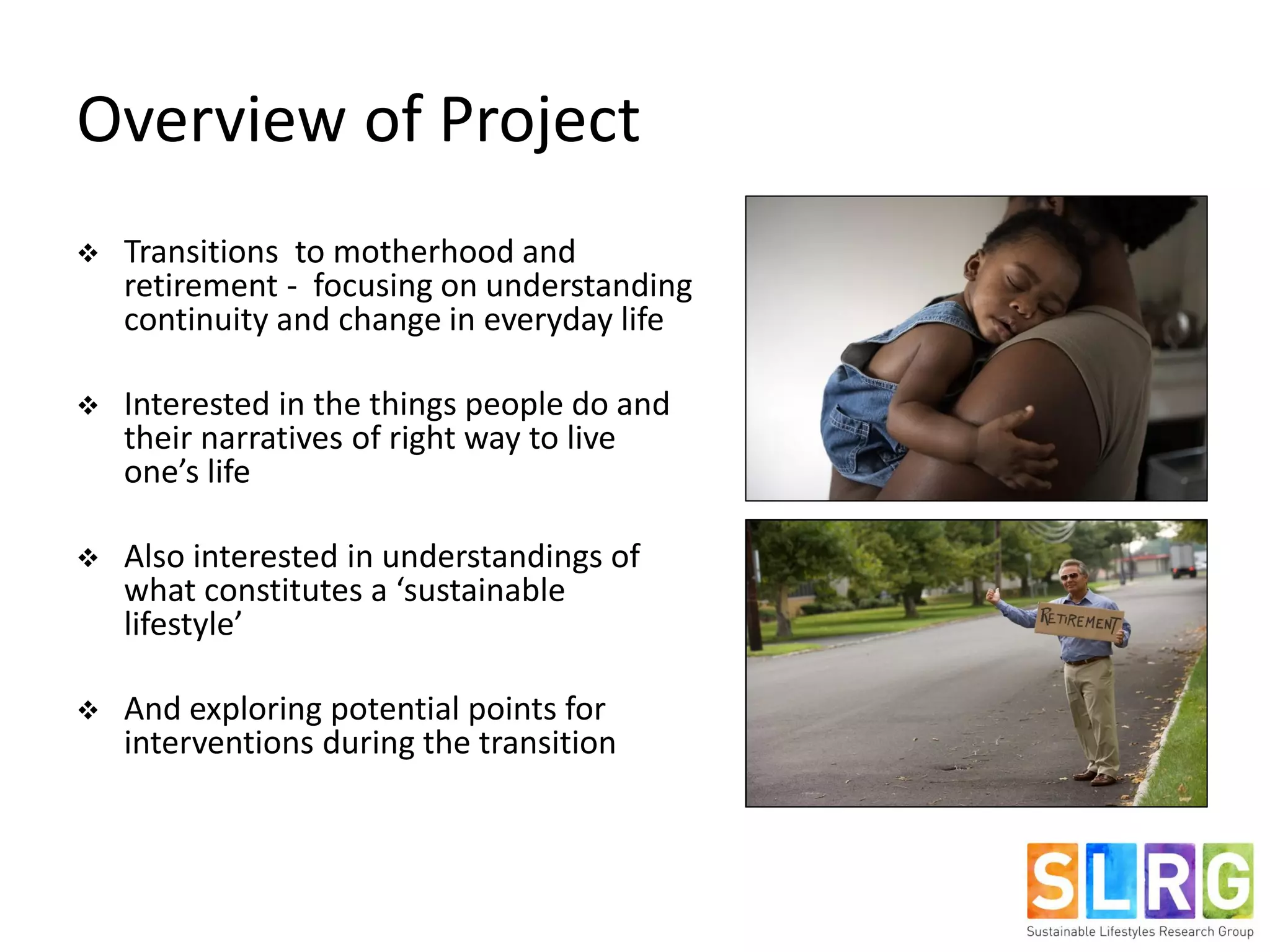
 Transitions to motherhood and
retirement - focusing on understanding
continuity and change in everyday life
 Interested in the things people do and
their narratives of right way to live
one’s life
 Also interested in understandings of
what constitutes a ‘sustainable
lifestyle’
 And exploring potential points for
interventions during the transition
Methodology
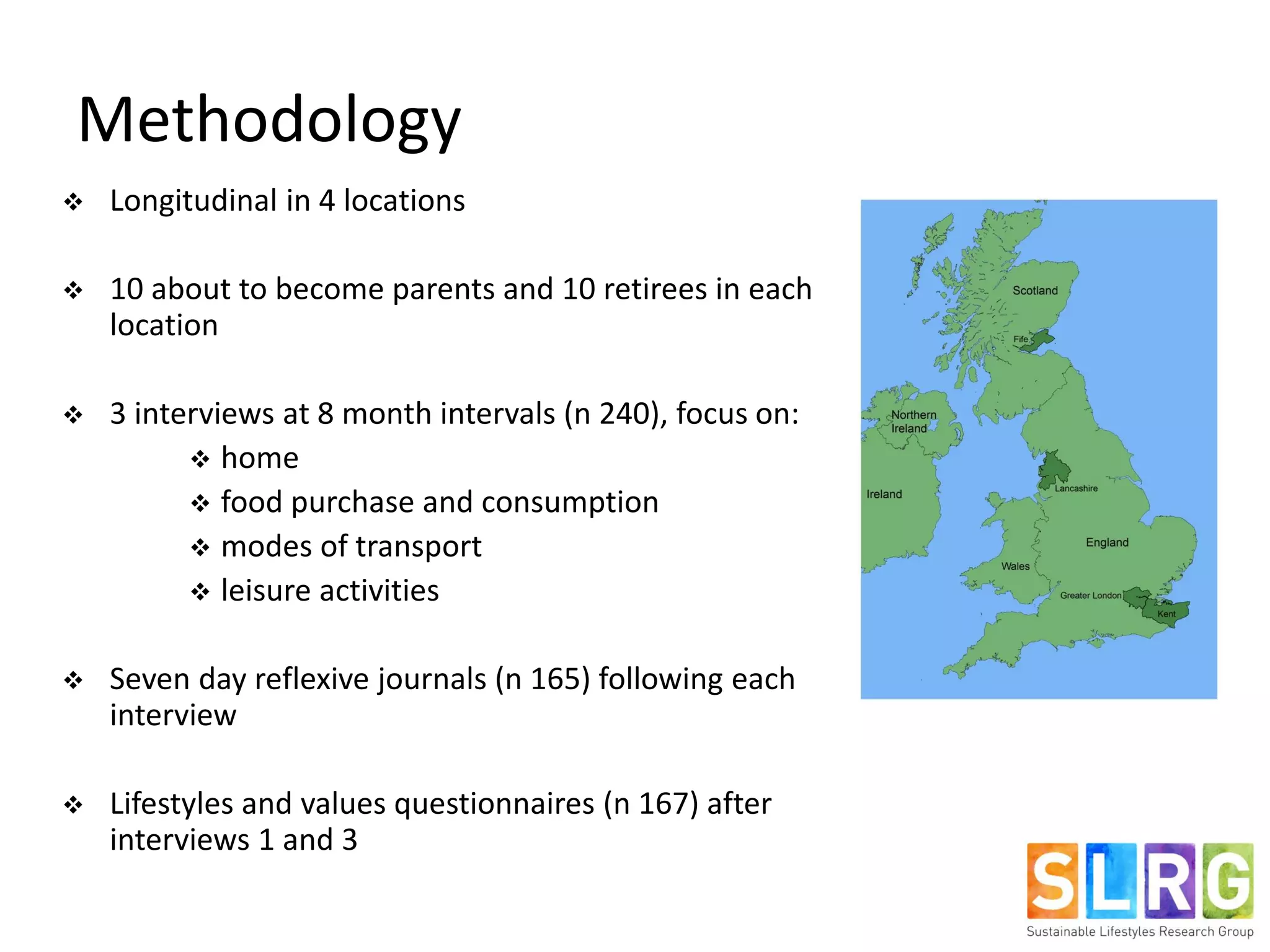
 Longitudinal in 4 locations
 10 about to become parents and 10 retirees in each
location
 3 interviews at 8 month intervals (n 240), focus on:
 home
 food purchase and consumption
 modes of transport
 leisure activities
 Seven day reflexive journals (n 165) following each
interview
 Lifestyles and values questionnaires (n 167) after
interviews 1 and 3
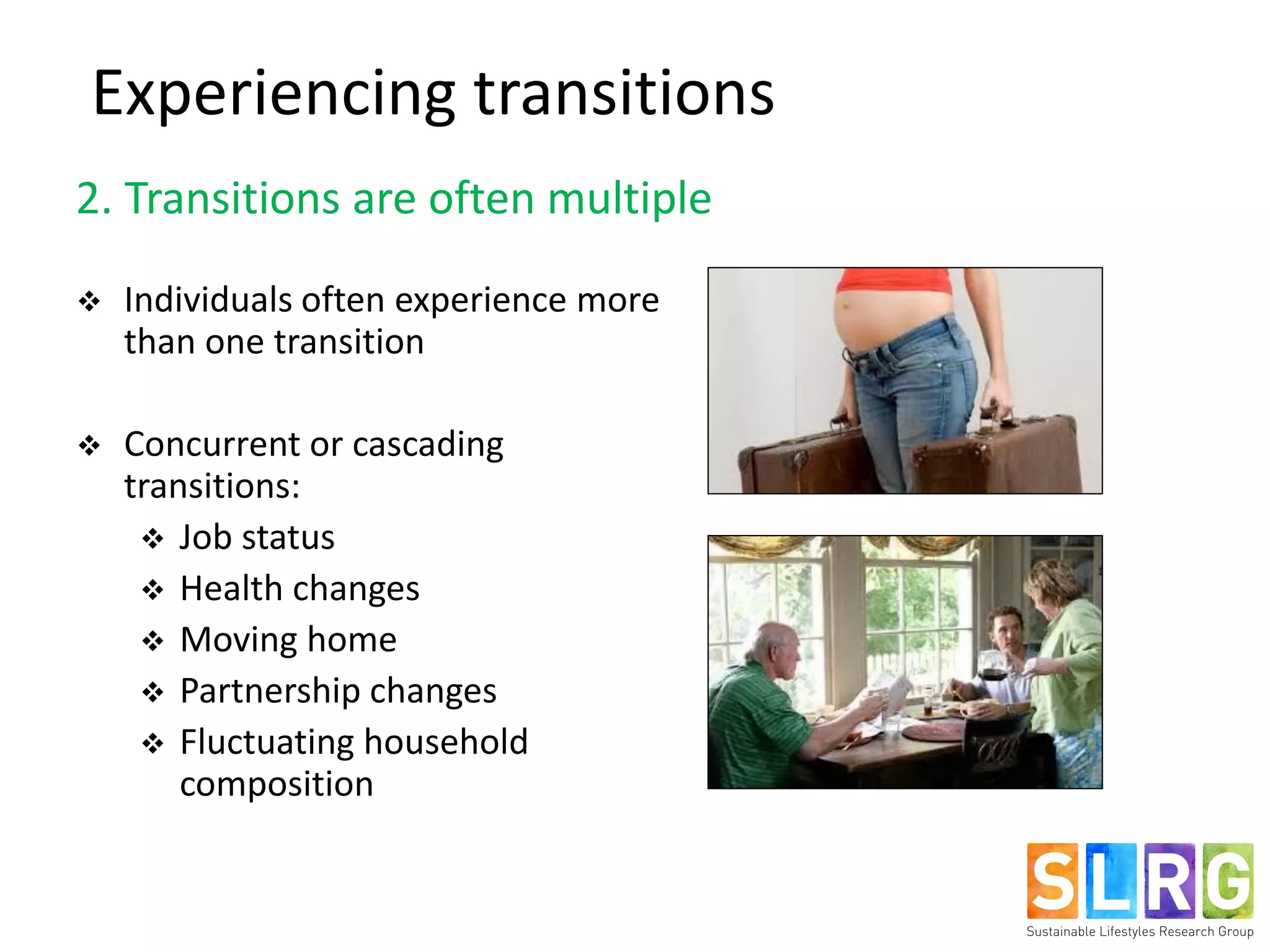
 Becoming a parent and retiring both long
processes with multiple phases - multiple
‘moments’ of change
 Characterised by shifts and readjustments in
detail of everyday life
 Changes often transitory:
“There were changes. I don’t think the changes have been permanent, I
think we’ve reverted back” (New parent)
Experiencing transitions
1. Transitions are processes not ‘moments’ of change
2. Transitions are often multiple
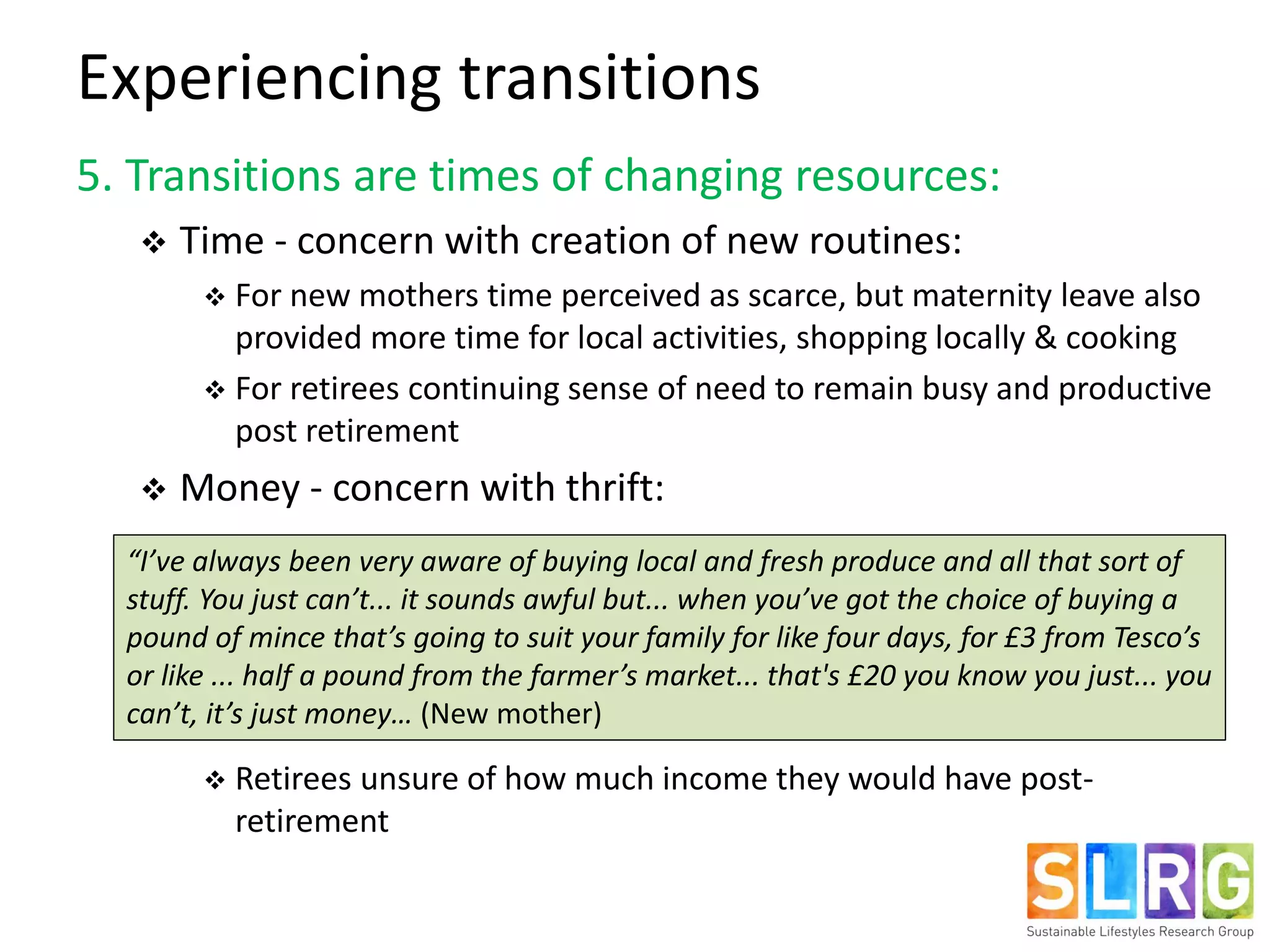
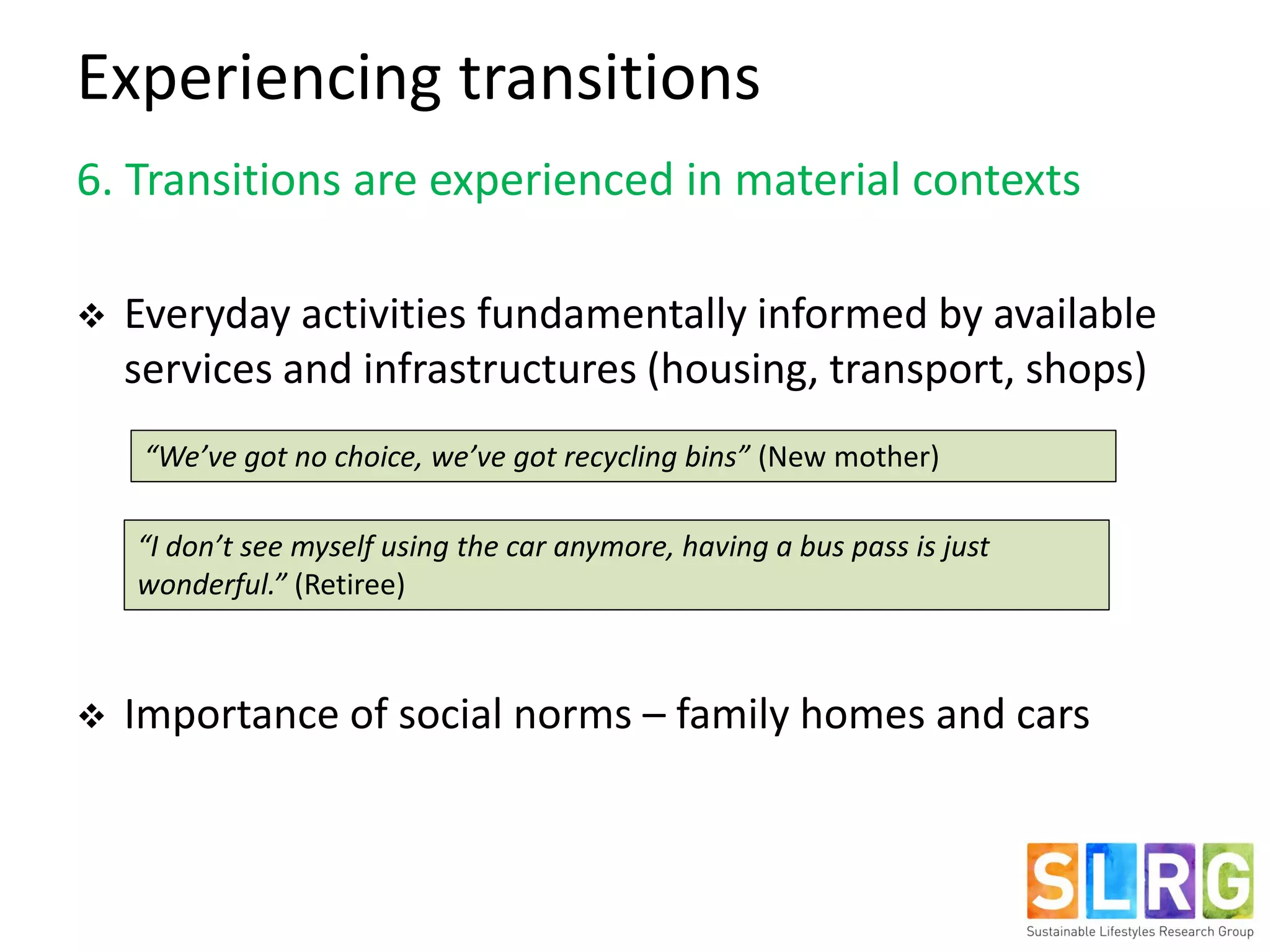
 Individuals often experience more
than one transition
 Concurrent or cascading
transitions:
 Job status
 Health changes
 Moving home
 Partnership changes
 Fluctuating household
composition
Experiencing transitions
3. Transitions are experienced by households
 ‘Individual’ transitions affect other family members
 Household negotiation of changes in everyday consumption
 Change or stability in individual consumption practices often
reflect others’ preferences or needs
So how often does your husband eat meat?
R: “Probably only a couple of times a week actually. We were talking about
it to someone and he was saying before he used to eat meat every day and …
he does eat it a lot less” (New mother)
Experiencing transitions
“I’ll put a jumper on whereas [wife] will turn the central heating on… if she is
cold I will let her put the heating on” (Retiree)
4. Transitions are a time of reflection on identity and
priorities
 Becoming a ‘good’ parent overrides everything else
 Contested identities for retirees – ‘it’s time for me’ versus
caring for grandchildren or other relatives
 Importance of family relationships
Experiencing transitions
“Every waking thought is her really and now we’re a family it’s changed all
sorts of things.” (New mother)
“I feel that I’ve done my bit and, …yeah, before it [work] kills me or you
know before I'm too old to do anything else. Yeah, no I actually feel now I
deserve it [retirement]” (Retiree)
Experiencing transitions
5. Transitions are times of changing resources:
 Time - concern with creation of new routines:
 For new mothers time perceived as scarce, but maternity leave also
provided more time for local activities, shopping locally & cooking
 For retirees continuing sense of need to remain busy and productive
post retirement
 Money - concern with thrift:
 Retirees unsure of how much income they would have post-
retirement
“I’ve always been very aware of buying local and fresh produce and all that sort of
stuff. You just can’t... it sounds awful but... when you’ve got the choice of buying a
pound of mince that’s going to suit your family for like four days, for £3 from Tesco’s
or like ... half a pound from the farmer’s market... that's £20 you know you just... you
can’t, it’s just money… (New mother)
Experiencing transitions
6. Transitions are experienced in material contexts
 Everyday activities fundamentally informed by available
services and infrastructures (housing, transport, shops)
 Importance of social norms – family homes and cars
“We’ve got no choice, we’ve got recycling bins” (New mother)
“I don’t see myself using the car anymore, having a bus pass is just
wonderful.” (Retiree)
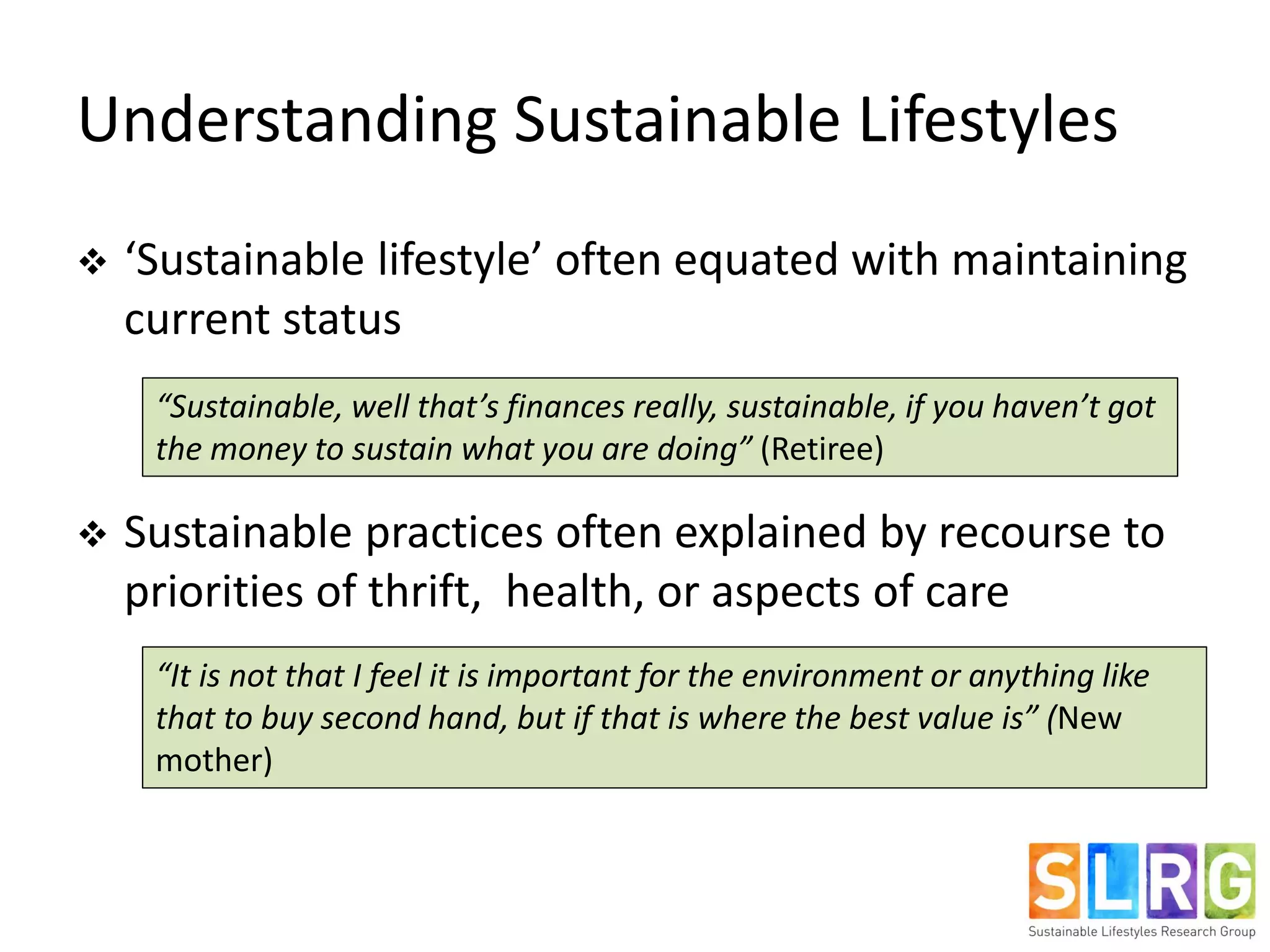
Understanding Sustainable Lifestyles
 ‘Sustainable lifestyle’ often equated with maintaining
current status
 Sustainable practices often explained by recourse to
priorities of thrift, health, or aspects of care
“Sustainable, well that’s finances really, sustainable, if you haven’t got
the money to sustain what you are doing” (Retiree)
“It is not that I feel it is important for the environment or anything like
that to buy second hand, but if that is where the best value is” (New
mother)
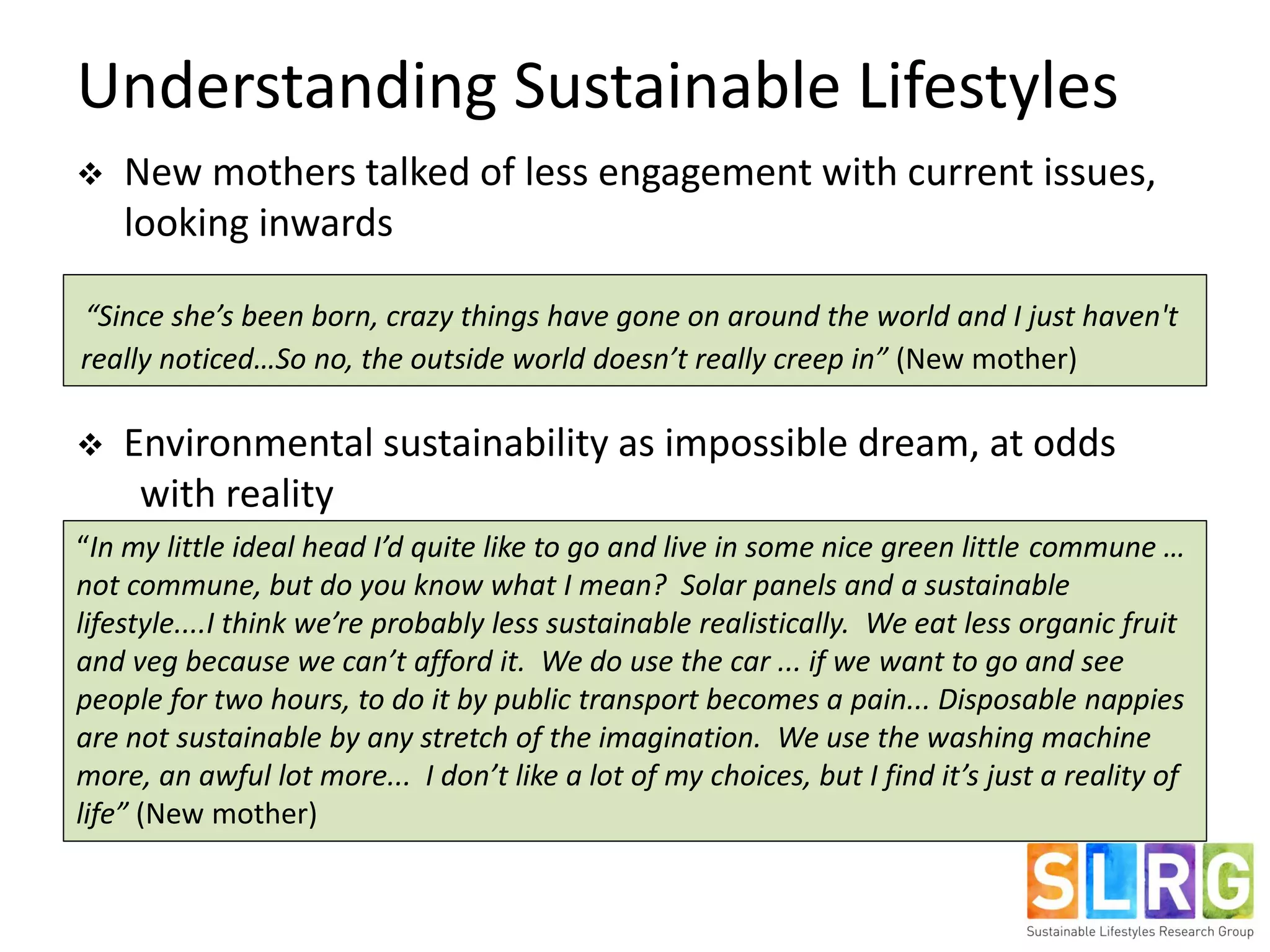
Understanding Sustainable Lifestyles
 New mothers talked of less engagement with current issues,
looking inwards
 Environmental sustainability as impossible dream, at odds
with reality
“Since she’s been born, crazy things have gone on around the world and I just haven't
really noticed…So no, the outside world doesn’t really creep in” (New mother)
“In my little ideal head I’d quite like to go and live in some nice green little commune …
not commune, but do you know what I mean? Solar panels and a sustainable
lifestyle....I think we’re probably less sustainable realistically. We eat less organic fruit
and veg because we can’t afford it. We do use the car ... if we want to go and see
people for two hours, to do it by public transport becomes a pain... Disposable nappies
are not sustainable by any stretch of the imagination. We use the washing machine
more, an awful lot more... I don’t like a lot of my choices, but I find it’s just a reality of
life” (New mother)
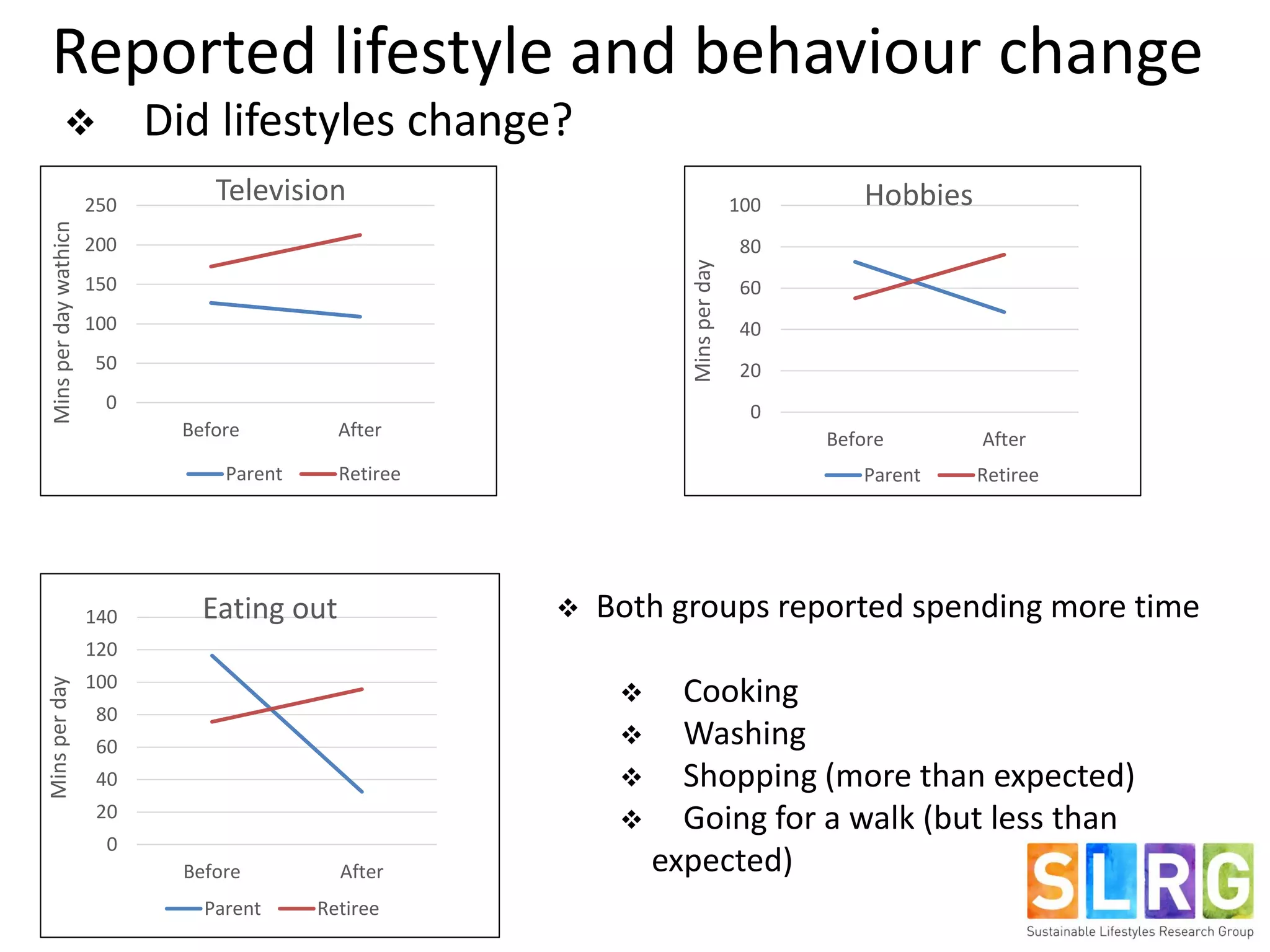
Reported lifestyle and behaviour change
0
50
100
150
200
250
Before After
Minsperdaywathicn
Television
Parent Retiree
0
20
40
60
80
100
Before After
Minsperday
Hobbies
Parent Retiree
0
20
40
60
80
100
120
140
Before After
Minsperday
Eating out
Parent Retiree
 Both groups reported spending more time
 Cooking
 Washing
 Shopping (more than expected)
 Going for a walk (but less than
expected)
 Did lifestyles change?
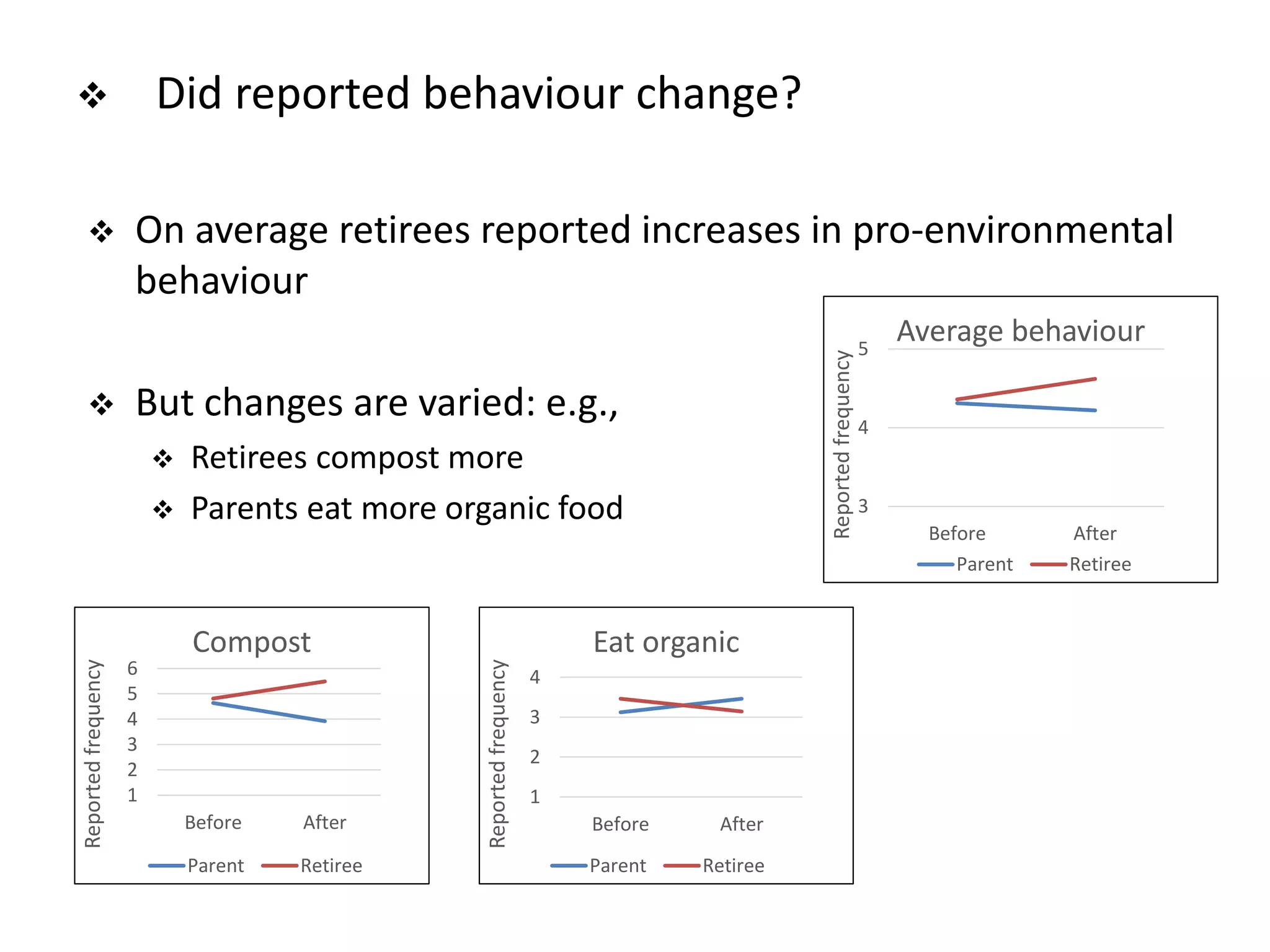
 Did reported behaviour change?
 On average retirees reported increases in pro-environmental
behaviour
 But changes are varied: e.g.,
 Retirees compost more
 Parents eat more organic food 3
4
5
Before After
Reportedfrequency
Average behaviour
Parent Retiree
1
2
3
4
5
6
Before After
Reportedfrequency
Compost
Parent Retiree
1
2
3
4
Before After
Reportedfrequency
Eat organic
Parent Retiree
Awareness of environmental impact
 When asked:
 45% said they had made changes in their life that benefited
the environment (37% of parents and 51% of retirees)
 Less washing, more recycling, more walking, more organic food
 Triggers were convenience, economical or health reasons - only one
person mentioned environmental reasons
 27% said they had changed something that could harm the
environment (52% of parents and 8% of retirees)
 more heating, bathing and washing, more fuel use, more food waste
and of course nappies.
 The triggers for parents were ‘having a baby’
Conclusions
 All transitions are not the same
 Transitions are:
1. Processes of ongoing change
2. Often experienced in multiple
3. Experienced by households
4. Time of reflection on identity and of new priorities
5. Times of changing resources of time & money
6. Lived in material contexts and shaped by social norms
 Transitions may be bad times for interventions specifically about
sustainable living
 Initiatives need to work with the grain of existing priorities
Contact: Kate Burningham
k.burningham@surrey.ac.uk
http://www.sustainablelifestyles.ac.uk/
+44 (0)1483 686689

ELiCiT: Exploring lifestyle changes in transition

  • 1.
    ELiCiT: Exploring lifestylechanges in transition Kate Burningham, Sue Venn, Birgitta Gatersleben, Ian Christie and Tim Jackson
  • 2.
    Overview  Project aims& methodology Experiencing transitions Understandings of sustainable lifestyles Reported lifestyle and behaviour change Conclusions
  • 3.
    Overview of Project Transitions to motherhood and retirement - focusing on understanding continuity and change in everyday life  Interested in the things people do and their narratives of right way to live one’s life  Also interested in understandings of what constitutes a ‘sustainable lifestyle’  And exploring potential points for interventions during the transition
  • 4.
    Methodology  Longitudinal in4 locations  10 about to become parents and 10 retirees in each location  3 interviews at 8 month intervals (n 240), focus on:  home  food purchase and consumption  modes of transport  leisure activities  Seven day reflexive journals (n 165) following each interview  Lifestyles and values questionnaires (n 167) after interviews 1 and 3
  • 5.
     Becoming aparent and retiring both long processes with multiple phases - multiple ‘moments’ of change  Characterised by shifts and readjustments in detail of everyday life  Changes often transitory: “There were changes. I don’t think the changes have been permanent, I think we’ve reverted back” (New parent) Experiencing transitions 1. Transitions are processes not ‘moments’ of change
  • 6.
    2. Transitions areoften multiple  Individuals often experience more than one transition  Concurrent or cascading transitions:  Job status  Health changes  Moving home  Partnership changes  Fluctuating household composition Experiencing transitions
  • 7.
    3. Transitions areexperienced by households  ‘Individual’ transitions affect other family members  Household negotiation of changes in everyday consumption  Change or stability in individual consumption practices often reflect others’ preferences or needs So how often does your husband eat meat? R: “Probably only a couple of times a week actually. We were talking about it to someone and he was saying before he used to eat meat every day and … he does eat it a lot less” (New mother) Experiencing transitions “I’ll put a jumper on whereas [wife] will turn the central heating on… if she is cold I will let her put the heating on” (Retiree)
  • 8.
    4. Transitions area time of reflection on identity and priorities  Becoming a ‘good’ parent overrides everything else  Contested identities for retirees – ‘it’s time for me’ versus caring for grandchildren or other relatives  Importance of family relationships Experiencing transitions “Every waking thought is her really and now we’re a family it’s changed all sorts of things.” (New mother) “I feel that I’ve done my bit and, …yeah, before it [work] kills me or you know before I'm too old to do anything else. Yeah, no I actually feel now I deserve it [retirement]” (Retiree)
  • 9.
    Experiencing transitions 5. Transitionsare times of changing resources:  Time - concern with creation of new routines:  For new mothers time perceived as scarce, but maternity leave also provided more time for local activities, shopping locally & cooking  For retirees continuing sense of need to remain busy and productive post retirement  Money - concern with thrift:  Retirees unsure of how much income they would have post- retirement “I’ve always been very aware of buying local and fresh produce and all that sort of stuff. You just can’t... it sounds awful but... when you’ve got the choice of buying a pound of mince that’s going to suit your family for like four days, for £3 from Tesco’s or like ... half a pound from the farmer’s market... that's £20 you know you just... you can’t, it’s just money… (New mother)
  • 10.
    Experiencing transitions 6. Transitionsare experienced in material contexts  Everyday activities fundamentally informed by available services and infrastructures (housing, transport, shops)  Importance of social norms – family homes and cars “We’ve got no choice, we’ve got recycling bins” (New mother) “I don’t see myself using the car anymore, having a bus pass is just wonderful.” (Retiree)
  • 11.
    Understanding Sustainable Lifestyles ‘Sustainable lifestyle’ often equated with maintaining current status  Sustainable practices often explained by recourse to priorities of thrift, health, or aspects of care “Sustainable, well that’s finances really, sustainable, if you haven’t got the money to sustain what you are doing” (Retiree) “It is not that I feel it is important for the environment or anything like that to buy second hand, but if that is where the best value is” (New mother)
  • 12.
    Understanding Sustainable Lifestyles New mothers talked of less engagement with current issues, looking inwards  Environmental sustainability as impossible dream, at odds with reality “Since she’s been born, crazy things have gone on around the world and I just haven't really noticed…So no, the outside world doesn’t really creep in” (New mother) “In my little ideal head I’d quite like to go and live in some nice green little commune … not commune, but do you know what I mean? Solar panels and a sustainable lifestyle....I think we’re probably less sustainable realistically. We eat less organic fruit and veg because we can’t afford it. We do use the car ... if we want to go and see people for two hours, to do it by public transport becomes a pain... Disposable nappies are not sustainable by any stretch of the imagination. We use the washing machine more, an awful lot more... I don’t like a lot of my choices, but I find it’s just a reality of life” (New mother)
  • 13.
    Reported lifestyle andbehaviour change 0 50 100 150 200 250 Before After Minsperdaywathicn Television Parent Retiree 0 20 40 60 80 100 Before After Minsperday Hobbies Parent Retiree 0 20 40 60 80 100 120 140 Before After Minsperday Eating out Parent Retiree  Both groups reported spending more time  Cooking  Washing  Shopping (more than expected)  Going for a walk (but less than expected)  Did lifestyles change?
  • 14.
     Did reportedbehaviour change?  On average retirees reported increases in pro-environmental behaviour  But changes are varied: e.g.,  Retirees compost more  Parents eat more organic food 3 4 5 Before After Reportedfrequency Average behaviour Parent Retiree 1 2 3 4 5 6 Before After Reportedfrequency Compost Parent Retiree 1 2 3 4 Before After Reportedfrequency Eat organic Parent Retiree
  • 15.
    Awareness of environmentalimpact  When asked:  45% said they had made changes in their life that benefited the environment (37% of parents and 51% of retirees)  Less washing, more recycling, more walking, more organic food  Triggers were convenience, economical or health reasons - only one person mentioned environmental reasons  27% said they had changed something that could harm the environment (52% of parents and 8% of retirees)  more heating, bathing and washing, more fuel use, more food waste and of course nappies.  The triggers for parents were ‘having a baby’
  • 16.
    Conclusions  All transitionsare not the same  Transitions are: 1. Processes of ongoing change 2. Often experienced in multiple 3. Experienced by households 4. Time of reflection on identity and of new priorities 5. Times of changing resources of time & money 6. Lived in material contexts and shaped by social norms  Transitions may be bad times for interventions specifically about sustainable living  Initiatives need to work with the grain of existing priorities
  • 17.