Dynamic Nuclear Polarization Imaging
Debabrata Bagchi
M. Sc.
Department of Chemistry
 Magnetic Resonance Imaging (MRI)
 MRI is a non-invasive imaging technique which provides spatially
resolved information and also idea about chemical environments by
measuring the distribution of nuclear spin density and molecular
mobility in an object.
 Undoubtedly, this imaging technique has become an ubiquitous
method for diagnosis in medical imaging and also in material
science, chemical engineering, etc.
 The main problem with standard MRI is that they suffer from low
sensitivity and lack of inherent contrast between the species of
interest.
 Low sensitivity of the method arises due to the small magnetic
moment of the nuclei under study (1H, 13C, 15N etc.). This directly
results in a small polarization of the nuclear spin reservoir (i.e.
difference of number of spins aligned parallel or anti-parallel to the
external magnetic field).
Problem with standard MRI
 Dynamic Nuclear Polarisation (DNP)
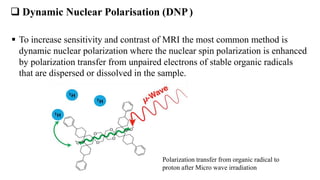
 To increase sensitivity and contrast of MRI the most common method is
dynamic nuclear polarization where the nuclear spin polarization is enhanced
by polarization transfer from unpaired electrons of stable organic radicals
that are dispersed or dissolved in the sample.
Polarization transfer from organic radical to
proton after Micro wave irradiation
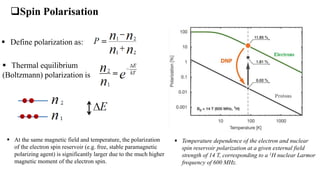
Spin Polarisation
 Temperature dependence of the electron and nuclear
spin reservoir polarization at a given external field
strength of 14 T, corresponding to a 1H nuclear Larmor
frequency of 600 MHz.
 Define polarization as:
 Thermal equilibrium
(Boltzmann) polarization is
 At the same magnetic field and temperature, the polarization
of the electron spin reservoir (e.g. free, stable paramagnetic
polarizing agent) is significantly larger due to the much higher
magnetic moment of the electron spin.
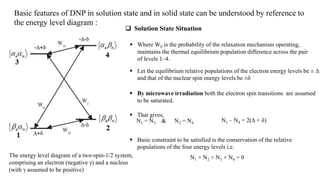
Basic features of DNP in solution state and in solid state can be understood by reference to
the energy level diagram :
The energy level diagram of a two-spin-1/2 system,
comprising an electron (negative γ) and a nucleus
(with γ assumed to be positive)
 Where W0 is the probability of the relaxation mechanism operating,
maintains the thermal equilibrium population difference across the pair
of levels 1–4.
 Solution State Situation
 By microwave irradiation both the electron spin transitions are assumed
to be saturated.
 That gives,
 Let the equilibrium relative populations of the electron energy levels be ± ∆
and that of the nuclear spin energy levels be ±δ
N2 = N4N1 = N3 & N1 – N4 = 2(∆ + δ)
 Basic constraint to be satisfied is the conservation of the relative
populations of the four energy levels i.e.
N1 + N2 + N3 + N4 = 0
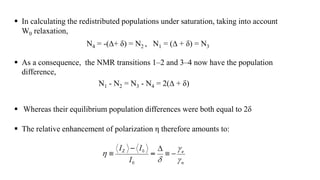
 In calculating the redistributed populations under saturation, taking into account
W0 relaxation,
N4 = -(∆+ δ) = N2 , N1 = (∆ + δ) = N3
 As a consequence, the NMR transitions 1–2 and 3–4 now have the population
difference,
N1 - N2 = N3 - N4 = 2(∆ + δ)
 Whereas their equilibrium population differences were both equal to 2δ
 The relative enhancement of polarization η therefore amounts to:
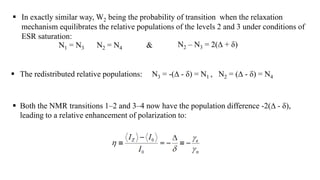
 In exactly similar way, W2 being the probability of transition when the relaxation
mechanism equilibrates the relative populations of the levels 2 and 3 under conditions of
ESR saturation:
N1 = N3 N2 = N4 N2 – N3 = 2(∆ + δ)&
 The redistributed relative populations: N3 = -(∆ - δ) = N1 , N2 = (∆ - δ) = N4
 Both the NMR transitions 1–2 and 3–4 now have the population difference -2(∆ - δ),
leading to a relative enhancement of polarization to:
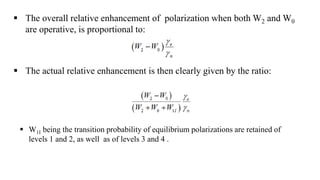
 The overall relative enhancement of polarization when both W2 and W0
are operative, is proportional to:
 The actual relative enhancement is then clearly given by the ratio:
 W1I being the transition probability of equilibrium polarizations are retained of
levels 1 and 2, as well as of levels 3 and 4 .
Mechanism of DNP
 When electron spin polarization deviates from its thermal equilibrium value,
polarization transfers between electrons and nuclei can occur spontaneously through electron-
nuclear cross relaxation and/or spin-state mixing among electrons and nuclei.
 E. g. the polarization transfer is spontaneous after a homolysis chemical reaction
 When the electron spin system is in a thermal equilibrium,
the polarization transfer requires continuous microwave irradiation at a frequency close to
the corresponding EPR frequency
 Mechanisms for the microwave-driven DNP processes are: 1.Overhauser effect (OE),
2. Solid-effect (SE),
3. Cross-effect (CE),
4. Thermal-mixing (TM).
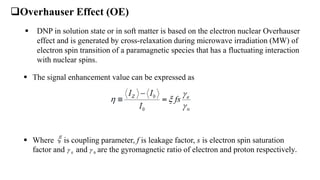
 DNP in solution state or in soft matter is based on the electron nuclear Overhauser
effect and is generated by cross-relaxation during microwave irradiation (MW) of
electron spin transition of a paramagnetic species that has a fluctuating interaction
with nuclear spins.
Overhauser Effect (OE)
 Where is coupling parameter, f is leakage factor, s is electron spin saturation
factor and g e and g n are the gyromagnetic ratio of electron and proton respectively.
 The signal enhancement value can be expressed as
Solid Effect (SE)
 The Solid Effect is a two spin process involving flip flop transitions between an electron
and a nearby nuclear spin induced by the microwave irradiation of a forbidden transition
in an electron-nuclear coupled system. It relies on the mixing of the spin states due to the
hyperfine coupling between them.
 The polarization is transported further away from the electron spin by flip flop processes
between nuclei, polarizing the entire sample. This process is referred to as (nuclear) spin
diffusion
 The corresponding transition probability and therefore the enhancement scales with B0
-2
Effectiveness of the SE gets weaker at High Magnetic Field .
 The solid effect is characterized by the fact that the separation between the irradiation
frequencies for maximum positive and negative enhancements is no less than twice the
nuclear Larmor frequency
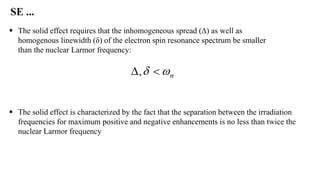
 The solid effect requires that the inhomogeneous spread (∆) as well as
homogenous linewidth (δ) of the electron spin resonance spectrum be smaller
than the nuclear Larmor frequency:
SE ...
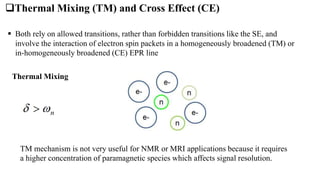
TM mechanism is not very useful for NMR or MRI applications because it requires
a higher concentration of paramagnetic species which affects signal resolution.
 Both rely on allowed transitions, rather than forbidden transitions like the SE, and
involve the interaction of electron spin packets in a homogeneously broadened (TM) or
in-homogeneously broadened (CE) EPR line
Thermal Mixing (TM) and Cross Effect (CE)
Thermal Mixing
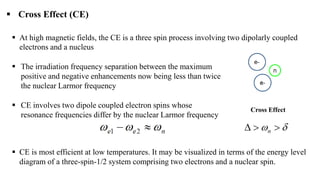
 At high magnetic fields, the CE is a three spin process involving two dipolarly coupled
electrons and a nucleus
Cross Effect
 Cross Effect (CE)
 The irradiation frequency separation between the maximum
positive and negative enhancements now being less than twice
the nuclear Larmor frequency
 CE involves two dipole coupled electron spins whose
resonance frequencies differ by the nuclear Larmor frequency
 CE is most efficient at low temperatures. It may be visualized in terms of the energy level
diagram of a three-spin-1/2 system comprising two electrons and a nuclear spin.
 DNP-MRI
 The creation of non-Boltzmann nuclear polarization (hyperpolarization)
by DNP is not performed on the imaging object itself but on a sample,
which is then transported to the imaging site and injected or applied in a
bolus-like fashion.
 Therefore, for the injection it has to be either a liquid or,( in the case of
129Xe and 3He) gaseous depending on different hyperpolarization
technique.
 Dissolution DNP Imaging
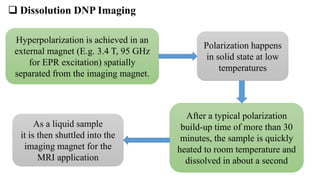
Hyperpolarization is achieved in an
external magnet (E.g. 3.4 T, 95 GHz
for EPR excitation) spatially
separated from the imaging magnet.
Polarization happens
in solid state at low
temperatures
After a typical polarization
build-up time of more than 30
minutes, the sample is quickly
heated to room temperature and
dissolved in about a second
As a liquid sample
it is then shuttled into the
imaging magnet for the
MRI application
Application of Dissolution DNP Imaging
 In Metabolic Imaging performing the hyperpolarization under these
conditions is optimal for high signal enhancements, (e.g. of 13C) because
additionally to the DNP effect a Boltzmann enhancement from the
temperature jump is obtained.
 Enormous signal enhancements (> 10000) can be achieved on relatively
large sample volumes (up to 100 ml) on a broad range of target molecules.
 Limitations of Dissolution DNP Imaging
 The requirement to shuttle between two magnetic fields practically
prohibits the use of nuclei with short relaxation times, like 1H
 The long polarization build-up time makes this approach a single shot
procedure, i.e. the experiment cannot be repeated quickly due to the slow
build-up time causing a slow repetition rate.
 Liquid State DNP Imaging
 Liquid DNP experiments for MRI application have been realized at a
polarizing magnetic field of approximately 0.35 T, corresponding to an
EPR frequency of approximately 9.8 GHz (Xband).
 Either a separate polarizing magnet or incorporated the polarizer setup in
the fringe field of the imaging magnet can be used.
 In contrary, performing DNP in the liquid state, allows an operation in
continuous mode, delivering a constant flow of hyperpolarized sample
 Problem with external polarizer
 The polarization achieved at the imaging site is scaled down by the
factor between the polarizing and the imaging field
E.g. In case of an X-band polarizer and1.5 T imaging field this scaling factor is roughly 1/5
Additionally, in both cases of external polarizers, the shuttling through a field
gradient might induce coherent and incoherent magnetic field effects on the
polarization and lead to relaxation losses during shuttling, resulting in
distorted spectra
The principle setup of the DNP
system in the MRI scanner
The DNP polarizer is placed inside the bore of the imaging magnet, right next to the imaging
object, represented by a mouse. The microwave source is placed well outside the bore.
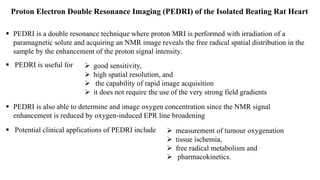
Proton Electron Double Resonance Imaging (PEDRI) of the Isolated Beating Rat Heart
 PEDRI is a double resonance technique where proton MRI is performed with irradiation of a
paramagnetic solute and acquiring an NMR image reveals the free radical spatial distribution in the
sample by the enhancement of the proton signal intensity.
 good sensitivity,
 high spatial resolution, and
 the capability of rapid image acquisition
 it does not require the use of the very strong field gradients
 PEDRI is useful for
 PEDRI is also able to determine and image oxygen concentration since the NMR signal
enhancement is reduced by oxygen-induced EPR line broadening
 Potential clinical applications of PEDRI include  measurement of tumour oxygenation
 tissue ischemia,
 free radical metabolism and
 pharmacokinetics.
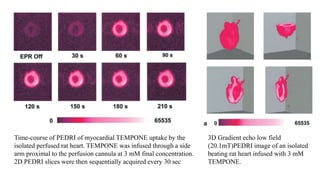
3D Gradient echo low field
(20.1mT)PEDRI image of an isolated
beating rat heart infused with 3 mM
TEMPONE.
Time-course of PEDRI of myocardial TEMPONE uptake by the
isolated perfused rat heart. TEMPONE was infused through a side
arm proximal to the perfusion cannula at 3 mM final concentration.
2D PEDRI slices were then sequentially acquired every 30 sec
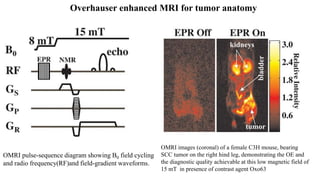
Overhauser enhanced MRI for tumor anatomy
OMRI pulse-sequence diagram showing B0 field cycling
and radio frequency(RF)and field-gradient waveforms.
OMRI images (coronal) of a female C3H mouse, bearing
SCC tumor on the right hind leg, demonstrating the OE and
the diagnostic quality achievable at this low magnetic field of
15 mT in presence of contrast agent Oxo63
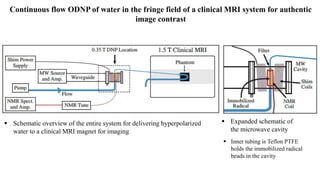
Continuous flow ODNP of water in the fringe field of a clinical MRI system for authentic
image contrast
 Schematic overview of the entire system for delivering hyperpolarized
water to a clinical MRI magnet for imaging
 Expanded schematic of
the microwave cavity
 Inner tubing is Teflon PTFE
holds the immobilized radical
beads in the cavity
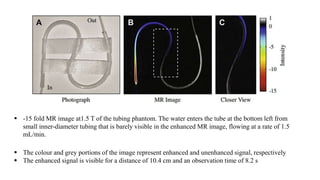
 -15 fold MR image at1.5 T of the tubing phantom. The water enters the tube at the bottom left from
small inner-diameter tubing that is barely visible in the enhanced MR image, flowing at a rate of 1.5
mL/min.
 The colour and grey portions of the image represent enhanced and unenhanced signal, respectively
 The enhanced signal is visible for a distance of 10.4 cm and an observation time of 8.2 s
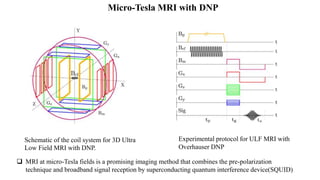
Micro-Tesla MRI with DNP
Schematic of the coil system for 3D Ultra
Low Field MRI with DNP.
Experimental protocol for ULF MRI with
Overhauser DNP
 MRI at micro-Tesla fields is a promising imaging method that combines the pre-polarization
technique and broadband signal reception by superconducting quantum interference device(SQUID)
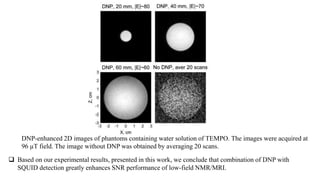
DNP-enhanced 2D images of phantoms containing water solution of TEMPO. The images were acquired at
96 µT field. The image without DNP was obtained by averaging 20 scans.
 Based on our experimental results, presented in this work, we conclude that combination of DNP with
SQUID detection greatly enhances SNR performance of low-field NMR/MRI.
 DNP: The future of imaging
 Hyperpolarization of 13C compounds is an extremely promising new avenue for molecular
imaging and metabolism studies. Applications to cancer and cardiac metabolism are
currently under development.
 The use of dynamic nuclear polarization 13C-pyruvate MRS in cancer is very
important
 Dynamic nuclear polarization of biocompatible 13C-enriched carbonates for in vivo
pH imaging :
This approach enabled large signal gains for low-toxicity hyperpolarized 13C
pH imaging in a phantom and in vivo in a murine model of prostate cancer.
 References
 Dynamic Nuclear Polarization for MRI: An In-bore Approach, Frankfurt, 2012
 Dynamic nuclear polarization in NMR by Prof N. Chandrakumar
 Songi Han et al. Journal of Magnetic Resonance 205 (2010) 247–254
 Michelle A. Espy et al. Journal of Magnetic Resonance 207 (2010) 78–88
 J. Kurhanewicz et al. Chem. Commun., 2016, 52, 3030
Thank you…

Dynamic Nuclear Polarization Imaging

  • 1.
    Dynamic Nuclear PolarizationImaging Debabrata Bagchi M. Sc. Department of Chemistry
  • 2.
     Magnetic ResonanceImaging (MRI)  MRI is a non-invasive imaging technique which provides spatially resolved information and also idea about chemical environments by measuring the distribution of nuclear spin density and molecular mobility in an object.  Undoubtedly, this imaging technique has become an ubiquitous method for diagnosis in medical imaging and also in material science, chemical engineering, etc.
  • 3.
     The mainproblem with standard MRI is that they suffer from low sensitivity and lack of inherent contrast between the species of interest.  Low sensitivity of the method arises due to the small magnetic moment of the nuclei under study (1H, 13C, 15N etc.). This directly results in a small polarization of the nuclear spin reservoir (i.e. difference of number of spins aligned parallel or anti-parallel to the external magnetic field). Problem with standard MRI
  • 4.
     Dynamic NuclearPolarisation (DNP)  To increase sensitivity and contrast of MRI the most common method is dynamic nuclear polarization where the nuclear spin polarization is enhanced by polarization transfer from unpaired electrons of stable organic radicals that are dispersed or dissolved in the sample. Polarization transfer from organic radical to proton after Micro wave irradiation
  • 5.
    Spin Polarisation  Temperaturedependence of the electron and nuclear spin reservoir polarization at a given external field strength of 14 T, corresponding to a 1H nuclear Larmor frequency of 600 MHz.  Define polarization as:  Thermal equilibrium (Boltzmann) polarization is  At the same magnetic field and temperature, the polarization of the electron spin reservoir (e.g. free, stable paramagnetic polarizing agent) is significantly larger due to the much higher magnetic moment of the electron spin.
  • 6.
    Basic features ofDNP in solution state and in solid state can be understood by reference to the energy level diagram : The energy level diagram of a two-spin-1/2 system, comprising an electron (negative γ) and a nucleus (with γ assumed to be positive)  Where W0 is the probability of the relaxation mechanism operating, maintains the thermal equilibrium population difference across the pair of levels 1–4.  Solution State Situation  By microwave irradiation both the electron spin transitions are assumed to be saturated.  That gives,  Let the equilibrium relative populations of the electron energy levels be ± ∆ and that of the nuclear spin energy levels be ±δ N2 = N4N1 = N3 & N1 – N4 = 2(∆ + δ)  Basic constraint to be satisfied is the conservation of the relative populations of the four energy levels i.e. N1 + N2 + N3 + N4 = 0
  • 7.
     In calculatingthe redistributed populations under saturation, taking into account W0 relaxation, N4 = -(∆+ δ) = N2 , N1 = (∆ + δ) = N3  As a consequence, the NMR transitions 1–2 and 3–4 now have the population difference, N1 - N2 = N3 - N4 = 2(∆ + δ)  Whereas their equilibrium population differences were both equal to 2δ  The relative enhancement of polarization η therefore amounts to:
  • 8.
     In exactlysimilar way, W2 being the probability of transition when the relaxation mechanism equilibrates the relative populations of the levels 2 and 3 under conditions of ESR saturation: N1 = N3 N2 = N4 N2 – N3 = 2(∆ + δ)&  The redistributed relative populations: N3 = -(∆ - δ) = N1 , N2 = (∆ - δ) = N4  Both the NMR transitions 1–2 and 3–4 now have the population difference -2(∆ - δ), leading to a relative enhancement of polarization to:
  • 9.
     The overallrelative enhancement of polarization when both W2 and W0 are operative, is proportional to:  The actual relative enhancement is then clearly given by the ratio:  W1I being the transition probability of equilibrium polarizations are retained of levels 1 and 2, as well as of levels 3 and 4 .
  • 10.
    Mechanism of DNP When electron spin polarization deviates from its thermal equilibrium value, polarization transfers between electrons and nuclei can occur spontaneously through electron- nuclear cross relaxation and/or spin-state mixing among electrons and nuclei.  E. g. the polarization transfer is spontaneous after a homolysis chemical reaction  When the electron spin system is in a thermal equilibrium, the polarization transfer requires continuous microwave irradiation at a frequency close to the corresponding EPR frequency  Mechanisms for the microwave-driven DNP processes are: 1.Overhauser effect (OE), 2. Solid-effect (SE), 3. Cross-effect (CE), 4. Thermal-mixing (TM).
  • 11.
     DNP insolution state or in soft matter is based on the electron nuclear Overhauser effect and is generated by cross-relaxation during microwave irradiation (MW) of electron spin transition of a paramagnetic species that has a fluctuating interaction with nuclear spins. Overhauser Effect (OE)  Where is coupling parameter, f is leakage factor, s is electron spin saturation factor and g e and g n are the gyromagnetic ratio of electron and proton respectively.  The signal enhancement value can be expressed as
  • 12.
    Solid Effect (SE) The Solid Effect is a two spin process involving flip flop transitions between an electron and a nearby nuclear spin induced by the microwave irradiation of a forbidden transition in an electron-nuclear coupled system. It relies on the mixing of the spin states due to the hyperfine coupling between them.  The polarization is transported further away from the electron spin by flip flop processes between nuclei, polarizing the entire sample. This process is referred to as (nuclear) spin diffusion  The corresponding transition probability and therefore the enhancement scales with B0 -2 Effectiveness of the SE gets weaker at High Magnetic Field .
  • 13.
     The solideffect is characterized by the fact that the separation between the irradiation frequencies for maximum positive and negative enhancements is no less than twice the nuclear Larmor frequency  The solid effect requires that the inhomogeneous spread (∆) as well as homogenous linewidth (δ) of the electron spin resonance spectrum be smaller than the nuclear Larmor frequency: SE ...
  • 14.
    TM mechanism isnot very useful for NMR or MRI applications because it requires a higher concentration of paramagnetic species which affects signal resolution.  Both rely on allowed transitions, rather than forbidden transitions like the SE, and involve the interaction of electron spin packets in a homogeneously broadened (TM) or in-homogeneously broadened (CE) EPR line Thermal Mixing (TM) and Cross Effect (CE) Thermal Mixing
  • 15.
     At highmagnetic fields, the CE is a three spin process involving two dipolarly coupled electrons and a nucleus Cross Effect  Cross Effect (CE)  The irradiation frequency separation between the maximum positive and negative enhancements now being less than twice the nuclear Larmor frequency  CE involves two dipole coupled electron spins whose resonance frequencies differ by the nuclear Larmor frequency  CE is most efficient at low temperatures. It may be visualized in terms of the energy level diagram of a three-spin-1/2 system comprising two electrons and a nuclear spin.
  • 16.
     DNP-MRI  Thecreation of non-Boltzmann nuclear polarization (hyperpolarization) by DNP is not performed on the imaging object itself but on a sample, which is then transported to the imaging site and injected or applied in a bolus-like fashion.  Therefore, for the injection it has to be either a liquid or,( in the case of 129Xe and 3He) gaseous depending on different hyperpolarization technique.
  • 17.
     Dissolution DNPImaging Hyperpolarization is achieved in an external magnet (E.g. 3.4 T, 95 GHz for EPR excitation) spatially separated from the imaging magnet. Polarization happens in solid state at low temperatures After a typical polarization build-up time of more than 30 minutes, the sample is quickly heated to room temperature and dissolved in about a second As a liquid sample it is then shuttled into the imaging magnet for the MRI application
  • 18.
    Application of DissolutionDNP Imaging  In Metabolic Imaging performing the hyperpolarization under these conditions is optimal for high signal enhancements, (e.g. of 13C) because additionally to the DNP effect a Boltzmann enhancement from the temperature jump is obtained.  Enormous signal enhancements (> 10000) can be achieved on relatively large sample volumes (up to 100 ml) on a broad range of target molecules.
  • 19.
     Limitations ofDissolution DNP Imaging  The requirement to shuttle between two magnetic fields practically prohibits the use of nuclei with short relaxation times, like 1H  The long polarization build-up time makes this approach a single shot procedure, i.e. the experiment cannot be repeated quickly due to the slow build-up time causing a slow repetition rate.
  • 20.
     Liquid StateDNP Imaging  Liquid DNP experiments for MRI application have been realized at a polarizing magnetic field of approximately 0.35 T, corresponding to an EPR frequency of approximately 9.8 GHz (Xband).  Either a separate polarizing magnet or incorporated the polarizer setup in the fringe field of the imaging magnet can be used.  In contrary, performing DNP in the liquid state, allows an operation in continuous mode, delivering a constant flow of hyperpolarized sample
  • 21.
     Problem withexternal polarizer  The polarization achieved at the imaging site is scaled down by the factor between the polarizing and the imaging field E.g. In case of an X-band polarizer and1.5 T imaging field this scaling factor is roughly 1/5 Additionally, in both cases of external polarizers, the shuttling through a field gradient might induce coherent and incoherent magnetic field effects on the polarization and lead to relaxation losses during shuttling, resulting in distorted spectra
  • 22.
    The principle setupof the DNP system in the MRI scanner The DNP polarizer is placed inside the bore of the imaging magnet, right next to the imaging object, represented by a mouse. The microwave source is placed well outside the bore.
  • 23.
    Proton Electron DoubleResonance Imaging (PEDRI) of the Isolated Beating Rat Heart  PEDRI is a double resonance technique where proton MRI is performed with irradiation of a paramagnetic solute and acquiring an NMR image reveals the free radical spatial distribution in the sample by the enhancement of the proton signal intensity.  good sensitivity,  high spatial resolution, and  the capability of rapid image acquisition  it does not require the use of the very strong field gradients  PEDRI is useful for  PEDRI is also able to determine and image oxygen concentration since the NMR signal enhancement is reduced by oxygen-induced EPR line broadening  Potential clinical applications of PEDRI include  measurement of tumour oxygenation  tissue ischemia,  free radical metabolism and  pharmacokinetics.
  • 24.
    3D Gradient echolow field (20.1mT)PEDRI image of an isolated beating rat heart infused with 3 mM TEMPONE. Time-course of PEDRI of myocardial TEMPONE uptake by the isolated perfused rat heart. TEMPONE was infused through a side arm proximal to the perfusion cannula at 3 mM final concentration. 2D PEDRI slices were then sequentially acquired every 30 sec
  • 25.
    Overhauser enhanced MRIfor tumor anatomy OMRI pulse-sequence diagram showing B0 field cycling and radio frequency(RF)and field-gradient waveforms. OMRI images (coronal) of a female C3H mouse, bearing SCC tumor on the right hind leg, demonstrating the OE and the diagnostic quality achievable at this low magnetic field of 15 mT in presence of contrast agent Oxo63
  • 26.
    Continuous flow ODNPof water in the fringe field of a clinical MRI system for authentic image contrast  Schematic overview of the entire system for delivering hyperpolarized water to a clinical MRI magnet for imaging  Expanded schematic of the microwave cavity  Inner tubing is Teflon PTFE holds the immobilized radical beads in the cavity
  • 27.
     -15 foldMR image at1.5 T of the tubing phantom. The water enters the tube at the bottom left from small inner-diameter tubing that is barely visible in the enhanced MR image, flowing at a rate of 1.5 mL/min.  The colour and grey portions of the image represent enhanced and unenhanced signal, respectively  The enhanced signal is visible for a distance of 10.4 cm and an observation time of 8.2 s
  • 28.
    Micro-Tesla MRI withDNP Schematic of the coil system for 3D Ultra Low Field MRI with DNP. Experimental protocol for ULF MRI with Overhauser DNP  MRI at micro-Tesla fields is a promising imaging method that combines the pre-polarization technique and broadband signal reception by superconducting quantum interference device(SQUID)
  • 29.
    DNP-enhanced 2D imagesof phantoms containing water solution of TEMPO. The images were acquired at 96 µT field. The image without DNP was obtained by averaging 20 scans.  Based on our experimental results, presented in this work, we conclude that combination of DNP with SQUID detection greatly enhances SNR performance of low-field NMR/MRI.
  • 30.
     DNP: Thefuture of imaging  Hyperpolarization of 13C compounds is an extremely promising new avenue for molecular imaging and metabolism studies. Applications to cancer and cardiac metabolism are currently under development.  The use of dynamic nuclear polarization 13C-pyruvate MRS in cancer is very important  Dynamic nuclear polarization of biocompatible 13C-enriched carbonates for in vivo pH imaging : This approach enabled large signal gains for low-toxicity hyperpolarized 13C pH imaging in a phantom and in vivo in a murine model of prostate cancer.
  • 31.
     References  DynamicNuclear Polarization for MRI: An In-bore Approach, Frankfurt, 2012  Dynamic nuclear polarization in NMR by Prof N. Chandrakumar  Songi Han et al. Journal of Magnetic Resonance 205 (2010) 247–254  Michelle A. Espy et al. Journal of Magnetic Resonance 207 (2010) 78–88  J. Kurhanewicz et al. Chem. Commun., 2016, 52, 3030 Thank you…