Outcomes
• By theend of this section you should be able to;
• Define key vocabulary related to the topic.
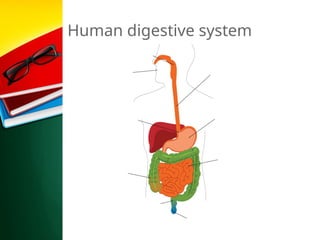
• Name the parts of the digestive system and their functions.
• Describe how digestion starts in the mouth.
• Make a model of the digestive system.
• Compare human digstive system to that of animals.
3.
Key Vocabulary
• Digestivesystem: the organs needed for the process
of digestion.
• Large intestine: the organ that absorbs water and
minerals back into the body.
• Oesphagus: the muscular tube that pushes food from
the mouth into the stomach.
• Saliva: the liquid produced in the mouth that contains a
digestive juice.
4.
Key Vocabulary
• Smallintestine: the organ that breaks down partially
digested food from the stomach into very tiny particles
that can be absorbed into the blood.
• Stomach: the organ which mixes chewed food with
digestive juices to form a thick liquid.
• Anus: the same, no clear difference visible.
Human digestive system
•Our bodies need energy from food in order to function
properly.
• Our digestive system breaks food into smaller particles
which our bodies can absorb.
• The process of breaking down food is called digestion.
• https://www.youtube.com/watch?v=ZBZWgrfZFbU
• https://www.youtube.com/watch?v=JLzX_KSrxDc
7.
Purpose of theparts:
• Mouth: chew and break food into smaller pieces, mix
food with saliva to ease swallowing. Saliva also contains
digestive juices which start breaking down the food.
• Oesphagus: the food moves down the oesphagus into
the stomach. The muscles in the oesphagus contract
and squeeze food down to the stomach.
• Stomach: food mixes with digestive juices and food
turns into a thick liquid.
• Small intestine: breaks down food until the particles are
small enough to be absorbed into the blood.
8.
Purpose of theparts:
• Large intestine: all undigested food particles that our
bodies don’t use now move to the large intestine. Water
and some remaining substances are absorbed here.
• Anus: All remaining undigested food and solids are now
pushed out of the body as waste.



![ANIMAL_CELL_,_TISSUE_AND_ORGAN_CULTURE[1].pptx](https://cdn.slidesharecdn.com/ss_thumbnails/animalcelltissueandorganculture1-260204172026-4462b440-thumbnail.jpg?width=640&height=640&fit=bounds)


