1
Cautionary Statement Regarding Forward-looking Information
This presentation contains, and the Company may from time to time make, written or oral "forward-looking statements" within the safe harbor provisions of the
Private Securities Litigations Reform Act of 1995. These statements include information with respect to our financial condition and its results of operations and
businesses. Words such as "anticipates," "expects," "intends," "plans," "believes," "seeks," "estimates," "may," "will," "continue," "project" and similar expressions,
as well as statements in the future tense, identify forward-looking statements.
These forward-looking statements are not guarantees of our future performance and are subject to risks and uncertainties that could cause actual results to differ
materially from the results contemplated by the forward-looking statements. These risks and uncertainties include:
• The ability to obtain new contracts at attractive prices;
• The size and timing of customer orders;
• Fluctuations in customer demand;
• Competitive factors;
• The timely completion of contracts;
• The timing and size of expenditures;
• The timely receipt of government approvals and permits;
• The adequacy of local labor supplies at our facilities;
• The availability and cost of funds;
• General economic conditions, both domestically and abroad;
• The successful integration of acquisitions; and
• Fluctuations in foreign currencies.
The effects of these factors are difficult to predict. New factors emerge from time to time and we cannot assess the potential impact of any such factor on the
business or the extent to which any factor, or combination of factors, may cause results to differ materially from those contained in any forward-looking statement.
Any forward-looking statement speaks only as of its date and we do not undertake any obligation to update any forward-looking statement to reflect events or
circumstances after the date of such statement or to reflect the occurrence of unanticipated events. In addition, see "Risk Factors" for a discussion of these and
other factors.
You are encouraged to read the SEC reports of DMC, particularly its Form 10-K for the Fiscal Year Ended December 31, 2012 for meaningful cautionary language
disclosing why actual results may vary materially from those anticipated by management.
2
Cautionary Statement Regarding Forward-looking Information
Use of Non-GAAP Financial Measures
Non-GAAP results used in this presentation are provided only as a supplement to the financial statements based on U.S. generally accepted accounting principles
(GAAP). The non-GAAP financial information is provided to enhance the reader's understanding of DMC’s financial performance, but no non-GAAP measure should
be considered in isolation or as a substitute for financial measures calculated in accordance with GAAP. Reconciliations of the most directly comparable GAAP
measures to non-GAAP measures are provided within the schedules attached to this release.
EBITDA is defined as net income plus or minus net interest plus taxes, depreciation and amortization. Adjusted EBITDA excludes stock-based compensation and,
when appropriate, other items that management does not utilize in assessing DMC’s operating performance (as further described in the attached financial
schedules). None of these non-GAAP financial measures are recognized terms under GAAP and do not purport to be an alternative to net income as an indicator of
operating performance or any other GAAP measure.
Management uses these non-GAAP measures in its operational and financial decision-making, believing that it is useful to eliminate certain items in order to focus
on what it deems to be a more reliable indicator of ongoing operating performance and the company’s ability to generate cash flow from operations. As a result,
internal management reports used during monthly operating reviews feature the adjusted EBITDA. Management also believes that investors may find non-GAAP
financial measures useful for the same reasons, although investors are cautioned that non-GAAP financial measures are not a substitute for GAAP disclosures.
EBITDA and adjusted EBITDA are also used by research analysts, investment bankers, and lenders to assess operating performance. For example, a measure
similar to EBITDA is required by the lenders under DMC’s credit facility.
Because not all companies use identical calculations, DMC’s presentation of non-GAAP financial measures may not be comparable to other similarly-titled measures
of other companies. However, these measures can still be useful in evaluating the company’s performance against its peer companies because management
believes the measures provide users with valuable insight into key components of GAAP financial disclosures. For example, a company with greater GAAP net
income may not be as appealing to investors if its net income is more heavily comprised of gains on asset sales. Likewise, eliminating the effects of interest income
and expense moderates the impact of a company's capital structure on its performance.
All of the items included in the reconciliation from net income to EBITDA and adjusted EBITDA are either (i) non-cash items (e.g., depreciation, amortization of
purchased intangibles and stock-based compensation) or (ii) items that management does not consider to be useful in assessing DMC’s operating performance
(e.g., income taxes and gain on sale of assets). In the case of the non-cash items, management believes that investors can better assess the company’s operating
performance if the measures are presented without such items because, unlike cash expenses, these adjustments do not affect DMC' ability to generate free cash
flow or invest in its business. For example, by adjusting for depreciation and amortization in computing EBITDA, users can compare operating performance without
regard to different accounting determinations such as useful life. In the case of the other items, management believes that investors can better assess operating
performance if the measures are presented without these items because their financial impact does not reflect ongoing operating performance.
3
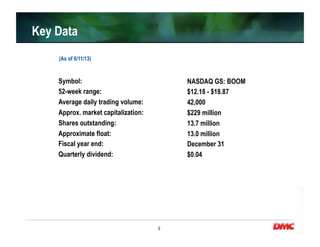
Key Data
Symbol:
52-week range:
Average daily trading volume:
Approx. market capitalization:
Shares outstanding:
Approximate float:
Fiscal year end:
Quarterly dividend:
NASDAQ GS: BOOM
$12.18 - $18.87
42,000
$229 million
13.7 million
13.0 million
December 31
$0.04
(As of 6/11/13)
4
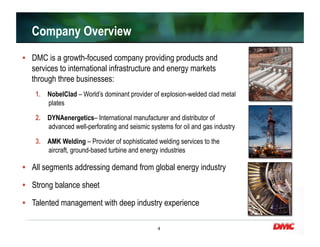
•  DMC is a growth-focused company providing products and
services to international infrastructure and energy markets
through three businesses:
1.  NobelClad – World’s dominant provider of explosion-welded clad metal
plates
2.  DYNAenergetics– International manufacturer and distributor of
advanced well-perforating and seismic systems for oil and gas industry
3.  AMK Welding – Provider of sophisticated welding services to the
aircraft, ground-based turbine and energy industries
•  All segments addressing demand from global energy industry
•  Strong balance sheet
•  Talented management with deep industry experience
Company Overview
5
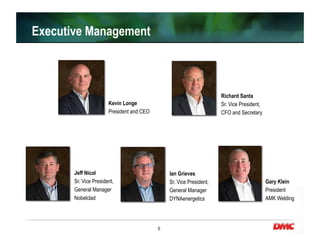
Executive Management
Kevin Longe
President and CEO
Richard Santa
Sr. Vice President,
CFO and Secretary
Jeff Nicol
Sr. Vice President,
General Manager
Nobelclad
Ian Grieves
Sr. Vice President,
General Manager
DYNAenergetics
Gary Klein
President
AMK Welding
6
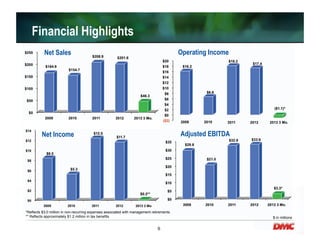
Net Sales Operating Income
6
Net Income Adjusted EBITDA
Financial Highlights
2009 2010 2011 2012 2013 3 Mo.
*Reflects $3.0 million in non-recurring expenses associated with management retirements
** Reflects approximately $1.2 million in tax benefits $ in millions
7
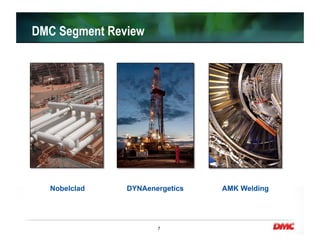
DMC Segment Review
Nobelclad DYNAenergetics AMK Welding
8
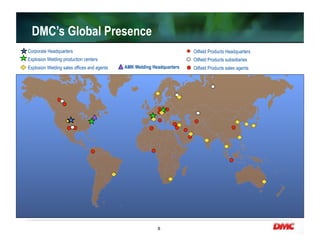
DMC’s Global Presence
Corporate Headquarters
Explosion Welding production centers
Explosion Welding sales offices and agents
Oilfield Products Headquarters
Oilfield Products subsidiaries
Oilfield Products sales agentsAMK Welding Headquarters
9
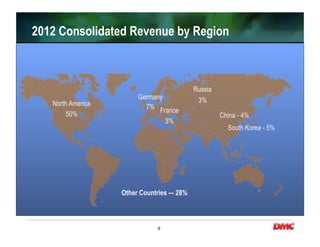
2012 Consolidated Revenue by Region
North America
50%
Germany
7%
South Korea - 5%
Russia
3%
Other Countries -– 28%
France
3%
China - 4%
10
10
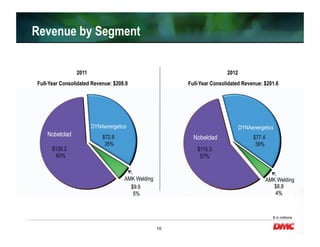
2011
Full-Year Consolidated Revenue: $208.9
Revenue by Segment
2012
Full-Year Consolidated Revenue: $201.6
Nobelclad
DYNAenergetics
AMK Welding
Nobelclad
DYNAenergetics
AMK Welding
$ in millions
11
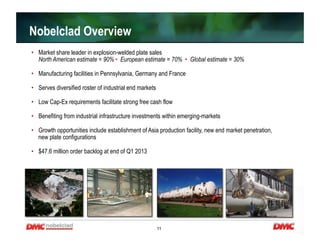
Nobelclad Overview
•  Market share leader in explosion-welded plate sales
North American estimate = 90% • European estimate = 70% • Global estimate = 30%
•  Manufacturing facilities in Pennsylvania, Germany and France
•  Serves diversified roster of industrial end markets
•  Low Cap-Ex requirements facilitate strong free cash flow
•  Benefiting from industrial infrastructure investments within emerging-markets
•  Growth opportunities include establishment of Asia production facility, new end market penetration,
new plate configurations
•  $47.6 million order backlog at end of Q1 2013
12
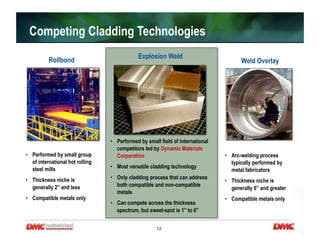
Weld OverlayRollbond
•  Performed by small group
of international hot rolling
steel mills
•  Thickness niche is
generally 2” and less
•  Compatible metals only
Explosion Weld
•  Performed by small field of international
competitors led by Dynamic Materials
Corporation
•  Most versatile cladding technology
•  Only cladding process that can address
both compatible and non-compatible
metals
•  Can compete across the thickness
spectrum, but sweet-spot is 1” to 6”
•  Arc-welding process
typically performed by
metal fabricators
•  Thickness niche is
generally 6” and greater
•  Compatible metals only
Competing Cladding Technologies
13
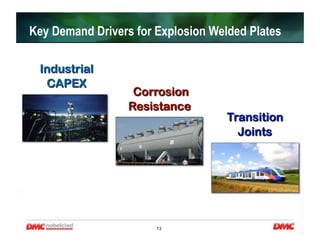
Key Demand Drivers for Explosion Welded Plates
14
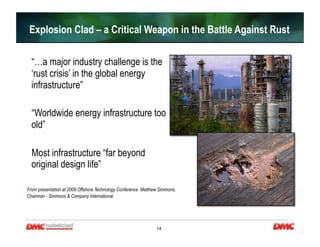
  “…a major industry challenge is the
‘rust crisis’ in the global energy
infrastructure”
  “Worldwide energy infrastructure too
old”
  Most infrastructure “far beyond
original design life”
From presentation at 2009 Offshore Technology Conference Matthew Simmons,
Chairman - Simmons & Company International
Explosion Clad – a Critical Weapon in the Battle Against Rust
15
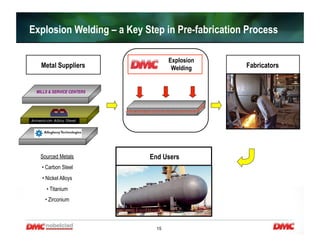
Explosion Welding – a Key Step in Pre-fabrication Process
Metal Suppliers
Explosion
Welding
End Users
MILLS & SERVICE CENTERS
Sourced Metals
• Carbon Steel
• Nickel Alloys
• Titanium
• Zirconium
16
• Chemical
• Oil & Gas
• Metals & Mining
• Marine
• Defense & Protection
• Power Generation
• Alternative Energy
• Industrial Refrigeration
• Transportation
Nine primary industries that utilize explosion welded products
Select End-Markets Served by Explosion Welding
17
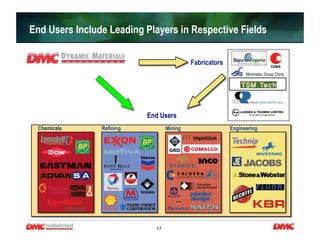
End Users
Chemicals Refining Mining EngineeringEngineeringRefining Mining
Morimatsu Group ChinaMorimatsu Group China
End Users Include Leading Players in Respective Fields
18
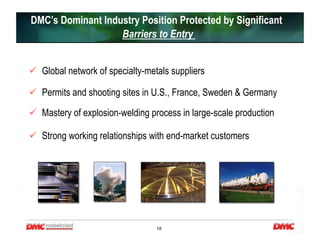
  Global network of specialty-metals suppliers
  Permits and shooting sites in U.S., France, Sweden & Germany
  Mastery of explosion-welding process in large-scale production
  Strong working relationships with end-market customers
DMC’s Dominant Industry Position Protected by Significant
Barriers to Entry
19
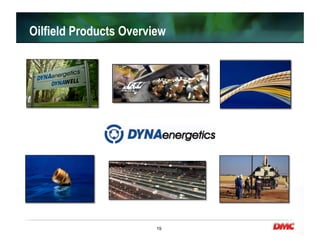
Oilfield Products Overview
20
•  DYNAenergetics, DMC’s Oilfield Products business, manufactures explosive
perforating systems and seismic devices for the oil & gas services industry
•  Benefiting from robust drilling activity, re-perforating of existing wells, and
increased use of horizontal and directional drilling techniques
•  Known for technical innovation, broad product offering and global distribution
network
•  Extension of DMC’s expertise in specialized explosive manufacturing processes
•  Growth opportunities include acquisitions, geographic expansion and new
production facilities
Oilfield Products Overview - continued
21
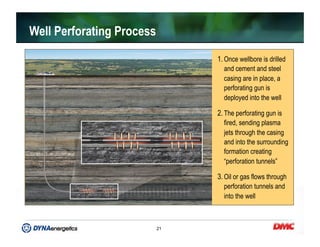
1. Once wellbore is drilled
and cement and steel
casing are in place, a
perforating gun is
deployed into the well
2. The perforating gun is
fired, sending plasma
jets through the casing
and into the surrounding
formation creating
“perforation tunnels”
3. Oil or gas flows through
perforation tunnels and
into the well
Well Perforating Process
22
Oilfield Products – Select Customers
*
*
*
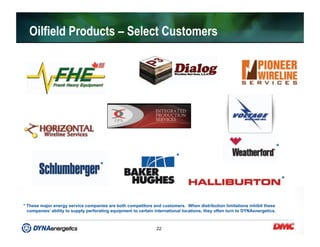
* These major energy service companies are both competitors and customers. When distribution limitations inhibit these
companies’ ability to supply perforating equipment to certain international locations, they often turn to DYNAenergetics.
*
23
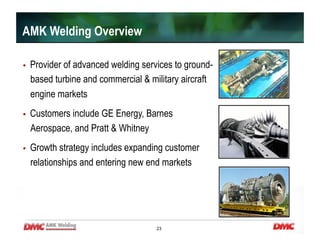
•  Provider of advanced welding services to ground-
based turbine and commercial & military aircraft
engine markets
•  Customers include GE Energy, Barnes
Aerospace, and Pratt & Whitney
•  Growth strategy includes expanding customer
relationships and entering new end markets
AMK Welding Overview
24
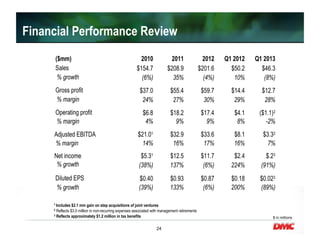
1 Includes $2.1 mm gain on step acquisitions of joint ventures
2 Reflects $3.0 million in non-recurring expenses associated with management retirements
3 Reflects approximately $1.2 million in tax benefits
Financial Performance Review
$ in millions
25
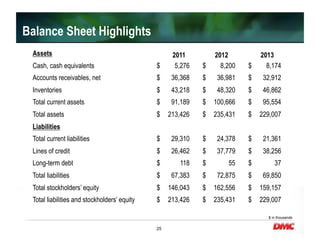
Assets
Cash, cash equivalents $ 5,276 $ 8,200 $ 8,174
Accounts receivables, net $ 36,368 $ 36,981 $ 32,912
Inventories $ 43,218 $ 48,320 $ 46,862
Total current assets $ 91,189 $ 100,666 $ 95,554
Total assets $ 213,426 $ 235,431 $ 229,007
Liabilities
Total current liabilities $ 29,310 $ 24,378 $ 21,361
Lines of credit $ 26,462 $ 37,779 $ 38,256
Long-term debt $ 118 $ 55 $ 37
Total liabilities $ 67,383 $ 72,875 $ 69,850
Total stockholders’ equity $ 146,043 $ 162,556 $ 159,157
Total liabilities and stockholders’ equity $ 213,426 $ 235,431 $ 229,007
Balance Sheet Highlights
2011 2012 2013
$ in thousands
26
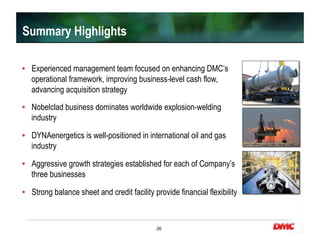
•  Experienced management team focused on enhancing DMC’s
operational framework, improving business-level cash flow,
advancing acquisition strategy
•  Nobelclad business dominates worldwide explosion-welding
industry
•  DYNAenergetics is well-positioned in international oil and gas
industry
•  Aggressive growth strategies established for each of Company’s
three businesses
•  Strong balance sheet and credit facility provide financial flexibility
Summary Highlights
27
Thank you.

Dynamic materialsjun13pres

  • 2.
    1 Cautionary Statement RegardingForward-looking Information This presentation contains, and the Company may from time to time make, written or oral "forward-looking statements" within the safe harbor provisions of the Private Securities Litigations Reform Act of 1995. These statements include information with respect to our financial condition and its results of operations and businesses. Words such as "anticipates," "expects," "intends," "plans," "believes," "seeks," "estimates," "may," "will," "continue," "project" and similar expressions, as well as statements in the future tense, identify forward-looking statements. These forward-looking statements are not guarantees of our future performance and are subject to risks and uncertainties that could cause actual results to differ materially from the results contemplated by the forward-looking statements. These risks and uncertainties include: • The ability to obtain new contracts at attractive prices; • The size and timing of customer orders; • Fluctuations in customer demand; • Competitive factors; • The timely completion of contracts; • The timing and size of expenditures; • The timely receipt of government approvals and permits; • The adequacy of local labor supplies at our facilities; • The availability and cost of funds; • General economic conditions, both domestically and abroad; • The successful integration of acquisitions; and • Fluctuations in foreign currencies. The effects of these factors are difficult to predict. New factors emerge from time to time and we cannot assess the potential impact of any such factor on the business or the extent to which any factor, or combination of factors, may cause results to differ materially from those contained in any forward-looking statement. Any forward-looking statement speaks only as of its date and we do not undertake any obligation to update any forward-looking statement to reflect events or circumstances after the date of such statement or to reflect the occurrence of unanticipated events. In addition, see "Risk Factors" for a discussion of these and other factors. You are encouraged to read the SEC reports of DMC, particularly its Form 10-K for the Fiscal Year Ended December 31, 2012 for meaningful cautionary language disclosing why actual results may vary materially from those anticipated by management.
  • 3.
    2 Cautionary Statement RegardingForward-looking Information Use of Non-GAAP Financial Measures Non-GAAP results used in this presentation are provided only as a supplement to the financial statements based on U.S. generally accepted accounting principles (GAAP). The non-GAAP financial information is provided to enhance the reader's understanding of DMC’s financial performance, but no non-GAAP measure should be considered in isolation or as a substitute for financial measures calculated in accordance with GAAP. Reconciliations of the most directly comparable GAAP measures to non-GAAP measures are provided within the schedules attached to this release. EBITDA is defined as net income plus or minus net interest plus taxes, depreciation and amortization. Adjusted EBITDA excludes stock-based compensation and, when appropriate, other items that management does not utilize in assessing DMC’s operating performance (as further described in the attached financial schedules). None of these non-GAAP financial measures are recognized terms under GAAP and do not purport to be an alternative to net income as an indicator of operating performance or any other GAAP measure. Management uses these non-GAAP measures in its operational and financial decision-making, believing that it is useful to eliminate certain items in order to focus on what it deems to be a more reliable indicator of ongoing operating performance and the company’s ability to generate cash flow from operations. As a result, internal management reports used during monthly operating reviews feature the adjusted EBITDA. Management also believes that investors may find non-GAAP financial measures useful for the same reasons, although investors are cautioned that non-GAAP financial measures are not a substitute for GAAP disclosures. EBITDA and adjusted EBITDA are also used by research analysts, investment bankers, and lenders to assess operating performance. For example, a measure similar to EBITDA is required by the lenders under DMC’s credit facility. Because not all companies use identical calculations, DMC’s presentation of non-GAAP financial measures may not be comparable to other similarly-titled measures of other companies. However, these measures can still be useful in evaluating the company’s performance against its peer companies because management believes the measures provide users with valuable insight into key components of GAAP financial disclosures. For example, a company with greater GAAP net income may not be as appealing to investors if its net income is more heavily comprised of gains on asset sales. Likewise, eliminating the effects of interest income and expense moderates the impact of a company's capital structure on its performance. All of the items included in the reconciliation from net income to EBITDA and adjusted EBITDA are either (i) non-cash items (e.g., depreciation, amortization of purchased intangibles and stock-based compensation) or (ii) items that management does not consider to be useful in assessing DMC’s operating performance (e.g., income taxes and gain on sale of assets). In the case of the non-cash items, management believes that investors can better assess the company’s operating performance if the measures are presented without such items because, unlike cash expenses, these adjustments do not affect DMC' ability to generate free cash flow or invest in its business. For example, by adjusting for depreciation and amortization in computing EBITDA, users can compare operating performance without regard to different accounting determinations such as useful life. In the case of the other items, management believes that investors can better assess operating performance if the measures are presented without these items because their financial impact does not reflect ongoing operating performance.
  • 4.
    3 Key Data Symbol: 52-week range: Averagedaily trading volume: Approx. market capitalization: Shares outstanding: Approximate float: Fiscal year end: Quarterly dividend: NASDAQ GS: BOOM $12.18 - $18.87 42,000 $229 million 13.7 million 13.0 million December 31 $0.04 (As of 6/11/13)
  • 5.
    4 •  DMC isa growth-focused company providing products and services to international infrastructure and energy markets through three businesses: 1.  NobelClad – World’s dominant provider of explosion-welded clad metal plates 2.  DYNAenergetics– International manufacturer and distributor of advanced well-perforating and seismic systems for oil and gas industry 3.  AMK Welding – Provider of sophisticated welding services to the aircraft, ground-based turbine and energy industries •  All segments addressing demand from global energy industry •  Strong balance sheet •  Talented management with deep industry experience Company Overview
  • 6.
    5 Executive Management Kevin Longe Presidentand CEO Richard Santa Sr. Vice President, CFO and Secretary Jeff Nicol Sr. Vice President, General Manager Nobelclad Ian Grieves Sr. Vice President, General Manager DYNAenergetics Gary Klein President AMK Welding
  • 7.
    6 Net Sales OperatingIncome 6 Net Income Adjusted EBITDA Financial Highlights 2009 2010 2011 2012 2013 3 Mo. *Reflects $3.0 million in non-recurring expenses associated with management retirements ** Reflects approximately $1.2 million in tax benefits $ in millions
  • 8.
    7 DMC Segment Review NobelcladDYNAenergetics AMK Welding
  • 9.
    8 DMC’s Global Presence CorporateHeadquarters Explosion Welding production centers Explosion Welding sales offices and agents Oilfield Products Headquarters Oilfield Products subsidiaries Oilfield Products sales agentsAMK Welding Headquarters
  • 10.
    9 2012 Consolidated Revenueby Region North America 50% Germany 7% South Korea - 5% Russia 3% Other Countries -– 28% France 3% China - 4%
  • 11.
    10 10 2011 Full-Year Consolidated Revenue:$208.9 Revenue by Segment 2012 Full-Year Consolidated Revenue: $201.6 Nobelclad DYNAenergetics AMK Welding Nobelclad DYNAenergetics AMK Welding $ in millions
  • 12.
    11 Nobelclad Overview •  Marketshare leader in explosion-welded plate sales North American estimate = 90% • European estimate = 70% • Global estimate = 30% •  Manufacturing facilities in Pennsylvania, Germany and France •  Serves diversified roster of industrial end markets •  Low Cap-Ex requirements facilitate strong free cash flow •  Benefiting from industrial infrastructure investments within emerging-markets •  Growth opportunities include establishment of Asia production facility, new end market penetration, new plate configurations •  $47.6 million order backlog at end of Q1 2013
  • 13.
    12 Weld OverlayRollbond •  Performedby small group of international hot rolling steel mills •  Thickness niche is generally 2” and less •  Compatible metals only Explosion Weld •  Performed by small field of international competitors led by Dynamic Materials Corporation •  Most versatile cladding technology •  Only cladding process that can address both compatible and non-compatible metals •  Can compete across the thickness spectrum, but sweet-spot is 1” to 6” •  Arc-welding process typically performed by metal fabricators •  Thickness niche is generally 6” and greater •  Compatible metals only Competing Cladding Technologies
  • 14.
    13 Key Demand Driversfor Explosion Welded Plates
  • 15.
    14   “…a majorindustry challenge is the ‘rust crisis’ in the global energy infrastructure”   “Worldwide energy infrastructure too old”   Most infrastructure “far beyond original design life” From presentation at 2009 Offshore Technology Conference Matthew Simmons, Chairman - Simmons & Company International Explosion Clad – a Critical Weapon in the Battle Against Rust
  • 16.
    15 Explosion Welding –a Key Step in Pre-fabrication Process Metal Suppliers Explosion Welding End Users MILLS & SERVICE CENTERS Sourced Metals • Carbon Steel • Nickel Alloys • Titanium • Zirconium
  • 17.
    16 • Chemical • Oil & Gas • Metals& Mining • Marine • Defense & Protection • Power Generation • Alternative Energy • Industrial Refrigeration • Transportation Nine primary industries that utilize explosion welded products Select End-Markets Served by Explosion Welding
  • 18.
    17 End Users Chemicals RefiningMining EngineeringEngineeringRefining Mining Morimatsu Group ChinaMorimatsu Group China End Users Include Leading Players in Respective Fields
  • 19.
    18   Global networkof specialty-metals suppliers   Permits and shooting sites in U.S., France, Sweden & Germany   Mastery of explosion-welding process in large-scale production   Strong working relationships with end-market customers DMC’s Dominant Industry Position Protected by Significant Barriers to Entry
  • 20.
  • 21.
    20 •  DYNAenergetics, DMC’sOilfield Products business, manufactures explosive perforating systems and seismic devices for the oil & gas services industry •  Benefiting from robust drilling activity, re-perforating of existing wells, and increased use of horizontal and directional drilling techniques •  Known for technical innovation, broad product offering and global distribution network •  Extension of DMC’s expertise in specialized explosive manufacturing processes •  Growth opportunities include acquisitions, geographic expansion and new production facilities Oilfield Products Overview - continued
  • 22.
    21 1. Once wellbore isdrilled and cement and steel casing are in place, a perforating gun is deployed into the well 2. The perforating gun is fired, sending plasma jets through the casing and into the surrounding formation creating “perforation tunnels” 3. Oil or gas flows through perforation tunnels and into the well Well Perforating Process
  • 23.
    22 Oilfield Products –Select Customers * * * * These major energy service companies are both competitors and customers. When distribution limitations inhibit these companies’ ability to supply perforating equipment to certain international locations, they often turn to DYNAenergetics. *
  • 24.
    23 •  Provider ofadvanced welding services to ground- based turbine and commercial & military aircraft engine markets •  Customers include GE Energy, Barnes Aerospace, and Pratt & Whitney •  Growth strategy includes expanding customer relationships and entering new end markets AMK Welding Overview
  • 25.
    24 1 Includes $2.1mm gain on step acquisitions of joint ventures 2 Reflects $3.0 million in non-recurring expenses associated with management retirements 3 Reflects approximately $1.2 million in tax benefits Financial Performance Review $ in millions
  • 26.
    25 Assets Cash, cash equivalents$ 5,276 $ 8,200 $ 8,174 Accounts receivables, net $ 36,368 $ 36,981 $ 32,912 Inventories $ 43,218 $ 48,320 $ 46,862 Total current assets $ 91,189 $ 100,666 $ 95,554 Total assets $ 213,426 $ 235,431 $ 229,007 Liabilities Total current liabilities $ 29,310 $ 24,378 $ 21,361 Lines of credit $ 26,462 $ 37,779 $ 38,256 Long-term debt $ 118 $ 55 $ 37 Total liabilities $ 67,383 $ 72,875 $ 69,850 Total stockholders’ equity $ 146,043 $ 162,556 $ 159,157 Total liabilities and stockholders’ equity $ 213,426 $ 235,431 $ 229,007 Balance Sheet Highlights 2011 2012 2013 $ in thousands
  • 27.
    26 •  Experienced managementteam focused on enhancing DMC’s operational framework, improving business-level cash flow, advancing acquisition strategy •  Nobelclad business dominates worldwide explosion-welding industry •  DYNAenergetics is well-positioned in international oil and gas industry •  Aggressive growth strategies established for each of Company’s three businesses •  Strong balance sheet and credit facility provide financial flexibility Summary Highlights
  • 28.