Introduction
• The systemsapproach has been a combination of
traditions, customs and a web of action, reaction and
interaction between parties. The systems approach is
given by Prof. John T. Dunlop of the Harvard University
(1958) and is also referred as Dunlop’s Approach. Dunlop
analyses industrial relations system as a subsystem of the
society. He suggested that industrial relations system
could be divided into four interrelated elements
comprising certain actors, certain contexts, an ideology
binding the industrial relations system together and a
body of rules created to govern the actors at the
workplace.
3.
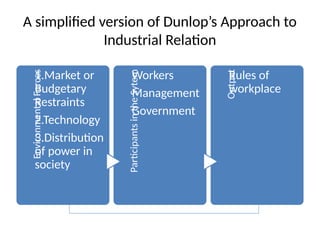
A simplified versionof Dunlop’s Approach to
Industrial Relation
Environmental
Forces
1.Market or
Budgetary
Restraints
2.Technology
3.Distribution
of power in
society
Participants
in
the
Sytem
Workers
Management
Government
Output
Rules of
workplace
4.
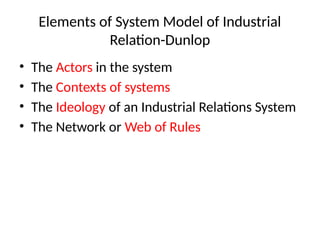
Elements of SystemModel of Industrial
Relation-Dunlop
• The Actors in the system
• The Contexts of systems
• The Ideology of an Industrial Relations System
• The Network or Web of Rules
5.
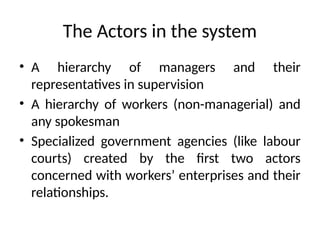
The Actors inthe system
• A hierarchy of managers and their
representatives in supervision
• A hierarchy of workers (non-managerial) and
any spokesman
• Specialized government agencies (like labour
courts) created by the first two actors
concerned with workers’ enterprises and their
relationships.
6.
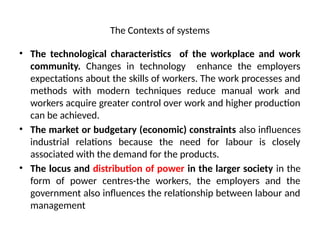
The Contexts ofsystems
• The technological characteristics of the workplace and work
community. Changes in technology enhance the employers
expectations about the skills of workers. The work processes and
methods with modern techniques reduce manual work and
workers acquire greater control over work and higher production
can be achieved.
• The market or budgetary (economic) constraints also influences
industrial relations because the need for labour is closely
associated with the demand for the products.
• The locus and distribution of power in the larger society in the
form of power centres-the workers, the employers and the
government also influences the relationship between labour and
management
7.
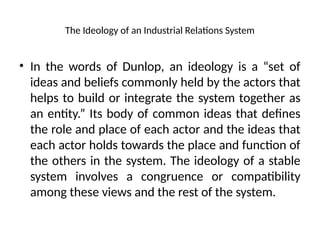
The Ideology ofan Industrial Relations System
• In the words of Dunlop, an ideology is a “set of
ideas and beliefs commonly held by the actors that
helps to build or integrate the system together as
an entity.” Its body of common ideas that defines
the role and place of each actor and the ideas that
each actor holds towards the place and function of
the others in the system. The ideology of a stable
system involves a congruence or compatibility
among these views and the rest of the system.
8.
The Network orWeb of Rules
For Dunlop, the establishment of procedures and rules is
the centre of attention in an industrial relations system.
These rules may be expressed in a variety of forms:
• the regulations and policies of the management hierarchy.
• the regulations, decrees, decisions, awards or order of
government agencies
• The rules and decisions of specialized agencies created by
the management and worker hierarchies
• Collective bargaining agreements.
• The customs and traditions of the workplace and work
community
9.
Shortcomings/Criticism of Dunlop’sTheory
• It is static, not dynamic in time.
• It concentrates on the structure of the system
ignoring the processes within it.
• It tends to ignore the essential element of all
industrial relations that of the nature and
development of conflicts itself.
• It focuses on formal rules to the neglect of
important informal rules and informal processes.
• It may not be integrated and it is a problematic
whether or not the actors share a common ideology
10.
Shortcomings/Criticism of Dunlop’sTheory
• It fails to give an account of how inputs into the system are
converted into outputs.
• It is environmentally biased and provides no articulation
between the internal plant level systems and the wider
systems.
• It favours an analytical approach based on comparison
rather than a problem solving approach built on description.
• It makes no special provision for the role of individual
personalities in industrial in industrial relations as the actors
are being viewed in a structural rather than in a dynamic
sense