04
The thought leadership factory
Duke 9 euros
9 789995 974558
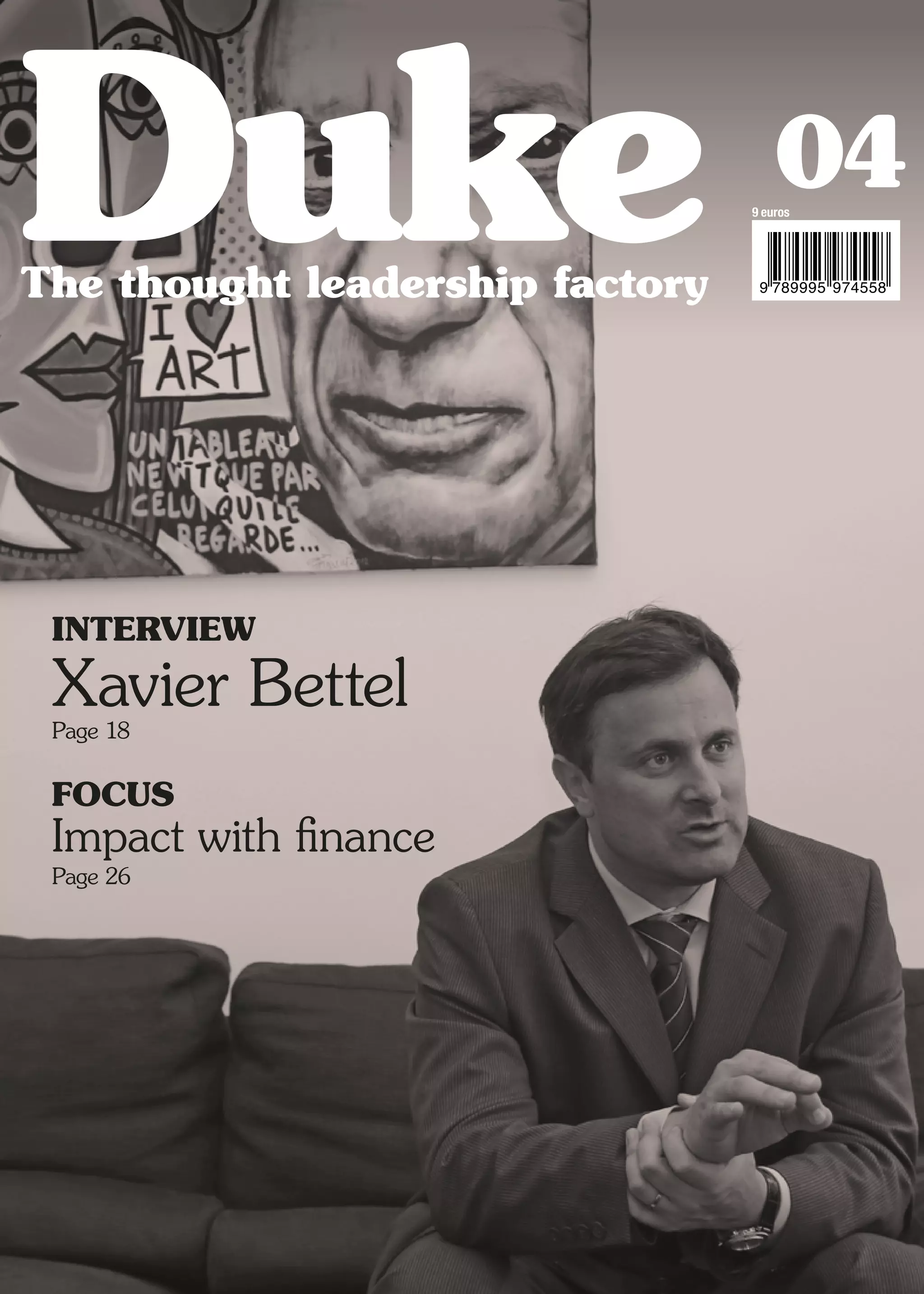
INTERVIEW
Xavier Bettel
Page 18
FOCUS
Impact with finance
Page 26
Big Bang Ferrari King Gold.
Mouvement manufacture UNICO. Chronographe roue
à colonnes. 72 heures de réserve de marche. Boîtier réalisé
dans un nouvel alliage d’or rouge: le King Gold.
Bracelet interchangeable par un système d’attache unique.
Série limitée à 500 pièces.
www.hublot.com • twitter.com/hublot • facebook.com/hublot
4A, rue du Marché-aux-Herbes, L-1728 Luxembourg
Tel: (+352) 22 44 90
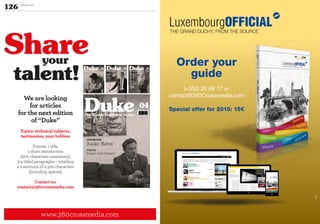
www.360crossmedia.com
contact@360Crossmedia.com
Crossmedia
The communication
agency for
creative minds
©360Crossmedia/B.J.
360Crossmedia Masterclass #2
“BOOST YOUR BRAND”
传播创新思维
9Duke 04
8
CONTENTS POLITICS
10. Grand Duchess Charlotte,
a Luxembourg icon
SUCCESS
12. Jean-Claude Biver: Cheese
NATION BRANDING
16. 360Crossmedia: Innovation made
in Luxembourg
POLITICS
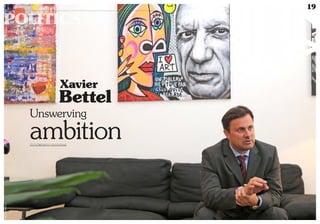
18. Xavier Bettel: Unswerving ambition
SOCIAL
22. UEL: Dynamic action at a time
of major change
24. Make-A-Wish: An awake dream
THOUGHT LEADERSHIP
FACTORY
28. CEO Lunch
30. ATTF: 15 years of transferring
savoir-faire
32. Impacting the world of finance:
It’s all about giving back...
34. Increasing the reach through
collaborative philanthropy
36. Guillermo G. Morales: From
Barcelona to Luxembourg
40. LE FREEPORT: A game changer
42. Hugues Delcourt: The future on
2 pillars
46. Sébastien Danloy: Luxembourg is
becoming a global centre of expertise
48. Elian: An obsession with excellence
50. Northern Trust: Empowering talented
people
52. BGP Investment: Capturing
opportunities
SPORT
54. Football from the stands
BUSINESS
58. ING: Retail Banking in 2015
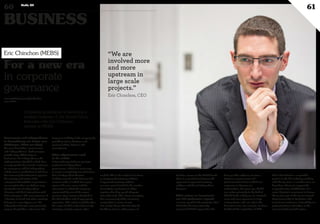
60. Eric Chinchon: For a new era in
corporate governance
62. Pay-as-you-go back office and IT
solutions from Clearstream Services IT
64. Documents in every form
66. Luc Rasschaert: A hands-on man
68. Jean-Marie Bettinger: The
Luxembourg structuring “toolbox” for
international investors
70. Antonio Thomas: Luxembourg’s
opportunity in the UCITS-AIFMD servicing
convergence
72. Venetia Lean: How we are serving
wealthy global families from Luxembourg
74. ACLE: A double platform for China
Outbound Investment in Europe
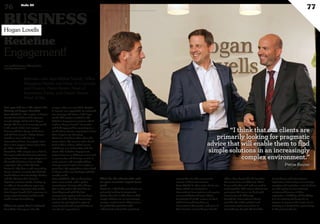
76. Hogan Lovells: Redefine Engagement!
78. A four-year assignment in Saudi Arabia
80. Deardle: Love as a gift!
82. Challenges for Supervisory Authorities
83. Make it easy to do business anywhere
84. Rana Hein-Hartmann: Welcome to
the VUCA world
86. Sandrine Leclercq: Luxembourg’s
fund expertise is a decisive factor
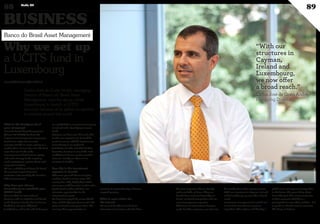
88. Banco do Brasil Asset Management:
Why we set up a UCITS fund in Luxembourg
90. Gérard Hoffmann: Riding the wave
and more
PRIVATE EQUITY
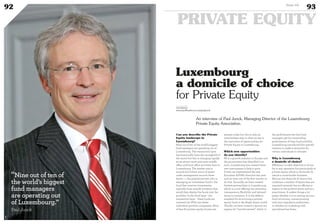
92. Luxembourg a domicile of choice
for Private Equity
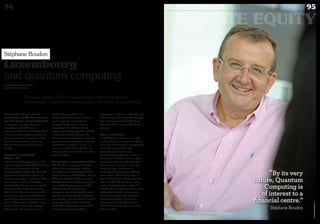
94. Stéphane Boudon: Luxembourg
and quantum computing
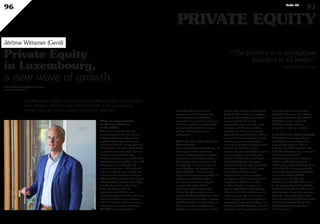
96. Jérôme Wittamer: Private Equity in
Luxembourg, a new wave of growth
INNOVATION
98. Oculus Rift: A technological UFO
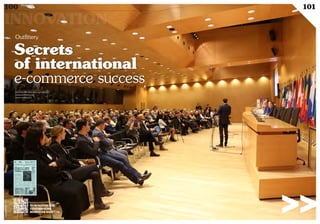
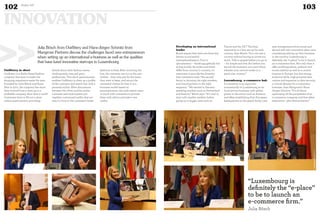
100. Outfittery: Secrets of international
e-commerce success
104. Social Typhoon & Tabloïd:
Inventions that prove their worth
LIFESTYLE
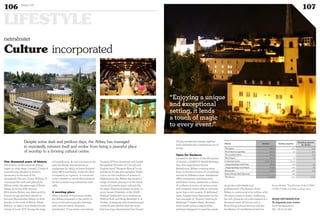
106. neimënster: Culture incorporated
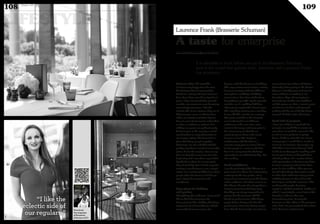
108. Laurence Frank: A taste for
enterprise
110. Slow Food: Fast Briefing
112. Kilian Jornet: Light and fast in the
silence of the mountains
116. Dublin Web Summit: Mind
blowing*!!!
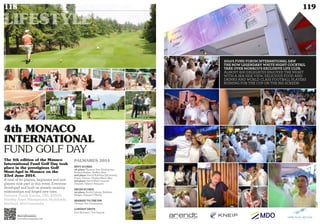
118. 4th Monaco International Fund
Golf Day
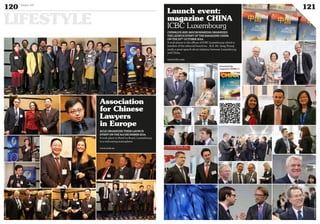
120. Event: Association for Chinese
Lawyers in Europe
121. Launch event: magazine CHINA
ICBC Luxembourg
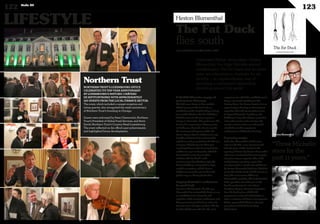
122. Northern Trust event
123. Heston Blumenthal: The Fat Duck
flies south
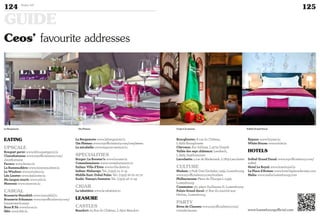
GUIDE
124. Ceos’ favourite addresses
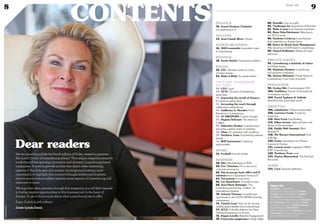
Dear readers
We are proud to publish the fourth edition of Duke, created to promote
the Grand Duchy of Luxembourg abroad. This unique magazine presents
a selection of fast-growing, innovative and dynamic Luxembourg-based
companies. It aims to provide articles that depict other interesting
aspects of this little gem of a country, its intriguing locations, most
importantly, to highlight this country’s thought leaders and business
drivers across various subject matters, some aspects of Luxembourg still
unknown to some.
We hope that after perusing through this magazine, you will feel inspired
to further explore opportunities in this business hub in the heart of
Europe. To get to know more about what Luxembourg has to offer.
Enjoy Duke’s fourth edition!
Josée-Lynda Denis
©360CROSSMEDIA
Duke 04
Publisher: Jérôme Bloch
(jbloch@360crossmedia.com) – Editor
in Chief: Josée-Lynda Denis – Head of
production: Anne-Sophie Théodore
(Studio@360crossmedia.com) – Conception
& coordination: 360Crossmedia – Sales:
care@360crossmedia – Artistic Director:
FranckWidling–CoverPhoto:
360Crossmedia/M.D.–Printrun: 5000 copies
www.duke.lu – Phone: (+352) 35 68 77 –
contact@360crossmedia.com
10
POLITICS
11Duke 04
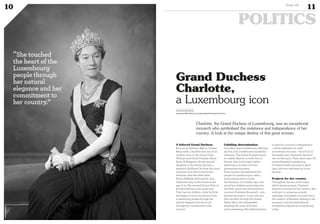
Charlotte, the Grand Duchess of Luxembourg, was an exceptional
monarch who symbolised the resistance and independence of her
country. A look at the unique destiny of this great woman.
Grand Duchess
Charlotte,
a Luxembourg icon
A beloved Grand Duchess
Born on 23 January 1896 in Colmar-
Berg castle, Charlotte was one of six
children born to the Grand Duke
William and Grand Duchess Marie-
Anne de Bragance. As the second
daughter in the family, she had a
peaceful childhood, far from the usual
concerns of an heir to the throne.
However, after her elder sister
Marie-Adélaïde abdicated in 1919,
Charlotte came to the throne at the
age of 23. She married Prince Felix of
Bourbon-Parma in the same year.
They had six children. Little by little,
she began to touch the hearts of the
Luxembourg people through her
natural elegance, but above all
through her commitment to her
country.
Unfailing determination
On 9 May 1940 Luxembourg, although
neutral, was invaded and annexed by
Germany. The Grand Duchess chose
to combat Nazism in exile, first in
France, then in Portugal, before
gathering in London with her
government ministers.
From London, she addressed the
people of Luxembourg by radio,
encouraging them to resist
the Germans. In October 1940, she
joined her children and husband in
the USA, which was still neutral, to
convince President Roosevelt – who
became her friend – to join the war.
She travelled through the United
States like a real ambassador,
pleading the cause of Europe
and Luxembourg. Her determination
to save her country’s independence
– which celebrates its 175th
anniversary this year – bore fruit: in
December 1941, Roosevelt declared
war on Germany. Three years later, US
troops liberated Luxembourg.
Charlotte finally returned in April
1944, and was welcomed as a true
heroine.
Projects for her country
Throughout the rest of her reign,
which lasted 45 years, Charlotte
helped to reconstruct her country. She
took part in numerous summit
meetings, and played a crucial role in
the creation of Benelux, leading to the
economic role and international
recognition enjoyed by Luxembourg
today.
www.monarchie.lu
www.myofficialstory.com/grandeduchessecharlotte
©EDOUARDKUTTER
“She touched
the heart of the
Luxembourg
people through
her natural
elegance and her
commitment to
her country.”
SUCCESS STORY
12 Duke 04
13
Jean-Claude Biver
Cheesewww.myofficialstory.com/jeanclaudebiver
www.hublot.com
©360CROSSMEDIA/M.M.
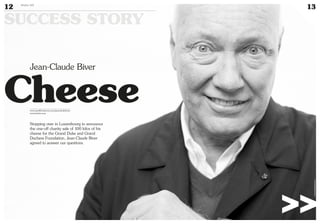
Stopping over in Luxembourg to announce
the one-off charity sale of 100 kilos of his
cheese for the Grand Duke and Grand
Duchess Foundation, Jean-Claude Biver
agreed to answer our questions.
>>
Constructive, creative. Qatar:
hospitality. Absolute generosity, like
everywhere in the Middle East.
Shanghai: the city where everything is
possible, at any time! Los Angeles:
Hollywood, dreams, emotions, and at
the same time Silicon Valley and its
technology. A blend of the rational and
irrational. New York: the city of every
nationality. Taxi drivers, concierges,
waiters. One world on a small
peninsula. Miami: the America of
vacations and reggae. Russia: the
Slavic spirit, full of art, sensitivity, love,
and a love of life and dancing. And the
Chinese: the Italians of Asia! A land of
fantasy, where “everything is possible”.
Exceptional food. Partying. Drinking.
Consuming.
What is your best marketing-
related memory?
The World Cup! Meeting Sepp Blatter,
a Swiss national who also began his
career in watchmaking, thanks to
Michel Pont, the football coach. Or the
advert we did with Bernie Ecclestone
when he had a black eye. He’s a friend
too. The best things are achieved
through relationships. Money is
volatile, friendship is eternal!
You’re a fantastic storyteller. What’s
the moral of the story you have to tell?
Ethics! Truth! Authenticity! Simplicity!
A love of people and traditions! A love
of the planet and nature!
I’d like to start with a game:
I ask you one word, you reply
with one word.
- OK.
- Passion? Love!
- Boredom? Don’t know it.
- Cheese? Watches!
- Bikes? Health!
- Death? Eternity!
- Luck? Work!
- Regret? Don’t know it.
- Innovation? Future!
- Luxembourg? Home country!
- Hublot? My passion!
- Switzerland? My nation!
- Jean-Claude Biver? Doubt.
You’re a citizen of the world.
How would you describe your
fellow citizens?
Ah, I understand! Firstly Japan: the
country of politeness, respect and love.
Love means being respectful and
welcoming and Japan encompasses all
that. Next London, with the world at its
feet. In London, it’s like the whole
world has come together. A tour of the
world, the city that represents the
whole planet. Paris! A nostalgia for
historical greatness. Great monuments.
London also has monuments, but it’s
different there. Geneva: gentle
Switzerland. We call it the French
Switzerland. Zurich? That’s
Switzerland at work. Luxembourg: the
European miracle. Naples: chaos!
SUCCESS
14 Duke 04
15
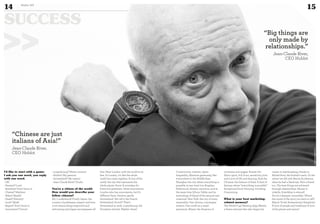
“Chinese are just
italians of Asia!”
Jean-Claude Biver,
CEO Hublot
>> “Big things are
only made by
relationships.”
Jean-Claude Biver,
CEO Hublot
©360CROSSMEDIA/M.M.
16
NATION BRANDING
17Duke 04
Breathtaking performance
360Crossmedia has grown from a
start-up to a profitable company by
delivering amazing performances,
including a website and a 20-page
magazine each in three hours. “Our
company is at the intersection of two
streams of innovation,” says CEO
Jérôme Bloch. “We have invested for
many years in disruptive technology
that empowers our users. AT the same
time, innovations such as DropBox,
Wix and Skype allow us to serve
clients anytime, anywhere, at the
speed of light, for a fraction of the
traditional cost.” Briefly,
360Crossmedia has created a system
involving a stock of more than 3,000
ready-to-use articles and several
hundred templates for websites,
magazines or brochures. Users can
choose to do everything by
themselves or call on assistance from
professional writers, photographers or
designers.
International ambition
Today, 70% of 360Crossmedia’s clients
are in Luxembourg and 30% abroad,
but the ambition for 2015 is to win
more international clients and further
expand turnover. By how much? Says
Bloch: “Plan A is to accelerate our
growth by taking on board one or
more new investors. A business plan
is circulating – in the form of a
magazine, of course! Plan B is to
continue to finance our growth
through cash flow. Either way, the
company keeps growing month by
month.”
 
Making the complicated
simple
So what’s the secret? When most
companies need weeks or months to
create a website or a magazine, how
can 360Crossmedia deliver in three
hours? “It is a matter of technology
and attitude,” Bloch says.
“If a great team is assembled and
everyone meets their deadline,
things can get done extremely fast.
And even if people don’t have the
skills to write themselves, our system
of questionnaires allows us to create
an article within an hour.
Producing a magazine or a website is
technically complicated for beginners,
but not for experts who do it every
day”. The company’s track record is
spectacular – it publishes magazines
in French and English, but also
Chinese, Russian and Arabic.
“We work hard, but our clients
connect us with spectacular decision-
makers: look at our recent interviews
with Donald Trump, Avishai
Abrahami (Wix), Andoni Luis Aduriz
(Mugaritz), Milton Glaser (I love NY)
and Florian Heinemann (Project
A Ventures). We are going to Tokyo
next month for special coverage
of three-star restaurants.”
Innovation is sometimes simpler
than it seems.
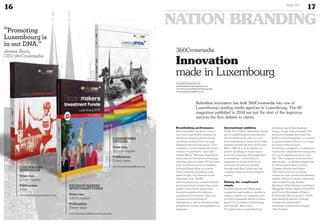
Relentless innovation has built 360Crossmedia into one of
Luxembourg’s leading media agencies in Luxembourg. The 82
magazines published in 2014 are just the start of the ingenious
services the firm delivers to clients.
Innovation
made in Luxembourg
www.360Crossmedia.com
www.luxembourgmonamour.com
www.decisionmakersluxembourg.com
www.luxembourgofficial.com
360Crossmedia
LUXEMBOURG
MONAMOUR
Print run:
3.000 copies
Publication:
2010
www.luxembourgmonamour.com
DECISION MAKERS
INVESTMENT FUNDS
Print run:
3.500 copies
Publication:
Every year
www.decisionmakersluxembourg.com
LUXEMBOURG
OFFICIAL
Print run:
15.000 copies
Publication:
Every year
www.luxembourgofficial.com
“Promoting
Luxembourg is
in our DNA.”
Jérôme Bloch,
CEO 360Crossmedia
Xavier
Bettel
Unswerving
ambitionwww.myofficialstory.com/xavierbettel
>>
©360CROSSMEDIA/M.D.
POLITICS
18 Duke 04
19
©360CROSSMEDIA/M.D.
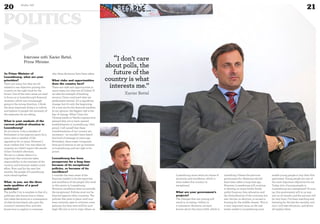
As Prime Minister of
Luxembourg, what are your
priorities?
There are many, but they are all
related to one objective: putting this
country on the right track for the
future. One of the main areas we need
to focus on is Luxembourg’s financial
situation, which was increasingly
going in the wrong direction. I think
the most important thing is to inform
and explain to people the necessity of
the measures we are taking.
What is your analysis of the
current political situation in
Luxembourg?
As you know, I was a member of
Parliament in the majority party for 5
years, then a member of the
opposition for 10 years. However I
must confess that I too was taken by
surprise, as I didn’t expect the results
of last October’s elections.
We are in a phase where it is
important that everyone takes
responsibility in the interests of the
country, and everyone makes a joint
effort. Now, and for the next few
months, the people of Luxembourg
must stand together.
What, to you, are the three
main qualities of a good
politician?
The profile I try to emulate is that of a
politician who knows how to listen,
who takes decisions as a consequence
of what he has heard, who puts the
country’s interests first, and who
knows how to explain to everyone
why these decisions have been taken.
What risks and opportunities
does the country face?
There are risks and opportunities in
many areas, but they are all linked. If
we take the example of banking
secrecy, I have continued what my
predecessor started. It’s a significant
change, but it’s only the beginning:
it’s a new era for the financial markets.
In my opinion, the biggest risk is the
fear of change. When I hear the
Chinese banks or Haribo express how
pleased they are to have opened
establishments in Luxembourg, I feel
proud. I tell myself that these
transformations of our country are
necessary - we wouldn’t have heard
this kind of message 10 years ago.
Nowadays, these major companies
have good reasons to set up business
in Luxembourg, and are right to be
proud.
Luxembourg has been
prosperous for a long time
because of its exceptional
policies, or because of its
excellence?
I consider the main asset of the
financial market to be the expertise
and excellence of the people who work
in this sector in Luxembourg.
However, excellence does not exclude
the exceptional. Policies must not be
directed against other countries. The
policies that were in place until now
were certainly open to criticism, even
jealousy, but they were still fair and
legal. My aim is not to copy others, as
Luxembourg must retain its values of
proximity and excellence, which is
what makes this country so
exceptional.
What are your government’s
projects?
The changes that are coming will
result in us losing 1 billion in
e-commerce. However, we have
known about this since 2006, which is
something I blame the previous
government for. Measures should
have been taken a long time ago.
However, Luxembourg will continue
to develop on many levels: firstly
public finances, then education and
the diversification of the economy, but
also the law on abortion, or access to
housing for the middle classes. This is
a very important issue, as the real
estate market in Luxembourg must
enable young people to buy their first
apartment. Young people are one of
the most important objectives for me.
Today, 20% of young people in
Luxembourg are unemployed! To sum
up, this government will in no way
rest on its laurels, and the autumn will
be very busy. I’ve been watching and
listening for the last few months, and
now I will take decisions, and above
all explain them.
Interview with Xavier Bettel,
Prime Minister.
>> “I don’t care
about polls, the
future of the
country is what
interests me.”
Xavier Bettel
POLITICS
20 Duke 04
21
22
SOCIAL
23Duke 04
How do you think your
organisation has developed?
To be frank, the political situation,
with two national elections and a
change in government, has hardly
given us time to draw breath.
Internally, the change in governance
at UEL has increased the workrate
involved in achieving our ambitious
targets. The setting up of an executive
committee, containing the directors of
UEL’s member organisations, has had
a dynamic effect. The UEL is getting
increasingly better at preparing
various reports in advance, at
pro-active preparation. These changes
are not yet complete, but they are well
on their way. I must say that the
arrival of Jean-Jacques Rommes on 1
May has been good for this area, as he
can now concentrate on these matters.
In general, despite the bad news in
recent times, I think that employer
unity and solidarity is holding up well.
Bad news?
Yes, for businesses. The government’s
cuts in the budget allocated to the
Employers Mutual Insurance Fund
was a shock. This has not yet been
passed, and was certainly not
negotiated. We will continue to fight
to regain the missing 45 million euros,
which is a government commitment.
If we fail, companies’ social security
contributions will rise, but we still
hope to be able to avoid this. Next,
there was a rise in VAT on housing
and on alcohol, yet another surprise
measure. Finally, the arbitrary
decision on indexation and the way it
was reported in the political media
really didn’t do much to help things.
Isn’t the economic situation in
Luxembourg good, compared
to its neighbours?
Yes, but that’s not the problem.
Managing means planning and
although our current situation might
be the envy of a number of European
countries, the trend is not good, and
it’s been like that for 10 years. The
UEL is therefore lobbying for a
reverse in the trend, to protect the
country’s progress. To do this, we
need to carry out reforms soon, before
they are imposed on us by necessity.
Luxembourg has some genuine assets
and is still a country where
entrepreneurship can be successful.
We must not lose this advantage, as
the wealth of our country is essential
to the companies and employees who
work here, a message that must also
be conveyed by politicians.
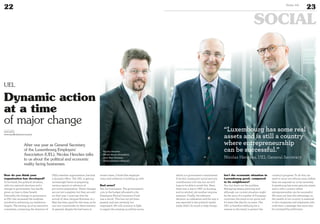
After one year as General Secretary
of the Luxembourg Employers’
Association (UEL), Nicolas Henckes talks
to us about the political and economic
reality facing businesses.
www.uel.lu
www.myofficialstory.com/uel
Dynamic action
at a time
of major change
UEL
©UEL
“Luxembourg has some real
assets and is still a country
where entrepreneurship
can be successful.”
Nicolas Henckes, UEL General Secretary
Nicolas Henckes,
Michel Wurth (Président),
Jean-Marc Rommes
(Administrateur délégué).
24
SOCIAL
25Duke 04
The History of Make-A-Wish®
Make-A-Wish® was founded in
Phoenix, Arizona in the USA in 1980.
It’s sole purpose is to grant the wishes
of children with life-threatening
medical conditions “to enrich the
human experience with hope, strength
and joy”.
Families, friends, medical
professionals and communities can be
touched by the simple, innocent wish
of a child. A wish sends a positive
message of hope, strength and joy to a
child when they need it most. The wish
experience has the power to re-ignite
the flames of life, creating a journey of
optimism for a child and their family.
Typically children’s wishes fall in to
four categories: To Be: a fire-fighter, a
policeman …, To Meet: a favorite
celebrity or athlete …, To Have: a
computer, a playhouse, a puppy … and
To Go: to a theme park or a major
sporting event…
Since its inception, the 50 worldwide
Make-A-Wish® affiliates have
collectively granted the wishes of
nearly 300.000 children with life-
threatening medical conditions around
the world.
The History of Make-A-Wish
Luxembourg
The Luxembourg affiliate of Make-a-
Wish® International was founded in
2012, at the inspiration of two people;
Marcel Hagendoorn, who is currently
the President and CEO of the
Association and David Micallef, who
both had the idea of writing to the
Phoenix based head office to enquire
about how to start a Luxembourg
affiliate at exactly the same time.
Neither of them knew each other
previously, but once they found out
that they had a common mission, they
decided to join forces to establish the
Charity, recruit a number of other
willing volunteers and between all of
them to raise the initial seed money
from the kind donations of many of
their friends and colleagues. These
initial donators became part of the
founding ‘Club 100’ of the Charity and
enabled it to launch and grant its first
wishes.
Since granting its first wish at the
beginning of 2013 the Charity has
granted over 10 wishes, with many
more currently being planned.
Keeping everything running has been
made possible by over sixty
volunteers and the Charity has
become well known for some of the
events that it organises each year: the
most notable of these events being the
Concours d’Elegance, which is 2 day
classic car and motorbike show that
takes place in the Mondorf Parc
Thermale each last weekend of
August and attracts some 7,000
visitors.
Future events for 2015
The volunteer team are currently
planning the wishes of another 10
children between the end of this year
and well into 2015.
Plans are also being made already for
next August’s Concours d’Elegance,
which we will hope will be even
bigger and better than both previous
years and will attract a further
increase in visitors, so that we can
grant even more wishes in 2016.
During late 2015, the Charity will hold
its second prestigious Gala event,
where we honour those that have
either donated or volunteered and we
provide an update to all on the years
activities.
In addition there will be a number of
ad hoc fundraising events in various
locations around Luxembourg, such
as Cite Concorde; these help us not
only raise money for the children, but
also spread the awareness of our work.
If anyone reading this is interested
in donating or volunteering,
we would be delighted to tell you how
you can help by contacting us on
info@make-a-wish.lu.
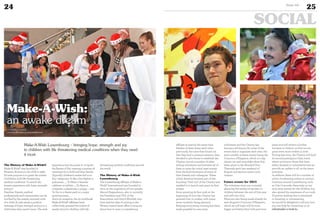
Make-A-Wish Luxembourg – bringing hope, strength and joy
to children with life threatening medical conditions when they need
it most.
Make-A-Wish:
an awake dream
www.make-a-wish.lu
www.myofficialstory.com/makeawish
©MAKE-A-WISHLUXEMBOURG
THOUGHT
LEADERSHIP
FACTORY
27
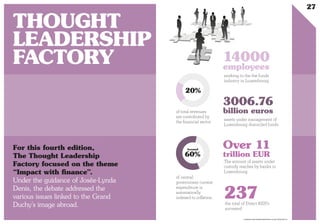
For this fourth edition,
The Thought Leadership
Factory focused on the theme
“Impact with finance”.
Under the guidance of Josée-Lynda
Denis, the debate addressed the
various issues linked to the Grand
Duchy’s image abroad. the total of Direct REIFs
surveyed
of total revenues
are contributed by
the financial sector
of central
government current
expenditure is
automatically
indexed to inflation.
working in the the funds
industry in Luxembourg
assets under management of
Luxembourg domiciled funds
The amount of assets under
custody reaches by banks in
Luxembourg
237
14000
employees
3006.76
billion euros
Over 11
trillion EUR
20%
Around
60%
© SOURCES: (IMF COUNTRY REPORT NO. 14/119), WWW.ALFI.LU
THOUGHT
LEADERSHIP
FACTORY
28 Duke 04
29
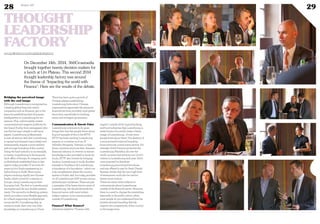
On December 14th, 2014, 360Crossmedia
brought together twenty decision makers for
a lunch at Um Plateau. This second 2014
thought leadership factory was around
the theme of “Impacting the world with
Finance”. Here are the results of the debate.
Bridging the perceived image
with the real image
Although Luxembourg is recognised as
a leading global financial centre,
companies such as Amazon, get in the
press for establishing their European
headquarters in Luxembourg for tax
reasons. This, unfortunately, creates
unwarranted and negative publicity for
the Grand Duchy, from newspapers who
use this hot topic simply to sell more
papers. Luxembourg professionals,
across all sectors, feel that Luxembourg
is named and shamed inaccurately and
subsequently, request a more realistic
and stronger branding of the country.
Using the fund industry as an example,
in reality, Luxembourg is the financial
back office of Europe. A company, such
as Multifonds established here in late
1990’s, today, provides IT services for
some 20,000 funds representing 30
billion Euros in AuM. More recent
players evolving rapidly are Chinese
banks, which invest for 2 reasons in
Europe, using Luxembourg as their
European hub. The first is Luxembourg’s
tax regime and the non-double taxation
treaty. The second is its Banking system,
which provides a more flexible approach
for a Bank supporting its subsidiaries
across the EU. Considering that, as
recent as 2006, there was very little
knowledge on Luxembourg in China.
There has been quite a growth of
Chinese players establishing
Luxembourg hubs since! Chinese
organisations appreciate the optimum
financial services provided, local global
know-how, specifically its banking
sector and stringent governance.
Communication & Savoir Faire
Luxembourg continues to do great
things that very few people know about.
A good example of this is the ATTF.
ATTF has been sending Luxembourg
experts, to countries such as, El
Salvador, Mongolia, Vietnam, to help
those countries structure their domestic
financial industry. In reverse, to ensure
knowledge is also provided to locals by
locals, ATTF also invests by bringing
locals to Luxembourg to study. Another
example is Fondation de Luxembourg -
a foundation of a foundation – which not
only complements where the country
assists in Public Aid, but today, provides
1% of Luxembourg’s GDP across various
philanthropic initiatives. These are just
2 examples of the lesser-known areas of
Luxembourg. We should diversify the
financial sector with more holistic
subject matters, in its communication
outside of Luxembourg.
Finance? What finance?
Initiatives related to “Finance with
impact”, outside of the typical banking
and fund industries that Luxembourg is
better known for, would create a better
image of Luxembourg… if only more
people knew about them! The absence of
a more powerful national branding
hurts everyone, across many sectors. For
example, Erich François promotes the
Luxembourg Marathon all over the
world, an event that attracts over 10,000
visitors to Luxembourg each year. Erich
once proposed to distribute
Luxembourg promotional brochures
and was offered to pay for them! Daniel
Rameau thinks that the very high level
of restaurants could also be used to
attract more visitors.
These are many other subjects to
communicate about Luxembourg,
outside of the financial sector. However,
there is a need to change the mentalities,
especially in the public sector, where
most people do not understand how the
limited national branding directly
impacts the competitivity of the country
in the longer term.
www.myofficialstory.com/thoughtleadershipfactory
©360CROSSMEDIA/R.P.
THOUGHT
LEADERSHIP
FACTORY
30 Duke 04
31
www.attf.lu
Read the other article “Fostering risk management excellence in micro finance”
www.myofficialstory.com/attf
©ATTF
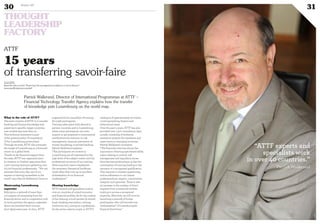
Patrick Wallerand, Director of International Programmes at ATTF –
Financial Technology Transfer Agency explains how the transfer
of knowledge puts Luxembourg on the world map.
15 years
of transferring savoir-faire
What is the role of ATTF?
The main mission of ATTF is to transfer
banking and finance knowledge and
expertise to specific, target countries,
now numbering more than 40.
This technical assistance is part
of the general policy of cooperation
of the Luxembourg government.
Through its work, ATTF also promotes
the image of Luxembourg as a financial
centre on a global level.
Thanks to the financial support from
the state, ATTF has organised since
its creation in October 1999 more than
1,300 training seminars gathering over
25,000 financial professionals. “We can
estimate that every day one of our
experts is training somewhere in the
world”, says Patrick Wallerand, Director.
Showcasing Luxembourg
expertise
Relying on a network of more than
120 experts all emanating from the
financial sector, and in cooperation with
its local partners, the agency organises
about one hundred short courses
(3-10 days) every year. In 2014, ATTF
organized 8,004 man/days of training
for 2,256 participants.
Training takes place both abroad in
partner countries and in Luxembourg
where some participants can even
acquire or get prepared to international
certifications for instance in risk
management, treasury, prevention of
money laundering or private banking.
Patrick Wallerand explains:
“The participants we receive in
Luxembourg are all impressed by the
high level of the subject matter and the
professional structure of our training
where practical cases complement
the necessary theoretical backbone.
Quite often they turn up as excellent
ambassadors of our financial
marketplace.”
Sharing knowledge
ATTF experts and specialists work in
over 40 countries of mixed economic
and financial profiles. As for the content
of the training, a local partner (a central
bank, banking association, training
institution, etc.), acting as a spokesman
for the sector, selects a topic in ATTF’s
catalogue of approximately 50 events,
covering banking, finance and
behavioural areas.
Over the past 5 years, ATTF has also
provided over 1,300 consultancy days,
usually consisting of technical
assistance projects for regulators and
supervisors in emerging countries.
Patrick Wallerand comments:
“The financial crisis has shown the
importance of having specialised skills;
topics relating to control, risk
management and regulatory issues
have become predominant, as has the
continuation of training leading to the
issuance of a recognised qualification.
This requires a constant questioning,
and an adherence to our values:
professionalism, respect, commitment,
integrity and openness. There is also
an increase in the number of direct
requests from commercial entities
wishing to access a recognised
expertise. Moreover, we will soon be
launching a network of former
participants, who will become true
“ambassadors” of Luxembourgish
financial know-how.”
ATTF
“ATTF experts and
specialists work
in over 40 countries.”
Patrick Wallerand
THOUGHT
LEADERSHIP
FACTORY
32 Duke 04
33
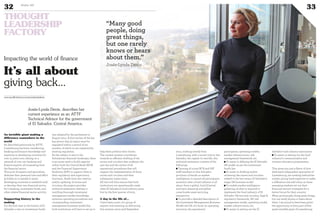
Josée-Lynda Denis, describes her
current experience as an ATTF
Technical Advisor for the government
of El Salvador, Central America.
It’s all about
giving back...
An invisible giant making a
difference somewhere in the
world
As described previously by ATTF,
Luxembourg has been transferring
banking and finance knowledge and
expertise to developing countries for
over 15 years now, relying on a
network of over 120 banking and
finance experts, all emanating from
the financial sector.
This pool of experts and specialists,
dedicate their personal time and effort
(a hobby so to speak) to assist
developing countries to establish and/
or develop their own financial sector,
be it banking, investment funds, and
other related financial sector activity.
Supporting history in the
making
For the first time in the history of El
Salvador, a law on investment funds
was adopted by the parliament in
August 2014. A first review of the law
has shown that 52 topics must be
regulated within a period of six
months, of which 21 are impacted by
existing regulation.
As the subject is new to the
Salvadorian financial landscape, there
is an acute need to build capacity
within both the Central Bank (BCR)
and the Financial Supervisory
Authority (SSF) to support them in
their regulatory and supervisory
functions. Aside from the creation
and/or updating of norms and
circulars, the project provides
technical assistance relating to
instilling thorough investment
management market knowledge,
optimum operating procedures and
corresponding investment
management business model that
both institutions will have to set up to
help them perform their duties.
The current mission contributes
towards an efficient drafting of the
norms and circulars that underpin the
new law and the review of all
operational procedures that will
support the implementation of those
norms and circulars and their
subsequent supervision.
All this will thus ensure that both
institutions are operationally ready
when El Salvador’s fund industry goes
live by the first quarter of 2015.
A day in the life of...
I have been a part of a group of
experts and assisting on delivering
this mission since mid-September
2014, working mostly from
Luxembourg, with a recent visit to San
Salvador, the capital. In real life, this
technical assistance consists of the
following:
 Training of a joint BCR and SSF
staff members in San Salvador:
provision of hands on market
intelligence, to ensure all participants
ascertain what a fund industry is all
about: from a global, local (Central
and Latin America) and global
cross-border asset servicing
perspective
 To provide a detailed description of
the Investment Management Business
Model: the life of a fund, its operating
structure, the operational
participants, operating models,
market infrastructure, risk
management framework, etc.
 To assist in defining the El Salvador
IM model, as per the investment
fund’s law
 To assist in drafting and/or
reviewing the norms and circulars
related to the law versus El Salvador’s
target IM business model
 To enable market intelligence
gathering of what is required to
implement the fund industry of El
Salvador: Norms and circulars, legal &
regulatory framework, IM risk
management model, operating model,
market infrastructure, etc.
 To assist in setting out the El
Salvador fund industry association
 To assist in setting out the fund
industry’s communication and
investor education programmes
This gives you just a flavor of how
dedicated independent specialists of
Luxembourg, are working behind the
scenes, giving back expertise to make
a difference and add value, as these
emerging markets set out their
financial sectors’ strategies for a
better future for their country.
Many good people, doing great things,
but one rarely knows or hears about
them. I am proud to have been given
the opportunity to form part of this
great invisible giant of Luxembourg.
www.myofficialstory.com/joseelyndadenis
Impacting the world of finance
©360CROSSMEDIA
“Many good
people, doing
great things,
but one rarely
knows or hears
about them.”
Josée-Lynda Denis
THOUGHT
LEADERSHIP
FACTORY
34 Duke 04
35
Increasing the
reach through
collaborative
philanthropy
S
ince ten years we are seeing
more and more collaborations
between foundations. It is
about finding synergies and
sharing best practices in order to
maximize the impact of the
engagement. Working with other
foundations at different levels further
enables the founders to deepen their
field knowledge and benefit from a local
support system to implement and follow
up on projects, while at the same time
broadening the scope of opportunities
and providing a holistic approach to the
missions that are carried out. One of the
key challenges for effective
collaborations is to find adequate
partners that share common values and
goals. In order to facilitate such
collaborations, the Fondation de
Luxembourg organizes regularly round
tables with the founders of the
foundations under its aegis. The
participants of each roundtable all share
a common theme. This can for example
be the theme of family foundations,
corporate philanthropy or foundations
active in the academic area. The latest
roundtable was organized by the
Fondation de Luxembourg in October
2014 and involved a dozen founders of
foundations active in the area of culture
and art. The intention was to contribute
to the exchange and the opportunity to
share experiences and explore different
approaches to philanthropy.
One of the conclusions of the
discussions among the philanthropists
was that in the current climate of
lacking trust, art is an excellent way to
make the connection between the
different groups of a multicultural
society. To quote one of the participants:
“You have to wake people up, so that
they look themselves in the mirror and
thereby also gain respect for others. The
event which was held at the
Luxembourg club House 17 was followed
by a walking lunch during which the
discussions between the founders
continued in a less formal way.
Patrice Lucas, who created the Loo&Lou
Foundation together with his partner,
herself an artist two years ago was
among the participants of this
roundtable. The theme of their
foundation reflects very well the above
conclusion of the roundtable. The Loo &
Lou Foundation’s intention is to
contribute to a better world by creating
more links between people, in a society
where the lack of understanding of each
other’s perspectives is generating more
violence, more crises and more conflicts.
The Loo & Lou Foundation is a direct
reference to this purpose of forming new
links to make more sense: a link from
the Extreme Orient (“Loo”) to the
Western world (“Lou”), a link between
the Southern and the Northern
hemispheres, a link between tradition
and modernity, a link between religion
and secularism and a link between
human beings, all the same but each
different.
The founders of the foundation believe
that the act of Art Creation and
Contemporary Art are two very
powerful vehicles that serve great
purposes. Contributing to their
promotion has a direct impact that
generates more links between people.
In this perspective the foundation
supports artists, events and projects
with the aim of stimulating the desire to
discover, understand, create and get
involved in creative design and
contemporary art.
To illustrate this with some examples,
during the first two years of its
existence, the Loo & Lou Foundation has
supported a number of emerging artists
in conjunction with the famous annual
“Nuit Blanche” event in Paris. Patrice
Lucas and his partner have
acknowledged the lack of supporting
structures and funding opportunities for
emerging artists, who are therefore very
limited in the development of their
artistic projects. In the long term they
believe that this may well impact the
future of Contemporary Art as such.
Another more local project, which is just
being initiated is the ArtFreaks project
in collaboration with the Luxembourg
museum of modern art, Mudam. The
purpose of this three-year project is to
allow young people to be inspired by
contemporary art by exposing them
directly to artists and other
professionals in the area.
www.fdlux.lu
www.myofficialstory.com/tonikahirdman
©FONDATIONDELUXEMBOURG
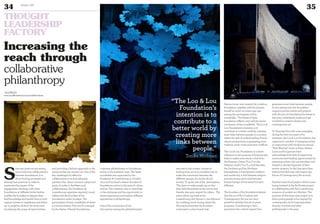
“The Loo & Lou
Foundation’s
intention is to
contribute to a
better world by
creating more
links between
people.”
Tonika Hirdman
>>
36 Duke 04
37
THOUGHT
LEADERSHIP
FACTORY
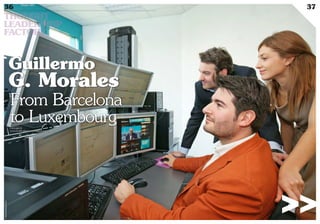
Guillermo
G. Morales
From Barcelona
to Luxembourgwww.ggm.lu
www.myofficialstory.com/guillermomorales
©360CROSSMEDIA/SE.M.
What are GGM Capital’s
Activities?
We are something simliar to what they
call in the U.S. a boutique investment
bank, headquartered in Luxembourg
with offices in Barcelona, New York
and London. Our three main divisions
are investment management through,
a SICAR vehicle; corporate finance,
with transactions mainly in European
IT; and our trading activities,
enhancing liquidity to Nasdaq-listed
companies. Our first venture capital
fund was the GGM High Growth IT
Fund. We have launched a second
fund focusing on disruptive tech
company based in Latin America
Tech. We are working in a third fund
that will focus on the hospitality sector
in Europe, investing in distressed
opportunities in the hotel sector.
What kind of investments do
you make?
The investment focus of GGM High
Growth IT Fund is on early-stage
companies that have the potential to
be disruptive and game changers but
that already show traction in the
market. A prime example is
Optimitive, a highly disruptive
technology company that saves its
customers up to 20% on industrial
energy bills. They have over three
years of R&D, employ 15 people across
Luxembourg, Spain and Germany
and already generating revenues.
The company received €1.4m from
us to support further sales and
marketing developments. We are also
assisting Optimitive with structuring,
financing and growth, and will
support them for the next four years
in becoming the global leader in
the sector.
Why did you set up your group
in Luxembourg?
I moved to Luxembourg in 2008 and
I brought in 2010 my family to have
the right platform both for my
personal investments and for GGM
Capital. The fund’s management team
is headquartered in Luxembourg.
We looked at different jurisdictions
but soon realised that no other country
could compete in offering an
environment that benefited the fund,
our investors and portfolio companies
so positively. We certainly encourage
our portfolio companies to consider
establishing their headquarters and
operations in Luxembourg and to
benefit not only from its IP regime
but from its friendly business oriented
enviroment. On a personal note,
I have recently invested in an exciting
project that is going live very soon: a
restaurant designed by internationally
renowned designer Lazaro Rosa
Violan with the support of a 2
Michelin star chef. This investment is
a way for me to support the
Luxembourg economy and share the
culture of my Spanish roots.
What is your ackground?
I founded my first company when
I was 17 and have spent my career so
far investing in start-ups particularly
in the security space, such as
biometrics and electronic signatures.
I first looked to raise money from
government to fund R&D projects,
but later decided to create a vehicle
to invest in these projects at a higher
level. As far as I know, I was one
of the youngest persons to establish
a fully-regulated venture capital
fund in Europe, at the age of 27
(I’m now 29). There’s a reason for that:
it normally takes some time to acquire
the IT and venture capital experience
you need. I’m lucky I started so young
and have built a solid team around me
for many years. 
He moved to Luxembourg with his family in 2010. Then
he headquartered his company here and now he is investing
heavily in the Grand Duchy. Portrait of a Businessman
who keeps Luxembourg strong.>>
38 Duke 04
THOUGHT
LEADERSHIP
FACTORY
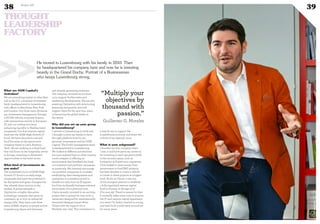
“Multiply your
objectives by
thousand with
passion.”
Guillermo G. Morales
39
©360CROSSMEDIA/SE.M.
©360CROSSMEDIA/MA.S.
Dowload
the magazine
Collector’s
zoneno
 1
40 Duke 04
41
THOUGHT
LEADERSHIP
FACTORY
What will change with the
opening of the Freeport?
The impact will be on two different
levels, the first relating to benefits for
Luxembourg. The Freeport contributes
to the diversification of our economy
and enriches it both as a financial
centre and a logistics platform. The
financial industry can now offer a
wider range of wealth management
services including management of
valuable physical assets. The Freeport
will also enhance Luxembourg Airport
as a major hub for transportation,
handling and storage of valuables.
On a second level, it will add value to
the world of art and precious objects in
general. Our facility incorporates
cutting-edge technology to ensure the
safety and security of stored goods.
Our basement features infrastructure
superior to that of any bank in
Luxembourg, including the Central
Bank. Nowhere in the world will you
find a hub combining a perfect
location in a stable country, adjacent to
a major air cargo hub and with direct
access to the European motorway
network, with a tailor made, secure
complex designed to facilitate logistics
flows and safeguard the capital value
of stored goods. In addition, our
building is in itself a work of art, the
product of Italian and American
designers, and respects the most
demanding standards of
sustainability, including low energy
consumption.
Which services do you offer?
Professionals and craftsmen will offer
end customers a broad range of
high-value services related to their
precious assets. Logistic companies
and other professionals provide on site
services in areas including
transportation, custom formalities,
packaging, restoration, scientific
analysis and insurance, photography,
valuations, condition reports, expert
advice, etc… Artworks and other
valuables can be displayed in one of
our showrooms for the pleasure of
their owners, family, friends or
possible purchasers (transactions in
the Freeport are VAT-free). Few of
these services and facilities are
available in art warehouses, at least
not on the same scale.
Who can use the Freeport?
The operators of the Freeport are
logistics companies specialising in
transportation, handling, and storage
of valuables that are tenants of the
facility and are licensed by the
Administration des Douanes et
Accises – a level of control not found
in other Freeports.
Our legislation also foresees a system
of total traceability of stored goods.
Our end-customers are collectors,
galleries, museums, foundations,
investors and anyone else requiring
secured storage and physical asset
management services.
What are your plans for the
Freeport over the next decade?
We are starting today with 11,000
square metres of rentable surface are. I
hope that within the next 10 years we
are not only planning but building an
extension of the facility.
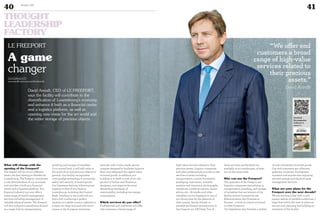
David Arendt, CEO of LE FREEPORT,
says the facility will contribute to the
diversification of Luxembourg’s economy
and enhance it both as a financial centre
and a logistics platform, as well as
opening new vistas for the art world and
the wider storage of precious objects.
www.luxfreeport.lu
www.myofficialstory.com/davidarendt
A game
changer
LE FREEPORT “We offer end
customers a broad
range of high-value
services related to
their precious
assets.”
David Arendt
>>
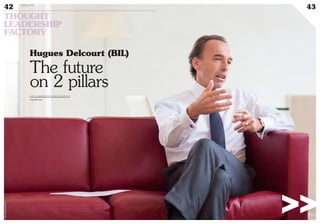
Hugues Delcourt (BIL)
The future
on 2 pillars
www.myofficialstory.com/huguesdelcourt
www.bil.com
©360CROSSMEDIA/M.M.
42 Duke 04
43
THOUGHT
LEADERSHIP
FACTORY
After a career in the Grand Duchy, Europe and Asia, Hugues
Delcourt has just taken up his post as the CEO of the BIL
(Banque Internationale à Luxembourg) Group. Interview.
What are the challenges
that a bank like BIL faces
today?
I can identify three: first, the
economic and financial environment.
I lived 17 of the last 25 years in Asia,
where the economic environment is
different. Here, growth is low and
although Luxembourg is doing very
well, its 2013 GDP is merely equal to
that of just before the crisis. The very
low rates help neither investors nor
banks. In this situation, banks must
find new growth opportunities, by
identifying their specific strong
points, niche areas where they can
really bring value to their customers,
and focus on those. The times of being
“everything to everyone, everywhere”
are over. The second challenge:
regulatory changes. The automatic
exchange of information is an
extraordinary opportunity for
Luxembourg, but the high rate of
ongoing regulatory changes is a
challenge. The deadlines are so short
that I sometimes see contradictions in
the reforms, not to mention the risk
that the costs associated with the new
regulations pose to the
competitiveness of banks. And the
last challenge: communication. We
must bolster the image of the
profession and the country by
explaining the fundamental role of
banks in the economy.
What are your priorities as
the new CEO of the BIL
Group?
I think we need to focus on our two
great pillars for which we have a
“right to win”. The geographical pillar,
focused on the Grand Duchy, where
we do four things: private banking,
retail banking, services to SMEs and
corporations as well as financial
markets. The strength of a multi-
business bank like BIL is being able to
meet the most diverse needs of our
customers. The other pillar, outside
the Grand Duchy, is focused on a
niche strategy in private banking. The
world is vast. We must stay focused
on non-residents and provide
solutions for them from Luxembourg
or other centres such as Dubai and
Switzerland. Our current thinking
- BIL 2020 - defines our ambitions and
vision, with all that this implies for
our various businesses. It amounts to
building the 2nd and 3rd floors of a
beautiful house with a strong
foundation. Our anchor in
Luxembourg is essential: we must
strengthen it further and promote it
internationally.
What opportunities do you see
for Luxembourg in the
medium term?
I see two: first internationally, where
Luxembourg must continue to invest
in its differentiation. We are the
world’s second fund centre, with over 3
trillion euros of deposits. I think we
have to continue to invest in the
supporting ecosystem, consisting of
banks, authorities and other service
providers. For this, we must promote
quality and be more decisive in the
way we sell the country. The university
is a good example of a proactive
approach that must be repeated in all
areas. For the rest, the country must
make its communication more
incisive. Luxembourg for Finance is
doing a great job, but in my view, these
are all components of the economic
fabric that must join forces and act
collectively. The English saying “the
whole is more than the sum of its
parts” is particularly appropriate in
our country.
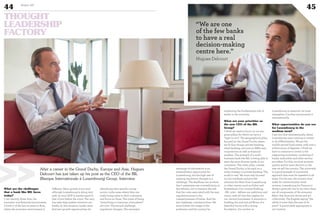
“We are one
of the few banks
to have a real
decision-making
centre here.”
Hugues Delcourt
©360CROSSMEDIA/M.M.
44 Duke 04
45
THOUGHT
LEADERSHIP
FACTORY
>>
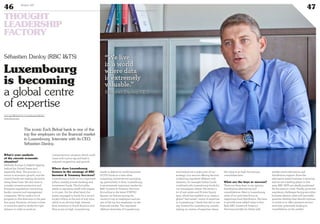
The iconic Esch Belval bank is one of the
top five employers on the financial market
in Luxembourg. Interview with its CEO,
Sébastien Danloy.
Luxembourg
is becoming
a global centre
of expertise
What’s your analysis
of the current economic
situation?
Globally, Europe is slightly lagging
behind the United States and
especially Asia. The priority is a
return to economic growth, and the
central banks are making decisions
along these lines. We also have to
consider investor protection and
European regulations concerning
banks, insurers and management
companies. We’ve made a lot of
progress in this direction in the past
five years. However, we have to bear
in mind the need to strike the right
balance in order to avoid an
‘overprotection’ situation which could
come with a price tag and lead to
reduced competition and growth.
Where does Luxembourg
feature in the strategy of RBC
Investor & Treasury Services?
Luxembourg is built on two important
pillars, namely private banking and
investment funds. The first pillar
needs to reposition itself with respect
to its past. On the other hand, the
assets managed in funds hit a record
€2,900 billion at the end of July 2014,
which is an all-time high. Interest
from investors in South America and
Asia is just as high. Luxembourg
needs to defend its world-renowned
UCITS funds at a time when
competing initiatives are springing
up, particularly in Asia. Luxembourg
is an extremely important market for
RBC Investor & Treasury Services.
According to the latest STATEC
figures, we feature among the
country’s top 20 employers and are
one of the top five employers on the
financial market. The regulated
offshore domiciles of Luxembourg
and Ireland are a major part of our
strategy. Our service offering favours
combining regulated offshore with
domestic, for example Italian funds
combined with Luxembourg funds for
our transalpine clients. We attract a
lot of real estate and Private Equity
here, which has enabled us to create a
global “real estate” centre of expertise
in Luxembourg. I think that this is one
way forward for Luxembourg, namely
relying on centres of expertise where
the value is so high that groups
consolidate here.
What are the keys to success?
There are three keys in my opinion:
distribution, alternatives and
consolidations. Here in Luxembourg,
some of our activities focus on
supporting fund distribution. We have
to provide more added value in this
field. RBC Investor & Treasury
Services provides its clients with
market trend information and
distribution support. Since the
alternative assets business is growing
and we are a leading player in this
area, RBC I&TS are ideally positioned
for the years to come. Finally, given the
regulatory challenges facing securities
business players, some will inevitably
question whether they should continue
to invest in or offer investors service
activities, potentially leading to
consolidation on the market.
www.myofficialstory.com/sebastiendanloy
www.rbcits.com
Sébastien Danloy (RBC I&TS) “We live
in a world
where data
is extremely
valuable.”
Sébastien Danloy, CEO
©360CROSSMEDIA/M.J.
46 Duke 04
47
THOUGHT
LEADERSHIP
FACTORY
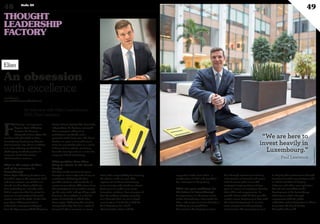
An interview with Elian Luxembourg’s
CEO, Paul Lawrence.
F
ollowing a management
buyout, Ogier Fiduciary
Services has become
independent from Ogier the
law firm and rebranded as Elian.
Luxembourg-based group director
Paul Lawrence says Elian’s ambition
is to raise industry standards by
challenging standard practice in
corporate, fund and trustees
administration services.
What is the origin of Elian
and of its presence in
Luxembourg?
Elian: Ogier Fiduciary Services was
formed in 1999 as the corporate, fund
and trust services arm of Channel
Islands law firm Ogier, which was
then embarking on a decade and a
half of expansion that has given it a
presence in international financial
centres around the globe. Earlier this
year Ogier Fiduciary Services
undertook a management buyout
from the Ogier group with backing from
Electra Private Equity PLC. Now fully
independent, the business renamed
Elian comprises offices in 10
jurisdictions worldwide and a
specialist staff of over 500. The firm’s
decision to open in Luxembourg in
2013 was essentially taken as a result
of demand from clients, stemming
from the country’s role as a centre for
corporate & fund structuring.
What qualities does Elian
bring to clients in the Grand
Duchy?
The firm stands out from its peers
through an almost obsessive focus on
excellences: delivering the best
possible solutions and standards of
service to our clients. This stems from
the commitment of our staff to always
‘go the extra mile’ and get things right
first time. Our ambition is to be the
setter of standards to which other
firms aspire. Achieving this involves
strong leadership, but also a spirit of
teamwork where everyone, at every
level, takes responsibility for ensuring
the client’s needs are met. That
requires all of Elian’s client-facing
teams to truly understand our clients’
businesses to enable us to create
innovative solutions. Two examples of
how the problem-solving mentality
runs through Elian are an in-depth
examination of 20 banks to find the
ideal depositary for a fund
administration client, and the
suggestion of the name Elian - a
combination of ‘elite’ and ‘guardian’ -
by a colleague in Hong Kong.
What are your ambitions for
the future in Luxembourg?
Its importance as a business centre
makes Luxembourg a key market for
Elian, and we plan to invest heavily in
building up our capabilities.
Paramount is developing our team
here through recruitment, training
and retention of talented and expert
staff. A central pillar of our HR
strategy is implementing training
plans to ensure all employees develop
their skills and competencies. To
provide clients with the best possible
service means keeping up to date with
the latest developments in an ever
more complex tax and regulatory
environment. We must play our part
in shaping that environment through
involvement with organisations such
as LPEA and ALFI in helping
influence and refine new legislation.
We will also contribute to the
development of the Luxembourg
industry as a whole through
engagement with the public
authorities and participation in efforts
to promote the Grand Duchy
throughout the world.
www.elian.com
www.myofficialstory.com/Paullawrence
“We are here to
invest heavily in
Luxembourg.”
Paul Lawrence
An obsession
with excellence
Elian
©360CROSSMEDIA/M.M.
48 Duke 04
49
THOUGHT
LEADERSHIP
FACTORY
50 Duke 04
51
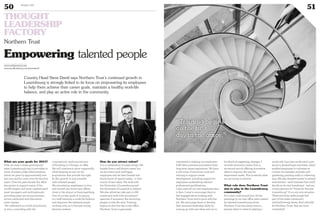
Country Head Steve David says Northern Trust’s continued growth in
Luxembourg is strongly linked to its focus on empowering its employees
to help them achieve their career goals, maintain a healthy work-life
balance, and play an active role in the community.
Empowering talented people
What are your goals for 2015?
First, we want to keep growing and
enter Luxembourg’s top 10 providers in
terms of assets under administration,
which we grew by approximately 20%
last year and by 140% over the last five
years. Over the past decade the office
has grown to support many of the
world’s largest and most sophisticated
asset managers and multinationals
providing asset servicing solutions
across traditional and alternative
asset classes.
We celebrated our tenth anniversary
in 2014, coinciding with the
corporation’s 125th anniversary
of founding in Chicago, in 1889.
We will continue to grow organically
while keeping an eye out for
acquisitions that provide the right
fit. But growth is only possible
with talented people.
We recruited 54 employees in 2014
and moved into brand new offices
close to the airport at Senningerberg.
One of our key goals is to ensure
our staff maintain a work-life balance
and empower the talented people
working with us to become strong
decision makers.
How do you attract talent?
It is a combination of many things. We
benefit from a well-known name, but
we also have loyal and happy
employees who let their friends and
family know of opportunities – a vital
source of new talent. We work with
the University of Luxembourg and
the University of Limerick in Ireland.
We also advertise, take part in HR
events and work with recruitment
agencies if necessary. But attracting
people is only the start. Training
begins on the first day in the office.
Northern Trust is genuinely
committed to helping our employees
fulfil their potential and achieve their
long-term career aspirations. We have
a rich array of resources, tools and
training to support career
development, including support for
employees undertaking relevant
professional qualifications.
I also meet all our new employees face
to face. I want to encourage them to
feel engaged about working with
Northern Trust and to grow with the
job. We encourage them to develop
their personal leadership skills by
coming up with new ideas and not to
be afraid of suggesting changes. I
recently received a memo from a
six-month recruit offering innovative
ideas to improve the way his
department works. This is exactly what
we are trying to achieve.
 
What role does Northern Trust
aim to play in the Luxembourg
community?
For a start, look around you: all the
paintings in our new office were created
by talented Luxembourg artists.
Northern Trust has always been a
pioneer when it comes to playing a
social role. Last year we devoted 1,500
hours to philanthropic activities, which
enabled employees to volunteer at
Caritas, for example, and help with
gardening, painting walls or collecting
toys. We also donated money to several
associations – each business line could
decide on its own beneficiary - and are
a main sponsor for “Dress for Success
Luxembourg”. It is a win-win situation.
These activities make people feel
part of the wider community
and build strong teams. And critically
for Northern Trust, they are more
committed!
www.northerntrust.com
www.myofficialstory.com/stevedavid
Northern Trust
©360CROSSMEDIA/M.M.
“Training begins
on the first
day in the office.”
Steve David
THOUGHT
LEADERSHIP
FACTORY
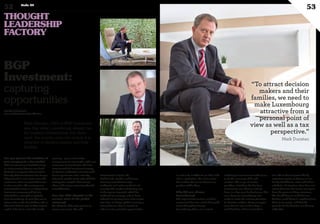
Mark Dunstan, CEO of BGP Investment,
says that while Luxembourg already has
the business infrastructure that firms
need, the country must also ensure it is
attractive to decision-makers and their
families.
BGP
Investment:
capturing
opportunities
Can you present the activities of
your company in a few words?
BGP Investment was founded in 2005
as a joint venture between two listed
Australian companies that wanted to
diversify their investments into Europe.
They focused on real estate across the
continents and at one point had assets
in nine countries. The company was
restructured in 2009 as an independent
investment company with 58,000
shareholders, managed completely
from Luxembourg. Its goal then was to
return value to the shareholders, who at
that point had lost 90% of their original
capital. It has been a slow but steady
recovery – gross assets under
management are now €1.3bn, with a net
asset value of around €500. We have
concentrated the investment strategy
on German residential real estate with
16,000 apartments and a minority
interest in another 7,000 units. And the
strategy has enjoyed a boomerang
effect, with success returning after the
early difficulties.
How has BGP adapted to the
current state of the global
economy?
We adopted a defensive posture to
protect our assets. We sold
investments in Spain, the
Netherlands, Sweden and France,
choosing instead Germany’s
residential real estate market for its
security. The market is behaving now
in the way we expected, which has
validated our strategy, and we have
reduced our gearing from 100% to just
over 60%. In today’s global economy, a
strong balance sheet is crucial in
order to seize potential opportunities,
as well as be credible for an IPO, trade
sale or acquisition. We can’t control
the markets, but we can bolster our
position within them.
Why did you choose
Luxembourg?
The original joint venture needed a
continental base for a fund that would
invest throughout Europe.
Luxembourg offers a tax-neutral,
multilingual environment with access
to all the necessary skills and
services. The range of service
providers, including the Big Four,
accountants, tax advisors and law
firms, is a key asset for businesses like
ours. However, Luxembourg also
needs to make the country attractive
for decision-makers. Many managers
come here for two or three days a
week but have a home somewhere
else. We need to improve this by
exploring aspects as diverse as tax,
family-friendliness, costs and airline
schedules. A structure alone does not
attract business, but senior managers
have the power to bring structures.
We should keep in mind that one
decision could bring in anything from
three to 30 people, and that the
grounds for the decision can be very
subjective.
www.bgp-investment.lu
www.myofficialstory.com/markdunstan
“To attract decision
makers and their
families, we need to
make Luxembourg
attractive from a
personal point of
view as well as a tax
perspective.”
Mark Dunstan
©360CROSSMEDIA/M.M.
52 Duke 04
53
THOUGHT
LEADERSHIP
FACTORY
54
SPORT
55Duke 04
His playing career was phenomenal. Despite losing to
Germany in the semi-final of the World Cup, Platini left
his stamp on football. Extremely ambitious, he made
the switch to footballing politics with his first major
project: organising the 1998 World Cup in France.
In 2007, he was appointed President of UEFA, and is
greeted throughout the world like a Head of State.
Already a man of power, Platini has no intention of
stopping there, and has resolved to take over the throne
currently occupied by Sepp Blatter. However, this
ambition may be somewhat compromised by the small
matter of the 2022 World Cup being awarded to Qatar.
A long way from the quiet, shy
little Argentinian boy from
Rosario who everybody saw as
autistic, the footballer today
nicknamed “la Pulga” continues
to smash records, scoring his
74th Champions League goal to
become its all-time leading
scorer. By 2014, aged 26, Lionel
Messi had accumulated four
Ballons d’Or in 2009, 2010, 2011
and 2012. Messi has given his
name to a style of play and
composure on the pitch, always
keeping the ball extremely
close to him. Having cheated
destiny, the young Argentine’s
star is in the ascendency.
From his early days at Nancy, through to his
time at Saint-Etienne and his subsequent
transfer to Juventus, Michel Platini made his
mark on world football.
Diagnosed at an early age
with a growth hormone
deficiency, Lionel Messi’s
character-building journey
through life, sometimes
experienced at breakneck
speed, enabled him to
reach the highest levels
of the game.
MICHEL PLATINI:
THE MAN OF
POWER
LIONEL MESSI:
FOOTBALLING
GENIUS
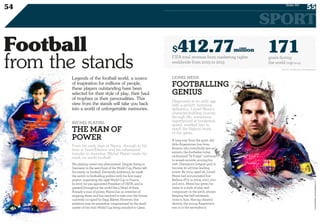
Legends of the football world, a source
of inspiration for millions of people,
these players outstanding have been
selected for their style of play, their haul
of trophies or their personalities. This
view from the stands will take you back
into a world of unforgettable memories.
Football
from the stands
©ILLUSTRATIONS :360CROSSMEDIA/T.M.
goals during
the world cup(2014)
171FIFA total revenue from marketing rights
worldwide from 2003 to 2013
million$412.77
Sources: www.fifa.com, www.statista.com
An undisputed icon in Argentina, Diego Maradona
is an exceptional player. The greatest football
players have no qualms about putting him on a
pedestal. Michel Platini, team captain of France in
1986, once said: “Diego was capable of things no
one else could match. The things I could do with a
football, he could do with an orange.” But is the
Argentine the best player of all time? One thing is
sure: he was the best player of his generation,
winning one World Cup in 1986, two UEFA cups in
1988 and 1990, and scoring memorable goals.
However, the so-called Golden Boy is still an
extremely controversial figure. A victim of the
football business and his forceful personality, he
regularly makes the front pages of the newspapers.
Diego Maradona declared at the age
of 12: “I have two dreams: to play in the
World Cup and win it with Argentina”.
DIEGO MARADONA:
THE HAND OF GOD
Although he is often talked about in the same breath as Lionel Messi, the two men have
extremely different styles and are therefore difficult to compare. One thing is certain: no
records are safe from this all-round player.
Cristiano Ronaldo is a phenomenal athlete with a sprinting speed of over 37 km/h,
unrivalled technical skill and a standing jump of 78 cm, which obviously takes us back to
that moment in the match against Manchester United, the Portuguese player’s former club,
when he literally launched himself into the skies over the Bernabéu to score with a header.
Although he is often talked about in the same breath as Lionel Messi, the two men have
extremely different styles and are therefore difficult to compare. One thing is certain: no
records are safe from this all-round player.
Three times World Champion with Brazil, he
also won the Brazilian championship with his
club Santos from 1961 to 1965. Pelé’s playing
style was powerful, technical and versatile,
with a surprisingly powerful shot. Extremely
loyal, he remained at Santos for 19 years,
before joining the New York Cosmos for two
seasons. In 2011, he was named honorary
president of the New York Cosmos.
Cristiano Ronaldo is a phenomenal athlete
with a sprinting speed of over 37 km/h,
unrivalled technical skill and a standing jump
of 78 cm, which obviously takes us back to that
moment in the match against Manchester United,
the Portuguese player’s former club, when he
literally launched himself into the skies over the
Bernabéu to score with a header.
While it is not surprising that Pelé
should be named as one of the
greatest footballers of all time, it still
has to be said that his playing career
was extraordinary.
CRISTIANO RONALDO:
THE STRAIGHT-A ATHLETE
PELÉ:
THE THREE-TIME
WORLD CUP
WINNER
©ILLUSTRATIONS :360CROSSMEDIA/T.M.
56
SPORT
57Duke 04
were collected by the
Brazilian government in taxes,
following the investments
made for the 2014 World Cup.
billion
US dollars7.2
Sources: www.fifa.com, www.statista.com
BUSINESS
58 Duke 04
59
ING is a universal bank involved in private,
corporate and retail banking. We interviewed
Uilson Castro, Head of Retail Investments
since 1st August 2014.
How do you see the retail
banking trend in Luxembourg?
It’s a business that is constantly
evolving in terms of solutions, services
and even client behaviour and
expectations. I’ve been working for ING
for 17 years now, and I’ve seen a rise in
this trend over the past 10 years.
Incidentally, during this period ING has
visibly strengthened its positioning on
the Luxembourg market and its
involvement in community life through
the Luxembourg Marathon and a
number of other sponsorships and major
events. Today, the reality is that clients
are increasingly doing their everyday
banking themselves, and only going
into their branch if they need something
specific. That’s when we need to be
extremely professional and give
specialist advice in order to provide
them with real added value.
What do you offer your retail
clients in terms of investments?
Can you describe the risks and
opportunities?
Investment proposals depend on several
factors that are specific to each
individual, such as the client’s
investment term, objective, personal
situation, knowledge of financial
solutions and also their assets in
general. Generally speaking, there are
three types of client, each requiring a
different approach: 1. Those who know
what they want and are looking for the
ideal channel for conveying their
instructions. 2. Those who decide for
themselves but want the benefit of our
expertise. We then perform an analysis
from a list of 20,000 funds and advise
them on a regular basis. 3. Those who
hand over complete management of
their assets to us. ING operates in an
open architecture environment,
enabling us to select the best funds,
whether or not they are ‘ING’ funds.
What makes this advisory business so
exciting is gaining the long-term trust of
our clients and filling a special place in
their lives. They then go on to entrust
you with other plans and recommend
you to their friends and family. These
plans are what we are here for. Clients
come to us for their asset management
and inheritance arrangements,
retirement preparations and funding for
various business and private plans…
everyone is affected by these different
areas depending on their stage of life.
We are here to support our clients at
these important and, often, sensitive
times.
What sets you apart from the
competition in terms of your
retail banking offer?
We offer a complete range of innovative
solutions, for example the “Orange”
account, which enables you to open an
account online, or our “X-tra Savings”,
which offers an extremely attractive
interest rate for a given period. ING’s
main strength is also based on the
excellent relationships it has with its
clients and on the quality of its advice.
The proof of this is that, today, more and
more clients are entrusting us with
every aspect of their finances, including
savings, loans and investments, which
makes for great long-term relationships.
Due to its entrepreneurial culture and
the fact that it is part of a large
international group, at the same time as
being firmly rooted in the Luxembourg
market, it seems to me that ING
Luxembourg is perfectly positioned to
meet every challenge and, most
importantly, support its clients by
empowering them to stay a step ahead
in life and in business.
Retail
Banking
in 2015
www.myofficialstory.com/ulisoncastro
www.ing.lu
ING
“Our clients’ plans
are what we are here for.”
Uilson Castro
©360CROSSMEDIA/M.J.
©360CROSSMEDIA/M.M.
BUSINESS
60 Duke 04
61
Corporate governance is becoming a
strategic business of the Grand Duchy.
Interview with Eric Chinchon,
partner at MEBS.
Governance and independence
in Luxembourg are facing new
challenges. What are they?
We must first define “governance”
and “independence”. Both concepts
provide huge added value to
businesses. On independence, the
right questions should be asked: Can
a company that has served a customer
for many years still be independent,
and be seen as such? Does it still have
the necessary detachment to appraise
the strategy and tactics of the
enterprise? Shareholder expectations
are essential when one defines very
clearly the role of independent
Directors and their interactions with
their colleagues. The mere presence of
a director at board and other meetings
belongs to a soon bygone era. An
independent director must primarily
protect shareholders and ensure the
long-term viability of the company by
providing vision, business and
personal ethics, fairness and
commitment.
What adjustments need
to be made?
If Luxembourg wishes to promote
professional independent
governance, I think it is necessary
to create a completely new profession:
that of independent director.
A choice must be made between the
current model, in which the expert
signs in his own name, and the
alternative in which the company
represented by one of the expert
partners signs reports submitted to
the shareholders and, if appropriate,
regulators. This model would broaden
the range of skills in boardrooms by
involving multiple experts when
needed. This is the model of law firms
or of approved statutory auditors.
If approved statutory auditors
are not a priori limited in the number
of mandates, professional ethics
requires that they spend adequate
time with each. This allows managing
files transversely while remaining
competitive in terms of cost.
It is not by chance that Eric Van de
Kerkhove, former audit partner of
Deloitte, serves on the MEBS board:
there is a parallelism between the
approach of approved statutory
auditors and that of independent
directors.
What return on investment
can the profession expect?
I cannot speak for the profession but I
think that the internationally
recognised MEBS approach is the
best possible evidence of return.
Patience, perseverance and
professionalism have enabled our
customers to become our
ambassadors. Six years ago, MEBS
was active primarily in the field of
UCITS funds. Today we are involved
more and more upstream in large
scale projects, and not only in the
financial sector. For example, we have
facilitated the acquisition of BAC
Films Distributions, a reputable
partner in the film industry working
with the top stars. In another area, we
have been chosen to support the
comprehensive rehabilitation of a
major historical monument in France:
the 25,000 sqm of the former French
Navy Pursership in Rochefort. The
trust of our customers, fostered by our
professionalism and ethics, is the
most powerful growth engine.
www.myofficialstory.com/ericchinchon
www.mebs.lu
For a new era
in corporate
governance
Eric Chinchon (MEBS) “We are
involved more
and more
upstream in
large scale
projects.”
Eric Chinchon, CEO
These are tricky times for small and
medium-sized financial service providers.
Business is going well, but they worry
about the complexity, cost and time
needed to hire staff and deploy
the necessary IT for their back office
operations. Unlike large institutions,
smaller organisations sometimes lack the
in-house resources to cope with market
volatility, or other business drivers such
as regulatory changes. Clearstream
Services IT has a flexible alternative,
with sophisticated pay-as-you go
outsourcing solutions.
Pay-as-you-go
back office and
IT solutions
from Clearstream
Services IT
Meeting spikes in demand
When there is a spike in demand,
clients can purchase just the right
amount of each service. “We offer a
range of value-added solutions right
through from pre-trade to post-trade,”
explained Herbert Muck, Sales
Manager with Clearstream Services.
“These sophisticated services
complete our offering that also
includes the more straightforward IT
Hosting and Managed Services,” he
added. This package has enabled new
and existing smaller financial
industry participants to bring new
products to market swiftly and
reliably. Clearstream Services IT has
been a CSSF regulated PSF since
2004. They provide robust,
sophisticated and secure
infrastructure, and all data remains
within the Grand Duchy.
Focusing on core business
“We are working with many new
market entrants,” Mr Muck noted.
“They bring a new mentality,
developing their operating model
with a keen appetite for outsourcing.”
The old reticence about letting a third
party provider deal with IT is dying,
he feels. “Increasingly firms realise
this is not core business, so they are
going beyond outsourcing basic
functions such as payroll and
purchasing. Clients are asking
themselves if it makes sense to keep
everything in house when they might
need to change their business model
next year,” he added.
Clients across the financial
sector
The suite of sophisticated services
includes SWIFT Service Bureau, SEPA
payment solutions, and reconciliation,
to mention just a few. Thanks to strong
demand, Clearstream Services IT has
increased staff numbers to on-board
and support new clients. These clients
are mainly wealth managers, tier-two
banks and insurance companies from
across Europe and beyond, in addition
to the core customer base within
Luxembourg. Fund businesses are also
coming on board. “Historically, these
businesses were not well structured in
terms of IT but this is changing and
they are moving towards lower cost,
straight through processing models,”
noted Mr Muck.
www.myofficialstory.com/herbertmuck
www.clearstream.com
BUSINESS
62 Duke 04
63
“All of this is our
contribution to
Luxembourg’s drive
to become a player
in the global IT
services market.”
Herbert Muck
©CLEARSTREAM
BUSINESS
64 Duke 04
65
Interview with Edith Magyarics,
CEO of Victor Buck Services
and Jean-Denis Diet, head of sales.
Documents
in every form
What are your group’s other
growth areas?
Victor Buck Services is organised
around 5 pillars. Firstly, Client
Communication Management, which
consists in processing data from
various sources and in various formats
to ensure the dissemination of
documents or information via a vast
range of distribution channels.
Secondly, the regulatory sector, for
which we have developed the Vgil
solution, which helps companies deal
with the requirements of new
legislation and existing needs in regard
to document collection. The integration
of Learch on 1 January 2014 also gave
us a head start in the legal archiving
sector. The next pillar - Information
Capturing Services – focuses on the
paperless office, to enable companies to
process their data in their own system.
The 4th pillar - Entreprise Content
Management – facilitates the totally
safe, external communication of
information. Finally, our Print & Mail
Rooms are represented by 6 companies
in Luxembourg which offer “insourced
outsourcing”: Victor Buck Services
supplies the people and the machines
directly to the company. In partnership
with the “Post Group”, Victor Buck
Services has developed a high level of
flexibility and a wide range of services,
which gives us high hopes for the
future!
www.myofficialstory.com/edithmagyarics
www.victorbuckservices.com
IN FIGURES
>> Date created: 2000
 Employees: 192 people
 33% women
“Everything
that affects
the financial
industry creates
opportunities
for us.”
©360CROSSMEDIA/M.M.
What’s the situation with the
law on electronic archiving in
Luxembourg?
The law on electronic archiving was
discussed by the Chamber of Deputies’
Economic Committee up to early
September. The draft law will soon be
amended and then presented to the
Chamber of Deputies. This project is
crucial to the country’s economic
development as an international
digital hub. Practically speaking, it will
change how we create, manage and
archive documents of legal value.
Luxembourg is one of the best
equipped countries to be a pioneer in
this sector, thanks to its electronic,
human and legal infrastructure. That
said, although the law in itself is an
asset, which will take on its full
meaning in a court, companies such as
Victor Buck Services can already offer
the same guarantees, which may also
be recognised as of right before a
court.
What are the consequences
for Victor Buck Services?
Our different clients are affected by
each regulatory change, which creates
opportunities for our company: Victor
Buck Services must listen to them, so
that it can meet their needs and offer
new, creative solutions. Since its early
days, Victor Buck Services’ main
activity has been to serve the
“Transfer Agent” business line in the
Investment Funds and major groups
sector. This is a solid backbone to
which we have added products and
solutions focusing on innovative
technologies and new services.
In this context, we have several cards
to play: return to our existing clients to
help them find solutions to the
regulatory and operational changes,
find new prospects in other industries,
and combine our different products to
offer global solutions to issues that are
both international and local. For
example, the paperless office can
affect hospitals, government
departments or businesses in other
sectors. With regard to our
development in Asia, our clients
frequently request our support in this
part of the world. This is why we have
a local presence in Singapore, as a
starting point, and another 24/7
remote office for all our clients in Asia.
©360Crossmedia/M.M.
BUSINESS
66 Duke 04
67
You have been appointed
CEO of IWI 6 months ago.
What are your priorities?
As a member of the Board of the
company for 7 years, I have endorsed
and supported the current strategy.
As a reminder, IWI has become a
recognized player in the area of
Wealth Insurance. My mission is to
continue with this plan. My primary
responsibility is to bolster our
efficiency to offset the impact of new
regulations and to meet the high
demands of a discerning clientele.
This involves three main priorities:
1. Developing new partnerships.
2. Investing in the skills of our teams.
3. Expanding the account
management, which consists in
following each partner with a
dedicated team of specialists.
What is your analysis of
current life insurance market?
Over the last 20 years Luxembourg
has developed a unique expertise
in life insurance under the Free
Service Provision. Today it is a
changing sector. To ensure a
prosperous future, it should reach
maturity by establishing a strong,
sustainable framework for skills.
This implies a sufficient number of
players with a local decision-making
centre who are able to invest in
development and innovation.
The regulator, politicians and local
actors must join forces to seize
this unique opportunity.
The job is to consolidate
Luxembourg’s economic plan for
the coming decades.
And what will be the next
step as far as IWI
is concerned?
Internally, once the account
management is well in place, we will
proceed to management
accountability that stimulates
entrepreneurship and the
empowerment of teams. Everyone
wins: we identify opportunities for our
partners while increasing the
operational efficiency of our business.
The needs of our partners and their
customers are constantly changing.
We must cultivate our capacity for
growth and the excellence of our
services in order to provide solutions
in line with their expectations.
IWI has always positioned itself
as an orchestrator of skills.
Contracts need to be creative,
customized and with a high added
value. Our added value is the support
and enhancement of synergies within
the framework of this approach using
legal, tax and financial skills at the
same time. We work together with
the client’s advisors and mobilise
expertise, internal or external,
with the fulfilment of goals
and satisfaction of customer needs
as our driving force.
After a career at KBC, Dexia Asset Management and Belfius Insurance,
Luc Rasschaert has been appointed CEO of IWI International Wealth
Insurer. Interview.
A hands-on man
www.iwi.lu
www.myofficialstory.com/lucrasschaert
Luc Rasschaert (IWI)
“Contracts need
to be creative,
customized and
with a high added
value.”
Luc Rasschaert, CEO
BUSINESS
68 Duke 04
69
Experta Corporate and Trust Services SA (Experta) is a PSF company
which provides global corporate services to international customers
seeking to structure their asset acquisitions, holdings, management
and transfers, as well as their private equity and real estate (PE/RE)
investments. Early in 2014, Experta decided to refocus on its core
business and strengthen its management team in order to better meet
its customers’ needs in today’s highly regulated and secure environment.
the structuring business is becoming
an increasingly important pillar
in the development of Luxembourg’s
financial centre.
We believe that in wealth structuring,
we cannot talk about products, but
only about tailor-made solutions.
Indeed, a solution that is more efficient
for one type of investor is not necessarily
the best one for another investor.
Non-European investors can get
the feeling that investing in Europe
is very challenging, given the
complexity of each country’s
corporate and tax laws.
However, the “toolbox” Luxembourg
offers is efficient for any international
investor looking for PE/RE investments
within Europe, but also beyond,
whatever their origin: US, Middle East,
Latin America or Russia, etc.
This country’s flexible corporate law
makes it possible to structure
investors, investments, and managers,
in accordance with their needs
and respective situations, through
dedicated SPVs such as SIFs
and SICARs. The recent introduction
of Luxembourg’s special limited
partnership into the country’s
corporate law is a very good example
of this flexibility. International
investors will be able to benefit
from Luxembourg’s real expertise
in international corporate, tax and
financial matters.
Private banking in
Luxembourg is increasingly
looking beyond Europe’s
boundaries in order to attract
new (U)HNWI clients.
What is Experta’s value
proposal in this context?
An increasing number of private
bankers are providing wealth
management services by leveraging
their wealth structuring business.
Today, Experta has many years
of experience in wealth and PE/RE
investment structuring.
Our core business used to focus only
on cross-border clients. However,
we’ve also been offering structuring
services to international clients for
the past several years.
Experta is seen as a key player in
wealth and PE/RE investment
structuring for international clients in
Luxembourg and beyond. Critical
elements in this assessment include
Experta’s development of new
technical skills, re-defined service
range and commitment to building
the capabilities needed to provide
global corporate services for both
Luxembourg’s non-regulated and
regulated vehicles, as well as its deep
interest in Islamic finance.
While Luxembourg has an
impressive toolbox for wealth
and estate planning, what is
your view of the utility of
solutions offered by foreign
jurisdictions?
Experta’s mission is to find the best
structuring solution for its clients.
We take into account criteria
including their countries of residence,
their heirs’ country(ies) of residence,
and the location of their assets and
investments.
Our teams have the skills and the
networks required in order to be able
to offer our clients foreign structuring
solutions (UK LLPs, US corporations,
Maltese investment funds, etc.).
For this purpose, Experta has
developed several international
partnerships with foreign corporate
service providers and tax advisors.
Luxembourg structures are
popular with US investors.
Are they also tax-efficient for
BRIC and Middle East
investors?
Many key players take the view that
www.myofficialstory.com/jeanmariebettinger
www.experta.lu
The Luxembourg
structuring “toolbox”
for international investors
Jean-Marie Bettinger (CEO of Experta)
“The recent introduction of
Luxembourg’s special limited
partnership into the country’s
corporate law is a very good
example of this flexibility.”
Jean-Marie Bettinger, CEO
©360CROSSMEDIA/M.M.
BUSINESS
70 Duke 04
71
ManagementPlus partner Antonio Thomas says that as the line between
servicing of traditional and alternative funds becomes increasingly
blurred, Luxembourg has an opportunity to provide management, asset
gathering and servicing solutions on a truly global scale. culture of flexibility that helps
businesses to flourish. As more fund
firms turn to cross-border
passporting, Luxembourg is in a
unique position to export its skills to
other markets too. For example, in
Switzerland there are approximately
3,500 private asset managers that,
due to new regulations, are required
or will soon be required, to comply
with enhanced infrastructure and
substance requirements. Luxembourg
has long operated in this space
domestically and can export this
easily to meet this new opportunity.
Thanks to the expertise build up over
the years, Luxembourg is recognised
as a leading edge jurisdiction for the
provision of à la carte outsourcing
solutions for risk, compliance and
Corporate Governance.
To other jurisdictions that have not
yet fully implemented AIFMD
solutions we can export our best
business practices. Ireland has done
this in the past as a servicing centre
for Cayman-domiciled funds, but
Luxembourg has an opportunity to do
it on a much wider scale. In short, it is
ideally positioned as a global platform
for Governance, Substance, Fund
Distribution and Asset Gathering.
What role is ManagementPlus
playing in these
developments?
You don’t have to be big to have global
reach, and ManagementPlus is a good
example, with its representatives in the
UK and US as well as sister companies
in the Cayman Islands and Singapore.
This enables to operate in a similar
way to the bigger players, but with a
complementary – and more user-
friendly – approach. We benefit from
all the industry’s knowledge, operate
on a global footing, and fill the gap in
the middle layer of the market,
managers with between €50m and
€100m in assets.
Our main pillars of activity reflect the
depth and asset class experience of the
firm’s three partners, enabling us to
cover all the main traditional and
alternative sectors, including UCITS,
real estate, private equity and hedge
funds. We are ideally placed for
managers to engage us to implement
outsourced solutions that ‘complement
and reinforce’ their current models,
leaving them the flexibility to
concentrate their activities and
enhance their competitiveness
advantage in the particular space they
operate in. We leverage our network to
work with managers or other service
providers in a fully flexible way. Our
model is based on asking clients what
they need, rather than trying to force
them down a route because it’s always
been done that way. By providing
substance and segregating duties, we
act as an extension of the client’s
management team rather than as
another layer.
What are key trends are at
work in the funds sector?
The most important trend is the
convergence between UCITS and
AIFM servicing, especially from a
Corporate Governance perspective.
With the “harmonisation”everything
is becoming more transparent,
managers are looking for a single
service model for their products in
both the UCITS and AIF space,
especially where they leverage
strategies across the platforms. As a
consequence, many service
companies are asking themselves
what infrastructure they really need.
Very often they have chosen to
downsize, with a single department
servicing all types of fund. Having
looked inwards and rationalised their
models they are increasingly turning
their docs externally and doing the
same with the infrastructure involved
in supporting their products. There
has been a lot of activity in the last
year or so, in particular with non-EU
based managers, which has seen them
locate specific activities in key
countries to ensure the optimal
footprint for future growth. Many
have launched AIFM’s based in
London, often converting existing
operations to preserve their ability to
distribute within the EU. Increasingly
they opt to domicile their funds in
Luxembourg, even though the AIFM
is in London, leveraging the better
distribution opportunities and other
facilities such as Independent
Directors and Management Company
players.
There is a logic in this approach as
this gives them the “best of breed”
from each domicile which helps to
reinforce the governance of their
product and attract additional
investors.
How can Luxembourg
maintain its leadership in fund
servicing?
Luxembourg has recognised the
trends mentioned above and has seen
the increase in its funds sector to Euro
3 trillion in 2014 and a raft of new
‘sophisticated’ UCITS being launched
by Non-EU managers. To continue to
build on ethics success it needs to
expand its community of experts to
cover all asset classes including
traditional funds, Hedge, PE and RE
in all the aspects of Fund servicing.
The country must remain at the
cutting edge of the industry,
providing adequate substance and
governance while staying true to its
www.myofficialstory.com/antoniothomas
www.mplgroup.com
Luxembourg’s
opportunity
in the UCITS-AIFMD
servicing convergence
Antonio Thomas (Partner at ManagementPlus)
“You don’t
have to be big
to have global
reach.”
Antonio Thomas
©360CROSSMEDIA/SE.M.
Venetia Lean explains how Banque Havilland is evolving to attract
and serve very wealthy clients, wherever they are – armed with
knowledge about their complexity and requirements from her own
entrepreneurial family.
How we are serving
wealthy global families
from Luxembourg
How would you describe these
ultra-high net worth families
that you are targeting?
Cultural differences aside, we find that
wealthy families share very similar
challenges and characteristics, which
can be defined by a single word –
complex. Take my own family, for
example, there are 8 children at
different stages of life who live and work
in multiple countries; who also work in
the family business which is in itself
becoming more complex. The nature of
our family’s personal and professional
activities brings a complexity that
needs to be managed. Similar cases can
be seen across wealthy families from all
parts of the globe such as the USA, CIS
countries, China and Latin America. A
recent trip to Brazil highlighted this
where you have wealthy families whose
children are studying in the US or
Europe, the parents have homes in
Brazil, Miami, Portugal and Paris, they
run operational businesses in Brazil but
due to political, legal and fiscal reasons
wish to structure their wealth on a
global basis. There is no one-size fits all
approach for serving this type of client.
What are those families
looking for?
Put simply these families are looking
for people they trust to help in
managing this complexity in a way
that is completely tailored to them.
Research shows that around 80% of
billionaires made the majority of their
wealth themselves and are typically
entrepreneurs who remain heavily
involved in running their businesses.
This group will need a different level
of assistance to those who have
inherited wealth for example. Both
groups however need access to a pool
of experts that can be called upon to
advise on their diverse needs from
managing an investment portfolio
through to acquiring real estate and
assistance co-ordinating this work. In
addition to this it is important to
remember that these families are truly
‘global citizens’ and their lives are
transnational, so the support they
need has to reflect this.
How is Banque Havilland
meeting these needs?
We are in the process of building an
international banking group which can
support the diverse needs of our client
base, and we feel that one of the best
ways to do this is by expanding our
global footprint to match that of our
clients. We are already well-established
in Luxembourg, London and Monaco,
and in the last month we have acquired
the private banking business of
Banque Pasche in Liechtenstein and
the Bahamas. These new additions
allow us to expand our geographic
reach and at the same time strengthen
our access to the strategic growth
markets of CIS countries, Latin
America and the Middle East.
It is important to emphasise that we
are looking for locations that are
credible and transparent from all
angles – clients today are looking for
locations with political and economic
stability, fiscal transparency, security
and a good reputation. They want
professional help to manage their
wealth and this is why jurisdictions
such as Luxembourg are so important
today. We have access to a pool of
talent which is multi-lingual and with
the right skill sets – whether financial,
legal or tax – and most importantly
the right attitude. People who are
motivated, flexible, and can turn their
mind to anything. We want to build a
team that can adapt to the needs of
our client base and be relied upon to
lead them through the complexities of
managing their wealth over the long
term.
*Ultra High Net Worth Individual
www.myofficialstory.com/venetialean
www.banquehavilland.com
BUSINESS
72 Duke 04
73
Venetia Lean (Banque Havilland)
©360CROSSMEDIA/PO.D.
“The future is
about managing
complexity,
trust and
transparency.”
Venetia Lean ,
Member of the Board
of Directors
IN SHORT
 Banque Havilland focuses on serving
international UHNWIs.
 Global expansion will ensure the bank
can meet the needs of their clients.
 Luxembourg is the perfect wealth
management platform.
©360Crosmmedia/M.S.
BUSINESS
74 Duke 04
75
Europe is increasingly targeted by Chinese investors who are
increasingly using Luxembourg as their hub for investments in the
region. The Association for Chinese Lawyers in Europe was created
in the Grand Duchy to help them, says the organisation’s president
Dr Shaohui Zhang.
Why was ACLE created?
The Association for Chinese Lawyers
in Europe (ACLE) was established to
provide Chinese investors seeking to
become active in Europe with the
right expertise. They feel more
comfortable with lawyers who speak
their mother tongue while offering a
comprehensive knowledge of
European legislation. Comprehension,
trust and communication are the
three critical elements in doing
business with Chinese clients. ACLE
works with 60 Chinese lawyers in
Europe, including both barristers and
solicitors, and membership is open to
anyone with the competence and
ability to speak the language. Our
members are listed on the website so
that investors can contact them easily.
Why do you describe ACLE as
a double platform?
ACLE has been created for Chinese
lawyers in Europe so they can get in
touch with each other, share
information or refer fellow members
to clients. We are also planning in the
near future to organise events and
training courses. But ACLE is also a
perfect portal for Chinese investors
looking for lawyers anywhere in
Europe. The six committee members
are based in the founding members of
the European Union, France,
Germany, Italy and the Benelux
countries. Luxembourg remains the
key hub for Chinese companies
because of its tax, financial and
human resources advantages. Half of
all Chinese investments in Europe go
through Luxembourg and 58% of the
20 bn invested by the China
Development Bank is in the Grand
Duchy. Most of it goes into mergers
and acquisitions, investment funds
and construction projects. Since I
became active here in 2006, I have
witnessed three waves of clients.
First were those interested in listing
their company in Paris or Frankfurt,
but this kind of activity decreased
after 2008. There have also been
players in the solar panel industry,
especially up to 2012. We continue to
see interest today from those
interested in MA, an area that can
benefit all parties. European
companies have the expertise and
intellectual property, while Chinese
companies have the liquidity to
support their growth. IEE and Hiwing
is a prime example of this kind of
win-win partnership.
How did your career bring you
here?
I studied law in China where I took
my bachelor’s degree before moving
to Belgium in 1997 and spending a
year in very intensive French classes.
That enabled me to study
International and European laws at
the Catholic University of Louvain,
where I received my master’s degree
in law in 2001. I continued studying
for a PhD with Prof. Marcel Fontaine,
whose specialist expertise is in
international contracts, hence my
thesis The Influence of Uniform Law
on the Chinese Law of Contracts.
Since 2006 I have been active as
corporate lawyer in Brussels and
Luxembourg.
www.acle.eu
www.myofficialstory.com/shaohuizhang
A double platform
for China Outbound
Investment in Europe
ACLE “China Outbound
Investment,
lawyers first!”
Dr. Shaohui Zhang,
President-ACLE
Interview with Jean-Michel Schmit, Office
Managing Partner and Head of Corporate
and Finance, Pierre Reuter, Head of
Investment Funds, and Gerard Neiens,
Head of Tax.
Redefine
Engagement!
Can you tell us a bit about the
history of Hogan Lovells?
Jean-Michel S.: The origins of Hogan
Lovells date back to John Spencer
Lovells (1899) and Frank J. Hogan
(1904). The firm as it currently stands
is the result of the 2010 merger
between US firm Hogan  Hartson
and UK firm Lovells. Today, Hogan
Lovells is one of the top 10
international firms. It employs more
than 2,500 lawyers across more than
40 offices worldwide.
Gerard N.: This merger was a first in
the legal world: the first transatlantic
merger between two major players in
the world of business law on their
respective sides of the Atlantic.
Pierre R.: The firm is still expanding.
Hogan Lovells recently absorbed the
South African firm Routledge Modise
and the Mexican firm Barrera,
Siqueiros y Torres Landa. Setting up
an office in Luxembourg a year ago
was a natural step given that at that
time Hogan Lovells had a presence in
every major financial market in the
world except Luxembourg.
What are your firm’s values?
Gerard N.: Four years after the
merger, when our new CEO, Stephen
J. Immelt, was appointed, we reviewed
our strategy and vision of the legal
world. This review resulted in the
Redefine Engagement project, which
outlines Hogan Lovells’ innovative
and bold approach for operating in a
world where clients’ expectations from
their lawyers are changing.
Pierre R.: Law firms often share the
same values. We want to take a fresh
look at these values, which means
redefining our relationship with the
client. The Redefine Engagement
project focuses on different areas such
as generosity and honesty, as well as
trust, passion and straight talking.
Entrepreneurial spirit also matters a
great deal. We apply these values both
in-house and in our dealings with the
outside world.
Jean-Michel S.: We are becoming
even more united, with a global
commitment. Among other things,
this is reflected in the fact that we
have dispensed with the dual
management system and now have
just one CEO. Our firm constantly
reviews its principles? in order to
move forward and respond better to
our clients’ expectations.
What do the clients who call
on your services expect from
you?
Pierre R.: I think that our clients are
primarily looking for pragmatic
advice that will enable them to find
simple solutions in an increasingly
complex environment. They want to
be guided by specialists who
understand not just the regulatory
context but also the commercial
aspects of their transactions.
Jean-Michel S.: Our main clients are
those which are involved in
international transactions and require
cross-jurisdictional? legal advice.
Practically all of the matters we deal
with in Luxembourg have an
international dimension, and most of
them involve several Hogan Lovells
offices. Our clients like the fact that
the teams from our different offices
know each other well and are used to
work together. This means that we can
guarantee that cases are dealt with
seamlessly and efficiently.
Gerard N.: International clients
also like the stable political and
economic environment here in
Luxembourg. Despite the fact that
Luxembourg and international
legislation is becoming increasingly
complex and restrictive, a lot of clients
are still opting for Luxembourg
structures? because of their
reputation, reliability and flexibility.
It is an exciting challenge for us
lawyers to promote the assets of our
country on a daily basis, particularly
in the present climate.
www.myofficialstory.com/hoganlovells
www.hoganlovells.com
BUSINESS
76 Duke 04
77
Hogan Lovells
©360CROSSMEDIA/ME.S.
“I think that our clients are
primarily looking for pragmatic
advice that will enable them to find
simple solutions in an increasingly
complex environment.”
Pierre Reuter
Richard Lepère, Managing Director
of Fund Channel, volunteered to create
the Asset Management Subsidiary of a
Saudi bank. This is his story.
A four-year
assignment
in Saudi Arabia
How did your arrival in the
country go?
Saudi Arabia is not an easy country to
get to. You can only obtain a visa for
religious or professional reasons.
Once you are there, you enter a world
which is completely different, where
all the men wear white thobes and red
keffiyehs. The women wear black.
Next you have to remember that the
environment – the desert – has always
been hostile to man. Oil changed
everything, and the Saudis went from
the Middle Ages to the 21st century in
barely two generations! You also have
to bear in mind the importance of
religion. During the five daily calls to
prayer, all businesses and shops stop!
The religious police monitor
everything. Their real name is “the
commission for the promotion of
virtue and the repression of vice”. I
didn’t make that up. More generally,
the business world has the
characteristics of a tribal society. This
is the only country that bears the
name of a tribe, the “Al Saoud”, which
means that some citizens feel closer to
their own native tribe than to their
nationality.
Under what conditions did you
carry out your assignment?
At the beginning, I felt the lack of
freedom. You have to give your
passport to your employer, there is no
freedom of conscience, political party
or trade union. The same goes for
Chambers of commerce or
associations: everything has to be
approved by the government. I had to
manage some difficult situations
when an employee needed to visit
their family abroad urgently. That
said, you can always find a solution.
You need to know the right people and
if you can speak the language a little,
that makes things easier. The
mechanics of local social regulation
lie in the Majlis, where the tribal
leaders hold a hearing. In 2007, I
began with 30 employees, 70% of
whom were Saudis – there are quotas
- and four years later I ended up with
70 people. The women were often as
reliable, if not more reliable, than the
men. Those who have studied only in
the country show little analytical
skills since the local education system
favours the learning “by heart”
particularly in religious studies that
represent 25% of the school day. You
therefore have to build teams well and
make them work by identifying the
decision makers and the doers.
What assessment would you
make of this experience?
All in all, I met lots of very warm,
talented people. These four years were
difficult, but they were an important
experience in my career for three
reasons: 1. It was the first time I was
responsible for a profit centre, with the
continuous challenges that involves 2.
I learnt how to manage time
frustrations, as the local pace of life is
different from the one in Europe. 3. It
helped me to improve my
multicultural management practices.
To get a Pakistani to work with an
Indian for example, you have to
manage skilfully.
www.myofficialstory.com/richardlepere
www.fund-channel.com
BUSINESS
78 Duke 04
79
©360CROSSMEDIA/B.J./DR
“Expect the
unexpected.”
Richard Lepère
Plate offered by his team during its departure
of Saudi Arabia.
City of Riyad.
BUSINESS
80 Duke 04
81
What is deardle, in a few
words?
It’s the first e-shop in the world to offer
love in so many different forms:
T-shirts, gifts, illustrations, stories,
tributes, photos, videos, and much
more.
How did the idea start?
Our company 360Crossmedia has been
working with international brands for
15 years. We advise them on how to
improve their image, their brand
awareness and above all their
popularity, and we’ve had a lot of
success. Our theme is that “It’s all
about emotions”. Deardle is therefore
the product of all our experience and
all the incredible encounters we’ve
been lucky enough to have.
Your background is in B2B,
aren’t you afraid of launching
something in B2C?
The border between the two is
imaginary. Let’s take iPhones for
example: they’re in the B2C category,
but the number of units sold to
businesses is considerable. For 15 years,
360Crossmedia has been working with
companies of all sizes, but through our
campaigns we have reached out to
millions of people. Where Deardle
plays its game well, is that it is
predominantly social. You can order an
illustration on a T-shirt or offer an
interview to your grandmother, then
combine the two to make newspapers,
books and magazines to give to your
loved ones, friends or colleagues to
mark the important moments in their
lives. For our company, Deardle
completes a range of solutions focused
on high-quality content.
It’s a funny name. Why
“Deardle”?
Personally, I love wordplay, and when I
married my wife, who’s German, I
discovered a sublime, yet
unpronounceable word: Dirndl. It’s the
traditional dress worn in Germany,
Austria and more generally in the
Alpine regions. The dirndl is
traditional, sexy and festive at the same
time, especially when worn at the Beer
festival. They’re a real favourite! So
when I was looking for a name that
would evoke the emotions that the
products sold on our site
would express, Deardle
seemed obvious to
me: “Dear” is an
English word
known all over the
world, and
“Deardle” sounds
like Google. QED.
An interview with Jérôme Bloch,
CEO of 360Crossmedia, which has just
launched Deardle.com.
Love as a gift!
www.jeromebloch.com
www.Deardle.com
Deardle
©Shutterstock/DR
“You can order an illustration
on a t-shirt or offer an interview
to your grandmother!”
Jérôme Bloch
BUSINESS
82 Duke 04
83
Jack Ma, from translator
to successful entrepreneur
Jack Ma was born in 1964, in Hangzhou,
China. Passionate
about English from a very young
age, he would cycle every day to the
only hotel in town where foreign visitors
stayed. He started his working career as
an English teacher and, thanks to his
brilliant language skills, soon set up his
own translation agency, enabling him to
engage with large US companies
wanting to establish a base in China. It
was during an interpreting trip to the
USA in 1995 that Jack Ma first
discovered PCs and the Internet, which
were almost non-existent in China. As
soon as he got home, he focused on a
new project: developing the Internet in
China. He started by setting up the
Chinese yellow pages in 1995, before
founding the Alibaba Group in 1999, on
which his wealth and reputation is built.
Alibaba Group
The Alibaba legend started in 1999,
when Jack Ma created the e-commerce
website alibaba.com. A business-to-
business platform which puts buyers and
sellers of a variety of products in touch,
Alibaba was an instant hit and, by 2002,
had over one million users. The group
subsequently diversified, launching all
kinds of online services and, notably,
Alipay, the online payment system
created in 2004. With a keen awareness
of the quality issues associated with
Chinese products, Alipay offers a unique
service enabling consumers to try the
product first to make sure that it suits
them before transferring the money to
the vendor. Alibaba announced that two
of its portals combined had handled
sales worth USD 170 billion in 2012, i.e.
more than its competitors eBay and
Amazon.com combined.
Come in Luxembourg
Although the Alibaba Group currently
manages European operations from its
London base, Alipay, the e-payment
platform, has confirmed that it is moving
to Luxembourg. The announcement was
made in July, at the same time as the
announcement of the arrival of the
Agricultural Bank of China (ABC),
following Pierre Gramegna’s mission to
China. This means that Alipay will be
joining the main e-payment companies,
notably PayPal and Amazon. The RMB
has rapidly become a leading global
currency. The fact that five of the top six
Chinese banks and Alipay will soon be
based here shows that Luxembourg is
the place to be for renminbi business in
the Eurozone.
Make it easy
to do business anywhere
www.alibaba.com
“I know
nothing about
technology.”
Jack Ma
Jean-Marc Goy (Counsel for International
Affairs at the CSSF) highlights the
evolution of rules and regulations within
the financial sector.
Challenges for
Supervisory Authorities
An evolving landscape
Toimproveistochange ;tobeperfectisto
changeoften.WinstonChurchillisknown
tohaveusedthisjocularsayinginhislong
career.
Tosaythattheworldhaschangedafterthe
globalfinancialandeconomiccrisis
amountstoapleonasmofsorts.With
regardtoinvestmentfundsandtothe
financialsector,thesechangeshavebeen
particularlystrikinginrelationtothe
revisionsofthelegalandregulatory
frameworkandinrelationtothe
modificationsoftheinstitutional
architectureofsupervisoryandregulatory
authorities.
AttheleveloftheEuropeanUnion,more
than30legislativeandregulatory
initiativestargetingthefinancialsector
havebeeninitiatedoverthepastfiveyears.
Time for a “regulatory break”
A“regulatorybreak”wouldseemaproper
idea,or,atleast,woulditbeappropriateto
considerablyslowdownthepaceatwhich
newrulesareenacted.Thetimehascome
toimplementandtransposeallthenew
rulesadoptedinthewakeofthecrisis,tolet
theentitiescoveredbytheserulesandthe
authoritiesapplytheminpracticeand
assesstheirstrengthsandweaknesses.In
anextstep,itshouldthenbeanalysed
whether,really,newadditionalrulesare
necessaryorwhethertheexistingrules
needtobereviewedtoimprovethemin
lightoftheexperiencesgathered.
Onehastokeepinmindthatthe
implementationofthenewrulesinviewof
greaterinvestorprotectionrepresentsa
costfactortoo,andthatinvestmentfunds
shouldremainattractiveenough,including
withregardtotheirfeestructures,to
preventasituationwhereinvestorsturn
awayfromthemtopurchaseother
investmentproducts,whichwouldbe
cheaperindeed,butwhichwouldbeless
regulatedandofferinferiorprotections.
Overthecourseofthelastyears,thenew
EuropeanauthoritiesEBA1
,ESMA2
and
EIOPA3
,havedevelopedandgrownto
reinforcetheirhumanandtechnical
resourcesaswellastheirpowers.They
haveproventhattheyhavetobe
consideredhenceforwardas“adult”
authoritiesthatdonotfailtousetheir
powerstoachievetheobjectiveofa
harmonisedapproachandsupervisory
convergence.AttheleveloftheEuropean
SystemofFinancialSupervision,theroleof
theEuropeanCentralBank,whichwas
alreadyprominent,hasgainedfurther
importancefollowingthesettingupofa
bankingunionwithasinglesupervisory
mechanism.
Atthesametime,theinfluenceof
internationalorganisations,suchasthe
FSB4
,theIMF5
,theBaselCommitteeor
IOSCO6
keepsgrowingcontinuously.
An efficient and respected
supervisory authority
Itiscrucialthattheauthorityofthe
financialsectorisrespected,effectiveand
efficientandtheCSSF7
hastofollowthe
evolutionsandchangesofthefinancial
sectorandofitsregulationsaswellasthe
developmentsconcerningtheinstitutional
architecture.Inordertodoso,theCSSFis
continuingitsrecruitmenteffortsto
reinforceitsresources,whicharenecessary
toappropriatelycarryoutitslegal
missions.WhentheCSSFstartedits
activitieson1January1999,ithada
headcountofsome100staff.Itsnew
headquarters,whichiscurrentlybeing
built,offersofficespaceforupto680
persons.
Thetimesarechanging.Theregulationsof
thefinancialsectorandtheinternational
institutionalarchitectureevolve.Itisnow
uptoalltheconcernedentities
(professionals,investors,politiciansand
authorities)tocontributeandplaytheir
partsothattheassertionmadebyWinston
Churchillcanbeprovedcorroboratedand
thatthesechangesresultinimprovements.
1.EuropeanBankingAuthority
2.EuropeanSecuritiesandMarketsAuthority
3.EuropeanInsuranceandOccupationalPensions
Authority
4.FinancialStabilityBoard
5.InternationalMonetaryFund
6.InternationalOrganizationofSecurities
Commissions
7.CommissiondeSurveillanceduSecteurFinancier
www.myofficialstory.com/jeanmarcgoy
www.cssf.lu
©360CROSSMEDIA/O.C.
©ALIPAY
©ALIBABA
An article by Rana Hein-Hartmann EMEA
Director, about the latest trends impacting
recruitment in Investment Funds.
Welcome to
the VUCA world
Living in a VUCA World
Volatility, uncertainty, complexity and
ambiguity are the four words which
mark our world today. Every aspect of
our lives is being deconstructed,
digitalised, modernised and rebuilt in
completely new ways. The impact of
living in a VUCA world is huge on
companies and staff. You have to be
more flexible, adaptable, and prepared to
make decisions without having all the
information. If you don’t make a
decision, one is made for you. Successful
companies today are those who have
found ways to make quality decisions
quickly, often by creating more direct
functional lines rather than relying on
traditional line management and
hierarchy. Hierarchy is history.
The career ladder is out
Successful careers no longer follow the
traditional ladder structure. They are
more like career lattices, where people
move sideways and horizontally, because
the lines between our businesses are
being blurred. Now you can approach
your law firm for tax advice, and your
administrator can also act as your
depositary bank, or help you manage
your assets on the ground. Relationships
are everything, and the key to a
company’s success. The difference
between relationships today and those of
the past are that the most successful
firms today are those who have found
ways to deepen them, providing a better
and more personal service, often by
taking service sideways. This creates the
opportunity to deepen knowledge and
experience by moving sideways, where
your work history is even more valuable
than moving upwards. This provides the
chance to see your field from a new
angle, creating a learning curve that
never used to exist. Depth of knowledge
is what clients want today.
Adaptability is everything
When change is the new norm,
innovation is the only answer. High
performance companies display
welcome attitudes to reasonable error, in
return for learning. They show an
openness to challenge, and use creative
spirit to untangle challenge and drive
their strategy forwards. Then they show
commitment to that agreed strategy.
They hire well at senior levels, and they
give their managers the freedom to run
the business. These companies succeed
because they are willing to try
something new. The approach rarely
goes wrong, because this new breed of
managers leave their ego at the door in
favour of an open door policy, which
both protects them, and also inspires
others, by listening to others. Employees
are engaged.
Thanks to new technology, there is now
more available than ever on thought
leadership, innovation, and genuine
inspiration to be found online, free, as
well as the ability to ‘follow’ some of the
most inspirational leaders of our time in
their daily thoughts. What could be more
inspiring, and equip us better, to help us
in this world of change?
www.myofficialstory.com/ranaheinhartmann
www.fundspartnership.com/
BUSINESS
84 Duke 04
85
Rana Hein-Hartmann (Funds Partnership)
©360CROSSMEDIA/M.M.
“When change is the new
norm, innovation is the
only answer.”
Rana Hein-Hartmann
BUSINESS
86 Duke 04
87
Sandrine Leclercq, Counsel with Baker  McKenzie, says
Luxembourg is emerging as a significant winner from AIFM legal.
Luxembourg’s fund
expertise
is a decisive factor
How is Luxembourg’s fund
industry coping with recent
legal and regulatory changes?
The optimistic predictions about the
impact of the EU’s Alternative
Investment Fund Managers Directive
are becoming reality as increasing
number of European promoters seek to
regroup their fund ranges in
Luxembourg, including redomiciling
their offshore vehicles to be able to
leverage on distribution facilities
throughout Europe. Some also relocate
their management operations for
better efficiency.
Alike, non-EU managers are looking
more and more often at EU
jurisdictions to launch their funds,
including to meet the demand of
non-EU investors, and especially as
institutional investors are less
confortable with offshore centres.
Luxembourg is now becoming
a fund hub not just for European
managers with EU investors
but also those from countries such
as the US, Australia and Brazil,
while the AIFMD label is starting
to gain traction with investors in
America and Asia.
Is Luxembourg now seen as an
optimal fund hub?
This year the European authorities are
scheduled to take a decision on
possibly extending the AIFMD
passport to non-EU funds and
managers. Luxembourg is the first
distribution hub in Europe and
whenever this decision is passed, this
could prompt overseas managers to set
up Luxembourg structures to take full
benefit of the product passporting
regime. Acknowledged expertise and
skills of local practitioners, have
proven to be a decisive factor in the
UCITS world, when fund groups are
deciding where to base their
operations and structures and this
success model will now be replicated
in the alternative world...
Are there risks as well
as opportunities?
Certainly Luxembourg has challenges
to deal with the various corporate tax
issues that have arisen over the past
few months, and to a lesser extend
the end of the banking secrecy.
In many cases, though Luxembourg
has come through strongly. In
particular the decline of private
banking business seems partly
compensated by the increased use of
Luxembourg funds as a wealth
management tool for other country
desks. While the banks are having to
adjust to changes, the fund industry is
largely unaffected by the new focus on
tax transparency.
How do these developments
affect international law firms?
Baker  McKenzie is active in 47
countries around the world, and over
the last 24 months clients have been
increasingly seeking our assistance
with fund redomiciliations,
restructuring of operations and fund
ranges as well as for the deployment of
their distribution activities. FATCA
obviously has also been a focus the
last year and MIFID II and UCITS V
are the next challenges to get ready for.
www.myofficialstory.com/sandrineleclercq
www.bakermckenzie.com/luxembourg
“Everything
that affects
the financial
industry creates
opportunities
for us.”
Sandrine Leclercq
©360CROSSMEDIA/P.D.
Sandrine Leclercq (Baker  McKenzie)
Carlos José da Costa André, managing
director of Banco do Brasil Asset
Management, says the group chose
Luxembourg to launch a UCITS
structure because of its global recognition
in markets around the world.
Why we set up
a UCITS fund in
Luxembourg
What is the background of
your company?
Banco do Brasil Asset Management
(known BB DTVM) has been the
largest asset management company in
Brazil since 1994 and currently
manages $220bn in assets, giving us a
market share of more than 21%. We have
more than 500 funds under
management in fixed income, equity
and multi-strategy funds targeting
retail, institutional, private clients and
corporate investors.
We are a subsidiary of Banco do Brasil,
the country’s largest financial
institution and owned by the Brazilian
federal government.
Why have you chosen
Luxembourg to establish your
UCITS fund?
We launched our international
business with an umbrella fund based
in the Cayman Islands, but in 2010 we
decided to set up in additional
jurisdictions, and at the end of that year
we established an investment company
in Ireland and a Qualifying Investor
Fund.
However, we have seen that to be able
to offer our expertise (...), it would be
useful to set up a UCITS structure too.
Luxembourg is our preferred
jurisdiction for this and BNP Paribas
Securities Services is one of the main
candidates to be our service provider
since we already use them in our
structure in Dublin.
How big is the investment
appetite in Brazil?
Whenever you talk about emerging
markets, Brazil is centre-stage. The
country has a big, highly diversified
economy, a solid financial market and a
liquid stock market, and there are
attractive opportunities in the
infrastructure sector.
We have just staged the soccer World
Cup, and the Olympic Games will take
place in Brazil in two years’ time. The
country offers opportunities to
investors to invest directly or finance
targeted projects.
What is your vision for
the future?
We want to be able to reach out to
international investors and offer them
the same expertise that we already
make available at home. They can
benefit from our local knowledge in
Brazil, our brand recognition and our
asset management expertise.
Whenever an international investor
seeks Brazilian exposure, our aim is to
be considered as their natural partner.
With our structures in Cayman, Ireland
and Luxembourg, we now offer a broad
reach.
Investment management is carried out
in Brazil for now, but we expect to
expand to other regions and develop a
global asset management proposition
in the future. The great thing about
Luxembourg is that many companies
in Asia recognise UCITS as a
prerequisite to enter their markets – it is
as good as a brand name in countries
like Korea or Taiwan.
www.myofficialstory.com/bancodobrasil
©BANCODOBRAZIL
“With our
structures in
Cayman,
Ireland and
Luxembourg,
we now offer
a broad reach.”
Carlos José da Costa André,
Managing Director
Banco do Brasil Asset Management
BUSINESS
88 Duke 04
89
“We think there will be 3% growth in the local ICT market over the
coming years, but we have budgeted for 4% growth,” noted Gérard
Hoffmann, Chairman  Managing Director of ICT solutions company
Telindus Luxembourg. This industry has proved to be largely resistant
to the post-2008 crisis, and the firm has a multi-facetted strategy to
help growth continue.
Riding the wave
and more
Four growth areas
There are four main business lines
being targeted by Telindus. Cloud
computing is a fast-growing global
trend and Mr Hoffmann sees
opportunities to “offer high-end
services linked to PSF [Financial
Sector Professional] outsourcing
standards.” Hand-in-hand with this
goes security. Banking secrecy may
have gone, but the country remains a
global centre of excellence for knowing
how to keep data secure. Telindus also
plans to grow market share in
connectivity, particularly business-to-
business data services. There will be
no let-up in outsourcing either, as all
firms seek to maintain and improve
their computing strength while
controlling costs.
A varied, growing market
“We are targeting one outsourcing
deal per year,” Mr Hoffmann said. Last
year they became Innovative Solutions
for Finance’s (IS4F) (ex-Associated
Dexia Technology Services) key
partner by operating its
telecommunications and storage
services in the BeLux: BIL here and
Belfius in Belgium. Thanks to this
strategic project, Telindus Luxembourg
has seen its turnover climb by 30 %
between 2013 and 2014, and they now
employ nearly 400 people.
Opportunities are coming from the
public sector too, such as the recent
announcement of a major push into
cloud computing for EU
administrations. As well, business and
personal use of mobile technology is
set to grow and with it demand for the
systems to cope with this traffic. There
is no sign of ICT firms leaving the
country, even after the change in EU
rules on charging VAT for virtual
products and services. “A handful have
announced their departure, but I
haven’t seen much movement yet,”
said Mr Hoffmann. “This still remains
a great place from which to base an
international business with a good
legal, regulatory and fiscal framework
backed with high quality state-
supported data centres and
connections,” he added.
New possibilities
On the horizon are the possibilities of
the new buzz term “FinTech” with a
new generation of services likely to
affect all areas of the financial sector.
These include payment systems,
peer-to-peer lending, crowd-funding,
digital currencies, even financial
advice. Telindus works with the
government and others to brain storm
new ideas, enabling new opportunities
to be seized. For the more immediate
future, Mr Hoffmann is excited about a
new range of products that are about to
be launched. All will be revealed soon.
www.myofficialstory.com/gerardhoffmann
www.telindus.lu/
Gérard Hoffmann (Chairman  Managing Director
of Telindus Luxembourg)
“We think there
will be 3%
growth in the
local ICT market
over the coming
years, but we
have budgeted
for 4% growth.”
Gérard Hoffmann
(Chairman  Managing
Director of Telindus
Luxembourg)
BUSINESS
90 Duke 04
91©DR
An interview of Paul Junck, Managing Director of the Luxembourg
Private Equity Association.
Luxembourg
a domicile of choice
for Private Equity
Can you describe the Private
Equity landscape in
Luxembourg?
Nine out of ten of the world’s biggest
fund managers are operating out of
Luxembourg. The transaction layer
has historically been the stronghold of
the sector but this is changing rapidly
as we attract more and more middle
office and front office activities here in
Luxembourg. The market size is
around 200 billion euros of assets
under management accross three
layers : 1. the general partner, who is
managing an investment fund 2. the
fund that receives investments,
typically from outside investors that
would then deploy the funds into the
portfolio. In the third layer - the
transaction layer - these funds are
invested via SPVs into these
individual portfolio companies. More
of less 60 private equity houses are
present today but this is only an
intermediate step in what we see is
the next wave of opportunities for
Private Equity in Luxembourg.
Which new opportunities
do you identify?
PE is a growth industry in Europe and
the government has identified it as
such. Luxembourg has created three
new instruments to help it grow.
Firstly we implemented the new
European AIFMD directive last year
and we were one of the first movers to
do that. Secondly, we have created
limited partnerships in Luxembourg,
which is a tool offering tax neutrality,
transparency, flexibility and tailored
terms to investors. It is the defacto
standard for structuring a private
equity fund in the Anglo Saxon world.
Thirdly, we have created a special tax
regime for “carried interest” which is
the performance fee that fund
managers get for outstanding
performance of their fund portfolio.
Luxembourg introduced this specific
taxation to make it attractive for
certain individuals to relocate.
Why is Luxembourg
a domicile of choice?
Efficiency is a key objective to strive
for in any operation but particularly in
private equity which is obviously by
nature a cross-border business.
Having one domicile of choice that
combines a number of layers that are
required certainly has an efficiency
impact in the positive sense and as a
practitioner. It makes things a lot
easier whether it is in setting up your
fund structures, communicating
with your regulatory authorities,
or whether its in dealing with
specialised law firms.
www.lpea.lu
www.myofficialstory.com/pauljunck
©DR
“Nine out of ten of
the world’s biggest
fund managers
are operating out
of Luxembourg.”
Paul Junck
92
PRIVATE EQUITY
93Duke 04
Stéphane Boudon, CEO of Luxembourg’s AKUO Investment
Management, answers our questions about the future of Luxembourg.
Luxembourg
and quantum computing
You travel and you invest
around the world. How do you
see the future of Luxembourg?
In my view, a country the size of
Luxembourg should focus on
innovative industries with high added
value and strong market potential, for
example “quantum computing”. One
has to hurry, but this is what may
become the strength of the Grand
Duchy.
Quantum computing?
What is it?
Information technology gives us the
opportunity to go beyond the limits of
the current miniaturisation by
changing the paradigm, by using the
phenomena of quantum physics to
conceive new ways to “calculate”. One
can imagine working with qubits
instead of bits (atomic states instead
of magnetic domains representing
bits 0 and 1). The main interest of the
quantum computer would be that its
power is an exponential function in
terms of the number of qubits. In my
opinion, this is one of the strategic
industries for the next 20 years. It
would make possible many
combinatorial calculations that are
out of range of a conventional
computer at the current state of
knowledge. The ability to break
conventional cryptographic methods
is often put forward, but also the
location of connected objects (precise
geolocation for automatic car driving,
the finding of a book on a rack ...), a
more comprehensive modelling of
complex phenomena such as weather,
protein folding…
Do quantum computers exist?
The Canadian company Dwave has
sold its first experimental machines
operating at very low temperatures to
Google, Amazon, NSA, NASA... We are
talking of millions of dollars for each.
The Quantum Computing programme
is one of the key programmes of the
NSA, knowing that all current
encryption algorithms would become
obsolete in an instant. We must design
new systems, new algorithms, if only to
protect banking and financial data
worldwide. Applications are yet to be
conceived and will probably be
surprising, as at the time when the laser
was invented: who would have thought
that a plasterer would use it daily, or
that it would be incorporated into all
printers?
More examples?
I am thinking of Singapore, a small
territory that has managed to ride on
the waves of innovation, starting with
electronic components, then
proceeding to software and
biotechnology to become a leader in
innovation in the life sciences. By its
very nature, Quantum Computing is
of interest to a financial centre. By
focusing early on this type of
technology, the country could have
faster returns than, for example, in
biotechnology, not only because that
is an already “old” discipline where
major centres have been active for
decades, but also because information
technologies by their very nature
follow faster cycles. One Quantum
Computing platform, Quantum
Innovation Lab, already exists in
London, Dwave has been around for
over a decade…
www.myofficialstory.com/akuo
www.akuoinvestment.com
Stéphane Boudon
©360CROSSMEDIA/O.C.
94
PRIVATE EQUITY
95Duke 04
“By its very
nature, Quantum
Computing is
of interest to a
financial centre.”
Stéphane Boudon
The Managing Partner of Genii Investment Management, Genii Capital’s
sister company, has been appointed Chairman of the Luxembourg
Private Equity  Venture Capital Association. Interview. marketing officer to boost our
involvement, and to enhance the
excellent work of our technical
committees we are going to increase
both the number of roadshows held
internationally and the frequency,
quality and circulation of our
publications.
What are the major trends at
the moment?
Before going into technical details, I’d
like to point out the significant
positive and key impact that private
equity and venture capital players
have on job creation in Europe and
Luxembourg. In fact, most internet
stars like Skype and Spotify were
financed by VCs. In terms of the
impact in Luxembourg, regardless of
investments, the business has a
three-layer structure, namely the
manager, the funds and the
transaction layer ensuring that
Private Equity operations are tax
neutral. Without this third layer from
which our country benefits, investors
would be taxed two to three times on
the same income! Luxembourg is
therefore an important player in this
market and is growing in the Private
Equity funds sector due, in particular,
to the special limited partnership, a
unique English-style limited
partnership solution located on the
continent and therefore onshore,
providing an alternative to private
equity funds located offshore. When it
comes to managers, we have to make
further progress, particularly by
creating competitive conditions, both
in terms of regulations and tax.
However the new trend at the moment
is the emergence of a fourth layer
between the first and second layers
called the AIFM (the alternative
investment fund manager created by
the European directive of the same
name). This includes several
important roles such as portfolio
management, risk management and
compliance. What is new is that a
number of foreign managers are
moving their AIFM to Luxembourg,
either to swell their existing teams or
set up new ones. We aren’t seeing
entire management teams landing in
Luxembourg quite yet, but things are
moving in the right direction and a lot
of players will be surprised at just how
much the environment will have
changed in five years’ time. This is
especially likely since the OECD’s
BEPS (base erosion and profit
shifting) initiative will force
companies to take up a position.
A word or two about training?
The LPEA is currently working on
establishing a partnership with a
major market player in order to
formalise the skills required in the
field. The objective is clear, namely to
raise the general level of
understanding of Private Equity in
order to enable professionals to
deliver a top quality client experience
and enable the country to make the
most of the opportunities ahead. We
are in need of highly skilled
personnel. For example, the
development of AIFMs is the reason
for the growing demand for skilled
profiles like compliance officers and
risk managers. People who opt to go
down this career path and want to
excel through their perfect knowledge
of the roles of Private Equity and
Venture Capital managers have
nothing to fear!
What are your priorities
as the new Chairman
of the LPEA?
The current economic situation
presents opportunities that we can
only take advantage of by coming
together and communicating more
and better. Both the management and
the executive committee of the LPEA
are therefore focusing their efforts on
the key area of strengthening
dialogue and improving coordination.
Firstly among our members, then with
the government, ministries and
promotion agencies, and finally with
other associations, actors in the real
economy and our foreign colleagues.
The Luxembourg platform that serves
Private Equity is already outstanding,
but there is room to make it even
better! To achieve this, the
government and the business
community have to be able to listen to
each other without preconceptions
and tell it how it is at the same time as
remaining constructive at all times.
The LPEA has just appointed a
www.myofficialstory.com/jeromewittamer
www.genii-capital.com
Private Equity
in Luxembourg,
a new wave of growth
Jérôme Wittamer (Genii)
“The priority is to strengthen
dialogue at all levels.”
Jérôme Wittamer
©360crossmedia/B.J.
96
PRIVATE EQUITY
97Duke 04
Palmer Luckey, the little
genius
It was in 2011 in his parents’ garage in
Long Beach (California) that the
legend of Palmer Luckey, then aged
18, began. Frustrated by technological
weaknesses of virtual reality helmets
of the time, the young man began to
build his own prototype. After months
of work, Palmer Luckey believed he
had won his bet. He decided to talk to
a specialised forum where he crossed
paths with one John Carmack,
co-founder of id Software, a video
game company known for its real-time
3D graphics. Palmer Luckey sent his
prototype to John Carmack who
proposed to integrate the third edition
of his game Doom 3 into the young
man’s helmet. Palmer Luckey then
founded the company Oculus VR and
presented Oculus Rift for the first
time at E3 2012 (Electronic
Entertainment Expo).
The challenge of virtual
reality malaise
Since the appearance of virtual reality
helmets, designers have faced a major
problem: the gap between the
movement and the image that can
make players sick. Dizziness, nausea,
loss of balance... Oculus VR had
access to the expertise of Michael
Abrash, Engineer at Valve and
developer of the video game Quake,
enabling the company to design a new
prototype that significantly reduced
these physiological problems. Today
Oculus Rift is distinguished by a
camera that moves without a time lag
to reproduce head movements in the
3D world. From a technical point of
view, Oculus Rift consists of a 7-inch
LCD screen (1280 x 800 pixels),
positioned before the very eyes of the
wearer. Each eye sees a part of the
screen through a lens which can
reproduce a realistic view of the
displayed virtual environment. Fluid
and flawless, Oculus Rift meets with
unanimous approval of the
specialists.
A promising future
Bought for $2 billion by Facebook,
Oculus VR wants to go beyond the
simple video games scene. For Palmer
Luckey, “the way we see things will
change as virtual reality becomes
democratised, as people experience
things like VR cinema or 3D
360-degree panoramas, or
communicate with people far away.”
An opinion shared by the boss of
Facebook, who will use his helmet to
attend virtual classes and even
consult a doctor!
Founded in 2012 by Palmer Luckey, Oculus VR
revolutionises the world of virtual reality with
Oculus Rift. This is the last word in virtual reality
helmets, with which the start-up company intends
to attract not only video game players, but also
other more unexpected sectors.
A technological UFO
www.oculus.com
www.myofficialstory.com/oculus
Oculus Rift
©DR
“Virtual reality
will change the way
we see the world.”
INNOVATION
98 Duke 04
99
Secrets
of international
e-commerce success
www.myofficialstory.com/outfittery
www.outfittery.com
www.outfittery.lu

©360CROSSMEDIA/H.M.-A.
Outfittery
DOWNLOAD THE
LUXEMBOURG
BUSINESS GAZETTE
INNOVATION
100 Duke 04
101
Julia Bösch from Outfittery and Hans-Jürgen Schmitz from
Mangrove Partners discuss the challenges faced new entrepreneurs
when setting up an international e-business as well as the qualities
that have lured innovative start-ups to Luxembourg.
Outfittery in short
Outfittery is a Berlin-based fashion
company that aims to make the
shopping experience easier for men.
Founded by Julia Bösch and Anna
Alex in 2012, the company has since
then evolved from a start-up to a
profitable company. How does it work?
Customers have to fill out a short
online questionnaire, providing
details about their fashion tastes,
clothing style, size and price
preferences. This short questionnaire
enables Outfittery to draw up a profile
of the customer and match him with a
personal stylist. After discussions
between the client and the stylist,
customer and style experts put
together customised outfits that are
sent in a box to the customer’s home
(delivery is free). After receiving the
box, the customer can try on the new
clothes – they only pay for the items
they want to keep, and return the
unwanted clothes for free. It is a
business model based on
personalisation; the style expert stays
in touch with customers to provide
them with advice and select new
outfits.
Developing an international
leader
Bosch argues that there are three key
factors in successful
internationalisation. First is
‘glocalisation’ – thinkingq globally but
acting locally. As styles and tastes
differ from country to country, it’s
important to provide the diversity
that customers need. The second
factor is choosing the right markets,
and choosing them in the right
sequence. “We started in German-
speaking markets such as Switzerland
and Austria,” Bösch says. “It’s vital to
start with smaller markets before
going on to bigger ones such as
France and the UK.” The final
imperative is a lean set-up for each
country. Says Bösch: “You can test a
country without having to invest too
much. Talk to people before you go in
– it’s simple and free. But before you
launch the business, you won’t know
whether your service works in a
particular country”.
Luxembourg, e-commerce hub
E-commerce is as important
economically to Luxembourg as its
fund service business, with global
giants in the sector such as Amazon
and eBay establishing their European
headquarters in the grand duchy. Last
year entrepreneurs from home and
abroad with 290 innovative ideas were
considering setting up their business
in the country. Luxembourg is
definitely the “e-place” to be to launch
an e-commerce firm. Not only does it
offer multilingualism, political and
social stability as well as a central
location in Europe, but also strong
technical skills, high-powered data
centres and expertise in data security,
a critical element for e-commerce
business. Says Mangrove’s Hans-
Jürgen Schmitz: “It’s all about
optimising all the parameters of an
e-commerce company, and that takes
experience - plus determination.”
©360CROSSMEDIA/H.M.-A.

“Luxembourg is
definitely the “e-place”
to be to launch an
e-commerce firm.”
Julia Bösch
INNOVATION
102 Duke 04
103
360Crossmedia decides to develop its it
offer with two new pieces of software:
Social Typhoon, a system to devise and
distribute interviews and tabloïd, which lets
you create your own newspaper in seconds.
The first customers are won, here’s why.
Social Typhoon knew where
to fit in
Jeremy, 5, plays with his tablet. But he
is not at home, he is in the nursery
while his parents are working and
answers questions from the mistress
via video. The software was invented
as a result of visits to nursing homes.
It was intended to facilitate
communication with older people, to
collect their memories and turn them
into high-value content, but schools
and nurseries seem seduced by the
pedagogical value and simplicity of
the tool.
Tabloïd fulfils its promise
The old tabloid distributed in the
streets by a man shouting headlines is
a thing of the past! You can now
create it yourself with just a few clicks.
The software remains consistent with
the concept of speed and simplicity
and gives you access to a stock of
labelled 360Crossmedia material.
Every month or every week,
companies can publish internally or
externally, digitally or as a hard copy,
their personalised tabloid that
contains their news.
Software that keeps up
with the times
360Crossmedia decides to bet on IT in
2015! Thus, companies can contact local
specialists to develop their custom
software while retaining the spirit of
their communication system. Bonus?
An almost unlimited supply of high
quality content, articles and photos
delivered free of copyright and created
by great handpicked professionals.
www.socialtyphoon.com
http://tabloid.socialtyphoon.com
www.360crossmedia.com
Inventions that
prove their worth
Social Typhoon  Tabloïd
Download the
ALFI tabloid
43
seconds to create your tabloid
24
to devise your interview
+ 3000
articles ready for use
©360CROSSMEDIA/DR
INNOVATION
104 Duke 04
105
©DR
©DR
©MENNBODSON
©DR
LIFESTYLE
106 Duke 04
107
One thousand years of history
The history of Neumünster Abbey
began in 1083 when Conrad I, Count of
Luxembourg, decided to found a
monastery to the east of his
stronghold. His son, Count William II,
continued the work and placed the
Abbey under the patronage of Notre
Dame. (1) In the 16th century,
Altmünster Abbey was destroyed by
French troops and then rebuilt to
become Neumünster Abbey in 1606
thanks to the work of Abbott Pierre
Roberti. In 1684 it was shelled by the
troops of Louis XIV during the siege
of Luxembourg. At various times in its
past the Abbey has served as an
orphanage (in 1805), military hospital
(1815-1867) and finally, under the Nazi
occupation, as a prison. It continued
to be a detention centre administered
by the Luxembourg authorities until
1985.
A meeting place
After a decade of renovation works,
the Abbey reopened to the public in
2004 to become a popular meeting
and cultural centre, renamed
neimënster. From music concerts by
Youssou N’Dour (musician and former
Senegalese Minister of Culture) and
English band ”Massive Attack” to an
exhibition by the photographer Sarah
Caron on the condition of women in
Afghanistan, the Abbey has hosted a
range of events placing it at the nerve
centre of Luxembourg’s cultural life.
Its many illustrious guests include, in
2010, former President of the USSR
Mikhail Gorbachev for a conference,
Helmut Kohl and King Abdullah II of
Jordan. In keeping with Luxembourg’s
multicultural identity and the unity
that has long characterized the Grand
Duchy, neimënster brings together
and celebrates the Luxembourg art of
living.
Open for business
Located in the heart of the old quarter
of Grund, a UNESCO World Heritage
Site, this magnificent former
Benedictine Abbey covering more
than 12 000 m2 consists of 3 buildings
erected at different times. neimënster
offers permanent and temporary
exhibition rooms, restaurant, a choice
of conference rooms of various sizes
and reception rooms able to welcome
more than 2 000 guests. A dedicated
team, headed since September by the
new manager of “Events, Catering 
Meetings” Charles Maes, develops
tailor-made and eco-responsible
solutions designed to meet the needs
of private individuals and
professionals. The history of the
Abbey is continuing to be written with
the many events it hosts, combining
the rich character of a site steeped in a
thousand years of history with a
flourishing cultural activity and the
excellence of a professional service.
Pauly, Michel. “The History of the CCRN.”
CCRN. CCRN, n.d. Web. 14 Aug. 2014.
MORE INFORMATION
To organize your event:
www.neimenster.lu
Tel. : 26 20 52-937
Rooms Surface Seating capacity
Standing capacity
for drinks
The Agora 490 m2
250 500
The Cloister (+ garden) 400 m2
90 300
The vaulted cellars 270 m2
200
The Chapel 133 m2
70 90
6 meeting rooms 30 m2
- 61 m2
12, 50
1 large meeting room Dune 198 m2
160 90
1 large meeting room Ensch 205 m2
180 66
Restaurant 422 m2
260 405
Robert Krieps Hall (theatre) 283
The Parvis 3 000 m2
1 500 2 000
Despite some dark and perilous days, the Abbey has managed
to repeatedly reinvent itself and evolve from being a peaceful place
of worship to a thriving cultural centre.
Culture incorporated
neimënster
“Enjoying a unique
and exceptional
setting, it lends
a touch of magic
to every event.”
108 109
It is advisable to book before you go to the Brasserie Schuman,
such is the crowd that gathers there. Interview with Laurence Frank,
the proprietor.
A taste for enterprise
Balance after 18 months
I’ve been very happy since the start.
Our balance sheet is very positive,
thanks to a strong and loyal customer
base. Some have even been loyal for 12
years. I have also found that, over the
months, new customers were becoming
increasingly numerous. I like the
eclectic side of our regulars: they are of
different ages, some are theatre fans,
others are artistic or political figures.
You can cross businessmen and traders
as often as students or retirees. If at
midday our guests are predominantly
businessmen, in the evening a mixed
crowd gathers to enjoy themselves in
our lounge setting. The Brasserie is a
place that brings people together!
Customers are also satisfied with the
quality of products served at reasonable
prices. As for the service, I have to say
that I’ve kept the same team since the
beginning and I owe them a great deal.
My thanks to them! It’s a team spirit,
they all stand by. Now it looks easy, but
starting a new business is not a simple
matter. It is sometimes difficult to refuse
people when the terrace is full but we
try to always be responsive and
considerate.
Cosy place for holidays
and parties
The lighting, the ambiance: I very much
like to think that coming to the
Brasserie feels like a holiday, like being
teleported out of Luxembourg. Indeed,
our wonderful terrace opens 180
degrees, with the theatre as a backdrop.
This cosy environment creates a setting
for great evenings with very different
atmospheres: weddings, birthdays,
communions, New Year celebrations...
Everything is possible. By the way, this
reminds me of a wedding held here
where guests toyed with a barrel organ.
The only thing missing was a monkey!
It was a bit like a funfair. So amusing.
The space available to the Brasserie
even lends itself to two different
ambiances at the same time, more
music in the lounge and more quiet in
the restaurant part. Outside we
regularly put on shows with music,
dancers or else DJs. Lastly, in
collaboration with the theatre, I
organise every year an annual dinner
for 500 people in a room on the first
floor. It is a very stressful challenge -
especially for our chef Morris Clip - but
also exciting.
Good neighbours
I see the proximity of the Theatre as a
great asset. It is above all an interesting
exchange for the two parties, since
many of our customers go to the theatre
and its audience and artists come to us.
The Theatre director has always been a
frequent guest from the beginning.
Weekdays are always expected to be
quieter, but the Brasserie still fills
thanks to performances. This brings
people before, during and after the
performance. But it also brings people
from abroad. For example, we welcome
many visitors from Metz and Trèves.
Naturally! Before going to the theatre,
they see a friendly place and want to
come and have something to eat.
Sometimes they end up staying in
Luxembourg. Besides our neighbour
and the square we share, I want to point
out that we also have underground
parking and the use of the big Glacis
car park. Another major advantage.
Head full of projects
I have lots of ideas in my head! For
example, we would like to create our
own wines. It would be nice to be able
to sell our own products in pretty
boxes. I’d like to start this. As I know
many people, I would like to market it
at Luxair, for instance. Let people say:
“Ah! This is from Luxembourg!” And
let the Luxembourgeois travelling with
Luxair get to know us through these
refined products. It’s a matter of time
and organisation: in business you have
to start a company and wait for three
years for it to stabilise. Then you can
launch other things, but caution is still
in order. Your staff must enjoy perfect
stability, because in the end it is the
best way to satisfy the customer. I like
working with people, knowing
suppliers and their products. Talking of
which, I regularly do a small tour of the
Moselle in order to offer new
Luxembourg wines. To vary the
domains on offer. Thus, in the past year
and a half, I’ve presented the best wines
of six houses in my brasserie.
www.myofficialstory.com/brasserieschuman
Laurence Frank (Brasserie Schuman)
LIFESTYLE
Duke 04©DR
“I like the
eclectic side of
our regulars.”
Download
the magazine
of Brasserie
Schuman: Lili’s
LIFESTYLE
110 Duke 04
111
For those of you that love good food
and good wine, asking yourself questions
on “Fast Food” and the “Fast life”,
you are ready to discover the world
of “Slow Food”.
The committee is extremely
cosmopolitan and its members,
already more than 100, work for the
promotion of ingredients whose
production is in line with the
philosophy of Slow Food. In other
words, supporting products that are:
good, clean, equitable, and consumed
in conviviality.
To implement this, the convivium has
launched the following initiatives:
a. Convivial and gastronomic events
around the knowledge of local
products with the objective of
supporting biodiversity and
producers with this philosophy. This
can help identify the products and
preparation techniques that should be
catalogued and saved by Slow Food
International. The events are not only
a theoretical probe – there is also
ample opportunity to get a literal
‘taste’ for this philosophy (for
instance, visit of an apple orchard, a
traditional baker or a beef breeder)
b. Activities which bring together and
improve knowledge of different
culinary traditions. The committee
itself already includes 5 different
culinary cultures. Imagine Sake
evenings, olive oil tasting…
c. Workshops to educate ‘taste’ from a
young age through fun interventions
in classrooms and day-care centers
d. Participation in the Slow Food
International fairs including the
Cheese Fair, Fish Fair and Salone del
Gusto in Torino, Italy.
e. Entertain relationships with other
convivia especially with the Slow
Food Luxembourg convivium already
in operation since 1999.
MORE INFORMATION
Excited by the idea of supporting this
cause? Join us, and become a member at
info@slowfoodgrand-duche.com
www.slowfoodgrand-duche.com
Where does Slow Food come
from?
Slow Food, founded in 1989, is a
‘green’ gastronomic NGO financed by
its members, to promote gastronomic
traditions, the origin and flavors of
products and to educate consumers as
to the consequences of food choices
on the rest of the world. To give you a
sense of the amplitude of this
movement, it counts in excess of
100,000 members in more than 150
countries.
Its activities focus mostly on
education on taste, consumer
education, awareness and advocacy
on biodiversity.
The Slow food foundation allows
producers to develop their savoir-faire
while promoting biodiversity using
new economic models. The result of
this has been:
 the launch of 300 biodiversity
projects which attempt to save
traditional products or preparation
techniques
 the cataloguing of 800 products as
‘endangered’
 the creation of the International
Network Terra Madre to link small
producers, chefs, university students
and engaged youth to improve the
supply chain of food production.
In order to have a local impact, around
1500 convivia have formed across the
world, to coordinate slow food
activities and organize events which
promote the group’s philosophy. They
help to identify which products should
be catalogued as ‘endangered’ and
how to maintain their production. In
Luxembourg there are 2 such convivia
– “SF Luxembourg” created in 1999
and “SF Grand-Duche” in 2013.
What is at stake?
Food is life – what we eat is an integral
part of our historical and cultural
heritage. It is the reflection of our
society and as such we must protect it,
and appreciate it for its true value.
What is the motivation?
We stand by the following principles:
a. We should be active consumers
weaving links between local
producers and artisans in the food
industry who share the Slow Food
philosophy.
b. We are responsible for what we eat
and for the example that we give our
younger generation
c. We are convinced that conviviality
and human companionship are the
binding elements of our diet
d. We believe in the richness of
cultural exchange through culinary
means. Luxembourg, through its
cosmopolitan social fabric is perfectly
poised to take advantage of this
The Convivium SF Grand-
Duche
In light of these stakes and these
principles, the Slow Food Grand-
Duché wants to promote the
philosophy and objectives of the Slow
Food International movement locally.
Fast Briefing
Slow Food
©360CROSSMEDIA/B.J.
“Food is life.”
Sylvie Ferrari
©DR
Kilian
sky-runner
JornetLight and fast
in the silence
of the
mountainswww.myofficialstory.com/kilianjornet
www.kilianjornet.cat
www.summitsofmylife.com

LIFESTYLE
112 113Duke 04
You have popularised a new
kind of mountaineering -
lighter, faster, but also more
dangerous?
Danger is subjective – you always have a
choice. Going light and fast is dangerous
in some ways but safer in others. Going
light does mean taking more risks, so
you must be very aware of your
capabilities and skills, where your limits
are and where you should stop.
Isn’t there a paradox in being a
competitor in high-profile races
but also a lover of nature who’s
happy to be alone in the
mountains?
It’s a balance - I spend 80% of my time
alone in the silence of the mountains,
and much less competing, or dealing
with the media. But I also enjoy this
aspect of racing, getting to know fellow
athletes and other people.
As someone who has never
sought fame, how do you view
young people of the Red Bull
generation who will risk their
lives on a bike, in a wingsuit or
on skis for a few moments in
the spotlight?
On one hand, I understand the
adrenaline rush and the feeling of doing
something that no-one has done before.
But I also want to stay alive, and I control
the risks that I take. For example, I
wouldn’t do traditional mountaineering
because I’m not well prepared for it and
I’d probably kill myself!
Has running up mountains
helped you find happiness? If
not, is there a real danger in
aiming higher and higher?
It’s a constant search. I’ve found
moments of true happiness, but I also
need the motivation of having new
projects in mind.
What is the business model for
a sky-runner: Sponsorship?
Motivational speaking? Race
earnings?
I’m lucky enough to have sponsors that
pay for my day-to-day expenses and
allow me to train and compete around
the world.
Your latest book is entitled
Run or Die. What happens
when your legs say, Stop?
There is definitely a life after running. I
imagine that in a few years I will no
longer be able to compete at the same
level, but there will always be a way to
remain connected to the mountains and
commune with nature.
Is your latest project a
synthesis of what you stand
for: an ultimate legacy to
sky-running, or a new way to
finance and experience a
dream and a lifestyle?
It’s not really pure sky-running but a
mix between mountaineering and the
fast and light style. The project started
out as an effort to sum up all my values
and fulfil a dream, and now, halfway
through, it’s been an incredible journey.
You are only at home 15 days a
year. Is this the price you have
to pay to live out your passion
and break all the records you
have done this year?
I’m a nomad. I enjoy being in different
places, and I don’t really mind not being
at home longer if it means being able to
discover new mountains around the
world.
Kilian Jornet, who has transformed sky-running, collecting
every possible record in the process, says that even when he
can no longer compete at the same level, he will still find a way
to be connected to the mountains and commune with nature.

©DR
“Danger is
subjective –
you always
have
a choice.”
Kilian Jornet
114 Duke 04
115
LIFESTYLE
LIFESTYLE
116 Duke 04
117
aimed to raise $100,000 on Kickstarter,
and has already raised $222,000. With
360ME, you can watch recorded videos
and move the camera 360°. Imagine
having such a camera at your wedding:
years later, you could zoom in on each
guest. Finally, LoveRobots allows you
to personalise different objects and
“print” them!
The lessons from Dublin
For Luxembourg, the lesson is simple:
the idea that the best start-ups in
Europe will come knocking on our
door does not hold up. The opposite is
true in fact: the different countries,
incubators and investors must do
everything they can to attract the best
entrepreneurs. For entrepreneurs
based in Luxembourg, the trip to
Dublin was useful for assessing the
incredible difficulty involved in
turning an excellent idea into a success
story, in a world where talent knows no
borders. As Oliver Samwer, from
Rocket Internet confided: “An idea is
not worth anything. What’s important
is the execution.”
Web Summit
Four years ago, there were 400 people
at Web Summit. This year, 22,000
people came to Dublin. There were
2,000 start-ups exhibiting, 700
investors and 1,300 journalists. The list
of speakers alone was dizzying: Peter
Thiel, Eva Longoria, Bono and a long
list of representatives from companies
who shape our everyday lives -
Dropbox, Facebook, Microsoft, Oculus,
Tinder, Evernote etc. Their
presentations lasted an average of 15
minutes, as the world’s leaders don’t
have much time to waste.
Mind blowing*
The general impression was of
“Harvard on steroids**”. Like the start
of a marathon, when you find yourself
surrounded by thousands of perfect
bodies, at the Web Summit, the
average IQ seemed to be twice as high
as anywhere else and the energy levels
higher than that of a Tour de France
cyclist during the prologue race.
Everyone defended their ideas with
such talent, conviction and energy that
you ended up believing in a different
future. A better one. Treevolt has
invented modules which – once rolled
in bitumen – produce electricity when
cars drive on top. Keecker has created
a robot that projects videos onto any
wall of your apartment. The company
It’s one of the major new world
technology events. 360Crossmedia was
there and here’s our report.
Mind blowing*!!!
Dublin Web Summit
©FLICKR
©PHOTOS:360CROSSMEDIA
4th MONACO
INTERNATIONAL
FUND GOLF DAY
The 4th edition of the Monaco
International Fund Golf Day took
place in the prestigious Golf
Mont-Agel in Monaco on the
23rd June 2014.
A total of 60 players, beginners and non-
players took part in this event. Everyone
developed and built on already existing
relationships and forged new ones.
Partners: Funds Europe, UBS, KNEIP,
BlueBay Asset Management, Multifonds,
Maitland, 360Crossmedia
More information :
www.360crossmedia.com
PALMARES 2014
NETT SCORES
1st place: Thomas Van Ditzhuysen,
Roland Raeber, Steffen Glos
2nd place: David Kubilius (56 points),
Pieter Theron, Charles-Henri Rey
3rd place: David Keel, Laurent
Jeannel, Fabrice Pasquier
GROSS SCORES
1st place: André Leroux, Baldwin
Berges, Feargal O’Reilly
NEAREST TO THE PIN
Thomas Van Ditzhuysen
LONGEST DRIVE
Don McLean / Sue Sugrue
118 Duke 04
LIFESTYLE
119
2014'S FUND FORUM INTERNATIONAL SAW
THE NOW LEGENDARY WHITE NIGHT COCKTAIL
TAKE OVER MONACO'S EXCLUSIVE LIFE CLUB.
ALMOST 600 DELEGATES ENJOYED THE NIGHT
WITH A SEA SIDE VIEW, DELICIOUS FOOD AND
DRINKS AND WORLD CLASS FOOTBALL PLAYERS
RUSHING FOR THE CUP ON THE BIG SCREEN!
©KNEIP
Download the
magazine CHINAn°1
©PHOTOS:360CROSSMEDIA
LIFESTYLE
120 Duke 04
121
Launch event:
magazine CHINA
ICBC Luxembourg
Association
for Chinese
Lawyers
in Europe
©360CROSSMEDIA/M.J.
ACLE ORGANIZED THEIR LAUNCH
EVENT ON THE 3rd DECEMBER 2014.
It took place in Hotel Le Royal, Luxembourg
in a welcoming atmosphere.
www.acle.eu
CHINALUX AND 360CROSSMEDIA ORGANIZED
THE LAUNCH EVENT OF THE MAGAZINE CHINA
ON THE 23RD
OCTOBER 2014.
It took places in the offices of ICBC Luxembourg which is
member of the editorial board too. . H.E. Mr. Zeng Xianqi
made a great speech about relations between Luxembourg
and China.
www.icbc.com
LIFESTYLE
122 Duke 04
123
Northern Trust
NORTHERN TRUST’S LUXEMBOURG OFFICE
CELEBRATED ITS TEN-YEAR ANNIVERSARY
AT LUXEMBOURG’S HISTORIC CHÂTEAU
DE SEPTFONTAINES WITH APPROXIMATELY
100 GUESTS FROM THE LOCAL FINANCE SECTOR.
The event, which included a canapé reception and
string quartet, also recognised the 125th anniversary
of Northern Trust’s founding in Chicago.
Guests were welcomed by Peter Cherecwich, Northern
Trust’s President of Global Fund Services, and Steve
David, Northern Trust’s Country Head Luxembourg.
The event reflected on the office’s past achievements
and highlighted future developments.
Celebrated British restaurateur Heston
Blumenthal, his triple Michelin-starred
establishment The Fat Duck and its entire
team are relocating to Australia for six
months – an unprecedented way of
launching a permanent relationship
stretching around the world.
The Fat Duck
flies south
A 35,000-kilometre voyage of
gastronomic discovery
Thebadnews:Heston’sBlumenthal’s
fabledrestaurantTheFatDuck,an
establishmenttheEnglishvillageofBray
justoutsideWindsorthathasheldthree
Michelinstarsforthepast11years,is
closinginDecember.Thegoodnews:The
FatDuckisreopeninginFebruary2015–
inMelbourne,Australia.Forsixmonths
therestaurantwilloperatewithinthe
CrownTowershotelinMelbourne’sarty
Southbankdistrict,beforeBlumenthal
andtheteamdecampbacktotheUKlater
nextyear.Whythe35,000-kilometre
roundtrip?Blumenthalhaslonghadthe
ambitiontoopeninAustralia,whichhe
firstvisitedin2003;hewantedto
celebrateTheFatDuck’s20th
anniversaryinbreathtakingstyle;the
historicbuildinginBray,builtin1640,
neededrenovation;andtheCrown
Melbournewantedtoputitselfonthe
globalmapasadiningdestination.
Tapping Australia’s enthusiasm
for good food
Eversincehisfirstvisitadecadeago,
Blumenthalhasnurturedthedesiretorun
anestablishmentinAustraliaand
capitaliseofthecountry’senthusiasmand
discernmentforgoodfood,aswellasits
treasuretroveofuniqueproduce.TheFat
DuckinMelbournewillofferthesame
experienceforwhichtheestablishmentin
Brayisrenowned,includingitsfull
TastingMenu.ForCrownResorts,itisan
opportunitytodevelopaninternational
reputationthatwillattractvisitorsfrom
farbeyondAustralia.Backhome,the
buildinginBraywillundergorenovation
andmodernisationofitsinteriors,the
creationofnewworkareasandcareful
refurbishmentthatrespectsits
architecturalandhistoricalheritage.
A growing empire
AndwhenBlumenthalandhisteam
returntotheUK,anewrestaurantwill
taketheplaceofTheFatDuck.The
openingofDinnerbyHestonBlumenthal
willcreatealastinglinkbetweentemples
ofgastronomyonoppositesidesofthe
world,joiningagrowingempirethat
alreadyincludesaLondon-basedDinner
byHestonBlumenthal(withtwoMichelin
stars),TheHindsHeadandTheCrownat
Bray.Themostrecentadditionto
Blumenthal’sportfolio,ThePerfectionists’
Café,openedinJunethisyearinthe
brand-newTerminal2atLondon’s
HeathrowAirport.Drawinginspiration
fromhisbookseriesandUKTV
programme,InSearchofPerfection,it
offersaselectionofBritain’smostpopular
dishes,preparedbrisklyforaclientele
preparingtoheadoffforfar-flung
destinations.
www.myofficialstory.com/hestonblumenthal
Heston Blumenthal
©THEFATDUCK
©360CROSSMEDIA/S.M.
“ThreeMichelin
starsforthe
past11years.”
Heston Blumenthal
Head Chef Jonny Lake
124 Duke 04
125
GUIDE
EATING
UPSCALE
Bouquet garni: www.lebouquetgarni.lu
Clairefontaine: www.myofficialstory.com/
clairefontaine
Favaro: www.favaro.lu
La Rameaudière: www.larameaudiere.lu
Le Windsor: www.windsor.lu
Léa Linster: www.lealinster.lu
Ma langue sourit: www.mls.lu
Mosconi: www.mosconi.lu
CASUAL
Brasserie Mansfeld: www.mansfeld.lu
Brasserie Schuman: www.myofficialstory.com/
brasserieschuman
Boos K Fé: www.boos.lu
Ikki: www.ikki.lu
La Bergamote: www.labergamote.lu
Um Plateau: www.myofficialstory.com/umplateau
La mirabelle: www.espaces-saveurs.lu
SPECIALITIES
Burger: Le Booster’s: www.booster.lu
Comealamaison: www.comealamaison.lu
Italian: Villa d’Este: www.villa-deste.lu
Indian: Maharaja: Tel.: (+352) 24 17 45
Middle East: Dubaï Palm: Tel.: (+352) 26 20 22 72
Sushi: Yamayu Santatsu Tel.: (+352) 46 12 49
CIGAR
La tabatière: www.la-tabatiere.lu
LEASURE
CASTLES 
Beaufort: 24 Rue du Château, L-6310 Beaufort
Bourglinster: 8 rue du Château,
L-6162 Bourglinster
Clervaux: Am Schlass, L-9774 Urspelt
Vallée des sept châteaux: Leesbach,
L-8363 Septfontaines
Larochette: 4 rue de Medernach, L-7619 Larochette
CULTURE
Mudam: 3 Park Drai Eechelen 1499, Luxembourg
www.myofficialstory.com/mudam
Philharmonie: Place de l’Europe L-1499,
Luxembourg
Casemates: 30, place Guillaume II, Luxembourg
Palais Grand ducal: 17 Rue du marché-aux-
Herbes, Luxembourg
PARTY
Rives de Clausen: www.myofficialstory.com/
rivesdeclausen
Bypass: www.bypass.lu
White House: www.white.lu
HOTELS
Sofitel Grand Ducal: www.myofficialstory.com/
sofitel
Hotel Le Royal: www.hotelroyal.lu
Le Place d’Armes: www.hotel-leplacedarmes.com
Melia: www.melia-luxembourg.com
Ceos’ favourite addresses
La Bergamote Um Plateau Come à la maison Sofitel Grand Ducal
www.luxembourgofficial.com
126 Duke 04
www.360crossmedia.com
Share
talent!
We are looking
for articles
for the next edition
of “Duke”
Topics: technical subjects,
testimonies, your hobbies
Format: 1 title,
1 short introduction
(200 characters maximum),
3-4 titled paragraphs – totalling
a maximum of 2.300 characters
(including spaces).
Contact us:
contact@360crossmedia.com
your
THE GRAND DUCHY, FROM THE SOURCE
Monarchie
Politics
Business
AssociationsGastronomie
Art de vivreCultureShopping
©DR
THE GRAND DUCHY, FROM THE SOURCE
Order your
guide
(+352) 35 68 77 or
contact@360Crossmedia.com
Special offer for 2015: 15€
We have extensive experience in servicing private clients, families
and their family offices. Our support allows you to preserve,
manage and grow your wealth in an efficient manner.
We work closely with law firms, private bankers and other advisers
on all related wealth management matters to shape solutions
tailored to your needs.
This has made us the preferred provider of family office support
solutions for the last 50 years.
OUR KEY SERVICES FOR PRIVATE CLIENTS
 Simplifying your daily life
 Monitoring and protecting your private wealth
 Supporting the responsibilities of your family
 Structuring your private wealth strategies
 Handling your corporate administrative services
 Contributing to your financial growth  strategy
www.sgggroup.comWe support your ambitions.

DUKE 04_1Q2015

  • 1.
    04 The thought leadershipfactory Duke 9 euros 9 789995 974558 INTERVIEW Xavier Bettel Page 18 FOCUS Impact with finance Page 26
  • 2.
    Big Bang FerrariKing Gold. Mouvement manufacture UNICO. Chronographe roue à colonnes. 72 heures de réserve de marche. Boîtier réalisé dans un nouvel alliage d’or rouge: le King Gold. Bracelet interchangeable par un système d’attache unique. Série limitée à 500 pièces. www.hublot.com • twitter.com/hublot • facebook.com/hublot 4A, rue du Marché-aux-Herbes, L-1728 Luxembourg Tel: (+352) 22 44 90
  • 3.
    www.360crossmedia.com contact@360Crossmedia.com Crossmedia The communication agency for creativeminds ©360Crossmedia/B.J. 360Crossmedia Masterclass #2 “BOOST YOUR BRAND” 传播创新思维
  • 5.
    9Duke 04 8 CONTENTS POLITICS 10.Grand Duchess Charlotte, a Luxembourg icon SUCCESS 12. Jean-Claude Biver: Cheese NATION BRANDING 16. 360Crossmedia: Innovation made in Luxembourg POLITICS 18. Xavier Bettel: Unswerving ambition SOCIAL 22. UEL: Dynamic action at a time of major change 24. Make-A-Wish: An awake dream THOUGHT LEADERSHIP FACTORY 28. CEO Lunch 30. ATTF: 15 years of transferring savoir-faire 32. Impacting the world of finance: It’s all about giving back... 34. Increasing the reach through collaborative philanthropy 36. Guillermo G. Morales: From Barcelona to Luxembourg 40. LE FREEPORT: A game changer 42. Hugues Delcourt: The future on 2 pillars 46. Sébastien Danloy: Luxembourg is becoming a global centre of expertise 48. Elian: An obsession with excellence 50. Northern Trust: Empowering talented people 52. BGP Investment: Capturing opportunities SPORT 54. Football from the stands BUSINESS 58. ING: Retail Banking in 2015 60. Eric Chinchon: For a new era in corporate governance 62. Pay-as-you-go back office and IT solutions from Clearstream Services IT 64. Documents in every form 66. Luc Rasschaert: A hands-on man 68. Jean-Marie Bettinger: The Luxembourg structuring “toolbox” for international investors 70. Antonio Thomas: Luxembourg’s opportunity in the UCITS-AIFMD servicing convergence 72. Venetia Lean: How we are serving wealthy global families from Luxembourg 74. ACLE: A double platform for China Outbound Investment in Europe 76. Hogan Lovells: Redefine Engagement! 78. A four-year assignment in Saudi Arabia 80. Deardle: Love as a gift! 82. Challenges for Supervisory Authorities 83. Make it easy to do business anywhere 84. Rana Hein-Hartmann: Welcome to the VUCA world 86. Sandrine Leclercq: Luxembourg’s fund expertise is a decisive factor 88. Banco do Brasil Asset Management: Why we set up a UCITS fund in Luxembourg 90. Gérard Hoffmann: Riding the wave and more PRIVATE EQUITY 92. Luxembourg a domicile of choice for Private Equity 94. Stéphane Boudon: Luxembourg and quantum computing 96. Jérôme Wittamer: Private Equity in Luxembourg, a new wave of growth INNOVATION 98. Oculus Rift: A technological UFO 100. Outfittery: Secrets of international e-commerce success 104. Social Typhoon & Tabloïd: Inventions that prove their worth LIFESTYLE 106. neimënster: Culture incorporated 108. Laurence Frank: A taste for enterprise 110. Slow Food: Fast Briefing 112. Kilian Jornet: Light and fast in the silence of the mountains 116. Dublin Web Summit: Mind blowing*!!! 118. 4th Monaco International Fund Golf Day 120. Event: Association for Chinese Lawyers in Europe 121. Launch event: magazine CHINA ICBC Luxembourg 122. Northern Trust event 123. Heston Blumenthal: The Fat Duck flies south GUIDE 124. Ceos’ favourite addresses Dear readers We are proud to publish the fourth edition of Duke, created to promote the Grand Duchy of Luxembourg abroad. This unique magazine presents a selection of fast-growing, innovative and dynamic Luxembourg-based companies. It aims to provide articles that depict other interesting aspects of this little gem of a country, its intriguing locations, most importantly, to highlight this country’s thought leaders and business drivers across various subject matters, some aspects of Luxembourg still unknown to some. We hope that after perusing through this magazine, you will feel inspired to further explore opportunities in this business hub in the heart of Europe. To get to know more about what Luxembourg has to offer. Enjoy Duke’s fourth edition! Josée-Lynda Denis ©360CROSSMEDIA Duke 04 Publisher: Jérôme Bloch (jbloch@360crossmedia.com) – Editor in Chief: Josée-Lynda Denis – Head of production: Anne-Sophie Théodore (Studio@360crossmedia.com) – Conception & coordination: 360Crossmedia – Sales: care@360crossmedia – Artistic Director: FranckWidling–CoverPhoto: 360Crossmedia/M.D.–Printrun: 5000 copies www.duke.lu – Phone: (+352) 35 68 77 – contact@360crossmedia.com
  • 6.
    10 POLITICS 11Duke 04 Charlotte, theGrand Duchess of Luxembourg, was an exceptional monarch who symbolised the resistance and independence of her country. A look at the unique destiny of this great woman. Grand Duchess Charlotte, a Luxembourg icon A beloved Grand Duchess Born on 23 January 1896 in Colmar- Berg castle, Charlotte was one of six children born to the Grand Duke William and Grand Duchess Marie- Anne de Bragance. As the second daughter in the family, she had a peaceful childhood, far from the usual concerns of an heir to the throne. However, after her elder sister Marie-Adélaïde abdicated in 1919, Charlotte came to the throne at the age of 23. She married Prince Felix of Bourbon-Parma in the same year. They had six children. Little by little, she began to touch the hearts of the Luxembourg people through her natural elegance, but above all through her commitment to her country. Unfailing determination On 9 May 1940 Luxembourg, although neutral, was invaded and annexed by Germany. The Grand Duchess chose to combat Nazism in exile, first in France, then in Portugal, before gathering in London with her government ministers. From London, she addressed the people of Luxembourg by radio, encouraging them to resist the Germans. In October 1940, she joined her children and husband in the USA, which was still neutral, to convince President Roosevelt – who became her friend – to join the war. She travelled through the United States like a real ambassador, pleading the cause of Europe and Luxembourg. Her determination to save her country’s independence – which celebrates its 175th anniversary this year – bore fruit: in December 1941, Roosevelt declared war on Germany. Three years later, US troops liberated Luxembourg. Charlotte finally returned in April 1944, and was welcomed as a true heroine. Projects for her country Throughout the rest of her reign, which lasted 45 years, Charlotte helped to reconstruct her country. She took part in numerous summit meetings, and played a crucial role in the creation of Benelux, leading to the economic role and international recognition enjoyed by Luxembourg today. www.monarchie.lu www.myofficialstory.com/grandeduchessecharlotte ©EDOUARDKUTTER “She touched the heart of the Luxembourg people through her natural elegance and her commitment to her country.”
  • 7.
    SUCCESS STORY 12 Duke04 13 Jean-Claude Biver Cheesewww.myofficialstory.com/jeanclaudebiver www.hublot.com ©360CROSSMEDIA/M.M. Stopping over in Luxembourg to announce the one-off charity sale of 100 kilos of his cheese for the Grand Duke and Grand Duchess Foundation, Jean-Claude Biver agreed to answer our questions. >>
  • 8.
    Constructive, creative. Qatar: hospitality.Absolute generosity, like everywhere in the Middle East. Shanghai: the city where everything is possible, at any time! Los Angeles: Hollywood, dreams, emotions, and at the same time Silicon Valley and its technology. A blend of the rational and irrational. New York: the city of every nationality. Taxi drivers, concierges, waiters. One world on a small peninsula. Miami: the America of vacations and reggae. Russia: the Slavic spirit, full of art, sensitivity, love, and a love of life and dancing. And the Chinese: the Italians of Asia! A land of fantasy, where “everything is possible”. Exceptional food. Partying. Drinking. Consuming. What is your best marketing- related memory? The World Cup! Meeting Sepp Blatter, a Swiss national who also began his career in watchmaking, thanks to Michel Pont, the football coach. Or the advert we did with Bernie Ecclestone when he had a black eye. He’s a friend too. The best things are achieved through relationships. Money is volatile, friendship is eternal! You’re a fantastic storyteller. What’s the moral of the story you have to tell? Ethics! Truth! Authenticity! Simplicity! A love of people and traditions! A love of the planet and nature! I’d like to start with a game: I ask you one word, you reply with one word. - OK. - Passion? Love! - Boredom? Don’t know it. - Cheese? Watches! - Bikes? Health! - Death? Eternity! - Luck? Work! - Regret? Don’t know it. - Innovation? Future! - Luxembourg? Home country! - Hublot? My passion! - Switzerland? My nation! - Jean-Claude Biver? Doubt. You’re a citizen of the world. How would you describe your fellow citizens? Ah, I understand! Firstly Japan: the country of politeness, respect and love. Love means being respectful and welcoming and Japan encompasses all that. Next London, with the world at its feet. In London, it’s like the whole world has come together. A tour of the world, the city that represents the whole planet. Paris! A nostalgia for historical greatness. Great monuments. London also has monuments, but it’s different there. Geneva: gentle Switzerland. We call it the French Switzerland. Zurich? That’s Switzerland at work. Luxembourg: the European miracle. Naples: chaos! SUCCESS 14 Duke 04 15 “Chinese are just italians of Asia!” Jean-Claude Biver, CEO Hublot >> “Big things are only made by relationships.” Jean-Claude Biver, CEO Hublot ©360CROSSMEDIA/M.M.
  • 9.
    16 NATION BRANDING 17Duke 04 Breathtakingperformance 360Crossmedia has grown from a start-up to a profitable company by delivering amazing performances, including a website and a 20-page magazine each in three hours. “Our company is at the intersection of two streams of innovation,” says CEO Jérôme Bloch. “We have invested for many years in disruptive technology that empowers our users. AT the same time, innovations such as DropBox, Wix and Skype allow us to serve clients anytime, anywhere, at the speed of light, for a fraction of the traditional cost.” Briefly, 360Crossmedia has created a system involving a stock of more than 3,000 ready-to-use articles and several hundred templates for websites, magazines or brochures. Users can choose to do everything by themselves or call on assistance from professional writers, photographers or designers. International ambition Today, 70% of 360Crossmedia’s clients are in Luxembourg and 30% abroad, but the ambition for 2015 is to win more international clients and further expand turnover. By how much? Says Bloch: “Plan A is to accelerate our growth by taking on board one or more new investors. A business plan is circulating – in the form of a magazine, of course! Plan B is to continue to finance our growth through cash flow. Either way, the company keeps growing month by month.”   Making the complicated simple So what’s the secret? When most companies need weeks or months to create a website or a magazine, how can 360Crossmedia deliver in three hours? “It is a matter of technology and attitude,” Bloch says. “If a great team is assembled and everyone meets their deadline, things can get done extremely fast. And even if people don’t have the skills to write themselves, our system of questionnaires allows us to create an article within an hour. Producing a magazine or a website is technically complicated for beginners, but not for experts who do it every day”. The company’s track record is spectacular – it publishes magazines in French and English, but also Chinese, Russian and Arabic. “We work hard, but our clients connect us with spectacular decision- makers: look at our recent interviews with Donald Trump, Avishai Abrahami (Wix), Andoni Luis Aduriz (Mugaritz), Milton Glaser (I love NY) and Florian Heinemann (Project A Ventures). We are going to Tokyo next month for special coverage of three-star restaurants.” Innovation is sometimes simpler than it seems. Relentless innovation has built 360Crossmedia into one of Luxembourg’s leading media agencies in Luxembourg. The 82 magazines published in 2014 are just the start of the ingenious services the firm delivers to clients. Innovation made in Luxembourg www.360Crossmedia.com www.luxembourgmonamour.com www.decisionmakersluxembourg.com www.luxembourgofficial.com 360Crossmedia LUXEMBOURG MONAMOUR Print run: 3.000 copies Publication: 2010 www.luxembourgmonamour.com DECISION MAKERS INVESTMENT FUNDS Print run: 3.500 copies Publication: Every year www.decisionmakersluxembourg.com LUXEMBOURG OFFICIAL Print run: 15.000 copies Publication: Every year www.luxembourgofficial.com “Promoting Luxembourg is in our DNA.” Jérôme Bloch, CEO 360Crossmedia
  • 10.
  • 11.
    ©360CROSSMEDIA/M.D. As Prime Ministerof Luxembourg, what are your priorities? There are many, but they are all related to one objective: putting this country on the right track for the future. One of the main areas we need to focus on is Luxembourg’s financial situation, which was increasingly going in the wrong direction. I think the most important thing is to inform and explain to people the necessity of the measures we are taking. What is your analysis of the current political situation in Luxembourg? As you know, I was a member of Parliament in the majority party for 5 years, then a member of the opposition for 10 years. However I must confess that I too was taken by surprise, as I didn’t expect the results of last October’s elections. We are in a phase where it is important that everyone takes responsibility in the interests of the country, and everyone makes a joint effort. Now, and for the next few months, the people of Luxembourg must stand together. What, to you, are the three main qualities of a good politician? The profile I try to emulate is that of a politician who knows how to listen, who takes decisions as a consequence of what he has heard, who puts the country’s interests first, and who knows how to explain to everyone why these decisions have been taken. What risks and opportunities does the country face? There are risks and opportunities in many areas, but they are all linked. If we take the example of banking secrecy, I have continued what my predecessor started. It’s a significant change, but it’s only the beginning: it’s a new era for the financial markets. In my opinion, the biggest risk is the fear of change. When I hear the Chinese banks or Haribo express how pleased they are to have opened establishments in Luxembourg, I feel proud. I tell myself that these transformations of our country are necessary - we wouldn’t have heard this kind of message 10 years ago. Nowadays, these major companies have good reasons to set up business in Luxembourg, and are right to be proud. Luxembourg has been prosperous for a long time because of its exceptional policies, or because of its excellence? I consider the main asset of the financial market to be the expertise and excellence of the people who work in this sector in Luxembourg. However, excellence does not exclude the exceptional. Policies must not be directed against other countries. The policies that were in place until now were certainly open to criticism, even jealousy, but they were still fair and legal. My aim is not to copy others, as Luxembourg must retain its values of proximity and excellence, which is what makes this country so exceptional. What are your government’s projects? The changes that are coming will result in us losing 1 billion in e-commerce. However, we have known about this since 2006, which is something I blame the previous government for. Measures should have been taken a long time ago. However, Luxembourg will continue to develop on many levels: firstly public finances, then education and the diversification of the economy, but also the law on abortion, or access to housing for the middle classes. This is a very important issue, as the real estate market in Luxembourg must enable young people to buy their first apartment. Young people are one of the most important objectives for me. Today, 20% of young people in Luxembourg are unemployed! To sum up, this government will in no way rest on its laurels, and the autumn will be very busy. I’ve been watching and listening for the last few months, and now I will take decisions, and above all explain them. Interview with Xavier Bettel, Prime Minister. >> “I don’t care about polls, the future of the country is what interests me.” Xavier Bettel POLITICS 20 Duke 04 21
  • 12.
    22 SOCIAL 23Duke 04 How doyou think your organisation has developed? To be frank, the political situation, with two national elections and a change in government, has hardly given us time to draw breath. Internally, the change in governance at UEL has increased the workrate involved in achieving our ambitious targets. The setting up of an executive committee, containing the directors of UEL’s member organisations, has had a dynamic effect. The UEL is getting increasingly better at preparing various reports in advance, at pro-active preparation. These changes are not yet complete, but they are well on their way. I must say that the arrival of Jean-Jacques Rommes on 1 May has been good for this area, as he can now concentrate on these matters. In general, despite the bad news in recent times, I think that employer unity and solidarity is holding up well. Bad news? Yes, for businesses. The government’s cuts in the budget allocated to the Employers Mutual Insurance Fund was a shock. This has not yet been passed, and was certainly not negotiated. We will continue to fight to regain the missing 45 million euros, which is a government commitment. If we fail, companies’ social security contributions will rise, but we still hope to be able to avoid this. Next, there was a rise in VAT on housing and on alcohol, yet another surprise measure. Finally, the arbitrary decision on indexation and the way it was reported in the political media really didn’t do much to help things. Isn’t the economic situation in Luxembourg good, compared to its neighbours? Yes, but that’s not the problem. Managing means planning and although our current situation might be the envy of a number of European countries, the trend is not good, and it’s been like that for 10 years. The UEL is therefore lobbying for a reverse in the trend, to protect the country’s progress. To do this, we need to carry out reforms soon, before they are imposed on us by necessity. Luxembourg has some genuine assets and is still a country where entrepreneurship can be successful. We must not lose this advantage, as the wealth of our country is essential to the companies and employees who work here, a message that must also be conveyed by politicians. After one year as General Secretary of the Luxembourg Employers’ Association (UEL), Nicolas Henckes talks to us about the political and economic reality facing businesses. www.uel.lu www.myofficialstory.com/uel Dynamic action at a time of major change UEL ©UEL “Luxembourg has some real assets and is still a country where entrepreneurship can be successful.” Nicolas Henckes, UEL General Secretary Nicolas Henckes, Michel Wurth (Président), Jean-Marc Rommes (Administrateur délégué).
  • 13.
    24 SOCIAL 25Duke 04 The Historyof Make-A-Wish® Make-A-Wish® was founded in Phoenix, Arizona in the USA in 1980. It’s sole purpose is to grant the wishes of children with life-threatening medical conditions “to enrich the human experience with hope, strength and joy”. Families, friends, medical professionals and communities can be touched by the simple, innocent wish of a child. A wish sends a positive message of hope, strength and joy to a child when they need it most. The wish experience has the power to re-ignite the flames of life, creating a journey of optimism for a child and their family. Typically children’s wishes fall in to four categories: To Be: a fire-fighter, a policeman …, To Meet: a favorite celebrity or athlete …, To Have: a computer, a playhouse, a puppy … and To Go: to a theme park or a major sporting event… Since its inception, the 50 worldwide Make-A-Wish® affiliates have collectively granted the wishes of nearly 300.000 children with life- threatening medical conditions around the world. The History of Make-A-Wish Luxembourg The Luxembourg affiliate of Make-a- Wish® International was founded in 2012, at the inspiration of two people; Marcel Hagendoorn, who is currently the President and CEO of the Association and David Micallef, who both had the idea of writing to the Phoenix based head office to enquire about how to start a Luxembourg affiliate at exactly the same time. Neither of them knew each other previously, but once they found out that they had a common mission, they decided to join forces to establish the Charity, recruit a number of other willing volunteers and between all of them to raise the initial seed money from the kind donations of many of their friends and colleagues. These initial donators became part of the founding ‘Club 100’ of the Charity and enabled it to launch and grant its first wishes. Since granting its first wish at the beginning of 2013 the Charity has granted over 10 wishes, with many more currently being planned. Keeping everything running has been made possible by over sixty volunteers and the Charity has become well known for some of the events that it organises each year: the most notable of these events being the Concours d’Elegance, which is 2 day classic car and motorbike show that takes place in the Mondorf Parc Thermale each last weekend of August and attracts some 7,000 visitors. Future events for 2015 The volunteer team are currently planning the wishes of another 10 children between the end of this year and well into 2015. Plans are also being made already for next August’s Concours d’Elegance, which we will hope will be even bigger and better than both previous years and will attract a further increase in visitors, so that we can grant even more wishes in 2016. During late 2015, the Charity will hold its second prestigious Gala event, where we honour those that have either donated or volunteered and we provide an update to all on the years activities. In addition there will be a number of ad hoc fundraising events in various locations around Luxembourg, such as Cite Concorde; these help us not only raise money for the children, but also spread the awareness of our work. If anyone reading this is interested in donating or volunteering, we would be delighted to tell you how you can help by contacting us on info@make-a-wish.lu. Make-A-Wish Luxembourg – bringing hope, strength and joy to children with life threatening medical conditions when they need it most. Make-A-Wish: an awake dream www.make-a-wish.lu www.myofficialstory.com/makeawish ©MAKE-A-WISHLUXEMBOURG
  • 14.
    THOUGHT LEADERSHIP FACTORY 27 For this fourthedition, The Thought Leadership Factory focused on the theme “Impact with finance”. Under the guidance of Josée-Lynda Denis, the debate addressed the various issues linked to the Grand Duchy’s image abroad. the total of Direct REIFs surveyed of total revenues are contributed by the financial sector of central government current expenditure is automatically indexed to inflation. working in the the funds industry in Luxembourg assets under management of Luxembourg domiciled funds The amount of assets under custody reaches by banks in Luxembourg 237 14000 employees 3006.76 billion euros Over 11 trillion EUR 20% Around 60% © SOURCES: (IMF COUNTRY REPORT NO. 14/119), WWW.ALFI.LU
  • 15.
    THOUGHT LEADERSHIP FACTORY 28 Duke 04 29 OnDecember 14th, 2014, 360Crossmedia brought together twenty decision makers for a lunch at Um Plateau. This second 2014 thought leadership factory was around the theme of “Impacting the world with Finance”. Here are the results of the debate. Bridging the perceived image with the real image Although Luxembourg is recognised as a leading global financial centre, companies such as Amazon, get in the press for establishing their European headquarters in Luxembourg for tax reasons. This, unfortunately, creates unwarranted and negative publicity for the Grand Duchy, from newspapers who use this hot topic simply to sell more papers. Luxembourg professionals, across all sectors, feel that Luxembourg is named and shamed inaccurately and subsequently, request a more realistic and stronger branding of the country. Using the fund industry as an example, in reality, Luxembourg is the financial back office of Europe. A company, such as Multifonds established here in late 1990’s, today, provides IT services for some 20,000 funds representing 30 billion Euros in AuM. More recent players evolving rapidly are Chinese banks, which invest for 2 reasons in Europe, using Luxembourg as their European hub. The first is Luxembourg’s tax regime and the non-double taxation treaty. The second is its Banking system, which provides a more flexible approach for a Bank supporting its subsidiaries across the EU. Considering that, as recent as 2006, there was very little knowledge on Luxembourg in China. There has been quite a growth of Chinese players establishing Luxembourg hubs since! Chinese organisations appreciate the optimum financial services provided, local global know-how, specifically its banking sector and stringent governance. Communication & Savoir Faire Luxembourg continues to do great things that very few people know about. A good example of this is the ATTF. ATTF has been sending Luxembourg experts, to countries such as, El Salvador, Mongolia, Vietnam, to help those countries structure their domestic financial industry. In reverse, to ensure knowledge is also provided to locals by locals, ATTF also invests by bringing locals to Luxembourg to study. Another example is Fondation de Luxembourg - a foundation of a foundation – which not only complements where the country assists in Public Aid, but today, provides 1% of Luxembourg’s GDP across various philanthropic initiatives. These are just 2 examples of the lesser-known areas of Luxembourg. We should diversify the financial sector with more holistic subject matters, in its communication outside of Luxembourg. Finance? What finance? Initiatives related to “Finance with impact”, outside of the typical banking and fund industries that Luxembourg is better known for, would create a better image of Luxembourg… if only more people knew about them! The absence of a more powerful national branding hurts everyone, across many sectors. For example, Erich François promotes the Luxembourg Marathon all over the world, an event that attracts over 10,000 visitors to Luxembourg each year. Erich once proposed to distribute Luxembourg promotional brochures and was offered to pay for them! Daniel Rameau thinks that the very high level of restaurants could also be used to attract more visitors. These are many other subjects to communicate about Luxembourg, outside of the financial sector. However, there is a need to change the mentalities, especially in the public sector, where most people do not understand how the limited national branding directly impacts the competitivity of the country in the longer term. www.myofficialstory.com/thoughtleadershipfactory ©360CROSSMEDIA/R.P.
  • 16.
    THOUGHT LEADERSHIP FACTORY 30 Duke 04 31 www.attf.lu Readthe other article “Fostering risk management excellence in micro finance” www.myofficialstory.com/attf ©ATTF Patrick Wallerand, Director of International Programmes at ATTF – Financial Technology Transfer Agency explains how the transfer of knowledge puts Luxembourg on the world map. 15 years of transferring savoir-faire What is the role of ATTF? The main mission of ATTF is to transfer banking and finance knowledge and expertise to specific, target countries, now numbering more than 40. This technical assistance is part of the general policy of cooperation of the Luxembourg government. Through its work, ATTF also promotes the image of Luxembourg as a financial centre on a global level. Thanks to the financial support from the state, ATTF has organised since its creation in October 1999 more than 1,300 training seminars gathering over 25,000 financial professionals. “We can estimate that every day one of our experts is training somewhere in the world”, says Patrick Wallerand, Director. Showcasing Luxembourg expertise Relying on a network of more than 120 experts all emanating from the financial sector, and in cooperation with its local partners, the agency organises about one hundred short courses (3-10 days) every year. In 2014, ATTF organized 8,004 man/days of training for 2,256 participants. Training takes place both abroad in partner countries and in Luxembourg where some participants can even acquire or get prepared to international certifications for instance in risk management, treasury, prevention of money laundering or private banking. Patrick Wallerand explains: “The participants we receive in Luxembourg are all impressed by the high level of the subject matter and the professional structure of our training where practical cases complement the necessary theoretical backbone. Quite often they turn up as excellent ambassadors of our financial marketplace.” Sharing knowledge ATTF experts and specialists work in over 40 countries of mixed economic and financial profiles. As for the content of the training, a local partner (a central bank, banking association, training institution, etc.), acting as a spokesman for the sector, selects a topic in ATTF’s catalogue of approximately 50 events, covering banking, finance and behavioural areas. Over the past 5 years, ATTF has also provided over 1,300 consultancy days, usually consisting of technical assistance projects for regulators and supervisors in emerging countries. Patrick Wallerand comments: “The financial crisis has shown the importance of having specialised skills; topics relating to control, risk management and regulatory issues have become predominant, as has the continuation of training leading to the issuance of a recognised qualification. This requires a constant questioning, and an adherence to our values: professionalism, respect, commitment, integrity and openness. There is also an increase in the number of direct requests from commercial entities wishing to access a recognised expertise. Moreover, we will soon be launching a network of former participants, who will become true “ambassadors” of Luxembourgish financial know-how.” ATTF “ATTF experts and specialists work in over 40 countries.” Patrick Wallerand
  • 17.
    THOUGHT LEADERSHIP FACTORY 32 Duke 04 33 Josée-LyndaDenis, describes her current experience as an ATTF Technical Advisor for the government of El Salvador, Central America. It’s all about giving back... An invisible giant making a difference somewhere in the world As described previously by ATTF, Luxembourg has been transferring banking and finance knowledge and expertise to developing countries for over 15 years now, relying on a network of over 120 banking and finance experts, all emanating from the financial sector. This pool of experts and specialists, dedicate their personal time and effort (a hobby so to speak) to assist developing countries to establish and/ or develop their own financial sector, be it banking, investment funds, and other related financial sector activity. Supporting history in the making For the first time in the history of El Salvador, a law on investment funds was adopted by the parliament in August 2014. A first review of the law has shown that 52 topics must be regulated within a period of six months, of which 21 are impacted by existing regulation. As the subject is new to the Salvadorian financial landscape, there is an acute need to build capacity within both the Central Bank (BCR) and the Financial Supervisory Authority (SSF) to support them in their regulatory and supervisory functions. Aside from the creation and/or updating of norms and circulars, the project provides technical assistance relating to instilling thorough investment management market knowledge, optimum operating procedures and corresponding investment management business model that both institutions will have to set up to help them perform their duties. The current mission contributes towards an efficient drafting of the norms and circulars that underpin the new law and the review of all operational procedures that will support the implementation of those norms and circulars and their subsequent supervision. All this will thus ensure that both institutions are operationally ready when El Salvador’s fund industry goes live by the first quarter of 2015. A day in the life of... I have been a part of a group of experts and assisting on delivering this mission since mid-September 2014, working mostly from Luxembourg, with a recent visit to San Salvador, the capital. In real life, this technical assistance consists of the following:  Training of a joint BCR and SSF staff members in San Salvador: provision of hands on market intelligence, to ensure all participants ascertain what a fund industry is all about: from a global, local (Central and Latin America) and global cross-border asset servicing perspective  To provide a detailed description of the Investment Management Business Model: the life of a fund, its operating structure, the operational participants, operating models, market infrastructure, risk management framework, etc.  To assist in defining the El Salvador IM model, as per the investment fund’s law  To assist in drafting and/or reviewing the norms and circulars related to the law versus El Salvador’s target IM business model  To enable market intelligence gathering of what is required to implement the fund industry of El Salvador: Norms and circulars, legal & regulatory framework, IM risk management model, operating model, market infrastructure, etc.  To assist in setting out the El Salvador fund industry association  To assist in setting out the fund industry’s communication and investor education programmes This gives you just a flavor of how dedicated independent specialists of Luxembourg, are working behind the scenes, giving back expertise to make a difference and add value, as these emerging markets set out their financial sectors’ strategies for a better future for their country. Many good people, doing great things, but one rarely knows or hears about them. I am proud to have been given the opportunity to form part of this great invisible giant of Luxembourg. www.myofficialstory.com/joseelyndadenis Impacting the world of finance ©360CROSSMEDIA “Many good people, doing great things, but one rarely knows or hears about them.” Josée-Lynda Denis
  • 18.
    THOUGHT LEADERSHIP FACTORY 34 Duke 04 35 Increasingthe reach through collaborative philanthropy S ince ten years we are seeing more and more collaborations between foundations. It is about finding synergies and sharing best practices in order to maximize the impact of the engagement. Working with other foundations at different levels further enables the founders to deepen their field knowledge and benefit from a local support system to implement and follow up on projects, while at the same time broadening the scope of opportunities and providing a holistic approach to the missions that are carried out. One of the key challenges for effective collaborations is to find adequate partners that share common values and goals. In order to facilitate such collaborations, the Fondation de Luxembourg organizes regularly round tables with the founders of the foundations under its aegis. The participants of each roundtable all share a common theme. This can for example be the theme of family foundations, corporate philanthropy or foundations active in the academic area. The latest roundtable was organized by the Fondation de Luxembourg in October 2014 and involved a dozen founders of foundations active in the area of culture and art. The intention was to contribute to the exchange and the opportunity to share experiences and explore different approaches to philanthropy. One of the conclusions of the discussions among the philanthropists was that in the current climate of lacking trust, art is an excellent way to make the connection between the different groups of a multicultural society. To quote one of the participants: “You have to wake people up, so that they look themselves in the mirror and thereby also gain respect for others. The event which was held at the Luxembourg club House 17 was followed by a walking lunch during which the discussions between the founders continued in a less formal way. Patrice Lucas, who created the Loo&Lou Foundation together with his partner, herself an artist two years ago was among the participants of this roundtable. The theme of their foundation reflects very well the above conclusion of the roundtable. The Loo & Lou Foundation’s intention is to contribute to a better world by creating more links between people, in a society where the lack of understanding of each other’s perspectives is generating more violence, more crises and more conflicts. The Loo & Lou Foundation is a direct reference to this purpose of forming new links to make more sense: a link from the Extreme Orient (“Loo”) to the Western world (“Lou”), a link between the Southern and the Northern hemispheres, a link between tradition and modernity, a link between religion and secularism and a link between human beings, all the same but each different. The founders of the foundation believe that the act of Art Creation and Contemporary Art are two very powerful vehicles that serve great purposes. Contributing to their promotion has a direct impact that generates more links between people. In this perspective the foundation supports artists, events and projects with the aim of stimulating the desire to discover, understand, create and get involved in creative design and contemporary art. To illustrate this with some examples, during the first two years of its existence, the Loo & Lou Foundation has supported a number of emerging artists in conjunction with the famous annual “Nuit Blanche” event in Paris. Patrice Lucas and his partner have acknowledged the lack of supporting structures and funding opportunities for emerging artists, who are therefore very limited in the development of their artistic projects. In the long term they believe that this may well impact the future of Contemporary Art as such. Another more local project, which is just being initiated is the ArtFreaks project in collaboration with the Luxembourg museum of modern art, Mudam. The purpose of this three-year project is to allow young people to be inspired by contemporary art by exposing them directly to artists and other professionals in the area. www.fdlux.lu www.myofficialstory.com/tonikahirdman ©FONDATIONDELUXEMBOURG “The Loo & Lou Foundation’s intention is to contribute to a better world by creating more links between people.” Tonika Hirdman
  • 19.
    >> 36 Duke 04 37 THOUGHT LEADERSHIP FACTORY Guillermo G.Morales From Barcelona to Luxembourgwww.ggm.lu www.myofficialstory.com/guillermomorales ©360CROSSMEDIA/SE.M.
  • 20.
    What are GGMCapital’s Activities? We are something simliar to what they call in the U.S. a boutique investment bank, headquartered in Luxembourg with offices in Barcelona, New York and London. Our three main divisions are investment management through, a SICAR vehicle; corporate finance, with transactions mainly in European IT; and our trading activities, enhancing liquidity to Nasdaq-listed companies. Our first venture capital fund was the GGM High Growth IT Fund. We have launched a second fund focusing on disruptive tech company based in Latin America Tech. We are working in a third fund that will focus on the hospitality sector in Europe, investing in distressed opportunities in the hotel sector. What kind of investments do you make? The investment focus of GGM High Growth IT Fund is on early-stage companies that have the potential to be disruptive and game changers but that already show traction in the market. A prime example is Optimitive, a highly disruptive technology company that saves its customers up to 20% on industrial energy bills. They have over three years of R&D, employ 15 people across Luxembourg, Spain and Germany and already generating revenues. The company received €1.4m from us to support further sales and marketing developments. We are also assisting Optimitive with structuring, financing and growth, and will support them for the next four years in becoming the global leader in the sector. Why did you set up your group in Luxembourg? I moved to Luxembourg in 2008 and I brought in 2010 my family to have the right platform both for my personal investments and for GGM Capital. The fund’s management team is headquartered in Luxembourg. We looked at different jurisdictions but soon realised that no other country could compete in offering an environment that benefited the fund, our investors and portfolio companies so positively. We certainly encourage our portfolio companies to consider establishing their headquarters and operations in Luxembourg and to benefit not only from its IP regime but from its friendly business oriented enviroment. On a personal note, I have recently invested in an exciting project that is going live very soon: a restaurant designed by internationally renowned designer Lazaro Rosa Violan with the support of a 2 Michelin star chef. This investment is a way for me to support the Luxembourg economy and share the culture of my Spanish roots. What is your ackground? I founded my first company when I was 17 and have spent my career so far investing in start-ups particularly in the security space, such as biometrics and electronic signatures. I first looked to raise money from government to fund R&D projects, but later decided to create a vehicle to invest in these projects at a higher level. As far as I know, I was one of the youngest persons to establish a fully-regulated venture capital fund in Europe, at the age of 27 (I’m now 29). There’s a reason for that: it normally takes some time to acquire the IT and venture capital experience you need. I’m lucky I started so young and have built a solid team around me for many years.  He moved to Luxembourg with his family in 2010. Then he headquartered his company here and now he is investing heavily in the Grand Duchy. Portrait of a Businessman who keeps Luxembourg strong.>> 38 Duke 04 THOUGHT LEADERSHIP FACTORY “Multiply your objectives by thousand with passion.” Guillermo G. Morales 39 ©360CROSSMEDIA/SE.M.
  • 21.
    ©360CROSSMEDIA/MA.S. Dowload the magazine Collector’s zoneno  1 40 Duke04 41 THOUGHT LEADERSHIP FACTORY What will change with the opening of the Freeport? The impact will be on two different levels, the first relating to benefits for Luxembourg. The Freeport contributes to the diversification of our economy and enriches it both as a financial centre and a logistics platform. The financial industry can now offer a wider range of wealth management services including management of valuable physical assets. The Freeport will also enhance Luxembourg Airport as a major hub for transportation, handling and storage of valuables. On a second level, it will add value to the world of art and precious objects in general. Our facility incorporates cutting-edge technology to ensure the safety and security of stored goods. Our basement features infrastructure superior to that of any bank in Luxembourg, including the Central Bank. Nowhere in the world will you find a hub combining a perfect location in a stable country, adjacent to a major air cargo hub and with direct access to the European motorway network, with a tailor made, secure complex designed to facilitate logistics flows and safeguard the capital value of stored goods. In addition, our building is in itself a work of art, the product of Italian and American designers, and respects the most demanding standards of sustainability, including low energy consumption. Which services do you offer? Professionals and craftsmen will offer end customers a broad range of high-value services related to their precious assets. Logistic companies and other professionals provide on site services in areas including transportation, custom formalities, packaging, restoration, scientific analysis and insurance, photography, valuations, condition reports, expert advice, etc… Artworks and other valuables can be displayed in one of our showrooms for the pleasure of their owners, family, friends or possible purchasers (transactions in the Freeport are VAT-free). Few of these services and facilities are available in art warehouses, at least not on the same scale. Who can use the Freeport? The operators of the Freeport are logistics companies specialising in transportation, handling, and storage of valuables that are tenants of the facility and are licensed by the Administration des Douanes et Accises – a level of control not found in other Freeports. Our legislation also foresees a system of total traceability of stored goods. Our end-customers are collectors, galleries, museums, foundations, investors and anyone else requiring secured storage and physical asset management services. What are your plans for the Freeport over the next decade? We are starting today with 11,000 square metres of rentable surface are. I hope that within the next 10 years we are not only planning but building an extension of the facility. David Arendt, CEO of LE FREEPORT, says the facility will contribute to the diversification of Luxembourg’s economy and enhance it both as a financial centre and a logistics platform, as well as opening new vistas for the art world and the wider storage of precious objects. www.luxfreeport.lu www.myofficialstory.com/davidarendt A game changer LE FREEPORT “We offer end customers a broad range of high-value services related to their precious assets.” David Arendt
  • 22.
    >> Hugues Delcourt (BIL) Thefuture on 2 pillars www.myofficialstory.com/huguesdelcourt www.bil.com ©360CROSSMEDIA/M.M. 42 Duke 04 43 THOUGHT LEADERSHIP FACTORY
  • 23.
    After a careerin the Grand Duchy, Europe and Asia, Hugues Delcourt has just taken up his post as the CEO of the BIL (Banque Internationale à Luxembourg) Group. Interview. What are the challenges that a bank like BIL faces today? I can identify three: first, the economic and financial environment. I lived 17 of the last 25 years in Asia, where the economic environment is different. Here, growth is low and although Luxembourg is doing very well, its 2013 GDP is merely equal to that of just before the crisis. The very low rates help neither investors nor banks. In this situation, banks must find new growth opportunities, by identifying their specific strong points, niche areas where they can really bring value to their customers, and focus on those. The times of being “everything to everyone, everywhere” are over. The second challenge: regulatory changes. The automatic exchange of information is an extraordinary opportunity for Luxembourg, but the high rate of ongoing regulatory changes is a challenge. The deadlines are so short that I sometimes see contradictions in the reforms, not to mention the risk that the costs associated with the new regulations pose to the competitiveness of banks. And the last challenge: communication. We must bolster the image of the profession and the country by explaining the fundamental role of banks in the economy. What are your priorities as the new CEO of the BIL Group? I think we need to focus on our two great pillars for which we have a “right to win”. The geographical pillar, focused on the Grand Duchy, where we do four things: private banking, retail banking, services to SMEs and corporations as well as financial markets. The strength of a multi- business bank like BIL is being able to meet the most diverse needs of our customers. The other pillar, outside the Grand Duchy, is focused on a niche strategy in private banking. The world is vast. We must stay focused on non-residents and provide solutions for them from Luxembourg or other centres such as Dubai and Switzerland. Our current thinking - BIL 2020 - defines our ambitions and vision, with all that this implies for our various businesses. It amounts to building the 2nd and 3rd floors of a beautiful house with a strong foundation. Our anchor in Luxembourg is essential: we must strengthen it further and promote it internationally. What opportunities do you see for Luxembourg in the medium term? I see two: first internationally, where Luxembourg must continue to invest in its differentiation. We are the world’s second fund centre, with over 3 trillion euros of deposits. I think we have to continue to invest in the supporting ecosystem, consisting of banks, authorities and other service providers. For this, we must promote quality and be more decisive in the way we sell the country. The university is a good example of a proactive approach that must be repeated in all areas. For the rest, the country must make its communication more incisive. Luxembourg for Finance is doing a great job, but in my view, these are all components of the economic fabric that must join forces and act collectively. The English saying “the whole is more than the sum of its parts” is particularly appropriate in our country. “We are one of the few banks to have a real decision-making centre here.” Hugues Delcourt ©360CROSSMEDIA/M.M. 44 Duke 04 45 THOUGHT LEADERSHIP FACTORY >>
  • 24.
    The iconic EschBelval bank is one of the top five employers on the financial market in Luxembourg. Interview with its CEO, Sébastien Danloy. Luxembourg is becoming a global centre of expertise What’s your analysis of the current economic situation? Globally, Europe is slightly lagging behind the United States and especially Asia. The priority is a return to economic growth, and the central banks are making decisions along these lines. We also have to consider investor protection and European regulations concerning banks, insurers and management companies. We’ve made a lot of progress in this direction in the past five years. However, we have to bear in mind the need to strike the right balance in order to avoid an ‘overprotection’ situation which could come with a price tag and lead to reduced competition and growth. Where does Luxembourg feature in the strategy of RBC Investor & Treasury Services? Luxembourg is built on two important pillars, namely private banking and investment funds. The first pillar needs to reposition itself with respect to its past. On the other hand, the assets managed in funds hit a record €2,900 billion at the end of July 2014, which is an all-time high. Interest from investors in South America and Asia is just as high. Luxembourg needs to defend its world-renowned UCITS funds at a time when competing initiatives are springing up, particularly in Asia. Luxembourg is an extremely important market for RBC Investor & Treasury Services. According to the latest STATEC figures, we feature among the country’s top 20 employers and are one of the top five employers on the financial market. The regulated offshore domiciles of Luxembourg and Ireland are a major part of our strategy. Our service offering favours combining regulated offshore with domestic, for example Italian funds combined with Luxembourg funds for our transalpine clients. We attract a lot of real estate and Private Equity here, which has enabled us to create a global “real estate” centre of expertise in Luxembourg. I think that this is one way forward for Luxembourg, namely relying on centres of expertise where the value is so high that groups consolidate here. What are the keys to success? There are three keys in my opinion: distribution, alternatives and consolidations. Here in Luxembourg, some of our activities focus on supporting fund distribution. We have to provide more added value in this field. RBC Investor & Treasury Services provides its clients with market trend information and distribution support. Since the alternative assets business is growing and we are a leading player in this area, RBC I&TS are ideally positioned for the years to come. Finally, given the regulatory challenges facing securities business players, some will inevitably question whether they should continue to invest in or offer investors service activities, potentially leading to consolidation on the market. www.myofficialstory.com/sebastiendanloy www.rbcits.com Sébastien Danloy (RBC I&TS) “We live in a world where data is extremely valuable.” Sébastien Danloy, CEO ©360CROSSMEDIA/M.J. 46 Duke 04 47 THOUGHT LEADERSHIP FACTORY
  • 25.
    An interview withElian Luxembourg’s CEO, Paul Lawrence. F ollowing a management buyout, Ogier Fiduciary Services has become independent from Ogier the law firm and rebranded as Elian. Luxembourg-based group director Paul Lawrence says Elian’s ambition is to raise industry standards by challenging standard practice in corporate, fund and trustees administration services. What is the origin of Elian and of its presence in Luxembourg? Elian: Ogier Fiduciary Services was formed in 1999 as the corporate, fund and trust services arm of Channel Islands law firm Ogier, which was then embarking on a decade and a half of expansion that has given it a presence in international financial centres around the globe. Earlier this year Ogier Fiduciary Services undertook a management buyout from the Ogier group with backing from Electra Private Equity PLC. Now fully independent, the business renamed Elian comprises offices in 10 jurisdictions worldwide and a specialist staff of over 500. The firm’s decision to open in Luxembourg in 2013 was essentially taken as a result of demand from clients, stemming from the country’s role as a centre for corporate & fund structuring. What qualities does Elian bring to clients in the Grand Duchy? The firm stands out from its peers through an almost obsessive focus on excellences: delivering the best possible solutions and standards of service to our clients. This stems from the commitment of our staff to always ‘go the extra mile’ and get things right first time. Our ambition is to be the setter of standards to which other firms aspire. Achieving this involves strong leadership, but also a spirit of teamwork where everyone, at every level, takes responsibility for ensuring the client’s needs are met. That requires all of Elian’s client-facing teams to truly understand our clients’ businesses to enable us to create innovative solutions. Two examples of how the problem-solving mentality runs through Elian are an in-depth examination of 20 banks to find the ideal depositary for a fund administration client, and the suggestion of the name Elian - a combination of ‘elite’ and ‘guardian’ - by a colleague in Hong Kong. What are your ambitions for the future in Luxembourg? Its importance as a business centre makes Luxembourg a key market for Elian, and we plan to invest heavily in building up our capabilities. Paramount is developing our team here through recruitment, training and retention of talented and expert staff. A central pillar of our HR strategy is implementing training plans to ensure all employees develop their skills and competencies. To provide clients with the best possible service means keeping up to date with the latest developments in an ever more complex tax and regulatory environment. We must play our part in shaping that environment through involvement with organisations such as LPEA and ALFI in helping influence and refine new legislation. We will also contribute to the development of the Luxembourg industry as a whole through engagement with the public authorities and participation in efforts to promote the Grand Duchy throughout the world. www.elian.com www.myofficialstory.com/Paullawrence “We are here to invest heavily in Luxembourg.” Paul Lawrence An obsession with excellence Elian ©360CROSSMEDIA/M.M. 48 Duke 04 49 THOUGHT LEADERSHIP FACTORY
  • 26.
    50 Duke 04 51 CountryHead Steve David says Northern Trust’s continued growth in Luxembourg is strongly linked to its focus on empowering its employees to help them achieve their career goals, maintain a healthy work-life balance, and play an active role in the community. Empowering talented people What are your goals for 2015? First, we want to keep growing and enter Luxembourg’s top 10 providers in terms of assets under administration, which we grew by approximately 20% last year and by 140% over the last five years. Over the past decade the office has grown to support many of the world’s largest and most sophisticated asset managers and multinationals providing asset servicing solutions across traditional and alternative asset classes. We celebrated our tenth anniversary in 2014, coinciding with the corporation’s 125th anniversary of founding in Chicago, in 1889. We will continue to grow organically while keeping an eye out for acquisitions that provide the right fit. But growth is only possible with talented people. We recruited 54 employees in 2014 and moved into brand new offices close to the airport at Senningerberg. One of our key goals is to ensure our staff maintain a work-life balance and empower the talented people working with us to become strong decision makers. How do you attract talent? It is a combination of many things. We benefit from a well-known name, but we also have loyal and happy employees who let their friends and family know of opportunities – a vital source of new talent. We work with the University of Luxembourg and the University of Limerick in Ireland. We also advertise, take part in HR events and work with recruitment agencies if necessary. But attracting people is only the start. Training begins on the first day in the office. Northern Trust is genuinely committed to helping our employees fulfil their potential and achieve their long-term career aspirations. We have a rich array of resources, tools and training to support career development, including support for employees undertaking relevant professional qualifications. I also meet all our new employees face to face. I want to encourage them to feel engaged about working with Northern Trust and to grow with the job. We encourage them to develop their personal leadership skills by coming up with new ideas and not to be afraid of suggesting changes. I recently received a memo from a six-month recruit offering innovative ideas to improve the way his department works. This is exactly what we are trying to achieve.   What role does Northern Trust aim to play in the Luxembourg community? For a start, look around you: all the paintings in our new office were created by talented Luxembourg artists. Northern Trust has always been a pioneer when it comes to playing a social role. Last year we devoted 1,500 hours to philanthropic activities, which enabled employees to volunteer at Caritas, for example, and help with gardening, painting walls or collecting toys. We also donated money to several associations – each business line could decide on its own beneficiary - and are a main sponsor for “Dress for Success Luxembourg”. It is a win-win situation. These activities make people feel part of the wider community and build strong teams. And critically for Northern Trust, they are more committed! www.northerntrust.com www.myofficialstory.com/stevedavid Northern Trust ©360CROSSMEDIA/M.M. “Training begins on the first day in the office.” Steve David THOUGHT LEADERSHIP FACTORY
  • 27.
    Mark Dunstan, CEOof BGP Investment, says that while Luxembourg already has the business infrastructure that firms need, the country must also ensure it is attractive to decision-makers and their families. BGP Investment: capturing opportunities Can you present the activities of your company in a few words? BGP Investment was founded in 2005 as a joint venture between two listed Australian companies that wanted to diversify their investments into Europe. They focused on real estate across the continents and at one point had assets in nine countries. The company was restructured in 2009 as an independent investment company with 58,000 shareholders, managed completely from Luxembourg. Its goal then was to return value to the shareholders, who at that point had lost 90% of their original capital. It has been a slow but steady recovery – gross assets under management are now €1.3bn, with a net asset value of around €500. We have concentrated the investment strategy on German residential real estate with 16,000 apartments and a minority interest in another 7,000 units. And the strategy has enjoyed a boomerang effect, with success returning after the early difficulties. How has BGP adapted to the current state of the global economy? We adopted a defensive posture to protect our assets. We sold investments in Spain, the Netherlands, Sweden and France, choosing instead Germany’s residential real estate market for its security. The market is behaving now in the way we expected, which has validated our strategy, and we have reduced our gearing from 100% to just over 60%. In today’s global economy, a strong balance sheet is crucial in order to seize potential opportunities, as well as be credible for an IPO, trade sale or acquisition. We can’t control the markets, but we can bolster our position within them. Why did you choose Luxembourg? The original joint venture needed a continental base for a fund that would invest throughout Europe. Luxembourg offers a tax-neutral, multilingual environment with access to all the necessary skills and services. The range of service providers, including the Big Four, accountants, tax advisors and law firms, is a key asset for businesses like ours. However, Luxembourg also needs to make the country attractive for decision-makers. Many managers come here for two or three days a week but have a home somewhere else. We need to improve this by exploring aspects as diverse as tax, family-friendliness, costs and airline schedules. A structure alone does not attract business, but senior managers have the power to bring structures. We should keep in mind that one decision could bring in anything from three to 30 people, and that the grounds for the decision can be very subjective. www.bgp-investment.lu www.myofficialstory.com/markdunstan “To attract decision makers and their families, we need to make Luxembourg attractive from a personal point of view as well as a tax perspective.” Mark Dunstan ©360CROSSMEDIA/M.M. 52 Duke 04 53 THOUGHT LEADERSHIP FACTORY
  • 28.
    54 SPORT 55Duke 04 His playingcareer was phenomenal. Despite losing to Germany in the semi-final of the World Cup, Platini left his stamp on football. Extremely ambitious, he made the switch to footballing politics with his first major project: organising the 1998 World Cup in France. In 2007, he was appointed President of UEFA, and is greeted throughout the world like a Head of State. Already a man of power, Platini has no intention of stopping there, and has resolved to take over the throne currently occupied by Sepp Blatter. However, this ambition may be somewhat compromised by the small matter of the 2022 World Cup being awarded to Qatar. A long way from the quiet, shy little Argentinian boy from Rosario who everybody saw as autistic, the footballer today nicknamed “la Pulga” continues to smash records, scoring his 74th Champions League goal to become its all-time leading scorer. By 2014, aged 26, Lionel Messi had accumulated four Ballons d’Or in 2009, 2010, 2011 and 2012. Messi has given his name to a style of play and composure on the pitch, always keeping the ball extremely close to him. Having cheated destiny, the young Argentine’s star is in the ascendency. From his early days at Nancy, through to his time at Saint-Etienne and his subsequent transfer to Juventus, Michel Platini made his mark on world football. Diagnosed at an early age with a growth hormone deficiency, Lionel Messi’s character-building journey through life, sometimes experienced at breakneck speed, enabled him to reach the highest levels of the game. MICHEL PLATINI: THE MAN OF POWER LIONEL MESSI: FOOTBALLING GENIUS Legends of the football world, a source of inspiration for millions of people, these players outstanding have been selected for their style of play, their haul of trophies or their personalities. This view from the stands will take you back into a world of unforgettable memories. Football from the stands ©ILLUSTRATIONS :360CROSSMEDIA/T.M. goals during the world cup(2014) 171FIFA total revenue from marketing rights worldwide from 2003 to 2013 million$412.77 Sources: www.fifa.com, www.statista.com
  • 29.
    An undisputed iconin Argentina, Diego Maradona is an exceptional player. The greatest football players have no qualms about putting him on a pedestal. Michel Platini, team captain of France in 1986, once said: “Diego was capable of things no one else could match. The things I could do with a football, he could do with an orange.” But is the Argentine the best player of all time? One thing is sure: he was the best player of his generation, winning one World Cup in 1986, two UEFA cups in 1988 and 1990, and scoring memorable goals. However, the so-called Golden Boy is still an extremely controversial figure. A victim of the football business and his forceful personality, he regularly makes the front pages of the newspapers. Diego Maradona declared at the age of 12: “I have two dreams: to play in the World Cup and win it with Argentina”. DIEGO MARADONA: THE HAND OF GOD Although he is often talked about in the same breath as Lionel Messi, the two men have extremely different styles and are therefore difficult to compare. One thing is certain: no records are safe from this all-round player. Cristiano Ronaldo is a phenomenal athlete with a sprinting speed of over 37 km/h, unrivalled technical skill and a standing jump of 78 cm, which obviously takes us back to that moment in the match against Manchester United, the Portuguese player’s former club, when he literally launched himself into the skies over the Bernabéu to score with a header. Although he is often talked about in the same breath as Lionel Messi, the two men have extremely different styles and are therefore difficult to compare. One thing is certain: no records are safe from this all-round player. Three times World Champion with Brazil, he also won the Brazilian championship with his club Santos from 1961 to 1965. Pelé’s playing style was powerful, technical and versatile, with a surprisingly powerful shot. Extremely loyal, he remained at Santos for 19 years, before joining the New York Cosmos for two seasons. In 2011, he was named honorary president of the New York Cosmos. Cristiano Ronaldo is a phenomenal athlete with a sprinting speed of over 37 km/h, unrivalled technical skill and a standing jump of 78 cm, which obviously takes us back to that moment in the match against Manchester United, the Portuguese player’s former club, when he literally launched himself into the skies over the Bernabéu to score with a header. While it is not surprising that Pelé should be named as one of the greatest footballers of all time, it still has to be said that his playing career was extraordinary. CRISTIANO RONALDO: THE STRAIGHT-A ATHLETE PELÉ: THE THREE-TIME WORLD CUP WINNER ©ILLUSTRATIONS :360CROSSMEDIA/T.M. 56 SPORT 57Duke 04 were collected by the Brazilian government in taxes, following the investments made for the 2014 World Cup. billion US dollars7.2 Sources: www.fifa.com, www.statista.com
  • 30.
    BUSINESS 58 Duke 04 59 INGis a universal bank involved in private, corporate and retail banking. We interviewed Uilson Castro, Head of Retail Investments since 1st August 2014. How do you see the retail banking trend in Luxembourg? It’s a business that is constantly evolving in terms of solutions, services and even client behaviour and expectations. I’ve been working for ING for 17 years now, and I’ve seen a rise in this trend over the past 10 years. Incidentally, during this period ING has visibly strengthened its positioning on the Luxembourg market and its involvement in community life through the Luxembourg Marathon and a number of other sponsorships and major events. Today, the reality is that clients are increasingly doing their everyday banking themselves, and only going into their branch if they need something specific. That’s when we need to be extremely professional and give specialist advice in order to provide them with real added value. What do you offer your retail clients in terms of investments? Can you describe the risks and opportunities? Investment proposals depend on several factors that are specific to each individual, such as the client’s investment term, objective, personal situation, knowledge of financial solutions and also their assets in general. Generally speaking, there are three types of client, each requiring a different approach: 1. Those who know what they want and are looking for the ideal channel for conveying their instructions. 2. Those who decide for themselves but want the benefit of our expertise. We then perform an analysis from a list of 20,000 funds and advise them on a regular basis. 3. Those who hand over complete management of their assets to us. ING operates in an open architecture environment, enabling us to select the best funds, whether or not they are ‘ING’ funds. What makes this advisory business so exciting is gaining the long-term trust of our clients and filling a special place in their lives. They then go on to entrust you with other plans and recommend you to their friends and family. These plans are what we are here for. Clients come to us for their asset management and inheritance arrangements, retirement preparations and funding for various business and private plans… everyone is affected by these different areas depending on their stage of life. We are here to support our clients at these important and, often, sensitive times. What sets you apart from the competition in terms of your retail banking offer? We offer a complete range of innovative solutions, for example the “Orange” account, which enables you to open an account online, or our “X-tra Savings”, which offers an extremely attractive interest rate for a given period. ING’s main strength is also based on the excellent relationships it has with its clients and on the quality of its advice. The proof of this is that, today, more and more clients are entrusting us with every aspect of their finances, including savings, loans and investments, which makes for great long-term relationships. Due to its entrepreneurial culture and the fact that it is part of a large international group, at the same time as being firmly rooted in the Luxembourg market, it seems to me that ING Luxembourg is perfectly positioned to meet every challenge and, most importantly, support its clients by empowering them to stay a step ahead in life and in business. Retail Banking in 2015 www.myofficialstory.com/ulisoncastro www.ing.lu ING “Our clients’ plans are what we are here for.” Uilson Castro ©360CROSSMEDIA/M.J.
  • 31.
    ©360CROSSMEDIA/M.M. BUSINESS 60 Duke 04 61 Corporategovernance is becoming a strategic business of the Grand Duchy. Interview with Eric Chinchon, partner at MEBS. Governance and independence in Luxembourg are facing new challenges. What are they? We must first define “governance” and “independence”. Both concepts provide huge added value to businesses. On independence, the right questions should be asked: Can a company that has served a customer for many years still be independent, and be seen as such? Does it still have the necessary detachment to appraise the strategy and tactics of the enterprise? Shareholder expectations are essential when one defines very clearly the role of independent Directors and their interactions with their colleagues. The mere presence of a director at board and other meetings belongs to a soon bygone era. An independent director must primarily protect shareholders and ensure the long-term viability of the company by providing vision, business and personal ethics, fairness and commitment. What adjustments need to be made? If Luxembourg wishes to promote professional independent governance, I think it is necessary to create a completely new profession: that of independent director. A choice must be made between the current model, in which the expert signs in his own name, and the alternative in which the company represented by one of the expert partners signs reports submitted to the shareholders and, if appropriate, regulators. This model would broaden the range of skills in boardrooms by involving multiple experts when needed. This is the model of law firms or of approved statutory auditors. If approved statutory auditors are not a priori limited in the number of mandates, professional ethics requires that they spend adequate time with each. This allows managing files transversely while remaining competitive in terms of cost. It is not by chance that Eric Van de Kerkhove, former audit partner of Deloitte, serves on the MEBS board: there is a parallelism between the approach of approved statutory auditors and that of independent directors. What return on investment can the profession expect? I cannot speak for the profession but I think that the internationally recognised MEBS approach is the best possible evidence of return. Patience, perseverance and professionalism have enabled our customers to become our ambassadors. Six years ago, MEBS was active primarily in the field of UCITS funds. Today we are involved more and more upstream in large scale projects, and not only in the financial sector. For example, we have facilitated the acquisition of BAC Films Distributions, a reputable partner in the film industry working with the top stars. In another area, we have been chosen to support the comprehensive rehabilitation of a major historical monument in France: the 25,000 sqm of the former French Navy Pursership in Rochefort. The trust of our customers, fostered by our professionalism and ethics, is the most powerful growth engine. www.myofficialstory.com/ericchinchon www.mebs.lu For a new era in corporate governance Eric Chinchon (MEBS) “We are involved more and more upstream in large scale projects.” Eric Chinchon, CEO
  • 32.
    These are trickytimes for small and medium-sized financial service providers. Business is going well, but they worry about the complexity, cost and time needed to hire staff and deploy the necessary IT for their back office operations. Unlike large institutions, smaller organisations sometimes lack the in-house resources to cope with market volatility, or other business drivers such as regulatory changes. Clearstream Services IT has a flexible alternative, with sophisticated pay-as-you go outsourcing solutions. Pay-as-you-go back office and IT solutions from Clearstream Services IT Meeting spikes in demand When there is a spike in demand, clients can purchase just the right amount of each service. “We offer a range of value-added solutions right through from pre-trade to post-trade,” explained Herbert Muck, Sales Manager with Clearstream Services. “These sophisticated services complete our offering that also includes the more straightforward IT Hosting and Managed Services,” he added. This package has enabled new and existing smaller financial industry participants to bring new products to market swiftly and reliably. Clearstream Services IT has been a CSSF regulated PSF since 2004. They provide robust, sophisticated and secure infrastructure, and all data remains within the Grand Duchy. Focusing on core business “We are working with many new market entrants,” Mr Muck noted. “They bring a new mentality, developing their operating model with a keen appetite for outsourcing.” The old reticence about letting a third party provider deal with IT is dying, he feels. “Increasingly firms realise this is not core business, so they are going beyond outsourcing basic functions such as payroll and purchasing. Clients are asking themselves if it makes sense to keep everything in house when they might need to change their business model next year,” he added. Clients across the financial sector The suite of sophisticated services includes SWIFT Service Bureau, SEPA payment solutions, and reconciliation, to mention just a few. Thanks to strong demand, Clearstream Services IT has increased staff numbers to on-board and support new clients. These clients are mainly wealth managers, tier-two banks and insurance companies from across Europe and beyond, in addition to the core customer base within Luxembourg. Fund businesses are also coming on board. “Historically, these businesses were not well structured in terms of IT but this is changing and they are moving towards lower cost, straight through processing models,” noted Mr Muck. www.myofficialstory.com/herbertmuck www.clearstream.com BUSINESS 62 Duke 04 63 “All of this is our contribution to Luxembourg’s drive to become a player in the global IT services market.” Herbert Muck ©CLEARSTREAM
  • 33.
    BUSINESS 64 Duke 04 65 Interviewwith Edith Magyarics, CEO of Victor Buck Services and Jean-Denis Diet, head of sales. Documents in every form What are your group’s other growth areas? Victor Buck Services is organised around 5 pillars. Firstly, Client Communication Management, which consists in processing data from various sources and in various formats to ensure the dissemination of documents or information via a vast range of distribution channels. Secondly, the regulatory sector, for which we have developed the Vgil solution, which helps companies deal with the requirements of new legislation and existing needs in regard to document collection. The integration of Learch on 1 January 2014 also gave us a head start in the legal archiving sector. The next pillar - Information Capturing Services – focuses on the paperless office, to enable companies to process their data in their own system. The 4th pillar - Entreprise Content Management – facilitates the totally safe, external communication of information. Finally, our Print & Mail Rooms are represented by 6 companies in Luxembourg which offer “insourced outsourcing”: Victor Buck Services supplies the people and the machines directly to the company. In partnership with the “Post Group”, Victor Buck Services has developed a high level of flexibility and a wide range of services, which gives us high hopes for the future! www.myofficialstory.com/edithmagyarics www.victorbuckservices.com IN FIGURES >> Date created: 2000  Employees: 192 people  33% women “Everything that affects the financial industry creates opportunities for us.” ©360CROSSMEDIA/M.M. What’s the situation with the law on electronic archiving in Luxembourg? The law on electronic archiving was discussed by the Chamber of Deputies’ Economic Committee up to early September. The draft law will soon be amended and then presented to the Chamber of Deputies. This project is crucial to the country’s economic development as an international digital hub. Practically speaking, it will change how we create, manage and archive documents of legal value. Luxembourg is one of the best equipped countries to be a pioneer in this sector, thanks to its electronic, human and legal infrastructure. That said, although the law in itself is an asset, which will take on its full meaning in a court, companies such as Victor Buck Services can already offer the same guarantees, which may also be recognised as of right before a court. What are the consequences for Victor Buck Services? Our different clients are affected by each regulatory change, which creates opportunities for our company: Victor Buck Services must listen to them, so that it can meet their needs and offer new, creative solutions. Since its early days, Victor Buck Services’ main activity has been to serve the “Transfer Agent” business line in the Investment Funds and major groups sector. This is a solid backbone to which we have added products and solutions focusing on innovative technologies and new services. In this context, we have several cards to play: return to our existing clients to help them find solutions to the regulatory and operational changes, find new prospects in other industries, and combine our different products to offer global solutions to issues that are both international and local. For example, the paperless office can affect hospitals, government departments or businesses in other sectors. With regard to our development in Asia, our clients frequently request our support in this part of the world. This is why we have a local presence in Singapore, as a starting point, and another 24/7 remote office for all our clients in Asia.
  • 34.
    ©360Crossmedia/M.M. BUSINESS 66 Duke 04 67 Youhave been appointed CEO of IWI 6 months ago. What are your priorities? As a member of the Board of the company for 7 years, I have endorsed and supported the current strategy. As a reminder, IWI has become a recognized player in the area of Wealth Insurance. My mission is to continue with this plan. My primary responsibility is to bolster our efficiency to offset the impact of new regulations and to meet the high demands of a discerning clientele. This involves three main priorities: 1. Developing new partnerships. 2. Investing in the skills of our teams. 3. Expanding the account management, which consists in following each partner with a dedicated team of specialists. What is your analysis of current life insurance market? Over the last 20 years Luxembourg has developed a unique expertise in life insurance under the Free Service Provision. Today it is a changing sector. To ensure a prosperous future, it should reach maturity by establishing a strong, sustainable framework for skills. This implies a sufficient number of players with a local decision-making centre who are able to invest in development and innovation. The regulator, politicians and local actors must join forces to seize this unique opportunity. The job is to consolidate Luxembourg’s economic plan for the coming decades. And what will be the next step as far as IWI is concerned? Internally, once the account management is well in place, we will proceed to management accountability that stimulates entrepreneurship and the empowerment of teams. Everyone wins: we identify opportunities for our partners while increasing the operational efficiency of our business. The needs of our partners and their customers are constantly changing. We must cultivate our capacity for growth and the excellence of our services in order to provide solutions in line with their expectations. IWI has always positioned itself as an orchestrator of skills. Contracts need to be creative, customized and with a high added value. Our added value is the support and enhancement of synergies within the framework of this approach using legal, tax and financial skills at the same time. We work together with the client’s advisors and mobilise expertise, internal or external, with the fulfilment of goals and satisfaction of customer needs as our driving force. After a career at KBC, Dexia Asset Management and Belfius Insurance, Luc Rasschaert has been appointed CEO of IWI International Wealth Insurer. Interview. A hands-on man www.iwi.lu www.myofficialstory.com/lucrasschaert Luc Rasschaert (IWI) “Contracts need to be creative, customized and with a high added value.” Luc Rasschaert, CEO
  • 35.
    BUSINESS 68 Duke 04 69 ExpertaCorporate and Trust Services SA (Experta) is a PSF company which provides global corporate services to international customers seeking to structure their asset acquisitions, holdings, management and transfers, as well as their private equity and real estate (PE/RE) investments. Early in 2014, Experta decided to refocus on its core business and strengthen its management team in order to better meet its customers’ needs in today’s highly regulated and secure environment. the structuring business is becoming an increasingly important pillar in the development of Luxembourg’s financial centre. We believe that in wealth structuring, we cannot talk about products, but only about tailor-made solutions. Indeed, a solution that is more efficient for one type of investor is not necessarily the best one for another investor. Non-European investors can get the feeling that investing in Europe is very challenging, given the complexity of each country’s corporate and tax laws. However, the “toolbox” Luxembourg offers is efficient for any international investor looking for PE/RE investments within Europe, but also beyond, whatever their origin: US, Middle East, Latin America or Russia, etc. This country’s flexible corporate law makes it possible to structure investors, investments, and managers, in accordance with their needs and respective situations, through dedicated SPVs such as SIFs and SICARs. The recent introduction of Luxembourg’s special limited partnership into the country’s corporate law is a very good example of this flexibility. International investors will be able to benefit from Luxembourg’s real expertise in international corporate, tax and financial matters. Private banking in Luxembourg is increasingly looking beyond Europe’s boundaries in order to attract new (U)HNWI clients. What is Experta’s value proposal in this context? An increasing number of private bankers are providing wealth management services by leveraging their wealth structuring business. Today, Experta has many years of experience in wealth and PE/RE investment structuring. Our core business used to focus only on cross-border clients. However, we’ve also been offering structuring services to international clients for the past several years. Experta is seen as a key player in wealth and PE/RE investment structuring for international clients in Luxembourg and beyond. Critical elements in this assessment include Experta’s development of new technical skills, re-defined service range and commitment to building the capabilities needed to provide global corporate services for both Luxembourg’s non-regulated and regulated vehicles, as well as its deep interest in Islamic finance. While Luxembourg has an impressive toolbox for wealth and estate planning, what is your view of the utility of solutions offered by foreign jurisdictions? Experta’s mission is to find the best structuring solution for its clients. We take into account criteria including their countries of residence, their heirs’ country(ies) of residence, and the location of their assets and investments. Our teams have the skills and the networks required in order to be able to offer our clients foreign structuring solutions (UK LLPs, US corporations, Maltese investment funds, etc.). For this purpose, Experta has developed several international partnerships with foreign corporate service providers and tax advisors. Luxembourg structures are popular with US investors. Are they also tax-efficient for BRIC and Middle East investors? Many key players take the view that www.myofficialstory.com/jeanmariebettinger www.experta.lu The Luxembourg structuring “toolbox” for international investors Jean-Marie Bettinger (CEO of Experta) “The recent introduction of Luxembourg’s special limited partnership into the country’s corporate law is a very good example of this flexibility.” Jean-Marie Bettinger, CEO ©360CROSSMEDIA/M.M.
  • 36.
    BUSINESS 70 Duke 04 71 ManagementPluspartner Antonio Thomas says that as the line between servicing of traditional and alternative funds becomes increasingly blurred, Luxembourg has an opportunity to provide management, asset gathering and servicing solutions on a truly global scale. culture of flexibility that helps businesses to flourish. As more fund firms turn to cross-border passporting, Luxembourg is in a unique position to export its skills to other markets too. For example, in Switzerland there are approximately 3,500 private asset managers that, due to new regulations, are required or will soon be required, to comply with enhanced infrastructure and substance requirements. Luxembourg has long operated in this space domestically and can export this easily to meet this new opportunity. Thanks to the expertise build up over the years, Luxembourg is recognised as a leading edge jurisdiction for the provision of à la carte outsourcing solutions for risk, compliance and Corporate Governance. To other jurisdictions that have not yet fully implemented AIFMD solutions we can export our best business practices. Ireland has done this in the past as a servicing centre for Cayman-domiciled funds, but Luxembourg has an opportunity to do it on a much wider scale. In short, it is ideally positioned as a global platform for Governance, Substance, Fund Distribution and Asset Gathering. What role is ManagementPlus playing in these developments? You don’t have to be big to have global reach, and ManagementPlus is a good example, with its representatives in the UK and US as well as sister companies in the Cayman Islands and Singapore. This enables to operate in a similar way to the bigger players, but with a complementary – and more user- friendly – approach. We benefit from all the industry’s knowledge, operate on a global footing, and fill the gap in the middle layer of the market, managers with between €50m and €100m in assets. Our main pillars of activity reflect the depth and asset class experience of the firm’s three partners, enabling us to cover all the main traditional and alternative sectors, including UCITS, real estate, private equity and hedge funds. We are ideally placed for managers to engage us to implement outsourced solutions that ‘complement and reinforce’ their current models, leaving them the flexibility to concentrate their activities and enhance their competitiveness advantage in the particular space they operate in. We leverage our network to work with managers or other service providers in a fully flexible way. Our model is based on asking clients what they need, rather than trying to force them down a route because it’s always been done that way. By providing substance and segregating duties, we act as an extension of the client’s management team rather than as another layer. What are key trends are at work in the funds sector? The most important trend is the convergence between UCITS and AIFM servicing, especially from a Corporate Governance perspective. With the “harmonisation”everything is becoming more transparent, managers are looking for a single service model for their products in both the UCITS and AIF space, especially where they leverage strategies across the platforms. As a consequence, many service companies are asking themselves what infrastructure they really need. Very often they have chosen to downsize, with a single department servicing all types of fund. Having looked inwards and rationalised their models they are increasingly turning their docs externally and doing the same with the infrastructure involved in supporting their products. There has been a lot of activity in the last year or so, in particular with non-EU based managers, which has seen them locate specific activities in key countries to ensure the optimal footprint for future growth. Many have launched AIFM’s based in London, often converting existing operations to preserve their ability to distribute within the EU. Increasingly they opt to domicile their funds in Luxembourg, even though the AIFM is in London, leveraging the better distribution opportunities and other facilities such as Independent Directors and Management Company players. There is a logic in this approach as this gives them the “best of breed” from each domicile which helps to reinforce the governance of their product and attract additional investors. How can Luxembourg maintain its leadership in fund servicing? Luxembourg has recognised the trends mentioned above and has seen the increase in its funds sector to Euro 3 trillion in 2014 and a raft of new ‘sophisticated’ UCITS being launched by Non-EU managers. To continue to build on ethics success it needs to expand its community of experts to cover all asset classes including traditional funds, Hedge, PE and RE in all the aspects of Fund servicing. The country must remain at the cutting edge of the industry, providing adequate substance and governance while staying true to its www.myofficialstory.com/antoniothomas www.mplgroup.com Luxembourg’s opportunity in the UCITS-AIFMD servicing convergence Antonio Thomas (Partner at ManagementPlus) “You don’t have to be big to have global reach.” Antonio Thomas ©360CROSSMEDIA/SE.M.
  • 37.
    Venetia Lean explainshow Banque Havilland is evolving to attract and serve very wealthy clients, wherever they are – armed with knowledge about their complexity and requirements from her own entrepreneurial family. How we are serving wealthy global families from Luxembourg How would you describe these ultra-high net worth families that you are targeting? Cultural differences aside, we find that wealthy families share very similar challenges and characteristics, which can be defined by a single word – complex. Take my own family, for example, there are 8 children at different stages of life who live and work in multiple countries; who also work in the family business which is in itself becoming more complex. The nature of our family’s personal and professional activities brings a complexity that needs to be managed. Similar cases can be seen across wealthy families from all parts of the globe such as the USA, CIS countries, China and Latin America. A recent trip to Brazil highlighted this where you have wealthy families whose children are studying in the US or Europe, the parents have homes in Brazil, Miami, Portugal and Paris, they run operational businesses in Brazil but due to political, legal and fiscal reasons wish to structure their wealth on a global basis. There is no one-size fits all approach for serving this type of client. What are those families looking for? Put simply these families are looking for people they trust to help in managing this complexity in a way that is completely tailored to them. Research shows that around 80% of billionaires made the majority of their wealth themselves and are typically entrepreneurs who remain heavily involved in running their businesses. This group will need a different level of assistance to those who have inherited wealth for example. Both groups however need access to a pool of experts that can be called upon to advise on their diverse needs from managing an investment portfolio through to acquiring real estate and assistance co-ordinating this work. In addition to this it is important to remember that these families are truly ‘global citizens’ and their lives are transnational, so the support they need has to reflect this. How is Banque Havilland meeting these needs? We are in the process of building an international banking group which can support the diverse needs of our client base, and we feel that one of the best ways to do this is by expanding our global footprint to match that of our clients. We are already well-established in Luxembourg, London and Monaco, and in the last month we have acquired the private banking business of Banque Pasche in Liechtenstein and the Bahamas. These new additions allow us to expand our geographic reach and at the same time strengthen our access to the strategic growth markets of CIS countries, Latin America and the Middle East. It is important to emphasise that we are looking for locations that are credible and transparent from all angles – clients today are looking for locations with political and economic stability, fiscal transparency, security and a good reputation. They want professional help to manage their wealth and this is why jurisdictions such as Luxembourg are so important today. We have access to a pool of talent which is multi-lingual and with the right skill sets – whether financial, legal or tax – and most importantly the right attitude. People who are motivated, flexible, and can turn their mind to anything. We want to build a team that can adapt to the needs of our client base and be relied upon to lead them through the complexities of managing their wealth over the long term. *Ultra High Net Worth Individual www.myofficialstory.com/venetialean www.banquehavilland.com BUSINESS 72 Duke 04 73 Venetia Lean (Banque Havilland) ©360CROSSMEDIA/PO.D. “The future is about managing complexity, trust and transparency.” Venetia Lean , Member of the Board of Directors IN SHORT  Banque Havilland focuses on serving international UHNWIs.  Global expansion will ensure the bank can meet the needs of their clients.  Luxembourg is the perfect wealth management platform.
  • 38.
    ©360Crosmmedia/M.S. BUSINESS 74 Duke 04 75 Europeis increasingly targeted by Chinese investors who are increasingly using Luxembourg as their hub for investments in the region. The Association for Chinese Lawyers in Europe was created in the Grand Duchy to help them, says the organisation’s president Dr Shaohui Zhang. Why was ACLE created? The Association for Chinese Lawyers in Europe (ACLE) was established to provide Chinese investors seeking to become active in Europe with the right expertise. They feel more comfortable with lawyers who speak their mother tongue while offering a comprehensive knowledge of European legislation. Comprehension, trust and communication are the three critical elements in doing business with Chinese clients. ACLE works with 60 Chinese lawyers in Europe, including both barristers and solicitors, and membership is open to anyone with the competence and ability to speak the language. Our members are listed on the website so that investors can contact them easily. Why do you describe ACLE as a double platform? ACLE has been created for Chinese lawyers in Europe so they can get in touch with each other, share information or refer fellow members to clients. We are also planning in the near future to organise events and training courses. But ACLE is also a perfect portal for Chinese investors looking for lawyers anywhere in Europe. The six committee members are based in the founding members of the European Union, France, Germany, Italy and the Benelux countries. Luxembourg remains the key hub for Chinese companies because of its tax, financial and human resources advantages. Half of all Chinese investments in Europe go through Luxembourg and 58% of the 20 bn invested by the China Development Bank is in the Grand Duchy. Most of it goes into mergers and acquisitions, investment funds and construction projects. Since I became active here in 2006, I have witnessed three waves of clients. First were those interested in listing their company in Paris or Frankfurt, but this kind of activity decreased after 2008. There have also been players in the solar panel industry, especially up to 2012. We continue to see interest today from those interested in MA, an area that can benefit all parties. European companies have the expertise and intellectual property, while Chinese companies have the liquidity to support their growth. IEE and Hiwing is a prime example of this kind of win-win partnership. How did your career bring you here? I studied law in China where I took my bachelor’s degree before moving to Belgium in 1997 and spending a year in very intensive French classes. That enabled me to study International and European laws at the Catholic University of Louvain, where I received my master’s degree in law in 2001. I continued studying for a PhD with Prof. Marcel Fontaine, whose specialist expertise is in international contracts, hence my thesis The Influence of Uniform Law on the Chinese Law of Contracts. Since 2006 I have been active as corporate lawyer in Brussels and Luxembourg. www.acle.eu www.myofficialstory.com/shaohuizhang A double platform for China Outbound Investment in Europe ACLE “China Outbound Investment, lawyers first!” Dr. Shaohui Zhang, President-ACLE
  • 39.
    Interview with Jean-MichelSchmit, Office Managing Partner and Head of Corporate and Finance, Pierre Reuter, Head of Investment Funds, and Gerard Neiens, Head of Tax. Redefine Engagement! Can you tell us a bit about the history of Hogan Lovells? Jean-Michel S.: The origins of Hogan Lovells date back to John Spencer Lovells (1899) and Frank J. Hogan (1904). The firm as it currently stands is the result of the 2010 merger between US firm Hogan Hartson and UK firm Lovells. Today, Hogan Lovells is one of the top 10 international firms. It employs more than 2,500 lawyers across more than 40 offices worldwide. Gerard N.: This merger was a first in the legal world: the first transatlantic merger between two major players in the world of business law on their respective sides of the Atlantic. Pierre R.: The firm is still expanding. Hogan Lovells recently absorbed the South African firm Routledge Modise and the Mexican firm Barrera, Siqueiros y Torres Landa. Setting up an office in Luxembourg a year ago was a natural step given that at that time Hogan Lovells had a presence in every major financial market in the world except Luxembourg. What are your firm’s values? Gerard N.: Four years after the merger, when our new CEO, Stephen J. Immelt, was appointed, we reviewed our strategy and vision of the legal world. This review resulted in the Redefine Engagement project, which outlines Hogan Lovells’ innovative and bold approach for operating in a world where clients’ expectations from their lawyers are changing. Pierre R.: Law firms often share the same values. We want to take a fresh look at these values, which means redefining our relationship with the client. The Redefine Engagement project focuses on different areas such as generosity and honesty, as well as trust, passion and straight talking. Entrepreneurial spirit also matters a great deal. We apply these values both in-house and in our dealings with the outside world. Jean-Michel S.: We are becoming even more united, with a global commitment. Among other things, this is reflected in the fact that we have dispensed with the dual management system and now have just one CEO. Our firm constantly reviews its principles? in order to move forward and respond better to our clients’ expectations. What do the clients who call on your services expect from you? Pierre R.: I think that our clients are primarily looking for pragmatic advice that will enable them to find simple solutions in an increasingly complex environment. They want to be guided by specialists who understand not just the regulatory context but also the commercial aspects of their transactions. Jean-Michel S.: Our main clients are those which are involved in international transactions and require cross-jurisdictional? legal advice. Practically all of the matters we deal with in Luxembourg have an international dimension, and most of them involve several Hogan Lovells offices. Our clients like the fact that the teams from our different offices know each other well and are used to work together. This means that we can guarantee that cases are dealt with seamlessly and efficiently. Gerard N.: International clients also like the stable political and economic environment here in Luxembourg. Despite the fact that Luxembourg and international legislation is becoming increasingly complex and restrictive, a lot of clients are still opting for Luxembourg structures? because of their reputation, reliability and flexibility. It is an exciting challenge for us lawyers to promote the assets of our country on a daily basis, particularly in the present climate. www.myofficialstory.com/hoganlovells www.hoganlovells.com BUSINESS 76 Duke 04 77 Hogan Lovells ©360CROSSMEDIA/ME.S. “I think that our clients are primarily looking for pragmatic advice that will enable them to find simple solutions in an increasingly complex environment.” Pierre Reuter
  • 40.
    Richard Lepère, ManagingDirector of Fund Channel, volunteered to create the Asset Management Subsidiary of a Saudi bank. This is his story. A four-year assignment in Saudi Arabia How did your arrival in the country go? Saudi Arabia is not an easy country to get to. You can only obtain a visa for religious or professional reasons. Once you are there, you enter a world which is completely different, where all the men wear white thobes and red keffiyehs. The women wear black. Next you have to remember that the environment – the desert – has always been hostile to man. Oil changed everything, and the Saudis went from the Middle Ages to the 21st century in barely two generations! You also have to bear in mind the importance of religion. During the five daily calls to prayer, all businesses and shops stop! The religious police monitor everything. Their real name is “the commission for the promotion of virtue and the repression of vice”. I didn’t make that up. More generally, the business world has the characteristics of a tribal society. This is the only country that bears the name of a tribe, the “Al Saoud”, which means that some citizens feel closer to their own native tribe than to their nationality. Under what conditions did you carry out your assignment? At the beginning, I felt the lack of freedom. You have to give your passport to your employer, there is no freedom of conscience, political party or trade union. The same goes for Chambers of commerce or associations: everything has to be approved by the government. I had to manage some difficult situations when an employee needed to visit their family abroad urgently. That said, you can always find a solution. You need to know the right people and if you can speak the language a little, that makes things easier. The mechanics of local social regulation lie in the Majlis, where the tribal leaders hold a hearing. In 2007, I began with 30 employees, 70% of whom were Saudis – there are quotas - and four years later I ended up with 70 people. The women were often as reliable, if not more reliable, than the men. Those who have studied only in the country show little analytical skills since the local education system favours the learning “by heart” particularly in religious studies that represent 25% of the school day. You therefore have to build teams well and make them work by identifying the decision makers and the doers. What assessment would you make of this experience? All in all, I met lots of very warm, talented people. These four years were difficult, but they were an important experience in my career for three reasons: 1. It was the first time I was responsible for a profit centre, with the continuous challenges that involves 2. I learnt how to manage time frustrations, as the local pace of life is different from the one in Europe. 3. It helped me to improve my multicultural management practices. To get a Pakistani to work with an Indian for example, you have to manage skilfully. www.myofficialstory.com/richardlepere www.fund-channel.com BUSINESS 78 Duke 04 79 ©360CROSSMEDIA/B.J./DR “Expect the unexpected.” Richard Lepère Plate offered by his team during its departure of Saudi Arabia. City of Riyad.
  • 41.
    BUSINESS 80 Duke 04 81 Whatis deardle, in a few words? It’s the first e-shop in the world to offer love in so many different forms: T-shirts, gifts, illustrations, stories, tributes, photos, videos, and much more. How did the idea start? Our company 360Crossmedia has been working with international brands for 15 years. We advise them on how to improve their image, their brand awareness and above all their popularity, and we’ve had a lot of success. Our theme is that “It’s all about emotions”. Deardle is therefore the product of all our experience and all the incredible encounters we’ve been lucky enough to have. Your background is in B2B, aren’t you afraid of launching something in B2C? The border between the two is imaginary. Let’s take iPhones for example: they’re in the B2C category, but the number of units sold to businesses is considerable. For 15 years, 360Crossmedia has been working with companies of all sizes, but through our campaigns we have reached out to millions of people. Where Deardle plays its game well, is that it is predominantly social. You can order an illustration on a T-shirt or offer an interview to your grandmother, then combine the two to make newspapers, books and magazines to give to your loved ones, friends or colleagues to mark the important moments in their lives. For our company, Deardle completes a range of solutions focused on high-quality content. It’s a funny name. Why “Deardle”? Personally, I love wordplay, and when I married my wife, who’s German, I discovered a sublime, yet unpronounceable word: Dirndl. It’s the traditional dress worn in Germany, Austria and more generally in the Alpine regions. The dirndl is traditional, sexy and festive at the same time, especially when worn at the Beer festival. They’re a real favourite! So when I was looking for a name that would evoke the emotions that the products sold on our site would express, Deardle seemed obvious to me: “Dear” is an English word known all over the world, and “Deardle” sounds like Google. QED. An interview with Jérôme Bloch, CEO of 360Crossmedia, which has just launched Deardle.com. Love as a gift! www.jeromebloch.com www.Deardle.com Deardle ©Shutterstock/DR “You can order an illustration on a t-shirt or offer an interview to your grandmother!” Jérôme Bloch
  • 42.
    BUSINESS 82 Duke 04 83 JackMa, from translator to successful entrepreneur Jack Ma was born in 1964, in Hangzhou, China. Passionate about English from a very young age, he would cycle every day to the only hotel in town where foreign visitors stayed. He started his working career as an English teacher and, thanks to his brilliant language skills, soon set up his own translation agency, enabling him to engage with large US companies wanting to establish a base in China. It was during an interpreting trip to the USA in 1995 that Jack Ma first discovered PCs and the Internet, which were almost non-existent in China. As soon as he got home, he focused on a new project: developing the Internet in China. He started by setting up the Chinese yellow pages in 1995, before founding the Alibaba Group in 1999, on which his wealth and reputation is built. Alibaba Group The Alibaba legend started in 1999, when Jack Ma created the e-commerce website alibaba.com. A business-to- business platform which puts buyers and sellers of a variety of products in touch, Alibaba was an instant hit and, by 2002, had over one million users. The group subsequently diversified, launching all kinds of online services and, notably, Alipay, the online payment system created in 2004. With a keen awareness of the quality issues associated with Chinese products, Alipay offers a unique service enabling consumers to try the product first to make sure that it suits them before transferring the money to the vendor. Alibaba announced that two of its portals combined had handled sales worth USD 170 billion in 2012, i.e. more than its competitors eBay and Amazon.com combined. Come in Luxembourg Although the Alibaba Group currently manages European operations from its London base, Alipay, the e-payment platform, has confirmed that it is moving to Luxembourg. The announcement was made in July, at the same time as the announcement of the arrival of the Agricultural Bank of China (ABC), following Pierre Gramegna’s mission to China. This means that Alipay will be joining the main e-payment companies, notably PayPal and Amazon. The RMB has rapidly become a leading global currency. The fact that five of the top six Chinese banks and Alipay will soon be based here shows that Luxembourg is the place to be for renminbi business in the Eurozone. Make it easy to do business anywhere www.alibaba.com “I know nothing about technology.” Jack Ma Jean-Marc Goy (Counsel for International Affairs at the CSSF) highlights the evolution of rules and regulations within the financial sector. Challenges for Supervisory Authorities An evolving landscape Toimproveistochange ;tobeperfectisto changeoften.WinstonChurchillisknown tohaveusedthisjocularsayinginhislong career. Tosaythattheworldhaschangedafterthe globalfinancialandeconomiccrisis amountstoapleonasmofsorts.With regardtoinvestmentfundsandtothe financialsector,thesechangeshavebeen particularlystrikinginrelationtothe revisionsofthelegalandregulatory frameworkandinrelationtothe modificationsoftheinstitutional architectureofsupervisoryandregulatory authorities. AttheleveloftheEuropeanUnion,more than30legislativeandregulatory initiativestargetingthefinancialsector havebeeninitiatedoverthepastfiveyears. Time for a “regulatory break” A“regulatorybreak”wouldseemaproper idea,or,atleast,woulditbeappropriateto considerablyslowdownthepaceatwhich newrulesareenacted.Thetimehascome toimplementandtransposeallthenew rulesadoptedinthewakeofthecrisis,tolet theentitiescoveredbytheserulesandthe authoritiesapplytheminpracticeand assesstheirstrengthsandweaknesses.In anextstep,itshouldthenbeanalysed whether,really,newadditionalrulesare necessaryorwhethertheexistingrules needtobereviewedtoimprovethemin lightoftheexperiencesgathered. Onehastokeepinmindthatthe implementationofthenewrulesinviewof greaterinvestorprotectionrepresentsa costfactortoo,andthatinvestmentfunds shouldremainattractiveenough,including withregardtotheirfeestructures,to preventasituationwhereinvestorsturn awayfromthemtopurchaseother investmentproducts,whichwouldbe cheaperindeed,butwhichwouldbeless regulatedandofferinferiorprotections. Overthecourseofthelastyears,thenew EuropeanauthoritiesEBA1 ,ESMA2 and EIOPA3 ,havedevelopedandgrownto reinforcetheirhumanandtechnical resourcesaswellastheirpowers.They haveproventhattheyhavetobe consideredhenceforwardas“adult” authoritiesthatdonotfailtousetheir powerstoachievetheobjectiveofa harmonisedapproachandsupervisory convergence.AttheleveloftheEuropean SystemofFinancialSupervision,theroleof theEuropeanCentralBank,whichwas alreadyprominent,hasgainedfurther importancefollowingthesettingupofa bankingunionwithasinglesupervisory mechanism. Atthesametime,theinfluenceof internationalorganisations,suchasthe FSB4 ,theIMF5 ,theBaselCommitteeor IOSCO6 keepsgrowingcontinuously. An efficient and respected supervisory authority Itiscrucialthattheauthorityofthe financialsectorisrespected,effectiveand efficientandtheCSSF7 hastofollowthe evolutionsandchangesofthefinancial sectorandofitsregulationsaswellasthe developmentsconcerningtheinstitutional architecture.Inordertodoso,theCSSFis continuingitsrecruitmenteffortsto reinforceitsresources,whicharenecessary toappropriatelycarryoutitslegal missions.WhentheCSSFstartedits activitieson1January1999,ithada headcountofsome100staff.Itsnew headquarters,whichiscurrentlybeing built,offersofficespaceforupto680 persons. Thetimesarechanging.Theregulationsof thefinancialsectorandtheinternational institutionalarchitectureevolve.Itisnow uptoalltheconcernedentities (professionals,investors,politiciansand authorities)tocontributeandplaytheir partsothattheassertionmadebyWinston Churchillcanbeprovedcorroboratedand thatthesechangesresultinimprovements. 1.EuropeanBankingAuthority 2.EuropeanSecuritiesandMarketsAuthority 3.EuropeanInsuranceandOccupationalPensions Authority 4.FinancialStabilityBoard 5.InternationalMonetaryFund 6.InternationalOrganizationofSecurities Commissions 7.CommissiondeSurveillanceduSecteurFinancier www.myofficialstory.com/jeanmarcgoy www.cssf.lu ©360CROSSMEDIA/O.C. ©ALIPAY ©ALIBABA
  • 43.
    An article byRana Hein-Hartmann EMEA Director, about the latest trends impacting recruitment in Investment Funds. Welcome to the VUCA world Living in a VUCA World Volatility, uncertainty, complexity and ambiguity are the four words which mark our world today. Every aspect of our lives is being deconstructed, digitalised, modernised and rebuilt in completely new ways. The impact of living in a VUCA world is huge on companies and staff. You have to be more flexible, adaptable, and prepared to make decisions without having all the information. If you don’t make a decision, one is made for you. Successful companies today are those who have found ways to make quality decisions quickly, often by creating more direct functional lines rather than relying on traditional line management and hierarchy. Hierarchy is history. The career ladder is out Successful careers no longer follow the traditional ladder structure. They are more like career lattices, where people move sideways and horizontally, because the lines between our businesses are being blurred. Now you can approach your law firm for tax advice, and your administrator can also act as your depositary bank, or help you manage your assets on the ground. Relationships are everything, and the key to a company’s success. The difference between relationships today and those of the past are that the most successful firms today are those who have found ways to deepen them, providing a better and more personal service, often by taking service sideways. This creates the opportunity to deepen knowledge and experience by moving sideways, where your work history is even more valuable than moving upwards. This provides the chance to see your field from a new angle, creating a learning curve that never used to exist. Depth of knowledge is what clients want today. Adaptability is everything When change is the new norm, innovation is the only answer. High performance companies display welcome attitudes to reasonable error, in return for learning. They show an openness to challenge, and use creative spirit to untangle challenge and drive their strategy forwards. Then they show commitment to that agreed strategy. They hire well at senior levels, and they give their managers the freedom to run the business. These companies succeed because they are willing to try something new. The approach rarely goes wrong, because this new breed of managers leave their ego at the door in favour of an open door policy, which both protects them, and also inspires others, by listening to others. Employees are engaged. Thanks to new technology, there is now more available than ever on thought leadership, innovation, and genuine inspiration to be found online, free, as well as the ability to ‘follow’ some of the most inspirational leaders of our time in their daily thoughts. What could be more inspiring, and equip us better, to help us in this world of change? www.myofficialstory.com/ranaheinhartmann www.fundspartnership.com/ BUSINESS 84 Duke 04 85 Rana Hein-Hartmann (Funds Partnership) ©360CROSSMEDIA/M.M. “When change is the new norm, innovation is the only answer.” Rana Hein-Hartmann
  • 44.
    BUSINESS 86 Duke 04 87 SandrineLeclercq, Counsel with Baker McKenzie, says Luxembourg is emerging as a significant winner from AIFM legal. Luxembourg’s fund expertise is a decisive factor How is Luxembourg’s fund industry coping with recent legal and regulatory changes? The optimistic predictions about the impact of the EU’s Alternative Investment Fund Managers Directive are becoming reality as increasing number of European promoters seek to regroup their fund ranges in Luxembourg, including redomiciling their offshore vehicles to be able to leverage on distribution facilities throughout Europe. Some also relocate their management operations for better efficiency. Alike, non-EU managers are looking more and more often at EU jurisdictions to launch their funds, including to meet the demand of non-EU investors, and especially as institutional investors are less confortable with offshore centres. Luxembourg is now becoming a fund hub not just for European managers with EU investors but also those from countries such as the US, Australia and Brazil, while the AIFMD label is starting to gain traction with investors in America and Asia. Is Luxembourg now seen as an optimal fund hub? This year the European authorities are scheduled to take a decision on possibly extending the AIFMD passport to non-EU funds and managers. Luxembourg is the first distribution hub in Europe and whenever this decision is passed, this could prompt overseas managers to set up Luxembourg structures to take full benefit of the product passporting regime. Acknowledged expertise and skills of local practitioners, have proven to be a decisive factor in the UCITS world, when fund groups are deciding where to base their operations and structures and this success model will now be replicated in the alternative world... Are there risks as well as opportunities? Certainly Luxembourg has challenges to deal with the various corporate tax issues that have arisen over the past few months, and to a lesser extend the end of the banking secrecy. In many cases, though Luxembourg has come through strongly. In particular the decline of private banking business seems partly compensated by the increased use of Luxembourg funds as a wealth management tool for other country desks. While the banks are having to adjust to changes, the fund industry is largely unaffected by the new focus on tax transparency. How do these developments affect international law firms? Baker McKenzie is active in 47 countries around the world, and over the last 24 months clients have been increasingly seeking our assistance with fund redomiciliations, restructuring of operations and fund ranges as well as for the deployment of their distribution activities. FATCA obviously has also been a focus the last year and MIFID II and UCITS V are the next challenges to get ready for. www.myofficialstory.com/sandrineleclercq www.bakermckenzie.com/luxembourg “Everything that affects the financial industry creates opportunities for us.” Sandrine Leclercq ©360CROSSMEDIA/P.D. Sandrine Leclercq (Baker McKenzie)
  • 45.
    Carlos José daCosta André, managing director of Banco do Brasil Asset Management, says the group chose Luxembourg to launch a UCITS structure because of its global recognition in markets around the world. Why we set up a UCITS fund in Luxembourg What is the background of your company? Banco do Brasil Asset Management (known BB DTVM) has been the largest asset management company in Brazil since 1994 and currently manages $220bn in assets, giving us a market share of more than 21%. We have more than 500 funds under management in fixed income, equity and multi-strategy funds targeting retail, institutional, private clients and corporate investors. We are a subsidiary of Banco do Brasil, the country’s largest financial institution and owned by the Brazilian federal government. Why have you chosen Luxembourg to establish your UCITS fund? We launched our international business with an umbrella fund based in the Cayman Islands, but in 2010 we decided to set up in additional jurisdictions, and at the end of that year we established an investment company in Ireland and a Qualifying Investor Fund. However, we have seen that to be able to offer our expertise (...), it would be useful to set up a UCITS structure too. Luxembourg is our preferred jurisdiction for this and BNP Paribas Securities Services is one of the main candidates to be our service provider since we already use them in our structure in Dublin. How big is the investment appetite in Brazil? Whenever you talk about emerging markets, Brazil is centre-stage. The country has a big, highly diversified economy, a solid financial market and a liquid stock market, and there are attractive opportunities in the infrastructure sector. We have just staged the soccer World Cup, and the Olympic Games will take place in Brazil in two years’ time. The country offers opportunities to investors to invest directly or finance targeted projects. What is your vision for the future? We want to be able to reach out to international investors and offer them the same expertise that we already make available at home. They can benefit from our local knowledge in Brazil, our brand recognition and our asset management expertise. Whenever an international investor seeks Brazilian exposure, our aim is to be considered as their natural partner. With our structures in Cayman, Ireland and Luxembourg, we now offer a broad reach. Investment management is carried out in Brazil for now, but we expect to expand to other regions and develop a global asset management proposition in the future. The great thing about Luxembourg is that many companies in Asia recognise UCITS as a prerequisite to enter their markets – it is as good as a brand name in countries like Korea or Taiwan. www.myofficialstory.com/bancodobrasil ©BANCODOBRAZIL “With our structures in Cayman, Ireland and Luxembourg, we now offer a broad reach.” Carlos José da Costa André, Managing Director Banco do Brasil Asset Management BUSINESS 88 Duke 04 89
  • 46.
    “We think therewill be 3% growth in the local ICT market over the coming years, but we have budgeted for 4% growth,” noted Gérard Hoffmann, Chairman Managing Director of ICT solutions company Telindus Luxembourg. This industry has proved to be largely resistant to the post-2008 crisis, and the firm has a multi-facetted strategy to help growth continue. Riding the wave and more Four growth areas There are four main business lines being targeted by Telindus. Cloud computing is a fast-growing global trend and Mr Hoffmann sees opportunities to “offer high-end services linked to PSF [Financial Sector Professional] outsourcing standards.” Hand-in-hand with this goes security. Banking secrecy may have gone, but the country remains a global centre of excellence for knowing how to keep data secure. Telindus also plans to grow market share in connectivity, particularly business-to- business data services. There will be no let-up in outsourcing either, as all firms seek to maintain and improve their computing strength while controlling costs. A varied, growing market “We are targeting one outsourcing deal per year,” Mr Hoffmann said. Last year they became Innovative Solutions for Finance’s (IS4F) (ex-Associated Dexia Technology Services) key partner by operating its telecommunications and storage services in the BeLux: BIL here and Belfius in Belgium. Thanks to this strategic project, Telindus Luxembourg has seen its turnover climb by 30 % between 2013 and 2014, and they now employ nearly 400 people. Opportunities are coming from the public sector too, such as the recent announcement of a major push into cloud computing for EU administrations. As well, business and personal use of mobile technology is set to grow and with it demand for the systems to cope with this traffic. There is no sign of ICT firms leaving the country, even after the change in EU rules on charging VAT for virtual products and services. “A handful have announced their departure, but I haven’t seen much movement yet,” said Mr Hoffmann. “This still remains a great place from which to base an international business with a good legal, regulatory and fiscal framework backed with high quality state- supported data centres and connections,” he added. New possibilities On the horizon are the possibilities of the new buzz term “FinTech” with a new generation of services likely to affect all areas of the financial sector. These include payment systems, peer-to-peer lending, crowd-funding, digital currencies, even financial advice. Telindus works with the government and others to brain storm new ideas, enabling new opportunities to be seized. For the more immediate future, Mr Hoffmann is excited about a new range of products that are about to be launched. All will be revealed soon. www.myofficialstory.com/gerardhoffmann www.telindus.lu/ Gérard Hoffmann (Chairman Managing Director of Telindus Luxembourg) “We think there will be 3% growth in the local ICT market over the coming years, but we have budgeted for 4% growth.” Gérard Hoffmann (Chairman Managing Director of Telindus Luxembourg) BUSINESS 90 Duke 04 91©DR
  • 47.
    An interview ofPaul Junck, Managing Director of the Luxembourg Private Equity Association. Luxembourg a domicile of choice for Private Equity Can you describe the Private Equity landscape in Luxembourg? Nine out of ten of the world’s biggest fund managers are operating out of Luxembourg. The transaction layer has historically been the stronghold of the sector but this is changing rapidly as we attract more and more middle office and front office activities here in Luxembourg. The market size is around 200 billion euros of assets under management accross three layers : 1. the general partner, who is managing an investment fund 2. the fund that receives investments, typically from outside investors that would then deploy the funds into the portfolio. In the third layer - the transaction layer - these funds are invested via SPVs into these individual portfolio companies. More of less 60 private equity houses are present today but this is only an intermediate step in what we see is the next wave of opportunities for Private Equity in Luxembourg. Which new opportunities do you identify? PE is a growth industry in Europe and the government has identified it as such. Luxembourg has created three new instruments to help it grow. Firstly we implemented the new European AIFMD directive last year and we were one of the first movers to do that. Secondly, we have created limited partnerships in Luxembourg, which is a tool offering tax neutrality, transparency, flexibility and tailored terms to investors. It is the defacto standard for structuring a private equity fund in the Anglo Saxon world. Thirdly, we have created a special tax regime for “carried interest” which is the performance fee that fund managers get for outstanding performance of their fund portfolio. Luxembourg introduced this specific taxation to make it attractive for certain individuals to relocate. Why is Luxembourg a domicile of choice? Efficiency is a key objective to strive for in any operation but particularly in private equity which is obviously by nature a cross-border business. Having one domicile of choice that combines a number of layers that are required certainly has an efficiency impact in the positive sense and as a practitioner. It makes things a lot easier whether it is in setting up your fund structures, communicating with your regulatory authorities, or whether its in dealing with specialised law firms. www.lpea.lu www.myofficialstory.com/pauljunck ©DR “Nine out of ten of the world’s biggest fund managers are operating out of Luxembourg.” Paul Junck 92 PRIVATE EQUITY 93Duke 04
  • 48.
    Stéphane Boudon, CEOof Luxembourg’s AKUO Investment Management, answers our questions about the future of Luxembourg. Luxembourg and quantum computing You travel and you invest around the world. How do you see the future of Luxembourg? In my view, a country the size of Luxembourg should focus on innovative industries with high added value and strong market potential, for example “quantum computing”. One has to hurry, but this is what may become the strength of the Grand Duchy. Quantum computing? What is it? Information technology gives us the opportunity to go beyond the limits of the current miniaturisation by changing the paradigm, by using the phenomena of quantum physics to conceive new ways to “calculate”. One can imagine working with qubits instead of bits (atomic states instead of magnetic domains representing bits 0 and 1). The main interest of the quantum computer would be that its power is an exponential function in terms of the number of qubits. In my opinion, this is one of the strategic industries for the next 20 years. It would make possible many combinatorial calculations that are out of range of a conventional computer at the current state of knowledge. The ability to break conventional cryptographic methods is often put forward, but also the location of connected objects (precise geolocation for automatic car driving, the finding of a book on a rack ...), a more comprehensive modelling of complex phenomena such as weather, protein folding… Do quantum computers exist? The Canadian company Dwave has sold its first experimental machines operating at very low temperatures to Google, Amazon, NSA, NASA... We are talking of millions of dollars for each. The Quantum Computing programme is one of the key programmes of the NSA, knowing that all current encryption algorithms would become obsolete in an instant. We must design new systems, new algorithms, if only to protect banking and financial data worldwide. Applications are yet to be conceived and will probably be surprising, as at the time when the laser was invented: who would have thought that a plasterer would use it daily, or that it would be incorporated into all printers? More examples? I am thinking of Singapore, a small territory that has managed to ride on the waves of innovation, starting with electronic components, then proceeding to software and biotechnology to become a leader in innovation in the life sciences. By its very nature, Quantum Computing is of interest to a financial centre. By focusing early on this type of technology, the country could have faster returns than, for example, in biotechnology, not only because that is an already “old” discipline where major centres have been active for decades, but also because information technologies by their very nature follow faster cycles. One Quantum Computing platform, Quantum Innovation Lab, already exists in London, Dwave has been around for over a decade… www.myofficialstory.com/akuo www.akuoinvestment.com Stéphane Boudon ©360CROSSMEDIA/O.C. 94 PRIVATE EQUITY 95Duke 04 “By its very nature, Quantum Computing is of interest to a financial centre.” Stéphane Boudon
  • 49.
    The Managing Partnerof Genii Investment Management, Genii Capital’s sister company, has been appointed Chairman of the Luxembourg Private Equity Venture Capital Association. Interview. marketing officer to boost our involvement, and to enhance the excellent work of our technical committees we are going to increase both the number of roadshows held internationally and the frequency, quality and circulation of our publications. What are the major trends at the moment? Before going into technical details, I’d like to point out the significant positive and key impact that private equity and venture capital players have on job creation in Europe and Luxembourg. In fact, most internet stars like Skype and Spotify were financed by VCs. In terms of the impact in Luxembourg, regardless of investments, the business has a three-layer structure, namely the manager, the funds and the transaction layer ensuring that Private Equity operations are tax neutral. Without this third layer from which our country benefits, investors would be taxed two to three times on the same income! Luxembourg is therefore an important player in this market and is growing in the Private Equity funds sector due, in particular, to the special limited partnership, a unique English-style limited partnership solution located on the continent and therefore onshore, providing an alternative to private equity funds located offshore. When it comes to managers, we have to make further progress, particularly by creating competitive conditions, both in terms of regulations and tax. However the new trend at the moment is the emergence of a fourth layer between the first and second layers called the AIFM (the alternative investment fund manager created by the European directive of the same name). This includes several important roles such as portfolio management, risk management and compliance. What is new is that a number of foreign managers are moving their AIFM to Luxembourg, either to swell their existing teams or set up new ones. We aren’t seeing entire management teams landing in Luxembourg quite yet, but things are moving in the right direction and a lot of players will be surprised at just how much the environment will have changed in five years’ time. This is especially likely since the OECD’s BEPS (base erosion and profit shifting) initiative will force companies to take up a position. A word or two about training? The LPEA is currently working on establishing a partnership with a major market player in order to formalise the skills required in the field. The objective is clear, namely to raise the general level of understanding of Private Equity in order to enable professionals to deliver a top quality client experience and enable the country to make the most of the opportunities ahead. We are in need of highly skilled personnel. For example, the development of AIFMs is the reason for the growing demand for skilled profiles like compliance officers and risk managers. People who opt to go down this career path and want to excel through their perfect knowledge of the roles of Private Equity and Venture Capital managers have nothing to fear! What are your priorities as the new Chairman of the LPEA? The current economic situation presents opportunities that we can only take advantage of by coming together and communicating more and better. Both the management and the executive committee of the LPEA are therefore focusing their efforts on the key area of strengthening dialogue and improving coordination. Firstly among our members, then with the government, ministries and promotion agencies, and finally with other associations, actors in the real economy and our foreign colleagues. The Luxembourg platform that serves Private Equity is already outstanding, but there is room to make it even better! To achieve this, the government and the business community have to be able to listen to each other without preconceptions and tell it how it is at the same time as remaining constructive at all times. The LPEA has just appointed a www.myofficialstory.com/jeromewittamer www.genii-capital.com Private Equity in Luxembourg, a new wave of growth Jérôme Wittamer (Genii) “The priority is to strengthen dialogue at all levels.” Jérôme Wittamer ©360crossmedia/B.J. 96 PRIVATE EQUITY 97Duke 04
  • 50.
    Palmer Luckey, thelittle genius It was in 2011 in his parents’ garage in Long Beach (California) that the legend of Palmer Luckey, then aged 18, began. Frustrated by technological weaknesses of virtual reality helmets of the time, the young man began to build his own prototype. After months of work, Palmer Luckey believed he had won his bet. He decided to talk to a specialised forum where he crossed paths with one John Carmack, co-founder of id Software, a video game company known for its real-time 3D graphics. Palmer Luckey sent his prototype to John Carmack who proposed to integrate the third edition of his game Doom 3 into the young man’s helmet. Palmer Luckey then founded the company Oculus VR and presented Oculus Rift for the first time at E3 2012 (Electronic Entertainment Expo). The challenge of virtual reality malaise Since the appearance of virtual reality helmets, designers have faced a major problem: the gap between the movement and the image that can make players sick. Dizziness, nausea, loss of balance... Oculus VR had access to the expertise of Michael Abrash, Engineer at Valve and developer of the video game Quake, enabling the company to design a new prototype that significantly reduced these physiological problems. Today Oculus Rift is distinguished by a camera that moves without a time lag to reproduce head movements in the 3D world. From a technical point of view, Oculus Rift consists of a 7-inch LCD screen (1280 x 800 pixels), positioned before the very eyes of the wearer. Each eye sees a part of the screen through a lens which can reproduce a realistic view of the displayed virtual environment. Fluid and flawless, Oculus Rift meets with unanimous approval of the specialists. A promising future Bought for $2 billion by Facebook, Oculus VR wants to go beyond the simple video games scene. For Palmer Luckey, “the way we see things will change as virtual reality becomes democratised, as people experience things like VR cinema or 3D 360-degree panoramas, or communicate with people far away.” An opinion shared by the boss of Facebook, who will use his helmet to attend virtual classes and even consult a doctor! Founded in 2012 by Palmer Luckey, Oculus VR revolutionises the world of virtual reality with Oculus Rift. This is the last word in virtual reality helmets, with which the start-up company intends to attract not only video game players, but also other more unexpected sectors. A technological UFO www.oculus.com www.myofficialstory.com/oculus Oculus Rift ©DR “Virtual reality will change the way we see the world.” INNOVATION 98 Duke 04 99
  • 51.
  • 52.
    Julia Bösch fromOutfittery and Hans-Jürgen Schmitz from Mangrove Partners discuss the challenges faced new entrepreneurs when setting up an international e-business as well as the qualities that have lured innovative start-ups to Luxembourg. Outfittery in short Outfittery is a Berlin-based fashion company that aims to make the shopping experience easier for men. Founded by Julia Bösch and Anna Alex in 2012, the company has since then evolved from a start-up to a profitable company. How does it work? Customers have to fill out a short online questionnaire, providing details about their fashion tastes, clothing style, size and price preferences. This short questionnaire enables Outfittery to draw up a profile of the customer and match him with a personal stylist. After discussions between the client and the stylist, customer and style experts put together customised outfits that are sent in a box to the customer’s home (delivery is free). After receiving the box, the customer can try on the new clothes – they only pay for the items they want to keep, and return the unwanted clothes for free. It is a business model based on personalisation; the style expert stays in touch with customers to provide them with advice and select new outfits. Developing an international leader Bosch argues that there are three key factors in successful internationalisation. First is ‘glocalisation’ – thinkingq globally but acting locally. As styles and tastes differ from country to country, it’s important to provide the diversity that customers need. The second factor is choosing the right markets, and choosing them in the right sequence. “We started in German- speaking markets such as Switzerland and Austria,” Bösch says. “It’s vital to start with smaller markets before going on to bigger ones such as France and the UK.” The final imperative is a lean set-up for each country. Says Bösch: “You can test a country without having to invest too much. Talk to people before you go in – it’s simple and free. But before you launch the business, you won’t know whether your service works in a particular country”. Luxembourg, e-commerce hub E-commerce is as important economically to Luxembourg as its fund service business, with global giants in the sector such as Amazon and eBay establishing their European headquarters in the grand duchy. Last year entrepreneurs from home and abroad with 290 innovative ideas were considering setting up their business in the country. Luxembourg is definitely the “e-place” to be to launch an e-commerce firm. Not only does it offer multilingualism, political and social stability as well as a central location in Europe, but also strong technical skills, high-powered data centres and expertise in data security, a critical element for e-commerce business. Says Mangrove’s Hans- Jürgen Schmitz: “It’s all about optimising all the parameters of an e-commerce company, and that takes experience - plus determination.” ©360CROSSMEDIA/H.M.-A. “Luxembourg is definitely the “e-place” to be to launch an e-commerce firm.” Julia Bösch INNOVATION 102 Duke 04 103
  • 53.
    360Crossmedia decides todevelop its it offer with two new pieces of software: Social Typhoon, a system to devise and distribute interviews and tabloïd, which lets you create your own newspaper in seconds. The first customers are won, here’s why. Social Typhoon knew where to fit in Jeremy, 5, plays with his tablet. But he is not at home, he is in the nursery while his parents are working and answers questions from the mistress via video. The software was invented as a result of visits to nursing homes. It was intended to facilitate communication with older people, to collect their memories and turn them into high-value content, but schools and nurseries seem seduced by the pedagogical value and simplicity of the tool. Tabloïd fulfils its promise The old tabloid distributed in the streets by a man shouting headlines is a thing of the past! You can now create it yourself with just a few clicks. The software remains consistent with the concept of speed and simplicity and gives you access to a stock of labelled 360Crossmedia material. Every month or every week, companies can publish internally or externally, digitally or as a hard copy, their personalised tabloid that contains their news. Software that keeps up with the times 360Crossmedia decides to bet on IT in 2015! Thus, companies can contact local specialists to develop their custom software while retaining the spirit of their communication system. Bonus? An almost unlimited supply of high quality content, articles and photos delivered free of copyright and created by great handpicked professionals. www.socialtyphoon.com http://tabloid.socialtyphoon.com www.360crossmedia.com Inventions that prove their worth Social Typhoon Tabloïd Download the ALFI tabloid 43 seconds to create your tabloid 24 to devise your interview + 3000 articles ready for use ©360CROSSMEDIA/DR INNOVATION 104 Duke 04 105
  • 54.
    ©DR ©DR ©MENNBODSON ©DR LIFESTYLE 106 Duke 04 107 Onethousand years of history The history of Neumünster Abbey began in 1083 when Conrad I, Count of Luxembourg, decided to found a monastery to the east of his stronghold. His son, Count William II, continued the work and placed the Abbey under the patronage of Notre Dame. (1) In the 16th century, Altmünster Abbey was destroyed by French troops and then rebuilt to become Neumünster Abbey in 1606 thanks to the work of Abbott Pierre Roberti. In 1684 it was shelled by the troops of Louis XIV during the siege of Luxembourg. At various times in its past the Abbey has served as an orphanage (in 1805), military hospital (1815-1867) and finally, under the Nazi occupation, as a prison. It continued to be a detention centre administered by the Luxembourg authorities until 1985. A meeting place After a decade of renovation works, the Abbey reopened to the public in 2004 to become a popular meeting and cultural centre, renamed neimënster. From music concerts by Youssou N’Dour (musician and former Senegalese Minister of Culture) and English band ”Massive Attack” to an exhibition by the photographer Sarah Caron on the condition of women in Afghanistan, the Abbey has hosted a range of events placing it at the nerve centre of Luxembourg’s cultural life. Its many illustrious guests include, in 2010, former President of the USSR Mikhail Gorbachev for a conference, Helmut Kohl and King Abdullah II of Jordan. In keeping with Luxembourg’s multicultural identity and the unity that has long characterized the Grand Duchy, neimënster brings together and celebrates the Luxembourg art of living. Open for business Located in the heart of the old quarter of Grund, a UNESCO World Heritage Site, this magnificent former Benedictine Abbey covering more than 12 000 m2 consists of 3 buildings erected at different times. neimënster offers permanent and temporary exhibition rooms, restaurant, a choice of conference rooms of various sizes and reception rooms able to welcome more than 2 000 guests. A dedicated team, headed since September by the new manager of “Events, Catering Meetings” Charles Maes, develops tailor-made and eco-responsible solutions designed to meet the needs of private individuals and professionals. The history of the Abbey is continuing to be written with the many events it hosts, combining the rich character of a site steeped in a thousand years of history with a flourishing cultural activity and the excellence of a professional service. Pauly, Michel. “The History of the CCRN.” CCRN. CCRN, n.d. Web. 14 Aug. 2014. MORE INFORMATION To organize your event: www.neimenster.lu Tel. : 26 20 52-937 Rooms Surface Seating capacity Standing capacity for drinks The Agora 490 m2 250 500 The Cloister (+ garden) 400 m2 90 300 The vaulted cellars 270 m2 200 The Chapel 133 m2 70 90 6 meeting rooms 30 m2 - 61 m2 12, 50 1 large meeting room Dune 198 m2 160 90 1 large meeting room Ensch 205 m2 180 66 Restaurant 422 m2 260 405 Robert Krieps Hall (theatre) 283 The Parvis 3 000 m2 1 500 2 000 Despite some dark and perilous days, the Abbey has managed to repeatedly reinvent itself and evolve from being a peaceful place of worship to a thriving cultural centre. Culture incorporated neimënster “Enjoying a unique and exceptional setting, it lends a touch of magic to every event.”
  • 55.
    108 109 It isadvisable to book before you go to the Brasserie Schuman, such is the crowd that gathers there. Interview with Laurence Frank, the proprietor. A taste for enterprise Balance after 18 months I’ve been very happy since the start. Our balance sheet is very positive, thanks to a strong and loyal customer base. Some have even been loyal for 12 years. I have also found that, over the months, new customers were becoming increasingly numerous. I like the eclectic side of our regulars: they are of different ages, some are theatre fans, others are artistic or political figures. You can cross businessmen and traders as often as students or retirees. If at midday our guests are predominantly businessmen, in the evening a mixed crowd gathers to enjoy themselves in our lounge setting. The Brasserie is a place that brings people together! Customers are also satisfied with the quality of products served at reasonable prices. As for the service, I have to say that I’ve kept the same team since the beginning and I owe them a great deal. My thanks to them! It’s a team spirit, they all stand by. Now it looks easy, but starting a new business is not a simple matter. It is sometimes difficult to refuse people when the terrace is full but we try to always be responsive and considerate. Cosy place for holidays and parties The lighting, the ambiance: I very much like to think that coming to the Brasserie feels like a holiday, like being teleported out of Luxembourg. Indeed, our wonderful terrace opens 180 degrees, with the theatre as a backdrop. This cosy environment creates a setting for great evenings with very different atmospheres: weddings, birthdays, communions, New Year celebrations... Everything is possible. By the way, this reminds me of a wedding held here where guests toyed with a barrel organ. The only thing missing was a monkey! It was a bit like a funfair. So amusing. The space available to the Brasserie even lends itself to two different ambiances at the same time, more music in the lounge and more quiet in the restaurant part. Outside we regularly put on shows with music, dancers or else DJs. Lastly, in collaboration with the theatre, I organise every year an annual dinner for 500 people in a room on the first floor. It is a very stressful challenge - especially for our chef Morris Clip - but also exciting. Good neighbours I see the proximity of the Theatre as a great asset. It is above all an interesting exchange for the two parties, since many of our customers go to the theatre and its audience and artists come to us. The Theatre director has always been a frequent guest from the beginning. Weekdays are always expected to be quieter, but the Brasserie still fills thanks to performances. This brings people before, during and after the performance. But it also brings people from abroad. For example, we welcome many visitors from Metz and Trèves. Naturally! Before going to the theatre, they see a friendly place and want to come and have something to eat. Sometimes they end up staying in Luxembourg. Besides our neighbour and the square we share, I want to point out that we also have underground parking and the use of the big Glacis car park. Another major advantage. Head full of projects I have lots of ideas in my head! For example, we would like to create our own wines. It would be nice to be able to sell our own products in pretty boxes. I’d like to start this. As I know many people, I would like to market it at Luxair, for instance. Let people say: “Ah! This is from Luxembourg!” And let the Luxembourgeois travelling with Luxair get to know us through these refined products. It’s a matter of time and organisation: in business you have to start a company and wait for three years for it to stabilise. Then you can launch other things, but caution is still in order. Your staff must enjoy perfect stability, because in the end it is the best way to satisfy the customer. I like working with people, knowing suppliers and their products. Talking of which, I regularly do a small tour of the Moselle in order to offer new Luxembourg wines. To vary the domains on offer. Thus, in the past year and a half, I’ve presented the best wines of six houses in my brasserie. www.myofficialstory.com/brasserieschuman Laurence Frank (Brasserie Schuman) LIFESTYLE Duke 04©DR “I like the eclectic side of our regulars.” Download the magazine of Brasserie Schuman: Lili’s
  • 56.
    LIFESTYLE 110 Duke 04 111 Forthose of you that love good food and good wine, asking yourself questions on “Fast Food” and the “Fast life”, you are ready to discover the world of “Slow Food”. The committee is extremely cosmopolitan and its members, already more than 100, work for the promotion of ingredients whose production is in line with the philosophy of Slow Food. In other words, supporting products that are: good, clean, equitable, and consumed in conviviality. To implement this, the convivium has launched the following initiatives: a. Convivial and gastronomic events around the knowledge of local products with the objective of supporting biodiversity and producers with this philosophy. This can help identify the products and preparation techniques that should be catalogued and saved by Slow Food International. The events are not only a theoretical probe – there is also ample opportunity to get a literal ‘taste’ for this philosophy (for instance, visit of an apple orchard, a traditional baker or a beef breeder) b. Activities which bring together and improve knowledge of different culinary traditions. The committee itself already includes 5 different culinary cultures. Imagine Sake evenings, olive oil tasting… c. Workshops to educate ‘taste’ from a young age through fun interventions in classrooms and day-care centers d. Participation in the Slow Food International fairs including the Cheese Fair, Fish Fair and Salone del Gusto in Torino, Italy. e. Entertain relationships with other convivia especially with the Slow Food Luxembourg convivium already in operation since 1999. MORE INFORMATION Excited by the idea of supporting this cause? Join us, and become a member at info@slowfoodgrand-duche.com www.slowfoodgrand-duche.com Where does Slow Food come from? Slow Food, founded in 1989, is a ‘green’ gastronomic NGO financed by its members, to promote gastronomic traditions, the origin and flavors of products and to educate consumers as to the consequences of food choices on the rest of the world. To give you a sense of the amplitude of this movement, it counts in excess of 100,000 members in more than 150 countries. Its activities focus mostly on education on taste, consumer education, awareness and advocacy on biodiversity. The Slow food foundation allows producers to develop their savoir-faire while promoting biodiversity using new economic models. The result of this has been:  the launch of 300 biodiversity projects which attempt to save traditional products or preparation techniques  the cataloguing of 800 products as ‘endangered’  the creation of the International Network Terra Madre to link small producers, chefs, university students and engaged youth to improve the supply chain of food production. In order to have a local impact, around 1500 convivia have formed across the world, to coordinate slow food activities and organize events which promote the group’s philosophy. They help to identify which products should be catalogued as ‘endangered’ and how to maintain their production. In Luxembourg there are 2 such convivia – “SF Luxembourg” created in 1999 and “SF Grand-Duche” in 2013. What is at stake? Food is life – what we eat is an integral part of our historical and cultural heritage. It is the reflection of our society and as such we must protect it, and appreciate it for its true value. What is the motivation? We stand by the following principles: a. We should be active consumers weaving links between local producers and artisans in the food industry who share the Slow Food philosophy. b. We are responsible for what we eat and for the example that we give our younger generation c. We are convinced that conviviality and human companionship are the binding elements of our diet d. We believe in the richness of cultural exchange through culinary means. Luxembourg, through its cosmopolitan social fabric is perfectly poised to take advantage of this The Convivium SF Grand- Duche In light of these stakes and these principles, the Slow Food Grand- Duché wants to promote the philosophy and objectives of the Slow Food International movement locally. Fast Briefing Slow Food ©360CROSSMEDIA/B.J. “Food is life.” Sylvie Ferrari
  • 57.
    ©DR Kilian sky-runner JornetLight and fast inthe silence of the mountainswww.myofficialstory.com/kilianjornet www.kilianjornet.cat www.summitsofmylife.com LIFESTYLE 112 113Duke 04
  • 58.
    You have populariseda new kind of mountaineering - lighter, faster, but also more dangerous? Danger is subjective – you always have a choice. Going light and fast is dangerous in some ways but safer in others. Going light does mean taking more risks, so you must be very aware of your capabilities and skills, where your limits are and where you should stop. Isn’t there a paradox in being a competitor in high-profile races but also a lover of nature who’s happy to be alone in the mountains? It’s a balance - I spend 80% of my time alone in the silence of the mountains, and much less competing, or dealing with the media. But I also enjoy this aspect of racing, getting to know fellow athletes and other people. As someone who has never sought fame, how do you view young people of the Red Bull generation who will risk their lives on a bike, in a wingsuit or on skis for a few moments in the spotlight? On one hand, I understand the adrenaline rush and the feeling of doing something that no-one has done before. But I also want to stay alive, and I control the risks that I take. For example, I wouldn’t do traditional mountaineering because I’m not well prepared for it and I’d probably kill myself! Has running up mountains helped you find happiness? If not, is there a real danger in aiming higher and higher? It’s a constant search. I’ve found moments of true happiness, but I also need the motivation of having new projects in mind. What is the business model for a sky-runner: Sponsorship? Motivational speaking? Race earnings? I’m lucky enough to have sponsors that pay for my day-to-day expenses and allow me to train and compete around the world. Your latest book is entitled Run or Die. What happens when your legs say, Stop? There is definitely a life after running. I imagine that in a few years I will no longer be able to compete at the same level, but there will always be a way to remain connected to the mountains and commune with nature. Is your latest project a synthesis of what you stand for: an ultimate legacy to sky-running, or a new way to finance and experience a dream and a lifestyle? It’s not really pure sky-running but a mix between mountaineering and the fast and light style. The project started out as an effort to sum up all my values and fulfil a dream, and now, halfway through, it’s been an incredible journey. You are only at home 15 days a year. Is this the price you have to pay to live out your passion and break all the records you have done this year? I’m a nomad. I enjoy being in different places, and I don’t really mind not being at home longer if it means being able to discover new mountains around the world. Kilian Jornet, who has transformed sky-running, collecting every possible record in the process, says that even when he can no longer compete at the same level, he will still find a way to be connected to the mountains and commune with nature. ©DR “Danger is subjective – you always have a choice.” Kilian Jornet 114 Duke 04 115 LIFESTYLE
  • 59.
    LIFESTYLE 116 Duke 04 117 aimedto raise $100,000 on Kickstarter, and has already raised $222,000. With 360ME, you can watch recorded videos and move the camera 360°. Imagine having such a camera at your wedding: years later, you could zoom in on each guest. Finally, LoveRobots allows you to personalise different objects and “print” them! The lessons from Dublin For Luxembourg, the lesson is simple: the idea that the best start-ups in Europe will come knocking on our door does not hold up. The opposite is true in fact: the different countries, incubators and investors must do everything they can to attract the best entrepreneurs. For entrepreneurs based in Luxembourg, the trip to Dublin was useful for assessing the incredible difficulty involved in turning an excellent idea into a success story, in a world where talent knows no borders. As Oliver Samwer, from Rocket Internet confided: “An idea is not worth anything. What’s important is the execution.” Web Summit Four years ago, there were 400 people at Web Summit. This year, 22,000 people came to Dublin. There were 2,000 start-ups exhibiting, 700 investors and 1,300 journalists. The list of speakers alone was dizzying: Peter Thiel, Eva Longoria, Bono and a long list of representatives from companies who shape our everyday lives - Dropbox, Facebook, Microsoft, Oculus, Tinder, Evernote etc. Their presentations lasted an average of 15 minutes, as the world’s leaders don’t have much time to waste. Mind blowing* The general impression was of “Harvard on steroids**”. Like the start of a marathon, when you find yourself surrounded by thousands of perfect bodies, at the Web Summit, the average IQ seemed to be twice as high as anywhere else and the energy levels higher than that of a Tour de France cyclist during the prologue race. Everyone defended their ideas with such talent, conviction and energy that you ended up believing in a different future. A better one. Treevolt has invented modules which – once rolled in bitumen – produce electricity when cars drive on top. Keecker has created a robot that projects videos onto any wall of your apartment. The company It’s one of the major new world technology events. 360Crossmedia was there and here’s our report. Mind blowing*!!! Dublin Web Summit ©FLICKR
  • 60.
    ©PHOTOS:360CROSSMEDIA 4th MONACO INTERNATIONAL FUND GOLFDAY The 4th edition of the Monaco International Fund Golf Day took place in the prestigious Golf Mont-Agel in Monaco on the 23rd June 2014. A total of 60 players, beginners and non- players took part in this event. Everyone developed and built on already existing relationships and forged new ones. Partners: Funds Europe, UBS, KNEIP, BlueBay Asset Management, Multifonds, Maitland, 360Crossmedia More information : www.360crossmedia.com PALMARES 2014 NETT SCORES 1st place: Thomas Van Ditzhuysen, Roland Raeber, Steffen Glos 2nd place: David Kubilius (56 points), Pieter Theron, Charles-Henri Rey 3rd place: David Keel, Laurent Jeannel, Fabrice Pasquier GROSS SCORES 1st place: André Leroux, Baldwin Berges, Feargal O’Reilly NEAREST TO THE PIN Thomas Van Ditzhuysen LONGEST DRIVE Don McLean / Sue Sugrue 118 Duke 04 LIFESTYLE 119 2014'S FUND FORUM INTERNATIONAL SAW THE NOW LEGENDARY WHITE NIGHT COCKTAIL TAKE OVER MONACO'S EXCLUSIVE LIFE CLUB. ALMOST 600 DELEGATES ENJOYED THE NIGHT WITH A SEA SIDE VIEW, DELICIOUS FOOD AND DRINKS AND WORLD CLASS FOOTBALL PLAYERS RUSHING FOR THE CUP ON THE BIG SCREEN! ©KNEIP
  • 61.
    Download the magazine CHINAn°1 ©PHOTOS:360CROSSMEDIA LIFESTYLE 120Duke 04 121 Launch event: magazine CHINA ICBC Luxembourg Association for Chinese Lawyers in Europe ©360CROSSMEDIA/M.J. ACLE ORGANIZED THEIR LAUNCH EVENT ON THE 3rd DECEMBER 2014. It took place in Hotel Le Royal, Luxembourg in a welcoming atmosphere. www.acle.eu CHINALUX AND 360CROSSMEDIA ORGANIZED THE LAUNCH EVENT OF THE MAGAZINE CHINA ON THE 23RD OCTOBER 2014. It took places in the offices of ICBC Luxembourg which is member of the editorial board too. . H.E. Mr. Zeng Xianqi made a great speech about relations between Luxembourg and China. www.icbc.com
  • 62.
    LIFESTYLE 122 Duke 04 123 NorthernTrust NORTHERN TRUST’S LUXEMBOURG OFFICE CELEBRATED ITS TEN-YEAR ANNIVERSARY AT LUXEMBOURG’S HISTORIC CHÂTEAU DE SEPTFONTAINES WITH APPROXIMATELY 100 GUESTS FROM THE LOCAL FINANCE SECTOR. The event, which included a canapé reception and string quartet, also recognised the 125th anniversary of Northern Trust’s founding in Chicago. Guests were welcomed by Peter Cherecwich, Northern Trust’s President of Global Fund Services, and Steve David, Northern Trust’s Country Head Luxembourg. The event reflected on the office’s past achievements and highlighted future developments. Celebrated British restaurateur Heston Blumenthal, his triple Michelin-starred establishment The Fat Duck and its entire team are relocating to Australia for six months – an unprecedented way of launching a permanent relationship stretching around the world. The Fat Duck flies south A 35,000-kilometre voyage of gastronomic discovery Thebadnews:Heston’sBlumenthal’s fabledrestaurantTheFatDuck,an establishmenttheEnglishvillageofBray justoutsideWindsorthathasheldthree Michelinstarsforthepast11years,is closinginDecember.Thegoodnews:The FatDuckisreopeninginFebruary2015– inMelbourne,Australia.Forsixmonths therestaurantwilloperatewithinthe CrownTowershotelinMelbourne’sarty Southbankdistrict,beforeBlumenthal andtheteamdecampbacktotheUKlater nextyear.Whythe35,000-kilometre roundtrip?Blumenthalhaslonghadthe ambitiontoopeninAustralia,whichhe firstvisitedin2003;hewantedto celebrateTheFatDuck’s20th anniversaryinbreathtakingstyle;the historicbuildinginBray,builtin1640, neededrenovation;andtheCrown Melbournewantedtoputitselfonthe globalmapasadiningdestination. Tapping Australia’s enthusiasm for good food Eversincehisfirstvisitadecadeago, Blumenthalhasnurturedthedesiretorun anestablishmentinAustraliaand capitaliseofthecountry’senthusiasmand discernmentforgoodfood,aswellasits treasuretroveofuniqueproduce.TheFat DuckinMelbournewillofferthesame experienceforwhichtheestablishmentin Brayisrenowned,includingitsfull TastingMenu.ForCrownResorts,itisan opportunitytodevelopaninternational reputationthatwillattractvisitorsfrom farbeyondAustralia.Backhome,the buildinginBraywillundergorenovation andmodernisationofitsinteriors,the creationofnewworkareasandcareful refurbishmentthatrespectsits architecturalandhistoricalheritage. A growing empire AndwhenBlumenthalandhisteam returntotheUK,anewrestaurantwill taketheplaceofTheFatDuck.The openingofDinnerbyHestonBlumenthal willcreatealastinglinkbetweentemples ofgastronomyonoppositesidesofthe world,joiningagrowingempirethat alreadyincludesaLondon-basedDinner byHestonBlumenthal(withtwoMichelin stars),TheHindsHeadandTheCrownat Bray.Themostrecentadditionto Blumenthal’sportfolio,ThePerfectionists’ Café,openedinJunethisyearinthe brand-newTerminal2atLondon’s HeathrowAirport.Drawinginspiration fromhisbookseriesandUKTV programme,InSearchofPerfection,it offersaselectionofBritain’smostpopular dishes,preparedbrisklyforaclientele preparingtoheadoffforfar-flung destinations. www.myofficialstory.com/hestonblumenthal Heston Blumenthal ©THEFATDUCK ©360CROSSMEDIA/S.M. “ThreeMichelin starsforthe past11years.” Heston Blumenthal Head Chef Jonny Lake
  • 63.
    124 Duke 04 125 GUIDE EATING UPSCALE Bouquetgarni: www.lebouquetgarni.lu Clairefontaine: www.myofficialstory.com/ clairefontaine Favaro: www.favaro.lu La Rameaudière: www.larameaudiere.lu Le Windsor: www.windsor.lu Léa Linster: www.lealinster.lu Ma langue sourit: www.mls.lu Mosconi: www.mosconi.lu CASUAL Brasserie Mansfeld: www.mansfeld.lu Brasserie Schuman: www.myofficialstory.com/ brasserieschuman Boos K Fé: www.boos.lu Ikki: www.ikki.lu La Bergamote: www.labergamote.lu Um Plateau: www.myofficialstory.com/umplateau La mirabelle: www.espaces-saveurs.lu SPECIALITIES Burger: Le Booster’s: www.booster.lu Comealamaison: www.comealamaison.lu Italian: Villa d’Este: www.villa-deste.lu Indian: Maharaja: Tel.: (+352) 24 17 45 Middle East: Dubaï Palm: Tel.: (+352) 26 20 22 72 Sushi: Yamayu Santatsu Tel.: (+352) 46 12 49 CIGAR La tabatière: www.la-tabatiere.lu LEASURE CASTLES  Beaufort: 24 Rue du Château, L-6310 Beaufort Bourglinster: 8 rue du Château, L-6162 Bourglinster Clervaux: Am Schlass, L-9774 Urspelt Vallée des sept châteaux: Leesbach, L-8363 Septfontaines Larochette: 4 rue de Medernach, L-7619 Larochette CULTURE Mudam: 3 Park Drai Eechelen 1499, Luxembourg www.myofficialstory.com/mudam Philharmonie: Place de l’Europe L-1499, Luxembourg Casemates: 30, place Guillaume II, Luxembourg Palais Grand ducal: 17 Rue du marché-aux- Herbes, Luxembourg PARTY Rives de Clausen: www.myofficialstory.com/ rivesdeclausen Bypass: www.bypass.lu White House: www.white.lu HOTELS Sofitel Grand Ducal: www.myofficialstory.com/ sofitel Hotel Le Royal: www.hotelroyal.lu Le Place d’Armes: www.hotel-leplacedarmes.com Melia: www.melia-luxembourg.com Ceos’ favourite addresses La Bergamote Um Plateau Come à la maison Sofitel Grand Ducal www.luxembourgofficial.com
  • 64.
    126 Duke 04 www.360crossmedia.com Share talent! Weare looking for articles for the next edition of “Duke” Topics: technical subjects, testimonies, your hobbies Format: 1 title, 1 short introduction (200 characters maximum), 3-4 titled paragraphs – totalling a maximum of 2.300 characters (including spaces). Contact us: contact@360crossmedia.com your THE GRAND DUCHY, FROM THE SOURCE Monarchie Politics Business AssociationsGastronomie Art de vivreCultureShopping ©DR THE GRAND DUCHY, FROM THE SOURCE Order your guide (+352) 35 68 77 or contact@360Crossmedia.com Special offer for 2015: 15€
  • 65.
    We have extensiveexperience in servicing private clients, families and their family offices. Our support allows you to preserve, manage and grow your wealth in an efficient manner. We work closely with law firms, private bankers and other advisers on all related wealth management matters to shape solutions tailored to your needs. This has made us the preferred provider of family office support solutions for the last 50 years. OUR KEY SERVICES FOR PRIVATE CLIENTS Simplifying your daily life Monitoring and protecting your private wealth Supporting the responsibilities of your family Structuring your private wealth strategies Handling your corporate administrative services Contributing to your financial growth strategy www.sgggroup.comWe support your ambitions.