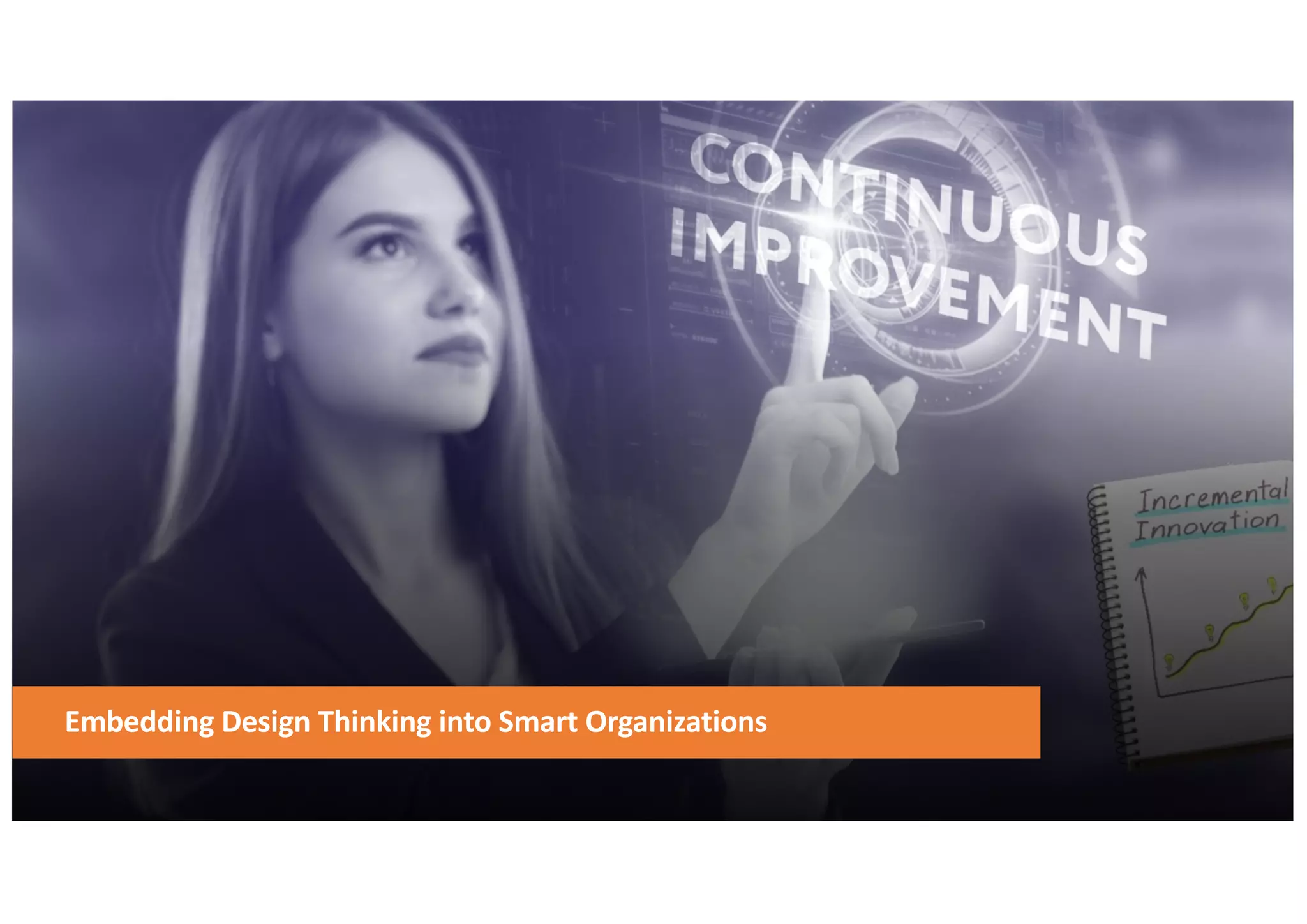
Embedding Design Thinking into Smart Organizations
Embedding
Design Thinking
within the
Organization
To innovate continuously you may want to
consider embedding Design Thinking within
your organization.
• In order to accomplish that, I recommend
conducting a Change Management
Project.
• Let‘s have a look at 10 steps to consider
(on the following slides).
• NB: You may want to consider Kotter‘s
Dual Operating System: Kotter, J.P. (2012)
Accelerate!, Harvard Business Review,
Nov 2012
1- SECURING
SUPPORT
FROM TOP
MANAGEMENT
• Projects have the best chance if they are
known to and supported by top management.
Outline the advantages to them and explain
your approach.
• If you convince them, your undertaking will
be mentioned in corporate communications
and you will have access to helpful resources.
In addition, you can refer to the company
management in discussions and negotiations.
• New projects in organizations do not
automatically find the approval of everyone.
A certain inertia is quite healthy, since not
every newspaper report should lead to a
realignment of day-to-day business.
• However, in order to anchor new things in
your company, you have to take these
resistances into account and deal with them.
• I mentioned the importance of support from
top management earlier. Also important are
so-called quick wins: These are quickly
achieved successes, which you can then "sell"
company-wide in order to "promote" your
project. In the long run, only very few people
want to doubt something that is apparently
successful.
• Please take quick wins into account during
planning: Plan your undertaking in such a
way that promising interim results are
achieved at an early stage.
2- QUICK-
WINS:
CONVINCING
THROUGH
EARLY
SUCCESSES
3- SELECT A
SUITABLE
(AGILE)
PROJECT -
OR INITIATE
ONE
• Design Thinking is an agile method and therefore
harmonizes well with such projects. The core of
agile projects are so-called sprints - meaning
cycles lasting 30 days (or 60 or 90), in which
previously defined goals are realized.
• The duration of the project sprints is fixed, and
the Design Thinking microprocess can be planned.
Thus, Design Thinking and an agile project can be
coordinated with each other.
• The Design Thinking microcycle results can flow
into project sprints: For example, a prototype
suggested by a Design Thinking team can then be
implemented by the project team.
• Of course, the reverse is also possible: Challenges
in a project can be dealt with by a Design
Thinking team, for example.
• Find or initiate a suitable project to collaborate
with.
4-
PERSUASION
AND
SUPPORT
DURING THE
IMPLEMEN-
TATION
• Seek dialogue with the teams of shortlisted
projects. Inform them about your
undertaking and work together to identify the
benefits that Design Thinking can bring to the
project in question. Maybe the team is faced
with a tricky challenge and Design Thinking
can help?
• Ideally, this will lead you to a win-win
situation. Prioritize the project with a clear
win-win case. That favors quick wins (see
above)
• Please also accompany the implementation of
the project: New approaches that are left to
themselves may come to nothing.
5-
EMBRACING
THE
RESULTS
• In any case, please take up the results
achieved by the project. Make sure the ideas
are appreciated and implemented as needed.
• If the results cannot be used, it is important
to communicate and justify this.
• Please keep in mind that innovations at the
beginning are sometimes accompanied by
additional effort. For people, it is enormously
frustrating when these expenses simply go to
waste and the efforts were therefore in vain.
6- SUCCESS IS
CONTAGIOUS:
COMMUNI-
CATING
ACHIEVE-
MENTS
• We have already discussed the importance of
short-term successes (quick wins). The same
applies to important results.
• Please communicate what has been achieved.
That is important for the team's spirit and
bolsters your undertaking.
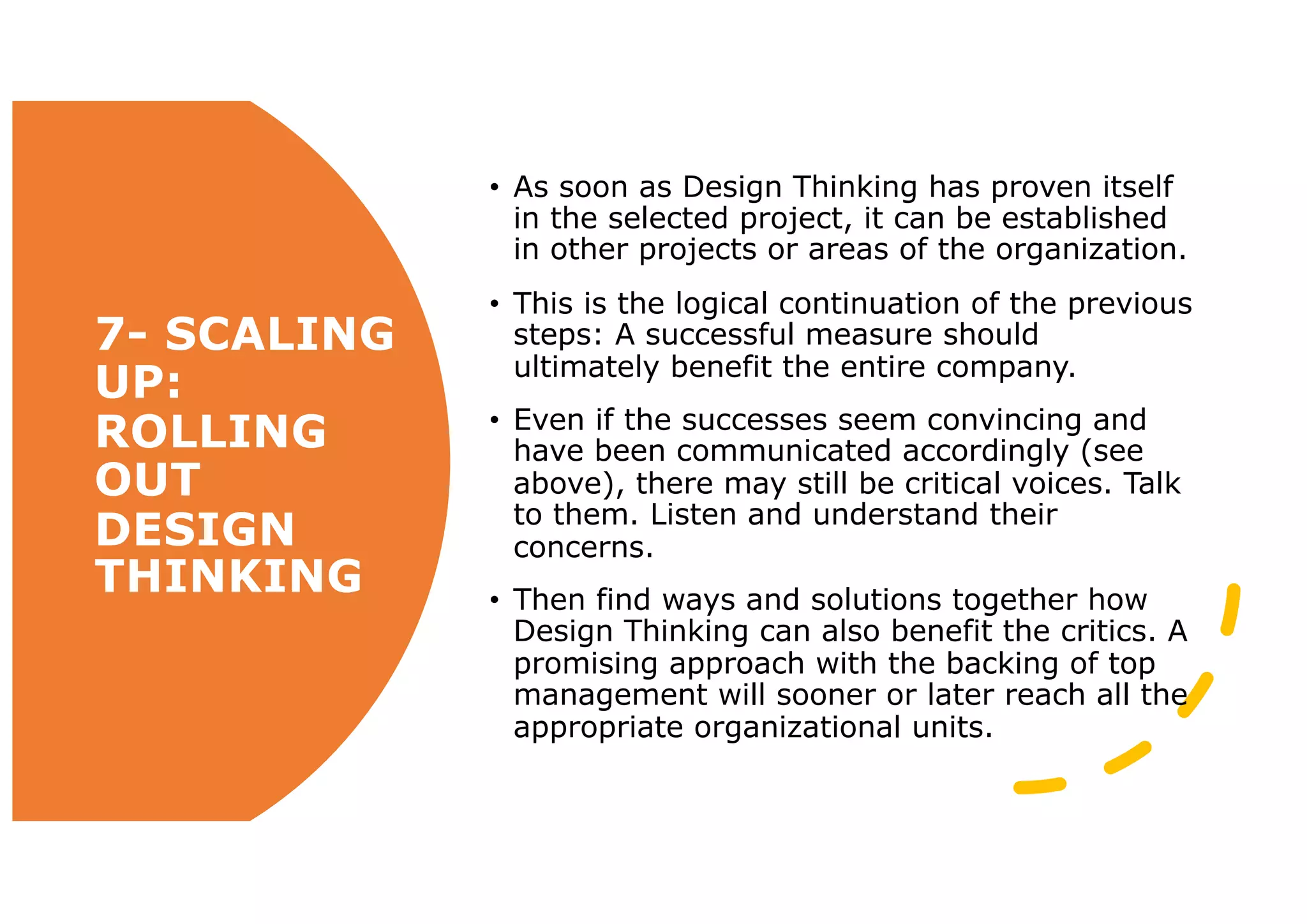
7- SCALING
UP:
ROLLING
OUT
DESIGN
THINKING
• As soon as Design Thinking has proven itself
in the selected project, it can be established
in other projects or areas of the organization.
• This is the logical continuation of the previous
steps: A successful measure should
ultimately benefit the entire company.
• Even if the successes seem convincing and
have been communicated accordingly (see
above), there may still be critical voices. Talk
to them. Listen and understand their
concerns.
• Then find ways and solutions together how
Design Thinking can also benefit the critics. A
promising approach with the backing of top
management will sooner or later reach all the
appropriate organizational units.
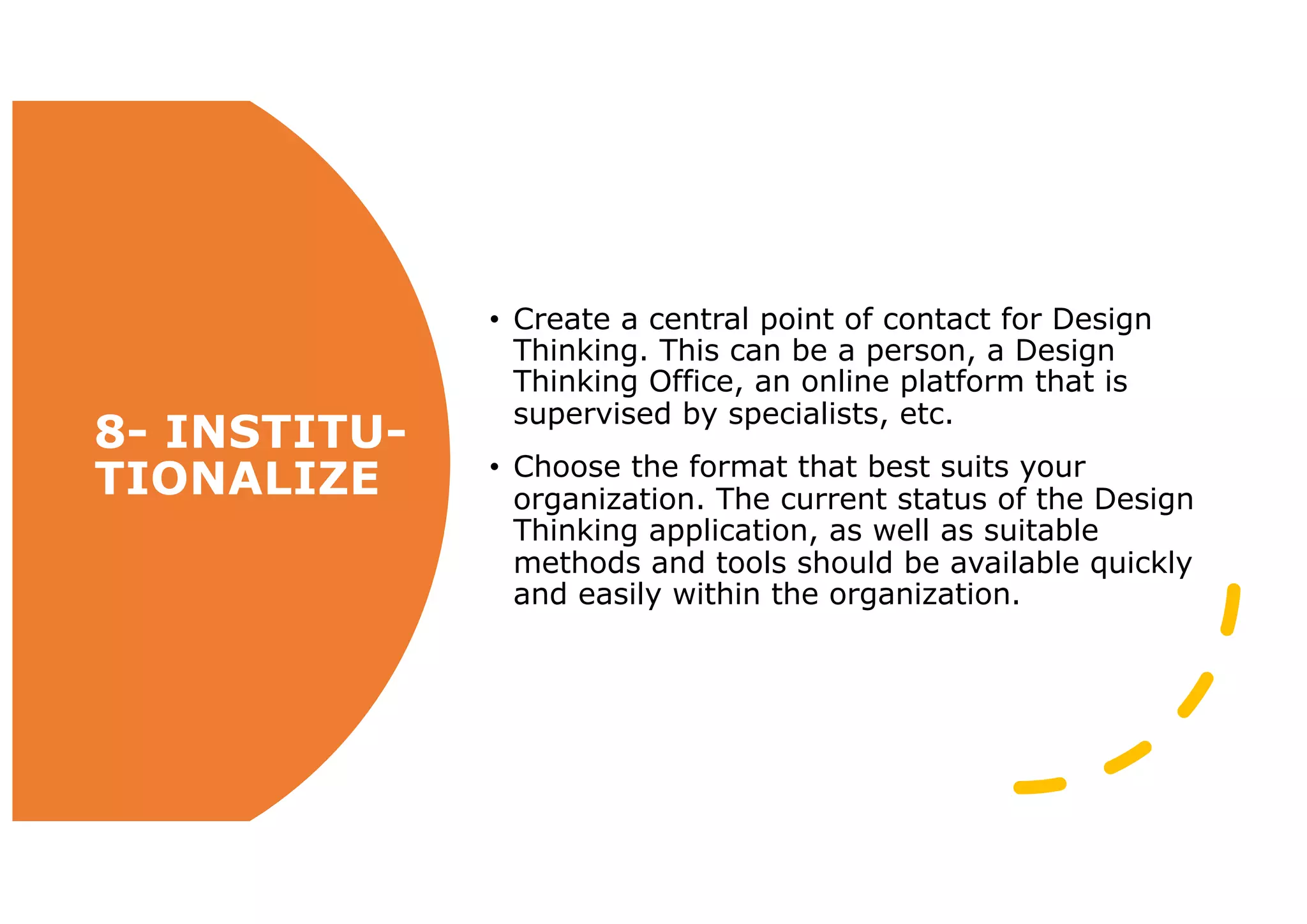
8- INSTITU-
TIONALIZE
• Create a central point of contact for Design
Thinking. This can be a person, a Design
Thinking Office, an online platform that is
supervised by specialists, etc.
• Choose the format that best suits your
organization. The current status of the Design
Thinking application, as well as suitable
methods and tools should be available quickly
and easily within the organization.
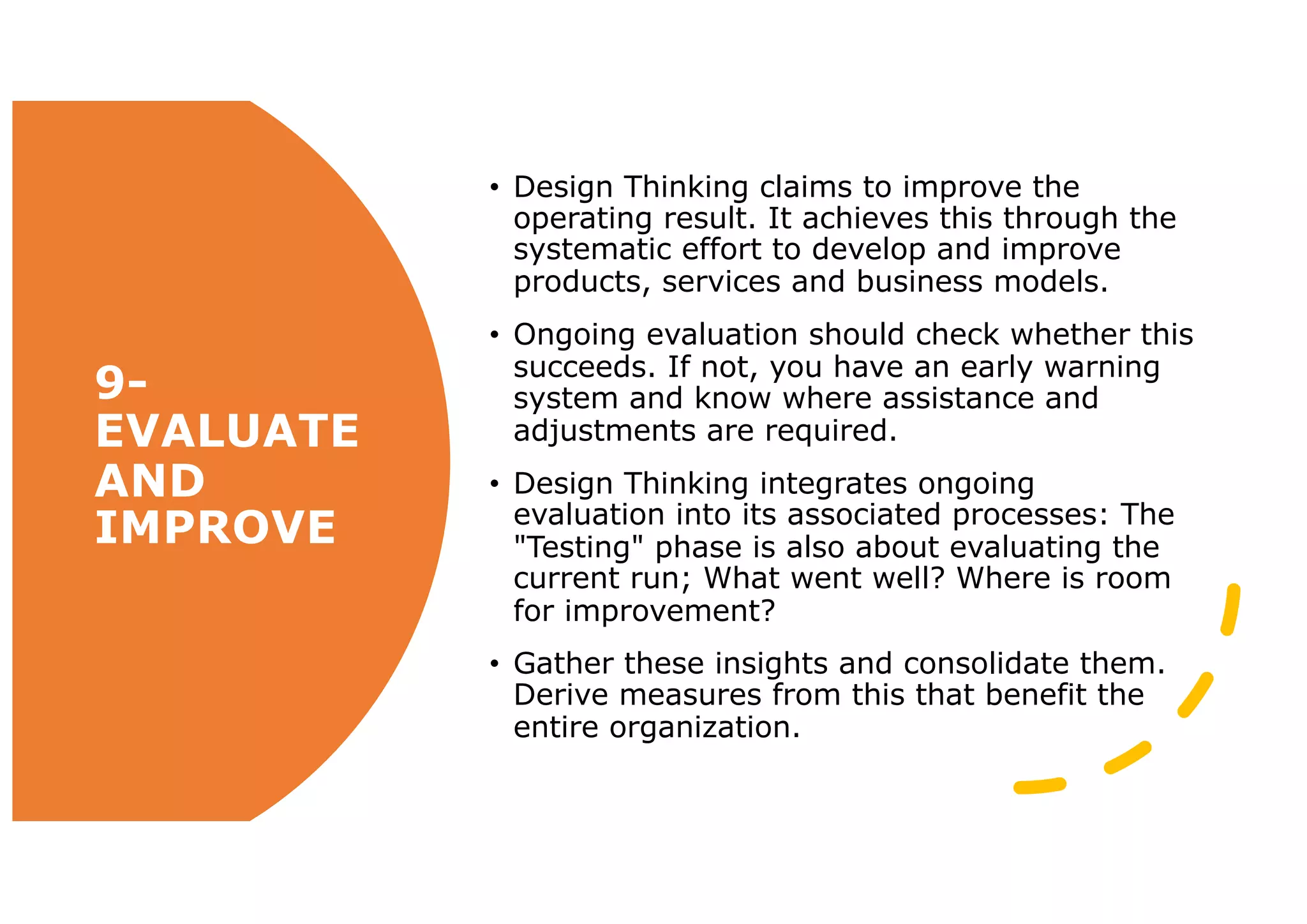
9-
EVALUATE
AND
IMPROVE
• Design Thinking claims to improve the
operating result. It achieves this through the
systematic effort to develop and improve
products, services and business models.
• Ongoing evaluation should check whether this
succeeds. If not, you have an early warning
system and know where assistance and
adjustments are required.
• Design Thinking integrates ongoing
evaluation into its associated processes: The
"Testing" phase is also about evaluating the
current run; What went well? Where is room
for improvement?
• Gather these insights and consolidate them.
Derive measures from this that benefit the
entire organization.
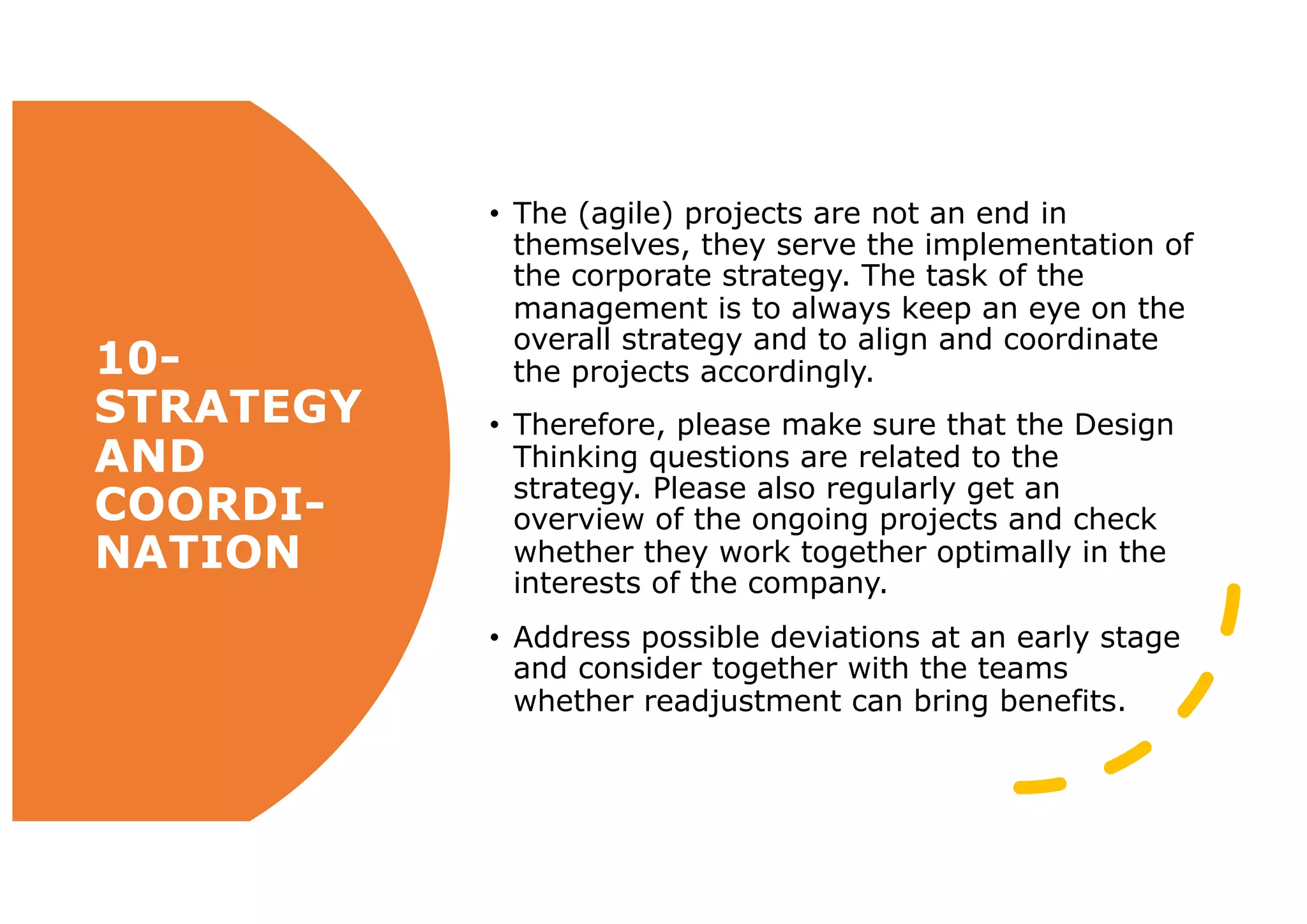
10-
STRATEGY
AND
COORDI-
NATION
• The (agile) projects are not an end in
themselves, they serve the implementation of
the corporate strategy. The task of the
management is to always keep an eye on the
overall strategy and to align and coordinate
the projects accordingly.
• Therefore, please make sure that the Design
Thinking questions are related to the
strategy. Please also regularly get an
overview of the ongoing projects and check
whether they work together optimally in the
interests of the company.
• Address possible deviations at an early stage
and consider together with the teams
whether readjustment can bring benefits.
Embedding
Design Thinking
within the
Organization
Further hints
• In any case, I recommend that you clearly define
your mission, including the KPIs.
• Please also make sure that you have access to the
necessary resources – even before you start your
project.
Further information
https://itsalexander.gumroad.com
https://www.linkedin.com/in/thealexandersimon/

DT-10-Steps.pdf

  • 1.
    Embedding Design Thinkinginto Smart Organizations
  • 2.
    Embedding Design Thinking within the Organization Toinnovate continuously you may want to consider embedding Design Thinking within your organization. • In order to accomplish that, I recommend conducting a Change Management Project. • Let‘s have a look at 10 steps to consider (on the following slides). • NB: You may want to consider Kotter‘s Dual Operating System: Kotter, J.P. (2012) Accelerate!, Harvard Business Review, Nov 2012
  • 3.
    1- SECURING SUPPORT FROM TOP MANAGEMENT •Projects have the best chance if they are known to and supported by top management. Outline the advantages to them and explain your approach. • If you convince them, your undertaking will be mentioned in corporate communications and you will have access to helpful resources. In addition, you can refer to the company management in discussions and negotiations.
  • 4.
    • New projectsin organizations do not automatically find the approval of everyone. A certain inertia is quite healthy, since not every newspaper report should lead to a realignment of day-to-day business. • However, in order to anchor new things in your company, you have to take these resistances into account and deal with them. • I mentioned the importance of support from top management earlier. Also important are so-called quick wins: These are quickly achieved successes, which you can then "sell" company-wide in order to "promote" your project. In the long run, only very few people want to doubt something that is apparently successful. • Please take quick wins into account during planning: Plan your undertaking in such a way that promising interim results are achieved at an early stage. 2- QUICK- WINS: CONVINCING THROUGH EARLY SUCCESSES
  • 5.
    3- SELECT A SUITABLE (AGILE) PROJECT- OR INITIATE ONE • Design Thinking is an agile method and therefore harmonizes well with such projects. The core of agile projects are so-called sprints - meaning cycles lasting 30 days (or 60 or 90), in which previously defined goals are realized. • The duration of the project sprints is fixed, and the Design Thinking microprocess can be planned. Thus, Design Thinking and an agile project can be coordinated with each other. • The Design Thinking microcycle results can flow into project sprints: For example, a prototype suggested by a Design Thinking team can then be implemented by the project team. • Of course, the reverse is also possible: Challenges in a project can be dealt with by a Design Thinking team, for example. • Find or initiate a suitable project to collaborate with.
  • 6.
    4- PERSUASION AND SUPPORT DURING THE IMPLEMEN- TATION • Seekdialogue with the teams of shortlisted projects. Inform them about your undertaking and work together to identify the benefits that Design Thinking can bring to the project in question. Maybe the team is faced with a tricky challenge and Design Thinking can help? • Ideally, this will lead you to a win-win situation. Prioritize the project with a clear win-win case. That favors quick wins (see above) • Please also accompany the implementation of the project: New approaches that are left to themselves may come to nothing.
  • 7.
    5- EMBRACING THE RESULTS • In anycase, please take up the results achieved by the project. Make sure the ideas are appreciated and implemented as needed. • If the results cannot be used, it is important to communicate and justify this. • Please keep in mind that innovations at the beginning are sometimes accompanied by additional effort. For people, it is enormously frustrating when these expenses simply go to waste and the efforts were therefore in vain.
  • 8.
    6- SUCCESS IS CONTAGIOUS: COMMUNI- CATING ACHIEVE- MENTS •We have already discussed the importance of short-term successes (quick wins). The same applies to important results. • Please communicate what has been achieved. That is important for the team's spirit and bolsters your undertaking.
  • 9.
    7- SCALING UP: ROLLING OUT DESIGN THINKING • Assoon as Design Thinking has proven itself in the selected project, it can be established in other projects or areas of the organization. • This is the logical continuation of the previous steps: A successful measure should ultimately benefit the entire company. • Even if the successes seem convincing and have been communicated accordingly (see above), there may still be critical voices. Talk to them. Listen and understand their concerns. • Then find ways and solutions together how Design Thinking can also benefit the critics. A promising approach with the backing of top management will sooner or later reach all the appropriate organizational units.
  • 10.
    8- INSTITU- TIONALIZE • Createa central point of contact for Design Thinking. This can be a person, a Design Thinking Office, an online platform that is supervised by specialists, etc. • Choose the format that best suits your organization. The current status of the Design Thinking application, as well as suitable methods and tools should be available quickly and easily within the organization.
  • 11.
    9- EVALUATE AND IMPROVE • Design Thinkingclaims to improve the operating result. It achieves this through the systematic effort to develop and improve products, services and business models. • Ongoing evaluation should check whether this succeeds. If not, you have an early warning system and know where assistance and adjustments are required. • Design Thinking integrates ongoing evaluation into its associated processes: The "Testing" phase is also about evaluating the current run; What went well? Where is room for improvement? • Gather these insights and consolidate them. Derive measures from this that benefit the entire organization.
  • 12.
    10- STRATEGY AND COORDI- NATION • The (agile)projects are not an end in themselves, they serve the implementation of the corporate strategy. The task of the management is to always keep an eye on the overall strategy and to align and coordinate the projects accordingly. • Therefore, please make sure that the Design Thinking questions are related to the strategy. Please also regularly get an overview of the ongoing projects and check whether they work together optimally in the interests of the company. • Address possible deviations at an early stage and consider together with the teams whether readjustment can bring benefits.
  • 13.
    Embedding Design Thinking within the Organization Furtherhints • In any case, I recommend that you clearly define your mission, including the KPIs. • Please also make sure that you have access to the necessary resources – even before you start your project. Further information https://itsalexander.gumroad.com https://www.linkedin.com/in/thealexandersimon/