Title:
Extraction, isolation and activity determination of
antioxidant from green peas peel and its application in
food.
Presented by
Mamta Sahurkar
Laxminarayan Institute of
Technology,
Nagpur.
Guided by
Dr. Sneha.V. Karadbhajne
Asst. prof (Food technology)
Laxminarayan Institute of
Technology,
Nagpur
• Green pea (Pisum sativum L.) is an important vegetable crop.
• India is second largest producer of green peas after China.
• In India it is grown on 0.7 million hectares of land yielding 0.6 million tonnes.
• It is utilized after removing the pod to prepare edible seeds as frozen, canned or fresh
food.
• They possess favorable composition with respect to micronutrients, low fat, high
protein and fibre content.
• Rich in antioxidant components like Vitamin C, Carotenoids and various phenolic
compounds, mostly present in cotyledons.
INTRODUCTION
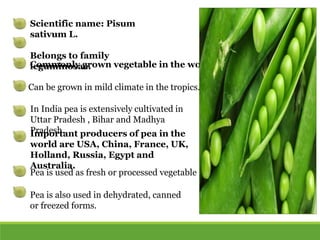
Scientific name: Pisum
sativum L.
Belongs to family
leguminosae.Commonly grown vegetable in the world.
Can be grown in mild climate in the tropics.
In India pea is extensively cultivated in
Uttar Pradesh , Bihar and Madhya
Pradesh.Important producers of pea in the
world are USA, China, France, UK,
Holland, Russia, Egypt and
Australia.
Pea is used as fresh or processed vegetable
Pea is also used in dehydrated, canned
or freezed forms.
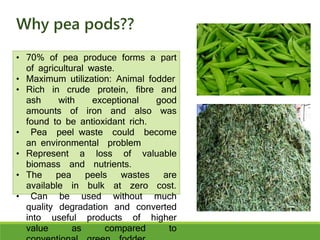
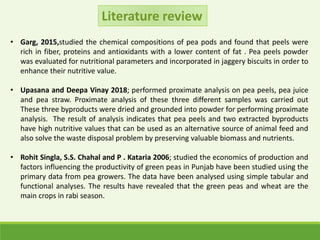
• 70% of pea produce forms a part
of agricultural waste.
• Maximum utilization: Animal fodder
• Rich in crude protein, fibre and
ash with exceptional good
amounts of iron and also was
found to be antioxidant rich.
• Pea peel waste could become
an environmental problem
• Represent a loss of valuable
biomass and nutrients.
• The pea peels wastes are
available in bulk at zero cost.
• Can be used without much
quality degradation and converted
into useful products of higher
value as compared to
Why pea pods??
• Garg, 2015,studied the chemical compositions of pea pods and found that peels were
rich in fiber, proteins and antioxidants with a lower content of fat . Pea peels powder
was evaluated for nutritional parameters and incorporated in jaggery biscuits in order to
enhance their nutritive value.
• Upasana and Deepa Vinay 2018; performed proximate analysis on pea peels, pea juice
and pea straw. Proximate analysis of these three different samples was carried out
These three byproducts were dried and grounded into powder for performing proximate
analysis. The result of analysis indicates that pea peels and two extracted byproducts
have high nutritive values that can be used as an alternative source of animal feed and
also solve the waste disposal problem by preserving valuable biomass and nutrients.
• Rohit Singla, S.S. Chahal and P . Kataria 2006; studied the economics of production and
factors influencing the productivity of green peas in Punjab have been studied using the
primary data from pea growers. The data have been analysed using simple tabular and
functional analyses. The results have revealed that the green peas and wheat are the
main crops in rabi season.
Literature review
• Fatma Hadrich et al 2014; evaluated antioxidant and antimicrobial activities of the peel
of pea (Pisum sativum), with particular attention to the content of some bioactive
compounds. Total content of polyphenols and flavonoids of Pisum sativum peel extracts,
including a crude aqueous extract, a methanolic extract and an ethyl acetate extract was
carried out according to the standard methods to assess their corresponding antioxidant
activities.
• M. Selvamuthukumaran and John Shi 2017; The by-products obtained from plant
processing industries are the cheap source of bioactive compounds especially
antioxidants. The process systems along with industrial applications for non-
conventional method of antioxidants extraction were discussed, and the comparative
efficacies of different extraction methods were highlighted.
• Prabha Hegde et al 2015; aimed to explore the potential to develop a commercially
feasible extraction method to recover polyphenols from orange peels. Different drying
techniques, extraction temperatures, solvents and duration were attempted. All the
extracts were analyzed for total polyphenol content by Folin Ciocalteau method.
Though extraction of sundried samples with acidified aqueous methanol yielded the
highest polyphenol content, for commercial purpose.
• Anna Kotlarz et al.2012; tested nutritional usability of pea seeds (Pisum sativum L.) at
full maturity, proximate composition of ground seeds collected over 4 years period
as well as amino acids, minerals (Ca, P, Na, K), tannins and fiber fractions (NDF,ADF,
ADL). The calculated protein nutritional values were compared against amino acid
standards of human and animal nutrition and the whole egg protein. Effects of
the cropping year and variety variance in respect of chemical composition of seeds
were examined.
• Agnieszkatroszyńska and Ewaciska 2002; evaluated phenolic compounds of seed Coats
of white and coloured Varieties of Pea (Pisum sativum L.) and their total antioxidant
activity. The purpose of this study was to compare the composition and contents of
phenolic acids and condensed tannin in the seed coats of white and coloured varieties
of pea and to examine the antioxidant properties of methanol and acetone extracts
containing these phenolic compounds. The contents of phenolic acids were quantified
by the HPLC analysis. The sum of free phenolic acids, those liberated from soluble
esters and those liberated from soluble glycosides, was higher for coloured seed coat
(78.53 g per g dry matter) than for the white seed coat (17.17 g/g dry matter)
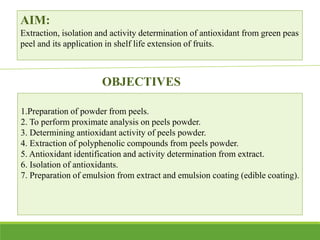
AIM:
Extraction, isolation and activity determination of antioxidant from green peas
peel and its application in shelf life extension of fruits.
OBJECTIVES
1.Preparation of powder from peels.
2. To perform proximate analysis on peels powder.
3. Determining antioxidant activity of peels powder.
4. Extraction of polyphenolic compounds from peels powder.
5. Antioxidant identification and activity determination from extract.
6. Isolation of antioxidants.
7. Preparation of emulsion from extract and emulsion coating (edible coating).
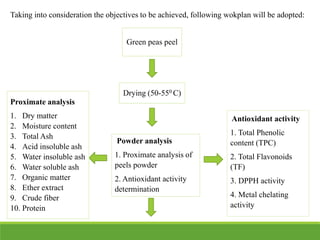
Taking into consideration the objectives to be achieved, following wokplan will be adopted:
Green peas peel
Drying (50-550 C)
Powder analysis
1. Proximate analysis of
peels powder
2. Antioxidant activity
determination
Antioxidant activity
1. Total Phenolic
content (TPC)
2. Total Flavonoids
(TF)
3. DPPH activity
4. Metal chelating
activity
Proximate analysis
1. Dry matter
2. Moisture content
3. Total Ash
4. Acid insoluble ash
5. Water insoluble ash
6. Water soluble ash
7. Organic matter
8. Ether extract
9. Crude fiber
10. Protein
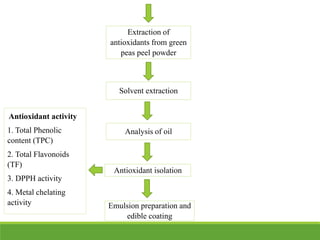
Extraction of
antioxidants from green
peas peel powder
Solvent extraction
Analysis of oil
Antioxidant isolation
Emulsion preparation and
edible coating
Antioxidant activity
1. Total Phenolic
content (TPC)
2. Total Flavonoids
(TF)
3. DPPH activity
4. Metal chelating
activity
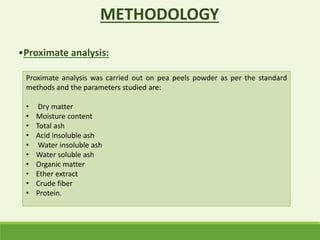
Proximate analysis was carried out on pea peels powder as per the standard
methods and the parameters studied are:
• Dry matter
• Moisture content
• Total ash
• Acid insoluble ash
• Water insoluble ash
• Water soluble ash
• Organic matter
• Ether extract
• Crude fiber
• Protein.
•Proximate analysis:
METHODOLOGY
•Total phenolic content (TPC)
As per the method described by Singleton and Rosi (1965), methanolic
extract of peels powder was prepared and TPC was determined by
observing the absorbance at 765 nm and using gallic acid as standard.
Antioxidant activity determination
•Total flavonoid content (TPC)
Sample was exploited for determination of TF content by observing the
absorbance of methanolic extracts at 420 nm and using quercetin as
standard .(D.Marinova et al,2005)
DPPH activity
When a solution of DPPH (1, 1-diphenyl-2-picrylhydrazyl) is mixed with that of a substrate (AH) that
can donate a hydrogen atom, then this gives rise to the reduced form with the loss of this violet
color. In order to evaluate the antioxidant potential through free radical scavenging by the test
samples, the change in optical density of DPPH radicals is monitored. According to the sample
extract (0.2 mL) is diluted with methanol and 2 mL of DPPH solution (0.5 mM) is added. After 30
min, the absorbance is measured at 517 nm. The percentage of the DPPH radical scavenging is
calculated using the equation as given below:
Where Abr is the absorbance before reaction and Aar is the absorbance after reaction has taken
place (Manzocco, L et al 1998).
% inhibition of DPPH radical = [(Abr- Aar/ Abr) x 100]
Metal chelating activity
Ferrozine can form a complex with a red color by forming chelates with Fe2+. This reaction is
restricted in the presence of other chelating agents and results in a decrease of the red color of
the ferrozine-Fe2+ complexes. Measurement of the color reduction determines the chelating
activity to compete with ferrozine for the ferrous ions. 0.1 mL of the extract is added to a
solution of 0.5 mL ferrous chloride (0.2 mM). The reaction is started by the addition of 0.2 mL
of ferrozine (5 mM) and incubated at room temperature for 10 min and then the absorbance is
measured at 562 nm. EDTA or citric acid can be used as a positive control (Soler-Rivas et al
2000).
The initial part of the project work was
performed during current session in the
laboratory of Laxminarayan Institute of
Technology(Food Technology):
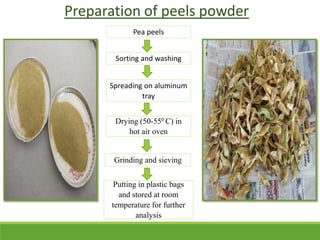
Pea peels
Spreading on aluminum
tray
Drying (50-550 C) in
hot air oven
Grinding and sieving
Putting in plastic bags
and stored at room
temperature for further
analysis
Sorting and washing
Preparation of peels powder
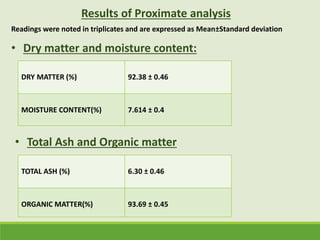
Results of Proximate analysis
• Dry matter and moisture content:
DRY MATTER (%) 92.38 ± 0.46
MOISTURE CONTENT(%) 7.614 ± 0.4
• Total Ash and Organic matter
Readings were noted in triplicates and are expressed as Mean±Standard deviation
TOTAL ASH (%) 6.30 ± 0.46
ORGANIC MATTER(%) 93.69 ± 0.45
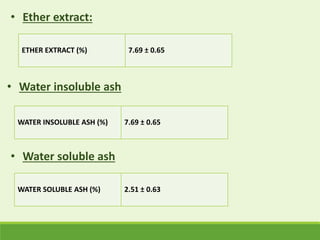
• Ether extract:
ETHER EXTRACT (%) 7.69 ± 0.65
• Water insoluble ash
WATER INSOLUBLE ASH (%) 7.69 ± 0.65
• Water soluble ash
WATER SOLUBLE ASH (%) 2.51 ± 0.63
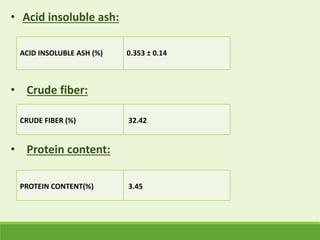
• Acid insoluble ash:
ACID INSOLUBLE ASH (%) 0.353 ± 0.14
• Crude fiber:
CRUDE FIBER (%) 32.42
• Protein content:
PROTEIN CONTENT(%) 3.45
References
• D. Marinova, F. Ribarova, and M. Atanassova, “Total phenolic and total flavonoids in
Bulgarian fruits and vegetables,” Journal of the University of Chemical Technology and
Metallurgy. 2005; vol. 40, no. 3, pp. 255–260.
• Manzocco, L., Anese, M., Nicoli, M.C. Antioxidant properties of tea extracts as affected by
processing. Lebens-mittel-Wissenschaft Und-Technologies 1998; 31 (7–8), 694–698.
• Soler-Rivas, C., Espin, J.C., Wichers, H.J. An easy and fast test to compare total free radical
scavenger capacity of foodstuffs. Phytochem. Anal .2000; 11, 330–338.
• Troszynska A, Estrella I, Lopez-Amores M L and Hernandez T. Antioxidant activity of pea
(Pisum sativum L.) seed coat acetone extract. J Lebensmittel .2002; 35(2): 158- 64.
• V. L. Singleton and J. A. Rossi, “Colorimetry of total phenolics with phosphomolybdic-
phosphotungstic acid reagents,” The American Journal of Enology and Viticulture. 1965;
vol. 16, pp. 144–158.
• Verma N, Bansal M C and Kumar V .Pea peel waste for cellulose. 2011; 1505-19
THANK YOU

Presentation1

  • 1.
    Title: Extraction, isolation andactivity determination of antioxidant from green peas peel and its application in food. Presented by Mamta Sahurkar Laxminarayan Institute of Technology, Nagpur. Guided by Dr. Sneha.V. Karadbhajne Asst. prof (Food technology) Laxminarayan Institute of Technology, Nagpur
  • 2.
    • Green pea(Pisum sativum L.) is an important vegetable crop. • India is second largest producer of green peas after China. • In India it is grown on 0.7 million hectares of land yielding 0.6 million tonnes. • It is utilized after removing the pod to prepare edible seeds as frozen, canned or fresh food. • They possess favorable composition with respect to micronutrients, low fat, high protein and fibre content. • Rich in antioxidant components like Vitamin C, Carotenoids and various phenolic compounds, mostly present in cotyledons. INTRODUCTION
  • 3.
    Scientific name: Pisum sativumL. Belongs to family leguminosae.Commonly grown vegetable in the world. Can be grown in mild climate in the tropics. In India pea is extensively cultivated in Uttar Pradesh , Bihar and Madhya Pradesh.Important producers of pea in the world are USA, China, France, UK, Holland, Russia, Egypt and Australia. Pea is used as fresh or processed vegetable Pea is also used in dehydrated, canned or freezed forms.
  • 4.
    • 70% ofpea produce forms a part of agricultural waste. • Maximum utilization: Animal fodder • Rich in crude protein, fibre and ash with exceptional good amounts of iron and also was found to be antioxidant rich. • Pea peel waste could become an environmental problem • Represent a loss of valuable biomass and nutrients. • The pea peels wastes are available in bulk at zero cost. • Can be used without much quality degradation and converted into useful products of higher value as compared to Why pea pods??
  • 5.
    • Garg, 2015,studiedthe chemical compositions of pea pods and found that peels were rich in fiber, proteins and antioxidants with a lower content of fat . Pea peels powder was evaluated for nutritional parameters and incorporated in jaggery biscuits in order to enhance their nutritive value. • Upasana and Deepa Vinay 2018; performed proximate analysis on pea peels, pea juice and pea straw. Proximate analysis of these three different samples was carried out These three byproducts were dried and grounded into powder for performing proximate analysis. The result of analysis indicates that pea peels and two extracted byproducts have high nutritive values that can be used as an alternative source of animal feed and also solve the waste disposal problem by preserving valuable biomass and nutrients. • Rohit Singla, S.S. Chahal and P . Kataria 2006; studied the economics of production and factors influencing the productivity of green peas in Punjab have been studied using the primary data from pea growers. The data have been analysed using simple tabular and functional analyses. The results have revealed that the green peas and wheat are the main crops in rabi season. Literature review
  • 6.
    • Fatma Hadrichet al 2014; evaluated antioxidant and antimicrobial activities of the peel of pea (Pisum sativum), with particular attention to the content of some bioactive compounds. Total content of polyphenols and flavonoids of Pisum sativum peel extracts, including a crude aqueous extract, a methanolic extract and an ethyl acetate extract was carried out according to the standard methods to assess their corresponding antioxidant activities. • M. Selvamuthukumaran and John Shi 2017; The by-products obtained from plant processing industries are the cheap source of bioactive compounds especially antioxidants. The process systems along with industrial applications for non- conventional method of antioxidants extraction were discussed, and the comparative efficacies of different extraction methods were highlighted. • Prabha Hegde et al 2015; aimed to explore the potential to develop a commercially feasible extraction method to recover polyphenols from orange peels. Different drying techniques, extraction temperatures, solvents and duration were attempted. All the extracts were analyzed for total polyphenol content by Folin Ciocalteau method. Though extraction of sundried samples with acidified aqueous methanol yielded the highest polyphenol content, for commercial purpose.
  • 7.
    • Anna Kotlarzet al.2012; tested nutritional usability of pea seeds (Pisum sativum L.) at full maturity, proximate composition of ground seeds collected over 4 years period as well as amino acids, minerals (Ca, P, Na, K), tannins and fiber fractions (NDF,ADF, ADL). The calculated protein nutritional values were compared against amino acid standards of human and animal nutrition and the whole egg protein. Effects of the cropping year and variety variance in respect of chemical composition of seeds were examined. • Agnieszkatroszyńska and Ewaciska 2002; evaluated phenolic compounds of seed Coats of white and coloured Varieties of Pea (Pisum sativum L.) and their total antioxidant activity. The purpose of this study was to compare the composition and contents of phenolic acids and condensed tannin in the seed coats of white and coloured varieties of pea and to examine the antioxidant properties of methanol and acetone extracts containing these phenolic compounds. The contents of phenolic acids were quantified by the HPLC analysis. The sum of free phenolic acids, those liberated from soluble esters and those liberated from soluble glycosides, was higher for coloured seed coat (78.53 g per g dry matter) than for the white seed coat (17.17 g/g dry matter)
  • 8.
    AIM: Extraction, isolation andactivity determination of antioxidant from green peas peel and its application in shelf life extension of fruits. OBJECTIVES 1.Preparation of powder from peels. 2. To perform proximate analysis on peels powder. 3. Determining antioxidant activity of peels powder. 4. Extraction of polyphenolic compounds from peels powder. 5. Antioxidant identification and activity determination from extract. 6. Isolation of antioxidants. 7. Preparation of emulsion from extract and emulsion coating (edible coating).
  • 9.
    Taking into considerationthe objectives to be achieved, following wokplan will be adopted: Green peas peel Drying (50-550 C) Powder analysis 1. Proximate analysis of peels powder 2. Antioxidant activity determination Antioxidant activity 1. Total Phenolic content (TPC) 2. Total Flavonoids (TF) 3. DPPH activity 4. Metal chelating activity Proximate analysis 1. Dry matter 2. Moisture content 3. Total Ash 4. Acid insoluble ash 5. Water insoluble ash 6. Water soluble ash 7. Organic matter 8. Ether extract 9. Crude fiber 10. Protein
  • 10.
    Extraction of antioxidants fromgreen peas peel powder Solvent extraction Analysis of oil Antioxidant isolation Emulsion preparation and edible coating Antioxidant activity 1. Total Phenolic content (TPC) 2. Total Flavonoids (TF) 3. DPPH activity 4. Metal chelating activity
  • 11.
    Proximate analysis wascarried out on pea peels powder as per the standard methods and the parameters studied are: • Dry matter • Moisture content • Total ash • Acid insoluble ash • Water insoluble ash • Water soluble ash • Organic matter • Ether extract • Crude fiber • Protein. •Proximate analysis: METHODOLOGY
  • 12.
    •Total phenolic content(TPC) As per the method described by Singleton and Rosi (1965), methanolic extract of peels powder was prepared and TPC was determined by observing the absorbance at 765 nm and using gallic acid as standard. Antioxidant activity determination •Total flavonoid content (TPC) Sample was exploited for determination of TF content by observing the absorbance of methanolic extracts at 420 nm and using quercetin as standard .(D.Marinova et al,2005)
  • 13.
    DPPH activity When asolution of DPPH (1, 1-diphenyl-2-picrylhydrazyl) is mixed with that of a substrate (AH) that can donate a hydrogen atom, then this gives rise to the reduced form with the loss of this violet color. In order to evaluate the antioxidant potential through free radical scavenging by the test samples, the change in optical density of DPPH radicals is monitored. According to the sample extract (0.2 mL) is diluted with methanol and 2 mL of DPPH solution (0.5 mM) is added. After 30 min, the absorbance is measured at 517 nm. The percentage of the DPPH radical scavenging is calculated using the equation as given below: Where Abr is the absorbance before reaction and Aar is the absorbance after reaction has taken place (Manzocco, L et al 1998). % inhibition of DPPH radical = [(Abr- Aar/ Abr) x 100] Metal chelating activity Ferrozine can form a complex with a red color by forming chelates with Fe2+. This reaction is restricted in the presence of other chelating agents and results in a decrease of the red color of the ferrozine-Fe2+ complexes. Measurement of the color reduction determines the chelating activity to compete with ferrozine for the ferrous ions. 0.1 mL of the extract is added to a solution of 0.5 mL ferrous chloride (0.2 mM). The reaction is started by the addition of 0.2 mL of ferrozine (5 mM) and incubated at room temperature for 10 min and then the absorbance is measured at 562 nm. EDTA or citric acid can be used as a positive control (Soler-Rivas et al 2000).
  • 14.
    The initial partof the project work was performed during current session in the laboratory of Laxminarayan Institute of Technology(Food Technology):
  • 15.
    Pea peels Spreading onaluminum tray Drying (50-550 C) in hot air oven Grinding and sieving Putting in plastic bags and stored at room temperature for further analysis Sorting and washing Preparation of peels powder
  • 16.
    Results of Proximateanalysis • Dry matter and moisture content: DRY MATTER (%) 92.38 ± 0.46 MOISTURE CONTENT(%) 7.614 ± 0.4 • Total Ash and Organic matter Readings were noted in triplicates and are expressed as Mean±Standard deviation TOTAL ASH (%) 6.30 ± 0.46 ORGANIC MATTER(%) 93.69 ± 0.45
  • 17.
    • Ether extract: ETHEREXTRACT (%) 7.69 ± 0.65 • Water insoluble ash WATER INSOLUBLE ASH (%) 7.69 ± 0.65 • Water soluble ash WATER SOLUBLE ASH (%) 2.51 ± 0.63
  • 18.
    • Acid insolubleash: ACID INSOLUBLE ASH (%) 0.353 ± 0.14 • Crude fiber: CRUDE FIBER (%) 32.42 • Protein content: PROTEIN CONTENT(%) 3.45
  • 19.
    References • D. Marinova,F. Ribarova, and M. Atanassova, “Total phenolic and total flavonoids in Bulgarian fruits and vegetables,” Journal of the University of Chemical Technology and Metallurgy. 2005; vol. 40, no. 3, pp. 255–260. • Manzocco, L., Anese, M., Nicoli, M.C. Antioxidant properties of tea extracts as affected by processing. Lebens-mittel-Wissenschaft Und-Technologies 1998; 31 (7–8), 694–698. • Soler-Rivas, C., Espin, J.C., Wichers, H.J. An easy and fast test to compare total free radical scavenger capacity of foodstuffs. Phytochem. Anal .2000; 11, 330–338. • Troszynska A, Estrella I, Lopez-Amores M L and Hernandez T. Antioxidant activity of pea (Pisum sativum L.) seed coat acetone extract. J Lebensmittel .2002; 35(2): 158- 64. • V. L. Singleton and J. A. Rossi, “Colorimetry of total phenolics with phosphomolybdic- phosphotungstic acid reagents,” The American Journal of Enology and Viticulture. 1965; vol. 16, pp. 144–158. • Verma N, Bansal M C and Kumar V .Pea peel waste for cellulose. 2011; 1505-19
  • 20.