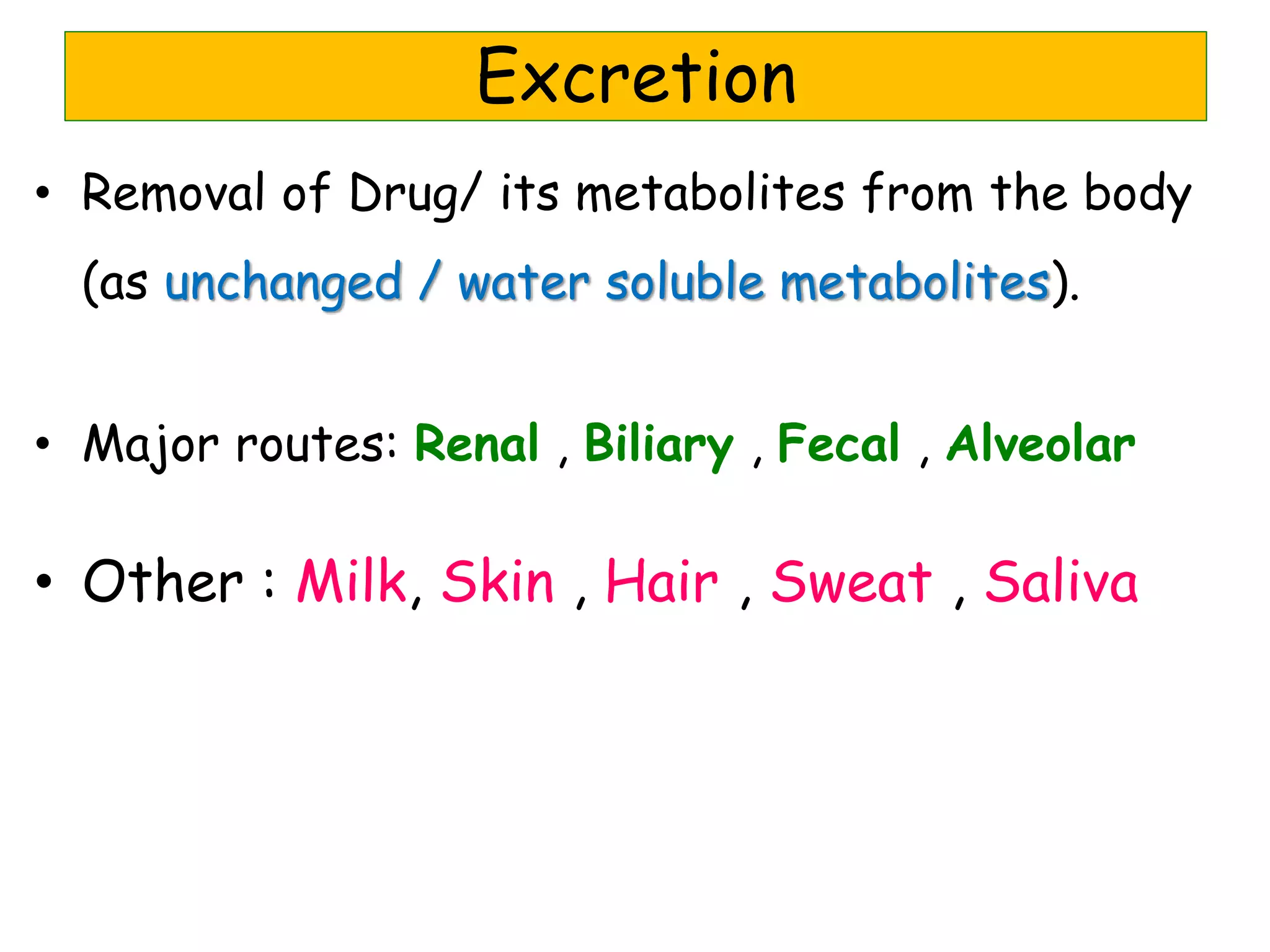
• Removal of Drug/ its metabolites from the body
(as unchanged / water soluble metabolites).
• Major routes: Renal , Biliary , Fecal , Alveolar
• Other : Milk, Skin , Hair , Sweat , Saliva
Excretion
1. Renal Excretion:
e.g. Frusemide, Gentamicin, d-TC, digoxin etc)
• Amount of Drug / Metabolites excreted
(i.e. ultimately present in urine) depends on
following Processes:
• Net Renal Excretion (RE) = (GF + ATS) - PTR
Where, GF = Glomerular Filtration
ATS = Active Tubular Secretion
PTR = Passive Tubular Reabsorption
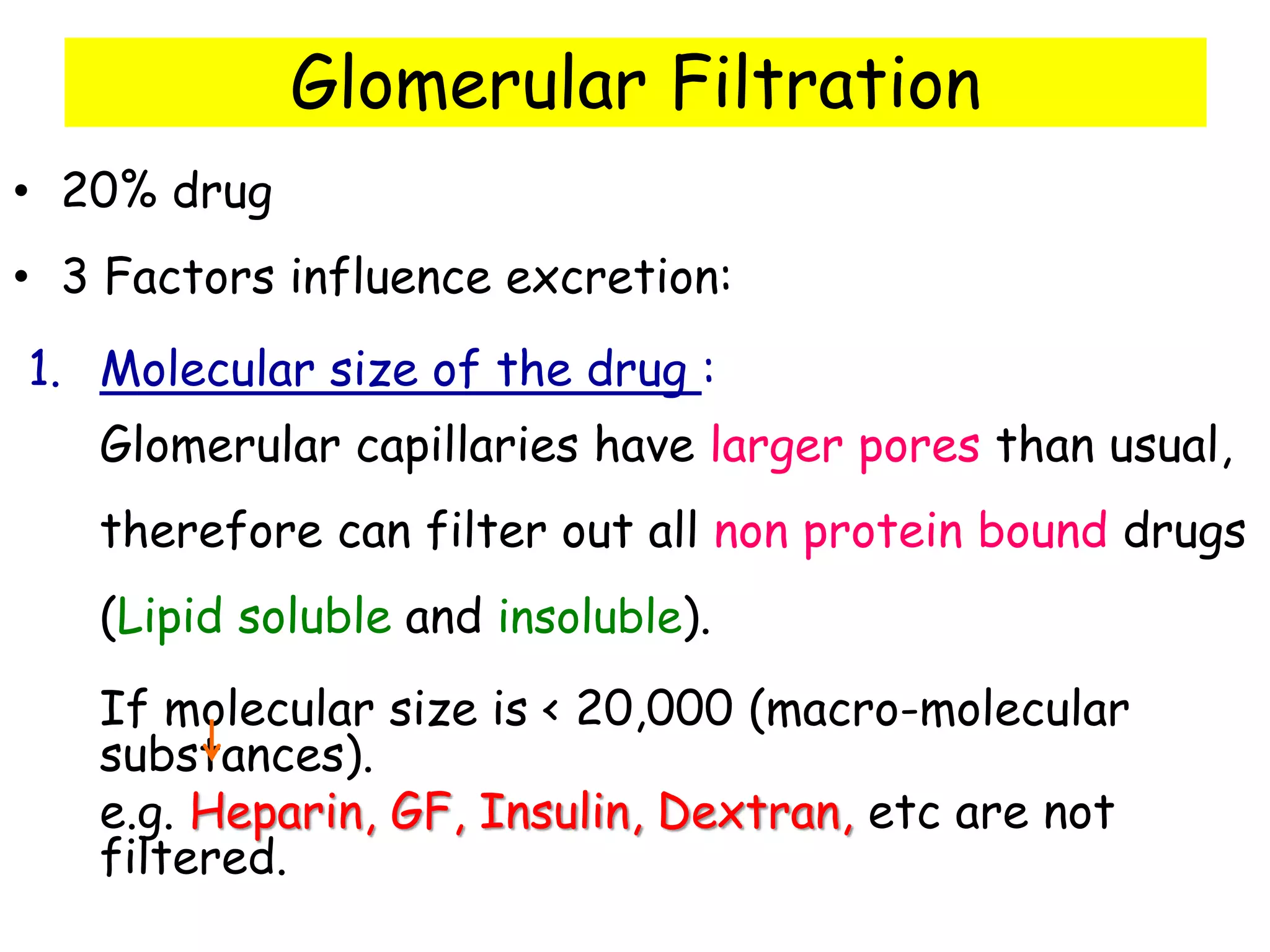
• 20% drug
• 3 Factors influence excretion:
1. Molecular size of the drug :
Glomerular capillaries have larger pores than usual,
therefore can filter out all non protein bound drugs
(Lipid soluble and insoluble).
If molecular size is < 20,000 (macro-molecular
substances).
e.g. Heparin, GF, Insulin, Dextran, etc are not
filtered.
Glomerular Filtration
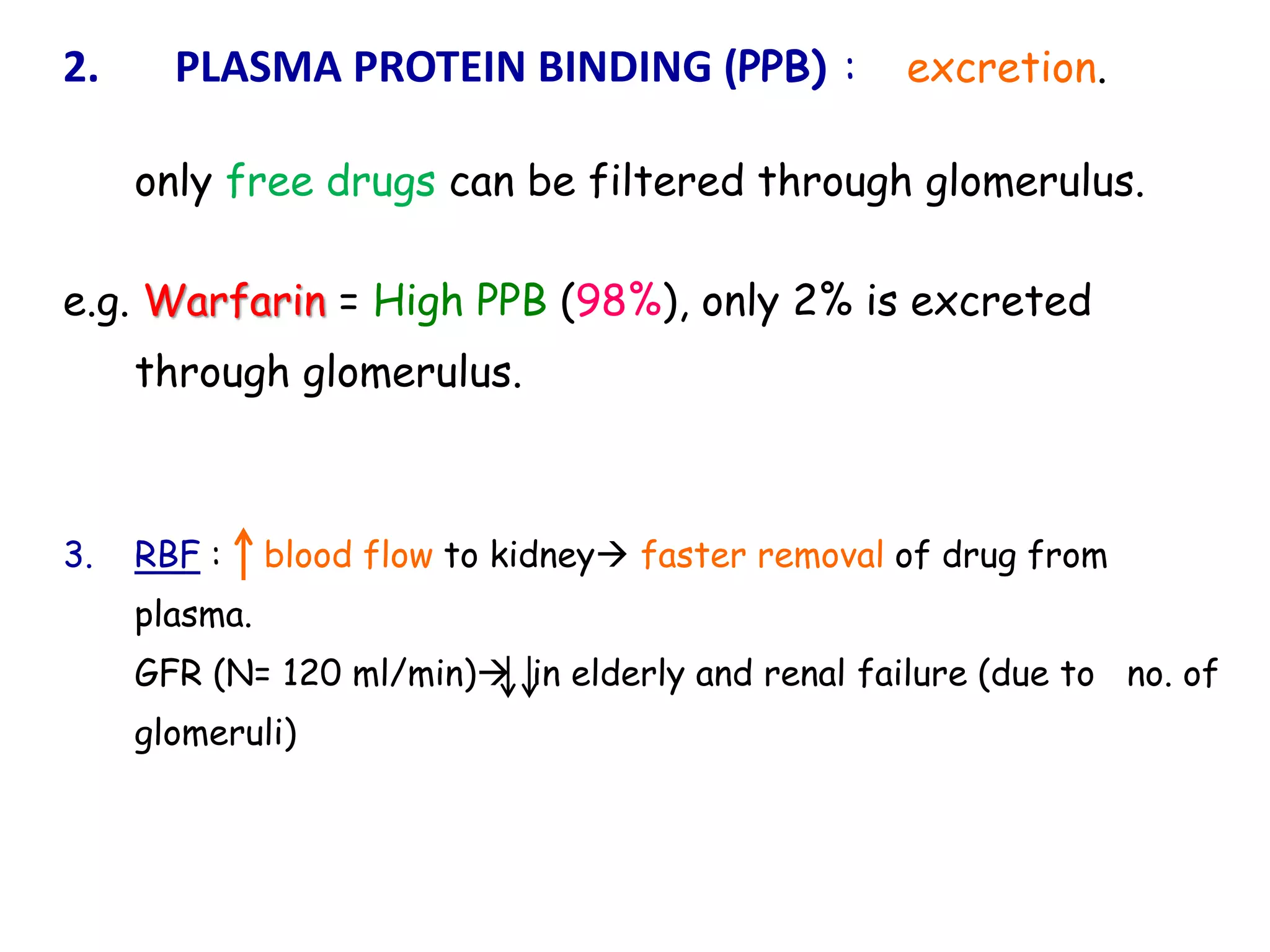
2. PLASMA PROTEIN BINDING (PPB) : excretion.
only free drugs can be filtered through glomerulus.
e.g. Warfarin = High PPB (98%), only 2% is excreted
through glomerulus.
3. RBF : blood flow to kidney faster removal of drug from
plasma.
GFR (N= 120 ml/min) in elderly and renal failure (due to no. of
glomeruli)
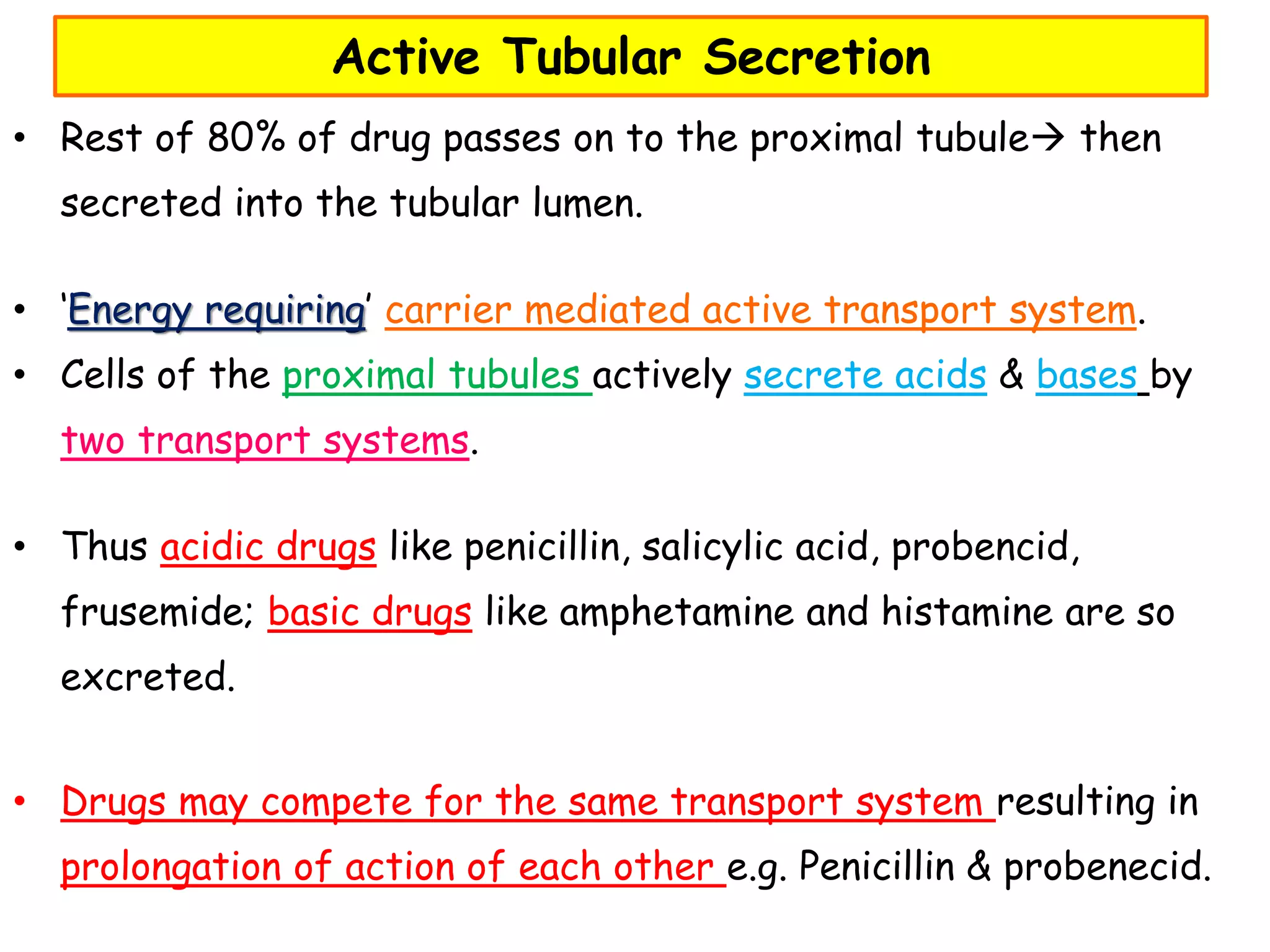
• Rest of 80% of drug passes on to the proximal tubule then
secreted into the tubular lumen.
• ‘Energy requiring’ carrier mediated active transport system.
• Cells of the proximal tubules actively secrete acids & bases by
two transport systems.
• Thus acidic drugs like penicillin, salicylic acid, probencid,
frusemide; basic drugs like amphetamine and histamine are so
excreted.
• Drugs may compete for the same transport system resulting in
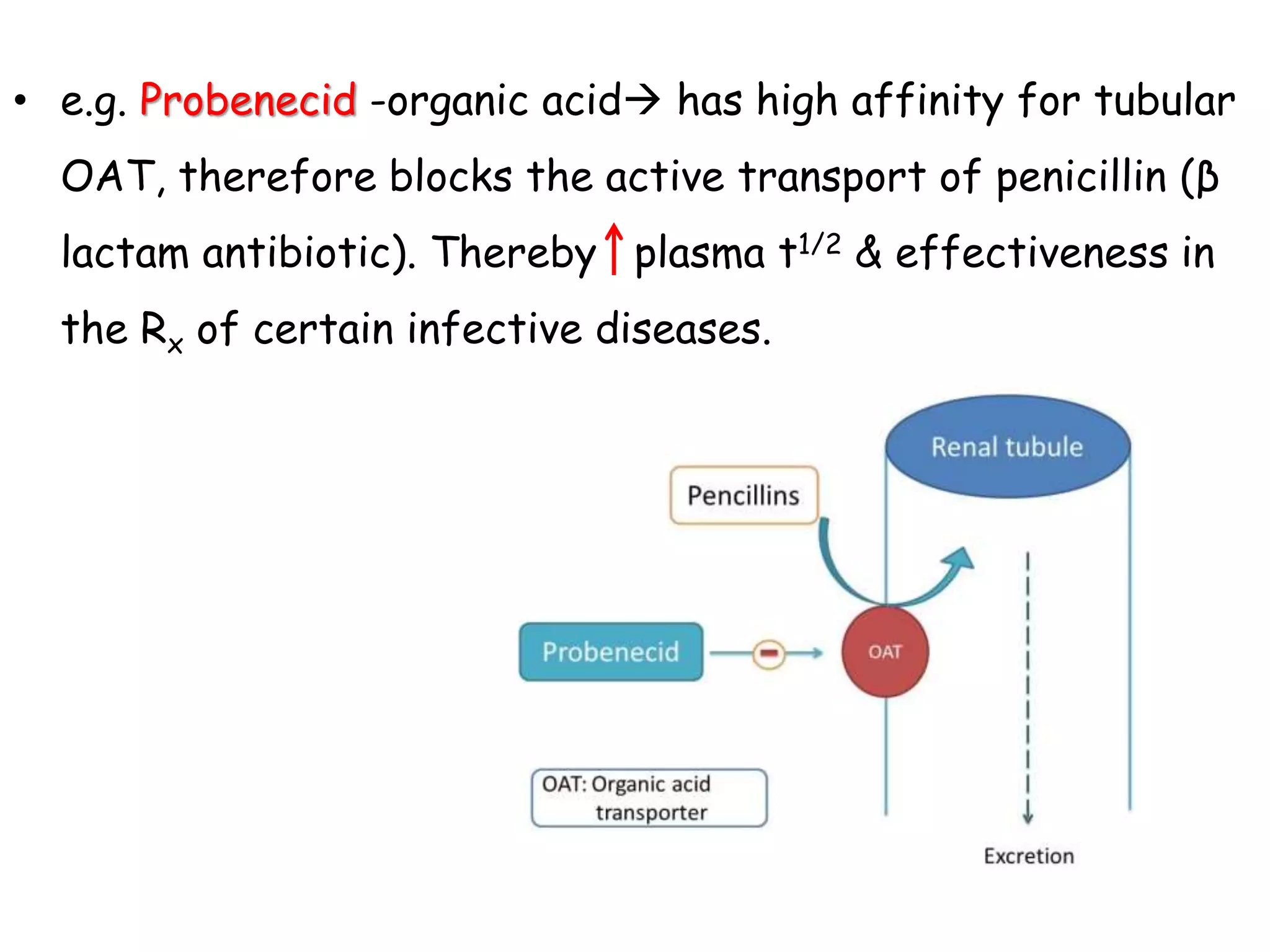
prolongation of action of each other e.g. Penicillin & probenecid.
Active Tubular Secretion
2 Independent renal transporters are operating at this level:
1. For ACIDIC Drugs (OAT=Organic Anion Transporter) e.g.
Captopril , Penicillin,etc
2. For BASIC Drugs (OCT=Organic Cation Transporter) e.g.
Cimetidine, Ranitidine, Metformin, Procainamide,
Nicotine,etc.
• Carrier system -non-specific, therefore drug having
similar physicochemical properties compete for the same
carrier system.
• e.g. Probenecid -organic acid has high affinity for tubular
OAT, therefore blocks the active transport of penicillin (β
lactam antibiotic). Thereby plasma t1/2 & effectiveness in
the Rx of certain infective diseases.
Passive diffusion of drug molecules can occur in
either direction in the renal tubules depending on :
1. Drug concentration
2. Lipid solubility
3. pH of urine
Strongly acidic & basic drug remain in ionized form
at any pH of urine & hence are excreted in urine.
Passive Tubular Reabsorption
Weakly acidic drugs
(Salicylates, Barbiturates
etc.)
in acidic urine
Remain mainly in
unionised form.
Reabsorbed in circulation.
If urine made alkaline
(Sod.bicarb/citrate)
• Weakly basic drugs
(Morphine, Amphetamine etc.)
in alkaline urine
Remain mainly in
unionised form.
Reabsorbed in circulation
If urine made acidic
(Vitamin C).
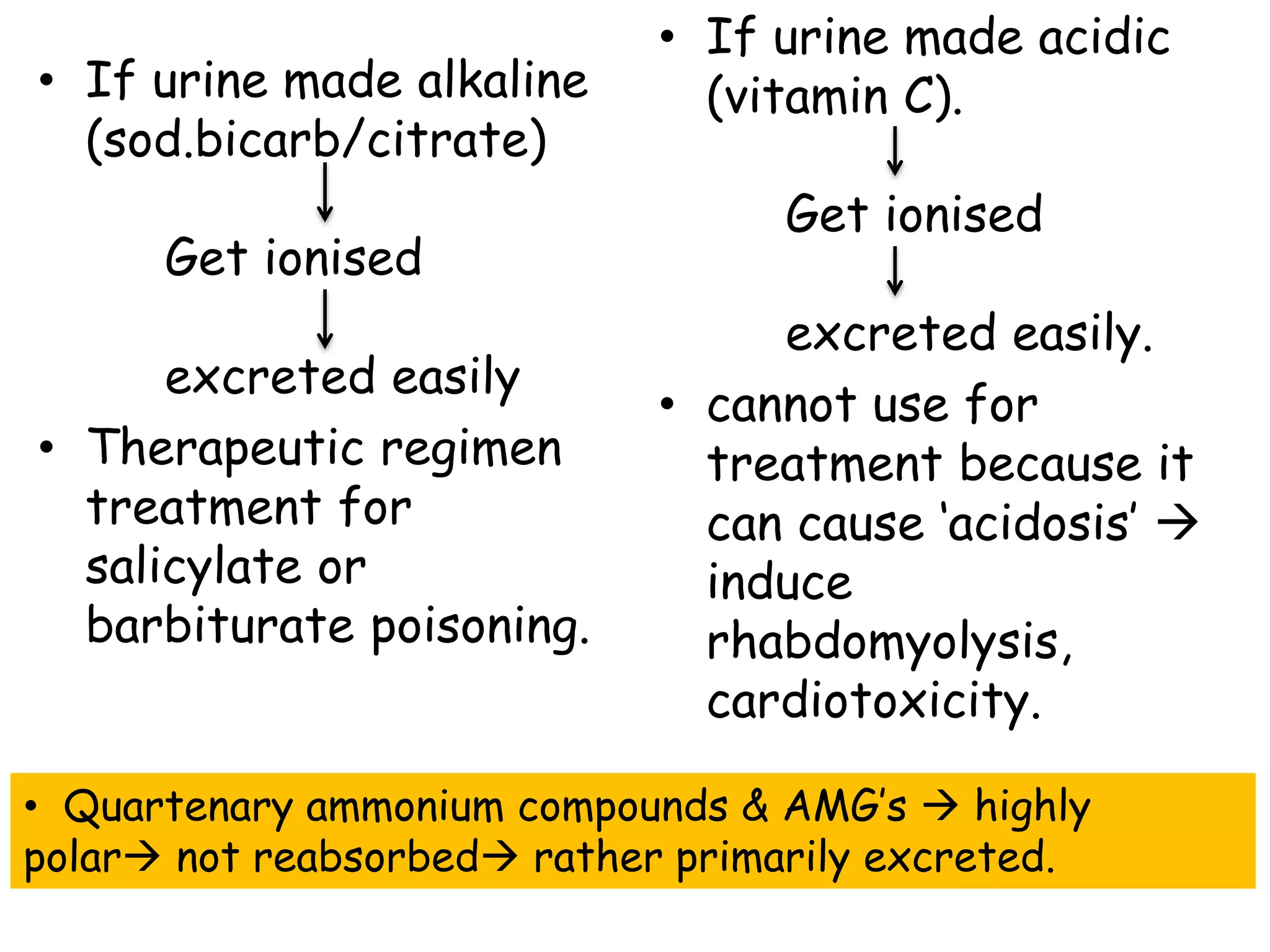
• If urine made alkaline
(sod.bicarb/citrate)
Get ionised
excreted easily
• Therapeutic regimen
treatment for
salicylate or
barbiturate poisoning.
• If urine made acidic
(vitamin C).
Get ionised
excreted easily.
• cannot use for
treatment because it
can cause ‘acidosis’ 
induce
rhabdomyolysis,
cardiotoxicity.
• Quartenary ammonium compounds & AMG’s  highly
polar not reabsorbed rather primarily excreted.
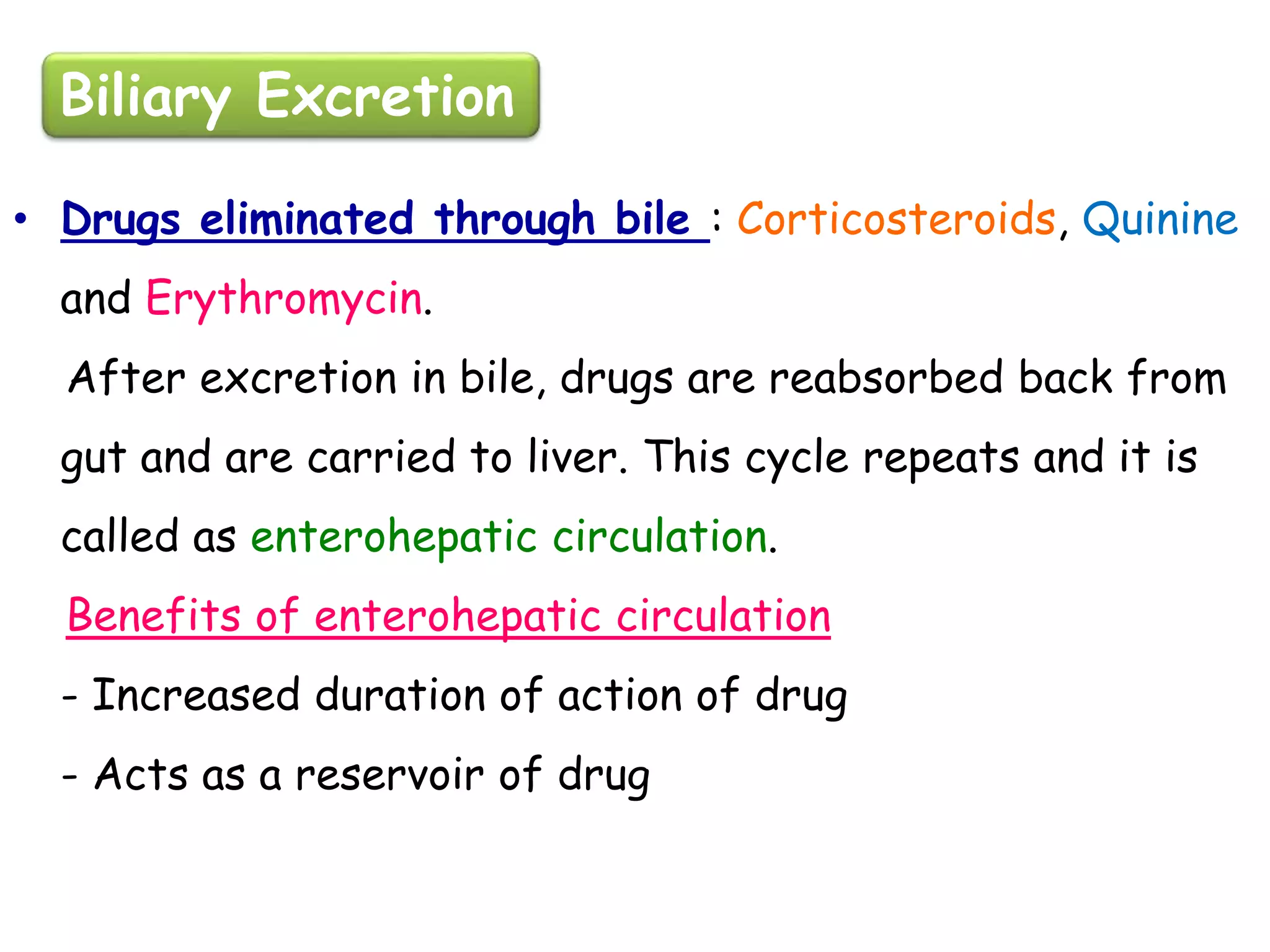
• Drugs eliminated through bile : Corticosteroids, Quinine
and Erythromycin.
After excretion in bile, drugs are reabsorbed back from
gut and are carried to liver. This cycle repeats and it is
called as enterohepatic circulation.
Benefits of enterohepatic circulation
- Increased duration of action of drug
- Acts as a reservoir of drug
Biliary Excretion
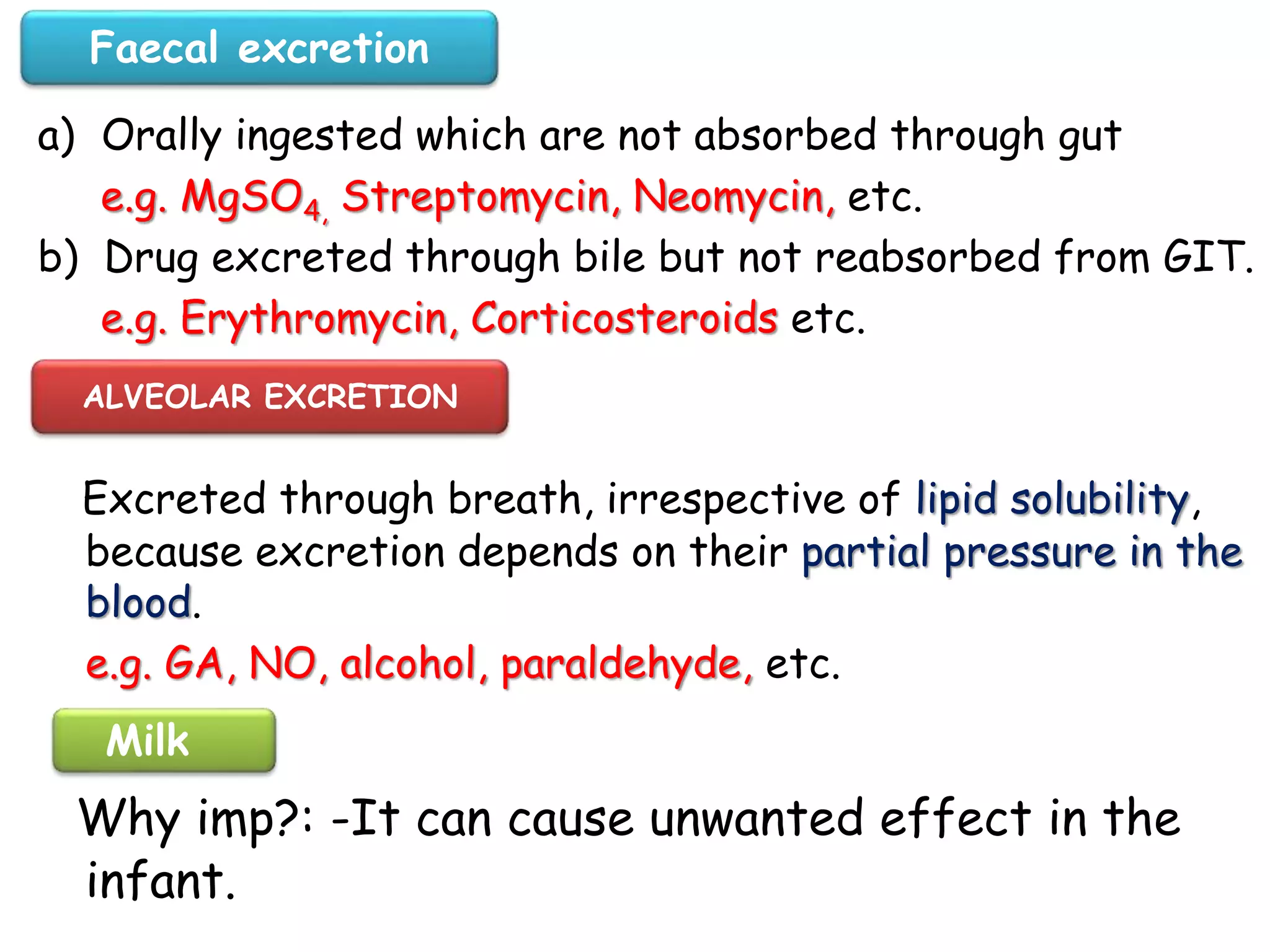
a) Orally ingested which are not absorbed through gut
e.g. MgSO4, Streptomycin, Neomycin, etc.
b) Drug excreted through bile but not reabsorbed from GIT.
e.g. Erythromycin, Corticosteroids etc.
Excreted through breath, irrespective of lipid solubility,
because excretion depends on their partial pressure in the
blood.
e.g. GA, NO, alcohol, paraldehyde, etc.
Why imp?: -It can cause unwanted effect in the
infant.
Faecal excretion
ALVEOLAR EXCRETION
Milk
• (Theoretical) volume of plasma from which the drug
is completely removed in unit time.
i.e. CL= Rate of elimination
Plasma conc.(C)
• The total ability of the body to clear a drug from
the plasma is renal clearance plus hepatic
clearance plus clearance from all other tissues.
CLEARANCE
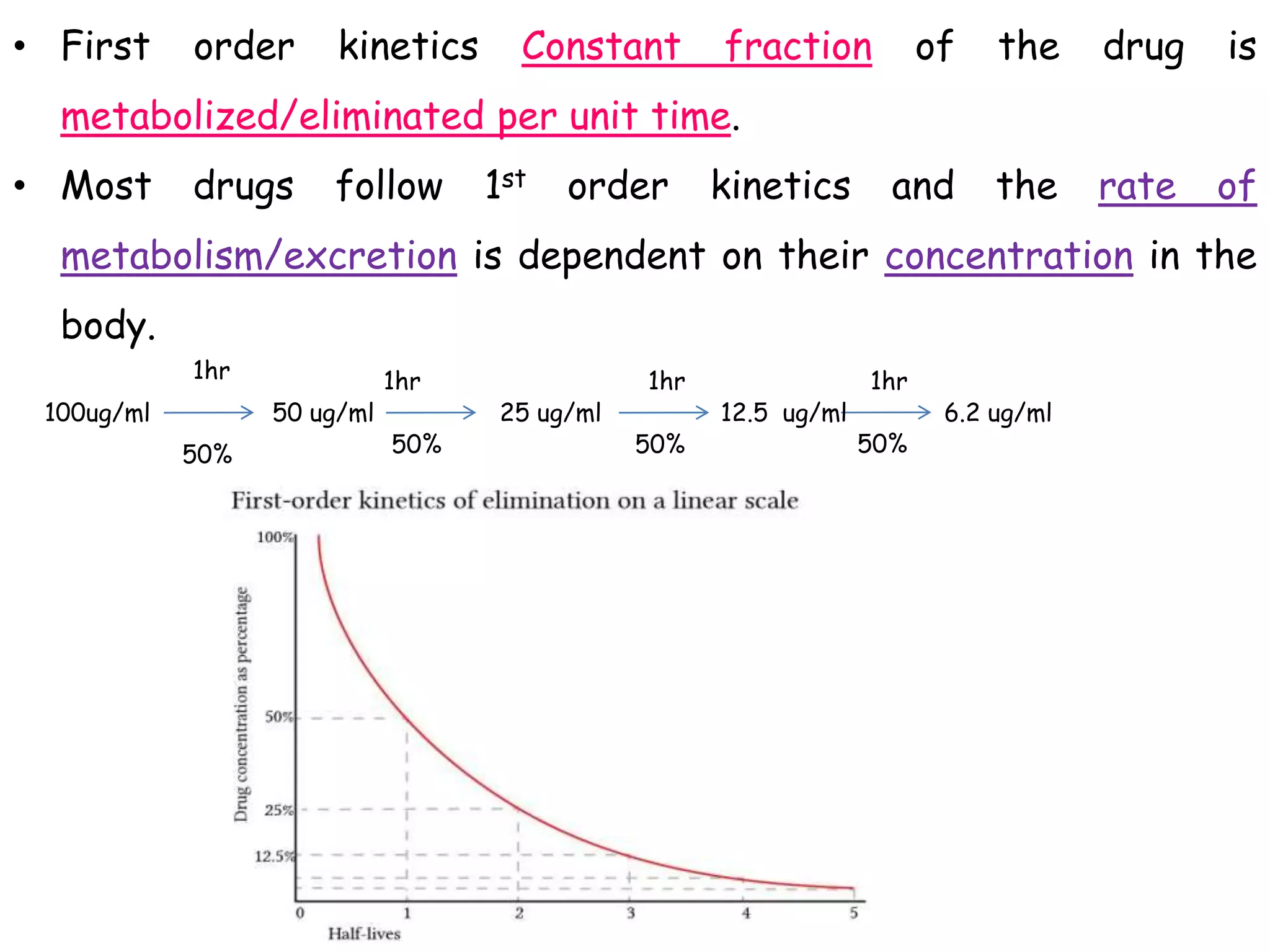
• First order kinetics Constant fraction of the drug is
metabolized/eliminated per unit time.
• Most drugs follow 1st order kinetics and the rate of
metabolism/excretion is dependent on their concentration in the
body.
100ug/ml
1hr
50%
50 ug/ml
1hr
50%
25 ug/ml
1hr
50% 50%
12.5 ug/ml
1hr
6.2 ug/ml
• Zero order kinetics Constant amount of the drug present in the body is
metabolized/eliminated per unit time.
• The metabolic enzymes get saturated and hence with increase the dose
,the plasma drug level increases disproportionately resulting in toxicity
200ug/ml
1hr
50ug
150ug/ml 100ug/ml
1hr
50ug 50ug
50 ug/ml
1hr 1hr
50ug
0ug
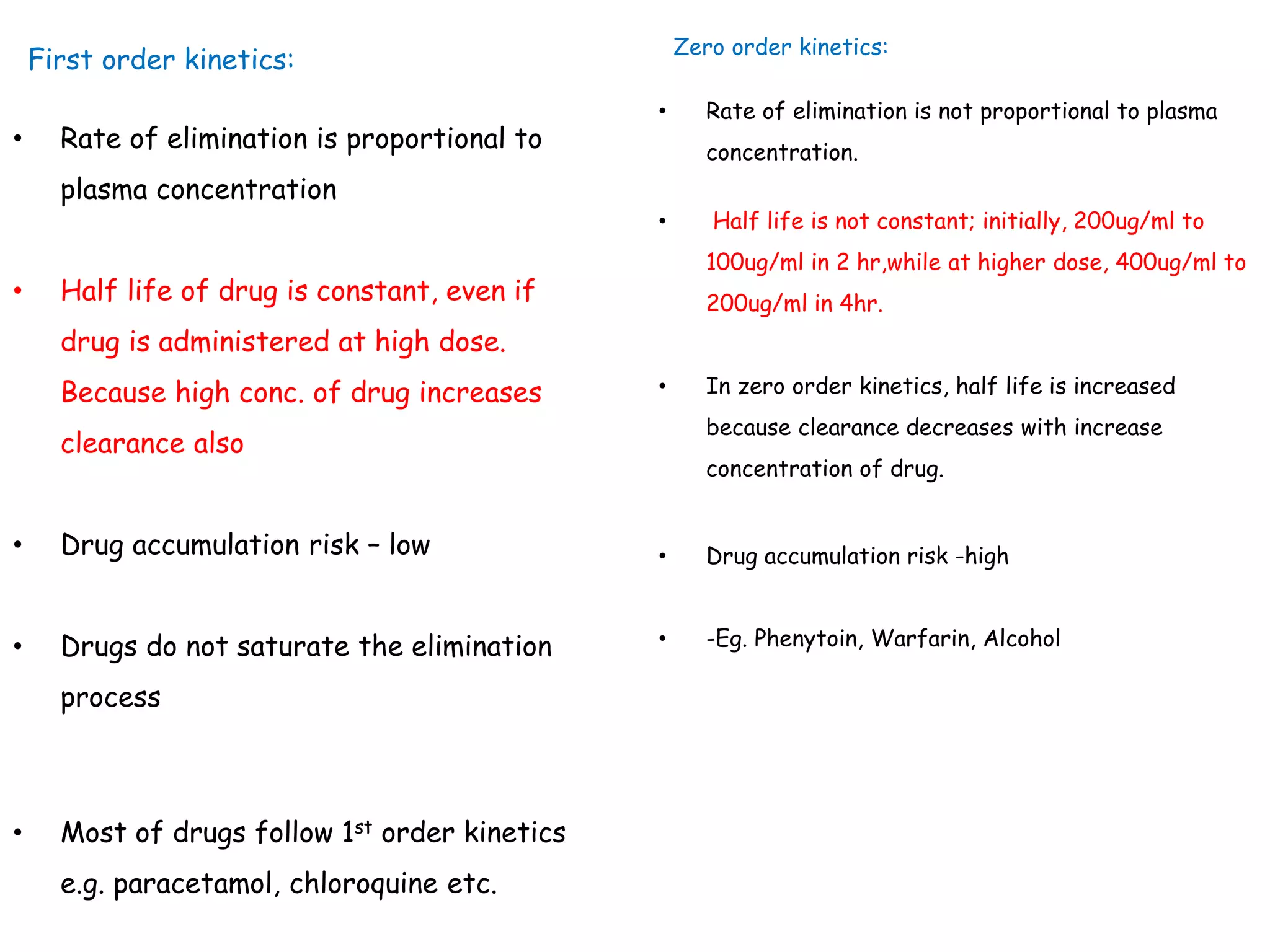
First order kinetics:
• Rate of elimination is proportional to
plasma concentration
• Half life of drug is constant, even if
drug is administered at high dose.
Because high conc. of drug increases
clearance also
• Drug accumulation risk – low
• Drugs do not saturate the elimination
process
• Most of drugs follow 1st order kinetics
e.g. paracetamol, chloroquine etc.
Zero order kinetics:
• Rate of elimination is not proportional to plasma
concentration.
• Half life is not constant; initially, 200ug/ml to
100ug/ml in 2 hr,while at higher dose, 400ug/ml to
200ug/ml in 4hr.
• In zero order kinetics, half life is increased
because clearance decreases with increase
concentration of drug.
• Drug accumulation risk -high
• -Eg. Phenytoin, Warfarin, Alcohol
• PLASMA HALF-LIFE (t1/2 )-Time duration in which plasma conc.
of the drug falls by 50 % of the earlier value.
• Significance of plasma t1/2 : plasma t1/2 is necessary to know
the
- Duration of action of the drug
- Frequency of administration
- Time needed for attainment of SSCP - longer the t1/2
longer is the time needed to attain SSCP
- To calculate the loading and maintenance doses of the drug
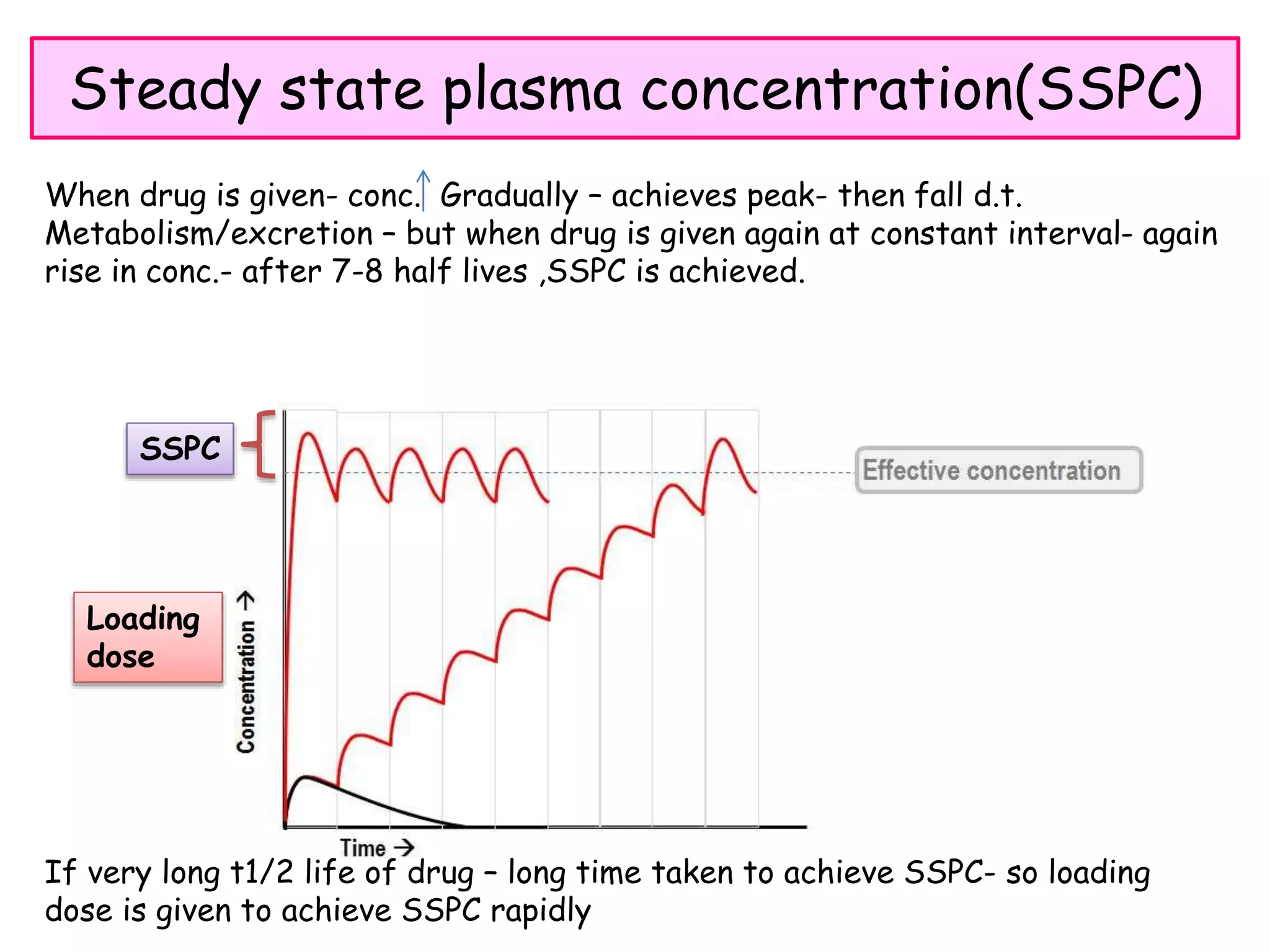
Steady state plasma concentration(SSPC)
SSPC
When drug is given- conc. Gradually – achieves peak- then fall d.t.
Metabolism/excretion – but when drug is given again at constant interval- again
rise in conc.- after 7-8 half lives ,SSPC is achieved.
If very long t1/2 life of drug – long time taken to achieve SSPC- so loading
dose is given to achieve SSPC rapidly
Loading
dose

Drug excretion -DM WIMS -7-04-22.pptx

  • 1.
    • Removal ofDrug/ its metabolites from the body (as unchanged / water soluble metabolites). • Major routes: Renal , Biliary , Fecal , Alveolar • Other : Milk, Skin , Hair , Sweat , Saliva Excretion
  • 2.
    1. Renal Excretion: e.g.Frusemide, Gentamicin, d-TC, digoxin etc) • Amount of Drug / Metabolites excreted (i.e. ultimately present in urine) depends on following Processes: • Net Renal Excretion (RE) = (GF + ATS) - PTR Where, GF = Glomerular Filtration ATS = Active Tubular Secretion PTR = Passive Tubular Reabsorption
  • 3.
    • 20% drug •3 Factors influence excretion: 1. Molecular size of the drug : Glomerular capillaries have larger pores than usual, therefore can filter out all non protein bound drugs (Lipid soluble and insoluble). If molecular size is < 20,000 (macro-molecular substances). e.g. Heparin, GF, Insulin, Dextran, etc are not filtered. Glomerular Filtration
  • 4.
    2. PLASMA PROTEINBINDING (PPB) : excretion. only free drugs can be filtered through glomerulus. e.g. Warfarin = High PPB (98%), only 2% is excreted through glomerulus. 3. RBF : blood flow to kidney faster removal of drug from plasma. GFR (N= 120 ml/min) in elderly and renal failure (due to no. of glomeruli)
  • 5.
    • Rest of80% of drug passes on to the proximal tubule then secreted into the tubular lumen. • ‘Energy requiring’ carrier mediated active transport system. • Cells of the proximal tubules actively secrete acids & bases by two transport systems. • Thus acidic drugs like penicillin, salicylic acid, probencid, frusemide; basic drugs like amphetamine and histamine are so excreted. • Drugs may compete for the same transport system resulting in prolongation of action of each other e.g. Penicillin & probenecid. Active Tubular Secretion
  • 6.
    2 Independent renaltransporters are operating at this level: 1. For ACIDIC Drugs (OAT=Organic Anion Transporter) e.g. Captopril , Penicillin,etc 2. For BASIC Drugs (OCT=Organic Cation Transporter) e.g. Cimetidine, Ranitidine, Metformin, Procainamide, Nicotine,etc. • Carrier system -non-specific, therefore drug having similar physicochemical properties compete for the same carrier system.
  • 7.
    • e.g. Probenecid-organic acid has high affinity for tubular OAT, therefore blocks the active transport of penicillin (β lactam antibiotic). Thereby plasma t1/2 & effectiveness in the Rx of certain infective diseases.
  • 8.
    Passive diffusion ofdrug molecules can occur in either direction in the renal tubules depending on : 1. Drug concentration 2. Lipid solubility 3. pH of urine Strongly acidic & basic drug remain in ionized form at any pH of urine & hence are excreted in urine. Passive Tubular Reabsorption
  • 9.
    Weakly acidic drugs (Salicylates,Barbiturates etc.) in acidic urine Remain mainly in unionised form. Reabsorbed in circulation. If urine made alkaline (Sod.bicarb/citrate) • Weakly basic drugs (Morphine, Amphetamine etc.) in alkaline urine Remain mainly in unionised form. Reabsorbed in circulation If urine made acidic (Vitamin C).
  • 10.
    • If urinemade alkaline (sod.bicarb/citrate) Get ionised excreted easily • Therapeutic regimen treatment for salicylate or barbiturate poisoning. • If urine made acidic (vitamin C). Get ionised excreted easily. • cannot use for treatment because it can cause ‘acidosis’  induce rhabdomyolysis, cardiotoxicity. • Quartenary ammonium compounds & AMG’s  highly polar not reabsorbed rather primarily excreted.
  • 11.
    • Drugs eliminatedthrough bile : Corticosteroids, Quinine and Erythromycin. After excretion in bile, drugs are reabsorbed back from gut and are carried to liver. This cycle repeats and it is called as enterohepatic circulation. Benefits of enterohepatic circulation - Increased duration of action of drug - Acts as a reservoir of drug Biliary Excretion
  • 12.
    a) Orally ingestedwhich are not absorbed through gut e.g. MgSO4, Streptomycin, Neomycin, etc. b) Drug excreted through bile but not reabsorbed from GIT. e.g. Erythromycin, Corticosteroids etc. Excreted through breath, irrespective of lipid solubility, because excretion depends on their partial pressure in the blood. e.g. GA, NO, alcohol, paraldehyde, etc. Why imp?: -It can cause unwanted effect in the infant. Faecal excretion ALVEOLAR EXCRETION Milk
  • 13.
    • (Theoretical) volumeof plasma from which the drug is completely removed in unit time. i.e. CL= Rate of elimination Plasma conc.(C) • The total ability of the body to clear a drug from the plasma is renal clearance plus hepatic clearance plus clearance from all other tissues. CLEARANCE
  • 14.
    • First orderkinetics Constant fraction of the drug is metabolized/eliminated per unit time. • Most drugs follow 1st order kinetics and the rate of metabolism/excretion is dependent on their concentration in the body. 100ug/ml 1hr 50% 50 ug/ml 1hr 50% 25 ug/ml 1hr 50% 50% 12.5 ug/ml 1hr 6.2 ug/ml
  • 15.
    • Zero orderkinetics Constant amount of the drug present in the body is metabolized/eliminated per unit time. • The metabolic enzymes get saturated and hence with increase the dose ,the plasma drug level increases disproportionately resulting in toxicity 200ug/ml 1hr 50ug 150ug/ml 100ug/ml 1hr 50ug 50ug 50 ug/ml 1hr 1hr 50ug 0ug
  • 16.
    First order kinetics: •Rate of elimination is proportional to plasma concentration • Half life of drug is constant, even if drug is administered at high dose. Because high conc. of drug increases clearance also • Drug accumulation risk – low • Drugs do not saturate the elimination process • Most of drugs follow 1st order kinetics e.g. paracetamol, chloroquine etc. Zero order kinetics: • Rate of elimination is not proportional to plasma concentration. • Half life is not constant; initially, 200ug/ml to 100ug/ml in 2 hr,while at higher dose, 400ug/ml to 200ug/ml in 4hr. • In zero order kinetics, half life is increased because clearance decreases with increase concentration of drug. • Drug accumulation risk -high • -Eg. Phenytoin, Warfarin, Alcohol
  • 17.
    • PLASMA HALF-LIFE(t1/2 )-Time duration in which plasma conc. of the drug falls by 50 % of the earlier value. • Significance of plasma t1/2 : plasma t1/2 is necessary to know the - Duration of action of the drug - Frequency of administration - Time needed for attainment of SSCP - longer the t1/2 longer is the time needed to attain SSCP - To calculate the loading and maintenance doses of the drug
  • 18.
    Steady state plasmaconcentration(SSPC) SSPC When drug is given- conc. Gradually – achieves peak- then fall d.t. Metabolism/excretion – but when drug is given again at constant interval- again rise in conc.- after 7-8 half lives ,SSPC is achieved. If very long t1/2 life of drug – long time taken to achieve SSPC- so loading dose is given to achieve SSPC rapidly Loading dose

Editor's Notes

  • #11 AMG= Aminoglycosides