pharmacokinetics
Ali Sadeq Mayali
Medical Student at University of Kufa
Introduction
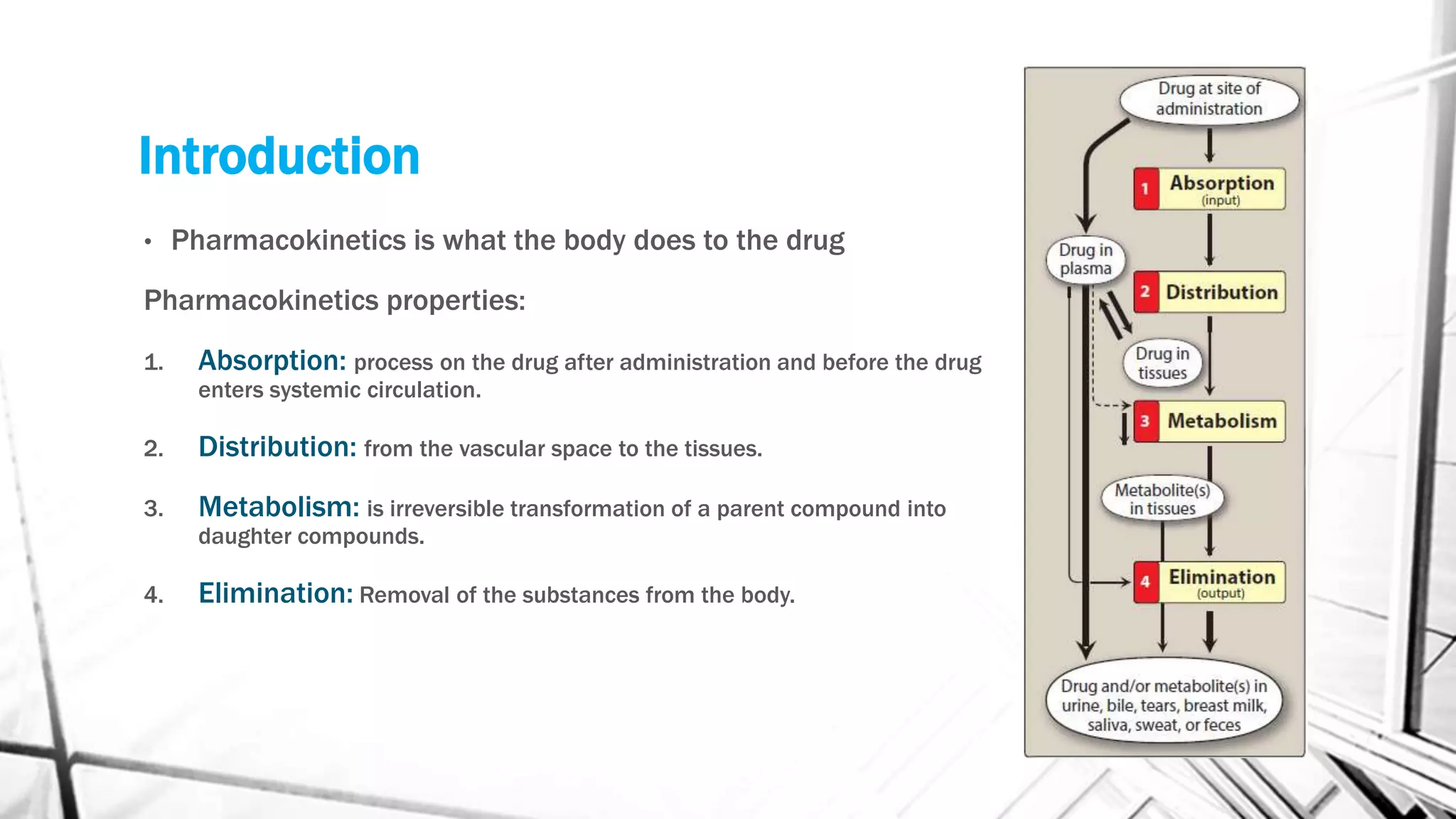
• Pharmacokinetics is what the body does to the drug
Pharmacokinetics properties:
1. Absorption: process on the drug after administration and before the drug
enters systemic circulation.
2. Distribution: from the vascular space to the tissues.
3. Metabolism: is irreversible transformation of a parent compound into
daughter compounds.
4. Elimination: Removal of the substances from the body.
Absorption
• Site of administration
• Enteral
• Parenteral
• Transdermal
• Movement of the drug through membrane: against concentration and along the concentration
• Active transport is ATP dependent
• Passive diffusion
• PH effect on drug absorption
Most of drugs are weak acids or weak bases so environment acidity would have an effect on the
drug absorption through selective membranes
Distribution
process at which the drug reversibly leaves the blood and enters the extracellular fluid.
• This depend on blood flow, capillary permeability and plasma proteins
• Volume of distribution: extent of blood distributed > plasma. formula= is: Vd =
𝐴𝑚𝑜𝑢𝑛𝑡 𝑜𝑓 𝑑𝑟𝑢𝑔 𝑖𝑛 𝑡ℎ𝑒 𝑏𝑜𝑑𝑦
𝑃𝑙𝑎𝑠𝑚𝑎 𝑑𝑟𝑢𝑔 𝑐𝑜𝑛𝑐𝑒𝑛𝑡𝑟𝑎𝑡𝑖𝑜𝑛
• low Vd suggests high drug in the plasma
• High Vd > low drug in the plasma, means that the drug is fat soluble and suck in the fatty tissue
• Bioavailability: the fraction of the administered drug that reaches the systemic circulation.
e.g. 100U of drug > absorbed 50% > extraction 50% > bioavailability is 25%
One of the factors affect bioavailability is first pass metabolism
• Some of drugs undergo first pass metabolism in the liver. These drugs absorbed in the intestine > portal
circulation > hepatic portal vein > central vein > hepatic vein > IVC > heart > body
Metabolism
The process of transformation the drug irreversibly into daughter metabolite. The three major
routes of elimination are hepatic metabolism, biliary elimination, and urinary elimination
• Some agents are administered as inactive, then activated by metabolism.
• Drug X > Active metabolite > inactive
• Phase I: Hydrolysis, oxidation and reduction which is dealing with P450 system.
• Enzyme Inducers: CYP450-dependent enzymes are the target of enzyme inducers. e.g. CYP
isozymes, certain drugs like carbamazepine are able to increase the synthesis of one or more CYP
isozymes. This causes increase biotransformation of the drugs > decrease drug plasma concentration
Consequences: (1) decrease plasma drug concentration (2) decrease drug activity if metabolite is
inactive (3) increase drug activity if metabolite is active.
• Enzymes Inhibitors: Some drugs are capable of inhibiting CYP isozyme activity.
e.g. omeprazole is a potent inhibitor of three of CYP isozymes responsible for warfarin metabolism, if
the two drugs are taken together, the concentration of warfarin in the plasma will increase which
leads to inhibition of coagulation > serious problems .
• Phase II: conjugation reactions, if the metabolite from phase I is sufficiently polar, it can be excreted by
the kidneys. However there are many phase I metabolites are to lipophilic and need to be conjugated with
a highly water soluble molecules (e.g. glucuronyl) to be retained in the kidney tubules.
• Drugs are eliminated according to first and zero order kinetics.
First order & Zero order Kinetics
• Zero order kinetics takes place at a constant rate independent of the exiting concentration
or initial concentration
Example: A patient was given 100 mg of drug A orally. Assume that the drug metabolism follows
zero order kinetics at a rate of 10 mg/min.
So after 1 min 10 mg will be absorbed, and after 8 minutes, 80 mg will be absorbed.
Even if you give the patient 200 mg, 10 mg will be absorbed in the first minute, that is zero
order kinetics.
• First order takes place at constant proportion of the drug concentration available at that
time
Example: A patient was given 100 mg of drug B which is following first order kinetics at a rate of
10% per minute, of the exiting concentration at that time
So first minute 10% will be absorbed from the 100 mg > 10 mg, 2nd minute 10% of 90 mg will be
absorbed …. That is first order which never comes to end!
Elimination
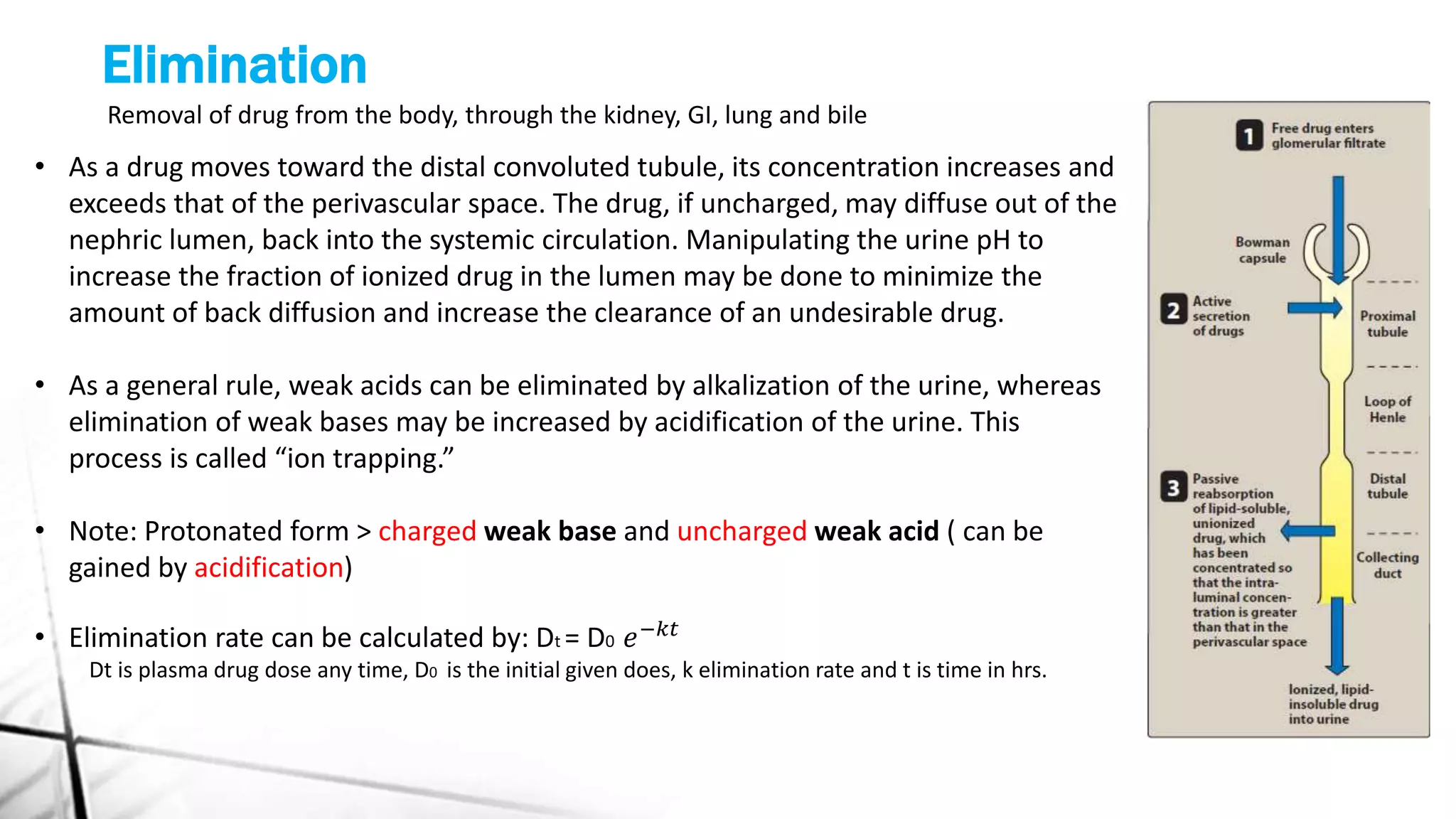
Removal of drug from the body, through the kidney, GI, lung and bile
• As a drug moves toward the distal convoluted tubule, its concentration increases and
exceeds that of the perivascular space. The drug, if uncharged, may diffuse out of the
nephric lumen, back into the systemic circulation. Manipulating the urine pH to
increase the fraction of ionized drug in the lumen may be done to minimize the
amount of back diffusion and increase the clearance of an undesirable drug.
• As a general rule, weak acids can be eliminated by alkalization of the urine, whereas
elimination of weak bases may be increased by acidification of the urine. This
process is called “ion trapping.”
• Note: Protonated form > charged weak base and uncharged weak acid ( can be
gained by acidification)
• Elimination rate can be calculated by: Dt = D0 𝑒−𝑘𝑡
Dt is plasma drug dose any time, D0 is the initial given does, k elimination rate and t is time in hrs.

Pharmacokinetics

  • 1.
    pharmacokinetics Ali Sadeq Mayali MedicalStudent at University of Kufa
  • 2.
    Introduction • Pharmacokinetics iswhat the body does to the drug Pharmacokinetics properties: 1. Absorption: process on the drug after administration and before the drug enters systemic circulation. 2. Distribution: from the vascular space to the tissues. 3. Metabolism: is irreversible transformation of a parent compound into daughter compounds. 4. Elimination: Removal of the substances from the body.
  • 3.
    Absorption • Site ofadministration • Enteral • Parenteral • Transdermal • Movement of the drug through membrane: against concentration and along the concentration • Active transport is ATP dependent • Passive diffusion • PH effect on drug absorption Most of drugs are weak acids or weak bases so environment acidity would have an effect on the drug absorption through selective membranes
  • 4.
    Distribution process at whichthe drug reversibly leaves the blood and enters the extracellular fluid. • This depend on blood flow, capillary permeability and plasma proteins • Volume of distribution: extent of blood distributed > plasma. formula= is: Vd = 𝐴𝑚𝑜𝑢𝑛𝑡 𝑜𝑓 𝑑𝑟𝑢𝑔 𝑖𝑛 𝑡ℎ𝑒 𝑏𝑜𝑑𝑦 𝑃𝑙𝑎𝑠𝑚𝑎 𝑑𝑟𝑢𝑔 𝑐𝑜𝑛𝑐𝑒𝑛𝑡𝑟𝑎𝑡𝑖𝑜𝑛 • low Vd suggests high drug in the plasma • High Vd > low drug in the plasma, means that the drug is fat soluble and suck in the fatty tissue • Bioavailability: the fraction of the administered drug that reaches the systemic circulation. e.g. 100U of drug > absorbed 50% > extraction 50% > bioavailability is 25% One of the factors affect bioavailability is first pass metabolism • Some of drugs undergo first pass metabolism in the liver. These drugs absorbed in the intestine > portal circulation > hepatic portal vein > central vein > hepatic vein > IVC > heart > body
  • 5.
    Metabolism The process oftransformation the drug irreversibly into daughter metabolite. The three major routes of elimination are hepatic metabolism, biliary elimination, and urinary elimination • Some agents are administered as inactive, then activated by metabolism. • Drug X > Active metabolite > inactive • Phase I: Hydrolysis, oxidation and reduction which is dealing with P450 system. • Enzyme Inducers: CYP450-dependent enzymes are the target of enzyme inducers. e.g. CYP isozymes, certain drugs like carbamazepine are able to increase the synthesis of one or more CYP isozymes. This causes increase biotransformation of the drugs > decrease drug plasma concentration Consequences: (1) decrease plasma drug concentration (2) decrease drug activity if metabolite is inactive (3) increase drug activity if metabolite is active. • Enzymes Inhibitors: Some drugs are capable of inhibiting CYP isozyme activity. e.g. omeprazole is a potent inhibitor of three of CYP isozymes responsible for warfarin metabolism, if the two drugs are taken together, the concentration of warfarin in the plasma will increase which leads to inhibition of coagulation > serious problems . • Phase II: conjugation reactions, if the metabolite from phase I is sufficiently polar, it can be excreted by the kidneys. However there are many phase I metabolites are to lipophilic and need to be conjugated with a highly water soluble molecules (e.g. glucuronyl) to be retained in the kidney tubules. • Drugs are eliminated according to first and zero order kinetics.
  • 6.
    First order &Zero order Kinetics • Zero order kinetics takes place at a constant rate independent of the exiting concentration or initial concentration Example: A patient was given 100 mg of drug A orally. Assume that the drug metabolism follows zero order kinetics at a rate of 10 mg/min. So after 1 min 10 mg will be absorbed, and after 8 minutes, 80 mg will be absorbed. Even if you give the patient 200 mg, 10 mg will be absorbed in the first minute, that is zero order kinetics. • First order takes place at constant proportion of the drug concentration available at that time Example: A patient was given 100 mg of drug B which is following first order kinetics at a rate of 10% per minute, of the exiting concentration at that time So first minute 10% will be absorbed from the 100 mg > 10 mg, 2nd minute 10% of 90 mg will be absorbed …. That is first order which never comes to end!
  • 7.
    Elimination Removal of drugfrom the body, through the kidney, GI, lung and bile • As a drug moves toward the distal convoluted tubule, its concentration increases and exceeds that of the perivascular space. The drug, if uncharged, may diffuse out of the nephric lumen, back into the systemic circulation. Manipulating the urine pH to increase the fraction of ionized drug in the lumen may be done to minimize the amount of back diffusion and increase the clearance of an undesirable drug. • As a general rule, weak acids can be eliminated by alkalization of the urine, whereas elimination of weak bases may be increased by acidification of the urine. This process is called “ion trapping.” • Note: Protonated form > charged weak base and uncharged weak acid ( can be gained by acidification) • Elimination rate can be calculated by: Dt = D0 𝑒−𝑘𝑡 Dt is plasma drug dose any time, D0 is the initial given does, k elimination rate and t is time in hrs.