Drought-characteristic features.
Water potential in soil-plant air
continum
CHARACTERISTICS OF DROUGHTS
 The characteristics of droughts are
expressed in terms of:
(1) drought index
(2) intensity-duration-frequency
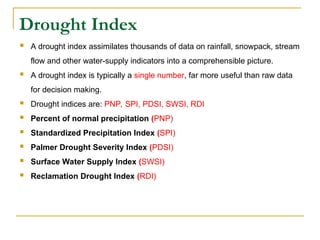
Drought Index
 A drought index assimilates thousands of data on rainfall, snowpack, stream
flow and other water-supply indicators into a comprehensible picture.
 A drought index is typically a single number, far more useful than raw data
for decision making.
 Drought indices are: PNP, SPI, PDSI, SWSI, RDI
 Percent of normal precipitation (PNP)
 Standardized Precipitation Index (SPI)
 Palmer Drought Severity Index (PDSI)
 Surface Water Supply Index (SWSI)
 Reclamation Drought Index (RDI)
Important drought indices
Percent of normal precipitation (PNP)
 The percent of normal precipitation is the ratio of actual to
normal precipitation for a given location and a given period,
expressed as a percentage.
 Analyses using the percent of normal are effective when
used for a single region and a single season.
 In other applications, the index can vary depending on the
choice of period, including monthly, seasonal, or annual.
Standardized Precipitation Index (SPI)
 The Standardized Precipitation Index (SPI) was developed
in the understanding that a certain deficit of precipitation
has different impacts on the soil moisture, ground water,
reservoir storage, and stream flow.
 The SPI was designed to quantify the precipitation deficit
for multiple time scales.
 The SPI is an index based on the precipitation record for a
location and chosen period (months or years).
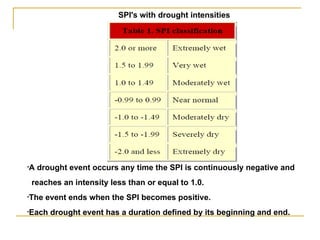
•A drought event occurs any time the SPI is continuously negative and
reaches an intensity less than or equal to 1.0.
•The event ends when the SPI becomes positive.
•Each drought event has a duration defined by its beginning and end.
SPI's with drought intensities
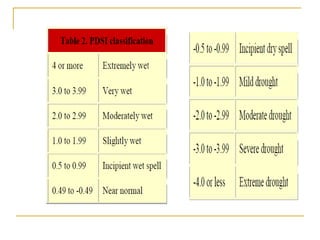
Palmer Drought Severity Index (PDSI)
 Index based on the supply-and-demand concept of the
water-balance equation
 PDSI provide standardized measurements of moisture
conditions, so that comparisons can be made between
locations and between durations.
 The PDSI is a meteorological drought index that is
responsive to abnormal weather conditions, either on the
dry or wet side.
 When conditions change from dry to normal or wet, the drought
measured by the PDSI ends without taking into account other long-
term hydrological aspects.
 The PDSI is calculated based on precipitation and temperature data,
as well as the local Available Water Content (AWC) of the soil.
 From the inputs, all the basic terms of the water balance equation
can be determined, including evapotranspiration, soil recharge,
runoff, and moisture loss from the surface layer.
 Water Balance Equation P = Q + AET + GW + DS, with all terms expressed in
mm/year, where P is Precipitation, Q is Runoff, AET is actual evapotranspiration, GW
is exchange with groundwater aquifer and DS is change in soil storage.
Surface Water Supply Index (SWSI)
 The objective of the SWSI is to incorporate both hydrological and
climatological features into a single index
 The SWSI values are standardized to allow comparisons between basins.
 A reservoir is an artificial lake created in a river valley by the construction of
a dam. The most critical purpose of reservoirs is flood risk management.
Reservoirs collect water during times of high rainfall, reducing flood risk, and
then release the water slowly over the following weeks and months.
 Four inputs are required: snowpack, stream flow, precipitation, and reservoir
storage.
 The SWSI is dependent on the season; therefore, it is computed with only
the snowpack, precipitation, and reservoir storage in the winter, while in
summer months, streamflow replaces snowpack as a component of the
SWSI.
Reclamation Drought Index (RDI)
 The Reclamation Drought Index (RDI) was developed as
a tool for defining drought severity and duration, and for
predicting the beginning and end of a drought period.
 As with the SWSI, the RDI is calculated at a river basin
level. It incorporates the supply components of
precipitation, snowpack, streamflow, and reservoir levels.
 The RDI is adaptable to each particular region and its
main strength is its ability to account for both climate and
water supply factors
 The RDI differs from the SWSI in that it builds a
temperature-based demand component and a duration
into the index.
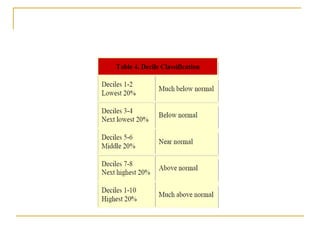
Deciles (monthly drought)
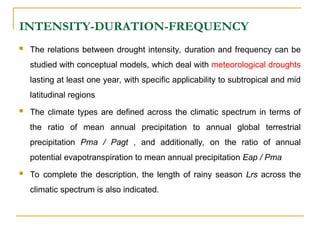
INTENSITY-DURATION-FREQUENCY
 The relations between drought intensity, duration and frequency can be
studied with conceptual models, which deal with meteorological droughts
lasting at least one year, with specific applicability to subtropical and mid
latitudinal regions
 The climate types are defined across the climatic spectrum in terms of
the ratio of mean annual precipitation to annual global terrestrial
precipitation Pma / Pagt , and additionally, on the ratio of annual
potential evapotranspiration to mean annual precipitation Eap / Pma
 To complete the description, the length of rainy season Lrs across the
climatic spectrum is also indicated.
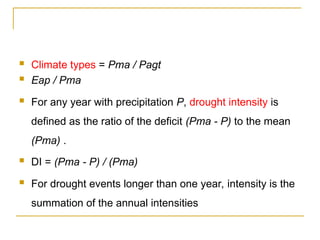
 Climate types = Pma / Pagt
 Eap / Pma
 For any year with precipitation P, drought intensity is
defined as the ratio of the deficit (Pma - P) to the mean
(Pma) .
 DI = (Pma - P) / (Pma)
 For drought events longer than one year, intensity is the
summation of the annual intensities
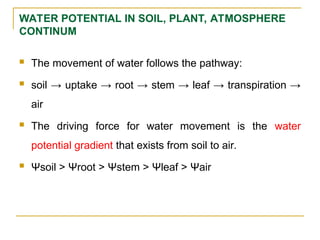
WATER POTENTIAL IN SOIL, PLANT, ATMOSPHERE
CONTINUM
 The movement of water follows the pathway:
 soil → uptake → root → stem → leaf → transpiration →
air
 The driving force for water movement is the water
potential gradient that exists from soil to air.
 Ψsoil > Ψroot > Ψstem > Ψleaf > Ψair
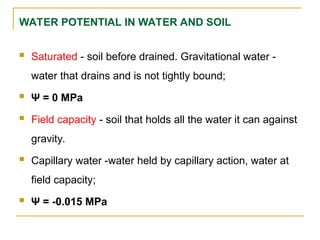
WATER POTENTIAL IN WATER AND SOIL
 Saturated - soil before drained. Gravitational water -
water that drains and is not tightly bound;
 Ψ = 0 MPa
 Field capacity - soil that holds all the water it can against
gravity.
 Capillary water -water held by capillary action, water at
field capacity;
 Ψ = -0.015 MPa
 Permanent wilting percentage - soil moisture content at
which plants can't get enough water. For most,
 Ψ = -1.5 Mpa
 between PWP and FC is the water available for a
plant to use
 clay holds more water than sand at any →Ψ ;
MOVEMENT OF WATER FROM PLANT TO AIR
 Movement of water from plant to air occurs via transpiration.
 Air has a very high capacity for holding water. For example at 20
C, the water potential of water in air at 100% RH = 0 MPa; 98%
RH -2.7 MPa; 50% RH = -93.5 MPa.
 There is a very steep water potential gradient from soil to air.
 Essentially, the plant just inserts itself between the two and
takes advantage of passive transport.
ROLE OF WATER POTENTIAL IN THE MOVEMENT OF WATER
FROM SOIL THROUGH THE PLANT AND INTO THE AIR
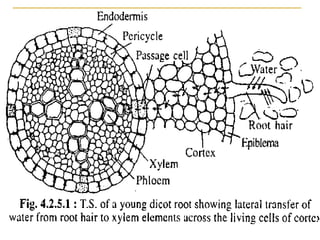
 Water and mineral enter through root epidermis, cross
the cortex, pass into the stele, and are carried upward in
the xylem.
 The cells cannot get enough mineral ions from the soil
by diffusion alone.
 The soil solution is too dilute.
ACTIVE TRANSPORT of these ions must occur.
Specific carrier proteins in the plasma membrane attract and
carry their specific mineral into the cell.
A Proton Pump: H+ is pumped out of the cell causing a
change in pH and a voltage across the membrane.
This helps drive the anions and cations into the cell.
Water and minerals cross the cortex in one of 2 ways: Via
SYMPLAST which is the living continuum of cytoplasm
connected by plasmodesmata.
Via APOPLAST which is nonliving matrix of cell walls.
At the endodermis the apoplastic route is blocked by the
CASPARIAN STRIP.
This is a ring of suberin around each endodermal cell.
Here water and minerals must enter the stele through the cells of
the endodermis.
Water and minerals enter the stele via symplast, but xylem is part
of the apoplast.
Transfer cells selectively pump ions out of the symplast into the
apoplast so they may enter the xylem. This action requires energy.
Water transported up from the roots must replace water lost by
transpiration
ROOT PRESSURE
 In the last step, water is drawn into xylem from turgid pericycle
cells.
 It is because in the absence of turgor pressure of the xylem
vessels, the SP of xylem vessels becomes higher than SP of the
cells of the pericycle when water enters into xylem from pericycle
 A pressure is developed in the xylem of roots which can raise the
water to a certain height in the xylem.
 This pressure is called as root pressure.
TRANSPIRATION PULL THEORY
During transpiration, water evaporates from the inter cellular
spaces of the leaves to the outer atmosphere through the
stomata.
More water is released into the intercellular spaces from the
mesophyll cells and in turn, mesophyll cells draw water from
the xylem of the leaf.
Due to this, a tension is created in water in the xylem elements of
the leaves and this tension is transmitted downward to water
in the xylem of root through xylem of stem.
Water is pulled upward in the form of a continuous unbroken
water column to reach the transpiring surface up to the top of
the plants.

Drought-characteristic features and Water potential

  • 1.
  • 2.
    CHARACTERISTICS OF DROUGHTS The characteristics of droughts are expressed in terms of: (1) drought index (2) intensity-duration-frequency
  • 3.
    Drought Index  Adrought index assimilates thousands of data on rainfall, snowpack, stream flow and other water-supply indicators into a comprehensible picture.  A drought index is typically a single number, far more useful than raw data for decision making.  Drought indices are: PNP, SPI, PDSI, SWSI, RDI  Percent of normal precipitation (PNP)  Standardized Precipitation Index (SPI)  Palmer Drought Severity Index (PDSI)  Surface Water Supply Index (SWSI)  Reclamation Drought Index (RDI)
  • 4.
    Important drought indices Percentof normal precipitation (PNP)  The percent of normal precipitation is the ratio of actual to normal precipitation for a given location and a given period, expressed as a percentage.  Analyses using the percent of normal are effective when used for a single region and a single season.  In other applications, the index can vary depending on the choice of period, including monthly, seasonal, or annual.
  • 5.
    Standardized Precipitation Index(SPI)  The Standardized Precipitation Index (SPI) was developed in the understanding that a certain deficit of precipitation has different impacts on the soil moisture, ground water, reservoir storage, and stream flow.  The SPI was designed to quantify the precipitation deficit for multiple time scales.  The SPI is an index based on the precipitation record for a location and chosen period (months or years).
  • 6.
    •A drought eventoccurs any time the SPI is continuously negative and reaches an intensity less than or equal to 1.0. •The event ends when the SPI becomes positive. •Each drought event has a duration defined by its beginning and end. SPI's with drought intensities
  • 7.
    Palmer Drought SeverityIndex (PDSI)  Index based on the supply-and-demand concept of the water-balance equation  PDSI provide standardized measurements of moisture conditions, so that comparisons can be made between locations and between durations.  The PDSI is a meteorological drought index that is responsive to abnormal weather conditions, either on the dry or wet side.
  • 8.
     When conditionschange from dry to normal or wet, the drought measured by the PDSI ends without taking into account other long- term hydrological aspects.  The PDSI is calculated based on precipitation and temperature data, as well as the local Available Water Content (AWC) of the soil.  From the inputs, all the basic terms of the water balance equation can be determined, including evapotranspiration, soil recharge, runoff, and moisture loss from the surface layer.  Water Balance Equation P = Q + AET + GW + DS, with all terms expressed in mm/year, where P is Precipitation, Q is Runoff, AET is actual evapotranspiration, GW is exchange with groundwater aquifer and DS is change in soil storage.
  • 10.
    Surface Water SupplyIndex (SWSI)  The objective of the SWSI is to incorporate both hydrological and climatological features into a single index  The SWSI values are standardized to allow comparisons between basins.  A reservoir is an artificial lake created in a river valley by the construction of a dam. The most critical purpose of reservoirs is flood risk management. Reservoirs collect water during times of high rainfall, reducing flood risk, and then release the water slowly over the following weeks and months.  Four inputs are required: snowpack, stream flow, precipitation, and reservoir storage.  The SWSI is dependent on the season; therefore, it is computed with only the snowpack, precipitation, and reservoir storage in the winter, while in summer months, streamflow replaces snowpack as a component of the SWSI.
  • 11.
    Reclamation Drought Index(RDI)  The Reclamation Drought Index (RDI) was developed as a tool for defining drought severity and duration, and for predicting the beginning and end of a drought period.  As with the SWSI, the RDI is calculated at a river basin level. It incorporates the supply components of precipitation, snowpack, streamflow, and reservoir levels.  The RDI is adaptable to each particular region and its main strength is its ability to account for both climate and water supply factors  The RDI differs from the SWSI in that it builds a temperature-based demand component and a duration into the index.
  • 12.
  • 14.
    INTENSITY-DURATION-FREQUENCY  The relationsbetween drought intensity, duration and frequency can be studied with conceptual models, which deal with meteorological droughts lasting at least one year, with specific applicability to subtropical and mid latitudinal regions  The climate types are defined across the climatic spectrum in terms of the ratio of mean annual precipitation to annual global terrestrial precipitation Pma / Pagt , and additionally, on the ratio of annual potential evapotranspiration to mean annual precipitation Eap / Pma  To complete the description, the length of rainy season Lrs across the climatic spectrum is also indicated.
  • 15.
     Climate types= Pma / Pagt  Eap / Pma  For any year with precipitation P, drought intensity is defined as the ratio of the deficit (Pma - P) to the mean (Pma) .  DI = (Pma - P) / (Pma)  For drought events longer than one year, intensity is the summation of the annual intensities
  • 16.
    WATER POTENTIAL INSOIL, PLANT, ATMOSPHERE CONTINUM  The movement of water follows the pathway:  soil → uptake → root → stem → leaf → transpiration → air  The driving force for water movement is the water potential gradient that exists from soil to air.  Ψsoil > Ψroot > Ψstem > Ψleaf > Ψair
  • 17.
    WATER POTENTIAL INWATER AND SOIL  Saturated - soil before drained. Gravitational water - water that drains and is not tightly bound;  Ψ = 0 MPa  Field capacity - soil that holds all the water it can against gravity.  Capillary water -water held by capillary action, water at field capacity;  Ψ = -0.015 MPa
  • 18.
     Permanent wiltingpercentage - soil moisture content at which plants can't get enough water. For most,  Ψ = -1.5 Mpa  between PWP and FC is the water available for a plant to use  clay holds more water than sand at any →Ψ ;
  • 19.
    MOVEMENT OF WATERFROM PLANT TO AIR  Movement of water from plant to air occurs via transpiration.  Air has a very high capacity for holding water. For example at 20 C, the water potential of water in air at 100% RH = 0 MPa; 98% RH -2.7 MPa; 50% RH = -93.5 MPa.  There is a very steep water potential gradient from soil to air.  Essentially, the plant just inserts itself between the two and takes advantage of passive transport.
  • 20.
    ROLE OF WATERPOTENTIAL IN THE MOVEMENT OF WATER FROM SOIL THROUGH THE PLANT AND INTO THE AIR  Water and mineral enter through root epidermis, cross the cortex, pass into the stele, and are carried upward in the xylem.  The cells cannot get enough mineral ions from the soil by diffusion alone.  The soil solution is too dilute.
  • 22.
    ACTIVE TRANSPORT ofthese ions must occur. Specific carrier proteins in the plasma membrane attract and carry their specific mineral into the cell. A Proton Pump: H+ is pumped out of the cell causing a change in pH and a voltage across the membrane. This helps drive the anions and cations into the cell. Water and minerals cross the cortex in one of 2 ways: Via SYMPLAST which is the living continuum of cytoplasm connected by plasmodesmata. Via APOPLAST which is nonliving matrix of cell walls.
  • 23.
    At the endodermisthe apoplastic route is blocked by the CASPARIAN STRIP. This is a ring of suberin around each endodermal cell. Here water and minerals must enter the stele through the cells of the endodermis. Water and minerals enter the stele via symplast, but xylem is part of the apoplast. Transfer cells selectively pump ions out of the symplast into the apoplast so they may enter the xylem. This action requires energy. Water transported up from the roots must replace water lost by transpiration
  • 24.
    ROOT PRESSURE  Inthe last step, water is drawn into xylem from turgid pericycle cells.  It is because in the absence of turgor pressure of the xylem vessels, the SP of xylem vessels becomes higher than SP of the cells of the pericycle when water enters into xylem from pericycle  A pressure is developed in the xylem of roots which can raise the water to a certain height in the xylem.  This pressure is called as root pressure.
  • 25.
    TRANSPIRATION PULL THEORY Duringtranspiration, water evaporates from the inter cellular spaces of the leaves to the outer atmosphere through the stomata. More water is released into the intercellular spaces from the mesophyll cells and in turn, mesophyll cells draw water from the xylem of the leaf. Due to this, a tension is created in water in the xylem elements of the leaves and this tension is transmitted downward to water in the xylem of root through xylem of stem. Water is pulled upward in the form of a continuous unbroken water column to reach the transpiring surface up to the top of the plants.