DROUGHT
Contents
• Consequences
• Globally
• Causes
• Types
• Pictures
• Regions affected
• About Droughts
• Protection and Relief
Drought
Drought is an extended period when a region
notes a deficiency in its water supply whether
surface or underground water. A drought can
last for months or years, or may be declared
after as few as 15 days. Generally, this occurs
when a region receives consistently below
average precipitation. It can have a substantial
impact on the ecosystem and agriculture of
the affected region. Although droughts can
persist for several years, even a short, intense
drought can cause significant damage and
harm the local economy.
Consequences
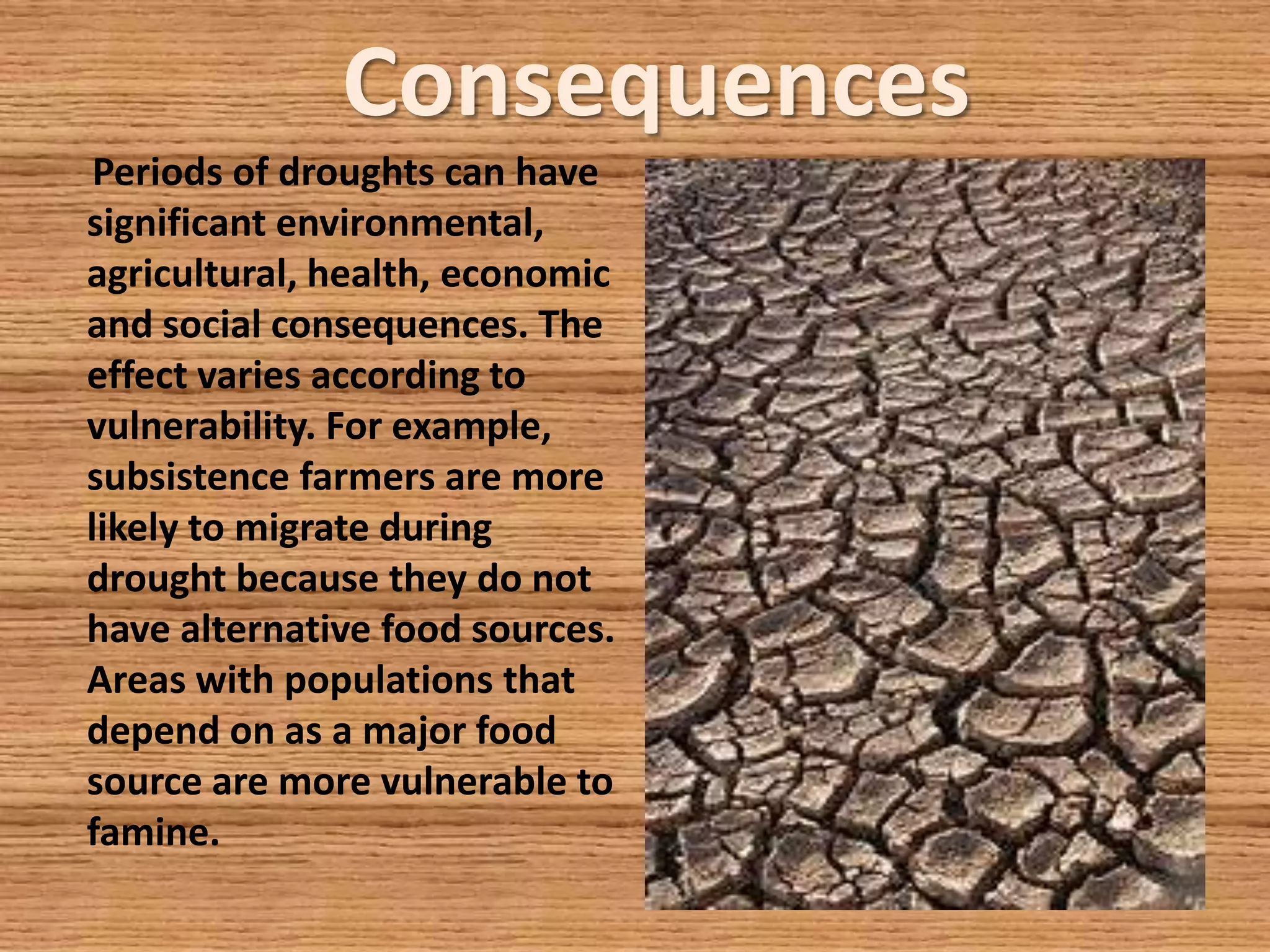
Periods of droughts can have
significant environmental,
agricultural, health, economic
and social consequences. The
effect varies according to
vulnerability. For example,
subsistence farmers are more
likely to migrate during
drought because they do not
have alternative food sources.
Areas with populations that
depend on as a major food
source are more vulnerable to
famine.
Globally
Drought is a normal, recurring feature of the climate in most parts
of the world. In 2005, parts of the Amazon basin experienced the
worst drought in 100 years. A 23 July 2006 article reported Woods
Hole Research Center results showing that the forest in its present
form could survive only three years of drought. Scientists at the
Brazilian National Institute of Amazonian Research argue in the
article that this drought response, coupled with the effects
of deforestation on regional climate, are pushing the rainforest
towards a "tipping point" where it would irreversibly start to die. It
concludes that the rainforest is on the brink of being turned
into savanna or desert, with catastrophic consequences for the
world's climate. Modern people can effectively mitigate much of
the impact of drought through irrigation and crop rotation. Failure
to develop adequate drought mitigation strategies carries a grave
human cost in the modern era, exacerbated by ever-increasing
population densities.
CausesGenerally, rainfall is related to the amount and dew
point determined by air temperature of water vapour
carried by regional atmosphere, combined with the
upward forcing of the air mass containing that water
vapour. If these combined factors do not support
precipitation volumes sufficient to reach the surface,
the result is a drought. This can be triggered by high
level of reflected sunlight, and above average
prevalence of high pressure systems, winds carrying
continental, rather than oceanic air masses (i.e.
reduced water content), and ridges of high pressure
areas from behaviours which prevent or restrict the
developing of thunderstorm activity or rainfall over
one certain region.
Types
Meteorological drought is brought
about when there is a
prolonged period with less than
average precipitation.
Meteorological drought usually
precedes the other kinds of
drought.
Hydrological drought is brought
about when the water reserves
available in sources such
as aquifers, lakes and reservoirs
fall below
the statistical average.
Hydrological drought tends to
show up more slowly because it
involves stored water that is
used but not replenished.
• Agricultural droughts are
droughts that affect crop
production or the ecology of
the range. This condition can
also arise independently from
any change in precipitation
levels when soil conditions and
erosion triggered by poorly
planned agricultural
endeavours cause a shortfall in
water available to the crops.
However, in a traditional
drought, it is caused by an
extended period of below
average precipitation.
Pictures
Regions affected
• Tirunelveli district, south of Vaigai River in
Tamil Nadu
• Coimbatore area in Kerala
• Saurashtra and Kutch regions in Gujarat
• Mirzapur plateau and Palamu regions in Uttar
Pradesh
• Purulia district of West Bengal
• Kalahandi region of Orissa.
Protection and Relief
Dams - many dams and their associated reservoirs supply
additional water in times of drought.
Cloud seeding - a form of intentional weather modification to
induce rainfall.
Desalination - of sea water for irrigation or consumption.
Land use - Carefully planned crop rotation can help to
minimize erosion and allow farmers to plant less water-
dependent crops in drier years.
Outdoor water-use restriction - Regulating the use of
sprinklers, hoses or buckets on outdoor plants, filling pools,
and other water-intensive home maintenance tasks.
Rainwater harvesting - Collection and storage of rainwater
from roofs or other suitable catchments.
Recycled water - Former wastewater that has been treated
and purified for reuse.
Done by:-
V. Varshini
Vigasini.S

Drought

  • 1.
  • 2.
    Contents • Consequences • Globally •Causes • Types • Pictures • Regions affected • About Droughts • Protection and Relief
  • 3.
    Drought Drought is anextended period when a region notes a deficiency in its water supply whether surface or underground water. A drought can last for months or years, or may be declared after as few as 15 days. Generally, this occurs when a region receives consistently below average precipitation. It can have a substantial impact on the ecosystem and agriculture of the affected region. Although droughts can persist for several years, even a short, intense drought can cause significant damage and harm the local economy.
  • 4.
    Consequences Periods of droughtscan have significant environmental, agricultural, health, economic and social consequences. The effect varies according to vulnerability. For example, subsistence farmers are more likely to migrate during drought because they do not have alternative food sources. Areas with populations that depend on as a major food source are more vulnerable to famine.
  • 5.
    Globally Drought is anormal, recurring feature of the climate in most parts of the world. In 2005, parts of the Amazon basin experienced the worst drought in 100 years. A 23 July 2006 article reported Woods Hole Research Center results showing that the forest in its present form could survive only three years of drought. Scientists at the Brazilian National Institute of Amazonian Research argue in the article that this drought response, coupled with the effects of deforestation on regional climate, are pushing the rainforest towards a "tipping point" where it would irreversibly start to die. It concludes that the rainforest is on the brink of being turned into savanna or desert, with catastrophic consequences for the world's climate. Modern people can effectively mitigate much of the impact of drought through irrigation and crop rotation. Failure to develop adequate drought mitigation strategies carries a grave human cost in the modern era, exacerbated by ever-increasing population densities.
  • 6.
    CausesGenerally, rainfall isrelated to the amount and dew point determined by air temperature of water vapour carried by regional atmosphere, combined with the upward forcing of the air mass containing that water vapour. If these combined factors do not support precipitation volumes sufficient to reach the surface, the result is a drought. This can be triggered by high level of reflected sunlight, and above average prevalence of high pressure systems, winds carrying continental, rather than oceanic air masses (i.e. reduced water content), and ridges of high pressure areas from behaviours which prevent or restrict the developing of thunderstorm activity or rainfall over one certain region.
  • 7.
    Types Meteorological drought isbrought about when there is a prolonged period with less than average precipitation. Meteorological drought usually precedes the other kinds of drought. Hydrological drought is brought about when the water reserves available in sources such as aquifers, lakes and reservoirs fall below the statistical average. Hydrological drought tends to show up more slowly because it involves stored water that is used but not replenished. • Agricultural droughts are droughts that affect crop production or the ecology of the range. This condition can also arise independently from any change in precipitation levels when soil conditions and erosion triggered by poorly planned agricultural endeavours cause a shortfall in water available to the crops. However, in a traditional drought, it is caused by an extended period of below average precipitation.
  • 8.
  • 9.
    Regions affected • Tirunelvelidistrict, south of Vaigai River in Tamil Nadu • Coimbatore area in Kerala • Saurashtra and Kutch regions in Gujarat • Mirzapur plateau and Palamu regions in Uttar Pradesh • Purulia district of West Bengal • Kalahandi region of Orissa.
  • 10.
    Protection and Relief Dams- many dams and their associated reservoirs supply additional water in times of drought. Cloud seeding - a form of intentional weather modification to induce rainfall. Desalination - of sea water for irrigation or consumption. Land use - Carefully planned crop rotation can help to minimize erosion and allow farmers to plant less water- dependent crops in drier years. Outdoor water-use restriction - Regulating the use of sprinklers, hoses or buckets on outdoor plants, filling pools, and other water-intensive home maintenance tasks. Rainwater harvesting - Collection and storage of rainwater from roofs or other suitable catchments. Recycled water - Former wastewater that has been treated and purified for reuse.
  • 11.