FACULTY OF ENGINEERING AND NATURAL SCIENCES
DEPARTMENT OF GENETICS AND BIOENGINEERING
BIO 323: GENETIC ENGINEERING-1
LABORATORY REPORT
Experiments Name: Drosophila Melanogaster
Experiments Date and Submission Date: (16.10.2016)&(19.12.2016)
Students Name / Surname: Necla YÜCEL
Students ID Number: 116201132
Evaluator Name: Asst. Prof. Dr. Özgür GÜL
2
CONTENTS
List of Tables……...……………………………………………………………………………………..3
List of Figures..………………………………………………………………………………………….3
Aim……………………………………………………………………………………………………...4
Introduction…………………………………………………………………………………………...4-6
Materials………………………………………………………………………………………………...6
Method………………………………………………………………………………………………..7-8
Result………………………………………………………………………………………………...9-10
Discussion…………………………………………………………………………………………..10-11
Conclusion…………………………………………………………………………………………..…11
References…………………………………………………………………………………………...…11
3
LIST OF TABLES
 Table 1: Result of Drosophila’s Numbers
LIST OF FIGURES
 Figure-1: Life cycle of Drosophila melanogaster
 Figure-2: Body size – female is generally larger than male.
 Figure-3: Show Male (left) and Female (right) wild-type Drosophila
 Figure-4: Dorsal view of Drosophila
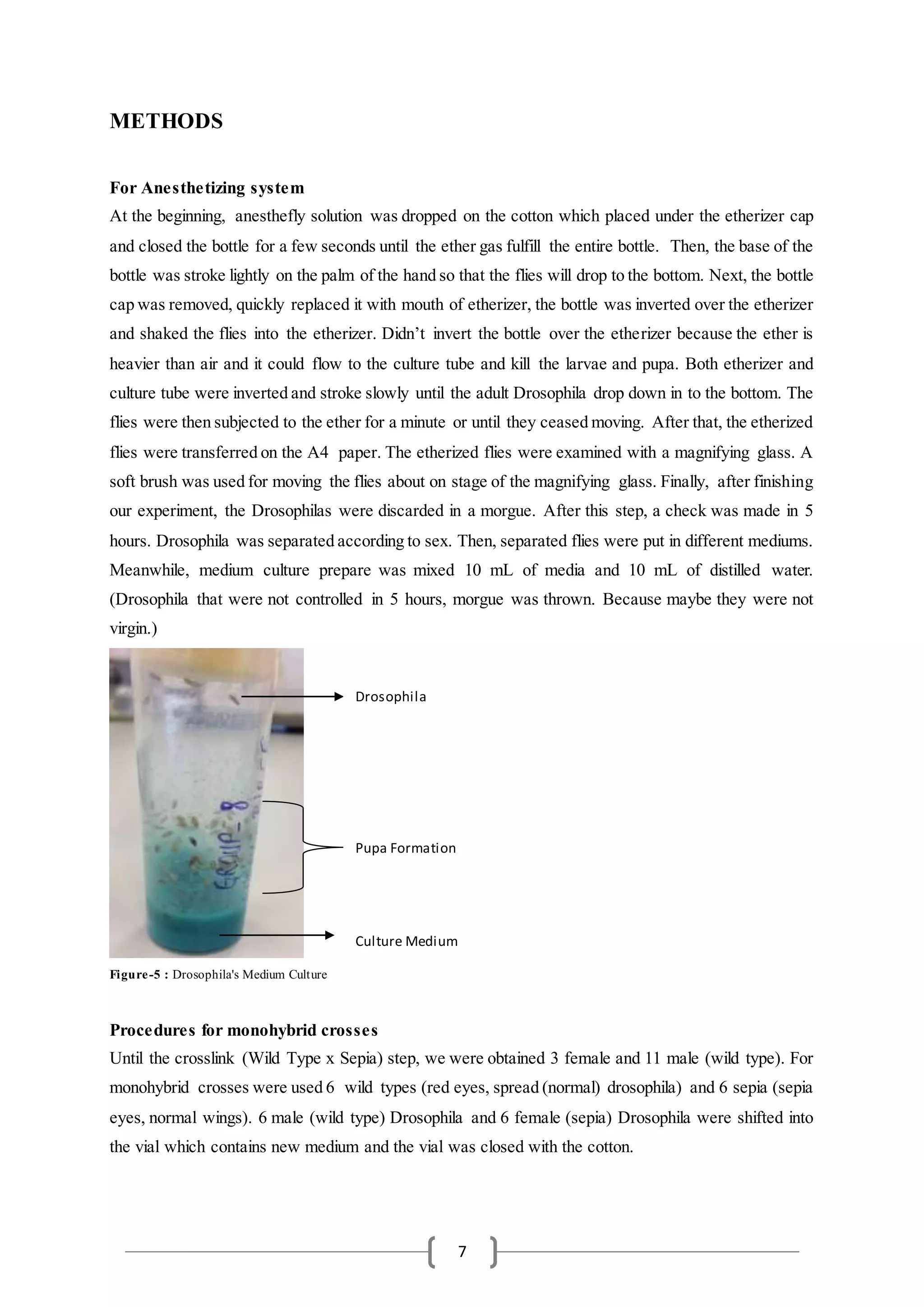
 Figure-5 : Drosophila's Medium Culture
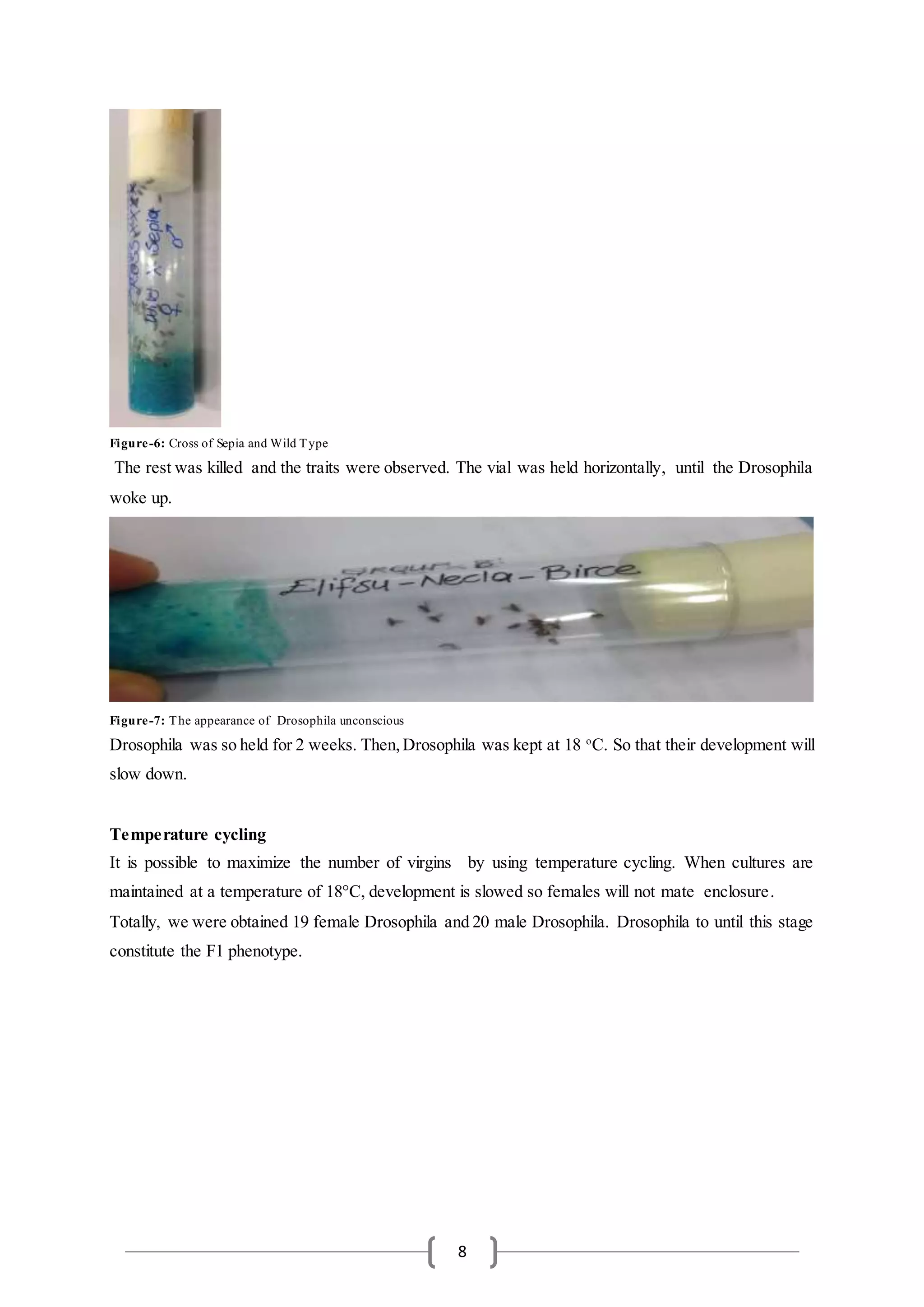
 Figure-6: Cross of Sepia and Wild Type
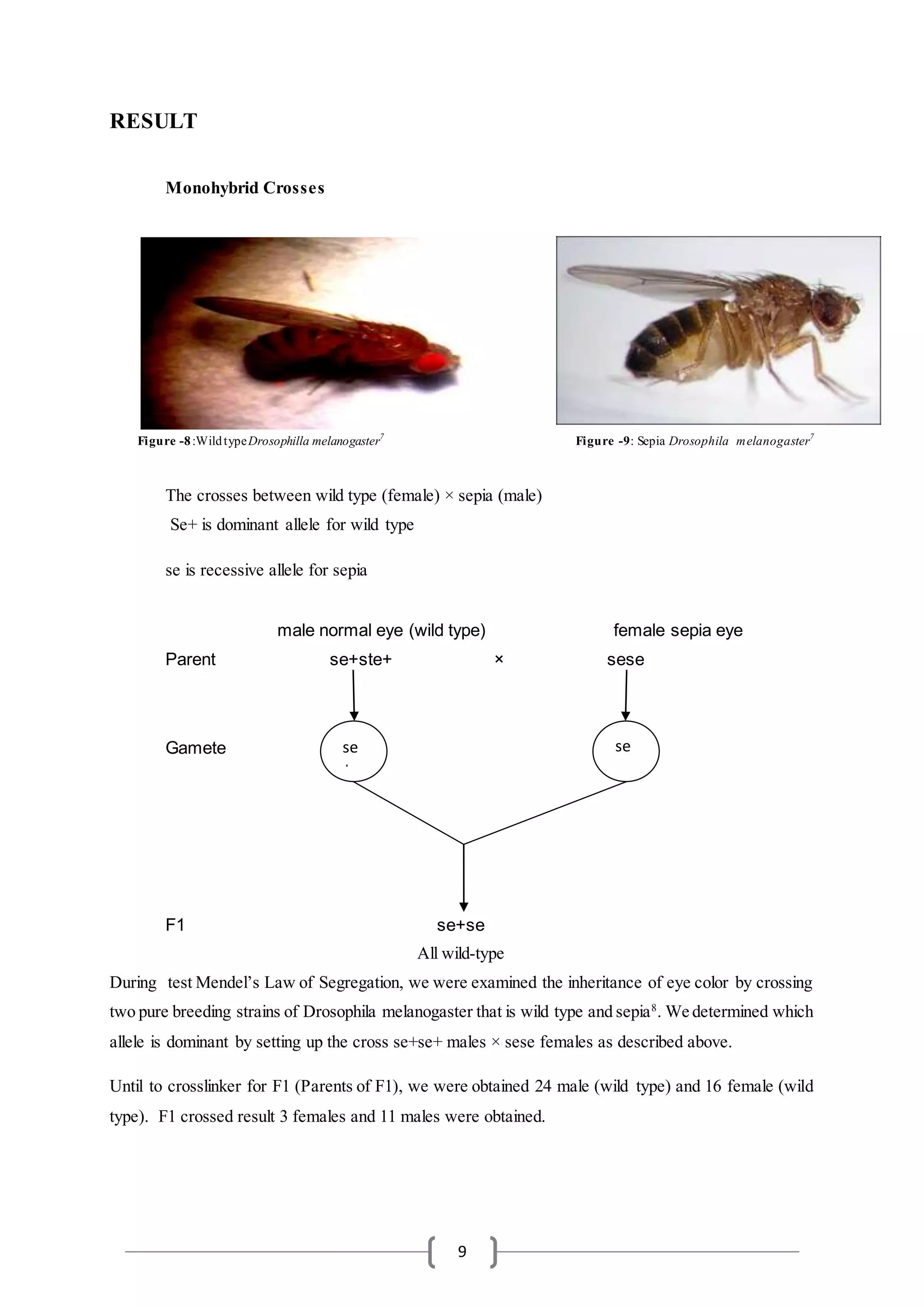
 Figure-7: The appearance of Drosophila unconscious
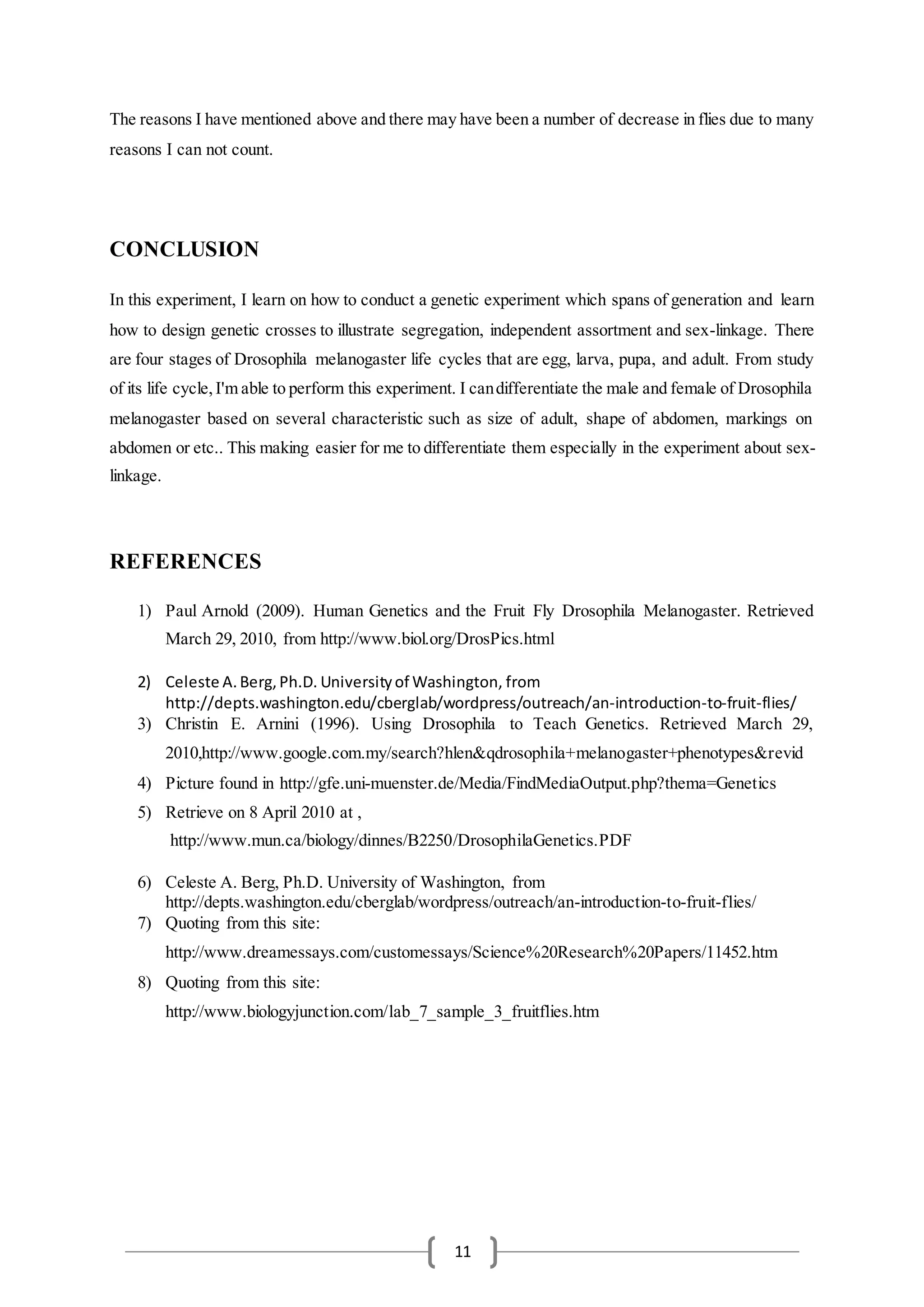
 Figure -8 :Wild type Drosophilla melanogaster
 Figure -9: Sepia Drosophila melanogaster
 Figure-10: Showing the poured Medium Culture
4
AIM
The purpose of this experiment, in the sex linked cross of Drosophila Melanogaster; a phenotypic ratio
of 1:1 was obtained, to introduced normal "wild type" and various mutant phenotypes, to determine the
ratio of monohybrid cross of Drosophila melanogaster, and to differentiate male and female of
Drosophila melanogaster.
INTRODUCTION
Life cycle of Drosophila melanogaster
D.melanogaster exhibits complete metamorphism, meaning the life cycle includes anegg, larval (worm-
like) form, pupa and finally emergence as a flying adult. This is the same as the well-known
metamorphosis of butterflies and many other insects. The larval stage has three instars, or molts.1
Life cycle by day
Day 0: Female lays eggs
Day 1: Eggs hatch
Day 2: First instar (one day in length)
Day 3: Second instar (one day in length)
Day 5: Third and final instar (two days in length)
Day 7: Larvae begin roaming stage. Pupariation (pupal formation) occurs 120 hours after egg laying
Day 11-12: Eclosion (adults emerge from the pupa case).2
The time from egg to adult is temperature- dependent. The above cycle is for a temperature range of 21-
23 degrees C. The higher the temperature,the faster the generation time, whereas a lower (to 18 degrees
C) temperature causes a longer generation time. Females can lay up to 100 eggs/day. Virgin females are
able to lay eggs; however, they will be sterile and few in number. After the eggs hatch, small larvae
should be visible in the growing medium. If your media is white, look for the black area at the head of
the larvae. Some dried premixed media is blue to help identify larvae however this is not a necessity and
with a little patience and practice, larvae are easily seen. In addition, as the larvae feed they disrupt the
smooth surface of the media and so by looking only at the surface one can tell if larvae are present.
However,it is always a good idea to double checkusing a stereomicroscope. Afterthe third instar, larvae
will begin to migrate up the culture vial in order to pupate.3
5
Figure-1: Life cycle of Drosophila melanogaster4
Sex difference
Several criteria may be used to distinguish male and female Drosophila melanogaster
Figure-2: Bodysize – femaleis generally largerthanmale.
Abdomen shape – the female abdomen curve to a point, the male abdomen is round and much
shorter.
Figure-3: Show Male (left) and Female (right) wild-type Drosophila
 Mark on their abdomen - Alternating dark and light bands can be seen on the entire rear portion
of the female; the last few segments of the male are fused.5
6
 DORSAL VIEW
Figure-4: Dorsal view of Drosophila
Why use Drosophila?
1. They are small and easily handled.
2. They can be easily anesthetized and manipulated individually with unsophisticated equipment.
3. They are sexually dimorphic (males and females are different), making it is quite easy to
differentiate the sexes.
4. Virgins fruit flies are physically distinctive from mature adults, making it easy to obtain virgin
males and females for genetic crosses.
5. Flies have a short generation time (10-12 days) and do well at room temperature.
6. The care and culture of fruit flies requires little equipment, is low in cost and uses little space
even for large cultures.6
MATERIALS
- Drosophila Melanogaster (Male-Female)
- Drosophila Medium (Each vial contain 10 mL Media and 10 mL Distilled water)
- Anesthefly Solution
- Vial Tube With Sponge Cover
- Soft Paint Brush
- Marker (pen)
- Magnifying Glass
- q-tips
7
METHODS
For Anesthetizing system
At the beginning, anesthefly solution was dropped on the cotton which placed under the etherizer cap
and closed the bottle for a few seconds until the ether gas fulfill the entire bottle. Then, the base of the
bottle was stroke lightly on the palm of the hand so that the flies will drop to the bottom. Next, the bottle
cap was removed, quickly replaced it with mouth of etherizer, the bottle was inverted over the etherizer
and shaked the flies into the etherizer. Didn’t invert the bottle over the etherizer because the ether is
heavier than air and it could flow to the culture tube and kill the larvae and pupa. Both etherizer and
culture tube were inverted and stroke slowly until the adult Drosophila drop down in to the bottom. The
flies were then subjected to the ether for a minute or until they ceased moving. After that, the etherized
flies were transferred on the A4 paper. The etherized flies were examined with a magnifying glass. A
soft brush was used for moving the flies about on stage of the magnifying glass. Finally, after finishing
our experiment, the Drosophilas were discarded in a morgue. After this step, a check was made in 5
hours. Drosophila was separated according to sex. Then, separated flies were put in different mediums.
Meanwhile, medium culture prepare was mixed 10 mL of media and 10 mL of distilled water.
(Drosophila that were not controlled in 5 hours, morgue was thrown. Because maybe they were not
virgin.)
Figure-5 : Drosophila's Medium Culture
Procedures for monohybrid crosses
Until the crosslink (Wild Type x Sepia) step, we were obtained 3 female and 11 male (wild type). For
monohybrid crosses were used 6 wild types (red eyes, spread (normal) drosophila) and 6 sepia (sepia
eyes, normal wings). 6 male (wild type) Drosophila and 6 female (sepia) Drosophila were shifted into
the vial which contains new medium and the vial was closed with the cotton.
Culture Medium
Pupa Formation
Drosophila
8
Figure-6: Cross of Sepia and Wild Type
The rest was killed and the traits were observed. The vial was held horizontally, until the Drosophila
woke up.
Figure-7: The appearance of Drosophila unconscious
Drosophila was so held for 2 weeks. Then,Drosophila was kept at 18 o
C. So that their development will
slow down.
Temperature cycling
It is possible to maximize the number of virgins by using temperature cycling. When cultures are
maintained at a temperature of 18°C, development is slowed so females will not mate enclosure.
Totally, we were obtained 19 female Drosophila and 20 male Drosophila. Drosophila to until this stage
constitute the F1 phenotype.
9
RESULT
Monohybrid Crosses
Figure -8:WildtypeDrosophilla melanogaster7
Figure -9: Sepia Drosophila melanogaster7
The crosses between wild type (female) × sepia (male)
Se+ is dominant allele for wild type
se is recessive allele for sepia
male normal eye (wild type) female sepia eye
Parent se+ste+ × sese
Gamete
F1 se+se
All wild-type
During test Mendel’s Law of Segregation, we were examined the inheritance of eye color by crossing
two pure breeding strains of Drosophila melanogaster that is wild type and sepia8
. We determined which
allele is dominant by setting up the cross se+se+ males × sese females as described above.
Until to crosslinker for F1 (Parents of F1), we were obtained 24 male (wild type) and 16 female (wild
type). F1 crossed result 3 females and 11 males were obtained.
se
+
se
10
Table 1: Result of Drosophila’s Numbers
DROSOPHILA TOTAL OBTAINED Total Virgin
Parent (Male) 24 11 (virgin)
Parent (Female) 16 3 (virgin)
F1 (Male) 20
F1 (Female) 19
Using for Cross F1 (Wild
Type) Male
6
Using for Cross F1 (Sepia)
Female
6
DISCUSSION
In this experiment, Parental generation (the parents of F1), 24 male and 16 female Drosophila were
obtained. However,in the F1 crossover phase, there were only 3 females and 11 male Drosophila. The
reasons for the decrease of flies:
1) The flies need to be inspected every 5 hours, against a possible mating. But, me and my group
of friends have not done the checks regularly. At the controls over 5 hours, we put female
Drosophila in morgh and put their male Drosophila in male medium culture (Against a possible
mating). If the controls are not exceeded for 5 hours, we put the females in the female medium.
2) Drosophila should be careful when taking them to the medium when they are unconscious,
because the Drosophila stick to medium culture and died there. That's why, when the flies are
unconscious and the tube should be on the horizontal side. However, when we were
experimenting, we did not pay attention to this step.
3) Flies on the medium culture may have died from oxygen deficiency.
4) During the anesthesia procedure, when the vial hit the bench, medium culture was poured.
Puppies in the media died. Living Drosophila may have been died the same reason.
Figure-10: Showing the poured Medium Culture
PouredMediumCulture
11
The reasons I have mentioned above and there may have been a number of decrease in flies due to many
reasons I can not count.
CONCLUSION
In this experiment, I learn on how to conduct a genetic experiment which spans of generation and learn
how to design genetic crosses to illustrate segregation, independent assortment and sex-linkage. There
are four stages of Drosophila melanogaster life cycles that are egg, larva, pupa, and adult. From study
of its life cycle,I'm able to perform this experiment. I candifferentiate the male and female of Drosophila
melanogaster based on several characteristic such as size of adult, shape of abdomen, markings on
abdomen or etc.. This making easier for me to differentiate them especially in the experiment about sex-
linkage.
REFERENCES
1) Paul Arnold (2009). Human Genetics and the Fruit Fly Drosophila Melanogaster. Retrieved
March 29, 2010, from http://www.biol.org/DrosPics.html
2) Celeste A.Berg,Ph.D. Universityof Washington, from
http://depts.washington.edu/cberglab/wordpress/outreach/an-introduction-to-fruit-flies/
3) Christin E. Arnini (1996). Using Drosophila to Teach Genetics. Retrieved March 29,
2010,http://www.google.com.my/search?hlen&qdrosophila+melanogaster+phenotypes&revid
4) Picture found in http://gfe.uni-muenster.de/Media/FindMediaOutput.php?thema=Genetics
5) Retrieve on 8 April 2010 at ,
http://www.mun.ca/biology/dinnes/B2250/DrosophilaGenetics.PDF
6) Celeste A. Berg, Ph.D. University of Washington, from
http://depts.washington.edu/cberglab/wordpress/outreach/an-introduction-to-fruit-flies/
7) Quoting from this site:
http://www.dreamessays.com/customessays/Science%20Research%20Papers/11452.htm
8) Quoting from this site:
http://www.biologyjunction.com/lab_7_sample_3_fruitflies.htm

Drosophila - Laboratory Report 1

  • 1.
    FACULTY OF ENGINEERINGAND NATURAL SCIENCES DEPARTMENT OF GENETICS AND BIOENGINEERING BIO 323: GENETIC ENGINEERING-1 LABORATORY REPORT Experiments Name: Drosophila Melanogaster Experiments Date and Submission Date: (16.10.2016)&(19.12.2016) Students Name / Surname: Necla YÜCEL Students ID Number: 116201132 Evaluator Name: Asst. Prof. Dr. Özgür GÜL
  • 2.
    2 CONTENTS List of Tables……...……………………………………………………………………………………..3 Listof Figures..………………………………………………………………………………………….3 Aim……………………………………………………………………………………………………...4 Introduction…………………………………………………………………………………………...4-6 Materials………………………………………………………………………………………………...6 Method………………………………………………………………………………………………..7-8 Result………………………………………………………………………………………………...9-10 Discussion…………………………………………………………………………………………..10-11 Conclusion…………………………………………………………………………………………..…11 References…………………………………………………………………………………………...…11
  • 3.
    3 LIST OF TABLES Table 1: Result of Drosophila’s Numbers LIST OF FIGURES  Figure-1: Life cycle of Drosophila melanogaster  Figure-2: Body size – female is generally larger than male.  Figure-3: Show Male (left) and Female (right) wild-type Drosophila  Figure-4: Dorsal view of Drosophila  Figure-5 : Drosophila's Medium Culture  Figure-6: Cross of Sepia and Wild Type  Figure-7: The appearance of Drosophila unconscious  Figure -8 :Wild type Drosophilla melanogaster  Figure -9: Sepia Drosophila melanogaster  Figure-10: Showing the poured Medium Culture
  • 4.
    4 AIM The purpose ofthis experiment, in the sex linked cross of Drosophila Melanogaster; a phenotypic ratio of 1:1 was obtained, to introduced normal "wild type" and various mutant phenotypes, to determine the ratio of monohybrid cross of Drosophila melanogaster, and to differentiate male and female of Drosophila melanogaster. INTRODUCTION Life cycle of Drosophila melanogaster D.melanogaster exhibits complete metamorphism, meaning the life cycle includes anegg, larval (worm- like) form, pupa and finally emergence as a flying adult. This is the same as the well-known metamorphosis of butterflies and many other insects. The larval stage has three instars, or molts.1 Life cycle by day Day 0: Female lays eggs Day 1: Eggs hatch Day 2: First instar (one day in length) Day 3: Second instar (one day in length) Day 5: Third and final instar (two days in length) Day 7: Larvae begin roaming stage. Pupariation (pupal formation) occurs 120 hours after egg laying Day 11-12: Eclosion (adults emerge from the pupa case).2 The time from egg to adult is temperature- dependent. The above cycle is for a temperature range of 21- 23 degrees C. The higher the temperature,the faster the generation time, whereas a lower (to 18 degrees C) temperature causes a longer generation time. Females can lay up to 100 eggs/day. Virgin females are able to lay eggs; however, they will be sterile and few in number. After the eggs hatch, small larvae should be visible in the growing medium. If your media is white, look for the black area at the head of the larvae. Some dried premixed media is blue to help identify larvae however this is not a necessity and with a little patience and practice, larvae are easily seen. In addition, as the larvae feed they disrupt the smooth surface of the media and so by looking only at the surface one can tell if larvae are present. However,it is always a good idea to double checkusing a stereomicroscope. Afterthe third instar, larvae will begin to migrate up the culture vial in order to pupate.3
  • 5.
    5 Figure-1: Life cycleof Drosophila melanogaster4 Sex difference Several criteria may be used to distinguish male and female Drosophila melanogaster Figure-2: Bodysize – femaleis generally largerthanmale. Abdomen shape – the female abdomen curve to a point, the male abdomen is round and much shorter. Figure-3: Show Male (left) and Female (right) wild-type Drosophila  Mark on their abdomen - Alternating dark and light bands can be seen on the entire rear portion of the female; the last few segments of the male are fused.5
  • 6.
    6  DORSAL VIEW Figure-4:Dorsal view of Drosophila Why use Drosophila? 1. They are small and easily handled. 2. They can be easily anesthetized and manipulated individually with unsophisticated equipment. 3. They are sexually dimorphic (males and females are different), making it is quite easy to differentiate the sexes. 4. Virgins fruit flies are physically distinctive from mature adults, making it easy to obtain virgin males and females for genetic crosses. 5. Flies have a short generation time (10-12 days) and do well at room temperature. 6. The care and culture of fruit flies requires little equipment, is low in cost and uses little space even for large cultures.6 MATERIALS - Drosophila Melanogaster (Male-Female) - Drosophila Medium (Each vial contain 10 mL Media and 10 mL Distilled water) - Anesthefly Solution - Vial Tube With Sponge Cover - Soft Paint Brush - Marker (pen) - Magnifying Glass - q-tips
  • 7.
    7 METHODS For Anesthetizing system Atthe beginning, anesthefly solution was dropped on the cotton which placed under the etherizer cap and closed the bottle for a few seconds until the ether gas fulfill the entire bottle. Then, the base of the bottle was stroke lightly on the palm of the hand so that the flies will drop to the bottom. Next, the bottle cap was removed, quickly replaced it with mouth of etherizer, the bottle was inverted over the etherizer and shaked the flies into the etherizer. Didn’t invert the bottle over the etherizer because the ether is heavier than air and it could flow to the culture tube and kill the larvae and pupa. Both etherizer and culture tube were inverted and stroke slowly until the adult Drosophila drop down in to the bottom. The flies were then subjected to the ether for a minute or until they ceased moving. After that, the etherized flies were transferred on the A4 paper. The etherized flies were examined with a magnifying glass. A soft brush was used for moving the flies about on stage of the magnifying glass. Finally, after finishing our experiment, the Drosophilas were discarded in a morgue. After this step, a check was made in 5 hours. Drosophila was separated according to sex. Then, separated flies were put in different mediums. Meanwhile, medium culture prepare was mixed 10 mL of media and 10 mL of distilled water. (Drosophila that were not controlled in 5 hours, morgue was thrown. Because maybe they were not virgin.) Figure-5 : Drosophila's Medium Culture Procedures for monohybrid crosses Until the crosslink (Wild Type x Sepia) step, we were obtained 3 female and 11 male (wild type). For monohybrid crosses were used 6 wild types (red eyes, spread (normal) drosophila) and 6 sepia (sepia eyes, normal wings). 6 male (wild type) Drosophila and 6 female (sepia) Drosophila were shifted into the vial which contains new medium and the vial was closed with the cotton. Culture Medium Pupa Formation Drosophila
  • 8.
    8 Figure-6: Cross ofSepia and Wild Type The rest was killed and the traits were observed. The vial was held horizontally, until the Drosophila woke up. Figure-7: The appearance of Drosophila unconscious Drosophila was so held for 2 weeks. Then,Drosophila was kept at 18 o C. So that their development will slow down. Temperature cycling It is possible to maximize the number of virgins by using temperature cycling. When cultures are maintained at a temperature of 18°C, development is slowed so females will not mate enclosure. Totally, we were obtained 19 female Drosophila and 20 male Drosophila. Drosophila to until this stage constitute the F1 phenotype.
  • 9.
    9 RESULT Monohybrid Crosses Figure -8:WildtypeDrosophillamelanogaster7 Figure -9: Sepia Drosophila melanogaster7 The crosses between wild type (female) × sepia (male) Se+ is dominant allele for wild type se is recessive allele for sepia male normal eye (wild type) female sepia eye Parent se+ste+ × sese Gamete F1 se+se All wild-type During test Mendel’s Law of Segregation, we were examined the inheritance of eye color by crossing two pure breeding strains of Drosophila melanogaster that is wild type and sepia8 . We determined which allele is dominant by setting up the cross se+se+ males × sese females as described above. Until to crosslinker for F1 (Parents of F1), we were obtained 24 male (wild type) and 16 female (wild type). F1 crossed result 3 females and 11 males were obtained. se + se
  • 10.
    10 Table 1: Resultof Drosophila’s Numbers DROSOPHILA TOTAL OBTAINED Total Virgin Parent (Male) 24 11 (virgin) Parent (Female) 16 3 (virgin) F1 (Male) 20 F1 (Female) 19 Using for Cross F1 (Wild Type) Male 6 Using for Cross F1 (Sepia) Female 6 DISCUSSION In this experiment, Parental generation (the parents of F1), 24 male and 16 female Drosophila were obtained. However,in the F1 crossover phase, there were only 3 females and 11 male Drosophila. The reasons for the decrease of flies: 1) The flies need to be inspected every 5 hours, against a possible mating. But, me and my group of friends have not done the checks regularly. At the controls over 5 hours, we put female Drosophila in morgh and put their male Drosophila in male medium culture (Against a possible mating). If the controls are not exceeded for 5 hours, we put the females in the female medium. 2) Drosophila should be careful when taking them to the medium when they are unconscious, because the Drosophila stick to medium culture and died there. That's why, when the flies are unconscious and the tube should be on the horizontal side. However, when we were experimenting, we did not pay attention to this step. 3) Flies on the medium culture may have died from oxygen deficiency. 4) During the anesthesia procedure, when the vial hit the bench, medium culture was poured. Puppies in the media died. Living Drosophila may have been died the same reason. Figure-10: Showing the poured Medium Culture PouredMediumCulture
  • 11.
    11 The reasons Ihave mentioned above and there may have been a number of decrease in flies due to many reasons I can not count. CONCLUSION In this experiment, I learn on how to conduct a genetic experiment which spans of generation and learn how to design genetic crosses to illustrate segregation, independent assortment and sex-linkage. There are four stages of Drosophila melanogaster life cycles that are egg, larva, pupa, and adult. From study of its life cycle,I'm able to perform this experiment. I candifferentiate the male and female of Drosophila melanogaster based on several characteristic such as size of adult, shape of abdomen, markings on abdomen or etc.. This making easier for me to differentiate them especially in the experiment about sex- linkage. REFERENCES 1) Paul Arnold (2009). Human Genetics and the Fruit Fly Drosophila Melanogaster. Retrieved March 29, 2010, from http://www.biol.org/DrosPics.html 2) Celeste A.Berg,Ph.D. Universityof Washington, from http://depts.washington.edu/cberglab/wordpress/outreach/an-introduction-to-fruit-flies/ 3) Christin E. Arnini (1996). Using Drosophila to Teach Genetics. Retrieved March 29, 2010,http://www.google.com.my/search?hlen&qdrosophila+melanogaster+phenotypes&revid 4) Picture found in http://gfe.uni-muenster.de/Media/FindMediaOutput.php?thema=Genetics 5) Retrieve on 8 April 2010 at , http://www.mun.ca/biology/dinnes/B2250/DrosophilaGenetics.PDF 6) Celeste A. Berg, Ph.D. University of Washington, from http://depts.washington.edu/cberglab/wordpress/outreach/an-introduction-to-fruit-flies/ 7) Quoting from this site: http://www.dreamessays.com/customessays/Science%20Research%20Papers/11452.htm 8) Quoting from this site: http://www.biologyjunction.com/lab_7_sample_3_fruitflies.htm