Download as PDF, PPTX
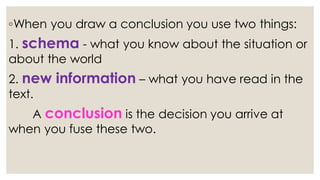
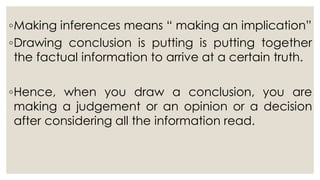
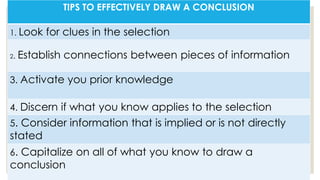



Drawing a conclusion requires combining what is known (schemas) with new information from a text. A conclusion is the decision reached by synthesizing these two elements. To draw an effective conclusion, one should look for clues in the text, identify connections between pieces of information, apply prior knowledge, and consider both stated and implied details. The conclusion should be an inference, judgment, or opinion made after comprehensively analyzing all available information. The example provided illustrates this process, where combining what is explicitly stated with background knowledge leads to the conclusion that a classmate was suspended for cheating based on being seen leaving the dean's office with his parents and then not returning to classes.


