Database System Concepts, 7th Ed.
©Silberschatz, Korth and Sudarshan
See www.db-book.com for conditions on re-use
Chapter 1: Introduction
©Silberschatz, Korth and Sudarshan
1.4
Database System Concepts - 7th Edition
Database Applications Examples
 Enterprise Information
• Sales: customers, products, purchases
• Accounting: payments, receipts, assets
• Human Resources: Information about employees, salaries, payroll taxes.
 Manufacturing: management of production, inventory, orders, supply
chain.
 Banking and finance
• customer information, accounts, loans, and banking transactions.
• Credit card transactions
• Finance: sales and purchases of financial instruments (e.g., stocks and
bonds; storing real-time market data
 Universities: registration, grades
©Silberschatz, Korth and Sudarshan
1.5
Database System Concepts - 7th Edition
Database Applications Examples (Cont.)
 Airlines: reservations, schedules
 Telecommunication: records of calls, texts, and data usage,
generating monthly bills, maintaining balances on prepaid calling
cards
 Web-based services
• Online retailers: order tracking, customized recommendations
• Online advertisements
 Document databases
 Navigation systems: For maintaining the locations of varies places of
interest along with the exact routes of roads, train systems, buses,
etc.
©Silberschatz, Korth and Sudarshan
1.6
Database System Concepts - 7th Edition
Purpose of Database Systems
In the early days, database applications were built directly on top of file
systems, which leads to:
 Data redundancy and inconsistency: data is stored in multiple file
formats resulting induplication of information in different files
 Difficulty in accessing data
• Need to write a new program to carry out each new task
 Data isolation
• Multiple files and formats
 Integrity problems
• Integrity constraints (e.g., account balance > 0) become “buried” in
program code rather than being stated explicitly
• Hard to add new constraints or change existing ones
©Silberschatz, Korth and Sudarshan
1.7
Database System Concepts - 7th Edition
Purpose of Database Systems (Cont.)
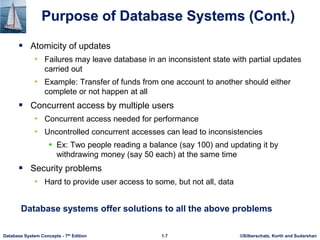
 Atomicity of updates
• Failures may leave database in an inconsistent state with partial updates
carried out
• Example: Transfer of funds from one account to another should either
complete or not happen at all
 Concurrent access by multiple users
• Concurrent access needed for performance
• Uncontrolled concurrent accesses can lead to inconsistencies
 Ex: Two people reading a balance (say 100) and updating it by
withdrawing money (say 50 each) at the same time
 Security problems
• Hard to provide user access to some, but not all, data
Database systems offer solutions to all the above problems
©Silberschatz, Korth and Sudarshan
1.10
Database System Concepts - 7th Edition
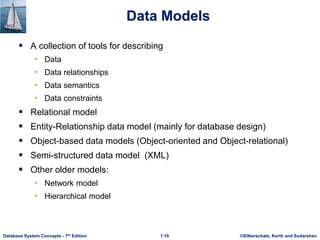
Data Models
 A collection of tools for describing
• Data
• Data relationships
• Data semantics
• Data constraints
 Relational model
 Entity-Relationship data model (mainly for database design)
 Object-based data models (Object-oriented and Object-relational)
 Semi-structured data model (XML)
 Other older models:
• Network model
• Hierarchical model
©Silberschatz, Korth and Sudarshan
1.11
Database System Concepts - 7th Edition
Relational Model
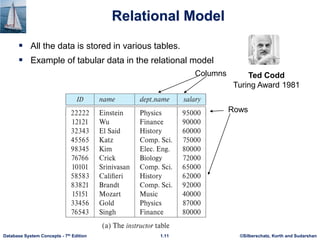
 All the data is stored in various tables.
 Example of tabular data in the relational model
Columns
Rows
Ted Codd
Turing Award 1981
©Silberschatz, Korth and Sudarshan
1.12
Database System Concepts - 7th Edition
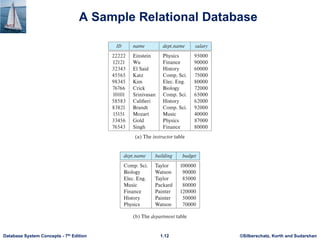
A Sample Relational Database
©Silberschatz, Korth and Sudarshan
1.14
Database System Concepts - 7th Edition
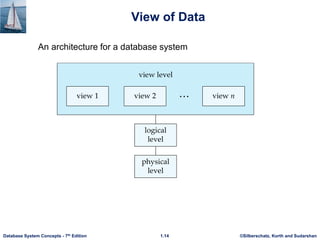
View of Data
An architecture for a database system
©Silberschatz, Korth and Sudarshan
1.15
Database System Concepts - 7th Edition
Instances and Schemas
 Similar to types and variables in programming languages
 Logical Schema – the overall logical structure of the database
• Example: The database consists of information about a set of
customers and accounts in a bank and the relationship between
them
 Analogous to type information of a variable in a program
 Physical schema– the overall physical structure of the database
 Instance – the actual content of the database at a particular point in
time
• Analogous to the value of a variable
©Silberschatz, Korth and Sudarshan
1.16
Database System Concepts - 7th Edition
Physical Data Independence
 Physical Data Independence – the ability to modify the physical
schema without changing the logical schema
• Applications depend on the logical schema
• In general, the interfaces between the various levels and
components should be well defined so that changes in some parts
do not seriously influence others.
©Silberschatz, Korth and Sudarshan
1.17
Database System Concepts - 7th Edition
Data Definition Language (DDL)
 Specification notation for defining the database schema
Example: create table instructor (
ID char(5),
name varchar(20),
dept_name varchar(20),
salary numeric(8,2))
 DDL compiler generates a set of table templates stored in a data
dictionary
 Data dictionary contains metadata (i.e., data about data)
• Database schema
• Integrity constraints
 Primary key (ID uniquely identifies instructors)
• Authorization
 Who can access what
©Silberschatz, Korth and Sudarshan
1.18
Database System Concepts - 7th Edition
Data Manipulation Language (DML)
 Language for accessing and updating the data organized by the
appropriate data model
• DML also known as query language
 Two classes of languages
• Pure – used for proving properties about computational power
and for optimization
 Relational Algebra
 Tuple relational calculus
 Domain relational calculus
• Commercial – used in commercial systems
 SQL is the most widely used commercial language
©Silberschatz, Korth and Sudarshan
1.19
Database System Concepts - 7th Edition
Data Manipulation Language (Cont.)
 There are basically two types of data-manipulation language
• Procedural DML -- require a user to specify what data are
needed and how to get those data.
• Declarative DML -- require a user to specify what data are
needed without specifying how to get those data.
 Declarative DMLs are usually easier to learn and use than are
procedural DMLs.
 Declarative DMLs are also referred to as non-procedural DMLs
 The portion of a DML that involves information retrieval is called a
query language.
©Silberschatz, Korth and Sudarshan
1.20
Database System Concepts - 7th Edition
SQL Query Language
 SQL query language is nonprocedural. A query takes as input
several tables (possibly only one) and always returns a single table.
 Example to find all instructors in Comp. Sci. dept
select name
from instructor
where dept_name = 'Comp. Sci.'
 SQL is NOT a Turing machine equivalent language
 To be able to compute complex functions SQL is usually embedded in
some higher-level language
 Application programs generally access databases through one of
• Language extensions to allow embedded SQL
• Application program interface (e.g., ODBC/JDBC) which allow
SQL queries to be sent to a database
©Silberschatz, Korth and Sudarshan
1.21
Database System Concepts - 7th Edition
Database Access from Application
Program
 Non-procedural query languages such as SQL are not as powerful as
a universal Turing machine.
 SQL does not support actions such as input from users, output to
displays, or communication over the network.
 Such computations and actions must be written in a host language,
such as C/C++, Java or Python, with embedded SQL queries that
access the data in the database.
 Application programs -- are programs that are used to interact with
the database in this fashion.
©Silberschatz, Korth and Sudarshan
1.22
Database System Concepts - 7th Edition
Database Design
The process of designing the general structure of the database:
 Logical Design – Deciding on the database schema. Database
design requires that we find a “good” collection of relation schemas.
• Business decision – What attributes should we record in the database?
• Computer Science decision – What relation schemas should we have
and how should the attributes be distributed among the various relation
schemas?
 Physical Design – Deciding on the physical layout of the database
©Silberschatz, Korth and Sudarshan
1.23
Database System Concepts - 7th Edition
Database Engine
 A database system is partitioned into modules that deal with each of
the responsibilities of the overall system.
 The functional components of a database system can be divided into
• The storage manager,
• The query processor component,
• The transaction management component.
©Silberschatz, Korth and Sudarshan
1.24
Database System Concepts - 7th Edition
Storage Manager
 A program module that provides the interface between the low-level
data stored in the database and the application programs and queries
submitted to the system.
 The storage manager is responsible to the following tasks:
• Interaction with the OS file manager
• Efficient storing, retrieving and updating of data
 The storage manager components include:
• Authorization and integrity manager
• Transaction manager
• File manager
• Buffer manager
©Silberschatz, Korth and Sudarshan
1.25
Database System Concepts - 7th Edition
Storage Manager (Cont.)
 The storage manager implements several data structures as part of
the physical system implementation:
• Data files -- store the database itself
• Data dictionary -- stores metadata about the structure of the database, in
particular the schema of the database.
• Indices -- can provide fast access to data items. A database index
provides pointers to those data items that hold a particular value.
©Silberschatz, Korth and Sudarshan
1.26
Database System Concepts - 7th Edition
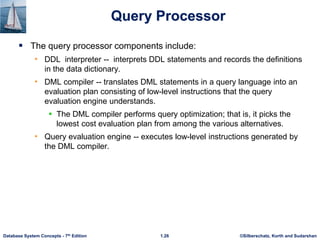
Query Processor
 The query processor components include:
• DDL interpreter -- interprets DDL statements and records the definitions
in the data dictionary.
• DML compiler -- translates DML statements in a query language into an
evaluation plan consisting of low-level instructions that the query
evaluation engine understands.
 The DML compiler performs query optimization; that is, it picks the
lowest cost evaluation plan from among the various alternatives.
• Query evaluation engine -- executes low-level instructions generated by
the DML compiler.
©Silberschatz, Korth and Sudarshan
1.27
Database System Concepts - 7th Edition
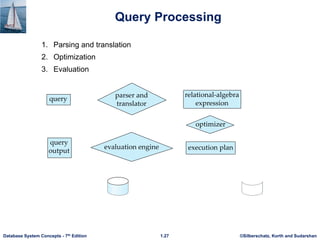
Query Processing
1. Parsing and translation
2. Optimization
3. Evaluation
©Silberschatz, Korth and Sudarshan
1.28
Database System Concepts - 7th Edition
Transaction Management
 A transaction is a collection of operations that performs a single
logical function in a database application
 Transaction-management component ensures that the database
remains in a consistent (correct) state despite system failures (e.g.,
power failures and operating system crashes) and transaction
failures.
 Concurrency-control manager controls the interaction among the
concurrent transactions, to ensure the consistency of the database.
©Silberschatz, Korth and Sudarshan
1.29
Database System Concepts - 7th Edition
Database Architecture
 Centralized databases
• One to a few cores, shared memory
 Client-server,
• One server machine executes work on behalf of multiple client machines.
 Parallel databases
• Many core shared memory
• Shared disk
• Shared nothing
 Distributed databases
• Geographical distribution
• Schema/data heterogeneity
©Silberschatz, Korth and Sudarshan
1.30
Database System Concepts - 7th Edition
Database Applications
Database applications are usually partitioned into two or three parts
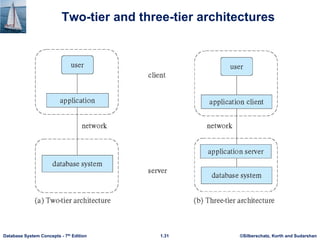
 Two-tier architecture -- the application resides at the client machine,
where it invokes database system functionality at the server machine
 Three-tier architecture -- the client machine acts as a front end and
does not contain any direct database calls.
• The client end communicates with an application server, usually through a
forms interface.
• The application server in turn communicates with a database system to
access data.
©Silberschatz, Korth and Sudarshan
1.31
Database System Concepts - 7th Edition
Two-tier and three-tier architectures
©Silberschatz, Korth and Sudarshan
1.32
Database System Concepts - 7th Edition
Database Users
There are four different types of database-system users
 Naive users -- unsophisticated users who interact with the system by
invoking one of the application programs that have been written
previously.
 Application programmers -- are computer professionals who write
application programs.
 Sophisticated users -- interact with the system without writing
programs
• using a database query language or by
• using tools such as data analysis software.
 Specialized users --write specialized database applications that do
not fit into the traditional data-processing framework. For example,
CAD, graphic data, audio, video.
©Silberschatz, Korth and Sudarshan
1.33
Database System Concepts - 7th Edition
Database Administrator
A person who has central control over the system is called a database
administrator (DBA), whose functions are:
 Schema definition
 Storage structure and access-method definition
 Schema and physical-organization modification
 Granting of authorization for data access
 Routine maintenance
 Periodically backing up the database
 Ensuring that enough free disk space is available for normal
operations, and upgrading disk space as required
 Monitoring jobs running on the database and ensuring that
performance is not degraded by very expensive tasks submitted by
some users
©Silberschatz, Korth and Sudarshan
1.34
Database System Concepts - 7th Edition
History of Database Systems
 1950s and early 1960s:
• Data processing using magnetic tapes for storage
 Tapes provided only sequential access
• Punched cards for input
 Late 1960s and 1970s:
• Hard disks allowed direct access to data
• Network and hierarchical data models in widespread use
• Ted Codd defines the relational data model
 Would win the ACM Turing Award for this work
 IBM Research begins System R prototype
 UC Berkeley (Michael Stonebraker) begins Ingres prototype
 Oracle releases first commercial relational database
• High-performance (for the era) transaction processing
©Silberschatz, Korth and Sudarshan
1.35
Database System Concepts - 7th Edition
History of Database Systems (Cont.)
 1980s:
• Research relational prototypes evolve into commercial systems
 SQL becomes industrial standard
• Parallel and distributed database systems
 Wisconsin, IBM, Teradata
• Object-oriented database systems
 1990s:
• Large decision support and data-mining applications
• Large multi-terabyte data warehouses
• Emergence of Web commerce
©Silberschatz, Korth and Sudarshan
1.36
Database System Concepts - 7th Edition
History of Database Systems (Cont.)
 2000s
• Big data storage systems
 Google BigTable, Yahoo PNuts, Amazon,
 “NoSQL” systems.
• Big data analysis: beyond SQL
 Map reduce and friends
 2010s
• SQL reloaded
 SQL front end to Map Reduce systems
 Massively parallel database systems
 Multi-core main-memory databases
©Silberschatz, Korth and Sudarshan
1.37
Database System Concepts - 7th Edition
End of Chapter 1
©Silberschatz, Korth and Sudarshan
1.38
Database System Concepts - 7th Edition
END OF CHAPTER 1

DownloadClassSessionFile (37).pdf

  • 1.
    Database System Concepts,7th Ed. ©Silberschatz, Korth and Sudarshan See www.db-book.com for conditions on re-use Chapter 1: Introduction
  • 2.
    ©Silberschatz, Korth andSudarshan 1.4 Database System Concepts - 7th Edition Database Applications Examples  Enterprise Information • Sales: customers, products, purchases • Accounting: payments, receipts, assets • Human Resources: Information about employees, salaries, payroll taxes.  Manufacturing: management of production, inventory, orders, supply chain.  Banking and finance • customer information, accounts, loans, and banking transactions. • Credit card transactions • Finance: sales and purchases of financial instruments (e.g., stocks and bonds; storing real-time market data  Universities: registration, grades
  • 3.
    ©Silberschatz, Korth andSudarshan 1.5 Database System Concepts - 7th Edition Database Applications Examples (Cont.)  Airlines: reservations, schedules  Telecommunication: records of calls, texts, and data usage, generating monthly bills, maintaining balances on prepaid calling cards  Web-based services • Online retailers: order tracking, customized recommendations • Online advertisements  Document databases  Navigation systems: For maintaining the locations of varies places of interest along with the exact routes of roads, train systems, buses, etc.
  • 4.
    ©Silberschatz, Korth andSudarshan 1.6 Database System Concepts - 7th Edition Purpose of Database Systems In the early days, database applications were built directly on top of file systems, which leads to:  Data redundancy and inconsistency: data is stored in multiple file formats resulting induplication of information in different files  Difficulty in accessing data • Need to write a new program to carry out each new task  Data isolation • Multiple files and formats  Integrity problems • Integrity constraints (e.g., account balance > 0) become “buried” in program code rather than being stated explicitly • Hard to add new constraints or change existing ones
  • 5.
    ©Silberschatz, Korth andSudarshan 1.7 Database System Concepts - 7th Edition Purpose of Database Systems (Cont.)  Atomicity of updates • Failures may leave database in an inconsistent state with partial updates carried out • Example: Transfer of funds from one account to another should either complete or not happen at all  Concurrent access by multiple users • Concurrent access needed for performance • Uncontrolled concurrent accesses can lead to inconsistencies  Ex: Two people reading a balance (say 100) and updating it by withdrawing money (say 50 each) at the same time  Security problems • Hard to provide user access to some, but not all, data Database systems offer solutions to all the above problems
  • 6.
    ©Silberschatz, Korth andSudarshan 1.10 Database System Concepts - 7th Edition Data Models  A collection of tools for describing • Data • Data relationships • Data semantics • Data constraints  Relational model  Entity-Relationship data model (mainly for database design)  Object-based data models (Object-oriented and Object-relational)  Semi-structured data model (XML)  Other older models: • Network model • Hierarchical model
  • 7.
    ©Silberschatz, Korth andSudarshan 1.11 Database System Concepts - 7th Edition Relational Model  All the data is stored in various tables.  Example of tabular data in the relational model Columns Rows Ted Codd Turing Award 1981
  • 8.
    ©Silberschatz, Korth andSudarshan 1.12 Database System Concepts - 7th Edition A Sample Relational Database
  • 9.
    ©Silberschatz, Korth andSudarshan 1.14 Database System Concepts - 7th Edition View of Data An architecture for a database system
  • 10.
    ©Silberschatz, Korth andSudarshan 1.15 Database System Concepts - 7th Edition Instances and Schemas  Similar to types and variables in programming languages  Logical Schema – the overall logical structure of the database • Example: The database consists of information about a set of customers and accounts in a bank and the relationship between them  Analogous to type information of a variable in a program  Physical schema– the overall physical structure of the database  Instance – the actual content of the database at a particular point in time • Analogous to the value of a variable
  • 11.
    ©Silberschatz, Korth andSudarshan 1.16 Database System Concepts - 7th Edition Physical Data Independence  Physical Data Independence – the ability to modify the physical schema without changing the logical schema • Applications depend on the logical schema • In general, the interfaces between the various levels and components should be well defined so that changes in some parts do not seriously influence others.
  • 12.
    ©Silberschatz, Korth andSudarshan 1.17 Database System Concepts - 7th Edition Data Definition Language (DDL)  Specification notation for defining the database schema Example: create table instructor ( ID char(5), name varchar(20), dept_name varchar(20), salary numeric(8,2))  DDL compiler generates a set of table templates stored in a data dictionary  Data dictionary contains metadata (i.e., data about data) • Database schema • Integrity constraints  Primary key (ID uniquely identifies instructors) • Authorization  Who can access what
  • 13.
    ©Silberschatz, Korth andSudarshan 1.18 Database System Concepts - 7th Edition Data Manipulation Language (DML)  Language for accessing and updating the data organized by the appropriate data model • DML also known as query language  Two classes of languages • Pure – used for proving properties about computational power and for optimization  Relational Algebra  Tuple relational calculus  Domain relational calculus • Commercial – used in commercial systems  SQL is the most widely used commercial language
  • 14.
    ©Silberschatz, Korth andSudarshan 1.19 Database System Concepts - 7th Edition Data Manipulation Language (Cont.)  There are basically two types of data-manipulation language • Procedural DML -- require a user to specify what data are needed and how to get those data. • Declarative DML -- require a user to specify what data are needed without specifying how to get those data.  Declarative DMLs are usually easier to learn and use than are procedural DMLs.  Declarative DMLs are also referred to as non-procedural DMLs  The portion of a DML that involves information retrieval is called a query language.
  • 15.
    ©Silberschatz, Korth andSudarshan 1.20 Database System Concepts - 7th Edition SQL Query Language  SQL query language is nonprocedural. A query takes as input several tables (possibly only one) and always returns a single table.  Example to find all instructors in Comp. Sci. dept select name from instructor where dept_name = 'Comp. Sci.'  SQL is NOT a Turing machine equivalent language  To be able to compute complex functions SQL is usually embedded in some higher-level language  Application programs generally access databases through one of • Language extensions to allow embedded SQL • Application program interface (e.g., ODBC/JDBC) which allow SQL queries to be sent to a database
  • 16.
    ©Silberschatz, Korth andSudarshan 1.21 Database System Concepts - 7th Edition Database Access from Application Program  Non-procedural query languages such as SQL are not as powerful as a universal Turing machine.  SQL does not support actions such as input from users, output to displays, or communication over the network.  Such computations and actions must be written in a host language, such as C/C++, Java or Python, with embedded SQL queries that access the data in the database.  Application programs -- are programs that are used to interact with the database in this fashion.
  • 17.
    ©Silberschatz, Korth andSudarshan 1.22 Database System Concepts - 7th Edition Database Design The process of designing the general structure of the database:  Logical Design – Deciding on the database schema. Database design requires that we find a “good” collection of relation schemas. • Business decision – What attributes should we record in the database? • Computer Science decision – What relation schemas should we have and how should the attributes be distributed among the various relation schemas?  Physical Design – Deciding on the physical layout of the database
  • 18.
    ©Silberschatz, Korth andSudarshan 1.23 Database System Concepts - 7th Edition Database Engine  A database system is partitioned into modules that deal with each of the responsibilities of the overall system.  The functional components of a database system can be divided into • The storage manager, • The query processor component, • The transaction management component.
  • 19.
    ©Silberschatz, Korth andSudarshan 1.24 Database System Concepts - 7th Edition Storage Manager  A program module that provides the interface between the low-level data stored in the database and the application programs and queries submitted to the system.  The storage manager is responsible to the following tasks: • Interaction with the OS file manager • Efficient storing, retrieving and updating of data  The storage manager components include: • Authorization and integrity manager • Transaction manager • File manager • Buffer manager
  • 20.
    ©Silberschatz, Korth andSudarshan 1.25 Database System Concepts - 7th Edition Storage Manager (Cont.)  The storage manager implements several data structures as part of the physical system implementation: • Data files -- store the database itself • Data dictionary -- stores metadata about the structure of the database, in particular the schema of the database. • Indices -- can provide fast access to data items. A database index provides pointers to those data items that hold a particular value.
  • 21.
    ©Silberschatz, Korth andSudarshan 1.26 Database System Concepts - 7th Edition Query Processor  The query processor components include: • DDL interpreter -- interprets DDL statements and records the definitions in the data dictionary. • DML compiler -- translates DML statements in a query language into an evaluation plan consisting of low-level instructions that the query evaluation engine understands.  The DML compiler performs query optimization; that is, it picks the lowest cost evaluation plan from among the various alternatives. • Query evaluation engine -- executes low-level instructions generated by the DML compiler.
  • 22.
    ©Silberschatz, Korth andSudarshan 1.27 Database System Concepts - 7th Edition Query Processing 1. Parsing and translation 2. Optimization 3. Evaluation
  • 23.
    ©Silberschatz, Korth andSudarshan 1.28 Database System Concepts - 7th Edition Transaction Management  A transaction is a collection of operations that performs a single logical function in a database application  Transaction-management component ensures that the database remains in a consistent (correct) state despite system failures (e.g., power failures and operating system crashes) and transaction failures.  Concurrency-control manager controls the interaction among the concurrent transactions, to ensure the consistency of the database.
  • 24.
    ©Silberschatz, Korth andSudarshan 1.29 Database System Concepts - 7th Edition Database Architecture  Centralized databases • One to a few cores, shared memory  Client-server, • One server machine executes work on behalf of multiple client machines.  Parallel databases • Many core shared memory • Shared disk • Shared nothing  Distributed databases • Geographical distribution • Schema/data heterogeneity
  • 25.
    ©Silberschatz, Korth andSudarshan 1.30 Database System Concepts - 7th Edition Database Applications Database applications are usually partitioned into two or three parts  Two-tier architecture -- the application resides at the client machine, where it invokes database system functionality at the server machine  Three-tier architecture -- the client machine acts as a front end and does not contain any direct database calls. • The client end communicates with an application server, usually through a forms interface. • The application server in turn communicates with a database system to access data.
  • 26.
    ©Silberschatz, Korth andSudarshan 1.31 Database System Concepts - 7th Edition Two-tier and three-tier architectures
  • 27.
    ©Silberschatz, Korth andSudarshan 1.32 Database System Concepts - 7th Edition Database Users There are four different types of database-system users  Naive users -- unsophisticated users who interact with the system by invoking one of the application programs that have been written previously.  Application programmers -- are computer professionals who write application programs.  Sophisticated users -- interact with the system without writing programs • using a database query language or by • using tools such as data analysis software.  Specialized users --write specialized database applications that do not fit into the traditional data-processing framework. For example, CAD, graphic data, audio, video.
  • 28.
    ©Silberschatz, Korth andSudarshan 1.33 Database System Concepts - 7th Edition Database Administrator A person who has central control over the system is called a database administrator (DBA), whose functions are:  Schema definition  Storage structure and access-method definition  Schema and physical-organization modification  Granting of authorization for data access  Routine maintenance  Periodically backing up the database  Ensuring that enough free disk space is available for normal operations, and upgrading disk space as required  Monitoring jobs running on the database and ensuring that performance is not degraded by very expensive tasks submitted by some users
  • 29.
    ©Silberschatz, Korth andSudarshan 1.34 Database System Concepts - 7th Edition History of Database Systems  1950s and early 1960s: • Data processing using magnetic tapes for storage  Tapes provided only sequential access • Punched cards for input  Late 1960s and 1970s: • Hard disks allowed direct access to data • Network and hierarchical data models in widespread use • Ted Codd defines the relational data model  Would win the ACM Turing Award for this work  IBM Research begins System R prototype  UC Berkeley (Michael Stonebraker) begins Ingres prototype  Oracle releases first commercial relational database • High-performance (for the era) transaction processing
  • 30.
    ©Silberschatz, Korth andSudarshan 1.35 Database System Concepts - 7th Edition History of Database Systems (Cont.)  1980s: • Research relational prototypes evolve into commercial systems  SQL becomes industrial standard • Parallel and distributed database systems  Wisconsin, IBM, Teradata • Object-oriented database systems  1990s: • Large decision support and data-mining applications • Large multi-terabyte data warehouses • Emergence of Web commerce
  • 31.
    ©Silberschatz, Korth andSudarshan 1.36 Database System Concepts - 7th Edition History of Database Systems (Cont.)  2000s • Big data storage systems  Google BigTable, Yahoo PNuts, Amazon,  “NoSQL” systems. • Big data analysis: beyond SQL  Map reduce and friends  2010s • SQL reloaded  SQL front end to Map Reduce systems  Massively parallel database systems  Multi-core main-memory databases
  • 32.
    ©Silberschatz, Korth andSudarshan 1.37 Database System Concepts - 7th Edition End of Chapter 1
  • 33.
    ©Silberschatz, Korth andSudarshan 1.38 Database System Concepts - 7th Edition END OF CHAPTER 1