Visit https://ebookfinal.com to download the full version and
explore more ebooks
Object Storage with Swift Cloud storage
administration through OpenStack 1. Aufl Edition
Arnold
_____ Click the link below to download _____
https://ebookfinal.com/download/object-storage-with-
swift-cloud-storage-administration-through-
openstack-1-aufl-edition-arnold/
Explore and download more ebooks at ebookfinal.com
Here are some suggested products you might be interested in.
Click the link to download
OpenStack Cloud Computing Cookbook 3rd Edition Over 110
effective recipes to help you build and operate OpenStack
cloud computing storage networking and automation Kevin
Jackson
https://ebookfinal.com/download/openstack-cloud-computing-
cookbook-3rd-edition-over-110-effective-recipes-to-help-you-build-and-
operate-openstack-cloud-computing-storage-networking-and-automation-
kevin-jackson/
Cloud Storage Forensics 1st Edition Darren Quick
https://ebookfinal.com/download/cloud-storage-forensics-1st-edition-
darren-quick/
Computation and Storage in the Cloud Understanding the
Trade Offs 1 Edition Edition Dong Yuan
https://ebookfinal.com/download/computation-and-storage-in-the-cloud-
understanding-the-trade-offs-1-edition-edition-dong-yuan/
Core Data in Swift Data Storage and Management for iOS and
OS X Marcus S. Zarra
https://ebookfinal.com/download/core-data-in-swift-data-storage-and-
management-for-ios-and-os-x-marcus-s-zarra/
Handbook of Hydrogen Storage New Materials for Future
Energy Storage 1st Edition Michael Hirscher
https://ebookfinal.com/download/handbook-of-hydrogen-storage-new-
materials-for-future-energy-storage-1st-edition-michael-hirscher/
Building Storage Networks Second Edition Marc Farley
https://ebookfinal.com/download/building-storage-networks-second-
edition-marc-farley/
Solar Energy Storage 1st Edition Bent Sorensen
https://ebookfinal.com/download/solar-energy-storage-1st-edition-bent-
sorensen/
Energy storage for sustainable microgrid 1st Edition Gao
https://ebookfinal.com/download/energy-storage-for-sustainable-
microgrid-1st-edition-gao/
Creative Homeowner Cabinets Shelves Home Storage Solutions
24 Storage Projects Plus Ideas for Organizing Your HOme
First Edition Herb Hughes
https://ebookfinal.com/download/creative-homeowner-cabinets-shelves-
home-storage-solutions-24-storage-projects-plus-ideas-for-organizing-
your-home-first-edition-herb-hughes/
Object Storage with Swift Cloud storage administration
through OpenStack 1. Aufl Edition Arnold Digital Instant
Download
Author(s): Arnold, Joe
ISBN(s): 9781491900826, 1491900822
Edition: 1. Aufl
File Details: PDF, 9.21 MB
Year: 2014
Language: english
Joe Arnold and members of the SwiftStack team
OpenStack Swift
OpenStack Swift
by Joe Arnold and members of the SwiftStack team
Copyright © 2015 SwiftStack, Inc.. All rights reserved.
Printed in the United States of America.
Published by O’Reilly Media, Inc., 1005 Gravenstein Highway North, Sebastopol, CA 95472.
O’Reilly books may be purchased for educational, business, or sales promotional use. Online editions are
also available for most titles (http://safaribooksonline.com). For more information, contact our corporate/
institutional sales department: 800-998-9938 or corporate@oreilly.com.
Editor: Andy Oram
Production Editor: Nicole Shelby
Copyeditor: Charles Roumeliotis
Proofreader: Carla Thornton
Indexer: Judy McConville
Cover Designer: Ellie Volckhausen
Interior Designer: David Futato
Illustrator: Rebecca Demarest
October 2014: First Edition
Revision History for the First Edition:
2014-10-08: First release
See http://oreilly.com/catalog/errata.csp?isbn=9781491900826 for release details.
The O’Reilly logo is a registered trademark of O’Reilly Media, Inc. OpenStack Swift, the cover image, and
related trade dress are trademarks of O’Reilly Media, Inc.
Many of the designations used by manufacturers and sellers to distinguish their products are claimed as
trademarks.Wherethosedesignationsappearinthisbook,andO’ReillyMedia,Inc.wasawareofatrademark
claim, the designations have been printed in caps or initial caps.
While the publisher and the authors have used good faith efforts to ensure that the information and in‐
structions contained in this work are accurate, the publisher and the authors disclaim all responsibility for
errors or omissions, including without limitation responsibility for damages resulting from the use of or
reliance on this work. Use of the information and instructions contained in this work is at your own risk. If
any code samples or other technology this work contains or describes is subject to open source licenses or
the intellectual property rights of others, it is your responsibility to ensure that your use thereof complies
with such licenses and/or rights.
ISBN: 978-1-491-90082-6
[LSI]
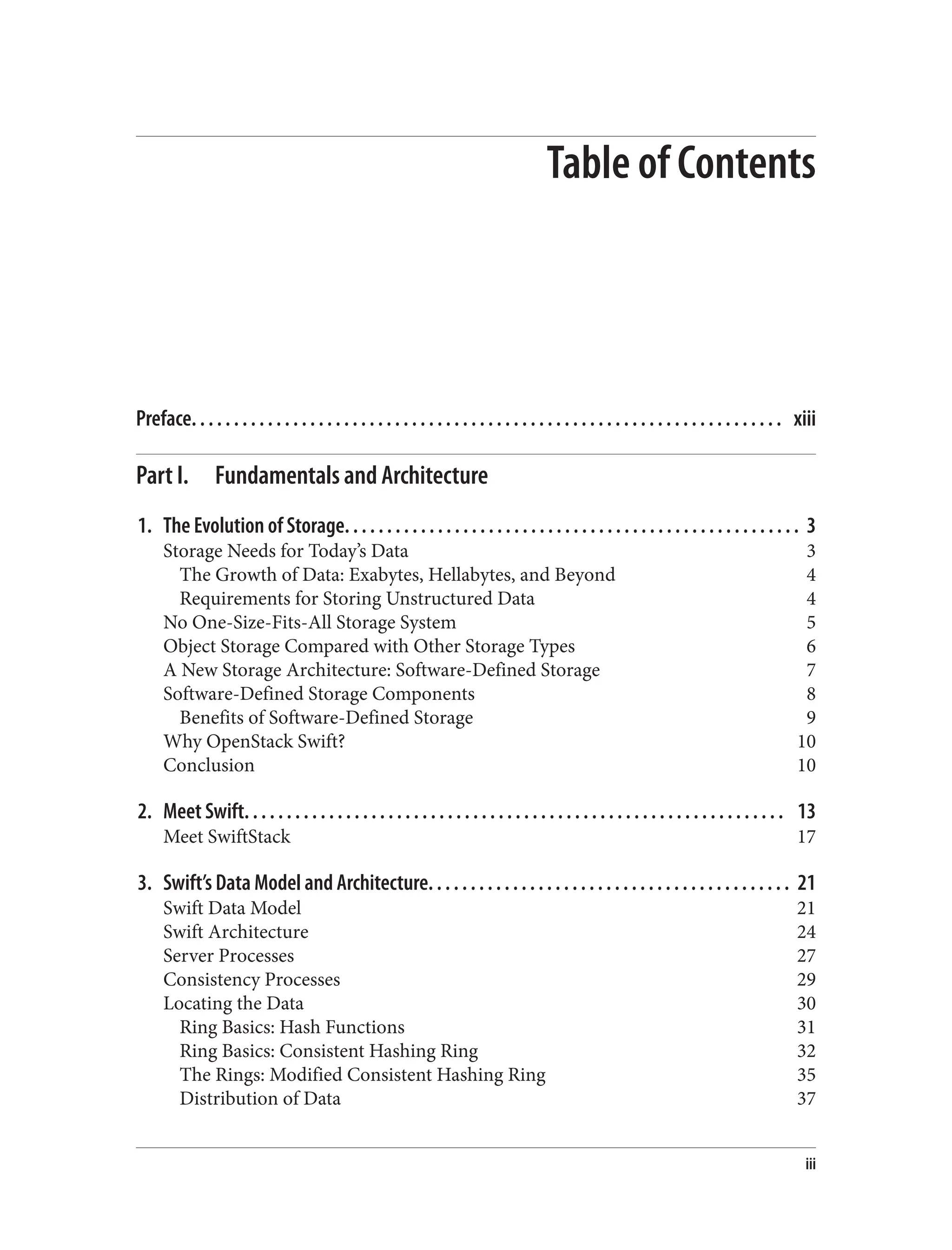
Table of Contents
Preface. . . . . . . . . . . . . . . . . . . . . . . . . . . . . . . . . . . . . . . . . . . . . . . . . . . . . . . . . . . . . . . . . . . . . . xiii
Part I. Fundamentals and Architecture
1. The Evolution of Storage. . . . . . . . . . . . . . . . . . . . . . . . . . . . . . . . . . . . . . . . . . . . . . . . . . . . . . 3
Storage Needs for Today’s Data 3
The Growth of Data: Exabytes, Hellabytes, and Beyond 4
Requirements for Storing Unstructured Data 4
No One-Size-Fits-All Storage System 5
Object Storage Compared with Other Storage Types 6
A New Storage Architecture: Software-Defined Storage 7
Software-Defined Storage Components 8
Benefits of Software-Defined Storage 9
Why OpenStack Swift? 10
Conclusion 10
2. Meet Swift. . . . . . . . . . . . . . . . . . . . . . . . . . . . . . . . . . . . . . . . . . . . . . . . . . . . . . . . . . . . . . . . 13
Meet SwiftStack 17
3. Swift’s Data Model and Architecture. . . . . . . . . . . . . . . . . . . . . . . . . . . . . . . . . . . . . . . . . . . 21
Swift Data Model 21
Swift Architecture 24
Server Processes 27
Consistency Processes 29
Locating the Data 30
Ring Basics: Hash Functions 31
Ring Basics: Consistent Hashing Ring 32
The Rings: Modified Consistent Hashing Ring 35
Distribution of Data 37
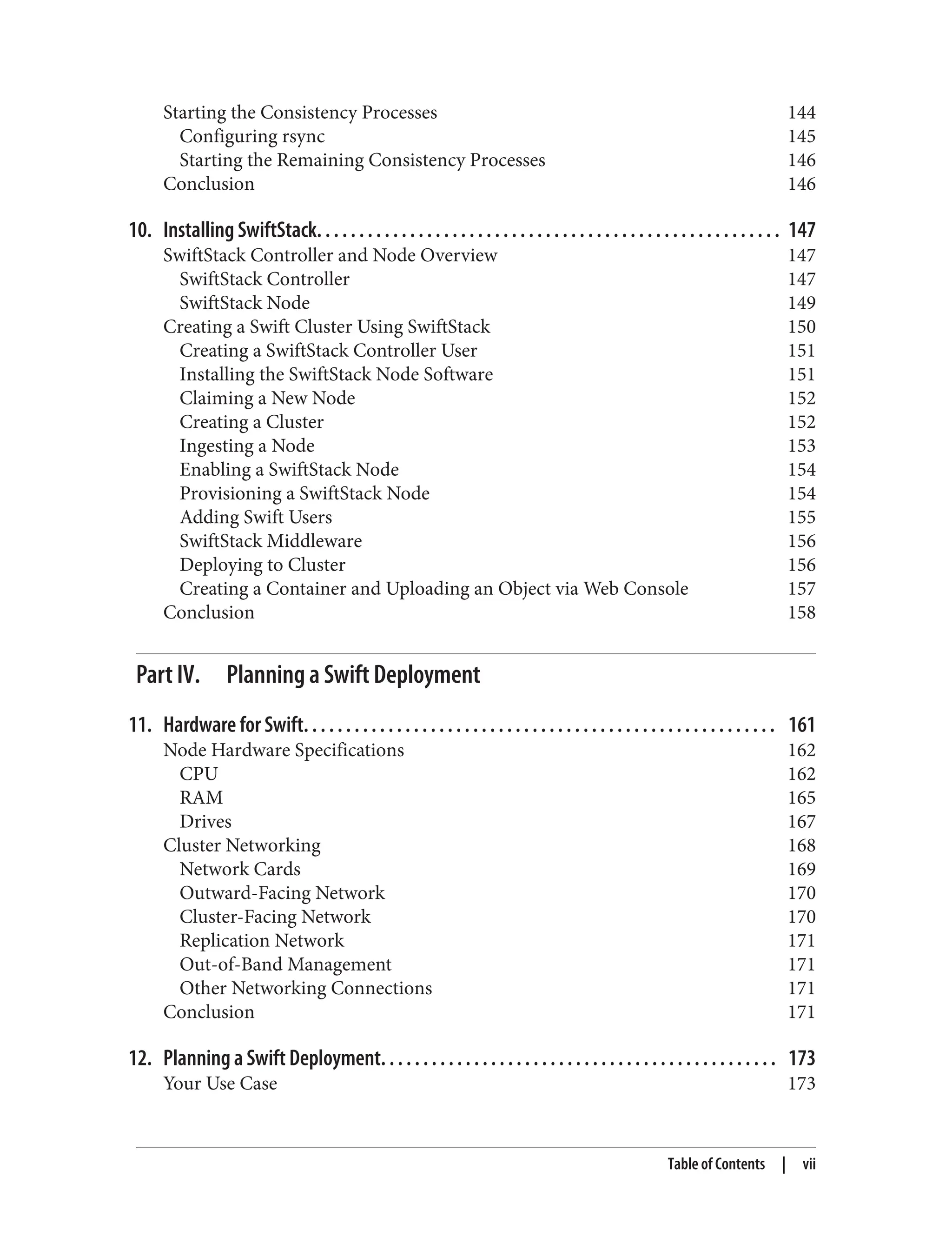
iii
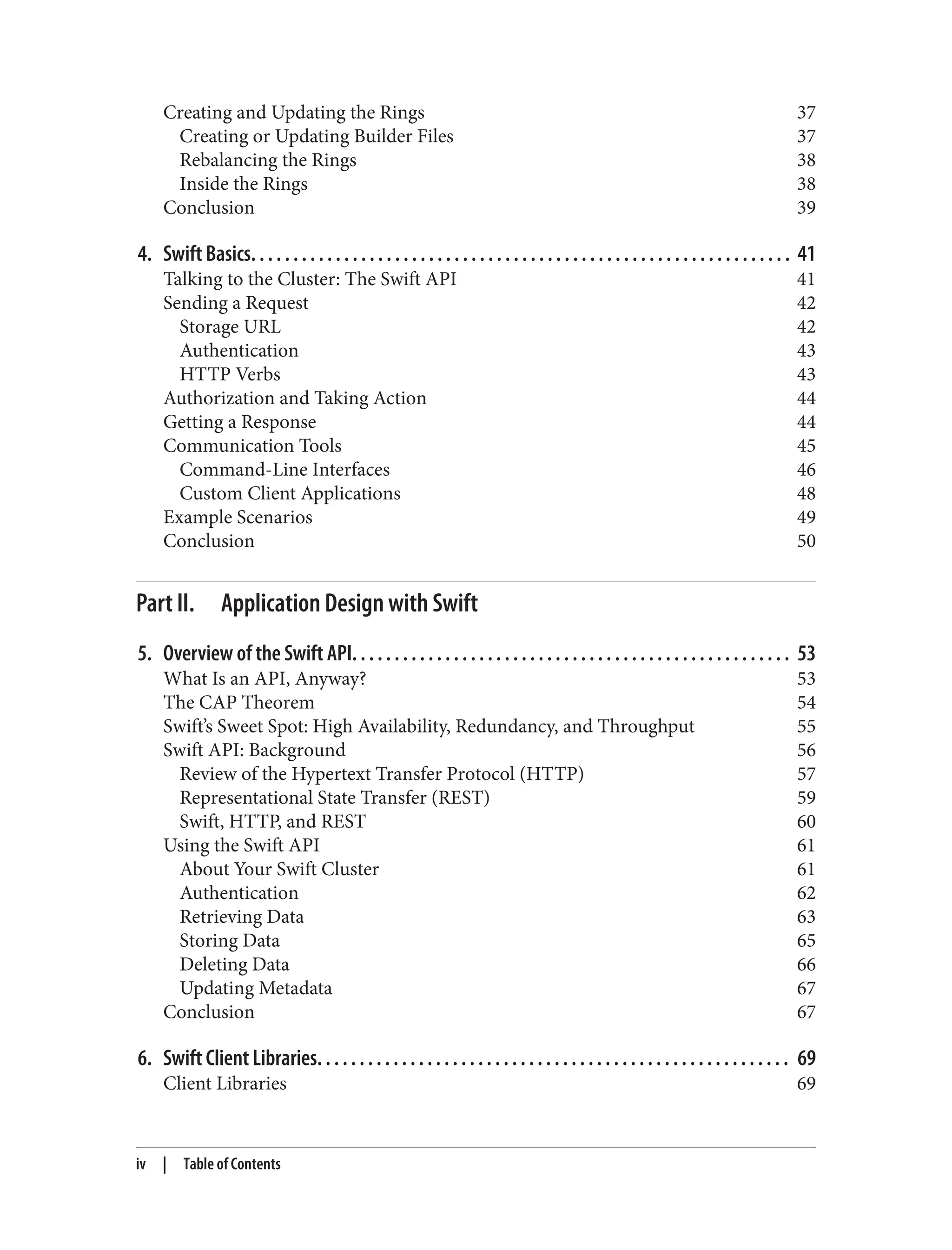
Creating and Updating the Rings 37
Creating or Updating Builder Files 37
Rebalancing the Rings 38
Inside the Rings 38
Conclusion 39
4. Swift Basics. . . . . . . . . . . . . . . . . . . . . . . . . . . . . . . . . . . . . . . . . . . . . . . . . . . . . . . . . . . . . . . . 41
Talking to the Cluster: The Swift API 41
Sending a Request 42
Storage URL 42
Authentication 43
HTTP Verbs 43
Authorization and Taking Action 44
Getting a Response 44
Communication Tools 45
Command-Line Interfaces 46
Custom Client Applications 48
Example Scenarios 49
Conclusion 50
Part II. Application Design with Swift
5. Overview of the Swift API. . . . . . . . . . . . . . . . . . . . . . . . . . . . . . . . . . . . . . . . . . . . . . . . . . . . 53
What Is an API, Anyway? 53
The CAP Theorem 54
Swift’s Sweet Spot: High Availability, Redundancy, and Throughput 55
Swift API: Background 56
Review of the Hypertext Transfer Protocol (HTTP) 57
Representational State Transfer (REST) 59
Swift, HTTP, and REST 60
Using the Swift API 61
About Your Swift Cluster 61
Authentication 62
Retrieving Data 63
Storing Data 65
Deleting Data 66
Updating Metadata 67
Conclusion 67
6. Swift Client Libraries. . . . . . . . . . . . . . . . . . . . . . . . . . . . . . . . . . . . . . . . . . . . . . . . . . . . . . . . 69
Client Libraries 69
iv | Table of Contents
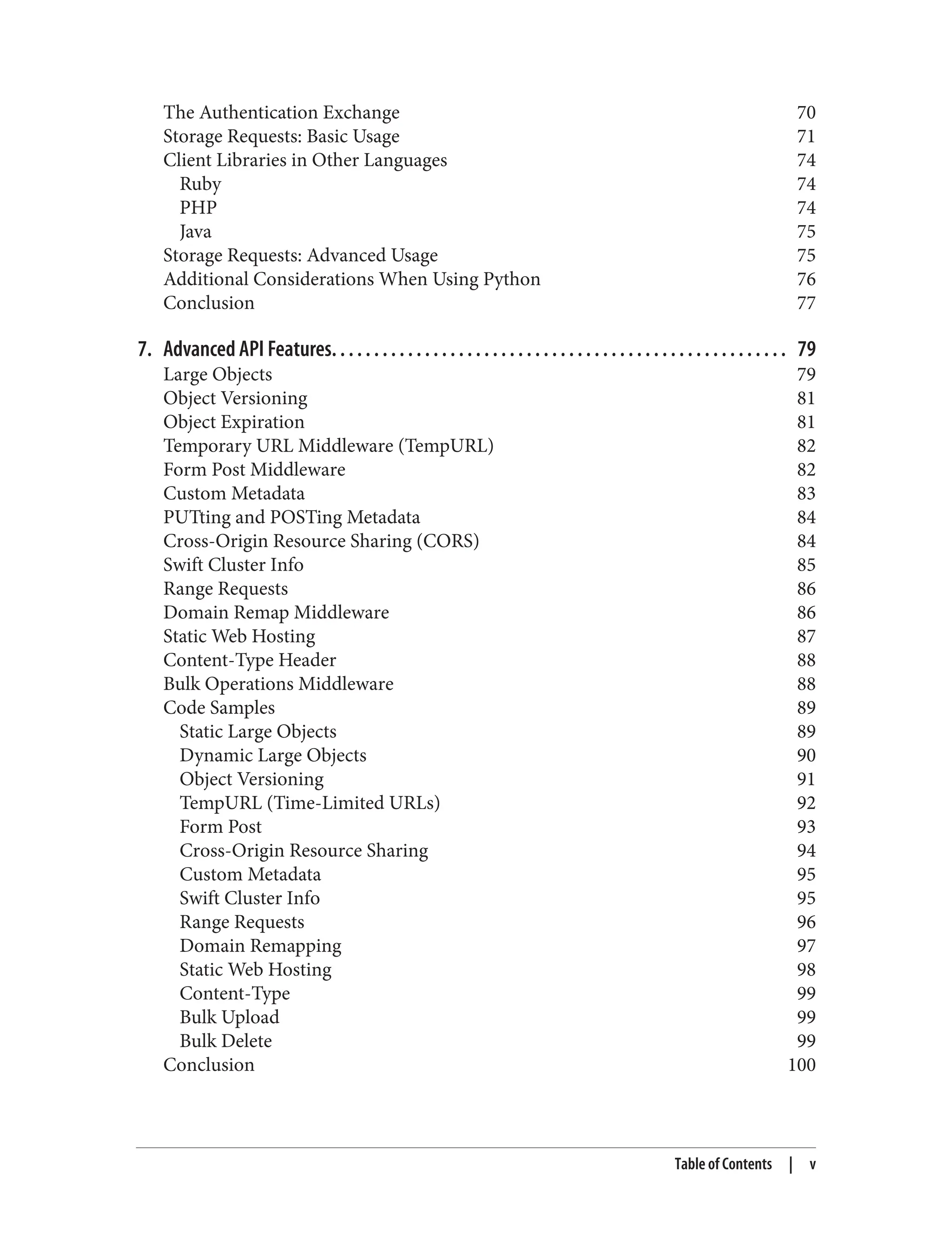
The Authentication Exchange 70
Storage Requests: Basic Usage 71
Client Libraries in Other Languages 74
Ruby 74
PHP 74
Java 75
Storage Requests: Advanced Usage 75
Additional Considerations When Using Python 76
Conclusion 77
7. Advanced API Features. . . . . . . . . . . . . . . . . . . . . . . . . . . . . . . . . . . . . . . . . . . . . . . . . . . . . . 79
Large Objects 79
Object Versioning 81
Object Expiration 81
Temporary URL Middleware (TempURL) 82
Form Post Middleware 82
Custom Metadata 83
PUTting and POSTing Metadata 84
Cross-Origin Resource Sharing (CORS) 84
Swift Cluster Info 85
Range Requests 86
Domain Remap Middleware 86
Static Web Hosting 87
Content-Type Header 88
Bulk Operations Middleware 88
Code Samples 89
Static Large Objects 89
Dynamic Large Objects 90
Object Versioning 91
TempURL (Time-Limited URLs) 92
Form Post 93
Cross-Origin Resource Sharing 94
Custom Metadata 95
Swift Cluster Info 95
Range Requests 96
Domain Remapping 97
Static Web Hosting 98
Content-Type 99
Bulk Upload 99
Bulk Delete 99
Conclusion 100
Table of Contents | v
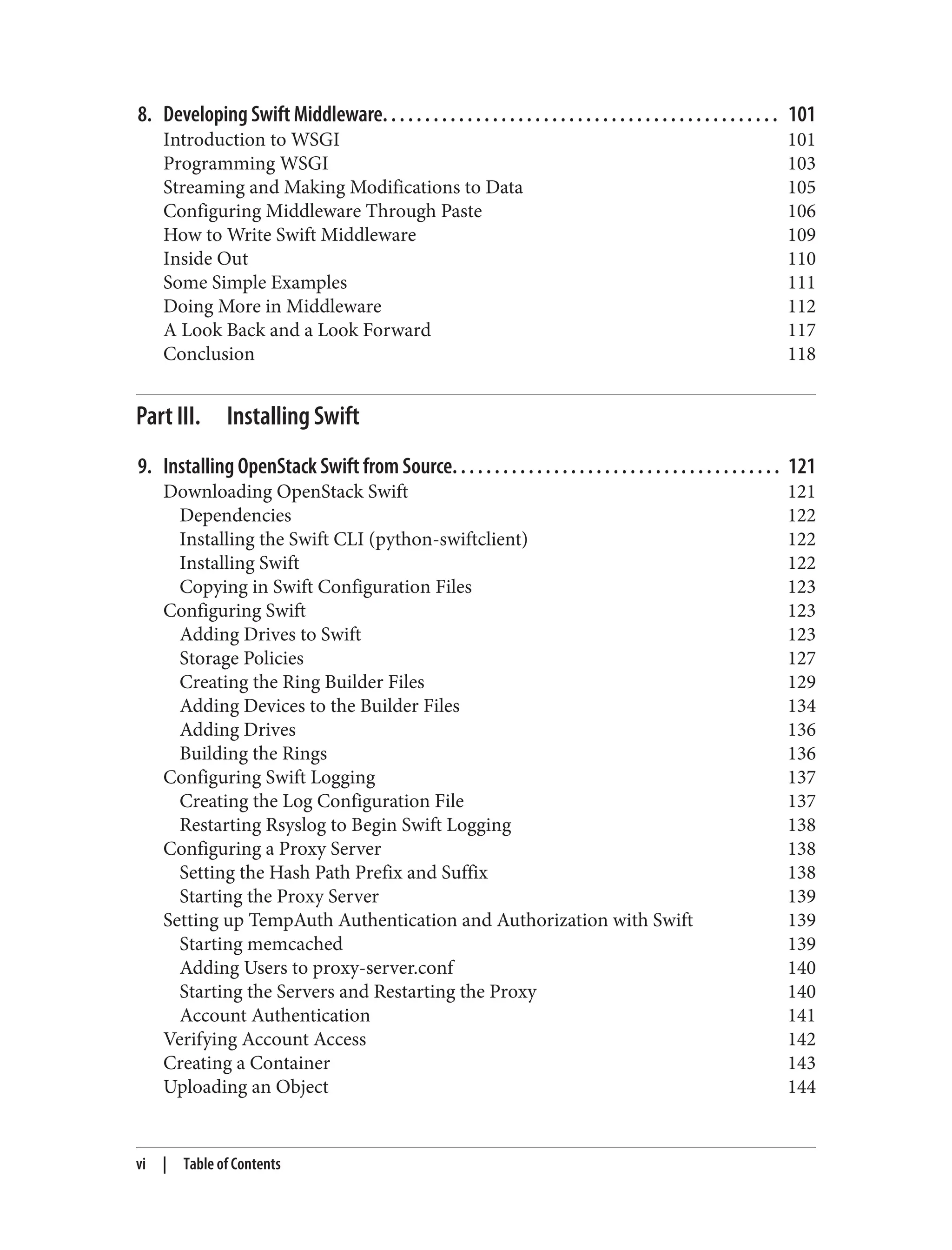
8. Developing Swift Middleware. . . . . . . . . . . . . . . . . . . . . . . . . . . . . . . . . . . . . . . . . . . . . . . 101
Introduction to WSGI 101
Programming WSGI 103
Streaming and Making Modifications to Data 105
Configuring Middleware Through Paste 106
How to Write Swift Middleware 109
Inside Out 110
Some Simple Examples 111
Doing More in Middleware 112
A Look Back and a Look Forward 117
Conclusion 118
Part III. Installing Swift
9. Installing OpenStack Swift from Source. . . . . . . . . . . . . . . . . . . . . . . . . . . . . . . . . . . . . . . 121
Downloading OpenStack Swift 121
Dependencies 122
Installing the Swift CLI (python-swiftclient) 122
Installing Swift 122
Copying in Swift Configuration Files 123
Configuring Swift 123
Adding Drives to Swift 123
Storage Policies 127
Creating the Ring Builder Files 129
Adding Devices to the Builder Files 134
Adding Drives 136
Building the Rings 136
Configuring Swift Logging 137
Creating the Log Configuration File 137
Restarting Rsyslog to Begin Swift Logging 138
Configuring a Proxy Server 138
Setting the Hash Path Prefix and Suffix 138
Starting the Proxy Server 139
Setting up TempAuth Authentication and Authorization with Swift 139
Starting memcached 139
Adding Users to proxy-server.conf 140
Starting the Servers and Restarting the Proxy 140
Account Authentication 141
Verifying Account Access 142
Creating a Container 143
Uploading an Object 144
vi | Table of Contents
Starting the Consistency Processes 144
Configuring rsync 145
Starting the Remaining Consistency Processes 146
Conclusion 146
10. Installing SwiftStack. . . . . . . . . . . . . . . . . . . . . . . . . . . . . . . . . . . . . . . . . . . . . . . . . . . . . . . 147
SwiftStack Controller and Node Overview 147
SwiftStack Controller 147
SwiftStack Node 149
Creating a Swift Cluster Using SwiftStack 150
Creating a SwiftStack Controller User 151
Installing the SwiftStack Node Software 151
Claiming a New Node 152
Creating a Cluster 152
Ingesting a Node 153
Enabling a SwiftStack Node 154
Provisioning a SwiftStack Node 154
Adding Swift Users 155
SwiftStack Middleware 156
Deploying to Cluster 156
Creating a Container and Uploading an Object via Web Console 157
Conclusion 158
Part IV. Planning a Swift Deployment
11. Hardware for Swift. . . . . . . . . . . . . . . . . . . . . . . . . . . . . . . . . . . . . . . . . . . . . . . . . . . . . . . . 161
Node Hardware Specifications 162
CPU 162
RAM 165
Drives 167
Cluster Networking 168
Network Cards 169
Outward-Facing Network 170
Cluster-Facing Network 170
Replication Network 171
Out-of-Band Management 171
Other Networking Connections 171
Conclusion 171
12. Planning a Swift Deployment. . . . . . . . . . . . . . . . . . . . . . . . . . . . . . . . . . . . . . . . . . . . . . . 173
Your Use Case 173
Table of Contents | vii
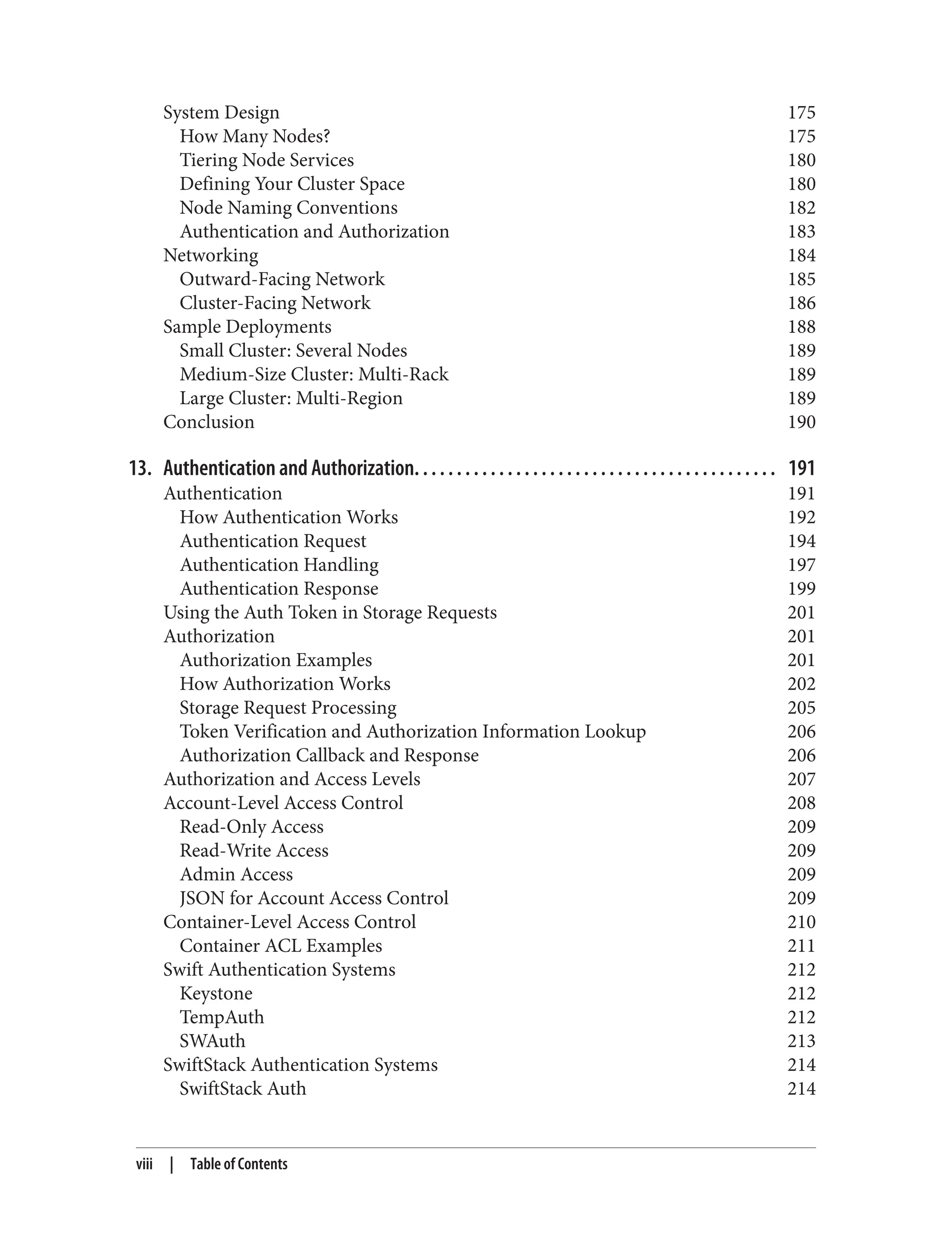
System Design 175
How Many Nodes? 175
Tiering Node Services 180
Defining Your Cluster Space 180
Node Naming Conventions 182
Authentication and Authorization 183
Networking 184
Outward-Facing Network 185
Cluster-Facing Network 186
Sample Deployments 188
Small Cluster: Several Nodes 189
Medium-Size Cluster: Multi-Rack 189
Large Cluster: Multi-Region 189
Conclusion 190
13. Authentication and Authorization. . . . . . . . . . . . . . . . . . . . . . . . . . . . . . . . . . . . . . . . . . . 191
Authentication 191
How Authentication Works 192
Authentication Request 194
Authentication Handling 197
Authentication Response 199
Using the Auth Token in Storage Requests 201
Authorization 201
Authorization Examples 201
How Authorization Works 202
Storage Request Processing 205
Token Verification and Authorization Information Lookup 206
Authorization Callback and Response 206
Authorization and Access Levels 207
Account-Level Access Control 208
Read-Only Access 209
Read-Write Access 209
Admin Access 209
JSON for Account Access Control 209
Container-Level Access Control 210
Container ACL Examples 211
Swift Authentication Systems 212
Keystone 212
TempAuth 212
SWAuth 213
SwiftStack Authentication Systems 214
SwiftStack Auth 214
viii | Table of Contents
SwiftStack LDAP 214
SwiftStack Active Directory 215
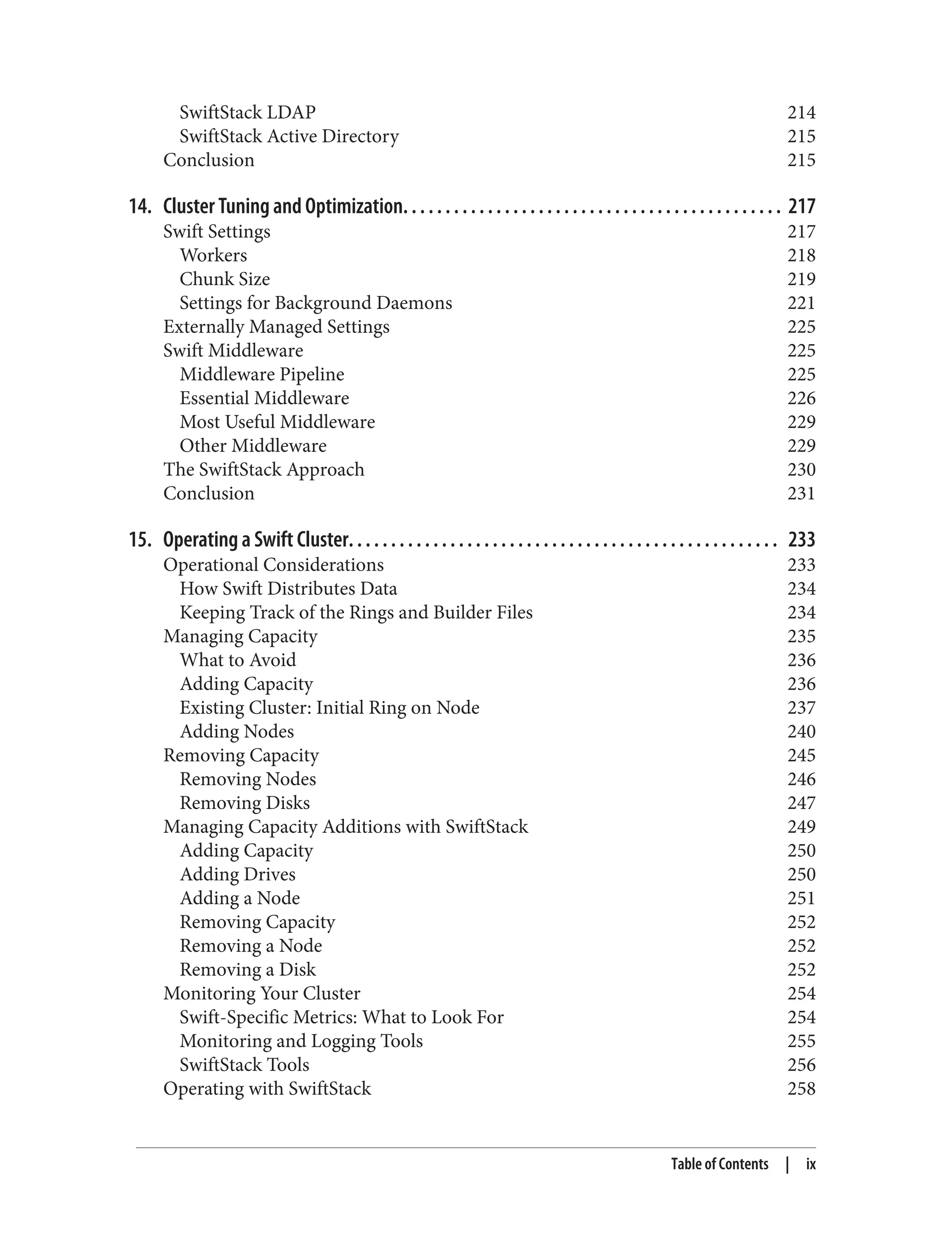
Conclusion 215
14. Cluster Tuning and Optimization. . . . . . . . . . . . . . . . . . . . . . . . . . . . . . . . . . . . . . . . . . . . . 217
Swift Settings 217
Workers 218
Chunk Size 219
Settings for Background Daemons 221
Externally Managed Settings 225
Swift Middleware 225
Middleware Pipeline 225
Essential Middleware 226
Most Useful Middleware 229
Other Middleware 229
The SwiftStack Approach 230
Conclusion 231
15. Operating a Swift Cluster. . . . . . . . . . . . . . . . . . . . . . . . . . . . . . . . . . . . . . . . . . . . . . . . . . . 233
Operational Considerations 233
How Swift Distributes Data 234
Keeping Track of the Rings and Builder Files 234
Managing Capacity 235
What to Avoid 236
Adding Capacity 236
Existing Cluster: Initial Ring on Node 237
Adding Nodes 240
Removing Capacity 245
Removing Nodes 246
Removing Disks 247
Managing Capacity Additions with SwiftStack 249
Adding Capacity 250
Adding Drives 250
Adding a Node 251
Removing Capacity 252
Removing a Node 252
Removing a Disk 252
Monitoring Your Cluster 254
Swift-Specific Metrics: What to Look For 254
Monitoring and Logging Tools 255
SwiftStack Tools 256
Operating with SwiftStack 258
Table of Contents | ix
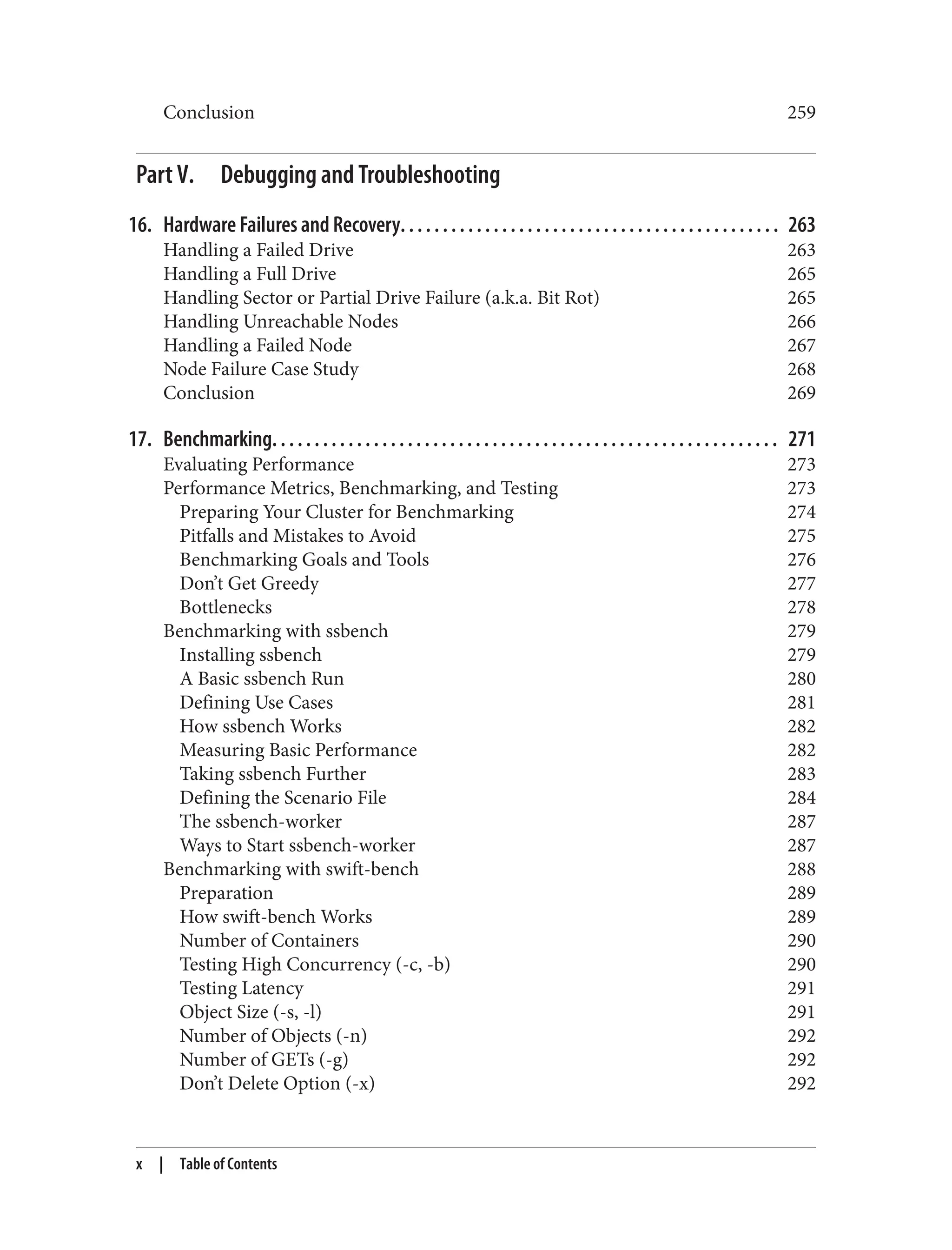
Conclusion 259
Part V. Debugging and Troubleshooting
16. Hardware Failures and Recovery. . . . . . . . . . . . . . . . . . . . . . . . . . . . . . . . . . . . . . . . . . . . . 263
Handling a Failed Drive 263
Handling a Full Drive 265
Handling Sector or Partial Drive Failure (a.k.a. Bit Rot) 265
Handling Unreachable Nodes 266
Handling a Failed Node 267
Node Failure Case Study 268
Conclusion 269
17. Benchmarking. . . . . . . . . . . . . . . . . . . . . . . . . . . . . . . . . . . . . . . . . . . . . . . . . . . . . . . . . . . . 271
Evaluating Performance 273
Performance Metrics, Benchmarking, and Testing 273
Preparing Your Cluster for Benchmarking 274
Pitfalls and Mistakes to Avoid 275
Benchmarking Goals and Tools 276
Don’t Get Greedy 277
Bottlenecks 278
Benchmarking with ssbench 279
Installing ssbench 279
A Basic ssbench Run 280
Defining Use Cases 281
How ssbench Works 282
Measuring Basic Performance 282
Taking ssbench Further 283
Defining the Scenario File 284
The ssbench-worker 287
Ways to Start ssbench-worker 287
Benchmarking with swift-bench 288
Preparation 289
How swift-bench Works 289
Number of Containers 290
Testing High Concurrency (-c, -b) 290
Testing Latency 291
Object Size (-s, -l) 291
Number of Objects (-n) 292
Number of GETs (-g) 292
Don’t Delete Option (-x) 292
x | Table of Contents
Creating a Configuration File 292
Sample swift-bench Run 293
Running a Distributed swift-bench 293
Sample swift-bench Configuration 293
Statistics Tools 295
Conclusion 296
A Swift Afterword. . . . . . . . . . . . . . . . . . . . . . . . . . . . . . . . . . . . . . . . . . . . . . . . . . . . . . . . . . . . 297
Index. . . . . . . . . . . . . . . . . . . . . . . . . . . . . . . . . . . . . . . . . . . . . . . . . . . . . . . . . . . . . . . . . . . . . . . 301
Table of Contents | xi
Preface
Modern object storage began when applications started to store and serve up assets for
web and mobile users. More and more applications needed to deliver content directly
to users regardless of whether they were using a laptop, tablet, or smartphone. Object
storage is powerful because it can speak the language of the web: HTTP. Additionally,
because of its adeptness at storing non-transactional data, it is perfect for archives,
backups, file sharing, scientific and research data, and digital media.
This book covers both the Swift object storage project (referred to simply as Swift) and
SwiftStack, an object storage software company and platform. SwiftStack offers user-
friendly ways of accessing, deploying, and managing Swift clusters. Our goal is to show
you how to use Swift on your own, present SwiftStack’s main features, and help you
decide whether SwiftStack makes sense for you. We believe SwiftStack is a terrific prod‐
uct suitable for many uses, but rest assured that the Swift ecosystem is rich and growing,
so there are plenty of options for service providers if SwiftStack turns out not to be a
good fit. In the end we want to sell you on Swift object storage, not necessarily on
SwiftStack.
Now, six years out from having first used object storage for my applications, I want to
share my experiences dealing with the dramatic growth of data. I was fortunate to have
a front-row seat as part of the team building one of the first widely used Platform-as-a
Service (PaaS) environments running on top of Amazon Web Services. This helped the
industry see how powerful an HTTP-based object storage system could be. Personally,
I have seen how object storage delivers more flexibility, less lock-in, better control, and
lowercoststhanwhattraditionalstoragesystemscouldprovide.Ihavealsoheardsimilar
things from other organizations. With data (but not IT budgets) growing exponentially,
there is absolute certainty that data storage challenges will persist and grow, affecting
pretty much everyone who stores and serves data at scale.
The catalyst for this book was the pain I experienced firsthand deploying and managing
object storage systems at scale. As a deployer, I often found myself wanting additional
practical information. I also wanted to understand more fully the fundamentals of how
xiii
these systems work, and why and how they should be used. Now it’s my hope that this
book can deliver both practical and theoretical insights about an important and rapidly
evolving topic: object storage with Swift.
Before proceeding further, I’d like to share John Dickinson’s memories of working on
the original Swift development team. John explains why and how Swift was developed
and captures the collaborative and innovative spirit of OpenStack and the development
of Swift.
The Origins of Swift: From the Small to the Open
Recalled fondly by John Dickinson, OpenStack Swift Project Technical Lead, Director of
Technology at SwiftStack.
In 2008, Rackspace developed its Rackspace Cloud Files cloud storage service as a re‐
sponse to customer demands and as an answer to Amazon’s Simple Storage Service (S3).
The underlying technology developed for the first iteration of Rackspace Cloud Files
was great up to a point, but frankly required a lot of time, effort, and money to scale.
With unstructured data growing so rapidly, we knew we needed something better. So
in August 2009, Rackspace set a team to work developing a complete, ground up re‐
placement for their initial cloud storage platform. I was fortunate to be on the original
project team, code-named “Swift.”
A team of about nine of us set to work. None of us had specific roles. Mostly, we sat
around in a small, often hot room, on the fourth floor in downtown San Antonio, iden‐
tifying the hard problems we needed to solve. We were trying to figure out how we
woulddeploySwift,whatthenetworkwouldlooklike,whattheinfrastructuretosupport
it was going to look like—all that good stuff. We were very collaborative, but we would
also compete to arrive at the best solution. We’d think about a problem and then go
home. Two people would come back the next day with implementations for it and we’d
choose the one we thought was better. There was a really great team dynamic and it was
an awesome experience. Ideas were always flying around that room and some of them
were crazy. But some of them worked out really well.
We worked on this for about a year and in July 2010, as part of the OpenStack project
that Rackspace cofounded with NASA, we released the source code for Swift under the
Apache 2 license. We contributed the Cloud Files Swift Code, which became OpenStack
Object Storage. In October 2010, a subsequent release of Swift, named “Austin,” which
includedthecomputeorchestrationframeworkcontributedbyNASA,wasmadepublic.
The first commercial deployments of Swift outside Rackspace were at Korea Telecom
and Internap, which used Swift to provide public cloud storage services. (That’s how I
came to know Joe Arnold, and ultimately join SwiftStack.) Swift is now used by web
companies, businesses of all sizes, life sciences companies, research organizations, and
service providers worldwide.
xiv | Preface
In the end, I think we created the kernel of a great cloud storage platform and I am proud
to have been part of that. But it is also very gratifying to be part of something larger.
When Rackspace Hosting made a short video about how Swift was made, we chose to
end with a shot of text receding into star-filled outer space. Our invocation of Star
Wars was partly tongue in cheek and partly serious. We really did and still do feel that
we’re part of a growing rebel force fighting the emergence of proprietary cloud stacks
and creating a standard way to deploy applications and connect clouds. We’re still part
of the minority, but our forces and capacities are growing, in large part because more
and more companies and developers are working with OpenStack Swift.
Why This Book?
At SwiftStack, a company that I cofounded in 2011, our big idea was to provide Swift
object storage with a management system so our customers could achieve (1) flexibility
in how (and where) they deployed their storage, (2) control of their data without being
locked in to a vendor, and (3) extremely economical private cloud storage.
These features are the essence of software-defined storage (SDS), a new term that is still
evolving. We think the term perfectly illustrates the fundamental change that Swift rep‐
resents. Key aspects of SDS are scalability, adaptability, and the ability to use most any
hardware. Operators can now make choices concerning how their storage is scaled and
managed, and how users can store and access data—all driven programmatically for the
entire storage tier, regardless of where the storage resources are deployed. SwiftStack
was very early in this trend and was one of the first to offer an SDS storage controller
to manage commodity storage hardware.
SwiftStack is dedicated to delivering and improving Swift solutions because we believe
that data storage should scale globally, without technical constraints, limits, or lock-in.
When data-centric organizations and data-centric applications can grow unconstrain‐
ed,theywillbeabletodiscoverandtakeadvantageofnewopportunitiesandinnovations
in their industries.
This book was started as a way to voice those beliefs. We are highlighting SDS, which
is a fundamental change that is happening in the storage sector. Of course, we will shine
the spotlight brightly on understanding the Swift object storage project and we will
introduce SwiftStack. We bring not just our ideas—but the experience of the entire
SwiftStack team. SwiftStack is fortunate to include some of the founders of Swift and
top contributing Swift developers. Together, we have learned much from real-world
deployments, large and small, which we will share with you throughout this book.
Preface | xv
Who Should Read This Book?
OpenStack Swift is written for deployers, operators, and developers interested in using
Swift. Although it’s not necessary to read this book cover to cover, we make an attempt
to provide the topics in a logical order.
This book attempts to explain Swift in clear and simple terms so that anyone can un‐
derstand the basic concepts and principles, though a few skills will be useful to get the
most out of this book. We assume some familiarity with Linux administration, net‐
working, and storage. Additionally, basic programming skills will come in handy for
thechapterscoveringtheSwiftAPI.WeofferprogrammingoverviewsonPython,Ruby,
PHP, and Java.
This book aims to help newcomers learn from our experiences. Our goal is to get you
up and running more quickly and easily, making your successful conversion to Swift,
well, swifter!
What’s in This Book?
This book has three major components. Part I (Chapters 1 through 4) covers the fun‐
damentals of Swift in a way we hope is accessible to all our readers. Think of it as a Swift
boot camp. We aim to familiarize you with the architecture, history, use cases, and basic
operation of Swift.
Part II (Chapters 5 through 8) is geared to developers who want to get the most out of
their Swift cluster. A big shift has happened with the transition from filesystems to
objects, and these chapters will provide a foundation on how to use an HTTP-
addressable object storage system. How to use Swift—and how not to use Swift—will
be covered in gruesome detail.
The next major component of the book is for storage operators, architects, and systems
administrators. We break this section into three parts—installation, planning a deploy‐
ment, and ongoing operations. Part III (Chapters 9 and 10) covers Swift installation
options. Part IV (Chapters 11 through 14) offers guidance on deployment considera‐
tions: hardware, networking, and Swift features of interest to operators. Finally, Part V
(Chapters 15 through 17) covers what to do when (not if) something goes wrong.
Depending on your interests, here are a few possible itineraries through the book:
• If you’re responsible for designing and architecting a Swift cluster, read Part I, then
check out Part IV.
• If you’re a developer, after reading Part I, continue with Part II to learn about Swift
and its API.
xvi | Preface
• If you’re a systems administrator or in operations, read Part I, then head straight to
Part III, then Part IV.
Conventions Used in This Book
The following typographical conventions are used in this book:
Italic
Indicates new terms, special emphasis, URLs, email addresses, filenames, and ex‐
tensions.
Constant width
Used for program listings, as well as within paragraphs to refer to program elements
such as variable or function names, databases, data types, environment variables,
statements, and keywords.
Constant width bold
Highlights key parts of examples.
Angle brackets (<>)
Shows text that should be replaced with user-supplied values or values determined
by context.
The following terms are used in this book:
Drive, disk, device
A drive refers to a storage medium, generally a hard disk drive (HDD) or solid-state
drive (SSD). The term disk can also be used. A device is a drive as it is seen by the
system.
OpenStack Object Storage, OpenStack Swift, Swift Object Storage, Swift
OpenStack Object Storage is commonly called OpenStack Swift or Swift Object
Storage, or simply referred to as Swift within the OpenStack community. All these
terms are used in the book and all references to Swift should be understood as
referring to the OpenStack Swift project.
Multi-region cluster
Sometimes referred to as global cluster or geo-cluster. We prefer the term multi-
region cluster (MRC) as it best fits with the actual tiering name (regions) and indi‐
cates that regions need not be separated by vast geographic distances.
Swift node
A machine running Swift processes is referred to as a node.
Preface | xvii
Using Code Examples
This book aims to help you work effectively with Swift. In general, you may use the code
in this book in your programs and documentation. You do not need to contact us for
permission unless you’re reproducing a significant portion of the code. For example,
writing a program that uses several chunks of code from this book does not require
permission. Selling or distributing a CD-ROM of examples does require permission.
Answering a question by citing this book and quoting example code does not require
permission. Incorporating a significant amount of example code from this book into
your product’s documentation does require permission.
We appreciate, but do not require, attribution. An attribution usually includes the title,
author, and publication year. For example: “OpenStack Swift, by Joe Arnold and mem‐
bers of the SwiftStack team (O’Reilly). Copyright 2015 SwiftStack, Inc.,
978-1-491-90082-6.”
If you feel your use of code examples falls outside fair use or the permission given here,
feel free to contact us via email (contact@swiftstack.com).
Examples will be maintained at http://swiftstack.com/book/.
Safari® Books Online
Safari Books Online is an on-demand digital library that
delivers expert content in both book and video form from
the world’s leading authors in technology and business.
Technology professionals, software developers, web designers, and business and crea‐
tive professionals use Safari Books Online as their primary resource for research, prob‐
lem solving, learning, and certification training.
Safari Books Online offers a range of plans and pricing for enterprise, government,
education, and individuals.
Members have access to thousands of books, training videos, and prepublication manu‐
scripts in one fully searchable database from publishers like O’Reilly Media, Prentice
Hall Professional, Addison-Wesley Professional, Microsoft Press, Sams, Que, Peachpit
Press, Focal Press, Cisco Press, John Wiley & Sons, Syngress, Morgan Kaufmann, IBM
Redbooks, Packt, Adobe Press, FT Press, Apress, Manning, New Riders, McGraw-Hill,
Jones & Bartlett, Course Technology, and hundreds more. For more information about
Safari Books Online, please visit us online.
xviii | Preface
How to Contact Us
SwiftStack provides an SDS system for object storage. Our solution combines a unique,
decoupled storage controller with Swift, which gives our customers cost-effective, scale-
out storage running on standard server hardware.
The company was founded in 2011 to help operations teams implement and manage
an easy-to-use, multitenant, and highly scalable cloud storage platform. Our product is
compatible with Red Hat Enterprise Linux, CentOS, and Ubuntu, and can run on a wide
range of hardware.
SwiftStack is headquartered in San Francisco, CA, with support operations covering
Asian and European time zones. To contact us, you can email contact@swiftstack.com.
If you have specific questions for me, you can email me at joe@swiftstack.com.
As you use this book and work with Swift and SwiftStack, we invite your comments and
feedback. From the very start, Swift has benefited from the contributions of hundreds
of developers and users. And we hope that doesn’t stop.
This book was a collaborative effort. We’re proud of what we’ve put together. But we
also know there will be future editions and we invite your comments, feedback, and
suggestions. Please let us know what we need to correct or add; share your insights; and
help us create a resource that will serve you and the broader community better. You can
do so by visiting http://swiftstack.com/book/.
Please address comments and questions concerning this book to the publisher:
O’Reilly Media, Inc.
1005 Gravenstein Highway North
Sebastopol, CA 95472
800-998-9938 (in the United States or Canada)
707-829-0515 (international or local)
707-829-0104 (fax)
We have a web page for this book, where we list errata, examples, and any additional
information. You can access this page at http://bit.ly/openstack_swift.
To comment or ask technical questions about this book, send email to bookques
tions@oreilly.com.
For more information about our books, courses, conferences, and news, see our website
at http://www.oreilly.com.
Find us on Facebook: http://facebook.com/oreilly
Follow us on Twitter: http://twitter.com/oreillymedia
Watch us on YouTube: http://www.youtube.com/oreillymedia
Preface | xix
Acknowledgments
Over a hundred developers have contributed to Swift. I’d like to thank each one of them
fortheirongoingcontributions.TherearealsohundredsofoperatorsofSwiftwhocount
on a stable, reliable storage system. Without them, Swift would just be an interesting
idea. So, I would like to thank all of the Swift operators for trusting us with your data.
This book is the collaborative work of several authors. Amanda Plimpton served as a
linchpin for this project. In addition to the chapters she wrote, she was able to dream
up, assemble, and pull out of us the many pieces of content needed to form a cohesive
whole. Jon Solera authored five crucial chapters on how to architect and develop Swift
applications, how to use and develop Swift middleware, and options for authentication
and authorization. Martin Lanner contributed several chapters on building, managing,
and benchmarking Swift clusters.
This project couldn’t have come together without the support of a large cast. Many at
SwiftStack have contributed to writing this book. Thanks to Hugo Kuo for his expert
knowledge of configuring Swift, and to Alexander Corwin, Darrell Bishop, John Dick‐
inson, Clay Gerrard, Sam Merritt, Zack M. Davis, and everyone else on the team who
provided feedback. Thanks to Anders Tjernlund for thinking we should write this book
in the first place.
Thanks to our technical reviewers, Paul Luse, Peter Portante, and Rodney Peck, who
took time from their busy schedules to help us make a better book. Thanks to Christina
Marcet for technical editing. Finally, many thanks to Mark Feldman for providing his
craft of writing to this project and for advocating for the reader.
—Joe Arnold
xx | Preface
PART I
Fundamentals and Architecture
This part covers the fundamentals of Swift—think of it as a Swift boot camp. It aims to
give you useful information about the architecture and purpose of Swift that will guide
you to administering and programming it correctly. This section also discusses some
history, use cases, major Swift components, and the basic operation of Swift.
CHAPTER 1
The Evolution of Storage
Joe Arnold
In 2011, OpenStack Object Storage, code-named Swift, was launched as an inaugural
project within the OpenStack cloud computing project. OpenStack Swift was a thought‐
ful and creative response to the unprecedented and precipitous growth in data. It in‐
troduced the world to an open-source storage system proven to run at extremely large
scale.
The timing couldn’t have been more perfect. Just as the growth in online data was taking
off, software-defined storage (SDS) with systems such as Swift was being developed.
Object storage and SDS are logical next steps in the evolution of storage.
But before getting into Swift (in Chapter 2), we should examine the boom in unstruc‐
tured data, its particular storage requirements, and how storage has evolved to include
object storage and SDS. We will also explain how object storage compares to the more
familiar block and file storage.
Storage Needs for Today’s Data
In this era of connected devices, demands on storage systems are increasing exponen‐
tially.Usersareproducingandconsumingmoredatathanever,withsocialmedia,online
video, user-uploaded content, gaming, and Software-as-a-Service applications all con‐
tributing to the vast need for easily accessible storage systems that can grow without
bounds. A wide spectrum of companies and institutions are facing greater and greater
storage demands. In the geological and life sciences, machine-generated data is much
more valuable when it is accessible. Video productions are taping more hours at higher
resolution than ever before. Enterprises are capturing more data about their projects
and employees expect instant access and collaboration.
What is all this data? The majority is “unstructured” data. This means that the data does
not have a predefined data model and is typically stored as a file as opposed to an entry
3
1. Press release for IDC’s Outlook for Data Byte Density Across the Globe Has Big Implications for the Future,
October 2013.
in a database (which would be structured data). Much of this unstructured data is the
ever-proliferating images, videos, emails, documents, and files of all types. This data is
generated by consumers on billions of devices with more coming online each year. Data
is also being generated by the many Internet-connected devices such as sensors and
cameras across all types of industry.
The Growth of Data: Exabytes, Hellabytes, and Beyond
To understand the scale of this growth in data, consider that according to research
conducted by the International Data Corporation (IDC) in 2013, worldwide installed
raw storage capacity (byte density) will climb from 2,596 exabytes (EB) in 2012 to a
staggering 7,235 EB in 2017.1
Stored data is continuing to grow at ever faster rates,
leading IDC to estimate that by 2020 the amount of data in the world will reach 35,840
exabytes. Divided by the world’s population, that is roughly 4 terabytes per person.
By now you might be wondering just how big an exabyte is. It’s an almost unimaginably
large quantity, but let’s try. It’s equivalent to about one thousand petabytes (PB), one
million terabytes (TB), or one billion gigabytes (GB). These figures will be meaningful
to some, but if they’re not, we’ll contextualize this a bit more. An average book takes up
about 1 megabyte. The largest library in the world, the Library of Congress, has about
23 million volumes, which total approximately 23 TB of data. So it would take over
43,000 libraries the size of the Library of Congress to generate an exabyte. Another
example would be high-resolution photos, which are roughly 2 MB in size; an exabyte
would be almost 537 billion high-resolution photos.
Storage capacity continues to grow, necessitating new labels for ever larger quantities
of data. Beyond an exabyte (1018
bytes), we have the zettabyte (1021
bytes) and yottabyte
(1024
bytes), which follow the prefixes offered by the International System of Units (SI).
In response both to the rapid growth of data and the proliferation of terms, some have
suggested that we simply use “hellabyte,” for “hell of a lot of bytes.”
Requirements for Storing Unstructured Data
Unstructured data often needs to be stored in a way that ensures durability, availability,
and manageability—all at low cost.
Durability
Durability is the extent to which a storage system can guarantee that data will never
be permanently lost or corrupted, in spite of individual component failures (such
as the loss of a drive or a computer). Data is arguably the most critical (and often
irreplaceable) thing we create. Many types of data must be stored forever. In a data
4 | Chapter 1: The Evolution of Storage
center, most unstructured data needs to be kept for a very long time to meet cus‐
tomer expectations, legal and regulatory requirements, or both.
Availability
Availability refers to a storage system’s uptime and responsiveness in the face of
individual component failures or heavy system load. Unstructured data usually
needs to be available in an instant across a variety of devices regardless of location;
users want to access their data on their mobile devices, laptops at home, and desk‐
tops at work. Although some data can be archived, many users expect most of their
data to be immediately available.
Manageability
Manageability—the level of effort and resources required to keep the system func‐
tioning smoothly in the long term—can easily be an issue with small storage sys‐
tems, or even with a personal computer. The concept can include personnel, time,
risk, flexibility, and many other considerations that are difficult to quantify. With
larger storage systems coming online, manageability becomes critical. Storage
should be easy to manage. A small number of administrators should be able to
support a large number of storage servers.
Low cost
Unstructured data needs to be stored at low cost. With enough money, any storage
problem can be solved. However, we live in a world of constraints. Business models
and available budgets require low-cost data storage solutions. There are many fac‐
tors that need to be accounted for in a systems’ overall costs. This includes initial
up-front expenses, such as the cost of acquiring hardware. But there are also on‐
going costs that might need to be factored in. These costs might include additional
software licenses, personnel costs to manage the system, and data center costs such
as power and bandwidth.
No One-Size-Fits-All Storage System
Although it would be great if there was a one-size-fits-all solution for the large amounts
of mostly unstructured data the world is generating, there isn’t. Storage systems entail
trade-offs that we can think of as responses to their particular requirements and cir‐
cumstances.
The CAP theorem, first advanced by Eric Brewster (University of California at Berkeley
professor, Computer Science Division) in 2000, succinctly frames the problem. It states
that distributed computer systems cannot simultaneously provide:
Consistency
All clients see the same version of the data at the same time.
No One-Size-Fits-All Storage System | 5
2. This principle is similar to the adage that says you can only pick two: fast, cheap, or good.
Availability
When you read or write to the system, you are guaranteed to get a response.
Partition tolerance
The system works when the network isn’t perfect.
Because these are incompatible, you have to choose the two that are most important for
your particular circumstances when implementing a distributed computer system.2
Because partition tolerance isn’t really optional in a distributed system, this means par‐
tition tolerance will be paired with either consistency or availability. If the system de‐
mandsconsistency(forexample,abankthatrecordsaccountbalances),thenavailability
needs to suffer. This is typically what is needed for transactional workloads such as
supportingdatabases.Ontheotherhand,ifyouwantpartitiontoleranceandavailability,
then you must tolerate the system being occasionally inconsistent. Although purpose-
built storage systems offer an operator more reliability for a particular workload than
ageneral-purposestoragesystemdesignedtosupportallworkloads,ifasystempurports
to do all three equally well you should take a closer look. There are always trade-offs
and sacrifices.
Following the CAP theorem, Swift trades consistency for eventual consistency to gain
availability and partition tolerance. This means Swift is up to the task of handling the
workloads required to store large amounts of unstructured data. The term “eventual
consistency” refers to a popular way of handling distributed storage. It doesn’t meet the
ideal of providing every update to every reader before the writer is notified that a write
was successful, but it guarantees that all readers will see the update in a reasonably short
amount of time.
This allows Swift to be very durable and highly available. These trade-offs and the CAP
theorem are explored in greater depth in Chapter 5.
Object Storage Compared with Other Storage Types
Different types of data have different access patterns and therefore can be best stored
on different types of storage systems. There are three broad categories of data storage:
block storage, file storage, and object storage.
Block storage
This stores structured data, which is represented as equal-size blocks (say, 212
bits
per block) without putting any interpretation on the bits. Often, this kind of storage
is useful when the application needs to tightly control the structure of the data. A
common use for block storage is databases, which can use a raw block device to
efficiently read and write structured data. Additionally, filesystems are used to ab‐
6 | Chapter 1: The Evolution of Storage
stract a block device, which then does everything from running operating systems
to storing files.
File storage
This is what we’re most used to seeing as desktop users. In its simplest form, file
storage takes a hard drive (like the one on your computer) and exposes a filesystem
on it for storing unstructured data. You see the filesystem when you open and close
documents on your computer. A data center contains systems that expose a file‐
system over a network. Although file storage provides a useful abstraction on top
of a storage device, there are challenges as the system scales. File storage needs
strong consistency, which creates constraints as the system grows and is put under
high demand. In addition, filesystems often require other features (such as file
locking) that create a barrier for working well with large amounts of data.
Object storage
ThiswillbefamiliartothosewhoregularlyaccesstheInternetorusemobiledevices.
Object storage doesn’t provide access to raw blocks of data; nor does it offer file-
based access. Instead, it provides access to whole objects or blobs of data—generally
through an API specific to that system. Objects are accessible via URLs using HTTP
protocols, similar to how websites are accessible in web browsers. Object storage
abstracts these locations as URLs so that the storage system can grow and scale
independently from the underlying storage mechanisms. This makes object storage
ideal for systems that need to grow and scale for capacity, concurrency, or both.
One of the main advantages of object storage is its ability to distribute requests for
objects across a large number of storage servers. This provides reliable, scaleable storage
for large amounts of data at a relatively low cost.
As the system scales, it can continue to present a single namespace. This means an
application or user doesn’t need to—and some would say shouldn’t—know which stor‐
age system is going to be used. This reduces operator burden, unlike a filesystem where
operators might have to manage multiple storage volumes. Because an object storage
system provides a single namespace, there is no need to break data up and send it to
different storage locations, which can increase complexity and confusion.
A New Storage Architecture: Software-Defined Storage
The history of data storage began with hard drives connected to a mainframe. Then
storage migrated off the mainframe to separate, dedicated storage systems with in-line
controllers.However,theworldkeepschanging.Applicationsarenowmuchlarger.This
means their storage needs have pushed beyond what the architecture of an in-line stor‐
age controller can accommodate.
Older generations of storage often ran on custom hardware and used closed software.
Typically, there were expensive maintenance contracts, difficult data migration, and a
A New Storage Architecture: Software-Defined Storage | 7
tightlycontrolledecosystem.Thesesystemsneededtightcontrolstopredictandprevent
failures.
The scale of unstructured data storage is forcing a sea change in storage architecture,
and this is where SDS enters our story. It represents a huge shift in how data is stored.
With SDS, the entire storage stack is recast to best meet the criteria of durability, avail‐
ability, low cost, and manageability.
SDS places responsibility for the system in the software, not in specific hardware com‐
ponents. Rather than trying to prevent failures, SDS accepts failures in the system as
inevitable. This is a big change. It means that rather than predicting failures, the system
simply works through or around those failures.
Unstructured data is starting to rapidly outpace structured data in both total storage
and revenue. SDS solutions offer the best way to store unstructured data. By providing
a way to deal with failures, it becomes possible to run your system on standard and
open-server hardware—the kind that might fail occasionally. If you’re willing to accept
this, you can easily add components to scale the system in increments that make sense
for your specific needs. When whole systems can be run across mix-and-match hard‐
ware from multiple vendors—perhaps purchased years apart from each other—then
migration becomes less of an issue.
This means that you can create storage that spans not just one rack, one networking
switch,orevenjustonedatacenter,butservesasasinglesystemoverlarge-scale,private,
corporate networks or even the Internet. That is a powerful defense against the deluge
of data that many businesses are experiencing.
Software-Defined Storage Components
An SDS system separates the intelligence and access from the underlying physical hard‐
ware. There are four components of an SDS system:
Storage routing
The storage routing layer acts as a gateway to the storage system. Pools of routers
and services to access the routers can be distributed across multiple data centers
and geographical locations. The router layer scales out with each additional node,
allowing for more capacity for data access.
The routers in an SDS system can route storage requests around hardware and
networking faults. When there is a hardware failure, the system applies simple rules
to service the request by assembling the necessary data chunks or retrieving copies
of the data from non-failed locations.
The processes in an SDS system account for access control, enable supported pro‐
tocols, and respond to API requests.
8 | Chapter 1: The Evolution of Storage
Storage resilience
In an SDS system, the ability to recover from failures is the responsibility of the
software, not the hardware. Various data protection schemes are used to ensure that
data is not corrupted or lost.
There can be separate processes running on the system to continuously audit the
existing data and measure how well the data is protected across multiple storage
nodes. If data is found to be corrupt or not protected enough, proactive measures
can be taken by the system.
Physical hardware
Within an SDS system, the physical hardware stores the bits on disk. However,
nodes storing data are not individually responsible for ensuring durability of their
own data, as that is the responsibility of the storage resilience systems. Likewise,
when a node is down, the storage routing systems will route around it.
Out-of-band controller
SDS systems should be efficient to manage and scale. These distributed storage
systems need an alternative form of management rather than a traditional storage
controller, which intercepts each storage request. Therefore, an out-of-band, ex‐
ternal storage controller is used by operators to orchestrate members of a distribut‐
ed SDS system.
A controller can dynamically tune the system to optimize performance, perform
upgrades, and manage capacity. A controller can also allow faster recoveries when
hardware fails and allow an operator to respond to operational events. In this way,
anSDScontrollercanorchestrateavailableresources–storage,networking,routing,
and services–for the entire cluster.
Benefits of Software-Defined Storage
SDS systems can effectively manage scale and drive operational efficiencies in the in‐
frastructure. Capacity management is a lot simpler with an SDS system, because each
component is a member of a distributed system. Because of this arrangement, upgrades,
expansions, and decommissions can be achieved without any downtime and with no
need for forklift (physical) data migration.
The separation of physical hardware from the software allows for mix-and-match hard‐
ware configurations within the same storage system. Drives of varying capacity or per‐
formance can be used in the same system, enabling incremental capacity increases. This
allows for just-in-time purchasing, which lets you take advantage of the technology
innovation curve and avoid deploying too much storage.
SDS solutions are also often open source, which means better standards, more tools,
and the ability to avoid lock-in to a single vendor. Open source encourages a large
thriving ecosystem, where the diversity of the community members drives standards
Software-Defined Storage Components | 9
and tools. Now that we’re building applications that need to be compatible with more
and more devices, creating and refining standards becomes more and more important.
Why OpenStack Swift?
Swift allows for a wide spectrum of uses, including supporting web/mobile applications,
backups, and active archiving. Layers of additional services let users access the storage
system via its native HTTP interface, or use command-line tools, filesystem gateways,
oreasy-to-useapplicationstostoreandsyncdatawiththeirdesktops,tablets,andmobile
devices.
Swiftisanobjectstoragesystem,which,aswehavediscussed,meansittradesimmediate
consistency for eventual consistency. This allows Swift to achieve high availability, re‐
dundancy, throughput, and capacity. With a focus on availability over consistency, Swift
has no transaction or locking delays. Large numbers of simultaneous reads are fast, as
are simultaneous writes. This means that Swift is capable of scaling to an extremely large
number of concurrent connections and extremely large sets of data. Since its launch,
Swift has gained a community of hundreds of contributors, gotten even more stable,
become faster, and added many great new features.
Swift can also be installed on what is often referred to as commodity hardware. This
means that standard, low-cost server components can be used to build the storage sys‐
tem. By relying on Swift to provide the logical software management of data rather than
a specialized vendor hardware, you gain incredible flexibility in the features, deploy‐
ment, and scaling of your storage system. This, in essence, is what software-defined
storage is all about.
But what might be most interesting is what happens “under the hood.” Swift is a fun‐
damentally new sort of storage system. It isn’t a single, monolithic system, but rather a
distributedsystemthateasilyscalesoutandtoleratesfailurewithoutcompromisingdata
availability. Swift doesn’t attempt to be like other storage systems and mimic their in‐
terfaces, and as a result it is changing how storage works.
Thiscomeswithsomeconstraints,tobesure,butitisaperfectmatchformanyoftoday’s
applications. Swift is more and more widespread and is evolving into a standard way to
store and distribute large amounts of data.
Conclusion
In recent years, two major changes to storage have come about in very short order. First,
the emergence of web and mobile applications have fundamentally changed data con‐
sumption and production. This first started with the consumer web and has grown
quickly with increasing numbers of enterprise applications.
10 | Chapter 1: The Evolution of Storage
The second major change has been the emergence of SDS, which enables large, dis‐
tributed storage systems to be built with standards-based, commodity storage servers.
This has dramatically reduced the costs of deploying data-intensive applications, as
there is no reliance on individual hardware components to be durable.
InthenextchapterweintroduceOpenStackSwift.Wewillmorefullydiscussthefeatures
and benefits of Swift. After that you’ll get to dive into the particulars of the architecture
of Swift.
Conclusion | 11
CHAPTER 2
Meet Swift
Joe Arnold
In this chapter you will meet Swift, learning about some of its key features and benefits.
This conceptual overview will prepare you for later chapters that go into much greater
detail, including Chapter 9, where we cover installing a Swift cluster from source. You
will also meet SwiftStack the company, which provides software and support to install
and operate Swift. You won’t see much of SwiftStack again until Chapter 10 when we
cover installing SwiftStack software.
Swift is a multi-tenant, highly scalable, and durable object storage system designed to
store large amounts of unstructured data at low cost. Swift is used by businesses of all
sizes, service providers, and research organizations worldwide. It is typically used to
store unstructured data such as documents, web content, backups, images, and virtual
machine snapshots. Originally developed as the engine behind RackSpace Cloud Files
in 2010, it was open-sourced as part of the OpenStack project. With hundreds of com‐
panies and thousands of developers now participating in the OpenStack project, the
usage of Swift is increasing rapidly.
Swift is not a traditional filesystem or a raw block device. Instead, it lets you store,
retrieve,anddeleteobjectsalongwiththeirassociatedmetadataincontainers(“buckets”
in Amazon S3 terminology) via a RESTful HTTP API. Developers can either write
directly to the Swift API or use one of the many client libraries that exist for popular
programming languages, such as Java, Python, Ruby, and C#.
Swift’s key characteristics include:
Scalablity
Swift is designed to scale linearly based on how much data needs to be stored and
how many users need to be served. This means that it can scale from a few nodes
with a handful of drives to thousands of machines with dozens, even hundreds, of
petabytes of storage. As the system grows in usage and the number of requests
increase, performance doesn’t degrade, in part because Swift is designed to be scal‐
13
able with no single point of failure. To scale up, the system grows where needed—
byaddingstoragenodestoincreasestoragecapacity,addingproxynodesasrequests
increase, and growing network capacity where bottlenecks are detected.
Durability
Swift’s innovative distributed architecture means that it provides extremely durable
storage. The essence of durability is that stored objects will always be available and
have data integrity. To ensure an object is persistently available, Swift copies it and
distributes the copies across the cluster. Auditing processes run, verifying that data
is still good. Replicators run to ensure that the correct number of copies are in the
cluster. In the event that a device fails, missing data copies are replicated and placed
throughout the cluster to ensure that durability levels are maintained.
Multi-regional capability
Swift can distribute data across multiple data centers, which may have high latency
between them. Distribution can be done for a number of reasons. One would be to
provide high availability of data by allowing it to be accessed from each region.
Another reason would be to designate one region as a disaster recovery site.
Swift does this by allowing operators to define regions and zones within a cluster.
Regions generally specify geographic boundaries, such as data centers in different
cities. Zones are portions of regions that define points of failure for groups of ma‐
chines, such as a rack where all the nodes are on one power source going to the
same switch. The use of regions and zones ensures that Swift places copies across
the cluster in a way that allows for failures. It enables a cluster to survive even if a
zone is unavailable. This provides additional guarantees of durability and availa‐
bility of data.
High concurrency
Swift is architected to distribute requests across multiple servers. By using a shared-
nothing approach, Swift can take advantage of all the available server capacity to
handle many requests simultaneously. This increases the system’s concurrency and
total throughput available. This is a great advantage to those who need to satisfy
the storage needs of large-scale web workloads.
Flexible storage
Swift offers great flexibility in data architecture and hardware, allowing operators
to tailor their storage to meet the specific needs of their users. In addition to the
ability to mix and match commodity hardware, Swift has storage polices that allow
operators to use hardware in a way that best handles the constraints of various
situations. For example, need higher performance for some data? Create a storage
policy that only uses the SSDs in the cluster. Need data to be available across the
globe? Create a storage policy that encompasses data centers across the world. Need
data to be in a particular country? Create a policy that will place data only in that
region.
14 | Chapter 2: Meet Swift
Swift’s underlying storage methods are also very flexible. Its pluggable architecture
allows the incorporation of new storage systems. Typically, direct-attached storage
devices are used to build a cluster, but emerging technology (such as key/value
Ethernet drives from Seagate) and other open source and commercial storage sys‐
tems that have adaptors can become storage targets in a Swift cluster.
Open source
Swift is open-sourced under the Apache 2 license as part of the OpenStack project.
With more than 150 participating developers as of early 2014, the Swift community
is growing every quarter. As with other open source projects, source code can be
reviewed by many more developers than is the case with proprietary software. This
means potential bugs tend to be more visible and are more rapidly corrected than
with proprietary software. In the long term, “open” generally wins.
Large ecosystem
The Swift ecosystem is powered by open source code, but unlike some open source
projects, it is a large ecosystem with multiple companies that test and develop Swift
at scale. Having so many vendors participating greatly reduces the risk of vendor
lock-in for users. The large number of organizations and developers participating
in the OpenStack project means that the development velocity and breadth of tools,
utilities, and services for Swift is great and will only increase over time. Many tools,
libraries, clients, and applications already support Swift’s API and many more are
in the works. With such a vibrant and engaged ecosystem, it is easy to obtain tools,
best practices, and deployment know-how from other organizations and commu‐
nity members who are using Swift.
Runs on commodity hardware
Swift is designed from the ground up to handle failures, so reliability of individual
components is less critical. Swift installations can run robustly on commodity
hardware, and even on regular desktop drives rather than more expensive enter‐
prise drives. Companies can choose hardware quality and configuration to suit the
tolerances of the application and their ability to replace failed equipment.
Swift’s ability to use commodity hardware means there is no lock-in with any par‐
ticular hardware vendor. As a result, deployments can continually take advantage
of decreasing hardware prices and increasing drive capacity. It also allows data to
be moved from one media to another to address constraints such as IO rate or
latency.
Developer-friendliness
Developers benefit from the rich and growing body of Swift tools and libraries.
Beyond the core functionality to store and serve data durably at large scale, Swift
has many built-in features that make it easy for application developers and users.
Features that developers might find useful include:
Meet SwiftJoe Arnold | 15
Static website hosting
Users can host static websites, which support client-side JavaScript and CSS
scripting, directly from Swift. Swift also supports custom error pages and auto-
generated listings.
Automatically expiring objects
Objects can be given an expiration time after which they are no longer available
and will be deleted. This is very useful for preventing stale data from circulating
and to comply with data retention policies.
Time-limited URLs
URLs can be generated that are valid for only a limited period of time. These
URLs can prevent hotlinking or enable temporary write permissions without
needing to hand out full credentials to an untrusted party.
Quotas
Storage limits can be set on containers and accounts.
Upload directly from HTML forms
Users can generate web forms that upload data directly into Swift so that it
doesn’t have to be proxied through another server.
Versioned writes
Users can write a new version of an object to Swift while keeping all older
versions.
Support for chunked transfer encoding
Users can upload data to Swift without knowing ahead of time how large the
object is.
Multirange reads
Users can read one or more sections of an object with a single read request.
Access control lists
Users can configure access to their data to give or deny others the ability to read
or write the data.
Programmatic access to data locality
Deployers can integrate Swift with systems such as Hadoop and take advantage
of locality information to lower network requirements when processing data.
Customizability
Middleware can be developed and run directly on the storage system. For fur‐
ther details on these features, see Part II.
16 | Chapter 2: Meet Swift
Operator-friendly
Swift is appealing to IT operators for a number of reasons. It lets you use low-cost,
industry-standard servers and disks. With Swift, you can manage more data and
use cases with ease. Because an API is used to store and serve data, you do not spend
time managing volumes for individual projects. Enabling new applications is easy
and quick. Finally, Swift’s durable architecture with no single point of failure lets
you avoid catastrophic failure and rest a bit easier. The chapters in this book on
deploying and operating Swift clusters will provide you with an overview of how
easy it really is.
Upcoming features
The Swift developer community is working on many additional features that will
be added to upcoming releases of Swift, such as storage policies and support for
erasure coding. Storage policies will allow deployers and users to choose what
hardware data is on, how the data is stored across that hardware, and in which
region the data resides. The erasure coding support in Swift will enable deployers
to store data with erasure coding instead of (or in addition to) Swift’s standard
replica model. The design goal is to be able to have erasure-coded storage plus
replicas coexisting in a single Swift cluster. This will allow a choice in how to store
data and will allow applications to make the right trade-offs based on their use.
Meet SwiftStack
SwiftStack is a company that provides highly available and scalable object storage soft‐
ware based on OpenStack Swift and is one of your alternatives to installing, integrating,
and operating Swift directly from source.
Several of the core contributors who are part of the approval process for code contri‐
butions to the Swift repositories work at SwiftStack. This, in combination with the
company’s real-world experience in deploying Swift, allows SwiftStack to contribute
heavily upstream and often lead many of the major initiatives for Swift in collaboration
with the rest of the Swift developer community.
The SwiftStack software package includes an unmodified, 100% open source version of
OpenStack Swift and adds software components for deployment, integration (with au‐
thentication and billing systems), monitoring, and management of Swift clusters. Swift‐
Stack also provides training, consulting, and 24×7 support for SwiftStack software, in‐
cluding Swift. The SwiftStack product is composed of two parts:
SwiftStack Node
This runs OpenStack Swift. SwiftStack Node software automates the installation of
the latest, stable version of Swift via a package-based installer. At this writing, there
are installers for CentOS/Red Hat Server 6.3, 6.4, or 6.5 (64-bit), or Ubuntu 12.04
LTS Precise Server (64-bit). Additionally, the SwiftStack Node software provides
Meet SwiftStack | 17
preconfigured runtime elements, additional integrations, and access methods de‐
scribed below.
SwiftStack Controller
The SwiftStack Controller is an out-of-band management system that manages one
or more Swift clusters and automates the deployment, integration, and ongoing
operations of SwiftStack Nodes. As such, the SwiftStack Controller decouples the
control and management of the storage nodes from the physical hardware. The
actual storage services run on the servers where Swift is installed, while the de‐
ployment, management, and monitoring are conducted out-of-band by the Swift‐
Stack Controller.
The SwiftStack product offers several benefits to operators:
Automated storage provisioning
Devices are automatically identified by agents running on the SwiftStack Node, and
an operator places those nodes in a region or zone. The SwiftStack Controller keeps
track of all the devices and provides a consistent interface for operators to add and
remove capacity.
Automated failure management
Agents running on the SwiftStack Node detect drive failures and can alert an op‐
erator. Although Swift will automatically route around a failure, this feature lets
operators deal with failures in a consistent way. Extensive dashboards on cluster
statistics also let operators see how the cluster is operating.
Lifecycle management
A SwiftStack Controller can be upgraded separately from Swift. A Controller can
perform a rolling, no-downtime upgrade of Swift as new versions are released. It
can be configured with a warm standby if desired. A Controller can also fold in old
and new hardware in the same cluster. Agents identify the available capacity and
will gradually rebalance data automatically.
User and capacity management
Several authentication modules are supported by SwiftStack, including on-cluster
accounts. You can create storage groups (which can be provisioned with an API),
and integrate with the Lightweight Directory Acccess Protocol (LDAP) and Open‐
Stack Keystone. Additionally, these show capacity and trending. A per-account uti‐
lization API provides the ability to do chargeback.
Additional access methods
SwiftStack includes a web UI for users that can be custom-tailored with additional
CSS to suit your organization. SwiftStack also includes the ability to provide file‐
system access via the Common Internet File System (CIFS)/Network File System
(NFS).
18 | Chapter 2: Meet Swift
Exploring the Variety of Random
Documents with Different Content
desiderandolo, lo avrebbe cercato? — E pure questo era necessario
e doveroso: necessario per la sua pace e per il suo avvenire;
doveroso verso la giovinetta, che poteva illudersi su le sue intenzioni
e soffrire immeritatamente per la sua debolezza.
Ma se la nonna o l’abitudine o la sorte lo avessero ricondotto presso
di lei? Se si fosse trovato un’altra volta solo con lei in uno di quei
momenti di tristezza e d’abbandono, in cui non si risponde dei proprii
atti e delle proprie parole? Se la catena fosse ribadita un giorno,
inaspettatamente, con una frase, con un gesto, in sèguito a un
movimento repentino e concorde delle due anime già pronte a
fondersi? Ciò non era fuori della possibilità: il cammino degli uomini
non è quasi mai segnato dai grandi fatti, preparati di lunga mano e
pazientemente voluti; ma dai piccoli episodii imprevisti, dalle
circostanze sempre mutevoli, dalle risoluzioni subitanee e
inconsiderate, che impongon poi serie responsabilità e provocano,
come dirette conseguenze, gli avvenimenti più gravi e decisivi della
vita!
In tal caso, egli da un momento all’altro si sarebbe trovato di fronte a
un fatto compiuto, all’irreparabile, all’oscuro problema dell’amor
casto, della passione corrisposta e insodisfatta, al bivio spinoso della
conquista estrema o dell’estrema rinuncia!
Lentamente, trascinato dall’ardore dell’imaginazione, egli si diede a
esaminare questa possibilità, come già si fosse avverata; a
sviscerare con sottile analisi il problema, per ricercarne tra le varie
soluzioni quella che sola avrebbe salvato insieme il suo Ideale e la
tranquillità della sua coscienza. Pensava: «Io potrei sempre fuggirla,
anche più tardi, anche quando fosse sopravvenuto un accordo
esplicito tra noi: la partenza dalla villa mi separerebbe
necessariamente da lei, e il tempo e la lontananza sanerebbero poi
ogni ferita. Ma, secondando in questo modo gli eventi, non
commetterei un’azione obliqua e sleale? Non mi farei complice d’un
inganno consapevolmente, volontariamente, colpevolmente?»
Aurelio si rammentò di quell’Altro, del primo adoratore di Flavia, il
quale aveva agito precisamente così ed egli aveva con tanta
severità giudicato; ed ebbe un moto di rivolta morale contro sè
stesso, contro il suo pensiero che s’era per un istante compiaciuto
nella certezza d’una comoda liberazione. «Ah, no, no! Io questo non
farò mai! Non mi sottrarrò mai per paura o per calcolo alle
responsabilità assunte! Io sono diverso, sostanzialmente diverso da
codesta gente borghese, che pecca per debolezza e si rinfranca per
viltà. Altro sangue scorre nelle mie vene; e altra legge presiede alla
mia condotta. Se un giorno per disgrazia dovessi trovarmi legato a
Flavia da una promessa, da una semplice confessione d’amore,
saprei senza dubbio sopportarne con dignità qualunque
conseguenza... Ma qual conseguenza? «Flavia era zitella, in quella
età nella quale tutte le speranze e tutte le forze della donna tendono
a toglierla dalla casa paterna per creare una casa propria, per
ottenere da un nuovo stato l’indipendenza di sè stessa e la direzione
d’una famiglia. Ogni intesa sentimentale con lei presupponeva
dunque una conclusione unica e necessaria; egli, confidandole il suo
amore, si sarebbe moralmente obbligato a darle il suo nome, a
chiamarla compagna della sua vita, a consacrarle intero il suo
avvenire; egli, salvo casi imprevedibili, avrebbe dovuto sposarla!
«Sposarla?!» egli esclamò stupefatto dal suono stesso della parola,
levandosi d’un tratto a sedere. Ed ebbe una specie di sussulto intimo
istintivo, simile a quello che si prova talvolta quando, camminando
distratti per le vie, ci sembra d’udire improvvisamente il rullo
minaccioso d’un carro dietro le spalle e ci si avvede poi, rivolgendoci
spauriti, che il carro passa senza nostro pericolo dall’opposto lato
della strada. Aurelio sorrise sùbito del suo stupore ingiustificato e del
suo atto repentino: la sola enunciazione della cosa gli parve così
enorme e quasi così assurda che assunse, nel suo spirito calmo e
sereno, aspetto ridicolo.
«Che cosa buffa, la vita!» egli si disse, sogghignando e scotendo il
capo: «Sposarla?! In verità, basterebbe quest’unica prospettiva a
tenermi recluso nella mia camera per un anno intero!»
Il suo pensiero, abituato alle gravi meditazioni, parve sdegnare
l’argomento che non era a bastanza serio e positivo; si distrasse per
qualche istante nella contemplazione delle cose remote, del lento
declinare dei colli dalla parte d’Arona, dove il lago sembrava
allargarsi infinitamente come un mare morto. Il vento cessava: le
barche calavano le vele a una a una, malinconicamente, e
prendevan da lontano l’apparenza d’insetti bizzarri che
camminassero a passi faticosi sul piano delle acque. Il piroscafo,
ingrandito dalla vicinanza, entrava fischiando nella baja di Laveno.
Di nuovo però, dopo la percezione della pace circostante, Aurelio,
(proprio come chi abbia temuto un pericolo anche imaginario), fu
tratto a mano a mano, senza volerlo, a costruire compiutamente
quella vaga possibilità e a considerarla con riflessione, quasi fosse
già sul punto d’effettuarsi. — Chi era dunque costei? Egli la
conosceva da poco tempo e poco la conosceva: era per lui
un’estranea, un’ignota piombata d’improvviso nella sua esistenza
per impadronirsi d’una parte del suo essere, per contendergli la
libertà del suo tempo, forse per troncare il filo del suo destino. Nelle
ore che aveva vissute con lei, ella gli era bene apparsa sotto le
forme esteriori più lusinghevoli, ma nulla gli aveva rivelato dell’anima
sua, de’ suoi gusti, de’ suoi istinti, de’ suoi desiderii, della sua intima
essenza. Era ella buona? era sincera? era pura? Non celava forse,
sotto la dolcezza del sembiante e l’innocenza degli sguardi, la
vergogna o la smania insodisfatta d’un fallo, la maligna curiosità
della donna indifferente o la terribile leggerezza della donna vana,
desiosa di lusso, di piaceri, di licenza? Aveva veramente amato
quell’Altro? Cedeva ora di nuovo alla passione, o la fingeva per
giuoco e per vanità? Era dunque capace d’amare, di sacrificarsi, di
comprendere e d’offrirsi? — Egli non sapeva nulla, nulla! E quel
lembo stesso del suo passato, che gli aveva voluto scoprire, lasciava
l’adito a mille supposizioni diverse, non rendeva se non più oscuro e
inquietante il mistero della sua bellezza.
E la sua famiglia? Era essa degna d’imparentarsi con lui? I Boris
erano d’infima origine: insòrti solo da pochi anni dal torbido gregge
degli umili, essi erano giunti rapidamente all’agiatezza e forse omai
all’opulenza per le vie tortuose della speculazione e dell’intrigo. Il
padre Boris, che portava il titolo d’ingegnere senza esercitarne la
professione, era notissimo in Milano come amministratore d’alcune
grandi famiglie e come iniziatore di parecchie imprese più o meno
fortunate. Coinvolto nei più gravi disastri finanziarii, che avevano
scosso negli ultimi tempi la metropoli lombarda, egli n’era sempre
uscito senz’onta e senza danno, acquistando anzi, a traverso le
stesse disavventure della sua instancabile avidità, reputazione e
stima sempre maggiori. Ora al sommo della possanza, egli ambiva a
divenire un uomo pubblico, a conquistare un posto autorevole, a
insediarsi comodamente al Comune tra i degni rappresentanti del
Popolo che lavora e che soffre. Attivo, astuto, intraprendente, egli
poteva dirsi il tipo perfetto della nuova classe dominatrice, che sa
sfruttare con esperta mano il giovine albero della libertà; egli era
veramente l’incarnazione della odierna borghesia trionfante, sorretta
da un egoismo feroce, capace di qualunque simulazione,
prosternata fino a terra d’innanzi all’altare dell’Oro.
Per un uomo simile, il matrimonio dell’unica figliuola con un nobile
d’illustri origini, sarebbe stato certo il coronamento d’un gran sogno,
il trionfo più insigne di sua vita. Con ogni probabilità, in quel giorno,
avrebbe in fine aperto i forzieri gelosi, dov’era andato accumulando il
frutto della sua perspicacia, e dai lastrici, pazientemente battuti
anche negli anni della fortuna, si sarebbe compiaciuto di veder
trascorrere in cocchio per le vie popolose la contessa sua figlia,
rifulgente di beltà e d’orgoglio. — Ma poteva egli, Aurelio Imberido,
accettare un contratto di quel genere? Poteva vendere il suo nome
alla vacua ambizione d’un plebeo arricchito? Ed era certo che Flavia
lo avrebbe sposato per lui e non per la vanità, comune a tutte le
femmine, di divenire la moglie d’un nobile?
Aurelio pensò alla rovina economica e sociale di tante magnifiche
schiatte, private nell’ultimo secolo d’ogni potestà, scomparse
lentamente nelle tenebre per lasciare il posto ai nuovi venuti; pensò
alla sua stessa famiglia, già un poco corrotta nel sangue, piombata
nell’indigenza, forse vicina a scomparire per sempre con lui dalla
faccia della terra. E per un istante l’idea d’un figliuolo, d’un erede,
d’un continuatore occupò tutta la sua mente; fece tacere in lui ogni
scrupolo morale, ogni timore, ogni objezione dell’amor proprio. Non
aveva egli un dovere da adempiere verso i suoi maggiori, che gli
avevan trasmesso un nome glorioso e un’impronta profonda di
superiorità? Non era egli in obbligo di conservare quel nome e
quell’impronta alle generazioni venture? E perchè dunque non
avrebbe seguito l’esempio di tanti suoi pari, i quali, spogliati dei loro
averi e delle loro attribuzioni, s’erano risollevati, accettando
un’alleanza di sangue con quegli stessi che li avevano sopraffatti?
«Ah, no, no!» egli gridò d’un tratto, in una ribellione di tutta la sua
coscienza. Quei suoi pari egli aveva sempre disapprovati; li aveva
anche condannati ne’ suoi scritti come i più acerrimi nemici della
tradizione aristocratica; poichè, portando un nome superbo, lo
avevano esautorato e avvilito, mercanteggiandolo, cedendolo su la
piazza al maggiore offerente. I figli di costoro, se pure potevan
chiamarsi per forma i legittimi discendenti di stirpi illustri, avevan
però nelle loro vene un sangue spurio, eran bastardi creati da un
connubio ineguale, espulsi da un alvo plebeo, cresciuti in un
ambiente corrotto. La nobiltà non aveva più alcuna ragion d’essere,
se non cercava di mantenersi immune dal contagio borghese, se
non sapeva conservarsi estranea e indifferente al trionfo fittizio dei
finanzieri e dei bottegai. Questi eran riusciti a usurparne le
ricchezze? la nobiltà, per riconquistarle innanzi tempo, non doveva,
no, cedere ad essi il più sicuro de’ suoi privilegi: quello del nome e
del sangue.
Così l’Imberido aveva crudamente asserito in uno degli ultimi articoli
pubblicati su la Rivista, che tante discussioni e tante critiche aveva
sollevate tra i suoi stessi ammiratori. Ora, che valore avrebbero poi
avuto la sua parola e il suo apostolato, quand’egli avesse in tal guisa
trasgredito alle sue massime sociali? E con che severità l’atto
contradittorio sarebbe stato giudicato, non solo dagli avversarii, ma
dai medesimi suoi amici? Certo, tutto il suo piano sarebbe d’un colpo
crollato sotto il peso della diffidenza e del ridicolo, e le macerie
avrebbero sepolto per sempre il suo decoro e la sua ambizione.
Sarebbe in sèguito bastata la ricchezza a compensarlo di tanta
perdita? E avrebbe egli potuto sopportare un’esistenza da parassita
gaudente nella casa d’un estraneo? Ahimè, egli non avrebbe durato
un mese in una condizione simile: con il suo orgoglio e con la sua
ombrosità, in ogni sguardo della moglie o del suocero avrebbe letto
un tacito rinfacciamento, un’affermazione di padronanza su di lui,
un’intenzione di sindacato su le sue azioni, assolutamente
intollerabili. Egli, per sottrarsi alla tortura umiliante dei sospetti e dei
rimproveri, sarebbe andato ben presto alla ricerca d’un guadagno,
d’una qualunque occupazione proficua, del più umile degli impieghi.
E così la sua vita si sarebbe consumata inutilmente in opere ingrate
e ingloriose, al contatto di gente diversa da lui, tra i rimpianti
implacabili d’un bel sogno volontariamente distrutto.
«No!» egli esclamò, concludendo quel sèguito serrato di
considerazioni. «Io non mi credo degno d’una tal sorte! Io non mi
voglio trovare nella necessità morale di sacrificarmi! Suprema jattura
sarebbe per me s’io sposassi Flavia: io debbo dunque fin d’ora
evitarla, fuggirla, dimenticarla.»
La sua mente era stanca; la luce intensa del pomeriggio, che
s’insinuava a poco a poco tra i fusti sottili, aveva appesantite le sue
palpebre. Il giovine chiuse gli occhi, s’abbandonò con un moto lento,
supino su l’erba, sostenendosi il capo con le due mani intrecciate
dietro l’occipite.
Una gran calma si faceva dentro di lui: il suo pensiero, affaticato dal
lungo dibattito, ottuso dalla canicola, parve distendersi mollemente,
come il suo corpo, in un’inerzia sonnolenta. Qualche imagine vaga e
indistinta si rifletté per un attimo su lo sfondo rossastro delle
palpebre abbassate, si modificò, si trasformò, disparve. D’un tratto il
sembiante di Flavia, sorridente e con gli sguardi luminosi, si disegnò
ben chiaro nello spazio fantastico, e diede una sùbita accelerazione
ai palpiti del cuore. Alcune parole risonarono disperse nel silenzio
del suo cervello, come proferite all’orecchio di lui da una ben nota
voce femminea: «Ho amato e non amerò più.....» Poi, sùbito: «È
vero: gli assomiglia negli occhi, nella bocca, specialmente quando
parla e ride...» In fine: «L’avevo mal giudicato. Ella in vece è un
uomo di cuore, di molto cuore.....»
Egli si scosse con un movimento brusco di tutto il corpo, aperse gli
occhi, li fissò, abbacinati e come ciechi, d’innanzi a sè, sul
paesaggio inondato dal sole.
Il più piccolo romore non rompeva il sonno della natura: non un
soffio di vento, non un murmure d’acque, non una voce, non un
latrato, non un’eco di lavoro lontano.
Istintivamente, offesi dal chiarore, i suoi sguardi s’abbassarono
verso il suolo: a pochi passi da lui, su una zolla nuda tra i ciuffi arsi
dell’erbe, giaceva riverso il corpo esanime d’una grossa lucertola
con il capo schiacciato. La minuscola spoglia, abbandonata dal
destino in quel luogo deserto, attrasse l’attenzione del giovine. Egli
pensò, osservandola, alla fragilità di tutti gli organismi viventi,
all’inutilità d’ogni esistenza, al potere formidabile della Morte, che
nessuno risparmia, che ogni essere indifferentemente colpisce.
Contava egli nell’armonia dell’universo più di quella semplice
creatura inconscia, che il piede d’un fanciullo era bastato ad
arrestare d’un tratto nel suo cammino e a distruggere? Aveva egli
una sorte diversa dalla sua?
Una profonda mestizia l’invase. Egli sentì il tempo fluire
irreparabilmente, le cose disperdersi nella vanità dello spazio, le
ambizioni e i desiderii perire. Egli sentì che la vita è triste, e che oltre
la vita son tristi anche le speranze.
E una voce ammonitrice gli disse:
«Guardati dalla Chimera! Il tuo sogno è fastidioso, è stupido, è vano.
Affrèttati, giovine, a godere quello che la realità ti offre, prima che le
tenebre ti circondino.»
E la stessa voce sùbito dopo soggiunse:
«È vero che la vita è breve, e i suoi piaceri son caduchi e velenosi.
Perché dunque vivere di realità e non d’illusioni? Un giorno tutto sarà
nulla: che importerà allora se tu avrai goduto o avrai solamente
sognato?»
VIII.
Una festa.
Da tre lunghi dì Aurelio Imberido non si faceva più vedere dalle
vicine. Chiuso nella sua camera quasi tutta la giornata, egli lavorava
con gran lena, si sprofondava nelle più gravi letture, dominava così i
suoi desiderii fino a illudersi d’essersene interamente liberato. Ogni
sera poi, sùbito dopo il pranzo, usciva dal palazzo prima che le Boris
avessero occupato il rialto, si dilungava in prolisse passeggiate
meditative su i colli circostanti, e, approfittando del plenilunio, non
rientrava in casa che a notte inoltrata, quando era ben sicuro di non
più incontrarle.
Il quarto giorno (era di domenica) donna Marta, che aveva già dato
qualche segno manifesto di mal umore, apparve inaspettatamente
su la soglia della sua stanza, mentr’egli stava a tavolino scrivendo, e
gli disse con accento imperioso che non ammetteva contradizioni:
— Scusa se ti disturbo. Bada che questa sera siamo invitati in casa
Boris. Non si può mancare, perché l’invito ci viene dall’ingegnere
medesimo e si tratta d’una festa di famiglia: del compleanno di
Flavia. Alle sei precise tròvati abbasso: io ti aspetterò.
Gittato uno sguardo dominatore sul nipote, richiuse con uno strappo
brusco l’uscio e disparve.
Quando donna Marta al braccio d’Aurelio entrò nella sala dei Boris,
la conversazione vi ferveva animatissima. Il luogo era quasi oscuro:
dalle anguste finestre penetrava un chiaror pallido che lasciava in
ombra la maggior parte del vano; in quell’ombra irriconoscibili eran
sedute diverse persone, che all’apparire dei due invitati si alzarono,
interrompendo i loro discorsi.
L’ingegnere si fece incontro a essi, facendo un profondo inchino
cerimonioso e un gesto largo con le mani come per abbracciarli:
— Signora contessa, quale onore.... Signor conte, son ben lieto di
rivederla in casa mia...
Porse mollemente la destra alla vecchia signora e ad Aurelio che,
stringendola, provò di nuovo a quel contatto languido e passivo un
senso di ripugnanza, invincibile. Poi chiamò a sè gli altri invitati, e
fece le presentazioni.
— Donna Marta Imberido, il conte Imberido, suo nipote; l’avvocato
Maurizio Siena, il mio giovine amico Giorgio Ugenti.
Aurelio sorrise ironicamente, abbassando il capo d’avanti a due
giovinotti quasi imberbi, uno altissimo e sottile, l’altro basso e
tarchiato, che s’affrettarono a stringer la mano a sua nonna e a lui,
senza un atto di sussiego o di deferenza, con grande semplicità,
come tra camerati.
Donna Marta sedette sul divano insieme con Luisa; i quattro uomini
si fermarono a discorrere in mezzo della sala. L’Ugenti, il più alto,
biondo, con due esigui baffi su una bocca freschissima e un gran
naso cartilaginoso e arcuato in mezzo alla faccia oblunga, parlava
del gran caldo in città, delle sue occupazioni faticose, del desiderio,
per lui ineffettuabile, di passare una quindicina di giorni libero e
tranquillo alla campagna. L’altro, un tipo ebraico dall’espressione
penetrante e sarcastica, nerissimo d’occhi e di capelli e olivastro di
carnagione, asseriva in vece, sogghignando, che la città non è mai
così piacevole come in estate, quando la società elegante l’ha
disertata e le notti brevi son tepide come giorni di primavera senza la
noja del sole. Incerto tra i due, l’ingegnere ascoltava entrambi con
visibile compiacenza, e approvava a tratti indifferentemente or l’uno
or l’altro con un cenno rapido del capo, con un’interjezione
ammirativa, con qualche breve osservazione in cui si ripetevan sotto
forma diversa le stesse cose dette prima da’ suoi interlocutori.
Mentre i tre discorrevano, Aurelio, muto nel crocchio, considerava
con attenzione il padre Boris, che rivolto verso la finestra era in
piena luce. Il suo viso rugoso dai lineamenti grossolani, dalle labbra
sottili, dalle mascelle robuste, dalla fronte stretta, limitata da una
folta capigliatura setolosa, sarebbe parso quello d’un contadino, se
non fosse stato corretto da due fedine diplomatiche, a pena un po’
brizzolate alle estremità. Alto, ossuto, muscoloso, quell’uomo, non
ostante la potenza della sua complessione, aveva nei gesti, nelle
attitudini, nel suono della voce, sopra tutto negli sguardi, una
espressione così mite, umile o paurosa, che a poco a poco d’avanti
agli occhi dell’osservatore perdeva ogni apparenza di forza e di
salute. Sopra tutto i suoi sguardi eran degni di studio e d’attenzione
— pallidi sguardi obliqui e pietosi, che si volgevano in torno
pateticamente come per rassicurare, per confortare, per ammansare
un nemico o per procurarsi un complice; pallidi sguardi indulgenti,
che sembravan dire a chiunque si dirigevano: «Tranquillizzati: io non
ti voglio rovinare; io ti desidero amico; io non ti tradirò mai, se per
caso conoscerò un tuo fallo segreto; noi siamo fatti per intenderci e
per ajutarci a vicenda.» Il giovine, a ogni incontro de’ suoi con quegli
sguardi ambigui, sentiva crescer dentro l’ostilità sorda che nudriva
contro il Boris, come una specie d’antipatia di razza che glie ne
rendeva intollerabile perfino la vicinanza.
Una porta s’aperse. La signora Teresa entrò, dicendo a voce alta:
— Signori, la zuppa è in tavola.
Portava un abito pomposo da teatro, di tinta viva, quasi scollacciato,
tutto adorno di trine preziose, scintillante di vetri e d’ori. Flavia, in
una veste bianca semplicissima, la seguiva recando nella mano una
lucerna.
Si scambiarono saluti e augurii; l’ingegnere presentò agli Imberido
una sua sorella, esile e smunta, ch’era entrata nella stanza,
inosservata, dietro la signorina Boris; poi tutti, confusamente, si
diressero verso la sala da pranzo, conversando, ridendo, annusando
il buon odore che si propagava in torno dalla cucina contigua.
Aurelio veniva ultimo al fianco di Luisa. Questa, a un tratto, si
appoggiò fortemente al suo braccio e gli disse piano all’orecchio,
indicandogli l’ebreo che li precedeva:
— Vede? è un pretendente alla mano di Flavia! Chi sa che stasera
non si combini qualche cosa in famiglia!
Diede in una risatina acutissima, guardò bene il giovine negli occhi,
e lo lasciò bruscamente senz’altro aggiungere, correndo innanzi alla
conquista del suo posto.
La mensa, ben rischiarata dalle sedici fiamme di due alti candelabri
di bronzo, aveva un aspetto di gran lusso. L’argenteria copiosa e
massiccia, il vasellame miniato in oro, la finezza della biancheria
cifrata e frangiata, parlavano in vero della ricchezza degli ospiti, ma
rivelavano altresì, nella loro lucente e inestetica novità, la
recentissima fortuna di questi e il loro gusto volgare nel prediligere i
prodotti dell’industria moderna alle creazioni dell’arte. Nessuna cosa
memore, nessun oggetto singolare rompeva su quella tavola
oblunga la monotona uniformità di quegli utensili comuni, segnati da
un marchio esatto, fusi in cavi inesauribili o copiati da mani
mercenarie, simili in tutto a mille altri utensili offerti nelle vetrine delle
botteghe all’anonima richiesta dei passanti.
Sedettero intorno alla mensa l’ingegnere, tra donna Marta e Flavia,
poi in ordine l’avvocato Siena, la signora Teresa, Aurelio, Luisa,
l’Ugenti e in fine la sorella del Boris. Aurelio aveva quasi di fronte
Flavia e il pretendente, che lo guardava sotto le lenti da miope con
un’ostinazione pressochè offensiva.
Le conversazioni non tardarono a esser riprese con grande vivacità.
L’Ugenti, espansivo e ciarliero, aveva prima tenuti allegri i
commensali con i racconti delle sue prodezze infantili, che lo avevan
reso uno tra i più temuti e i più battuti fanciulli terribili; ora il Siena,
per contrasto, li annoiava tutti, narrando con pedanteria curialesca e
con una certa solennità di gesti e di parole il caso d’un giovinetto
perverso, che egli aveva in quell’anno difeso d’avanti al tribunale per
ferimento volontario d’un coetaneo e che, assolto per merito suo, era
stato poi rinchiuso in una casa di correzione. La sua voce tra
gutturale e nasale, regolata da una cantilena continua, a ogni
minima interruzione s’elevava bruscamente di tono e squillava come
per dominare un tumulto.
Udendolo, osservandolo, Aurelio pensava: «Flavia lo potrà amare?
potrà esser felice con un uomo simile?» E le parole maligne di Luisa
gli tornavano alla mente, riempiendogli l’animo di rancore e di
desolazione. Pensava: «È possibile ch’ella accetti? È possibile che
ella non sappia distinguere? ch’ella sia affatto indifferente tra me e
lui? che almeno, ricordandosi di me, non abbia un’esitazione prima
d’acconsentire?» Guardava ora la giovinetta, che pareva
attentissima al discorso dell’ebreo. Nulla sul suo viso che indicasse il
più tenue turbamento sentimentale, un passaggio di memorie, un
assalto di rimpianti, uno sforzo della volontà per nascondere agli
estranei l’intima sua inquietudine. Ella, che aveva riso con
spontanea gajezza ai racconti dell’Ugenti, ascoltava adesso seria
seria la cantilena prolissa e tediosa dell’altro, senza un moto
d’impazienza, senza mai rivolgere uno sguardo fuggevole a lui che
fissandola lo chiedeva.
Aurelio pensò, vedendo accanto a lei il Boris: «Ella è la figlia di
quell’uomo basso e volgare. Qual maraviglia se ne ha ereditato gli
istinti e le ambizioni? Il pretendente deve esser ricco, avaro e
laborioso: ecco tre ragioni formidabili per non rifiutarlo.» Egli
considerò a più riprese, alternativamente, il padre e la figliuola,
cercandone le rassomiglianze. In verità costui, non ostante la rozza
semplicità del sembiante, poteva ben dirsi la maschera deforme di
lei: aveva la medesima fronte angusta, lo stesso color grigio degli
occhi, un’analoga struttura del capo; perfino la bocca grande e quasi
sdentata rammentava quella bellissima della erede nel colorito
acceso della pelle, nel sorriso, specialmente in una certa piega
amara, che si formava nei momenti d’attenzione a un angolo delle
labbra. Erano entrambi dello stesso sangue, discesi per linea diretta
l’una dall’altro, frutti successivi d’un medesimo albero, le cui radici
s’affondavano in un terreno incolto e malnoto; dovevan dunque agire
entrambi sotto identici impulsi, correre verso una mèta comune,
desiderare un unico destino!
«Ma perchè m’occupo tanto di lei?» egli si domandò d’un tratto.
«Che mi fa s’ella sposa quell’ebreo pedante a preferenza d’un
qualunque altro? Io, certo, non la sposerò mai. Dunque?» Cercò di
sottrarsi in qualche modo al pensiero molesto che lo perseguitava, di
cancellare dalla memoria la confidenza insidiosa della bionda. Volse
perciò in giro uno sguardo indagatore ai suoi commensali: notò che
l’ingegnere e sua sorella portavan spesso il coltello alla bocca, se ne
servivano per scalcare il pesce, non indugiavano per semplicità a
metter le dita sul piatto; anche notò che la sorella in distrazione
s’asciugava talvolta le labbra e il mento col lembo della tovaglia.
S’accorse, osservando bene il giovine Ugenti, che questo teneva
appeso alla catena dell’orologio un distintivo a lui ben noto, la
medaglietta d’argento con l’effigie di Carlo Marx, l’apostolo del
Socialismo. S’accorse che il Siena aveva le unghie lunghe, adunche,
non ben polite. Un senso istintivo di molestia, d’insofferenza, quasi di
soffocazione, quel senso che assale spesso nelle strette d’una
calca, si diffuse rapidamente nel suo essere, parve salirgli alla gola e
stringerla a forza, rendendogli impossibile di trangugiare un sol
boccone di più. Egli si sentiva male tra quella gente diversa da lui; si
sentiva assolutamente isolato, poichè anche sua nonna, in
quell’ambiente ch’era già stato il suo, s’era a poco a poco
dimenticata delle abitudini apprese, s’era confusa con gli altri e
discorreva ora animatissimamente con la sorella del Boris, come si
discorre soltanto con una sua simile.
La signora Teresa si volse a lui e gli disse per la decima volta:
— Perchè non mangia? Perchè non beve?
Egli rispose:
— Grazie, ne ho a bastanza. Io mangio sempre poco....
— Ma se non ha mangiato niente! Via, conte, si faccia coraggio!....
Prenda ancora qualche cosa, almeno per farmi piacere.
E gli afferrò il piatto, glie lo riempì di nuovo fino all’orlo.
Il pranzo era interminabile. L’ingegnere, un po’ acceso dalle
abondanti libazioni, proponeva ora una gita in compagnia sul
Motterone per una delle domeniche successive; e il Siena, sempre
freddo e solenne, si scusava di non poter parteciparvi in causa delle
sue occupazioni, salvo che non la si rimandasse almeno di due
settimane.
— Ah, — gridò d’un tratto l’Ugenti; — non vorrei poi che coincidesse
proprio col giorno delle elezioni, perchè in tal caso dovrei mancar io,
e ne sarei desolatissimo.
— E che ti fa se ci sono le elezioni? — chiese ridendo il Boris.
— Caro ingegnere, la disciplina del partito esige la mia presenza. Se
ciascuno s’astenesse per una causa o per un’altra fidandosi del voto
dei correligionari, nessuno naturalmente voterebbe, e gli avversarii, i
cari borghesi, trionferebbero in eterno. Nel caso presente poi si tratta
d’una grande battaglia; e la vittoria sarà certo strepitosa per noi
socialisti purchè si vada tutti compatti alle urne.
Il Boris rise del suo riso blando, pieno d’indulgenza, e disse
scotendo il capo:
— E quando bene avrete vinto?....
— Avremo un deputato di più al Parlamento: saremo su la via di
diventar maggioranza e di imporre le nostre leggi anche a chi non le
vuole.
— Lei crede? — chiese l’Imberido con sottile ironia.
— Fermamente, — rispose serio e convinto il giovine, volgendosi a
lui senza rancore. — Noi siamo i trionfatori del domani, poiché la
nostra idea va guadagnando, ogni dì più, terreno e potenza.
— Dica meglio: la loro retorica, perché l’idea è piuttosto astrusa e
complicata e non si presta troppo ad adattarsi nelle teste ottuse in
cui la si vorrebbe trapiantare. Ma ammettiamo pure che sia l’Idea
che trionfi, ammettiamo pure che i socialisti si conquistino tutti i
cinquecento seggi del Parlamento; io nego sempre che i loro sogni
febbrili possano per questo semplice fatto divenire realtà, come nego
che l’êra della felicità universale abbia a essere mercè loro
inaugurata.
— E perché, di grazia? — domandò l’Ugenti sempre con grande
cortesia.
— Perché l’avvento del Socialismo non esige soltanto una riforma
economica e sociale, già un poco fantastica com’è quella che si
propone; ma sopra tutto una riforma delle anime e delle coscienze.
Esige un’umanità diversa dalla nostra, rinnovata dalle fondamenta;
esige l’abolizione assoluta di tutti gli istinti e i sentimenti che
animano o muovono gli uomini sul nostro povero pianeta. Questo,
almeno che io sappia, non si può ottenere né con la ragione né con
la forza: e non lo si otterrà, mi creda, nemmeno con una legge votata
all’unanimità dal suo Parlamento di socialisti.
L’Ugenti che, mentre Aurelio parlava, continuava a scrollare il capo
in atto di diniego, s’alzò bruscamente in piedi per rispondere con
maggior forza a’ suoi argomenti. Il Siena però, attento e impassibile
al suo posto, lo prevenne.
— Io non sono socialista, — egli disse con la sua voce nasale, con il
suo accento cattedratico — o almeno non sono collettivista nel
senso etimologico della parola. L’abolizione della proprietà privata è,
secondo me, una riforma ineffettuabile. Ma, ciò non ostante, mi
guardo bene dal giudicare il Socialismo con la severità sdegnosa e
con l’antipatia manifesta con cui il signor Imberido lo condanna. Lo
spettacolo delle sofferenze umane, delle ingiustizie sociali non mi
può lasciare inerte, estraneo, indifferente a osservarle o a
giustificarle. Io considero quindi le nuove teorie come il risultato
ancora imperfetto d’una ricerca nobile e generosa per alleviare le
une e per rimediare alle altre. Sotto questo aspetto, bisogna
riconoscerlo, il Socialismo è un’idea altamente rispettabile, che
merita l’appoggio di tutti i buoni e il soccorso di tutti gli intelligenti.
L’Ugenti, ch’era rimasto ritto in piedi, approvò romorosamente; il
Boris stesso annuì col capo, sorridendo; Flavia, che aveva fatto
cenni palesi d’assentimento a ogni pausa dell’avvocato, battè in fine
le mani e gridò con trasporto, guardando per la prima volta negli
occhi l’Imberido:
— È vero! È vero!
Allora un’esasperazione subitanea prese Aurelio. L’antipatia fisica,
che provava contro l’avvocato pedante, il pensiero geloso che Flavia
fosse per appartenergli, il rancore, che avevan mosso in lui quelle
approvazioni concordi e specialmente l’esclamazione entusiastica
della giovinetta, lo fecero sussultare su la sedia e atteggiare il viso a
un’espressione amara di disprezzo e di sarcasmo. Egli disse con la
voce aspra e altezzosa:
— Questa è appunto la parte retorica del Socialismo, alla quale
accennavo pocanzi e che costituisce tutto il suo fascino e tutta la sua
virtù. Ma la retorica è sempre stata retorica; e con le vuote
promesse, con le false lusinghe, con le descrizioni fantastiche d’un
meccanismo sociale imperfettibile, non si ha, no, il diritto di mettere a
soqquadro il mondo intero, d’aizzare le masse brute alla ribellione, di
preparare al prossimo avvenire giorni criminosi di stragi, di rapine e
di vandalismi....
L’Ugenti fece l’atto d’interromperlo.
— I socialisti — egli continuò risoluto — con qualche proposta
generica, che basta un ragionamento infantile a dimostrare
insensata, s’atteggiano evangelicamente a redentori della umanità, e
chiamano in tanto alla riscossa gli ignoranti e i barbari, adulandoli,
solleticandone gli appetiti, rinfocolandone le ambizioni. Ora, sanno
essi se al momento critico questa gente, come sarà padrona del
campo, non li abbandonerà sghignazzando ai loro sogni malati?
Possono essi garentire dell’onestà, della buona fede, dell’obedienza
illuminata dei loro numerosi gregarii? E sono in fine sicuri di poter
costruire, sopra una rivoluzione dei più torbidi elementi sociali, quel
monumento di giustizia, d’equità, di benessere, del quale non son
peranco riusciti a tracciare un piano convincente nei loro libri e nelle
loro discussioni teoriche? Caro signore, — egli soggiunse,
volgendosi con un moto brusco all’avvocato, — di fronte al disastro,
che ne minaccia, io intendo in vece che tutti i buoni e tutti gli
intelligenti s’accordino tra loro per combattere questi rètori pericolosi
con ogni arma, con ogni possibile repressione.
Il socialista e l’avvocato proruppero insieme in una protesta
veemente — il primo balzando di nuovo in piedi, sollevando le
lunghe braccia alte sul lungo corpo sottile; l’altro agitandosi
convulsamente su la sedia, torturandosi con la mano gli esigui baffi
neri.
— Le persecuzioni non ci fanno paura! — urlava l’Ugenti
stentoreamente. — Ben vengano le persecuzioni! Esse hanno
sempre spianato la via alle idee nuove; le violenze e gli abusi di
potere non fanno se non inasprire l’opinione pubblica contro le classi
dominanti e affrettare i moti rivoluzionarii. Un anno di dispotismo val
quanto mezzo secolo guadagnato per il trionfo della nostra causa....
— La libertà di pensiero non può essere conculcata in un regime
democratico, — declamava Maurizio Siena, alzando la voce per
dominare quella dell’Ugenti; — essa è una conquista intangibile del
nostro secolo di scienza e di progresso. Gli uomini d’ordine hanno il
sacro dovere di rispettarla....
Parlavano insieme, e le loro parole giungevano confuse all’orecchio
dell’Imberido. Flavia e Luisa, che su le prime avevano protestato,
ridevano ora allegramente del tumulto improvviso. Soltanto il Boris,
sempre tranquillo e sorridente, affermava in silenzio col capo,
ammiccando però con gli occhi stretti e come riconoscenti a colui
che aveva proclamato forte lo sterminio dei disturbatori.
— Basta! — gridò d’un tratto la signora Teresa; e, per richiamar
l’attenzione, percosse ripetutamente con la lama del coltello il suo
bicchiere.
— Basta con la politica! — fece eco donna Marta, che a più riprese
aveva rimproverato il nipote con gli sguardi.
— Voi ci stordite.... Parliamo d’altro, per carità! Si stava concertando
una bella passeggiata in compagnia sul Motterone. Quando la si fa,
dunque? Con le vostre chiacchiere non si verrà mai a una
conclusione!
I due giovini, che gridavano insieme, s’interruppero a mezzo d’una
frase, si guardarono in torno come stupefatti di trovarsi presenti a un
convito ospitale, e scoppiarono insieme a ridere, scusandosi con le
donne per la loro vivacità inopportuna. L’Imberido aggiunse le sue
scuse a quelle de’ suoi avversarii; e la conversazione fu ripresa
senz’altro sul tema meno eccitante dell’escursione in montagna.
Questa fu stabilita per domenica quindici «tempo ed elezioni
permettendo», secondo la espressione finale dell’ingegnere.
— Mi raccomando a lei, — mormorò Luisa all’orecchio d’Aurelio; —
faccia venire anche il signor Zaldini. È così simpatico!
La discussione calorosa aveva lasciato l’Imberido in quello stato
d’accasciamento e quasi di desolazione, in cui egli sempre cadeva
sotto l’urto d’un’opinione altrui, altrettanto salda e inflessibile quanto
la sua. Mentre gli altri, già immemori di tutto, ciarlavano e ridevano
spensieratamente, egli riandava ancora, incerto e umiliato, il corso
della disputa inutile; e una folla di buoni argomenti taciuti, di nuove
risposte efficaci, sorgeva spontanea nel suo pensiero a offuscare le
cose che aveva dette, a dimostrargli l’imperizia della sua dialettica e
l’imprudenza delle sue affermazioni. Perché non aveva saputo
rimaner muto e impassibile alle frasi del giovine socialista? E perché,
anche affrontando una discussione, non aveva riflettuto, non aveva
considerato il valore e la qualità de’ suoi ascoltatori, non aveva
pesato bene le sue parole, prima di ribattere? — In vece egli s’era
lasciato miseramente trascinare dall’impeto de’ suoi sentimenti;
aveva parlato con rancore e non con serenità spassionata; aveva
fatto, di fronte a quegli estranei, la figura meschina d’un retrogrado
rabbioso o d’un volgare nemico della Luce!
Sopra tutto in causa di Flavia egli si rammaricava d’aver discorso in
tal modo. Nel fondo del suo spirito, un poco annebbiato dai vapori
del vino bevuto in copia, incominciava omai a trepidare un senso di
malinconia tenera e obliosa, quel bisogno d’abbandonarsi, di
perdonare, di fraternizzare che assale irresistibile all’inizio di
un’ebrietà. Guardando ora la fanciulla, Aurelio la trovava, nella
semplicità della sua bianca veste virginale, sovranamente
incantevole; un soffio di vaghe memorie gli passava a traverso la
mente angustiata, inclinandola insensibilmente a benevolenza verso
di lei, riaccendendo a mano a mano il fuoco assopito della sua
simpatia. Ed egli, inconsapevole, si stupiva d’aver potuto contrariare
la bella creatura che gli splendeva d’innanzi, e si rimproverava il suo
contegno pertinacemente ostile e scortese, e deplorava il suo
indocile orgoglio che ogni dì più scavava un abisso incolmabile tra le
loro due vite. — Ma non era egli dunque che la gittava
deliberatamente tra le braccia del rivale? Non la voleva egli così,
estranea e nemica, divisa sempre da lui da un ostacolo immane?
Non era preferibile per il suo scopo quel dissidio aperto e sincero a
un’intesa lentamente insidiosa, a una domestichezza con lei che
avrebbe potuto generare la catastrofe temuta? — Oh, un suo
sguardo lusinghevole! Egli, certo, avrebbe in quel momento
sacrificato il suo sogno più caro per uno sguardo lusinghevole di lei,
che fosse venuto a traverso la mensa a ricercarlo!
Frattanto intorno a lui l’animazione aumentava. La fine del pranzo
generoso rendeva loquaci e ilari gli altri commensali, li accomunava
in un unico sentimento di benessere, di confidenza, d’espansiva
cordialità. Parlavan tutti insieme, e il frastuono delle voci alte e delle
risate rimbombava sotto la vòlta profonda: l’ingegnere, con gli occhi
sfavillanti e il naso purpureo, raccontava a donna Marta un aneddoto
procace, che pareva scandalizzasse l’anima candida della sorella
zitellona, in atto di turarsi le orecchie con le mani; il Siena, acceso in
viso, discorreva vivacemente con Flavia e la signora Boris,
prorompendo a tratti in ghigni gutturali, che lo facevan torcere e
rannicchiarsi su la sedia come all’impressione d’un solletico ostinato;
l’Ugenti in vece era divenuto patetico e nebuloso, e declamava chino
verso la bionda un’ardente poesia di passione, sottolineandone i
passaggi più teneri con certi sguardi estasiati, tremuli nel vuoto,
battendo con le lunghe braccia aperte il ritmo dei versi sonanti.
Le bottiglie del vino di Sciampagna, recate per i brindisi, suscitarono
un’acclamazione entusiastica, un grido unanime d’esultanza.
Sembrò quasi che un vento di frenesia passasse d’improvviso nella
sala da pranzo, esagitando le fiamme delle candele, scotendo le
sedie e gli oggetti sparsi in disordine su la tavola. Le fanciulle e
donna Marta applaudirono; Maurizio e Giorgio si levarono d’un balzo
in piedi, per disputarsi con comico accanimento l’onore di stapparle.
Come i calici furon tutti ricolmi del dolce vino propiziatorio, l’Ugenti
con un atto risoluto impugnò il suo bicchiere, lo sollevò alto sopra il
capo e incominciò a parlare.
Il fumo delle sigarette si dilatava omai su le teste, striando l’aria di
tenui strati azzurrognoli, continuamente mobili. L’afa nella stanza
chiusa si faceva sempre più sensibile e opprimente; un odore acre di
vivande e di vini saliva a ondate dalla mensa, intollerabile. Il giovine
socialista, la fronte imperlata di sudore, proseguiva il suo discorso
con una foga enfatica di gesti e d’accenti, esaltando le virtù e le
attitudini della donna, illustrandone l’alta missione morale,
profetizzandole un avvenire glorioso in una società meno egoistica e
più giusta della presente. E gli altri, d’un tratto ammutoliti, lo
guardavano attoniti, stupefatti, senz’ascoltarlo, nell’attesa impaziente
d’una conclusione.
Quand’egli s’interruppe a mezzo d’un periodo per riprender fiato, un
applauso formidabile risonò sotto la vòlta e i calici simultaneamente
s’alzarono per brindare. Il Siena, nell’immenso strepito, urlò con tutte
le forze de’ suoi polmoni:
— Evviva dunque la signorina Flavia! Alla sua salute, alla sua
felicità, all’esaudimento delle sue speranze!
Gli evviva echeggiarono, mentre i calici s’incrociavano, battevan
forte l’un contro l’altro, tintinnando.
Flavia abbandonò prima il suo posto, s’avvicinò a suo padre, poi a
sua madre, e, strettoli tra le braccia, li baciò ripetutamente sul viso,
assai commossa: aveva gli occhi lucidi, un rossor vivo cosparso su
le guance delicate. Così accesa e come trasfigurata, stretta nella
semplice veste bianca, ella emanava dalla persona un fascino
irresistibile, l’incanto sublime della Vergine, quell’acuto profumo di
poesia e di candore, che infiamma l’imaginazione, inebria i sensi e
abolisce ogni volontà. Aurelio, il quale muto e immobile
l’accompagnava con gli sguardi, si sentiva languire d’ammirazione e
di desiderio. Non mai gli era parsa così leggiadra e così nobile di
Welcome to our website – the ideal destination for book lovers and
knowledge seekers. With a mission to inspire endlessly, we offer a
vast collection of books, ranging from classic literary works to
specialized publications, self-development books, and children's
literature. Each book is a new journey of discovery, expanding
knowledge and enriching the soul of the reade
Our website is not just a platform for buying books, but a bridge
connecting readers to the timeless values of culture and wisdom. With
an elegant, user-friendly interface and an intelligent search system,
we are committed to providing a quick and convenient shopping
experience. Additionally, our special promotions and home delivery
services ensure that you save time and fully enjoy the joy of reading.
Let us accompany you on the journey of exploring knowledge and
personal growth!
ebookfinal.com

Download Full Object Storage with Swift Cloud storage administration through OpenStack 1. Aufl Edition Arnold PDF All Chapters

  • 1.
    Visit https://ebookfinal.com todownload the full version and explore more ebooks Object Storage with Swift Cloud storage administration through OpenStack 1. Aufl Edition Arnold _____ Click the link below to download _____ https://ebookfinal.com/download/object-storage-with- swift-cloud-storage-administration-through- openstack-1-aufl-edition-arnold/ Explore and download more ebooks at ebookfinal.com
  • 2.
    Here are somesuggested products you might be interested in. Click the link to download OpenStack Cloud Computing Cookbook 3rd Edition Over 110 effective recipes to help you build and operate OpenStack cloud computing storage networking and automation Kevin Jackson https://ebookfinal.com/download/openstack-cloud-computing- cookbook-3rd-edition-over-110-effective-recipes-to-help-you-build-and- operate-openstack-cloud-computing-storage-networking-and-automation- kevin-jackson/ Cloud Storage Forensics 1st Edition Darren Quick https://ebookfinal.com/download/cloud-storage-forensics-1st-edition- darren-quick/ Computation and Storage in the Cloud Understanding the Trade Offs 1 Edition Edition Dong Yuan https://ebookfinal.com/download/computation-and-storage-in-the-cloud- understanding-the-trade-offs-1-edition-edition-dong-yuan/ Core Data in Swift Data Storage and Management for iOS and OS X Marcus S. Zarra https://ebookfinal.com/download/core-data-in-swift-data-storage-and- management-for-ios-and-os-x-marcus-s-zarra/
  • 3.
    Handbook of HydrogenStorage New Materials for Future Energy Storage 1st Edition Michael Hirscher https://ebookfinal.com/download/handbook-of-hydrogen-storage-new- materials-for-future-energy-storage-1st-edition-michael-hirscher/ Building Storage Networks Second Edition Marc Farley https://ebookfinal.com/download/building-storage-networks-second- edition-marc-farley/ Solar Energy Storage 1st Edition Bent Sorensen https://ebookfinal.com/download/solar-energy-storage-1st-edition-bent- sorensen/ Energy storage for sustainable microgrid 1st Edition Gao https://ebookfinal.com/download/energy-storage-for-sustainable- microgrid-1st-edition-gao/ Creative Homeowner Cabinets Shelves Home Storage Solutions 24 Storage Projects Plus Ideas for Organizing Your HOme First Edition Herb Hughes https://ebookfinal.com/download/creative-homeowner-cabinets-shelves- home-storage-solutions-24-storage-projects-plus-ideas-for-organizing- your-home-first-edition-herb-hughes/
  • 5.
    Object Storage withSwift Cloud storage administration through OpenStack 1. Aufl Edition Arnold Digital Instant Download Author(s): Arnold, Joe ISBN(s): 9781491900826, 1491900822 Edition: 1. Aufl File Details: PDF, 9.21 MB Year: 2014 Language: english
  • 8.
    Joe Arnold andmembers of the SwiftStack team OpenStack Swift
  • 9.
    OpenStack Swift by JoeArnold and members of the SwiftStack team Copyright © 2015 SwiftStack, Inc.. All rights reserved. Printed in the United States of America. Published by O’Reilly Media, Inc., 1005 Gravenstein Highway North, Sebastopol, CA 95472. O’Reilly books may be purchased for educational, business, or sales promotional use. Online editions are also available for most titles (http://safaribooksonline.com). For more information, contact our corporate/ institutional sales department: 800-998-9938 or corporate@oreilly.com. Editor: Andy Oram Production Editor: Nicole Shelby Copyeditor: Charles Roumeliotis Proofreader: Carla Thornton Indexer: Judy McConville Cover Designer: Ellie Volckhausen Interior Designer: David Futato Illustrator: Rebecca Demarest October 2014: First Edition Revision History for the First Edition: 2014-10-08: First release See http://oreilly.com/catalog/errata.csp?isbn=9781491900826 for release details. The O’Reilly logo is a registered trademark of O’Reilly Media, Inc. OpenStack Swift, the cover image, and related trade dress are trademarks of O’Reilly Media, Inc. Many of the designations used by manufacturers and sellers to distinguish their products are claimed as trademarks.Wherethosedesignationsappearinthisbook,andO’ReillyMedia,Inc.wasawareofatrademark claim, the designations have been printed in caps or initial caps. While the publisher and the authors have used good faith efforts to ensure that the information and in‐ structions contained in this work are accurate, the publisher and the authors disclaim all responsibility for errors or omissions, including without limitation responsibility for damages resulting from the use of or reliance on this work. Use of the information and instructions contained in this work is at your own risk. If any code samples or other technology this work contains or describes is subject to open source licenses or the intellectual property rights of others, it is your responsibility to ensure that your use thereof complies with such licenses and/or rights. ISBN: 978-1-491-90082-6 [LSI]
  • 10.
    Table of Contents Preface.. . . . . . . . . . . . . . . . . . . . . . . . . . . . . . . . . . . . . . . . . . . . . . . . . . . . . . . . . . . . . . . . . . . . . xiii Part I. Fundamentals and Architecture 1. The Evolution of Storage. . . . . . . . . . . . . . . . . . . . . . . . . . . . . . . . . . . . . . . . . . . . . . . . . . . . . . 3 Storage Needs for Today’s Data 3 The Growth of Data: Exabytes, Hellabytes, and Beyond 4 Requirements for Storing Unstructured Data 4 No One-Size-Fits-All Storage System 5 Object Storage Compared with Other Storage Types 6 A New Storage Architecture: Software-Defined Storage 7 Software-Defined Storage Components 8 Benefits of Software-Defined Storage 9 Why OpenStack Swift? 10 Conclusion 10 2. Meet Swift. . . . . . . . . . . . . . . . . . . . . . . . . . . . . . . . . . . . . . . . . . . . . . . . . . . . . . . . . . . . . . . . 13 Meet SwiftStack 17 3. Swift’s Data Model and Architecture. . . . . . . . . . . . . . . . . . . . . . . . . . . . . . . . . . . . . . . . . . . 21 Swift Data Model 21 Swift Architecture 24 Server Processes 27 Consistency Processes 29 Locating the Data 30 Ring Basics: Hash Functions 31 Ring Basics: Consistent Hashing Ring 32 The Rings: Modified Consistent Hashing Ring 35 Distribution of Data 37 iii
  • 11.
    Creating and Updatingthe Rings 37 Creating or Updating Builder Files 37 Rebalancing the Rings 38 Inside the Rings 38 Conclusion 39 4. Swift Basics. . . . . . . . . . . . . . . . . . . . . . . . . . . . . . . . . . . . . . . . . . . . . . . . . . . . . . . . . . . . . . . . 41 Talking to the Cluster: The Swift API 41 Sending a Request 42 Storage URL 42 Authentication 43 HTTP Verbs 43 Authorization and Taking Action 44 Getting a Response 44 Communication Tools 45 Command-Line Interfaces 46 Custom Client Applications 48 Example Scenarios 49 Conclusion 50 Part II. Application Design with Swift 5. Overview of the Swift API. . . . . . . . . . . . . . . . . . . . . . . . . . . . . . . . . . . . . . . . . . . . . . . . . . . . 53 What Is an API, Anyway? 53 The CAP Theorem 54 Swift’s Sweet Spot: High Availability, Redundancy, and Throughput 55 Swift API: Background 56 Review of the Hypertext Transfer Protocol (HTTP) 57 Representational State Transfer (REST) 59 Swift, HTTP, and REST 60 Using the Swift API 61 About Your Swift Cluster 61 Authentication 62 Retrieving Data 63 Storing Data 65 Deleting Data 66 Updating Metadata 67 Conclusion 67 6. Swift Client Libraries. . . . . . . . . . . . . . . . . . . . . . . . . . . . . . . . . . . . . . . . . . . . . . . . . . . . . . . . 69 Client Libraries 69 iv | Table of Contents
  • 12.
    The Authentication Exchange70 Storage Requests: Basic Usage 71 Client Libraries in Other Languages 74 Ruby 74 PHP 74 Java 75 Storage Requests: Advanced Usage 75 Additional Considerations When Using Python 76 Conclusion 77 7. Advanced API Features. . . . . . . . . . . . . . . . . . . . . . . . . . . . . . . . . . . . . . . . . . . . . . . . . . . . . . 79 Large Objects 79 Object Versioning 81 Object Expiration 81 Temporary URL Middleware (TempURL) 82 Form Post Middleware 82 Custom Metadata 83 PUTting and POSTing Metadata 84 Cross-Origin Resource Sharing (CORS) 84 Swift Cluster Info 85 Range Requests 86 Domain Remap Middleware 86 Static Web Hosting 87 Content-Type Header 88 Bulk Operations Middleware 88 Code Samples 89 Static Large Objects 89 Dynamic Large Objects 90 Object Versioning 91 TempURL (Time-Limited URLs) 92 Form Post 93 Cross-Origin Resource Sharing 94 Custom Metadata 95 Swift Cluster Info 95 Range Requests 96 Domain Remapping 97 Static Web Hosting 98 Content-Type 99 Bulk Upload 99 Bulk Delete 99 Conclusion 100 Table of Contents | v
  • 13.
    8. Developing SwiftMiddleware. . . . . . . . . . . . . . . . . . . . . . . . . . . . . . . . . . . . . . . . . . . . . . . 101 Introduction to WSGI 101 Programming WSGI 103 Streaming and Making Modifications to Data 105 Configuring Middleware Through Paste 106 How to Write Swift Middleware 109 Inside Out 110 Some Simple Examples 111 Doing More in Middleware 112 A Look Back and a Look Forward 117 Conclusion 118 Part III. Installing Swift 9. Installing OpenStack Swift from Source. . . . . . . . . . . . . . . . . . . . . . . . . . . . . . . . . . . . . . . 121 Downloading OpenStack Swift 121 Dependencies 122 Installing the Swift CLI (python-swiftclient) 122 Installing Swift 122 Copying in Swift Configuration Files 123 Configuring Swift 123 Adding Drives to Swift 123 Storage Policies 127 Creating the Ring Builder Files 129 Adding Devices to the Builder Files 134 Adding Drives 136 Building the Rings 136 Configuring Swift Logging 137 Creating the Log Configuration File 137 Restarting Rsyslog to Begin Swift Logging 138 Configuring a Proxy Server 138 Setting the Hash Path Prefix and Suffix 138 Starting the Proxy Server 139 Setting up TempAuth Authentication and Authorization with Swift 139 Starting memcached 139 Adding Users to proxy-server.conf 140 Starting the Servers and Restarting the Proxy 140 Account Authentication 141 Verifying Account Access 142 Creating a Container 143 Uploading an Object 144 vi | Table of Contents
  • 14.
    Starting the ConsistencyProcesses 144 Configuring rsync 145 Starting the Remaining Consistency Processes 146 Conclusion 146 10. Installing SwiftStack. . . . . . . . . . . . . . . . . . . . . . . . . . . . . . . . . . . . . . . . . . . . . . . . . . . . . . . 147 SwiftStack Controller and Node Overview 147 SwiftStack Controller 147 SwiftStack Node 149 Creating a Swift Cluster Using SwiftStack 150 Creating a SwiftStack Controller User 151 Installing the SwiftStack Node Software 151 Claiming a New Node 152 Creating a Cluster 152 Ingesting a Node 153 Enabling a SwiftStack Node 154 Provisioning a SwiftStack Node 154 Adding Swift Users 155 SwiftStack Middleware 156 Deploying to Cluster 156 Creating a Container and Uploading an Object via Web Console 157 Conclusion 158 Part IV. Planning a Swift Deployment 11. Hardware for Swift. . . . . . . . . . . . . . . . . . . . . . . . . . . . . . . . . . . . . . . . . . . . . . . . . . . . . . . . 161 Node Hardware Specifications 162 CPU 162 RAM 165 Drives 167 Cluster Networking 168 Network Cards 169 Outward-Facing Network 170 Cluster-Facing Network 170 Replication Network 171 Out-of-Band Management 171 Other Networking Connections 171 Conclusion 171 12. Planning a Swift Deployment. . . . . . . . . . . . . . . . . . . . . . . . . . . . . . . . . . . . . . . . . . . . . . . 173 Your Use Case 173 Table of Contents | vii
  • 15.
    System Design 175 HowMany Nodes? 175 Tiering Node Services 180 Defining Your Cluster Space 180 Node Naming Conventions 182 Authentication and Authorization 183 Networking 184 Outward-Facing Network 185 Cluster-Facing Network 186 Sample Deployments 188 Small Cluster: Several Nodes 189 Medium-Size Cluster: Multi-Rack 189 Large Cluster: Multi-Region 189 Conclusion 190 13. Authentication and Authorization. . . . . . . . . . . . . . . . . . . . . . . . . . . . . . . . . . . . . . . . . . . 191 Authentication 191 How Authentication Works 192 Authentication Request 194 Authentication Handling 197 Authentication Response 199 Using the Auth Token in Storage Requests 201 Authorization 201 Authorization Examples 201 How Authorization Works 202 Storage Request Processing 205 Token Verification and Authorization Information Lookup 206 Authorization Callback and Response 206 Authorization and Access Levels 207 Account-Level Access Control 208 Read-Only Access 209 Read-Write Access 209 Admin Access 209 JSON for Account Access Control 209 Container-Level Access Control 210 Container ACL Examples 211 Swift Authentication Systems 212 Keystone 212 TempAuth 212 SWAuth 213 SwiftStack Authentication Systems 214 SwiftStack Auth 214 viii | Table of Contents
  • 16.
    SwiftStack LDAP 214 SwiftStackActive Directory 215 Conclusion 215 14. Cluster Tuning and Optimization. . . . . . . . . . . . . . . . . . . . . . . . . . . . . . . . . . . . . . . . . . . . . 217 Swift Settings 217 Workers 218 Chunk Size 219 Settings for Background Daemons 221 Externally Managed Settings 225 Swift Middleware 225 Middleware Pipeline 225 Essential Middleware 226 Most Useful Middleware 229 Other Middleware 229 The SwiftStack Approach 230 Conclusion 231 15. Operating a Swift Cluster. . . . . . . . . . . . . . . . . . . . . . . . . . . . . . . . . . . . . . . . . . . . . . . . . . . 233 Operational Considerations 233 How Swift Distributes Data 234 Keeping Track of the Rings and Builder Files 234 Managing Capacity 235 What to Avoid 236 Adding Capacity 236 Existing Cluster: Initial Ring on Node 237 Adding Nodes 240 Removing Capacity 245 Removing Nodes 246 Removing Disks 247 Managing Capacity Additions with SwiftStack 249 Adding Capacity 250 Adding Drives 250 Adding a Node 251 Removing Capacity 252 Removing a Node 252 Removing a Disk 252 Monitoring Your Cluster 254 Swift-Specific Metrics: What to Look For 254 Monitoring and Logging Tools 255 SwiftStack Tools 256 Operating with SwiftStack 258 Table of Contents | ix
  • 17.
    Conclusion 259 Part V.Debugging and Troubleshooting 16. Hardware Failures and Recovery. . . . . . . . . . . . . . . . . . . . . . . . . . . . . . . . . . . . . . . . . . . . . 263 Handling a Failed Drive 263 Handling a Full Drive 265 Handling Sector or Partial Drive Failure (a.k.a. Bit Rot) 265 Handling Unreachable Nodes 266 Handling a Failed Node 267 Node Failure Case Study 268 Conclusion 269 17. Benchmarking. . . . . . . . . . . . . . . . . . . . . . . . . . . . . . . . . . . . . . . . . . . . . . . . . . . . . . . . . . . . 271 Evaluating Performance 273 Performance Metrics, Benchmarking, and Testing 273 Preparing Your Cluster for Benchmarking 274 Pitfalls and Mistakes to Avoid 275 Benchmarking Goals and Tools 276 Don’t Get Greedy 277 Bottlenecks 278 Benchmarking with ssbench 279 Installing ssbench 279 A Basic ssbench Run 280 Defining Use Cases 281 How ssbench Works 282 Measuring Basic Performance 282 Taking ssbench Further 283 Defining the Scenario File 284 The ssbench-worker 287 Ways to Start ssbench-worker 287 Benchmarking with swift-bench 288 Preparation 289 How swift-bench Works 289 Number of Containers 290 Testing High Concurrency (-c, -b) 290 Testing Latency 291 Object Size (-s, -l) 291 Number of Objects (-n) 292 Number of GETs (-g) 292 Don’t Delete Option (-x) 292 x | Table of Contents
  • 18.
    Creating a ConfigurationFile 292 Sample swift-bench Run 293 Running a Distributed swift-bench 293 Sample swift-bench Configuration 293 Statistics Tools 295 Conclusion 296 A Swift Afterword. . . . . . . . . . . . . . . . . . . . . . . . . . . . . . . . . . . . . . . . . . . . . . . . . . . . . . . . . . . . 297 Index. . . . . . . . . . . . . . . . . . . . . . . . . . . . . . . . . . . . . . . . . . . . . . . . . . . . . . . . . . . . . . . . . . . . . . . 301 Table of Contents | xi
  • 20.
    Preface Modern object storagebegan when applications started to store and serve up assets for web and mobile users. More and more applications needed to deliver content directly to users regardless of whether they were using a laptop, tablet, or smartphone. Object storage is powerful because it can speak the language of the web: HTTP. Additionally, because of its adeptness at storing non-transactional data, it is perfect for archives, backups, file sharing, scientific and research data, and digital media. This book covers both the Swift object storage project (referred to simply as Swift) and SwiftStack, an object storage software company and platform. SwiftStack offers user- friendly ways of accessing, deploying, and managing Swift clusters. Our goal is to show you how to use Swift on your own, present SwiftStack’s main features, and help you decide whether SwiftStack makes sense for you. We believe SwiftStack is a terrific prod‐ uct suitable for many uses, but rest assured that the Swift ecosystem is rich and growing, so there are plenty of options for service providers if SwiftStack turns out not to be a good fit. In the end we want to sell you on Swift object storage, not necessarily on SwiftStack. Now, six years out from having first used object storage for my applications, I want to share my experiences dealing with the dramatic growth of data. I was fortunate to have a front-row seat as part of the team building one of the first widely used Platform-as-a Service (PaaS) environments running on top of Amazon Web Services. This helped the industry see how powerful an HTTP-based object storage system could be. Personally, I have seen how object storage delivers more flexibility, less lock-in, better control, and lowercoststhanwhattraditionalstoragesystemscouldprovide.Ihavealsoheardsimilar things from other organizations. With data (but not IT budgets) growing exponentially, there is absolute certainty that data storage challenges will persist and grow, affecting pretty much everyone who stores and serves data at scale. The catalyst for this book was the pain I experienced firsthand deploying and managing object storage systems at scale. As a deployer, I often found myself wanting additional practical information. I also wanted to understand more fully the fundamentals of how xiii
  • 21.
    these systems work,and why and how they should be used. Now it’s my hope that this book can deliver both practical and theoretical insights about an important and rapidly evolving topic: object storage with Swift. Before proceeding further, I’d like to share John Dickinson’s memories of working on the original Swift development team. John explains why and how Swift was developed and captures the collaborative and innovative spirit of OpenStack and the development of Swift. The Origins of Swift: From the Small to the Open Recalled fondly by John Dickinson, OpenStack Swift Project Technical Lead, Director of Technology at SwiftStack. In 2008, Rackspace developed its Rackspace Cloud Files cloud storage service as a re‐ sponse to customer demands and as an answer to Amazon’s Simple Storage Service (S3). The underlying technology developed for the first iteration of Rackspace Cloud Files was great up to a point, but frankly required a lot of time, effort, and money to scale. With unstructured data growing so rapidly, we knew we needed something better. So in August 2009, Rackspace set a team to work developing a complete, ground up re‐ placement for their initial cloud storage platform. I was fortunate to be on the original project team, code-named “Swift.” A team of about nine of us set to work. None of us had specific roles. Mostly, we sat around in a small, often hot room, on the fourth floor in downtown San Antonio, iden‐ tifying the hard problems we needed to solve. We were trying to figure out how we woulddeploySwift,whatthenetworkwouldlooklike,whattheinfrastructuretosupport it was going to look like—all that good stuff. We were very collaborative, but we would also compete to arrive at the best solution. We’d think about a problem and then go home. Two people would come back the next day with implementations for it and we’d choose the one we thought was better. There was a really great team dynamic and it was an awesome experience. Ideas were always flying around that room and some of them were crazy. But some of them worked out really well. We worked on this for about a year and in July 2010, as part of the OpenStack project that Rackspace cofounded with NASA, we released the source code for Swift under the Apache 2 license. We contributed the Cloud Files Swift Code, which became OpenStack Object Storage. In October 2010, a subsequent release of Swift, named “Austin,” which includedthecomputeorchestrationframeworkcontributedbyNASA,wasmadepublic. The first commercial deployments of Swift outside Rackspace were at Korea Telecom and Internap, which used Swift to provide public cloud storage services. (That’s how I came to know Joe Arnold, and ultimately join SwiftStack.) Swift is now used by web companies, businesses of all sizes, life sciences companies, research organizations, and service providers worldwide. xiv | Preface
  • 22.
    In the end,I think we created the kernel of a great cloud storage platform and I am proud to have been part of that. But it is also very gratifying to be part of something larger. When Rackspace Hosting made a short video about how Swift was made, we chose to end with a shot of text receding into star-filled outer space. Our invocation of Star Wars was partly tongue in cheek and partly serious. We really did and still do feel that we’re part of a growing rebel force fighting the emergence of proprietary cloud stacks and creating a standard way to deploy applications and connect clouds. We’re still part of the minority, but our forces and capacities are growing, in large part because more and more companies and developers are working with OpenStack Swift. Why This Book? At SwiftStack, a company that I cofounded in 2011, our big idea was to provide Swift object storage with a management system so our customers could achieve (1) flexibility in how (and where) they deployed their storage, (2) control of their data without being locked in to a vendor, and (3) extremely economical private cloud storage. These features are the essence of software-defined storage (SDS), a new term that is still evolving. We think the term perfectly illustrates the fundamental change that Swift rep‐ resents. Key aspects of SDS are scalability, adaptability, and the ability to use most any hardware. Operators can now make choices concerning how their storage is scaled and managed, and how users can store and access data—all driven programmatically for the entire storage tier, regardless of where the storage resources are deployed. SwiftStack was very early in this trend and was one of the first to offer an SDS storage controller to manage commodity storage hardware. SwiftStack is dedicated to delivering and improving Swift solutions because we believe that data storage should scale globally, without technical constraints, limits, or lock-in. When data-centric organizations and data-centric applications can grow unconstrain‐ ed,theywillbeabletodiscoverandtakeadvantageofnewopportunitiesandinnovations in their industries. This book was started as a way to voice those beliefs. We are highlighting SDS, which is a fundamental change that is happening in the storage sector. Of course, we will shine the spotlight brightly on understanding the Swift object storage project and we will introduce SwiftStack. We bring not just our ideas—but the experience of the entire SwiftStack team. SwiftStack is fortunate to include some of the founders of Swift and top contributing Swift developers. Together, we have learned much from real-world deployments, large and small, which we will share with you throughout this book. Preface | xv
  • 23.
    Who Should ReadThis Book? OpenStack Swift is written for deployers, operators, and developers interested in using Swift. Although it’s not necessary to read this book cover to cover, we make an attempt to provide the topics in a logical order. This book attempts to explain Swift in clear and simple terms so that anyone can un‐ derstand the basic concepts and principles, though a few skills will be useful to get the most out of this book. We assume some familiarity with Linux administration, net‐ working, and storage. Additionally, basic programming skills will come in handy for thechapterscoveringtheSwiftAPI.WeofferprogrammingoverviewsonPython,Ruby, PHP, and Java. This book aims to help newcomers learn from our experiences. Our goal is to get you up and running more quickly and easily, making your successful conversion to Swift, well, swifter! What’s in This Book? This book has three major components. Part I (Chapters 1 through 4) covers the fun‐ damentals of Swift in a way we hope is accessible to all our readers. Think of it as a Swift boot camp. We aim to familiarize you with the architecture, history, use cases, and basic operation of Swift. Part II (Chapters 5 through 8) is geared to developers who want to get the most out of their Swift cluster. A big shift has happened with the transition from filesystems to objects, and these chapters will provide a foundation on how to use an HTTP- addressable object storage system. How to use Swift—and how not to use Swift—will be covered in gruesome detail. The next major component of the book is for storage operators, architects, and systems administrators. We break this section into three parts—installation, planning a deploy‐ ment, and ongoing operations. Part III (Chapters 9 and 10) covers Swift installation options. Part IV (Chapters 11 through 14) offers guidance on deployment considera‐ tions: hardware, networking, and Swift features of interest to operators. Finally, Part V (Chapters 15 through 17) covers what to do when (not if) something goes wrong. Depending on your interests, here are a few possible itineraries through the book: • If you’re responsible for designing and architecting a Swift cluster, read Part I, then check out Part IV. • If you’re a developer, after reading Part I, continue with Part II to learn about Swift and its API. xvi | Preface
  • 24.
    • If you’rea systems administrator or in operations, read Part I, then head straight to Part III, then Part IV. Conventions Used in This Book The following typographical conventions are used in this book: Italic Indicates new terms, special emphasis, URLs, email addresses, filenames, and ex‐ tensions. Constant width Used for program listings, as well as within paragraphs to refer to program elements such as variable or function names, databases, data types, environment variables, statements, and keywords. Constant width bold Highlights key parts of examples. Angle brackets (<>) Shows text that should be replaced with user-supplied values or values determined by context. The following terms are used in this book: Drive, disk, device A drive refers to a storage medium, generally a hard disk drive (HDD) or solid-state drive (SSD). The term disk can also be used. A device is a drive as it is seen by the system. OpenStack Object Storage, OpenStack Swift, Swift Object Storage, Swift OpenStack Object Storage is commonly called OpenStack Swift or Swift Object Storage, or simply referred to as Swift within the OpenStack community. All these terms are used in the book and all references to Swift should be understood as referring to the OpenStack Swift project. Multi-region cluster Sometimes referred to as global cluster or geo-cluster. We prefer the term multi- region cluster (MRC) as it best fits with the actual tiering name (regions) and indi‐ cates that regions need not be separated by vast geographic distances. Swift node A machine running Swift processes is referred to as a node. Preface | xvii
  • 25.
    Using Code Examples Thisbook aims to help you work effectively with Swift. In general, you may use the code in this book in your programs and documentation. You do not need to contact us for permission unless you’re reproducing a significant portion of the code. For example, writing a program that uses several chunks of code from this book does not require permission. Selling or distributing a CD-ROM of examples does require permission. Answering a question by citing this book and quoting example code does not require permission. Incorporating a significant amount of example code from this book into your product’s documentation does require permission. We appreciate, but do not require, attribution. An attribution usually includes the title, author, and publication year. For example: “OpenStack Swift, by Joe Arnold and mem‐ bers of the SwiftStack team (O’Reilly). Copyright 2015 SwiftStack, Inc., 978-1-491-90082-6.” If you feel your use of code examples falls outside fair use or the permission given here, feel free to contact us via email (contact@swiftstack.com). Examples will be maintained at http://swiftstack.com/book/. Safari® Books Online Safari Books Online is an on-demand digital library that delivers expert content in both book and video form from the world’s leading authors in technology and business. Technology professionals, software developers, web designers, and business and crea‐ tive professionals use Safari Books Online as their primary resource for research, prob‐ lem solving, learning, and certification training. Safari Books Online offers a range of plans and pricing for enterprise, government, education, and individuals. Members have access to thousands of books, training videos, and prepublication manu‐ scripts in one fully searchable database from publishers like O’Reilly Media, Prentice Hall Professional, Addison-Wesley Professional, Microsoft Press, Sams, Que, Peachpit Press, Focal Press, Cisco Press, John Wiley & Sons, Syngress, Morgan Kaufmann, IBM Redbooks, Packt, Adobe Press, FT Press, Apress, Manning, New Riders, McGraw-Hill, Jones & Bartlett, Course Technology, and hundreds more. For more information about Safari Books Online, please visit us online. xviii | Preface
  • 26.
    How to ContactUs SwiftStack provides an SDS system for object storage. Our solution combines a unique, decoupled storage controller with Swift, which gives our customers cost-effective, scale- out storage running on standard server hardware. The company was founded in 2011 to help operations teams implement and manage an easy-to-use, multitenant, and highly scalable cloud storage platform. Our product is compatible with Red Hat Enterprise Linux, CentOS, and Ubuntu, and can run on a wide range of hardware. SwiftStack is headquartered in San Francisco, CA, with support operations covering Asian and European time zones. To contact us, you can email contact@swiftstack.com. If you have specific questions for me, you can email me at joe@swiftstack.com. As you use this book and work with Swift and SwiftStack, we invite your comments and feedback. From the very start, Swift has benefited from the contributions of hundreds of developers and users. And we hope that doesn’t stop. This book was a collaborative effort. We’re proud of what we’ve put together. But we also know there will be future editions and we invite your comments, feedback, and suggestions. Please let us know what we need to correct or add; share your insights; and help us create a resource that will serve you and the broader community better. You can do so by visiting http://swiftstack.com/book/. Please address comments and questions concerning this book to the publisher: O’Reilly Media, Inc. 1005 Gravenstein Highway North Sebastopol, CA 95472 800-998-9938 (in the United States or Canada) 707-829-0515 (international or local) 707-829-0104 (fax) We have a web page for this book, where we list errata, examples, and any additional information. You can access this page at http://bit.ly/openstack_swift. To comment or ask technical questions about this book, send email to bookques tions@oreilly.com. For more information about our books, courses, conferences, and news, see our website at http://www.oreilly.com. Find us on Facebook: http://facebook.com/oreilly Follow us on Twitter: http://twitter.com/oreillymedia Watch us on YouTube: http://www.youtube.com/oreillymedia Preface | xix
  • 27.
    Acknowledgments Over a hundreddevelopers have contributed to Swift. I’d like to thank each one of them fortheirongoingcontributions.TherearealsohundredsofoperatorsofSwiftwhocount on a stable, reliable storage system. Without them, Swift would just be an interesting idea. So, I would like to thank all of the Swift operators for trusting us with your data. This book is the collaborative work of several authors. Amanda Plimpton served as a linchpin for this project. In addition to the chapters she wrote, she was able to dream up, assemble, and pull out of us the many pieces of content needed to form a cohesive whole. Jon Solera authored five crucial chapters on how to architect and develop Swift applications, how to use and develop Swift middleware, and options for authentication and authorization. Martin Lanner contributed several chapters on building, managing, and benchmarking Swift clusters. This project couldn’t have come together without the support of a large cast. Many at SwiftStack have contributed to writing this book. Thanks to Hugo Kuo for his expert knowledge of configuring Swift, and to Alexander Corwin, Darrell Bishop, John Dick‐ inson, Clay Gerrard, Sam Merritt, Zack M. Davis, and everyone else on the team who provided feedback. Thanks to Anders Tjernlund for thinking we should write this book in the first place. Thanks to our technical reviewers, Paul Luse, Peter Portante, and Rodney Peck, who took time from their busy schedules to help us make a better book. Thanks to Christina Marcet for technical editing. Finally, many thanks to Mark Feldman for providing his craft of writing to this project and for advocating for the reader. —Joe Arnold xx | Preface
  • 28.
    PART I Fundamentals andArchitecture This part covers the fundamentals of Swift—think of it as a Swift boot camp. It aims to give you useful information about the architecture and purpose of Swift that will guide you to administering and programming it correctly. This section also discusses some history, use cases, major Swift components, and the basic operation of Swift.
  • 30.
    CHAPTER 1 The Evolutionof Storage Joe Arnold In 2011, OpenStack Object Storage, code-named Swift, was launched as an inaugural project within the OpenStack cloud computing project. OpenStack Swift was a thought‐ ful and creative response to the unprecedented and precipitous growth in data. It in‐ troduced the world to an open-source storage system proven to run at extremely large scale. The timing couldn’t have been more perfect. Just as the growth in online data was taking off, software-defined storage (SDS) with systems such as Swift was being developed. Object storage and SDS are logical next steps in the evolution of storage. But before getting into Swift (in Chapter 2), we should examine the boom in unstruc‐ tured data, its particular storage requirements, and how storage has evolved to include object storage and SDS. We will also explain how object storage compares to the more familiar block and file storage. Storage Needs for Today’s Data In this era of connected devices, demands on storage systems are increasing exponen‐ tially.Usersareproducingandconsumingmoredatathanever,withsocialmedia,online video, user-uploaded content, gaming, and Software-as-a-Service applications all con‐ tributing to the vast need for easily accessible storage systems that can grow without bounds. A wide spectrum of companies and institutions are facing greater and greater storage demands. In the geological and life sciences, machine-generated data is much more valuable when it is accessible. Video productions are taping more hours at higher resolution than ever before. Enterprises are capturing more data about their projects and employees expect instant access and collaboration. What is all this data? The majority is “unstructured” data. This means that the data does not have a predefined data model and is typically stored as a file as opposed to an entry 3
  • 31.
    1. Press releasefor IDC’s Outlook for Data Byte Density Across the Globe Has Big Implications for the Future, October 2013. in a database (which would be structured data). Much of this unstructured data is the ever-proliferating images, videos, emails, documents, and files of all types. This data is generated by consumers on billions of devices with more coming online each year. Data is also being generated by the many Internet-connected devices such as sensors and cameras across all types of industry. The Growth of Data: Exabytes, Hellabytes, and Beyond To understand the scale of this growth in data, consider that according to research conducted by the International Data Corporation (IDC) in 2013, worldwide installed raw storage capacity (byte density) will climb from 2,596 exabytes (EB) in 2012 to a staggering 7,235 EB in 2017.1 Stored data is continuing to grow at ever faster rates, leading IDC to estimate that by 2020 the amount of data in the world will reach 35,840 exabytes. Divided by the world’s population, that is roughly 4 terabytes per person. By now you might be wondering just how big an exabyte is. It’s an almost unimaginably large quantity, but let’s try. It’s equivalent to about one thousand petabytes (PB), one million terabytes (TB), or one billion gigabytes (GB). These figures will be meaningful to some, but if they’re not, we’ll contextualize this a bit more. An average book takes up about 1 megabyte. The largest library in the world, the Library of Congress, has about 23 million volumes, which total approximately 23 TB of data. So it would take over 43,000 libraries the size of the Library of Congress to generate an exabyte. Another example would be high-resolution photos, which are roughly 2 MB in size; an exabyte would be almost 537 billion high-resolution photos. Storage capacity continues to grow, necessitating new labels for ever larger quantities of data. Beyond an exabyte (1018 bytes), we have the zettabyte (1021 bytes) and yottabyte (1024 bytes), which follow the prefixes offered by the International System of Units (SI). In response both to the rapid growth of data and the proliferation of terms, some have suggested that we simply use “hellabyte,” for “hell of a lot of bytes.” Requirements for Storing Unstructured Data Unstructured data often needs to be stored in a way that ensures durability, availability, and manageability—all at low cost. Durability Durability is the extent to which a storage system can guarantee that data will never be permanently lost or corrupted, in spite of individual component failures (such as the loss of a drive or a computer). Data is arguably the most critical (and often irreplaceable) thing we create. Many types of data must be stored forever. In a data 4 | Chapter 1: The Evolution of Storage
  • 32.
    center, most unstructureddata needs to be kept for a very long time to meet cus‐ tomer expectations, legal and regulatory requirements, or both. Availability Availability refers to a storage system’s uptime and responsiveness in the face of individual component failures or heavy system load. Unstructured data usually needs to be available in an instant across a variety of devices regardless of location; users want to access their data on their mobile devices, laptops at home, and desk‐ tops at work. Although some data can be archived, many users expect most of their data to be immediately available. Manageability Manageability—the level of effort and resources required to keep the system func‐ tioning smoothly in the long term—can easily be an issue with small storage sys‐ tems, or even with a personal computer. The concept can include personnel, time, risk, flexibility, and many other considerations that are difficult to quantify. With larger storage systems coming online, manageability becomes critical. Storage should be easy to manage. A small number of administrators should be able to support a large number of storage servers. Low cost Unstructured data needs to be stored at low cost. With enough money, any storage problem can be solved. However, we live in a world of constraints. Business models and available budgets require low-cost data storage solutions. There are many fac‐ tors that need to be accounted for in a systems’ overall costs. This includes initial up-front expenses, such as the cost of acquiring hardware. But there are also on‐ going costs that might need to be factored in. These costs might include additional software licenses, personnel costs to manage the system, and data center costs such as power and bandwidth. No One-Size-Fits-All Storage System Although it would be great if there was a one-size-fits-all solution for the large amounts of mostly unstructured data the world is generating, there isn’t. Storage systems entail trade-offs that we can think of as responses to their particular requirements and cir‐ cumstances. The CAP theorem, first advanced by Eric Brewster (University of California at Berkeley professor, Computer Science Division) in 2000, succinctly frames the problem. It states that distributed computer systems cannot simultaneously provide: Consistency All clients see the same version of the data at the same time. No One-Size-Fits-All Storage System | 5
  • 33.
    2. This principleis similar to the adage that says you can only pick two: fast, cheap, or good. Availability When you read or write to the system, you are guaranteed to get a response. Partition tolerance The system works when the network isn’t perfect. Because these are incompatible, you have to choose the two that are most important for your particular circumstances when implementing a distributed computer system.2 Because partition tolerance isn’t really optional in a distributed system, this means par‐ tition tolerance will be paired with either consistency or availability. If the system de‐ mandsconsistency(forexample,abankthatrecordsaccountbalances),thenavailability needs to suffer. This is typically what is needed for transactional workloads such as supportingdatabases.Ontheotherhand,ifyouwantpartitiontoleranceandavailability, then you must tolerate the system being occasionally inconsistent. Although purpose- built storage systems offer an operator more reliability for a particular workload than ageneral-purposestoragesystemdesignedtosupportallworkloads,ifasystempurports to do all three equally well you should take a closer look. There are always trade-offs and sacrifices. Following the CAP theorem, Swift trades consistency for eventual consistency to gain availability and partition tolerance. This means Swift is up to the task of handling the workloads required to store large amounts of unstructured data. The term “eventual consistency” refers to a popular way of handling distributed storage. It doesn’t meet the ideal of providing every update to every reader before the writer is notified that a write was successful, but it guarantees that all readers will see the update in a reasonably short amount of time. This allows Swift to be very durable and highly available. These trade-offs and the CAP theorem are explored in greater depth in Chapter 5. Object Storage Compared with Other Storage Types Different types of data have different access patterns and therefore can be best stored on different types of storage systems. There are three broad categories of data storage: block storage, file storage, and object storage. Block storage This stores structured data, which is represented as equal-size blocks (say, 212 bits per block) without putting any interpretation on the bits. Often, this kind of storage is useful when the application needs to tightly control the structure of the data. A common use for block storage is databases, which can use a raw block device to efficiently read and write structured data. Additionally, filesystems are used to ab‐ 6 | Chapter 1: The Evolution of Storage
  • 34.
    stract a blockdevice, which then does everything from running operating systems to storing files. File storage This is what we’re most used to seeing as desktop users. In its simplest form, file storage takes a hard drive (like the one on your computer) and exposes a filesystem on it for storing unstructured data. You see the filesystem when you open and close documents on your computer. A data center contains systems that expose a file‐ system over a network. Although file storage provides a useful abstraction on top of a storage device, there are challenges as the system scales. File storage needs strong consistency, which creates constraints as the system grows and is put under high demand. In addition, filesystems often require other features (such as file locking) that create a barrier for working well with large amounts of data. Object storage ThiswillbefamiliartothosewhoregularlyaccesstheInternetorusemobiledevices. Object storage doesn’t provide access to raw blocks of data; nor does it offer file- based access. Instead, it provides access to whole objects or blobs of data—generally through an API specific to that system. Objects are accessible via URLs using HTTP protocols, similar to how websites are accessible in web browsers. Object storage abstracts these locations as URLs so that the storage system can grow and scale independently from the underlying storage mechanisms. This makes object storage ideal for systems that need to grow and scale for capacity, concurrency, or both. One of the main advantages of object storage is its ability to distribute requests for objects across a large number of storage servers. This provides reliable, scaleable storage for large amounts of data at a relatively low cost. As the system scales, it can continue to present a single namespace. This means an application or user doesn’t need to—and some would say shouldn’t—know which stor‐ age system is going to be used. This reduces operator burden, unlike a filesystem where operators might have to manage multiple storage volumes. Because an object storage system provides a single namespace, there is no need to break data up and send it to different storage locations, which can increase complexity and confusion. A New Storage Architecture: Software-Defined Storage The history of data storage began with hard drives connected to a mainframe. Then storage migrated off the mainframe to separate, dedicated storage systems with in-line controllers.However,theworldkeepschanging.Applicationsarenowmuchlarger.This means their storage needs have pushed beyond what the architecture of an in-line stor‐ age controller can accommodate. Older generations of storage often ran on custom hardware and used closed software. Typically, there were expensive maintenance contracts, difficult data migration, and a A New Storage Architecture: Software-Defined Storage | 7
  • 35.
    tightlycontrolledecosystem.Thesesystemsneededtightcontrolstopredictandprevent failures. The scale ofunstructured data storage is forcing a sea change in storage architecture, and this is where SDS enters our story. It represents a huge shift in how data is stored. With SDS, the entire storage stack is recast to best meet the criteria of durability, avail‐ ability, low cost, and manageability. SDS places responsibility for the system in the software, not in specific hardware com‐ ponents. Rather than trying to prevent failures, SDS accepts failures in the system as inevitable. This is a big change. It means that rather than predicting failures, the system simply works through or around those failures. Unstructured data is starting to rapidly outpace structured data in both total storage and revenue. SDS solutions offer the best way to store unstructured data. By providing a way to deal with failures, it becomes possible to run your system on standard and open-server hardware—the kind that might fail occasionally. If you’re willing to accept this, you can easily add components to scale the system in increments that make sense for your specific needs. When whole systems can be run across mix-and-match hard‐ ware from multiple vendors—perhaps purchased years apart from each other—then migration becomes less of an issue. This means that you can create storage that spans not just one rack, one networking switch,orevenjustonedatacenter,butservesasasinglesystemoverlarge-scale,private, corporate networks or even the Internet. That is a powerful defense against the deluge of data that many businesses are experiencing. Software-Defined Storage Components An SDS system separates the intelligence and access from the underlying physical hard‐ ware. There are four components of an SDS system: Storage routing The storage routing layer acts as a gateway to the storage system. Pools of routers and services to access the routers can be distributed across multiple data centers and geographical locations. The router layer scales out with each additional node, allowing for more capacity for data access. The routers in an SDS system can route storage requests around hardware and networking faults. When there is a hardware failure, the system applies simple rules to service the request by assembling the necessary data chunks or retrieving copies of the data from non-failed locations. The processes in an SDS system account for access control, enable supported pro‐ tocols, and respond to API requests. 8 | Chapter 1: The Evolution of Storage
  • 36.
    Storage resilience In anSDS system, the ability to recover from failures is the responsibility of the software, not the hardware. Various data protection schemes are used to ensure that data is not corrupted or lost. There can be separate processes running on the system to continuously audit the existing data and measure how well the data is protected across multiple storage nodes. If data is found to be corrupt or not protected enough, proactive measures can be taken by the system. Physical hardware Within an SDS system, the physical hardware stores the bits on disk. However, nodes storing data are not individually responsible for ensuring durability of their own data, as that is the responsibility of the storage resilience systems. Likewise, when a node is down, the storage routing systems will route around it. Out-of-band controller SDS systems should be efficient to manage and scale. These distributed storage systems need an alternative form of management rather than a traditional storage controller, which intercepts each storage request. Therefore, an out-of-band, ex‐ ternal storage controller is used by operators to orchestrate members of a distribut‐ ed SDS system. A controller can dynamically tune the system to optimize performance, perform upgrades, and manage capacity. A controller can also allow faster recoveries when hardware fails and allow an operator to respond to operational events. In this way, anSDScontrollercanorchestrateavailableresources–storage,networking,routing, and services–for the entire cluster. Benefits of Software-Defined Storage SDS systems can effectively manage scale and drive operational efficiencies in the in‐ frastructure. Capacity management is a lot simpler with an SDS system, because each component is a member of a distributed system. Because of this arrangement, upgrades, expansions, and decommissions can be achieved without any downtime and with no need for forklift (physical) data migration. The separation of physical hardware from the software allows for mix-and-match hard‐ ware configurations within the same storage system. Drives of varying capacity or per‐ formance can be used in the same system, enabling incremental capacity increases. This allows for just-in-time purchasing, which lets you take advantage of the technology innovation curve and avoid deploying too much storage. SDS solutions are also often open source, which means better standards, more tools, and the ability to avoid lock-in to a single vendor. Open source encourages a large thriving ecosystem, where the diversity of the community members drives standards Software-Defined Storage Components | 9
  • 37.
    and tools. Nowthat we’re building applications that need to be compatible with more and more devices, creating and refining standards becomes more and more important. Why OpenStack Swift? Swift allows for a wide spectrum of uses, including supporting web/mobile applications, backups, and active archiving. Layers of additional services let users access the storage system via its native HTTP interface, or use command-line tools, filesystem gateways, oreasy-to-useapplicationstostoreandsyncdatawiththeirdesktops,tablets,andmobile devices. Swiftisanobjectstoragesystem,which,aswehavediscussed,meansittradesimmediate consistency for eventual consistency. This allows Swift to achieve high availability, re‐ dundancy, throughput, and capacity. With a focus on availability over consistency, Swift has no transaction or locking delays. Large numbers of simultaneous reads are fast, as are simultaneous writes. This means that Swift is capable of scaling to an extremely large number of concurrent connections and extremely large sets of data. Since its launch, Swift has gained a community of hundreds of contributors, gotten even more stable, become faster, and added many great new features. Swift can also be installed on what is often referred to as commodity hardware. This means that standard, low-cost server components can be used to build the storage sys‐ tem. By relying on Swift to provide the logical software management of data rather than a specialized vendor hardware, you gain incredible flexibility in the features, deploy‐ ment, and scaling of your storage system. This, in essence, is what software-defined storage is all about. But what might be most interesting is what happens “under the hood.” Swift is a fun‐ damentally new sort of storage system. It isn’t a single, monolithic system, but rather a distributedsystemthateasilyscalesoutandtoleratesfailurewithoutcompromisingdata availability. Swift doesn’t attempt to be like other storage systems and mimic their in‐ terfaces, and as a result it is changing how storage works. Thiscomeswithsomeconstraints,tobesure,butitisaperfectmatchformanyoftoday’s applications. Swift is more and more widespread and is evolving into a standard way to store and distribute large amounts of data. Conclusion In recent years, two major changes to storage have come about in very short order. First, the emergence of web and mobile applications have fundamentally changed data con‐ sumption and production. This first started with the consumer web and has grown quickly with increasing numbers of enterprise applications. 10 | Chapter 1: The Evolution of Storage
  • 38.
    The second majorchange has been the emergence of SDS, which enables large, dis‐ tributed storage systems to be built with standards-based, commodity storage servers. This has dramatically reduced the costs of deploying data-intensive applications, as there is no reliance on individual hardware components to be durable. InthenextchapterweintroduceOpenStackSwift.Wewillmorefullydiscussthefeatures and benefits of Swift. After that you’ll get to dive into the particulars of the architecture of Swift. Conclusion | 11
  • 40.
    CHAPTER 2 Meet Swift JoeArnold In this chapter you will meet Swift, learning about some of its key features and benefits. This conceptual overview will prepare you for later chapters that go into much greater detail, including Chapter 9, where we cover installing a Swift cluster from source. You will also meet SwiftStack the company, which provides software and support to install and operate Swift. You won’t see much of SwiftStack again until Chapter 10 when we cover installing SwiftStack software. Swift is a multi-tenant, highly scalable, and durable object storage system designed to store large amounts of unstructured data at low cost. Swift is used by businesses of all sizes, service providers, and research organizations worldwide. It is typically used to store unstructured data such as documents, web content, backups, images, and virtual machine snapshots. Originally developed as the engine behind RackSpace Cloud Files in 2010, it was open-sourced as part of the OpenStack project. With hundreds of com‐ panies and thousands of developers now participating in the OpenStack project, the usage of Swift is increasing rapidly. Swift is not a traditional filesystem or a raw block device. Instead, it lets you store, retrieve,anddeleteobjectsalongwiththeirassociatedmetadataincontainers(“buckets” in Amazon S3 terminology) via a RESTful HTTP API. Developers can either write directly to the Swift API or use one of the many client libraries that exist for popular programming languages, such as Java, Python, Ruby, and C#. Swift’s key characteristics include: Scalablity Swift is designed to scale linearly based on how much data needs to be stored and how many users need to be served. This means that it can scale from a few nodes with a handful of drives to thousands of machines with dozens, even hundreds, of petabytes of storage. As the system grows in usage and the number of requests increase, performance doesn’t degrade, in part because Swift is designed to be scal‐ 13
  • 41.
    able with nosingle point of failure. To scale up, the system grows where needed— byaddingstoragenodestoincreasestoragecapacity,addingproxynodesasrequests increase, and growing network capacity where bottlenecks are detected. Durability Swift’s innovative distributed architecture means that it provides extremely durable storage. The essence of durability is that stored objects will always be available and have data integrity. To ensure an object is persistently available, Swift copies it and distributes the copies across the cluster. Auditing processes run, verifying that data is still good. Replicators run to ensure that the correct number of copies are in the cluster. In the event that a device fails, missing data copies are replicated and placed throughout the cluster to ensure that durability levels are maintained. Multi-regional capability Swift can distribute data across multiple data centers, which may have high latency between them. Distribution can be done for a number of reasons. One would be to provide high availability of data by allowing it to be accessed from each region. Another reason would be to designate one region as a disaster recovery site. Swift does this by allowing operators to define regions and zones within a cluster. Regions generally specify geographic boundaries, such as data centers in different cities. Zones are portions of regions that define points of failure for groups of ma‐ chines, such as a rack where all the nodes are on one power source going to the same switch. The use of regions and zones ensures that Swift places copies across the cluster in a way that allows for failures. It enables a cluster to survive even if a zone is unavailable. This provides additional guarantees of durability and availa‐ bility of data. High concurrency Swift is architected to distribute requests across multiple servers. By using a shared- nothing approach, Swift can take advantage of all the available server capacity to handle many requests simultaneously. This increases the system’s concurrency and total throughput available. This is a great advantage to those who need to satisfy the storage needs of large-scale web workloads. Flexible storage Swift offers great flexibility in data architecture and hardware, allowing operators to tailor their storage to meet the specific needs of their users. In addition to the ability to mix and match commodity hardware, Swift has storage polices that allow operators to use hardware in a way that best handles the constraints of various situations. For example, need higher performance for some data? Create a storage policy that only uses the SSDs in the cluster. Need data to be available across the globe? Create a storage policy that encompasses data centers across the world. Need data to be in a particular country? Create a policy that will place data only in that region. 14 | Chapter 2: Meet Swift
  • 42.
    Swift’s underlying storagemethods are also very flexible. Its pluggable architecture allows the incorporation of new storage systems. Typically, direct-attached storage devices are used to build a cluster, but emerging technology (such as key/value Ethernet drives from Seagate) and other open source and commercial storage sys‐ tems that have adaptors can become storage targets in a Swift cluster. Open source Swift is open-sourced under the Apache 2 license as part of the OpenStack project. With more than 150 participating developers as of early 2014, the Swift community is growing every quarter. As with other open source projects, source code can be reviewed by many more developers than is the case with proprietary software. This means potential bugs tend to be more visible and are more rapidly corrected than with proprietary software. In the long term, “open” generally wins. Large ecosystem The Swift ecosystem is powered by open source code, but unlike some open source projects, it is a large ecosystem with multiple companies that test and develop Swift at scale. Having so many vendors participating greatly reduces the risk of vendor lock-in for users. The large number of organizations and developers participating in the OpenStack project means that the development velocity and breadth of tools, utilities, and services for Swift is great and will only increase over time. Many tools, libraries, clients, and applications already support Swift’s API and many more are in the works. With such a vibrant and engaged ecosystem, it is easy to obtain tools, best practices, and deployment know-how from other organizations and commu‐ nity members who are using Swift. Runs on commodity hardware Swift is designed from the ground up to handle failures, so reliability of individual components is less critical. Swift installations can run robustly on commodity hardware, and even on regular desktop drives rather than more expensive enter‐ prise drives. Companies can choose hardware quality and configuration to suit the tolerances of the application and their ability to replace failed equipment. Swift’s ability to use commodity hardware means there is no lock-in with any par‐ ticular hardware vendor. As a result, deployments can continually take advantage of decreasing hardware prices and increasing drive capacity. It also allows data to be moved from one media to another to address constraints such as IO rate or latency. Developer-friendliness Developers benefit from the rich and growing body of Swift tools and libraries. Beyond the core functionality to store and serve data durably at large scale, Swift has many built-in features that make it easy for application developers and users. Features that developers might find useful include: Meet SwiftJoe Arnold | 15
  • 43.
    Static website hosting Userscan host static websites, which support client-side JavaScript and CSS scripting, directly from Swift. Swift also supports custom error pages and auto- generated listings. Automatically expiring objects Objects can be given an expiration time after which they are no longer available and will be deleted. This is very useful for preventing stale data from circulating and to comply with data retention policies. Time-limited URLs URLs can be generated that are valid for only a limited period of time. These URLs can prevent hotlinking or enable temporary write permissions without needing to hand out full credentials to an untrusted party. Quotas Storage limits can be set on containers and accounts. Upload directly from HTML forms Users can generate web forms that upload data directly into Swift so that it doesn’t have to be proxied through another server. Versioned writes Users can write a new version of an object to Swift while keeping all older versions. Support for chunked transfer encoding Users can upload data to Swift without knowing ahead of time how large the object is. Multirange reads Users can read one or more sections of an object with a single read request. Access control lists Users can configure access to their data to give or deny others the ability to read or write the data. Programmatic access to data locality Deployers can integrate Swift with systems such as Hadoop and take advantage of locality information to lower network requirements when processing data. Customizability Middleware can be developed and run directly on the storage system. For fur‐ ther details on these features, see Part II. 16 | Chapter 2: Meet Swift
  • 44.
    Operator-friendly Swift is appealingto IT operators for a number of reasons. It lets you use low-cost, industry-standard servers and disks. With Swift, you can manage more data and use cases with ease. Because an API is used to store and serve data, you do not spend time managing volumes for individual projects. Enabling new applications is easy and quick. Finally, Swift’s durable architecture with no single point of failure lets you avoid catastrophic failure and rest a bit easier. The chapters in this book on deploying and operating Swift clusters will provide you with an overview of how easy it really is. Upcoming features The Swift developer community is working on many additional features that will be added to upcoming releases of Swift, such as storage policies and support for erasure coding. Storage policies will allow deployers and users to choose what hardware data is on, how the data is stored across that hardware, and in which region the data resides. The erasure coding support in Swift will enable deployers to store data with erasure coding instead of (or in addition to) Swift’s standard replica model. The design goal is to be able to have erasure-coded storage plus replicas coexisting in a single Swift cluster. This will allow a choice in how to store data and will allow applications to make the right trade-offs based on their use. Meet SwiftStack SwiftStack is a company that provides highly available and scalable object storage soft‐ ware based on OpenStack Swift and is one of your alternatives to installing, integrating, and operating Swift directly from source. Several of the core contributors who are part of the approval process for code contri‐ butions to the Swift repositories work at SwiftStack. This, in combination with the company’s real-world experience in deploying Swift, allows SwiftStack to contribute heavily upstream and often lead many of the major initiatives for Swift in collaboration with the rest of the Swift developer community. The SwiftStack software package includes an unmodified, 100% open source version of OpenStack Swift and adds software components for deployment, integration (with au‐ thentication and billing systems), monitoring, and management of Swift clusters. Swift‐ Stack also provides training, consulting, and 24×7 support for SwiftStack software, in‐ cluding Swift. The SwiftStack product is composed of two parts: SwiftStack Node This runs OpenStack Swift. SwiftStack Node software automates the installation of the latest, stable version of Swift via a package-based installer. At this writing, there are installers for CentOS/Red Hat Server 6.3, 6.4, or 6.5 (64-bit), or Ubuntu 12.04 LTS Precise Server (64-bit). Additionally, the SwiftStack Node software provides Meet SwiftStack | 17
  • 45.
    preconfigured runtime elements,additional integrations, and access methods de‐ scribed below. SwiftStack Controller The SwiftStack Controller is an out-of-band management system that manages one or more Swift clusters and automates the deployment, integration, and ongoing operations of SwiftStack Nodes. As such, the SwiftStack Controller decouples the control and management of the storage nodes from the physical hardware. The actual storage services run on the servers where Swift is installed, while the de‐ ployment, management, and monitoring are conducted out-of-band by the Swift‐ Stack Controller. The SwiftStack product offers several benefits to operators: Automated storage provisioning Devices are automatically identified by agents running on the SwiftStack Node, and an operator places those nodes in a region or zone. The SwiftStack Controller keeps track of all the devices and provides a consistent interface for operators to add and remove capacity. Automated failure management Agents running on the SwiftStack Node detect drive failures and can alert an op‐ erator. Although Swift will automatically route around a failure, this feature lets operators deal with failures in a consistent way. Extensive dashboards on cluster statistics also let operators see how the cluster is operating. Lifecycle management A SwiftStack Controller can be upgraded separately from Swift. A Controller can perform a rolling, no-downtime upgrade of Swift as new versions are released. It can be configured with a warm standby if desired. A Controller can also fold in old and new hardware in the same cluster. Agents identify the available capacity and will gradually rebalance data automatically. User and capacity management Several authentication modules are supported by SwiftStack, including on-cluster accounts. You can create storage groups (which can be provisioned with an API), and integrate with the Lightweight Directory Acccess Protocol (LDAP) and Open‐ Stack Keystone. Additionally, these show capacity and trending. A per-account uti‐ lization API provides the ability to do chargeback. Additional access methods SwiftStack includes a web UI for users that can be custom-tailored with additional CSS to suit your organization. SwiftStack also includes the ability to provide file‐ system access via the Common Internet File System (CIFS)/Network File System (NFS). 18 | Chapter 2: Meet Swift
  • 46.
    Exploring the Varietyof Random Documents with Different Content
  • 47.
    desiderandolo, lo avrebbecercato? — E pure questo era necessario e doveroso: necessario per la sua pace e per il suo avvenire; doveroso verso la giovinetta, che poteva illudersi su le sue intenzioni e soffrire immeritatamente per la sua debolezza. Ma se la nonna o l’abitudine o la sorte lo avessero ricondotto presso di lei? Se si fosse trovato un’altra volta solo con lei in uno di quei momenti di tristezza e d’abbandono, in cui non si risponde dei proprii atti e delle proprie parole? Se la catena fosse ribadita un giorno, inaspettatamente, con una frase, con un gesto, in sèguito a un movimento repentino e concorde delle due anime già pronte a fondersi? Ciò non era fuori della possibilità: il cammino degli uomini non è quasi mai segnato dai grandi fatti, preparati di lunga mano e pazientemente voluti; ma dai piccoli episodii imprevisti, dalle circostanze sempre mutevoli, dalle risoluzioni subitanee e inconsiderate, che impongon poi serie responsabilità e provocano, come dirette conseguenze, gli avvenimenti più gravi e decisivi della vita! In tal caso, egli da un momento all’altro si sarebbe trovato di fronte a un fatto compiuto, all’irreparabile, all’oscuro problema dell’amor casto, della passione corrisposta e insodisfatta, al bivio spinoso della conquista estrema o dell’estrema rinuncia! Lentamente, trascinato dall’ardore dell’imaginazione, egli si diede a esaminare questa possibilità, come già si fosse avverata; a sviscerare con sottile analisi il problema, per ricercarne tra le varie soluzioni quella che sola avrebbe salvato insieme il suo Ideale e la tranquillità della sua coscienza. Pensava: «Io potrei sempre fuggirla, anche più tardi, anche quando fosse sopravvenuto un accordo esplicito tra noi: la partenza dalla villa mi separerebbe necessariamente da lei, e il tempo e la lontananza sanerebbero poi ogni ferita. Ma, secondando in questo modo gli eventi, non commetterei un’azione obliqua e sleale? Non mi farei complice d’un inganno consapevolmente, volontariamente, colpevolmente?» Aurelio si rammentò di quell’Altro, del primo adoratore di Flavia, il quale aveva agito precisamente così ed egli aveva con tanta
  • 48.
    severità giudicato; edebbe un moto di rivolta morale contro sè stesso, contro il suo pensiero che s’era per un istante compiaciuto nella certezza d’una comoda liberazione. «Ah, no, no! Io questo non farò mai! Non mi sottrarrò mai per paura o per calcolo alle responsabilità assunte! Io sono diverso, sostanzialmente diverso da codesta gente borghese, che pecca per debolezza e si rinfranca per viltà. Altro sangue scorre nelle mie vene; e altra legge presiede alla mia condotta. Se un giorno per disgrazia dovessi trovarmi legato a Flavia da una promessa, da una semplice confessione d’amore, saprei senza dubbio sopportarne con dignità qualunque conseguenza... Ma qual conseguenza? «Flavia era zitella, in quella età nella quale tutte le speranze e tutte le forze della donna tendono a toglierla dalla casa paterna per creare una casa propria, per ottenere da un nuovo stato l’indipendenza di sè stessa e la direzione d’una famiglia. Ogni intesa sentimentale con lei presupponeva dunque una conclusione unica e necessaria; egli, confidandole il suo amore, si sarebbe moralmente obbligato a darle il suo nome, a chiamarla compagna della sua vita, a consacrarle intero il suo avvenire; egli, salvo casi imprevedibili, avrebbe dovuto sposarla! «Sposarla?!» egli esclamò stupefatto dal suono stesso della parola, levandosi d’un tratto a sedere. Ed ebbe una specie di sussulto intimo istintivo, simile a quello che si prova talvolta quando, camminando distratti per le vie, ci sembra d’udire improvvisamente il rullo minaccioso d’un carro dietro le spalle e ci si avvede poi, rivolgendoci spauriti, che il carro passa senza nostro pericolo dall’opposto lato della strada. Aurelio sorrise sùbito del suo stupore ingiustificato e del suo atto repentino: la sola enunciazione della cosa gli parve così enorme e quasi così assurda che assunse, nel suo spirito calmo e sereno, aspetto ridicolo. «Che cosa buffa, la vita!» egli si disse, sogghignando e scotendo il capo: «Sposarla?! In verità, basterebbe quest’unica prospettiva a tenermi recluso nella mia camera per un anno intero!» Il suo pensiero, abituato alle gravi meditazioni, parve sdegnare l’argomento che non era a bastanza serio e positivo; si distrasse per
  • 49.
    qualche istante nellacontemplazione delle cose remote, del lento declinare dei colli dalla parte d’Arona, dove il lago sembrava allargarsi infinitamente come un mare morto. Il vento cessava: le barche calavano le vele a una a una, malinconicamente, e prendevan da lontano l’apparenza d’insetti bizzarri che camminassero a passi faticosi sul piano delle acque. Il piroscafo, ingrandito dalla vicinanza, entrava fischiando nella baja di Laveno. Di nuovo però, dopo la percezione della pace circostante, Aurelio, (proprio come chi abbia temuto un pericolo anche imaginario), fu tratto a mano a mano, senza volerlo, a costruire compiutamente quella vaga possibilità e a considerarla con riflessione, quasi fosse già sul punto d’effettuarsi. — Chi era dunque costei? Egli la conosceva da poco tempo e poco la conosceva: era per lui un’estranea, un’ignota piombata d’improvviso nella sua esistenza per impadronirsi d’una parte del suo essere, per contendergli la libertà del suo tempo, forse per troncare il filo del suo destino. Nelle ore che aveva vissute con lei, ella gli era bene apparsa sotto le forme esteriori più lusinghevoli, ma nulla gli aveva rivelato dell’anima sua, de’ suoi gusti, de’ suoi istinti, de’ suoi desiderii, della sua intima essenza. Era ella buona? era sincera? era pura? Non celava forse, sotto la dolcezza del sembiante e l’innocenza degli sguardi, la vergogna o la smania insodisfatta d’un fallo, la maligna curiosità della donna indifferente o la terribile leggerezza della donna vana, desiosa di lusso, di piaceri, di licenza? Aveva veramente amato quell’Altro? Cedeva ora di nuovo alla passione, o la fingeva per giuoco e per vanità? Era dunque capace d’amare, di sacrificarsi, di comprendere e d’offrirsi? — Egli non sapeva nulla, nulla! E quel lembo stesso del suo passato, che gli aveva voluto scoprire, lasciava l’adito a mille supposizioni diverse, non rendeva se non più oscuro e inquietante il mistero della sua bellezza. E la sua famiglia? Era essa degna d’imparentarsi con lui? I Boris erano d’infima origine: insòrti solo da pochi anni dal torbido gregge degli umili, essi erano giunti rapidamente all’agiatezza e forse omai all’opulenza per le vie tortuose della speculazione e dell’intrigo. Il padre Boris, che portava il titolo d’ingegnere senza esercitarne la
  • 50.
    professione, era notissimoin Milano come amministratore d’alcune grandi famiglie e come iniziatore di parecchie imprese più o meno fortunate. Coinvolto nei più gravi disastri finanziarii, che avevano scosso negli ultimi tempi la metropoli lombarda, egli n’era sempre uscito senz’onta e senza danno, acquistando anzi, a traverso le stesse disavventure della sua instancabile avidità, reputazione e stima sempre maggiori. Ora al sommo della possanza, egli ambiva a divenire un uomo pubblico, a conquistare un posto autorevole, a insediarsi comodamente al Comune tra i degni rappresentanti del Popolo che lavora e che soffre. Attivo, astuto, intraprendente, egli poteva dirsi il tipo perfetto della nuova classe dominatrice, che sa sfruttare con esperta mano il giovine albero della libertà; egli era veramente l’incarnazione della odierna borghesia trionfante, sorretta da un egoismo feroce, capace di qualunque simulazione, prosternata fino a terra d’innanzi all’altare dell’Oro. Per un uomo simile, il matrimonio dell’unica figliuola con un nobile d’illustri origini, sarebbe stato certo il coronamento d’un gran sogno, il trionfo più insigne di sua vita. Con ogni probabilità, in quel giorno, avrebbe in fine aperto i forzieri gelosi, dov’era andato accumulando il frutto della sua perspicacia, e dai lastrici, pazientemente battuti anche negli anni della fortuna, si sarebbe compiaciuto di veder trascorrere in cocchio per le vie popolose la contessa sua figlia, rifulgente di beltà e d’orgoglio. — Ma poteva egli, Aurelio Imberido, accettare un contratto di quel genere? Poteva vendere il suo nome alla vacua ambizione d’un plebeo arricchito? Ed era certo che Flavia lo avrebbe sposato per lui e non per la vanità, comune a tutte le femmine, di divenire la moglie d’un nobile? Aurelio pensò alla rovina economica e sociale di tante magnifiche schiatte, private nell’ultimo secolo d’ogni potestà, scomparse lentamente nelle tenebre per lasciare il posto ai nuovi venuti; pensò alla sua stessa famiglia, già un poco corrotta nel sangue, piombata nell’indigenza, forse vicina a scomparire per sempre con lui dalla faccia della terra. E per un istante l’idea d’un figliuolo, d’un erede, d’un continuatore occupò tutta la sua mente; fece tacere in lui ogni scrupolo morale, ogni timore, ogni objezione dell’amor proprio. Non
  • 51.
    aveva egli undovere da adempiere verso i suoi maggiori, che gli avevan trasmesso un nome glorioso e un’impronta profonda di superiorità? Non era egli in obbligo di conservare quel nome e quell’impronta alle generazioni venture? E perchè dunque non avrebbe seguito l’esempio di tanti suoi pari, i quali, spogliati dei loro averi e delle loro attribuzioni, s’erano risollevati, accettando un’alleanza di sangue con quegli stessi che li avevano sopraffatti? «Ah, no, no!» egli gridò d’un tratto, in una ribellione di tutta la sua coscienza. Quei suoi pari egli aveva sempre disapprovati; li aveva anche condannati ne’ suoi scritti come i più acerrimi nemici della tradizione aristocratica; poichè, portando un nome superbo, lo avevano esautorato e avvilito, mercanteggiandolo, cedendolo su la piazza al maggiore offerente. I figli di costoro, se pure potevan chiamarsi per forma i legittimi discendenti di stirpi illustri, avevan però nelle loro vene un sangue spurio, eran bastardi creati da un connubio ineguale, espulsi da un alvo plebeo, cresciuti in un ambiente corrotto. La nobiltà non aveva più alcuna ragion d’essere, se non cercava di mantenersi immune dal contagio borghese, se non sapeva conservarsi estranea e indifferente al trionfo fittizio dei finanzieri e dei bottegai. Questi eran riusciti a usurparne le ricchezze? la nobiltà, per riconquistarle innanzi tempo, non doveva, no, cedere ad essi il più sicuro de’ suoi privilegi: quello del nome e del sangue. Così l’Imberido aveva crudamente asserito in uno degli ultimi articoli pubblicati su la Rivista, che tante discussioni e tante critiche aveva sollevate tra i suoi stessi ammiratori. Ora, che valore avrebbero poi avuto la sua parola e il suo apostolato, quand’egli avesse in tal guisa trasgredito alle sue massime sociali? E con che severità l’atto contradittorio sarebbe stato giudicato, non solo dagli avversarii, ma dai medesimi suoi amici? Certo, tutto il suo piano sarebbe d’un colpo crollato sotto il peso della diffidenza e del ridicolo, e le macerie avrebbero sepolto per sempre il suo decoro e la sua ambizione. Sarebbe in sèguito bastata la ricchezza a compensarlo di tanta perdita? E avrebbe egli potuto sopportare un’esistenza da parassita gaudente nella casa d’un estraneo? Ahimè, egli non avrebbe durato
  • 52.
    un mese inuna condizione simile: con il suo orgoglio e con la sua ombrosità, in ogni sguardo della moglie o del suocero avrebbe letto un tacito rinfacciamento, un’affermazione di padronanza su di lui, un’intenzione di sindacato su le sue azioni, assolutamente intollerabili. Egli, per sottrarsi alla tortura umiliante dei sospetti e dei rimproveri, sarebbe andato ben presto alla ricerca d’un guadagno, d’una qualunque occupazione proficua, del più umile degli impieghi. E così la sua vita si sarebbe consumata inutilmente in opere ingrate e ingloriose, al contatto di gente diversa da lui, tra i rimpianti implacabili d’un bel sogno volontariamente distrutto. «No!» egli esclamò, concludendo quel sèguito serrato di considerazioni. «Io non mi credo degno d’una tal sorte! Io non mi voglio trovare nella necessità morale di sacrificarmi! Suprema jattura sarebbe per me s’io sposassi Flavia: io debbo dunque fin d’ora evitarla, fuggirla, dimenticarla.» La sua mente era stanca; la luce intensa del pomeriggio, che s’insinuava a poco a poco tra i fusti sottili, aveva appesantite le sue palpebre. Il giovine chiuse gli occhi, s’abbandonò con un moto lento, supino su l’erba, sostenendosi il capo con le due mani intrecciate dietro l’occipite. Una gran calma si faceva dentro di lui: il suo pensiero, affaticato dal lungo dibattito, ottuso dalla canicola, parve distendersi mollemente, come il suo corpo, in un’inerzia sonnolenta. Qualche imagine vaga e indistinta si rifletté per un attimo su lo sfondo rossastro delle palpebre abbassate, si modificò, si trasformò, disparve. D’un tratto il sembiante di Flavia, sorridente e con gli sguardi luminosi, si disegnò ben chiaro nello spazio fantastico, e diede una sùbita accelerazione ai palpiti del cuore. Alcune parole risonarono disperse nel silenzio del suo cervello, come proferite all’orecchio di lui da una ben nota voce femminea: «Ho amato e non amerò più.....» Poi, sùbito: «È vero: gli assomiglia negli occhi, nella bocca, specialmente quando parla e ride...» In fine: «L’avevo mal giudicato. Ella in vece è un uomo di cuore, di molto cuore.....»
  • 53.
    Egli si scossecon un movimento brusco di tutto il corpo, aperse gli occhi, li fissò, abbacinati e come ciechi, d’innanzi a sè, sul paesaggio inondato dal sole. Il più piccolo romore non rompeva il sonno della natura: non un soffio di vento, non un murmure d’acque, non una voce, non un latrato, non un’eco di lavoro lontano. Istintivamente, offesi dal chiarore, i suoi sguardi s’abbassarono verso il suolo: a pochi passi da lui, su una zolla nuda tra i ciuffi arsi dell’erbe, giaceva riverso il corpo esanime d’una grossa lucertola con il capo schiacciato. La minuscola spoglia, abbandonata dal destino in quel luogo deserto, attrasse l’attenzione del giovine. Egli pensò, osservandola, alla fragilità di tutti gli organismi viventi, all’inutilità d’ogni esistenza, al potere formidabile della Morte, che nessuno risparmia, che ogni essere indifferentemente colpisce. Contava egli nell’armonia dell’universo più di quella semplice creatura inconscia, che il piede d’un fanciullo era bastato ad arrestare d’un tratto nel suo cammino e a distruggere? Aveva egli una sorte diversa dalla sua? Una profonda mestizia l’invase. Egli sentì il tempo fluire irreparabilmente, le cose disperdersi nella vanità dello spazio, le ambizioni e i desiderii perire. Egli sentì che la vita è triste, e che oltre la vita son tristi anche le speranze. E una voce ammonitrice gli disse: «Guardati dalla Chimera! Il tuo sogno è fastidioso, è stupido, è vano. Affrèttati, giovine, a godere quello che la realità ti offre, prima che le tenebre ti circondino.» E la stessa voce sùbito dopo soggiunse: «È vero che la vita è breve, e i suoi piaceri son caduchi e velenosi. Perché dunque vivere di realità e non d’illusioni? Un giorno tutto sarà nulla: che importerà allora se tu avrai goduto o avrai solamente sognato?»
  • 54.
    VIII. Una festa. Da trelunghi dì Aurelio Imberido non si faceva più vedere dalle vicine. Chiuso nella sua camera quasi tutta la giornata, egli lavorava con gran lena, si sprofondava nelle più gravi letture, dominava così i suoi desiderii fino a illudersi d’essersene interamente liberato. Ogni sera poi, sùbito dopo il pranzo, usciva dal palazzo prima che le Boris avessero occupato il rialto, si dilungava in prolisse passeggiate meditative su i colli circostanti, e, approfittando del plenilunio, non rientrava in casa che a notte inoltrata, quando era ben sicuro di non più incontrarle. Il quarto giorno (era di domenica) donna Marta, che aveva già dato qualche segno manifesto di mal umore, apparve inaspettatamente su la soglia della sua stanza, mentr’egli stava a tavolino scrivendo, e gli disse con accento imperioso che non ammetteva contradizioni: — Scusa se ti disturbo. Bada che questa sera siamo invitati in casa Boris. Non si può mancare, perché l’invito ci viene dall’ingegnere medesimo e si tratta d’una festa di famiglia: del compleanno di Flavia. Alle sei precise tròvati abbasso: io ti aspetterò. Gittato uno sguardo dominatore sul nipote, richiuse con uno strappo brusco l’uscio e disparve. Quando donna Marta al braccio d’Aurelio entrò nella sala dei Boris, la conversazione vi ferveva animatissima. Il luogo era quasi oscuro: dalle anguste finestre penetrava un chiaror pallido che lasciava in ombra la maggior parte del vano; in quell’ombra irriconoscibili eran
  • 55.
    sedute diverse persone,che all’apparire dei due invitati si alzarono, interrompendo i loro discorsi. L’ingegnere si fece incontro a essi, facendo un profondo inchino cerimonioso e un gesto largo con le mani come per abbracciarli: — Signora contessa, quale onore.... Signor conte, son ben lieto di rivederla in casa mia... Porse mollemente la destra alla vecchia signora e ad Aurelio che, stringendola, provò di nuovo a quel contatto languido e passivo un senso di ripugnanza, invincibile. Poi chiamò a sè gli altri invitati, e fece le presentazioni. — Donna Marta Imberido, il conte Imberido, suo nipote; l’avvocato Maurizio Siena, il mio giovine amico Giorgio Ugenti. Aurelio sorrise ironicamente, abbassando il capo d’avanti a due giovinotti quasi imberbi, uno altissimo e sottile, l’altro basso e tarchiato, che s’affrettarono a stringer la mano a sua nonna e a lui, senza un atto di sussiego o di deferenza, con grande semplicità, come tra camerati. Donna Marta sedette sul divano insieme con Luisa; i quattro uomini si fermarono a discorrere in mezzo della sala. L’Ugenti, il più alto, biondo, con due esigui baffi su una bocca freschissima e un gran naso cartilaginoso e arcuato in mezzo alla faccia oblunga, parlava del gran caldo in città, delle sue occupazioni faticose, del desiderio, per lui ineffettuabile, di passare una quindicina di giorni libero e tranquillo alla campagna. L’altro, un tipo ebraico dall’espressione penetrante e sarcastica, nerissimo d’occhi e di capelli e olivastro di carnagione, asseriva in vece, sogghignando, che la città non è mai così piacevole come in estate, quando la società elegante l’ha disertata e le notti brevi son tepide come giorni di primavera senza la noja del sole. Incerto tra i due, l’ingegnere ascoltava entrambi con visibile compiacenza, e approvava a tratti indifferentemente or l’uno or l’altro con un cenno rapido del capo, con un’interjezione ammirativa, con qualche breve osservazione in cui si ripetevan sotto forma diversa le stesse cose dette prima da’ suoi interlocutori.
  • 56.
    Mentre i trediscorrevano, Aurelio, muto nel crocchio, considerava con attenzione il padre Boris, che rivolto verso la finestra era in piena luce. Il suo viso rugoso dai lineamenti grossolani, dalle labbra sottili, dalle mascelle robuste, dalla fronte stretta, limitata da una folta capigliatura setolosa, sarebbe parso quello d’un contadino, se non fosse stato corretto da due fedine diplomatiche, a pena un po’ brizzolate alle estremità. Alto, ossuto, muscoloso, quell’uomo, non ostante la potenza della sua complessione, aveva nei gesti, nelle attitudini, nel suono della voce, sopra tutto negli sguardi, una espressione così mite, umile o paurosa, che a poco a poco d’avanti agli occhi dell’osservatore perdeva ogni apparenza di forza e di salute. Sopra tutto i suoi sguardi eran degni di studio e d’attenzione — pallidi sguardi obliqui e pietosi, che si volgevano in torno pateticamente come per rassicurare, per confortare, per ammansare un nemico o per procurarsi un complice; pallidi sguardi indulgenti, che sembravan dire a chiunque si dirigevano: «Tranquillizzati: io non ti voglio rovinare; io ti desidero amico; io non ti tradirò mai, se per caso conoscerò un tuo fallo segreto; noi siamo fatti per intenderci e per ajutarci a vicenda.» Il giovine, a ogni incontro de’ suoi con quegli sguardi ambigui, sentiva crescer dentro l’ostilità sorda che nudriva contro il Boris, come una specie d’antipatia di razza che glie ne rendeva intollerabile perfino la vicinanza. Una porta s’aperse. La signora Teresa entrò, dicendo a voce alta: — Signori, la zuppa è in tavola. Portava un abito pomposo da teatro, di tinta viva, quasi scollacciato, tutto adorno di trine preziose, scintillante di vetri e d’ori. Flavia, in una veste bianca semplicissima, la seguiva recando nella mano una lucerna. Si scambiarono saluti e augurii; l’ingegnere presentò agli Imberido una sua sorella, esile e smunta, ch’era entrata nella stanza, inosservata, dietro la signorina Boris; poi tutti, confusamente, si diressero verso la sala da pranzo, conversando, ridendo, annusando il buon odore che si propagava in torno dalla cucina contigua. Aurelio veniva ultimo al fianco di Luisa. Questa, a un tratto, si
  • 57.
    appoggiò fortemente alsuo braccio e gli disse piano all’orecchio, indicandogli l’ebreo che li precedeva: — Vede? è un pretendente alla mano di Flavia! Chi sa che stasera non si combini qualche cosa in famiglia! Diede in una risatina acutissima, guardò bene il giovine negli occhi, e lo lasciò bruscamente senz’altro aggiungere, correndo innanzi alla conquista del suo posto. La mensa, ben rischiarata dalle sedici fiamme di due alti candelabri di bronzo, aveva un aspetto di gran lusso. L’argenteria copiosa e massiccia, il vasellame miniato in oro, la finezza della biancheria cifrata e frangiata, parlavano in vero della ricchezza degli ospiti, ma rivelavano altresì, nella loro lucente e inestetica novità, la recentissima fortuna di questi e il loro gusto volgare nel prediligere i prodotti dell’industria moderna alle creazioni dell’arte. Nessuna cosa memore, nessun oggetto singolare rompeva su quella tavola oblunga la monotona uniformità di quegli utensili comuni, segnati da un marchio esatto, fusi in cavi inesauribili o copiati da mani mercenarie, simili in tutto a mille altri utensili offerti nelle vetrine delle botteghe all’anonima richiesta dei passanti. Sedettero intorno alla mensa l’ingegnere, tra donna Marta e Flavia, poi in ordine l’avvocato Siena, la signora Teresa, Aurelio, Luisa, l’Ugenti e in fine la sorella del Boris. Aurelio aveva quasi di fronte Flavia e il pretendente, che lo guardava sotto le lenti da miope con un’ostinazione pressochè offensiva. Le conversazioni non tardarono a esser riprese con grande vivacità. L’Ugenti, espansivo e ciarliero, aveva prima tenuti allegri i commensali con i racconti delle sue prodezze infantili, che lo avevan reso uno tra i più temuti e i più battuti fanciulli terribili; ora il Siena, per contrasto, li annoiava tutti, narrando con pedanteria curialesca e con una certa solennità di gesti e di parole il caso d’un giovinetto perverso, che egli aveva in quell’anno difeso d’avanti al tribunale per ferimento volontario d’un coetaneo e che, assolto per merito suo, era stato poi rinchiuso in una casa di correzione. La sua voce tra
  • 58.
    gutturale e nasale,regolata da una cantilena continua, a ogni minima interruzione s’elevava bruscamente di tono e squillava come per dominare un tumulto. Udendolo, osservandolo, Aurelio pensava: «Flavia lo potrà amare? potrà esser felice con un uomo simile?» E le parole maligne di Luisa gli tornavano alla mente, riempiendogli l’animo di rancore e di desolazione. Pensava: «È possibile ch’ella accetti? È possibile che ella non sappia distinguere? ch’ella sia affatto indifferente tra me e lui? che almeno, ricordandosi di me, non abbia un’esitazione prima d’acconsentire?» Guardava ora la giovinetta, che pareva attentissima al discorso dell’ebreo. Nulla sul suo viso che indicasse il più tenue turbamento sentimentale, un passaggio di memorie, un assalto di rimpianti, uno sforzo della volontà per nascondere agli estranei l’intima sua inquietudine. Ella, che aveva riso con spontanea gajezza ai racconti dell’Ugenti, ascoltava adesso seria seria la cantilena prolissa e tediosa dell’altro, senza un moto d’impazienza, senza mai rivolgere uno sguardo fuggevole a lui che fissandola lo chiedeva. Aurelio pensò, vedendo accanto a lei il Boris: «Ella è la figlia di quell’uomo basso e volgare. Qual maraviglia se ne ha ereditato gli istinti e le ambizioni? Il pretendente deve esser ricco, avaro e laborioso: ecco tre ragioni formidabili per non rifiutarlo.» Egli considerò a più riprese, alternativamente, il padre e la figliuola, cercandone le rassomiglianze. In verità costui, non ostante la rozza semplicità del sembiante, poteva ben dirsi la maschera deforme di lei: aveva la medesima fronte angusta, lo stesso color grigio degli occhi, un’analoga struttura del capo; perfino la bocca grande e quasi sdentata rammentava quella bellissima della erede nel colorito acceso della pelle, nel sorriso, specialmente in una certa piega amara, che si formava nei momenti d’attenzione a un angolo delle labbra. Erano entrambi dello stesso sangue, discesi per linea diretta l’una dall’altro, frutti successivi d’un medesimo albero, le cui radici s’affondavano in un terreno incolto e malnoto; dovevan dunque agire entrambi sotto identici impulsi, correre verso una mèta comune, desiderare un unico destino!
  • 59.
    «Ma perchè m’occupotanto di lei?» egli si domandò d’un tratto. «Che mi fa s’ella sposa quell’ebreo pedante a preferenza d’un qualunque altro? Io, certo, non la sposerò mai. Dunque?» Cercò di sottrarsi in qualche modo al pensiero molesto che lo perseguitava, di cancellare dalla memoria la confidenza insidiosa della bionda. Volse perciò in giro uno sguardo indagatore ai suoi commensali: notò che l’ingegnere e sua sorella portavan spesso il coltello alla bocca, se ne servivano per scalcare il pesce, non indugiavano per semplicità a metter le dita sul piatto; anche notò che la sorella in distrazione s’asciugava talvolta le labbra e il mento col lembo della tovaglia. S’accorse, osservando bene il giovine Ugenti, che questo teneva appeso alla catena dell’orologio un distintivo a lui ben noto, la medaglietta d’argento con l’effigie di Carlo Marx, l’apostolo del Socialismo. S’accorse che il Siena aveva le unghie lunghe, adunche, non ben polite. Un senso istintivo di molestia, d’insofferenza, quasi di soffocazione, quel senso che assale spesso nelle strette d’una calca, si diffuse rapidamente nel suo essere, parve salirgli alla gola e stringerla a forza, rendendogli impossibile di trangugiare un sol boccone di più. Egli si sentiva male tra quella gente diversa da lui; si sentiva assolutamente isolato, poichè anche sua nonna, in quell’ambiente ch’era già stato il suo, s’era a poco a poco dimenticata delle abitudini apprese, s’era confusa con gli altri e discorreva ora animatissimamente con la sorella del Boris, come si discorre soltanto con una sua simile. La signora Teresa si volse a lui e gli disse per la decima volta: — Perchè non mangia? Perchè non beve? Egli rispose: — Grazie, ne ho a bastanza. Io mangio sempre poco.... — Ma se non ha mangiato niente! Via, conte, si faccia coraggio!.... Prenda ancora qualche cosa, almeno per farmi piacere. E gli afferrò il piatto, glie lo riempì di nuovo fino all’orlo. Il pranzo era interminabile. L’ingegnere, un po’ acceso dalle abondanti libazioni, proponeva ora una gita in compagnia sul
  • 60.
    Motterone per unadelle domeniche successive; e il Siena, sempre freddo e solenne, si scusava di non poter parteciparvi in causa delle sue occupazioni, salvo che non la si rimandasse almeno di due settimane. — Ah, — gridò d’un tratto l’Ugenti; — non vorrei poi che coincidesse proprio col giorno delle elezioni, perchè in tal caso dovrei mancar io, e ne sarei desolatissimo. — E che ti fa se ci sono le elezioni? — chiese ridendo il Boris. — Caro ingegnere, la disciplina del partito esige la mia presenza. Se ciascuno s’astenesse per una causa o per un’altra fidandosi del voto dei correligionari, nessuno naturalmente voterebbe, e gli avversarii, i cari borghesi, trionferebbero in eterno. Nel caso presente poi si tratta d’una grande battaglia; e la vittoria sarà certo strepitosa per noi socialisti purchè si vada tutti compatti alle urne. Il Boris rise del suo riso blando, pieno d’indulgenza, e disse scotendo il capo: — E quando bene avrete vinto?.... — Avremo un deputato di più al Parlamento: saremo su la via di diventar maggioranza e di imporre le nostre leggi anche a chi non le vuole. — Lei crede? — chiese l’Imberido con sottile ironia. — Fermamente, — rispose serio e convinto il giovine, volgendosi a lui senza rancore. — Noi siamo i trionfatori del domani, poiché la nostra idea va guadagnando, ogni dì più, terreno e potenza. — Dica meglio: la loro retorica, perché l’idea è piuttosto astrusa e complicata e non si presta troppo ad adattarsi nelle teste ottuse in cui la si vorrebbe trapiantare. Ma ammettiamo pure che sia l’Idea che trionfi, ammettiamo pure che i socialisti si conquistino tutti i cinquecento seggi del Parlamento; io nego sempre che i loro sogni febbrili possano per questo semplice fatto divenire realtà, come nego che l’êra della felicità universale abbia a essere mercè loro inaugurata.
  • 61.
    — E perché,di grazia? — domandò l’Ugenti sempre con grande cortesia. — Perché l’avvento del Socialismo non esige soltanto una riforma economica e sociale, già un poco fantastica com’è quella che si propone; ma sopra tutto una riforma delle anime e delle coscienze. Esige un’umanità diversa dalla nostra, rinnovata dalle fondamenta; esige l’abolizione assoluta di tutti gli istinti e i sentimenti che animano o muovono gli uomini sul nostro povero pianeta. Questo, almeno che io sappia, non si può ottenere né con la ragione né con la forza: e non lo si otterrà, mi creda, nemmeno con una legge votata all’unanimità dal suo Parlamento di socialisti. L’Ugenti che, mentre Aurelio parlava, continuava a scrollare il capo in atto di diniego, s’alzò bruscamente in piedi per rispondere con maggior forza a’ suoi argomenti. Il Siena però, attento e impassibile al suo posto, lo prevenne. — Io non sono socialista, — egli disse con la sua voce nasale, con il suo accento cattedratico — o almeno non sono collettivista nel senso etimologico della parola. L’abolizione della proprietà privata è, secondo me, una riforma ineffettuabile. Ma, ciò non ostante, mi guardo bene dal giudicare il Socialismo con la severità sdegnosa e con l’antipatia manifesta con cui il signor Imberido lo condanna. Lo spettacolo delle sofferenze umane, delle ingiustizie sociali non mi può lasciare inerte, estraneo, indifferente a osservarle o a giustificarle. Io considero quindi le nuove teorie come il risultato ancora imperfetto d’una ricerca nobile e generosa per alleviare le une e per rimediare alle altre. Sotto questo aspetto, bisogna riconoscerlo, il Socialismo è un’idea altamente rispettabile, che merita l’appoggio di tutti i buoni e il soccorso di tutti gli intelligenti. L’Ugenti, ch’era rimasto ritto in piedi, approvò romorosamente; il Boris stesso annuì col capo, sorridendo; Flavia, che aveva fatto cenni palesi d’assentimento a ogni pausa dell’avvocato, battè in fine le mani e gridò con trasporto, guardando per la prima volta negli occhi l’Imberido:
  • 62.
    — È vero!È vero! Allora un’esasperazione subitanea prese Aurelio. L’antipatia fisica, che provava contro l’avvocato pedante, il pensiero geloso che Flavia fosse per appartenergli, il rancore, che avevan mosso in lui quelle approvazioni concordi e specialmente l’esclamazione entusiastica della giovinetta, lo fecero sussultare su la sedia e atteggiare il viso a un’espressione amara di disprezzo e di sarcasmo. Egli disse con la voce aspra e altezzosa: — Questa è appunto la parte retorica del Socialismo, alla quale accennavo pocanzi e che costituisce tutto il suo fascino e tutta la sua virtù. Ma la retorica è sempre stata retorica; e con le vuote promesse, con le false lusinghe, con le descrizioni fantastiche d’un meccanismo sociale imperfettibile, non si ha, no, il diritto di mettere a soqquadro il mondo intero, d’aizzare le masse brute alla ribellione, di preparare al prossimo avvenire giorni criminosi di stragi, di rapine e di vandalismi.... L’Ugenti fece l’atto d’interromperlo. — I socialisti — egli continuò risoluto — con qualche proposta generica, che basta un ragionamento infantile a dimostrare insensata, s’atteggiano evangelicamente a redentori della umanità, e chiamano in tanto alla riscossa gli ignoranti e i barbari, adulandoli, solleticandone gli appetiti, rinfocolandone le ambizioni. Ora, sanno essi se al momento critico questa gente, come sarà padrona del campo, non li abbandonerà sghignazzando ai loro sogni malati? Possono essi garentire dell’onestà, della buona fede, dell’obedienza illuminata dei loro numerosi gregarii? E sono in fine sicuri di poter costruire, sopra una rivoluzione dei più torbidi elementi sociali, quel monumento di giustizia, d’equità, di benessere, del quale non son peranco riusciti a tracciare un piano convincente nei loro libri e nelle loro discussioni teoriche? Caro signore, — egli soggiunse, volgendosi con un moto brusco all’avvocato, — di fronte al disastro, che ne minaccia, io intendo in vece che tutti i buoni e tutti gli intelligenti s’accordino tra loro per combattere questi rètori pericolosi con ogni arma, con ogni possibile repressione.
  • 63.
    Il socialista el’avvocato proruppero insieme in una protesta veemente — il primo balzando di nuovo in piedi, sollevando le lunghe braccia alte sul lungo corpo sottile; l’altro agitandosi convulsamente su la sedia, torturandosi con la mano gli esigui baffi neri. — Le persecuzioni non ci fanno paura! — urlava l’Ugenti stentoreamente. — Ben vengano le persecuzioni! Esse hanno sempre spianato la via alle idee nuove; le violenze e gli abusi di potere non fanno se non inasprire l’opinione pubblica contro le classi dominanti e affrettare i moti rivoluzionarii. Un anno di dispotismo val quanto mezzo secolo guadagnato per il trionfo della nostra causa.... — La libertà di pensiero non può essere conculcata in un regime democratico, — declamava Maurizio Siena, alzando la voce per dominare quella dell’Ugenti; — essa è una conquista intangibile del nostro secolo di scienza e di progresso. Gli uomini d’ordine hanno il sacro dovere di rispettarla.... Parlavano insieme, e le loro parole giungevano confuse all’orecchio dell’Imberido. Flavia e Luisa, che su le prime avevano protestato, ridevano ora allegramente del tumulto improvviso. Soltanto il Boris, sempre tranquillo e sorridente, affermava in silenzio col capo, ammiccando però con gli occhi stretti e come riconoscenti a colui che aveva proclamato forte lo sterminio dei disturbatori. — Basta! — gridò d’un tratto la signora Teresa; e, per richiamar l’attenzione, percosse ripetutamente con la lama del coltello il suo bicchiere. — Basta con la politica! — fece eco donna Marta, che a più riprese aveva rimproverato il nipote con gli sguardi. — Voi ci stordite.... Parliamo d’altro, per carità! Si stava concertando una bella passeggiata in compagnia sul Motterone. Quando la si fa, dunque? Con le vostre chiacchiere non si verrà mai a una conclusione! I due giovini, che gridavano insieme, s’interruppero a mezzo d’una frase, si guardarono in torno come stupefatti di trovarsi presenti a un
  • 64.
    convito ospitale, escoppiarono insieme a ridere, scusandosi con le donne per la loro vivacità inopportuna. L’Imberido aggiunse le sue scuse a quelle de’ suoi avversarii; e la conversazione fu ripresa senz’altro sul tema meno eccitante dell’escursione in montagna. Questa fu stabilita per domenica quindici «tempo ed elezioni permettendo», secondo la espressione finale dell’ingegnere. — Mi raccomando a lei, — mormorò Luisa all’orecchio d’Aurelio; — faccia venire anche il signor Zaldini. È così simpatico! La discussione calorosa aveva lasciato l’Imberido in quello stato d’accasciamento e quasi di desolazione, in cui egli sempre cadeva sotto l’urto d’un’opinione altrui, altrettanto salda e inflessibile quanto la sua. Mentre gli altri, già immemori di tutto, ciarlavano e ridevano spensieratamente, egli riandava ancora, incerto e umiliato, il corso della disputa inutile; e una folla di buoni argomenti taciuti, di nuove risposte efficaci, sorgeva spontanea nel suo pensiero a offuscare le cose che aveva dette, a dimostrargli l’imperizia della sua dialettica e l’imprudenza delle sue affermazioni. Perché non aveva saputo rimaner muto e impassibile alle frasi del giovine socialista? E perché, anche affrontando una discussione, non aveva riflettuto, non aveva considerato il valore e la qualità de’ suoi ascoltatori, non aveva pesato bene le sue parole, prima di ribattere? — In vece egli s’era lasciato miseramente trascinare dall’impeto de’ suoi sentimenti; aveva parlato con rancore e non con serenità spassionata; aveva fatto, di fronte a quegli estranei, la figura meschina d’un retrogrado rabbioso o d’un volgare nemico della Luce! Sopra tutto in causa di Flavia egli si rammaricava d’aver discorso in tal modo. Nel fondo del suo spirito, un poco annebbiato dai vapori del vino bevuto in copia, incominciava omai a trepidare un senso di malinconia tenera e obliosa, quel bisogno d’abbandonarsi, di perdonare, di fraternizzare che assale irresistibile all’inizio di un’ebrietà. Guardando ora la fanciulla, Aurelio la trovava, nella semplicità della sua bianca veste virginale, sovranamente incantevole; un soffio di vaghe memorie gli passava a traverso la mente angustiata, inclinandola insensibilmente a benevolenza verso
  • 65.
    di lei, riaccendendoa mano a mano il fuoco assopito della sua simpatia. Ed egli, inconsapevole, si stupiva d’aver potuto contrariare la bella creatura che gli splendeva d’innanzi, e si rimproverava il suo contegno pertinacemente ostile e scortese, e deplorava il suo indocile orgoglio che ogni dì più scavava un abisso incolmabile tra le loro due vite. — Ma non era egli dunque che la gittava deliberatamente tra le braccia del rivale? Non la voleva egli così, estranea e nemica, divisa sempre da lui da un ostacolo immane? Non era preferibile per il suo scopo quel dissidio aperto e sincero a un’intesa lentamente insidiosa, a una domestichezza con lei che avrebbe potuto generare la catastrofe temuta? — Oh, un suo sguardo lusinghevole! Egli, certo, avrebbe in quel momento sacrificato il suo sogno più caro per uno sguardo lusinghevole di lei, che fosse venuto a traverso la mensa a ricercarlo! Frattanto intorno a lui l’animazione aumentava. La fine del pranzo generoso rendeva loquaci e ilari gli altri commensali, li accomunava in un unico sentimento di benessere, di confidenza, d’espansiva cordialità. Parlavan tutti insieme, e il frastuono delle voci alte e delle risate rimbombava sotto la vòlta profonda: l’ingegnere, con gli occhi sfavillanti e il naso purpureo, raccontava a donna Marta un aneddoto procace, che pareva scandalizzasse l’anima candida della sorella zitellona, in atto di turarsi le orecchie con le mani; il Siena, acceso in viso, discorreva vivacemente con Flavia e la signora Boris, prorompendo a tratti in ghigni gutturali, che lo facevan torcere e rannicchiarsi su la sedia come all’impressione d’un solletico ostinato; l’Ugenti in vece era divenuto patetico e nebuloso, e declamava chino verso la bionda un’ardente poesia di passione, sottolineandone i passaggi più teneri con certi sguardi estasiati, tremuli nel vuoto, battendo con le lunghe braccia aperte il ritmo dei versi sonanti. Le bottiglie del vino di Sciampagna, recate per i brindisi, suscitarono un’acclamazione entusiastica, un grido unanime d’esultanza. Sembrò quasi che un vento di frenesia passasse d’improvviso nella sala da pranzo, esagitando le fiamme delle candele, scotendo le sedie e gli oggetti sparsi in disordine su la tavola. Le fanciulle e donna Marta applaudirono; Maurizio e Giorgio si levarono d’un balzo
  • 66.
    in piedi, perdisputarsi con comico accanimento l’onore di stapparle. Come i calici furon tutti ricolmi del dolce vino propiziatorio, l’Ugenti con un atto risoluto impugnò il suo bicchiere, lo sollevò alto sopra il capo e incominciò a parlare. Il fumo delle sigarette si dilatava omai su le teste, striando l’aria di tenui strati azzurrognoli, continuamente mobili. L’afa nella stanza chiusa si faceva sempre più sensibile e opprimente; un odore acre di vivande e di vini saliva a ondate dalla mensa, intollerabile. Il giovine socialista, la fronte imperlata di sudore, proseguiva il suo discorso con una foga enfatica di gesti e d’accenti, esaltando le virtù e le attitudini della donna, illustrandone l’alta missione morale, profetizzandole un avvenire glorioso in una società meno egoistica e più giusta della presente. E gli altri, d’un tratto ammutoliti, lo guardavano attoniti, stupefatti, senz’ascoltarlo, nell’attesa impaziente d’una conclusione. Quand’egli s’interruppe a mezzo d’un periodo per riprender fiato, un applauso formidabile risonò sotto la vòlta e i calici simultaneamente s’alzarono per brindare. Il Siena, nell’immenso strepito, urlò con tutte le forze de’ suoi polmoni: — Evviva dunque la signorina Flavia! Alla sua salute, alla sua felicità, all’esaudimento delle sue speranze! Gli evviva echeggiarono, mentre i calici s’incrociavano, battevan forte l’un contro l’altro, tintinnando. Flavia abbandonò prima il suo posto, s’avvicinò a suo padre, poi a sua madre, e, strettoli tra le braccia, li baciò ripetutamente sul viso, assai commossa: aveva gli occhi lucidi, un rossor vivo cosparso su le guance delicate. Così accesa e come trasfigurata, stretta nella semplice veste bianca, ella emanava dalla persona un fascino irresistibile, l’incanto sublime della Vergine, quell’acuto profumo di poesia e di candore, che infiamma l’imaginazione, inebria i sensi e abolisce ogni volontà. Aurelio, il quale muto e immobile l’accompagnava con gli sguardi, si sentiva languire d’ammirazione e di desiderio. Non mai gli era parsa così leggiadra e così nobile di
  • 67.
    Welcome to ourwebsite – the ideal destination for book lovers and knowledge seekers. With a mission to inspire endlessly, we offer a vast collection of books, ranging from classic literary works to specialized publications, self-development books, and children's literature. Each book is a new journey of discovery, expanding knowledge and enriching the soul of the reade Our website is not just a platform for buying books, but a bridge connecting readers to the timeless values of culture and wisdom. With an elegant, user-friendly interface and an intelligent search system, we are committed to providing a quick and convenient shopping experience. Additionally, our special promotions and home delivery services ensure that you save time and fully enjoy the joy of reading. Let us accompany you on the journey of exploring knowledge and personal growth! ebookfinal.com