GUru jambHeshwar university of science
and technology, Hisar
DOCUMENTS RELATED TO
SHIPMENT
DR. VIJENDER PAL SAINI
Contents
• INTRODUCTION
• DOCUMENT RELATED TO SHIPMENT
• CONCLUSION
• REFERENCE
INTRODUCTION
 The export process is made more complex by the wide variety of
documents that the exporter needs to complete to ensure that the
order reaches its destination quickly, safety and without problems.
For shipment process, certain documents will be required.
Document related to shipment
Shipping Bill
Mate’s Receipt
Cart Ticket
Certificate of Measurement
Bill of Lading
Airway Bill
Bill of Entry
Shipping bill
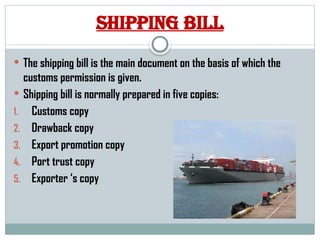
 The shipping bill is the main document on the basis of which the
customs permission is given.
 Shipping bill is normally prepared in five copies:
1. Customs copy
2. Drawback copy
3. Export promotion copy
4. Port trust copy
5. Exporter ‘s copy
Types of shipping bill
 Free shipping bill: It used in case of goods which neither attract any
export duty nor entitled for duty drawback.
 Dutiable shipping bill: It used in case of goods. Which attract export duty.
It may not be entitled to duty drawback.
 Drawback shipping bill: It is used in case when refund of duties is
allowed on the goods exported
 Shipping bill for shipment ex-bond: It used in case of imported goods
for re-export and which are kept in bond.
 Coastal shipping bill: It used in case of shipment that is moved from one
port to another port, by sea ,within India. It is not an export document.
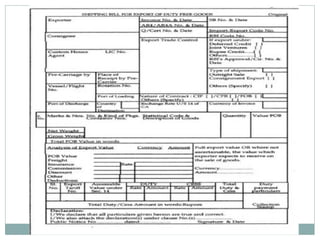
Contents of shipping bill
 Nature of goods exported
 Name of vessel
 Flag
 Country of destination, the port at which the goods are to be discharged
 Exporter’s address
 Importer’s address
 Details of the package, such as numbers and marks
 Description of goods
 FOB price and real value of goods as defined in the sea customs act
 Total number of packages with total weight and value
Mate receipt
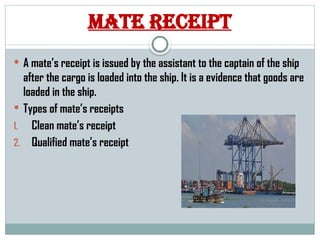
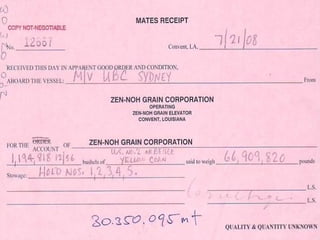
 A mate’s receipt is issued by the assistant to the captain of the ship
after the cargo is loaded into the ship. It is a evidence that goods are
loaded in the ship.
 Types of mate’s receipts
1. Clean mate’s receipt
2. Qualified mate’s receipt
Contents of mate receipt
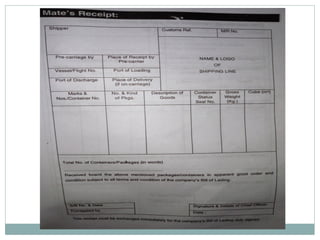
 Name and logo of the shipping line
 Name and address of the shipper
 Name and the number of vessel
 Name of the port of loading
 Name of the port of discharge and place of delivery
 Marks and container description
 Total number of container and packages
 Description of goods in terms of quantity
 Container status and seal number
 Shipping bill number and date
 Signature and initials of the chief officer
Cart ticket
 A cart ticket is also known as cart chit, vehicle and gate pass, is
prepared by the exporter and includes details of
I. Export cargo in terms of the shipper name
II. The number of packages
III. The shipping bill number
IV. The port of destination
V. The number of the vehicle carrying the cargo.
Certificate of measurement
 Freight is charged either on the basis of weight or measurement.
 When it is changed on the basis of weight, the weight declared by the
shipper may be accepted
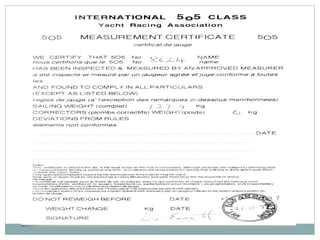
 The certificate contains
1. The name of the vessel
2. Port of destination
3. Description of goods
4. Quantity, length, breadth, depth of the package
Bill of lading
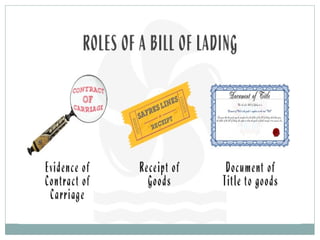
 The bill of lading is a document wherein the shipping company gives
its official receipts for the goods shipped in its vessel and at the
same time contracts to carry them to the port of destination.
 It is a very important document to the exporter as it constitutes
document of title to the goods.
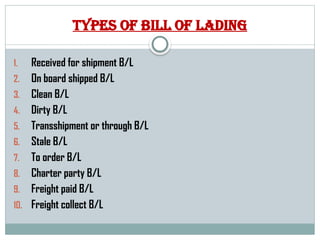
Types of bill of lading
1. Received for shipment B/L
2. On board shipped B/L
3. Clean B/L
4. Dirty B/L
5. Transshipment or through B/L
6. Stale B/L
7. To order B/L
8. Charter party B/L
9. Freight paid B/L
10. Freight collect B/L
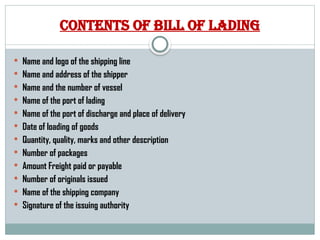
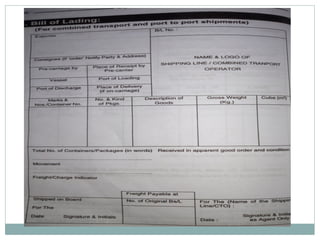
Contents of bill of lading
 Name and logo of the shipping line
 Name and address of the shipper
 Name and the number of vessel
 Name of the port of lading
 Name of the port of discharge and place of delivery
 Date of loading of goods
 Quantity, quality, marks and other description
 Number of packages
 Amount Freight paid or payable
 Number of originals issued
 Name of the shipping company
 Signature of the issuing authority
Airway bill
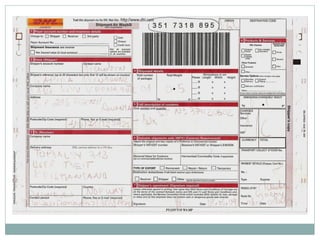
 An airway bill, also called an air consignment note is a receipt issued
by an airline for the carriage of goods
 As each shipping company has its own bill of lading each airline has
its own airway bill
Contents of airway bill
 Name of the airport of departure and destination
 The names and addresses of the consignor, consignee and the first
carrier
 Marks and container number
 Packing and container description
 Total number of containers and packages
 Description of good in terms of quantity
 Container status and seal number
 Amount of freight paid or payable
 Signature of the issuing carrier or his agent
Bill of entry
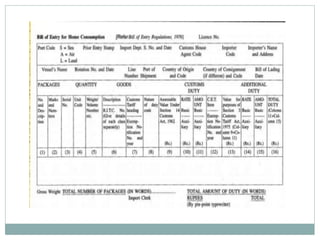
 Bill of entry is a declaration from made by the importer or his
clearing agent in the prescribed from under bill of entry regulations,
1971 on the strength of which clearance of imported goods can be
made.
 When goods are imported in a particular country, the importer has
to pay the necessary import duty.
Types of bill of entry
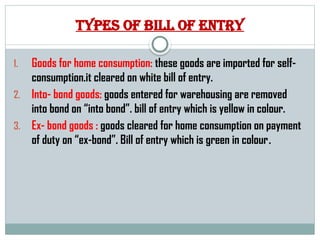
1. Goods for home consumption: these goods are imported for self-
consumption.it cleared on white bill of entry.
2. Into- bond goods: goods entered for warehousing are removed
into bond on “into bond”. bill of entry which is yellow in colour.
3. Ex- bond goods : goods cleared for home consumption on payment
of duty on “ex-bond”. Bill of entry which is green in colour.
Contents of bill of entry
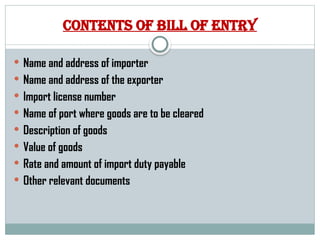
 Name and address of importer
 Name and address of the exporter
 Import license number
 Name of port where goods are to be cleared
 Description of goods
 Value of goods
 Rate and amount of import duty payable
 Other relevant documents
Reference
 EXPORT IMPORT PROCEDURES AND DOCUMENTATION – DR.
KHUSHPAT S. JAIN (page no.103-140)
 EXPORT IMPORT PROCEDURES DOCUMENTATION
AND LOGISTICS – C.RAMA GOPAL (page no.19-26)
 EXPORT IMPORT AND LOGISTICS MANAGEMENT –
USHA KIRAN RAI (page no.195-203)
Documents related to shipment_Chapter_2.pptx

Documents related to shipment_Chapter_2.pptx

  • 1.
    GUru jambHeshwar universityof science and technology, Hisar DOCUMENTS RELATED TO SHIPMENT DR. VIJENDER PAL SAINI
  • 2.
    Contents • INTRODUCTION • DOCUMENTRELATED TO SHIPMENT • CONCLUSION • REFERENCE
  • 3.
    INTRODUCTION  The exportprocess is made more complex by the wide variety of documents that the exporter needs to complete to ensure that the order reaches its destination quickly, safety and without problems. For shipment process, certain documents will be required.
  • 4.
    Document related toshipment Shipping Bill Mate’s Receipt Cart Ticket Certificate of Measurement Bill of Lading Airway Bill Bill of Entry
  • 5.
    Shipping bill  Theshipping bill is the main document on the basis of which the customs permission is given.  Shipping bill is normally prepared in five copies: 1. Customs copy 2. Drawback copy 3. Export promotion copy 4. Port trust copy 5. Exporter ‘s copy
  • 6.
    Types of shippingbill  Free shipping bill: It used in case of goods which neither attract any export duty nor entitled for duty drawback.  Dutiable shipping bill: It used in case of goods. Which attract export duty. It may not be entitled to duty drawback.  Drawback shipping bill: It is used in case when refund of duties is allowed on the goods exported  Shipping bill for shipment ex-bond: It used in case of imported goods for re-export and which are kept in bond.  Coastal shipping bill: It used in case of shipment that is moved from one port to another port, by sea ,within India. It is not an export document.
  • 7.
    Contents of shippingbill  Nature of goods exported  Name of vessel  Flag  Country of destination, the port at which the goods are to be discharged  Exporter’s address  Importer’s address  Details of the package, such as numbers and marks  Description of goods  FOB price and real value of goods as defined in the sea customs act  Total number of packages with total weight and value
  • 9.
    Mate receipt  Amate’s receipt is issued by the assistant to the captain of the ship after the cargo is loaded into the ship. It is a evidence that goods are loaded in the ship.  Types of mate’s receipts 1. Clean mate’s receipt 2. Qualified mate’s receipt
  • 10.
    Contents of matereceipt  Name and logo of the shipping line  Name and address of the shipper  Name and the number of vessel  Name of the port of loading  Name of the port of discharge and place of delivery  Marks and container description  Total number of container and packages  Description of goods in terms of quantity  Container status and seal number  Shipping bill number and date  Signature and initials of the chief officer
  • 13.
    Cart ticket  Acart ticket is also known as cart chit, vehicle and gate pass, is prepared by the exporter and includes details of I. Export cargo in terms of the shipper name II. The number of packages III. The shipping bill number IV. The port of destination V. The number of the vehicle carrying the cargo.
  • 14.
    Certificate of measurement Freight is charged either on the basis of weight or measurement.  When it is changed on the basis of weight, the weight declared by the shipper may be accepted  The certificate contains 1. The name of the vessel 2. Port of destination 3. Description of goods 4. Quantity, length, breadth, depth of the package
  • 16.
    Bill of lading The bill of lading is a document wherein the shipping company gives its official receipts for the goods shipped in its vessel and at the same time contracts to carry them to the port of destination.  It is a very important document to the exporter as it constitutes document of title to the goods.
  • 18.
    Types of billof lading 1. Received for shipment B/L 2. On board shipped B/L 3. Clean B/L 4. Dirty B/L 5. Transshipment or through B/L 6. Stale B/L 7. To order B/L 8. Charter party B/L 9. Freight paid B/L 10. Freight collect B/L
  • 19.
    Contents of billof lading  Name and logo of the shipping line  Name and address of the shipper  Name and the number of vessel  Name of the port of lading  Name of the port of discharge and place of delivery  Date of loading of goods  Quantity, quality, marks and other description  Number of packages  Amount Freight paid or payable  Number of originals issued  Name of the shipping company  Signature of the issuing authority
  • 21.
    Airway bill  Anairway bill, also called an air consignment note is a receipt issued by an airline for the carriage of goods  As each shipping company has its own bill of lading each airline has its own airway bill
  • 22.
    Contents of airwaybill  Name of the airport of departure and destination  The names and addresses of the consignor, consignee and the first carrier  Marks and container number  Packing and container description  Total number of containers and packages  Description of good in terms of quantity  Container status and seal number  Amount of freight paid or payable  Signature of the issuing carrier or his agent
  • 24.
    Bill of entry Bill of entry is a declaration from made by the importer or his clearing agent in the prescribed from under bill of entry regulations, 1971 on the strength of which clearance of imported goods can be made.  When goods are imported in a particular country, the importer has to pay the necessary import duty.
  • 25.
    Types of billof entry 1. Goods for home consumption: these goods are imported for self- consumption.it cleared on white bill of entry. 2. Into- bond goods: goods entered for warehousing are removed into bond on “into bond”. bill of entry which is yellow in colour. 3. Ex- bond goods : goods cleared for home consumption on payment of duty on “ex-bond”. Bill of entry which is green in colour.
  • 26.
    Contents of billof entry  Name and address of importer  Name and address of the exporter  Import license number  Name of port where goods are to be cleared  Description of goods  Value of goods  Rate and amount of import duty payable  Other relevant documents
  • 28.
    Reference  EXPORT IMPORTPROCEDURES AND DOCUMENTATION – DR. KHUSHPAT S. JAIN (page no.103-140)  EXPORT IMPORT PROCEDURES DOCUMENTATION AND LOGISTICS – C.RAMA GOPAL (page no.19-26)  EXPORT IMPORT AND LOGISTICS MANAGEMENT – USHA KIRAN RAI (page no.195-203)