Hisrich
Peters
Shepherd
Chapter 5
Identifying and Analyzing
Domestic and International
Opportunities
Copyright © 2010 by The McGraw-Hill Companies, Inc. All rights reserved.McGraw-Hill/Irwin
5-2
Introduction
 Entrepreneurs find it difficult to both
manage and expand the venture they
created.
 To expand a venture, entrepreneurs need
to:
 Identify opportunities for domestic and
international expansion.
 Develop different management skills.
 Infuse new entrepreneurial spirit
(intrapreneurship).
5-3
 Factors contributing to international
expansion:
 Opening up of controlled economies to market-
oriented enterprise.
 Self-interest of organizations as well as the
impact of external events and forces.
 Developing countries need training and
education as well as infrastructure to support
their development and growth in the next
century.
Introduction (cont.)
5-4
Opportunity Recognition and the
Opportunity Assessment Plan
 The key to successful domestic and
international entrepreneurship is to develop
an idea that has a market with a need for
the product or service idea conceived.
 Opportunity assessment is often best
accomplished by developing an opportunity
assessment plan.
 An opportunity assessment plan is not a
business plan.
5-5
 An opportunity assessment plan has four
sections:
 The first section develops the idea, analyzes
competitive products and companies, and
identifies the unique selling propositions.
 The second section focuses on the market—its
size, trends, characteristics, and growth rate.
 The third section focuses on the entrepreneur’s
and management team’s skills and experience.
 The final section develops a time line indicating
the steps to successfully launch the venture.
Opportunity Recognition and the
Opportunity Assessment Plan (cont.)
5-6
 Search Engines
 There are many key terms for searching the
needed industry, market, and competitive
information.
 Trade Associations
 Good source for country-specific industry data.
 Trade Publications
 Provide information and insights on trend,
companies, and trade shows from a local
perspective of the particular market and market
conditions.
Information Sources (cont.)
5-7
The Nature of International
Entrepreneurship
 International entrepreneurship is the
process of an entrepreneur conducting
business activities across national
boundaries.
 The activities necessary for ascertaining and
satisfying the needs and wants of target
consumers take place in more than one country.
 With a commercial history of only 300
years, the United States is a relative
newcomer to the international business
arena.
5-8
The Importance of International
Business to the Firm
 International business has become
increasingly important to firms of all sizes.
 A successful entrepreneur must be able to:
 Fully understand the difference between
domestic and international business.
 Respond accordingly thereby successfully “going
global.”
5-9
International versus Domestic
Entrepreneurship
 Economics
 In a domestic business strategy, the entire
country is organized under a single economic
system and has the same currency.
 Creating a business strategy for a multicountry
area means dealing with differences in:
 Levels of economic development.
 Currency valuations.
 Government regulations.
 Banking, venture capital, marketing, and distribution
systems.
5-10
 Stage of Economic Development
 Certain factors significantly impact a firm’s
ability to successfully engage in international
business such as:
 Fundamental infrastructures.
 Banking facilities and systems.
 Educational systems.
 Legal system.
 Business ethics and norms.
International versus Domestic
Entrepreneurship (cont.)
5-11
 Balance of Payments Current Account
 With the present system of flexible exchange
rates, a country’s current account (the
difference between the value of a country’s
imports and exports over time) affects the
valuation of its currency.
 The valuation of one country’s currency affects
business transactions between countries.
International versus Domestic
Entrepreneurship (cont.)
5-12
 Type of System
 Difficulties in doing business in economies that
are developing, or in transition.
 Use of barter or third-party arrangements in
these countries to increase business activity.
 Barter - A method of payment using nonmoney items.
 Third-party arrangements - Paying for goods indirectly
through another source.
International versus Domestic
Entrepreneurship (cont.)
5-13
 Political-Legal Environment
 Political risk analysis - An assessment of a
country’s political policies and its stability prior
to entry.
 Types of political risks:
 Operating risk.
 Transfer risk.
 Ownership risk .
 Conflict and changes in the solvency of the country.
International versus Domestic
Entrepreneurship (cont.)
5-14
 A country’s legal system regulates:
 Its business practices.
 The manner in which business transactions are
executed.
 The rights and obligations involved in any business
transaction between parties.
 Critical areas for every entrepreneur:
 Property rights.
 Contract law.
 Product safety.
 Product liability.
International versus Domestic
Entrepreneurship (cont.)
5-15
 Language
 One of the biggest problems for the
entrepreneur is finding a translator.
 Significant problems can occur with careless
translation.
 Care should be taken to hire a translator whose
native tongue is the target language and whose
expertise matches that of the original authors.
International versus Domestic
Entrepreneurship (cont.)
5-16
Technological Environment
 The variation and availability of technology
are often surprising, particularly to an
entrepreneur from a developed country.
 New products in a country are created
based on the conditions and infrastructure
operant in that country.
5-17
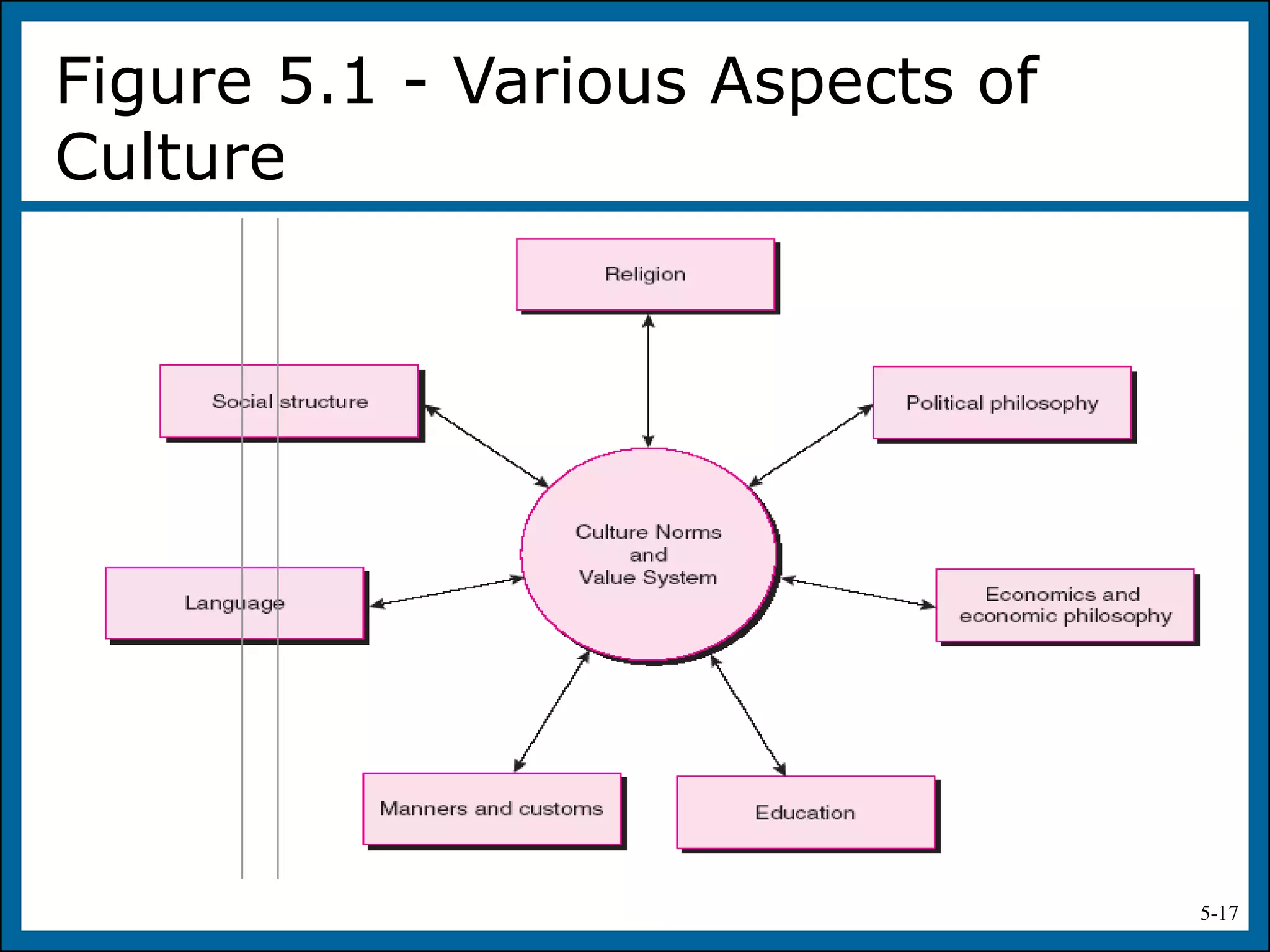
Figure 5.1 - Various Aspects of
Culture
Figure 5.1
5-18
Available Distribution Systems
 Factors to be considered in determining the
distribution system for a country:
 Overall sales potential.
 Amount and type of competition.
 Cost of the product.
 Geographical size and density.
 Investment policies.
 Exchange rates and controls.
 Level of political risk.
 Overall marketing plan.
5-19
Motivations to Go Global
 Profits.
 Competitive pressures.
 Unique product(s) or service(s).
 Excess production capacity.
 Declining home country sales.
 Unique market opportunity.
 Economies of scale.
 Technological advantage.
 Tax benefits.
5-20
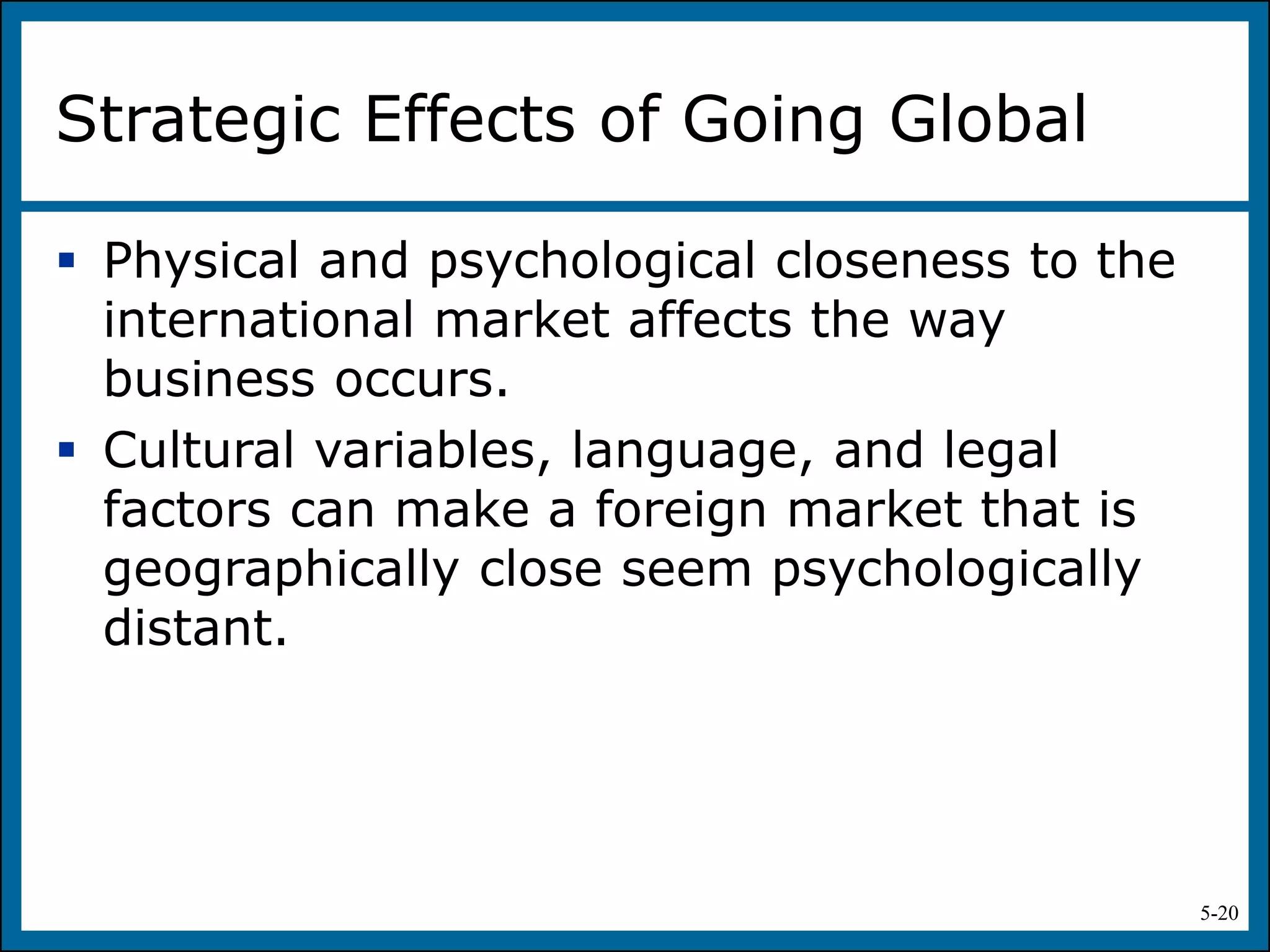
Strategic Effects of Going Global
 Physical and psychological closeness to the
international market affects the way
business occurs.
 Cultural variables, language, and legal
factors can make a foreign market that is
geographically close seem psychologically
distant.
5-21
 Issues involved in psychological distance:
 The distance envisioned by the entrepreneur
may be based more on perception than reality.
 Closer psychological proximity makes it easier
for an entrepreneurial firm to enter a market.
 There are more similarities than differences
between individual entrepreneurs regardless of
the country.
Strategic Effects of Going Global
(cont.)
5-22
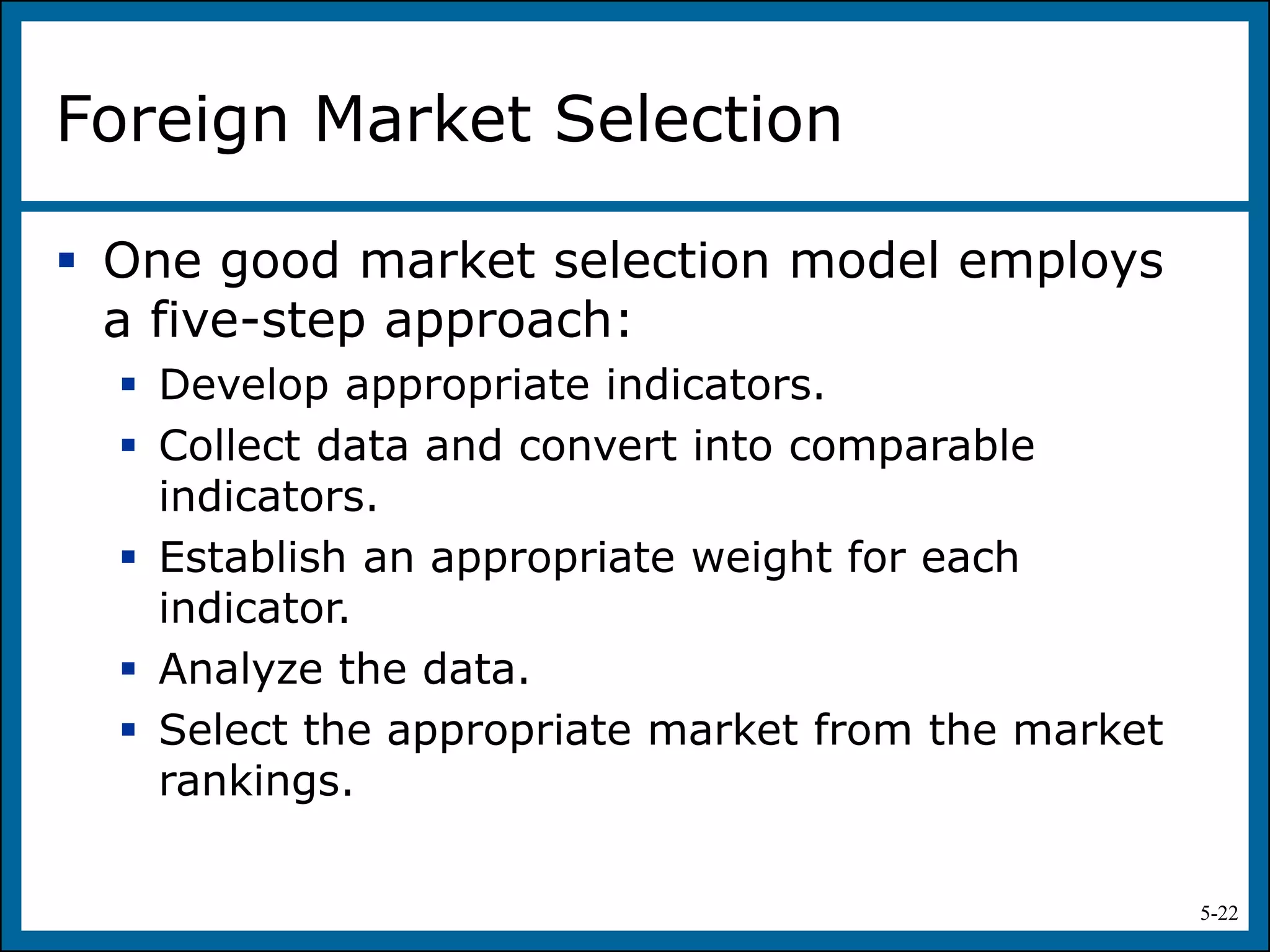
Foreign Market Selection
 One good market selection model employs
a five-step approach:
 Develop appropriate indicators.
 Collect data and convert into comparable
indicators.
 Establish an appropriate weight for each
indicator.
 Analyze the data.
 Select the appropriate market from the market
rankings.
5-23
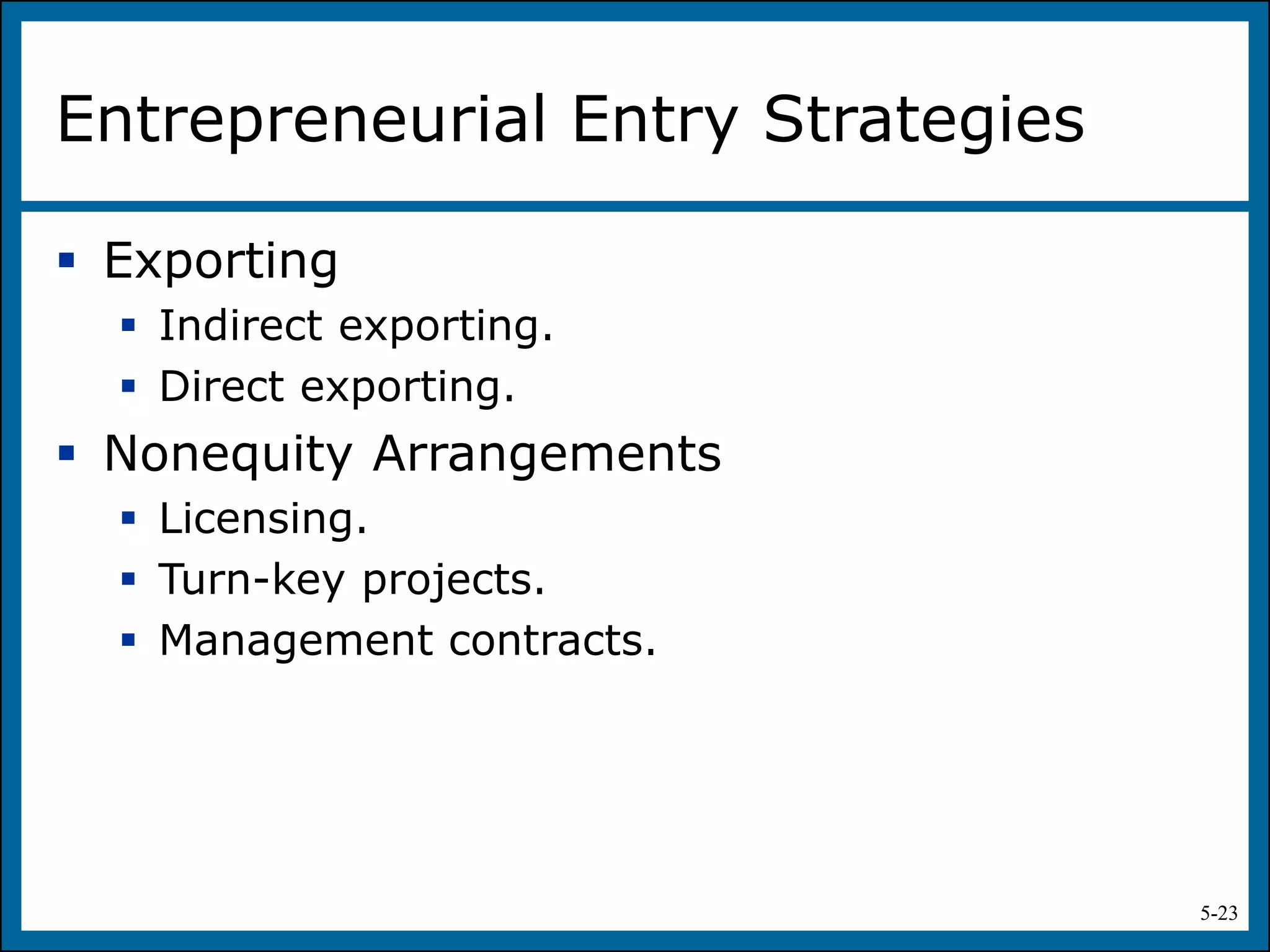
Entrepreneurial Entry Strategies
 Exporting
 Indirect exporting.
 Direct exporting.
 Nonequity Arrangements
 Licensing.
 Turn-key projects.
 Management contracts.
5-24
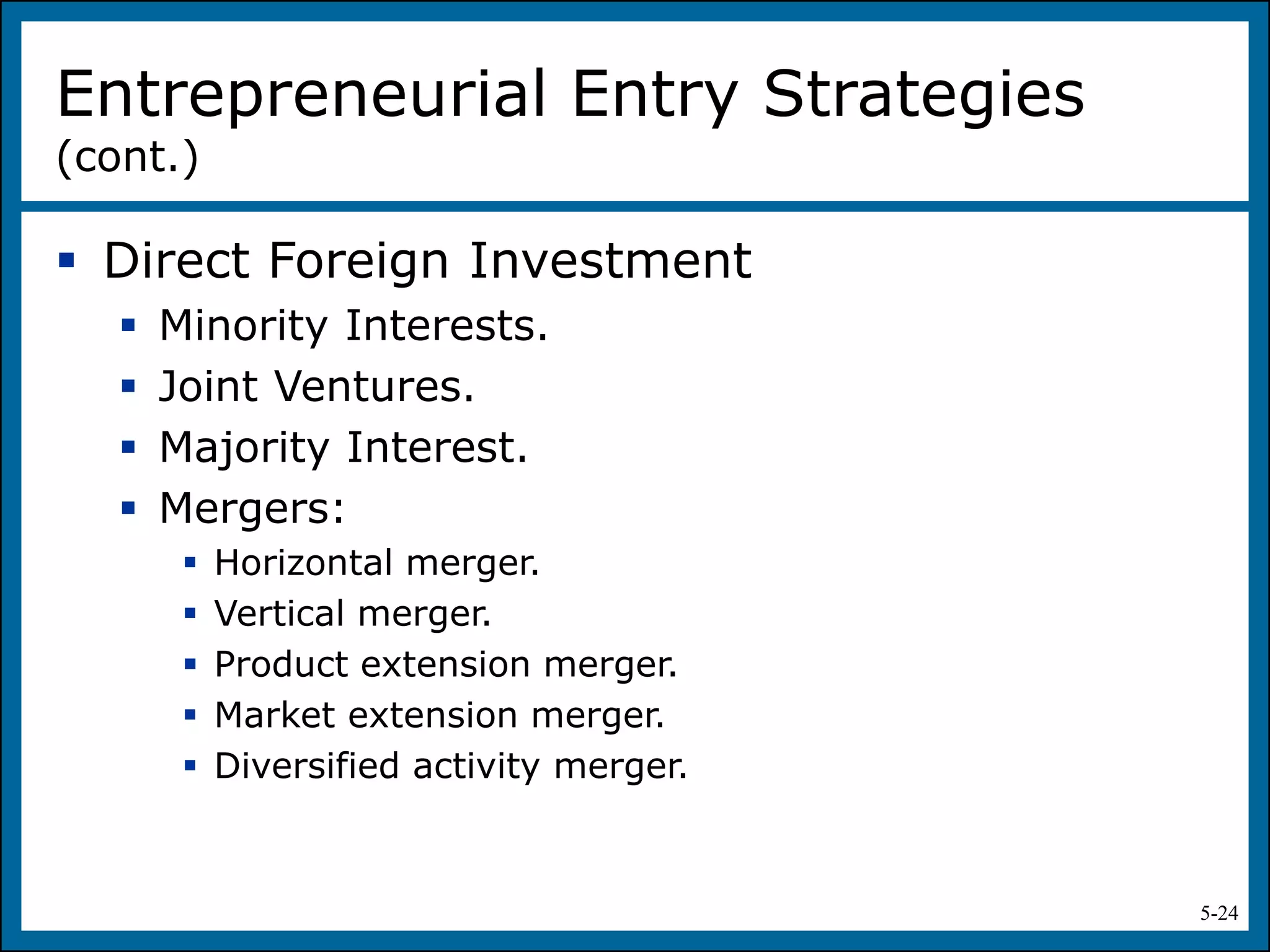
Entrepreneurial Entry Strategies
(cont.)
 Direct Foreign Investment
 Minority Interests.
 Joint Ventures.
 Majority Interest.
 Mergers:
 Horizontal merger.
 Vertical merger.
 Product extension merger.
 Market extension merger.
 Diversified activity merger.
5-25
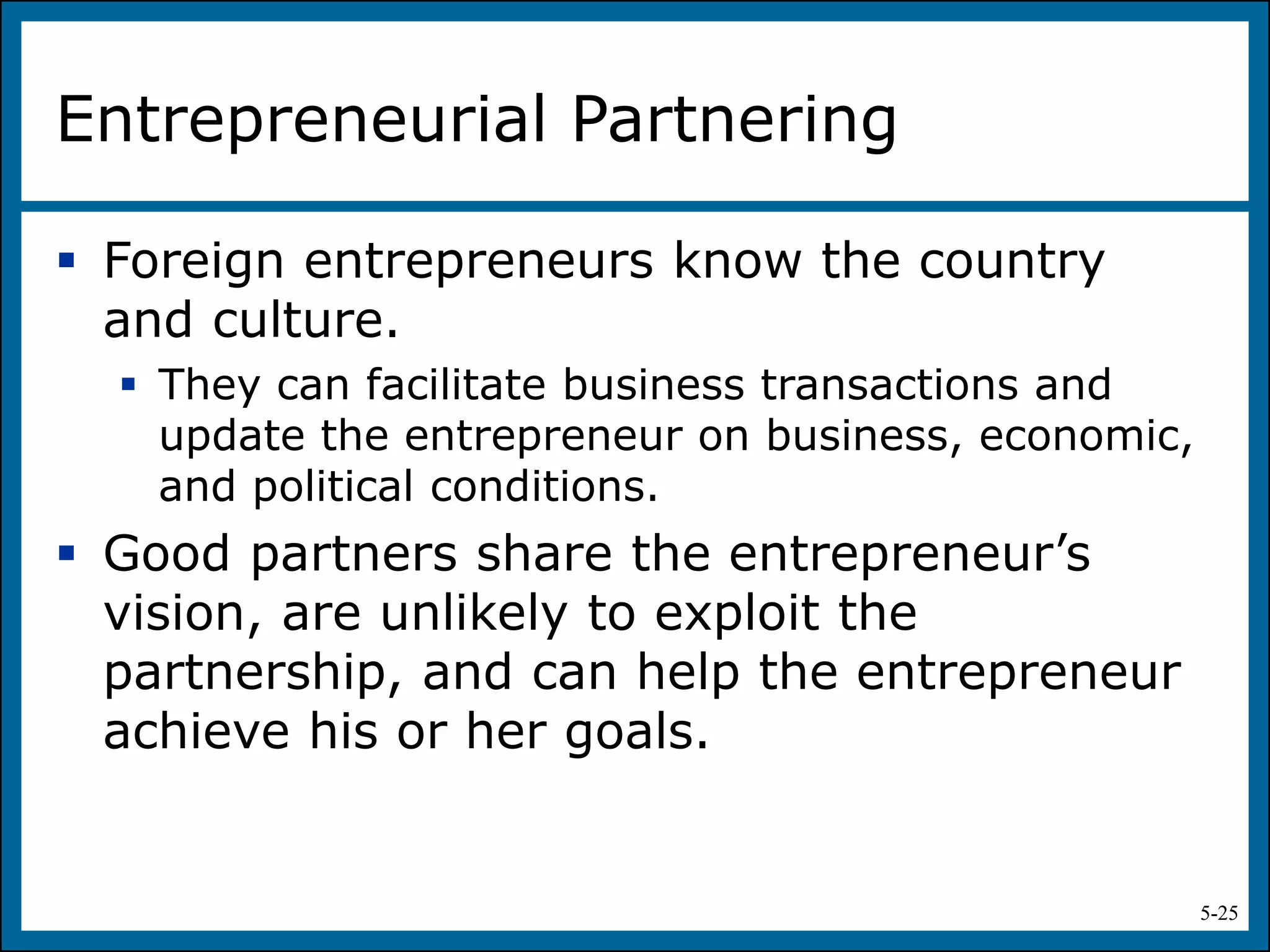
Entrepreneurial Partnering
 Foreign entrepreneurs know the country
and culture.
 They can facilitate business transactions and
update the entrepreneur on business, economic,
and political conditions.
 Good partners share the entrepreneur’s
vision, are unlikely to exploit the
partnership, and can help the entrepreneur
achieve his or her goals.

Do ms entrepreneurship chapter 5

  • 1.
    Hisrich Peters Shepherd Chapter 5 Identifying andAnalyzing Domestic and International Opportunities Copyright © 2010 by The McGraw-Hill Companies, Inc. All rights reserved.McGraw-Hill/Irwin
  • 2.
    5-2 Introduction  Entrepreneurs findit difficult to both manage and expand the venture they created.  To expand a venture, entrepreneurs need to:  Identify opportunities for domestic and international expansion.  Develop different management skills.  Infuse new entrepreneurial spirit (intrapreneurship).
  • 3.
    5-3  Factors contributingto international expansion:  Opening up of controlled economies to market- oriented enterprise.  Self-interest of organizations as well as the impact of external events and forces.  Developing countries need training and education as well as infrastructure to support their development and growth in the next century. Introduction (cont.)
  • 4.
    5-4 Opportunity Recognition andthe Opportunity Assessment Plan  The key to successful domestic and international entrepreneurship is to develop an idea that has a market with a need for the product or service idea conceived.  Opportunity assessment is often best accomplished by developing an opportunity assessment plan.  An opportunity assessment plan is not a business plan.
  • 5.
    5-5  An opportunityassessment plan has four sections:  The first section develops the idea, analyzes competitive products and companies, and identifies the unique selling propositions.  The second section focuses on the market—its size, trends, characteristics, and growth rate.  The third section focuses on the entrepreneur’s and management team’s skills and experience.  The final section develops a time line indicating the steps to successfully launch the venture. Opportunity Recognition and the Opportunity Assessment Plan (cont.)
  • 6.
    5-6  Search Engines There are many key terms for searching the needed industry, market, and competitive information.  Trade Associations  Good source for country-specific industry data.  Trade Publications  Provide information and insights on trend, companies, and trade shows from a local perspective of the particular market and market conditions. Information Sources (cont.)
  • 7.
    5-7 The Nature ofInternational Entrepreneurship  International entrepreneurship is the process of an entrepreneur conducting business activities across national boundaries.  The activities necessary for ascertaining and satisfying the needs and wants of target consumers take place in more than one country.  With a commercial history of only 300 years, the United States is a relative newcomer to the international business arena.
  • 8.
    5-8 The Importance ofInternational Business to the Firm  International business has become increasingly important to firms of all sizes.  A successful entrepreneur must be able to:  Fully understand the difference between domestic and international business.  Respond accordingly thereby successfully “going global.”
  • 9.
    5-9 International versus Domestic Entrepreneurship Economics  In a domestic business strategy, the entire country is organized under a single economic system and has the same currency.  Creating a business strategy for a multicountry area means dealing with differences in:  Levels of economic development.  Currency valuations.  Government regulations.  Banking, venture capital, marketing, and distribution systems.
  • 10.
    5-10  Stage ofEconomic Development  Certain factors significantly impact a firm’s ability to successfully engage in international business such as:  Fundamental infrastructures.  Banking facilities and systems.  Educational systems.  Legal system.  Business ethics and norms. International versus Domestic Entrepreneurship (cont.)
  • 11.
    5-11  Balance ofPayments Current Account  With the present system of flexible exchange rates, a country’s current account (the difference between the value of a country’s imports and exports over time) affects the valuation of its currency.  The valuation of one country’s currency affects business transactions between countries. International versus Domestic Entrepreneurship (cont.)
  • 12.
    5-12  Type ofSystem  Difficulties in doing business in economies that are developing, or in transition.  Use of barter or third-party arrangements in these countries to increase business activity.  Barter - A method of payment using nonmoney items.  Third-party arrangements - Paying for goods indirectly through another source. International versus Domestic Entrepreneurship (cont.)
  • 13.
    5-13  Political-Legal Environment Political risk analysis - An assessment of a country’s political policies and its stability prior to entry.  Types of political risks:  Operating risk.  Transfer risk.  Ownership risk .  Conflict and changes in the solvency of the country. International versus Domestic Entrepreneurship (cont.)
  • 14.
    5-14  A country’slegal system regulates:  Its business practices.  The manner in which business transactions are executed.  The rights and obligations involved in any business transaction between parties.  Critical areas for every entrepreneur:  Property rights.  Contract law.  Product safety.  Product liability. International versus Domestic Entrepreneurship (cont.)
  • 15.
    5-15  Language  Oneof the biggest problems for the entrepreneur is finding a translator.  Significant problems can occur with careless translation.  Care should be taken to hire a translator whose native tongue is the target language and whose expertise matches that of the original authors. International versus Domestic Entrepreneurship (cont.)
  • 16.
    5-16 Technological Environment  Thevariation and availability of technology are often surprising, particularly to an entrepreneur from a developed country.  New products in a country are created based on the conditions and infrastructure operant in that country.
  • 17.
    5-17 Figure 5.1 -Various Aspects of Culture Figure 5.1
  • 18.
    5-18 Available Distribution Systems Factors to be considered in determining the distribution system for a country:  Overall sales potential.  Amount and type of competition.  Cost of the product.  Geographical size and density.  Investment policies.  Exchange rates and controls.  Level of political risk.  Overall marketing plan.
  • 19.
    5-19 Motivations to GoGlobal  Profits.  Competitive pressures.  Unique product(s) or service(s).  Excess production capacity.  Declining home country sales.  Unique market opportunity.  Economies of scale.  Technological advantage.  Tax benefits.
  • 20.
    5-20 Strategic Effects ofGoing Global  Physical and psychological closeness to the international market affects the way business occurs.  Cultural variables, language, and legal factors can make a foreign market that is geographically close seem psychologically distant.
  • 21.
    5-21  Issues involvedin psychological distance:  The distance envisioned by the entrepreneur may be based more on perception than reality.  Closer psychological proximity makes it easier for an entrepreneurial firm to enter a market.  There are more similarities than differences between individual entrepreneurs regardless of the country. Strategic Effects of Going Global (cont.)
  • 22.
    5-22 Foreign Market Selection One good market selection model employs a five-step approach:  Develop appropriate indicators.  Collect data and convert into comparable indicators.  Establish an appropriate weight for each indicator.  Analyze the data.  Select the appropriate market from the market rankings.
  • 23.
    5-23 Entrepreneurial Entry Strategies Exporting  Indirect exporting.  Direct exporting.  Nonequity Arrangements  Licensing.  Turn-key projects.  Management contracts.
  • 24.
    5-24 Entrepreneurial Entry Strategies (cont.) Direct Foreign Investment  Minority Interests.  Joint Ventures.  Majority Interest.  Mergers:  Horizontal merger.  Vertical merger.  Product extension merger.  Market extension merger.  Diversified activity merger.
  • 25.
    5-25 Entrepreneurial Partnering  Foreignentrepreneurs know the country and culture.  They can facilitate business transactions and update the entrepreneur on business, economic, and political conditions.  Good partners share the entrepreneur’s vision, are unlikely to exploit the partnership, and can help the entrepreneur achieve his or her goals.