Module: Entrepreneurship
Topic: International Entrepreneurial
Opportunities
Week 4
Kashif Ali
Department of Business Administration
kashifali@uosahiwal.edu.pk
1
• To identify the aspects and importance of
international entrepreneurship.
• To identify the important strategic issues in
international entrepreneurship.
• To identify the available options for entering
international markets.
• To present the problems and barriers to
international entrepreneurship.
• To explain the aspects of th entrepreneurial
process.
Learning Objectives
• To explain the differences between
entrepreneurial and managerial domains.
• To explain the organizational environment
conducive for entrepreneurship.
• To identify the general characteristics of an
Entrepreneur.
• To explain the process of establishing
entrepreneurship in an organization.
Learning Objectives (cont’d)
International
Entrepreneurship
• International entrepreneurship is the process
of an entrepreneur conducting business activities
across national boundaries.
• It is exporting, licensing, or opening a sales office in
another country.
• When an entrepreneur executes his or her business
in more than one country, international
entrepreneurship occurs.
Importance of International
Entrepreneurship
• International business has become increasingly
important to firms of all sizes.
• The successful entrepreneur will be someone who
understands how international business differs from
domestic business and is able to act accordingly.
International Vs Domestic
Entrepreneurship
• Whether international or domestic, an entrepreneur
is concerned about the same basic issues sales,
costs, and profits.
• What varies is the relative importance of the factors
being considered.
• International entrepreneurial decisions are more
complex due to uncontrollable factors.
Uncontrollable Factors
• Economic
• Political-Legal Environment
• Cultural Environment
• Technological Environment
Economic
• Creating a business strategy for multiple countries
means dealing with different levels of economic
development and different distribution systems.
• There are still many difficulties in doing business in
developing and transition economies due to:
– Gaps in the knowledge of the Western system
regarding business plans, marketing, and profits.
– Widely variable rates of return.
– Differences in the accounting system.
– Communications.
Political-Legal Environment
• Multiple political and legal environments create
different business problems.
• Each element of the international business strategy
can potentially be affected by multiple legal
environments.
• Laws governing business arrangements also vary
greatly in the 150 different legal systems and
• sets of national laws.
Cultural Environment
• The impact of culture on entrepreneurs and
strategies is significant.
• Understanding the local culture is necessary when
developing worldwide plans.
Technological Environment
• Technology varies significantly across countries.
• New products in a country are created based on the
conditions and infrastructure of that country.
• Different theories to determine the consumers’
intention to use Technology
– Technology Acceptance Model
– Theory of Reasoned Action
– Theory of Planned Behaviour
– Decomposed Theory of Planned Behavior etc.
Strategic Issues
• The allocation of responsibility between the U.S. and
foreign operations.
• The nature of the planning and control systems to be
used.
• The appropriate organizational structure for
conducting international operations.
• The degree of standardization possible.
Strategic Issues (Cont’d)
• With experience in international operations,
entrepreneurs tend to change their approach to
responsibility.
– Stage 1: In the first stages the entrepreneur
typically follows a highly centralized decision
making process.
– Stage 2: When success occurs, it is no longer
possible to use completely centralized decision
making process.
– Stage 3: Decentralization is scaled back and
major strategic decisions are again centralized.
Strategic Issues (Cont’d)
To understand what is required for effective planning,
reporting, and control, the entrepreneur should
consider:
• Environmental analysis.
– Market characteristics.
– Marketing institutions.
– Industry conditions.
– Legal environment.
– Resources.
– Political environment.
Strategic Issues (Cont’d)
• Strategic planning.
• Structure.
• Operational planning.
• Controlling the marketing program.
Entering International Markets
• The choice of entry method depends on the
goals of the entrepreneur and the company’s
strengths and weaknesses.
• Exporting
• Non Equity Arrangements
• Direct Foreign Investment
Entering International Markets
• Exporting
– Indirect exporting involves a foreign purchaser
in the local market or using an export
management firm.
– For certain commodities, foreign buyers seek out
sources of supply.
– Export management firms, another indirect
method, are located in many commercial centers.
Entering International Markets
• Exporting
– Direct exporting through independent
distributors or through one’s own overseas sales
office is another entry method.
– An independent foreign distributor directly
contacts foreign customers and takes care of all
technicalities.
– Entrepreneurs who do not wish to give up control
over marketing can open overseas sales offices
and hire their own salespeople.
Entering International Markets
Non equity arrangements
• Non equity arrangements allow the entrepreneur to
enter a market without direct equity investment in
the foreign market.
– Licensing involves a manufacturer giving a foreign
manufacturer the right to use a patent, trademark, or
technology in return for a royalty.
– This arrangement is most appropriate when the
entrepreneur has no prospect of entering the market
through exporting or direct investment.
– The process is usually low risk and an easy way to
generate incremental income.
Entering International Markets
Non equity arrangements
• Non equity arrangements allow the entrepreneur to
enter a market without direct equity investment in
the foreign market.
– Licensing involves a manufacturer giving a foreign
manufacturer the right to use a patent, trademark, or
technology in return for a royalty.
– This arrangement is most appropriate when the
entrepreneur has no prospect of entering the market
through exporting or direct investment.
– The process is usually low risk and an easy way to
generate incremental income.
Entering International Markets
Direct Foreign Investment
– Minority interests
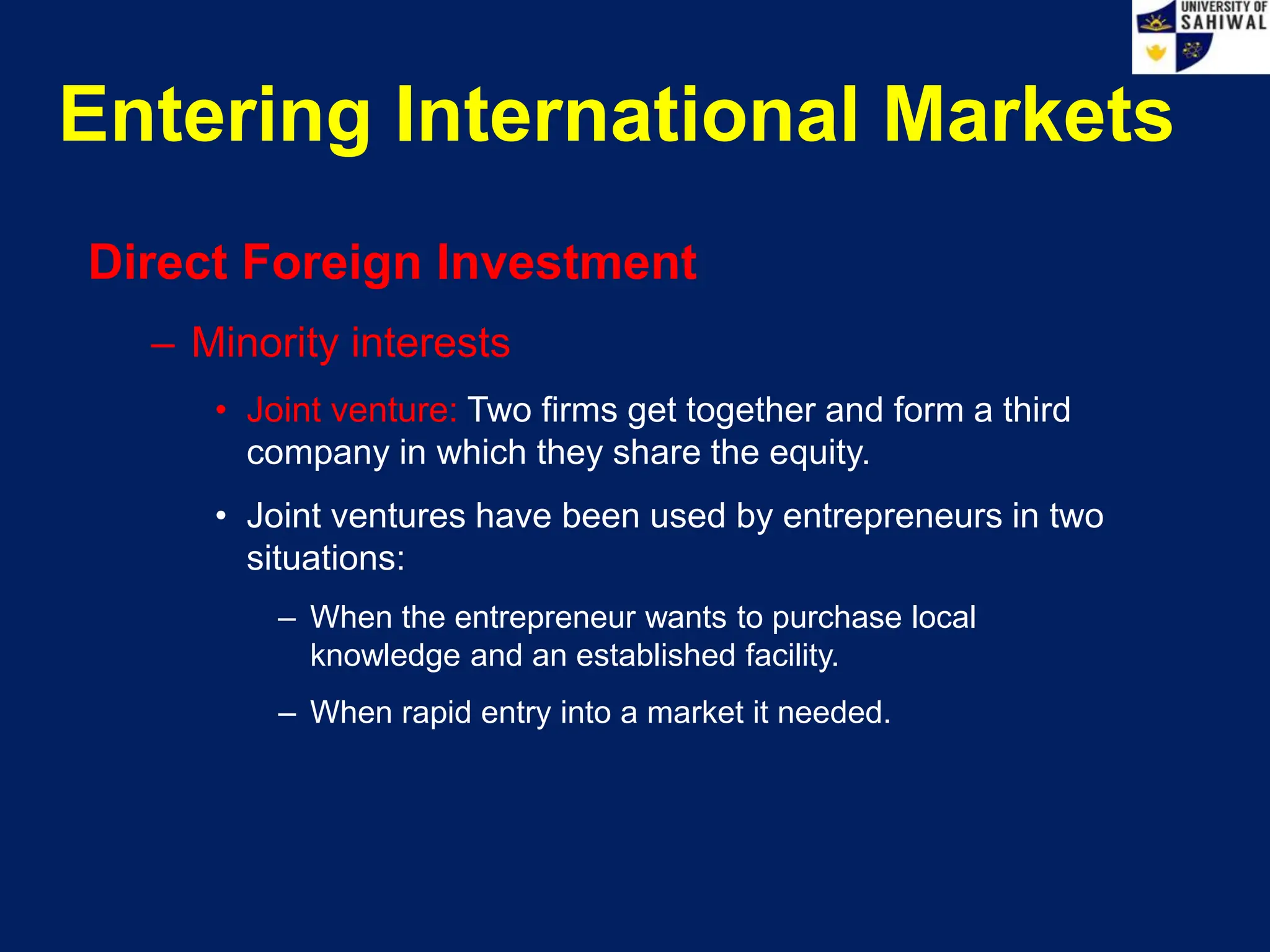
• Joint venture: Two firms get together and form a third
company in which they share the equity.
• Joint ventures have been used by entrepreneurs in two
situations:
– When the entrepreneur wants to purchase local
knowledge and an established facility.
– When rapid entry into a market it needed.
Entering International Markets
Direct Foreign Investment
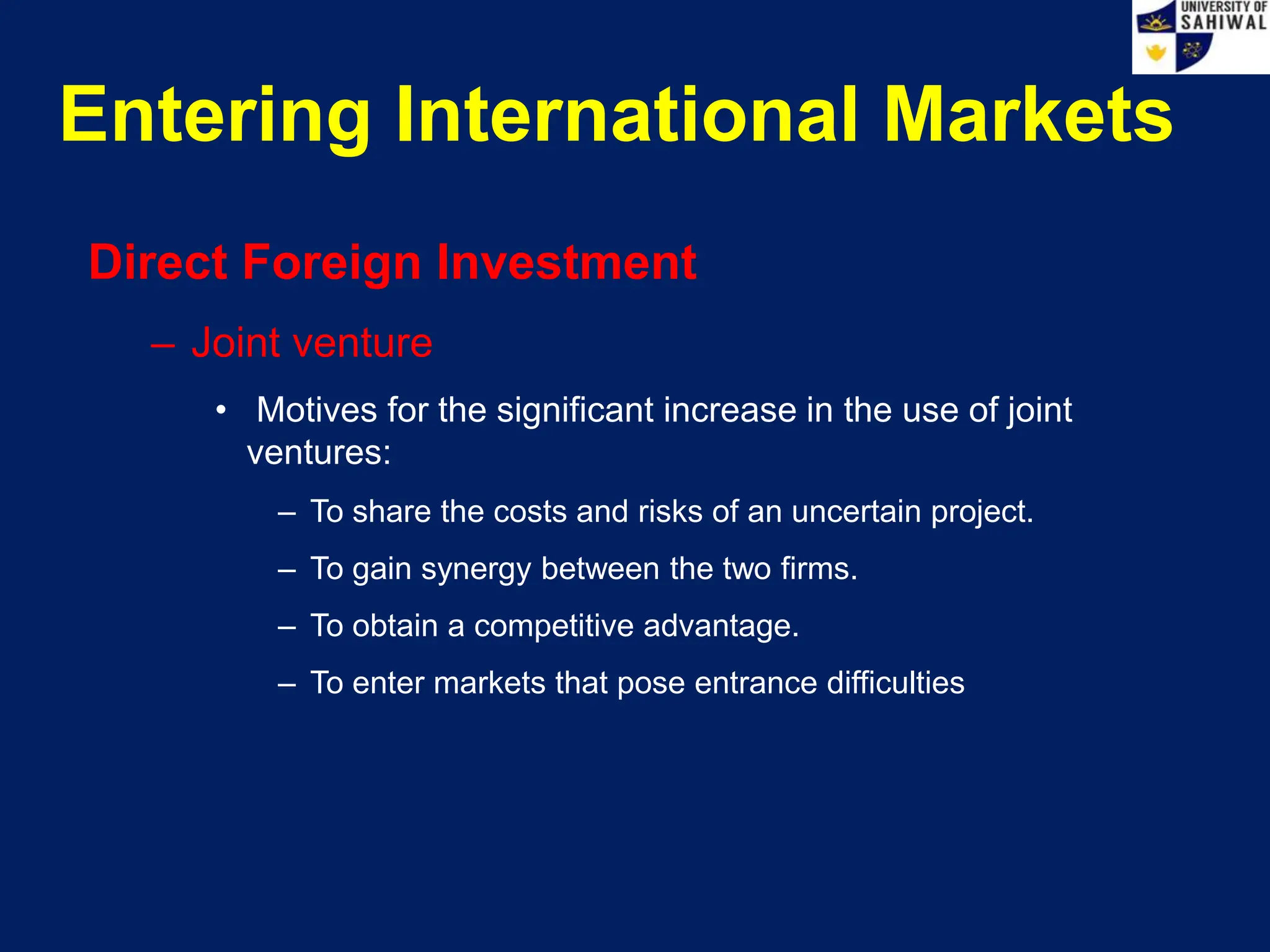
– Joint venture
• Motives for the significant increase in the use of joint
ventures:
– To share the costs and risks of an uncertain project.
– To gain synergy between the two firms.
– To obtain a competitive advantage.
– To enter markets that pose entrance difficulties
Entering International Markets
Direct Foreign Investment
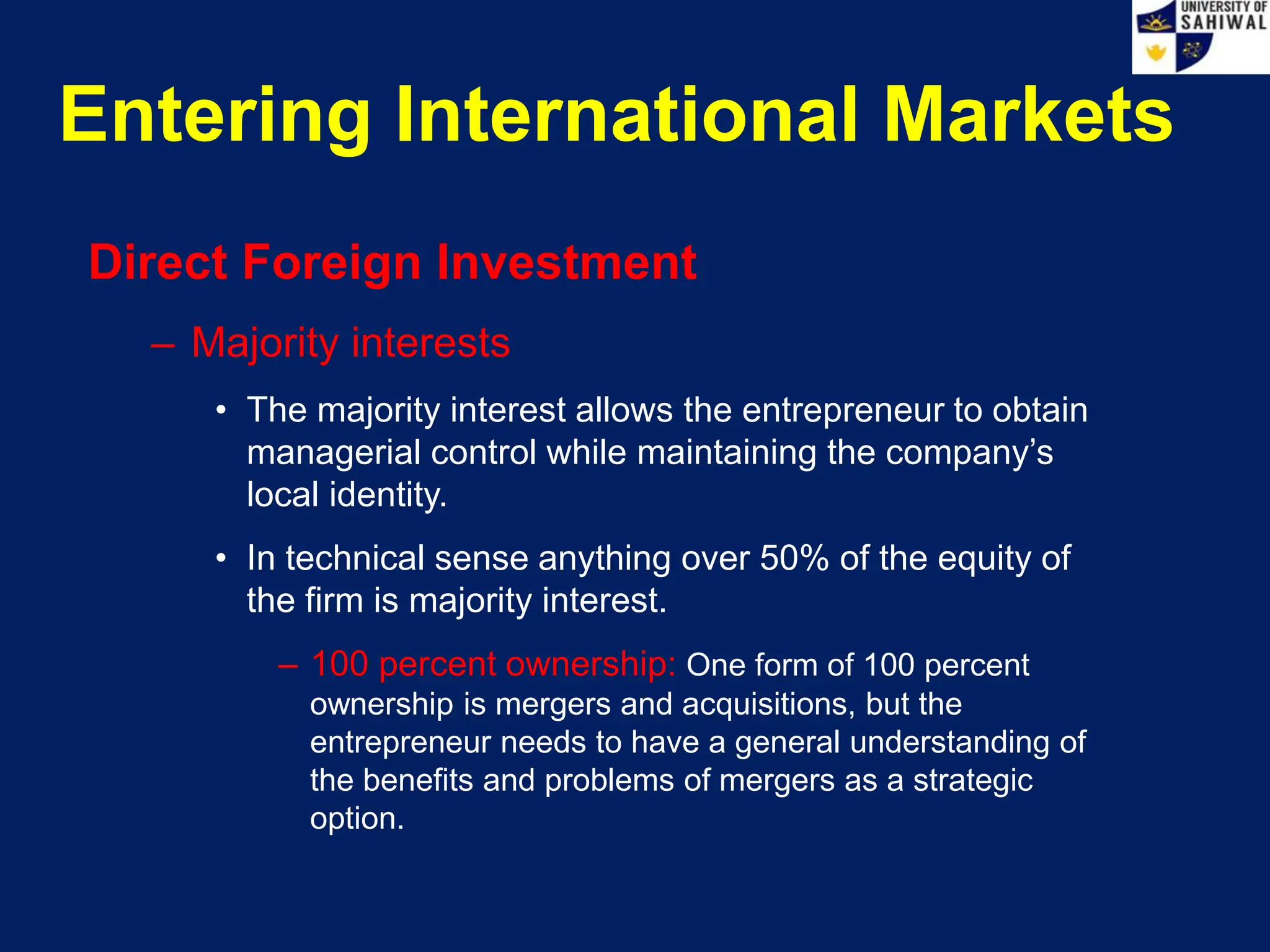
– Majority interests
• The majority interest allows the entrepreneur to obtain
managerial control while maintaining the company’s
local identity.
• In technical sense anything over 50% of the equity of
the firm is majority interest.
– 100 percent ownership: One form of 100 percent
ownership is mergers and acquisitions, but the
entrepreneur needs to have a general understanding of
the benefits and problems of mergers as a strategic
option.
Entering International Markets
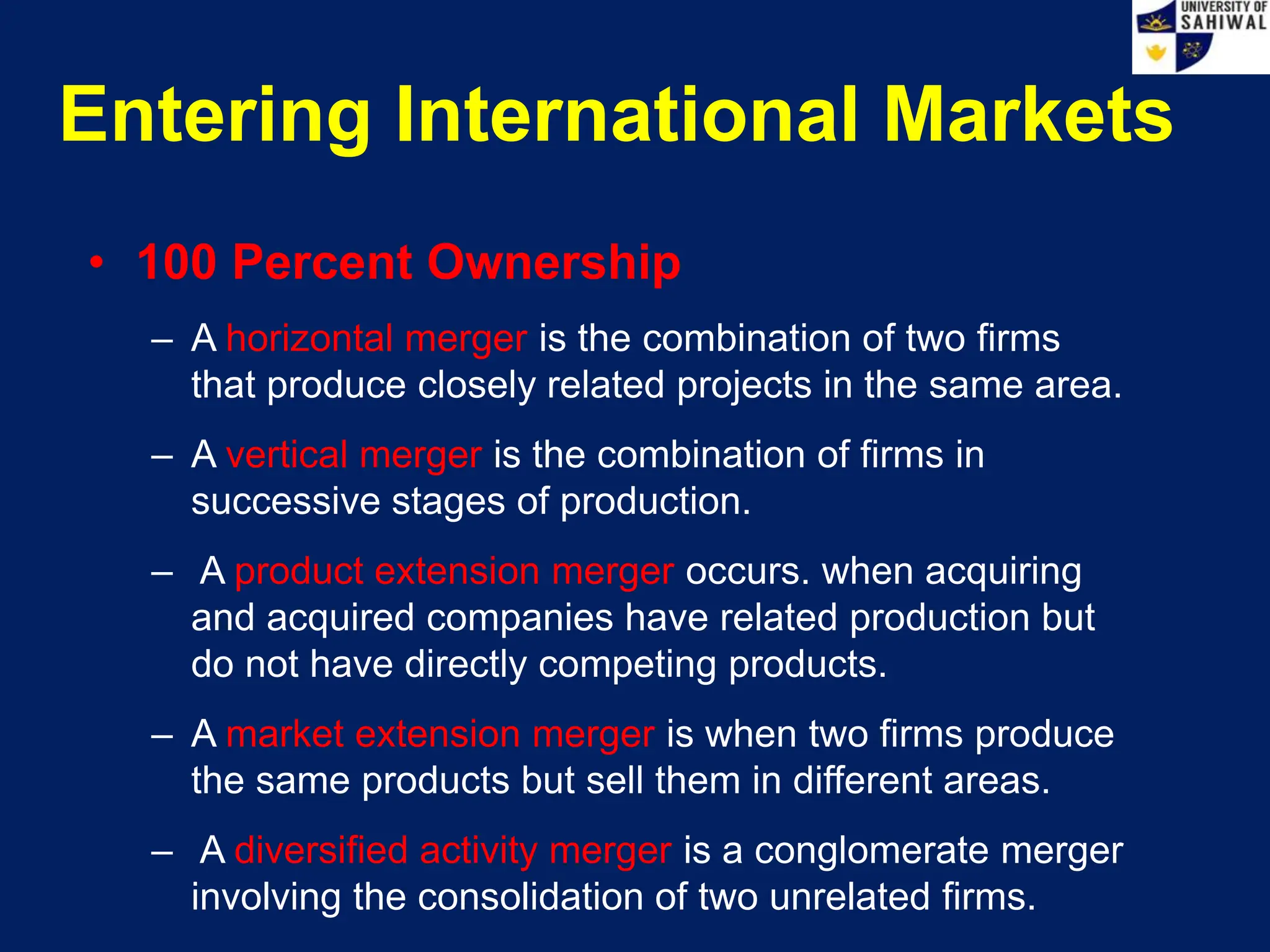
• 100 Percent Ownership
– A horizontal merger is the combination of two firms
that produce closely related projects in the same area.
– A vertical merger is the combination of firms in
successive stages of production.
– A product extension merger occurs. when acquiring
and acquired companies have related production but
do not have directly competing products.
– A market extension merger is when two firms produce
the same products but sell them in different areas.
– A diversified activity merger is a conglomerate merger
involving the consolidation of two unrelated firms.
Barriers to International
Entrepreneurship
• General Agreement on Tariffs and
Trade (GATT)
• Increasing Protectionist Attitudes
• Trade Blocks and Free Trade Areas
• Entrepreneur’s Strategies and Trade
Barriers
Barriers to International
Entrepreneurship
• General Agreement on Tariffs and Trade (GATT)
– GATT is a multilateral agreement with the objective of
liberalizing trade by eliminating tariffs and import
quotas.
– In each round, mutual tariff reductions are negotiated
between member nations. Members can ask for
investigation of violations.
– While GATT has helped develop more unrestricted
trade, its voluntary membership gives it little authority.
Barriers to International
Entrepreneurship
• Increasing Protectionist Attitudes
– Support of free trade increased significantly due to the
rise in protectionist pressures in many countries.
– The persistent U.S. trade deficit has strained the
world trading system.
– The economic success of a country (Japan) perceived
as not playing by the rules has also strained the
trading system.
– In response many countries have established bilateral
voluntary export restrictions.
Barriers to International
Entrepreneurship
• Trade Blocks and Free Trade Areas
– Groups of nations are banding together to increase
investment between nations in the group and exclude
others.
– The North American Free Trade Agreement (NAFTA)
between the U.S., Canada, and Mexico reduces
barriers and encourages investment. The Americas,
Argentina, Brazil, Paraguay, and Uruguay have
created a free trade zone between the countries.
– The European Community (EC) is founded on the
principle of supra-nationality, with member nations not
being able to enter into trade agreements on their own
that are inconsistent with EC regulations.
Barriers to International
Entrepreneurship
• Entrepreneur’s Strategies and Trade Barriers
– Trade barriers pose problems for entrepreneurs who
want to become involved in international business.
– Trade barriers increase the costs of exporting projects
to a country. Voluntary export restrictions may limit the
ability to sell products in a country from production
facilities outside the country.
– An entrepreneur may have to locate assembly or
facilities in a country to conform to the local content
regulations.
Entrepreneurial Partnering
• One of the best methods to enter an international
market is to partner with an entrepreneur in that
country.
• These foreign entrepreneurs know the country and
culture and therefore facilitate business transactions
while keeping the entrepreneur current on business,
economic and political conditions.
• This partnering is facilitated by understanding the
nature of entrepreneurship in the country.
• Three areas of particular interest to U.S.
entrepreneurs are Europe, the Far East and
transition economies.
Sources of New Ideas
• A sound idea for a new product or service, properly
evaluated, is essential to successfully launch a new
venture.
• Some of the more frequently used ideas for new
entrepreneur include
– Consumers
– Existing companies
– Distribution channels
– Federal government
– Research and development.
Sources of New Ideas
• Consumers
– Determine their wants/needs.
• Existing companies
– See if there are ways to improve upon products and
services in the market.
• Distribution channels
– Elicit suggestions from channel members.
• The Federal Government
– Check the Government’s Patent Office files.
• Research and Development
– Conduct your own research & development.
1. Hisrich, R. D., Peters, M. P., Shepherd, D. A., (2017),
Entrepreneurship. McGraw Hill Education. New York
Reference Book /Reading
Material
In case of any query feel free to contact:
kashifali@uosahiwal.edu.pk
Any Questions?
Thank you

week 4 Entrepreneurship of the day with you

  • 1.
    Module: Entrepreneurship Topic: InternationalEntrepreneurial Opportunities Week 4 Kashif Ali Department of Business Administration kashifali@uosahiwal.edu.pk 1
  • 2.
    • To identifythe aspects and importance of international entrepreneurship. • To identify the important strategic issues in international entrepreneurship. • To identify the available options for entering international markets. • To present the problems and barriers to international entrepreneurship. • To explain the aspects of th entrepreneurial process. Learning Objectives
  • 3.
    • To explainthe differences between entrepreneurial and managerial domains. • To explain the organizational environment conducive for entrepreneurship. • To identify the general characteristics of an Entrepreneur. • To explain the process of establishing entrepreneurship in an organization. Learning Objectives (cont’d)
  • 4.
    International Entrepreneurship • International entrepreneurshipis the process of an entrepreneur conducting business activities across national boundaries. • It is exporting, licensing, or opening a sales office in another country. • When an entrepreneur executes his or her business in more than one country, international entrepreneurship occurs.
  • 5.
    Importance of International Entrepreneurship •International business has become increasingly important to firms of all sizes. • The successful entrepreneur will be someone who understands how international business differs from domestic business and is able to act accordingly.
  • 6.
    International Vs Domestic Entrepreneurship •Whether international or domestic, an entrepreneur is concerned about the same basic issues sales, costs, and profits. • What varies is the relative importance of the factors being considered. • International entrepreneurial decisions are more complex due to uncontrollable factors.
  • 7.
    Uncontrollable Factors • Economic •Political-Legal Environment • Cultural Environment • Technological Environment
  • 8.
    Economic • Creating abusiness strategy for multiple countries means dealing with different levels of economic development and different distribution systems. • There are still many difficulties in doing business in developing and transition economies due to: – Gaps in the knowledge of the Western system regarding business plans, marketing, and profits. – Widely variable rates of return. – Differences in the accounting system. – Communications.
  • 9.
    Political-Legal Environment • Multiplepolitical and legal environments create different business problems. • Each element of the international business strategy can potentially be affected by multiple legal environments. • Laws governing business arrangements also vary greatly in the 150 different legal systems and • sets of national laws.
  • 10.
    Cultural Environment • Theimpact of culture on entrepreneurs and strategies is significant. • Understanding the local culture is necessary when developing worldwide plans.
  • 11.
    Technological Environment • Technologyvaries significantly across countries. • New products in a country are created based on the conditions and infrastructure of that country. • Different theories to determine the consumers’ intention to use Technology – Technology Acceptance Model – Theory of Reasoned Action – Theory of Planned Behaviour – Decomposed Theory of Planned Behavior etc.
  • 12.
    Strategic Issues • Theallocation of responsibility between the U.S. and foreign operations. • The nature of the planning and control systems to be used. • The appropriate organizational structure for conducting international operations. • The degree of standardization possible.
  • 13.
    Strategic Issues (Cont’d) •With experience in international operations, entrepreneurs tend to change their approach to responsibility. – Stage 1: In the first stages the entrepreneur typically follows a highly centralized decision making process. – Stage 2: When success occurs, it is no longer possible to use completely centralized decision making process. – Stage 3: Decentralization is scaled back and major strategic decisions are again centralized.
  • 14.
    Strategic Issues (Cont’d) Tounderstand what is required for effective planning, reporting, and control, the entrepreneur should consider: • Environmental analysis. – Market characteristics. – Marketing institutions. – Industry conditions. – Legal environment. – Resources. – Political environment.
  • 15.
    Strategic Issues (Cont’d) •Strategic planning. • Structure. • Operational planning. • Controlling the marketing program.
  • 16.
    Entering International Markets •The choice of entry method depends on the goals of the entrepreneur and the company’s strengths and weaknesses. • Exporting • Non Equity Arrangements • Direct Foreign Investment
  • 17.
    Entering International Markets •Exporting – Indirect exporting involves a foreign purchaser in the local market or using an export management firm. – For certain commodities, foreign buyers seek out sources of supply. – Export management firms, another indirect method, are located in many commercial centers.
  • 18.
    Entering International Markets •Exporting – Direct exporting through independent distributors or through one’s own overseas sales office is another entry method. – An independent foreign distributor directly contacts foreign customers and takes care of all technicalities. – Entrepreneurs who do not wish to give up control over marketing can open overseas sales offices and hire their own salespeople.
  • 19.
    Entering International Markets Nonequity arrangements • Non equity arrangements allow the entrepreneur to enter a market without direct equity investment in the foreign market. – Licensing involves a manufacturer giving a foreign manufacturer the right to use a patent, trademark, or technology in return for a royalty. – This arrangement is most appropriate when the entrepreneur has no prospect of entering the market through exporting or direct investment. – The process is usually low risk and an easy way to generate incremental income.
  • 20.
    Entering International Markets Nonequity arrangements • Non equity arrangements allow the entrepreneur to enter a market without direct equity investment in the foreign market. – Licensing involves a manufacturer giving a foreign manufacturer the right to use a patent, trademark, or technology in return for a royalty. – This arrangement is most appropriate when the entrepreneur has no prospect of entering the market through exporting or direct investment. – The process is usually low risk and an easy way to generate incremental income.
  • 21.
    Entering International Markets DirectForeign Investment – Minority interests • Joint venture: Two firms get together and form a third company in which they share the equity. • Joint ventures have been used by entrepreneurs in two situations: – When the entrepreneur wants to purchase local knowledge and an established facility. – When rapid entry into a market it needed.
  • 22.
    Entering International Markets DirectForeign Investment – Joint venture • Motives for the significant increase in the use of joint ventures: – To share the costs and risks of an uncertain project. – To gain synergy between the two firms. – To obtain a competitive advantage. – To enter markets that pose entrance difficulties
  • 23.
    Entering International Markets DirectForeign Investment – Majority interests • The majority interest allows the entrepreneur to obtain managerial control while maintaining the company’s local identity. • In technical sense anything over 50% of the equity of the firm is majority interest. – 100 percent ownership: One form of 100 percent ownership is mergers and acquisitions, but the entrepreneur needs to have a general understanding of the benefits and problems of mergers as a strategic option.
  • 24.
    Entering International Markets •100 Percent Ownership – A horizontal merger is the combination of two firms that produce closely related projects in the same area. – A vertical merger is the combination of firms in successive stages of production. – A product extension merger occurs. when acquiring and acquired companies have related production but do not have directly competing products. – A market extension merger is when two firms produce the same products but sell them in different areas. – A diversified activity merger is a conglomerate merger involving the consolidation of two unrelated firms.
  • 25.
    Barriers to International Entrepreneurship •General Agreement on Tariffs and Trade (GATT) • Increasing Protectionist Attitudes • Trade Blocks and Free Trade Areas • Entrepreneur’s Strategies and Trade Barriers
  • 26.
    Barriers to International Entrepreneurship •General Agreement on Tariffs and Trade (GATT) – GATT is a multilateral agreement with the objective of liberalizing trade by eliminating tariffs and import quotas. – In each round, mutual tariff reductions are negotiated between member nations. Members can ask for investigation of violations. – While GATT has helped develop more unrestricted trade, its voluntary membership gives it little authority.
  • 27.
    Barriers to International Entrepreneurship •Increasing Protectionist Attitudes – Support of free trade increased significantly due to the rise in protectionist pressures in many countries. – The persistent U.S. trade deficit has strained the world trading system. – The economic success of a country (Japan) perceived as not playing by the rules has also strained the trading system. – In response many countries have established bilateral voluntary export restrictions.
  • 28.
    Barriers to International Entrepreneurship •Trade Blocks and Free Trade Areas – Groups of nations are banding together to increase investment between nations in the group and exclude others. – The North American Free Trade Agreement (NAFTA) between the U.S., Canada, and Mexico reduces barriers and encourages investment. The Americas, Argentina, Brazil, Paraguay, and Uruguay have created a free trade zone between the countries. – The European Community (EC) is founded on the principle of supra-nationality, with member nations not being able to enter into trade agreements on their own that are inconsistent with EC regulations.
  • 29.
    Barriers to International Entrepreneurship •Entrepreneur’s Strategies and Trade Barriers – Trade barriers pose problems for entrepreneurs who want to become involved in international business. – Trade barriers increase the costs of exporting projects to a country. Voluntary export restrictions may limit the ability to sell products in a country from production facilities outside the country. – An entrepreneur may have to locate assembly or facilities in a country to conform to the local content regulations.
  • 30.
    Entrepreneurial Partnering • Oneof the best methods to enter an international market is to partner with an entrepreneur in that country. • These foreign entrepreneurs know the country and culture and therefore facilitate business transactions while keeping the entrepreneur current on business, economic and political conditions. • This partnering is facilitated by understanding the nature of entrepreneurship in the country. • Three areas of particular interest to U.S. entrepreneurs are Europe, the Far East and transition economies.
  • 31.
    Sources of NewIdeas • A sound idea for a new product or service, properly evaluated, is essential to successfully launch a new venture. • Some of the more frequently used ideas for new entrepreneur include – Consumers – Existing companies – Distribution channels – Federal government – Research and development.
  • 32.
    Sources of NewIdeas • Consumers – Determine their wants/needs. • Existing companies – See if there are ways to improve upon products and services in the market. • Distribution channels – Elicit suggestions from channel members. • The Federal Government – Check the Government’s Patent Office files. • Research and Development – Conduct your own research & development.
  • 33.
    1. Hisrich, R.D., Peters, M. P., Shepherd, D. A., (2017), Entrepreneurship. McGraw Hill Education. New York Reference Book /Reading Material
  • 34.
    In case ofany query feel free to contact: kashifali@uosahiwal.edu.pk Any Questions?
  • 35.