Discrete Mathematics
MCA-105
Introduction
• Discrete mathematics is the study of
mathematical structures that are
fundamentally discrete rather than
continuous.
Discrete vs. Continuous Mathematics
Continuous Mathematics
It considers objects that vary continuously;
Example:
– Analog wristwatch (separate hour, minute, and second hands).
– 1:25 pm to 1:27pm
– Real-number system --- core of continuous mathematics;
Discrete Mathematics
It considers objects that vary in a discrete way.
Example:
– Digital wristwatch.
– Integers --- core of discrete mathematics
Problems Covered
• Cover non-continuous domain. For example,
• Is it possible to visit 3 islands in a river with 6
bridges without crossing any bridge more than
once?
• Or, what is the smallest number of telephone
lines needed to connect 200 cities?
Logic
• The rules of logic give precise meaning to
mathematical statements.
• These rules are used to distinguish between
valid and invalid mathematical arguments.
Statement
• A statement is declarative sentence that is
either true or false, but not the both.
• A statement is also referred as a proposition.
Propositional Logic/ Calculus
• The area of logic that deals with propositions is called the propositional
calculus or propositional Logic.
• Example of proposition logic:
– Washington, D.C., is the capital of the United States of America.
– Toronto is the capital of Canada.
– 1 + 1 = 2.
– 2 + 2 = 3.
• Example of not proposition logic
– What time is it?
– Read this carefully.
– x + 1 = 2.
– x + y = z.
• Sentences 1 and 2 are not propositions because they are not declarative
sentences. Sentences 3 and 4 are not propositions because they are
neither true nor false
Propositional Variables
• Variables that represent propositions, just as
letters are used to denote numerical variables.
• If a proposition is true, we say that it has a
truth value of “true” and denoted by T.
• If a proposition is false, we say that it has a
truth value of “false” and denoted by F.
Compound Proposition
• Many mathematical statements are
constructed by combining (logical operators)
one or more propositions.
• Examples
• “3+2=5” and “Kurukshetra is a city”
• “the grass is green” or “it is raining”
• “Discrete mathematics is a subject not difficult
to me”
Compound Propositions
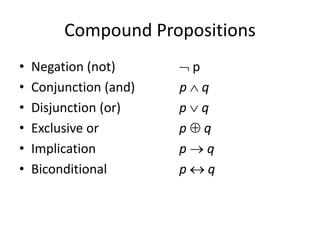
• Negation (not)  p
• Conjunction (and) p  q
• Disjunction (or) p  q
• Exclusive or p  q
• Implication p  q
• Biconditional p  q
Negation
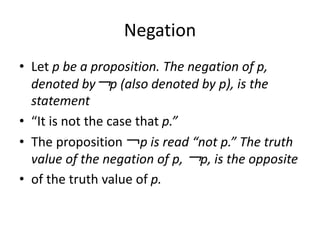
• Let p be a proposition. The negation of p,
denoted by¬p (also denoted by p), is the
statement
• “It is not the case that p.”
• The proposition ¬p is read “not p.” The truth
value of the negation of p, ¬p, is the opposite
• of the truth value of p.
Example of Negation
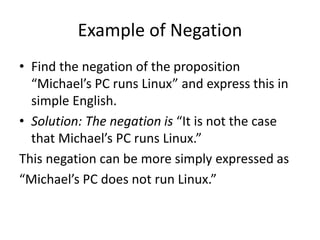
• Find the negation of the proposition
“Michael’s PC runs Linux” and express this in
simple English.
• Solution: The negation is “It is not the case
that Michael’s PC runs Linux.”
This negation can be more simply expressed as
“Michael’s PC does not run Linux.”
Question
• Find the negation of the proposition
“Vandana’s smartphone has at least 32GB of
memory” and express this in simple English.
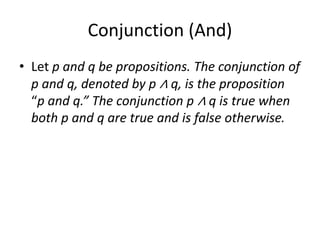
Conjunction (And)
• Let p and q be propositions. The conjunction of
p and q, denoted by p ∧ q, is the proposition
“p and q.” The conjunction p ∧ q is true when
both p and q are true and is false otherwise.
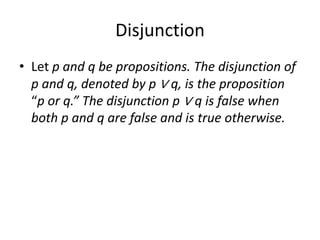
Disjunction
• Let p and q be propositions. The disjunction of
p and q, denoted by p ∨ q, is the proposition
“p or q.” The disjunction p ∨ q is false when
both p and q are false and is true otherwise.
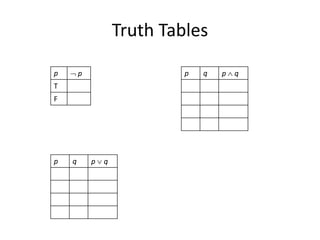
Truth Tables
p  p
T
F
p q p  q
p q p  q
Reference
• “Discrete mathematics and its applications” by
Kenneth H. Rosen, 7th Edition, TMH.

DM 1.pptx

  • 1.
  • 2.
    Introduction • Discrete mathematicsis the study of mathematical structures that are fundamentally discrete rather than continuous.
  • 3.
    Discrete vs. ContinuousMathematics Continuous Mathematics It considers objects that vary continuously; Example: – Analog wristwatch (separate hour, minute, and second hands). – 1:25 pm to 1:27pm – Real-number system --- core of continuous mathematics; Discrete Mathematics It considers objects that vary in a discrete way. Example: – Digital wristwatch. – Integers --- core of discrete mathematics
  • 4.
    Problems Covered • Covernon-continuous domain. For example, • Is it possible to visit 3 islands in a river with 6 bridges without crossing any bridge more than once? • Or, what is the smallest number of telephone lines needed to connect 200 cities?
  • 5.
    Logic • The rulesof logic give precise meaning to mathematical statements. • These rules are used to distinguish between valid and invalid mathematical arguments.
  • 6.
    Statement • A statementis declarative sentence that is either true or false, but not the both. • A statement is also referred as a proposition.
  • 7.
    Propositional Logic/ Calculus •The area of logic that deals with propositions is called the propositional calculus or propositional Logic. • Example of proposition logic: – Washington, D.C., is the capital of the United States of America. – Toronto is the capital of Canada. – 1 + 1 = 2. – 2 + 2 = 3. • Example of not proposition logic – What time is it? – Read this carefully. – x + 1 = 2. – x + y = z. • Sentences 1 and 2 are not propositions because they are not declarative sentences. Sentences 3 and 4 are not propositions because they are neither true nor false
  • 8.
    Propositional Variables • Variablesthat represent propositions, just as letters are used to denote numerical variables. • If a proposition is true, we say that it has a truth value of “true” and denoted by T. • If a proposition is false, we say that it has a truth value of “false” and denoted by F.
  • 9.
    Compound Proposition • Manymathematical statements are constructed by combining (logical operators) one or more propositions. • Examples • “3+2=5” and “Kurukshetra is a city” • “the grass is green” or “it is raining” • “Discrete mathematics is a subject not difficult to me”
  • 10.
    Compound Propositions • Negation(not)  p • Conjunction (and) p  q • Disjunction (or) p  q • Exclusive or p  q • Implication p  q • Biconditional p  q
  • 11.
    Negation • Let pbe a proposition. The negation of p, denoted by¬p (also denoted by p), is the statement • “It is not the case that p.” • The proposition ¬p is read “not p.” The truth value of the negation of p, ¬p, is the opposite • of the truth value of p.
  • 12.
    Example of Negation •Find the negation of the proposition “Michael’s PC runs Linux” and express this in simple English. • Solution: The negation is “It is not the case that Michael’s PC runs Linux.” This negation can be more simply expressed as “Michael’s PC does not run Linux.”
  • 13.
    Question • Find thenegation of the proposition “Vandana’s smartphone has at least 32GB of memory” and express this in simple English.
  • 14.
    Conjunction (And) • Letp and q be propositions. The conjunction of p and q, denoted by p ∧ q, is the proposition “p and q.” The conjunction p ∧ q is true when both p and q are true and is false otherwise.
  • 15.
    Disjunction • Let pand q be propositions. The disjunction of p and q, denoted by p ∨ q, is the proposition “p or q.” The disjunction p ∨ q is false when both p and q are false and is true otherwise.
  • 16.
    Truth Tables p p T F p q p  q p q p  q
  • 17.
    Reference • “Discrete mathematicsand its applications” by Kenneth H. Rosen, 7th Edition, TMH.

Editor's Notes

  • #6 In this slide, we will cover mathematical argument/statement and introduce tools to construct these arguments.