Presented By: Ms. Kalaivani Sathish M. Pharm
Assistant Professor,
PIMS - Panipat
 Diuretics is an agent which increase
urine and solute.it may be classified
as follows:
 1. HIGH EFFICACY DIURETICS
 Furosemide,azosemide,
bumetanide,piretanide,torsemide.
 2.MODERATE EFFICACY DIURETICS
 THIAZIDES
 Benzothiadiazines –
chlorothiazide,hydrochlorothiazide,
 polythiazide
 THIAZIDE RELATED AGENT
 Chlorthalidone,clopamide,
 indapamide,metolazone,xipamide.
 3.LOW EFFICACY DIURETICS
 POTASSIUM SPARING DIURETICS
 Triamterene,amiloride,spironolactone.
 CARBONIC ANHYDRASE INHIBITOR
 Acetazolamide,methazolamide,
 dorzolamide
 OSMOTIC DIURETICS
 Mannitol,urea,glycerol
 METHYLXANTHINE
 Theophylline
 4.NEWER AGENT
 Vasopressin antagonist –
conivaptan,tolvaptan,lixirvapta
n.
 Loop diuretics act on the
ascending limb of the loop of
henle.frusemide is the most
commonly used diuretics.it is a
sulphonamide derivative.it is a
powerful diuretics.
 Frusemide acts by inhibiting NaCL
reabsorption in the thick ascending limb
of the Henles loop.it blocks the Na K
2CL symporter in the loop.it greatly
increase the excretion of Na and CL in
the urine.as large amount of NaCL is
absorbed in this segment. Diuretic
response increases with dose and over
treatment may cause dehydration.
In Loop of Henle
Frusemide inhibits Na Cl reabsorption
Increase the excretion of Na & Cl in urine
Leads to increased urinary output
In Loop of Henle
Frusemide inhibits Na Cl reabsorption
Increase the excretion of Na & Cl in urine
Leads to increased urinary output
 Frusemide is also a weak carbonic
enhydrase inhibitor hence it increase
the excretion of HCO3 and
phosphate.
 PHARMACOKINETICS
 Frusemide is rapidly absorbed orally,
highly bound to plasma
proteins,metabolized in the liver and
excreted by kidneys.IV it acts in 2-5
minutes,oral it takes
 20-40minutes.
 BUMETANIDE
 Is a sulfonamide like Frusemide but
it is 40 times more potent than
Frusemide.
 TORSEMIDE
 Is longer acting and can be given
once a day.
 ETHACRYNIC ACID
 Is more likely to cause adverse effect
ototoxicity and is not commonly used.
 Hyperkalemia and metabolic
alkalosis
 dehydration,
 hypotension
 Hyperuricemia,hypocalcemia,
 Hypomagnesemia,ototoxicity,
 Hyperglycemia,skinrashes,
 nausea,vomitting,hypotension,
 Weakness.
 Edema
 Acute renal failure
 Acute pulmanary edema
 Cerebral edema
 Forced diuresis:in poisoning due
to drug like barbiturates and
salicylates, Frusemide is used
with IV fluids.
 Hypertension with renal
impairment
 Chlorthiazide was the first thiazide to be
synthesized.
 Mechanism of action
 Thiazide act on the early distal tubule.it
have a moderate efficacy 90% of the filtered
sodium is already reabsorbed before
reaching the distal tubule.they also inhibit
carbonic anhydrase activity and increase
bicarbonate loss.it also enhance excretion of
Mg and K .But they inhibit urinary
excretion of Ca and uric acid resulting in
hypercalcemia and hyperuricemia.
In early distal tubule
inhibit carbonic anhydrase activity and increase bicarbonate
loss
Enhance excretion of Mg and K and Inhibit urinary excretion
of Ca and uric acid
Leads to increased urinary output
In early distal tubule
inhibit carbonic anhydrase activity and increase bicarbonate
loss
Enhance excretion of Mg and K and Inhibit urinary excretion
of Ca and uric acid
Leads to increased urinary output
Thiazides are well absorbed
orally and are rapid
acting.they are excreted by
kidney.
Hyperkalemia,hyperuricemia,
hypotension,hyperglycemia,
GIT disturbance,allergic
reaction.
Hypertension
Congestive heart failure
Edema
Renal stones
Diabetes insipidus
Example of potassium sparing
diuretics is Spironolactone it is an
aldosterone antagonist,
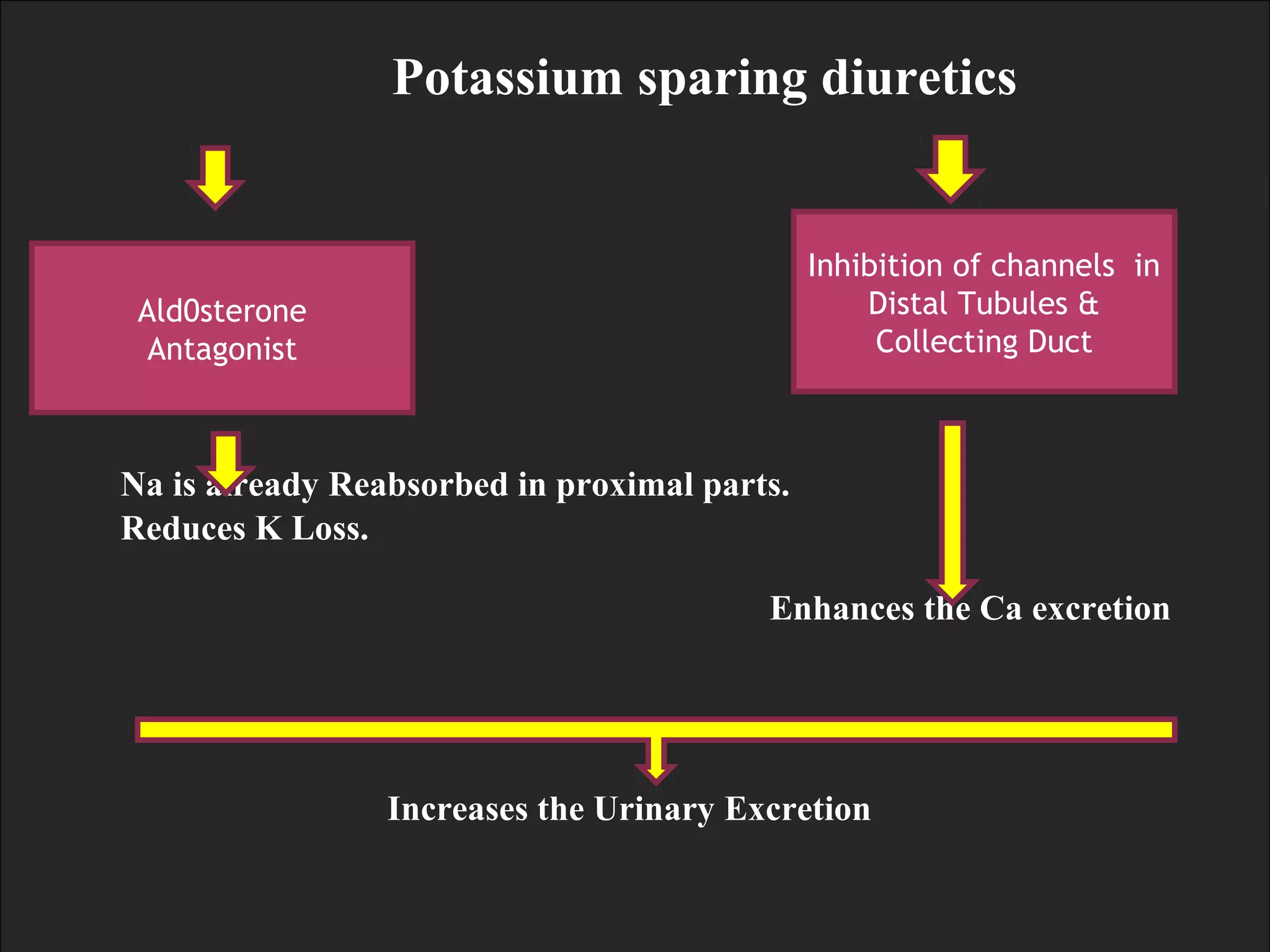
 It may act two ways .they may be
aldosterone antagonist or directly
inhibition of channels in distal tubes
and collecting duct.
 Major amount of Na is reabsorbed is
proximal parts. It also reduces K
loss
Potassium sparing diuretics
Na is already Reabsorbed in proximal parts.
Reduces K Loss.
Enhances the Ca excretion
Increases the Urinary Excretion
Potassium sparing diuretics
Na is already Reabsorbed in proximal parts.
Reduces K Loss.
Enhances the Ca excretion
Increases the Urinary Excretion
Ald0sterone
Antagonist
Inhibition of channels in
Distal Tubules &
Collecting Duct
 Mannitol is an osmotic diuretics.
 Given in IV (Orally Not Absorbed), it gets
filtered by the glomerulus but not
reabsorbed.
 It causes water to be retained in proximal
tubule and descending loop of Henle, by
osmotic effect resulting in water diuresis.
 There is also some loss of sodium.
 Increased Osmotic Pressure in Proximal
Tubule
 Decreased Water reabsorption
 Increased Urine Excretion
 To maintain urine volume and prevent
oliguria (Decreased Urine Output)
 To reduce ICP and IOP following
head injury and Glaucoma
respectively.

Diuretics

  • 1.
    Presented By: Ms.Kalaivani Sathish M. Pharm Assistant Professor, PIMS - Panipat
  • 2.
     Diuretics isan agent which increase urine and solute.it may be classified as follows:  1. HIGH EFFICACY DIURETICS  Furosemide,azosemide, bumetanide,piretanide,torsemide.  2.MODERATE EFFICACY DIURETICS  THIAZIDES  Benzothiadiazines – chlorothiazide,hydrochlorothiazide,  polythiazide
  • 3.
     THIAZIDE RELATEDAGENT  Chlorthalidone,clopamide,  indapamide,metolazone,xipamide.  3.LOW EFFICACY DIURETICS  POTASSIUM SPARING DIURETICS  Triamterene,amiloride,spironolactone.  CARBONIC ANHYDRASE INHIBITOR  Acetazolamide,methazolamide,  dorzolamide
  • 4.
     OSMOTIC DIURETICS Mannitol,urea,glycerol  METHYLXANTHINE  Theophylline  4.NEWER AGENT  Vasopressin antagonist – conivaptan,tolvaptan,lixirvapta n.
  • 5.
     Loop diureticsact on the ascending limb of the loop of henle.frusemide is the most commonly used diuretics.it is a sulphonamide derivative.it is a powerful diuretics.
  • 6.
     Frusemide actsby inhibiting NaCL reabsorption in the thick ascending limb of the Henles loop.it blocks the Na K 2CL symporter in the loop.it greatly increase the excretion of Na and CL in the urine.as large amount of NaCL is absorbed in this segment. Diuretic response increases with dose and over treatment may cause dehydration.
  • 7.
    In Loop ofHenle Frusemide inhibits Na Cl reabsorption Increase the excretion of Na & Cl in urine Leads to increased urinary output In Loop of Henle Frusemide inhibits Na Cl reabsorption Increase the excretion of Na & Cl in urine Leads to increased urinary output
  • 8.
     Frusemide isalso a weak carbonic enhydrase inhibitor hence it increase the excretion of HCO3 and phosphate.  PHARMACOKINETICS  Frusemide is rapidly absorbed orally, highly bound to plasma proteins,metabolized in the liver and excreted by kidneys.IV it acts in 2-5 minutes,oral it takes  20-40minutes.
  • 9.
     BUMETANIDE  Isa sulfonamide like Frusemide but it is 40 times more potent than Frusemide.  TORSEMIDE  Is longer acting and can be given once a day.  ETHACRYNIC ACID  Is more likely to cause adverse effect ototoxicity and is not commonly used.
  • 10.
     Hyperkalemia andmetabolic alkalosis  dehydration,  hypotension  Hyperuricemia,hypocalcemia,  Hypomagnesemia,ototoxicity,  Hyperglycemia,skinrashes,  nausea,vomitting,hypotension,  Weakness.
  • 11.
     Edema  Acuterenal failure  Acute pulmanary edema  Cerebral edema  Forced diuresis:in poisoning due to drug like barbiturates and salicylates, Frusemide is used with IV fluids.  Hypertension with renal impairment
  • 12.
     Chlorthiazide wasthe first thiazide to be synthesized.  Mechanism of action  Thiazide act on the early distal tubule.it have a moderate efficacy 90% of the filtered sodium is already reabsorbed before reaching the distal tubule.they also inhibit carbonic anhydrase activity and increase bicarbonate loss.it also enhance excretion of Mg and K .But they inhibit urinary excretion of Ca and uric acid resulting in hypercalcemia and hyperuricemia.
  • 13.
    In early distaltubule inhibit carbonic anhydrase activity and increase bicarbonate loss Enhance excretion of Mg and K and Inhibit urinary excretion of Ca and uric acid Leads to increased urinary output In early distal tubule inhibit carbonic anhydrase activity and increase bicarbonate loss Enhance excretion of Mg and K and Inhibit urinary excretion of Ca and uric acid Leads to increased urinary output
  • 14.
    Thiazides are wellabsorbed orally and are rapid acting.they are excreted by kidney. Hyperkalemia,hyperuricemia, hypotension,hyperglycemia, GIT disturbance,allergic reaction.
  • 15.
  • 16.
    Example of potassiumsparing diuretics is Spironolactone it is an aldosterone antagonist,
  • 17.
     It mayact two ways .they may be aldosterone antagonist or directly inhibition of channels in distal tubes and collecting duct.  Major amount of Na is reabsorbed is proximal parts. It also reduces K loss
  • 18.
    Potassium sparing diuretics Nais already Reabsorbed in proximal parts. Reduces K Loss. Enhances the Ca excretion Increases the Urinary Excretion Potassium sparing diuretics Na is already Reabsorbed in proximal parts. Reduces K Loss. Enhances the Ca excretion Increases the Urinary Excretion Ald0sterone Antagonist Inhibition of channels in Distal Tubules & Collecting Duct
  • 19.
     Mannitol isan osmotic diuretics.  Given in IV (Orally Not Absorbed), it gets filtered by the glomerulus but not reabsorbed.  It causes water to be retained in proximal tubule and descending loop of Henle, by osmotic effect resulting in water diuresis.  There is also some loss of sodium.
  • 20.
     Increased OsmoticPressure in Proximal Tubule  Decreased Water reabsorption  Increased Urine Excretion
  • 21.
     To maintainurine volume and prevent oliguria (Decreased Urine Output)  To reduce ICP and IOP following head injury and Glaucoma respectively.