Diuretics
Dr. Pravin Prasad
M.B.B.S., MD Clinical Pharmacology
Lecturer, Lumbini Medical College & TH
8 April 2019 (25 Chaitra 2075), Monday
By the end of this class, MBBS
Sem III students will be able
to:
Classify diuretics
Explain the mechanism of action of loop
diuretics and thiazide diuretics
Compare the adverse effects of loop diuretics
and thiazide diuretics
List their uses
Identify their common drug interactions
Preliminaries
Relevant Physiology
Functional Unit of Kidney
Nephron
Parts of nephron:
Glomerulus
Proximal Tubule
Loop of Henle
Distal Tubule
Collecting Duct
Relevant Physiology
Process of urine formation
Ultrafiltration
Tubular reabsorption
Tubular secretion
Relevant Physiology
Pharmacologically,
nephron is divided into:
Site I: Proximal
Convoluted Tubule
Site II: Thick Ascending
Limb of Loop of Henle
Site III: Cortical Diluting
segment of Loop of
Henle
Site IV: Distal
Convoluted Tubule and
Urinary constituent
movements: Site I
Sodium Potassium Water
Reabsorbed Reabsorbed
Along the
osmotic gradient
4 Processes:
• Direct entry
• Coupled to
absorption of
anions
• Exchanged with H+
• Passive diffusion
Utilizes:
• Paracellula
r pathways
Utilizes:
• Transcellular
aquaporin-1
channels
• Paracellular
pathways
Urinary constituent
movements: Site II
Movement of only salts occur
Impermeable to water
Luminal fluid
Cuboidal
cells of TAL
(medullary
portion)
Na+-K+-2Cl-
K+ Cl-
K+
Na+
Na+
Ca2+, Mg2+
Extracellular fluid
Urinary constituent
movements: Site III
Movement of only salts occur
Impermeable to water
Luminal fluid
Extracellular fluid
Cl-Na+
Na+-Cl- symporter No reabsorption or secretion of K+
Urinary constituent
movements: Site IV
Comprises of
Distal tubule
Collecting duct
Two types of cells
Principal cells
Intercalated cells
Urinary constituent
movements: Site IV
Principal cells
Intercalated
cells
Luminal fluid
Extracellular fluid
K+
Na+
Na+
Na+
Amiloride sensitive renal epithelial Na+
channels
• Sodium channel
• Present in renal epithelial cells
• Sensitive to amiloride
Modulated by aldosterone
H+
Diuretics
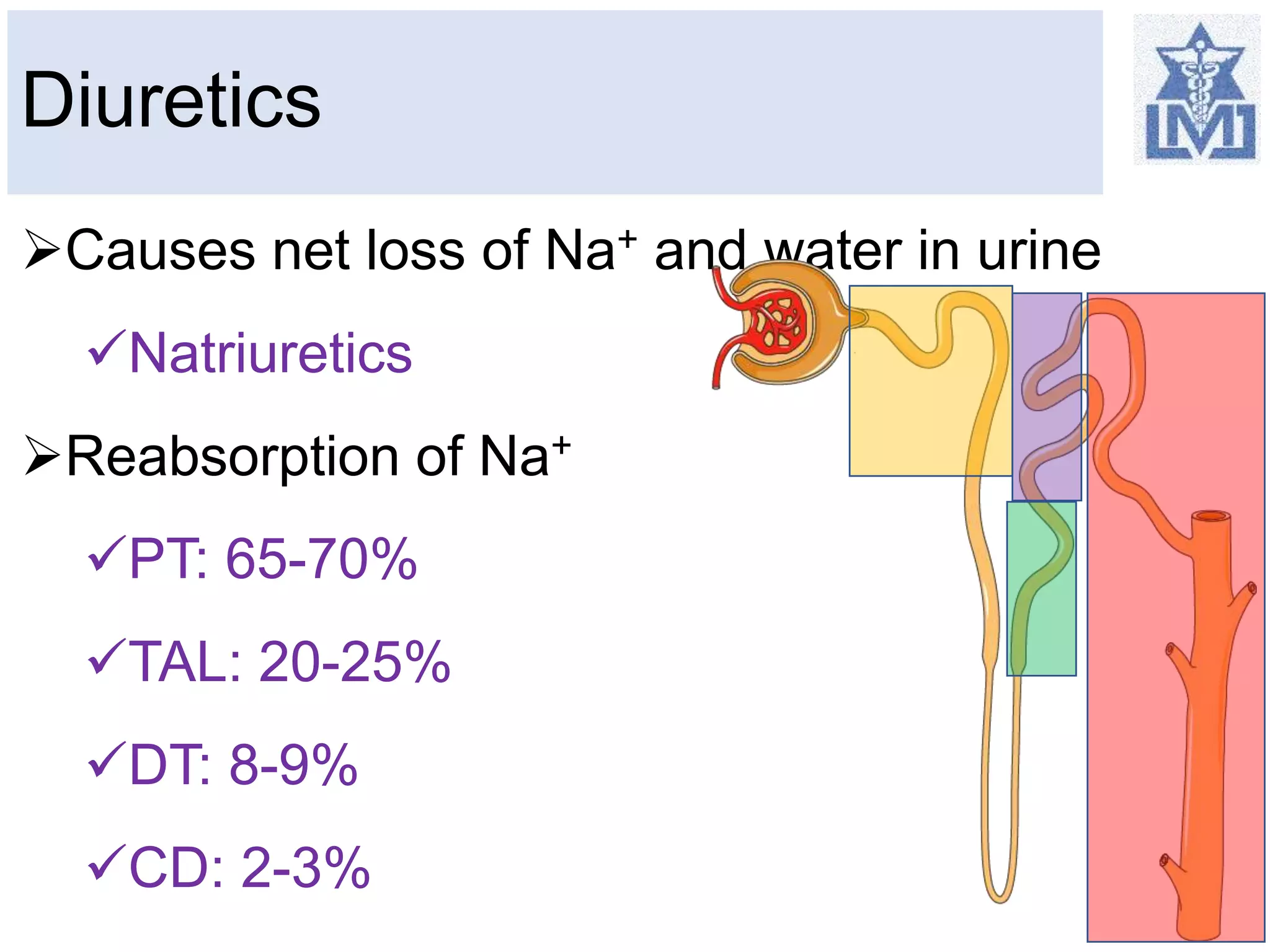
Causes net loss of Na+ and water in urine
Natriuretics
Reabsorption of Na+
PT: 65-70%
TAL: 20-25%
DT: 8-9%
CD: 2-3%
Diuretics: Classification
High ceiling
Medium efficacy
Weak / adjunctive
• Furosemide
• Bumetanide
• Torasemide
Diuretics: Classification
High ceiling
Medium efficacy
Weak / adjunctive
Benzothiadiazines
• Hydrochlorothiazide
• Hydroflumethiazine
• Benzthiazide
Thiazide like
• Chlorthalidone
• Metolazone
• Xipamide
• Indapamide
• Clopamide
Diuretics: Classification
High ceiling
Medium efficacy
Weak / adjunctive
Carbonic Anhydrase
Inhibitors
• Acetazolamide
Osmotic Diuretics
• Mannitol
• Isosorbide, Glycerol
Potassium sparing
diuretics
• Spironolactone,
Eplerenone
• Amiloride,
High ceiling diuretics
Furosemide, Bumetanide, Torasemide
Dose dependent diuresis occurs
Up to 10L/d of urine can be produced
Quick onset of action
Intravenous: 2-5 mins, Oral 20-40 mins
Short duration of action
4-6 hours
Furosemide: Mechanism of
action
Secreted by Organic anion transporter (OATP)
present in PT cells
Reaches Thick Ascending Limb of LoH
Inhibits Na+-K+-2Cl- cotransporter
• Decreased absorption of Na+
• High amount of Na+ and water excreted in
urine
Furosemide: Mechanism of
Action
Luminal fluid
Cuboidal
cells of TAL
(medullary
portion)
Na+-K+-2Cl-
K+ Cl-
K+
Na+
Na+
Ca2+, Mg2+
Extracellular fluid
Furosemide: Mechanism of
action
Minor actions:
Inhibits Carbonic anhydrase enzyme in PT
• Increase HCO3
- excretion
• Mild alkalosis in high dose (due to loss of
Cl-)
Increased local PG synthesis
• Altered intrarenal haemodynamic
Furosemide: Other actions
Prompt increase in systemic venous
capacitance
PG mediated
Decreases left ventricular filling pressure
Affords quick relief in Left ventricular failure
and Pulmonary oedema
Furosemide: Pharmacokinetics
Absorption after oral administration takes 2-3
hours
Bioavailability 60%
Reduced in severe congestive heart failure
Plasma t1/2 1-2 hour
Single oral dose acts for 4-6 hrs
Prolonged in pulmonary oedema, renal and
hepatic insufficiency
Loop diuretics: Uses
Oedema
Acute pulmonary oedema
Hypertension
Co-existing renal insufficiency, CHF,
resistant cases, hypertensive emergencies
Along with Blood Transfusion
Hypercalcemia of malignancy
Cerebral oedema
Medium efficacy diuretics
Thiazide and thiazide like drugs
Have flat dose-response curves
Acts in cortical diluting segment of
LoH or early DT
Acts by inhibiting Na+-Cl- symporter
Additional carbonic anhydrase
inhibitor action
Alkaline urine rich in Cl- produced
Thiazide: Mechanism of action
Secreted by OATP in PT
Reaches cortical diluting segment or early DT
along luminal fluid
Inhibits Na+-Cl- symporter
Decreased Na+ and Cl- absorption
Increased urine passed
Thiazide: Mechanism of action
Luminal fluid
Extracellular fluid
Cl-Na+
Na+-Cl- symporter No reabsorption or secretion of K+
Thiazides: Other actions
Additional carbonic anhydrase inhibitory action
Increase HCO3
- and PO4
3- excretion
Reduces GFR
By reducing blood volume and by inducing
intrarenal haemodynamic changes
• Not effective in patients with low GFR
Extrarenal actions
Slow developing fall in BP
Elevation of blood sugar
Thiazides: Pharmacokinetics
Well absorbed orally
Action starts within 1 hour, duration 6-48 hrs
Hydrochlorothiazide: 6hrs
Chlorthalidone: 48 hrs
Variable distribution (depends on lipid
solubility)
Eliminated mainly unchanged in urine
Thiazides: Uses
Hypertension
One of the First line drugs (Chlorthalidone)
Oedema
Diabetes Insipidus (DI)
Nephrogenic DI
Hypercalciuria with recurrent calcium stones in
the kidney
ADRs: Loop Diuretics vs
Thiazides
Loop Diuretics Thiazide
Hypokalaemia Less common
More
common
Acute Saline
Depletion
Seen
Not So
Common
Dilutional
Hyponatremia
After vigorous use
of Loop diuretics in
CHF
Rare
ADRs: Loop Diuretics vs
Thiazides
Loop Diuretics Thiazide
GIT and CNS
Disturbances
Nausea/Vomiting, diarrhoea,
headache, giddiness, weakness,
paraesthesia, impotence
Allergic
manifestation
• Rashes, photosensitivity
• Rarely blood dyscrasias
• Sulphonamide hypersensitivity
Hearing Loss
Only with Loop
diuretics
ADRs: Loop Diuretics vs
Thiazides
Loop Diuretics Thiazide
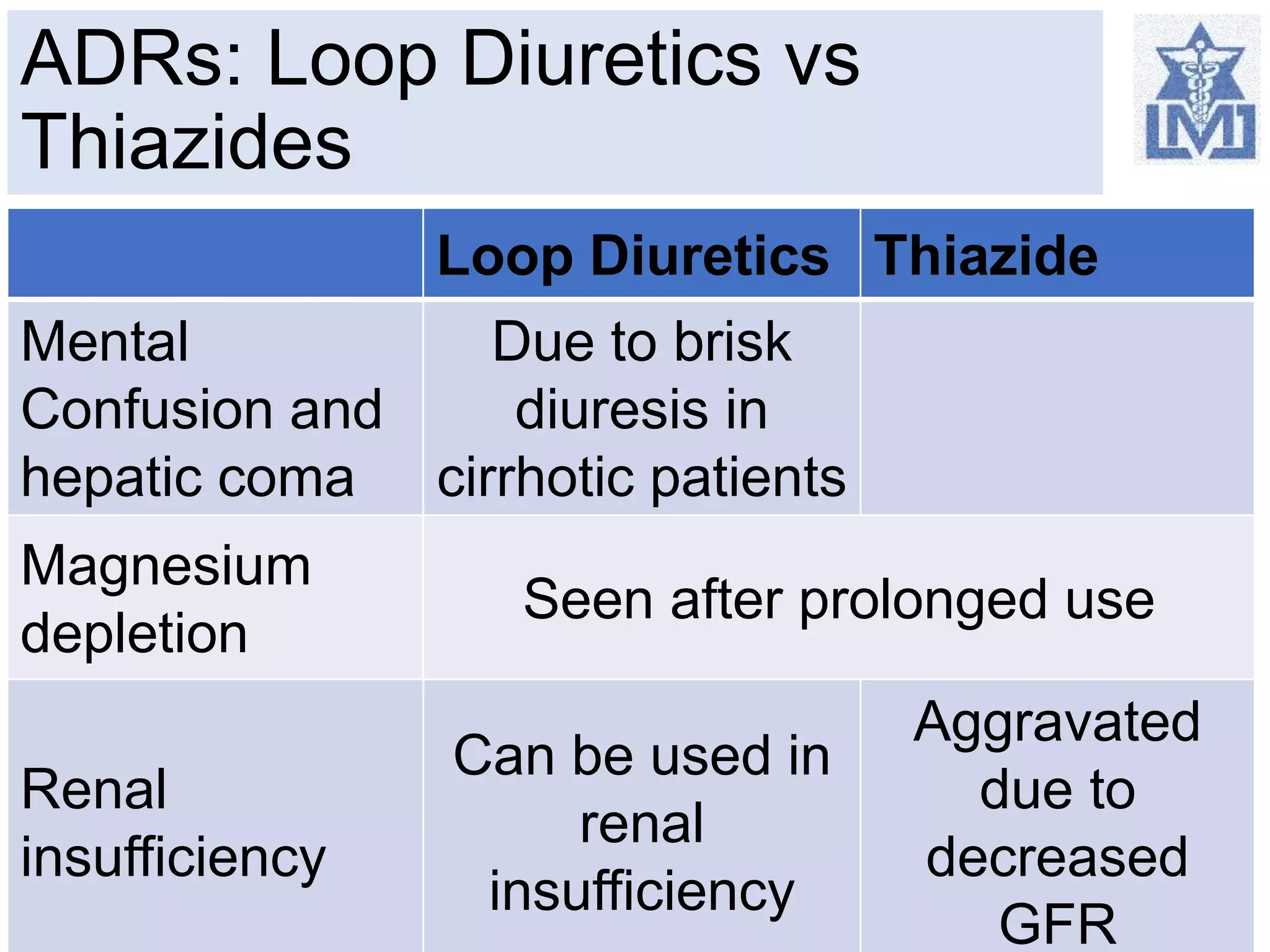
Mental
Confusion and
hepatic coma
Due to brisk
diuresis in
cirrhotic patients
Magnesium
depletion
Seen after prolonged use
Renal
insufficiency
Can be used in
renal
insufficiency
Aggravated
due to
decreased
GFR
ADRs: Loop Diuretics vs
Thiazides
Loop
Diuretics
Thiazide
Hyperuricemia Less common
High dose
thiazides
Hyperglycaemi
a,
hyperlipidaemi
a
Hypocalcaemia
Seen on
chronic Not seen
Drug Interactions: Loop
diuretics and Thiazides
Potentiates all other antihypertensives
As it induces Hypokalaemia:
Enhances digitalis toxicity
Increased risk of Cardiac arrhythmia
Reduces sulfonylurea action (oral
hypoglycaemics)
Drug Interactions: Loop
diuretics and Thiazides
Additive ototoxicity and nephrotoxicity of
aminoglycosides
Actions reduced when used with indomethacin
and other NSAIDs
Probenecid and diuretics reduces each other’s
actions
Serum Lithium level rises
Post Test
All of the following are the adverse effects of
thiazide diuretics EXCEPT:
?Hypomagnesemia
?Hypovolaemia
?Hypocalcaemia
?Hypokalaemia
Conclusion
Diuretics can be broadly grouped into three
categories
Loop diuretics acts by inhibiting Na+-K+-2Cl-
cotransporter, Thiazides act by inhibiting Na+-Cl-
symporter
Loop diuretics and thiazides share some side
effects and have some specific side effects
Are commonly employed in HTN, oedema
Drug interactions of loop diuretics can enhance
Any queries?
Next class:
Wednesday
Continue Diuretics
Revise the topics
from BOOK
Thank you.

Diuretics

  • 1.
    Diuretics Dr. Pravin Prasad M.B.B.S.,MD Clinical Pharmacology Lecturer, Lumbini Medical College & TH 8 April 2019 (25 Chaitra 2075), Monday
  • 2.
    By the endof this class, MBBS Sem III students will be able to: Classify diuretics Explain the mechanism of action of loop diuretics and thiazide diuretics Compare the adverse effects of loop diuretics and thiazide diuretics List their uses Identify their common drug interactions
  • 3.
  • 4.
    Relevant Physiology Functional Unitof Kidney Nephron Parts of nephron: Glomerulus Proximal Tubule Loop of Henle Distal Tubule Collecting Duct
  • 5.
    Relevant Physiology Process ofurine formation Ultrafiltration Tubular reabsorption Tubular secretion
  • 6.
    Relevant Physiology Pharmacologically, nephron isdivided into: Site I: Proximal Convoluted Tubule Site II: Thick Ascending Limb of Loop of Henle Site III: Cortical Diluting segment of Loop of Henle Site IV: Distal Convoluted Tubule and
  • 7.
    Urinary constituent movements: SiteI Sodium Potassium Water Reabsorbed Reabsorbed Along the osmotic gradient 4 Processes: • Direct entry • Coupled to absorption of anions • Exchanged with H+ • Passive diffusion Utilizes: • Paracellula r pathways Utilizes: • Transcellular aquaporin-1 channels • Paracellular pathways
  • 8.
    Urinary constituent movements: SiteII Movement of only salts occur Impermeable to water Luminal fluid Cuboidal cells of TAL (medullary portion) Na+-K+-2Cl- K+ Cl- K+ Na+ Na+ Ca2+, Mg2+ Extracellular fluid
  • 9.
    Urinary constituent movements: SiteIII Movement of only salts occur Impermeable to water Luminal fluid Extracellular fluid Cl-Na+ Na+-Cl- symporter No reabsorption or secretion of K+
  • 10.
    Urinary constituent movements: SiteIV Comprises of Distal tubule Collecting duct Two types of cells Principal cells Intercalated cells
  • 11.
    Urinary constituent movements: SiteIV Principal cells Intercalated cells Luminal fluid Extracellular fluid K+ Na+ Na+ Na+ Amiloride sensitive renal epithelial Na+ channels • Sodium channel • Present in renal epithelial cells • Sensitive to amiloride Modulated by aldosterone H+
  • 12.
    Diuretics Causes net lossof Na+ and water in urine Natriuretics Reabsorption of Na+ PT: 65-70% TAL: 20-25% DT: 8-9% CD: 2-3%
  • 13.
    Diuretics: Classification High ceiling Mediumefficacy Weak / adjunctive • Furosemide • Bumetanide • Torasemide
  • 14.
    Diuretics: Classification High ceiling Mediumefficacy Weak / adjunctive Benzothiadiazines • Hydrochlorothiazide • Hydroflumethiazine • Benzthiazide Thiazide like • Chlorthalidone • Metolazone • Xipamide • Indapamide • Clopamide
  • 15.
    Diuretics: Classification High ceiling Mediumefficacy Weak / adjunctive Carbonic Anhydrase Inhibitors • Acetazolamide Osmotic Diuretics • Mannitol • Isosorbide, Glycerol Potassium sparing diuretics • Spironolactone, Eplerenone • Amiloride,
  • 16.
    High ceiling diuretics Furosemide,Bumetanide, Torasemide Dose dependent diuresis occurs Up to 10L/d of urine can be produced Quick onset of action Intravenous: 2-5 mins, Oral 20-40 mins Short duration of action 4-6 hours
  • 17.
    Furosemide: Mechanism of action Secretedby Organic anion transporter (OATP) present in PT cells Reaches Thick Ascending Limb of LoH Inhibits Na+-K+-2Cl- cotransporter • Decreased absorption of Na+ • High amount of Na+ and water excreted in urine
  • 18.
    Furosemide: Mechanism of Action Luminalfluid Cuboidal cells of TAL (medullary portion) Na+-K+-2Cl- K+ Cl- K+ Na+ Na+ Ca2+, Mg2+ Extracellular fluid
  • 19.
    Furosemide: Mechanism of action Minoractions: Inhibits Carbonic anhydrase enzyme in PT • Increase HCO3 - excretion • Mild alkalosis in high dose (due to loss of Cl-) Increased local PG synthesis • Altered intrarenal haemodynamic
  • 20.
    Furosemide: Other actions Promptincrease in systemic venous capacitance PG mediated Decreases left ventricular filling pressure Affords quick relief in Left ventricular failure and Pulmonary oedema
  • 21.
    Furosemide: Pharmacokinetics Absorption afteroral administration takes 2-3 hours Bioavailability 60% Reduced in severe congestive heart failure Plasma t1/2 1-2 hour Single oral dose acts for 4-6 hrs Prolonged in pulmonary oedema, renal and hepatic insufficiency
  • 22.
    Loop diuretics: Uses Oedema Acutepulmonary oedema Hypertension Co-existing renal insufficiency, CHF, resistant cases, hypertensive emergencies Along with Blood Transfusion Hypercalcemia of malignancy Cerebral oedema
  • 23.
    Medium efficacy diuretics Thiazideand thiazide like drugs Have flat dose-response curves Acts in cortical diluting segment of LoH or early DT Acts by inhibiting Na+-Cl- symporter Additional carbonic anhydrase inhibitor action Alkaline urine rich in Cl- produced
  • 24.
    Thiazide: Mechanism ofaction Secreted by OATP in PT Reaches cortical diluting segment or early DT along luminal fluid Inhibits Na+-Cl- symporter Decreased Na+ and Cl- absorption Increased urine passed
  • 25.
    Thiazide: Mechanism ofaction Luminal fluid Extracellular fluid Cl-Na+ Na+-Cl- symporter No reabsorption or secretion of K+
  • 26.
    Thiazides: Other actions Additionalcarbonic anhydrase inhibitory action Increase HCO3 - and PO4 3- excretion Reduces GFR By reducing blood volume and by inducing intrarenal haemodynamic changes • Not effective in patients with low GFR Extrarenal actions Slow developing fall in BP Elevation of blood sugar
  • 27.
    Thiazides: Pharmacokinetics Well absorbedorally Action starts within 1 hour, duration 6-48 hrs Hydrochlorothiazide: 6hrs Chlorthalidone: 48 hrs Variable distribution (depends on lipid solubility) Eliminated mainly unchanged in urine
  • 28.
    Thiazides: Uses Hypertension One ofthe First line drugs (Chlorthalidone) Oedema Diabetes Insipidus (DI) Nephrogenic DI Hypercalciuria with recurrent calcium stones in the kidney
  • 29.
    ADRs: Loop Diureticsvs Thiazides Loop Diuretics Thiazide Hypokalaemia Less common More common Acute Saline Depletion Seen Not So Common Dilutional Hyponatremia After vigorous use of Loop diuretics in CHF Rare
  • 30.
    ADRs: Loop Diureticsvs Thiazides Loop Diuretics Thiazide GIT and CNS Disturbances Nausea/Vomiting, diarrhoea, headache, giddiness, weakness, paraesthesia, impotence Allergic manifestation • Rashes, photosensitivity • Rarely blood dyscrasias • Sulphonamide hypersensitivity Hearing Loss Only with Loop diuretics
  • 31.
    ADRs: Loop Diureticsvs Thiazides Loop Diuretics Thiazide Mental Confusion and hepatic coma Due to brisk diuresis in cirrhotic patients Magnesium depletion Seen after prolonged use Renal insufficiency Can be used in renal insufficiency Aggravated due to decreased GFR
  • 32.
    ADRs: Loop Diureticsvs Thiazides Loop Diuretics Thiazide Hyperuricemia Less common High dose thiazides Hyperglycaemi a, hyperlipidaemi a Hypocalcaemia Seen on chronic Not seen
  • 33.
    Drug Interactions: Loop diureticsand Thiazides Potentiates all other antihypertensives As it induces Hypokalaemia: Enhances digitalis toxicity Increased risk of Cardiac arrhythmia Reduces sulfonylurea action (oral hypoglycaemics)
  • 34.
    Drug Interactions: Loop diureticsand Thiazides Additive ototoxicity and nephrotoxicity of aminoglycosides Actions reduced when used with indomethacin and other NSAIDs Probenecid and diuretics reduces each other’s actions Serum Lithium level rises
  • 35.
    Post Test All ofthe following are the adverse effects of thiazide diuretics EXCEPT: ?Hypomagnesemia ?Hypovolaemia ?Hypocalcaemia ?Hypokalaemia
  • 36.
    Conclusion Diuretics can bebroadly grouped into three categories Loop diuretics acts by inhibiting Na+-K+-2Cl- cotransporter, Thiazides act by inhibiting Na+-Cl- symporter Loop diuretics and thiazides share some side effects and have some specific side effects Are commonly employed in HTN, oedema Drug interactions of loop diuretics can enhance
  • 37.
    Any queries? Next class: Wednesday ContinueDiuretics Revise the topics from BOOK Thank you.

Editor's Notes

  • #13 If a drug is active in PT, compensatory mechanisms will act and decrease the effect produced, hence weak diuretics If a drug is active in TAL, significant step in urine formation is blocked: THE DRUGS WILL BE HIGHLY EFFICACIOUS (compensatory mechanism post TAL is only 10-12%) If a drug is active in DT, significant steps in urine formation (85-95%) is already over, so they will be less efficacious If a drug is active in late DT and CD, it will effect only 2-3% of urine formation, hence weak diuretics
  • #23 Oedema: Preferred in CHF Nephrotic syndrome, chronic renal failure, resistant edema Impending acute renal failure Acute pulmonary oedema (acute Left Ventricular Failure, following Myocardial Infarction) Hypertension Co-existing renal insufficiency, CHF, resistant cases, hypertensive emergencies Along with Blood Transfusion Hypercalcemia of malignancy Cerebral edema Combined with osmotic diuretics to improve efficacy
  • #30 Longer acting drugs cause more K+ loss Symptoms- weakness, fatigue, muscle cramps, cardiac arrhythmias Prevented/ treated by- high dietary intake, (KCl supplements, concurrent use of K+ sparing agents- ACE inhibitors/ AT1 antagonists: cirrhotics, cardiac pts-post MI, receiving digitalis, antiarrhythmics, TCA, elderly pts) Acute saline infusion: treat with saline infusion Dilutional Hyponatremia: water retained due to compensatory mechanism of kidney, Na not rertained due to diuretics, ecf gets diluted, pt thirsty, t/t: withhold diuretics, restrict water intake, give glucocorticoids, treat co-existing hypokalemia
  • #31 Longer acting drugs cause more K+ loss Symptoms- weakness, fatigue, muscle cramps, cardiac arrhythmias Prevented/ treated by- high dietary intake, (KCl supplements, concurrent use of K+ sparing agents- ACE inhibitors/ AT1 antagonists: cirrhotics, cardiac pts-post MI, receiving digitalis, antiarrhythmics, TCA, elderly pts) Acute saline infusion: treat with saline infusion Dilutional Hyponatremia: water retained due to compensatory mechanism of kidney, Na not rertained due to diuretics, ecf gets diluted, pt thirsty, t/t: withhold diuretics, restrict water intake, give glucocorticoids, treat co-existing hypokalemia
  • #32 Longer acting drugs cause more K+ loss Symptoms- weakness, fatigue, muscle cramps, cardiac arrhythmias Prevented/ treated by- high dietary intake, (KCl supplements, concurrent use of K+ sparing agents- ACE inhibitors/ AT1 antagonists: cirrhotics, cardiac pts-post MI, receiving digitalis, antiarrhythmics, TCA, elderly pts) Acute saline infusion: treat with saline infusion Dilutional Hyponatremia: water retained due to compensatory mechanism of kidney, Na not rertained due to diuretics, ecf gets diluted, pt thirsty, t/t: withhold diuretics, restrict water intake, give glucocorticoids, treat co-existing hypokalemia
  • #33 Longer acting drugs cause more K+ loss Symptoms- weakness, fatigue, muscle cramps, cardiac arrhythmias Prevented/ treated by- high dietary intake, (KCl supplements, concurrent use of K+ sparing agents- ACE inhibitors/ AT1 antagonists: cirrhotics, cardiac pts-post MI, receiving digitalis, antiarrhythmics, TCA, elderly pts) Acute saline infusion: treat with saline infusion Dilutional Hyponatremia: water retained due to compensatory mechanism of kidney, Na not rertained due to diuretics, ecf gets diluted, pt thirsty, t/t: withhold diuretics, restrict water intake, give glucocorticoids, treat co-existing hypokalemia