CORTICOSTEROIDS
Dr. Pravin Prasad
MBBS, MD Clinical Pharmacology
Assistant Professor, Department of Clinical Pharmacology
Maharajgunj Medical Campus, Kathmandu
13 July 2020 (29 Asar 2077), Monday
By the end of this discussion, BDS 2nd year
students will be able to:
► List the hormones secreted from adrenal cortex
► Explain the mechanism of action of synthetic corticoids
► List the indications, adverse reactions, precautions and contraindications
of synthetic corticoids
► List the adverse reactions, precautions and contraindications of synthetic
corticoids
Endocrine Pharmacology and Dental Therapeutics
2
Adrenal hormones
► Adrenal glands has two parts:
 Cortex
 Glomerulosa- aldosterone (mineralocorticoid)
 Fasciculata- hydrocortisone (glucocorticoids)
 Reticularis- testosterone (sex hormone)
 Medulla
 Adrenaline
Endocrine Pharmacology and Dental Therapeutics
3
Adrenal hormones
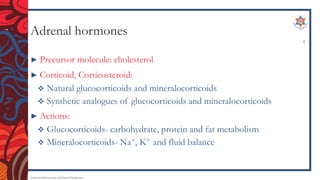
► Precursor molecule: cholesterol
► Corticoid, Corticosteroid:
 Natural glucocorticoids and mineralocorticoids
 Synthetic analogues of glucocorticoids and mineralocorticoids
► Actions:
 Glucocorticoids- carbohydrate, protein and fat metabolism
 Mineralocorticoids- Na+, K+ and fluid balance
Endocrine Pharmacology and Dental Therapeutics
4
Mechanism of action
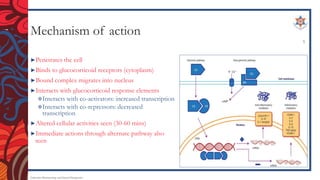
►Penetrates the cell
►Binds to glucocorticoid receptors (cytoplasm)
►Bound complex migrates into nucleus
►Interacts with glucocorticoid response elements
Interacts with co-activators: increased transcription
Interacts with co-repressors: decreased
transcription
►Altered cellular activities seen (30-60 mins)
►Immediate actions through alternate pathway also
seen
Endocrine Pharmacology and Dental Therapeutics
5
Synthetic corticosteroids
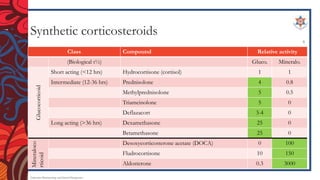
Class Compound Relative activity
(Biological t½) Gluco. Mineralo.
Glucocorticoid
Short acting (<12 hrs) Hydrocortisone (cortisol) 1 1
Intermediate (12-36 hrs) Prednisolone 4 0.8
Methylprednisolone 5 0.5
Triamcinolone 5 0
Deflazacort 3-4 0
Long acting (>36 hrs) Dexamethasone 25 0
Betamethasone 25 0
Mineraloco
rticoid
Desoxycorticosterone acetate (DOCA) 0 100
Fludrocortisone 10 150
Aldosterone 0.3 3000
Endocrine Pharmacology and Dental Therapeutics
6
Synthetic corticosteroids
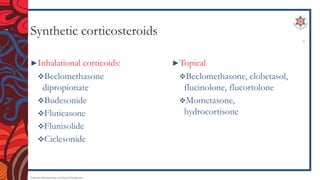
►Inhalational corticoids:
Beclomethasone
dipropionate
Budesonide
Fluticasone
Flunisolide
Ciclesonide
►Topical
Beclomethasone, clobetasol,
flucinolone, flucortolone
Mometasone,
hydrocortisone
Endocrine Pharmacology and Dental Therapeutics
7
Indications
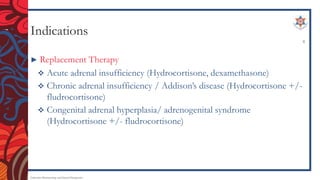
► Replacement Therapy
 Acute adrenal insufficiency (Hydrocortisone, dexamethasone)
 Chronic adrenal insufficiency / Addison’s disease (Hydrocortisone +/-
fludrocortisone)
 Congenital adrenal hyperplasia/ adrenogenital syndrome
(Hydrocortisone +/- fludrocortisone)
Endocrine Pharmacology and Dental Therapeutics
8
Indications
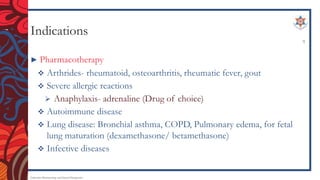
► Pharmacotherapy
 Arthrides- rheumatoid, osteoarthritis, rheumatic fever, gout
 Severe allergic reactions
 Anaphylaxis- adrenaline (Drug of choice)
 Autoimmune disease
 Lung disease: Bronchial asthma, COPD, Pulmonary edema, for fetal
lung maturation (dexamethasone/ betamethasone)
 Infective diseases
Endocrine Pharmacology and Dental Therapeutics
9
Indications
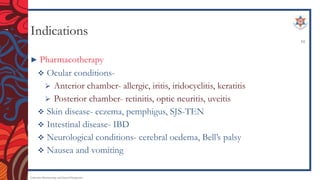
► Pharmacotherapy
 Ocular conditions-
 Anterior chamber- allergic, iritis, iridocyclitis, keratitis
 Posterior chamber- retinitis, optic neuritis, uveitis
 Skin disease- eczema, pemphigus, SJS-TEN
 Intestinal disease- IBD
 Neurological conditions- cerebral oedema, Bell’s palsy
 Nausea and vomiting
Endocrine Pharmacology and Dental Therapeutics
10
Indications
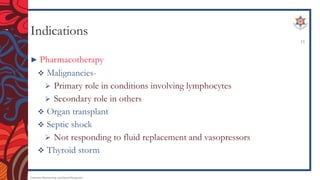
► Pharmacotherapy
 Malignancies-
 Primary role in conditions involving lymphocytes
 Secondary role in others
 Organ transplant
 Septic shock
 Not responding to fluid replacement and vasopressors
 Thyroid storm
Endocrine Pharmacology and Dental Therapeutics
11
Adverse effects
► Mineralocorticoid:
 Sodium and water retention
 Oedema
 Hypokalaemic alkalosis
 Progressive rise in BP
Endocrine Pharmacology and Dental Therapeutics
12
Adverse effects
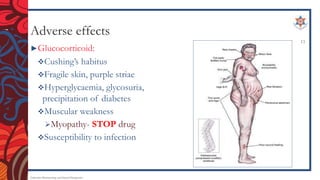
►Glucocorticoid:
Cushing’s habitus
Fragile skin, purple striae
Hyperglycaemia, glycosuria,
precipitation of diabetes
Muscular weakness
Myopathy- STOP drug
Susceptibility to infection
Endocrine Pharmacology and Dental Therapeutics
13
Adverse effects
► Glucocorticoid:
 Delayed healing of wounds and surgical incisions.
 Peptic ulceration
 Osteoporosis
 Eye: Posterior subcapsular cataract, glaucoma
 Growth retardation in children
 Psychiatric disturbances: mild euphoria, depression
 Suppression of HPA axis
Endocrine Pharmacology and Dental Therapeutics
14
Precautions and Contraindications
► Peptic ulcer
► Diabetes mellitus
► Hypertension
► Viral and fungal infections
► Tuberculosis and other infections
► Osteoporosis
► Herpes simplex keratitis
► Psychosis
► Epilepsy
► CHF
► Renal failure
Endocrine Pharmacology and Dental Therapeutics
15
Conclusion: Classwork!!
► List the hormones secreted from adrenal cortex
► Explain the mechanism of action of synthetic corticoids
► List the indications, adverse reactions, precautions and contraindications
of synthetic corticoids
► List the adverse reactions, precautions and contraindications of synthetic
corticoids
Endocrine Pharmacology and Dental Therapeutics
16
Questions??
► Thank you!
Endocrine Pharmacology and Dental Therapeutics
17

Corticosteroids 2020

  • 1.
    CORTICOSTEROIDS Dr. Pravin Prasad MBBS,MD Clinical Pharmacology Assistant Professor, Department of Clinical Pharmacology Maharajgunj Medical Campus, Kathmandu 13 July 2020 (29 Asar 2077), Monday
  • 2.
    By the endof this discussion, BDS 2nd year students will be able to: ► List the hormones secreted from adrenal cortex ► Explain the mechanism of action of synthetic corticoids ► List the indications, adverse reactions, precautions and contraindications of synthetic corticoids ► List the adverse reactions, precautions and contraindications of synthetic corticoids Endocrine Pharmacology and Dental Therapeutics 2
  • 3.
    Adrenal hormones ► Adrenalglands has two parts:  Cortex  Glomerulosa- aldosterone (mineralocorticoid)  Fasciculata- hydrocortisone (glucocorticoids)  Reticularis- testosterone (sex hormone)  Medulla  Adrenaline Endocrine Pharmacology and Dental Therapeutics 3
  • 4.
    Adrenal hormones ► Precursormolecule: cholesterol ► Corticoid, Corticosteroid:  Natural glucocorticoids and mineralocorticoids  Synthetic analogues of glucocorticoids and mineralocorticoids ► Actions:  Glucocorticoids- carbohydrate, protein and fat metabolism  Mineralocorticoids- Na+, K+ and fluid balance Endocrine Pharmacology and Dental Therapeutics 4
  • 5.
    Mechanism of action ►Penetratesthe cell ►Binds to glucocorticoid receptors (cytoplasm) ►Bound complex migrates into nucleus ►Interacts with glucocorticoid response elements Interacts with co-activators: increased transcription Interacts with co-repressors: decreased transcription ►Altered cellular activities seen (30-60 mins) ►Immediate actions through alternate pathway also seen Endocrine Pharmacology and Dental Therapeutics 5
  • 6.
    Synthetic corticosteroids Class CompoundRelative activity (Biological t½) Gluco. Mineralo. Glucocorticoid Short acting (<12 hrs) Hydrocortisone (cortisol) 1 1 Intermediate (12-36 hrs) Prednisolone 4 0.8 Methylprednisolone 5 0.5 Triamcinolone 5 0 Deflazacort 3-4 0 Long acting (>36 hrs) Dexamethasone 25 0 Betamethasone 25 0 Mineraloco rticoid Desoxycorticosterone acetate (DOCA) 0 100 Fludrocortisone 10 150 Aldosterone 0.3 3000 Endocrine Pharmacology and Dental Therapeutics 6
  • 7.
    Synthetic corticosteroids ►Inhalational corticoids: Beclomethasone dipropionate Budesonide Fluticasone Flunisolide Ciclesonide ►Topical Beclomethasone,clobetasol, flucinolone, flucortolone Mometasone, hydrocortisone Endocrine Pharmacology and Dental Therapeutics 7
  • 8.
    Indications ► Replacement Therapy Acute adrenal insufficiency (Hydrocortisone, dexamethasone)  Chronic adrenal insufficiency / Addison’s disease (Hydrocortisone +/- fludrocortisone)  Congenital adrenal hyperplasia/ adrenogenital syndrome (Hydrocortisone +/- fludrocortisone) Endocrine Pharmacology and Dental Therapeutics 8
  • 9.
    Indications ► Pharmacotherapy  Arthrides-rheumatoid, osteoarthritis, rheumatic fever, gout  Severe allergic reactions  Anaphylaxis- adrenaline (Drug of choice)  Autoimmune disease  Lung disease: Bronchial asthma, COPD, Pulmonary edema, for fetal lung maturation (dexamethasone/ betamethasone)  Infective diseases Endocrine Pharmacology and Dental Therapeutics 9
  • 10.
    Indications ► Pharmacotherapy  Ocularconditions-  Anterior chamber- allergic, iritis, iridocyclitis, keratitis  Posterior chamber- retinitis, optic neuritis, uveitis  Skin disease- eczema, pemphigus, SJS-TEN  Intestinal disease- IBD  Neurological conditions- cerebral oedema, Bell’s palsy  Nausea and vomiting Endocrine Pharmacology and Dental Therapeutics 10
  • 11.
    Indications ► Pharmacotherapy  Malignancies- Primary role in conditions involving lymphocytes  Secondary role in others  Organ transplant  Septic shock  Not responding to fluid replacement and vasopressors  Thyroid storm Endocrine Pharmacology and Dental Therapeutics 11
  • 12.
    Adverse effects ► Mineralocorticoid: Sodium and water retention  Oedema  Hypokalaemic alkalosis  Progressive rise in BP Endocrine Pharmacology and Dental Therapeutics 12
  • 13.
    Adverse effects ►Glucocorticoid: Cushing’s habitus Fragileskin, purple striae Hyperglycaemia, glycosuria, precipitation of diabetes Muscular weakness Myopathy- STOP drug Susceptibility to infection Endocrine Pharmacology and Dental Therapeutics 13
  • 14.
    Adverse effects ► Glucocorticoid: Delayed healing of wounds and surgical incisions.  Peptic ulceration  Osteoporosis  Eye: Posterior subcapsular cataract, glaucoma  Growth retardation in children  Psychiatric disturbances: mild euphoria, depression  Suppression of HPA axis Endocrine Pharmacology and Dental Therapeutics 14
  • 15.
    Precautions and Contraindications ►Peptic ulcer ► Diabetes mellitus ► Hypertension ► Viral and fungal infections ► Tuberculosis and other infections ► Osteoporosis ► Herpes simplex keratitis ► Psychosis ► Epilepsy ► CHF ► Renal failure Endocrine Pharmacology and Dental Therapeutics 15
  • 16.
    Conclusion: Classwork!! ► Listthe hormones secreted from adrenal cortex ► Explain the mechanism of action of synthetic corticoids ► List the indications, adverse reactions, precautions and contraindications of synthetic corticoids ► List the adverse reactions, precautions and contraindications of synthetic corticoids Endocrine Pharmacology and Dental Therapeutics 16
  • 17.
    Questions?? ► Thank you! EndocrinePharmacology and Dental Therapeutics 17

Editor's Notes

  • #14 Cushing’s habitus: characteristic appearance with rounded face, narrow mouth, supraclavicular hump, obesity of trunk with relatively thin limbs Fragile skin, purple striae—typically on thighs and lower abdomen, easy bruising, telangiectasis, hirsutism. Cutaneous atrophy localized to the site occurs with topical application as well Muscular weakness: proximal (shoulder, arm, pelvis, thigh) muscles are primarily affected. Myopathy occurs occasionally, warrants withdrawal of the corticoids. Susceptibility to infection: this is nonspecific for all types of pathogenic organisms. Latent tuberculosis may flare; opportunistic infections with low grade pathogens (Candida, etc.) set in.
  • #15 Delayed healing: of wounds and surgical incisions. Peptic ulceration: risk is doubled; bleeding and silent perforation of ulcers may occur. Dyspeptic symptoms are frequent with high dose therapy. Osteoporosis: especially involving vertebrae and other flat spongy bones. Compression fractures of vertebrae and spontaneous fracture of long bones can occur, especially in the elderly. Radiological evidence of osteoporosis is an indication for withdrawal of corticoid therapy. Corticosteroid induced osteoporosis can be prevented/arrested by calcium supplements + vit D, and by estrogen/raloxifene or androgen replacement therapy in females and males respectively. However, bisphosphonates are the most effective drugs in this regard. Growth retardation: in children occurs even with small doses if given for long periods. Large doses do inhibit GH secretion, but growth retardation may, in addition, be a direct cellular effect of corticoids. Recombinant GH given concurrently can prevent growth retardation, but risk/benefit of such use is not known. Foetal abnormalities: Cleft palate and other defects are produced in animals, but have not been encountered on clinical use in pregnant women. The risk of abortion, stillbirth or neonatal death is not increased, but intrauterine growth retardation can occur after prolonged therapy, and neurological/behavioral disturbances in the offspring are feared. Prednisolone appears safer than dexa/beta methasone, because it is metabolized by placenta, reducing foetal exposure. There Psychiatric disturbances: mild euphoria frequently accompanies high dose steroid treatment. This may rarely progress to manic psychosis. Nervousness, decreased sleep and mood changes occur in some patients. Rarely a depressive illness may be induced after long-term use. Suppression of hypothalamo-pituitary-adrenal (HPA) axis: occurs depending both on dose and duration of therapy. In time, adrenal cortex atrophies and stoppage of exogenous steroid precipitates withdrawal syndrome consisting of malaise, fever, anorexia, nausea, postural hypotension, electrolyte imbalance, weakness, pain in muscles and joints and reactivation of the disease for which they were used. Subjected to stress, these patients may go into acute adrenal insufficiency leading to cardiovascular collapse.