PROCESS STUDY OF DEMAND & SUPPLY PLANNING AND
DEMAND MANAGEMENT OF AN INTEGRATED POWER UTILITY
DISTRIBUTION FUNCTION
PROJECTS, OPERATIONS & MAINTENANCE PERSPECTIVE
Submitted to:
Adeel Ali Shah, Syed
(In-charge Supply Chain Capstone I)
Prepared by:
Zain Farooq, Muhammad [17601]
Zakir Ali Rizwe, Sayyed [19131]
Azeem, Osama [20211]
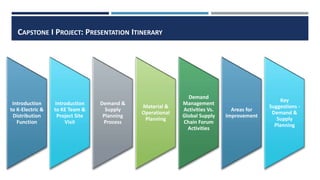
CAPSTONE I PROJECT: PRESENTATION ITINERARY
Introduction
to K-Electric &
Distribution
Function
Introduction
to KE Team &
Project Site
Visit
Demand &
Supply
Planning
Process
Material &
Operational
Planning
Demand
Management
Activities Vs.
Global Supply
Chain Forum
Activities
Areas for
Improvement
Key
Suggestions -
Demand &
Supply
Planning
K-ELECTRIC LIMITED
 K-Electric, the only ‘Vertically Integrated’ Power Utility of Pakistan
 Incorporated as Karachi Electric Supply Corporation under Indian Companies
Act in the year 1913
 Registration in the year 1953 as Karachi Electric Supply Corporation
 Change of name (after privatization in the year 2005) as Karachi Electric
Supply Company Limited in the year 2008
 Rebranding, from KESC to K-Electric Limited in the year 2014
K-ELECTRIC – SERVICES & ACHIEVEMENTS
 Electrifying Karachi, the ‘City of Lights’, housing 22 Million+ inhabitants
across 6,500 square-km across Karachi, DHABEJI & GHARO in Sindh and
Hub, UTHAL, VENDAR & BELA in Baluchistan
 Employ 11,000 resources & approximately 5,000 OSPs
Key Achievements:
 1,057MW added in Generation & improved generation fleet efficiency
from 30.1% to 37.4%
 Servicing 1,253.1 km extra-high-tension (EHT) & 27,000 km low-tension
(LT) network circuits
 Curbing electricity theft through marketing campaigns, LEA support and
installation of aerial-bundle-cable and introduced performance based
load-shed regime, today 61% of Karachi is load-shed exempted
 Hold corporate accolades for reporting standards, CSR initiatives, best
employer to name a few. Complete SAP shop, state of the art technology
infrastructure & a SCADA/ DCS driven utility operations.
 Vibrant social media presence
POWER UTILITY – ROLE OF SUPPLY CHAIN
 Power Utility Conventional Supply Chain
 meeting electricity supply in response to
customer demand
 Specialized areas; managed by engineers running
generation & load-dispatch
 Challenge: consistent fuel-supply, competition &
compliance to the regulator
 Utility - Project and O&M Supply Chain
 supply chain connecting business capital to utility
project O&M requirements
 Demand & supply meet the following requirements:
 Preventive & corrective maintenance inventories
 NEPRA compliance (project-based)
 Efficiency gain initiatives: Project based inventory
 Service expansion; increasing customer foot-print
DISTRIBUTION
NETWORK
DISTRIBUTION – PROJECTS AND O&M: SUPPLY CHAIN
Central Store
KDA Grid
Location
BALDIA – Scrap
Yard
FB Area Block
LANDHI – Cable
Yard
Distribution Stores (26)
1. Material Replenishment
2. Maintain safety stock
3. Inventory receipts for
requirement fulfilment
Region-1
New
Connection
Region-4
Region-3
Region-2
Integrated Business Centers,
New Connection & Special
Projects [Customers]
1. Complaints
2. Projects
3. Improvement
4. New connections
KE Fleet Operations [engaged & own gangs, scheduling, planning & service delivery]
At disposal of regional offices, IBCs & Project offices site consumption & inter-facility logistics [CLSC]
Vendor Delivery
Distribution [regional PMO office, IBCs, New Connection & DSNP Office]
Supported by PQC vendors, EPC & Project teams
Supply Chain [Inventory Management & Distribution Stores]
Supported by Finance, Fleet Operations, Network Workshop & IT
Karachi GEO
space
GLOBAL SUPPLY CHAIN FORUM [SCM PROCESSES] VS. IMPLEMENTATION AT KE
Customer
Relationship
Management
&
Customer Services
Order
Management
Return
Management
Supplier
Relationship
Management
Distribution Special Projects & Material
Management engage departmental
requirement, called herein as
‘customers’. These include regional
offices, IBCs, EPC, SIP, NC
User departments & hierarchies,
Finance & Material Management
department aggregate and rationalize
customer demand (order) fulfilment
Responsibility of Procurement.
Vendor master, performance of the
supplier
Maintain supplier coordination,
internal movements, scrap transfers, &
un‐consumed material
DEMAND MANAGEMENT
DEMAND PLANNING PROCESS
DEMAND PLANNING – IMPROVEMENT AREAS
Limit ‘traceability’
demand vs. supply vs. consumption
Customer
‘unconstrained
demand’
Strategic direction or a
Planning horizon
(3‐5 years)
Demand
movement
on EXCEL
‘Individual focused’,
demand rationalization
processes
Process does not
involve Supply Chain
till demand finalization
SUPPLY PLANNING
SUPPLY PLANNING PROCESS
SUPPLY PLANNING – IMPROVEMENT AREAS
Efficient Inventory Flow
Management across
DMS & PQC Issuance
End-to-End
Operating
framework
Reduce
monthly
demand
swings
Geo location
of Inventory
sites
Inventory
Consumption
plan
demand fluctuation stretch supply lines
Impact vendor relationship
Increase inventory hold‐time
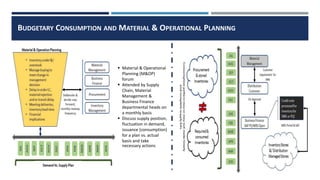
BUDGETARY CONSUMPTION AND MATERIAL & OPERATIONAL PLANNING
 Material & Operational
Planning (M&OP)
forum
 Attended by Supply
Chain, Material
Management &
Business Finance
departmental heads on
a monthly basis
 Discuss supply position,
fluctuation in demand,
issuance (consumption)
for a plan vs. actual
basis and take
necessary actions
AREAS OF IMPROVEMENT
Improve field survey &
planning to optimize
working BoM
Consistency
in demand decisions
Role of
treasury
& finance
Involved role of
Procurement & IM
function
Budget monitoring
driven on material
purchased vs. BoM
issuance
financial impact of delayed supply &
consumption
Inventory & lead‐time to
consumption
INTERNATIONAL JOURNAL OF LOGISTIC MANAGEMENT
DEMAND MANAGEMENT STRATEGIC & OPERATIONAL ACTIVITIES IMPLEMENTATION AT KE
StrategicActivities
OperationalActivities
The activity does not exist in KE
Activity is either done differently at KE Or the requirement is only true for FMCGs
Activity exist but no details on interfacing/connecting input and outputs
Activity performed at KE
SUPPLY CHAIN FEATURES
Cost Containment
THE NEW AGENDA
SUPPLY CHAIN SHIFT
Explore options to manage
costs by working proactively
with suppliers to identify
alternative products and
services that
could satisfy functional needs,
perhaps at a lower cost.
Supply Assurance
Integrated view of
Future Demand
Manage Supply Assurance
Risk management
Imperative to undertake different
sources of risk & potential impact on
major projects, maintenance and
support routines delivering customer
services.
Noted that user, finance, SC (Inventory
& Procurement) and Distribution do
not have an integrated view. Courtesy
to the limited insight developed, the
reason is the departmental fabric and
way IT solutions have been designed to
deliver.
SCM professionals should have an
insight to current as well as future
demand & supply of their direct
suppliers’ industry sectors, and a similar
view for the key inputs on which the
suppliers rely, such as steel and craft
labor (Edward H. Frazelle, 2016).
CAPSTONE PROJECT I: KEY SUGGESTIONS
Demand
Visibility
[3-5 years
Planning
Horizon]
Constraint
or
Surveyed
Demand
[DRONE]
Establish
Project
economic
value add
(EVA)
Demand
Accountability
[at the User
level]
Flexible
BoM
[Survey]
Demand
Monitoring &
Traceability till
Consumption
[Support: SAP
IBP]
Inventory
Location &
Movement
[CN/DN GIS
tracking]
Explore
New
Agenda
Supply
Chain
AREAS OF IMPROVEMENT
Thank You

Distribution Supply Chain - Project O&M

  • 1.
    PROCESS STUDY OFDEMAND & SUPPLY PLANNING AND DEMAND MANAGEMENT OF AN INTEGRATED POWER UTILITY DISTRIBUTION FUNCTION PROJECTS, OPERATIONS & MAINTENANCE PERSPECTIVE Submitted to: Adeel Ali Shah, Syed (In-charge Supply Chain Capstone I) Prepared by: Zain Farooq, Muhammad [17601] Zakir Ali Rizwe, Sayyed [19131] Azeem, Osama [20211]
  • 2.
    CAPSTONE I PROJECT:PRESENTATION ITINERARY Introduction to K-Electric & Distribution Function Introduction to KE Team & Project Site Visit Demand & Supply Planning Process Material & Operational Planning Demand Management Activities Vs. Global Supply Chain Forum Activities Areas for Improvement Key Suggestions - Demand & Supply Planning
  • 3.
    K-ELECTRIC LIMITED  K-Electric,the only ‘Vertically Integrated’ Power Utility of Pakistan  Incorporated as Karachi Electric Supply Corporation under Indian Companies Act in the year 1913  Registration in the year 1953 as Karachi Electric Supply Corporation  Change of name (after privatization in the year 2005) as Karachi Electric Supply Company Limited in the year 2008  Rebranding, from KESC to K-Electric Limited in the year 2014
  • 4.
    K-ELECTRIC – SERVICES& ACHIEVEMENTS  Electrifying Karachi, the ‘City of Lights’, housing 22 Million+ inhabitants across 6,500 square-km across Karachi, DHABEJI & GHARO in Sindh and Hub, UTHAL, VENDAR & BELA in Baluchistan  Employ 11,000 resources & approximately 5,000 OSPs Key Achievements:  1,057MW added in Generation & improved generation fleet efficiency from 30.1% to 37.4%  Servicing 1,253.1 km extra-high-tension (EHT) & 27,000 km low-tension (LT) network circuits  Curbing electricity theft through marketing campaigns, LEA support and installation of aerial-bundle-cable and introduced performance based load-shed regime, today 61% of Karachi is load-shed exempted  Hold corporate accolades for reporting standards, CSR initiatives, best employer to name a few. Complete SAP shop, state of the art technology infrastructure & a SCADA/ DCS driven utility operations.  Vibrant social media presence
  • 5.
    POWER UTILITY –ROLE OF SUPPLY CHAIN  Power Utility Conventional Supply Chain  meeting electricity supply in response to customer demand  Specialized areas; managed by engineers running generation & load-dispatch  Challenge: consistent fuel-supply, competition & compliance to the regulator  Utility - Project and O&M Supply Chain  supply chain connecting business capital to utility project O&M requirements  Demand & supply meet the following requirements:  Preventive & corrective maintenance inventories  NEPRA compliance (project-based)  Efficiency gain initiatives: Project based inventory  Service expansion; increasing customer foot-print
  • 6.
  • 7.
    DISTRIBUTION – PROJECTSAND O&M: SUPPLY CHAIN Central Store KDA Grid Location BALDIA – Scrap Yard FB Area Block LANDHI – Cable Yard Distribution Stores (26) 1. Material Replenishment 2. Maintain safety stock 3. Inventory receipts for requirement fulfilment Region-1 New Connection Region-4 Region-3 Region-2 Integrated Business Centers, New Connection & Special Projects [Customers] 1. Complaints 2. Projects 3. Improvement 4. New connections KE Fleet Operations [engaged & own gangs, scheduling, planning & service delivery] At disposal of regional offices, IBCs & Project offices site consumption & inter-facility logistics [CLSC] Vendor Delivery Distribution [regional PMO office, IBCs, New Connection & DSNP Office] Supported by PQC vendors, EPC & Project teams Supply Chain [Inventory Management & Distribution Stores] Supported by Finance, Fleet Operations, Network Workshop & IT Karachi GEO space
  • 8.
    GLOBAL SUPPLY CHAINFORUM [SCM PROCESSES] VS. IMPLEMENTATION AT KE Customer Relationship Management & Customer Services Order Management Return Management Supplier Relationship Management Distribution Special Projects & Material Management engage departmental requirement, called herein as ‘customers’. These include regional offices, IBCs, EPC, SIP, NC User departments & hierarchies, Finance & Material Management department aggregate and rationalize customer demand (order) fulfilment Responsibility of Procurement. Vendor master, performance of the supplier Maintain supplier coordination, internal movements, scrap transfers, & un‐consumed material
  • 9.
  • 10.
  • 11.
    DEMAND PLANNING –IMPROVEMENT AREAS Limit ‘traceability’ demand vs. supply vs. consumption Customer ‘unconstrained demand’ Strategic direction or a Planning horizon (3‐5 years) Demand movement on EXCEL ‘Individual focused’, demand rationalization processes Process does not involve Supply Chain till demand finalization
  • 12.
  • 13.
  • 14.
    SUPPLY PLANNING –IMPROVEMENT AREAS Efficient Inventory Flow Management across DMS & PQC Issuance End-to-End Operating framework Reduce monthly demand swings Geo location of Inventory sites Inventory Consumption plan demand fluctuation stretch supply lines Impact vendor relationship Increase inventory hold‐time
  • 15.
    BUDGETARY CONSUMPTION ANDMATERIAL & OPERATIONAL PLANNING  Material & Operational Planning (M&OP) forum  Attended by Supply Chain, Material Management & Business Finance departmental heads on a monthly basis  Discuss supply position, fluctuation in demand, issuance (consumption) for a plan vs. actual basis and take necessary actions
  • 16.
    AREAS OF IMPROVEMENT Improvefield survey & planning to optimize working BoM Consistency in demand decisions Role of treasury & finance Involved role of Procurement & IM function Budget monitoring driven on material purchased vs. BoM issuance financial impact of delayed supply & consumption Inventory & lead‐time to consumption
  • 17.
    INTERNATIONAL JOURNAL OFLOGISTIC MANAGEMENT DEMAND MANAGEMENT STRATEGIC & OPERATIONAL ACTIVITIES IMPLEMENTATION AT KE StrategicActivities OperationalActivities The activity does not exist in KE Activity is either done differently at KE Or the requirement is only true for FMCGs Activity exist but no details on interfacing/connecting input and outputs Activity performed at KE
  • 18.
    SUPPLY CHAIN FEATURES CostContainment THE NEW AGENDA SUPPLY CHAIN SHIFT Explore options to manage costs by working proactively with suppliers to identify alternative products and services that could satisfy functional needs, perhaps at a lower cost. Supply Assurance Integrated view of Future Demand Manage Supply Assurance Risk management Imperative to undertake different sources of risk & potential impact on major projects, maintenance and support routines delivering customer services. Noted that user, finance, SC (Inventory & Procurement) and Distribution do not have an integrated view. Courtesy to the limited insight developed, the reason is the departmental fabric and way IT solutions have been designed to deliver. SCM professionals should have an insight to current as well as future demand & supply of their direct suppliers’ industry sectors, and a similar view for the key inputs on which the suppliers rely, such as steel and craft labor (Edward H. Frazelle, 2016).
  • 19.
    CAPSTONE PROJECT I:KEY SUGGESTIONS Demand Visibility [3-5 years Planning Horizon] Constraint or Surveyed Demand [DRONE] Establish Project economic value add (EVA) Demand Accountability [at the User level] Flexible BoM [Survey] Demand Monitoring & Traceability till Consumption [Support: SAP IBP] Inventory Location & Movement [CN/DN GIS tracking] Explore New Agenda Supply Chain
  • 20.