Distilled World Model Absorption by Experts in MoE Architecture
Discussion of the preconditioning needed for smaller Domain Experts Gen AIS to enable absorption of World Models in the distilled MoE architecture. Previous discussion focused on the output of World Models by large generic LLMs.
Distilled World Model Absorption by Experts in MoE Architecture
1.
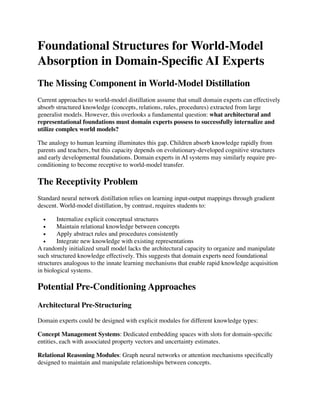
Foundational Structures forWorld-Model
Absorption in Domain-Speci
fi
c AI Experts
The Missing Component in World-Model Distillation
Current approaches to world-model distillation assume that small domain experts can effectively
absorb structured knowledge (concepts, relations, rules, procedures) extracted from large
generalist models. However, this overlooks a fundamental question: what architectural and
representational foundations must domain experts possess to successfully internalize and
utilize complex world models?
The analogy to human learning illuminates this gap. Children absorb knowledge rapidly from
parents and teachers, but this capacity depends on evolutionary-developed cognitive structures
and early developmental foundations. Domain experts in AI systems may similarly require pre-
conditioning to become receptive to world-model transfer.
The Receptivity Problem
Standard neural network distillation relies on learning input-output mappings through gradient
descent. World-model distillation, by contrast, requires students to:
• Internalize explicit conceptual structures
• Maintain relational knowledge between concepts
• Apply abstract rules and procedures consistently
• Integrate new knowledge with existing representations
A randomly initialized small model lacks the architectural capacity to organize and manipulate
such structured knowledge effectively. This suggests that domain experts need foundational
structures analogous to the innate learning mechanisms that enable rapid knowledge acquisition
in biological systems.
Potential Pre-Conditioning Approaches
Architectural Pre-Structuring
Domain experts could be designed with explicit modules for different knowledge types:
Concept Management Systems: Dedicated embedding spaces with slots for domain-speci
fi
c
entities, each with associated property vectors and uncertainty estimates.
Relational Reasoning Modules: Graph neural networks or attention mechanisms speci
fi
cally
designed to maintain and manipulate relationships between concepts.
2.
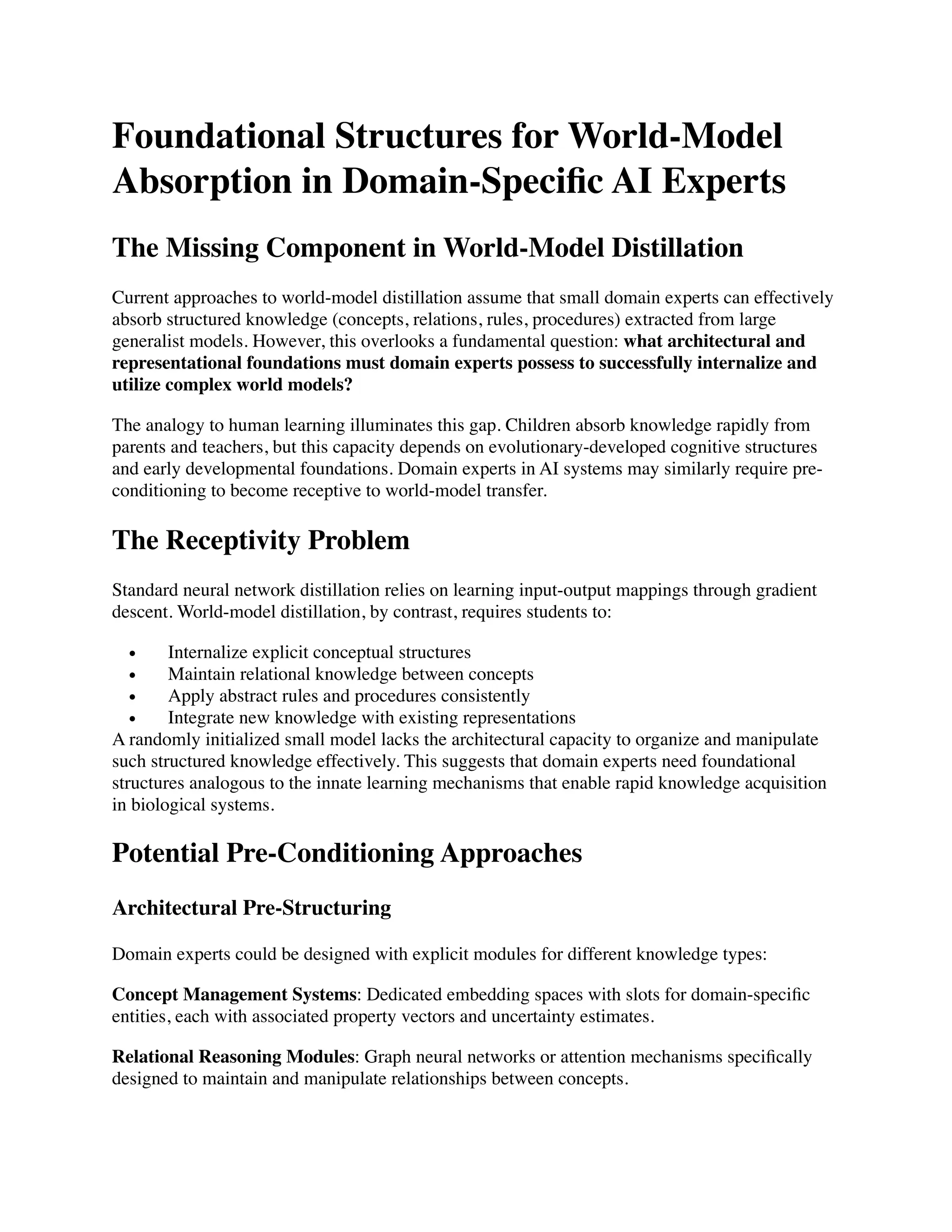
Rule Storage andApplication: Separate modules for encoding logical constraints, with
mechanisms for checking rule consistency and applying transformations.
Hierarchical Memory Systems: Structured representations for multi-step procedures that can be
decomposed, recomposed, and adapted to new contexts.
Foundation Pre-Training
Before domain-speci
fi
c distillation, experts could undergo preparatory training on:
Meta-Learning Tasks: Exercises requiring rapid absorption of new concepts and rules within
controlled environments.
Structured Reasoning Datasets: Formal logic problems, simple mathematical reasoning, or
rule-based games that develop general capacity for symbolic manipulation.
Concept Manipulation Exercises: Tasks requiring explicit concept identi
fi
cation, property
assignment, and relational reasoning.
Progressive Complexity Training: Starting with simple structures and gradually increasing
complexity to build receptive capacity.
Progressive Distillation Protocols
Rather than transferring complete world models immediately:
• Begin with simple concept-property mappings
• Gradually introduce relational structures
• Add procedural knowledge only after conceptual foundations are stable
• Continuously monitor and adapt transfer rate based on absorption capacity
Critical Limitations and Challenges
Analogy Breakdown
The child-parent learning comparison, while intuitive, has signi
fi
cant limitations:
Evolutionary vs. Engineered Systems: Human learning mechanisms emerged through millions
of years of natural selection. Engineering similar capabilities from scratch may require
fundamentally different approaches that don't exist in biological systems.
Mechanistic Gaps: We lack detailed understanding of how children's "innate structures" actually
function computationally. Terms like "language acquisition device" describe phenomena without
explaining underlying mechanisms.
3.
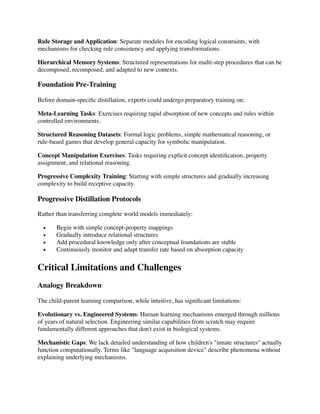
Scale and ContextDifferences: Children learn through years of rich multimodal interaction.
Domain experts must absorb knowledge in controlled, limited training phases with constrained
inputs.
Technical Implementation Questions
Measuring Receptivity: How do we evaluate whether a model has developed appropriate
foundational structures? What constitutes successful "world model readiness"?
Avoiding Over-Speci
fi
cation: Pre-structuring domain experts might make them too rigid to
adapt to the speci
fi
c knowledge being transferred, potentially limiting rather than enabling
learning.
Transfer Format Optimization: Should experts adapt to the teacher's knowledge representation
format, or should extracted knowledge be reformatted for each specialist's architecture?
Distinguishing Learning from Mimicry: How do we verify that apparent knowledge
absorption represents genuine understanding rather than sophisticated pattern matching?
Alternative Approaches
Co-Evolutionary Knowledge Transfer
Instead of pre-conditioning students to receive
fi
xed teacher knowledge formats:
• Train domain experts and knowledge extraction methods jointly
• Allow students to "negotiate" knowledge formats they can best utilize
• Develop adaptive transfer protocols that adjust based on real-time student capacity
assessment
• Create feedback mechanisms where student learning dif
fi
culties inform teacher
knowledge extraction strategies
Minimal Suf
fi
cient Architectures
Focus on identifying the smallest architectural modi
fi
cations needed for effective world-model
absorption, avoiding complex pre-conditioning that may introduce unnecessary constraints.
Research Directions
This analysis suggests several critical research questions:
Capacity Bottlenecks: How does the student's representational capacity limit what knowledge
can be effectively transferred? Can we predict transfer success from architectural properties?
4.
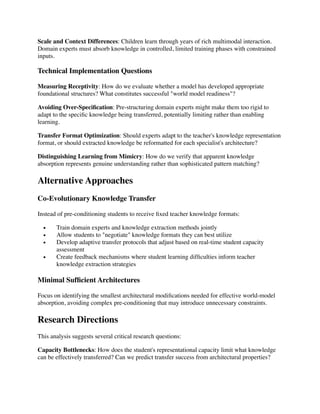
Dynamic Scaffolding: Canwe develop systems that automatically provide appropriate learning
supports based on the student's current capabilities and learning trajectory?
Knowledge Format Standards: Should the
fi
eld develop standardized formats for transferring
world models, or should each student-teacher pair negotiate optimal representations?
Evaluation Frameworks: How do we measure genuine knowledge absorption versus super
fi
cial
pattern matching in the context of structured world models?
Architectural Minimalism: What are the minimal necessary structures for world-model
receptivity across different domains?
Implementation Strategy
Phase 1: Foundation Analysis
• Systematically study what architectural components enable structured knowledge
absorption
• Develop metrics for measuring "world model receptivity" in neural networks
• Test minimal architectural modi
fi
cations on simple transfer tasks
Phase 2: Pre-Conditioning Protocols
• Design and evaluate different pre-training approaches for developing receptive capacity
• Compare architectural pre-structuring versus learned foundations
• Establish best practices for progressive knowledge transfer
Phase 3: Adaptive Transfer Systems
• Develop methods for dynamically adjusting knowledge transfer based on student capacity
• Create feedback mechanisms between students and teachers
• Build systems that can diagnose and address transfer failures
Conclusion
The insight about foundational structures addresses a crucial gap in world-model distillation
research. However, moving from biological inspiration to engineering implementation requires
careful attention to the fundamental differences between evolved and designed systems.
The path forward involves systematic investigation of minimal necessary structures,
development of principled pre-conditioning approaches, and creation of adaptive transfer
protocols. Success in this area could be decisive for the viability of interpretable domain-expert
architectures.
5.
Rather than assumingthat small models can automatically absorb complex knowledge, we must
explicitly engineer the capacity for structured knowledge reception and utilization. This
represents a signi
fi
cant but potentially surmountable challenge in building trustworthy, ef
fi
cient
AI systems.