Discrete Structures
2
Course Objectives
1.Express statements with the precision of formal logic
2.Analyze arguments to test their validity
3.Apply the basic properties and operations related to sets
4.Apply to sets the basic properties and operations related
to relations and function
5.Define terms recursively
6.Prove a formula using mathematical induction
7.Prove statements using direct and indirect methods
3
Course Objectives
8.Identify and use the formulas of combinatorics in different
problems
9.Illustrate the basic definitions of graph theory and
properties of graphs
10.Relate each major topic in Discrete Mathematics to an
application area in computing
4
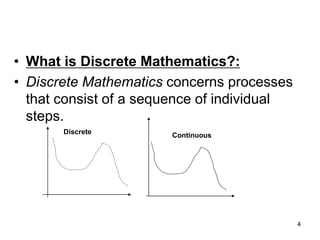
• What is Discrete Mathematics?:
• Discrete Mathematics concerns processes
that consist of a sequence of individual
steps.
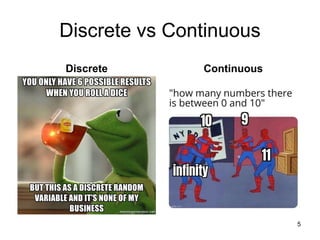
Continuous
Discrete
Discrete vs Continuous
Discrete Continuous
5
6
Logic
• LOGIC:
• Logic is the study of the principles and methods that
distinguishes between a valid and an invalid argument.
• SIMPLE STATEMENT:
• A statement is a declarative sentence that is either true
or false but not both.
• A statement is also referred to as a proposition
• Example: 2+2 = 4, It is Sunday today
• If a proposition is true, we say that it has a truth value of
"true”.
• If a proposition is false, its truth value is "false".
• The truth values “true” and “false” are, respectively,
denoted by the letters T and F.
7
Logic
• EXAMPLES :
• Grass is green.
• 4 + 2 = 6
• 4 + 2 = 7
• There are four fingers in a hand.
are propositions
8
Logic
• Not Propositions
• Close the door.
• x is greater than 2.
• He is very rich
are not propositions.
9
Logic
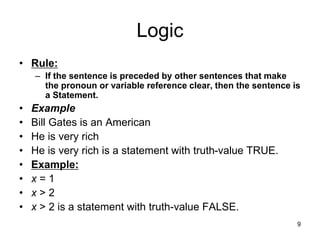
• Rule:
– If the sentence is preceded by other sentences that make
the pronoun or variable reference clear, then the sentence is
a Statement.
• Example
• Bill Gates is an American
• He is very rich
• He is very rich is a statement with truth-value TRUE.
• Example:
• x = 1
• x > 2
• x > 2 is a statement with truth-value FALSE.
Logic
10
11
Logic
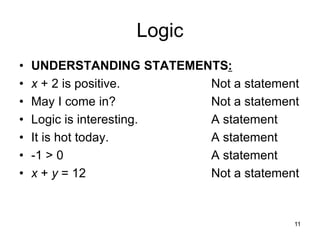
• UNDERSTANDING STATEMENTS:
• x + 2 is positive. Not a statement
• May I come in? Not a statement
• Logic is interesting. A statement
• It is hot today. A statement
• -1 > 0 A statement
• x + y = 12 Not a statement
12
Logic
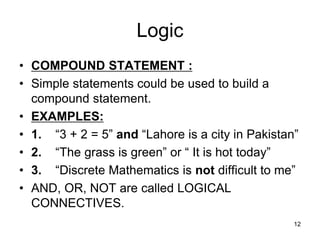
• COMPOUND STATEMENT :
• Simple statements could be used to build a
compound statement.
• EXAMPLES:
• 1. “3 + 2 = 5” and “Lahore is a city in Pakistan”
• 2. “The grass is green” or “ It is hot today”
• 3. “Discrete Mathematics is not difficult to me”
• AND, OR, NOT are called LOGICAL
CONNECTIVES.
13
Logic
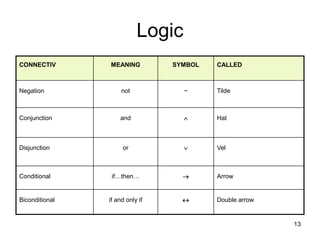
CONNECTIV MEANING SYMBOL CALLED
Negation not ~ Tilde
Conjunction and  Hat
Disjunction or  Vel
Conditional if…then…  Arrow
Biconditional if and only if  Double arrow
14
Logic
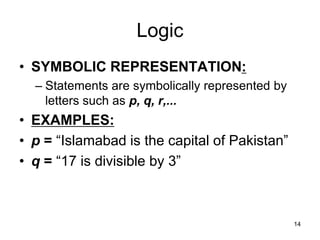
• SYMBOLIC REPRESENTATION:
– Statements are symbolically represented by
letters such as p, q, r,...
• EXAMPLES:
• p = “Islamabad is the capital of Pakistan”
• q = “17 is divisible by 3”
15
Logic
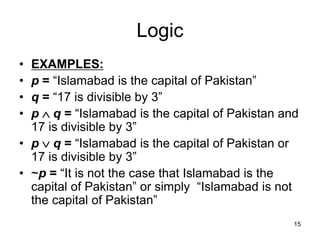
• EXAMPLES:
• p = “Islamabad is the capital of Pakistan”
• q = “17 is divisible by 3”
• p  q = “Islamabad is the capital of Pakistan and
17 is divisible by 3”
• p  q = “Islamabad is the capital of Pakistan or
17 is divisible by 3”
• ~p = “It is not the case that Islamabad is the
capital of Pakistan” or simply “Islamabad is not
the capital of Pakistan”
16
Logic
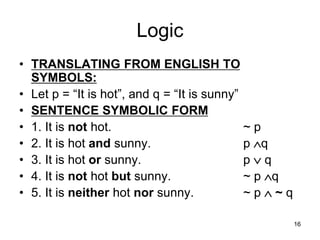
• TRANSLATING FROM ENGLISH TO
SYMBOLS:
• Let p = “It is hot”, and q = “It is sunny”
• SENTENCE SYMBOLIC FORM
• 1. It is not hot. ~ p
• 2. It is hot and sunny. p q
• 3. It is hot or sunny. p  q
• 4. It is not hot but sunny. ~ p q
• 5. It is neither hot nor sunny. ~ p  ~ q
17
Logic
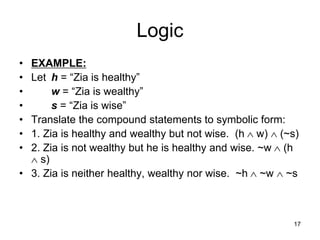
• EXAMPLE:
• Let h = “Zia is healthy”
• w = “Zia is wealthy”
• s = “Zia is wise”
• Translate the compound statements to symbolic form:
• 1. Zia is healthy and wealthy but not wise. (h  w)  (~s)
• 2. Zia is not wealthy but he is healthy and wise. ~w  (h
 s)
• 3. Zia is neither healthy, wealthy nor wise. ~h  ~w  ~s
18
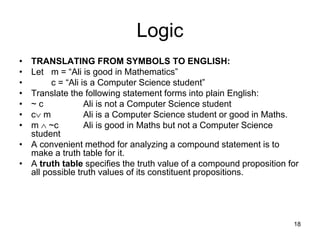
Logic
• TRANSLATING FROM SYMBOLS TO ENGLISH:
• Let m = “Ali is good in Mathematics”
• c = “Ali is a Computer Science student”
• Translate the following statement forms into plain English:
• ~ c Ali is not a Computer Science student
• c m Ali is a Computer Science student or good in Maths.
• m  ~c Ali is good in Maths but not a Computer Science
student
• A convenient method for analyzing a compound statement is to
make a truth table for it.
• A truth table specifies the truth value of a compound proposition for
all possible truth values of its constituent propositions.
19
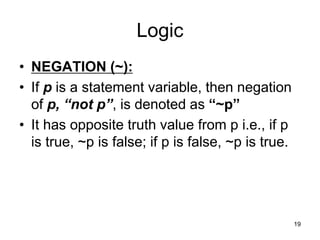
Logic
• NEGATION (~):
• If p is a statement variable, then negation
of p, “not p”, is denoted as “~p”
• It has opposite truth value from p i.e., if p
is true, ~p is false; if p is false, ~p is true.
20
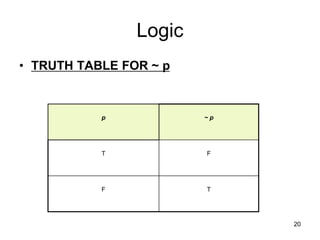
Logic
• TRUTH TABLE FOR ~ p
p ~ p
T F
F T
21
Logic
• CONJUNCTION ():
• If p and q are statements, then the
conjunction of p and q is “p and q”,
denoted as “p  q”.
• It is true when, and only when, both p and
q are true. If either p or q is false, or if
both are false, pq is false.
22
Logic
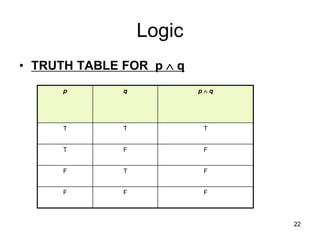
• TRUTH TABLE FOR p  q
p q p  q
T T T
T F F
F T F
F F F
23
Logic
• DISJUNCTION () or INCLUSIVE OR
• If p & q are statements, then the
disjunction of p and q is “p or q”,
denoted as “p  q”.It is true when at least
one of p or q is true and is false only when
both p and q are false.
24
Logic
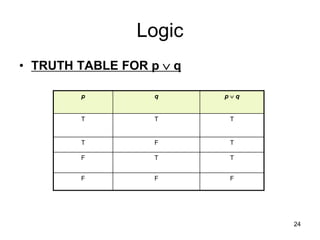
• TRUTH TABLE FOR p  q
p q p  q
T T T
T F T
F T T
F F F
25
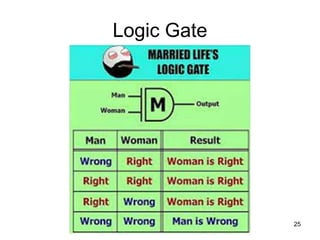
Logic Gate
26
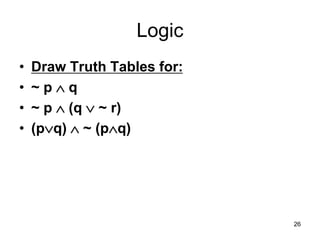
Logic
• Draw Truth Tables for:
• ~ p  q
• ~ p  (q  ~ r)
• (pq)  ~ (pq)
27
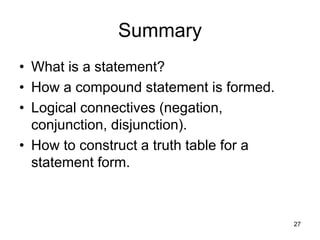
Summary
• What is a statement?
• How a compound statement is formed.
• Logical connectives (negation,
conjunction, disjunction).
• How to construct a truth table for a
statement form.

Lecture # 2 discrete for beginners.ppt

  • 1.
  • 2.
    2 Course Objectives 1.Express statementswith the precision of formal logic 2.Analyze arguments to test their validity 3.Apply the basic properties and operations related to sets 4.Apply to sets the basic properties and operations related to relations and function 5.Define terms recursively 6.Prove a formula using mathematical induction 7.Prove statements using direct and indirect methods
  • 3.
    3 Course Objectives 8.Identify anduse the formulas of combinatorics in different problems 9.Illustrate the basic definitions of graph theory and properties of graphs 10.Relate each major topic in Discrete Mathematics to an application area in computing
  • 4.
    4 • What isDiscrete Mathematics?: • Discrete Mathematics concerns processes that consist of a sequence of individual steps. Continuous Discrete
  • 5.
  • 6.
    6 Logic • LOGIC: • Logicis the study of the principles and methods that distinguishes between a valid and an invalid argument. • SIMPLE STATEMENT: • A statement is a declarative sentence that is either true or false but not both. • A statement is also referred to as a proposition • Example: 2+2 = 4, It is Sunday today • If a proposition is true, we say that it has a truth value of "true”. • If a proposition is false, its truth value is "false". • The truth values “true” and “false” are, respectively, denoted by the letters T and F.
  • 7.
    7 Logic • EXAMPLES : •Grass is green. • 4 + 2 = 6 • 4 + 2 = 7 • There are four fingers in a hand. are propositions
  • 8.
    8 Logic • Not Propositions •Close the door. • x is greater than 2. • He is very rich are not propositions.
  • 9.
    9 Logic • Rule: – Ifthe sentence is preceded by other sentences that make the pronoun or variable reference clear, then the sentence is a Statement. • Example • Bill Gates is an American • He is very rich • He is very rich is a statement with truth-value TRUE. • Example: • x = 1 • x > 2 • x > 2 is a statement with truth-value FALSE.
  • 10.
  • 11.
    11 Logic • UNDERSTANDING STATEMENTS: •x + 2 is positive. Not a statement • May I come in? Not a statement • Logic is interesting. A statement • It is hot today. A statement • -1 > 0 A statement • x + y = 12 Not a statement
  • 12.
    12 Logic • COMPOUND STATEMENT: • Simple statements could be used to build a compound statement. • EXAMPLES: • 1. “3 + 2 = 5” and “Lahore is a city in Pakistan” • 2. “The grass is green” or “ It is hot today” • 3. “Discrete Mathematics is not difficult to me” • AND, OR, NOT are called LOGICAL CONNECTIVES.
  • 13.
    13 Logic CONNECTIV MEANING SYMBOLCALLED Negation not ~ Tilde Conjunction and  Hat Disjunction or  Vel Conditional if…then…  Arrow Biconditional if and only if  Double arrow
  • 14.
    14 Logic • SYMBOLIC REPRESENTATION: –Statements are symbolically represented by letters such as p, q, r,... • EXAMPLES: • p = “Islamabad is the capital of Pakistan” • q = “17 is divisible by 3”
  • 15.
    15 Logic • EXAMPLES: • p= “Islamabad is the capital of Pakistan” • q = “17 is divisible by 3” • p  q = “Islamabad is the capital of Pakistan and 17 is divisible by 3” • p  q = “Islamabad is the capital of Pakistan or 17 is divisible by 3” • ~p = “It is not the case that Islamabad is the capital of Pakistan” or simply “Islamabad is not the capital of Pakistan”
  • 16.
    16 Logic • TRANSLATING FROMENGLISH TO SYMBOLS: • Let p = “It is hot”, and q = “It is sunny” • SENTENCE SYMBOLIC FORM • 1. It is not hot. ~ p • 2. It is hot and sunny. p q • 3. It is hot or sunny. p  q • 4. It is not hot but sunny. ~ p q • 5. It is neither hot nor sunny. ~ p  ~ q
  • 17.
    17 Logic • EXAMPLE: • Leth = “Zia is healthy” • w = “Zia is wealthy” • s = “Zia is wise” • Translate the compound statements to symbolic form: • 1. Zia is healthy and wealthy but not wise. (h  w)  (~s) • 2. Zia is not wealthy but he is healthy and wise. ~w  (h  s) • 3. Zia is neither healthy, wealthy nor wise. ~h  ~w  ~s
  • 18.
    18 Logic • TRANSLATING FROMSYMBOLS TO ENGLISH: • Let m = “Ali is good in Mathematics” • c = “Ali is a Computer Science student” • Translate the following statement forms into plain English: • ~ c Ali is not a Computer Science student • c m Ali is a Computer Science student or good in Maths. • m  ~c Ali is good in Maths but not a Computer Science student • A convenient method for analyzing a compound statement is to make a truth table for it. • A truth table specifies the truth value of a compound proposition for all possible truth values of its constituent propositions.
  • 19.
    19 Logic • NEGATION (~): •If p is a statement variable, then negation of p, “not p”, is denoted as “~p” • It has opposite truth value from p i.e., if p is true, ~p is false; if p is false, ~p is true.
  • 20.
    20 Logic • TRUTH TABLEFOR ~ p p ~ p T F F T
  • 21.
    21 Logic • CONJUNCTION (): •If p and q are statements, then the conjunction of p and q is “p and q”, denoted as “p  q”. • It is true when, and only when, both p and q are true. If either p or q is false, or if both are false, pq is false.
  • 22.
    22 Logic • TRUTH TABLEFOR p  q p q p  q T T T T F F F T F F F F
  • 23.
    23 Logic • DISJUNCTION ()or INCLUSIVE OR • If p & q are statements, then the disjunction of p and q is “p or q”, denoted as “p  q”.It is true when at least one of p or q is true and is false only when both p and q are false.
  • 24.
    24 Logic • TRUTH TABLEFOR p  q p q p  q T T T T F T F T T F F F
  • 25.
  • 26.
    26 Logic • Draw TruthTables for: • ~ p  q • ~ p  (q  ~ r) • (pq)  ~ (pq)
  • 27.
    27 Summary • What isa statement? • How a compound statement is formed. • Logical connectives (negation, conjunction, disjunction). • How to construct a truth table for a statement form.

Editor's Notes

  • #7 An argument is a reason or set of reasons given in support of an idea, action or theory.