DEFENCE INNOVATION ORGANISATION
(Under Aegis of Department of Defence Production)
Ministry of Defence, Government of India
New Delhi -110002
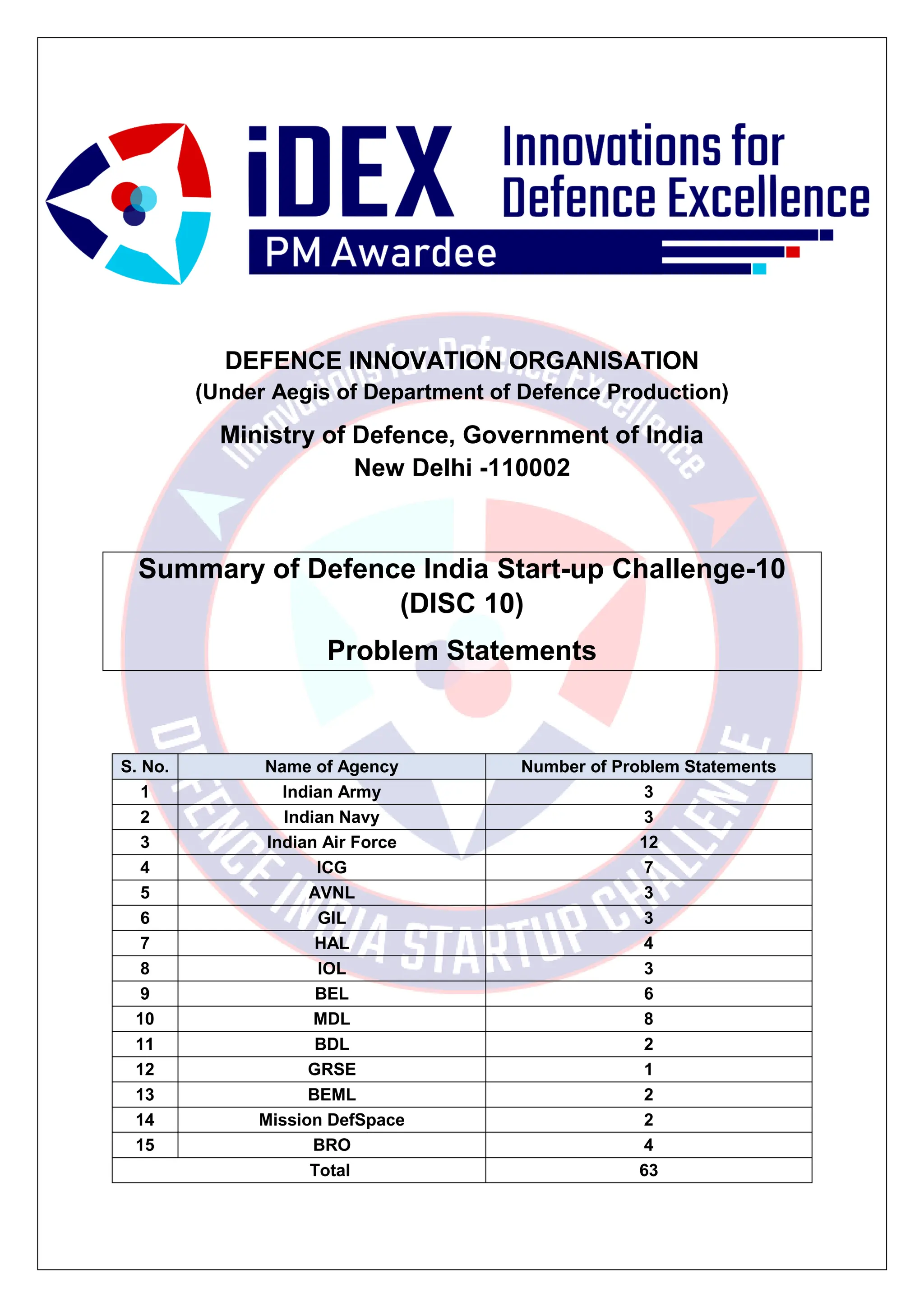
Summary of Defence India Start-up Challenge-10
(DISC 10)
Problem Statements
S. No. Name of Agency Number of Problem Statements
1 Indian Army 3
2 Indian Navy 3
3 Indian Air Force 12
4 ICG 7
5 AVNL 3
6 GIL 3
7 HAL 4
8 IOL 3
9 BEL 6
10 MDL 8
11 BDL 2
12 GRSE 1
13 BEML 2
14 Mission DefSpace 2
15 BRO 4
Total 63
DISC 10 l Challenges 2
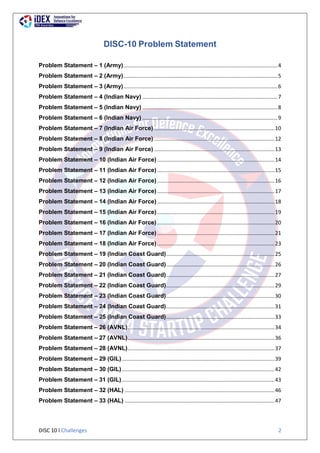
DISC-10 Problem Statement
Problem Statement – 1 (Army)........................................................................................................4
Problem Statement – 2 (Army)........................................................................................................5
Problem Statement – 3 (Army)........................................................................................................6
Problem Statement – 4 (Indian Navy) ...........................................................................................7
Problem Statement – 5 (Indian Navy) ...........................................................................................8
Problem Statement – 6 (Indian Navy) ...........................................................................................9
Problem Statement – 7 (Indian Air Force) .................................................................................10
Problem Statement – 8 (Indian Air Force) .................................................................................12
Problem Statement – 9 (Indian Air Force) .................................................................................13
Problem Statement – 10 (Indian Air Force) ...............................................................................14
Problem Statement – 11 (Indian Air Force) ...............................................................................15
Problem Statement – 12 (Indian Air Force) ...............................................................................16
Problem Statement – 13 (Indian Air Force) ...............................................................................17
Problem Statement – 14 (Indian Air Force) ...............................................................................18
Problem Statement – 15 (Indian Air Force) ...............................................................................19
Problem Statement – 16 (Indian Air Force) ...............................................................................20
Problem Statement – 17 (Indian Air Force) ...............................................................................21
Problem Statement – 18 (Indian Air Force) ...............................................................................23
Problem Statement – 19 (Indian Coast Guard).........................................................................25
Problem Statement – 20 (Indian Coast Guard).........................................................................26
Problem Statement – 21 (Indian Coast Guard).........................................................................27
Problem Statement – 22 (Indian Coast Guard).........................................................................29
Problem Statement – 23 (Indian Coast Guard).........................................................................30
Problem Statement – 24 (Indian Coast Guard).........................................................................31
Problem Statement – 25 (Indian Coast Guard).........................................................................33
Problem Statement – 26 (AVNL)...................................................................................................34
Problem Statement – 27 (AVNL)...................................................................................................36
Problem Statement – 28 (AVNL)...................................................................................................37
Problem Statement – 29 (GIL).......................................................................................................39
Problem Statement – 30 (GIL).......................................................................................................42
Problem Statement – 31 (GIL).......................................................................................................43
Problem Statement – 32 (HAL) .....................................................................................................46
Problem Statement – 33 (HAL) .....................................................................................................47
DISC 10 l Challenges 3
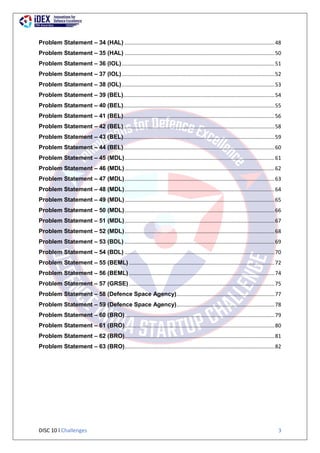
Problem Statement – 34 (HAL) .....................................................................................................48
Problem Statement – 35 (HAL) .....................................................................................................50
Problem Statement – 36 (IOL).......................................................................................................51
Problem Statement – 37 (IOL).......................................................................................................52
Problem Statement – 38 (IOL).......................................................................................................53
Problem Statement – 39 (BEL)......................................................................................................54
Problem Statement – 40 (BEL)......................................................................................................55
Problem Statement – 41 (BEL)......................................................................................................56
Problem Statement – 42 (BEL)......................................................................................................58
Problem Statement – 43 (BEL)......................................................................................................59
Problem Statement – 44 (BEL)......................................................................................................60
Problem Statement – 45 (MDL).....................................................................................................61
Problem Statement – 46 (MDL).....................................................................................................62
Problem Statement – 47 (MDL).....................................................................................................63
Problem Statement – 48 (MDL).....................................................................................................64
Problem Statement – 49 (MDL).....................................................................................................65
Problem Statement – 50 (MDL).....................................................................................................66
Problem Statement – 51 (MDL).....................................................................................................67
Problem Statement – 52 (MDL).....................................................................................................68
Problem Statement – 53 (BDL) .....................................................................................................69
Problem Statement – 54 (BDL) .....................................................................................................70
Problem Statement – 55 (BEML) ..................................................................................................72
Problem Statement – 56 (BEML) ..................................................................................................74
Problem Statement – 57 (GRSE) ..................................................................................................75
Problem Statement – 58 (Defence Space Agency)..................................................................77
Problem Statement – 59 (Defence Space Agency)..................................................................78
Problem Statement – 60 (BRO).....................................................................................................79
Problem Statement – 61 (BRO).....................................................................................................80
Problem Statement – 62 (BRO).....................................................................................................81
Problem Statement – 63 (BRO).....................................................................................................82
DISC 10 l Challenges 4
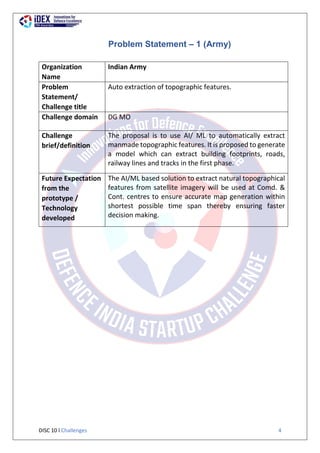
Problem Statement – 1 (Army)
Organization
Name
Indian Army
Problem
Statement/
Challenge title
Auto extraction of topographic features.
Challenge domain DG MO
Challenge
brief/definition
The proposal is to use AI/ ML to automatically extract
manmade topographic features. It is proposed to generate
a model which can extract building footprints, roads,
railway lines and tracks in the first phase.
Future Expectation
from the
prototype /
Technology
developed
The AI/ML based solution to extract natural topographical
features from satellite imagery will be used at Comd. &
Cont. centres to ensure accurate map generation within
shortest possible time span thereby ensuring faster
decision making.
DISC 10 l Challenges 5
Problem Statement – 2 (Army)
Organization
Name
Indian Army
Problem
Statement/
Challenge title
Automatic activation device for combat free fall
parachute.
Challenge domain DG Infantry
Challenge
brief/definition
This is req. to cater the eventualities when a CFF
personnel is not able to deploy his main canopy or if any
canopy malfunctions.
Future Expectation
from the
prototype /
Technology
developed
The AAD, being a critical component of CFF parachute
system and lifesaving device will be used as safety
equipment for unforeseen contingencies during combat
freefall missions and training. Thus, ensuring safety and
ensuring that the individual lands safely.
DISC 10 l Challenges 6
Problem Statement – 3 (Army)
Organization
Name
Indian Army
Problem
Statement/
Challenge title
Integrated digital cockpit.
Challenge domain DG AC
Challenge
brief/definition
Keeping recurring breakdowns and relatively inaccurate
o/p given by analogue eqp. A digital Panel touch screen
equipped with a warning system is needed to access all
the data accurately at a glance and continuously monitor
AFV’s health.
Future Expectation
from the
prototype /
Technology
developed
The digital panel touchscreen equipment with a warning
system will ensure data accuracy and continuous
monitoring of the health of AFVs.
The integrated digital cockpit will ensure timely repair
without the need to search for the problem at hand
thereby ensuring time critical repairs in situ.
DISC 10 l Challenges 7
Problem Statement – 4 (Indian Navy)
Organization Name Directorate of Marine Engineering
Problem
Statement/
Challenge title
Development of Laser-based Tools Techniques for Turbine
(GT) to Reduction Gear (RG) and RG to Shaft Alignment.
Challenge domain Laser-based technology for Shaft Line Alignment
Challenge
brief/definition
Currently, the conventional methods (mechanical dial
gauge) are being used for alignment of GT to RG and RG
to shaft line on-board IN warships.
This technique has a number of significant drawbacks
including-
 Conventional methods are tedious and time
consuming which require multiple iterations and are
inefficient.
 During capture of readings, no concurrent work can
be progressed in Engine Room.
 Special tools required for carrying out alignment are
nonstandard and different across all platform/ ships.
Future Expectation
from the prototype
/ Technology
developed
The laser-based GT to RG and RG to Shaft Line Alignment
tools/ techniques should be able provide a universal
solution to overcome the existing issues experienced
while using the conventional methodology.
The results will be more precise and able to capture
sufficient readings to avoid multiple iterations.
DISC 10 l Challenges 8
Problem Statement – 5 (Indian Navy)
Organization
Name
Directorate of Staff Requirements
Problem
Statement/
Challenge title
Development of Underwater Target Structure (UTS).
Challenge domain Underwater Target for Combat Torpedo Firings
Challenge
brief/definition
Design and development of recoverable Underwater
Target Structure capable of being deployed at sea by IN
Ships for combat torpedo firings.
Future Expectation
from the
prototype /
Technology
developed
Development of Underwater Target Structure with
following capabilities:
1. Capable of deployment upto 100 m. depth towable.
2. Recoverable.
3. Assembly/dismantling at Naval Dockyards.
4. Live feed of torpedo firings using underwater
cameras.
5. Compatible with Acoustic Targets.
DISC 10 l Challenges 9
Problem Statement – 6 (Indian Navy)
Organization
Name
Directorate of Naval Intelligence
Problem
Statement/
Challenge title
Naval Imagery and Target Information Network (NITIN).
Challenge domain Information Technology and Networking
Challenge
brief/definition
Design and development of imaginary cum target
software viz intended to carry of entire data-basing and
make the authentic data available for other agencies for
immediate use during hostilities breakout.
Future Expectation
from the
prototype /
Technology
developed
The two major submodules i.e. IMM (Imagery
Management Module) and TAM (Target Analysis Module)
should be able to upload and download heavy images
(3GB), easy retrieval of data either by name,
latitude/longitude, date, types, class of ships, or any
other category by various agencies when they sight
foreign warships and area/ vessels of interest and able to
deal with the Integrated Geospatial target folders (IGTFS)
and making them available for other User/ Agencies.
Interface between GUI (Graphical User Interface)
including GIS (Geographical Information System) and
software in addition should have suitable Al engine for
image recognition (as an when proven).
DISC 10 l Challenges 10
Problem Statement – 7 (Indian Air Force)
Sponsoring Dte/
Command/
Station
Indian Air Force - DGMS (Air)
Problem
Statement/
Challenge Title
Development of an indigenized Hypoxicator to provide
Normobaric Hypoxia Indoctrination to the aircrew.
Challenge Brief/
Definition
(Give details of
innovation to be
done by the start-
up and expected
deliverables at the
end of the project)
The existing hypoxicator are imported. By virtue of which,
they are expensive and require high maintenance. The
availability of vendors and technical support is also limited
for such hypoxicators. In addition, they do not conform to
'Make in India' clause. Development of an lndigenized
hypoxicator would provide a safe and effective platform
for Aeromedical Training in line with international Military
Training.
Development-
Normobaric-hypoxia can be achieved by either of the
following methods:
 Air separation through semipermeable membrane.
Extracting oxygen from ambient air.
 Gas mixture from a single cylinder controlled by a
solenoid valve and delivering different concentrations
as per altitude (e.g., 8% O2 + 92% N2 to simulate
25000 ft).
 Different gas mixture in separate cylinders simulating
different altitudes.
The air separation method is technology intensive and the
integrated circuits needs to be imported whereas gas
mixture is a simpler method not involving air separation.
The QRs are as follows:
 Power supply: Equipment to be compatible with
Indian commercial electric supply.
 Desired Altitude Range: From ≤ 5000 ft. upto 30000 ft.
 Duration of Operation: The equipment should be able
to function continuously up to 10h/day.
DISC 10 l Challenges 11
 One time compressor running hours without
servicing: upto 5000h.
 Number of simultaneous mask users: One to five.
 Flow-rate: Upto 50L Changeover from Hypoxia to
Mormoxia should be within the Time of useful
consciousness at that altitude.
 Noise Specification: Less than 50 dB
 Output Pressure: 14 to 110 psi
 Storage Humidity: Upto 95%
 Operating Temperature: 5 degree to 40 degree Celsius
 Mobility: It should be feasible to move the equipment
from one place to another.
 Sturdiness: Connectors, tubing masks, mask harness
and components which are prone for wear and tear
should be of sturdy built.
 Installation and Demonstration: Installation and
demonstration of the equipment to be carried out at
IAM IAF, Bengaluru.
 Warranty: Onsite after sale servicing and repair of the
equipment required for minimum 02 years.
Comprehensive Annual Maintenance Contract for
minimum 03 years.
 Training for Users: For Medical Officers who will use
equipment for training and research.
 Training for Technicians: For technical staff to carry
out daily inspection to assess serviceability of
equipment and to undertake minor troubleshooting
operations. Either independently or on telephonic
consultation with OEM rep.
 Technical Manuals: Provision of Technical Manuals
giving out all the technical details of the equipment.
 Spare Masks: Mask harness angles connections and
consumables if any.
DISC 10 l Challenges 12
Problem Statement – 8 (Indian Air Force)
Details Sought Indian Air Force - Staff Comments
Sponsoring
Directorate/
Command/ Station
Dte of Ops (AD) (C & R)
Problem Statement
/Challenge title
(give brief
Definition)
Design and Develop Pressurized Radome for Indian
Airforce Radar.
Challenge Brief/
definition
(Please give details
of the innovation to
be done by the
start-up and
expected
deliverables at the
end of the project)
These radars are already operational in IAF. In order to
facilitate them operating in high altitude areas, it needs
to be provisioned with Pressurized radomes.
Future expectation
from the
prototype/
Technology
developed
Radomes to be dismountable for facilitating reassembly
at a new location. The radomes must be capable of
facilitating the radar to operate upto an altitude of 5 KM
AMSL.
DISC 10 l Challenges 13
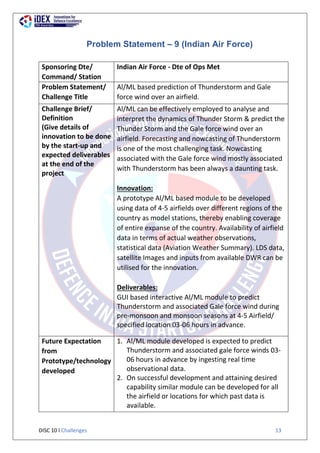
Problem Statement – 9 (Indian Air Force)
Sponsoring Dte/
Command/ Station
Indian Air Force - Dte of Ops Met
Problem Statement/
Challenge Title
Al/ML based prediction of Thunderstorm and Gale
force wind over an airfield.
Challenge Brief/
Definition
(Give details of
innovation to be done
by the start-up and
expected deliverables
at the end of the
project
Al/ML can be effectively employed to analyse and
interpret the dynamics of Thunder Storm & predict the
Thunder Storm and the Gale force wind over an
airfield. Forecasting and nowcasting of Thunderstorm
is one of the most challenging task. Nowcasting
associated with the Gale force wind mostly associated
with Thunderstorm has been always a daunting task.
Innovation:
A prototype Al/ML based module to be developed
using data of 4-5 airfields over different regions of the
country as model stations, thereby enabling coverage
of entire expanse of the country. Availability of airfield
data in terms of actual weather observations,
statistical data (Aviation Weather Summary). LDS data,
satellite Images and inputs from available DWR can be
utilised for the innovation.
Deliverables:
GUI based interactive Al/ML module to predict
Thunderstorm and associated Gale force wind during
pre-monsoon and monsoon seasons at 4-5 Airfield/
specified location 03-06 hours in advance.
Future Expectation
from
Prototype/technology
developed
1. Al/ML module developed is expected to predict
Thunderstorm and associated gale force winds 03-
06 hours in advance by ingesting real time
observational data.
2. On successful development and attaining desired
capability similar module can be developed for all
the airfield or locations for which past data is
available.
DISC 10 l Challenges 14
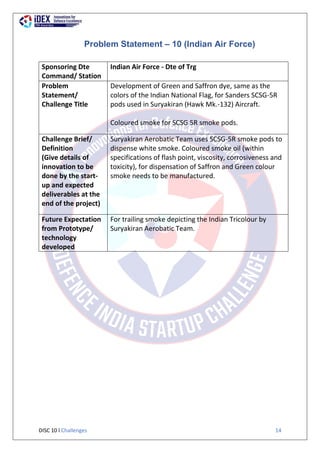
Problem Statement – 10 (Indian Air Force)
Sponsoring Dte
Command/ Station
Indian Air Force - Dte of Trg
Problem
Statement/
Challenge Title
Development of Green and Saffron dye, same as the
colors of the Indian National Flag, for Sanders SCSG-5R
pods used in Suryakiran (Hawk Mk.-132) Aircraft.
Coloured smoke for SCSG 5R smoke pods.
Challenge Brief/
Definition
(Give details of
innovation to be
done by the start-
up and expected
deliverables at the
end of the project)
Suryakiran Aerobatic Team uses SCSG-5R smoke pods to
dispense white smoke. Coloured smoke oil (within
specifications of flash point, viscosity, corrosiveness and
toxicity), for dispensation of Saffron and Green colour
smoke needs to be manufactured.
Future Expectation
from Prototype/
technology
developed
For trailing smoke depicting the Indian Tricolour by
Suryakiran Aerobatic Team.
DISC 10 l Challenges 15
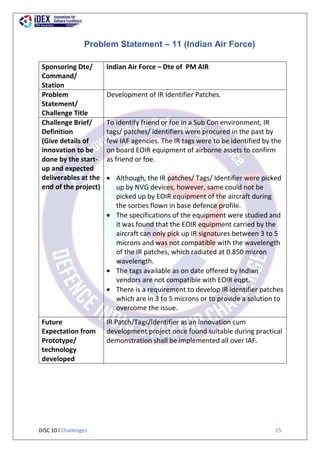
Problem Statement – 11 (Indian Air Force)
Sponsoring Dte/
Command/
Station
Indian Air Force – Dte of PM AIR
Problem
Statement/
Challenge Title
Development of IR Identifier Patches.
Challenge Brief/
Definition
(Give details of
innovation to be
done by the start-
up and expected
deliverables at the
end of the project)
To identify friend or foe in a Sub Con environment, IR
tags/ patches/ identifiers were procured in the past by
few IAF agencies. The IR tags were to be identified by the
on board EOIR equipment of airborne assets to confirm
as friend or foe.
 Although, the IR patches/ Tags/ Identifier were picked
up by NVG devices, however, same could not be
picked up by EOIR equipment of the aircraft during
the sorties flown in base defence profile.
 The specifications of the equipment were studied and
it was found that the EOIR equipment carried by the
aircraft can only pick up IR signatures between 3 to 5
microns and was not compatible with the wavelength
of the IR patches, which radiated at 0.850 micron
wavelength.
 The tags available as on date offered by Indian
vendors are not compatible with EOIR eqpt.
 There is a requirement to develop IR identifier patches
which are in 3 to 5 microns or to provide a solution to
overcome the issue.
Future
Expectation from
Prototype/
technology
developed
IR Patch/Tags/ldentifier as an innovation cum
development project once found suitable during practical
demonstration shall be implemented all over IAF.
DISC 10 l Challenges 16
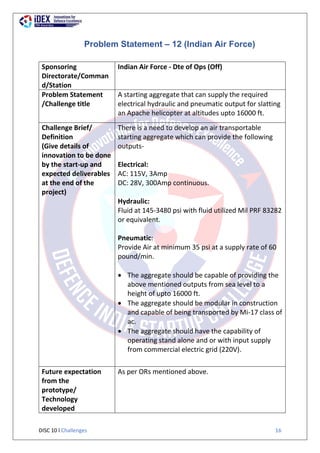
Problem Statement – 12 (Indian Air Force)
Sponsoring
Directorate/Comman
d/Station
Indian Air Force - Dte of Ops (Off)
Problem Statement
/Challenge title
A starting aggregate that can supply the required
electrical hydraulic and pneumatic output for slatting
an Apache helicopter at altitudes upto 16000 ft.
Challenge Brief/
Definition
(Give details of
innovation to be done
by the start-up and
expected deliverables
at the end of the
project)
There is a need to develop an air transportable
starting aggregate which can provide the following
outputs-
Electrical:
AC: 115V, 3Amp
DC: 28V, 300Amp continuous.
Hydraulic:
Fluid at 145-3480 psi with fluid utilized Mil PRF 83282
or equivalent.
Pneumatic:
Provide Air at minimum 35 psi at a supply rate of 60
pound/min.
 The aggregate should be capable of providing the
above mentioned outputs from sea level to a
height of upto 16000 ft.
 The aggregate should be modular in construction
and capable of being transported by Mi-17 class of
ac.
 The aggregate should have the capability of
operating stand alone and or with input supply
from commercial electric grid (220V).
Future expectation
from the
prototype/
Technology
developed
As per ORs mentioned above.
DISC 10 l Challenges 17
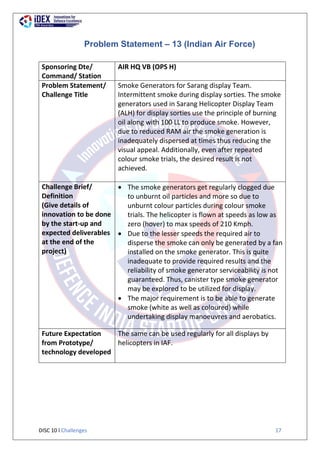
Problem Statement – 13 (Indian Air Force)
Sponsoring Dte/
Command/ Station
AIR HQ VB (OPS H)
Problem Statement/
Challenge Title
Smoke Generators for Sarang display Team.
Intermittent smoke during display sorties. The smoke
generators used in Sarang Helicopter Display Team
(ALH) for display sorties use the principle of burning
oil along with 100 LL to produce smoke. However,
due to reduced RAM air the smoke generation is
inadequately dispersed at times thus reducing the
visual appeal. Additionally, even after repeated
colour smoke trials, the desired result is not
achieved.
Challenge Brief/
Definition
(Give details of
innovation to be done
by the start-up and
expected deliverables
at the end of the
project)
 The smoke generators get regularly clogged due
to unburnt oil particles and more so due to
unburnt colour particles during colour smoke
trials. The helicopter is flown at speeds as low as
zero (hover) to max speeds of 210 Kmph.
 Due to the lesser speeds the required air to
disperse the smoke can only be generated by a fan
installed on the smoke generator. This is quite
inadequate to provide required results and the
reliability of smoke generator serviceability is not
guaranteed. Thus, canister type smoke generator
may be explored to be utilized for display.
 The major requirement is to be able to generate
smoke (white as well as coloured) while
undertaking display manoeuvres and aerobatics.
Future Expectation
from Prototype/
technology developed
The same can be used regularly for all displays by
helicopters in IAF.
DISC 10 l Challenges 18
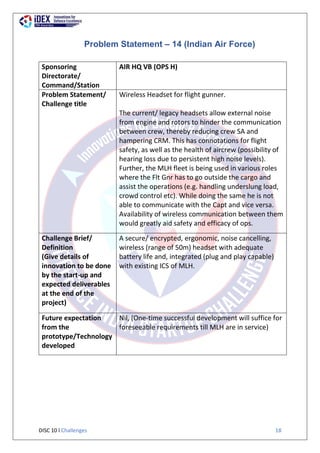
Problem Statement – 14 (Indian Air Force)
Sponsoring
Directorate/
Command/Station
AIR HQ VB (OPS H)
Problem Statement/
Challenge title
Wireless Headset for flight gunner.
The current/ legacy headsets allow external noise
from engine and rotors to hinder the communication
between crew, thereby reducing crew SA and
hampering CRM. This has connotations for flight
safety, as well as the health of aircrew (possibility of
hearing loss due to persistent high noise levels).
Further, the MLH fleet is being used in various roles
where the Flt Gnr has to go outside the cargo and
assist the operations (e.g. handling underslung load,
crowd control etc). While doing the same he is not
able to communicate with the Capt and vice versa.
Availability of wireless communication between them
would greatly aid safety and efficacy of ops.
Challenge Brief/
Definition
(Give details of
innovation to be done
by the start-up and
expected deliverables
at the end of the
project)
A secure/ encrypted, ergonomic, noise cancelling,
wireless (range of 50m) headset with adequate
battery life and, integrated (plug and play capable)
with existing ICS of MLH.
Future expectation
from the
prototype/Technology
developed
Nil, (One-time successful development will suffice for
foreseeable requirements till MLH are in service)
DISC 10 l Challenges 19
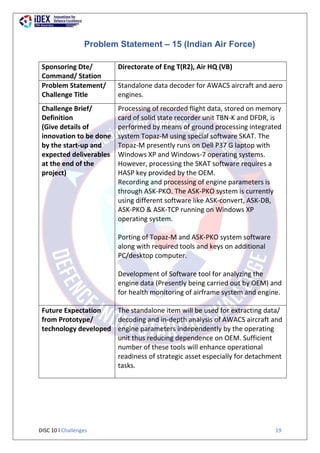
Problem Statement – 15 (Indian Air Force)
Sponsoring Dte/
Command/ Station
Directorate of Eng T(R2), Air HQ (VB)
Problem Statement/
Challenge Title
Standalone data decoder for AWACS aircraft and aero
engines.
Challenge Brief/
Definition
(Give details of
innovation to be done
by the start-up and
expected deliverables
at the end of the
project)
Processing of recorded flight data, stored on memory
card of solid state recorder unit TBN-K and DFDR, is
performed by means of ground processing integrated
system Topaz-M using special software SKAT. The
Topaz-M presently runs on Dell P37 G laptop with
Windows XP and Windows-7 operating systems.
However, processing the SKAT software requires a
HASP key provided by the OEM.
Recording and processing of engine parameters is
through ASK-PKO. The ASK-PKO system is currently
using different software like ASK-convert, ASK-DB,
ASK-PKO & ASK-TCP running on Windows XP
operating system.
Porting of Topaz-M and ASK-PKO system software
along with required tools and keys on additional
PC/desktop computer.
Development of Software tool for analyzing the
engine data (Presently being carried out by OEM) and
for health monitoring of airframe system and engine.
Future Expectation
from Prototype/
technology developed
The standalone item will be used for extracting data/
decoding and in-depth analysis of AWACS aircraft and
engine parameters independently by the operating
unit thus reducing dependence on OEM. Sufficient
number of these tools will enhance operational
readiness of strategic asset especially for detachment
tasks.
DISC 10 l Challenges 20
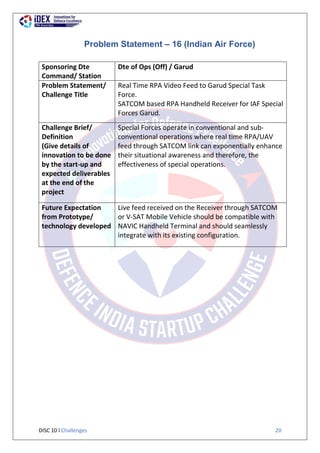
Problem Statement – 16 (Indian Air Force)
Sponsoring Dte
Command/ Station
Dte of Ops (Off) / Garud
Problem Statement/
Challenge Title
Real Time RPA Video Feed to Garud Special Task
Force.
SATCOM based RPA Handheld Receiver for IAF Special
Forces Garud.
Challenge Brief/
Definition
(Give details of
innovation to be done
by the start-up and
expected deliverables
at the end of the
project
Special Forces operate in conventional and sub-
conventional operations where real time RPA/UAV
feed through SATCOM link can exponentially enhance
their situational awareness and therefore, the
effectiveness of special operations.
Future Expectation
from Prototype/
technology developed
Live feed received on the Receiver through SATCOM
or V-SAT Mobile Vehicle should be compatible with
NAVIC Handheld Terminal and should seamlessly
integrate with its existing configuration.
DISC 10 l Challenges 21
Problem Statement – 17 (Indian Air Force)
Sponsoring Dte/
Command/ Station
Dte of Ops Met
Problem Statement/
Challenge Title
Automated cloud observation and reporting using Al/
ML.
Al/ML can be effectively employed for automated
cloud observation and reporting at an ALG/ Helipad/
DZ/ Airfield.
Challenge Brief/
Definition
(Give details of
innovation to be done
by the start-up and
expected deliverables
at the end of the
project)
Presently, clouds are reported based on visual
observation. It has certain limitations due to limited
view from the observation point and difference in
observation skills of observers which leads to some
subjectivity. At present equipment available at Met
sections for the cloud measurements are Laser Range
Finder (LRF) and Laser Ceilometers. These equipment
observe only overhead cloud height and LRF cannot
be used during precipitation.
Innovation:
 A prototype AI/ML based module integrated
with camera/ imaging device to be developed
for installed at 4-5 airfields over different
regions of the country as model stations for
real time observation and reporting of clouds
(as per the cloud reporting guidelines issued by
World Meteorological Office (WMO) and
International Civil Aviation Organisation (ICAO)
in Met observation).
 The innovation is expected to scan the sky 360°
and convert it in cloud observation report.
Deliverables:
 GUI based interactive AI/ML module integrated
with suitable imaging device (which scans the
sky 360°) for installation at 4-5 airfields over
different regions of the country as model
stations to observe and report cloud.
DISC 10 l Challenges 22
 It may be programmed to apply correction in
height of clouds, considering the angle at which
equipment is scanning.
 It should also have provision of integration with
cloud measuring equipment like ceilometer to
provide complete cloud image instead of only
overhead observation.
Future Expectation
from Prototype/
technology developed
 Automated cloud observation and reporting
capability in integration with an
equipment/camera for scanning the sky.
 Provision for time period selection for automated
cloud reporting (i.e. every 10 min, 30 min or 1 hr
etc.).
 Provisions for integration with other cloud
measuring equipment like ceilometer.
 lf performance is found satisfactory, equipment
may also be integrated with Automatic Weather
Stations (AWS).
DISC 10 l Challenges 23
Problem Statement – 18 (Indian Air Force)
Sponsoring
Directorate/
Command/Station
Indian Air Force - DGMS (Air)
Problem Statement/
Challenge title (give
brief Definition)
Development of a full coverage, lightweight,
airworthy, Anti-G suit to provide protection up to 9
Gz automatically, without straining by the pilot.
Challenge
Brief/definition
(Please give details of
the innovation to be
done by the start-up
and expected
deliverables at the
end of the project)
The current Anti-G suits provide protection up to 6
Gz. While aircraft are capable of 9 Gz. The gap
between 6-9 Gz is covered by the pilot's straining.
This results in an ever present danger of G-induced
loss of consciousness, wavering of attention from the
task at hand, fatigue especially when several Gz is to
be sustained and abandoning of a situation of
advantage, in the event of a grey-out.
The Anti-G Suit (AGS) will consist of a full coverage
garment, covering the entire torso, legs and arms.
The head and neck, hands and feet will not be
enclosed in the garment. The garment will be
pressurized using inflatable bladders.
Developing of the AGS would entail the following-
Selection of a suitable fabric, that is:
 Breathable.
 Non-stretchable.
 Durable.
 Non-friable.
 Light weight.
 Wearable.
 Gentle on the skin.
Design and Development of a bladder system that is:
 Lightweight.
 Correctly sized for adequate protection.
 Correctly positioned for adequate protection.
 A correct number for adequate protection.
DISC 10 l Challenges 24
 Designed and placed so that undue heat load is
not applied on the pilot.
 Designed for pilot comfort.
Stitching and fitment:
 Snug fitment for adequate protection.
 Adjustable fitment so as to reduce the logistic
challenge.
 Tear proof stitching.
Integration with the existing Anti-G system of the
aircraft of the IAF.
Future expectation
from the prototype/
Technology
developed
If the technology is successful, it would be a game
changer for combat effectiveness in the IAF, providing
a definite military edge over the adversary.
DISC 10 l Challenges 25
Problem Statement – 19 (Indian Coast Guard)
Organization Name Indian Coast Guard
Problem Statement/
Challenge title
Interconnected Wearable Safety Bands.
It has proved difficult to locate sea-farers during night
in an eventual case of going overboard especially
during monsoon season. There is a need to
electronically monitor movement of personnel on
weather decks.
Challenge domain Marine Electronics/ Safety of life at Sea
Challenge
brief/definition
 Wearable Safety bands to be worn by all sea-farers
which are interconnected to each other and also
connected to a mother device in the ship. During
sailing if a person goes overboard, the loop of
connection will be broken and alarm will be
generated in the mother device.
 The Safety band worn by person overboard will
automatically send GPS coordinates to the mother
device thus helping in easier location of the person
at distress.
Future Expectation
from the prototype/
Technology
developed
The wearable safety bands can be worn by all sea-
farers during sailing and will provide additional boost
in confidence for keeping lives safe at sea. The safety
bands can have features like waterproofing, SOS
signal projection, active GPS which can be lifesaving
in case of any eventuality.
DISC 10 l Challenges 26
Problem Statement – 20 (Indian Coast Guard)
Organization Name Indian Coast Guard
Problem Statement/
Challenge title
Indigenisation on Vacuum Toilet System with sewage
treatment plant.
Challenge domain Environmental / Ecological requirements
Challenge
brief/definition
Ships to be provided with Vacuum Toilet System for
collection of sewage from WC’s fitted onboard. The
collected sewage is to be treated prior as per MARPOL
(Annex IV requirement). ICG ships are equipped with
foreign make Vacuum Toilet System. The non-
operationalization of toilet system affects the
habitability and in turn affects the operational
availability of ships.
Future Expectation
from the prototype /
Technology
developed
Lesser dependency on foreign firms and easier
availability of spare parts.
DISC 10 l Challenges 27
Problem Statement – 21 (Indian Coast Guard)
Organization Name Indian Coast Guard
Problem Statement/
Challenge title
Integrated M-SAR Incident Management and Op
Planning Software.
Challenge domain Indian Search and Rescue Region (Maritime) and
Indian Ocean Region
Challenge
brief/definition
 ICG has been entrusted with duties of nodal
agency for coordination of Maritime Search &
Rescue in the ISRR as well as larger IOR/Indo-
Pacific Region. The region witnesses large number
of merchant traffic, fishing, small vessels and air
traffic, coupled with increased frequency of
cyclonic disturbances increase likelihood of threat
to life/property.
 Analysis, Collation, Fusion and Management of
large number of merchant, fishing, small vessels
aviation traffic data on single GIU and utilizing the
same for SAR/maritime incident management
requires integration of many databases and in-
house Incident Management Software.
 Besides, an Integrated Planning software with
Met/Oceanic and Topographical oceanic inputs as
well as maritime traffic databases would optimize
the planning of search areas/search patterns,
identifying SRUs, accurate and timely dispatch of
Search and Rescue Services to mariners in Distress
including fishermen at sea. Similar software have
been developed in-house by foreign countries for
Coast Guards in collaboration with IT companies
such as SAROPs, SAR Master 600, BMT SARIS.
Future Expectation
from the prototype /
Technology
developed
1. The software can be integrated with real-time
inputs and AI from SRUs, On Scene Coordinators,
and Surveillance Units for Real Time Management
of SAR Operation. The technology would assist in
realizing aims of digitization, meta-data analytics,
integration of AI, UAVs and technology in saving
lives.
DISC 10 l Challenges 28
2. It will serve the larger obligations and
commitment of India under the SAR Convention,
1979 and UNCLOS.
DISC 10 l Challenges 29
Problem Statement – 22 (Indian Coast Guard)
Organization Name Indian Coast Guard
Problem Statement/
Challenge title
Designing and Manufacturing of Outer loop, Inner
loop and skirt segment for H 187 class of ACV.
Challenge domain All ACVs operated by the Indian Coast Guard are of
flexible skirt type with a high lift. A special flexible
fibre reinforced rubber composite outer loop, inner
loop and skirt segment is fitted around the hull frame
and 128 rubber skirting fitted within the outer loop
act together to trap the air pumped in by four
centrifugal lift fans driven by diesel engines. These
loops have tendency to tear off due to rough terrain
on which crafts are operated. The cost of single unit
of outer loop along with anti-plough diaphragm and
rear inner loop is approximately 96 lakhs which is
manufactured in M/s Griffon Hoverwork Ltd, UK
which includes the shipping charges and custom duty.
High cost and long lead time for procurement and
supply of these spare not only keeps the craft non-
operational but also in views loss to government.
Challenge
brief/definition
Manufacturing of outer loop, inner loop and skirt
segment along with anti-plough diaphragm and rear
inner loop for all ACVs along with design machinery
by DRDO/MSME in India will enhance the operational
capabilities and will be cost effective for the Indian
Coast Guard. The cost of the spare will be nominal
and the lead time will considerably reduce.
Future Expectation
from the prototype /
Technology
developed
Once the firm/vendor is finalised for manufacturing
and designing the loop, its durability and operation
ability can be tested on NCNC basis.
DISC 10 l Challenges 30
Problem Statement – 23 (Indian Coast Guard)
Organization Name Indian Coast Guard
Problem Statement/
Challenge title
Hanging underwater probe (with camera and other
sensors) for ships.
Challenge domain Maritime
Challenge
brief/definition
Hanging underwater probe with camera and other
sensors can aid to maritime surface platforms in
many ways like, underwater search & surveillance.
In terms of specification, it can be in cylindrical shape
with dia. not exceeding 50 cm, equipped with camera
& light, multiple sensors for depth, pressure &
temperature, magnetic compass and audio frequency
receiver. It should be controlled though hanging wire
and able to operate upto 500 metre depth. It should
have safety feature for auto resurfacing in case of lost
control or any other emergency.
Future Expectation
from the prototype /
Technology
developed
ICG Ships may use the device for multi-purposes like,
underwater search for survivors/bodies, debris of
aircraft/Helo, vessels and also for underwater
surveillance and inspecting underwater fittings
amongst others.
DISC 10 l Challenges 31
Problem Statement – 24 (Indian Coast Guard)
Organization Name Indian Coast Guard
Problem Statement/
Challenge title
Wireless Boarding Camera set for VBSS (Visit, Board,
Search and Seizure) in Indian Coast Guard Ships.
Challenge domain The idea is to provide the team with a wireless
camera to establish a live video coverage of the vessel
boarded. The prototype developed consist of the
following:
 Helmet mounted wide angle IP camera.
 02 Radio transmitter (Onboard and BO).
 Battery Pack for power supply to camera and
transmitter (Held with BO).
 System Integrated with router onboard.
Challenge
brief/definition
Indian Coast Guard is a maritime law enforcement
(Anti-poaching /Anti-narcotics /Anti-Human
trafficking ops) and Search & Rescue agency of India
with jurisdiction over MZI. The surface platforms are
immensely responsible for majority of the above
activities and they are carried out through dedicated
boarding teams. Presently, only radio sets i.e. walkie-
talkie are the only source of communication (Voice)
between boarding teams and mother ship.
Presently, the scenario onboard the boarded vessel
cannot be ascertained through any visual aids.
Therefore, Provision of a live relay of the events
during the course of boarding is considered to be
essential. Hence, a live streaming of events are
relayed through an IP camera held with Boarding
officer (BO) for clear Surpic and adding on to the
flawless boarding operations at sea.
DISC 10 l Challenges 32
Future Expectation
from the prototype /
Technology
developed
1. The prototype may be expanded to include
microphone to enable audio/video coverage.
2. The camera transmission may be integrated with
ship’s VDR unit to provide recording of the same
which might help in future processing and
collation of data.
3. Expansion of range of wireless transmission using
high power transmitters.
4. Use of low weight to power ratio battery pack.
DISC 10 l Challenges 33
Problem Statement – 25 (Indian Coast Guard)
Organization Name Indian Coast Guard
Problem
Statement/
Challenge title
Virtual Reality based Fire Fighting and Damage Control
training module.
Fire Fighting (FF) and Damage Control (DC) proficiency is
essential in the professional repertoire of ICG personnel.
Exposure to realistic situations during routine training is
most effective method to develop FF and DC skills and
also familiarize personnel to different contingencies.
However, simulating realistic fire or flooding onboard is
dangerous and not permitted. Simulators are elaborate,
prohibitively costly and maintenance intensive shore-
based facilities. Hence such simulators cannot be
installed at multiple locations. ICG units are based at
different ports.
Challenge domain Virtual Reality aided training
Challenge
brief/definition
Developing Virtual Reality based FF and DC training
module. The VR based training module should mimic
real life fire and flooding situations authentically so that
training can be conducted in safe environments without
exposing equipment and personnel to any significant
risk.
Future Expectation
from the prototype
/ Technology
developed
The VR based FF and DC training module can be used by
ships for imparting credible training onboard in a cost
effective and safe way. It can also be developed to train
ICG personnel to conduct FF and DC operations onboard
Merchant Vessels, Fishing Boats etc.
DISC 10 l Challenges 34
Problem Statement – 26 (AVNL)
Organization Name AVNL
Problem
Statement/
Challenge title
Design & Development of-
1. Converter.
2. Gyro Unit.
3. Frequency And Voltage Regulating Unit.
Challenge domain Weapon stabilizer Assembly involves Hydraulic Power
system controlled by High precision Electronic stabilizer
system with the help of Gyro Unit (It involves
complicated electro mechanical assemblies).
Challenge
brief/definition
CONVERTER ALONG WITH FREQUENCY AND VOLTAGE
REGULATOR [T-90]
TECHNICAL DESCRIPTION
Converter along with regulator RChN 3/3 generates the
3 phase 36V, 400Hz AC current from 27 V DC supply to
power the FCS system components which work on AC
current such as gyro, synchro-resolvers etc. It is an
electro-mechanical type converter. Frequency and
voltage regulator RChN 3/3 regulates output voltage
and frequency. The voltage converter PT 800 is located
below the gun cradle while the regulator unit is located
on the turret base plate in front.
RATE GYRO
TECHNICAL DESCRIPTION
The rate gyro unit is designed to generate electric
signals proportional to the angular laying speed of the
gun in elevation and azimuth, which are required for the
steady operation of the weapon stabilizer and for
obtaining the desired transient.
Besides, the signal generated by the elevation rate gyro
unit is used for the hydraulic locking of the gun when it
DISC 10 l Challenges 35
rebounds from the upper or lower stop at an angular
speed exceeding 7+15 deg/s and for its additional
braking when it goes down at an angular speed
exceeding 7+15 deg/s in order to prevent it from coming
in contact with the ground. The rate gyro unit is located
on the base of the gun guard.
Future Expectation
from the prototype
/ Technology
developed
T-90 tanks production.
T-90, OE Tanks.
T-90, OH Tanks.
DISC 10 l Challenges 36
Problem Statement – 27 (AVNL)
Organization
Name
AVNL
Problem
Statement/
Challenge title
Design & Development of-
1. Supply Unit (Hydraulic Booster) Assembly.
2. Actuating Cylinder.
Challenge domain Weapon stabilizer Assembly involves Hydraulic Power
system controlled by High precision Electronic stabilizer
system with the help of Gyro Unit (It involves
complicated electro mechanical assemblies).
Challenge
brief/definition
HYDRAULIC BOOSTER
TECHNICAL DESCRIPTION
The hydraulic booster is designed to transform the
electric energy in the working fluid flow energy. The
hydraulic booster is located on the gun guard base.
ACTUATING CYLINDER
TECHNICAL DESCRIPTION
The actuating cylinder is designed to transform the
working fluid flow energy into the stabilizing or locking
moment upon arrival of the respective electric signals.
The body of the actuating cylinder is connected to the
turret roof and its piston, to the gun cradle. The
actuating cylinder is located to the left of the gun ahead
of sight 1G46.
Future Expectation
from the
prototype /
Technology
developed
T-90 tanks production.
T-90, OE Tanks.
T-90, OH Tanks.
DISC 10 l Challenges 37
Problem Statement – 28 (AVNL)
Organization
Name
AVNL
Problem
Statement/
Challenge title
Design & Development of-
1. Amplidyne Assembly.
2. Electric Motor Edm-1500.
3. Pump With Drive Motor.
Challenge domain Weapon stabilizer Assembly involves Hydraulic Power
system controlled by High precision Electronic stabilizer
system with the help of Gyro Unit (It involves
complicated electro mechanical assemblies).
Challenge
brief/definition
AMPLIDYNE T-90 TANKS ONLY
TECHNICAL DESCRIPTION
The Amplidyne is an electromechanical power amplifier
designed to amplify the electric control signal (coming
from K1) up to the value required for the operation of
the actuating motor. The Amplidyne is composed of a
drive, electric motor and special generator mounted in
one and the same housing on a common shaft. The
Amplidyne is located in the left part of the hull near the
storage batteries.
ELECTRIC MOTOR EDM-1500 SPECIFICATIONS T-90
Tanks Only
TECHNICAL DESCRIPTION
The Hydraulic Motor converts the energy of working
fluid into mechanical energy of output shaft. The High
Torque Hydraulic Motor consists of Hydraulic Motor and
Distributor.
DISC 10 l Challenges 38
Future Expectation
from the
prototype /
Technology
developed
T-90 tanks production.
T-90, OE Tanks.
T-90, OH Tanks.
DISC 10 l Challenges 39
Problem Statement – 29 (GIL)
Organization
Name
GIL
Problem
Statement/
Challenge title
Design & Development of Automatic Actuation Device
(AAD) For Reserve Parachute System.
Challenge domain Defence Aerospace/Recreational and Adventure sports
Challenge
brief/definition
Parachuting is used by military personnel, paratroopers,
wildfire-fighters, skydivers at sporting events of skydiving
or air shows and others as a vital part of their profession/
hobby.
Whatever the reason for parachuting, safety is a primary
concern. In addition to a primary parachute, most
parachutists equip themselves with a secondary or
reserve parachute. If the primary parachute
malfunctions, the parachutist deploys the reserve
parachute in order to land safely.
AAD is a safety device which is fitted with reserve
parachute and initiate automatic opening of reserve
parachute in case of free fall speed exceeds a prescribed
limit below specified altitude. This unit is in three parts
viz control unit, processing unit and cutter.
Design requirement of AAD System-
AAD system must consists of following:
 It should be capable of self-calibration.
 It should be electronic battery-operated tamper-
proof system with battery life of more than four
years.
 Weight: It should not be more than 250 gms.
 It should have provision for activation at preset
altitude and free fall velocity.
DISC 10 l Challenges 40
 The device should have a feature for setting
activation altitude if aircraft take off location and the
drop zone location are at different altitudes.
 The device should be rugged and robust to withstand
rigours of freefall jumps.
 The device should have auto switch off facility after
use.
 Operating range for AAD should be 1500 to 40,000
feet.
 Activation altitude should be between 1500 to 3000
ft.
 It should have self-testing facility.
 It should have service life not less than 10 years.
 It should not get affected when exposed to salt /fresh
water to a depth of 05 feet for duration of at least 10-
15 minutes.
 It should provide convenient information monitoring
such as Total number of jumps, overall free fall time,
last free fall time, max speed of the last free fall,
number of saves, atmospheric pressure, temperature
etc.
 It should be lightweight and very robust device.
 It should easily adapt to use in all weather conditions.
 It should have Alpha numeric display for ease of use
and communication.
 It should be designed to generate alerts for periodic
maintenance and the maintenance due date should
be accessed from the display.
 Overall cost of the AAD device should be competitive
to the market cost.
 It should be certified by some globally recognized
standard body related with parachute industry.
Future Expectation
from the
prototype /
Technology
developed
The demand for this high-quality parachuting equipment
i.e. AAD is expected to grow, driven by promotion of
adventure sports and recreational activities in India.
Indian Armed Forces, as well as the skydiving industry
DISC 10 l Challenges 41
constantly seek for reliable AAD, which creates a
substantial market opportunity for this item.
This equipment will be helpful reliable device for
promoting safe free fall parachuting/Aero Sports culture
within India.
DISC 10 l Challenges 42
Problem Statement – 30 (GIL)
Organization
Name
GIL
Problem
Statement/
Challenge title
Design & Development of Inter personal radio for
combat free fall parachuting operation.
Challenge domain Defence Aerospace
Challenge
brief/definition
The parachutist uses Interpersonal Radio for air-to-air or
air-to-ground communications. He mounts the radio so
that it also does not interfere with the manual activation
of the main parachute or the performance of emergency
procedures.
Design requirement of Interpersonal Radio-
The radio should work in the V/UHF band and should
have following features:
 Small form factor to fit into the jump suit of the free
faller.
 Compatible with the mission computer for transfer of
data between jumpers post deployment of parachute.
 Have ear phone and microphone compatible with the
helmet for in-flight voice communication.
 Should be shock proof and water resistant upto depth
of 5 feet of water.
 Built in encryption card for high end secrecy
requirements.
Future Expectation
from the
prototype /
Technology
developed
The demand for this high-quality combat free fall
parachuting equipment i.e. Interpersonal Radio is mainly
driven by requirement of Indian Armed Forces. This
equipment will be helpful reliable device for promoting
safe and successful combat free fall parachuting for
Indian Armed Forces.
Once developed same item can be customized and
exported as per requirement of foreign Armed forces.
DISC 10 l Challenges 43
Problem Statement – 31 (GIL)
Organization
Name
GIL
Problem
Statement/
Challenge title
Design & Development of Mission Computer with
Navigation System for combat free fall parachuting
operation.
Challenge domain Defence Aerospace
Challenge
brief/definition
The mission computer is used to improve jumpers
situational awareness about the mission progress,
improves safety and increases the effectiveness of
military jumper by providing accurate navigation even
for most demanding mission. Mission computer includes
the following:
 One Pilot Unit.
 One Display Screen.
 One support board or harness.
 One compass.
Design requirement of Mission Computer with
Navigation System:
1. System should be specifically designed for the combat
free fall mission using ruggedized modules and
proven sensors/software.
2. There should be facility to configure display based on
jumper’s experience and mission requirement.
3. Types of information display available to the jumper
should be:
 Jumpmaster screen to be used on the plane to
check the progress of the flight towards the
release point.
 Navigation screen to be used under canopy to
guide the jumper towards the landing zone.
DISC 10 l Challenges 44
 Map display of the area below the jumper during
the flight under the canopy.
iv) The mission computer with parachute navigation system
should have a facility of selecting one primary target and
two alternative landing targets. A push button located on
the mission computer can be activated with gloves to
allow the jumper to rotate through screens and landing
areas.
The mission computer should come with mission planner
software that provides mission planning for combat free
fall jumps/missions. It allows the user to select mission
parameters such as payload weight, canopy, aircraft
type, release altitude, speed, heading, and IP location.
The Mission Planner software should automatically
download the wind data and plan the mission for
optimum release point.
 It should be wearable, using chest harness to be used
for planning and execution of the free fall jump.
Facility to calculate descent rate and time to target on
deployment of parachute using onboard sensors
should be provided.
 It should be compatible with personal radios for data
transfer between multiple units during execution of
the free fall jump.
 In built Satellite Navigation [NavIC (Navigation with
Indian Constellation)] and map features for navigation
to target during day and night both should be
provided.
 It should be shock proof and water resistant, at least
IP 66 compliment or equivalent.
Future Expectation
from the
prototype /
Technology
developed
The demand for this high-quality combat free fall
parachuting equipment i.e. Mission computer with
navigation system is mainly driven by requirement of
Indian Armed Forces. This equipment will be helpful
DISC 10 l Challenges 45
reliable device for promoting safe and successful combat
free fall parachuting for Indian Armed Forces.
Once developed same item can be customized and
exported as per requirement of foreign Armed forces.
DISC 10 l Challenges 46
Problem Statement – 32 (HAL)
Organization
Name
HAL
Problem
Statement/
Challenge title
Development of UHF and L Band Ground Sectoral
Antenna.
Challenge domain Avionics and Communication
Challenge
brief/definition
 Antennas should work in UHF band and L band.
 The antennas gain should be not less than 10 dBi in
case of UHF antenna and the gain for L band antennas
should be not less than 12 dBi.
 The antenna Half Power beam width in Azimuth
should be not less than 90 degrees.
 The antennas should be vertically polarized.
 The antenna shall be designed to withstand various
environmental conditions, including temperature,
humidity and wind stress load as per JSSS5555 or MIL-
810-F/G.
Future Expectation
from the
prototype /
Technology
developed
It is expected to achieve optimum data communication
ranges from the developed antennae for the data link
systems under development at HAL.
DISC 10 l Challenges 47
Problem Statement – 33 (HAL)
Organization
Name
HAL
Problem
Statement/
Challenge title
Development of “Four phase dual coil stepper motor
with resolver (feedback)”.
Challenge domain Aero Engine fuel metering system
Challenge
brief/definition
India is still dependent on countries like France, Germany
and US for the supply of stepper motors for the use in
fuel metering system.
Currently there is no firm in India which has developed
an airworthy stepper motor for the above said use.
The specification and qualification requirement of the
component is specified below.
 Type: Hybrid stepper motor
 Voltage: 28V DC(Nominal), varying from 14 to 32 V
 Constant current control: 1 A ± 10mA
 Stepping Angle: 0.5°/1° (Half step / Full step)
 Dynamic torque: 15 Oz-in (1080 gm-cm) min.
 Temperature range: -40 °C to +70 °C
 Maximum stepping rate: 500 Steps /sec
 Medium of cooling: Air cooling
 Number of phases: 4 Phases (A, B, C & D)
 Resolver Supply: 5.5 to 10 VAC, 2500± 250 Hz
 Coil type: Dual coil type
 Winding insulation: Class H
 No. of Phase leads: 6
 Phase Lead requirement: MIL-STD; 6 pin for each
channel of stepper motor and for resolver.
Future Expectation
from the
prototype /
Technology
developed
The stepper motor so developed will be used on many of
the engines that are being developed at AERDC-HAL.
DISC 10 l Challenges 48
Problem Statement – 34 (HAL)
Organization
Name
HAL
Problem
Statement/
Challenge title
Development, Implementation, Validation of Time
Sensitive Network (TSN) Operation using Ethernet
Communication for Aerospace Onboard Systems.
Challenge domain Avionics and Communication
Challenge
brief/definition
To validate the Time Sensitive Network (TSN) Operation,
Innovator shall develop the following using Standard
Hardware Evaluation Boards available in Market:
 TSN Switch having minimum of 5 Nodes.
 High Resolution Camera, which provides Live Audio
and Video through TSN Ethernet.
 High Resolution Monitor which can accept video over
TSN Ethernet.
 Stereo Audio Head Set which can accept Audio over
TSN Ethernet.
 Standard Ethernet Ports (Minimum 2 No’s) from PC or
Laptop.
Innovator shall Design Time Sensitive Network (TSN)
Switch and TSN Nodes as per IEEE 802.1DP (Draft)
Protocol.
TSN Switch shall also support integration with Non-TSN
Ethernet (Standard Ethernet Ports).
Suitable Converters/Adapters may be used while
connecting TSN Nodes to Standard Ethernet if required.
All TSN Nodes and Standard Ethernet Ports shall be
connected to TSN Switch.
DISC 10 l Challenges 49
Innovator shall demonstrate a TSN Network Operation
with the following functions:
 Display of Live Video from Camera on Monitor.
 Playing of Live Audio from Camera on Stereo Audio
Head Set.
 Recording of Audio & Video from Camera on
PC/Laptop.
 Playing Video from PC/Laptop on Monitor.
 Playing Video from PC/Laptop on Stereo Audio Head
Set.
 Data Exchange between Two PCs/Laptops.
Future Expectation
from the
prototype /
Technology
developed
TSN Switch will be used to connect TSN Ethernets in
Future Aircrafts and Helicopters. Therefore, Innovator
shall be ready to Design and Develop (in future) a
Military Standard TSN Switch (Hardware & Software)
with all Certifications from Certification Agencies.
Innovator shall support the implementation of TSN Node
in HAL Developed Hardware Boards.
Innovator shall provide support during integration of TSN
Ethernets wherever Innovator’s Design is involved.
DISC 10 l Challenges 50
Problem Statement – 35 (HAL)
Organization
Name
HAL
Problem
Statement/
Challenge title
Development of “Spark type Ignitor box and ignitors”.
Challenge domain Aero Engine Ignition system
Challenge
brief/definition
Ignition unit is required for ignition of fuel air mixture in
the combustor of a gas turbine engine during engine
start phase. This unit consists of a low voltage high-
energy ignition box, high voltage leads (2 nos.) and spark
plugs (2 nos.)
Specifications-
 Input voltage: 12 to 32 V DC
 Maximum Input current: 2A
 Output signals: 3 kV
 Frequency: 1.5 to 3.5 Hz
 No. of output: 2 Nos.
 Energy given by the output: 0.40 to 0.70 Joules
 Minimum spark rate: 3.3 Hz
 Discharge: Unidirectional
 Temperature: - 55 to +125 °C
 Weight: 0.5 to 0.7 kg
 High voltage cable length: 0.5 to 0.6 m
Future Expectation
from the
prototype /
Technology
developed
HAL needs qualified units of these ignitors and ignitor
boxes.
DISC 10 l Challenges 51
Problem Statement – 36 (IOL)
Organization
Name
IOL
Problem
Statement/
Challenge title
Indigenization/development of Active Element of Laser
Made of Yttrium Alumino Garnet (YAG) Activated
Neodium, GS 4X65/55-D73 (Technical Specification: TY-6-
09-4622-87) for MIB (T-90).
Challenge domain Optical Fabrication of precise and critical Infrared Optics
Challenge
brief/definition
Active Element of Laser made of Yttrium Alumino Garnet
(YAG) Activated Neodium, GS-4X65/55-D73 (Technical
Specification: TU-6-09-4622-87) for MB (T-90) is a
specific type of very precise and accurate rhombus type
laser accuracy of the order of X/10 or better.
Being a specific type of CW (continuous wave) laser Rod,
it is being used to generate laser to guide the Missile
Fired.
Future Expectation
from the
prototype /
Technology
developed
As of now the laser Rod is not being manufactured in
India.
DISC 10 l Challenges 52
Problem Statement – 37 (IOL)
Organization
Name
IOL
Problem
Statement/
Challenge title
Development of an Eye Safe Laser Range Finder.
Challenge domain Electro optical domain
Challenge
brief/definition
Laser Range Finder is an important module used in the
multi sensor electro-optical systems for measuring the
range of target. This module is also used as a standalone
system also. All the fire control systems are equipped with
laser range finder.
In this challenge it is proposed to develop an eye safe laser
range finder in miniaturized form for measuring the range
of target. Prototype developed in the challenge should
have its inbuilt electronics and processing electronics for
measuring the range of target and then displaying
electronically on a screen.
Future Expectation
from the
prototype /
Technology
developed
Having a good quality, ruggedized and miniaturized Eye
Safe Laser Range Finder.
DISC 10 l Challenges 53
Problem Statement – 38 (IOL)
Organization
Name
IOL
Problem
Statement/
Challenge title
Development of an Image Processing algorithm for image
quality enhancement and Non Uniformity Calibration for
bad pixel-correction for Cooled Thermal Imagers.
Challenge domain Electro optical domain
Challenge
brief/definition
Thermal Imaging technology is latest technology for
night imaging. Cooled thermal imaging technology uses a
photon detector which is cooled by a cryogenic cooler
for better signal. Non Uniformity is natural phenomenon
associated with these imagers due to the multiple pixels
in Focal Plane Array. These non-uniformity in pixels
causes an uneven image.
In this challenge it is proposed to develop an algorithm
for image quality enhancement, non-uniformity
calibration and incorporation of various reticles by taking
the raw data from the proximity electronics of the
detector and processing this raw data in Video
Processing board for good image.
Future Expectation
from the
prototype /
Technology
developed
Having a good algorithm for image processing will
enhance the performance of thermal imager.
DISC 10 l Challenges 54
Problem Statement – 39 (BEL)
Organization
Name
BEL
Problem
Statement/
Challenge title
Read Out Integrated Circuit for Imaging Sensors (Low Light
CMOS, IR Sensors etc.)
Challenge domain Silicon Semiconductor recipe Design, Device Processing &
Fabrication at 40 nm Node.
Challenge
brief/definition
Si semiconductor design of the ROIC with the following
specs:
 Material: Si
 Format: 1280 x 1024
 Pixel Size: 4/ 10um
 Pitch: 4/ 10um
 ADC: 13 /14 bits
 Modes of operation: IWR, ITR
 Integration time: 1 to 10 ms Variable
 Frame Rate: 200 Hz
 Flip Chip Bond: Indium Bumped
Future Expectation
from the
prototype /
Technology
developed
ROIC shall be flip chip bonded with a Thermal Detector or
Low Light CMOS Sensor of the same format to make an
FPA (Focal Plane Array) which is the sensor for imaging
solutions.
DISC 10 l Challenges 55
Problem Statement – 40 (BEL)
Organization
Name
BEL
Problem
Statement/
Challenge title
To develop Proximity Sensor of Aerial Bomb Fuze for
activating Fuze firing circuit.
Challenge domain Proximity Sensors
Challenge
brief/definition
The Proximity Sensor should function correctly when the
Fuze is subjected to the following carriage envelop:
 Max Altitude: 18 km or more
 Mach Number: 1.5 or more
 ‘G’ Loading: -4g to +7.5g
 Ambient Operating temp: -50°C to +71°C
The Proximity sensor:
 Should be mountable inside existing Aerial Bomb Fuze.
 Should activate Fuze firing circuit at height of 9±3m
from target at all weather conditions and terrain.
 Should be immune to external RF noise.
 Should have no maintenance through its entire life
cycle.
 Reliability ≥ 95%
 Shelf Life: Minimum 15-years with the required
reliability.
 The Proximity sensor is to be assembled inside plastic
(Noryl, GFN2) enclosure (Radome) and potted with
polyurethane potting material.
Future Expectation
from the
prototype /
Technology
developed
Indigenous source.
DISC 10 l Challenges 56
Problem Statement – 41 (BEL)
Organization
Name
BEL
Problem
Statement/
Challenge title
To develop Proximity Sensor of Naval Artillery Fuze for
activating Fuze firing circuit.
Challenge domain Proximity Sensors
Challenge
brief/definition
The Proximity Sensor shall function on proximity against
fast moving high performance aerial targets and sea
skimming missiles where the characteristics of the target
are within the following envelope:
 Speed of the Target: Upto 1.5 Mach.
 Minimum Attack Height: > 5m above the peak of
waves.
 Minimum Target Dia: 0.3 metres.
 Height of Function: 0.5m to 30m above the target.
 Range of Functioning: 500m from muzzle to Max. Gun
range.
The Proximity Sensor:
 Should be mountable inside existing Artillery Proximity
Fuze cone.
 Should comprise of RF antenna working on FMCW
principle with characteristics of beam pattern such
that the sensitivity at the front is zero and maximum at
30-50° w.r.t. fore and aft axis.
 Should survive the Naval SRGM Artillery Gun firing
acceleration of Up to 20,000 g and 20,000 rpm.
 Should provide Sea clutter rejection.
 Should be immune to external RF noise.
 Should have no maintenance through its entire life
cycle.
 Reliability ≥ 95%
DISC 10 l Challenges 57
 Shelf Life: Minimum 10-years with the required
reliability.
 Operating conditions of -20°C to +55°C with Humidity
of +95%
 The Proximity sensor is to be assembled inside plastic
(Noryl, GFN2) enclosure (Radome) and potted with
polyurethane potting material.
Future Expectation
from the
prototype /
Technology
developed
Indigenous source.
DISC 10 l Challenges 58
Problem Statement – 42 (BEL)
Organization
Name
BEL
Problem
Statement/
Challenge title
To develop Proximity Sensor of Artillery Fuzes for
activating Fuze firing circuit at height of 10±6M from
target.
Challenge domain Proximity Sensors
Challenge
brief/definition
The Proximity sensor:
 Should be mountable inside existing Artillery Proximity
Fuze cone.
 Should be preferably based on FMCW technology.
 Should activate Fuze firing circuit at height of 10±6M
from target at all weather conditions and terrain.
 Should survive the Artillery Gun firing acceleration of
Up to 20,000 g and 20,000 rpm.
 Should be immune to external RF noise.
 Should have no maintenance through its entire life
cycle.
 Reliability ≥ 95%
 Shelf Life: Minimum 15-years with the required
reliability.
 Operating conditions of -30°C to +55°C upto Altitude of
6000 M above MSL.
 The Proximity sensor is to be assembled inside plastic
(Noryl, GFN2) enclosure (Radome) and potted with
polyurethane potting material.
Future Expectation
from the
prototype /
Technology
developed
Cost Reduction along with Indigenisation.
DISC 10 l Challenges 59
Problem Statement – 43 (BEL)
Organization
Name
BEL
Problem
Statement/
Challenge title
Si Semiconductor device for proximity Fuze.
Challenge domain Silicon Semiconductor recipe Design, Device Processing &
Fabrication at 40 nm Node
Challenge
brief/definition
Si semiconductor design of the semiconductor device
(Laser Diode) for proximity fuze with the following specs:
 Material: Si / InGaAs.
 Laser Diode.
 Power: 4 Watts.
Future Expectation
from the
prototype /
Technology
developed
This Laser diode along with a receiver shall be used as a
proximity fuze.
DISC 10 l Challenges 60
Problem Statement – 44 (BEL)
Organization
Name
BEL
Problem
Statement/
Challenge title
Technology development, to detect the bullet location in
the target plane for the subsonic weapons, which has
bullet/ammunition velocity less than 450 m/sec at the
target.
Challenge domain Operator Training Simulator
Challenge
brief/definition
Acoustic sensor based solutions are available to detect
the bullet locations, for the supersonic weapons, which
has bullet/ammunition velocity 450 m/sec or more at the
target. Acoustic sensors are unable to detect the shock
waves generated by bullets of subsonic weapons due to
low signal strength, as bullet velocity of such ammunition
is less than 450 m/sec at the target.
Required technology needs to be developed to resolve
the above challenge, with following key specifications:
 Accuracy: 5mm or less within a radius of 8 cm (from
target centre) and up to 10 mm anywhere on the
target at wind speed less than 1.5 m/sec.
 Detection Zone: 80 cm left and right from the target
centre and 180 cm from the target bottom.
 Max Rate of Fire: 18 rounds/second.
 Suitable for stationary target, pop-up target, turning or
rotation target, as well as for moving target exercises.
Future Expectation
from the
prototype /
Technology
developed
1. The technology developed shall be integrated with
Location Of Miss And Hit System (LOMAH) system, to
automate the existing training methodology of
weapons training at the existing firing ranges.
2. It is aimed to reduce the training duration by training
more firers in a specified period of time, manpower
requirement for the conduct of firing and provide
immediate feedback of the hit as well as miss bullets.
DISC 10 l Challenges 61
Problem Statement – 45 (MDL)
Organization
Name
MDL
Problem
Statement/
Challenge title
Indigenization of Bearing Time Device (BTD) which is
currently imported.
Challenge domain 1) Design and Development of the technology for
Bearing Time Device (BTD).
2) Development of Prototype for Land Based Trials.
Challenge
brief/definition
 Bearing Time device (BTD) is a 19” touchscreen and its
Graphical User Interface (GUI) running at
Combat/Weapon Control system and is used to display
Bearing time for Combat/Weapon Control and Sonar
Operators. BTD is getting plotting commands from
both Combat/Weapon Control and Sonar Operators
through dedicated LAN Network.
 To indigenously design and develop the Bearing Time
Device (BTD) for the submarines with minimum 50 %
indigenized content and should be of latest
manufacture, conform to the current production
standard and should have 100% of the defined life at
the time of delivery.
 This indigenized Bearing Time Device (BTD) will be
fitted on-board on successful completion of Land
based trials for submarine environment.
Future Expectation
from the
prototype /
Technology
developed
The indigenized Bearing Time Device (BTD) to be used on
board Indian Naval Submarines.
DISC 10 l Challenges 62
Problem Statement – 46 (MDL)
Organization
Name
MDL
Problem
Statement/
Challenge title
To develop/manufacture CATALYTIC BURNER which
should be of latest manufacture, conform to the current
production standard and should have 100% of the defined
life at the time of delivery.
May be fitted on-board on successful completion of Land
based trials for submarine environment. CATALYTIC
BURNER is intended to be used in Submarine.
Challenge domain CATALYTIC BURNER
Challenge
brief/definition
Catalytic burners are required in submarine to maintain
desirable levels of contaminants through pollution control
application. It executes oxygen generation, CO2 removal
and burning of contaminants such as carbon monoxide
and hydrocarbons.
Future Expectation
from the
prototype /
Technology
developed
1. Development of the product including procurement,
fabrication, assembly & integration.
2. Finalization of Exploitation Documents viz Technical &
Operating Instruction Manual, Maintenance Manual,
Installation Testing Manual.
3. Final Acceptance and Trial Protocols.
DISC 10 l Challenges 63
Problem Statement – 47 (MDL)
Organization
Name
MDL
Problem
Statement/
Challenge title
To develop/manufacture Prototype Flare Launcher Basket
with Protective Cover.
The product should be of latest manufacture, conform to
the current production standard and should have 100% of
the defined life at the time of delivery. The product may
be fitted on-board on successful completion of land based
trials for submarine environment. Most diesel submarines
have 3 baskets with 6 flares.
In a submarine with diesel-electric propulsion, basket
launches the flares outside submarine with the help of
high pressure air. These Flare launcher baskets can be
operated at both Surface and Snorkel conditions as per
the submarine requirement.
Challenge Domain Flare Launcher Basket With Protective Cover
Challenge
brief/definition
The flare launcher baskets (FLB) are parallelepipeds, the
dimensions of which are:
 Width: 488 mm
 Height: 652 mm
 Depth: 388 mm
The FLBs each weigh 68 kg when unloaded.
Future Expectation
from the
prototype /
Technology
developed
1. Design and development of the technology for Flare
Launcher Basket with Protective Cover for submarines.
2. Completion and Validation of Design.
3. Development of Prototype for Land Based Trials.
4. Acceptance Test Protocols for the Flare Launcher
Basket with Protective Cover for submarines.
5. Study report on retro fitment on-board conventional
submarines and final delivery of the product.
DISC 10 l Challenges 64
Problem Statement – 48 (MDL)
Organization
Name
MDL
Problem
Statement/
Challenge title
Indigenisation of Noise Generators for submarines which
is currently imported.
Challenge domain To indigenously design and develop the Noise generators
for the submarines with minimum 50 % indigenized
content.
Challenge
brief/definition
 Design and development of Internal Noise Generator
System which is used to modify the acoustic signature
of a submarine during entering and leaving harbour of
the foreign port.
 Design and development of External Acoustic
Generator system which is used to validate the various
Sonar sensors fitted onboard Scorpene Submarines.
Future
Expectation from
the prototype /
Technology
developed
1. Internal Noise Generator System can be used in all the
submarines.
2. External Acoustic Generator system can be used as
sonar test and trial tools for all the submarines.
DISC 10 l Challenges 65
Problem Statement – 49 (MDL)
Organization
Name
MDL
Problem
Statement/
Challenge title
Indigenization of Sonar Beacon for submarines which is
currently imported.
Challenge domain To indigenously design and develop the Sonar Beacon for
the submarines with minimum 50 % indigenized content.
Challenge
brief/definition
Design and development of Sonar Beacon System which is
used to send distress signal/SOS during distress of a
submarine while at Sea.
Future Expectation
from the
prototype /
Technology
developed
1. Two set of Sonar Beacon System can be used in all the
submarines.
2. Sonar Beacon System to be designed in NATO
frequency so that it can be used for all the submarines.
DISC 10 l Challenges 66
Problem Statement – 50 (MDL)
Organization
Name
MDL
Problem
Statement/
Challenge title
Design and Development Of Windlass, Capstan and Chain
Stopper for Submarine.
Challenge domain Towing, Mooring and Anchoring System
Challenge
brief/definition
The Windlass, Capstan and Chain stopper is designed for
following function:
 To pull the submarine by means of synthetic ropes
(mooring lines) so that submarine can be berth at one
position to enable the crew to move in a safe way on
the casing for work like maintenance etc.
 Anchoring the submarine in a static position by means
of an anchor and an anchoring line.
Future Expectation
from the
prototype /
Technology
developed
Successful completion of Land based trials for submarine
environment. The system is intended to be used in
Submarine.
DISC 10 l Challenges 67
Problem Statement – 51 (MDL)
Organization
Name
MDL
Problem
Statement/
Challenge title
To develop/manufacture VLF BUOYANT ANTENNA
SYSTEM which should be of latest manufacture, conform
to the current production standard and should have 100%
of the defined life at the time of delivery.
May be fitted on-board on successful completion of Land
based trials for submarine environment.
VLF BUOYANT ANTENNA SYSTEM is intended to be used
in Submarine.
Challenge domain Communication system (Weapon Electronics)
Challenge
brief/definition
Buoyant cable antenna for HF/VLF Reception.
 A VLF/LF/HF buoyant wire antenna system authorizes
the deployment and retrieval of a buoyant wire
antenna up to the surface where radio signals can be
picked up whilst the submarine remains well under
periscope depth.
 VLF/LF/HF broadcast reception is possible only with a
stable and straight course route according to a keel
depth / speed ratio. The Submarine can stay still and
quiet and save energy whilst remaining in
communication with the shore and/or ships and
aircraft at any time; but only in reception.
 VLF system is used for VLF (Very Low Frequency & High
frequency) reception. It consists of a towed buoyant
wire antenna (diameter: 16-18 mm; length: 625-650
m), which is a single core cable terminated by an
electrode and reinforced by a Kevlar structure
providing towing resistance.
Future Expectation
from the
prototype /
Technology
developed
Successful completion of Land based trials for submarine
environment. VLF BUOYANT ANTENNA SYSTEM is
intended to be used in Submarine.
DISC 10 l Challenges 68
Problem Statement – 52 (MDL)
Organization
Name
MDL
Problem
Statement/
Challenge title
Indigenization of ventilation fans on submarines.
• Responsible for intake of fresh air, discharge of foul air
and air-circulation though out the compartments.
• Indigenized version should cater to uninterrupted
functioning of the entire ventilation system.
Challenge domain To indigenously design and develop the ventilation fans
for the submarines with minimum 50 % indigenized
content.
Challenge
brief/definition
Design and development of Ventilation fan which is used
in submarines.
Indigenized ventilation fan should be compliant to
following specific tests concerned with the submarine
environment along with other generic tests applicable:
 Acoustic discretion.
 Shock test.
 Vibration test.
 Balancing test.
 Operation in specific submarine environmental
conditions.
Future Expectation
from the
prototype /
Technology
developed
1. Less reliability on foreign firms.
2. No operational/performance deviation from
submarine specifications.
3. Reduced dimensions.
4. Enhanced performance and monitoring system.
DISC 10 l Challenges 69
Problem Statement – 53 (BDL)
Organization
Name
BDL
Problem
Statement/
Challenge title
Indigenization Of Monolithic/Hybrid MWIR Jt Focal Plane
Array (MWIT FPA).
Challenge domain Format 384 x 288 pixels with variable integration time
Challenge
brief/definition
 Signal integrity/fidelity/compact ROIC.
 Small form factor /Power to Weight ratio.
 Thermal stability.
 Cooling efficiency.
Future Expectation
from the
prototype /
Technology
developed
Huge & continuous requirement in automatic target
detection and recognition systems/Passive imaging
systems in Missiles.
DISC 10 l Challenges 70
Problem Statement – 54 (BDL)
Organization
Name
BDL
Problem
Statement/
Challenge title
Indigenous development of Night Vision Goggle
Compatible Display Pane.
Challenge domain Photonics/Applied Optics
Challenge
brief/definition
Integrated Night Vision Goggle compatible Display Panel
consists:
 Display front Panel (Mechanical)
 Optical filter window
 Illumination PCB with LEDs
Brief Technical specifications of Night Vision Goggle
compatible Display Panel:
 Filter substrate: Polymethyl Methacrylate Sheet
(colorless sheet), 1.7 mm thickness.
 Surface Quality (Scratch–Dig): 80-50.
 Filter windows with optical filter transmitting the
source radiation between 660 nm-950 nm.
 NVIS compatible ring filter for LEDs.
 The illumination display (electronic displays of
monochromatic) should have radiance not greater
than 0.5 foot-lamberts as per MIL STD-3009.
 Background of the front face of the display is to be
finished with black matt lacquer to be applied over
complete panel in accordance with AS7786.
 Integral illumination should meet the class A Night
Vision Imaging System NVIS compatible lighting
requirements of MIL-L-85762 green A.
 The overlay has a recessed PCB with NVS filtered
filament lamp/LEDs, with flying leads for the power
supply
 Input supply voltage: 5V AC, 400Hz or 5V DC, 1A.
DISC 10 l Challenges 71
 Applicable standards: MIL-STD-3009 , MIL-STD-810 F,
MIL-L-85762, SAE AS7788,TYPE V, Class 1, NVIS Green
A.
Future Expectation
from the
prototype /
Technology
developed
The prototype developed will be used in BDL’s product for
the current and future requirement which is recurring in
nature.
DISC 10 l Challenges 72
Problem Statement – 55 (BEML)
Organization
Name
BEML
Problem
Statement/
Challenge title
Indigenous design and development of Obstacle
Deflection and Derailment Detection device (ODD).
Challenge domain Sensor integration to mechanical structure, fail safe and
communication to TCMS
Challenge
brief/definition
Background:
Functional Requirement-
 ODD shall detect obstacles of specific condition on
the track.
 ODD shall remove small obstacles from track.
 In the case of derailment of Train, ODD shall detect
the derailment.
 ODD shall provide distinct signal to TCMS for obstacle
and derailment detection.
Challenge:
 Using link structure, rectangle-shaped rotating pivot
will pass sensing area of non-contact detecting
sensors by rotating of detection bar.
 Non-contact detecting sensors installed in the
detecting sensor box will be activated by sensing
movement of the pivot.
 ODD system is working on mechanical principle. Using
SIL level 2 certified fail-safe inductive sensor,
reliability of system has to be ensured and system
failure by malfunction of sensors is excluded.
 Detection bar shall be V-shaped to remove the
obstacles to the outside of track.
DISC 10 l Challenges 73
Future Expectation
from the
prototype /
Technology
developed
The existing and upcoming UTO (Driverless trains)
projects are seeking ODD as a mandatory requirement.
With BEML experience and capabilities, it is proposed to
take up design and development of Obstacle deflection
and derailment detection device as a R&D project.
DISC 10 l Challenges 74
Problem Statement – 56 (BEML)
Organization
Name
BEML
Problem
Statement/
Challenge title
Design of multi axle and multi-mode steering system for
HMV 8x8 and HMV 12x12 vehicle.
Challenge domain Vehicle Dynamics, Design steering components and CAE
Simulation for performance & stability
Challenge
brief/definition
Background:
HMV 8x8 and HMV 12x12 vehicles are used for
transporting large and sensitive payloads on various
terrains where trailers cannot be used. Being a very long
vehicle, for good manoeuvrability these kind of vehicles
require multi axles steering capabilities including the rear
axle steering systems with multiple models like front 2
and rear two axle steering, crab steering and all wheel
steering.
Challenge:
 Preliminary design calculation to arrive at the steering
geometry and kinematic design.
 Determine Front and rear wheel cut angles
achievable.
 Ensure design meets the steering effort and dynamic
performance requirements.
 Determine and finalise the hydraulic circuit and
electronic control circuit required for meeting the
system requirements.
 Carry out ADAMS, AMESim, FEA simulations based on
design methodology required for design verification.
 Sizing and optimising of linkage components.
Future Expectation
from the
prototype /
Technology
developed
The proto of proposed design shall be developed and
engineered on the vehicle for performance monitoring
and proto evaluation. After design completion and proto
validation of the design, the same will be extended for
BEML HMV 8x8 and 12x12 vehicles.
DISC 10 l Challenges 75
Problem Statement – 57 (GRSE)
Organization
Name
GRSE
Problem
Statement/
Challenge title
Heavy Duty Non-Slip Epoxy Wearing Surface For Modular
Steel Bridge Decks.
Challenge domain Wearing Coat / Anti-Skid Surface / Non-Slip Epoxy
Coating
Challenge
brief/definition
Application of Non-Slip Epoxy Surface on top surface of
Steel Decks to achieve antiskid decks instead of
chequered plate which wears-out after sometime due to
cyclic loading and is very difficult to replace /
maintenance of same.
In view of further increase of deck life and easy
maintenance of decks surface alternate solution may be
proposed by vendor.
In this respect following features may be discussed with
vendor:
 GRSE requires heavy performance anti-skid surface on
top of the galvanized / OG painted chequered plate
which is to be designed with non-slip epoxy surface
using course gravel or pebble finish with epoxy glue
for min 40 years life, to create positive grip system
and reduce slippage on metallic surfaces against
vehicle loading condition.
 Epoxy to be done on top of galvanized / OG
chequered plate of decks for Modular Steel Bridges
before dispatch to customer site. Also, it should be
feasible for maintenance at site.
 Non-Slip Skid proofer High Performance Epoxy
Coating as should be 100% Solids with less weight
effect on bridge and Heavy Duty Non-Slip Coating
should provide a very aggressive surface for
applications in heavy raining / wet / slippery / ice fall
areas to prevent slips from heavy vehicle.
DISC 10 l Challenges 76
 Product should be used for heavy road traffic like 100
MT Truck and incorporates Epoxy Resins to provide
Toughness, excellent Chemical resistance, Wear,
Corrosion resistance with excellent Anti-Slip resistant
performance recommended for Skid proofing vehicle
road areas.
Future Expectation
from the
prototype /
Technology
developed
Technology development for Modular Steel Bridges.
DISC 10 l Challenges 77
Problem Statement – 58 (Defence Space Agency)
Organization
Name
Defence Space Agency
Problem
Statement/
Challenge title
Imagery data fusion for Optical and Radar data sources.
Challenge
brief/definition
As a component of DISC-8 Challenge 4: “Integration of
Optical and Radar Sensors into a network with AI based
Analytics”, It is proposed to develop a multi format
imagery data fusion platform along with AI analytical tool
which is capable of integrating the data received from
multiple optical and radar sensors into a unified data set.
The AI tool will analyse this unified data set to provide
reliable space situational awareness.
DISC 10 l Challenges 78
Problem Statement – 59 (Defence Space Agency)
Organization
Name
Defence Space Agency
Problem
Statement/
Challenge title
Geo-spatial Artificial Intelligence based Multi-Sensor
(Optical/Radar) Siting Simulator.
Challenge
brief/definition
As a component of DISC-8 Challenge 4: “Integration of
Optical and Radar Sensors into a network with AI based
Analytics”, a sensor Equipment Siting Simulator is
proposed to be developed which uses Geo-AI tool for
easy and efficient siting of optical and radar equipment
in our areas of operations. This would greatly assist in
faster deployment of future sensors for optimal
equipment performance.
DISC 10 l Challenges 79
Problem Statement – 60 (BRO)
Problem
Statement
Recce & Survey Drone to provide a soft strata heat map
of the different sediment types and bedrock along with
likely slide-prone zones to enable more accurate survey
and planning of road alignments.
Challenge Domain Drone based geological survey
Challenge Brief BRO is involved in construction of roads on green field
alignments. During initial survey in thick vegetation, it is
difficult to identify the rock strata and slide-prone area.
A drone based application to ascertain geological data
and slide-prone areas will enable more accurate
assessment of the requirement at the DPR stage.
Future
Expectation from
the Prototype/
Technology
Developed
Drone based geological survey will become an inherent
part of the DPR process and will be used extensively
during selection of alignment and avoiding hard rock &
slide-prone stretches to enable faster construction.
DISC 10 l Challenges 80
Problem Statement – 61 (BRO)
Problem
Statement
Concreting in extreme low temperatures.
Challenge Domain Road construction
Challenge Brief Concreting is not recommended to be carried out in
ambient temperatures below 10° C in order to ensure
predictable concrete behaviour.
In extremely cold region like Ladakh, the ambient
temperature during the day are above 10° C only from
Apr to Oct. Thus working season is curtailed and as a
result infrastructure projects take double the time to be
executed.
These restrictions not only enhance the overall cost of
work but also delay time bound execution of
infrastructure projects in border areas.
Future
Expectation from
the Prototype/
Technology
Developed
Undertake concreting work in sub zero temperatures.
DISC 10 l Challenges 81
Problem Statement – 62 (BRO)
Problem
Statement
Develop a self healing/ repairing road for areas affected
by heavy rainfall/ slow.
Challenge Domain Road construction
Challenge Brief BRO constructs roads in remote areas of the country.
These provide connectivity not only to the Indian Armed
Forces, but also to locals and tourists in the region.
Most of these remote areas either receives heavy snow
(in Northern States) or heavy rains (Eastern States). The
excessive snow/ rains tend to damage the surface of the
roads much earlier than their design lifecycle.
Further, speedy repair of all roads at all times becomes a
challenge with limited resources available on ground.
Hence, there is a need to develop a material of road
construction with which the roads would self heal
themselves, when small cracks appear, well before they
develop into pot holes.
Future
Expectation from
the Prototype/
Technology
Developed
Undertake concreting work in sub zero temperatures.
DISC 10 l Challenges 82
Problem Statement – 63 (BRO)
Problem
Statement
Design a route guidance and navigation system for
recognition of alignment of road in valley side by leading
dozers in regions with heavy snowfall and snow depth of
3 m to 4 m above roads surface.
Challenge Domain Snow clearance on mountain passes
Challenge Brief Difficulty in ascertaining the correct road alignment
during the snow clearance operations on snow covered
mountain passes with steep cross slopes.
Future
Expectation from
the Prototype/
Technology
Developed
Technology developed should also be utilized for
formation cutting on green field alignments to maintain
correct gradient, cross slopes camber and super elevation
using three dimensional coordinates.

DISC 10 Problem Statements.pdf

  • 1.
    DEFENCE INNOVATION ORGANISATION (UnderAegis of Department of Defence Production) Ministry of Defence, Government of India New Delhi -110002 Summary of Defence India Start-up Challenge-10 (DISC 10) Problem Statements S. No. Name of Agency Number of Problem Statements 1 Indian Army 3 2 Indian Navy 3 3 Indian Air Force 12 4 ICG 7 5 AVNL 3 6 GIL 3 7 HAL 4 8 IOL 3 9 BEL 6 10 MDL 8 11 BDL 2 12 GRSE 1 13 BEML 2 14 Mission DefSpace 2 15 BRO 4 Total 63
  • 2.
    DISC 10 lChallenges 2 DISC-10 Problem Statement Problem Statement – 1 (Army)........................................................................................................4 Problem Statement – 2 (Army)........................................................................................................5 Problem Statement – 3 (Army)........................................................................................................6 Problem Statement – 4 (Indian Navy) ...........................................................................................7 Problem Statement – 5 (Indian Navy) ...........................................................................................8 Problem Statement – 6 (Indian Navy) ...........................................................................................9 Problem Statement – 7 (Indian Air Force) .................................................................................10 Problem Statement – 8 (Indian Air Force) .................................................................................12 Problem Statement – 9 (Indian Air Force) .................................................................................13 Problem Statement – 10 (Indian Air Force) ...............................................................................14 Problem Statement – 11 (Indian Air Force) ...............................................................................15 Problem Statement – 12 (Indian Air Force) ...............................................................................16 Problem Statement – 13 (Indian Air Force) ...............................................................................17 Problem Statement – 14 (Indian Air Force) ...............................................................................18 Problem Statement – 15 (Indian Air Force) ...............................................................................19 Problem Statement – 16 (Indian Air Force) ...............................................................................20 Problem Statement – 17 (Indian Air Force) ...............................................................................21 Problem Statement – 18 (Indian Air Force) ...............................................................................23 Problem Statement – 19 (Indian Coast Guard).........................................................................25 Problem Statement – 20 (Indian Coast Guard).........................................................................26 Problem Statement – 21 (Indian Coast Guard).........................................................................27 Problem Statement – 22 (Indian Coast Guard).........................................................................29 Problem Statement – 23 (Indian Coast Guard).........................................................................30 Problem Statement – 24 (Indian Coast Guard).........................................................................31 Problem Statement – 25 (Indian Coast Guard).........................................................................33 Problem Statement – 26 (AVNL)...................................................................................................34 Problem Statement – 27 (AVNL)...................................................................................................36 Problem Statement – 28 (AVNL)...................................................................................................37 Problem Statement – 29 (GIL).......................................................................................................39 Problem Statement – 30 (GIL).......................................................................................................42 Problem Statement – 31 (GIL).......................................................................................................43 Problem Statement – 32 (HAL) .....................................................................................................46 Problem Statement – 33 (HAL) .....................................................................................................47
  • 3.
    DISC 10 lChallenges 3 Problem Statement – 34 (HAL) .....................................................................................................48 Problem Statement – 35 (HAL) .....................................................................................................50 Problem Statement – 36 (IOL).......................................................................................................51 Problem Statement – 37 (IOL).......................................................................................................52 Problem Statement – 38 (IOL).......................................................................................................53 Problem Statement – 39 (BEL)......................................................................................................54 Problem Statement – 40 (BEL)......................................................................................................55 Problem Statement – 41 (BEL)......................................................................................................56 Problem Statement – 42 (BEL)......................................................................................................58 Problem Statement – 43 (BEL)......................................................................................................59 Problem Statement – 44 (BEL)......................................................................................................60 Problem Statement – 45 (MDL).....................................................................................................61 Problem Statement – 46 (MDL).....................................................................................................62 Problem Statement – 47 (MDL).....................................................................................................63 Problem Statement – 48 (MDL).....................................................................................................64 Problem Statement – 49 (MDL).....................................................................................................65 Problem Statement – 50 (MDL).....................................................................................................66 Problem Statement – 51 (MDL).....................................................................................................67 Problem Statement – 52 (MDL).....................................................................................................68 Problem Statement – 53 (BDL) .....................................................................................................69 Problem Statement – 54 (BDL) .....................................................................................................70 Problem Statement – 55 (BEML) ..................................................................................................72 Problem Statement – 56 (BEML) ..................................................................................................74 Problem Statement – 57 (GRSE) ..................................................................................................75 Problem Statement – 58 (Defence Space Agency)..................................................................77 Problem Statement – 59 (Defence Space Agency)..................................................................78 Problem Statement – 60 (BRO).....................................................................................................79 Problem Statement – 61 (BRO).....................................................................................................80 Problem Statement – 62 (BRO).....................................................................................................81 Problem Statement – 63 (BRO).....................................................................................................82
  • 4.
    DISC 10 lChallenges 4 Problem Statement – 1 (Army) Organization Name Indian Army Problem Statement/ Challenge title Auto extraction of topographic features. Challenge domain DG MO Challenge brief/definition The proposal is to use AI/ ML to automatically extract manmade topographic features. It is proposed to generate a model which can extract building footprints, roads, railway lines and tracks in the first phase. Future Expectation from the prototype / Technology developed The AI/ML based solution to extract natural topographical features from satellite imagery will be used at Comd. & Cont. centres to ensure accurate map generation within shortest possible time span thereby ensuring faster decision making.
  • 5.
    DISC 10 lChallenges 5 Problem Statement – 2 (Army) Organization Name Indian Army Problem Statement/ Challenge title Automatic activation device for combat free fall parachute. Challenge domain DG Infantry Challenge brief/definition This is req. to cater the eventualities when a CFF personnel is not able to deploy his main canopy or if any canopy malfunctions. Future Expectation from the prototype / Technology developed The AAD, being a critical component of CFF parachute system and lifesaving device will be used as safety equipment for unforeseen contingencies during combat freefall missions and training. Thus, ensuring safety and ensuring that the individual lands safely.
  • 6.
    DISC 10 lChallenges 6 Problem Statement – 3 (Army) Organization Name Indian Army Problem Statement/ Challenge title Integrated digital cockpit. Challenge domain DG AC Challenge brief/definition Keeping recurring breakdowns and relatively inaccurate o/p given by analogue eqp. A digital Panel touch screen equipped with a warning system is needed to access all the data accurately at a glance and continuously monitor AFV’s health. Future Expectation from the prototype / Technology developed The digital panel touchscreen equipment with a warning system will ensure data accuracy and continuous monitoring of the health of AFVs. The integrated digital cockpit will ensure timely repair without the need to search for the problem at hand thereby ensuring time critical repairs in situ.
  • 7.
    DISC 10 lChallenges 7 Problem Statement – 4 (Indian Navy) Organization Name Directorate of Marine Engineering Problem Statement/ Challenge title Development of Laser-based Tools Techniques for Turbine (GT) to Reduction Gear (RG) and RG to Shaft Alignment. Challenge domain Laser-based technology for Shaft Line Alignment Challenge brief/definition Currently, the conventional methods (mechanical dial gauge) are being used for alignment of GT to RG and RG to shaft line on-board IN warships. This technique has a number of significant drawbacks including-  Conventional methods are tedious and time consuming which require multiple iterations and are inefficient.  During capture of readings, no concurrent work can be progressed in Engine Room.  Special tools required for carrying out alignment are nonstandard and different across all platform/ ships. Future Expectation from the prototype / Technology developed The laser-based GT to RG and RG to Shaft Line Alignment tools/ techniques should be able provide a universal solution to overcome the existing issues experienced while using the conventional methodology. The results will be more precise and able to capture sufficient readings to avoid multiple iterations.
  • 8.
    DISC 10 lChallenges 8 Problem Statement – 5 (Indian Navy) Organization Name Directorate of Staff Requirements Problem Statement/ Challenge title Development of Underwater Target Structure (UTS). Challenge domain Underwater Target for Combat Torpedo Firings Challenge brief/definition Design and development of recoverable Underwater Target Structure capable of being deployed at sea by IN Ships for combat torpedo firings. Future Expectation from the prototype / Technology developed Development of Underwater Target Structure with following capabilities: 1. Capable of deployment upto 100 m. depth towable. 2. Recoverable. 3. Assembly/dismantling at Naval Dockyards. 4. Live feed of torpedo firings using underwater cameras. 5. Compatible with Acoustic Targets.
  • 9.
    DISC 10 lChallenges 9 Problem Statement – 6 (Indian Navy) Organization Name Directorate of Naval Intelligence Problem Statement/ Challenge title Naval Imagery and Target Information Network (NITIN). Challenge domain Information Technology and Networking Challenge brief/definition Design and development of imaginary cum target software viz intended to carry of entire data-basing and make the authentic data available for other agencies for immediate use during hostilities breakout. Future Expectation from the prototype / Technology developed The two major submodules i.e. IMM (Imagery Management Module) and TAM (Target Analysis Module) should be able to upload and download heavy images (3GB), easy retrieval of data either by name, latitude/longitude, date, types, class of ships, or any other category by various agencies when they sight foreign warships and area/ vessels of interest and able to deal with the Integrated Geospatial target folders (IGTFS) and making them available for other User/ Agencies. Interface between GUI (Graphical User Interface) including GIS (Geographical Information System) and software in addition should have suitable Al engine for image recognition (as an when proven).
  • 10.
    DISC 10 lChallenges 10 Problem Statement – 7 (Indian Air Force) Sponsoring Dte/ Command/ Station Indian Air Force - DGMS (Air) Problem Statement/ Challenge Title Development of an indigenized Hypoxicator to provide Normobaric Hypoxia Indoctrination to the aircrew. Challenge Brief/ Definition (Give details of innovation to be done by the start- up and expected deliverables at the end of the project) The existing hypoxicator are imported. By virtue of which, they are expensive and require high maintenance. The availability of vendors and technical support is also limited for such hypoxicators. In addition, they do not conform to 'Make in India' clause. Development of an lndigenized hypoxicator would provide a safe and effective platform for Aeromedical Training in line with international Military Training. Development- Normobaric-hypoxia can be achieved by either of the following methods:  Air separation through semipermeable membrane. Extracting oxygen from ambient air.  Gas mixture from a single cylinder controlled by a solenoid valve and delivering different concentrations as per altitude (e.g., 8% O2 + 92% N2 to simulate 25000 ft).  Different gas mixture in separate cylinders simulating different altitudes. The air separation method is technology intensive and the integrated circuits needs to be imported whereas gas mixture is a simpler method not involving air separation. The QRs are as follows:  Power supply: Equipment to be compatible with Indian commercial electric supply.  Desired Altitude Range: From ≤ 5000 ft. upto 30000 ft.  Duration of Operation: The equipment should be able to function continuously up to 10h/day.
  • 11.
    DISC 10 lChallenges 11  One time compressor running hours without servicing: upto 5000h.  Number of simultaneous mask users: One to five.  Flow-rate: Upto 50L Changeover from Hypoxia to Mormoxia should be within the Time of useful consciousness at that altitude.  Noise Specification: Less than 50 dB  Output Pressure: 14 to 110 psi  Storage Humidity: Upto 95%  Operating Temperature: 5 degree to 40 degree Celsius  Mobility: It should be feasible to move the equipment from one place to another.  Sturdiness: Connectors, tubing masks, mask harness and components which are prone for wear and tear should be of sturdy built.  Installation and Demonstration: Installation and demonstration of the equipment to be carried out at IAM IAF, Bengaluru.  Warranty: Onsite after sale servicing and repair of the equipment required for minimum 02 years. Comprehensive Annual Maintenance Contract for minimum 03 years.  Training for Users: For Medical Officers who will use equipment for training and research.  Training for Technicians: For technical staff to carry out daily inspection to assess serviceability of equipment and to undertake minor troubleshooting operations. Either independently or on telephonic consultation with OEM rep.  Technical Manuals: Provision of Technical Manuals giving out all the technical details of the equipment.  Spare Masks: Mask harness angles connections and consumables if any.
  • 12.
    DISC 10 lChallenges 12 Problem Statement – 8 (Indian Air Force) Details Sought Indian Air Force - Staff Comments Sponsoring Directorate/ Command/ Station Dte of Ops (AD) (C & R) Problem Statement /Challenge title (give brief Definition) Design and Develop Pressurized Radome for Indian Airforce Radar. Challenge Brief/ definition (Please give details of the innovation to be done by the start-up and expected deliverables at the end of the project) These radars are already operational in IAF. In order to facilitate them operating in high altitude areas, it needs to be provisioned with Pressurized radomes. Future expectation from the prototype/ Technology developed Radomes to be dismountable for facilitating reassembly at a new location. The radomes must be capable of facilitating the radar to operate upto an altitude of 5 KM AMSL.
  • 13.
    DISC 10 lChallenges 13 Problem Statement – 9 (Indian Air Force) Sponsoring Dte/ Command/ Station Indian Air Force - Dte of Ops Met Problem Statement/ Challenge Title Al/ML based prediction of Thunderstorm and Gale force wind over an airfield. Challenge Brief/ Definition (Give details of innovation to be done by the start-up and expected deliverables at the end of the project Al/ML can be effectively employed to analyse and interpret the dynamics of Thunder Storm & predict the Thunder Storm and the Gale force wind over an airfield. Forecasting and nowcasting of Thunderstorm is one of the most challenging task. Nowcasting associated with the Gale force wind mostly associated with Thunderstorm has been always a daunting task. Innovation: A prototype Al/ML based module to be developed using data of 4-5 airfields over different regions of the country as model stations, thereby enabling coverage of entire expanse of the country. Availability of airfield data in terms of actual weather observations, statistical data (Aviation Weather Summary). LDS data, satellite Images and inputs from available DWR can be utilised for the innovation. Deliverables: GUI based interactive Al/ML module to predict Thunderstorm and associated Gale force wind during pre-monsoon and monsoon seasons at 4-5 Airfield/ specified location 03-06 hours in advance. Future Expectation from Prototype/technology developed 1. Al/ML module developed is expected to predict Thunderstorm and associated gale force winds 03- 06 hours in advance by ingesting real time observational data. 2. On successful development and attaining desired capability similar module can be developed for all the airfield or locations for which past data is available.
  • 14.
    DISC 10 lChallenges 14 Problem Statement – 10 (Indian Air Force) Sponsoring Dte Command/ Station Indian Air Force - Dte of Trg Problem Statement/ Challenge Title Development of Green and Saffron dye, same as the colors of the Indian National Flag, for Sanders SCSG-5R pods used in Suryakiran (Hawk Mk.-132) Aircraft. Coloured smoke for SCSG 5R smoke pods. Challenge Brief/ Definition (Give details of innovation to be done by the start- up and expected deliverables at the end of the project) Suryakiran Aerobatic Team uses SCSG-5R smoke pods to dispense white smoke. Coloured smoke oil (within specifications of flash point, viscosity, corrosiveness and toxicity), for dispensation of Saffron and Green colour smoke needs to be manufactured. Future Expectation from Prototype/ technology developed For trailing smoke depicting the Indian Tricolour by Suryakiran Aerobatic Team.
  • 15.
    DISC 10 lChallenges 15 Problem Statement – 11 (Indian Air Force) Sponsoring Dte/ Command/ Station Indian Air Force – Dte of PM AIR Problem Statement/ Challenge Title Development of IR Identifier Patches. Challenge Brief/ Definition (Give details of innovation to be done by the start- up and expected deliverables at the end of the project) To identify friend or foe in a Sub Con environment, IR tags/ patches/ identifiers were procured in the past by few IAF agencies. The IR tags were to be identified by the on board EOIR equipment of airborne assets to confirm as friend or foe.  Although, the IR patches/ Tags/ Identifier were picked up by NVG devices, however, same could not be picked up by EOIR equipment of the aircraft during the sorties flown in base defence profile.  The specifications of the equipment were studied and it was found that the EOIR equipment carried by the aircraft can only pick up IR signatures between 3 to 5 microns and was not compatible with the wavelength of the IR patches, which radiated at 0.850 micron wavelength.  The tags available as on date offered by Indian vendors are not compatible with EOIR eqpt.  There is a requirement to develop IR identifier patches which are in 3 to 5 microns or to provide a solution to overcome the issue. Future Expectation from Prototype/ technology developed IR Patch/Tags/ldentifier as an innovation cum development project once found suitable during practical demonstration shall be implemented all over IAF.
  • 16.
    DISC 10 lChallenges 16 Problem Statement – 12 (Indian Air Force) Sponsoring Directorate/Comman d/Station Indian Air Force - Dte of Ops (Off) Problem Statement /Challenge title A starting aggregate that can supply the required electrical hydraulic and pneumatic output for slatting an Apache helicopter at altitudes upto 16000 ft. Challenge Brief/ Definition (Give details of innovation to be done by the start-up and expected deliverables at the end of the project) There is a need to develop an air transportable starting aggregate which can provide the following outputs- Electrical: AC: 115V, 3Amp DC: 28V, 300Amp continuous. Hydraulic: Fluid at 145-3480 psi with fluid utilized Mil PRF 83282 or equivalent. Pneumatic: Provide Air at minimum 35 psi at a supply rate of 60 pound/min.  The aggregate should be capable of providing the above mentioned outputs from sea level to a height of upto 16000 ft.  The aggregate should be modular in construction and capable of being transported by Mi-17 class of ac.  The aggregate should have the capability of operating stand alone and or with input supply from commercial electric grid (220V). Future expectation from the prototype/ Technology developed As per ORs mentioned above.
  • 17.
    DISC 10 lChallenges 17 Problem Statement – 13 (Indian Air Force) Sponsoring Dte/ Command/ Station AIR HQ VB (OPS H) Problem Statement/ Challenge Title Smoke Generators for Sarang display Team. Intermittent smoke during display sorties. The smoke generators used in Sarang Helicopter Display Team (ALH) for display sorties use the principle of burning oil along with 100 LL to produce smoke. However, due to reduced RAM air the smoke generation is inadequately dispersed at times thus reducing the visual appeal. Additionally, even after repeated colour smoke trials, the desired result is not achieved. Challenge Brief/ Definition (Give details of innovation to be done by the start-up and expected deliverables at the end of the project)  The smoke generators get regularly clogged due to unburnt oil particles and more so due to unburnt colour particles during colour smoke trials. The helicopter is flown at speeds as low as zero (hover) to max speeds of 210 Kmph.  Due to the lesser speeds the required air to disperse the smoke can only be generated by a fan installed on the smoke generator. This is quite inadequate to provide required results and the reliability of smoke generator serviceability is not guaranteed. Thus, canister type smoke generator may be explored to be utilized for display.  The major requirement is to be able to generate smoke (white as well as coloured) while undertaking display manoeuvres and aerobatics. Future Expectation from Prototype/ technology developed The same can be used regularly for all displays by helicopters in IAF.
  • 18.
    DISC 10 lChallenges 18 Problem Statement – 14 (Indian Air Force) Sponsoring Directorate/ Command/Station AIR HQ VB (OPS H) Problem Statement/ Challenge title Wireless Headset for flight gunner. The current/ legacy headsets allow external noise from engine and rotors to hinder the communication between crew, thereby reducing crew SA and hampering CRM. This has connotations for flight safety, as well as the health of aircrew (possibility of hearing loss due to persistent high noise levels). Further, the MLH fleet is being used in various roles where the Flt Gnr has to go outside the cargo and assist the operations (e.g. handling underslung load, crowd control etc). While doing the same he is not able to communicate with the Capt and vice versa. Availability of wireless communication between them would greatly aid safety and efficacy of ops. Challenge Brief/ Definition (Give details of innovation to be done by the start-up and expected deliverables at the end of the project) A secure/ encrypted, ergonomic, noise cancelling, wireless (range of 50m) headset with adequate battery life and, integrated (plug and play capable) with existing ICS of MLH. Future expectation from the prototype/Technology developed Nil, (One-time successful development will suffice for foreseeable requirements till MLH are in service)
  • 19.
    DISC 10 lChallenges 19 Problem Statement – 15 (Indian Air Force) Sponsoring Dte/ Command/ Station Directorate of Eng T(R2), Air HQ (VB) Problem Statement/ Challenge Title Standalone data decoder for AWACS aircraft and aero engines. Challenge Brief/ Definition (Give details of innovation to be done by the start-up and expected deliverables at the end of the project) Processing of recorded flight data, stored on memory card of solid state recorder unit TBN-K and DFDR, is performed by means of ground processing integrated system Topaz-M using special software SKAT. The Topaz-M presently runs on Dell P37 G laptop with Windows XP and Windows-7 operating systems. However, processing the SKAT software requires a HASP key provided by the OEM. Recording and processing of engine parameters is through ASK-PKO. The ASK-PKO system is currently using different software like ASK-convert, ASK-DB, ASK-PKO & ASK-TCP running on Windows XP operating system. Porting of Topaz-M and ASK-PKO system software along with required tools and keys on additional PC/desktop computer. Development of Software tool for analyzing the engine data (Presently being carried out by OEM) and for health monitoring of airframe system and engine. Future Expectation from Prototype/ technology developed The standalone item will be used for extracting data/ decoding and in-depth analysis of AWACS aircraft and engine parameters independently by the operating unit thus reducing dependence on OEM. Sufficient number of these tools will enhance operational readiness of strategic asset especially for detachment tasks.
  • 20.
    DISC 10 lChallenges 20 Problem Statement – 16 (Indian Air Force) Sponsoring Dte Command/ Station Dte of Ops (Off) / Garud Problem Statement/ Challenge Title Real Time RPA Video Feed to Garud Special Task Force. SATCOM based RPA Handheld Receiver for IAF Special Forces Garud. Challenge Brief/ Definition (Give details of innovation to be done by the start-up and expected deliverables at the end of the project Special Forces operate in conventional and sub- conventional operations where real time RPA/UAV feed through SATCOM link can exponentially enhance their situational awareness and therefore, the effectiveness of special operations. Future Expectation from Prototype/ technology developed Live feed received on the Receiver through SATCOM or V-SAT Mobile Vehicle should be compatible with NAVIC Handheld Terminal and should seamlessly integrate with its existing configuration.
  • 21.
    DISC 10 lChallenges 21 Problem Statement – 17 (Indian Air Force) Sponsoring Dte/ Command/ Station Dte of Ops Met Problem Statement/ Challenge Title Automated cloud observation and reporting using Al/ ML. Al/ML can be effectively employed for automated cloud observation and reporting at an ALG/ Helipad/ DZ/ Airfield. Challenge Brief/ Definition (Give details of innovation to be done by the start-up and expected deliverables at the end of the project) Presently, clouds are reported based on visual observation. It has certain limitations due to limited view from the observation point and difference in observation skills of observers which leads to some subjectivity. At present equipment available at Met sections for the cloud measurements are Laser Range Finder (LRF) and Laser Ceilometers. These equipment observe only overhead cloud height and LRF cannot be used during precipitation. Innovation:  A prototype AI/ML based module integrated with camera/ imaging device to be developed for installed at 4-5 airfields over different regions of the country as model stations for real time observation and reporting of clouds (as per the cloud reporting guidelines issued by World Meteorological Office (WMO) and International Civil Aviation Organisation (ICAO) in Met observation).  The innovation is expected to scan the sky 360° and convert it in cloud observation report. Deliverables:  GUI based interactive AI/ML module integrated with suitable imaging device (which scans the sky 360°) for installation at 4-5 airfields over different regions of the country as model stations to observe and report cloud.
  • 22.
    DISC 10 lChallenges 22  It may be programmed to apply correction in height of clouds, considering the angle at which equipment is scanning.  It should also have provision of integration with cloud measuring equipment like ceilometer to provide complete cloud image instead of only overhead observation. Future Expectation from Prototype/ technology developed  Automated cloud observation and reporting capability in integration with an equipment/camera for scanning the sky.  Provision for time period selection for automated cloud reporting (i.e. every 10 min, 30 min or 1 hr etc.).  Provisions for integration with other cloud measuring equipment like ceilometer.  lf performance is found satisfactory, equipment may also be integrated with Automatic Weather Stations (AWS).
  • 23.
    DISC 10 lChallenges 23 Problem Statement – 18 (Indian Air Force) Sponsoring Directorate/ Command/Station Indian Air Force - DGMS (Air) Problem Statement/ Challenge title (give brief Definition) Development of a full coverage, lightweight, airworthy, Anti-G suit to provide protection up to 9 Gz automatically, without straining by the pilot. Challenge Brief/definition (Please give details of the innovation to be done by the start-up and expected deliverables at the end of the project) The current Anti-G suits provide protection up to 6 Gz. While aircraft are capable of 9 Gz. The gap between 6-9 Gz is covered by the pilot's straining. This results in an ever present danger of G-induced loss of consciousness, wavering of attention from the task at hand, fatigue especially when several Gz is to be sustained and abandoning of a situation of advantage, in the event of a grey-out. The Anti-G Suit (AGS) will consist of a full coverage garment, covering the entire torso, legs and arms. The head and neck, hands and feet will not be enclosed in the garment. The garment will be pressurized using inflatable bladders. Developing of the AGS would entail the following- Selection of a suitable fabric, that is:  Breathable.  Non-stretchable.  Durable.  Non-friable.  Light weight.  Wearable.  Gentle on the skin. Design and Development of a bladder system that is:  Lightweight.  Correctly sized for adequate protection.  Correctly positioned for adequate protection.  A correct number for adequate protection.
  • 24.
    DISC 10 lChallenges 24  Designed and placed so that undue heat load is not applied on the pilot.  Designed for pilot comfort. Stitching and fitment:  Snug fitment for adequate protection.  Adjustable fitment so as to reduce the logistic challenge.  Tear proof stitching. Integration with the existing Anti-G system of the aircraft of the IAF. Future expectation from the prototype/ Technology developed If the technology is successful, it would be a game changer for combat effectiveness in the IAF, providing a definite military edge over the adversary.
  • 25.
    DISC 10 lChallenges 25 Problem Statement – 19 (Indian Coast Guard) Organization Name Indian Coast Guard Problem Statement/ Challenge title Interconnected Wearable Safety Bands. It has proved difficult to locate sea-farers during night in an eventual case of going overboard especially during monsoon season. There is a need to electronically monitor movement of personnel on weather decks. Challenge domain Marine Electronics/ Safety of life at Sea Challenge brief/definition  Wearable Safety bands to be worn by all sea-farers which are interconnected to each other and also connected to a mother device in the ship. During sailing if a person goes overboard, the loop of connection will be broken and alarm will be generated in the mother device.  The Safety band worn by person overboard will automatically send GPS coordinates to the mother device thus helping in easier location of the person at distress. Future Expectation from the prototype/ Technology developed The wearable safety bands can be worn by all sea- farers during sailing and will provide additional boost in confidence for keeping lives safe at sea. The safety bands can have features like waterproofing, SOS signal projection, active GPS which can be lifesaving in case of any eventuality.
  • 26.
    DISC 10 lChallenges 26 Problem Statement – 20 (Indian Coast Guard) Organization Name Indian Coast Guard Problem Statement/ Challenge title Indigenisation on Vacuum Toilet System with sewage treatment plant. Challenge domain Environmental / Ecological requirements Challenge brief/definition Ships to be provided with Vacuum Toilet System for collection of sewage from WC’s fitted onboard. The collected sewage is to be treated prior as per MARPOL (Annex IV requirement). ICG ships are equipped with foreign make Vacuum Toilet System. The non- operationalization of toilet system affects the habitability and in turn affects the operational availability of ships. Future Expectation from the prototype / Technology developed Lesser dependency on foreign firms and easier availability of spare parts.
  • 27.
    DISC 10 lChallenges 27 Problem Statement – 21 (Indian Coast Guard) Organization Name Indian Coast Guard Problem Statement/ Challenge title Integrated M-SAR Incident Management and Op Planning Software. Challenge domain Indian Search and Rescue Region (Maritime) and Indian Ocean Region Challenge brief/definition  ICG has been entrusted with duties of nodal agency for coordination of Maritime Search & Rescue in the ISRR as well as larger IOR/Indo- Pacific Region. The region witnesses large number of merchant traffic, fishing, small vessels and air traffic, coupled with increased frequency of cyclonic disturbances increase likelihood of threat to life/property.  Analysis, Collation, Fusion and Management of large number of merchant, fishing, small vessels aviation traffic data on single GIU and utilizing the same for SAR/maritime incident management requires integration of many databases and in- house Incident Management Software.  Besides, an Integrated Planning software with Met/Oceanic and Topographical oceanic inputs as well as maritime traffic databases would optimize the planning of search areas/search patterns, identifying SRUs, accurate and timely dispatch of Search and Rescue Services to mariners in Distress including fishermen at sea. Similar software have been developed in-house by foreign countries for Coast Guards in collaboration with IT companies such as SAROPs, SAR Master 600, BMT SARIS. Future Expectation from the prototype / Technology developed 1. The software can be integrated with real-time inputs and AI from SRUs, On Scene Coordinators, and Surveillance Units for Real Time Management of SAR Operation. The technology would assist in realizing aims of digitization, meta-data analytics, integration of AI, UAVs and technology in saving lives.
  • 28.
    DISC 10 lChallenges 28 2. It will serve the larger obligations and commitment of India under the SAR Convention, 1979 and UNCLOS.
  • 29.
    DISC 10 lChallenges 29 Problem Statement – 22 (Indian Coast Guard) Organization Name Indian Coast Guard Problem Statement/ Challenge title Designing and Manufacturing of Outer loop, Inner loop and skirt segment for H 187 class of ACV. Challenge domain All ACVs operated by the Indian Coast Guard are of flexible skirt type with a high lift. A special flexible fibre reinforced rubber composite outer loop, inner loop and skirt segment is fitted around the hull frame and 128 rubber skirting fitted within the outer loop act together to trap the air pumped in by four centrifugal lift fans driven by diesel engines. These loops have tendency to tear off due to rough terrain on which crafts are operated. The cost of single unit of outer loop along with anti-plough diaphragm and rear inner loop is approximately 96 lakhs which is manufactured in M/s Griffon Hoverwork Ltd, UK which includes the shipping charges and custom duty. High cost and long lead time for procurement and supply of these spare not only keeps the craft non- operational but also in views loss to government. Challenge brief/definition Manufacturing of outer loop, inner loop and skirt segment along with anti-plough diaphragm and rear inner loop for all ACVs along with design machinery by DRDO/MSME in India will enhance the operational capabilities and will be cost effective for the Indian Coast Guard. The cost of the spare will be nominal and the lead time will considerably reduce. Future Expectation from the prototype / Technology developed Once the firm/vendor is finalised for manufacturing and designing the loop, its durability and operation ability can be tested on NCNC basis.
  • 30.
    DISC 10 lChallenges 30 Problem Statement – 23 (Indian Coast Guard) Organization Name Indian Coast Guard Problem Statement/ Challenge title Hanging underwater probe (with camera and other sensors) for ships. Challenge domain Maritime Challenge brief/definition Hanging underwater probe with camera and other sensors can aid to maritime surface platforms in many ways like, underwater search & surveillance. In terms of specification, it can be in cylindrical shape with dia. not exceeding 50 cm, equipped with camera & light, multiple sensors for depth, pressure & temperature, magnetic compass and audio frequency receiver. It should be controlled though hanging wire and able to operate upto 500 metre depth. It should have safety feature for auto resurfacing in case of lost control or any other emergency. Future Expectation from the prototype / Technology developed ICG Ships may use the device for multi-purposes like, underwater search for survivors/bodies, debris of aircraft/Helo, vessels and also for underwater surveillance and inspecting underwater fittings amongst others.
  • 31.
    DISC 10 lChallenges 31 Problem Statement – 24 (Indian Coast Guard) Organization Name Indian Coast Guard Problem Statement/ Challenge title Wireless Boarding Camera set for VBSS (Visit, Board, Search and Seizure) in Indian Coast Guard Ships. Challenge domain The idea is to provide the team with a wireless camera to establish a live video coverage of the vessel boarded. The prototype developed consist of the following:  Helmet mounted wide angle IP camera.  02 Radio transmitter (Onboard and BO).  Battery Pack for power supply to camera and transmitter (Held with BO).  System Integrated with router onboard. Challenge brief/definition Indian Coast Guard is a maritime law enforcement (Anti-poaching /Anti-narcotics /Anti-Human trafficking ops) and Search & Rescue agency of India with jurisdiction over MZI. The surface platforms are immensely responsible for majority of the above activities and they are carried out through dedicated boarding teams. Presently, only radio sets i.e. walkie- talkie are the only source of communication (Voice) between boarding teams and mother ship. Presently, the scenario onboard the boarded vessel cannot be ascertained through any visual aids. Therefore, Provision of a live relay of the events during the course of boarding is considered to be essential. Hence, a live streaming of events are relayed through an IP camera held with Boarding officer (BO) for clear Surpic and adding on to the flawless boarding operations at sea.
  • 32.
    DISC 10 lChallenges 32 Future Expectation from the prototype / Technology developed 1. The prototype may be expanded to include microphone to enable audio/video coverage. 2. The camera transmission may be integrated with ship’s VDR unit to provide recording of the same which might help in future processing and collation of data. 3. Expansion of range of wireless transmission using high power transmitters. 4. Use of low weight to power ratio battery pack.
  • 33.
    DISC 10 lChallenges 33 Problem Statement – 25 (Indian Coast Guard) Organization Name Indian Coast Guard Problem Statement/ Challenge title Virtual Reality based Fire Fighting and Damage Control training module. Fire Fighting (FF) and Damage Control (DC) proficiency is essential in the professional repertoire of ICG personnel. Exposure to realistic situations during routine training is most effective method to develop FF and DC skills and also familiarize personnel to different contingencies. However, simulating realistic fire or flooding onboard is dangerous and not permitted. Simulators are elaborate, prohibitively costly and maintenance intensive shore- based facilities. Hence such simulators cannot be installed at multiple locations. ICG units are based at different ports. Challenge domain Virtual Reality aided training Challenge brief/definition Developing Virtual Reality based FF and DC training module. The VR based training module should mimic real life fire and flooding situations authentically so that training can be conducted in safe environments without exposing equipment and personnel to any significant risk. Future Expectation from the prototype / Technology developed The VR based FF and DC training module can be used by ships for imparting credible training onboard in a cost effective and safe way. It can also be developed to train ICG personnel to conduct FF and DC operations onboard Merchant Vessels, Fishing Boats etc.
  • 34.
    DISC 10 lChallenges 34 Problem Statement – 26 (AVNL) Organization Name AVNL Problem Statement/ Challenge title Design & Development of- 1. Converter. 2. Gyro Unit. 3. Frequency And Voltage Regulating Unit. Challenge domain Weapon stabilizer Assembly involves Hydraulic Power system controlled by High precision Electronic stabilizer system with the help of Gyro Unit (It involves complicated electro mechanical assemblies). Challenge brief/definition CONVERTER ALONG WITH FREQUENCY AND VOLTAGE REGULATOR [T-90] TECHNICAL DESCRIPTION Converter along with regulator RChN 3/3 generates the 3 phase 36V, 400Hz AC current from 27 V DC supply to power the FCS system components which work on AC current such as gyro, synchro-resolvers etc. It is an electro-mechanical type converter. Frequency and voltage regulator RChN 3/3 regulates output voltage and frequency. The voltage converter PT 800 is located below the gun cradle while the regulator unit is located on the turret base plate in front. RATE GYRO TECHNICAL DESCRIPTION The rate gyro unit is designed to generate electric signals proportional to the angular laying speed of the gun in elevation and azimuth, which are required for the steady operation of the weapon stabilizer and for obtaining the desired transient. Besides, the signal generated by the elevation rate gyro unit is used for the hydraulic locking of the gun when it
  • 35.
    DISC 10 lChallenges 35 rebounds from the upper or lower stop at an angular speed exceeding 7+15 deg/s and for its additional braking when it goes down at an angular speed exceeding 7+15 deg/s in order to prevent it from coming in contact with the ground. The rate gyro unit is located on the base of the gun guard. Future Expectation from the prototype / Technology developed T-90 tanks production. T-90, OE Tanks. T-90, OH Tanks.
  • 36.
    DISC 10 lChallenges 36 Problem Statement – 27 (AVNL) Organization Name AVNL Problem Statement/ Challenge title Design & Development of- 1. Supply Unit (Hydraulic Booster) Assembly. 2. Actuating Cylinder. Challenge domain Weapon stabilizer Assembly involves Hydraulic Power system controlled by High precision Electronic stabilizer system with the help of Gyro Unit (It involves complicated electro mechanical assemblies). Challenge brief/definition HYDRAULIC BOOSTER TECHNICAL DESCRIPTION The hydraulic booster is designed to transform the electric energy in the working fluid flow energy. The hydraulic booster is located on the gun guard base. ACTUATING CYLINDER TECHNICAL DESCRIPTION The actuating cylinder is designed to transform the working fluid flow energy into the stabilizing or locking moment upon arrival of the respective electric signals. The body of the actuating cylinder is connected to the turret roof and its piston, to the gun cradle. The actuating cylinder is located to the left of the gun ahead of sight 1G46. Future Expectation from the prototype / Technology developed T-90 tanks production. T-90, OE Tanks. T-90, OH Tanks.
  • 37.
    DISC 10 lChallenges 37 Problem Statement – 28 (AVNL) Organization Name AVNL Problem Statement/ Challenge title Design & Development of- 1. Amplidyne Assembly. 2. Electric Motor Edm-1500. 3. Pump With Drive Motor. Challenge domain Weapon stabilizer Assembly involves Hydraulic Power system controlled by High precision Electronic stabilizer system with the help of Gyro Unit (It involves complicated electro mechanical assemblies). Challenge brief/definition AMPLIDYNE T-90 TANKS ONLY TECHNICAL DESCRIPTION The Amplidyne is an electromechanical power amplifier designed to amplify the electric control signal (coming from K1) up to the value required for the operation of the actuating motor. The Amplidyne is composed of a drive, electric motor and special generator mounted in one and the same housing on a common shaft. The Amplidyne is located in the left part of the hull near the storage batteries. ELECTRIC MOTOR EDM-1500 SPECIFICATIONS T-90 Tanks Only TECHNICAL DESCRIPTION The Hydraulic Motor converts the energy of working fluid into mechanical energy of output shaft. The High Torque Hydraulic Motor consists of Hydraulic Motor and Distributor.
  • 38.
    DISC 10 lChallenges 38 Future Expectation from the prototype / Technology developed T-90 tanks production. T-90, OE Tanks. T-90, OH Tanks.
  • 39.
    DISC 10 lChallenges 39 Problem Statement – 29 (GIL) Organization Name GIL Problem Statement/ Challenge title Design & Development of Automatic Actuation Device (AAD) For Reserve Parachute System. Challenge domain Defence Aerospace/Recreational and Adventure sports Challenge brief/definition Parachuting is used by military personnel, paratroopers, wildfire-fighters, skydivers at sporting events of skydiving or air shows and others as a vital part of their profession/ hobby. Whatever the reason for parachuting, safety is a primary concern. In addition to a primary parachute, most parachutists equip themselves with a secondary or reserve parachute. If the primary parachute malfunctions, the parachutist deploys the reserve parachute in order to land safely. AAD is a safety device which is fitted with reserve parachute and initiate automatic opening of reserve parachute in case of free fall speed exceeds a prescribed limit below specified altitude. This unit is in three parts viz control unit, processing unit and cutter. Design requirement of AAD System- AAD system must consists of following:  It should be capable of self-calibration.  It should be electronic battery-operated tamper- proof system with battery life of more than four years.  Weight: It should not be more than 250 gms.  It should have provision for activation at preset altitude and free fall velocity.
  • 40.
    DISC 10 lChallenges 40  The device should have a feature for setting activation altitude if aircraft take off location and the drop zone location are at different altitudes.  The device should be rugged and robust to withstand rigours of freefall jumps.  The device should have auto switch off facility after use.  Operating range for AAD should be 1500 to 40,000 feet.  Activation altitude should be between 1500 to 3000 ft.  It should have self-testing facility.  It should have service life not less than 10 years.  It should not get affected when exposed to salt /fresh water to a depth of 05 feet for duration of at least 10- 15 minutes.  It should provide convenient information monitoring such as Total number of jumps, overall free fall time, last free fall time, max speed of the last free fall, number of saves, atmospheric pressure, temperature etc.  It should be lightweight and very robust device.  It should easily adapt to use in all weather conditions.  It should have Alpha numeric display for ease of use and communication.  It should be designed to generate alerts for periodic maintenance and the maintenance due date should be accessed from the display.  Overall cost of the AAD device should be competitive to the market cost.  It should be certified by some globally recognized standard body related with parachute industry. Future Expectation from the prototype / Technology developed The demand for this high-quality parachuting equipment i.e. AAD is expected to grow, driven by promotion of adventure sports and recreational activities in India. Indian Armed Forces, as well as the skydiving industry
  • 41.
    DISC 10 lChallenges 41 constantly seek for reliable AAD, which creates a substantial market opportunity for this item. This equipment will be helpful reliable device for promoting safe free fall parachuting/Aero Sports culture within India.
  • 42.
    DISC 10 lChallenges 42 Problem Statement – 30 (GIL) Organization Name GIL Problem Statement/ Challenge title Design & Development of Inter personal radio for combat free fall parachuting operation. Challenge domain Defence Aerospace Challenge brief/definition The parachutist uses Interpersonal Radio for air-to-air or air-to-ground communications. He mounts the radio so that it also does not interfere with the manual activation of the main parachute or the performance of emergency procedures. Design requirement of Interpersonal Radio- The radio should work in the V/UHF band and should have following features:  Small form factor to fit into the jump suit of the free faller.  Compatible with the mission computer for transfer of data between jumpers post deployment of parachute.  Have ear phone and microphone compatible with the helmet for in-flight voice communication.  Should be shock proof and water resistant upto depth of 5 feet of water.  Built in encryption card for high end secrecy requirements. Future Expectation from the prototype / Technology developed The demand for this high-quality combat free fall parachuting equipment i.e. Interpersonal Radio is mainly driven by requirement of Indian Armed Forces. This equipment will be helpful reliable device for promoting safe and successful combat free fall parachuting for Indian Armed Forces. Once developed same item can be customized and exported as per requirement of foreign Armed forces.
  • 43.
    DISC 10 lChallenges 43 Problem Statement – 31 (GIL) Organization Name GIL Problem Statement/ Challenge title Design & Development of Mission Computer with Navigation System for combat free fall parachuting operation. Challenge domain Defence Aerospace Challenge brief/definition The mission computer is used to improve jumpers situational awareness about the mission progress, improves safety and increases the effectiveness of military jumper by providing accurate navigation even for most demanding mission. Mission computer includes the following:  One Pilot Unit.  One Display Screen.  One support board or harness.  One compass. Design requirement of Mission Computer with Navigation System: 1. System should be specifically designed for the combat free fall mission using ruggedized modules and proven sensors/software. 2. There should be facility to configure display based on jumper’s experience and mission requirement. 3. Types of information display available to the jumper should be:  Jumpmaster screen to be used on the plane to check the progress of the flight towards the release point.  Navigation screen to be used under canopy to guide the jumper towards the landing zone.
  • 44.
    DISC 10 lChallenges 44  Map display of the area below the jumper during the flight under the canopy. iv) The mission computer with parachute navigation system should have a facility of selecting one primary target and two alternative landing targets. A push button located on the mission computer can be activated with gloves to allow the jumper to rotate through screens and landing areas. The mission computer should come with mission planner software that provides mission planning for combat free fall jumps/missions. It allows the user to select mission parameters such as payload weight, canopy, aircraft type, release altitude, speed, heading, and IP location. The Mission Planner software should automatically download the wind data and plan the mission for optimum release point.  It should be wearable, using chest harness to be used for planning and execution of the free fall jump. Facility to calculate descent rate and time to target on deployment of parachute using onboard sensors should be provided.  It should be compatible with personal radios for data transfer between multiple units during execution of the free fall jump.  In built Satellite Navigation [NavIC (Navigation with Indian Constellation)] and map features for navigation to target during day and night both should be provided.  It should be shock proof and water resistant, at least IP 66 compliment or equivalent. Future Expectation from the prototype / Technology developed The demand for this high-quality combat free fall parachuting equipment i.e. Mission computer with navigation system is mainly driven by requirement of Indian Armed Forces. This equipment will be helpful
  • 45.
    DISC 10 lChallenges 45 reliable device for promoting safe and successful combat free fall parachuting for Indian Armed Forces. Once developed same item can be customized and exported as per requirement of foreign Armed forces.
  • 46.
    DISC 10 lChallenges 46 Problem Statement – 32 (HAL) Organization Name HAL Problem Statement/ Challenge title Development of UHF and L Band Ground Sectoral Antenna. Challenge domain Avionics and Communication Challenge brief/definition  Antennas should work in UHF band and L band.  The antennas gain should be not less than 10 dBi in case of UHF antenna and the gain for L band antennas should be not less than 12 dBi.  The antenna Half Power beam width in Azimuth should be not less than 90 degrees.  The antennas should be vertically polarized.  The antenna shall be designed to withstand various environmental conditions, including temperature, humidity and wind stress load as per JSSS5555 or MIL- 810-F/G. Future Expectation from the prototype / Technology developed It is expected to achieve optimum data communication ranges from the developed antennae for the data link systems under development at HAL.
  • 47.
    DISC 10 lChallenges 47 Problem Statement – 33 (HAL) Organization Name HAL Problem Statement/ Challenge title Development of “Four phase dual coil stepper motor with resolver (feedback)”. Challenge domain Aero Engine fuel metering system Challenge brief/definition India is still dependent on countries like France, Germany and US for the supply of stepper motors for the use in fuel metering system. Currently there is no firm in India which has developed an airworthy stepper motor for the above said use. The specification and qualification requirement of the component is specified below.  Type: Hybrid stepper motor  Voltage: 28V DC(Nominal), varying from 14 to 32 V  Constant current control: 1 A ± 10mA  Stepping Angle: 0.5°/1° (Half step / Full step)  Dynamic torque: 15 Oz-in (1080 gm-cm) min.  Temperature range: -40 °C to +70 °C  Maximum stepping rate: 500 Steps /sec  Medium of cooling: Air cooling  Number of phases: 4 Phases (A, B, C & D)  Resolver Supply: 5.5 to 10 VAC, 2500± 250 Hz  Coil type: Dual coil type  Winding insulation: Class H  No. of Phase leads: 6  Phase Lead requirement: MIL-STD; 6 pin for each channel of stepper motor and for resolver. Future Expectation from the prototype / Technology developed The stepper motor so developed will be used on many of the engines that are being developed at AERDC-HAL.
  • 48.
    DISC 10 lChallenges 48 Problem Statement – 34 (HAL) Organization Name HAL Problem Statement/ Challenge title Development, Implementation, Validation of Time Sensitive Network (TSN) Operation using Ethernet Communication for Aerospace Onboard Systems. Challenge domain Avionics and Communication Challenge brief/definition To validate the Time Sensitive Network (TSN) Operation, Innovator shall develop the following using Standard Hardware Evaluation Boards available in Market:  TSN Switch having minimum of 5 Nodes.  High Resolution Camera, which provides Live Audio and Video through TSN Ethernet.  High Resolution Monitor which can accept video over TSN Ethernet.  Stereo Audio Head Set which can accept Audio over TSN Ethernet.  Standard Ethernet Ports (Minimum 2 No’s) from PC or Laptop. Innovator shall Design Time Sensitive Network (TSN) Switch and TSN Nodes as per IEEE 802.1DP (Draft) Protocol. TSN Switch shall also support integration with Non-TSN Ethernet (Standard Ethernet Ports). Suitable Converters/Adapters may be used while connecting TSN Nodes to Standard Ethernet if required. All TSN Nodes and Standard Ethernet Ports shall be connected to TSN Switch.
  • 49.
    DISC 10 lChallenges 49 Innovator shall demonstrate a TSN Network Operation with the following functions:  Display of Live Video from Camera on Monitor.  Playing of Live Audio from Camera on Stereo Audio Head Set.  Recording of Audio & Video from Camera on PC/Laptop.  Playing Video from PC/Laptop on Monitor.  Playing Video from PC/Laptop on Stereo Audio Head Set.  Data Exchange between Two PCs/Laptops. Future Expectation from the prototype / Technology developed TSN Switch will be used to connect TSN Ethernets in Future Aircrafts and Helicopters. Therefore, Innovator shall be ready to Design and Develop (in future) a Military Standard TSN Switch (Hardware & Software) with all Certifications from Certification Agencies. Innovator shall support the implementation of TSN Node in HAL Developed Hardware Boards. Innovator shall provide support during integration of TSN Ethernets wherever Innovator’s Design is involved.
  • 50.
    DISC 10 lChallenges 50 Problem Statement – 35 (HAL) Organization Name HAL Problem Statement/ Challenge title Development of “Spark type Ignitor box and ignitors”. Challenge domain Aero Engine Ignition system Challenge brief/definition Ignition unit is required for ignition of fuel air mixture in the combustor of a gas turbine engine during engine start phase. This unit consists of a low voltage high- energy ignition box, high voltage leads (2 nos.) and spark plugs (2 nos.) Specifications-  Input voltage: 12 to 32 V DC  Maximum Input current: 2A  Output signals: 3 kV  Frequency: 1.5 to 3.5 Hz  No. of output: 2 Nos.  Energy given by the output: 0.40 to 0.70 Joules  Minimum spark rate: 3.3 Hz  Discharge: Unidirectional  Temperature: - 55 to +125 °C  Weight: 0.5 to 0.7 kg  High voltage cable length: 0.5 to 0.6 m Future Expectation from the prototype / Technology developed HAL needs qualified units of these ignitors and ignitor boxes.
  • 51.
    DISC 10 lChallenges 51 Problem Statement – 36 (IOL) Organization Name IOL Problem Statement/ Challenge title Indigenization/development of Active Element of Laser Made of Yttrium Alumino Garnet (YAG) Activated Neodium, GS 4X65/55-D73 (Technical Specification: TY-6- 09-4622-87) for MIB (T-90). Challenge domain Optical Fabrication of precise and critical Infrared Optics Challenge brief/definition Active Element of Laser made of Yttrium Alumino Garnet (YAG) Activated Neodium, GS-4X65/55-D73 (Technical Specification: TU-6-09-4622-87) for MB (T-90) is a specific type of very precise and accurate rhombus type laser accuracy of the order of X/10 or better. Being a specific type of CW (continuous wave) laser Rod, it is being used to generate laser to guide the Missile Fired. Future Expectation from the prototype / Technology developed As of now the laser Rod is not being manufactured in India.
  • 52.
    DISC 10 lChallenges 52 Problem Statement – 37 (IOL) Organization Name IOL Problem Statement/ Challenge title Development of an Eye Safe Laser Range Finder. Challenge domain Electro optical domain Challenge brief/definition Laser Range Finder is an important module used in the multi sensor electro-optical systems for measuring the range of target. This module is also used as a standalone system also. All the fire control systems are equipped with laser range finder. In this challenge it is proposed to develop an eye safe laser range finder in miniaturized form for measuring the range of target. Prototype developed in the challenge should have its inbuilt electronics and processing electronics for measuring the range of target and then displaying electronically on a screen. Future Expectation from the prototype / Technology developed Having a good quality, ruggedized and miniaturized Eye Safe Laser Range Finder.
  • 53.
    DISC 10 lChallenges 53 Problem Statement – 38 (IOL) Organization Name IOL Problem Statement/ Challenge title Development of an Image Processing algorithm for image quality enhancement and Non Uniformity Calibration for bad pixel-correction for Cooled Thermal Imagers. Challenge domain Electro optical domain Challenge brief/definition Thermal Imaging technology is latest technology for night imaging. Cooled thermal imaging technology uses a photon detector which is cooled by a cryogenic cooler for better signal. Non Uniformity is natural phenomenon associated with these imagers due to the multiple pixels in Focal Plane Array. These non-uniformity in pixels causes an uneven image. In this challenge it is proposed to develop an algorithm for image quality enhancement, non-uniformity calibration and incorporation of various reticles by taking the raw data from the proximity electronics of the detector and processing this raw data in Video Processing board for good image. Future Expectation from the prototype / Technology developed Having a good algorithm for image processing will enhance the performance of thermal imager.
  • 54.
    DISC 10 lChallenges 54 Problem Statement – 39 (BEL) Organization Name BEL Problem Statement/ Challenge title Read Out Integrated Circuit for Imaging Sensors (Low Light CMOS, IR Sensors etc.) Challenge domain Silicon Semiconductor recipe Design, Device Processing & Fabrication at 40 nm Node. Challenge brief/definition Si semiconductor design of the ROIC with the following specs:  Material: Si  Format: 1280 x 1024  Pixel Size: 4/ 10um  Pitch: 4/ 10um  ADC: 13 /14 bits  Modes of operation: IWR, ITR  Integration time: 1 to 10 ms Variable  Frame Rate: 200 Hz  Flip Chip Bond: Indium Bumped Future Expectation from the prototype / Technology developed ROIC shall be flip chip bonded with a Thermal Detector or Low Light CMOS Sensor of the same format to make an FPA (Focal Plane Array) which is the sensor for imaging solutions.
  • 55.
    DISC 10 lChallenges 55 Problem Statement – 40 (BEL) Organization Name BEL Problem Statement/ Challenge title To develop Proximity Sensor of Aerial Bomb Fuze for activating Fuze firing circuit. Challenge domain Proximity Sensors Challenge brief/definition The Proximity Sensor should function correctly when the Fuze is subjected to the following carriage envelop:  Max Altitude: 18 km or more  Mach Number: 1.5 or more  ‘G’ Loading: -4g to +7.5g  Ambient Operating temp: -50°C to +71°C The Proximity sensor:  Should be mountable inside existing Aerial Bomb Fuze.  Should activate Fuze firing circuit at height of 9±3m from target at all weather conditions and terrain.  Should be immune to external RF noise.  Should have no maintenance through its entire life cycle.  Reliability ≥ 95%  Shelf Life: Minimum 15-years with the required reliability.  The Proximity sensor is to be assembled inside plastic (Noryl, GFN2) enclosure (Radome) and potted with polyurethane potting material. Future Expectation from the prototype / Technology developed Indigenous source.
  • 56.
    DISC 10 lChallenges 56 Problem Statement – 41 (BEL) Organization Name BEL Problem Statement/ Challenge title To develop Proximity Sensor of Naval Artillery Fuze for activating Fuze firing circuit. Challenge domain Proximity Sensors Challenge brief/definition The Proximity Sensor shall function on proximity against fast moving high performance aerial targets and sea skimming missiles where the characteristics of the target are within the following envelope:  Speed of the Target: Upto 1.5 Mach.  Minimum Attack Height: > 5m above the peak of waves.  Minimum Target Dia: 0.3 metres.  Height of Function: 0.5m to 30m above the target.  Range of Functioning: 500m from muzzle to Max. Gun range. The Proximity Sensor:  Should be mountable inside existing Artillery Proximity Fuze cone.  Should comprise of RF antenna working on FMCW principle with characteristics of beam pattern such that the sensitivity at the front is zero and maximum at 30-50° w.r.t. fore and aft axis.  Should survive the Naval SRGM Artillery Gun firing acceleration of Up to 20,000 g and 20,000 rpm.  Should provide Sea clutter rejection.  Should be immune to external RF noise.  Should have no maintenance through its entire life cycle.  Reliability ≥ 95%
  • 57.
    DISC 10 lChallenges 57  Shelf Life: Minimum 10-years with the required reliability.  Operating conditions of -20°C to +55°C with Humidity of +95%  The Proximity sensor is to be assembled inside plastic (Noryl, GFN2) enclosure (Radome) and potted with polyurethane potting material. Future Expectation from the prototype / Technology developed Indigenous source.
  • 58.
    DISC 10 lChallenges 58 Problem Statement – 42 (BEL) Organization Name BEL Problem Statement/ Challenge title To develop Proximity Sensor of Artillery Fuzes for activating Fuze firing circuit at height of 10±6M from target. Challenge domain Proximity Sensors Challenge brief/definition The Proximity sensor:  Should be mountable inside existing Artillery Proximity Fuze cone.  Should be preferably based on FMCW technology.  Should activate Fuze firing circuit at height of 10±6M from target at all weather conditions and terrain.  Should survive the Artillery Gun firing acceleration of Up to 20,000 g and 20,000 rpm.  Should be immune to external RF noise.  Should have no maintenance through its entire life cycle.  Reliability ≥ 95%  Shelf Life: Minimum 15-years with the required reliability.  Operating conditions of -30°C to +55°C upto Altitude of 6000 M above MSL.  The Proximity sensor is to be assembled inside plastic (Noryl, GFN2) enclosure (Radome) and potted with polyurethane potting material. Future Expectation from the prototype / Technology developed Cost Reduction along with Indigenisation.
  • 59.
    DISC 10 lChallenges 59 Problem Statement – 43 (BEL) Organization Name BEL Problem Statement/ Challenge title Si Semiconductor device for proximity Fuze. Challenge domain Silicon Semiconductor recipe Design, Device Processing & Fabrication at 40 nm Node Challenge brief/definition Si semiconductor design of the semiconductor device (Laser Diode) for proximity fuze with the following specs:  Material: Si / InGaAs.  Laser Diode.  Power: 4 Watts. Future Expectation from the prototype / Technology developed This Laser diode along with a receiver shall be used as a proximity fuze.
  • 60.
    DISC 10 lChallenges 60 Problem Statement – 44 (BEL) Organization Name BEL Problem Statement/ Challenge title Technology development, to detect the bullet location in the target plane for the subsonic weapons, which has bullet/ammunition velocity less than 450 m/sec at the target. Challenge domain Operator Training Simulator Challenge brief/definition Acoustic sensor based solutions are available to detect the bullet locations, for the supersonic weapons, which has bullet/ammunition velocity 450 m/sec or more at the target. Acoustic sensors are unable to detect the shock waves generated by bullets of subsonic weapons due to low signal strength, as bullet velocity of such ammunition is less than 450 m/sec at the target. Required technology needs to be developed to resolve the above challenge, with following key specifications:  Accuracy: 5mm or less within a radius of 8 cm (from target centre) and up to 10 mm anywhere on the target at wind speed less than 1.5 m/sec.  Detection Zone: 80 cm left and right from the target centre and 180 cm from the target bottom.  Max Rate of Fire: 18 rounds/second.  Suitable for stationary target, pop-up target, turning or rotation target, as well as for moving target exercises. Future Expectation from the prototype / Technology developed 1. The technology developed shall be integrated with Location Of Miss And Hit System (LOMAH) system, to automate the existing training methodology of weapons training at the existing firing ranges. 2. It is aimed to reduce the training duration by training more firers in a specified period of time, manpower requirement for the conduct of firing and provide immediate feedback of the hit as well as miss bullets.
  • 61.
    DISC 10 lChallenges 61 Problem Statement – 45 (MDL) Organization Name MDL Problem Statement/ Challenge title Indigenization of Bearing Time Device (BTD) which is currently imported. Challenge domain 1) Design and Development of the technology for Bearing Time Device (BTD). 2) Development of Prototype for Land Based Trials. Challenge brief/definition  Bearing Time device (BTD) is a 19” touchscreen and its Graphical User Interface (GUI) running at Combat/Weapon Control system and is used to display Bearing time for Combat/Weapon Control and Sonar Operators. BTD is getting plotting commands from both Combat/Weapon Control and Sonar Operators through dedicated LAN Network.  To indigenously design and develop the Bearing Time Device (BTD) for the submarines with minimum 50 % indigenized content and should be of latest manufacture, conform to the current production standard and should have 100% of the defined life at the time of delivery.  This indigenized Bearing Time Device (BTD) will be fitted on-board on successful completion of Land based trials for submarine environment. Future Expectation from the prototype / Technology developed The indigenized Bearing Time Device (BTD) to be used on board Indian Naval Submarines.
  • 62.
    DISC 10 lChallenges 62 Problem Statement – 46 (MDL) Organization Name MDL Problem Statement/ Challenge title To develop/manufacture CATALYTIC BURNER which should be of latest manufacture, conform to the current production standard and should have 100% of the defined life at the time of delivery. May be fitted on-board on successful completion of Land based trials for submarine environment. CATALYTIC BURNER is intended to be used in Submarine. Challenge domain CATALYTIC BURNER Challenge brief/definition Catalytic burners are required in submarine to maintain desirable levels of contaminants through pollution control application. It executes oxygen generation, CO2 removal and burning of contaminants such as carbon monoxide and hydrocarbons. Future Expectation from the prototype / Technology developed 1. Development of the product including procurement, fabrication, assembly & integration. 2. Finalization of Exploitation Documents viz Technical & Operating Instruction Manual, Maintenance Manual, Installation Testing Manual. 3. Final Acceptance and Trial Protocols.
  • 63.
    DISC 10 lChallenges 63 Problem Statement – 47 (MDL) Organization Name MDL Problem Statement/ Challenge title To develop/manufacture Prototype Flare Launcher Basket with Protective Cover. The product should be of latest manufacture, conform to the current production standard and should have 100% of the defined life at the time of delivery. The product may be fitted on-board on successful completion of land based trials for submarine environment. Most diesel submarines have 3 baskets with 6 flares. In a submarine with diesel-electric propulsion, basket launches the flares outside submarine with the help of high pressure air. These Flare launcher baskets can be operated at both Surface and Snorkel conditions as per the submarine requirement. Challenge Domain Flare Launcher Basket With Protective Cover Challenge brief/definition The flare launcher baskets (FLB) are parallelepipeds, the dimensions of which are:  Width: 488 mm  Height: 652 mm  Depth: 388 mm The FLBs each weigh 68 kg when unloaded. Future Expectation from the prototype / Technology developed 1. Design and development of the technology for Flare Launcher Basket with Protective Cover for submarines. 2. Completion and Validation of Design. 3. Development of Prototype for Land Based Trials. 4. Acceptance Test Protocols for the Flare Launcher Basket with Protective Cover for submarines. 5. Study report on retro fitment on-board conventional submarines and final delivery of the product.
  • 64.
    DISC 10 lChallenges 64 Problem Statement – 48 (MDL) Organization Name MDL Problem Statement/ Challenge title Indigenisation of Noise Generators for submarines which is currently imported. Challenge domain To indigenously design and develop the Noise generators for the submarines with minimum 50 % indigenized content. Challenge brief/definition  Design and development of Internal Noise Generator System which is used to modify the acoustic signature of a submarine during entering and leaving harbour of the foreign port.  Design and development of External Acoustic Generator system which is used to validate the various Sonar sensors fitted onboard Scorpene Submarines. Future Expectation from the prototype / Technology developed 1. Internal Noise Generator System can be used in all the submarines. 2. External Acoustic Generator system can be used as sonar test and trial tools for all the submarines.
  • 65.
    DISC 10 lChallenges 65 Problem Statement – 49 (MDL) Organization Name MDL Problem Statement/ Challenge title Indigenization of Sonar Beacon for submarines which is currently imported. Challenge domain To indigenously design and develop the Sonar Beacon for the submarines with minimum 50 % indigenized content. Challenge brief/definition Design and development of Sonar Beacon System which is used to send distress signal/SOS during distress of a submarine while at Sea. Future Expectation from the prototype / Technology developed 1. Two set of Sonar Beacon System can be used in all the submarines. 2. Sonar Beacon System to be designed in NATO frequency so that it can be used for all the submarines.
  • 66.
    DISC 10 lChallenges 66 Problem Statement – 50 (MDL) Organization Name MDL Problem Statement/ Challenge title Design and Development Of Windlass, Capstan and Chain Stopper for Submarine. Challenge domain Towing, Mooring and Anchoring System Challenge brief/definition The Windlass, Capstan and Chain stopper is designed for following function:  To pull the submarine by means of synthetic ropes (mooring lines) so that submarine can be berth at one position to enable the crew to move in a safe way on the casing for work like maintenance etc.  Anchoring the submarine in a static position by means of an anchor and an anchoring line. Future Expectation from the prototype / Technology developed Successful completion of Land based trials for submarine environment. The system is intended to be used in Submarine.
  • 67.
    DISC 10 lChallenges 67 Problem Statement – 51 (MDL) Organization Name MDL Problem Statement/ Challenge title To develop/manufacture VLF BUOYANT ANTENNA SYSTEM which should be of latest manufacture, conform to the current production standard and should have 100% of the defined life at the time of delivery. May be fitted on-board on successful completion of Land based trials for submarine environment. VLF BUOYANT ANTENNA SYSTEM is intended to be used in Submarine. Challenge domain Communication system (Weapon Electronics) Challenge brief/definition Buoyant cable antenna for HF/VLF Reception.  A VLF/LF/HF buoyant wire antenna system authorizes the deployment and retrieval of a buoyant wire antenna up to the surface where radio signals can be picked up whilst the submarine remains well under periscope depth.  VLF/LF/HF broadcast reception is possible only with a stable and straight course route according to a keel depth / speed ratio. The Submarine can stay still and quiet and save energy whilst remaining in communication with the shore and/or ships and aircraft at any time; but only in reception.  VLF system is used for VLF (Very Low Frequency & High frequency) reception. It consists of a towed buoyant wire antenna (diameter: 16-18 mm; length: 625-650 m), which is a single core cable terminated by an electrode and reinforced by a Kevlar structure providing towing resistance. Future Expectation from the prototype / Technology developed Successful completion of Land based trials for submarine environment. VLF BUOYANT ANTENNA SYSTEM is intended to be used in Submarine.
  • 68.
    DISC 10 lChallenges 68 Problem Statement – 52 (MDL) Organization Name MDL Problem Statement/ Challenge title Indigenization of ventilation fans on submarines. • Responsible for intake of fresh air, discharge of foul air and air-circulation though out the compartments. • Indigenized version should cater to uninterrupted functioning of the entire ventilation system. Challenge domain To indigenously design and develop the ventilation fans for the submarines with minimum 50 % indigenized content. Challenge brief/definition Design and development of Ventilation fan which is used in submarines. Indigenized ventilation fan should be compliant to following specific tests concerned with the submarine environment along with other generic tests applicable:  Acoustic discretion.  Shock test.  Vibration test.  Balancing test.  Operation in specific submarine environmental conditions. Future Expectation from the prototype / Technology developed 1. Less reliability on foreign firms. 2. No operational/performance deviation from submarine specifications. 3. Reduced dimensions. 4. Enhanced performance and monitoring system.
  • 69.
    DISC 10 lChallenges 69 Problem Statement – 53 (BDL) Organization Name BDL Problem Statement/ Challenge title Indigenization Of Monolithic/Hybrid MWIR Jt Focal Plane Array (MWIT FPA). Challenge domain Format 384 x 288 pixels with variable integration time Challenge brief/definition  Signal integrity/fidelity/compact ROIC.  Small form factor /Power to Weight ratio.  Thermal stability.  Cooling efficiency. Future Expectation from the prototype / Technology developed Huge & continuous requirement in automatic target detection and recognition systems/Passive imaging systems in Missiles.
  • 70.
    DISC 10 lChallenges 70 Problem Statement – 54 (BDL) Organization Name BDL Problem Statement/ Challenge title Indigenous development of Night Vision Goggle Compatible Display Pane. Challenge domain Photonics/Applied Optics Challenge brief/definition Integrated Night Vision Goggle compatible Display Panel consists:  Display front Panel (Mechanical)  Optical filter window  Illumination PCB with LEDs Brief Technical specifications of Night Vision Goggle compatible Display Panel:  Filter substrate: Polymethyl Methacrylate Sheet (colorless sheet), 1.7 mm thickness.  Surface Quality (Scratch–Dig): 80-50.  Filter windows with optical filter transmitting the source radiation between 660 nm-950 nm.  NVIS compatible ring filter for LEDs.  The illumination display (electronic displays of monochromatic) should have radiance not greater than 0.5 foot-lamberts as per MIL STD-3009.  Background of the front face of the display is to be finished with black matt lacquer to be applied over complete panel in accordance with AS7786.  Integral illumination should meet the class A Night Vision Imaging System NVIS compatible lighting requirements of MIL-L-85762 green A.  The overlay has a recessed PCB with NVS filtered filament lamp/LEDs, with flying leads for the power supply  Input supply voltage: 5V AC, 400Hz or 5V DC, 1A.
  • 71.
    DISC 10 lChallenges 71  Applicable standards: MIL-STD-3009 , MIL-STD-810 F, MIL-L-85762, SAE AS7788,TYPE V, Class 1, NVIS Green A. Future Expectation from the prototype / Technology developed The prototype developed will be used in BDL’s product for the current and future requirement which is recurring in nature.
  • 72.
    DISC 10 lChallenges 72 Problem Statement – 55 (BEML) Organization Name BEML Problem Statement/ Challenge title Indigenous design and development of Obstacle Deflection and Derailment Detection device (ODD). Challenge domain Sensor integration to mechanical structure, fail safe and communication to TCMS Challenge brief/definition Background: Functional Requirement-  ODD shall detect obstacles of specific condition on the track.  ODD shall remove small obstacles from track.  In the case of derailment of Train, ODD shall detect the derailment.  ODD shall provide distinct signal to TCMS for obstacle and derailment detection. Challenge:  Using link structure, rectangle-shaped rotating pivot will pass sensing area of non-contact detecting sensors by rotating of detection bar.  Non-contact detecting sensors installed in the detecting sensor box will be activated by sensing movement of the pivot.  ODD system is working on mechanical principle. Using SIL level 2 certified fail-safe inductive sensor, reliability of system has to be ensured and system failure by malfunction of sensors is excluded.  Detection bar shall be V-shaped to remove the obstacles to the outside of track.
  • 73.
    DISC 10 lChallenges 73 Future Expectation from the prototype / Technology developed The existing and upcoming UTO (Driverless trains) projects are seeking ODD as a mandatory requirement. With BEML experience and capabilities, it is proposed to take up design and development of Obstacle deflection and derailment detection device as a R&D project.
  • 74.
    DISC 10 lChallenges 74 Problem Statement – 56 (BEML) Organization Name BEML Problem Statement/ Challenge title Design of multi axle and multi-mode steering system for HMV 8x8 and HMV 12x12 vehicle. Challenge domain Vehicle Dynamics, Design steering components and CAE Simulation for performance & stability Challenge brief/definition Background: HMV 8x8 and HMV 12x12 vehicles are used for transporting large and sensitive payloads on various terrains where trailers cannot be used. Being a very long vehicle, for good manoeuvrability these kind of vehicles require multi axles steering capabilities including the rear axle steering systems with multiple models like front 2 and rear two axle steering, crab steering and all wheel steering. Challenge:  Preliminary design calculation to arrive at the steering geometry and kinematic design.  Determine Front and rear wheel cut angles achievable.  Ensure design meets the steering effort and dynamic performance requirements.  Determine and finalise the hydraulic circuit and electronic control circuit required for meeting the system requirements.  Carry out ADAMS, AMESim, FEA simulations based on design methodology required for design verification.  Sizing and optimising of linkage components. Future Expectation from the prototype / Technology developed The proto of proposed design shall be developed and engineered on the vehicle for performance monitoring and proto evaluation. After design completion and proto validation of the design, the same will be extended for BEML HMV 8x8 and 12x12 vehicles.
  • 75.
    DISC 10 lChallenges 75 Problem Statement – 57 (GRSE) Organization Name GRSE Problem Statement/ Challenge title Heavy Duty Non-Slip Epoxy Wearing Surface For Modular Steel Bridge Decks. Challenge domain Wearing Coat / Anti-Skid Surface / Non-Slip Epoxy Coating Challenge brief/definition Application of Non-Slip Epoxy Surface on top surface of Steel Decks to achieve antiskid decks instead of chequered plate which wears-out after sometime due to cyclic loading and is very difficult to replace / maintenance of same. In view of further increase of deck life and easy maintenance of decks surface alternate solution may be proposed by vendor. In this respect following features may be discussed with vendor:  GRSE requires heavy performance anti-skid surface on top of the galvanized / OG painted chequered plate which is to be designed with non-slip epoxy surface using course gravel or pebble finish with epoxy glue for min 40 years life, to create positive grip system and reduce slippage on metallic surfaces against vehicle loading condition.  Epoxy to be done on top of galvanized / OG chequered plate of decks for Modular Steel Bridges before dispatch to customer site. Also, it should be feasible for maintenance at site.  Non-Slip Skid proofer High Performance Epoxy Coating as should be 100% Solids with less weight effect on bridge and Heavy Duty Non-Slip Coating should provide a very aggressive surface for applications in heavy raining / wet / slippery / ice fall areas to prevent slips from heavy vehicle.
  • 76.
    DISC 10 lChallenges 76  Product should be used for heavy road traffic like 100 MT Truck and incorporates Epoxy Resins to provide Toughness, excellent Chemical resistance, Wear, Corrosion resistance with excellent Anti-Slip resistant performance recommended for Skid proofing vehicle road areas. Future Expectation from the prototype / Technology developed Technology development for Modular Steel Bridges.
  • 77.
    DISC 10 lChallenges 77 Problem Statement – 58 (Defence Space Agency) Organization Name Defence Space Agency Problem Statement/ Challenge title Imagery data fusion for Optical and Radar data sources. Challenge brief/definition As a component of DISC-8 Challenge 4: “Integration of Optical and Radar Sensors into a network with AI based Analytics”, It is proposed to develop a multi format imagery data fusion platform along with AI analytical tool which is capable of integrating the data received from multiple optical and radar sensors into a unified data set. The AI tool will analyse this unified data set to provide reliable space situational awareness.
  • 78.
    DISC 10 lChallenges 78 Problem Statement – 59 (Defence Space Agency) Organization Name Defence Space Agency Problem Statement/ Challenge title Geo-spatial Artificial Intelligence based Multi-Sensor (Optical/Radar) Siting Simulator. Challenge brief/definition As a component of DISC-8 Challenge 4: “Integration of Optical and Radar Sensors into a network with AI based Analytics”, a sensor Equipment Siting Simulator is proposed to be developed which uses Geo-AI tool for easy and efficient siting of optical and radar equipment in our areas of operations. This would greatly assist in faster deployment of future sensors for optimal equipment performance.
  • 79.
    DISC 10 lChallenges 79 Problem Statement – 60 (BRO) Problem Statement Recce & Survey Drone to provide a soft strata heat map of the different sediment types and bedrock along with likely slide-prone zones to enable more accurate survey and planning of road alignments. Challenge Domain Drone based geological survey Challenge Brief BRO is involved in construction of roads on green field alignments. During initial survey in thick vegetation, it is difficult to identify the rock strata and slide-prone area. A drone based application to ascertain geological data and slide-prone areas will enable more accurate assessment of the requirement at the DPR stage. Future Expectation from the Prototype/ Technology Developed Drone based geological survey will become an inherent part of the DPR process and will be used extensively during selection of alignment and avoiding hard rock & slide-prone stretches to enable faster construction.
  • 80.
    DISC 10 lChallenges 80 Problem Statement – 61 (BRO) Problem Statement Concreting in extreme low temperatures. Challenge Domain Road construction Challenge Brief Concreting is not recommended to be carried out in ambient temperatures below 10° C in order to ensure predictable concrete behaviour. In extremely cold region like Ladakh, the ambient temperature during the day are above 10° C only from Apr to Oct. Thus working season is curtailed and as a result infrastructure projects take double the time to be executed. These restrictions not only enhance the overall cost of work but also delay time bound execution of infrastructure projects in border areas. Future Expectation from the Prototype/ Technology Developed Undertake concreting work in sub zero temperatures.
  • 81.
    DISC 10 lChallenges 81 Problem Statement – 62 (BRO) Problem Statement Develop a self healing/ repairing road for areas affected by heavy rainfall/ slow. Challenge Domain Road construction Challenge Brief BRO constructs roads in remote areas of the country. These provide connectivity not only to the Indian Armed Forces, but also to locals and tourists in the region. Most of these remote areas either receives heavy snow (in Northern States) or heavy rains (Eastern States). The excessive snow/ rains tend to damage the surface of the roads much earlier than their design lifecycle. Further, speedy repair of all roads at all times becomes a challenge with limited resources available on ground. Hence, there is a need to develop a material of road construction with which the roads would self heal themselves, when small cracks appear, well before they develop into pot holes. Future Expectation from the Prototype/ Technology Developed Undertake concreting work in sub zero temperatures.
  • 82.
    DISC 10 lChallenges 82 Problem Statement – 63 (BRO) Problem Statement Design a route guidance and navigation system for recognition of alignment of road in valley side by leading dozers in regions with heavy snowfall and snow depth of 3 m to 4 m above roads surface. Challenge Domain Snow clearance on mountain passes Challenge Brief Difficulty in ascertaining the correct road alignment during the snow clearance operations on snow covered mountain passes with steep cross slopes. Future Expectation from the Prototype/ Technology Developed Technology developed should also be utilized for formation cutting on green field alignments to maintain correct gradient, cross slopes camber and super elevation using three dimensional coordinates.