Panabo National High School – Senior High
School
New Site, Gredu, Panabo City
Disaster Readiness
and Risk Reduction
(DRRR)
Arzelo D. Rivas
Secondary
Teacher II
1
Basic
Definitions
& Terms
Learning
Objectives
At the end of this session, you
should be able to:
Define disaster, disaster
risk, elements at risk,
hazards, exposure,
sensitivity, adaptive
capacity, vulnerability,
and concepts of disaster
risk management.
4
DISASTER
The serious disruption of the functioning
of society, causing widespread human,
material or environmental losses, which
exceed the ability of the affected people to
cope using their own resources.
An event, either man-made or natural,
sudden or progressive, causing widespread
human, material or environmental losses
8
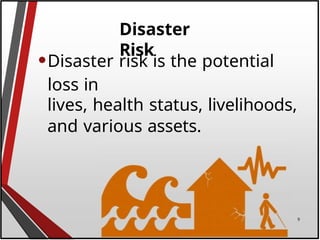
Disaster
Risk
•Disaster risk is the potential
loss in
lives, health status, livelihoods,
and various assets.
9
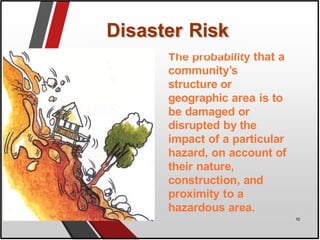
The probability that a
community’s
structure or
geographic area is to
be damaged or
disrupted by the
impact of a particular
hazard, on account of
their nature,
construction, and
proximity to a
hazardous area.
Disaster Risk
10
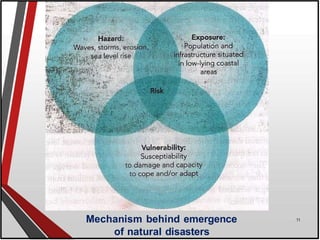
Mechanism behind emergence
of natural disasters
11
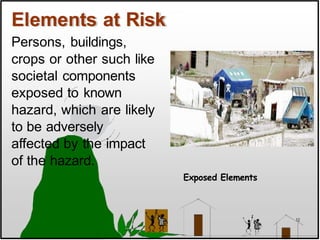
Elements at Risk
Exposed Elements
Persons, buildings,
crops or other such like
societal components
exposed to known
hazard, which are likely
to be adversely
affected by the impact
of the hazard.
12
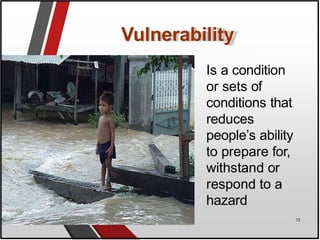
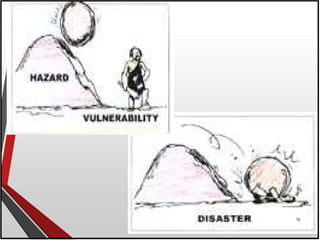
Vulnerability
Is a condition
or sets of
conditions that
reduces
people’s ability
to prepare for,
withstand or
respond to a
hazard
13
HAZARD
Phenomenon or situation, which has
the potential to cause disruption or
damage to people, their property, their
services and their environment
There is a
potential for
occurrence
of an event 14
15
Hazard
s
•Natural hazards are phenomena that
may cause severe death toll,
damages to property, environment,
and socio- economic condition of
communities.
•Three different types of natural
hazards
• Biological Hazard
• Geologic Hazard 16
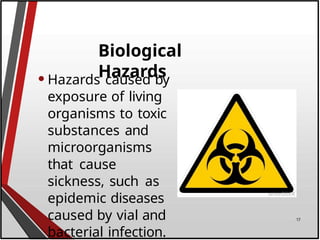
Biological
Hazards
•Hazards caused by
exposure of living
organisms to toxic
substances and
microorganisms
that cause
sickness, such as
epidemic diseases
caused by vial and
bacterial infection.
17
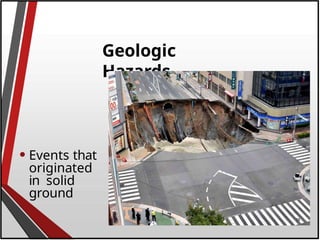
Geologic
Hazards
• Events that
originated
in solid
ground
18
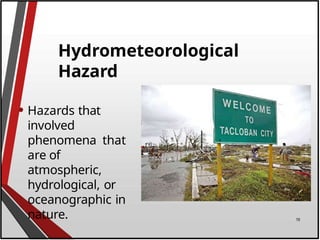
Hydrometeorological
Hazard
• Hazards that
involved
phenomena that
are of
atmospheric,
hydrological, or
oceanographic in
nature. 19
Impacts of
Disasters
Can be identified as direct, indirect, and
intangible.
ASPECTS AFFECTED
Social
Economic
Environment
al
20
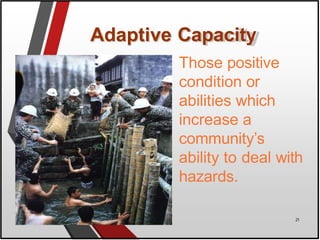
Adaptive Capacity
Those positive
condition or
abilities which
increase a
community’s
ability to deal with
hazards.
21
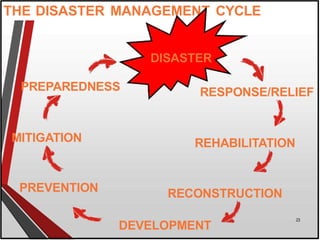
THE DISASTER MANAGEMENT CYCLE
DISASTER
RESPONSE/RELIEF
REHABILITATION
RECONSTRUCTION
DEVELOPMENT
PREVENTION
MITIGATION
PREPAREDNESS
23
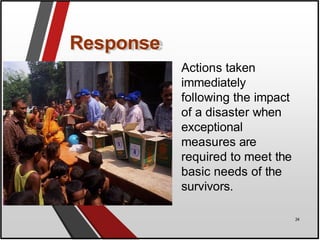
Response
Actions taken
immediately
following the impact
of a disaster when
exceptional
measures are
required to meet the
basic needs of the
survivors.
24
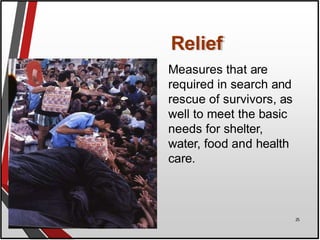
Relief
Measures that are
required in search and
rescue of survivors, as
well to meet the basic
needs for shelter,
water, food and health
care.
25
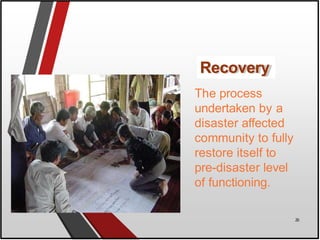
Recovery
The process
undertaken by a
disaster affected
community to fully
restore itself to
pre-disaster level
of functioning.
26
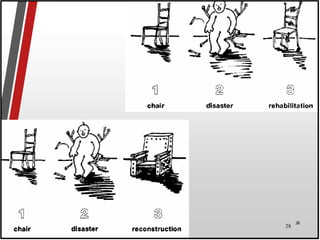
28
28
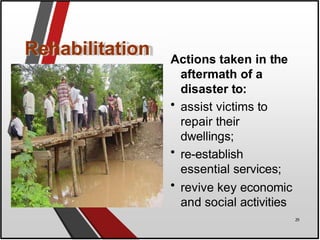
Rehabilitation Actions taken in the
aftermath of a
disaster to:
• assist victims to
repair their
dwellings;
• re-establish
essential services;
• revive key economic
and social activities
29
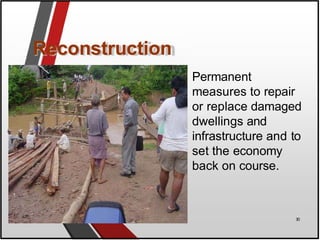
Reconstruction
Permanent
measures to repair
or replace damaged
dwellings and
infrastructure and to
set the economy
back on course.
30
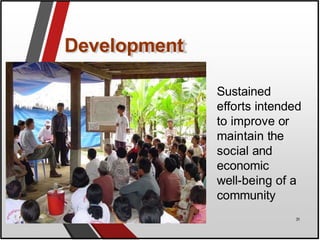
Development
Sustained
efforts intended
to improve or
maintain the
social and
economic
well-being of a
community
31
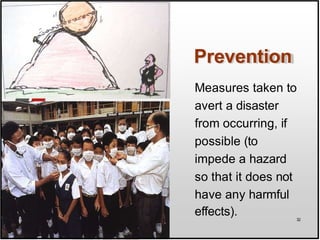
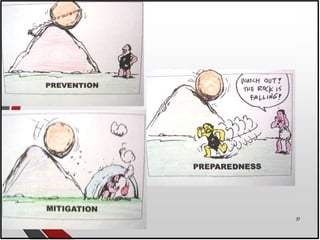
Prevention
Measures taken to
avert a disaster
from occurring, if
possible (to
impede a hazard
so that it does not
have any harmful
effects). 32
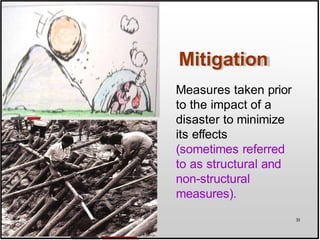
Mitigation
Measures taken prior
to the impact of a
disaster to minimize
its effects
(sometimes referred
to as structural and
non-structural
measures).
33
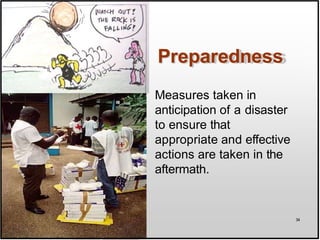
Preparedness
Measures taken in
anticipation of a disaster
to ensure that
appropriate and effective
actions are taken in the
aftermath.
34
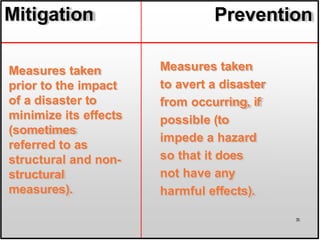
Measures taken
prior to the impact
of a disaster to
minimize its effects
(sometimes
referred to as
structural and non-
structural
measures).
Mitigation
Measures taken
to avert a disaster
from occurring, if
possible (to
impede a hazard
so that it does
not have any
harmful effects).
Prevention
35
Preparedness
Measures taken in
anticipation of a
disaster to ensure that
appropriate and
effective actions are
taken in the aftermath.
Measures taken
prior to the impact
of a disaster to
minimize its effects
(sometimes
referred to as
structural and non-
structural
measures).
Mitigation
36
37

disaster-readiness-and-risk-reduction-ppt.pptx