G3
DISASTER MANAGEMENT
&
ACCIDENT COMMUNICATION
P.PHANISEKHAR
LT/IRISET/SC
Disasters & accidents
An accident is an unplanned event that sometimes has inconvenient or
undesirable consequences, other times being inconsequential.
An emergency is a situation in which the community is capable of coping.
It is a situation generated by the real or imminent occurrence of an event
that requires immediate attention of emergency resources.
A disaster is a situation in which the community is incapable of coping. It is
a natural or human-caused event which causes intense negative impacts on
people, goods, services and/or the environment, exceeding the affected
community’s capability to respond; therefore the community seeks the
assistance of government and international agencies.
Types of Disasters
RIOTS=DISTURBANCES, UNRESTS
NATURAL Vulnerabilities in INDIA
Serious Accident
•Accident to a train which is attended with loss of life
or with grievous hurt to a passenger or passengers in
the train, or with serious damage to Railway
property of the value exceeding Rs 2 crore and any
other accident which in the opinion of the Chief
Commissioner of Railway Safety or Commissioner of
Railway Safety requires the holding of an inquiry by
the Commissioner of Railway Safety shall also be
deemed to be a serious accident.
RAILWAY ACCIDENTS
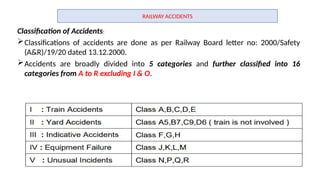
Classification of Accidents:
Classifications of accidents are done as per Railway Board letter no: 2000/Safety
(A&R)/19/20 dated 13.12.2000.
Accidents are broadly divided into 5 categories and further classified into 16
categories from A to R excluding I & O.
Disaster in Railway parlance
• In Railways, Disaster is defined as a major train accident
leading to heavy causalities and disruption to traffic for a
long period.
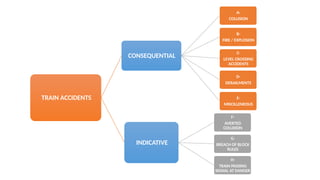
Train accidents:Train accident is an “accident that involves a
train”. Train accidents are further classified as:
• Consequential train accidents.
• Indicative train accidents.
https://www.youtube.com/watch?v=94KuIbpWBIE
Parlance=PHRASEOLOGY,PHRASING,VERNACULAR Consequential=IMPORTANT, SIGNIFICANT, MAJOR
Indicative=SUGGGESTIVE, ANALYTICAL, REVEALING
TRAIN ACCIDENTS
CONSEQUENTIAL
A-
COLLISION
B-
FIRE / EXPLOSION
C-
LEVEL CROSSING
ACCIDENTS
D-
DERAILMENTS
E-
MISCILLENEOUS
INDICATIVE
F-
AVERTED
COLLISION
G-
BREACH OF BLOCK
RULES
H-
TRAIN PASSING
SIGNAL AT DANGER
Class ‘A’ – Collisions
A-1 Collision involving a train carrying passengers, resulting in
(i) Loss of human life and/or grievous hurt and/or
(ii) Damage to Railway property of the value exceeding Rs. 2 crore and/or
(iii) Interruption of any important through line of communication for at least 24
hours.
A-2 Collision involving a train NOT carrying passengers resulting in
(iv) Loss of human life/grievous hurt and/or
(v) Damage to Railway property of the value exceeding Rs. 2 crore and/or
(vi) Interruption of any important through line of communication for at least 24
hours.
A-3 Collision involving a train carrying passengers, not falling under A-1 above.
A-4 Collision involving a train NOT carrying passengers not falling under A-2 above.
A-5 Other collisions, i.e. collisions occurring in shunting, marshalling yards, loco
yards and sidings etc. but not involving a train.
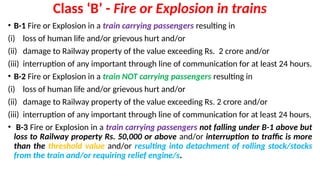
Class ‘B’ - Fire or Explosion in trains
• B-1 Fire or Explosion in a train carrying passengers resulting in
(i) loss of human life and/or grievous hurt and/or
(ii) damage to Railway property of the value exceeding Rs. 2 crore and/or
(iii) interruption of any important through line of communication for at least 24 hours.
• B-2 Fire or Explosion in a train NOT carrying passengers resulting in
(i) loss of human life and/or grievous hurt and/or
(ii) damage to Railway property of the value exceeding Rs. 2 crore and/or
(iii) interruption of any important through line of communication for at least 24 hours.
• B-3 Fire or Explosion in a train carrying passengers not falling under B-1 above but
loss to Railway property Rs. 50,000 or above and/or interruption to traffic is more
than the threshold value and/or resulting into detachment of rolling stock/stocks
from the train and/or requiring relief engine/s.
Class ‘B’ - Fire or Explosion in trains
• B-4 Fire or Explosion in a train NOT carrying passengers not falling under B-
2 above
(i) Loss to Railway property is Rs.50,000 or above and/or
(ii) Interruption to traffic is more than the threshold value and/or
(iii) Resulting into detachment of goods stock/stocks from the train.
• B-5 Fire in a train carrying passengers not falling under B-1 or B-3 above
• B-6 Fire in a train not carrying passengers and not falling under B-2 or B-4
above.
• B-7 Fire occurring in shunting, marshalling yards, loco yards and sidings
etc. involving rolling stock but not involving a train.
Class ‘C’- Trains running into road traffic and/or traffic
running into trains at level crossings.
• C-1 Trains carrying passengers running into road traffic and/or road traffic running into such
trains at manned level crossings resulting into loss of human life and/or grievous hurt
and/or damage to Railway property and/or interruption to traffic is more than the
threshold value.
• C-2 Trains NOT carrying passengers running into road traffic and/or road traffic running
into such trains at manned level crossings resulting into loss of human life and/or grievous
hurt and/or damage to Railway property and/or interruption to traffic is more than the
threshold value.
• C-3 Trains carrying passengers running into road traffic and/or road traffic running into such
trains at unmanned level crossings resulting into loss of human life and/or grievous hurt
and/or damage to Railway property and/or interruption to traffic is more than the
threshold value.
• C-4 Trains NOT carrying passengers running into road traffic and/or road traffic running
into such trains at unmanned level crossings resulting into loss of human life and/or
grievous hurt and/or damage to Railway property and/or interruption to traffic is more
than the threshold value.
Class ‘C’- Trains running into road traffic and/or
traffic running into trains at level crossings.
• C-5 Trains carrying passengers running into road traffic and /or road traffic
running into such trains at manned level crossings but not falling under C-1.
• C-6 Trains not carrying passengers running into road traffic and /or road traffic
running into such trains at manned level crossings but not falling under C-2.
• C-7 Trains carrying passengers running into road traffic and /or road traffic
running into such trains at unmanned level crossings but not falling under C-3.
• C-8 Trains not carrying passengers running into road traffic and /or road traffic
running into such trains at unmanned level crossings but not falling under C-4.
• C-9 Shunting engine with or without vehicles or loose vehicles running into road
traffic and /or road traffic running into shunting engine with or without vehicles
or loose vehicles at level crossings.
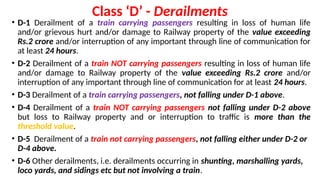
Class ‘D’ - Derailments
• D-1 Derailment of a train carrying passengers resulting in loss of human life
and/or grievous hurt and/or damage to Railway property of the value exceeding
Rs.2 crore and/or interruption of any important through line of communication for
at least 24 hours.
• D-2 Derailment of a train NOT carrying passengers resulting in loss of human life
and/or damage to Railway property of the value exceeding Rs.2 crore and/or
interruption of any important through line of communication for at least 24 hours.
• D-3 Derailment of a train carrying passengers, not falling under D-1 above.
• D-4 Derailment of a train NOT carrying passengers not falling under D-2 above
but loss to Railway property and or interruption to traffic is more than the
threshold value.
• D-5 Derailment of a train not carrying passengers, not falling either under D-2 or
D-4 above.
• D-6 Other derailments, i.e. derailments occurring in shunting, marshalling yards,
loco yards, and sidings etc but not involving a train.
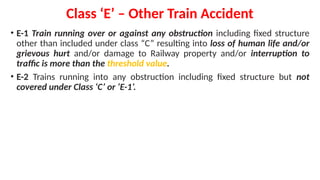
Class ‘E’ – Other Train Accident
• E-1 Train running over or against any obstruction including fixed structure
other than included under class “C” resulting into loss of human life and/or
grievous hurt and/or damage to Railway property and/or interruption to
traffic is more than the threshold value.
• E-2 Trains running into any obstruction including fixed structure but not
covered under Class ‘C’ or ‘E-1’.
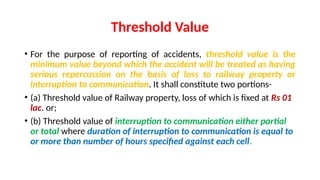
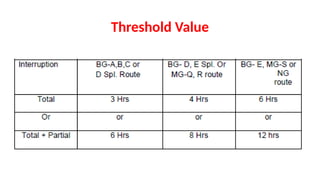
Threshold Value
• For the purpose of reporting of accidents, threshold value is the
minimum value beyond which the accident will be treated as having
serious repercussion on the basis of loss to railway property or
interruption to communication. It shall constitute two portions-
• (a) Threshold value of Railway property, loss of which is fixed at Rs 01
lac. or;
• (b) Threshold value of interruption to communication either partial
or total where duration of interruption to communication is equal to
or more than number of hours specified against each cell.
Threshold Value
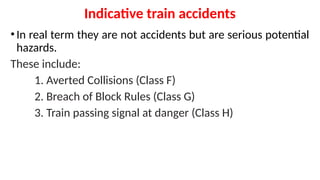
Indicative train accidents
•In real term they are not accidents but are serious potential
hazards.
These include:
1. Averted Collisions (Class F)
2. Breach of Block Rules (Class G)
3. Train passing signal at danger (Class H)
Class F -Averted Collisions
• F-1 Averted collision between trains at least one of which is carrying
passengers.
• F-2 Averted collision between a train carrying passengers and an
obstruction.
• F-3 Averted collision between trains NOT carrying passengers.
• F-4 Averted collision between train NOT carrying passengers and an
obstruction
Class ‘G’ - Breach of Block Rules
• G-1 Train carrying passengers, entering a block section without any authority
or without a proper ‘Authority to Proceed’.
• G-2 Train Not carrying passengers, entering a block section without any
authority or without proper ‘Authority to Proceed’.
• G-3 Train received on a blocked line, not constituting an averted collision.
• G-4 Train received on or entering a wrong line at a station or catch or Slip
Siding or SandHump etc.
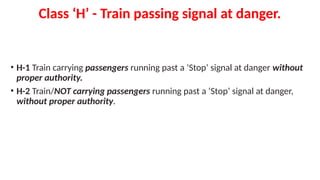
Class ‘H’ - Train passing signal at danger.
• H-1 Train carrying passengers running past a ‘Stop’ signal at danger without
proper authority.
• H-2 Train/NOT carrying passengers running past a ‘Stop’ signal at danger,
without proper authority.
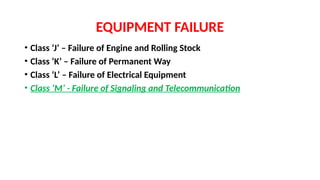
EQUIPMENT FAILURE
• Class ‘J’ – Failure of Engine and Rolling Stock
• Class ‘K’ – Failure of Permanent Way
• Class ‘L’ – Failure of Electrical Equipment
• Class ‘M’ - Failure of Signaling and Telecommunication
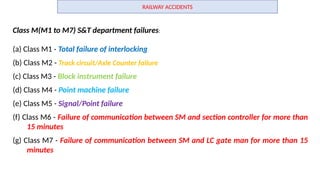
RAILWAY ACCIDENTS
Class M(M1 to M7) S&T department failures:
(a) Class M1 - Total failure of interlocking
(b) Class M2 - Track circuit/Axle Counter failure
(c) Class M3 - Block instrument failure
(d) Class M4 - Point machine failure
(e) Class M5 - Signal/Point failure
(f) Class M6 - Failure of communication between SM and section controller for more than
15 minutes
(g) Class M7 - Failure of communication between SM and LC gate man for more than 15
minutes
Definition of a Disaster on Railways as per Disaster
Management Act 2005,
•“Railway Disaster is a serious train accident or an
untoward event of grave nature, either on railway
premises or arising out of railway activity, due to
natural or manmade causes, that may lead to loss of
many lives and/or grievous injuries to a large number
of people, and/or severe disruption of traffic etc,
necessitating large scale help from other
Government/Non-government and Private
Organizations.”
Grave=SERIOUS, SEVERE, CRITICAL
Strengths of the Railways to handle a Disaster
• Railways’ own Communication Network.
• Operating Control on each Division linked with each Station.
• Uniformed force of RPF/RPSF
• Railways’ own Medical Infrastructure
• An army of Gang men spread out all over the Indian Railways.
• Scouts and Guides (they can at best provide background support).
• Dedicated Rescue/Restoration and Medical Equipment on Rails.
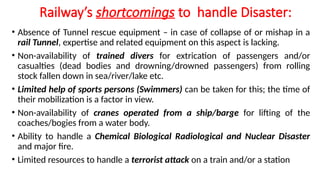
Railway’s shortcomings to handle Disaster:
• Absence of Tunnel rescue equipment – in case of collapse of or mishap in a
rail Tunnel, expertise and related equipment on this aspect is lacking.
• Non-availability of trained divers for extrication of passengers and/or
casualties (dead bodies and drowning/drowned passengers) from rolling
stock fallen down in sea/river/lake etc.
• Limited help of sports persons (Swimmers) can be taken for this; the time of
their mobilization is a factor in view.
• Non-availability of cranes operated from a ship/barge for lifting of the
coaches/bogies from a water body.
• Ability to handle a Chemical Biological Radiological and Nuclear Disaster
and major fire.
• Limited resources to handle a terrorist attack on a train and/or a station
Authority to declare a Disaster on Railways
• Railway Board has also approved to nominate GMs, AGMs or CSOs
(when GM/AGM are not available) for declaring an untoward
incident as Railway Disaster.
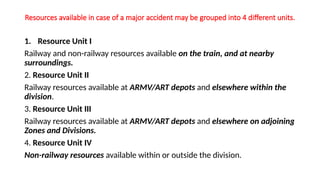
Resources available in case of a major accident may be grouped into 4 different units.
1. Resource Unit I
Railway and non-railway resources available on the train, and at nearby
surroundings.
2. Resource Unit II
Railway resources available at ARMV/ART depots and elsewhere within the
division.
3. Resource Unit III
Railway resources available at ARMV/ART depots and elsewhere on adjoining
Zones and Divisions.
4. Resource Unit IV
Non-railway resources available within or outside the division.
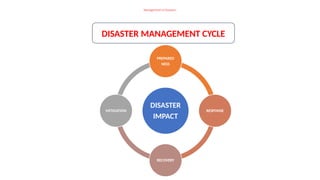
Management of disasters
DISASTER
IMPACT
PREPARED
NESS
RESPONSE
RECOVERY
MITIGATION
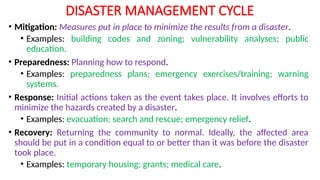
DISASTER MANAGEMENT CYCLE
• Mitigation: Measures put in place to minimize the results from a disaster.
• Examples: building codes and zoning; vulnerability analyses; public
education.
• Preparedness: Planning how to respond.
• Examples: preparedness plans; emergency exercises/training; warning
systems.
• Response: Initial actions taken as the event takes place. It involves efforts to
minimize the hazards created by a disaster.
• Examples: evacuation; search and rescue; emergency relief.
• Recovery: Returning the community to normal. Ideally, the affected area
should be put in a condition equal to or better than it was before the disaster
took place.
• Examples: temporary housing; grants; medical care.
Measures taken by Rlys to reduce accidents
1. Construction of ROB's/RUB's at LC gates.
2. Manning of UnManned Level Crossings gates.
3. Interlocking of Level Crossing gates.
4. Use of Train Actuated Warning Device (TAWD) and Anti-Collision
Device(ACD).
5. Upgradation of safety features in locomotives.
6. Upgradation/replacement of over-aged tracks, bridges, S&T gears
and rolling stock.
7. Reduction in thermit weld joints & use of SPURT Ultrasonic Rail Testing
Car) for rail flaw detection
8. Continuous Track Circuiting
9. Use fire detector, fire retardant in R.stock, work centre
10.Use crash worthy coach & tight lock couplers with anti climbing features.
11. Up-gradation of ART/ARMV's and improving skill of ART/ARMV's staff
with Trg., & up-gradation of eqpt.
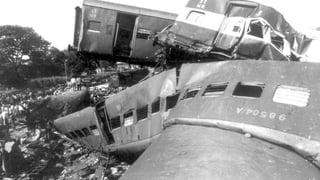
In the early hours of 02 August 1999 the Delhi bound Avadh
Assam Mail collided head-on into the Gauhati bound
Brahmaputra Mail at GHAISAL
We wish that no accidents should take
place
But we should be prepared to meet
any situation if any unfortunate
accident occurs or disaster takes place
Disaster Management System in I.Rlys
Ministry of Railways constituted a high level
Committee vide Rly Bd’s order
No. ERB-I/2002/23/44 Dt.16.09.2002
Final report on DM _for printing_.doc (indianrailways.gov.in)
Disaster Management Act 2005.
The new ACT provides that:
• There shall be a National Disaster Management Authority of which the Prime
Minister of India will be the Chairperson, helped by a Vice Chairperson.
• The National Authority shall have the responsibility of laying down the policies,
plans and guidelines for disaster management.
• There shall be created State Disaster Management Authorities, expected to be
chaired by the Chief Minister of the state.
• There shall be created District Disaster Management Authorities co-chaired by
the District Collector and President of the elected body of the district.
• The Central Government shall constitute the National Institute of Disaster
Management. State Authorities to meet the immediate needs of providing rescue
and relief to the victims of Disasters.
• Disaster Management plan to be prepared and reviewed every year.
Disaster Management Act 2005.
AAA2005___53.pdf (indiacode.nic.in)
• Ministry of Home Affairs is the nodal Ministry of all National Disasters
except Drought.
• Sixteen Battalions of Para-military forces have been trained to serve as the
National Disaster Management Response Force (NDRF) {
About Us | NDRF - National Disaster Response Force} with Two Battalions
each from Central Reserve Protection Force (CRPF) {
Role of CRPF | About Us | Central Reserve Police Force, Government of Indi
a.
}, Central Industrial Security Forces (CISF) {
CISF Activities in Disaster Management | CISF}, Indo Tibet Border Police
(ITBP) {ITBP|History & Role (itbpolice.nic.in) }and Border Security Force
(BSF).
Disaster Management Act 2005.
AAA2005___53.pdf (indiacode.nic.in)
• At present, National Disaster Response Force consist of 16
battalions from the BSF, CISF, CRPF, ITBP, SSB Sashastra
Seema Bal) and Assam Rifles. Each battalion have 18 self-
contained specialist search and rescue teams of 45 personnel
each including engineers, technicians, electricians, dog squads
and medical/paramedics. The total strength of each battalion is
1,149.
• All the 16 battalions have been equipped and trained to respond
natural as well as man-made disasters. Battalions are also trained
and equipped for response during chemical, biological, radiological
and nuclear (CBRN) emergencies.
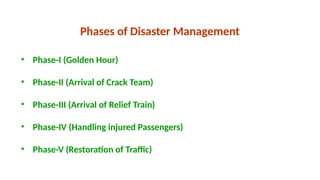
Phases of Disaster Management
• Phase-I (Golden Hour)
• Phase-II (Arrival of Crack Team)
• Phase-III (Arrival of Relief Train)
• Phase-IV (Handling injured Passengers)
• Phase-V (Restoration of Traffic)
Phase-I (Golden Hour)
• The first phase, which is of shortest duration, lasts for about an hour. It is
an amateurish, poorly equipped effort; but is nevertheless the most
important phase. In most cases, this is the only help available for a major
part of the "GOLDEN HOUR".
1. In the period immediately after the accident where grievous
injuries to passengers, loss of property etc. takes place, action has to be
taken on war footing by Railway Officials/ officers-on-board to render
definite medical care which gives relief to affected persons and also helps
them to overcome the trauma.
2. If a critical trauma patient is not given definite medical care within
one hour from the time of accident, chances of his ultimate recovery
reduces drastically, even with the best of Medical attention thereafter.
Extract of High Level Committee Report on Disaster Management
Disaster Syndrome:
(a) Shock Stage: In which victims are stunned, dazed and apathetic.
(b) Suggestible stage: In which victims tend to be passive but open to
suggestions and willing to take directions from rescue workers and
others.
(c) Recovery stage: In which the individual may be tense and
apprehensive and may show generalized anxiety.
Syndrome= condition, disease, pattern, disorder
Stunned= shocked, speechless, astonished
Dazed= confused, surprised
Apathetic= indifferent, lazy, uninterested
DR ABC
(i) D-DANGER:- Look out for danger. Make sure that no further danger exists either for the patient or for
the First Aider.
(ii) R-RESPONSE:- Check for consciousness. Call by his/her name, slap, pinch and shake plenty. If there is
no response, then it means that the patient is unconscious.
(iii) C-CIRCULATION:- Check the pulse. Normally we check the pulse at the wrist; however, sometimes it
is not felt because of severe bleeding. So, it is better to check the pulse at neck. (Carotid Pulse).
Pinch=squeeze, touch
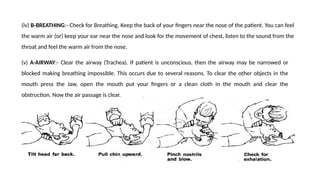
(iv) B-BREATHING:- Check for Breathing. Keep the back of your fingers near the nose of the patient. You can feel
the warm air (or) keep your ear near the nose and look for the movement of chest, listen to the sound from the
throat and feel the warm air from the nose.
(v) A-AIRWAY:- Clear the airway (Trachea). If patient is unconscious, then the airway may be narrowed or
blocked making breathing impossible. This occurs due to several reasons. To clear the other objects in the
mouth press the Jaw, open the mouth put your fingers or a clean cloth in the mouth and clear the
obstruction. Now the air passage is clear.
Special Task Teams :
 Relief & transportation of injured to hospitals - Medical
 Catering(food & drinking water), Payment of ex-gratia, liaison with Civil
admn., and Press - Commercial
 Security of luggage, parcels and railway property– Commercial & RPF
Lighting arrangement – Electrical
 Liaison with control and arranging logistics including shunting – Operating,
Passenger Care – Personnel
 Establishment of communication & booths – S&T
 Rescue & Relief operations including rerailment and preservation of clues -
Mechanical
 Provision of tents, accommodation etc. – Engineering
 Preservation of clues, measurement of track, wagon, photo/videography,
statement of witnesses. Breath analyzer test for staff involved in accident -
Safety
ACTION TO BE TAKEN AT DIVISIONAL LEVEL
i) Opening up of special enquiry booths at originating, terminating and
major stations en-route.
ii) Furnishing updated position of dead, injured and evacuated passengers to
all concerned.
iii) Help line Phone Number should be relayed through TV, Radio and press.
iv) Arrangement for issue of free Railway passes for relatives/dependents of
dead & injured.
v) Make arrangements for transportation of evacuated passengers to be
sent to destinations Transport vehicles can be hired.
vi) In case of major disaster, DRM can requisition helicopter/Aeroplane.
vii) Press should be briefed properly and quickly.
viii) HQ/Board should be advised quickly.
Duties of TI/PWI/SI/CWI/LI
(a) Rushing to accident site with men and material :
(i) Before leaving for the site of accident organize maximum number of
men to go to the accident site along with their equipment.
(ii) Reach the site of accident by quickest available means.
(b) Rescue and relief :
(iii) Ensure that the obstructed line is protected.
(iv) Direct all staff working under them to assist in rescue and relief work.
(v) All of them should work as per directions of OC Site.
(vi) Assess casualties and arrange to render First Aid.
(vii)Shift injured to nearest hospital.
Contd..
(c) Joint measurements and preservation of clues and evidences :
(i) Collect and record all evidences relating to the accident such as:
1. Condition of track, with special reference to alignment, gauge, cross levels,
super elevation, points of mount and drop and any sign of sabotage etc.
2. Condition of Rolling stock with reference to Brake Power and braking gear.
3. All marks on sleepers, rails, locomotives and vehicles etc. especially for
preservation of clues.
4. Position of derailed vehicles.
5.Prima facie cause of accident.
(ii) Seize and seal the Train Signal Register, Log book, Private Number Book, Line
Admission Book, Speed Recorder Chart and other relevant records.
Sabotage=DISRUPTION, DAMAGE, INTERRUPTION
Contd..
(iii) Note down the position of panel switches, indication, block instrument,
condition of relay room, status of data logger, etc.
(iv) Condition of switches, ground connections, point locking, occupancy of track
circuit, details of damage to outdoor signal/point gears should be noted down.
(v) Seize and seal the Speed Recording Graph and all other registers and repair log
book of the locomotive.
(vi) Record details of Brake Power and other aspects of Rolling stock as per
Performa.
(vii) Joint measurements of rolling stock should be taken.
Supervisors required going to Accident Site
(i) At the divisional level 80% of all supervisors available in divisional
headquarters should proceed to the accident site.
(ii) All other supervisors available in the field at other stations should also
proceed to the accident site.
(iii) Divisional Control Office should issue a recorded control message from
DRM to all Supervisors for proceeding to the accident site immediately by
fastest possible means.
GENERAL GUIDELINES FOR MAINTENANCE OF ARTs
1646207377563-Maintenance and Operational manual for 140T Cranes ARTs ARMEs(2).pdf (indianrailways.gov.in)
• The equipments are to be periodically tested to ensure their satisfactory working at
all times. Testing / Inspections shall be carried out as under
• Complete testing by ART nominated staff: once in 15 days.
• Inspection by ASTE/DSTE: once in 3 months.
• Inspection by Sr. DSTE/DSTE: once in 6 months.
1. A register is to be maintained in the ART for making entries for testing of
equipment.
2. Whenever the ART returns from accident spot, equipments are to be immediately
checked for their proper working.
3. Any short fall / missing equipment should be replaced with good working
equipment at the earliest.
4. All equipments having shelf life, viz. jointing kits, torch cells etc., shall be replaced
in due time.
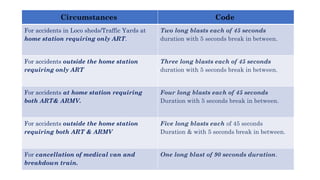
Circumstances Code
For accidents in Loco sheds/Traffic Yards at
home station requiring only ART.
Two long blasts each of 45 seconds
duration with 5 seconds break in between.
For accidents outside the home station
requiring only ART
Three long blasts each of 45 seconds
duration with 5 seconds break in between.
For accidents at home station requiring
both ART& ARMV.
Four long blasts each of 45 seconds
Duration with 5 seconds break in between.
For accidents outside the home station
requiring both ART & ARMV
Five long blasts each of 45 seconds
Duration & with 5 seconds break in between.
For cancellation of medical van and
breakdown train.
One long blast of 90 seconds duration.
TIME for Turning OUT
• On listening to these hooters or on receipt of a memo from the SM on
duty or the Loco foremen, the A.D.M.O/A.M.O. will immediately
report himself to SM on duty with his staff, ready to proceed to the
site of accident with the Relief Medical Van.
Target time for turning out the Medical Van:
In case of double exit siding - 15 Minutes
In case of single exit sidings - 20 Minutes
`The time is reckoned from the time of ordering to the time of dispatch.
`Target time for turning out the Break down trains / ART -
• During Day - 30 Minutes
• During Night - 45 minutes
The time is reckoned from the time of ordering to the time of leaving the
shed.
Communication arrangement during Disaster
(in greater detail to telecom supervisors)
•ACCIDENT COMMUNICATION
•PowerPoint Presentation (indianrailways.gov.in)
•
Microsoft Word - Chapter_XVII.doc (indianrailwa
ys.gov.in)
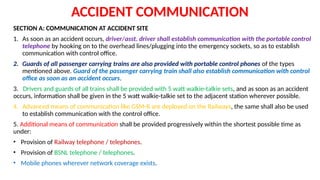
ACCIDENT COMMUNICATION
SECTION A: COMMUNICATION AT ACCIDENT SITE
1. As soon as an accident occurs, driver/asst. driver shall establish communication with the portable control
telephone by hooking on to the overhead lines/plugging into the emergency sockets, so as to establish
communication with control office.
2. Guards of all passenger carrying trains are also provided with portable control phones of the types
mentioned above. Guard of the passenger carrying train shall also establish communication with control
office as soon as an accident occurs.
3. Drivers and guards of all trains shall be provided with 5 watt walkie-talkie sets, and as soon as an accident
occurs, information shall be given in the 5 watt walkie-talkie set to the adjacent station wherever possible.
4. Advanced means of communication like GSM-R are deployed on the Railways, the same shall also be used
to establish communication with the control office.
5. Additional means of communication shall be provided progressively within the shortest possible time as
under:
• Provision of Railway telephone / telephones.
• Provision of BSNL telephone / telephones.
• Mobile phones wherever network coverage exists.
ACCIDENT COMMUNICATION
6. Accident Relief Trains (ART) are located at strategic locations of each division and are provided with
telecommunication equipment for providing additional facilities as under:
• PA system shall be established for making important announcements.
• Megaphones shall be given as per need at site.
• Walkie-talkie sets shall be distributed as per need.
• Magneto communication as required at site.
• Communication through satellite phone shall be established.
• FAX, E-mail shall be established wherever communication media is available.
• It shall be possible to provide the communication using satellite technology /through Railways own
OFC links, by extending bandwidth from the accident site to the adjacent station/using BSNL
connections. Mobile telephone exchange (WLL)may be established, if available.
• Wherever cell phone coverage exists, cell phones available with officers and with ART shall be used.
• It is desirable to send pictures of accident spot to Railway Board/Zonal/Divisional Headquarters using
e-mail for which extension of internet/railnet to site is required. It is desirable to send video coverage
to Railway Board/Zonal/Divisional Headquarters, as and when the necessary equipment are provided
in the ARTs.
Strategic= planned, considered, intentional
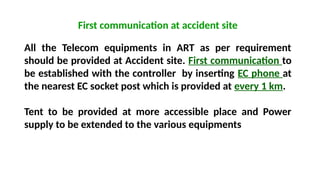
First communication at accident site
All the Telecom equipments in ART as per requirement
should be provided at Accident site. First communication to
be established with the controller by inserting EC phone at
the nearest EC socket post which is provided at every 1 km.
Tent to be provided at more accessible place and Power
supply to be extended to the various equipments
ACCIDENT COMMUNICATION
SECTION B: ACCIDENT INFORMATION FOR PUBLIC
• As soon as information regarding an accident is received, accident
information number shall be activated and manned. This number shall
normally be at the zonal/divisional headquarters. Adequate personnel
shall be posted by commercial branch to meet the demand depending
on the seriousness of the accident. Number of lines for this number
shall be suitably augmented depending on the demand.
• Close liaison shall be maintained with BSNL officials for monitoring the
call rates and increasing the lines as necessary.
• The accident information number should be made wide publicity
through audio, video and print media.
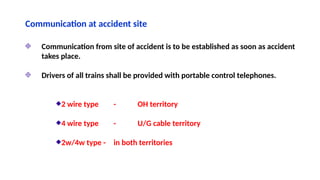
Communication at accident site
Communication from site of accident is to be established as soon as accident
takes place.
Drivers of all trains shall be provided with portable control telephones.
2 wire type - OH territory
4 wire type - U/G cable territory
2w/4w type - in both territories
Field Service (FS) / D-8 Cable
• IS-694-Part /1964
• During emergencies like Railway accidents, Floods, Cyclones, etc., this cable is
extensively used to provide temporary connections of the telephones as per
requirement.
• Single core twin twisted of size 7/0.375mm.
• Out of 7 strands, three strands of steel and four strands of copper forms a single
core called as L1. One more length has to be taken as L2.
• Available in length of 500Mtrs. and 1Km in a drum.
TEST ROOM
As soon as the test room, receive the message of train
accident from controller, He/She shall inform to all related
officers of the Division such as Sr.DSTE, DSTE, ADSTE, and
SSE/Incharge of Test Room etc.
ROLE OF TELECOM DEPARTMENT DURING TRAIN ACCIDENTS
TELECOMMUNICATION STAFF:
•Proceed to site by quickest means available.
•Ensure portable telephone / emergency telephone set is
provided at site.
•Wherever feasible, wireless sets to be installed at accident site
for communication with Divisional Headquarters and if possible
with Railway Headquarters.
Walkie-talkie sets / Megaphones / loud hailers to be deployed
as necessary.
•DOT/BSNL telephone with STD facility to be arranged at the
temporary enquiry offices opened at site and nearest location
wherever possible.
•Render such assistance as required by Guard in attending to the
accident victims and stranded passengers.
•Arrange for early restoration of telecom equipment as soon as
such restoration is permitted.
•Drivers and Guards of all trains shall be provided with 5 watt
walkie-talkie sets, information shall be given in the 5 watt walkie
talkie set to the adjacent station wherever possible.
In some sections arrangements are available to communicate
with control office on walkie-talkie/duplex VHF sets and this may
be used where such arrangement exist.
•Additional means of communication shall be provided
progressively within the shortest possible time as under:
Provision of Railway telephones.
Provision of BSNL telephones.
Mobile phones wherever network coverage exists.
•Accident Relief Trains (ART) are located at strategic locations of each
division and are provided with telecommunication equipment for providing
additional facilities as under:
•PA system shall be established for making important announcements.
•Megaphones shall be given as per need at site.
•Walkie-talkie sets shall be distributed as per need.
•Magneto communication as required at site.
•Communication through satellite phone shall be
established.
•FAX, E-mail shall be established wherever communication media
is available.
It shall be possible to provide the communication using satellite
technology / through Railways own OFC links, by extending
bandwidth from the accident site to the adjacent station / using
BSNL connections.
Mobile telephone exchange (WLL) may be established, if available.
•The VSAT terminal will deliver the composite data traffic from site
to the VSAT hub at New Delhi.
From here the composite data traffic will be transported to
Divisional HQ, Zonal HQ and Railway Board on existing MPLS
network.
•A video server shall be provided at New Delhi VSAT hub to
enable web based access to live and stored videos.
MAPLE connectivity diagram at Test room and
at accident spot
ACCIDENT INFORMATION FOR PUBLIC
•As soon as information regarding an accident is received, accident
information number (Help Line, mostly 1072) shall be activated and manned.
This number shall normally be at the zonal/divisional headquarters.
Adequate personnel shall be posted by commercial branch to meet the
demand depending on the seriousness of the accident.
Number of lines for this number shall be suitably augmented depending on
the demand.
•Close liaison shall be maintained with BSNL officials for monitoring the call
rates and increasing the lines as necessary.
•The accident information number should be made wide publicity through
audio, video and print media.
Action to be taken at Divisional Level
Opening up of special enquiry booth at major originating & terminating stns
enroute
Furnishing updated position of dead, injured and evacuated passengers to all
concerned.
Helpline no. be relayed thru TV, Radio & press
Arrangement for issue of free Railway passes for relatives/dependents of dead
& injured.
Transportation of evacuated passengers to be sent to destinations. Transport to
be hired.
In case of major disaster, DRM can requisition for helicopter / Aero plane.
Press should be briefed properly and quickly.
Headquarters/ Board should be advised quickly.
DISASTER MANAGEMENT CELL AT HEADQUARTERS
The Disaster Management Cell will operate at HQs and shall be attended by nominated Officers
of following dept
 Safety department
 Medical department
 Commercial department
 Operating department
 Mechanical department
 Engineering department
 Electrical department
 S&T department
 Every ART shall have nominated telecom staff. SE/JE and shall be assisted by 2
Telecom Maintainers and 3 Khalasis.
 Nominated staff shall test ART eqpt as per schedule and ensure working of all
eqpts.
 Nominated staff shall respond immediately whenever an accident takes place and
proceed by ART to site of accident.
 Nominated ART staff are responsible for establishing communication,
immediately on reaching site of accident.
Staff for Accident Relief Train
 A register to be maintained in ART for making entries for testing of equipment
and for their satisfactory operation.
 If ART returns from accident spot, eqpts to be checked for their working. Any
short fall to be replaced at the earliest.
 Charging of batteries, replacement of torch cells irrespective of usage,
replacement of cable jointing kit be carried out
 Adequate space be provided in ART for housing all eqpts to avoid rolling off
during movement
 Sophisticated eqpts., shall not be stacked one above other and packing provided
for Satellite phone, Wakie Talkie, FAX, Public Address system eqpt etc.,
 For charging of batteries, regular P/S be made available near ART for charging
batteries of PA system, Walkie Talkie where it is stationed
Instructions for Testing of ART eqpt
Disaster Management control rooms at Headquarters / Divisions
 BSNL Phones – 2 Nos with ISD facility.
 Railway Telephones – 3 Nos with STD facility.
 Fax Mc – 1 No. connected to BSNL / Rly line.
 Facility to extend section control to Disaster Management control. The concerned
section control, shall be connected.
 Hot line bet Headquarters & Divisional Disaster Management control room to be
provided
 Important Telephone nos. of hospitals /doctors/officials of State & district
administration and other functionaries be kept ready.
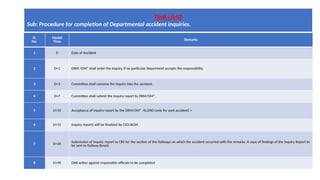
Sl.
No.
Model
Time
Remarks
1 D Date of Accident
2 D+1 DRM /GM* shall order the inquiry, if no particular department accepts the responsibility.
3 D+3 Committee shall convene the inquiry into the accident.
4 D+7 Committee shall submit the inquiry report to DRM/GM*.
5 D+10 Acceptance of inquiry report by the DRM/GM* /Sr.DSO (only for yard accident) +
6 D+15 Inquiry reports will be finalized by CSO/AGM.
7 D+20 Submission of inquiry report to CRS for the section of the Railways on which the accident occurred with the remarks. A copy of findings of the Inquiry Report to
be sent to Railway Board.
8 D+90 DAR action against responsible officials to be completed
TIME LIMIT
Sub: Procedure for completion of Departmental accident inquiries.
Inputs on Permanent way and C&W matters
• Record position of levers, SM’s control slides, indication of points, track
circuits, slot etc., Position of switch & knobs in case of Panel Interlocked stns
• In all cases of derailment in station section it should be noted whether the
move was signal move or not
• Check emergency release register and other relevant register & initial then
with date and time
• It should be checked whether crank handle(CH) is taken out and where it
was used be noted down.
• In case of collision in station yard, reasons for not setting & clamping
points against occupied lines should be brought out. Whether Line block
collars used
• Position of Block Instrument, seals & locks of instrument and block
counter should be checked.
• P.way gauge at point should be noted down in case of derailment
over/near the points. Damage to point gears, tongue rails should also to
be noted down
• DATA LOGGER REPORTS SHOULD BE KEPT READY ALONG WITH SCREEN
PRINTS IF REQUIRED.
• Effectiveness of interlocking of B.Instt with LSS. In S/L, TGT & TCF locks
should be specially checked.
• Train Signal Register(TSR), Private No.(PN) and relevant records(passing
Sig at ON…) be sealed
• B.Instt., position to be noted and be suspended till joint inspection is
carried out by traffic & Sig official
• Condition of seals of S&T gears normally kept sealed should be noted
down including relay rooms are double locked with counters if any
• L.box containing relay track feed should be sealed jointly by signal &
(traffic or any other official)
Early restoration of S&T gears when permitted
• The works should be divided into three phases
• Works which can be carried out before the debris are cleared/rerailment
of derailed vehicles
• Works which can be taken up after clearing of debris/Rerailment of
derailed vehicles and before track fit certificate is given
• Complete work along with track restoration and testing be carried out
when track fit certificate given
MEASURES FOR IMPROVEMENT OF SAFETY
• DO NOT USE SHORTCUT METHOD AT ANY COST
• REPAIR work be taken with DISCONECTION and CONSENT MEMO be
taken from ON DUTY ASM
• ENTRY to RELAY ROOM should be with PERMISSION from SM with due
entry in RELAY ROOM Register along with reason due to which it is
being opened
• CABLE MEGGERING TO BE DONE STRICTLY UNDER NI-working and
DISCONNECTION MEMO
• RECORD of MAINTENANCE ACTIVITY be made in MAINTENANCE
ACTIVITY REGISTER at each Stn
Revised List of Minimum Essential Telecom
Equipments to be kept in Accident Relief
Trains(ART’s)
Signed letter 17 05 2021.pdf (indianrailways.go
v.in)
List of Minimum Essential Telecom Eqpts.,- Accident Relief Trains (ARTs)
A) General (Common for RE as well as Non RE Area)
No. Final Item Qty.
1. Inspn Book, WTT latest copy of all sections 1 No.
2.a Desk type Electronic Magneto Telephone 4 Nos.
2.b Dry Cells large 6-I, 1.5 Volts each for Ph/Torch 12 Nos.
3. PVC Insulated, PVC Sheathed twin core cable 500 M
4. Microphones for cordless PA system 2 Nos.
5. Loudspeaker Horn type 5/10 Watts 2 Nos.
6.a Amp min 20W Power O/P (having interface for cordless mic) and
operating voltage of 12 VDC
2 Nos.
6.b 12 Volts batt for 6(a) with appropriate Batt chgr 2 Sets.
7. Megaphone with batt (min10 watts each) 4 Nos.
8. Stand for LS with adjustable Ht(1.5-3M) 2 Nos.
9. Field service telephone cable PVC insulated (D-8) along
with 6 pin Emergency Plug
4 drums of 500
M each
10. Push button Caller ID Phone 4 Nos.
11.a WT sets (5Watts) with 100% spare batt 30 Nos.
11.b Batt Chgr for 11(a) (with rapid charging) 8 Nos.
12. Digital Multimeter 2 Nos.
13. Power extn bd with drum (50M) 4 Nos.
14. Hand held Rechargeable LED Torch 4 Nos.
15. Jointing Kit & material(decided by Rlys )
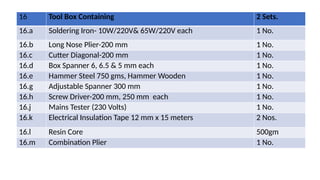
16 Tool Box Containing 2 Sets.
16.a Soldering Iron- 10W/220V& 65W/220V each 1 No.
16.b Long Nose Plier-200 mm 1 No.
16.c Cutter Diagonal-200 mm 1 No.
16.d Box Spanner 6, 6.5 & 5 mm each 1 No.
16.e Hammer Steel 750 gms, Hammer Wooden 1 No.
16.g Adjustable Spanner 300 mm 1 No.
16.h Screw Driver-200 mm, 250 mm each 1 No.
16.j Mains Tester (230 Volts) 1 No.
16.k Electrical Insulation Tape 12 mm x 15 meters 2 Nos.
16.l Resin Core 500gm
16.m Combination Plier 1 No.
17. Digital Voice rec with mic&playback with good memory data
transfr thru Pen drive/Hard disk
2 Nos.
18. 4 W way station eqpt with control phone. 2 Nos.
19. Smart Phone with chgr and SIM of different service provider (Min
6 inch display, 4G, VoLTE, Dual SIM, 4GB RAM and 128GB
memory)
4 Nos.
20. Satellite Ph(SAT Ph/ISAT phone2/Inmarsat Ph) 1 No.
21. All in one color printer(Fax,Scan,Copy & print) 1 No.
22. Auto Dialling System from Emergency Socket 1 No.
23. Cat-6 cable along with required accessories 2 box
24. Laptop with required configuration and accessories to suit
communication needs at accident site
1 No.
25. Hot Spot 4G Dongle (Different Service Provider) 4 no.
26. Power Bank of 30000 mAH for mobile charging 4 no.
27. FCT with SIM of different service provider 4 no.
28. 6 Core flexible OFC Cable for outdoor purpose 500M
29. 24 fibre OFC Splice enclosure 2 no.
30. LAN Extender for extending Ethernet 2 Pair
31. Rechargeable LED Search Light 2 no.
32. VHF Set (Duplex) of 25W each with interface for ph, incldg mast,
Antenna-GP Type and battery
1 Set
33. Folding Table-2no. Chair-6no. Beach Umbrella-2no.
36. Light weight prefabricated Tent kabuli (medium) 1 no.
37. Telecom Cable Route plan of Division 1 no.
38. Setup for Live streaming Video from accident site: 1 Set
Full HD Bullet IP Camera 12V DC with Tripod stand 1 No.
LTE Router Operating Voltage 12 VDC & with PoE Port 1 No.
Wireless Access Point -1 Km range with PoE operated 2 Nos.
Portable Battery 12V 7AH 4 Nos.
Battery Charger 12VDC, Data SIM Card 1 No.
Public Static IP at Divisional & Zonal Head Quarter 1 No.
39. MTRC mobile handset for MTRC covered area 2 Nos
40. 4Wire Portable Control Telephone with dry cells 2 Set
41. 1:1 isolating Transformer 2 No
42 V-SAT Terminal set 1 Set
43 Single/Multi SIM LTE Router Operating Volt 12 VDC and with PoE port
with LTE Data SIM(s)
1 Set
B) Specific Equipments Required for ARTs having beats
in Non-RE area having overhead lines
No. Final Item Qty.
1. Wire Portable Control Telephone with dry cells and telescopic pole of
minimum 6M height with its bracket opening space atleast 350 mm.
2 Nos.
2. Overhead control alignment charts 1 Set
Above is the List of Minimum Essential Telecom Eqpts., for
Accident Relief Train (ARTs)
RDSO lr no. STT/WL/ARRO(Pt)/244 Vol-II
dt. 17.05.2021
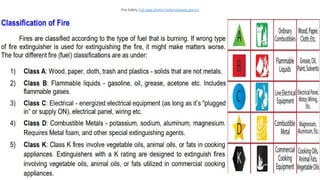
First Aid pocket-guide-1aid (meghomeguards.gov.in)
Fire Safety Full page photo (indianrailways.gov.in)
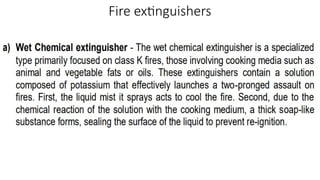
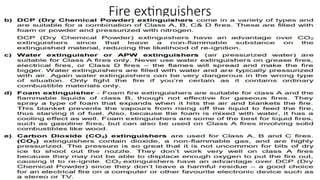
Fire extinguishers
Fire extinguishers

Disaster Management & fire fighting pptx

  • 1.
  • 2.
    Disasters & accidents Anaccident is an unplanned event that sometimes has inconvenient or undesirable consequences, other times being inconsequential. An emergency is a situation in which the community is capable of coping. It is a situation generated by the real or imminent occurrence of an event that requires immediate attention of emergency resources. A disaster is a situation in which the community is incapable of coping. It is a natural or human-caused event which causes intense negative impacts on people, goods, services and/or the environment, exceeding the affected community’s capability to respond; therefore the community seeks the assistance of government and international agencies.
  • 3.
  • 4.
  • 5.
    Serious Accident •Accident toa train which is attended with loss of life or with grievous hurt to a passenger or passengers in the train, or with serious damage to Railway property of the value exceeding Rs 2 crore and any other accident which in the opinion of the Chief Commissioner of Railway Safety or Commissioner of Railway Safety requires the holding of an inquiry by the Commissioner of Railway Safety shall also be deemed to be a serious accident.
  • 6.
    RAILWAY ACCIDENTS Classification ofAccidents: Classifications of accidents are done as per Railway Board letter no: 2000/Safety (A&R)/19/20 dated 13.12.2000. Accidents are broadly divided into 5 categories and further classified into 16 categories from A to R excluding I & O.
  • 7.
    Disaster in Railwayparlance • In Railways, Disaster is defined as a major train accident leading to heavy causalities and disruption to traffic for a long period. Train accidents:Train accident is an “accident that involves a train”. Train accidents are further classified as: • Consequential train accidents. • Indicative train accidents. https://www.youtube.com/watch?v=94KuIbpWBIE Parlance=PHRASEOLOGY,PHRASING,VERNACULAR Consequential=IMPORTANT, SIGNIFICANT, MAJOR Indicative=SUGGGESTIVE, ANALYTICAL, REVEALING
  • 8.
    TRAIN ACCIDENTS CONSEQUENTIAL A- COLLISION B- FIRE /EXPLOSION C- LEVEL CROSSING ACCIDENTS D- DERAILMENTS E- MISCILLENEOUS INDICATIVE F- AVERTED COLLISION G- BREACH OF BLOCK RULES H- TRAIN PASSING SIGNAL AT DANGER
  • 9.
    Class ‘A’ –Collisions A-1 Collision involving a train carrying passengers, resulting in (i) Loss of human life and/or grievous hurt and/or (ii) Damage to Railway property of the value exceeding Rs. 2 crore and/or (iii) Interruption of any important through line of communication for at least 24 hours. A-2 Collision involving a train NOT carrying passengers resulting in (iv) Loss of human life/grievous hurt and/or (v) Damage to Railway property of the value exceeding Rs. 2 crore and/or (vi) Interruption of any important through line of communication for at least 24 hours. A-3 Collision involving a train carrying passengers, not falling under A-1 above. A-4 Collision involving a train NOT carrying passengers not falling under A-2 above. A-5 Other collisions, i.e. collisions occurring in shunting, marshalling yards, loco yards and sidings etc. but not involving a train.
  • 10.
    Class ‘B’ -Fire or Explosion in trains • B-1 Fire or Explosion in a train carrying passengers resulting in (i) loss of human life and/or grievous hurt and/or (ii) damage to Railway property of the value exceeding Rs. 2 crore and/or (iii) interruption of any important through line of communication for at least 24 hours. • B-2 Fire or Explosion in a train NOT carrying passengers resulting in (i) loss of human life and/or grievous hurt and/or (ii) damage to Railway property of the value exceeding Rs. 2 crore and/or (iii) interruption of any important through line of communication for at least 24 hours. • B-3 Fire or Explosion in a train carrying passengers not falling under B-1 above but loss to Railway property Rs. 50,000 or above and/or interruption to traffic is more than the threshold value and/or resulting into detachment of rolling stock/stocks from the train and/or requiring relief engine/s.
  • 11.
    Class ‘B’ -Fire or Explosion in trains • B-4 Fire or Explosion in a train NOT carrying passengers not falling under B- 2 above (i) Loss to Railway property is Rs.50,000 or above and/or (ii) Interruption to traffic is more than the threshold value and/or (iii) Resulting into detachment of goods stock/stocks from the train. • B-5 Fire in a train carrying passengers not falling under B-1 or B-3 above • B-6 Fire in a train not carrying passengers and not falling under B-2 or B-4 above. • B-7 Fire occurring in shunting, marshalling yards, loco yards and sidings etc. involving rolling stock but not involving a train.
  • 12.
    Class ‘C’- Trainsrunning into road traffic and/or traffic running into trains at level crossings. • C-1 Trains carrying passengers running into road traffic and/or road traffic running into such trains at manned level crossings resulting into loss of human life and/or grievous hurt and/or damage to Railway property and/or interruption to traffic is more than the threshold value. • C-2 Trains NOT carrying passengers running into road traffic and/or road traffic running into such trains at manned level crossings resulting into loss of human life and/or grievous hurt and/or damage to Railway property and/or interruption to traffic is more than the threshold value. • C-3 Trains carrying passengers running into road traffic and/or road traffic running into such trains at unmanned level crossings resulting into loss of human life and/or grievous hurt and/or damage to Railway property and/or interruption to traffic is more than the threshold value. • C-4 Trains NOT carrying passengers running into road traffic and/or road traffic running into such trains at unmanned level crossings resulting into loss of human life and/or grievous hurt and/or damage to Railway property and/or interruption to traffic is more than the threshold value.
  • 13.
    Class ‘C’- Trainsrunning into road traffic and/or traffic running into trains at level crossings. • C-5 Trains carrying passengers running into road traffic and /or road traffic running into such trains at manned level crossings but not falling under C-1. • C-6 Trains not carrying passengers running into road traffic and /or road traffic running into such trains at manned level crossings but not falling under C-2. • C-7 Trains carrying passengers running into road traffic and /or road traffic running into such trains at unmanned level crossings but not falling under C-3. • C-8 Trains not carrying passengers running into road traffic and /or road traffic running into such trains at unmanned level crossings but not falling under C-4. • C-9 Shunting engine with or without vehicles or loose vehicles running into road traffic and /or road traffic running into shunting engine with or without vehicles or loose vehicles at level crossings.
  • 14.
    Class ‘D’ -Derailments • D-1 Derailment of a train carrying passengers resulting in loss of human life and/or grievous hurt and/or damage to Railway property of the value exceeding Rs.2 crore and/or interruption of any important through line of communication for at least 24 hours. • D-2 Derailment of a train NOT carrying passengers resulting in loss of human life and/or damage to Railway property of the value exceeding Rs.2 crore and/or interruption of any important through line of communication for at least 24 hours. • D-3 Derailment of a train carrying passengers, not falling under D-1 above. • D-4 Derailment of a train NOT carrying passengers not falling under D-2 above but loss to Railway property and or interruption to traffic is more than the threshold value. • D-5 Derailment of a train not carrying passengers, not falling either under D-2 or D-4 above. • D-6 Other derailments, i.e. derailments occurring in shunting, marshalling yards, loco yards, and sidings etc but not involving a train.
  • 15.
    Class ‘E’ –Other Train Accident • E-1 Train running over or against any obstruction including fixed structure other than included under class “C” resulting into loss of human life and/or grievous hurt and/or damage to Railway property and/or interruption to traffic is more than the threshold value. • E-2 Trains running into any obstruction including fixed structure but not covered under Class ‘C’ or ‘E-1’.
  • 16.
    Threshold Value • Forthe purpose of reporting of accidents, threshold value is the minimum value beyond which the accident will be treated as having serious repercussion on the basis of loss to railway property or interruption to communication. It shall constitute two portions- • (a) Threshold value of Railway property, loss of which is fixed at Rs 01 lac. or; • (b) Threshold value of interruption to communication either partial or total where duration of interruption to communication is equal to or more than number of hours specified against each cell.
  • 17.
  • 18.
    Indicative train accidents •Inreal term they are not accidents but are serious potential hazards. These include: 1. Averted Collisions (Class F) 2. Breach of Block Rules (Class G) 3. Train passing signal at danger (Class H)
  • 19.
    Class F -AvertedCollisions • F-1 Averted collision between trains at least one of which is carrying passengers. • F-2 Averted collision between a train carrying passengers and an obstruction. • F-3 Averted collision between trains NOT carrying passengers. • F-4 Averted collision between train NOT carrying passengers and an obstruction
  • 20.
    Class ‘G’ -Breach of Block Rules • G-1 Train carrying passengers, entering a block section without any authority or without a proper ‘Authority to Proceed’. • G-2 Train Not carrying passengers, entering a block section without any authority or without proper ‘Authority to Proceed’. • G-3 Train received on a blocked line, not constituting an averted collision. • G-4 Train received on or entering a wrong line at a station or catch or Slip Siding or SandHump etc.
  • 21.
    Class ‘H’ -Train passing signal at danger. • H-1 Train carrying passengers running past a ‘Stop’ signal at danger without proper authority. • H-2 Train/NOT carrying passengers running past a ‘Stop’ signal at danger, without proper authority.
  • 22.
    EQUIPMENT FAILURE • Class‘J’ – Failure of Engine and Rolling Stock • Class ‘K’ – Failure of Permanent Way • Class ‘L’ – Failure of Electrical Equipment • Class ‘M’ - Failure of Signaling and Telecommunication
  • 23.
    RAILWAY ACCIDENTS Class M(M1to M7) S&T department failures: (a) Class M1 - Total failure of interlocking (b) Class M2 - Track circuit/Axle Counter failure (c) Class M3 - Block instrument failure (d) Class M4 - Point machine failure (e) Class M5 - Signal/Point failure (f) Class M6 - Failure of communication between SM and section controller for more than 15 minutes (g) Class M7 - Failure of communication between SM and LC gate man for more than 15 minutes
  • 24.
    Definition of aDisaster on Railways as per Disaster Management Act 2005, •“Railway Disaster is a serious train accident or an untoward event of grave nature, either on railway premises or arising out of railway activity, due to natural or manmade causes, that may lead to loss of many lives and/or grievous injuries to a large number of people, and/or severe disruption of traffic etc, necessitating large scale help from other Government/Non-government and Private Organizations.” Grave=SERIOUS, SEVERE, CRITICAL
  • 25.
    Strengths of theRailways to handle a Disaster • Railways’ own Communication Network. • Operating Control on each Division linked with each Station. • Uniformed force of RPF/RPSF • Railways’ own Medical Infrastructure • An army of Gang men spread out all over the Indian Railways. • Scouts and Guides (they can at best provide background support). • Dedicated Rescue/Restoration and Medical Equipment on Rails.
  • 26.
    Railway’s shortcomings tohandle Disaster: • Absence of Tunnel rescue equipment – in case of collapse of or mishap in a rail Tunnel, expertise and related equipment on this aspect is lacking. • Non-availability of trained divers for extrication of passengers and/or casualties (dead bodies and drowning/drowned passengers) from rolling stock fallen down in sea/river/lake etc. • Limited help of sports persons (Swimmers) can be taken for this; the time of their mobilization is a factor in view. • Non-availability of cranes operated from a ship/barge for lifting of the coaches/bogies from a water body. • Ability to handle a Chemical Biological Radiological and Nuclear Disaster and major fire. • Limited resources to handle a terrorist attack on a train and/or a station
  • 27.
    Authority to declarea Disaster on Railways • Railway Board has also approved to nominate GMs, AGMs or CSOs (when GM/AGM are not available) for declaring an untoward incident as Railway Disaster.
  • 28.
    Resources available incase of a major accident may be grouped into 4 different units. 1. Resource Unit I Railway and non-railway resources available on the train, and at nearby surroundings. 2. Resource Unit II Railway resources available at ARMV/ART depots and elsewhere within the division. 3. Resource Unit III Railway resources available at ARMV/ART depots and elsewhere on adjoining Zones and Divisions. 4. Resource Unit IV Non-railway resources available within or outside the division.
  • 29.
  • 30.
    DISASTER MANAGEMENT CYCLE •Mitigation: Measures put in place to minimize the results from a disaster. • Examples: building codes and zoning; vulnerability analyses; public education. • Preparedness: Planning how to respond. • Examples: preparedness plans; emergency exercises/training; warning systems. • Response: Initial actions taken as the event takes place. It involves efforts to minimize the hazards created by a disaster. • Examples: evacuation; search and rescue; emergency relief. • Recovery: Returning the community to normal. Ideally, the affected area should be put in a condition equal to or better than it was before the disaster took place. • Examples: temporary housing; grants; medical care.
  • 31.
    Measures taken byRlys to reduce accidents 1. Construction of ROB's/RUB's at LC gates. 2. Manning of UnManned Level Crossings gates. 3. Interlocking of Level Crossing gates. 4. Use of Train Actuated Warning Device (TAWD) and Anti-Collision Device(ACD). 5. Upgradation of safety features in locomotives. 6. Upgradation/replacement of over-aged tracks, bridges, S&T gears and rolling stock.
  • 32.
    7. Reduction inthermit weld joints & use of SPURT Ultrasonic Rail Testing Car) for rail flaw detection 8. Continuous Track Circuiting 9. Use fire detector, fire retardant in R.stock, work centre 10.Use crash worthy coach & tight lock couplers with anti climbing features. 11. Up-gradation of ART/ARMV's and improving skill of ART/ARMV's staff with Trg., & up-gradation of eqpt.
  • 33.
    In the earlyhours of 02 August 1999 the Delhi bound Avadh Assam Mail collided head-on into the Gauhati bound Brahmaputra Mail at GHAISAL
  • 36.
    We wish thatno accidents should take place But we should be prepared to meet any situation if any unfortunate accident occurs or disaster takes place
  • 37.
    Disaster Management Systemin I.Rlys Ministry of Railways constituted a high level Committee vide Rly Bd’s order No. ERB-I/2002/23/44 Dt.16.09.2002 Final report on DM _for printing_.doc (indianrailways.gov.in)
  • 38.
    Disaster Management Act2005. The new ACT provides that: • There shall be a National Disaster Management Authority of which the Prime Minister of India will be the Chairperson, helped by a Vice Chairperson. • The National Authority shall have the responsibility of laying down the policies, plans and guidelines for disaster management. • There shall be created State Disaster Management Authorities, expected to be chaired by the Chief Minister of the state. • There shall be created District Disaster Management Authorities co-chaired by the District Collector and President of the elected body of the district. • The Central Government shall constitute the National Institute of Disaster Management. State Authorities to meet the immediate needs of providing rescue and relief to the victims of Disasters. • Disaster Management plan to be prepared and reviewed every year.
  • 39.
    Disaster Management Act2005. AAA2005___53.pdf (indiacode.nic.in) • Ministry of Home Affairs is the nodal Ministry of all National Disasters except Drought. • Sixteen Battalions of Para-military forces have been trained to serve as the National Disaster Management Response Force (NDRF) { About Us | NDRF - National Disaster Response Force} with Two Battalions each from Central Reserve Protection Force (CRPF) { Role of CRPF | About Us | Central Reserve Police Force, Government of Indi a. }, Central Industrial Security Forces (CISF) { CISF Activities in Disaster Management | CISF}, Indo Tibet Border Police (ITBP) {ITBP|History & Role (itbpolice.nic.in) }and Border Security Force (BSF).
  • 40.
    Disaster Management Act2005. AAA2005___53.pdf (indiacode.nic.in) • At present, National Disaster Response Force consist of 16 battalions from the BSF, CISF, CRPF, ITBP, SSB Sashastra Seema Bal) and Assam Rifles. Each battalion have 18 self- contained specialist search and rescue teams of 45 personnel each including engineers, technicians, electricians, dog squads and medical/paramedics. The total strength of each battalion is 1,149. • All the 16 battalions have been equipped and trained to respond natural as well as man-made disasters. Battalions are also trained and equipped for response during chemical, biological, radiological and nuclear (CBRN) emergencies.
  • 41.
    Phases of DisasterManagement • Phase-I (Golden Hour) • Phase-II (Arrival of Crack Team) • Phase-III (Arrival of Relief Train) • Phase-IV (Handling injured Passengers) • Phase-V (Restoration of Traffic)
  • 42.
    Phase-I (Golden Hour) •The first phase, which is of shortest duration, lasts for about an hour. It is an amateurish, poorly equipped effort; but is nevertheless the most important phase. In most cases, this is the only help available for a major part of the "GOLDEN HOUR". 1. In the period immediately after the accident where grievous injuries to passengers, loss of property etc. takes place, action has to be taken on war footing by Railway Officials/ officers-on-board to render definite medical care which gives relief to affected persons and also helps them to overcome the trauma. 2. If a critical trauma patient is not given definite medical care within one hour from the time of accident, chances of his ultimate recovery reduces drastically, even with the best of Medical attention thereafter.
  • 43.
    Extract of HighLevel Committee Report on Disaster Management
  • 44.
    Disaster Syndrome: (a) ShockStage: In which victims are stunned, dazed and apathetic. (b) Suggestible stage: In which victims tend to be passive but open to suggestions and willing to take directions from rescue workers and others. (c) Recovery stage: In which the individual may be tense and apprehensive and may show generalized anxiety. Syndrome= condition, disease, pattern, disorder Stunned= shocked, speechless, astonished Dazed= confused, surprised Apathetic= indifferent, lazy, uninterested
  • 45.
    DR ABC (i) D-DANGER:-Look out for danger. Make sure that no further danger exists either for the patient or for the First Aider. (ii) R-RESPONSE:- Check for consciousness. Call by his/her name, slap, pinch and shake plenty. If there is no response, then it means that the patient is unconscious. (iii) C-CIRCULATION:- Check the pulse. Normally we check the pulse at the wrist; however, sometimes it is not felt because of severe bleeding. So, it is better to check the pulse at neck. (Carotid Pulse). Pinch=squeeze, touch
  • 46.
    (iv) B-BREATHING:- Checkfor Breathing. Keep the back of your fingers near the nose of the patient. You can feel the warm air (or) keep your ear near the nose and look for the movement of chest, listen to the sound from the throat and feel the warm air from the nose. (v) A-AIRWAY:- Clear the airway (Trachea). If patient is unconscious, then the airway may be narrowed or blocked making breathing impossible. This occurs due to several reasons. To clear the other objects in the mouth press the Jaw, open the mouth put your fingers or a clean cloth in the mouth and clear the obstruction. Now the air passage is clear.
  • 47.
    Special Task Teams:  Relief & transportation of injured to hospitals - Medical  Catering(food & drinking water), Payment of ex-gratia, liaison with Civil admn., and Press - Commercial  Security of luggage, parcels and railway property– Commercial & RPF Lighting arrangement – Electrical  Liaison with control and arranging logistics including shunting – Operating, Passenger Care – Personnel  Establishment of communication & booths – S&T  Rescue & Relief operations including rerailment and preservation of clues - Mechanical  Provision of tents, accommodation etc. – Engineering  Preservation of clues, measurement of track, wagon, photo/videography, statement of witnesses. Breath analyzer test for staff involved in accident - Safety
  • 48.
    ACTION TO BETAKEN AT DIVISIONAL LEVEL i) Opening up of special enquiry booths at originating, terminating and major stations en-route. ii) Furnishing updated position of dead, injured and evacuated passengers to all concerned. iii) Help line Phone Number should be relayed through TV, Radio and press. iv) Arrangement for issue of free Railway passes for relatives/dependents of dead & injured. v) Make arrangements for transportation of evacuated passengers to be sent to destinations Transport vehicles can be hired. vi) In case of major disaster, DRM can requisition helicopter/Aeroplane. vii) Press should be briefed properly and quickly. viii) HQ/Board should be advised quickly.
  • 49.
    Duties of TI/PWI/SI/CWI/LI (a)Rushing to accident site with men and material : (i) Before leaving for the site of accident organize maximum number of men to go to the accident site along with their equipment. (ii) Reach the site of accident by quickest available means. (b) Rescue and relief : (iii) Ensure that the obstructed line is protected. (iv) Direct all staff working under them to assist in rescue and relief work. (v) All of them should work as per directions of OC Site. (vi) Assess casualties and arrange to render First Aid. (vii)Shift injured to nearest hospital.
  • 50.
    Contd.. (c) Joint measurementsand preservation of clues and evidences : (i) Collect and record all evidences relating to the accident such as: 1. Condition of track, with special reference to alignment, gauge, cross levels, super elevation, points of mount and drop and any sign of sabotage etc. 2. Condition of Rolling stock with reference to Brake Power and braking gear. 3. All marks on sleepers, rails, locomotives and vehicles etc. especially for preservation of clues. 4. Position of derailed vehicles. 5.Prima facie cause of accident. (ii) Seize and seal the Train Signal Register, Log book, Private Number Book, Line Admission Book, Speed Recorder Chart and other relevant records. Sabotage=DISRUPTION, DAMAGE, INTERRUPTION
  • 51.
    Contd.. (iii) Note downthe position of panel switches, indication, block instrument, condition of relay room, status of data logger, etc. (iv) Condition of switches, ground connections, point locking, occupancy of track circuit, details of damage to outdoor signal/point gears should be noted down. (v) Seize and seal the Speed Recording Graph and all other registers and repair log book of the locomotive. (vi) Record details of Brake Power and other aspects of Rolling stock as per Performa. (vii) Joint measurements of rolling stock should be taken.
  • 52.
    Supervisors required goingto Accident Site (i) At the divisional level 80% of all supervisors available in divisional headquarters should proceed to the accident site. (ii) All other supervisors available in the field at other stations should also proceed to the accident site. (iii) Divisional Control Office should issue a recorded control message from DRM to all Supervisors for proceeding to the accident site immediately by fastest possible means.
  • 53.
    GENERAL GUIDELINES FORMAINTENANCE OF ARTs 1646207377563-Maintenance and Operational manual for 140T Cranes ARTs ARMEs(2).pdf (indianrailways.gov.in) • The equipments are to be periodically tested to ensure their satisfactory working at all times. Testing / Inspections shall be carried out as under • Complete testing by ART nominated staff: once in 15 days. • Inspection by ASTE/DSTE: once in 3 months. • Inspection by Sr. DSTE/DSTE: once in 6 months. 1. A register is to be maintained in the ART for making entries for testing of equipment. 2. Whenever the ART returns from accident spot, equipments are to be immediately checked for their proper working. 3. Any short fall / missing equipment should be replaced with good working equipment at the earliest. 4. All equipments having shelf life, viz. jointing kits, torch cells etc., shall be replaced in due time.
  • 54.
    Circumstances Code For accidentsin Loco sheds/Traffic Yards at home station requiring only ART. Two long blasts each of 45 seconds duration with 5 seconds break in between. For accidents outside the home station requiring only ART Three long blasts each of 45 seconds duration with 5 seconds break in between. For accidents at home station requiring both ART& ARMV. Four long blasts each of 45 seconds Duration with 5 seconds break in between. For accidents outside the home station requiring both ART & ARMV Five long blasts each of 45 seconds Duration & with 5 seconds break in between. For cancellation of medical van and breakdown train. One long blast of 90 seconds duration.
  • 55.
    TIME for TurningOUT • On listening to these hooters or on receipt of a memo from the SM on duty or the Loco foremen, the A.D.M.O/A.M.O. will immediately report himself to SM on duty with his staff, ready to proceed to the site of accident with the Relief Medical Van. Target time for turning out the Medical Van: In case of double exit siding - 15 Minutes In case of single exit sidings - 20 Minutes `The time is reckoned from the time of ordering to the time of dispatch. `Target time for turning out the Break down trains / ART - • During Day - 30 Minutes • During Night - 45 minutes The time is reckoned from the time of ordering to the time of leaving the shed.
  • 56.
    Communication arrangement duringDisaster (in greater detail to telecom supervisors) •ACCIDENT COMMUNICATION •PowerPoint Presentation (indianrailways.gov.in) • Microsoft Word - Chapter_XVII.doc (indianrailwa ys.gov.in)
  • 57.
    ACCIDENT COMMUNICATION SECTION A:COMMUNICATION AT ACCIDENT SITE 1. As soon as an accident occurs, driver/asst. driver shall establish communication with the portable control telephone by hooking on to the overhead lines/plugging into the emergency sockets, so as to establish communication with control office. 2. Guards of all passenger carrying trains are also provided with portable control phones of the types mentioned above. Guard of the passenger carrying train shall also establish communication with control office as soon as an accident occurs. 3. Drivers and guards of all trains shall be provided with 5 watt walkie-talkie sets, and as soon as an accident occurs, information shall be given in the 5 watt walkie-talkie set to the adjacent station wherever possible. 4. Advanced means of communication like GSM-R are deployed on the Railways, the same shall also be used to establish communication with the control office. 5. Additional means of communication shall be provided progressively within the shortest possible time as under: • Provision of Railway telephone / telephones. • Provision of BSNL telephone / telephones. • Mobile phones wherever network coverage exists.
  • 58.
    ACCIDENT COMMUNICATION 6. AccidentRelief Trains (ART) are located at strategic locations of each division and are provided with telecommunication equipment for providing additional facilities as under: • PA system shall be established for making important announcements. • Megaphones shall be given as per need at site. • Walkie-talkie sets shall be distributed as per need. • Magneto communication as required at site. • Communication through satellite phone shall be established. • FAX, E-mail shall be established wherever communication media is available. • It shall be possible to provide the communication using satellite technology /through Railways own OFC links, by extending bandwidth from the accident site to the adjacent station/using BSNL connections. Mobile telephone exchange (WLL)may be established, if available. • Wherever cell phone coverage exists, cell phones available with officers and with ART shall be used. • It is desirable to send pictures of accident spot to Railway Board/Zonal/Divisional Headquarters using e-mail for which extension of internet/railnet to site is required. It is desirable to send video coverage to Railway Board/Zonal/Divisional Headquarters, as and when the necessary equipment are provided in the ARTs. Strategic= planned, considered, intentional
  • 59.
    First communication ataccident site All the Telecom equipments in ART as per requirement should be provided at Accident site. First communication to be established with the controller by inserting EC phone at the nearest EC socket post which is provided at every 1 km. Tent to be provided at more accessible place and Power supply to be extended to the various equipments
  • 60.
    ACCIDENT COMMUNICATION SECTION B:ACCIDENT INFORMATION FOR PUBLIC • As soon as information regarding an accident is received, accident information number shall be activated and manned. This number shall normally be at the zonal/divisional headquarters. Adequate personnel shall be posted by commercial branch to meet the demand depending on the seriousness of the accident. Number of lines for this number shall be suitably augmented depending on the demand. • Close liaison shall be maintained with BSNL officials for monitoring the call rates and increasing the lines as necessary. • The accident information number should be made wide publicity through audio, video and print media.
  • 61.
    Communication at accidentsite Communication from site of accident is to be established as soon as accident takes place. Drivers of all trains shall be provided with portable control telephones. 2 wire type - OH territory 4 wire type - U/G cable territory 2w/4w type - in both territories
  • 62.
    Field Service (FS)/ D-8 Cable • IS-694-Part /1964 • During emergencies like Railway accidents, Floods, Cyclones, etc., this cable is extensively used to provide temporary connections of the telephones as per requirement. • Single core twin twisted of size 7/0.375mm. • Out of 7 strands, three strands of steel and four strands of copper forms a single core called as L1. One more length has to be taken as L2. • Available in length of 500Mtrs. and 1Km in a drum.
  • 63.
    TEST ROOM As soonas the test room, receive the message of train accident from controller, He/She shall inform to all related officers of the Division such as Sr.DSTE, DSTE, ADSTE, and SSE/Incharge of Test Room etc. ROLE OF TELECOM DEPARTMENT DURING TRAIN ACCIDENTS
  • 64.
    TELECOMMUNICATION STAFF: •Proceed tosite by quickest means available. •Ensure portable telephone / emergency telephone set is provided at site. •Wherever feasible, wireless sets to be installed at accident site for communication with Divisional Headquarters and if possible with Railway Headquarters. Walkie-talkie sets / Megaphones / loud hailers to be deployed as necessary.
  • 65.
    •DOT/BSNL telephone withSTD facility to be arranged at the temporary enquiry offices opened at site and nearest location wherever possible. •Render such assistance as required by Guard in attending to the accident victims and stranded passengers. •Arrange for early restoration of telecom equipment as soon as such restoration is permitted.
  • 66.
    •Drivers and Guardsof all trains shall be provided with 5 watt walkie-talkie sets, information shall be given in the 5 watt walkie talkie set to the adjacent station wherever possible. In some sections arrangements are available to communicate with control office on walkie-talkie/duplex VHF sets and this may be used where such arrangement exist.
  • 67.
    •Additional means ofcommunication shall be provided progressively within the shortest possible time as under: Provision of Railway telephones. Provision of BSNL telephones. Mobile phones wherever network coverage exists.
  • 68.
    •Accident Relief Trains(ART) are located at strategic locations of each division and are provided with telecommunication equipment for providing additional facilities as under: •PA system shall be established for making important announcements. •Megaphones shall be given as per need at site. •Walkie-talkie sets shall be distributed as per need. •Magneto communication as required at site. •Communication through satellite phone shall be established.
  • 69.
    •FAX, E-mail shallbe established wherever communication media is available. It shall be possible to provide the communication using satellite technology / through Railways own OFC links, by extending bandwidth from the accident site to the adjacent station / using BSNL connections. Mobile telephone exchange (WLL) may be established, if available.
  • 70.
    •The VSAT terminalwill deliver the composite data traffic from site to the VSAT hub at New Delhi. From here the composite data traffic will be transported to Divisional HQ, Zonal HQ and Railway Board on existing MPLS network. •A video server shall be provided at New Delhi VSAT hub to enable web based access to live and stored videos.
  • 71.
    MAPLE connectivity diagramat Test room and at accident spot
  • 72.
    ACCIDENT INFORMATION FORPUBLIC •As soon as information regarding an accident is received, accident information number (Help Line, mostly 1072) shall be activated and manned. This number shall normally be at the zonal/divisional headquarters. Adequate personnel shall be posted by commercial branch to meet the demand depending on the seriousness of the accident. Number of lines for this number shall be suitably augmented depending on the demand. •Close liaison shall be maintained with BSNL officials for monitoring the call rates and increasing the lines as necessary. •The accident information number should be made wide publicity through audio, video and print media.
  • 73.
    Action to betaken at Divisional Level Opening up of special enquiry booth at major originating & terminating stns enroute Furnishing updated position of dead, injured and evacuated passengers to all concerned. Helpline no. be relayed thru TV, Radio & press Arrangement for issue of free Railway passes for relatives/dependents of dead & injured. Transportation of evacuated passengers to be sent to destinations. Transport to be hired. In case of major disaster, DRM can requisition for helicopter / Aero plane. Press should be briefed properly and quickly. Headquarters/ Board should be advised quickly.
  • 74.
    DISASTER MANAGEMENT CELLAT HEADQUARTERS The Disaster Management Cell will operate at HQs and shall be attended by nominated Officers of following dept  Safety department  Medical department  Commercial department  Operating department  Mechanical department  Engineering department  Electrical department  S&T department
  • 75.
     Every ARTshall have nominated telecom staff. SE/JE and shall be assisted by 2 Telecom Maintainers and 3 Khalasis.  Nominated staff shall test ART eqpt as per schedule and ensure working of all eqpts.  Nominated staff shall respond immediately whenever an accident takes place and proceed by ART to site of accident.  Nominated ART staff are responsible for establishing communication, immediately on reaching site of accident. Staff for Accident Relief Train
  • 76.
     A registerto be maintained in ART for making entries for testing of equipment and for their satisfactory operation.  If ART returns from accident spot, eqpts to be checked for their working. Any short fall to be replaced at the earliest.  Charging of batteries, replacement of torch cells irrespective of usage, replacement of cable jointing kit be carried out  Adequate space be provided in ART for housing all eqpts to avoid rolling off during movement  Sophisticated eqpts., shall not be stacked one above other and packing provided for Satellite phone, Wakie Talkie, FAX, Public Address system eqpt etc.,  For charging of batteries, regular P/S be made available near ART for charging batteries of PA system, Walkie Talkie where it is stationed Instructions for Testing of ART eqpt
  • 77.
    Disaster Management controlrooms at Headquarters / Divisions  BSNL Phones – 2 Nos with ISD facility.  Railway Telephones – 3 Nos with STD facility.  Fax Mc – 1 No. connected to BSNL / Rly line.  Facility to extend section control to Disaster Management control. The concerned section control, shall be connected.  Hot line bet Headquarters & Divisional Disaster Management control room to be provided  Important Telephone nos. of hospitals /doctors/officials of State & district administration and other functionaries be kept ready.
  • 78.
    Sl. No. Model Time Remarks 1 D Dateof Accident 2 D+1 DRM /GM* shall order the inquiry, if no particular department accepts the responsibility. 3 D+3 Committee shall convene the inquiry into the accident. 4 D+7 Committee shall submit the inquiry report to DRM/GM*. 5 D+10 Acceptance of inquiry report by the DRM/GM* /Sr.DSO (only for yard accident) + 6 D+15 Inquiry reports will be finalized by CSO/AGM. 7 D+20 Submission of inquiry report to CRS for the section of the Railways on which the accident occurred with the remarks. A copy of findings of the Inquiry Report to be sent to Railway Board. 8 D+90 DAR action against responsible officials to be completed TIME LIMIT Sub: Procedure for completion of Departmental accident inquiries.
  • 79.
    Inputs on Permanentway and C&W matters • Record position of levers, SM’s control slides, indication of points, track circuits, slot etc., Position of switch & knobs in case of Panel Interlocked stns • In all cases of derailment in station section it should be noted whether the move was signal move or not • Check emergency release register and other relevant register & initial then with date and time • It should be checked whether crank handle(CH) is taken out and where it was used be noted down.
  • 80.
    • In caseof collision in station yard, reasons for not setting & clamping points against occupied lines should be brought out. Whether Line block collars used • Position of Block Instrument, seals & locks of instrument and block counter should be checked. • P.way gauge at point should be noted down in case of derailment over/near the points. Damage to point gears, tongue rails should also to be noted down • DATA LOGGER REPORTS SHOULD BE KEPT READY ALONG WITH SCREEN PRINTS IF REQUIRED.
  • 81.
    • Effectiveness ofinterlocking of B.Instt with LSS. In S/L, TGT & TCF locks should be specially checked. • Train Signal Register(TSR), Private No.(PN) and relevant records(passing Sig at ON…) be sealed • B.Instt., position to be noted and be suspended till joint inspection is carried out by traffic & Sig official • Condition of seals of S&T gears normally kept sealed should be noted down including relay rooms are double locked with counters if any • L.box containing relay track feed should be sealed jointly by signal & (traffic or any other official)
  • 82.
    Early restoration ofS&T gears when permitted • The works should be divided into three phases • Works which can be carried out before the debris are cleared/rerailment of derailed vehicles • Works which can be taken up after clearing of debris/Rerailment of derailed vehicles and before track fit certificate is given • Complete work along with track restoration and testing be carried out when track fit certificate given
  • 83.
    MEASURES FOR IMPROVEMENTOF SAFETY • DO NOT USE SHORTCUT METHOD AT ANY COST • REPAIR work be taken with DISCONECTION and CONSENT MEMO be taken from ON DUTY ASM • ENTRY to RELAY ROOM should be with PERMISSION from SM with due entry in RELAY ROOM Register along with reason due to which it is being opened • CABLE MEGGERING TO BE DONE STRICTLY UNDER NI-working and DISCONNECTION MEMO • RECORD of MAINTENANCE ACTIVITY be made in MAINTENANCE ACTIVITY REGISTER at each Stn
  • 84.
    Revised List ofMinimum Essential Telecom Equipments to be kept in Accident Relief Trains(ART’s) Signed letter 17 05 2021.pdf (indianrailways.go v.in)
  • 85.
    List of MinimumEssential Telecom Eqpts.,- Accident Relief Trains (ARTs) A) General (Common for RE as well as Non RE Area) No. Final Item Qty. 1. Inspn Book, WTT latest copy of all sections 1 No. 2.a Desk type Electronic Magneto Telephone 4 Nos. 2.b Dry Cells large 6-I, 1.5 Volts each for Ph/Torch 12 Nos. 3. PVC Insulated, PVC Sheathed twin core cable 500 M 4. Microphones for cordless PA system 2 Nos. 5. Loudspeaker Horn type 5/10 Watts 2 Nos. 6.a Amp min 20W Power O/P (having interface for cordless mic) and operating voltage of 12 VDC 2 Nos. 6.b 12 Volts batt for 6(a) with appropriate Batt chgr 2 Sets.
  • 86.
    7. Megaphone withbatt (min10 watts each) 4 Nos. 8. Stand for LS with adjustable Ht(1.5-3M) 2 Nos. 9. Field service telephone cable PVC insulated (D-8) along with 6 pin Emergency Plug 4 drums of 500 M each 10. Push button Caller ID Phone 4 Nos. 11.a WT sets (5Watts) with 100% spare batt 30 Nos. 11.b Batt Chgr for 11(a) (with rapid charging) 8 Nos. 12. Digital Multimeter 2 Nos. 13. Power extn bd with drum (50M) 4 Nos. 14. Hand held Rechargeable LED Torch 4 Nos. 15. Jointing Kit & material(decided by Rlys )
  • 87.
    16 Tool BoxContaining 2 Sets. 16.a Soldering Iron- 10W/220V& 65W/220V each 1 No. 16.b Long Nose Plier-200 mm 1 No. 16.c Cutter Diagonal-200 mm 1 No. 16.d Box Spanner 6, 6.5 & 5 mm each 1 No. 16.e Hammer Steel 750 gms, Hammer Wooden 1 No. 16.g Adjustable Spanner 300 mm 1 No. 16.h Screw Driver-200 mm, 250 mm each 1 No. 16.j Mains Tester (230 Volts) 1 No. 16.k Electrical Insulation Tape 12 mm x 15 meters 2 Nos. 16.l Resin Core 500gm 16.m Combination Plier 1 No.
  • 88.
    17. Digital Voicerec with mic&playback with good memory data transfr thru Pen drive/Hard disk 2 Nos. 18. 4 W way station eqpt with control phone. 2 Nos. 19. Smart Phone with chgr and SIM of different service provider (Min 6 inch display, 4G, VoLTE, Dual SIM, 4GB RAM and 128GB memory) 4 Nos. 20. Satellite Ph(SAT Ph/ISAT phone2/Inmarsat Ph) 1 No. 21. All in one color printer(Fax,Scan,Copy & print) 1 No. 22. Auto Dialling System from Emergency Socket 1 No. 23. Cat-6 cable along with required accessories 2 box 24. Laptop with required configuration and accessories to suit communication needs at accident site 1 No.
  • 89.
    25. Hot Spot4G Dongle (Different Service Provider) 4 no. 26. Power Bank of 30000 mAH for mobile charging 4 no. 27. FCT with SIM of different service provider 4 no. 28. 6 Core flexible OFC Cable for outdoor purpose 500M 29. 24 fibre OFC Splice enclosure 2 no. 30. LAN Extender for extending Ethernet 2 Pair 31. Rechargeable LED Search Light 2 no. 32. VHF Set (Duplex) of 25W each with interface for ph, incldg mast, Antenna-GP Type and battery 1 Set 33. Folding Table-2no. Chair-6no. Beach Umbrella-2no. 36. Light weight prefabricated Tent kabuli (medium) 1 no. 37. Telecom Cable Route plan of Division 1 no.
  • 90.
    38. Setup forLive streaming Video from accident site: 1 Set Full HD Bullet IP Camera 12V DC with Tripod stand 1 No. LTE Router Operating Voltage 12 VDC & with PoE Port 1 No. Wireless Access Point -1 Km range with PoE operated 2 Nos. Portable Battery 12V 7AH 4 Nos. Battery Charger 12VDC, Data SIM Card 1 No. Public Static IP at Divisional & Zonal Head Quarter 1 No. 39. MTRC mobile handset for MTRC covered area 2 Nos 40. 4Wire Portable Control Telephone with dry cells 2 Set 41. 1:1 isolating Transformer 2 No 42 V-SAT Terminal set 1 Set 43 Single/Multi SIM LTE Router Operating Volt 12 VDC and with PoE port with LTE Data SIM(s) 1 Set
  • 91.
    B) Specific EquipmentsRequired for ARTs having beats in Non-RE area having overhead lines No. Final Item Qty. 1. Wire Portable Control Telephone with dry cells and telescopic pole of minimum 6M height with its bracket opening space atleast 350 mm. 2 Nos. 2. Overhead control alignment charts 1 Set Above is the List of Minimum Essential Telecom Eqpts., for Accident Relief Train (ARTs) RDSO lr no. STT/WL/ARRO(Pt)/244 Vol-II dt. 17.05.2021
  • 92.
    First Aid pocket-guide-1aid(meghomeguards.gov.in)
  • 93.
    Fire Safety Fullpage photo (indianrailways.gov.in)
  • 94.
  • 95.