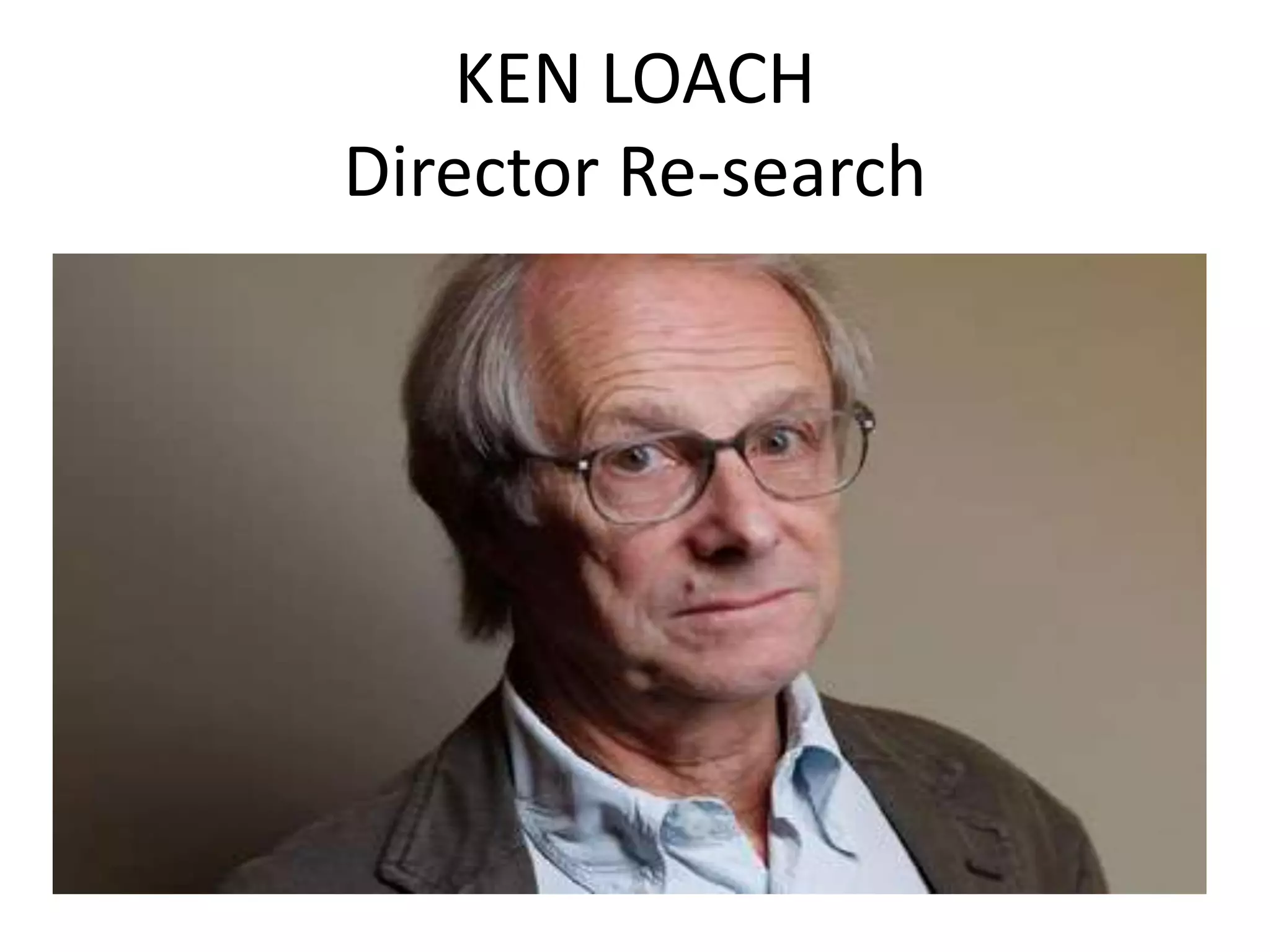
KEN LOACH
Director Re-search
Kenneth Charles "Ken" Loach (born 17 June 1936) is
an English director of television and independent film.
He is known for his socially critical directing style and
for his socialist ideals, which are evident in his film
treatment of social issues such as
poverty, homelessness (Cathy Come Home, 1966)
and labor rights (Riff-Raff, 1991, and The Navigators,
2001).Loach's film Kes (1969) was voted the
seventh greatest British film of the 20th century in a
poll by the British Film Institute. Two of his films, The
Wind That Shakes the Barley (2006) and I, Daniel
Blake (2016) received the Palme d'Or at the Cannes
Film Festival, making him the ninth filmmaker to win
the award twice.
Loach was a social campaigner for most of his
career. Critics say Loach’s weakness is that he
has never changed: he is still delivering the
same Marxist sermon he was half a century
ago. His fans argue that this is his strength.
Loach himself, now an unlikely 80 years old,
would ask why on earth he should change
when the system remains the same.
STYLE:
Ken Loach took his craft to pieces and rebuilt it,
borrowing some techniques (using natural light
whenever possible and casting nonprofessional actors
alongside professionals) and establishing new ones of
his own (shooting chronologically; feeding the
storyline to actors bit by bit, so their reactions are
real; combining improvised shots with closely scripted
ones). It is perhaps this level of realism that
distinguishes his films more than anything: Cathy,
wonderfully played by Carol White, looks shocked
when her child is taken away because the actor was;
ditto the boy who cries in Kes when he is caned on the
hand.
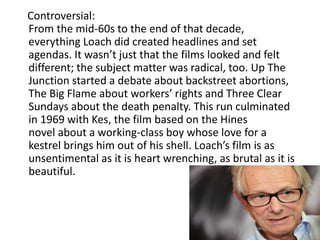
Controversial:
From the mid-60s to the end of that decade,
everything Loach did created headlines and set
agendas. It wasn’t just that the films looked and felt
different; the subject matter was radical, too. Up The
Junction started a debate about backstreet abortions,
The Big Flame about workers’ rights and Three Clear
Sundays about the death penalty. This run culminated
in 1969 with Kes, the film based on the Hines
novel about a working-class boy whose love for a
kestrel brings him out of his shell. Loach’s film is as
unsentimental as it is heart wrenching, as brutal as it is
beautiful.
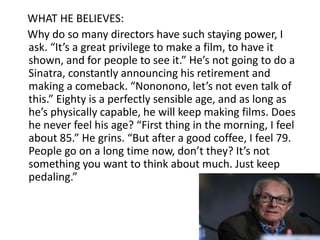
WHAT HE BELIEVES:
Why do so many directors have such staying power, I
ask. “It’s a great privilege to make a film, to have it
shown, and for people to see it.” He’s not going to do a
Sinatra, constantly announcing his retirement and
making a comeback. “Nononono, let’s not even talk of
this.” Eighty is a perfectly sensible age, and as long as
he’s physically capable, he will keep making films. Does
he never feel his age? “First thing in the morning, I feel
about 85.” He grins. “But after a good coffee, I feel 79.
People go on a long time now, don’t they? It’s not
something you want to think about much. Just keep
pedaling.”
Honours :
Loach has been awarded honorary doctorates by
the University of Bath, the University of Birmingham, Staffordshire
University, and Keele University.
Oxford University awarded him an Honorary Doctor of Civil
Law degree in June 2005.
In May 2006, he was awarded the BAFTA Fellowship at the BAFTA
TV Awards.
Loach also received an Honorary Doctorate from Heriot-Watt
University in 2003.
He received the 2003 Praemium Imperiale (lit. "World Culture Prize
in Memory of His Imperial Highness Prince Takamatsu") in the
category Film/Theatre.
In 2014 he was presented with the Honorary Golden Bear at
the 64th Berlin International Film Festival.
The Raindance Film Festival announced in September 2016 that it
would be honoring Loach with its inaugural Auteur Award, to
recognise his "achievements in filmmaking and contribution to the
film industry."
Director research

Director research

  • 1.
  • 2.
    Kenneth Charles "Ken"Loach (born 17 June 1936) is an English director of television and independent film. He is known for his socially critical directing style and for his socialist ideals, which are evident in his film treatment of social issues such as poverty, homelessness (Cathy Come Home, 1966) and labor rights (Riff-Raff, 1991, and The Navigators, 2001).Loach's film Kes (1969) was voted the seventh greatest British film of the 20th century in a poll by the British Film Institute. Two of his films, The Wind That Shakes the Barley (2006) and I, Daniel Blake (2016) received the Palme d'Or at the Cannes Film Festival, making him the ninth filmmaker to win the award twice.
  • 3.
    Loach was asocial campaigner for most of his career. Critics say Loach’s weakness is that he has never changed: he is still delivering the same Marxist sermon he was half a century ago. His fans argue that this is his strength. Loach himself, now an unlikely 80 years old, would ask why on earth he should change when the system remains the same.
  • 4.
    STYLE: Ken Loach tookhis craft to pieces and rebuilt it, borrowing some techniques (using natural light whenever possible and casting nonprofessional actors alongside professionals) and establishing new ones of his own (shooting chronologically; feeding the storyline to actors bit by bit, so their reactions are real; combining improvised shots with closely scripted ones). It is perhaps this level of realism that distinguishes his films more than anything: Cathy, wonderfully played by Carol White, looks shocked when her child is taken away because the actor was; ditto the boy who cries in Kes when he is caned on the hand.
  • 5.
    Controversial: From the mid-60sto the end of that decade, everything Loach did created headlines and set agendas. It wasn’t just that the films looked and felt different; the subject matter was radical, too. Up The Junction started a debate about backstreet abortions, The Big Flame about workers’ rights and Three Clear Sundays about the death penalty. This run culminated in 1969 with Kes, the film based on the Hines novel about a working-class boy whose love for a kestrel brings him out of his shell. Loach’s film is as unsentimental as it is heart wrenching, as brutal as it is beautiful.
  • 6.
    WHAT HE BELIEVES: Whydo so many directors have such staying power, I ask. “It’s a great privilege to make a film, to have it shown, and for people to see it.” He’s not going to do a Sinatra, constantly announcing his retirement and making a comeback. “Nononono, let’s not even talk of this.” Eighty is a perfectly sensible age, and as long as he’s physically capable, he will keep making films. Does he never feel his age? “First thing in the morning, I feel about 85.” He grins. “But after a good coffee, I feel 79. People go on a long time now, don’t they? It’s not something you want to think about much. Just keep pedaling.”
  • 7.
    Honours : Loach hasbeen awarded honorary doctorates by the University of Bath, the University of Birmingham, Staffordshire University, and Keele University. Oxford University awarded him an Honorary Doctor of Civil Law degree in June 2005. In May 2006, he was awarded the BAFTA Fellowship at the BAFTA TV Awards. Loach also received an Honorary Doctorate from Heriot-Watt University in 2003. He received the 2003 Praemium Imperiale (lit. "World Culture Prize in Memory of His Imperial Highness Prince Takamatsu") in the category Film/Theatre. In 2014 he was presented with the Honorary Golden Bear at the 64th Berlin International Film Festival. The Raindance Film Festival announced in September 2016 that it would be honoring Loach with its inaugural Auteur Award, to recognise his "achievements in filmmaking and contribution to the film industry."