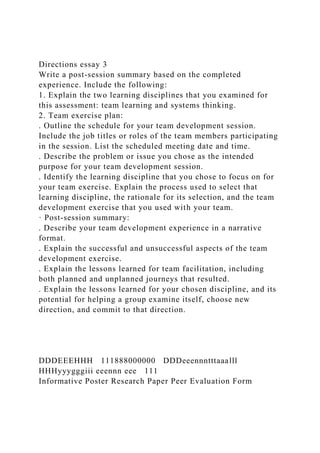
Directions essay 3
Write a post-session summary based on the completed
experience. Include the following:
1. Explain the two learning disciplines that you examined for
this assessment: team learning and systems thinking.
2. Team exercise plan:
. Outline the schedule for your team development session.
Include the job titles or roles of the team members participating
in the session. List the scheduled meeting date and time.
. Describe the problem or issue you chose as the intended
purpose for your team development session.
. Identify the learning discipline that you chose to focus on for
your team exercise. Explain the process used to select that
learning discipline, the rationale for its selection, and the team
development exercise that you used with your team.
· Post-session summary:
. Describe your team development experience in a narrative
format.
. Explain the successful and unsuccessful aspects of the team
development exercise.
. Explain the lessons learned for team facilitation, including
both planned and unplanned journeys that resulted.
. Explain the lessons learned for your chosen discipline, and its
potential for helping a group examine itself, choose new
direction, and commit to that direction.
DDDEEEHHH 111888000000 DDDeeennntttaaalll
HHHyyygggiii eeennn eee 111
Informative Poster Research Paper Peer Evaluation Form
At the conclusion of each group project, please rate yourself
and your team colleagues on regarding the relative
contributions that were made in preparing, submitting, and
presenting your group project. Please be honest,
objective, constructive, and fair in your evaluation of yourself
and your colleagues. Your ratings will not be
disclosed to other students. In rating yourself and your peers,
using the following five-point scale, where:
5 = Always 4 = Most of the time 3 = Sometimes 2 = Seldom 1
= Never
Project or Paper Title:
_____________________________________________________
____________
*Insert YOUR NAME IN THE FIRST COLUMN and those of
your peers’ in the other spaces. (One name at the top of each
column).
Names __________ __________ __________ __________
__________
Participated in discussions or
meetings
Contributed thoughtful research
germane to topic
Helped keep the group on the
task
Contributed useful ideas
Quantity of work done
Quality of work done
Shared equally in the work
Cooperated with colleagues
Made fair, considered decisions
re: direction of project and work
Deliverables on time, as promised
= = = = =
Total Score
Please take a moment to reflect, and answer the following
questions.
1. Would you want to work with this group again? Why or why
not?
2. In one sentence each; describe each team member’s
contribution toward the project reaching completion?
Dental Hygiene 1 Informative Poster Research Paper Rubric for
Evaluation (100 points poss.)
Qualities and Criteria Low Middle High
Point Value 0-3 4-6 7-10
Introduction
Problem statement; orientation to
topic
Little or no reference to the
topic and issues to be
covered
The writer makes the reader
aware of the topic but lacks
some clarity about its
importance. Overview of issues
to be covered is unclear.
The writer introduces the topic
and its importance. Provides a
clear overview of the issues to
be covered in the paper.
Conclusion and Relevance
Summary of the topic, issues
reviewed, and conclusions made;
explains relevance of topic to
student’s major field.
There is little indication
that the writer tried to
synthesize the information
presented in the paper.
Relevance of the topic to
the student’s major field is
absent.
The writer provides concluding
remarks that demonstrate an
analysis and synthesis of ideas.
However, some are not
supported in the paper.
Relevance of the topic to the
student’s major field is stated.
The writer makes succinct and
precise conclusions based on the
material presented. Insights into
the topic are appropriate.
Relevance of the topic to the
student’s major field is clear and
concise.
Qualities and Criteria Low Middle High
Point Value 0-10 11-15 16-20
Organization and Flow
Clear organization of material;
transitions tie paragraphs and
sections together.
Little evidence of a
cohesive plan. Little or no
description or detail. Ideas
are scrambled, jumbled or
disconnected. A natural
and logical flow of ideas
and facts is absent.
Material organized
appropriately but lacks some
clarity or consistency;
extraneous material may be
present. There is a basic flow
from one section to the next,
but not all sections or
paragraphs follow in a natural
or logical order.
Material is organized in a clear,
appropriate and precise manner.
Sections and paragraphs follow a
natural and logical order.
Transitions tie sections and
adjacent paragraphs together.
Clarity of Writing and
Grammar
Includes spelling, punctuation,
grammar, and format
It is difficult to understand
what the writer is trying to
express. The paper
contains many errors in
spelling, grammar, and/or
punctuation.
Writing is generally clear but
confusing at times. Paragraph
or sentence structure is too
repetitive. There are errors in
spelling, grammar, or
punctuation.
The writing is clear and
appropriately concise. There are
very few, if any, errors in
spelling, grammar, and
punctuation.
Citations and References
In-text citations are properly
referenced; references are listed in
an appropriate format with all
necessary components; references
are of adequate quality from peer-
reviewed sources (1.e., <30% from
non-refereed web sources); there
are at least 3 references.
The writer does not include
sufficient in-text citations.
References are incomplete
or improperly formatted.
Many references are of
poor quality. There are an
insufficient number of
references (<3).
The writer cites sources within
the body of the paper and
includes a corresponding
references list. Some citations
are lacking or there may be
some formatting problems.
Poor quality references are
somewhat overutilized. There
are too few references.
The writer includes all necessary
citations in the body of the
paper. The references in the list
match the in-text citations and
all are properly formatted. The
references are of adequate
quality and there are a sufficient
number of them utilized.
Quality and Criteria Low Middle High
Point Value 0-10 11-15 16-20
Content
Presents differing views;
synthesizes values and ethics
involved in these views; describes
potential resolution strategies;
adequate depth and coverage of
major issues; and appropriate
length.
The writer left out major
sections of required
content. The topics are
presented at too basic a
level. The ideas presented
have little or no
significance to the topic of
the paper. The paper lacks
depth. The length of the
paper is inappropriate.
The writer includes all major
sections of the required content
but does not cover them in as
much depth or detail. Some
redundancy may be present.
The length of the paper may be
somewhat inappropriate—too
short or too long.
The writer covers the
appropriate content without
being redundant. The
significance to the topic and the
issues is clear. The paper is an
appropriate length—covers the
topic adequately without being
too long or too short.
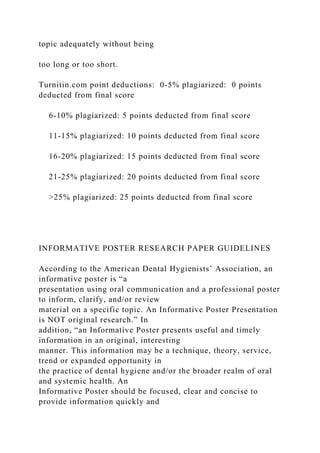
Turnitin.com point deductions: 0-5% plagiarized: 0 points
deducted from final score
6-10% plagiarized: 5 points deducted from final score
11-15% plagiarized: 10 points deducted from final score
16-20% plagiarized: 15 points deducted from final score
21-25% plagiarized: 20 points deducted from final score
>25% plagiarized: 25 points deducted from final score
INFORMATIVE POSTER RESEARCH PAPER GUIDELINES
According to the American Dental Hygienists’ Association, an
informative poster is “a
presentation using oral communication and a professional poster
to inform, clarify, and/or review
material on a specific topic. An Informative Poster Presentation
is NOT original research.” In
addition, “an Informative Poster presents useful and timely
information in an original, interesting
manner. This information may be a technique, theory, service,
trend or expanded opportunity in
the practice of dental hygiene and/or the broader realm of oral
and systemic health. An
Informative Poster should be focused, clear and concise to
provide information quickly and
stimulate attention and interest. An Informative Poster is not an
exhibit of materials.” Students
are to choose a partner to work on this assignment together.
Students who are in Clinics
A-D may pair up with another student from Clinics A-D (there
can be ONE group of three
students from Clinics A-D). Students who are in Clinics E-H
may pair up with another
student from Clinics E-H.
During DEH 1800 Dental Hygiene 1, student pairs will choose
the topic they will research for
their informative poster. The topic must be selected and
presented to the instructor for
approval no later than Monday, January 28, 2019. Once the
topic has been approved,
students will begin researching the selected topic and write a
scholarly paper based on their
research.
Informative Poster Research Paper
The Informative Poster Research paper is worth 10% of the
student’s final grade in DEH 1800
Dental Hygiene 1. The paper should be in a scholarly format
and include at least three (3) peer-
reviewed journal references (not including textbooks). None of
the references can come from
the Internet, unless they are from peer-reviewed journals. If a
student is unsure if a
reference is acceptable, the student MUST ask the instructor for
guidance.
All submitted work is to be typed, double-spaced, use 12-point
Times New Roman font, and
have a one-inch margin. The paper must be at least 3 full pages,
not including references.
Citations and references MUST use APA style. The paper will
be graded on the basis of style
(including grammar and spelling), depth, clarity, applicability,
adequacy of references, and
timeliness. The paper should include the following sections:
➢ Introduction
➢ Background
➢ Discussion
➢ Conclusion
**Note: An abstract is NOT required for this paper!!
A rough draft of the paper will be due Monday, February 25,
2019. STUDENT NAMES ARE
NOT TO BE WRITTEN ON THE ROUGH DRAFT, ONLY THE
STUDENTS’ ID NUMBERS!!
Rough drafts will then be randomly passed out to classmates for
critiquing; students will not
critique their own paper. The first rough draft CANNOT be in
outline form! Critiques of the
rough drafts will be due one week later on Monday, March 4,
2019. Tardiness in returning
the first rough draft will result in a five-point deduction from
the reviewers’ own final paper.
A second rough draft will be due on Monday, March 25, 2019.
The instructor will critique the
second rough draft. The second rough draft should be close to
the final version of the paper.
The instructor will write constructive critical comments on the
second rough draft and they will
be returned to the student via their clinic dispensary boxes on
Wednesday, April 3, 2019. It is
suggested that students read the constructive critical comments
carefully and follow
through with them.
**FINAL VERSION OF THE RESEARCH PAPER WILL BE
DUE MONDAY, APRIL 15, 2019.
LATE PAPERS WILL NOT BE ACCEPTED AND WILL
RECEIVE A GRADE OF ZERO (“0”).
The final paper MUST have the critiqued first and second rough
drafts stapled to it.
Failure to turn these in will result in a 5-point deduction from
the final paper grade for
EACH missing draft. Final research papers will also be
submitted to www.Turnitin.com
via the course’s Blackboard website.
The instructor’s research paper grading rubric can be found on
the course’s Blackboard website.
The rubric includes how many points will be deducted from the
paper depending on the
percentage of plagiarism as reported by www.Turnitin.com. The
student pairs should ensure
that they are turning in their own work and not someone else’s.
Each pair of students will privately critique each other’s
participation within the group. Each
group member’s completed group self-critique rubric MUST be
turned in to the instructor
when the final paper is due. Failure to turn in the completed
rubric will results in a 5-point
deduction from that individual’s paper grade. A rubric for group
self-critique can be found on
the course’s Blackboard website.
During Clinic 2, the informative poster itself will be developed.
Students will receive a timeline
schedule for development of the poster from the Clinic 2
Coordinator during the Clinic 2
Orientation.
http://www.turnitin.com/

Directions essay 3 Write a post-session summary based on the com.docx

  • 1.
    Directions essay 3 Writea post-session summary based on the completed experience. Include the following: 1. Explain the two learning disciplines that you examined for this assessment: team learning and systems thinking. 2. Team exercise plan: . Outline the schedule for your team development session. Include the job titles or roles of the team members participating in the session. List the scheduled meeting date and time. . Describe the problem or issue you chose as the intended purpose for your team development session. . Identify the learning discipline that you chose to focus on for your team exercise. Explain the process used to select that learning discipline, the rationale for its selection, and the team development exercise that you used with your team. · Post-session summary: . Describe your team development experience in a narrative format. . Explain the successful and unsuccessful aspects of the team development exercise. . Explain the lessons learned for team facilitation, including both planned and unplanned journeys that resulted. . Explain the lessons learned for your chosen discipline, and its potential for helping a group examine itself, choose new direction, and commit to that direction. DDDEEEHHH 111888000000 DDDeeennntttaaalll HHHyyygggiii eeennn eee 111 Informative Poster Research Paper Peer Evaluation Form
  • 2.
    At the conclusionof each group project, please rate yourself and your team colleagues on regarding the relative contributions that were made in preparing, submitting, and presenting your group project. Please be honest, objective, constructive, and fair in your evaluation of yourself and your colleagues. Your ratings will not be disclosed to other students. In rating yourself and your peers, using the following five-point scale, where: 5 = Always 4 = Most of the time 3 = Sometimes 2 = Seldom 1 = Never Project or Paper Title: _____________________________________________________ ____________ *Insert YOUR NAME IN THE FIRST COLUMN and those of your peers’ in the other spaces. (One name at the top of each column). Names __________ __________ __________ __________ __________ Participated in discussions or meetings Contributed thoughtful research germane to topic
  • 3.
    Helped keep thegroup on the task Contributed useful ideas Quantity of work done Quality of work done Shared equally in the work Cooperated with colleagues Made fair, considered decisions re: direction of project and work Deliverables on time, as promised = = = = = Total Score Please take a moment to reflect, and answer the following questions. 1. Would you want to work with this group again? Why or why not?
  • 4.
    2. In onesentence each; describe each team member’s contribution toward the project reaching completion? Dental Hygiene 1 Informative Poster Research Paper Rubric for Evaluation (100 points poss.) Qualities and Criteria Low Middle High Point Value 0-3 4-6 7-10 Introduction Problem statement; orientation to topic Little or no reference to the topic and issues to be covered The writer makes the reader aware of the topic but lacks some clarity about its importance. Overview of issues to be covered is unclear. The writer introduces the topic
  • 5.
    and its importance.Provides a clear overview of the issues to be covered in the paper. Conclusion and Relevance Summary of the topic, issues reviewed, and conclusions made; explains relevance of topic to student’s major field. There is little indication that the writer tried to synthesize the information presented in the paper. Relevance of the topic to the student’s major field is absent. The writer provides concluding remarks that demonstrate an analysis and synthesis of ideas.
  • 6.
    However, some arenot supported in the paper. Relevance of the topic to the student’s major field is stated. The writer makes succinct and precise conclusions based on the material presented. Insights into the topic are appropriate. Relevance of the topic to the student’s major field is clear and concise. Qualities and Criteria Low Middle High Point Value 0-10 11-15 16-20 Organization and Flow Clear organization of material; transitions tie paragraphs and sections together. Little evidence of a cohesive plan. Little or no
  • 7.
    description or detail.Ideas are scrambled, jumbled or disconnected. A natural and logical flow of ideas and facts is absent. Material organized appropriately but lacks some clarity or consistency; extraneous material may be present. There is a basic flow from one section to the next, but not all sections or paragraphs follow in a natural or logical order. Material is organized in a clear, appropriate and precise manner. Sections and paragraphs follow a natural and logical order.
  • 8.
    Transitions tie sectionsand adjacent paragraphs together. Clarity of Writing and Grammar Includes spelling, punctuation, grammar, and format It is difficult to understand what the writer is trying to express. The paper contains many errors in spelling, grammar, and/or punctuation. Writing is generally clear but confusing at times. Paragraph or sentence structure is too repetitive. There are errors in spelling, grammar, or punctuation.
  • 9.
    The writing isclear and appropriately concise. There are very few, if any, errors in spelling, grammar, and punctuation. Citations and References In-text citations are properly referenced; references are listed in an appropriate format with all necessary components; references are of adequate quality from peer- reviewed sources (1.e., <30% from non-refereed web sources); there are at least 3 references. The writer does not include sufficient in-text citations. References are incomplete or improperly formatted. Many references are of
  • 10.
    poor quality. Thereare an insufficient number of references (<3). The writer cites sources within the body of the paper and includes a corresponding references list. Some citations are lacking or there may be some formatting problems. Poor quality references are somewhat overutilized. There are too few references. The writer includes all necessary citations in the body of the paper. The references in the list match the in-text citations and all are properly formatted. The references are of adequate
  • 11.
    quality and thereare a sufficient number of them utilized. Quality and Criteria Low Middle High Point Value 0-10 11-15 16-20 Content Presents differing views; synthesizes values and ethics involved in these views; describes potential resolution strategies; adequate depth and coverage of major issues; and appropriate length. The writer left out major sections of required content. The topics are presented at too basic a level. The ideas presented have little or no
  • 12.
    significance to thetopic of the paper. The paper lacks depth. The length of the paper is inappropriate. The writer includes all major sections of the required content but does not cover them in as much depth or detail. Some redundancy may be present. The length of the paper may be somewhat inappropriate—too short or too long. The writer covers the appropriate content without being redundant. The significance to the topic and the issues is clear. The paper is an appropriate length—covers the
  • 13.
    topic adequately withoutbeing too long or too short. Turnitin.com point deductions: 0-5% plagiarized: 0 points deducted from final score 6-10% plagiarized: 5 points deducted from final score 11-15% plagiarized: 10 points deducted from final score 16-20% plagiarized: 15 points deducted from final score 21-25% plagiarized: 20 points deducted from final score >25% plagiarized: 25 points deducted from final score INFORMATIVE POSTER RESEARCH PAPER GUIDELINES According to the American Dental Hygienists’ Association, an informative poster is “a presentation using oral communication and a professional poster to inform, clarify, and/or review material on a specific topic. An Informative Poster Presentation is NOT original research.” In addition, “an Informative Poster presents useful and timely information in an original, interesting manner. This information may be a technique, theory, service, trend or expanded opportunity in the practice of dental hygiene and/or the broader realm of oral and systemic health. An Informative Poster should be focused, clear and concise to provide information quickly and
  • 14.
    stimulate attention andinterest. An Informative Poster is not an exhibit of materials.” Students are to choose a partner to work on this assignment together. Students who are in Clinics A-D may pair up with another student from Clinics A-D (there can be ONE group of three students from Clinics A-D). Students who are in Clinics E-H may pair up with another student from Clinics E-H. During DEH 1800 Dental Hygiene 1, student pairs will choose the topic they will research for their informative poster. The topic must be selected and presented to the instructor for approval no later than Monday, January 28, 2019. Once the topic has been approved, students will begin researching the selected topic and write a scholarly paper based on their research. Informative Poster Research Paper The Informative Poster Research paper is worth 10% of the student’s final grade in DEH 1800 Dental Hygiene 1. The paper should be in a scholarly format and include at least three (3) peer- reviewed journal references (not including textbooks). None of the references can come from the Internet, unless they are from peer-reviewed journals. If a student is unsure if a reference is acceptable, the student MUST ask the instructor for guidance. All submitted work is to be typed, double-spaced, use 12-point Times New Roman font, and
  • 15.
    have a one-inchmargin. The paper must be at least 3 full pages, not including references. Citations and references MUST use APA style. The paper will be graded on the basis of style (including grammar and spelling), depth, clarity, applicability, adequacy of references, and timeliness. The paper should include the following sections: ➢ Introduction ➢ Background ➢ Discussion ➢ Conclusion **Note: An abstract is NOT required for this paper!! A rough draft of the paper will be due Monday, February 25, 2019. STUDENT NAMES ARE NOT TO BE WRITTEN ON THE ROUGH DRAFT, ONLY THE STUDENTS’ ID NUMBERS!! Rough drafts will then be randomly passed out to classmates for critiquing; students will not critique their own paper. The first rough draft CANNOT be in outline form! Critiques of the rough drafts will be due one week later on Monday, March 4, 2019. Tardiness in returning the first rough draft will result in a five-point deduction from the reviewers’ own final paper. A second rough draft will be due on Monday, March 25, 2019. The instructor will critique the
  • 16.
    second rough draft.The second rough draft should be close to the final version of the paper. The instructor will write constructive critical comments on the second rough draft and they will be returned to the student via their clinic dispensary boxes on Wednesday, April 3, 2019. It is suggested that students read the constructive critical comments carefully and follow through with them. **FINAL VERSION OF THE RESEARCH PAPER WILL BE DUE MONDAY, APRIL 15, 2019. LATE PAPERS WILL NOT BE ACCEPTED AND WILL RECEIVE A GRADE OF ZERO (“0”). The final paper MUST have the critiqued first and second rough drafts stapled to it. Failure to turn these in will result in a 5-point deduction from the final paper grade for EACH missing draft. Final research papers will also be submitted to www.Turnitin.com via the course’s Blackboard website. The instructor’s research paper grading rubric can be found on the course’s Blackboard website. The rubric includes how many points will be deducted from the paper depending on the percentage of plagiarism as reported by www.Turnitin.com. The student pairs should ensure that they are turning in their own work and not someone else’s. Each pair of students will privately critique each other’s participation within the group. Each group member’s completed group self-critique rubric MUST be turned in to the instructor
  • 17.
    when the finalpaper is due. Failure to turn in the completed rubric will results in a 5-point deduction from that individual’s paper grade. A rubric for group self-critique can be found on the course’s Blackboard website. During Clinic 2, the informative poster itself will be developed. Students will receive a timeline schedule for development of the poster from the Clinic 2 Coordinator during the Clinic 2 Orientation. http://www.turnitin.com/ http://www.turnitin.com/