Equity Action Project
Emotional Support/ Comfort Animals At the Cleveland Institute of Art
Marcus D’Iorio
Kent State University
Running Header: Equity Action Project 2
College and University campuses today combined both an academic setting with a
residential setting for those students who decide to reside on campus. Residential settings on
college campuses have different names based on their institution. These names range from
Office of Housing and Residence Life, Office of Residence Life, Office of Residence Life and
Housing, and Residential Services. All of these names mean the same thing, an office that
provides oversight of the operation of the residence halls and when applicable off campus
college or university run housing. From a business perspective residence life on a college
campus is considered an auxiliary service, as it provides a product for the student at an additional
cost beyond the stated tuition amount for a college or university. Many times these offices work
collaboratively with other offices on campus. In addition, the rules that govern the residence
halls is the same as the Student Code of Conduct that the school may have. However, almost
always, the Offices of Residence Life have additional rules that surround the conduct of residents
within the residence hall.
One of the rules that is implemented in virtually every residence life hall system is no
pets except for fish are permitted. This is due to the type of setting and set up that the majority
of residence hall have. While modern residence halls have started to increase the square footage
of each room over the past few decades, the majority of housing, especially for first year
residential students is a small room of limited square feet. For example, Kent State University’s
Manchester Hall, which is part of the Eastaway complex has a double occupancy room
dimension of 11 feet by 17 feet (Kent State University, 2015). Allowing an animal (not
including a service animal to reside in the room), could cause potential danger to not only the
residents but also to the animal due to the confined space. While this is not the only reasoning
behind the no pets policy, there is no general consensus as to why it was originally implemented
Running Header: Equity Action Project 3
or when from the research that I was able to conduct. However, while the no pet policy has been
seen as a normal condition for living on campus for years, it is starting to be challenged by
students recently.
Within the residential settings, within the past decade, there has been an increase in the
amount of students who are requesting to have an emotional support animal reside with them in
their residence hall room at various colleges and universities across the country. This is due to
an increase in students who have received doctor referrals and recommendations to have an
animal in a college residence hall room as an emotional support animal. This national trend has
a variety of implications for residence life on a college campus in that there have already been
two lawsuits against colleges and universities for not allowing an emotional support/ comfort
animal filed. The University of Nebraska at Kearney was sued and there is an ongoing lawsuit
against Kent State University. Both universities were sued under violations of the Fair Housing
Act of 1968 and the Americans with Disabilities Act.
In August 2014, when I started my current role as the GA Hall Director at The Cleveland
Institute of Art the institute did not allow animals anywhere on the colleges grounds. The only
exception to it was when the Office of Student Life and Housing brought in therapy dogs from
the University Hospitals Case Medical Center. The dogs where brought in to help students with
finals, and were available for the students for about two hours during one of the days leading up
to finals. Over the course of the last year and into the first part of the Fall 2015 semester, there
have been a few instances where an emotional support animal has been requested. In one
instance a student with no documented disability through our Learning Support Services
Coordinator had brought her dog with her on campus and into her academic studio for her major.
This continued for about two week before an officially stop was put to it so that the institute
Running Header: Equity Action Project 4
could review policies. Even after this two week policy review period, and into the fist part of the
Fall 2015 semester no policy was in place outlining the different requirements of the student in
the form of an official request were in place. As we move forward though the Fall 2015
semester, there was an increase of requests for an emotional support/ comfort animal. For the
equity action project, I realized that it would be important to have some form of formal request
contract system in place.
Throughout this process I ran into different roadblocks that changed part of the direction
that I took for the project. As a starting point, I met with our Learning Support Services
Coordinator who helped to bring me up to date on what the institute was currently doing. In the
beginning of the project I found out that the Learning Support Services Coordinator was in the
final stages of creating an institutional policy around emotional support/ comfort animals. This
was due to the documents being written and waiting for final sign off from the institute lawyers
which happened in the middle part of the semester. It was at this point that I realized that we had
no official system in place once a student has requested the animal if they are living on campus
in the residence hall. With no system in place it created an inequity for our residential student
population, if they were to be approved by the new institutional policy. For the project, I
realized that in order foster a transition from an inequitable state to an equitable state the
institution needed an official contract for the residence hall, but also an outline of how the
information was to transmitted to the Director of Student Life and Housing.
During the research part of the project, I was asked by my supervisor to work on a
contract for emotional support/ comfort animals within the residence hall. However, as a starting
point for my research I looked at the result of the University of Nebraska- Kearney lawsuit and
the current state of the Kent State University lawsuit to see what they did, and to learn from
Running Header: Equity Action Project 5
them. This came about due to Johnson’s 2006 chapter on What Can We Do in which he talks
about not reinventing the wheel and to see what others have done in order to learn from it
(Johnson 2006). Tying in the information that I had gained from the two lawsuits, combined
with my research from after the lawsuits, and from talking with our Learning Support Services
Coordinator there was an apparent need for the contract to be equity minded. To be equity
minded, the contract needed to set out the guidelines for being allowed to have and emotional
support/ comfort animal in the building, and what the other roommates where not required to do.
This was important to have in the contract, as the student who would be allowed to have the
animal in the room would turn into the majority, as they are getting permission for something
that is above the normal operating practice of the hall. In order to prevent the other roommates
in the room from having to share the responsibility if something was to happen due to the animal
being present it was important to have them be included in both the contract as well as the
notification process. This will allow the roommates to be able to realize the impact that it has,
but also give them the opportunity to switch rooms if possible as well as understand that they
will not be held liable for any issues that arise. By having the roommates aware of this, it
allowed for an equaled and equitable understanding of what was required of the roommate to
have an emotional support/ comfort animal in the room, but also what the remaining roommates
rights are.
In addition however, by granting the student the ability to have an animal with her in the
building, it will show that the institute is equity minded in that we are compassionate about our
students, and even though they could have a medical reason for the request we will do what we
can within reasonable accommodations to allow the student to be able to feel safe and supported
while in the residence hall. As an department if we were to not allow any emotional support/
Running Header: Equity Action Project 6
comfort animals in the residence we would be excluding a population of students who would
directly benefit from it. In the Quillin 2014 presentation on disability and accessibility services,
there is a section on reasonable accommodation for students with disabilities. Reasonable
accommodation could come in different forms for students who wish to have an emotional
support/ comfort animal with them on campus. For us as a department by having a contract
granting the student the ability to have an emotional support/ comfort animal in the residence
hall we are providing reasonable accommodation to the student in a manner that does not impede
on other students. This will minimize the impact of the animal on the community at large. If
though, the animal does become disruptive to the community as outlined in the contract, the
department has the right to ask the emotional support/ comfort animal to be removed from the
hall. However, this would not be the best for the student. As a institute we have a second
building that we sublease to students that has single apartments. If needed this could be a
possibility if the conditions of the original confront for the main residence hall is broken.
While it is current practice to not make students aware of the possibility to have an animal with
them in the residence hall environment, if the student eventually does bring the animal to
campus, the scope of the project could have a bigger impact than the original intention.
At the current stage of the project, it is in a holding pattern until the student decides to
bring an emotional support/ comfort animal to the campus. While it looks like we may be able to
actually implement the project in spring semester, there is no guarantee. This project though
directly relates to me in that I could have a hand in how we as a institute handle an emotional
support/ comfort animal in the residence hall. Due to the nature of the request, it is important
that all of us who have now become involved remember that we are here to support the student,
and future students who may make such a request. This will enable us to become empowerment
Running Header: Equity Action Project 7
agents as outline by Alicia Dowd and Estela Mara Bensimon in their book Engaging the “Race
Question” Accountability and Equity in U.S. Higher Education. To become an empowerment
agent will allow for the us to be able to take a conscious based approach and work to help the
student (Dowd & Bensimon, 2015). In return we will be able to help the student overcome an
obstacle that they may currently face. To overcome the obstacle, the student and any future
students with the same request will be able to have the ability to have a normal academic
experience while at the Cleveland Institute of Art
The project was designed so that the contract is written in a way that at any point in the
future after I leave, the Division of Student Affairs will be able to pull the contract up on any
computer from our departmental servers. This ability was crucial for future impact, that it
needed to be hosted in an environment in which anyone who is involved with the decision
making for an emotional support/ comfort animal is able to open it to show the student both
before they decide to bring an animal to campus, but also after when they need to get the
appropriate signatures. Currently though, the project has been successful in that the student was
made aware of what they will be required of her in order to bring the animal to campus, but also
what they will be responsible for once the animal is on campus.
While we could say that the project was a success so far, there are a few concerns and
legal problems that could come about because of the request for an emotional support/ comfort
animal in the residence hall. The first is due to the residence hall not being owned by the
Cleveland Institute of Art, but instead owned by the developer who built it. In the developers
contract for other residential marketplace apartments in the area that are the same set up they
only allow a cat as a pet. While this issue would be beyond my capacity for this project and
beyond my capacity for my graduate assistantship position it is important to recognize that there
Running Header: Equity Action Project 8
could be an issues with the developer and that the institute will need to have clear evidence when
informing the developer about the animal and what they will be responsible for due to FHA and
ADA.
The current moment, it will be hard to know if the desired outcome of the project will be
seen due to the holding pattern that the overall project is currently in. In the future, though, to
know that this project would have a positive impact for the institute would be to see the state
from the time a student first arrives at the institute, though the request for an emotional support/
comfort animal, and finally to the end of year and even end of they time at the institute. This
would be seen in how their overall mental health has changed. While this is hard to tell without
the student explicitly saying it made a difference, there could be some subtle clues that the
faculty and staff could be able to pick up on as the student progresses through their four years.
Throughout this process I have come to realize that when you are working with students
who have a disability, it is easier to figure out reasonable accommodations for them, then to
outright say no to accommodating them. When looking towards the future, I am hoping to stay
within the field of residence life and housing and move into a professional residence hall director
role. This project has had immediate and impactful importance to not only my current role, but
also professional development as a whole in that if I was to encounter a situation like this in the
future I will have already had some knowledge on the request. By writing a contract and
working on the different policies that will be associated with allowing an emotional support
animal on campus in the residence hall, it has pushed my personal views and expand my
knowledge surrounding emotional support animals. If a situation was to come up, I would gather
the necessary information, including a list of possible reasonable accommodations for them, and
present it to my supervisor for review. Looking at this project in retrospective, while difficult to
Running Header: Equity Action Project 9
implement as it would be an institutional change, I realized that we as a field within residence
life and housing need adapt to what the modern college student is requesting, and what the
modern laws are saying that we need to do when someone with a disability requests to have an
emotional support/ comfort animal in the residence halls. This issue will never go away, in that
over the next decade we may see an increase in the amount of requests. Having this experience
now has allowed me to see what is needed, but also to figure out what the best strategies are and
what we need to do in order to accommodate the request.
The next steps for this project if it was to move forward would be for the student to
inform the department that they wish to bring an emotional support/ comfort animal to campus.
After that, they would be given the contract to review, sign, and get signed by their roommates.
At that point the contract would become effective, and the student who requested to have an
emotional support/ comfort animal with them on campus becoming liable for damages that the
animal may cause. In addition the developer of the residence hall would have to be informed.
For my position with the project, I would discuss which student has an emotional support/
comfort animal in the hall but not inform them as to why due to FERPA regulations. This would
be needed due to the nature of a residence hall, and informing the resident assistant staff of the
emotional support/ comfort animal being present, so that they do not unintentionally write up the
student or inform them that they animal has to leave the hall. By informing the resident assistant
staff of the emotional support/ comfort animal being present, I would be able to give them a set
of guidelines to use to talk about it with other resident if the other resident had brought up the
subject. These guidelines are not written yet, nor will they be written until we have confirmation
as to what the student’s intentions are, and what the emotional support/ comfort animal could
possibly be.
Running Header: Equity Action Project 10
Overall this project has changed my perceptions on what our mission is within any
residence life and housing office, but also what we need to do in order to provide reasonable
accommodations for students who live on campus with us. In this situation it is important that
we think of Justice as Care as our equity, in that by caring for the student and providing
reasonable accommodations we are providing the student with the same opportunities as a
regular student may have.
Running Header: Equity Action Project 11
References
Americans with Disabilities Act of 1990,AS AMENDED with ADA Amendments Act of 2008.
(2009). Retrieved December 16, 2015, from http://www.ada.gov/pubs/adastatute08.htm
Department of Justice sues KSU. (2014, September 8). Retrieved December 16, 2015, from
https://www.documentcloud.org/documents/1301543-department-of-justice-sues-
ksu.html
Dowd, A., & Bensimon, E. (2015). Introduction. In Engaging the "race question": Accountability
and equity in U.S. higher education (1st ed., p. 176). New York City, New York:
Teachers College Press.
Fair Housing -- It's Your Right - HUD. (n.d.). Retrieved December 16, 2015, from
http://portal.hud.gov/hudportal/HUD?src=/program_offices/fair_housing_equal_opp/FH
Laws/yourrights
Fair Housing Act. (n.d.). Retrieved December 16, 2015, from http://www.justice.gov/crt/fair-
housing-act-2
Fair Housing And Equal Opportunity. (n.d.). Retrieved December 16, 2015, from
http://portal.hud.gov/hudportal/HUD?src=/program_offices/fair_housing_equal_opp
Fernandez, C. (2014, September 17). Justice Department sues KSU for violating Fair Housing
Act. Retrieved December 16, 2015, from
http://www.kentwired.com/latest_updates/article_1a3f3ff6-3ee7-11e4-98fb-
0017a43b2370.html
Fine, A. (2011). Handbook on animal-assisted therapy theoretical foundations and guidelines for
practice (2nd ed., p. 552). San Diego, California: Academic Press.
Hoffman, C. (2015, October 20). Pets in the residence halls? Fredonia's 'emotional support
animals' policy. Retrieved December 16, 2015, from
http://fredonialeader.org/dailynews/pets-in-the-residence-halls-fredonias-emotional-
support-animals-policy/
Johnson, A. (2006). What Can We Do? In Privilege, Power, and Difference (2nd ed., p. 184).
McGraw-Hill.
Justice News. (2011, November 23). Retrieved December 16, 2015, from
http://www.justice.gov/opa/pr/fair-housing-lawsuit-filed-against-university-nebraska-
kearney-discrimination-against
Justice News. (2015, September 3). Retrieved December 16, 2015, from
http://www.justice.gov/opa/pr/justice-department-and-university-nebraska-kearney-settle-
lawsuit-over-rights-students
Running Header: Equity Action Project 12
Lawsuit over therapy dog raises questions about university housing | Inside Higher Ed. (2013,
December 13). Retrieved December 16, 2015, from
https://www.insidehighered.com/news/2011/12/13/lawsuit-over-therapy-dog-raises-
questions-about-university-housing
Maintaining an Emotional Support Animal in the Residence Halls. (2015, October 20). Retrieved
December 16, 2015, from https://www.fredonia.edu/reslife/ESAPolicy.pdf
Milenski, J. (2015, November 2). Emotional Support/ Comfort Animals [Personal interview].
Quillin, D. (2014, March 18). Overview of Student Accessibility Services. Lecture presented in
Dr. Iversion's HIED 66671 Class, Kent.
Room Diagrams. (n.d.). Retrieved December 16, 2015, from http://www.kent.edu/housing/room-
diagrams
Search ADA.gov. (n.d.). Retrieved December 16, 2015, from http://www.ada.gov/2010_regs.htm
Trasvina, J. (2013, April 25). Service Animals and Assistance Animals for People with
Disabilities in Housing and HUDFunded Programs. Retrieved December 16, 2015, from
https://assets.documentcloud.org/documents/1302630/servanimals-ntcfheo2013-01.pdf
Running Header: Equity Action Project 13
Appendix A
Adapted From SUNY Fredonia
Cleveland Institute of Art, Office of Student Life and Housing
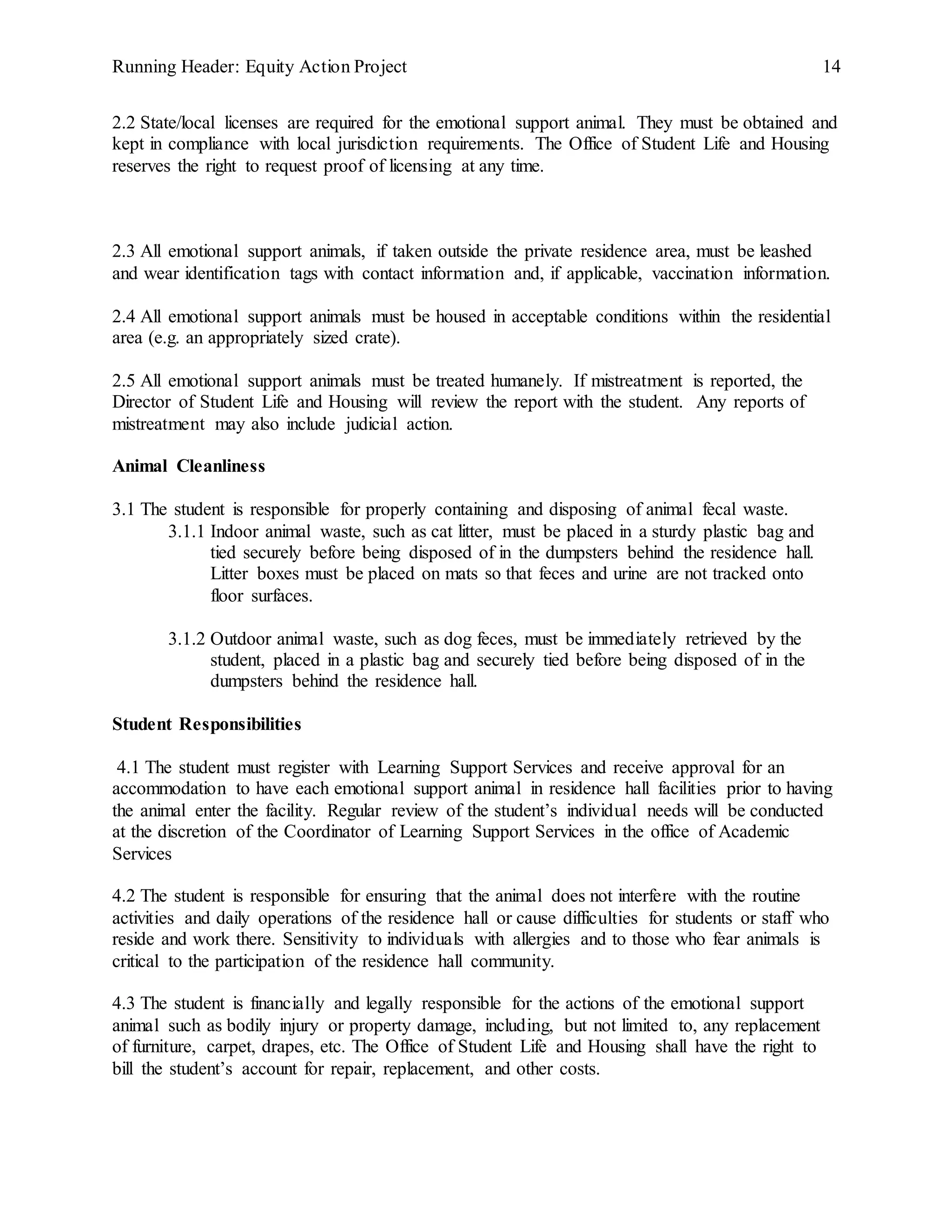
Emotional Support Animal Agreement
The following requirements apply to all students and their approved emotional support animals
living in the Uptown Residence Hall residence halls unless the nature of the documented
disability of the student precludes adherence to these requirements. For the purpose of this
agreement, the term “emotional support animal” includes “assistance animals” under the Fair
Housing Act (FHA).
Under the FHA, individuals with a disability may been titled to keep an “assistance animal” as a
reasonable accommodation in housing facilities provided the assistance animal is necessary to
afford the person with a disability an equal opportunity to use and enjoy on campus housing or
participate in the housing service and if there is an identifiable relationship between the
individual’s disability and the assistance the animal provides.
Animal Behavior and Approval for an Emotional Support Animal
1.1 A student needs to obtain approval for an emotional support animal by completing a request
with the Coordinator of Learning Support Services in the office of Academic Services. The
request should include certificates of vaccination, a copy of the animal’s registration or
license, and other information listed in this document.
1.2 An Emotional Support Animal is granted provided that their behavior, noise, odor, and waste
do not exceed reasonable standards for a well-behaved animal and that these factors do not
create unreasonable disruptions to the residence hall community.
1.3 Dangerous, poisonous, or illegal animals are not permitted.
1.4 The approved emotional support animal must be contained within the private residential area
at all times, except when transported outside the private residential area in an animal carrier
or controlled by a leash, harness, carrier, or other tether.
Animal Health and Well-being
2.1 All emotional support animals must be in good health and have all veterinarian-
recommended vaccinations to maintain the animal’s health and prevent contagious diseases.
Documentation of vaccines is due at time of approval. The Office of Student Life and Housing
reserves the right to request an updated verification at any time during the animal’s residency.
Running Header: Equity Action Project 14
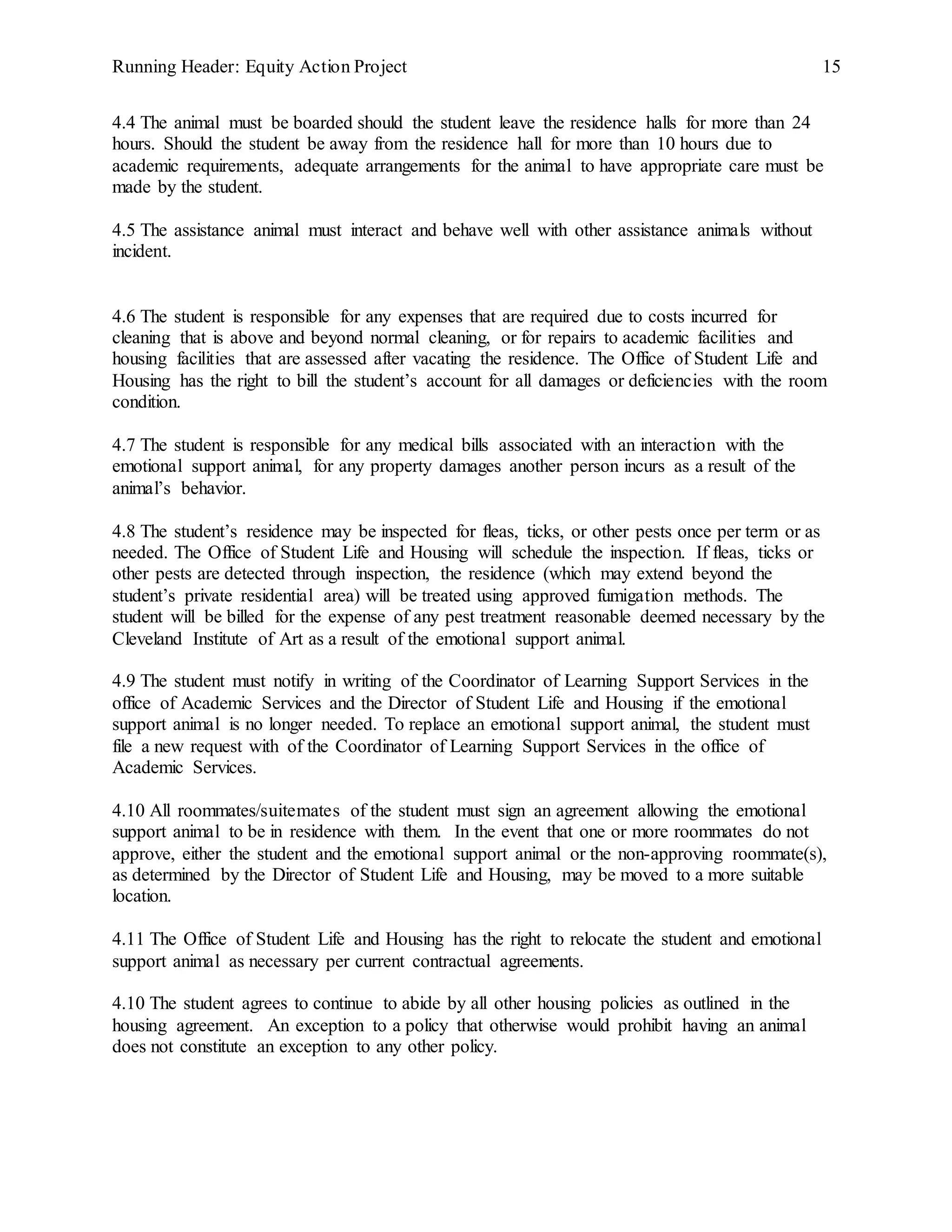
2.2 State/local licenses are required for the emotional support animal. They must be obtained and
kept in compliance with local jurisdiction requirements. The Office of Student Life and Housing
reserves the right to request proof of licensing at any time.
2.3 All emotional support animals, if taken outside the private residence area, must be leashed
and wear identification tags with contact information and, if applicable, vaccination information.
2.4 All emotional support animals must be housed in acceptable conditions within the residential
area (e.g. an appropriately sized crate).
2.5 All emotional support animals must be treated humanely. If mistreatment is reported, the
Director of Student Life and Housing will review the report with the student. Any reports of
mistreatment may also include judicial action.
Animal Cleanliness
3.1 The student is responsible for properly containing and disposing of animal fecal waste.
3.1.1 Indoor animal waste, such as cat litter, must be placed in a sturdy plastic bag and
tied securely before being disposed of in the dumpsters behind the residence hall.
Litter boxes must be placed on mats so that feces and urine are not tracked onto
floor surfaces.
3.1.2 Outdoor animal waste, such as dog feces, must be immediately retrieved by the
student, placed in a plastic bag and securely tied before being disposed of in the
dumpsters behind the residence hall.
Student Responsibilities
4.1 The student must register with Learning Support Services and receive approval for an
accommodation to have each emotional support animal in residence hall facilities prior to having
the animal enter the facility. Regular review of the student’s individual needs will be conducted
at the discretion of the Coordinator of Learning Support Services in the office of Academic
Services
4.2 The student is responsible for ensuring that the animal does not interfere with the routine
activities and daily operations of the residence hall or cause difficulties for students or staff who
reside and work there. Sensitivity to individuals with allergies and to those who fear animals is
critical to the participation of the residence hall community.
4.3 The student is financially and legally responsible for the actions of the emotional support
animal such as bodily injury or property damage, including, but not limited to, any replacement
of furniture, carpet, drapes, etc. The Office of Student Life and Housing shall have the right to
bill the student’s account for repair, replacement, and other costs.
Running Header: Equity Action Project 15
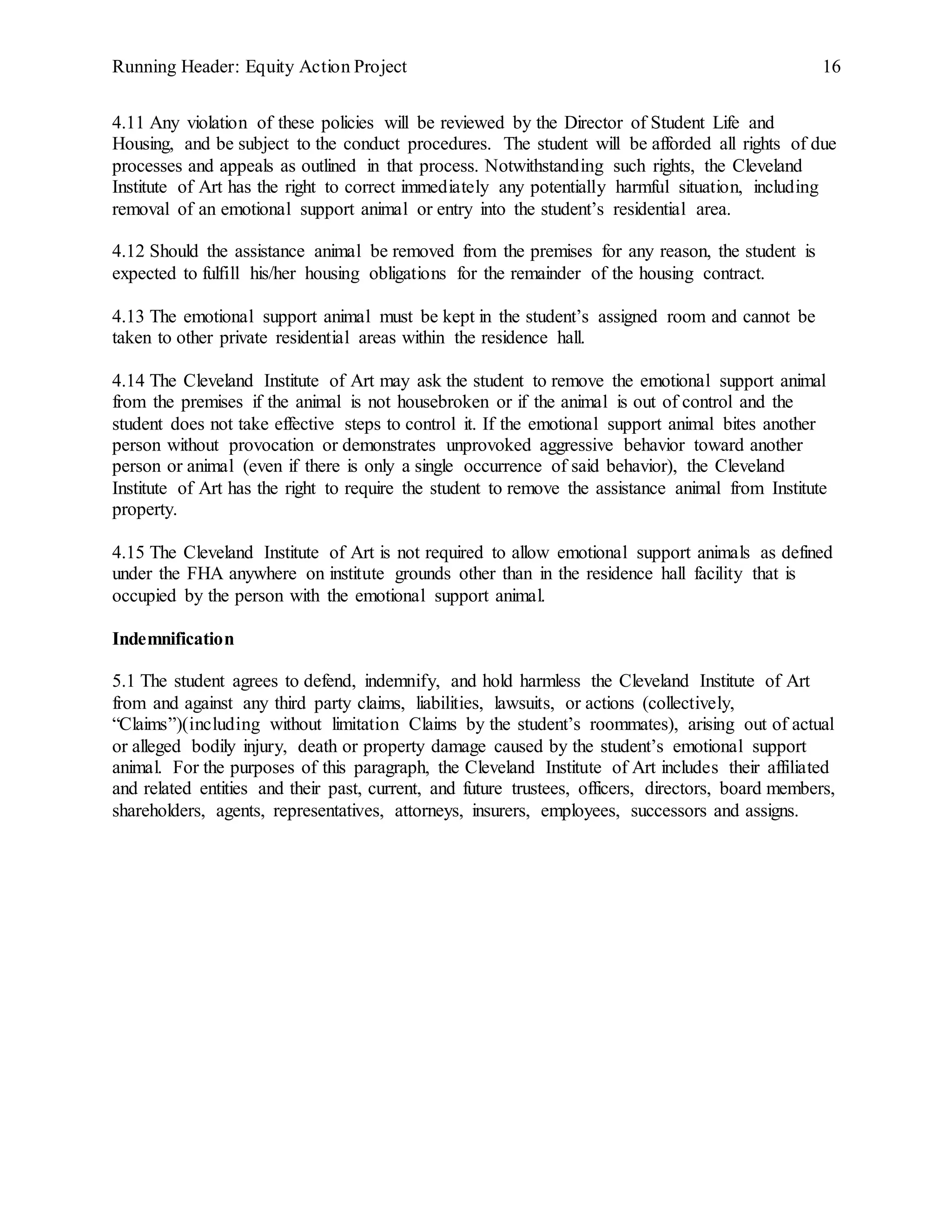
4.4 The animal must be boarded should the student leave the residence halls for more than 24
hours. Should the student be away from the residence hall for more than 10 hours due to
academic requirements, adequate arrangements for the animal to have appropriate care must be
made by the student.
4.5 The assistance animal must interact and behave well with other assistance animals without
incident.
4.6 The student is responsible for any expenses that are required due to costs incurred for
cleaning that is above and beyond normal cleaning, or for repairs to academic facilities and
housing facilities that are assessed after vacating the residence. The Office of Student Life and
Housing has the right to bill the student’s account for all damages or deficiencies with the room
condition.
4.7 The student is responsible for any medical bills associated with an interaction with the
emotional support animal, for any property damages another person incurs as a result of the
animal’s behavior.
4.8 The student’s residence may be inspected for fleas, ticks, or other pests once per term or as
needed. The Office of Student Life and Housing will schedule the inspection. If fleas, ticks or
other pests are detected through inspection, the residence (which may extend beyond the
student’s private residential area) will be treated using approved fumigation methods. The
student will be billed for the expense of any pest treatment reasonable deemed necessary by the
Cleveland Institute of Art as a result of the emotional support animal.
4.9 The student must notify in writing of the Coordinator of Learning Support Services in the
office of Academic Services and the Director of Student Life and Housing if the emotional
support animal is no longer needed. To replace an emotional support animal, the student must
file a new request with of the Coordinator of Learning Support Services in the office of
Academic Services.
4.10 All roommates/suitemates of the student must sign an agreement allowing the emotional
support animal to be in residence with them. In the event that one or more roommates do not
approve, either the student and the emotional support animal or the non-approving roommate(s),
as determined by the Director of Student Life and Housing, may be moved to a more suitable
location.
4.11 The Office of Student Life and Housing has the right to relocate the student and emotional
support animal as necessary per current contractual agreements.
4.10 The student agrees to continue to abide by all other housing policies as outlined in the
housing agreement. An exception to a policy that otherwise would prohibit having an animal
does not constitute an exception to any other policy.
Running Header: Equity Action Project 16
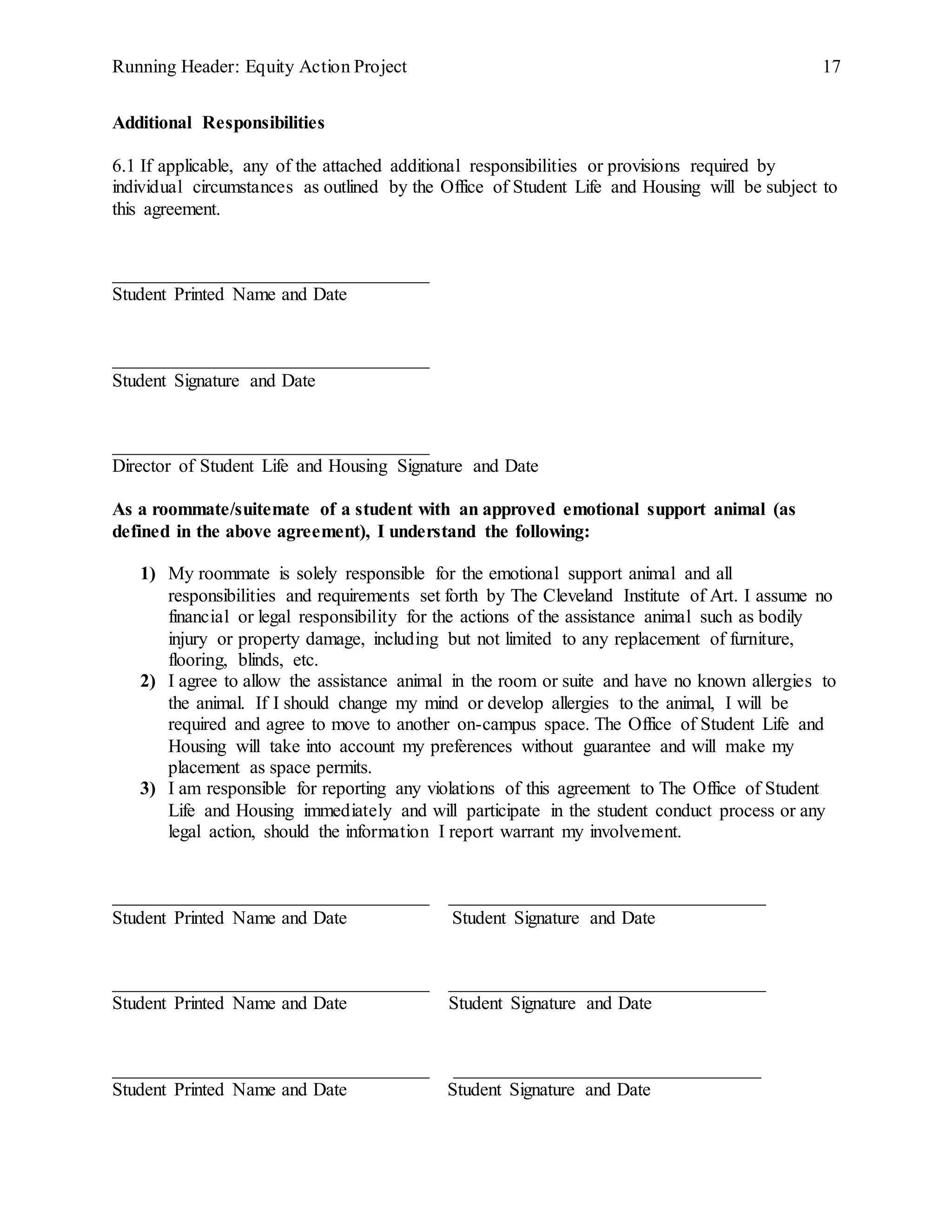
4.11 Any violation of these policies will be reviewed by the Director of Student Life and
Housing, and be subject to the conduct procedures. The student will be afforded all rights of due
processes and appeals as outlined in that process. Notwithstanding such rights, the Cleveland
Institute of Art has the right to correct immediately any potentially harmful situation, including
removal of an emotional support animal or entry into the student’s residential area.
4.12 Should the assistance animal be removed from the premises for any reason, the student is
expected to fulfill his/her housing obligations for the remainder of the housing contract.
4.13 The emotional support animal must be kept in the student’s assigned room and cannot be
taken to other private residential areas within the residence hall.
4.14 The Cleveland Institute of Art may ask the student to remove the emotional support animal
from the premises if the animal is not housebroken or if the animal is out of control and the
student does not take effective steps to control it. If the emotional support animal bites another
person without provocation or demonstrates unprovoked aggressive behavior toward another
person or animal (even if there is only a single occurrence of said behavior), the Cleveland
Institute of Art has the right to require the student to remove the assistance animal from Institute
property.
4.15 The Cleveland Institute of Art is not required to allow emotional support animals as defined
under the FHA anywhere on institute grounds other than in the residence hall facility that is
occupied by the person with the emotional support animal.
Indemnification
5.1 The student agrees to defend, indemnify, and hold harmless the Cleveland Institute of Art
from and against any third party claims, liabilities, lawsuits, or actions (collectively,
“Claims”)(including without limitation Claims by the student’s roommates), arising out of actual
or alleged bodily injury, death or property damage caused by the student’s emotional support
animal. For the purposes of this paragraph, the Cleveland Institute of Art includes their affiliated
and related entities and their past, current, and future trustees, officers, directors, board members,
shareholders, agents, representatives, attorneys, insurers, employees, successors and assigns.
Running Header: Equity Action Project 17
Additional Responsibilities
6.1 If applicable, any of the attached additional responsibilities or provisions required by
individual circumstances as outlined by the Office of Student Life and Housing will be subject to
this agreement.
__________________________________
Student Printed Name and Date
__________________________________
Student Signature and Date
__________________________________
Director of Student Life and Housing Signature and Date
As a roommate/suitemate of a student with an approved emotional support animal (as
defined in the above agreement), I understand the following:
1) My roommate is solely responsible for the emotional support animal and all
responsibilities and requirements set forth by The Cleveland Institute of Art. I assume no
financial or legal responsibility for the actions of the assistance animal such as bodily
injury or property damage, including but not limited to any replacement of furniture,
flooring, blinds, etc.
2) I agree to allow the assistance animal in the room or suite and have no known allergies to
the animal. If I should change my mind or develop allergies to the animal, I will be
required and agree to move to another on-campus space. The Office of Student Life and
Housing will take into account my preferences without guarantee and will make my
placement as space permits.
3) I am responsible for reporting any violations of this agreement to The Office of Student
Life and Housing immediately and will participate in the student conduct process or any
legal action, should the information I report warrant my involvement.
__________________________________ __________________________________
Student Printed Name and Date Student Signature and Date
__________________________________ __________________________________
Student Printed Name and Date Student Signature and Date
__________________________________ _________________________________
Student Printed Name and Date Student Signature and Date
Running Header: Equity Action Project 18
Appendix B
Documents provided during interview, with current CIA Policy
Dear Healthcare Provider,
Your client, , is requesting a housing accommodation that wouldpermitan
emotionalsupport animal ina residential facilityat theCleveland Institute of Art. Thereview
processforthishousing accommodationincludes thefollowing:
 student verification of a disability,
 a written request from the student, and
 verificationof the need for a housing accommodation by a healthcare provider
The healthcare provider verification form is attached. As you complete this form, please
bear in mind the welfare of both the student and the animal. In most cases, rooms are
typically shared with three other students, and the size of a typical suite is approximately 15
x 11’ for the bedroom and 15 x 12’ for the common area. This, of course, means that the
animal will be confined to a kennel or cage any time the student is in class or away from
the residence.
It is also important to consider the fact that a residence hall is the living space for many
students. There are students who may have allergies, a fear of some animals, or religious
principles that pertain to living with animals. In addition, a pet that barks incessantly or
whines frequently would have a negative impact beyond the student’s room.
If you have questions regarding the nature of the information needed for students with
disabilities, please call the Learning Support Services Office at 216-421-7462, Monday
through Friday 8:30 a.m. — 4:30 p.m.
Thank you for your assistance in completing this form. Please return the completed
document by mail, fax, or email as directed at the end of the form.
Sincerely,
Jill Milenski
Learning Support Services Coordinator
Cleveland Institute of Art
Running Header: Equity Action Project 19
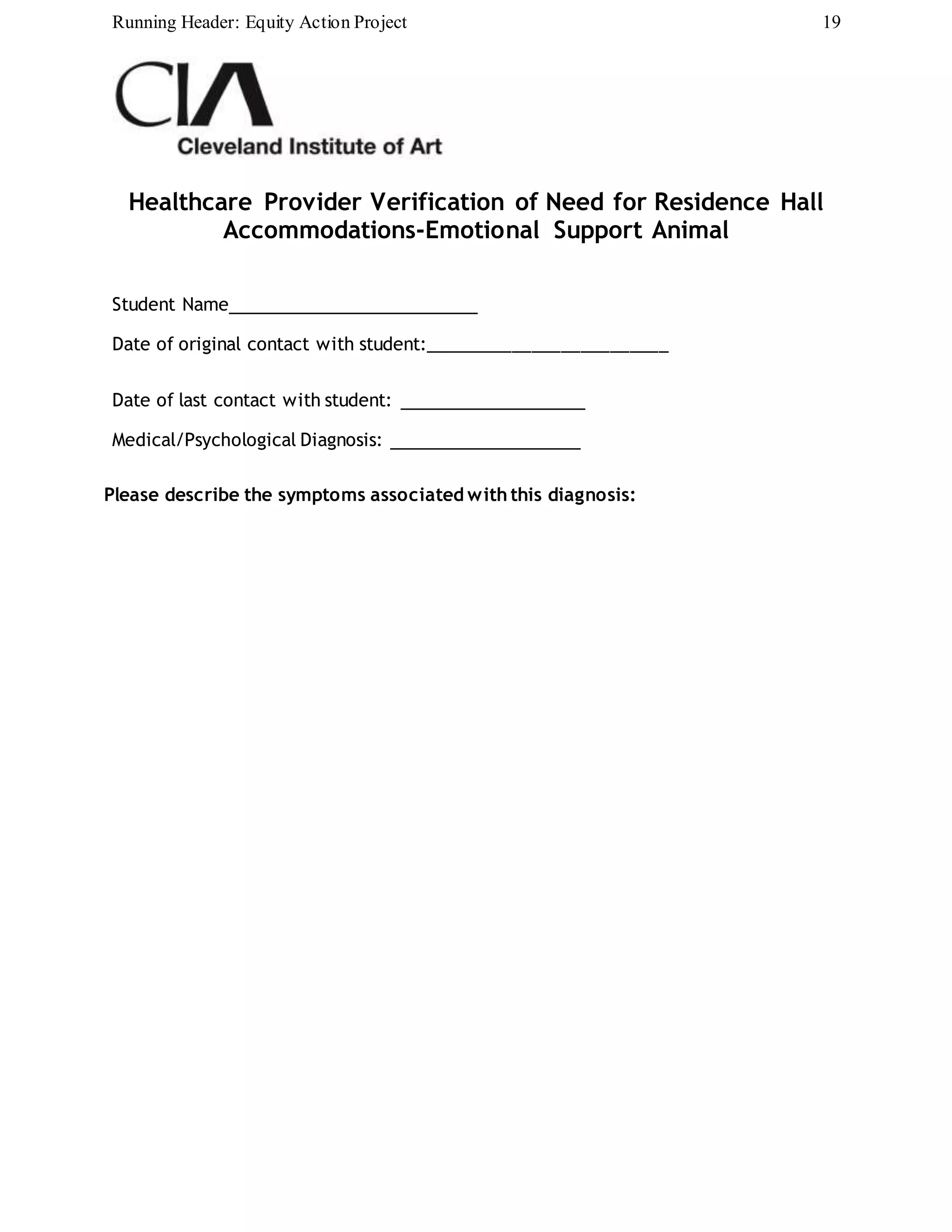
Healthcare Provider Verification of Need for Residence Hall
Accommodations-Emotional Support Animal
Student Name
Date of original contact with student:_________________________
Date of last contact with student:
Medical/Psychological Diagnosis:
Please describe the symptoms associated with this diagnosis:
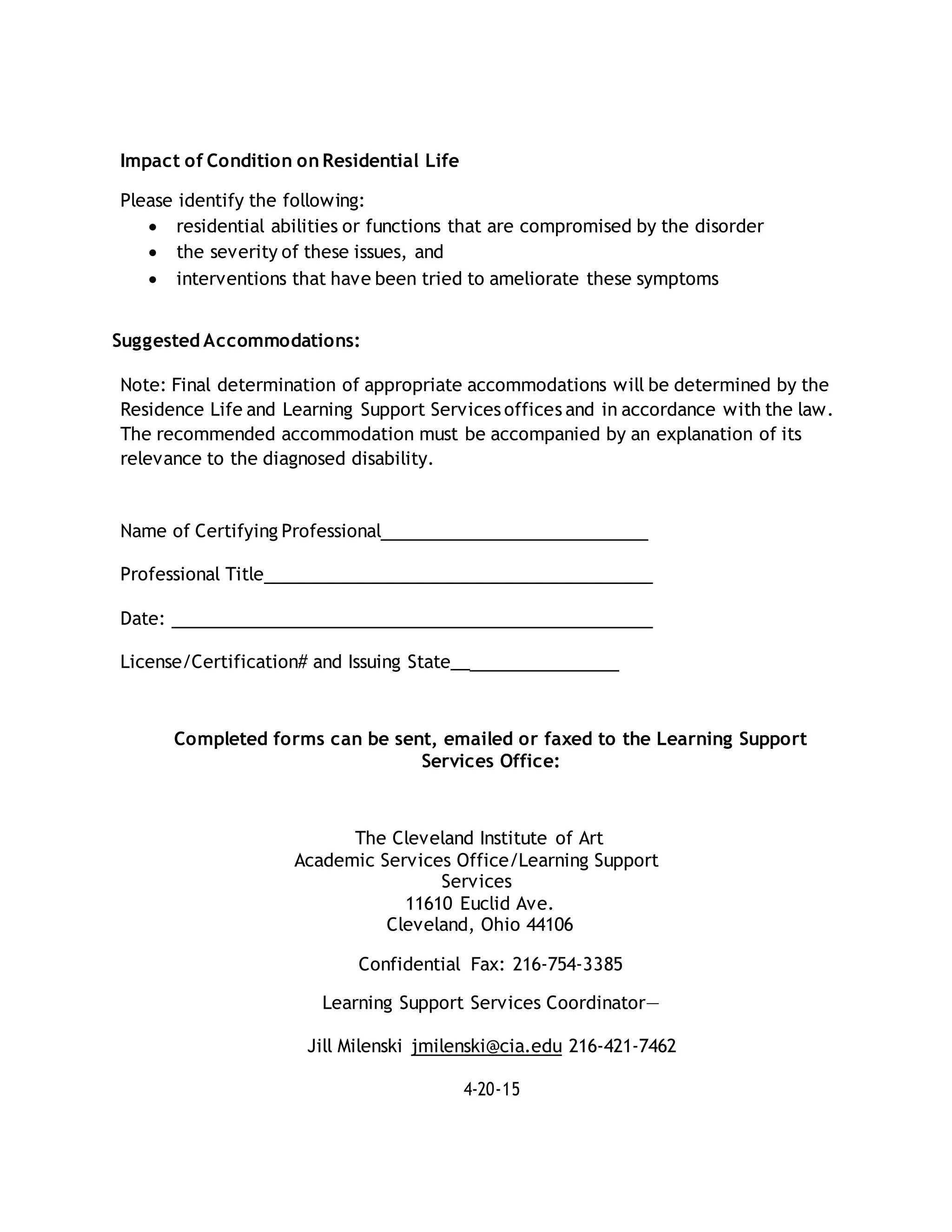
Impact of Condition on Residential Life
Please identify the following:
 residential abilities or functions that are compromised by the disorder
 the severity of these issues, and
 interventions that have been tried to ameliorate these symptoms
Suggested Accommodations:
Note: Final determination of appropriate accommodations will be determined by the
Residence Life and Learning Support Services offices and in accordance with the law.
The recommended accommodation must be accompanied by an explanation of its
relevance to the diagnosed disability.
Name of Certifying Professional
Professional Title
Date:
License/Certification# and Issuing State__
Completed forms can be sent, emailed or faxed to the Learning Support
Services Office:
The Cleveland Institute of Art
Academic Services Office/Learning Support
Services
11610 Euclid Ave.
Cleveland, Ohio 44106
Confidential Fax: 216-754-3385
Learning Support Services Coordinator—
Jill Milenski jmilenski@cia.edu 216-421-7462
4-20-15
Running Header: Equity Action Projec
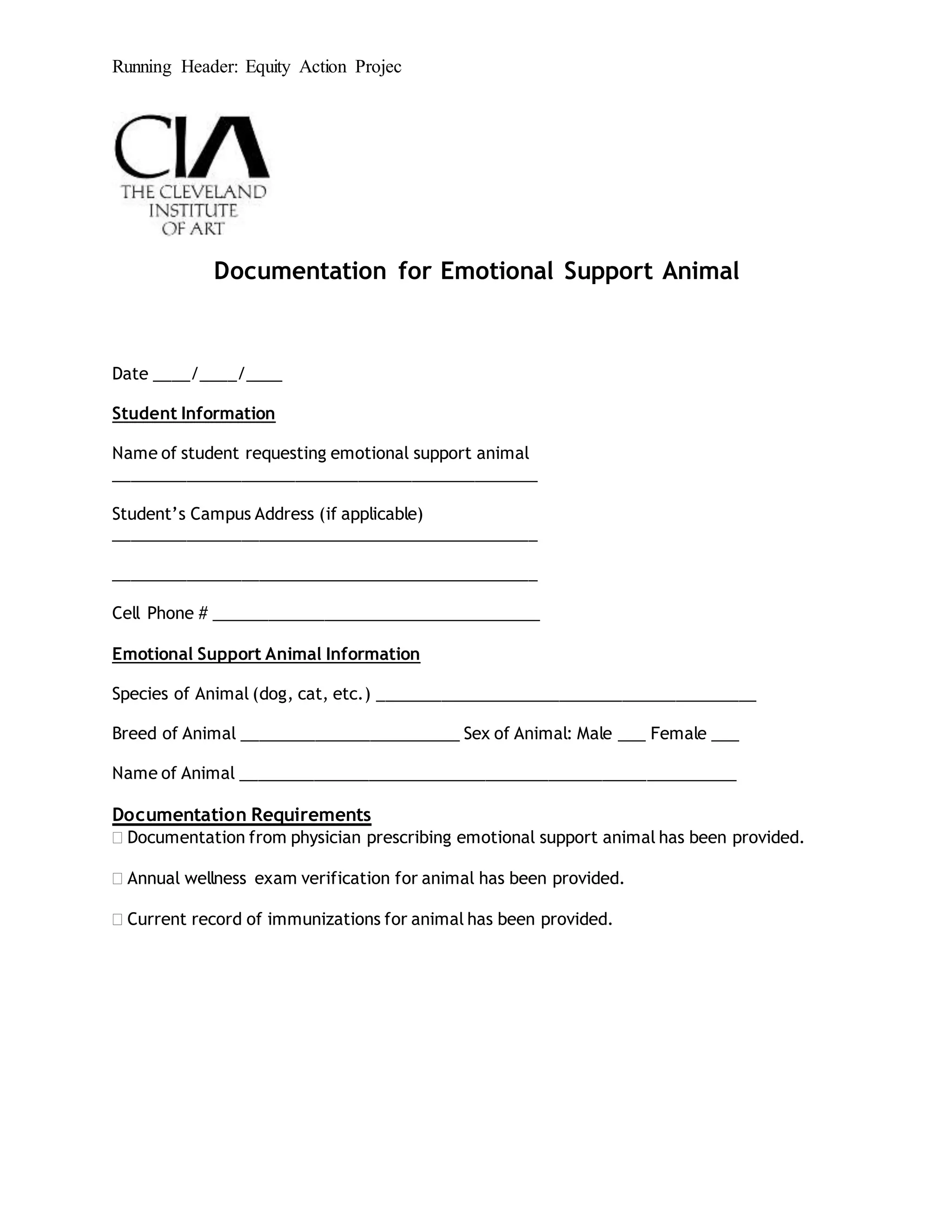
Documentation for Emotional Support Animal
Date ____/____/____
Student Information
Name of student requesting emotional support animal
_______________________________________________
Student’s Campus Address (if applicable)
_______________________________________________
_______________________________________________
Cell Phone # ____________________________________
Emotional Support Animal Information
Species of Animal (dog, cat, etc.) __________________________________________
Breed of Animal ________________________ Sex of Animal: Male ___ Female ___
Name of Animal _______________________________________________________
Documentation Requirements
 Documentation from physician prescribing emotional support animal has been provided.
 Annual wellness exam verification for animal has been provided.
 Current record of immunizations for animal has been provided.
Running Header: Equity Action Projec
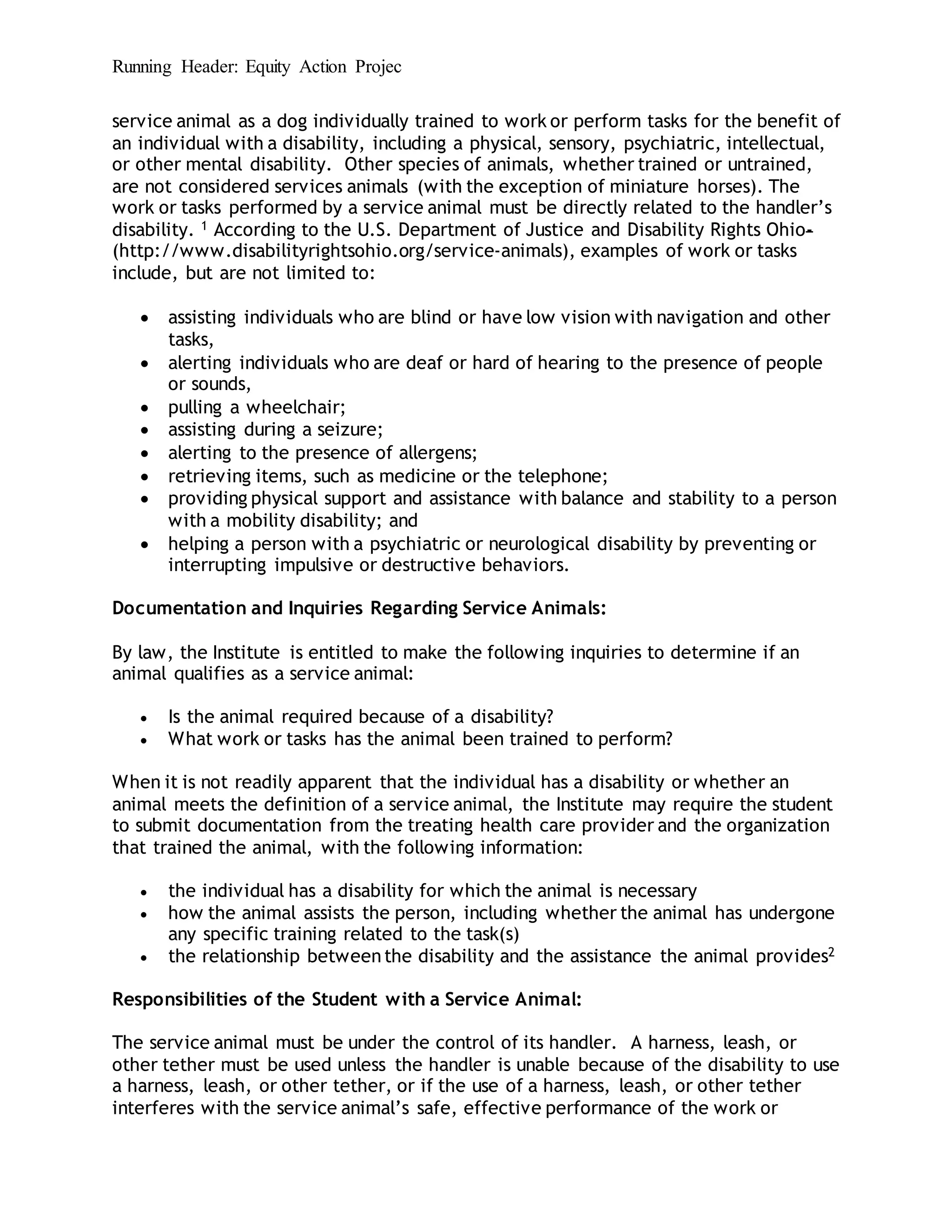
CIA Service Animal and Emotional Support Animal Policy
It is the policy of The Cleveland Institute of Art, in accordance with the provisions set
forth by Title IX of the Higher Education Act (1972 and as amended), Section 504 of
the Rehabilitation Act of 1973, and other federal regulations, not to discriminate on
the basis of race, color, creed, national or ethnic origin, gender, sexual orientation,
age or disability, in employment practices, administration of educational policies,
admission, scholarship and loan programs, and other college-administered programs
and activities.
Pets and other animals are restricted on the CIA campus. Students requesting an
accommodation of a service animal as established and defined by the Americans with
Disabilities Act (ADA), shall not be excluded from CIA housing, facilities or activities.
Requests for emotional support animals (animals that individuals with disabilities
utilize for emotional support, well-being, or comfort) are reviewed on a case-by-case
basis.
Requests for Accommodation:
Students should make requests to have a service or emotional support animal in CIA
facilities to the Learning Support Services Coordinator, Cleveland Institute of Art,
11610 Euclid Avenue, Cleveland, OH 44106, at least 30 days prior to the start of the
semester for which the request is being made. When it is not readily apparent that
an animal is a service animal as defined by ADA, or an emotional support animal under
the Fair Housing Act (FHA), Learning Support Services may require sufficient
documentation to determine which definition is appropriate to the animal. This
process may include additional conversations between Learning Support Services staff
and the requesting student.
Service Animals:
Definition: Service Animal
Under ADA, a public accommodation shall modify policies, practices, or procedures to
permit the use of a service animal by an individual with a disability. ADA defines a
Running Header: Equity Action Projec
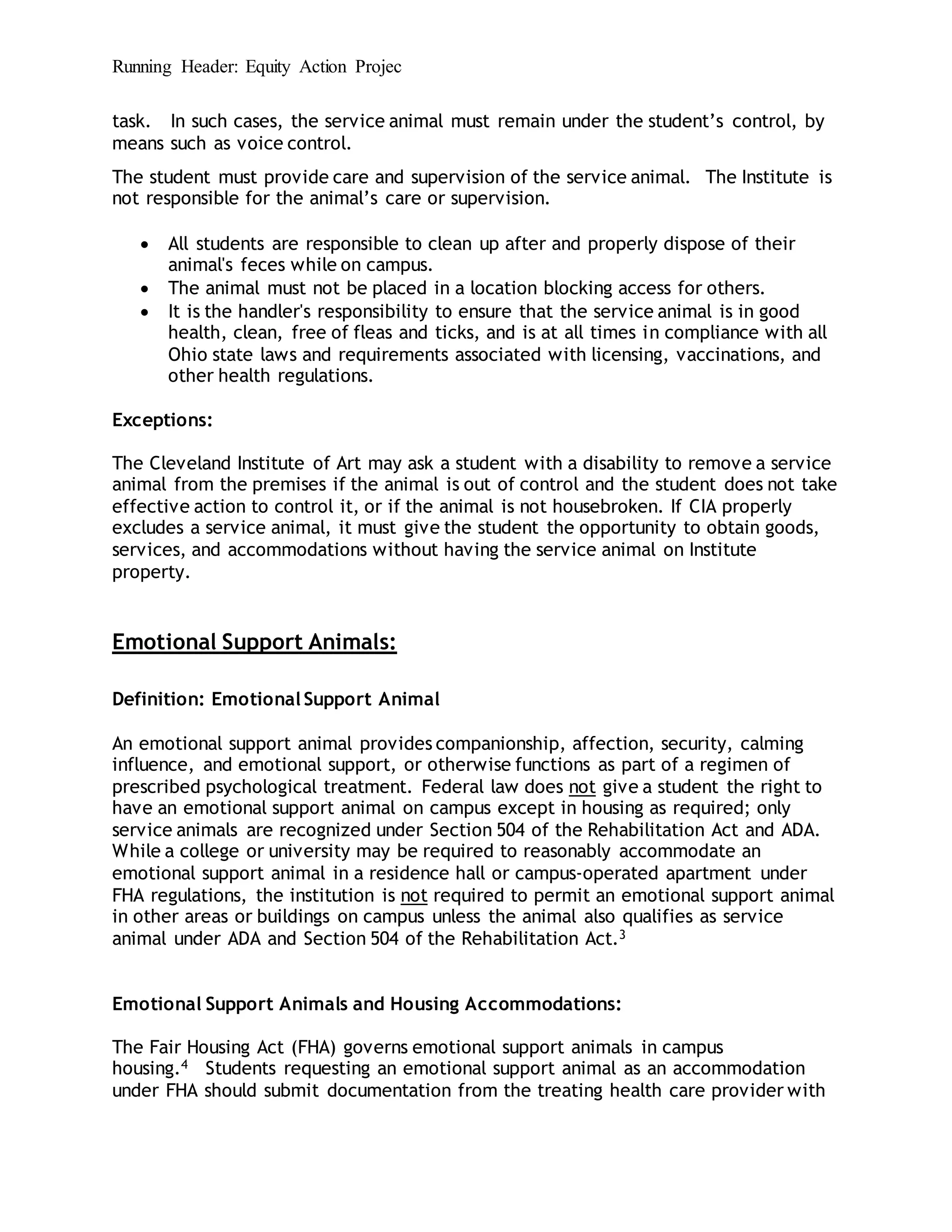
service animal as a dog individually trained to work or perform tasks for the benefit of
an individual with a disability, including a physical, sensory, psychiatric, intellectual,
or other mental disability. Other species of animals, whether trained or untrained,
are not considered services animals (with the exception of miniature horses). The
work or tasks performed by a service animal must be directly related to the handler’s
disability. 1 According to the U.S. Department of Justice and Disability Rights Ohio-
(http://www.disabilityrightsohio.org/service-animals), examples of work or tasks
include, but are not limited to:
 assisting individuals who are blind or have low vision with navigation and other
tasks,
 alerting individuals who are deaf or hard of hearing to the presence of people
or sounds,
 pulling a wheelchair;
 assisting during a seizure;
 alerting to the presence of allergens;
 retrieving items, such as medicine or the telephone;
 providing physical support and assistance with balance and stability to a person
with a mobility disability; and
 helping a person with a psychiatric or neurological disability by preventing or
interrupting impulsive or destructive behaviors.
Documentation and Inquiries Regarding Service Animals:
By law, the Institute is entitled to make the following inquiries to determine if an
animal qualifies as a service animal:
 Is the animal required because of a disability?
 What work or tasks has the animal been trained to perform?
When it is not readily apparent that the individual has a disability or whether an
animal meets the definition of a service animal, the Institute may require the student
to submit documentation from the treating health care provider and the organization
that trained the animal, with the following information:
 the individual has a disability for which the animal is necessary
 how the animal assists the person, including whether the animal has undergone
any specific training related to the task(s)
 the relationship betweenthe disability and the assistance the animal provides2
Responsibilities of the Student with a Service Animal:
The service animal must be under the control of its handler. A harness, leash, or
other tether must be used unless the handler is unable because of the disability to use
a harness, leash, or other tether, or if the use of a harness, leash, or other tether
interferes with the service animal’s safe, effective performance of the work or
Running Header: Equity Action Projec
task. In such cases, the service animal must remain under the student’s control, by
means such as voice control.
The student must provide care and supervision of the service animal. The Institute is
not responsible for the animal’s care or supervision.
 All students are responsible to clean up after and properly dispose of their
animal's feces while on campus.
 The animal must not be placed in a location blocking access for others.
 It is the handler's responsibility to ensure that the service animal is in good
health, clean, free of fleas and ticks, and is at all times in compliance with all
Ohio state laws and requirements associated with licensing, vaccinations, and
other health regulations.
Exceptions:
The Cleveland Institute of Art may ask a student with a disability to remove a service
animal from the premises if the animal is out of control and the student does not take
effective action to control it, or if the animal is not housebroken. If CIA properly
excludes a service animal, it must give the student the opportunity to obtain goods,
services, and accommodations without having the service animal on Institute
property.
Emotional Support Animals:
Definition: Emotional Support Animal
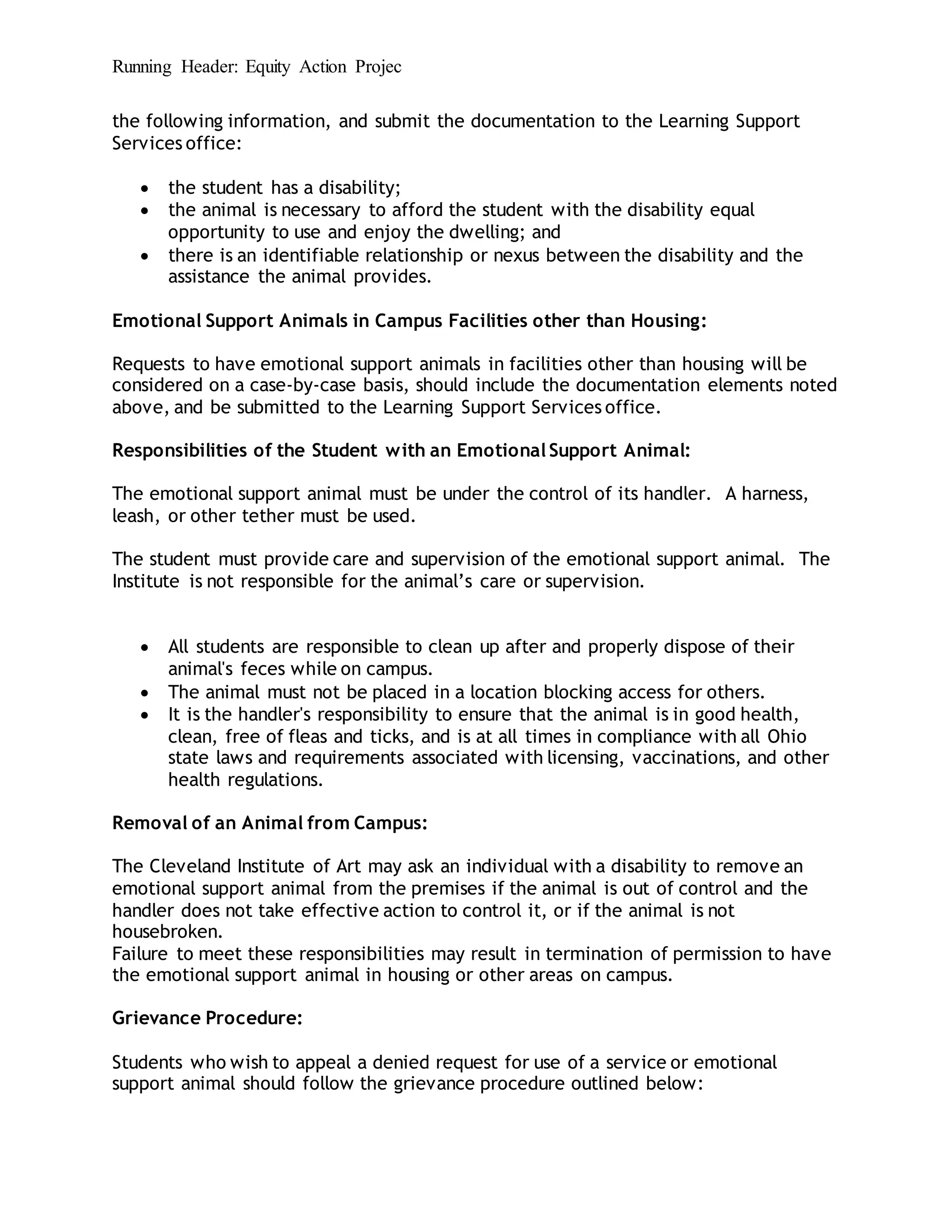
An emotional support animal provides companionship, affection, security, calming
influence, and emotional support, or otherwise functions as part of a regimen of
prescribed psychological treatment. Federal law does not give a student the right to
have an emotional support animal on campus except in housing as required; only
service animals are recognized under Section 504 of the Rehabilitation Act and ADA.
While a college or university may be required to reasonably accommodate an
emotional support animal in a residence hall or campus-operated apartment under
FHA regulations, the institution is not required to permit an emotional support animal
in other areas or buildings on campus unless the animal also qualifies as service
animal under ADA and Section 504 of the Rehabilitation Act.3
Emotional Support Animals and Housing Accommodations:
The Fair Housing Act (FHA) governs emotional support animals in campus
housing.4 Students requesting an emotional support animal as an accommodation
under FHA should submit documentation from the treating health care provider with
Running Header: Equity Action Projec
the following information, and submit the documentation to the Learning Support
Services office:
 the student has a disability;
 the animal is necessary to afford the student with the disability equal
opportunity to use and enjoy the dwelling; and
 there is an identifiable relationship or nexus between the disability and the
assistance the animal provides.
Emotional Support Animals in Campus Facilities other than Housing:
Requests to have emotional support animals in facilities other than housing will be
considered on a case-by-case basis, should include the documentation elements noted
above, and be submitted to the Learning Support Services office.
Responsibilities of the Student with an Emotional Support Animal:
The emotional support animal must be under the control of its handler. A harness,
leash, or other tether must be used.
The student must provide care and supervision of the emotional support animal. The
Institute is not responsible for the animal’s care or supervision.
 All students are responsible to clean up after and properly dispose of their
animal's feces while on campus.
 The animal must not be placed in a location blocking access for others.
 It is the handler's responsibility to ensure that the animal is in good health,
clean, free of fleas and ticks, and is at all times in compliance with all Ohio
state laws and requirements associated with licensing, vaccinations, and other
health regulations.
Removal of an Animal from Campus:
The Cleveland Institute of Art may ask an individual with a disability to remove an
emotional support animal from the premises if the animal is out of control and the
handler does not take effective action to control it, or if the animal is not
housebroken.
Failure to meet these responsibilities may result in termination of permission to have
the emotional support animal in housing or other areas on campus.
Grievance Procedure:
Students who wish to appeal a denied request for use of a service or emotional
support animal should follow the grievance procedure outlined below:
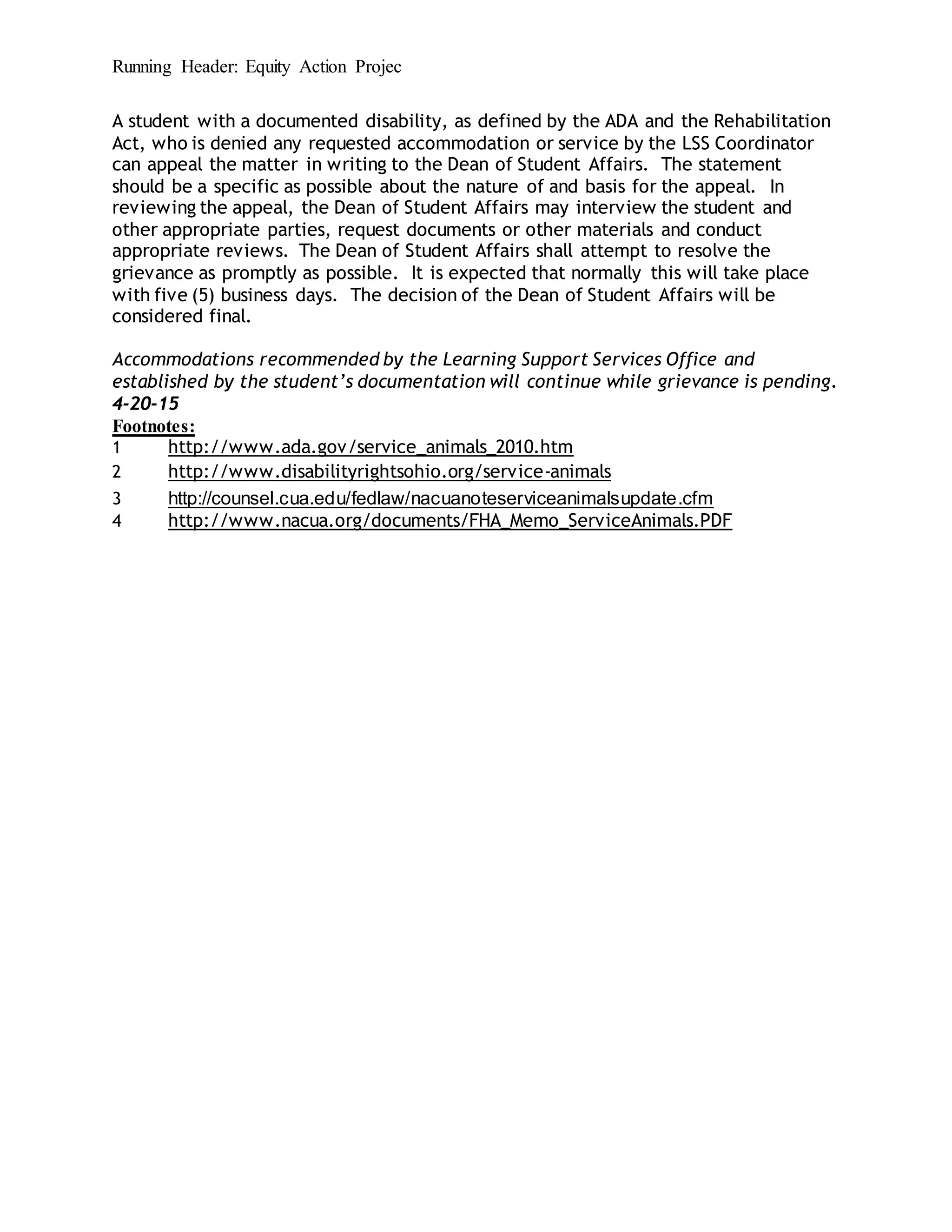
Running Header: Equity Action Projec
A student with a documented disability, as defined by the ADA and the Rehabilitation
Act, who is denied any requested accommodation or service by the LSS Coordinator
can appeal the matter in writing to the Dean of Student Affairs. The statement
should be a specific as possible about the nature of and basis for the appeal. In
reviewing the appeal, the Dean of Student Affairs may interview the student and
other appropriate parties, request documents or other materials and conduct
appropriate reviews. The Dean of Student Affairs shall attempt to resolve the
grievance as promptly as possible. It is expected that normally this will take place
with five (5) business days. The decision of the Dean of Student Affairs will be
considered final.
Accommodations recommended by the Learning Support Services Office and
established by the student’s documentation will continue while grievance is pending.
4-20-15
Footnotes:
1 http://www.ada.gov/service_animals_2010.htm
2 http://www.disabilityrightsohio.org/service-animals
3 http://counsel.cua.edu/fedlaw/nacuanoteserviceanimalsupdate.cfm
4 http://www.nacua.org/documents/FHA_Memo_ServiceAnimals.PDF
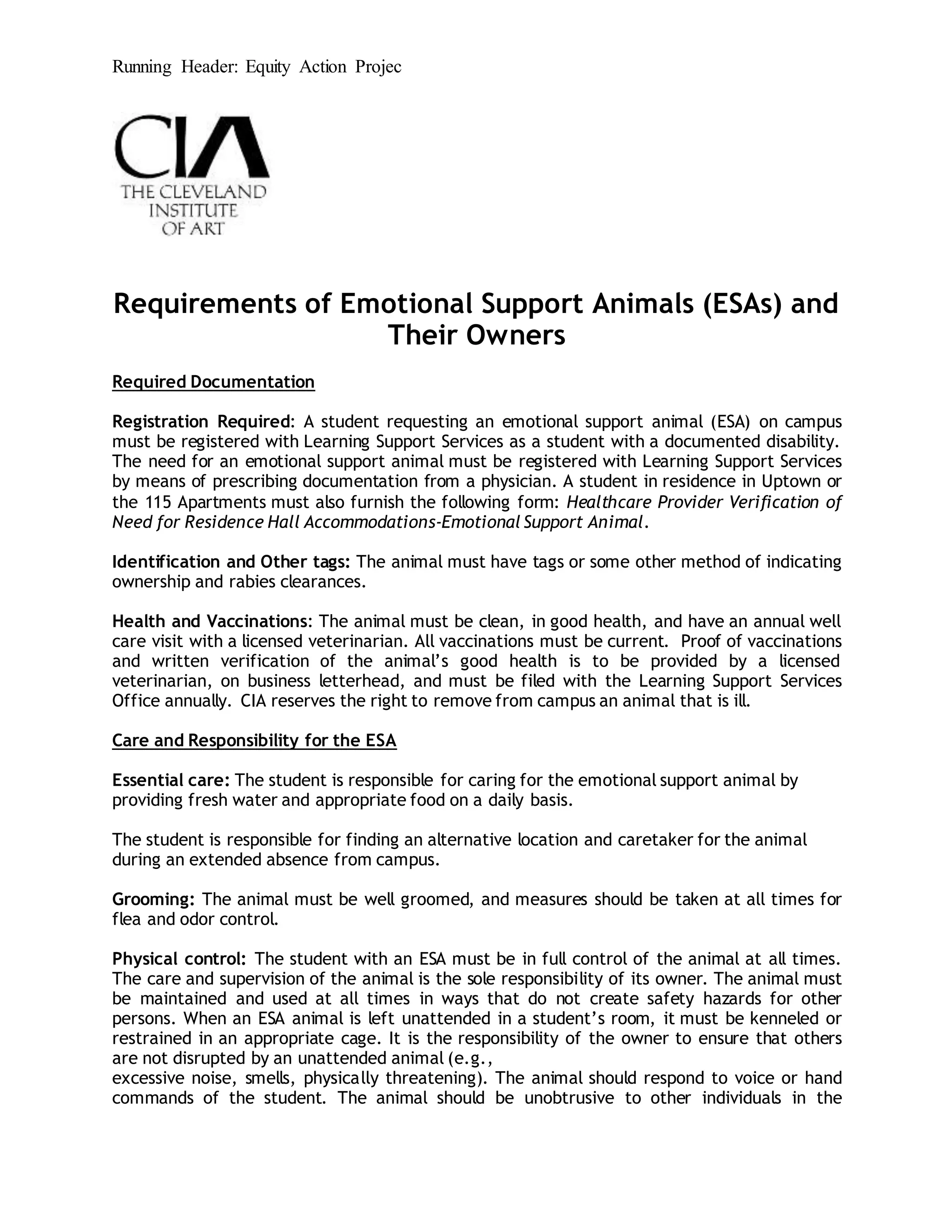
Running Header: Equity Action Projec
Requirements of Emotional Support Animals (ESAs) and
Their Owners
Required Documentation
Registration Required: A student requesting an emotional support animal (ESA) on campus
must be registered with Learning Support Services as a student with a documented disability.
The need for an emotional support animal must be registered with Learning Support Services
by means of prescribing documentation from a physician. A student in residence in Uptown or
the 115 Apartments must also furnish the following form: Healthcare Provider Verification of
Need for Residence Hall Accommodations-Emotional Support Animal.
Identification and Other tags: The animal must have tags or some other method of indicating
ownership and rabies clearances.
Health and Vaccinations: The animal must be clean, in good health, and have an annual well
care visit with a licensed veterinarian. All vaccinations must be current. Proof of vaccinations
and written verification of the animal’s good health is to be provided by a licensed
veterinarian, on business letterhead, and must be filed with the Learning Support Services
Office annually. CIA reserves the right to remove from campus an animal that is ill.
Care and Responsibility for the ESA
Essential care: The student is responsible for caring for the emotional support animal by
providing fresh water and appropriate food on a daily basis.
The student is responsible for finding an alternative location and caretaker for the animal
during an extended absence from campus.
Grooming: The animal must be well groomed, and measures should be taken at all times for
flea and odor control.
Physical control: The student with an ESA must be in full control of the animal at all times.
The care and supervision of the animal is the sole responsibility of its owner. The animal must
be maintained and used at all times in ways that do not create safety hazards for other
persons. When an ESA animal is left unattended in a student’s room, it must be kenneled or
restrained in an appropriate cage. It is the responsibility of the owner to ensure that others
are not disrupted by an unattended animal (e.g.,
excessive noise, smells, physically threatening). The animal should respond to voice or hand
commands of the student. The animal should be unobtrusive to other individuals in the
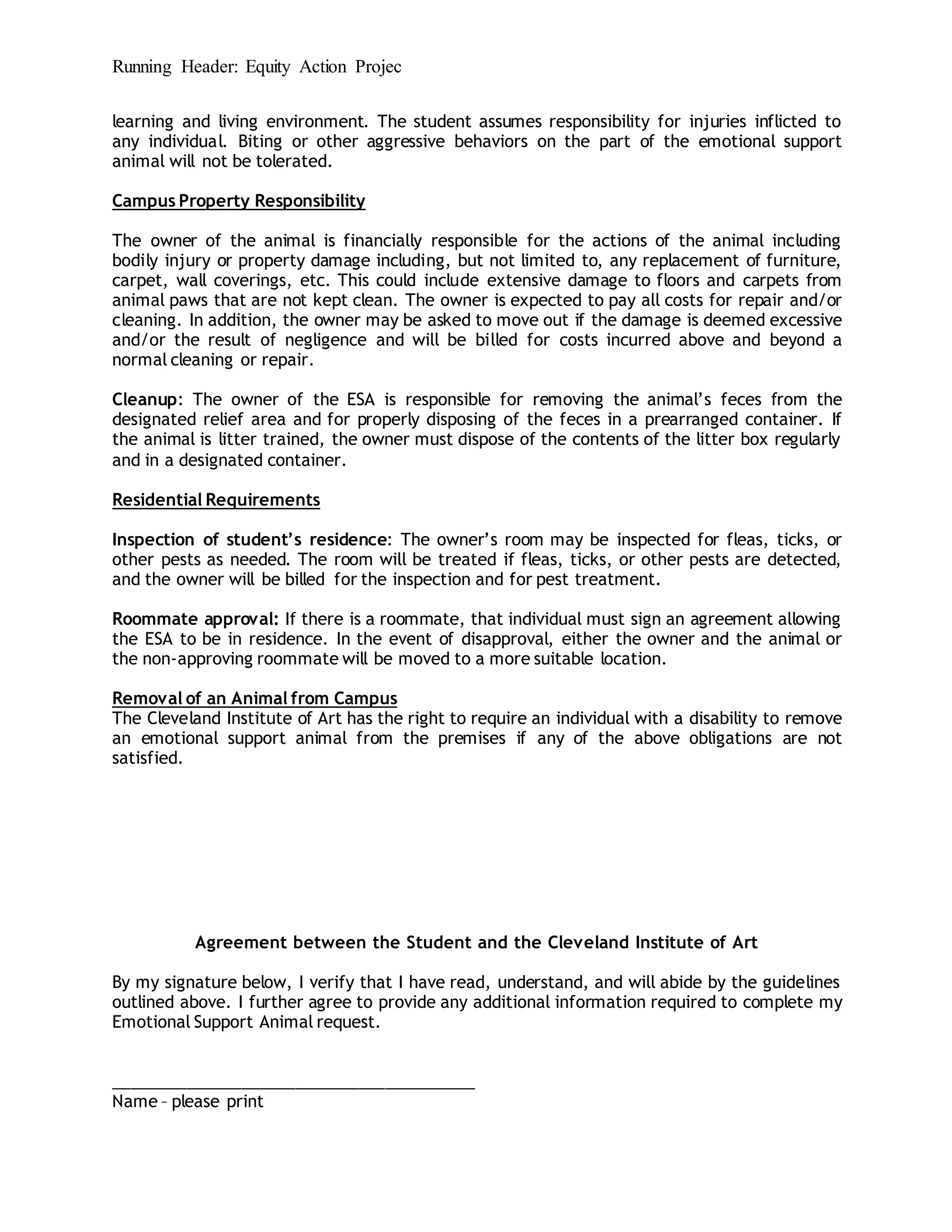
Running Header: Equity Action Projec
learning and living environment. The student assumes responsibility for injuries inflicted to
any individual. Biting or other aggressive behaviors on the part of the emotional support
animal will not be tolerated.
Campus Property Responsibility
The owner of the animal is financially responsible for the actions of the animal including
bodily injury or property damage including, but not limited to, any replacement of furniture,
carpet, wall coverings, etc. This could include extensive damage to floors and carpets from
animal paws that are not kept clean. The owner is expected to pay all costs for repair and/or
cleaning. In addition, the owner may be asked to move out if the damage is deemed excessive
and/or the result of negligence and will be billed for costs incurred above and beyond a
normal cleaning or repair.
Cleanup: The owner of the ESA is responsible for removing the animal’s feces from the
designated relief area and for properly disposing of the feces in a prearranged container. If
the animal is litter trained, the owner must dispose of the contents of the litter box regularly
and in a designated container.
Residential Requirements
Inspection of student’s residence: The owner’s room may be inspected for fleas, ticks, or
other pests as needed. The room will be treated if fleas, ticks, or other pests are detected,
and the owner will be billed for the inspection and for pest treatment.
Roommate approval: If there is a roommate, that individual must sign an agreement allowing
the ESA to be in residence. In the event of disapproval, either the owner and the animal or
the non-approving roommate will be moved to a more suitable location.
Removal of an Animal from Campus
The Cleveland Institute of Art has the right to require an individual with a disability to remove
an emotional support animal from the premises if any of the above obligations are not
satisfied.
Agreement between the Student and the Cleveland Institute of Art
By my signature below, I verify that I have read, understand, and will abide by the guidelines
outlined above. I further agree to provide any additional information required to complete my
Emotional Support Animal request.
________________________________________
Name – please print
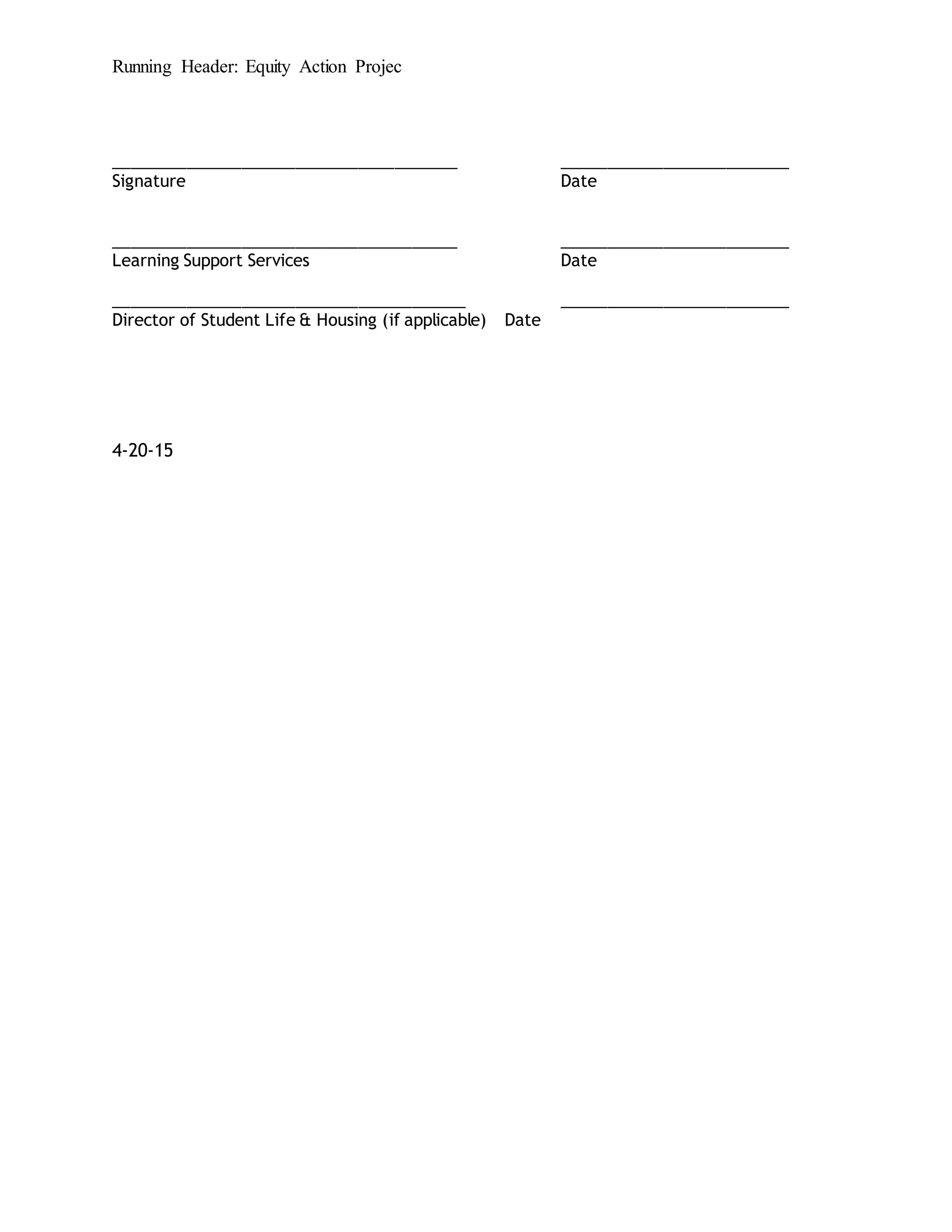
Running Header: Equity Action Projec
______________________________________ _________________________
Signature Date
______________________________________ _________________________
Learning Support Services Date
_______________________________________ _________________________
Director of Student Life & Housing (if applicable) Date
4-20-15

D'iorio, marcus equity action project

  • 1.
    Equity Action Project EmotionalSupport/ Comfort Animals At the Cleveland Institute of Art Marcus D’Iorio Kent State University
  • 2.
    Running Header: EquityAction Project 2 College and University campuses today combined both an academic setting with a residential setting for those students who decide to reside on campus. Residential settings on college campuses have different names based on their institution. These names range from Office of Housing and Residence Life, Office of Residence Life, Office of Residence Life and Housing, and Residential Services. All of these names mean the same thing, an office that provides oversight of the operation of the residence halls and when applicable off campus college or university run housing. From a business perspective residence life on a college campus is considered an auxiliary service, as it provides a product for the student at an additional cost beyond the stated tuition amount for a college or university. Many times these offices work collaboratively with other offices on campus. In addition, the rules that govern the residence halls is the same as the Student Code of Conduct that the school may have. However, almost always, the Offices of Residence Life have additional rules that surround the conduct of residents within the residence hall. One of the rules that is implemented in virtually every residence life hall system is no pets except for fish are permitted. This is due to the type of setting and set up that the majority of residence hall have. While modern residence halls have started to increase the square footage of each room over the past few decades, the majority of housing, especially for first year residential students is a small room of limited square feet. For example, Kent State University’s Manchester Hall, which is part of the Eastaway complex has a double occupancy room dimension of 11 feet by 17 feet (Kent State University, 2015). Allowing an animal (not including a service animal to reside in the room), could cause potential danger to not only the residents but also to the animal due to the confined space. While this is not the only reasoning behind the no pets policy, there is no general consensus as to why it was originally implemented
  • 3.
    Running Header: EquityAction Project 3 or when from the research that I was able to conduct. However, while the no pet policy has been seen as a normal condition for living on campus for years, it is starting to be challenged by students recently. Within the residential settings, within the past decade, there has been an increase in the amount of students who are requesting to have an emotional support animal reside with them in their residence hall room at various colleges and universities across the country. This is due to an increase in students who have received doctor referrals and recommendations to have an animal in a college residence hall room as an emotional support animal. This national trend has a variety of implications for residence life on a college campus in that there have already been two lawsuits against colleges and universities for not allowing an emotional support/ comfort animal filed. The University of Nebraska at Kearney was sued and there is an ongoing lawsuit against Kent State University. Both universities were sued under violations of the Fair Housing Act of 1968 and the Americans with Disabilities Act. In August 2014, when I started my current role as the GA Hall Director at The Cleveland Institute of Art the institute did not allow animals anywhere on the colleges grounds. The only exception to it was when the Office of Student Life and Housing brought in therapy dogs from the University Hospitals Case Medical Center. The dogs where brought in to help students with finals, and were available for the students for about two hours during one of the days leading up to finals. Over the course of the last year and into the first part of the Fall 2015 semester, there have been a few instances where an emotional support animal has been requested. In one instance a student with no documented disability through our Learning Support Services Coordinator had brought her dog with her on campus and into her academic studio for her major. This continued for about two week before an officially stop was put to it so that the institute
  • 4.
    Running Header: EquityAction Project 4 could review policies. Even after this two week policy review period, and into the fist part of the Fall 2015 semester no policy was in place outlining the different requirements of the student in the form of an official request were in place. As we move forward though the Fall 2015 semester, there was an increase of requests for an emotional support/ comfort animal. For the equity action project, I realized that it would be important to have some form of formal request contract system in place. Throughout this process I ran into different roadblocks that changed part of the direction that I took for the project. As a starting point, I met with our Learning Support Services Coordinator who helped to bring me up to date on what the institute was currently doing. In the beginning of the project I found out that the Learning Support Services Coordinator was in the final stages of creating an institutional policy around emotional support/ comfort animals. This was due to the documents being written and waiting for final sign off from the institute lawyers which happened in the middle part of the semester. It was at this point that I realized that we had no official system in place once a student has requested the animal if they are living on campus in the residence hall. With no system in place it created an inequity for our residential student population, if they were to be approved by the new institutional policy. For the project, I realized that in order foster a transition from an inequitable state to an equitable state the institution needed an official contract for the residence hall, but also an outline of how the information was to transmitted to the Director of Student Life and Housing. During the research part of the project, I was asked by my supervisor to work on a contract for emotional support/ comfort animals within the residence hall. However, as a starting point for my research I looked at the result of the University of Nebraska- Kearney lawsuit and the current state of the Kent State University lawsuit to see what they did, and to learn from
  • 5.
    Running Header: EquityAction Project 5 them. This came about due to Johnson’s 2006 chapter on What Can We Do in which he talks about not reinventing the wheel and to see what others have done in order to learn from it (Johnson 2006). Tying in the information that I had gained from the two lawsuits, combined with my research from after the lawsuits, and from talking with our Learning Support Services Coordinator there was an apparent need for the contract to be equity minded. To be equity minded, the contract needed to set out the guidelines for being allowed to have and emotional support/ comfort animal in the building, and what the other roommates where not required to do. This was important to have in the contract, as the student who would be allowed to have the animal in the room would turn into the majority, as they are getting permission for something that is above the normal operating practice of the hall. In order to prevent the other roommates in the room from having to share the responsibility if something was to happen due to the animal being present it was important to have them be included in both the contract as well as the notification process. This will allow the roommates to be able to realize the impact that it has, but also give them the opportunity to switch rooms if possible as well as understand that they will not be held liable for any issues that arise. By having the roommates aware of this, it allowed for an equaled and equitable understanding of what was required of the roommate to have an emotional support/ comfort animal in the room, but also what the remaining roommates rights are. In addition however, by granting the student the ability to have an animal with her in the building, it will show that the institute is equity minded in that we are compassionate about our students, and even though they could have a medical reason for the request we will do what we can within reasonable accommodations to allow the student to be able to feel safe and supported while in the residence hall. As an department if we were to not allow any emotional support/
  • 6.
    Running Header: EquityAction Project 6 comfort animals in the residence we would be excluding a population of students who would directly benefit from it. In the Quillin 2014 presentation on disability and accessibility services, there is a section on reasonable accommodation for students with disabilities. Reasonable accommodation could come in different forms for students who wish to have an emotional support/ comfort animal with them on campus. For us as a department by having a contract granting the student the ability to have an emotional support/ comfort animal in the residence hall we are providing reasonable accommodation to the student in a manner that does not impede on other students. This will minimize the impact of the animal on the community at large. If though, the animal does become disruptive to the community as outlined in the contract, the department has the right to ask the emotional support/ comfort animal to be removed from the hall. However, this would not be the best for the student. As a institute we have a second building that we sublease to students that has single apartments. If needed this could be a possibility if the conditions of the original confront for the main residence hall is broken. While it is current practice to not make students aware of the possibility to have an animal with them in the residence hall environment, if the student eventually does bring the animal to campus, the scope of the project could have a bigger impact than the original intention. At the current stage of the project, it is in a holding pattern until the student decides to bring an emotional support/ comfort animal to the campus. While it looks like we may be able to actually implement the project in spring semester, there is no guarantee. This project though directly relates to me in that I could have a hand in how we as a institute handle an emotional support/ comfort animal in the residence hall. Due to the nature of the request, it is important that all of us who have now become involved remember that we are here to support the student, and future students who may make such a request. This will enable us to become empowerment
  • 7.
    Running Header: EquityAction Project 7 agents as outline by Alicia Dowd and Estela Mara Bensimon in their book Engaging the “Race Question” Accountability and Equity in U.S. Higher Education. To become an empowerment agent will allow for the us to be able to take a conscious based approach and work to help the student (Dowd & Bensimon, 2015). In return we will be able to help the student overcome an obstacle that they may currently face. To overcome the obstacle, the student and any future students with the same request will be able to have the ability to have a normal academic experience while at the Cleveland Institute of Art The project was designed so that the contract is written in a way that at any point in the future after I leave, the Division of Student Affairs will be able to pull the contract up on any computer from our departmental servers. This ability was crucial for future impact, that it needed to be hosted in an environment in which anyone who is involved with the decision making for an emotional support/ comfort animal is able to open it to show the student both before they decide to bring an animal to campus, but also after when they need to get the appropriate signatures. Currently though, the project has been successful in that the student was made aware of what they will be required of her in order to bring the animal to campus, but also what they will be responsible for once the animal is on campus. While we could say that the project was a success so far, there are a few concerns and legal problems that could come about because of the request for an emotional support/ comfort animal in the residence hall. The first is due to the residence hall not being owned by the Cleveland Institute of Art, but instead owned by the developer who built it. In the developers contract for other residential marketplace apartments in the area that are the same set up they only allow a cat as a pet. While this issue would be beyond my capacity for this project and beyond my capacity for my graduate assistantship position it is important to recognize that there
  • 8.
    Running Header: EquityAction Project 8 could be an issues with the developer and that the institute will need to have clear evidence when informing the developer about the animal and what they will be responsible for due to FHA and ADA. The current moment, it will be hard to know if the desired outcome of the project will be seen due to the holding pattern that the overall project is currently in. In the future, though, to know that this project would have a positive impact for the institute would be to see the state from the time a student first arrives at the institute, though the request for an emotional support/ comfort animal, and finally to the end of year and even end of they time at the institute. This would be seen in how their overall mental health has changed. While this is hard to tell without the student explicitly saying it made a difference, there could be some subtle clues that the faculty and staff could be able to pick up on as the student progresses through their four years. Throughout this process I have come to realize that when you are working with students who have a disability, it is easier to figure out reasonable accommodations for them, then to outright say no to accommodating them. When looking towards the future, I am hoping to stay within the field of residence life and housing and move into a professional residence hall director role. This project has had immediate and impactful importance to not only my current role, but also professional development as a whole in that if I was to encounter a situation like this in the future I will have already had some knowledge on the request. By writing a contract and working on the different policies that will be associated with allowing an emotional support animal on campus in the residence hall, it has pushed my personal views and expand my knowledge surrounding emotional support animals. If a situation was to come up, I would gather the necessary information, including a list of possible reasonable accommodations for them, and present it to my supervisor for review. Looking at this project in retrospective, while difficult to
  • 9.
    Running Header: EquityAction Project 9 implement as it would be an institutional change, I realized that we as a field within residence life and housing need adapt to what the modern college student is requesting, and what the modern laws are saying that we need to do when someone with a disability requests to have an emotional support/ comfort animal in the residence halls. This issue will never go away, in that over the next decade we may see an increase in the amount of requests. Having this experience now has allowed me to see what is needed, but also to figure out what the best strategies are and what we need to do in order to accommodate the request. The next steps for this project if it was to move forward would be for the student to inform the department that they wish to bring an emotional support/ comfort animal to campus. After that, they would be given the contract to review, sign, and get signed by their roommates. At that point the contract would become effective, and the student who requested to have an emotional support/ comfort animal with them on campus becoming liable for damages that the animal may cause. In addition the developer of the residence hall would have to be informed. For my position with the project, I would discuss which student has an emotional support/ comfort animal in the hall but not inform them as to why due to FERPA regulations. This would be needed due to the nature of a residence hall, and informing the resident assistant staff of the emotional support/ comfort animal being present, so that they do not unintentionally write up the student or inform them that they animal has to leave the hall. By informing the resident assistant staff of the emotional support/ comfort animal being present, I would be able to give them a set of guidelines to use to talk about it with other resident if the other resident had brought up the subject. These guidelines are not written yet, nor will they be written until we have confirmation as to what the student’s intentions are, and what the emotional support/ comfort animal could possibly be.
  • 10.
    Running Header: EquityAction Project 10 Overall this project has changed my perceptions on what our mission is within any residence life and housing office, but also what we need to do in order to provide reasonable accommodations for students who live on campus with us. In this situation it is important that we think of Justice as Care as our equity, in that by caring for the student and providing reasonable accommodations we are providing the student with the same opportunities as a regular student may have.
  • 11.
    Running Header: EquityAction Project 11 References Americans with Disabilities Act of 1990,AS AMENDED with ADA Amendments Act of 2008. (2009). Retrieved December 16, 2015, from http://www.ada.gov/pubs/adastatute08.htm Department of Justice sues KSU. (2014, September 8). Retrieved December 16, 2015, from https://www.documentcloud.org/documents/1301543-department-of-justice-sues- ksu.html Dowd, A., & Bensimon, E. (2015). Introduction. In Engaging the "race question": Accountability and equity in U.S. higher education (1st ed., p. 176). New York City, New York: Teachers College Press. Fair Housing -- It's Your Right - HUD. (n.d.). Retrieved December 16, 2015, from http://portal.hud.gov/hudportal/HUD?src=/program_offices/fair_housing_equal_opp/FH Laws/yourrights Fair Housing Act. (n.d.). Retrieved December 16, 2015, from http://www.justice.gov/crt/fair- housing-act-2 Fair Housing And Equal Opportunity. (n.d.). Retrieved December 16, 2015, from http://portal.hud.gov/hudportal/HUD?src=/program_offices/fair_housing_equal_opp Fernandez, C. (2014, September 17). Justice Department sues KSU for violating Fair Housing Act. Retrieved December 16, 2015, from http://www.kentwired.com/latest_updates/article_1a3f3ff6-3ee7-11e4-98fb- 0017a43b2370.html Fine, A. (2011). Handbook on animal-assisted therapy theoretical foundations and guidelines for practice (2nd ed., p. 552). San Diego, California: Academic Press. Hoffman, C. (2015, October 20). Pets in the residence halls? Fredonia's 'emotional support animals' policy. Retrieved December 16, 2015, from http://fredonialeader.org/dailynews/pets-in-the-residence-halls-fredonias-emotional- support-animals-policy/ Johnson, A. (2006). What Can We Do? In Privilege, Power, and Difference (2nd ed., p. 184). McGraw-Hill. Justice News. (2011, November 23). Retrieved December 16, 2015, from http://www.justice.gov/opa/pr/fair-housing-lawsuit-filed-against-university-nebraska- kearney-discrimination-against Justice News. (2015, September 3). Retrieved December 16, 2015, from http://www.justice.gov/opa/pr/justice-department-and-university-nebraska-kearney-settle- lawsuit-over-rights-students
  • 12.
    Running Header: EquityAction Project 12 Lawsuit over therapy dog raises questions about university housing | Inside Higher Ed. (2013, December 13). Retrieved December 16, 2015, from https://www.insidehighered.com/news/2011/12/13/lawsuit-over-therapy-dog-raises- questions-about-university-housing Maintaining an Emotional Support Animal in the Residence Halls. (2015, October 20). Retrieved December 16, 2015, from https://www.fredonia.edu/reslife/ESAPolicy.pdf Milenski, J. (2015, November 2). Emotional Support/ Comfort Animals [Personal interview]. Quillin, D. (2014, March 18). Overview of Student Accessibility Services. Lecture presented in Dr. Iversion's HIED 66671 Class, Kent. Room Diagrams. (n.d.). Retrieved December 16, 2015, from http://www.kent.edu/housing/room- diagrams Search ADA.gov. (n.d.). Retrieved December 16, 2015, from http://www.ada.gov/2010_regs.htm Trasvina, J. (2013, April 25). Service Animals and Assistance Animals for People with Disabilities in Housing and HUDFunded Programs. Retrieved December 16, 2015, from https://assets.documentcloud.org/documents/1302630/servanimals-ntcfheo2013-01.pdf
  • 13.
    Running Header: EquityAction Project 13 Appendix A Adapted From SUNY Fredonia Cleveland Institute of Art, Office of Student Life and Housing Emotional Support Animal Agreement The following requirements apply to all students and their approved emotional support animals living in the Uptown Residence Hall residence halls unless the nature of the documented disability of the student precludes adherence to these requirements. For the purpose of this agreement, the term “emotional support animal” includes “assistance animals” under the Fair Housing Act (FHA). Under the FHA, individuals with a disability may been titled to keep an “assistance animal” as a reasonable accommodation in housing facilities provided the assistance animal is necessary to afford the person with a disability an equal opportunity to use and enjoy on campus housing or participate in the housing service and if there is an identifiable relationship between the individual’s disability and the assistance the animal provides. Animal Behavior and Approval for an Emotional Support Animal 1.1 A student needs to obtain approval for an emotional support animal by completing a request with the Coordinator of Learning Support Services in the office of Academic Services. The request should include certificates of vaccination, a copy of the animal’s registration or license, and other information listed in this document. 1.2 An Emotional Support Animal is granted provided that their behavior, noise, odor, and waste do not exceed reasonable standards for a well-behaved animal and that these factors do not create unreasonable disruptions to the residence hall community. 1.3 Dangerous, poisonous, or illegal animals are not permitted. 1.4 The approved emotional support animal must be contained within the private residential area at all times, except when transported outside the private residential area in an animal carrier or controlled by a leash, harness, carrier, or other tether. Animal Health and Well-being 2.1 All emotional support animals must be in good health and have all veterinarian- recommended vaccinations to maintain the animal’s health and prevent contagious diseases. Documentation of vaccines is due at time of approval. The Office of Student Life and Housing reserves the right to request an updated verification at any time during the animal’s residency.
  • 14.
    Running Header: EquityAction Project 14 2.2 State/local licenses are required for the emotional support animal. They must be obtained and kept in compliance with local jurisdiction requirements. The Office of Student Life and Housing reserves the right to request proof of licensing at any time. 2.3 All emotional support animals, if taken outside the private residence area, must be leashed and wear identification tags with contact information and, if applicable, vaccination information. 2.4 All emotional support animals must be housed in acceptable conditions within the residential area (e.g. an appropriately sized crate). 2.5 All emotional support animals must be treated humanely. If mistreatment is reported, the Director of Student Life and Housing will review the report with the student. Any reports of mistreatment may also include judicial action. Animal Cleanliness 3.1 The student is responsible for properly containing and disposing of animal fecal waste. 3.1.1 Indoor animal waste, such as cat litter, must be placed in a sturdy plastic bag and tied securely before being disposed of in the dumpsters behind the residence hall. Litter boxes must be placed on mats so that feces and urine are not tracked onto floor surfaces. 3.1.2 Outdoor animal waste, such as dog feces, must be immediately retrieved by the student, placed in a plastic bag and securely tied before being disposed of in the dumpsters behind the residence hall. Student Responsibilities 4.1 The student must register with Learning Support Services and receive approval for an accommodation to have each emotional support animal in residence hall facilities prior to having the animal enter the facility. Regular review of the student’s individual needs will be conducted at the discretion of the Coordinator of Learning Support Services in the office of Academic Services 4.2 The student is responsible for ensuring that the animal does not interfere with the routine activities and daily operations of the residence hall or cause difficulties for students or staff who reside and work there. Sensitivity to individuals with allergies and to those who fear animals is critical to the participation of the residence hall community. 4.3 The student is financially and legally responsible for the actions of the emotional support animal such as bodily injury or property damage, including, but not limited to, any replacement of furniture, carpet, drapes, etc. The Office of Student Life and Housing shall have the right to bill the student’s account for repair, replacement, and other costs.
  • 15.
    Running Header: EquityAction Project 15 4.4 The animal must be boarded should the student leave the residence halls for more than 24 hours. Should the student be away from the residence hall for more than 10 hours due to academic requirements, adequate arrangements for the animal to have appropriate care must be made by the student. 4.5 The assistance animal must interact and behave well with other assistance animals without incident. 4.6 The student is responsible for any expenses that are required due to costs incurred for cleaning that is above and beyond normal cleaning, or for repairs to academic facilities and housing facilities that are assessed after vacating the residence. The Office of Student Life and Housing has the right to bill the student’s account for all damages or deficiencies with the room condition. 4.7 The student is responsible for any medical bills associated with an interaction with the emotional support animal, for any property damages another person incurs as a result of the animal’s behavior. 4.8 The student’s residence may be inspected for fleas, ticks, or other pests once per term or as needed. The Office of Student Life and Housing will schedule the inspection. If fleas, ticks or other pests are detected through inspection, the residence (which may extend beyond the student’s private residential area) will be treated using approved fumigation methods. The student will be billed for the expense of any pest treatment reasonable deemed necessary by the Cleveland Institute of Art as a result of the emotional support animal. 4.9 The student must notify in writing of the Coordinator of Learning Support Services in the office of Academic Services and the Director of Student Life and Housing if the emotional support animal is no longer needed. To replace an emotional support animal, the student must file a new request with of the Coordinator of Learning Support Services in the office of Academic Services. 4.10 All roommates/suitemates of the student must sign an agreement allowing the emotional support animal to be in residence with them. In the event that one or more roommates do not approve, either the student and the emotional support animal or the non-approving roommate(s), as determined by the Director of Student Life and Housing, may be moved to a more suitable location. 4.11 The Office of Student Life and Housing has the right to relocate the student and emotional support animal as necessary per current contractual agreements. 4.10 The student agrees to continue to abide by all other housing policies as outlined in the housing agreement. An exception to a policy that otherwise would prohibit having an animal does not constitute an exception to any other policy.
  • 16.
    Running Header: EquityAction Project 16 4.11 Any violation of these policies will be reviewed by the Director of Student Life and Housing, and be subject to the conduct procedures. The student will be afforded all rights of due processes and appeals as outlined in that process. Notwithstanding such rights, the Cleveland Institute of Art has the right to correct immediately any potentially harmful situation, including removal of an emotional support animal or entry into the student’s residential area. 4.12 Should the assistance animal be removed from the premises for any reason, the student is expected to fulfill his/her housing obligations for the remainder of the housing contract. 4.13 The emotional support animal must be kept in the student’s assigned room and cannot be taken to other private residential areas within the residence hall. 4.14 The Cleveland Institute of Art may ask the student to remove the emotional support animal from the premises if the animal is not housebroken or if the animal is out of control and the student does not take effective steps to control it. If the emotional support animal bites another person without provocation or demonstrates unprovoked aggressive behavior toward another person or animal (even if there is only a single occurrence of said behavior), the Cleveland Institute of Art has the right to require the student to remove the assistance animal from Institute property. 4.15 The Cleveland Institute of Art is not required to allow emotional support animals as defined under the FHA anywhere on institute grounds other than in the residence hall facility that is occupied by the person with the emotional support animal. Indemnification 5.1 The student agrees to defend, indemnify, and hold harmless the Cleveland Institute of Art from and against any third party claims, liabilities, lawsuits, or actions (collectively, “Claims”)(including without limitation Claims by the student’s roommates), arising out of actual or alleged bodily injury, death or property damage caused by the student’s emotional support animal. For the purposes of this paragraph, the Cleveland Institute of Art includes their affiliated and related entities and their past, current, and future trustees, officers, directors, board members, shareholders, agents, representatives, attorneys, insurers, employees, successors and assigns.
  • 17.
    Running Header: EquityAction Project 17 Additional Responsibilities 6.1 If applicable, any of the attached additional responsibilities or provisions required by individual circumstances as outlined by the Office of Student Life and Housing will be subject to this agreement. __________________________________ Student Printed Name and Date __________________________________ Student Signature and Date __________________________________ Director of Student Life and Housing Signature and Date As a roommate/suitemate of a student with an approved emotional support animal (as defined in the above agreement), I understand the following: 1) My roommate is solely responsible for the emotional support animal and all responsibilities and requirements set forth by The Cleveland Institute of Art. I assume no financial or legal responsibility for the actions of the assistance animal such as bodily injury or property damage, including but not limited to any replacement of furniture, flooring, blinds, etc. 2) I agree to allow the assistance animal in the room or suite and have no known allergies to the animal. If I should change my mind or develop allergies to the animal, I will be required and agree to move to another on-campus space. The Office of Student Life and Housing will take into account my preferences without guarantee and will make my placement as space permits. 3) I am responsible for reporting any violations of this agreement to The Office of Student Life and Housing immediately and will participate in the student conduct process or any legal action, should the information I report warrant my involvement. __________________________________ __________________________________ Student Printed Name and Date Student Signature and Date __________________________________ __________________________________ Student Printed Name and Date Student Signature and Date __________________________________ _________________________________ Student Printed Name and Date Student Signature and Date
  • 18.
    Running Header: EquityAction Project 18 Appendix B Documents provided during interview, with current CIA Policy Dear Healthcare Provider, Your client, , is requesting a housing accommodation that wouldpermitan emotionalsupport animal ina residential facilityat theCleveland Institute of Art. Thereview processforthishousing accommodationincludes thefollowing:  student verification of a disability,  a written request from the student, and  verificationof the need for a housing accommodation by a healthcare provider The healthcare provider verification form is attached. As you complete this form, please bear in mind the welfare of both the student and the animal. In most cases, rooms are typically shared with three other students, and the size of a typical suite is approximately 15 x 11’ for the bedroom and 15 x 12’ for the common area. This, of course, means that the animal will be confined to a kennel or cage any time the student is in class or away from the residence. It is also important to consider the fact that a residence hall is the living space for many students. There are students who may have allergies, a fear of some animals, or religious principles that pertain to living with animals. In addition, a pet that barks incessantly or whines frequently would have a negative impact beyond the student’s room. If you have questions regarding the nature of the information needed for students with disabilities, please call the Learning Support Services Office at 216-421-7462, Monday through Friday 8:30 a.m. — 4:30 p.m. Thank you for your assistance in completing this form. Please return the completed document by mail, fax, or email as directed at the end of the form. Sincerely, Jill Milenski Learning Support Services Coordinator Cleveland Institute of Art
  • 19.
    Running Header: EquityAction Project 19 Healthcare Provider Verification of Need for Residence Hall Accommodations-Emotional Support Animal Student Name Date of original contact with student:_________________________ Date of last contact with student: Medical/Psychological Diagnosis: Please describe the symptoms associated with this diagnosis:
  • 20.
    Impact of Conditionon Residential Life Please identify the following:  residential abilities or functions that are compromised by the disorder  the severity of these issues, and  interventions that have been tried to ameliorate these symptoms Suggested Accommodations: Note: Final determination of appropriate accommodations will be determined by the Residence Life and Learning Support Services offices and in accordance with the law. The recommended accommodation must be accompanied by an explanation of its relevance to the diagnosed disability. Name of Certifying Professional Professional Title Date: License/Certification# and Issuing State__ Completed forms can be sent, emailed or faxed to the Learning Support Services Office: The Cleveland Institute of Art Academic Services Office/Learning Support Services 11610 Euclid Ave. Cleveland, Ohio 44106 Confidential Fax: 216-754-3385 Learning Support Services Coordinator— Jill Milenski jmilenski@cia.edu 216-421-7462 4-20-15
  • 21.
    Running Header: EquityAction Projec Documentation for Emotional Support Animal Date ____/____/____ Student Information Name of student requesting emotional support animal _______________________________________________ Student’s Campus Address (if applicable) _______________________________________________ _______________________________________________ Cell Phone # ____________________________________ Emotional Support Animal Information Species of Animal (dog, cat, etc.) __________________________________________ Breed of Animal ________________________ Sex of Animal: Male ___ Female ___ Name of Animal _______________________________________________________ Documentation Requirements  Documentation from physician prescribing emotional support animal has been provided.  Annual wellness exam verification for animal has been provided.  Current record of immunizations for animal has been provided.
  • 22.
    Running Header: EquityAction Projec CIA Service Animal and Emotional Support Animal Policy It is the policy of The Cleveland Institute of Art, in accordance with the provisions set forth by Title IX of the Higher Education Act (1972 and as amended), Section 504 of the Rehabilitation Act of 1973, and other federal regulations, not to discriminate on the basis of race, color, creed, national or ethnic origin, gender, sexual orientation, age or disability, in employment practices, administration of educational policies, admission, scholarship and loan programs, and other college-administered programs and activities. Pets and other animals are restricted on the CIA campus. Students requesting an accommodation of a service animal as established and defined by the Americans with Disabilities Act (ADA), shall not be excluded from CIA housing, facilities or activities. Requests for emotional support animals (animals that individuals with disabilities utilize for emotional support, well-being, or comfort) are reviewed on a case-by-case basis. Requests for Accommodation: Students should make requests to have a service or emotional support animal in CIA facilities to the Learning Support Services Coordinator, Cleveland Institute of Art, 11610 Euclid Avenue, Cleveland, OH 44106, at least 30 days prior to the start of the semester for which the request is being made. When it is not readily apparent that an animal is a service animal as defined by ADA, or an emotional support animal under the Fair Housing Act (FHA), Learning Support Services may require sufficient documentation to determine which definition is appropriate to the animal. This process may include additional conversations between Learning Support Services staff and the requesting student. Service Animals: Definition: Service Animal Under ADA, a public accommodation shall modify policies, practices, or procedures to permit the use of a service animal by an individual with a disability. ADA defines a
  • 23.
    Running Header: EquityAction Projec service animal as a dog individually trained to work or perform tasks for the benefit of an individual with a disability, including a physical, sensory, psychiatric, intellectual, or other mental disability. Other species of animals, whether trained or untrained, are not considered services animals (with the exception of miniature horses). The work or tasks performed by a service animal must be directly related to the handler’s disability. 1 According to the U.S. Department of Justice and Disability Rights Ohio- (http://www.disabilityrightsohio.org/service-animals), examples of work or tasks include, but are not limited to:  assisting individuals who are blind or have low vision with navigation and other tasks,  alerting individuals who are deaf or hard of hearing to the presence of people or sounds,  pulling a wheelchair;  assisting during a seizure;  alerting to the presence of allergens;  retrieving items, such as medicine or the telephone;  providing physical support and assistance with balance and stability to a person with a mobility disability; and  helping a person with a psychiatric or neurological disability by preventing or interrupting impulsive or destructive behaviors. Documentation and Inquiries Regarding Service Animals: By law, the Institute is entitled to make the following inquiries to determine if an animal qualifies as a service animal:  Is the animal required because of a disability?  What work or tasks has the animal been trained to perform? When it is not readily apparent that the individual has a disability or whether an animal meets the definition of a service animal, the Institute may require the student to submit documentation from the treating health care provider and the organization that trained the animal, with the following information:  the individual has a disability for which the animal is necessary  how the animal assists the person, including whether the animal has undergone any specific training related to the task(s)  the relationship betweenthe disability and the assistance the animal provides2 Responsibilities of the Student with a Service Animal: The service animal must be under the control of its handler. A harness, leash, or other tether must be used unless the handler is unable because of the disability to use a harness, leash, or other tether, or if the use of a harness, leash, or other tether interferes with the service animal’s safe, effective performance of the work or
  • 24.
    Running Header: EquityAction Projec task. In such cases, the service animal must remain under the student’s control, by means such as voice control. The student must provide care and supervision of the service animal. The Institute is not responsible for the animal’s care or supervision.  All students are responsible to clean up after and properly dispose of their animal's feces while on campus.  The animal must not be placed in a location blocking access for others.  It is the handler's responsibility to ensure that the service animal is in good health, clean, free of fleas and ticks, and is at all times in compliance with all Ohio state laws and requirements associated with licensing, vaccinations, and other health regulations. Exceptions: The Cleveland Institute of Art may ask a student with a disability to remove a service animal from the premises if the animal is out of control and the student does not take effective action to control it, or if the animal is not housebroken. If CIA properly excludes a service animal, it must give the student the opportunity to obtain goods, services, and accommodations without having the service animal on Institute property. Emotional Support Animals: Definition: Emotional Support Animal An emotional support animal provides companionship, affection, security, calming influence, and emotional support, or otherwise functions as part of a regimen of prescribed psychological treatment. Federal law does not give a student the right to have an emotional support animal on campus except in housing as required; only service animals are recognized under Section 504 of the Rehabilitation Act and ADA. While a college or university may be required to reasonably accommodate an emotional support animal in a residence hall or campus-operated apartment under FHA regulations, the institution is not required to permit an emotional support animal in other areas or buildings on campus unless the animal also qualifies as service animal under ADA and Section 504 of the Rehabilitation Act.3 Emotional Support Animals and Housing Accommodations: The Fair Housing Act (FHA) governs emotional support animals in campus housing.4 Students requesting an emotional support animal as an accommodation under FHA should submit documentation from the treating health care provider with
  • 25.
    Running Header: EquityAction Projec the following information, and submit the documentation to the Learning Support Services office:  the student has a disability;  the animal is necessary to afford the student with the disability equal opportunity to use and enjoy the dwelling; and  there is an identifiable relationship or nexus between the disability and the assistance the animal provides. Emotional Support Animals in Campus Facilities other than Housing: Requests to have emotional support animals in facilities other than housing will be considered on a case-by-case basis, should include the documentation elements noted above, and be submitted to the Learning Support Services office. Responsibilities of the Student with an Emotional Support Animal: The emotional support animal must be under the control of its handler. A harness, leash, or other tether must be used. The student must provide care and supervision of the emotional support animal. The Institute is not responsible for the animal’s care or supervision.  All students are responsible to clean up after and properly dispose of their animal's feces while on campus.  The animal must not be placed in a location blocking access for others.  It is the handler's responsibility to ensure that the animal is in good health, clean, free of fleas and ticks, and is at all times in compliance with all Ohio state laws and requirements associated with licensing, vaccinations, and other health regulations. Removal of an Animal from Campus: The Cleveland Institute of Art may ask an individual with a disability to remove an emotional support animal from the premises if the animal is out of control and the handler does not take effective action to control it, or if the animal is not housebroken. Failure to meet these responsibilities may result in termination of permission to have the emotional support animal in housing or other areas on campus. Grievance Procedure: Students who wish to appeal a denied request for use of a service or emotional support animal should follow the grievance procedure outlined below:
  • 26.
    Running Header: EquityAction Projec A student with a documented disability, as defined by the ADA and the Rehabilitation Act, who is denied any requested accommodation or service by the LSS Coordinator can appeal the matter in writing to the Dean of Student Affairs. The statement should be a specific as possible about the nature of and basis for the appeal. In reviewing the appeal, the Dean of Student Affairs may interview the student and other appropriate parties, request documents or other materials and conduct appropriate reviews. The Dean of Student Affairs shall attempt to resolve the grievance as promptly as possible. It is expected that normally this will take place with five (5) business days. The decision of the Dean of Student Affairs will be considered final. Accommodations recommended by the Learning Support Services Office and established by the student’s documentation will continue while grievance is pending. 4-20-15 Footnotes: 1 http://www.ada.gov/service_animals_2010.htm 2 http://www.disabilityrightsohio.org/service-animals 3 http://counsel.cua.edu/fedlaw/nacuanoteserviceanimalsupdate.cfm 4 http://www.nacua.org/documents/FHA_Memo_ServiceAnimals.PDF
  • 27.
    Running Header: EquityAction Projec Requirements of Emotional Support Animals (ESAs) and Their Owners Required Documentation Registration Required: A student requesting an emotional support animal (ESA) on campus must be registered with Learning Support Services as a student with a documented disability. The need for an emotional support animal must be registered with Learning Support Services by means of prescribing documentation from a physician. A student in residence in Uptown or the 115 Apartments must also furnish the following form: Healthcare Provider Verification of Need for Residence Hall Accommodations-Emotional Support Animal. Identification and Other tags: The animal must have tags or some other method of indicating ownership and rabies clearances. Health and Vaccinations: The animal must be clean, in good health, and have an annual well care visit with a licensed veterinarian. All vaccinations must be current. Proof of vaccinations and written verification of the animal’s good health is to be provided by a licensed veterinarian, on business letterhead, and must be filed with the Learning Support Services Office annually. CIA reserves the right to remove from campus an animal that is ill. Care and Responsibility for the ESA Essential care: The student is responsible for caring for the emotional support animal by providing fresh water and appropriate food on a daily basis. The student is responsible for finding an alternative location and caretaker for the animal during an extended absence from campus. Grooming: The animal must be well groomed, and measures should be taken at all times for flea and odor control. Physical control: The student with an ESA must be in full control of the animal at all times. The care and supervision of the animal is the sole responsibility of its owner. The animal must be maintained and used at all times in ways that do not create safety hazards for other persons. When an ESA animal is left unattended in a student’s room, it must be kenneled or restrained in an appropriate cage. It is the responsibility of the owner to ensure that others are not disrupted by an unattended animal (e.g., excessive noise, smells, physically threatening). The animal should respond to voice or hand commands of the student. The animal should be unobtrusive to other individuals in the
  • 28.
    Running Header: EquityAction Projec learning and living environment. The student assumes responsibility for injuries inflicted to any individual. Biting or other aggressive behaviors on the part of the emotional support animal will not be tolerated. Campus Property Responsibility The owner of the animal is financially responsible for the actions of the animal including bodily injury or property damage including, but not limited to, any replacement of furniture, carpet, wall coverings, etc. This could include extensive damage to floors and carpets from animal paws that are not kept clean. The owner is expected to pay all costs for repair and/or cleaning. In addition, the owner may be asked to move out if the damage is deemed excessive and/or the result of negligence and will be billed for costs incurred above and beyond a normal cleaning or repair. Cleanup: The owner of the ESA is responsible for removing the animal’s feces from the designated relief area and for properly disposing of the feces in a prearranged container. If the animal is litter trained, the owner must dispose of the contents of the litter box regularly and in a designated container. Residential Requirements Inspection of student’s residence: The owner’s room may be inspected for fleas, ticks, or other pests as needed. The room will be treated if fleas, ticks, or other pests are detected, and the owner will be billed for the inspection and for pest treatment. Roommate approval: If there is a roommate, that individual must sign an agreement allowing the ESA to be in residence. In the event of disapproval, either the owner and the animal or the non-approving roommate will be moved to a more suitable location. Removal of an Animal from Campus The Cleveland Institute of Art has the right to require an individual with a disability to remove an emotional support animal from the premises if any of the above obligations are not satisfied. Agreement between the Student and the Cleveland Institute of Art By my signature below, I verify that I have read, understand, and will abide by the guidelines outlined above. I further agree to provide any additional information required to complete my Emotional Support Animal request. ________________________________________ Name – please print
  • 29.
    Running Header: EquityAction Projec ______________________________________ _________________________ Signature Date ______________________________________ _________________________ Learning Support Services Date _______________________________________ _________________________ Director of Student Life & Housing (if applicable) Date 4-20-15