SPECIAL PURPOSE DIODES
Dr. G.S.Virdi
Former Chief Scientist
CSIR-Central Electronics Engineering
Research Institue - Pilani, India
• In an ideal diode, current flow freely
through the device when forward biased,
having no resistance.
• In an ideal diode, there would be no
voltage drop across it when forward
biased. All of the source voltage would be
dropped across circuit resistors.
• In an ideal diode, when reverse biased, it
would have infinite resistance, causing
zero current flow.
Ideal Diode
• A practical diode does offer some resistance to
current flow when forward biased.
• Since there is some resistance, there will be some
power dissipated when current flows through a
forward biased diode. Therefore, there is a
practical limit to the amount of current a diode
can conduct without damage.
• A reverse biased diode has very high resistance.
• Excessive reverse bias can cause the diode to
conduct.
Practical Diodes
 Zener Diode
 LEDs
 Photo Diode
 Varactor Diode
 Tunnel Diode
 Schottky Diode
 Schokley Diode
Special Diodes
• A Zener diode is a type of diode that permits current
not only in the forward direction like a normal diode,
but also in the reverse direction if the voltage is
larger than the breakdown voltage known as "Zener
knee voltage" or "Zener voltage". The device was
named after Clarence Zener, who discovered this
electrical property
• It is heavily doped in comparison with normal diode
to reduce the breakdown voltage.
• Breakdown voltage for commonly available zener
diodes can vary widely from 1.2 volts to 200 volts
Zener Diode
zener diode
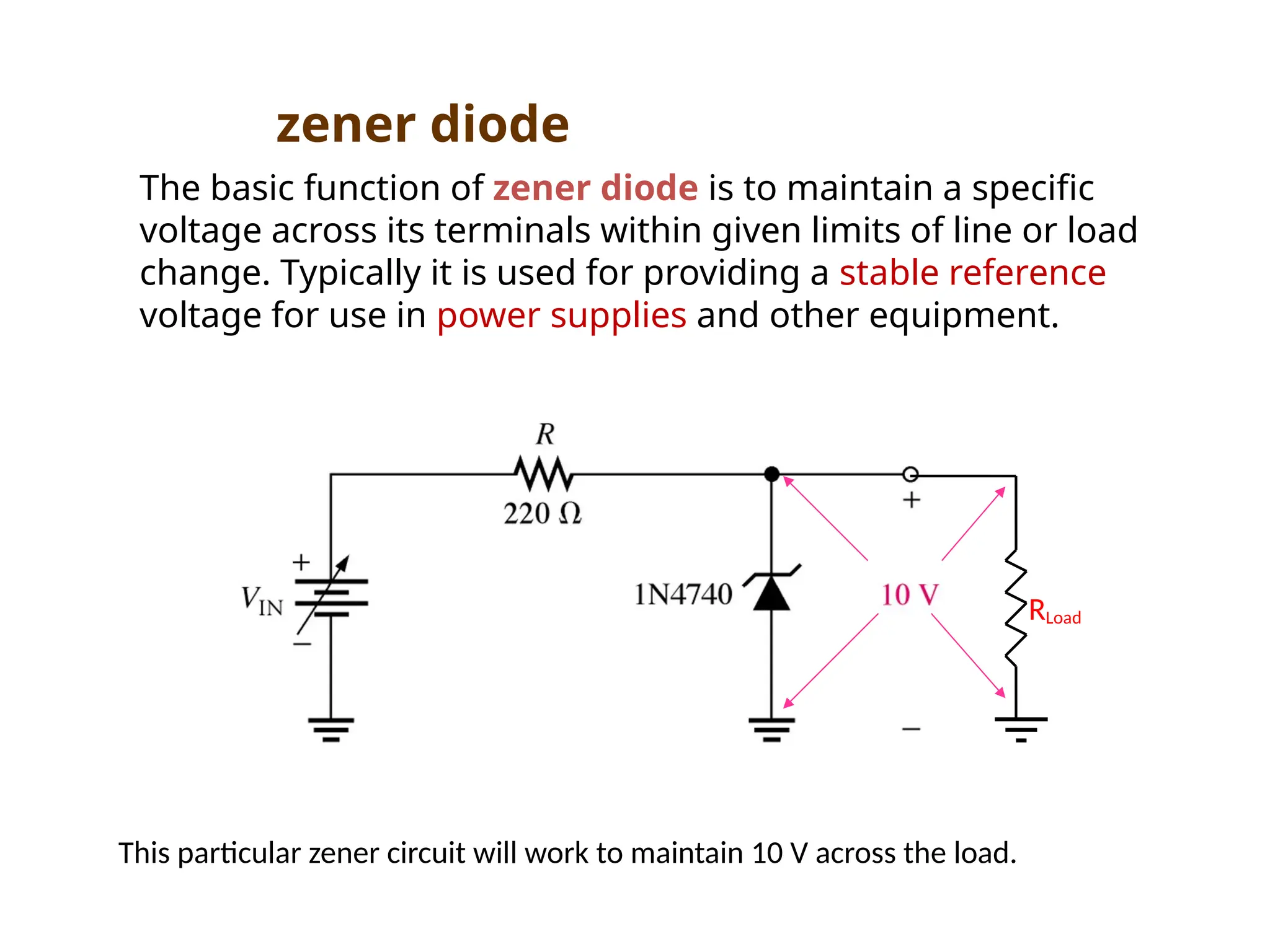
The basic function of zener diode is to maintain a specific
voltage across its terminals within given limits of line or load
change. Typically it is used for providing a stable reference
voltage for use in power supplies and other equipment.
This particular zener circuit will work to maintain 10 V across the load.
RLoad
Zener Diodes – Operating Range
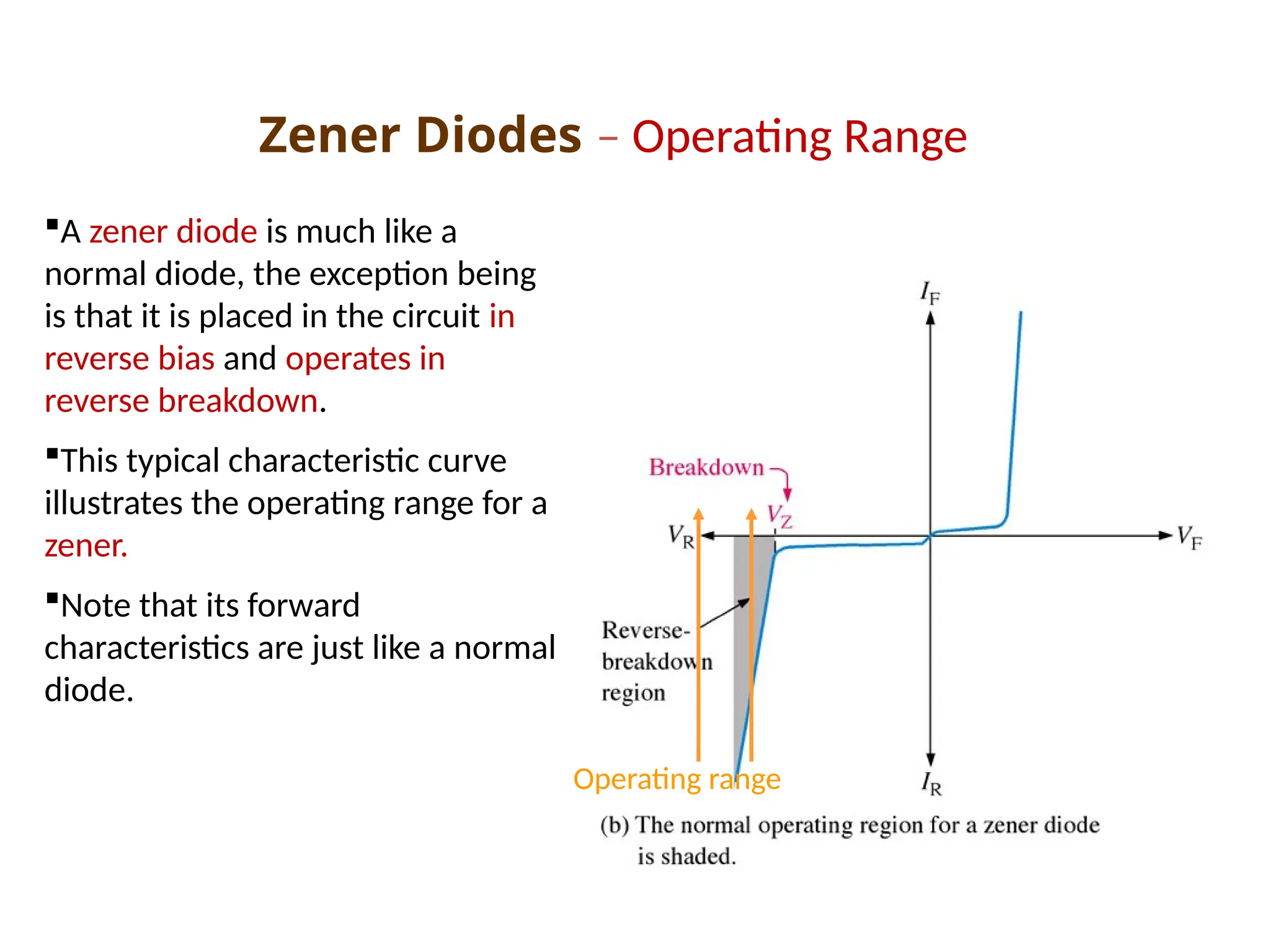
A zener diode is much like a
normal diode, the exception being
is that it is placed in the circuit in
reverse bias and operates in
reverse breakdown.
This typical characteristic curve
illustrates the operating range for a
zener.
Note that its forward
characteristics are just like a normal
diode.
Operating range
Zener Diodes – Regulation Ranges
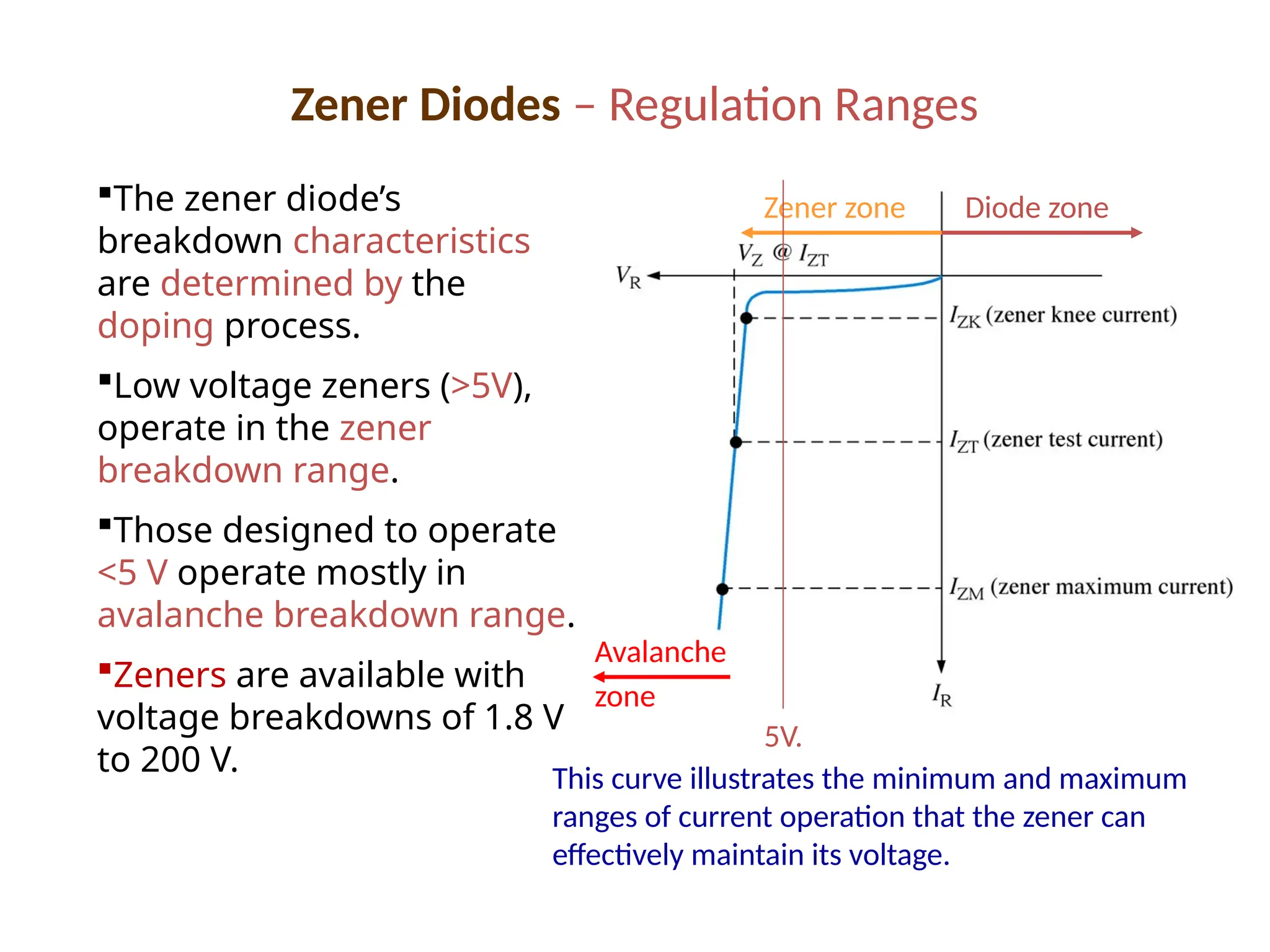
The zener diode’s
breakdown characteristics
are determined by the
doping process.
Low voltage zeners (>5V),
operate in the zener
breakdown range.
Those designed to operate
<5 V operate mostly in
avalanche breakdown range.
Zeners are available with
voltage breakdowns of 1.8 V
to 200 V. This curve illustrates the minimum and maximum
ranges of current operation that the zener can
effectively maintain its voltage.
Zener zone Diode zone
Avalanche
zone
5V.
Zener Diodes – Equivalent Circuit
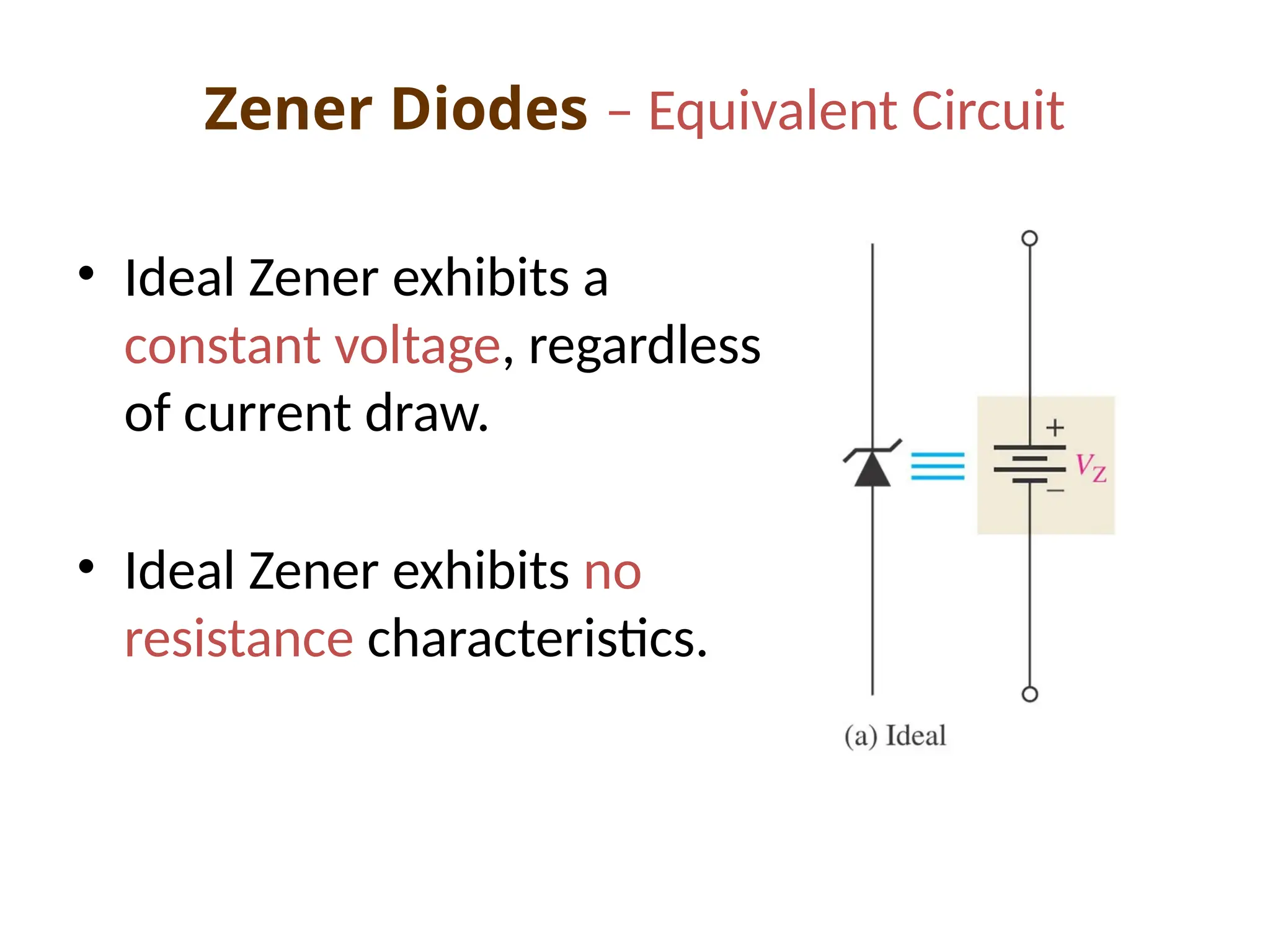
• Ideal Zener exhibits a
constant voltage, regardless
of current draw.
• Ideal Zener exhibits no
resistance characteristics.
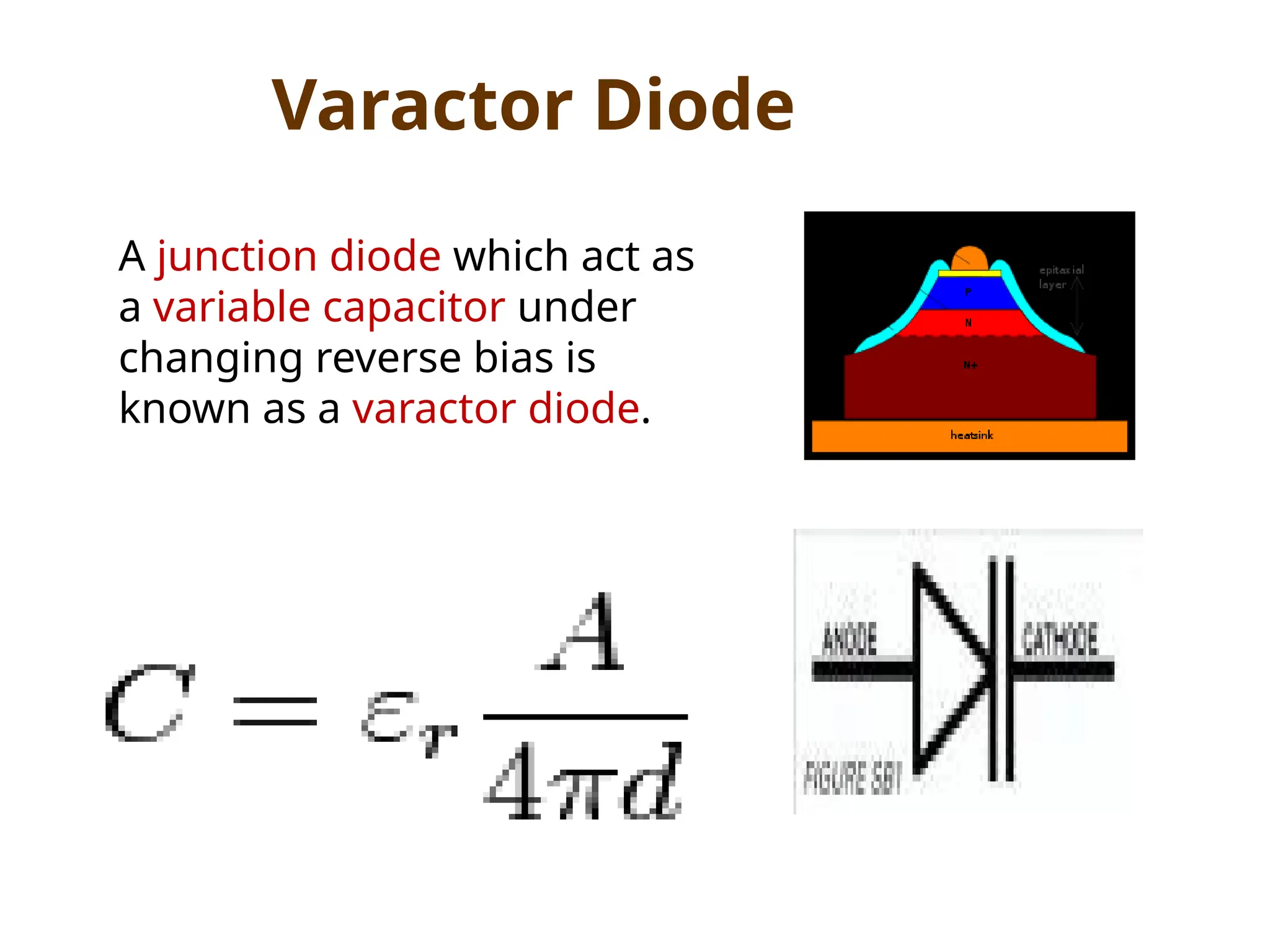
A junction diode which act as
a variable capacitor under
changing reverse bias is
known as a varactor diode.
Varactor Diode
Varactor Diode
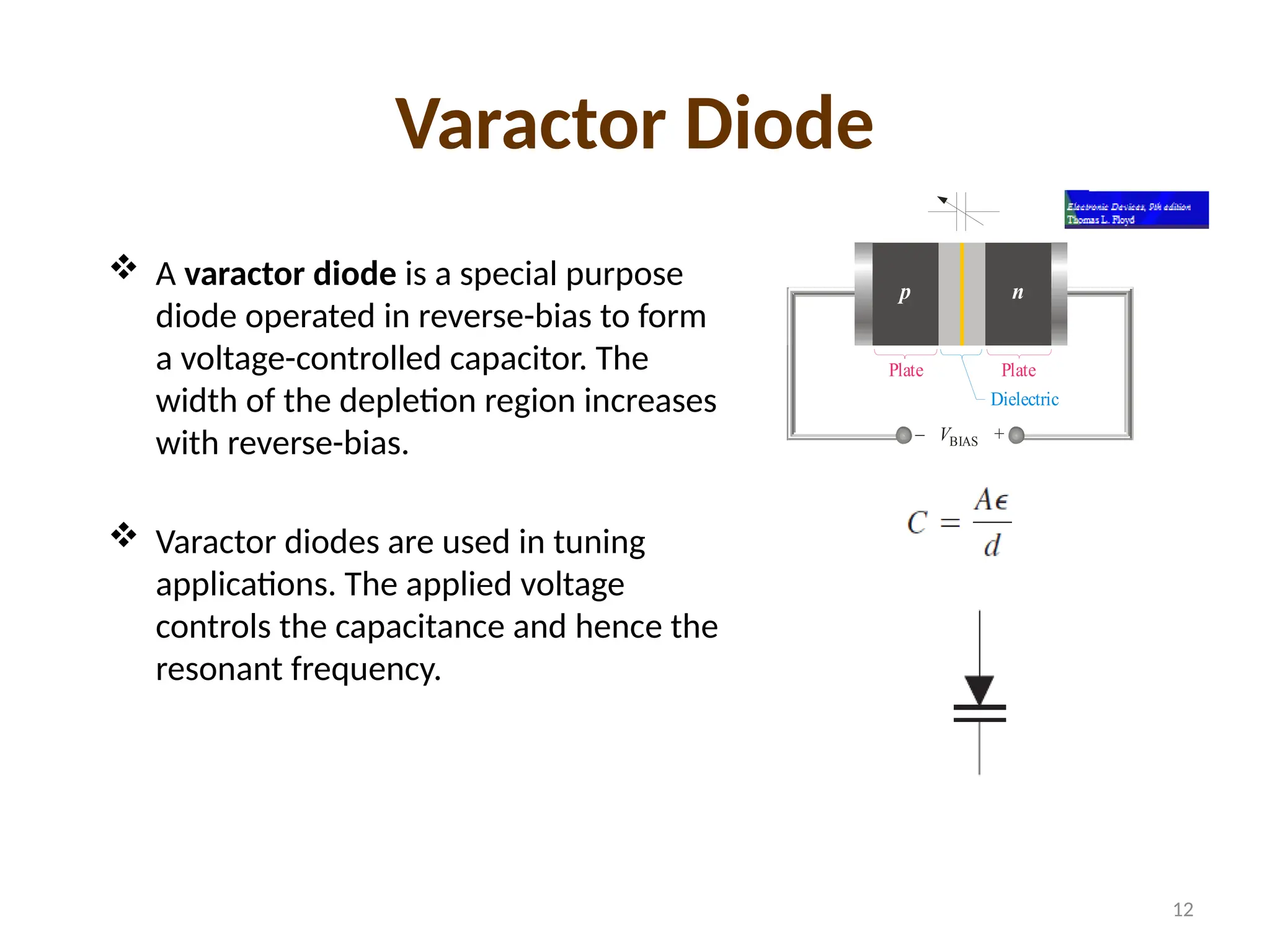
 A varactor diode is a special purpose
diode operated in reverse-bias to form
a voltage-controlled capacitor. The
width of the depletion region increases
with reverse-bias.
 Varactor diodes are used in tuning
applications. The applied voltage
controls the capacitance and hence the
resonant frequency.
p n
VBIAS
– +
Plate Plate
Dielectric
12
Varactor Diodes
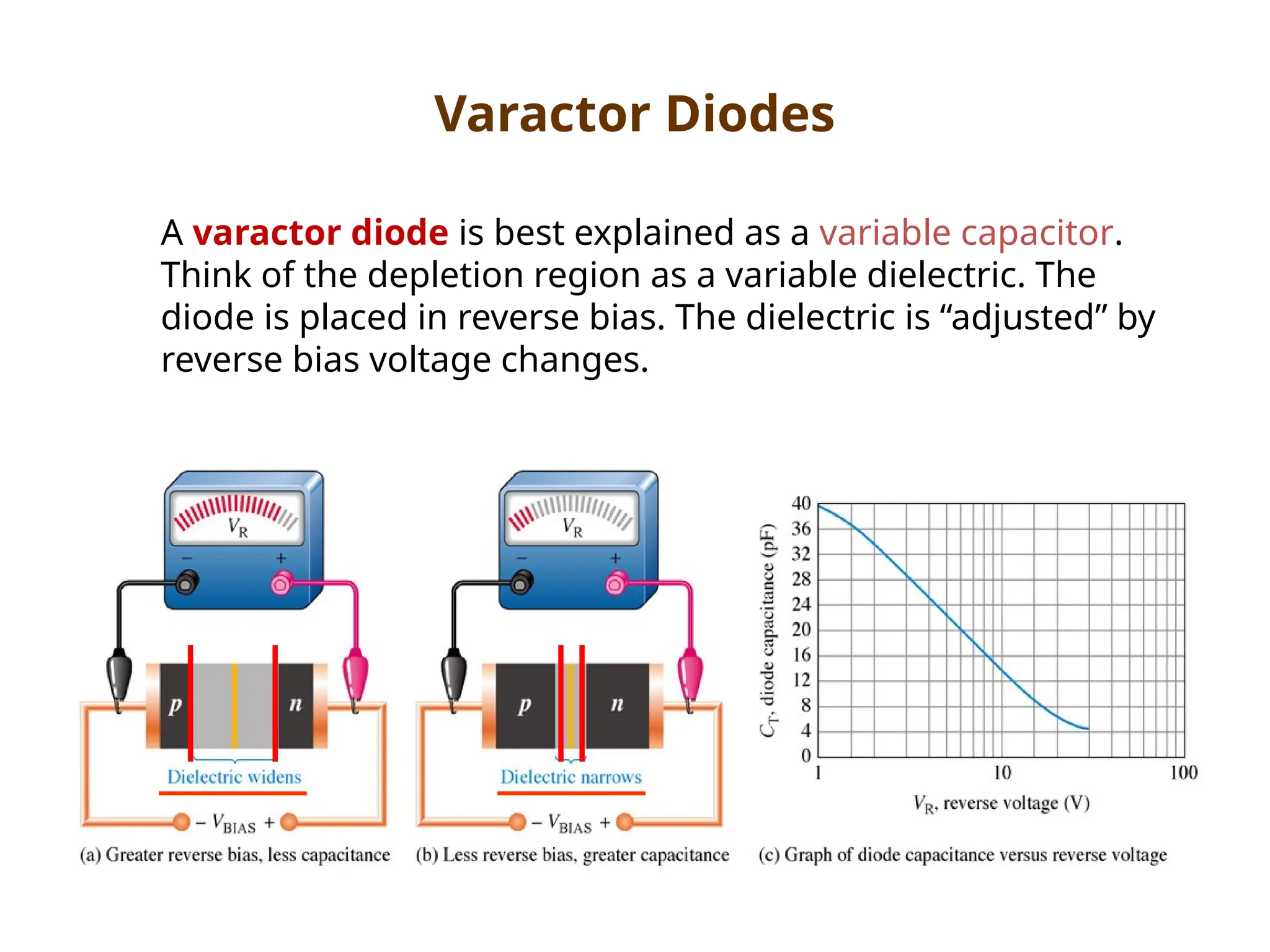
A varactor diode is best explained as a variable capacitor.
Think of the depletion region as a variable dielectric. The
diode is placed in reverse bias. The dielectric is “adjusted” by
reverse bias voltage changes.
Varactor Diodes
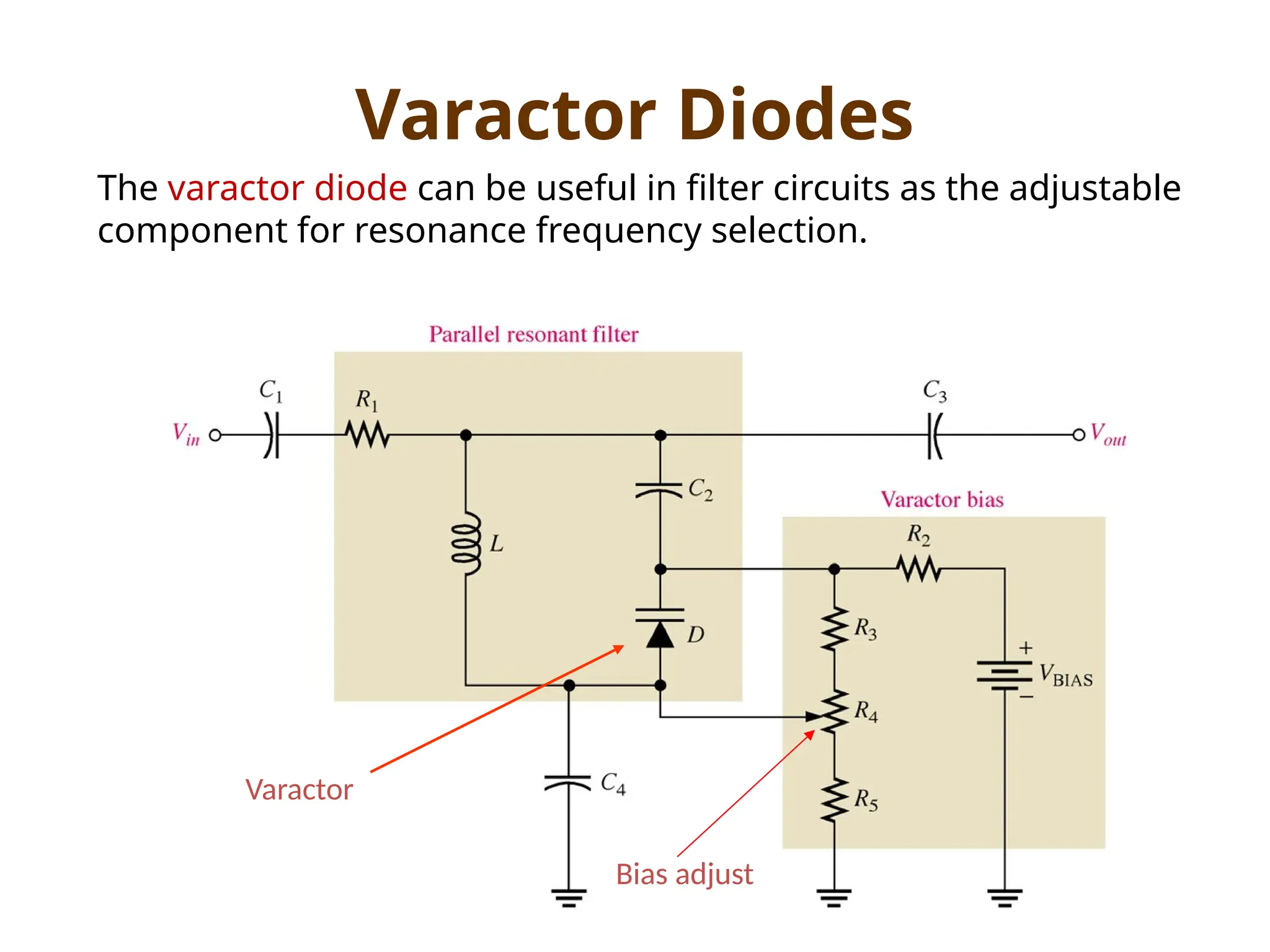
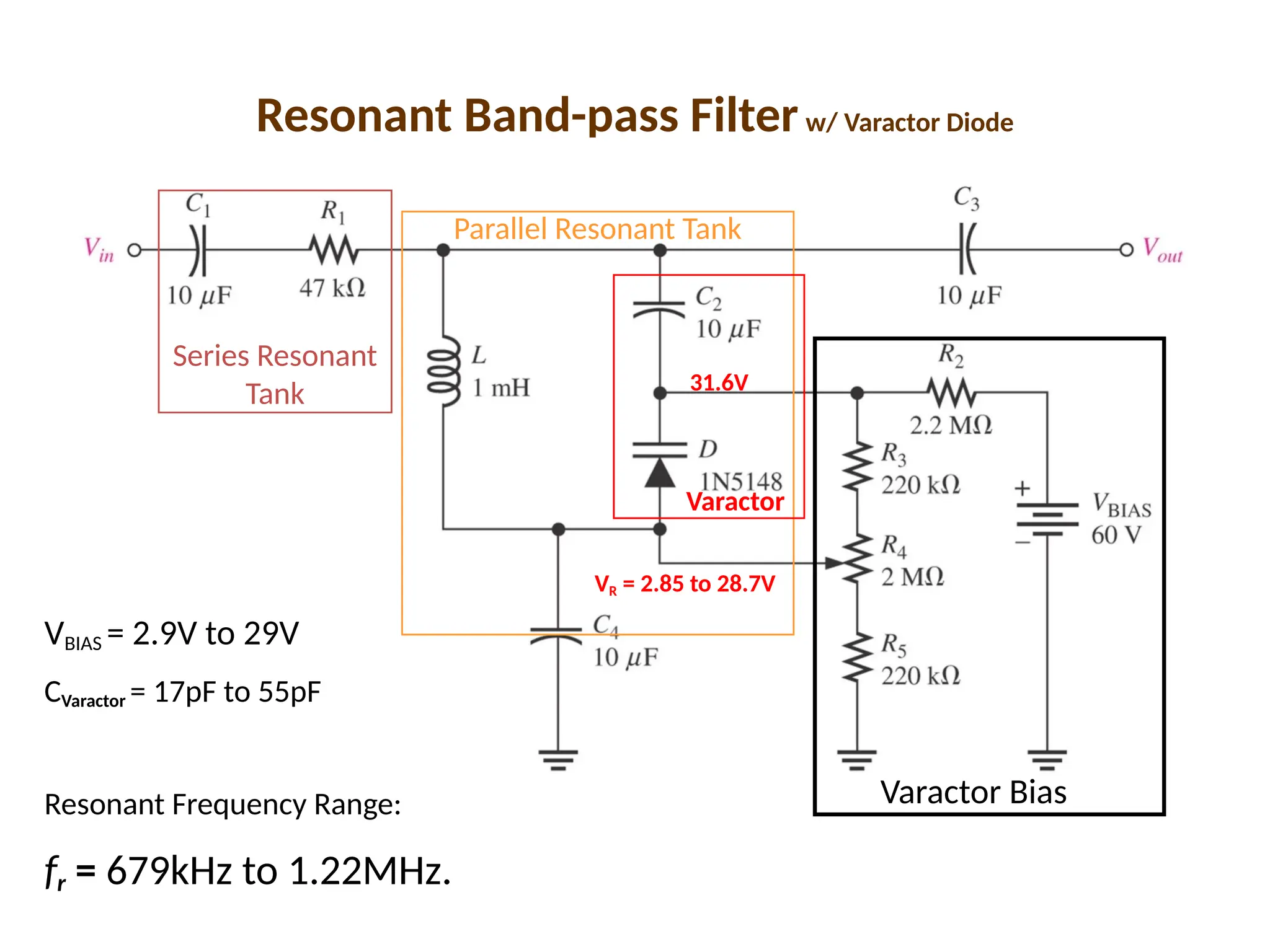
The varactor diode can be useful in filter circuits as the adjustable
component for resonance frequency selection.
Varactor
Bias adjust
Resonant Band-pass Filterw/ Varactor Diode
Series Resonant
Tank
Parallel Resonant Tank
Varactor
Varactor Bias
VBIAS = 2.9V to 29V
CVaractor = 17pF to 55pF
Resonant Frequency Range:
fr = 679kHz to 1.22MHz.
31.6V
VR = 2.85 to 28.7V
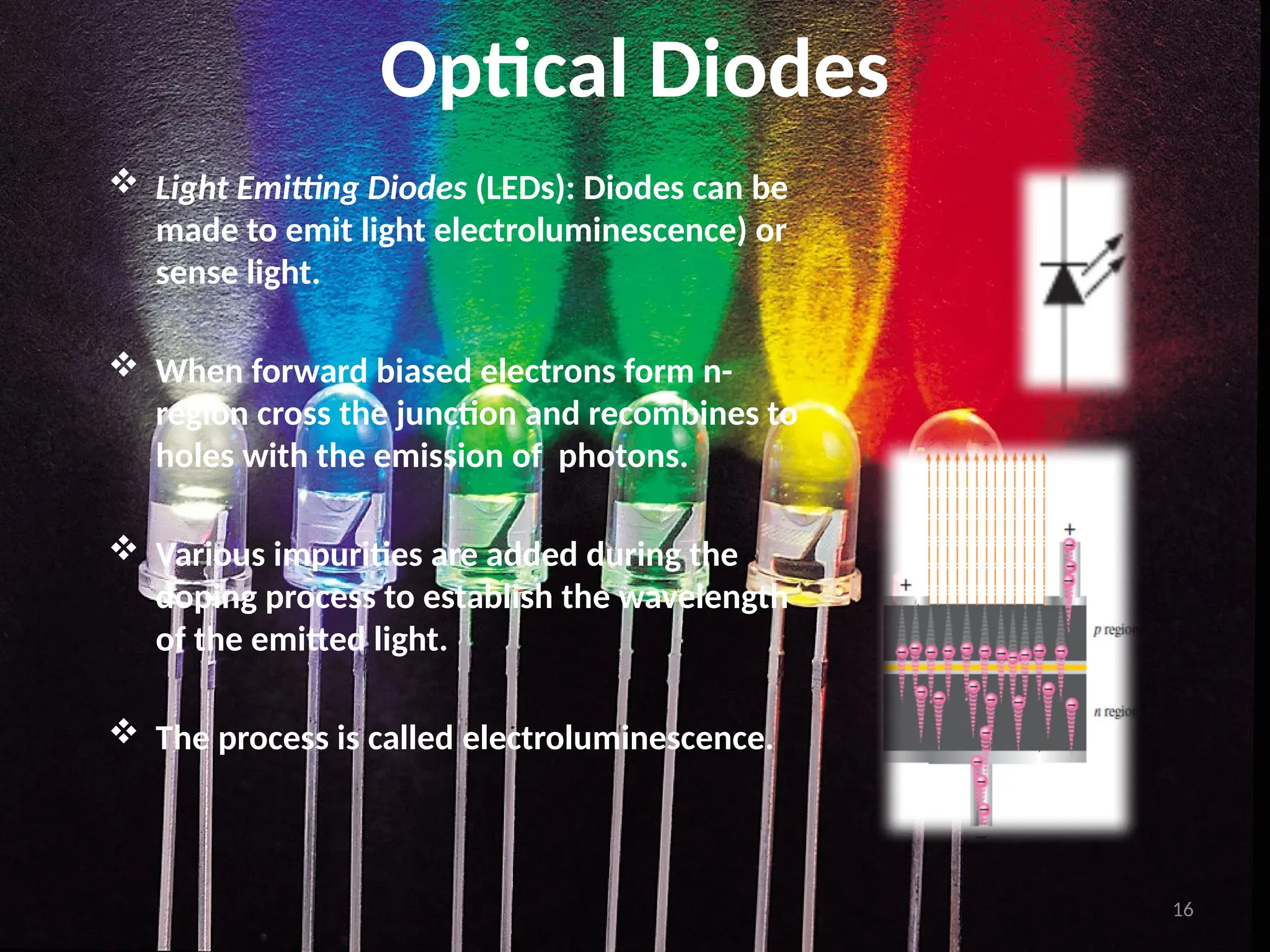
Optical Diodes
 Light Emitting Diodes (LEDs): Diodes can be
made to emit light electroluminescence) or
sense light.
 When forward biased electrons form n-
region cross the junction and recombines to
holes with the emission of photons.
 Various impurities are added during the
doping process to establish the wavelength
of the emitted light.
 The process is called electroluminescence.
16
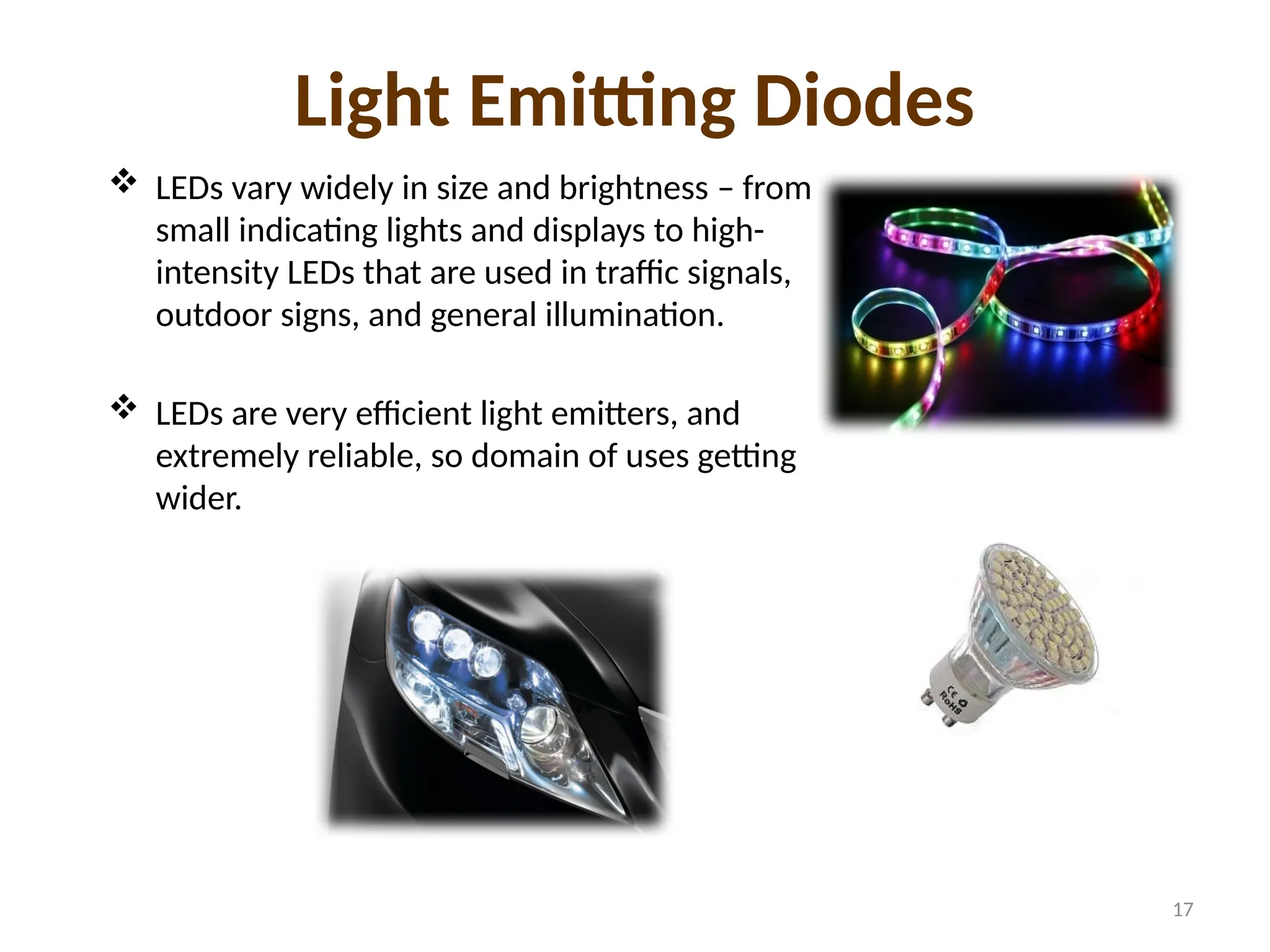
Light Emitting Diodes
 LEDs vary widely in size and brightness – from
small indicating lights and displays to high-
intensity LEDs that are used in traffic signals,
outdoor signs, and general illumination.
 LEDs are very efficient light emitters, and
extremely reliable, so domain of uses getting
wider.
17
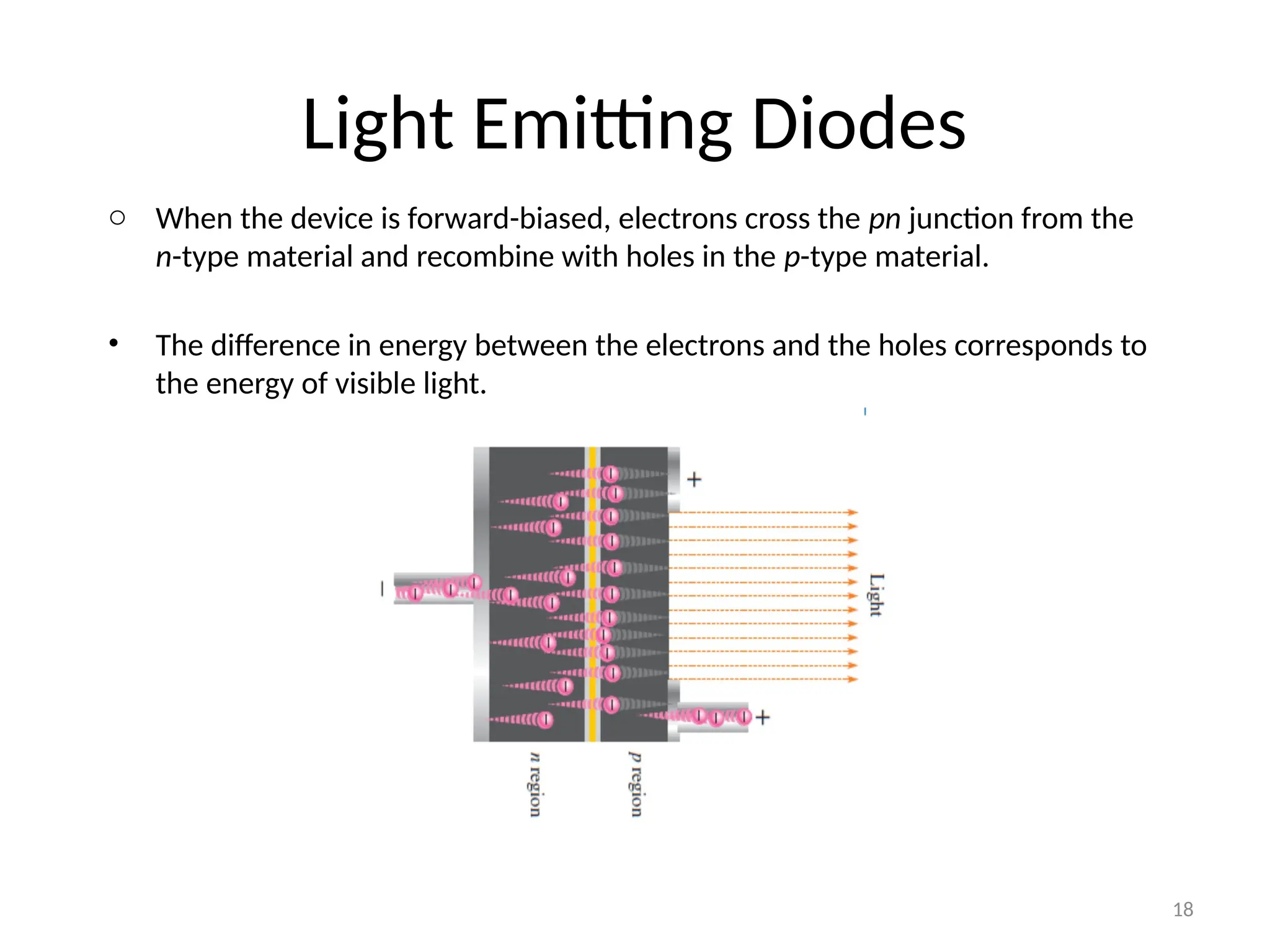
Light Emitting Diodes
o When the device is forward-biased, electrons cross the pn junction from the
n-type material and recombine with holes in the p-type material.
• The difference in energy between the electrons and the holes corresponds to
the energy of visible light.
18
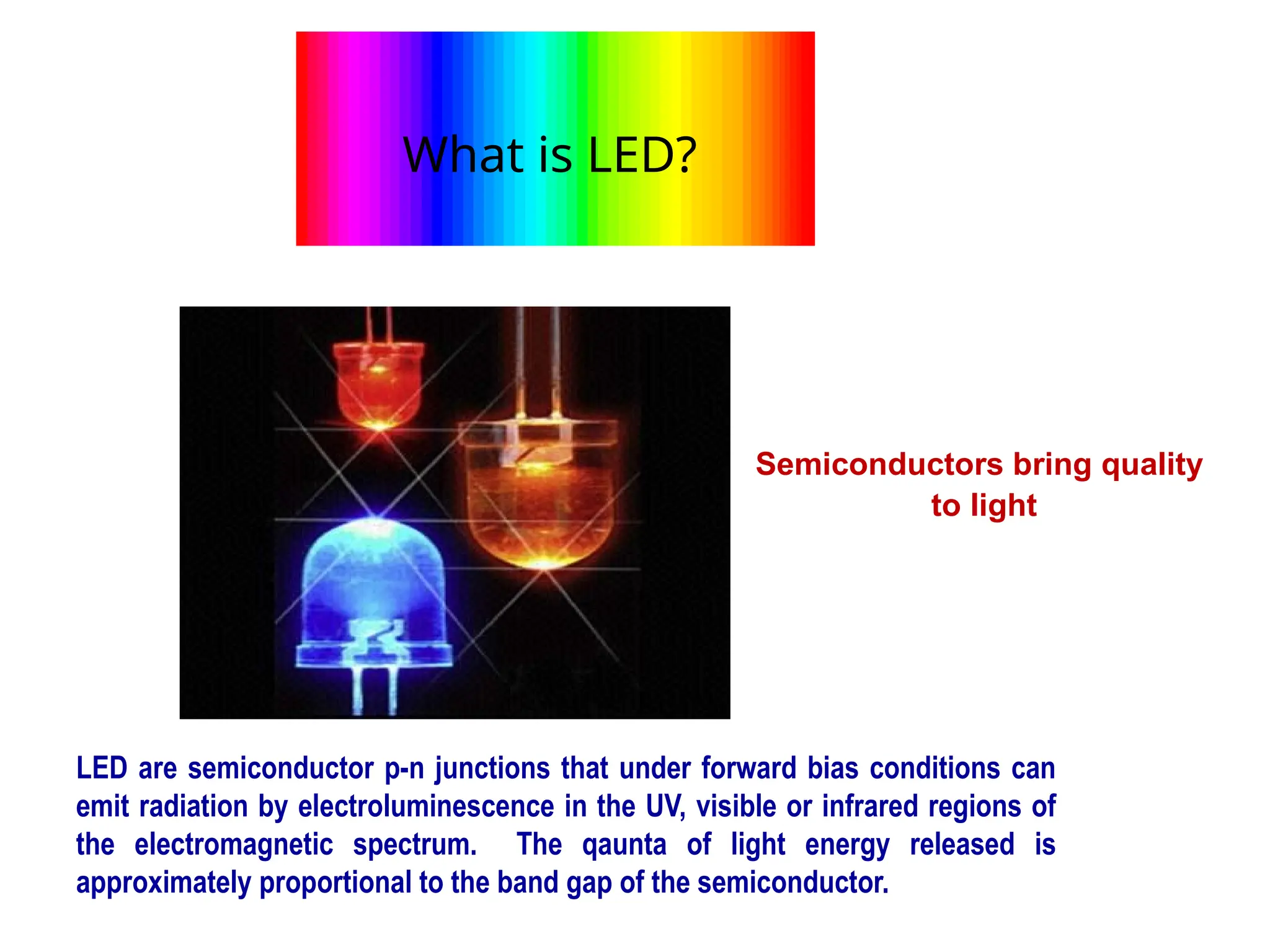
What is LED?
Semiconductors bring quality
to light
LED are semiconductor p-n junctions that under forward bias conditions can
emit radiation by electroluminescence in the UV, visible or infrared regions of
the electromagnetic spectrum. The qaunta of light energy released is
approximately proportional to the band gap of the semiconductor.
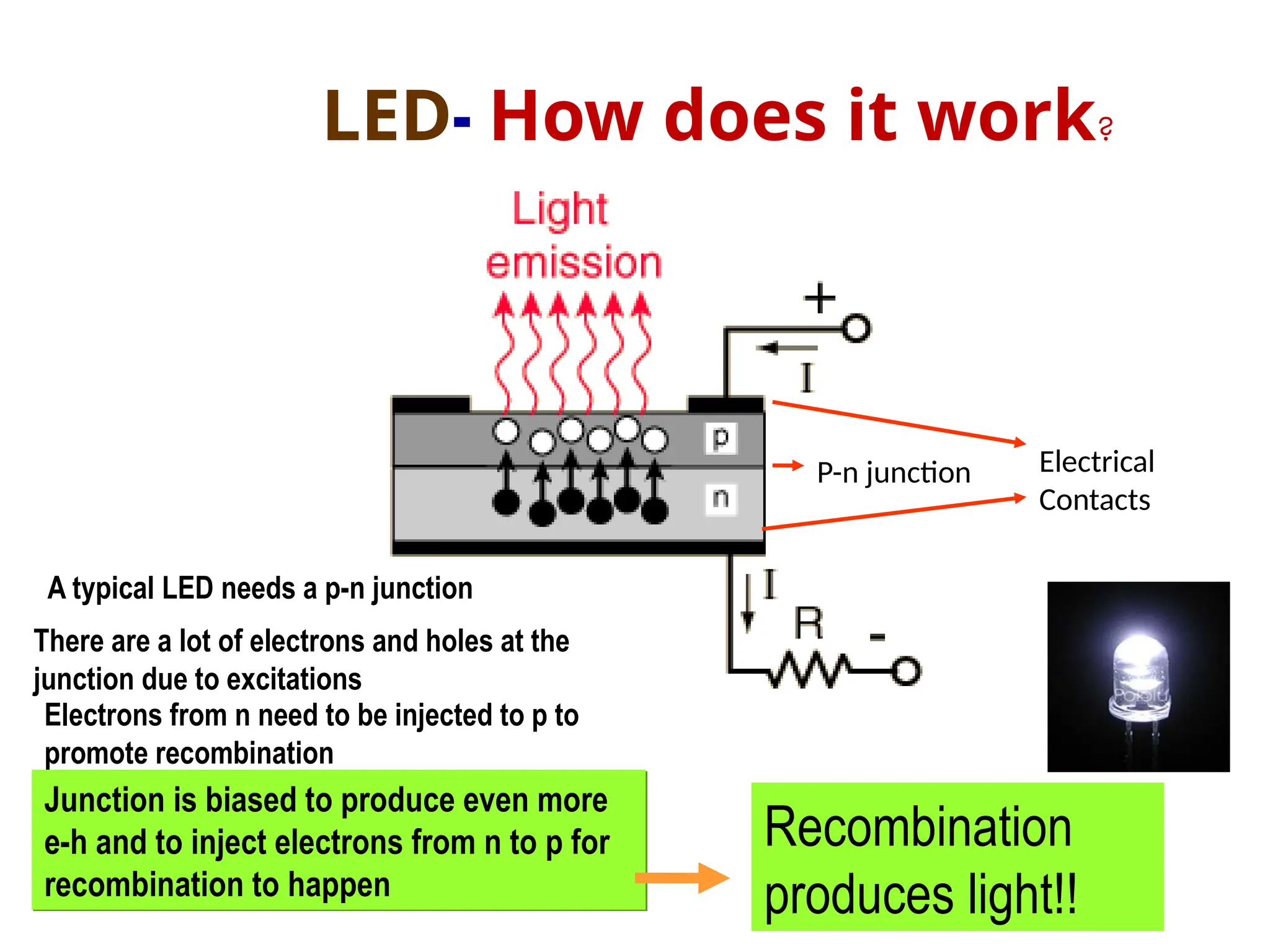
LED- How does it work?
P-n junction Electrical
Contacts
A typical LED needs a p-n junction
There are a lot of electrons and holes at the
junction due to excitations
Electrons from n need to be injected to p to
promote recombination
Junction is biased to produce even more
e-h and to inject electrons from n to p for
recombination to happen
Recombination
produces light!!
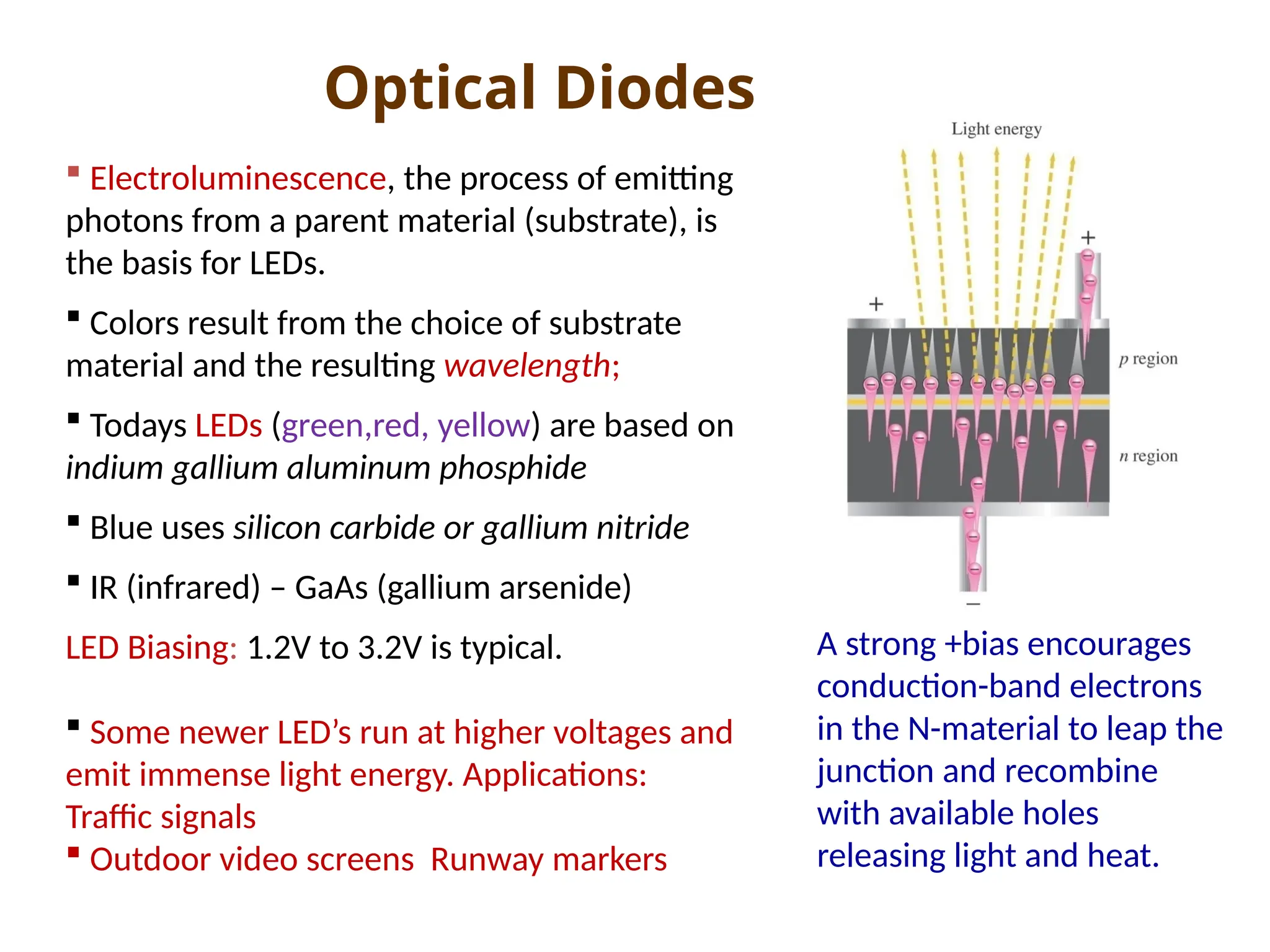
Optical Diodes
 Electroluminescence, the process of emitting
photons from a parent material (substrate), is
the basis for LEDs.
 Colors result from the choice of substrate
material and the resulting wavelength;
 Todays LEDs (green,red, yellow) are based on
indium gallium aluminum phosphide
 Blue uses silicon carbide or gallium nitride
 IR (infrared) – GaAs (gallium arsenide)
LED Biasing: 1.2V to 3.2V is typical.
 Some newer LED’s run at higher voltages and
emit immense light energy. Applications:
Traffic signals
 Outdoor video screens Runway markers
A strong +bias encourages
conduction-band electrons
in the N-material to leap the
junction and recombine
with available holes
releasing light and heat.
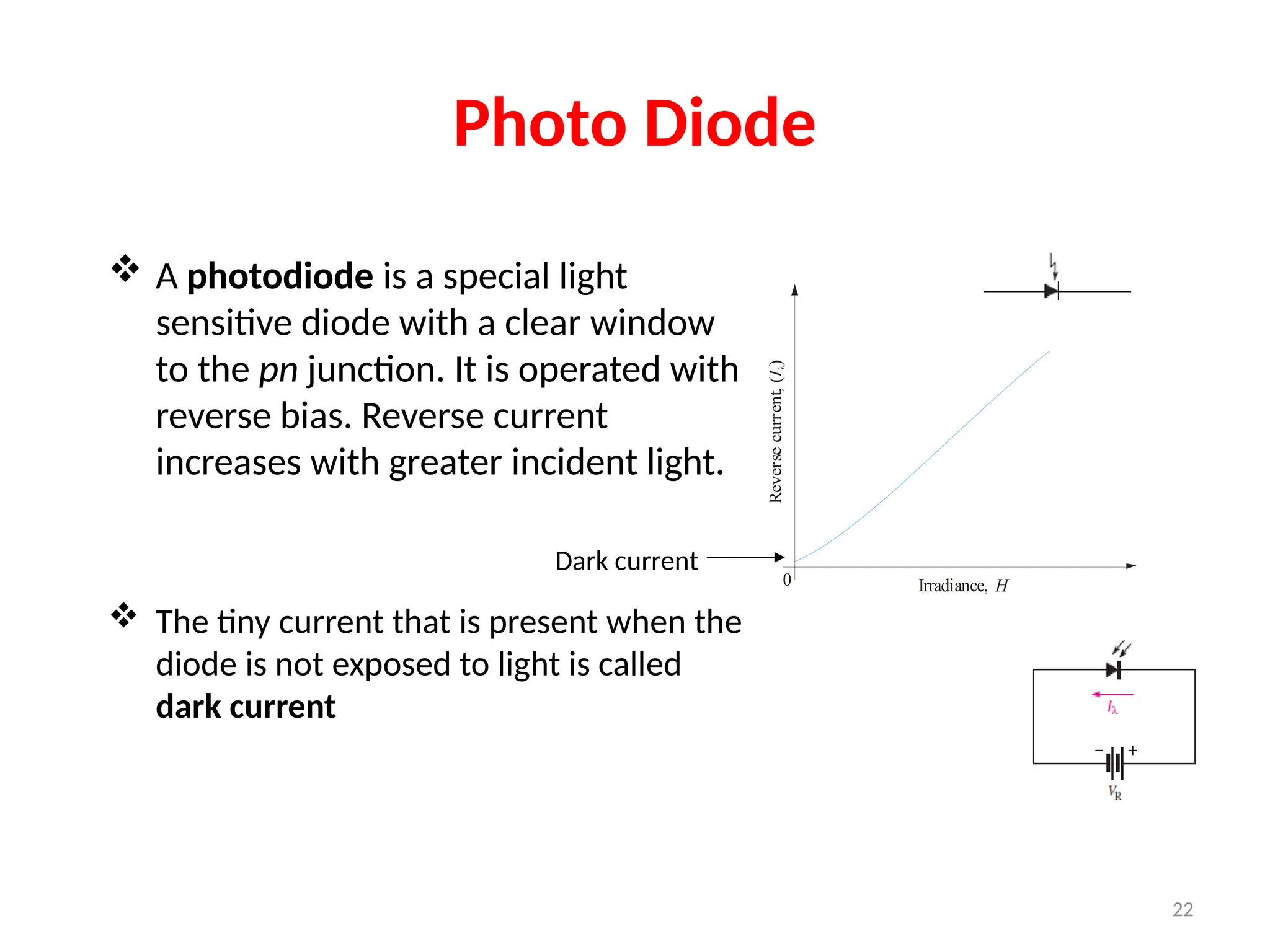
Photo Diode
 A photodiode is a special light
sensitive diode with a clear window
to the pn junction. It is operated with
reverse bias. Reverse current
increases with greater incident light.
 The tiny current that is present when the
diode is not exposed to light is called
dark current
Irradiance, H
Reverse
current,
(
)
I
l
0
Dark current
22
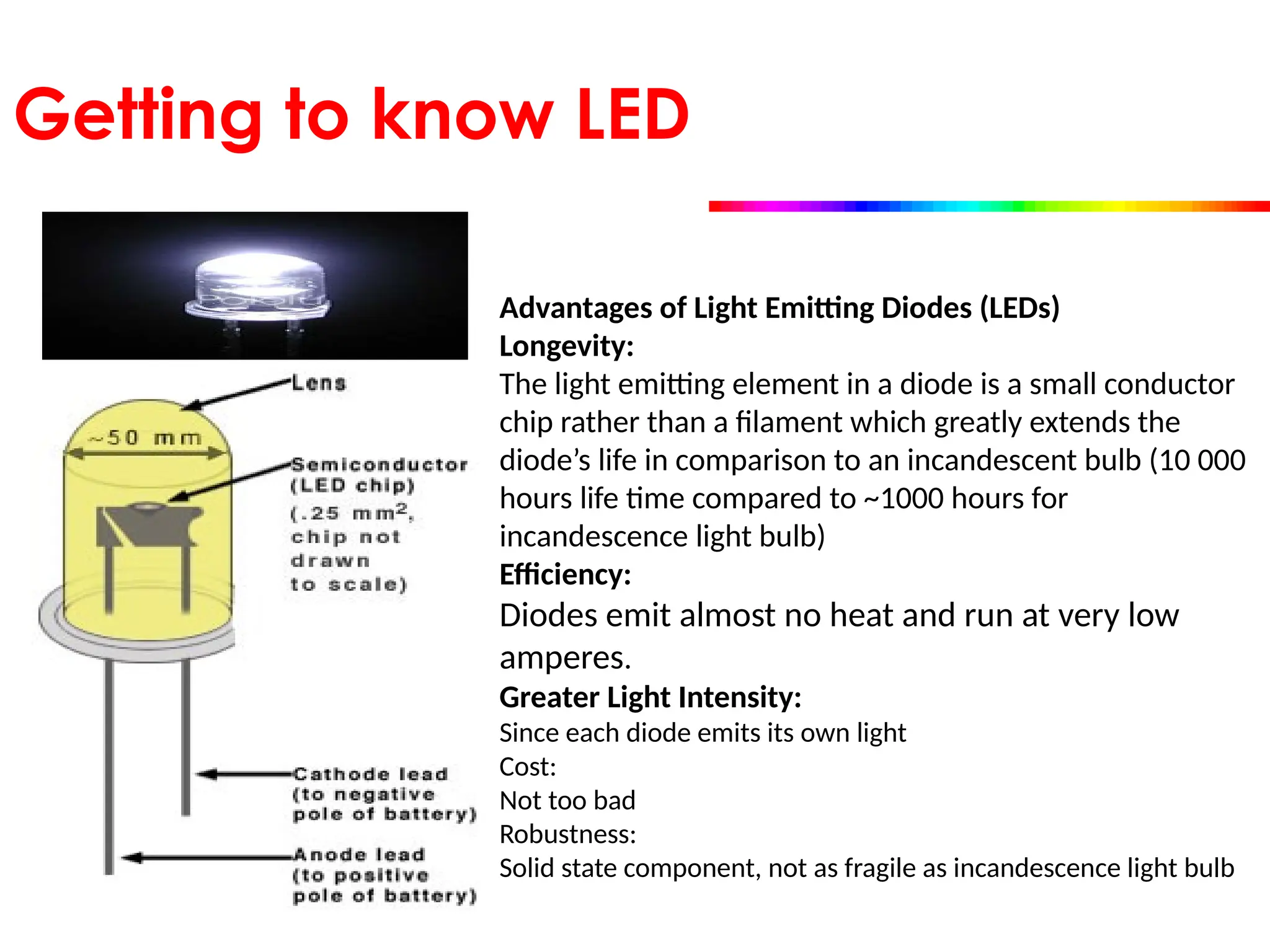
Getting to know LED
Advantages of Light Emitting Diodes (LEDs)
Longevity:
The light emitting element in a diode is a small conductor
chip rather than a filament which greatly extends the
diode’s life in comparison to an incandescent bulb (10 000
hours life time compared to ~1000 hours for
incandescence light bulb)
Efficiency:
Diodes emit almost no heat and run at very low
amperes.
Greater Light Intensity:
Since each diode emits its own light
Cost:
Not too bad
Robustness:
Solid state component, not as fragile as incandescence light bulb
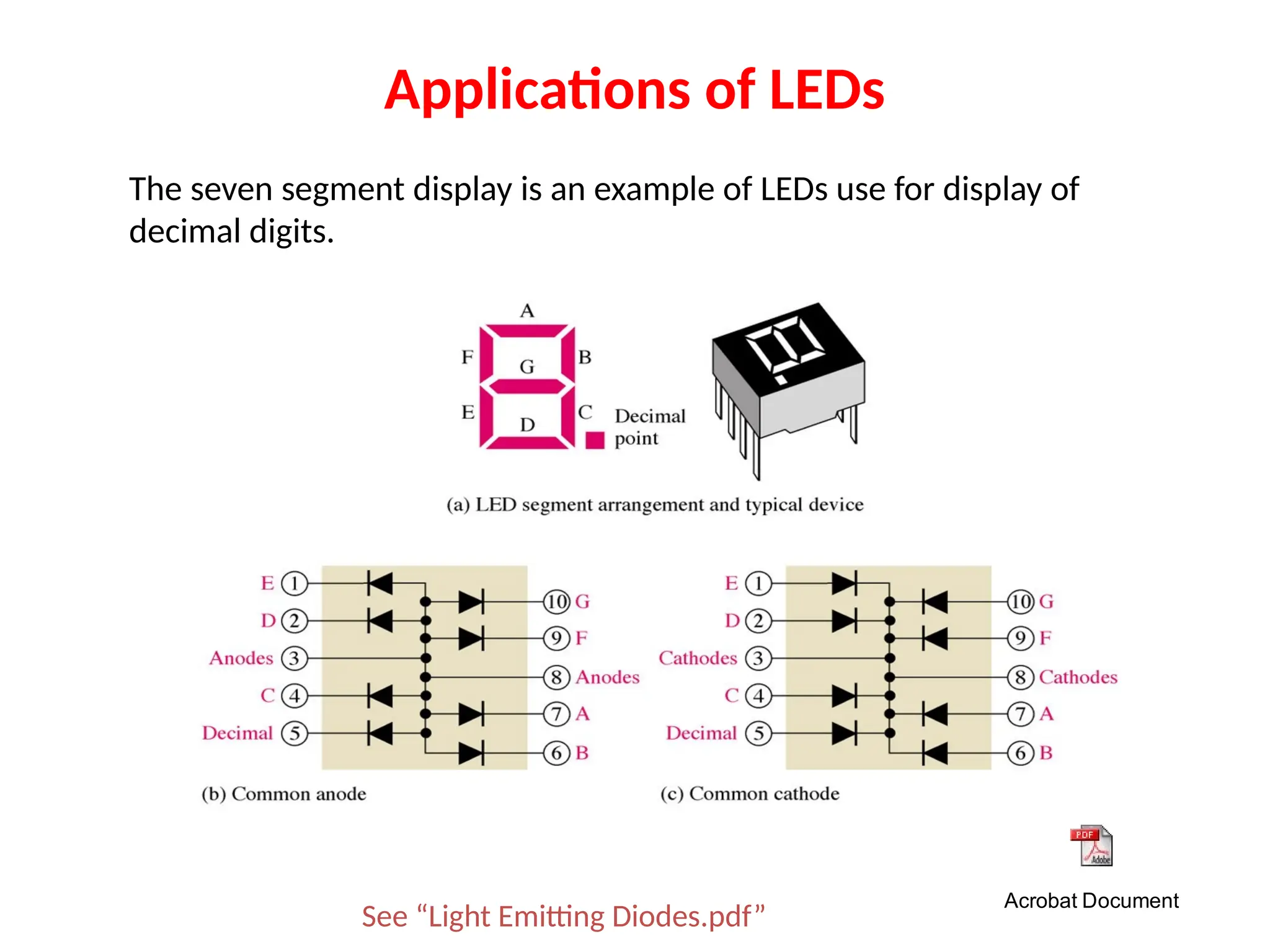
Applications of LEDs
The seven segment display is an example of LEDs use for display of
decimal digits.
See “Light Emitting Diodes.pdf”
Acrobat Document
Applications of LEDs
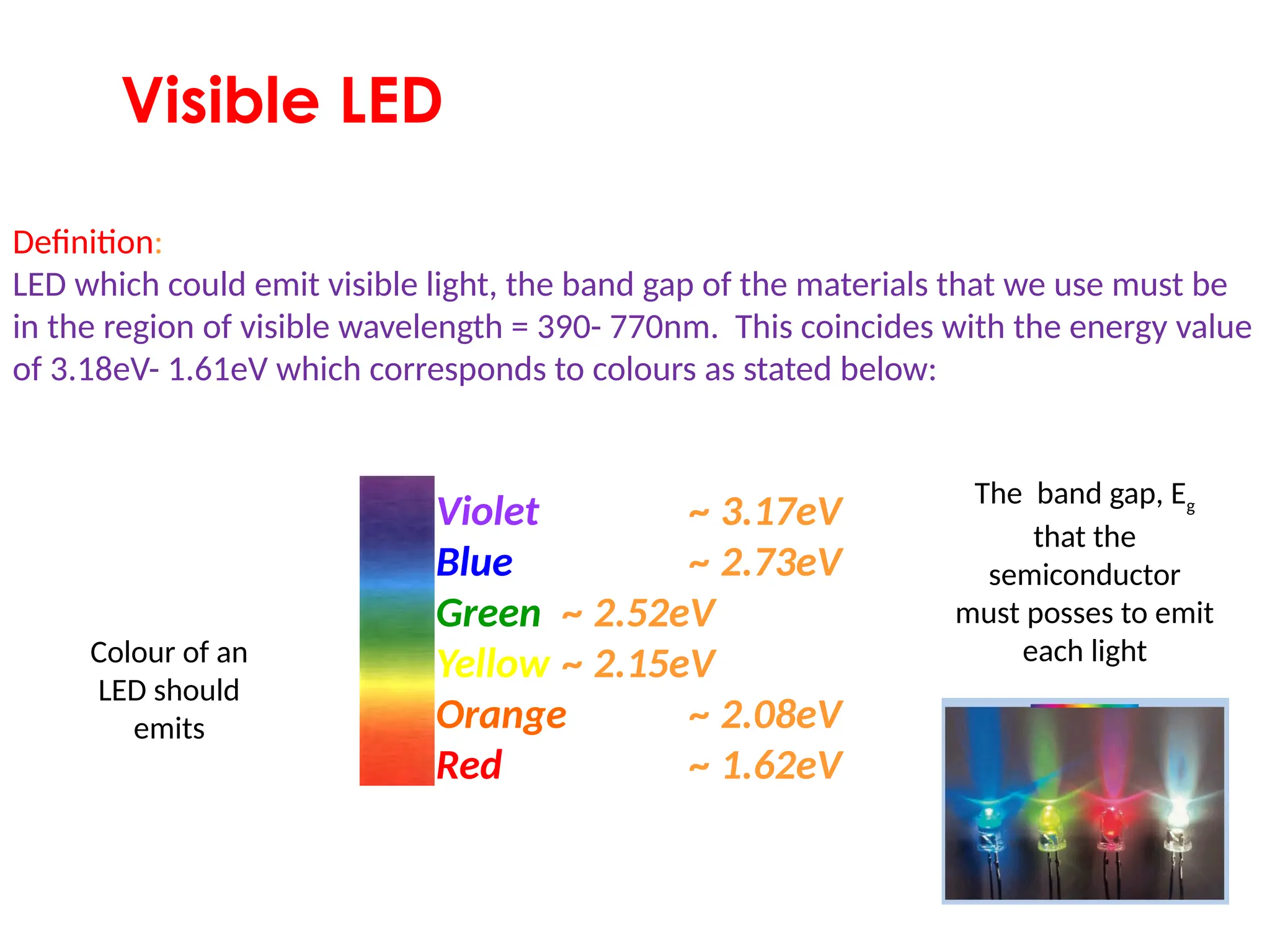
Visible LED
Definition:
LED which could emit visible light, the band gap of the materials that we use must be
in the region of visible wavelength = 390- 770nm. This coincides with the energy value
of 3.18eV- 1.61eV which corresponds to colours as stated below:
Violet ~ 3.17eV
Blue ~ 2.73eV
Green ~ 2.52eV
Yellow ~ 2.15eV
Orange ~ 2.08eV
Red ~ 1.62eV
Colour of an
LED should
emits
The band gap, Eg
that the
semiconductor
must posses to emit
each light
Visible LED
BAE 5413 27 of 10
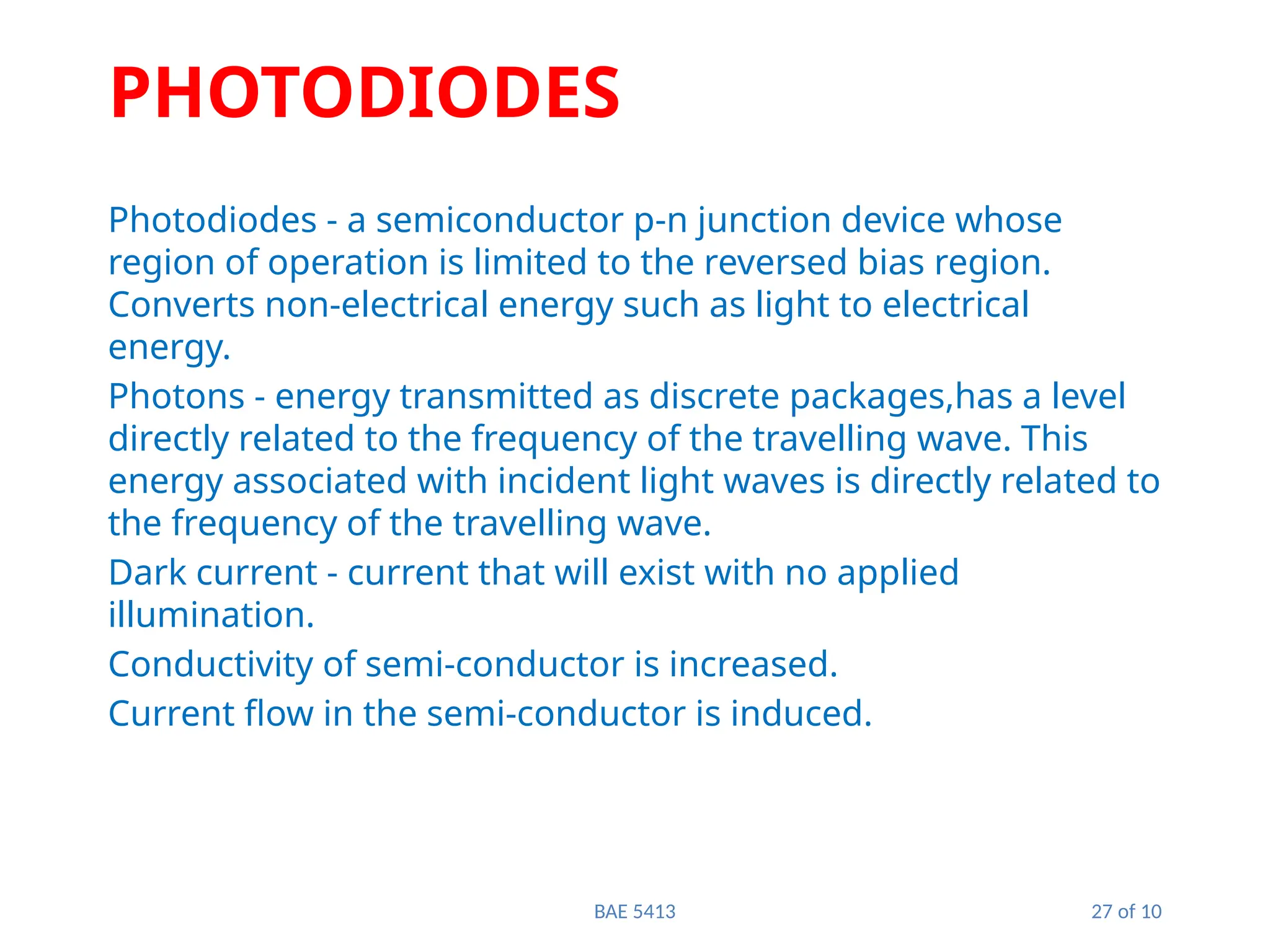
PHOTODIODES
Photodiodes - a semiconductor p-n junction device whose
region of operation is limited to the reversed bias region.
Converts non-electrical energy such as light to electrical
energy.
Photons - energy transmitted as discrete packages,has a level
directly related to the frequency of the travelling wave. This
energy associated with incident light waves is directly related to
the frequency of the travelling wave.
Dark current - current that will exist with no applied
illumination.
Conductivity of semi-conductor is increased.
Current flow in the semi-conductor is induced.
Photodiodes
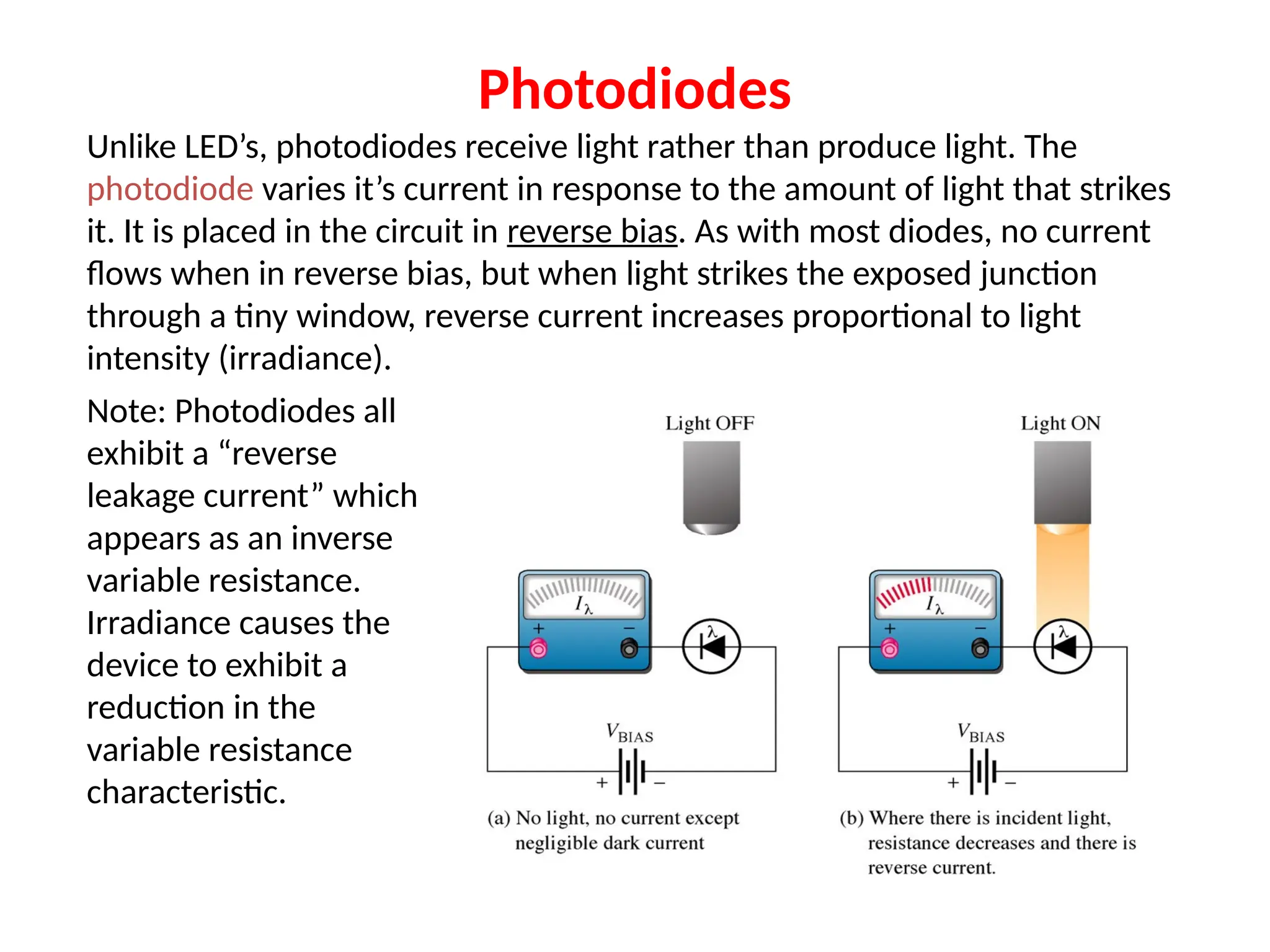
Unlike LED’s, photodiodes receive light rather than produce light. The
photodiode varies it’s current in response to the amount of light that strikes
it. It is placed in the circuit in reverse bias. As with most diodes, no current
flows when in reverse bias, but when light strikes the exposed junction
through a tiny window, reverse current increases proportional to light
intensity (irradiance).
Note: Photodiodes all
exhibit a “reverse
leakage current” which
appears as an inverse
variable resistance.
Irradiance causes the
device to exhibit a
reduction in the
variable resistance
characteristic.
Photodiode fundamentals
Based on PN or PIN junction
diodephoton absorption in the depletion
region induces current flow
Spectral sensitivity
Material Band gap
(eV)
Spectral sensitivity
silicon (Si) 1.12 250 to 1100 nm
indium arsenide (InGaAs) ~0.35 1000 to 2200 nm
Germanium (Ge) .67 900 to 1600 nm
I
P
N
+
-
h
RL
IL
electron
hole
Schottky Diode
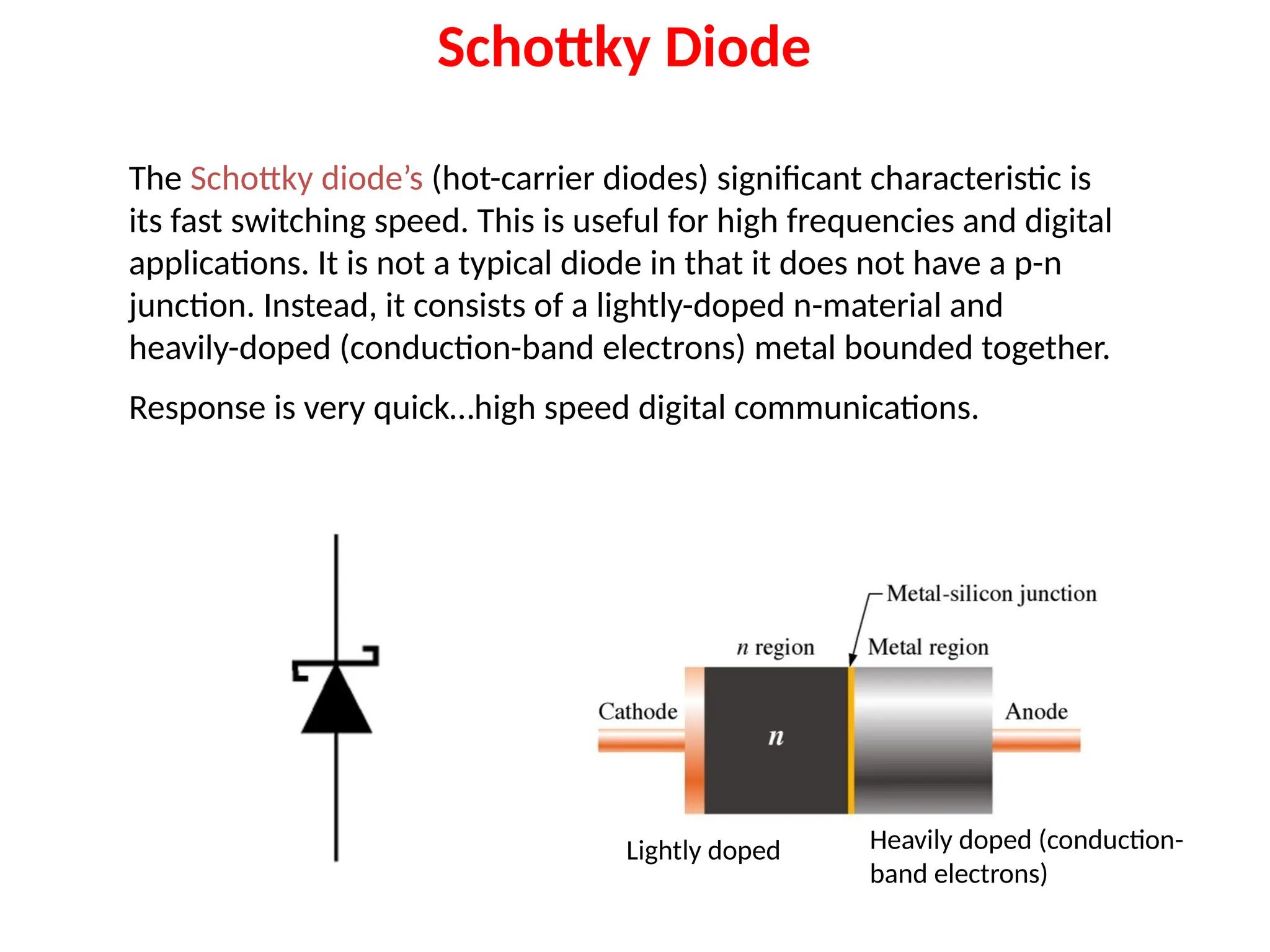
The Schottky diode’s (hot-carrier diodes) significant characteristic is
its fast switching speed. This is useful for high frequencies and digital
applications. It is not a typical diode in that it does not have a p-n
junction. Instead, it consists of a lightly-doped n-material and
heavily-doped (conduction-band electrons) metal bounded together.
Response is very quick…high speed digital communications.
Lightly doped Heavily doped (conduction-
band electrons)
Tunnel Diode
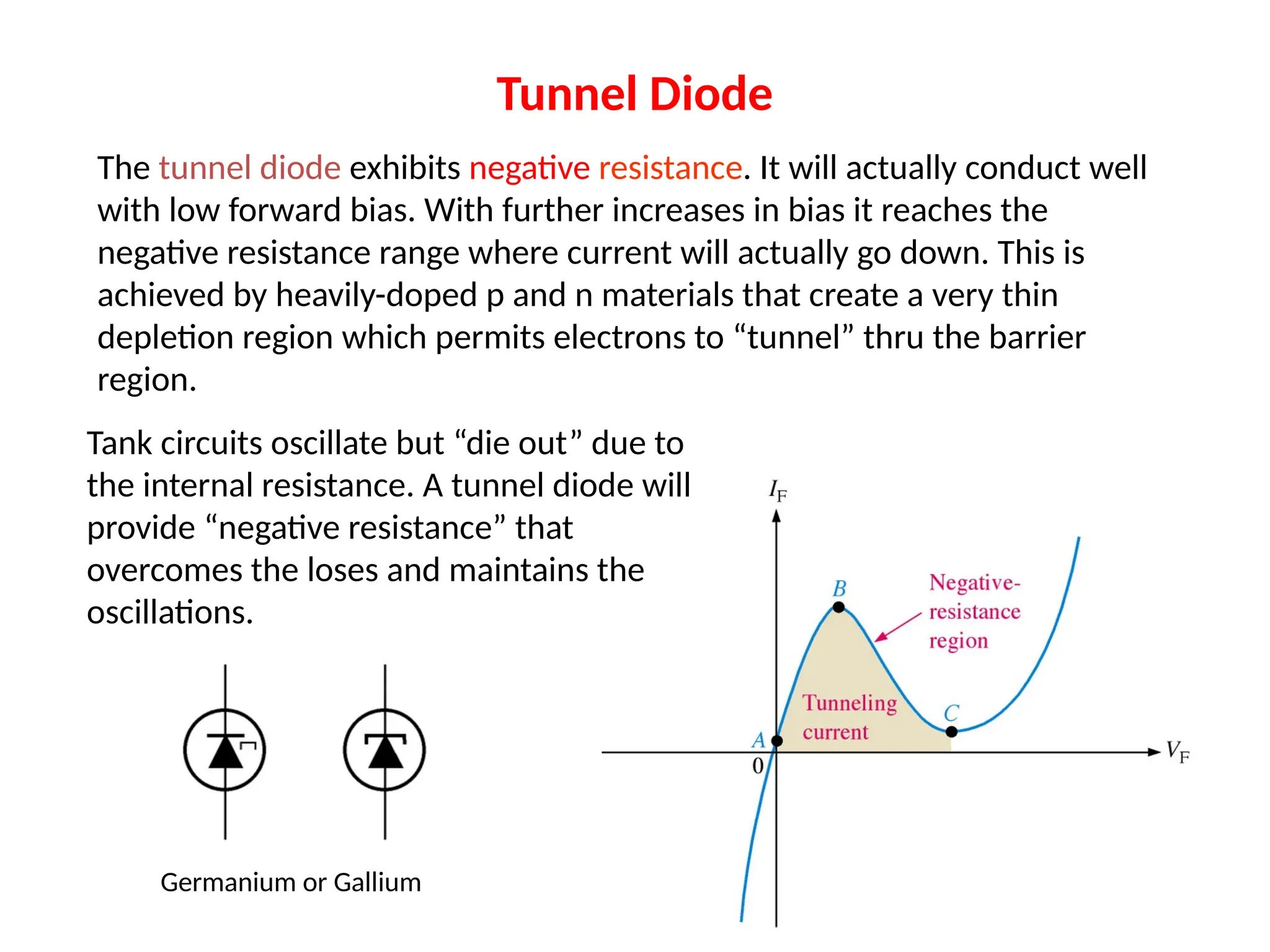
The tunnel diode exhibits negative resistance. It will actually conduct well
with low forward bias. With further increases in bias it reaches the
negative resistance range where current will actually go down. This is
achieved by heavily-doped p and n materials that create a very thin
depletion region which permits electrons to “tunnel” thru the barrier
region.
Germanium or Gallium
Tank circuits oscillate but “die out” due to
the internal resistance. A tunnel diode will
provide “negative resistance” that
overcomes the loses and maintains the
oscillations.
Tunnel Diodes
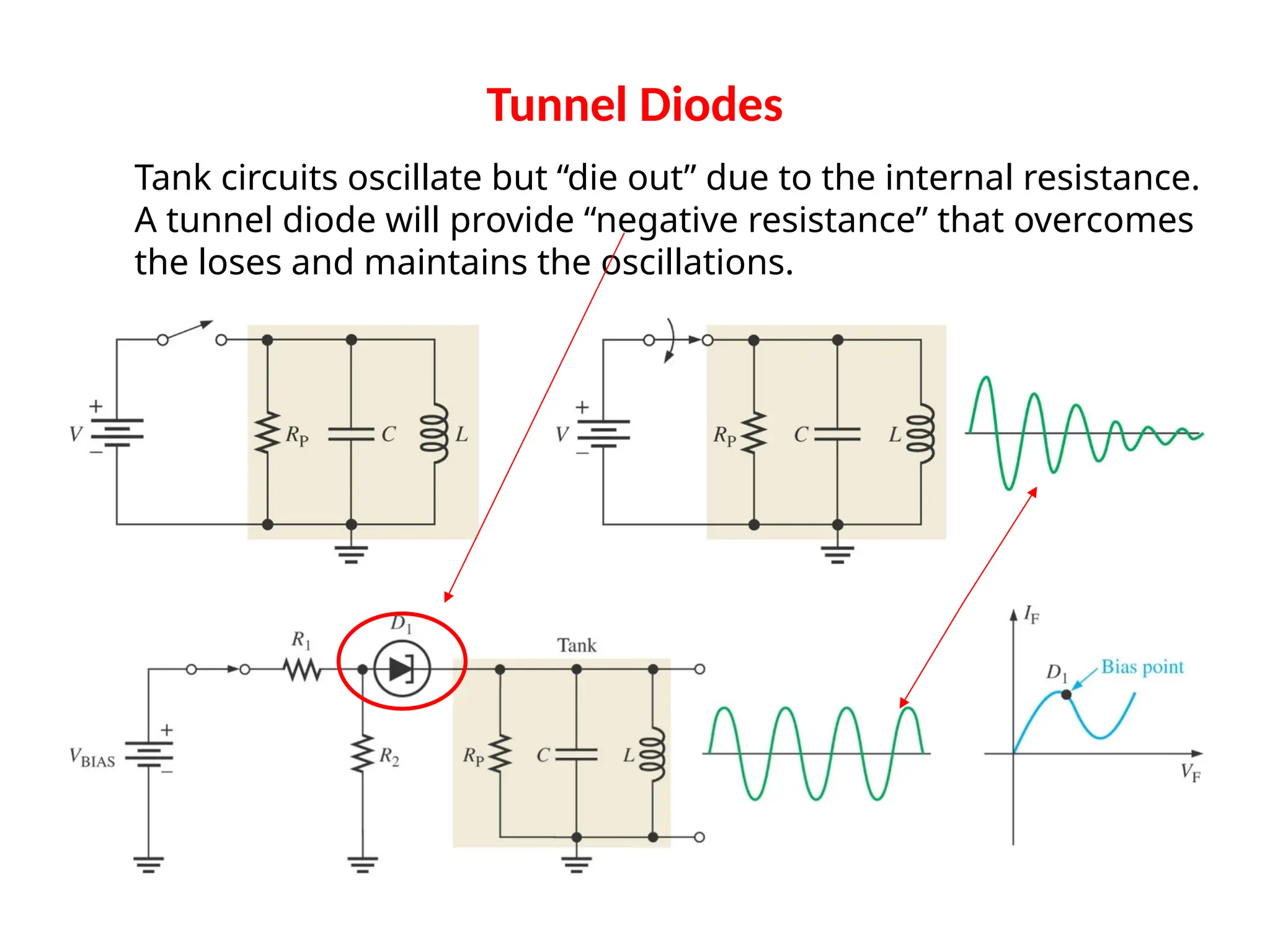
Tank circuits oscillate but “die out” due to the internal resistance.
A tunnel diode will provide “negative resistance” that overcomes
the loses and maintains the oscillations.
Other Diode Types
The laser diode (light amplification by stimulated emission of radiation)
produces a monochromatic (single color) “coherent” light. Laser diodes in
conjunction with photodiodes are used to retrieve data from compact
discs.
Forward bias the diode and electrons move thru the junction,
recombination occurs (as ordinary). Recombinations result in
photon release, causing a chain reaction of releases and avalanching
photons which form an intense laser beam.
Summary
 The zener diode operates in reverse breakdown.
 A zener diode maintains a nearly constant voltage across its
terminals over a specified range of currents.
 Line regulation is the maintenance of a specific voltage with
changing input voltages.
 Load regulation is the maintenance of a specific voltage for
different loads.
 There are other diode types used for specific RF purposes
such as varactor diodes (variable capacitance), Schottky diodes
(high speed switching), and PIN diodes (microwave attenuation
and switching).
Special purpose Diodes

Diode Demystified: From Ideal Assumptions to Specialty Applications

  • 1.
    SPECIAL PURPOSE DIODES Dr.G.S.Virdi Former Chief Scientist CSIR-Central Electronics Engineering Research Institue - Pilani, India
  • 3.
    • In anideal diode, current flow freely through the device when forward biased, having no resistance. • In an ideal diode, there would be no voltage drop across it when forward biased. All of the source voltage would be dropped across circuit resistors. • In an ideal diode, when reverse biased, it would have infinite resistance, causing zero current flow. Ideal Diode
  • 4.
    • A practicaldiode does offer some resistance to current flow when forward biased. • Since there is some resistance, there will be some power dissipated when current flows through a forward biased diode. Therefore, there is a practical limit to the amount of current a diode can conduct without damage. • A reverse biased diode has very high resistance. • Excessive reverse bias can cause the diode to conduct. Practical Diodes
  • 5.
     Zener Diode LEDs  Photo Diode  Varactor Diode  Tunnel Diode  Schottky Diode  Schokley Diode Special Diodes
  • 6.
    • A Zenerdiode is a type of diode that permits current not only in the forward direction like a normal diode, but also in the reverse direction if the voltage is larger than the breakdown voltage known as "Zener knee voltage" or "Zener voltage". The device was named after Clarence Zener, who discovered this electrical property • It is heavily doped in comparison with normal diode to reduce the breakdown voltage. • Breakdown voltage for commonly available zener diodes can vary widely from 1.2 volts to 200 volts Zener Diode
  • 7.
    zener diode The basicfunction of zener diode is to maintain a specific voltage across its terminals within given limits of line or load change. Typically it is used for providing a stable reference voltage for use in power supplies and other equipment. This particular zener circuit will work to maintain 10 V across the load. RLoad
  • 8.
    Zener Diodes –Operating Range A zener diode is much like a normal diode, the exception being is that it is placed in the circuit in reverse bias and operates in reverse breakdown. This typical characteristic curve illustrates the operating range for a zener. Note that its forward characteristics are just like a normal diode. Operating range
  • 9.
    Zener Diodes –Regulation Ranges The zener diode’s breakdown characteristics are determined by the doping process. Low voltage zeners (>5V), operate in the zener breakdown range. Those designed to operate <5 V operate mostly in avalanche breakdown range. Zeners are available with voltage breakdowns of 1.8 V to 200 V. This curve illustrates the minimum and maximum ranges of current operation that the zener can effectively maintain its voltage. Zener zone Diode zone Avalanche zone 5V.
  • 10.
    Zener Diodes –Equivalent Circuit • Ideal Zener exhibits a constant voltage, regardless of current draw. • Ideal Zener exhibits no resistance characteristics.
  • 11.
    A junction diodewhich act as a variable capacitor under changing reverse bias is known as a varactor diode. Varactor Diode
  • 12.
    Varactor Diode  Avaractor diode is a special purpose diode operated in reverse-bias to form a voltage-controlled capacitor. The width of the depletion region increases with reverse-bias.  Varactor diodes are used in tuning applications. The applied voltage controls the capacitance and hence the resonant frequency. p n VBIAS – + Plate Plate Dielectric 12
  • 13.
    Varactor Diodes A varactordiode is best explained as a variable capacitor. Think of the depletion region as a variable dielectric. The diode is placed in reverse bias. The dielectric is “adjusted” by reverse bias voltage changes.
  • 14.
    Varactor Diodes The varactordiode can be useful in filter circuits as the adjustable component for resonance frequency selection. Varactor Bias adjust
  • 15.
    Resonant Band-pass Filterw/Varactor Diode Series Resonant Tank Parallel Resonant Tank Varactor Varactor Bias VBIAS = 2.9V to 29V CVaractor = 17pF to 55pF Resonant Frequency Range: fr = 679kHz to 1.22MHz. 31.6V VR = 2.85 to 28.7V
  • 16.
    Optical Diodes  LightEmitting Diodes (LEDs): Diodes can be made to emit light electroluminescence) or sense light.  When forward biased electrons form n- region cross the junction and recombines to holes with the emission of photons.  Various impurities are added during the doping process to establish the wavelength of the emitted light.  The process is called electroluminescence. 16
  • 17.
    Light Emitting Diodes LEDs vary widely in size and brightness – from small indicating lights and displays to high- intensity LEDs that are used in traffic signals, outdoor signs, and general illumination.  LEDs are very efficient light emitters, and extremely reliable, so domain of uses getting wider. 17
  • 18.
    Light Emitting Diodes oWhen the device is forward-biased, electrons cross the pn junction from the n-type material and recombine with holes in the p-type material. • The difference in energy between the electrons and the holes corresponds to the energy of visible light. 18
  • 19.
    What is LED? Semiconductorsbring quality to light LED are semiconductor p-n junctions that under forward bias conditions can emit radiation by electroluminescence in the UV, visible or infrared regions of the electromagnetic spectrum. The qaunta of light energy released is approximately proportional to the band gap of the semiconductor.
  • 20.
    LED- How doesit work? P-n junction Electrical Contacts A typical LED needs a p-n junction There are a lot of electrons and holes at the junction due to excitations Electrons from n need to be injected to p to promote recombination Junction is biased to produce even more e-h and to inject electrons from n to p for recombination to happen Recombination produces light!!
  • 21.
    Optical Diodes  Electroluminescence,the process of emitting photons from a parent material (substrate), is the basis for LEDs.  Colors result from the choice of substrate material and the resulting wavelength;  Todays LEDs (green,red, yellow) are based on indium gallium aluminum phosphide  Blue uses silicon carbide or gallium nitride  IR (infrared) – GaAs (gallium arsenide) LED Biasing: 1.2V to 3.2V is typical.  Some newer LED’s run at higher voltages and emit immense light energy. Applications: Traffic signals  Outdoor video screens Runway markers A strong +bias encourages conduction-band electrons in the N-material to leap the junction and recombine with available holes releasing light and heat.
  • 22.
    Photo Diode  Aphotodiode is a special light sensitive diode with a clear window to the pn junction. It is operated with reverse bias. Reverse current increases with greater incident light.  The tiny current that is present when the diode is not exposed to light is called dark current Irradiance, H Reverse current, ( ) I l 0 Dark current 22
  • 23.
    Getting to knowLED Advantages of Light Emitting Diodes (LEDs) Longevity: The light emitting element in a diode is a small conductor chip rather than a filament which greatly extends the diode’s life in comparison to an incandescent bulb (10 000 hours life time compared to ~1000 hours for incandescence light bulb) Efficiency: Diodes emit almost no heat and run at very low amperes. Greater Light Intensity: Since each diode emits its own light Cost: Not too bad Robustness: Solid state component, not as fragile as incandescence light bulb
  • 24.
    Applications of LEDs Theseven segment display is an example of LEDs use for display of decimal digits. See “Light Emitting Diodes.pdf” Acrobat Document
  • 25.
  • 26.
    Visible LED Definition: LED whichcould emit visible light, the band gap of the materials that we use must be in the region of visible wavelength = 390- 770nm. This coincides with the energy value of 3.18eV- 1.61eV which corresponds to colours as stated below: Violet ~ 3.17eV Blue ~ 2.73eV Green ~ 2.52eV Yellow ~ 2.15eV Orange ~ 2.08eV Red ~ 1.62eV Colour of an LED should emits The band gap, Eg that the semiconductor must posses to emit each light Visible LED
  • 27.
    BAE 5413 27of 10 PHOTODIODES Photodiodes - a semiconductor p-n junction device whose region of operation is limited to the reversed bias region. Converts non-electrical energy such as light to electrical energy. Photons - energy transmitted as discrete packages,has a level directly related to the frequency of the travelling wave. This energy associated with incident light waves is directly related to the frequency of the travelling wave. Dark current - current that will exist with no applied illumination. Conductivity of semi-conductor is increased. Current flow in the semi-conductor is induced.
  • 28.
    Photodiodes Unlike LED’s, photodiodesreceive light rather than produce light. The photodiode varies it’s current in response to the amount of light that strikes it. It is placed in the circuit in reverse bias. As with most diodes, no current flows when in reverse bias, but when light strikes the exposed junction through a tiny window, reverse current increases proportional to light intensity (irradiance). Note: Photodiodes all exhibit a “reverse leakage current” which appears as an inverse variable resistance. Irradiance causes the device to exhibit a reduction in the variable resistance characteristic.
  • 29.
    Photodiode fundamentals Based onPN or PIN junction diodephoton absorption in the depletion region induces current flow Spectral sensitivity Material Band gap (eV) Spectral sensitivity silicon (Si) 1.12 250 to 1100 nm indium arsenide (InGaAs) ~0.35 1000 to 2200 nm Germanium (Ge) .67 900 to 1600 nm I P N + - h RL IL electron hole
  • 30.
    Schottky Diode The Schottkydiode’s (hot-carrier diodes) significant characteristic is its fast switching speed. This is useful for high frequencies and digital applications. It is not a typical diode in that it does not have a p-n junction. Instead, it consists of a lightly-doped n-material and heavily-doped (conduction-band electrons) metal bounded together. Response is very quick…high speed digital communications. Lightly doped Heavily doped (conduction- band electrons)
  • 31.
    Tunnel Diode The tunneldiode exhibits negative resistance. It will actually conduct well with low forward bias. With further increases in bias it reaches the negative resistance range where current will actually go down. This is achieved by heavily-doped p and n materials that create a very thin depletion region which permits electrons to “tunnel” thru the barrier region. Germanium or Gallium Tank circuits oscillate but “die out” due to the internal resistance. A tunnel diode will provide “negative resistance” that overcomes the loses and maintains the oscillations.
  • 32.
    Tunnel Diodes Tank circuitsoscillate but “die out” due to the internal resistance. A tunnel diode will provide “negative resistance” that overcomes the loses and maintains the oscillations.
  • 33.
    Other Diode Types Thelaser diode (light amplification by stimulated emission of radiation) produces a monochromatic (single color) “coherent” light. Laser diodes in conjunction with photodiodes are used to retrieve data from compact discs. Forward bias the diode and electrons move thru the junction, recombination occurs (as ordinary). Recombinations result in photon release, causing a chain reaction of releases and avalanching photons which form an intense laser beam.
  • 34.
    Summary  The zenerdiode operates in reverse breakdown.  A zener diode maintains a nearly constant voltage across its terminals over a specified range of currents.  Line regulation is the maintenance of a specific voltage with changing input voltages.  Load regulation is the maintenance of a specific voltage for different loads.  There are other diode types used for specific RF purposes such as varactor diodes (variable capacitance), Schottky diodes (high speed switching), and PIN diodes (microwave attenuation and switching).
  • 35.

Editor's Notes

  • #7 Fig. 3-9 Simple zener diode reg. circuit & label zener terminals
  • #8 Fig 3-2 b zener curve
  • #9 Fig 3-3
  • #13 Fig 3-20 depletion region
  • #14 Fig 3-23
  • #21 Fig 3-27
  • #24 Fig 3-32
  • #28 Fig 3-35
  • #30  Fig 3-39 Schottky schem. & Fig 3-40.
  • #33 Fig 3-47 a, b, & c